AOSpine Thoracolumbar
Classification System
•Compresión  A
•Distracción – hiperflexion  B
•Traslación 
Type A. Compression Injuries
Minor, nonstructural
fractures
A0.
Fractures, which do not compromise the
structural integrity of the spinal column such
as transverse process or spinous process
fractures.
Type A. Compression Injuries
Wedge-compression
A1.
Fracture of a single endplate without
involvement of the posterior wall of the
vertebral body.
SOLO se rompe UN platillo (o superior o inferior)
pero no hay compromiso del canal raquideo
Type A. Compression Injuries
Split
A2.
Fracture of both endplates without
involvement of the posterior wall of the
vertebral body.
Comprometen toda la vertebra, pero no hay
problema con el canal vertebral
Type A. Compression Injuries
Incomplete
burst
A3.
Fracture with any involvement of the
posterior wall; only a single endplate
fractured. Vertical fracture of the lamina is
usually present and does not constitute a
tension band failure.
Estallamiento incompleto de la vertebral que SI
compromete canal raquideo y REQUIERE de Qx.
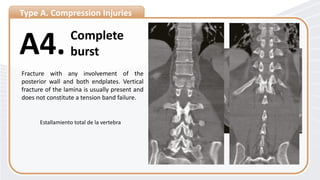
Type A. Compression Injuries
Complete
burst
A4.
Fracture with any involvement of the
posterior wall and both endplates. Vertical
fracture of the lamina is usually present and
does not constitute a tension band failure.
Estallamiento total de la vertebra
Type B. Distraction Injuries
Transosseous tension
band disruption
Chance fracture
B1.
Monosegmental pure osseous failure of the
posterior tension band. The classical Chance
fracture.
Acuñamiento del cuerpo vertebral por
rotura de los ligamentos posteriores por
bostezo
Type B. Distraction Injuries
Posterior tension
band disruption
B2.
Bony and/or ligamentary failure of the
posterior tension band together with a Type
A fracture. Type A fracture should be
classified separately.
A la distrrupcion posterior se le agrega
estallamiento parcial de la vertebra y PUEDE
haber compresión medular
Type B. Distraction Injuries
Hyperextension
B3.
Injury through the disk or vertebral body
leading to a hyperextended position of the
spinal column. Commonly seen in ankylotic
disorders. Anterior structures, especially the
ALL are ruptured but there is a posterior
hinge preventing further displacement.
Compromente tanto disco como cuerpo vertebral
Type C. Translation Injuries
Displacement or
dislocation
C.
There are no subtypes because various
configurations are possible due to
dissociation/dislocation. Can be combined
with subtypes of A or B.
Ocasionadas generalmente por un gran impacto
y genera un desplazamiento bastante marcado
de estructuras tanto antero-posterior como
laterales
Algorithm or morphologic classification
Neurologic injury
Neurologic status at the moment o admission should be scored according to the following scheme:
Type Description
N0 Neurologically intact
N1 Transient neurologic deficit, which is no longer present
N2 Radicular symptoms
N3 Incomplete spinal cord injury or any degree of cauda equine injury
N4 Complete spinal cord injury
NX Neurological status is unknown due to sedation or head injury
Modifiers
There are two modifiers, which can be used in addition to ad 1 and 2:
Type Description
M1
This modifier is used to designate fractures with and indeterminate injury to the
tension band based on spinal imaging with or without MRI. This modifier is
important for designating those injuries with stable injuries from a bony standpoint
for which ligamentous insufficiency may help determine whether operative
stabilization is a consideration.
M2
Is used to designate a patient-specific comorbidity, which might argue either for or
against surgery for patients with relative surgical indications. Examples of an M2
modifier include ankylosing spondylitis or burns affecting the skin overlying the
injured spine.

Victor-presentation.pdfffffffffffffffffffffffffffff

  • 1.
  • 2.
    •Compresión  A •Distracción– hiperflexion  B •Traslación 
  • 3.
    Type A. CompressionInjuries Minor, nonstructural fractures A0. Fractures, which do not compromise the structural integrity of the spinal column such as transverse process or spinous process fractures.
  • 4.
    Type A. CompressionInjuries Wedge-compression A1. Fracture of a single endplate without involvement of the posterior wall of the vertebral body. SOLO se rompe UN platillo (o superior o inferior) pero no hay compromiso del canal raquideo
  • 5.
    Type A. CompressionInjuries Split A2. Fracture of both endplates without involvement of the posterior wall of the vertebral body. Comprometen toda la vertebra, pero no hay problema con el canal vertebral
  • 6.
    Type A. CompressionInjuries Incomplete burst A3. Fracture with any involvement of the posterior wall; only a single endplate fractured. Vertical fracture of the lamina is usually present and does not constitute a tension band failure. Estallamiento incompleto de la vertebral que SI compromete canal raquideo y REQUIERE de Qx.
  • 7.
    Type A. CompressionInjuries Complete burst A4. Fracture with any involvement of the posterior wall and both endplates. Vertical fracture of the lamina is usually present and does not constitute a tension band failure. Estallamiento total de la vertebra
  • 8.
    Type B. DistractionInjuries Transosseous tension band disruption Chance fracture B1. Monosegmental pure osseous failure of the posterior tension band. The classical Chance fracture. Acuñamiento del cuerpo vertebral por rotura de los ligamentos posteriores por bostezo
  • 9.
    Type B. DistractionInjuries Posterior tension band disruption B2. Bony and/or ligamentary failure of the posterior tension band together with a Type A fracture. Type A fracture should be classified separately. A la distrrupcion posterior se le agrega estallamiento parcial de la vertebra y PUEDE haber compresión medular
  • 10.
    Type B. DistractionInjuries Hyperextension B3. Injury through the disk or vertebral body leading to a hyperextended position of the spinal column. Commonly seen in ankylotic disorders. Anterior structures, especially the ALL are ruptured but there is a posterior hinge preventing further displacement. Compromente tanto disco como cuerpo vertebral
  • 11.
    Type C. TranslationInjuries Displacement or dislocation C. There are no subtypes because various configurations are possible due to dissociation/dislocation. Can be combined with subtypes of A or B. Ocasionadas generalmente por un gran impacto y genera un desplazamiento bastante marcado de estructuras tanto antero-posterior como laterales
  • 12.
  • 13.
    Neurologic injury Neurologic statusat the moment o admission should be scored according to the following scheme: Type Description N0 Neurologically intact N1 Transient neurologic deficit, which is no longer present N2 Radicular symptoms N3 Incomplete spinal cord injury or any degree of cauda equine injury N4 Complete spinal cord injury NX Neurological status is unknown due to sedation or head injury
  • 14.
    Modifiers There are twomodifiers, which can be used in addition to ad 1 and 2: Type Description M1 This modifier is used to designate fractures with and indeterminate injury to the tension band based on spinal imaging with or without MRI. This modifier is important for designating those injuries with stable injuries from a bony standpoint for which ligamentous insufficiency may help determine whether operative stabilization is a consideration. M2 Is used to designate a patient-specific comorbidity, which might argue either for or against surgery for patients with relative surgical indications. Examples of an M2 modifier include ankylosing spondylitis or burns affecting the skin overlying the injured spine.