ANA PROFILE IN CVD/CTD
• ANA are a specific class of autoantibodies that
have the capability of binding and destroying
certain structures within the nucleus of the cells.
• Lower amounts of these antibodies can be seen
in the normal population.
• Spurt in titers is seen in patients of CTD.
• Not only are these antibodies involved in the
disease pathogenesis, but they also constitute
the basis for diagnosis and treatment of CTD.
• Their detection with high sensitivity and
specificity is therefore of utmost importance.
• Historical aspects of ANA:
• In 1941, Klemperer, Pollack and Baehr first described
systemic lupus erythematosus (SLE) as one of the CTD.
• Then in 1948 Malcom Hargrave, Helen Richmond and the
medical resident Robert Morton noted the presence of
previously unknown cells in the bone marrow of a patient
with SLE.
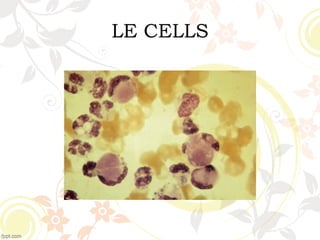
• They called these ‘LE cells’ - mature polymorphonuclear
leukocytes which ingested nuclear material from
degenerative white cells, in the presence of an antibody
to deoxyribonucleoprotein (the LE cell factor).
• LE cells, if present in large numbers, are highly
suggestive of SLE.
• Also demonstrated in other conditions like chronic DLE,
systemic sclerosis and rheumatoid arthritis.
LE CELLS
• ANA – the two broad subtypes
• Presently the ANA have been categorized in to 2 main
groups:
• Autoantibodies to DNA and histones:
• These include :
• A) antibodies against single and double-stranded DNA
(dsDNA).
• B) anti-histone antibodies.
• Autoantibodies to extractable nuclear antigens (ENA)
• Besides DNA and histones, autoantibodies may also
target other nuclear and cytoplasmic antigens.
• These nuclear antigens were named ENA as originally
they were extracted from the nuclei with saline.
• 1.Autoantibody to Smith antigen (Sm)
• 2. Ribonucleoproteins (RNP)
• 3. SSA/Ro
• 4. SSB/La
• 5. Scl-70
• 6. Jo-1
• 7. PM1
• Although most of these ENA are disease specific, still a
significant overlap exists.
• The sensitivity and specificity also varies depending upon
the type of underlying CTD.
• Sensitivity and specificity of ANA:
Autoantibodies Associated CTD Sensitivity specificity
ANA SLE 93 57
SJOGREN’S 48 52
SCLERODERMA 85 54
PM/DERMATOMY
OSITIS
61 63
RAYNAUD
PHENOMENA
64 41
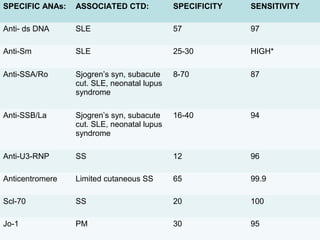
SPECIFIC ANAs: ASSOCIATED CTD: SPECIFICITY SENSITIVITY
Anti- ds DNA SLE 57 97
Anti-Sm SLE 25-30 HIGH*
Anti-SSA/Ro Sjogren’s syn, subacute
cut. SLE, neonatal lupus
syndrome
8-70 87
Anti-SSB/La Sjogren’s syn, subacute
cut. SLE, neonatal lupus
syndrome
16-40 94
Anti-U3-RNP SS 12 96
Anticentromere Limited cutaneous SS 65 99.9
Scl-70 SS 20 100
Jo-1 PM 30 95
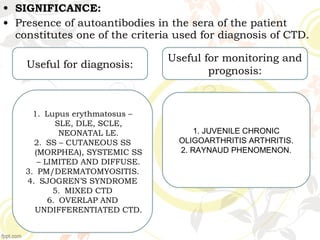
• SIGNIFICANCE:
• Presence of autoantibodies in the sera of the patient
constitutes one of the criteria used for diagnosis of CTD.
Useful for diagnosis:
Useful for monitoring and
prognosis:
1. Lupus erythmatosus –
SLE, DLE, SCLE,
NEONATAL LE.
2. SS – CUTANEOUS SS
(MORPHEA), SYSTEMIC SS
– LIMITED AND DIFFUSE.
3. PM/DERMATOMYOSITIS.
4. SJOGREN’S SYNDROME
5. MIXED CTD
6. OVERLAP AND
UNDIFFERENTIATED CTD.
1. JUVENILE CHRONIC
OLIGOARTHRITIS ARTHRITIS.
2. RAYNAUD PHENOMENON.
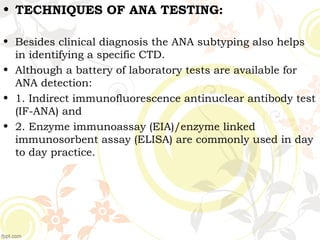
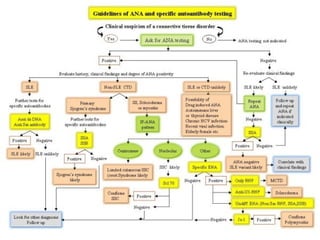
• TECHNIQUES OF ANA TESTING:
• Besides clinical diagnosis the ANA subtyping also helps
in identifying a specific CTD.
• Although a battery of laboratory tests are available for
ANA detection:
• 1. Indirect immunofluorescence antinuclear antibody test
(IF-ANA) and
• 2. Enzyme immunoassay (EIA)/enzyme linked
immunosorbent assay (ELISA) are commonly used in day
to day practice.
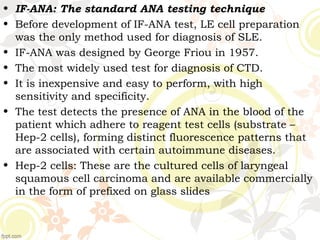
• IF-ANA: The standard ANA testing technique
• Before development of IF-ANA test, LE cell preparation
was the only method used for diagnosis of SLE.
• IF-ANA was designed by George Friou in 1957.
• The most widely used test for diagnosis of CTD.
• It is inexpensive and easy to perform, with high
sensitivity and specificity.
• The test detects the presence of ANA in the blood of the
patient which adhere to reagent test cells (substrate –
Hep-2 cells), forming distinct fluorescence patterns that
are associated with certain autoimmune diseases.
• Hep-2 cells: These are the cultured cells of laryngeal
squamous cell carcinoma and are available commercially
in the form of prefixed on glass slides
• The correct interpretation of the IF-ANA results is
important and must always be correlated with the
patient's symptoms and signs.
• While reporting IF-ANA three parameters are evaluated.
These include the:
• 1. Pattern of fluorescence
• 2. Substrate used and
• 3. The titer of a positive test.
• A negative IF-ANA result essentially excludes possibility
of active CTD.
• Fluorescence patterns and intensity:
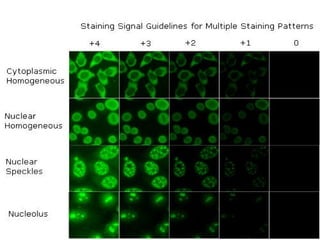
• Different staining patterns are reported which give clues
as to the significance of the ANA and type of CTD.
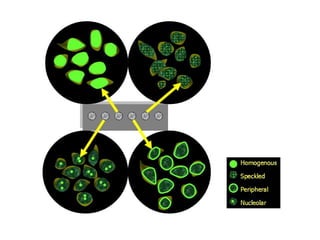
• 1. Nuclear patterns: homogeneous, speckled (fine
and coarse), peripheral/rim, nucleolar, centromeric,
PCNA (proliferating cell nuclear antigen), nuclear
dots, nuclear membrane, diffuse grainy.
• 2. Cytoplasmic patterns: speckled, mitochondrial-like,
ribosomal-like, Golgi apparatus, lysosomal-like,
cytoskeletal filaments (actin, vimentin, cytokeratin)
• 3. Mitotic patterns: mitotic spindle, centrosomes, NuMA
(nuclear mitotic apparatus), midbody, CENP-F
(centromere protein)
• Among these homogenous, speckled, peripheral and
nucleolar patterns are more commonly observed and
of clinical importance.
• With any of these fluorescence patterns intensity of
staining with a qualitative scale of values from + to ++++
should also be reported as fluorescence intensity is
generally proportional to antibody concentration and
predicts the severity of the CTD.
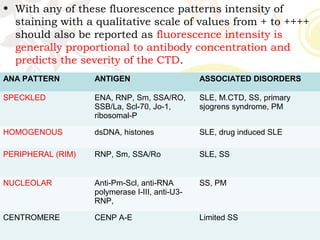
ANA PATTERN ANTIGEN ASSOCIATED DISORDERS
SPECKLED ENA, RNP, Sm, SSA/RO,
SSB/La, Scl-70, Jo-1,
ribosomal-P
SLE, M.CTD, SS, primary
sjogrens syndrome, PM
HOMOGENOUS dsDNA, histones SLE, drug induced SLE
PERIPHERAL (RIM) RNP, Sm, SSA/Ro SLE, SS
NUCLEOLAR Anti-Pm-Scl, anti-RNA
polymerase I-III, anti-U3-
RNP,
SS, PM
CENTROMERE CENP A-E Limited SS
• ANA substrate:
• Sera of some patients with SLE may be negative on
animal substrates i.e. mouse kidney or rat liver but are
positive on human substrate i.e. Hep-2 cell lines.
• Due to variable sensitivity with the substrate used it is
essential to report the type of substrate being used by
the lab.
• ANA titer:
• It is directly proportional to antibody concentration.
• Its evaluation is crucial as low titer is less significant
than a high titer and may be seen even in healthy
individuals.
• A titer of 1:160 is taken as significant for the diagnosis of
CTDs in majority of laboratories.
• Although IF-ANA test is widely used and considered to be
gold standard still the results may sometimes be
misinterpreted as it detects several different antibodies
cross-reactions can occur.
• In up to 3% of the normal population it can give false
positive result.
• Also ANA levels tend to rise when symptoms flare and
fall, often being undetectable, when symptoms are mild
or patient is in remission.
• Moreover each CTD has specific antibody associated with
it and sometimes it is difficult to specify or categorize an
autoantibody.
• Certain patterns i.e. nucleolar and centromeric are less
well defined by IF-ANA tests.
• The test therefore is mainly used for screening rather
than to diagnose a CTD.
• EIA/ELISA:
• 2 types of methods currently used for ANA testing:
• 1. Generic assay - detects ANA of broad specificity
similar to IF-ANA and
• 2. Antigen specific assay - detects ANA and reacts with
a single autoantigen i.e. dsDNA, SS-A/Ro, SS-B/La, Scl-
70, Sm, Sm/RNP etc.
• In antigen specific assay multiple antigens are coated on
to microtitre plates, usually a combination of SSA/Ro,
SSB/La, Sm, and U1-RNP, with many also including Jo-1
and Scl70.
• This new test is both highly specific and sensitive and
substantially decreases the time involved when screening
large numbers of patient samples.
• Its therefore becoming the most widely used method not
only for routine screening but also for detection of
specific ANA.
Lupus Erythematosus
• Gilliam classification:
• 1. Acute cut. LE (ACLE/SLE)
• 2. Subacute cut. LE (SCLE)
• 3. Chronic cut. LE (CCLE/DLE)
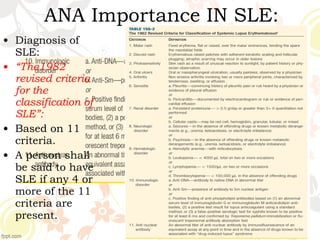
• Diagnosis of
SLE:
• “The1982
revised criteria
for the
classification of
SLE”:
• Based on 11
criteria.
• A person shall
be said to have
SLE if any 4 or
more of the 11
criteria are
present.
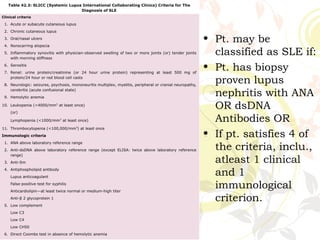
ANA Importance IN SLE:
• Pt. may be
classified as SLE if:
• Pt. has biopsy
proven lupus
nephritis with ANA
OR dsDNA
Antibodies OR
• If pt. satisfies 4 of
the criteria, inclu.,
atleast 1 clinical
and 1
immunological
criterion.
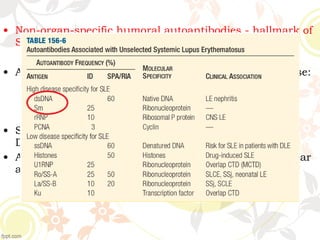
• Non-organ-specific humoral autoantibodies - hallmark of
SLE.
• A range of autoantibodies may be present in the disease:
ANA +++, ds DNA +++, Sm++, Ribosomal P ++
Ro, La ++, Cardiolipin +++ Rh Factor ++
• Some are more disease-specific - anti-double-stranded
DNA and anti-Sm antibodies,
• And some are much more commonly found - antinuclear
and anti-Ro antibodies.
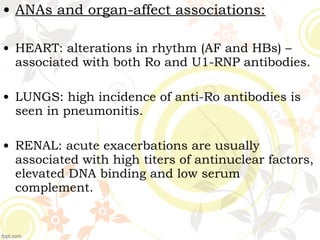
• ANAs and organ-affect associations:
• HEART: alterations in rhythm (AF and HBs) –
associated with both Ro and U1-RNP antibodies.
• LUNGS: high incidence of anti-Ro antibodies is
seen in pneumonitis.
• RENAL: acute exacerbations are usually
associated with high titers of antinuclear factors,
elevated DNA binding and low serum
complement.
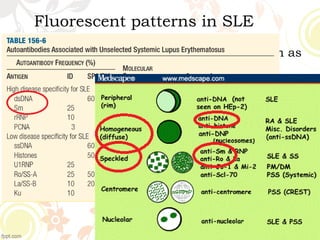
Fluorescent patterns in SLE
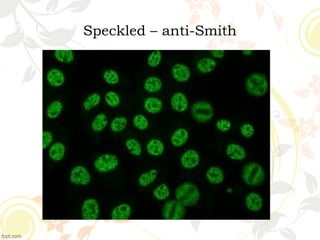
• Homogenous is more than twice as common as
speckled factor.
• Antinucleolar – seen occasionally.
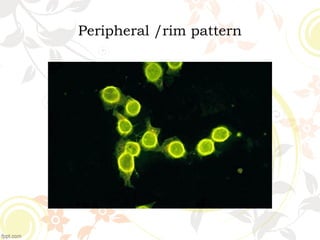
• Peripheral factor – present in high titre in more
than 50% in the active phase of the disease.
Subtype – shrunken peripheral pattern –
associated with a poor prognosis and high
incidence of renal ds. Appears 10-15 days before
an exacerbation of the ds. And is associated with
a fall in serum complement.
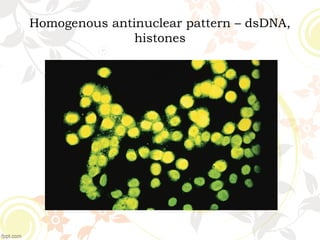
Homogenous antinuclear pattern – dsDNA,
histones
Speckled – anti-Smith
Peripheral /rim pattern
• Neonatal LE:
• Most commonly associated marker – Ro/SS-A antibody –
present in 82% of infants and 92% of mothers and 100%
of NLE patients.
• La/SS-B are less frequently found – 50% of NLE infants
and 60% of mothers. These are usually found in
association with Ro/SS-A antibodies.
• Neonatal & Childhood SLE - Anti Ro implicated in –rash, heart
blocks .
• Monitor carefully in child bearing women – Cause Neonatal LE
• Drug- induced SLE:
• Anti-histone antibodies – frequent.
• Anti-DNA antibodies – absent
• Serum complement – normal.
• Diffuse/ homogenous pattern of fluorescene.
SCLE:
• Was called ‘ANA –ve Lupus’.
• Usage of human cell lines as substrates has
negated this nomenclature.
• ANA +ve – found in 70% of patients.
• Anti Ro/ SS-A Ab 80%
• Anti La – smaller percentage.
DLE/CCLE
• ANAs - found in 5 - 60% of cases.
• ‘Homogeneous’ type of antinuclear factor being
twice as frequent as the ‘speckled’ type.
• ANA - more common in older patients, in those
who have had the disease for a long time and
when there is extensive skin involvement.
• They are also more common in patients with
chilblains, Raynaud’s phenomenon and joint
pains.
• Anti- ss DNA : 20%, Indicates widespread,
progressive disease. Fall with chloroquine Rx.
• Anti- ds DNA : –ve in DLE.
• If +ve – Indicate active systemic disease
(transition into SLE)
• Anti Ro/ SS-A Ab - sometimes detected
Ana profile in cvd

Ana profile in cvd

  • 1.
  • 2.
    • ANA area specific class of autoantibodies that have the capability of binding and destroying certain structures within the nucleus of the cells. • Lower amounts of these antibodies can be seen in the normal population. • Spurt in titers is seen in patients of CTD. • Not only are these antibodies involved in the disease pathogenesis, but they also constitute the basis for diagnosis and treatment of CTD. • Their detection with high sensitivity and specificity is therefore of utmost importance.
  • 3.
    • Historical aspectsof ANA: • In 1941, Klemperer, Pollack and Baehr first described systemic lupus erythematosus (SLE) as one of the CTD. • Then in 1948 Malcom Hargrave, Helen Richmond and the medical resident Robert Morton noted the presence of previously unknown cells in the bone marrow of a patient with SLE. • They called these ‘LE cells’ - mature polymorphonuclear leukocytes which ingested nuclear material from degenerative white cells, in the presence of an antibody to deoxyribonucleoprotein (the LE cell factor). • LE cells, if present in large numbers, are highly suggestive of SLE. • Also demonstrated in other conditions like chronic DLE, systemic sclerosis and rheumatoid arthritis.
  • 4.
  • 5.
    • ANA –the two broad subtypes • Presently the ANA have been categorized in to 2 main groups: • Autoantibodies to DNA and histones: • These include : • A) antibodies against single and double-stranded DNA (dsDNA). • B) anti-histone antibodies.
  • 6.
    • Autoantibodies toextractable nuclear antigens (ENA) • Besides DNA and histones, autoantibodies may also target other nuclear and cytoplasmic antigens. • These nuclear antigens were named ENA as originally they were extracted from the nuclei with saline. • 1.Autoantibody to Smith antigen (Sm) • 2. Ribonucleoproteins (RNP) • 3. SSA/Ro • 4. SSB/La • 5. Scl-70 • 6. Jo-1 • 7. PM1 • Although most of these ENA are disease specific, still a significant overlap exists. • The sensitivity and specificity also varies depending upon the type of underlying CTD.
  • 7.
    • Sensitivity andspecificity of ANA: Autoantibodies Associated CTD Sensitivity specificity ANA SLE 93 57 SJOGREN’S 48 52 SCLERODERMA 85 54 PM/DERMATOMY OSITIS 61 63 RAYNAUD PHENOMENA 64 41
  • 8.
    SPECIFIC ANAs: ASSOCIATEDCTD: SPECIFICITY SENSITIVITY Anti- ds DNA SLE 57 97 Anti-Sm SLE 25-30 HIGH* Anti-SSA/Ro Sjogren’s syn, subacute cut. SLE, neonatal lupus syndrome 8-70 87 Anti-SSB/La Sjogren’s syn, subacute cut. SLE, neonatal lupus syndrome 16-40 94 Anti-U3-RNP SS 12 96 Anticentromere Limited cutaneous SS 65 99.9 Scl-70 SS 20 100 Jo-1 PM 30 95
  • 9.
    • SIGNIFICANCE: • Presenceof autoantibodies in the sera of the patient constitutes one of the criteria used for diagnosis of CTD. Useful for diagnosis: Useful for monitoring and prognosis: 1. Lupus erythmatosus – SLE, DLE, SCLE, NEONATAL LE. 2. SS – CUTANEOUS SS (MORPHEA), SYSTEMIC SS – LIMITED AND DIFFUSE. 3. PM/DERMATOMYOSITIS. 4. SJOGREN’S SYNDROME 5. MIXED CTD 6. OVERLAP AND UNDIFFERENTIATED CTD. 1. JUVENILE CHRONIC OLIGOARTHRITIS ARTHRITIS. 2. RAYNAUD PHENOMENON.
  • 10.
    • TECHNIQUES OFANA TESTING: • Besides clinical diagnosis the ANA subtyping also helps in identifying a specific CTD. • Although a battery of laboratory tests are available for ANA detection: • 1. Indirect immunofluorescence antinuclear antibody test (IF-ANA) and • 2. Enzyme immunoassay (EIA)/enzyme linked immunosorbent assay (ELISA) are commonly used in day to day practice.
  • 11.
    • IF-ANA: Thestandard ANA testing technique • Before development of IF-ANA test, LE cell preparation was the only method used for diagnosis of SLE. • IF-ANA was designed by George Friou in 1957. • The most widely used test for diagnosis of CTD. • It is inexpensive and easy to perform, with high sensitivity and specificity. • The test detects the presence of ANA in the blood of the patient which adhere to reagent test cells (substrate – Hep-2 cells), forming distinct fluorescence patterns that are associated with certain autoimmune diseases. • Hep-2 cells: These are the cultured cells of laryngeal squamous cell carcinoma and are available commercially in the form of prefixed on glass slides
  • 12.
    • The correctinterpretation of the IF-ANA results is important and must always be correlated with the patient's symptoms and signs. • While reporting IF-ANA three parameters are evaluated. These include the: • 1. Pattern of fluorescence • 2. Substrate used and • 3. The titer of a positive test. • A negative IF-ANA result essentially excludes possibility of active CTD.
  • 13.
    • Fluorescence patternsand intensity: • Different staining patterns are reported which give clues as to the significance of the ANA and type of CTD. • 1. Nuclear patterns: homogeneous, speckled (fine and coarse), peripheral/rim, nucleolar, centromeric, PCNA (proliferating cell nuclear antigen), nuclear dots, nuclear membrane, diffuse grainy. • 2. Cytoplasmic patterns: speckled, mitochondrial-like, ribosomal-like, Golgi apparatus, lysosomal-like, cytoskeletal filaments (actin, vimentin, cytokeratin) • 3. Mitotic patterns: mitotic spindle, centrosomes, NuMA (nuclear mitotic apparatus), midbody, CENP-F (centromere protein) • Among these homogenous, speckled, peripheral and nucleolar patterns are more commonly observed and of clinical importance.
  • 14.
    • With anyof these fluorescence patterns intensity of staining with a qualitative scale of values from + to ++++ should also be reported as fluorescence intensity is generally proportional to antibody concentration and predicts the severity of the CTD. ANA PATTERN ANTIGEN ASSOCIATED DISORDERS SPECKLED ENA, RNP, Sm, SSA/RO, SSB/La, Scl-70, Jo-1, ribosomal-P SLE, M.CTD, SS, primary sjogrens syndrome, PM HOMOGENOUS dsDNA, histones SLE, drug induced SLE PERIPHERAL (RIM) RNP, Sm, SSA/Ro SLE, SS NUCLEOLAR Anti-Pm-Scl, anti-RNA polymerase I-III, anti-U3- RNP, SS, PM CENTROMERE CENP A-E Limited SS
  • 17.
    • ANA substrate: •Sera of some patients with SLE may be negative on animal substrates i.e. mouse kidney or rat liver but are positive on human substrate i.e. Hep-2 cell lines. • Due to variable sensitivity with the substrate used it is essential to report the type of substrate being used by the lab. • ANA titer: • It is directly proportional to antibody concentration. • Its evaluation is crucial as low titer is less significant than a high titer and may be seen even in healthy individuals. • A titer of 1:160 is taken as significant for the diagnosis of CTDs in majority of laboratories.
  • 18.
    • Although IF-ANAtest is widely used and considered to be gold standard still the results may sometimes be misinterpreted as it detects several different antibodies cross-reactions can occur. • In up to 3% of the normal population it can give false positive result. • Also ANA levels tend to rise when symptoms flare and fall, often being undetectable, when symptoms are mild or patient is in remission. • Moreover each CTD has specific antibody associated with it and sometimes it is difficult to specify or categorize an autoantibody. • Certain patterns i.e. nucleolar and centromeric are less well defined by IF-ANA tests. • The test therefore is mainly used for screening rather than to diagnose a CTD.
  • 19.
    • EIA/ELISA: • 2types of methods currently used for ANA testing: • 1. Generic assay - detects ANA of broad specificity similar to IF-ANA and • 2. Antigen specific assay - detects ANA and reacts with a single autoantigen i.e. dsDNA, SS-A/Ro, SS-B/La, Scl- 70, Sm, Sm/RNP etc. • In antigen specific assay multiple antigens are coated on to microtitre plates, usually a combination of SSA/Ro, SSB/La, Sm, and U1-RNP, with many also including Jo-1 and Scl70. • This new test is both highly specific and sensitive and substantially decreases the time involved when screening large numbers of patient samples. • Its therefore becoming the most widely used method not only for routine screening but also for detection of specific ANA.
  • 21.
    Lupus Erythematosus • Gilliamclassification: • 1. Acute cut. LE (ACLE/SLE) • 2. Subacute cut. LE (SCLE) • 3. Chronic cut. LE (CCLE/DLE)
  • 22.
    • Diagnosis of SLE: •“The1982 revised criteria for the classification of SLE”: • Based on 11 criteria. • A person shall be said to have SLE if any 4 or more of the 11 criteria are present. ANA Importance IN SLE:
  • 23.
    • Pt. maybe classified as SLE if: • Pt. has biopsy proven lupus nephritis with ANA OR dsDNA Antibodies OR • If pt. satisfies 4 of the criteria, inclu., atleast 1 clinical and 1 immunological criterion.
  • 24.
    • Non-organ-specific humoralautoantibodies - hallmark of SLE. • A range of autoantibodies may be present in the disease: ANA +++, ds DNA +++, Sm++, Ribosomal P ++ Ro, La ++, Cardiolipin +++ Rh Factor ++ • Some are more disease-specific - anti-double-stranded DNA and anti-Sm antibodies, • And some are much more commonly found - antinuclear and anti-Ro antibodies.
  • 25.
    • ANAs andorgan-affect associations: • HEART: alterations in rhythm (AF and HBs) – associated with both Ro and U1-RNP antibodies. • LUNGS: high incidence of anti-Ro antibodies is seen in pneumonitis. • RENAL: acute exacerbations are usually associated with high titers of antinuclear factors, elevated DNA binding and low serum complement.
  • 26.
    Fluorescent patterns inSLE • Homogenous is more than twice as common as speckled factor. • Antinucleolar – seen occasionally. • Peripheral factor – present in high titre in more than 50% in the active phase of the disease. Subtype – shrunken peripheral pattern – associated with a poor prognosis and high incidence of renal ds. Appears 10-15 days before an exacerbation of the ds. And is associated with a fall in serum complement.
  • 27.
    Homogenous antinuclear pattern– dsDNA, histones
  • 28.
  • 29.
  • 30.
    • Neonatal LE: •Most commonly associated marker – Ro/SS-A antibody – present in 82% of infants and 92% of mothers and 100% of NLE patients. • La/SS-B are less frequently found – 50% of NLE infants and 60% of mothers. These are usually found in association with Ro/SS-A antibodies. • Neonatal & Childhood SLE - Anti Ro implicated in –rash, heart blocks . • Monitor carefully in child bearing women – Cause Neonatal LE
  • 31.
    • Drug- inducedSLE: • Anti-histone antibodies – frequent. • Anti-DNA antibodies – absent • Serum complement – normal. • Diffuse/ homogenous pattern of fluorescene.
  • 32.
    SCLE: • Was called‘ANA –ve Lupus’. • Usage of human cell lines as substrates has negated this nomenclature. • ANA +ve – found in 70% of patients. • Anti Ro/ SS-A Ab 80% • Anti La – smaller percentage.
  • 33.
    DLE/CCLE • ANAs -found in 5 - 60% of cases. • ‘Homogeneous’ type of antinuclear factor being twice as frequent as the ‘speckled’ type. • ANA - more common in older patients, in those who have had the disease for a long time and when there is extensive skin involvement. • They are also more common in patients with chilblains, Raynaud’s phenomenon and joint pains. • Anti- ss DNA : 20%, Indicates widespread, progressive disease. Fall with chloroquine Rx.
  • 34.
    • Anti- dsDNA : –ve in DLE. • If +ve – Indicate active systemic disease (transition into SLE) • Anti Ro/ SS-A Ab - sometimes detected

Editor's Notes

  • #27 Peripheral --- ? Antibody Rooks, harrison - dsDNA Journal – RNP, Sm, Ro SLE : homogenous > speckled.
  • #31 Risk of NLE in a Ro positive mother without CTD or a previus h/o NLE is probably low – 2%. Risk may not be higher for symptomatic Ro +ve mothers. But for women who have already had a baby with NLE, estimated risk of having another affected child is around 25%.
  • #35 The SjT type of antibody (anti-La [SS-B]) is associated with ‘speckled’ antinuclear factor and rheumatoid factor in those patients with DLE and erythema multiforme