Agent Technology 
• Expert System (ES) vs Agent 
• Definition 
• Types of Agents
Expert Systems 
• Rule Based 
• Case Based 
• Knowledge system separate from 
inference engine 
• Pros 
· De-coupling of the system knowledge from the 
inference mechanism supports easier 
maintenance and management of both 
· System architecture can be readily re-used for 
different applications by, for instance, using 
different FACTS and RULES 
· Financial/Engineering/IS
Expert Systems 
• Cons/Limitations 
– Information Brittleness: If the environmental input is outside of the expert 
system's fact and/or rule-base scope it does nothing (quits) 
• Set of Rules: User wants something outside of fixed scope 
• Exception handling: Out of Scope 
– Isolation: An expert system is stand-alone i.e., does not enter into 
"collaboration with other expert systems” 
• Inefficient: Interrelated but no communication across ES systems 
• Not enterprise level 
– Example: ES 1 Finance/ES 2 Accounting 
– Static Behavior: The Level of Behavior (LOB) of the expert system is static, 
i.e., it does not improve over time or use 
– Incapable of Learning 
• Should be able to learn from mistakes & improve
How to overcome the ES limitations 
• How to overcome brittleness: 
– Support graceful degradation of performance by initiating 
and maintaining dialog with the environment (users) 
• Instead of just stopping, try to increase scope gradually 
by including user into system 
– Expand fact and rule bases automatically through learning 
mechanisms 
• Introduce new variable, ok first time, next time will 
recognize 
• How to overcome isolation: 
– Add mechanisms for coordination and collaboration 
• ES 1 Finance/ES 2 Accounting 
– Permit communication with each other at enterprise level
How to overcome the ES limitations 
• Static: 
– provide learning mechanisms
Agent 
· The augmentation of expert system 
capabilities to overcome limitations leads, 
in an evolutionary fashion, to the creation of 
intelligent agents 
· Sharing knowledge 
· Increase scope
What is an Agent 
• A computer system that 
– has goals, perceptors, and effectors 
– decides autonomously which action to take 
in a given situation
What is an Agent 
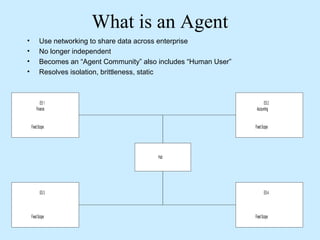
• Use networking to share data across enterprise 
• No longer independent 
• Becomes an “Agent Community” also includes “Human User” 
• Resolves isolation, brittleness, static 
ES 1 
Finance 
Fixed Scope 
ES 3 
Fixed Scope 
ES 2 
Accounting 
Fixed Scope 
ES 4 
Fixed Scope 
Hub
OOP Similarity 
The Class is the Intelligent Object 
Class Def Class Def - Public/Private - Public/Private 
Class Def 
• OOP Class uses Method invocation 
• Agent happens dynamically 
• OOP 
– (Method invoked) + (Rich Symantec/syntax) = Agent 
– OOP (not intelligent) + ES (intelligent) = Agent 
– Object just performs function 
– 1) Agent can calculate or can reject (can think/then perform) 
– 2) Communication ability 
Methodology - Action 
Intelligent 
Methodology - Action 
Not intelligent 
Methodology 
The OOP resides on top of the ES and creates an AI Agent
Definition of an Agent 
• Autonomy = Intelligent 
– Can reason/can think/learns from previous experience and 
can apply to new experience 
– an agent operates without the direct intervention of humans 
or others and has control over its own actions 
– an agent is able to exhibit goal-directed behavior by taking 
initiatives 
– Knows what problem to solve (goal directed behavior) 
• Social ability 
– an agent interacts with other agents via Agent 
Communication Language (ACL) 
• Symantec/Syntax of Language 
• Adaptive 
– an agent learns to improve its behavior
Agents vs ES 
• Personalized 
– agents -> different actions 
– ES -> same actions 
• active, autonomous 
– agents - on their own 
– ES - passively answer 
• adaptive 
– agent - learn and change 
– ES - remain static
How is Agent different from other 
Software 
• Personalized, customized 
• Proactive, takes initiatives 
• Autonomous 
• Adaptive
Types of Agents 
Agents 
Architecture Functionality Mobility 
Deliberative Reactive Interface Information/ Mobile Stationary 
Agent Agent Agent Internet Agent Agent 
Agent
Deliberate vs Reactive 
• A deliberative agent has an internal 
representation of the sequence of actions 
necessary to achieve a goal given or an event 
triggered (a Pre-plan/Priori plan). 
• Reactive agents do not store a priori plan of 
the actions. No internal representation of pre-plan 
exists within any of the reactive agents 
and, hence, the plans has to emerge upon an 
event through collaboration.
Interface vs Information 
• Interface agents migrate from the direct 
command metaphor to one that delegates 
some of the tasks to the agents in order to 
accommodate novice users. 
• Information (Internet) agents are designed to 
deal with the problem of information overload 
and the general issues of information 
management in Internet.
Mobile vs Stationary 
• Mobile agents are able to roam the 
network such as WWW, interacting with 
foreign hosts, and performing the 
various duties assigned at a remote site 
• Stationary agents stay at the client or at 
the server.
Why Mobile Agent? 
• Reduces network traffic 
• Shares load among machines 
• Go to the data if the data can’t come to 
you 
• User may have only infrequent 
connection to network

Artificial Intelligence: Agent Technology

  • 1.
    Agent Technology •Expert System (ES) vs Agent • Definition • Types of Agents
  • 2.
    Expert Systems •Rule Based • Case Based • Knowledge system separate from inference engine • Pros · De-coupling of the system knowledge from the inference mechanism supports easier maintenance and management of both · System architecture can be readily re-used for different applications by, for instance, using different FACTS and RULES · Financial/Engineering/IS
  • 3.
    Expert Systems •Cons/Limitations – Information Brittleness: If the environmental input is outside of the expert system's fact and/or rule-base scope it does nothing (quits) • Set of Rules: User wants something outside of fixed scope • Exception handling: Out of Scope – Isolation: An expert system is stand-alone i.e., does not enter into "collaboration with other expert systems” • Inefficient: Interrelated but no communication across ES systems • Not enterprise level – Example: ES 1 Finance/ES 2 Accounting – Static Behavior: The Level of Behavior (LOB) of the expert system is static, i.e., it does not improve over time or use – Incapable of Learning • Should be able to learn from mistakes & improve
  • 4.
    How to overcomethe ES limitations • How to overcome brittleness: – Support graceful degradation of performance by initiating and maintaining dialog with the environment (users) • Instead of just stopping, try to increase scope gradually by including user into system – Expand fact and rule bases automatically through learning mechanisms • Introduce new variable, ok first time, next time will recognize • How to overcome isolation: – Add mechanisms for coordination and collaboration • ES 1 Finance/ES 2 Accounting – Permit communication with each other at enterprise level
  • 5.
    How to overcomethe ES limitations • Static: – provide learning mechanisms
  • 6.
    Agent · Theaugmentation of expert system capabilities to overcome limitations leads, in an evolutionary fashion, to the creation of intelligent agents · Sharing knowledge · Increase scope
  • 7.
    What is anAgent • A computer system that – has goals, perceptors, and effectors – decides autonomously which action to take in a given situation
  • 8.
    What is anAgent • Use networking to share data across enterprise • No longer independent • Becomes an “Agent Community” also includes “Human User” • Resolves isolation, brittleness, static ES 1 Finance Fixed Scope ES 3 Fixed Scope ES 2 Accounting Fixed Scope ES 4 Fixed Scope Hub
  • 9.
    OOP Similarity TheClass is the Intelligent Object Class Def Class Def - Public/Private - Public/Private Class Def • OOP Class uses Method invocation • Agent happens dynamically • OOP – (Method invoked) + (Rich Symantec/syntax) = Agent – OOP (not intelligent) + ES (intelligent) = Agent – Object just performs function – 1) Agent can calculate or can reject (can think/then perform) – 2) Communication ability Methodology - Action Intelligent Methodology - Action Not intelligent Methodology The OOP resides on top of the ES and creates an AI Agent
  • 10.
    Definition of anAgent • Autonomy = Intelligent – Can reason/can think/learns from previous experience and can apply to new experience – an agent operates without the direct intervention of humans or others and has control over its own actions – an agent is able to exhibit goal-directed behavior by taking initiatives – Knows what problem to solve (goal directed behavior) • Social ability – an agent interacts with other agents via Agent Communication Language (ACL) • Symantec/Syntax of Language • Adaptive – an agent learns to improve its behavior
  • 11.
    Agents vs ES • Personalized – agents -> different actions – ES -> same actions • active, autonomous – agents - on their own – ES - passively answer • adaptive – agent - learn and change – ES - remain static
  • 12.
    How is Agentdifferent from other Software • Personalized, customized • Proactive, takes initiatives • Autonomous • Adaptive
  • 13.
    Types of Agents Agents Architecture Functionality Mobility Deliberative Reactive Interface Information/ Mobile Stationary Agent Agent Agent Internet Agent Agent Agent
  • 14.
    Deliberate vs Reactive • A deliberative agent has an internal representation of the sequence of actions necessary to achieve a goal given or an event triggered (a Pre-plan/Priori plan). • Reactive agents do not store a priori plan of the actions. No internal representation of pre-plan exists within any of the reactive agents and, hence, the plans has to emerge upon an event through collaboration.
  • 15.
    Interface vs Information • Interface agents migrate from the direct command metaphor to one that delegates some of the tasks to the agents in order to accommodate novice users. • Information (Internet) agents are designed to deal with the problem of information overload and the general issues of information management in Internet.
  • 16.
    Mobile vs Stationary • Mobile agents are able to roam the network such as WWW, interacting with foreign hosts, and performing the various duties assigned at a remote site • Stationary agents stay at the client or at the server.
  • 17.
    Why Mobile Agent? • Reduces network traffic • Shares load among machines • Go to the data if the data can’t come to you • User may have only infrequent connection to network