1
2
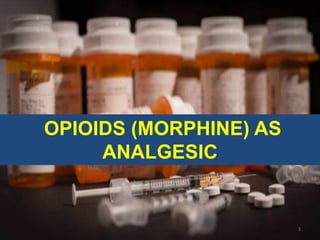
OPIOIDS (MORPHINE) AS
ANALGESIC
3
CONTENTS
 Introduction
 History
 Classification
 Structure
 Mechanism of actions
 Root of administration
 Morphine Effects (Acute Chronic)
 Clinical Uses
 Side Effects
 References
4
5
INTRODUCTION
INTRODUCTION
• ANALGESICS: Analgesics are a class of
medications designed specifically to relieve pain.
• OPIOID ANALGESICS: are known as
narcotics analgesic, that acts on CNS, usually used
for the treatment of acute and chronic pain for
thousands of years.
• OPIUM: A dark brown resin material from
unripe seed of poppies.
6
HISTORY
7
HISTORY
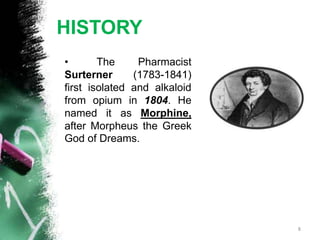
• The Pharmacist
Surterner (1783-1841)
first isolated and alkaloid
from opium in 1804. He
named it as Morphine,
after Morpheus the Greek
God of Dreams.
8
MORPHINE
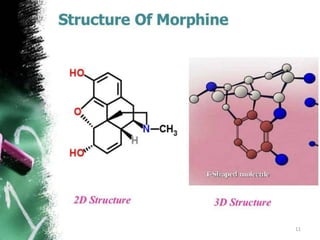
• Morphine is the principal alkaloid in
opium and still widely used.
• Biological source: It is obtained from
juice or latex from unripe seed of the
Papaver somniferum.
• Family: Papavaraceae
9
STRUCTURE
STRUCTURE
10
11
CLASSIFICATION
CLASSIFICATION
12
CLASSIFICATION
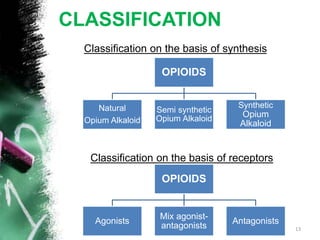
Classification on the basis of synthesis
OPIOIDS
OPIOIDS
Natural
Opium Alkaloid
Semi synthetic
Opium Alkaloid
Synthetic
Opium
Alkaloid
Classification on the basis of receptors
OPIOIDS
Agonists
Mix agonist-
antagonists
Antagonists
13
MECHANISM OF ACTIONS
MECHANISM OF A CTION
14
MECHANISM OF ACTIONS
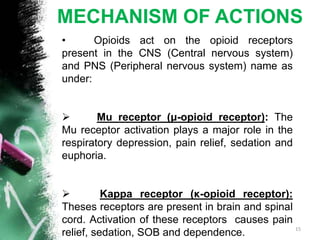
• Opioids act on the opioid receptors
present in the CNS (Central nervous system)
and PNS (Peripheral nervous system) name as
under:
 Mu receptor (μ-opioid receptor): The
Mu receptor activation plays a major role in the
respiratory depression, pain relief, sedation and
euphoria.
 Kappa receptor (κ-opioid receptor):
Theses receptors are present in brain and spinal
cord. Activation of these receptors causes pain
relief, sedation, SOB and dependence. 15
MECHANISM OF ACTIONS
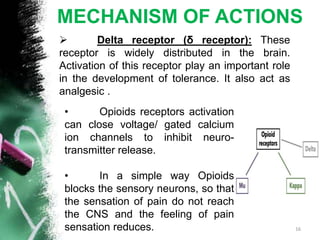
 Delta receptor (δ receptor): These
receptor is widely distributed in the brain.
Activation of this receptor play an important role
in the development of tolerance. It also act as
analgesic .
• Opioids receptors activation
can close voltage/ gated calcium
ion channels to inhibit neuro-
transmitter release.
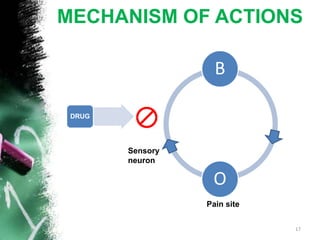
• In a simple way Opioids
blocks the sensory neurons, so that
the sensation of pain do not reach
the CNS and the feeling of pain
sensation reduces. 16
MECHANISM OF ACTIONS
B
O
DRUG
Pain site
Sensory
neuron
17
ROUTE OF ADMINISTRATION
18
ROUTE OF ADMINISTRATION
• Oral
• Inhalation
• Injectable (Intravenously
and Intramuscular)
• Transdermal
• Injection into the
space around the spinal
cord
19
MORPHINE EFFECTS
MORPHINE EFFECTS
20
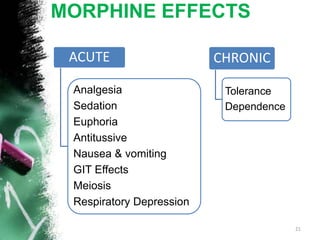
MORPHINE EFFECTS
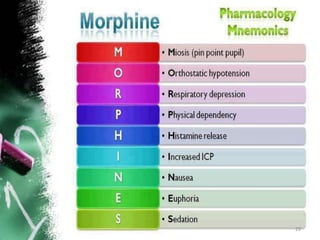
ACUTE
Analgesia
Sedation
Euphoria
Antitussive
Nausea & vomiting
GIT Effects
Meiosis
Respiratory Depression
CHRONIC
Tolerance
Dependence
21
CLINICAL USES
22
CLINICAL USES
 Analgesic (For Severe & Sharp pain)
 Pre-operative sedation and to facilitate the
induction of anesthesia
 For long term treatment of terminally ill,
pain ridden patients
 Management of acute pulmonary edema
 For treatment of anxiety & insomnia
 Morphine sulfate is used for treatment of
cancer
23
SIDE EFFECTS
24
SIDE EFFECTS
• Drowsiness
• Stomach pain and cramps
• Dry mouth
• Headache
• Nervousness
• Mood changes
• Small pupils
• Difficulty urinating or pain when urinating
• Blue or purple color to the skin
• Changes in heartbeat
• Agitation, hallucinations (seeing things or
hearing voices that do not exist), fever, sweating,
confusion, fast heartbeat, shivering, severe muscle
stiffness or twitching, loss of coordination, nausea,
vomiting, or diarrhea 25
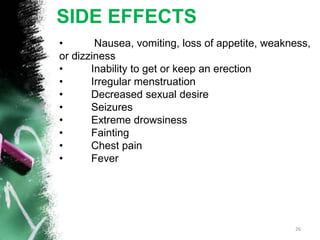
SIDE EFFECTS
• Nausea, vomiting, loss of appetite, weakness,
or dizziness
• Inability to get or keep an erection
• Irregular menstruation
• Decreased sexual desire
• Seizures
• Extreme drowsiness
• Fainting
• Chest pain
• Fever
26
WITHDRAWAL EFFECTS
27
WITHDRAWAL EFFECTS
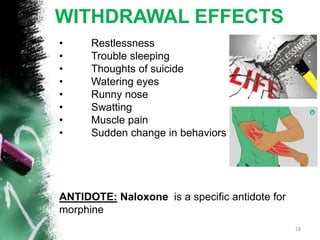
• Restlessness
• Trouble sleeping
• Thoughts of suicide
• Watering eyes
• Runny nose
• Swatting
• Muscle pain
• Sudden change in behaviors
ANTIDOTE: Naloxone is a specific antidote for
morphine
28
29
REFERENCES
30
REFERENCES
• Pharmacology by Katzung & Trevor’s 11th
Edition
• Comprehensive Pharmacy Review for
NAPLEX by Leon Shargel & Larry N. Swanson
• Google scholer
31
32

MORPHINE.pptx

  • 1.
  • 2.
  • 3.
  • 4.
    CONTENTS  Introduction  History Classification  Structure  Mechanism of actions  Root of administration  Morphine Effects (Acute Chronic)  Clinical Uses  Side Effects  References 4
  • 5.
  • 6.
    INTRODUCTION • ANALGESICS: Analgesicsare a class of medications designed specifically to relieve pain. • OPIOID ANALGESICS: are known as narcotics analgesic, that acts on CNS, usually used for the treatment of acute and chronic pain for thousands of years. • OPIUM: A dark brown resin material from unripe seed of poppies. 6
  • 7.
  • 8.
    HISTORY • The Pharmacist Surterner(1783-1841) first isolated and alkaloid from opium in 1804. He named it as Morphine, after Morpheus the Greek God of Dreams. 8
  • 9.
    MORPHINE • Morphine isthe principal alkaloid in opium and still widely used. • Biological source: It is obtained from juice or latex from unripe seed of the Papaver somniferum. • Family: Papavaraceae 9
  • 10.
  • 11.
  • 12.
  • 13.
    CLASSIFICATION Classification on thebasis of synthesis OPIOIDS OPIOIDS Natural Opium Alkaloid Semi synthetic Opium Alkaloid Synthetic Opium Alkaloid Classification on the basis of receptors OPIOIDS Agonists Mix agonist- antagonists Antagonists 13
  • 14.
  • 15.
    MECHANISM OF ACTIONS •Opioids act on the opioid receptors present in the CNS (Central nervous system) and PNS (Peripheral nervous system) name as under:  Mu receptor (μ-opioid receptor): The Mu receptor activation plays a major role in the respiratory depression, pain relief, sedation and euphoria.  Kappa receptor (κ-opioid receptor): Theses receptors are present in brain and spinal cord. Activation of these receptors causes pain relief, sedation, SOB and dependence. 15
  • 16.
    MECHANISM OF ACTIONS Delta receptor (δ receptor): These receptor is widely distributed in the brain. Activation of this receptor play an important role in the development of tolerance. It also act as analgesic . • Opioids receptors activation can close voltage/ gated calcium ion channels to inhibit neuro- transmitter release. • In a simple way Opioids blocks the sensory neurons, so that the sensation of pain do not reach the CNS and the feeling of pain sensation reduces. 16
  • 17.
    MECHANISM OF ACTIONS B O DRUG Painsite Sensory neuron 17
  • 18.
  • 19.
    ROUTE OF ADMINISTRATION •Oral • Inhalation • Injectable (Intravenously and Intramuscular) • Transdermal • Injection into the space around the spinal cord 19
  • 20.
  • 21.
    MORPHINE EFFECTS ACUTE Analgesia Sedation Euphoria Antitussive Nausea &vomiting GIT Effects Meiosis Respiratory Depression CHRONIC Tolerance Dependence 21
  • 22.
  • 23.
    CLINICAL USES  Analgesic(For Severe & Sharp pain)  Pre-operative sedation and to facilitate the induction of anesthesia  For long term treatment of terminally ill, pain ridden patients  Management of acute pulmonary edema  For treatment of anxiety & insomnia  Morphine sulfate is used for treatment of cancer 23
  • 24.
  • 25.
    SIDE EFFECTS • Drowsiness •Stomach pain and cramps • Dry mouth • Headache • Nervousness • Mood changes • Small pupils • Difficulty urinating or pain when urinating • Blue or purple color to the skin • Changes in heartbeat • Agitation, hallucinations (seeing things or hearing voices that do not exist), fever, sweating, confusion, fast heartbeat, shivering, severe muscle stiffness or twitching, loss of coordination, nausea, vomiting, or diarrhea 25
  • 26.
    SIDE EFFECTS • Nausea,vomiting, loss of appetite, weakness, or dizziness • Inability to get or keep an erection • Irregular menstruation • Decreased sexual desire • Seizures • Extreme drowsiness • Fainting • Chest pain • Fever 26
  • 27.
  • 28.
    WITHDRAWAL EFFECTS • Restlessness •Trouble sleeping • Thoughts of suicide • Watering eyes • Runny nose • Swatting • Muscle pain • Sudden change in behaviors ANTIDOTE: Naloxone is a specific antidote for morphine 28
  • 29.
  • 30.
  • 31.
    REFERENCES • Pharmacology byKatzung & Trevor’s 11th Edition • Comprehensive Pharmacy Review for NAPLEX by Leon Shargel & Larry N. Swanson • Google scholer 31
  • 32.