ANTIBIOTICS
PRODUCTION BY
MICROORGANISMS
PRODUCTION OF ANTIBIOTICS
● Antibiotics are produced industrially by a process of fermentation,
where the source microorganisms is grown in large containers
(100000-150000L Or more) containing a liquid growth media.
● Oxygen concentration, temperature, pH and nutrients levels must
be optimal and are closely monitored and adjusted if necessary.
● As antibiotics are secondary metabolites, the population size must
be controlled very carefully to ensure that maximum yield is
obtained before the cells die. Once is the process is complete, the
antibiotic must be extracted and purified to crystalline product.
● Microorganisms used in fermentation are rarely identical to their
counter parts in wild. This is because species are often genetically
modified to yield the maximum amount of antibiotics
PRODUCTION OF ANTIBIOTICS
Three methods for antibiotic production:-
1.Natural microbial production - using fermentation
technology Eg: Penicillin
2.Semi synthetic production - post production modification of
antibiotics Eg: Ampicillin
3.Synthetic production - made synthetically in lab Eg:
Quinoline
FERMENTATION TECHNOLOGY
The fermentation technology requires the following:-
1.A pure culture of chosen organism, in sufficient quantity.
2.Sterilized, carefully composed medium for growth of the organism.
3.A seed fermenter, a minimodel of production fermenter to develop
inoculum to initiate fermentation in main fermenter.
4.A production fermenter, the functional large model and
5.Equipments for ;-
● Draining the culture medium in steady state.
● Cell separation
● Collection of cell free supernatant
● Product purification
● Effluent treatment
STRAINS USED FOR PRODUCTION
● Species are often genetically modified to yield maximum
amount of antibiotics.
● Mutation is often used- introducing mutagens such as UV
radiations, X rays.
● Selection and further reproduction of the higher yielding
strains can raise yields by 20 folds or more.
● Another technique used to increase yields in gene
amplification, where copies of genes coding for the
enzymes involved in the antibiotic production can be
inserted back into a cell, via vectors such as plasmids.
RAW MATERIALS
● The compounds that make the fermentation broth are the
primary raw materials required for antibiotic production.
● The broth is an aqueous solution made up of all the ingredients
necessary for the modification of microorganisms.
● Typically it contains:-
Carbon source : molasses or soy meal, acetic acid, alcohols or
hydrocarbons. These materials are needed as a food source for
the organism.
Nitrogen source : Nitogen is another necessary compound in
metabolic cycles of the organism. Ammonia salt is typically
used.
RAW MATERIALS
Other elements : Phosphorus, Sulfur, Magnesium, Zinc.
Antifoaming agents to prevent foaming during fermentation
such as Lard oil, octadecanol.
STEPS IN ANTIBIOTIC PRODUCTION
● First the organism that makes the antibiotic must be identified
● Desired microorganism must then be isolated
● The organism then must be grown in large scale so as to allow the
purification and chemical analysis of the antibiotic.
● The antibiotic is tested against wide variety of bacterial species.
● Sterile conditions must be maintained throughout the manufacturing
processes.
A. Starting a culture
Before the fermentation process the desired microbe must be
identified and its number must be increased by many times.
A starter culture from sample of previously isolated organism is
created in the lab.
A.Starting a culture
A sample of the organism is transferred to an agar containing plate.
Initial culture is then transferred to shake flask containing nutrients
necessary for growth.
A suspension is formed which is transferred to seed tanks for further growth.
The seed tanks are steel tanks designed to provide an ideal environment
for growing microorganisms.
The seed tanks are equipped with mixers, which mix the growth medium
with microbes, and a pump to deliver sterilized, filtered air.
After about 24-28 hrs, the material in the seed tank is transferred to primary
fermentation tank.
STEPS IN ANTIBIOTIC PRODUCTION
B. Fermentation
● The fermentation tank is a large version of the seed tank, which is able to
hold about 30000 gallons.
● Microorganisms are allowed to grow and multiply.
● During this process, they excrete large quantities of the desired antibiotic.
● The tanks are coded to keep the temperature between 73-81°F.
● It is constantly agitated and a continuous stream of sterilized air is pumped
into it.
● Anti foaming agents are periodically introduced.
● Since pH control is vital for optimal growth, acids or bases are added to the
tank as required.
STEPS IN ANTIBIOTIC PRODUCTION
C. Isolation and purification
● After 3-5 days, the maximum amount of antibiotics will have been
produced. Then the isolation process can begin
● The isolation depends on the specific antibiotic produced, the
fermentation broth is processed by various purification methods.
● Water soluble antibiotics :
Antibiotics which are water soluble, purified by ion exchange method.
The compound is first separated from the waste organic materials in
the broth.
Then sent through equipments, which separates the other water
soluble compound from the desired one.
● Oil soluble antibiotics :-
Solvent separation method
STEPS IN ANTIBIOTIC PRODUCTION
● Oil soluble antibiotics
The broth is treated with organic solvents such as butyl
acetate or methyl isobutyl ketone. Which can dissolve the
antibiotic.
The dissolved antibiotic is then recovered using various
organic chemical process.
At the end of this step as purified form of antibiotics is
obtained which can be further refined into different
product types.
STEPS IN ANTIBIOTIC PRODUCTION
D. Refining and packaging
● Antibiotic products can take many different forms- solutions for
intravenous bags or syringes, a pill or gel capsule, powder which are
incorporated into ointment.
● Various refining steps may be taken after the initial isolation.
● For intravenous bags the crystalline antibiotic can be dissolved in a
solution, put in the bag, which is then sealed.
● For gel capsules, the produced antibiotics is typically filled to the
bottom half of a capsule then the top half is mechanically put in
place.
● When used in ointments, the antibiotic is mixed into the oinment.
● Quality control methods are done
FERMENTERS AND ITS TYPES
BY: AYESHA KABEER
FERMENTER(BIOREACTOR)
•Closed container with adequate arrangement for aeration, agitation, temperature and
pH control, and drain or overflow vent to remove the waste biomass of cultured
microorganisms along-with their products.
•Is a device in which a substrate of low value is utilized by living cells or enzymes to
generate a product of higher value.
•Extensively used for food processing, fermentation, waste treatment, etc.
BIOREACTOR
•All bioreactors deal with heterogeneous systems dealing with two or more phases, e.g., liquid, gas, sol
•Therefore, optimal conditions for fermentation necessitate efficient transfer of mass, heat and momen
the other.
•Generally, 20-25% of fermenter volume is left unfilled with medium as “head space” to allow for splash
aeration.
•The fermenter design varies greatly depending on the type and the fermentation for which it is used
BIOREACTOR
A bioreactor should provide for the following:
•Agitation (for mixing of cells and medium),
•Aeration (aerobic fermenters); for O2 supply,
•Regulation of factors like temperature, pH, pressure, aeration, nutrient feeding, liquid level etc.,
•Sterilization and maintenance of sterility, and
•Withdrawal of cells/medium (for continuous fermenters).
Modern fermenters are usually integrated with computers for efficient process monitoring, data acqu
SIZE OF FERMENTERS(BIOREACTOR):
•The size of fermenters ranges from 1-2-liter laboratory fermenters to 5,00,000 liters or, occasionally, eve
to 1.2 million liters have been used.
•The size of the fermenter used depends on the process and how it is operated.
CONSTRUCTION OF
FERMENTERS:
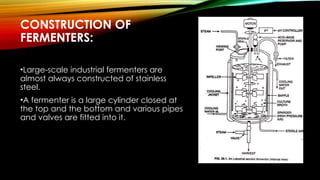
•Large-scale industrial fermenters are
almost always constructed of stainless
steel.
•A fermenter is a large cylinder closed at
the top and the bottom and various pipes
and valves are fitted into it.
CONSTRUCTION OF FERMENTERS(BIOREACTOR):
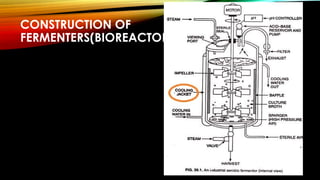
•Since most industrial fermentation process is aerobic, the construction of a typical aerobic fermenter i
I. Cooling Jacket:
•The fermenter is fitted externally with a cooling jacket through which steam (for sterilization) or cooling
•Cooling jacket is necessary because sterilization of the nutrient medium and removal of the heat gen
successful completion of the fermentation in the fermenter.
CONSTRUCTION OF
FERMENTERS(BIOREACTOR):
CONSTRUCTION OF FERMENTERS(BIOREACTOR):
II. Aeration system:
•Critical part of a fermenter.
•In a fermenter with a high microbial population density, there is a tremendous oxygen demand by the
being poorly soluble in water hardly transfers rapidly throughout the growth medium.
• Two separate aeration devices are used to ensure proper aeration in fermenter.
i. Sparger (series of holes in a metal ring)
ii. Impeller(also called agitator) device necessary for stirring of the fermenter.
CONSTRUCTION OF FERMENTERS(BIOREACTOR):
•The stirring accomplishes two things:
i. It mixes the gas bubbles through the liquid culture medium and
ii. It mixes the microbial cells through the liquid culture medium. In this way, the stirring ensures unifo
cells to the nutrients.
CONSTRUCTION OF FERMENTERS(BIOREACTOR):
III. Baffles:
•The baffles are metal strips normally incorporated into fermenters of all sizes to prevent a vortex and to
efficiency.
IV. Controlling Devices for Environmental Factors
•Environmental factors that are frequently controlled includes temperature, oxygen concentration, pH
nutrients, and product concentration.

CONSTRUCTION OF FERMENTERS(BIOREACTOR):
•Use of Computer in Fermenter
•Computers are used to model fermentation processes in industrial fermenters.
•Integration of computers into fermentation systems is based on the computers capacity for process m
data storage, and error-detection.
• Biotransformation is a process by which organic compounds
from one form to another to reduce the persistence and toxi
chemical compounds.
• This process is aided by major range of microorganisms and t
such as bacteria, fungi and enzymes.
Microorganisms as Catalysts
• Microorganisms, encompassing bacteria, fungi, and yeasts, possess an arsenal of
enzymatic machinery that enables them to perform complex chemical transformations.
• These transformations are at the heart of various metabolic pathways, including the
degradation of organic matter, the synthesis of biomolecules, and the detoxification of
harmful compounds
Mechanisms of Microbial Transformation
• Microbial transformation involves a sequence of enzymatic reactions orchestrated by
microorganisms to modify substrates.
• This could include the conversion of organic molecules into simpler compounds, the
synthesis of complex molecules from simpler ones, and the alteration of functional groups
within molecules. Key mechanisms include oxidation-reduction reactions, hydrolysis, and
conjugation.
Diversity of Microbial Transformation
• Microorganisms display remarkable diversity in their transformative capabilities. Some microbes are adept at
down complex polymers, like lignin and cellulose, into simpler sugars through enzymatic degradation.
• Others excel in producing secondary metabolites, such as antibiotics, pigments, and bioactive compounds, w
have immense industrial and pharmaceutical value.
Applications in Biotechnology
• Microbial transformation forms the foundation of various biotechnological processes. For
instance, it underpins the production of biofuels, where microorganisms convert biomass
into bioethanol through fermentation.
• Additionally, genetically engineered microbes have been developed to produce valuable
proteins, enzymes, and chemicals on an industrial scale.
Pharmaceutical Prospects
• Microbial transformation has revolutionized drug discovery and synthesis. The isolation of antibiotics
from microorganisms, such as penicillin from Penicillium, paved the way for the pharmaceutical
industry.
• Contemporary advances involve harnessing microorganisms to synthesize complex pharmaceutical
intermediates, reducing reliance on resource-intensive chemical synthesis.
Agricultural Advancements
• Microbes contribute to sustainable agriculture through the nitrogen fixation process, where certain
bacteria convert atmospheric nitrogen into plant-usable forms.
• Additionally, microbial biofertilizers enhance nutrient avallability to plants and contribute to soil
health. Moreover, biopesticides derived from microorganisms offer environmentally friendly
alternatives to chemical pesticides.
Environmental Remediation
• Microbial transformation is central to bioremediation, a strategy for
cleaning up contaminated environments.
• Certain microorganisms possess the capability to degrade pollutants
like hydrocarbons, heavy metals, and chlorinated compounds,
transforming them into less harmful substances.
ANTIBIOTICS PRODUCTION BY MICROORGANISMS.pptx

ANTIBIOTICS PRODUCTION BY MICROORGANISMS.pptx

  • 1.
  • 2.
    PRODUCTION OF ANTIBIOTICS ●Antibiotics are produced industrially by a process of fermentation, where the source microorganisms is grown in large containers (100000-150000L Or more) containing a liquid growth media. ● Oxygen concentration, temperature, pH and nutrients levels must be optimal and are closely monitored and adjusted if necessary. ● As antibiotics are secondary metabolites, the population size must be controlled very carefully to ensure that maximum yield is obtained before the cells die. Once is the process is complete, the antibiotic must be extracted and purified to crystalline product. ● Microorganisms used in fermentation are rarely identical to their counter parts in wild. This is because species are often genetically modified to yield the maximum amount of antibiotics
  • 3.
    PRODUCTION OF ANTIBIOTICS Threemethods for antibiotic production:- 1.Natural microbial production - using fermentation technology Eg: Penicillin 2.Semi synthetic production - post production modification of antibiotics Eg: Ampicillin 3.Synthetic production - made synthetically in lab Eg: Quinoline
  • 4.
    FERMENTATION TECHNOLOGY The fermentationtechnology requires the following:- 1.A pure culture of chosen organism, in sufficient quantity. 2.Sterilized, carefully composed medium for growth of the organism. 3.A seed fermenter, a minimodel of production fermenter to develop inoculum to initiate fermentation in main fermenter. 4.A production fermenter, the functional large model and 5.Equipments for ;- ● Draining the culture medium in steady state. ● Cell separation ● Collection of cell free supernatant ● Product purification ● Effluent treatment
  • 5.
    STRAINS USED FORPRODUCTION ● Species are often genetically modified to yield maximum amount of antibiotics. ● Mutation is often used- introducing mutagens such as UV radiations, X rays. ● Selection and further reproduction of the higher yielding strains can raise yields by 20 folds or more. ● Another technique used to increase yields in gene amplification, where copies of genes coding for the enzymes involved in the antibiotic production can be inserted back into a cell, via vectors such as plasmids.
  • 6.
    RAW MATERIALS ● Thecompounds that make the fermentation broth are the primary raw materials required for antibiotic production. ● The broth is an aqueous solution made up of all the ingredients necessary for the modification of microorganisms. ● Typically it contains:- Carbon source : molasses or soy meal, acetic acid, alcohols or hydrocarbons. These materials are needed as a food source for the organism. Nitrogen source : Nitogen is another necessary compound in metabolic cycles of the organism. Ammonia salt is typically used.
  • 7.
    RAW MATERIALS Other elements: Phosphorus, Sulfur, Magnesium, Zinc. Antifoaming agents to prevent foaming during fermentation such as Lard oil, octadecanol.
  • 8.
    STEPS IN ANTIBIOTICPRODUCTION ● First the organism that makes the antibiotic must be identified ● Desired microorganism must then be isolated ● The organism then must be grown in large scale so as to allow the purification and chemical analysis of the antibiotic. ● The antibiotic is tested against wide variety of bacterial species. ● Sterile conditions must be maintained throughout the manufacturing processes. A. Starting a culture Before the fermentation process the desired microbe must be identified and its number must be increased by many times. A starter culture from sample of previously isolated organism is created in the lab.
  • 9.
    A.Starting a culture Asample of the organism is transferred to an agar containing plate. Initial culture is then transferred to shake flask containing nutrients necessary for growth. A suspension is formed which is transferred to seed tanks for further growth. The seed tanks are steel tanks designed to provide an ideal environment for growing microorganisms. The seed tanks are equipped with mixers, which mix the growth medium with microbes, and a pump to deliver sterilized, filtered air. After about 24-28 hrs, the material in the seed tank is transferred to primary fermentation tank.
  • 10.
    STEPS IN ANTIBIOTICPRODUCTION B. Fermentation ● The fermentation tank is a large version of the seed tank, which is able to hold about 30000 gallons. ● Microorganisms are allowed to grow and multiply. ● During this process, they excrete large quantities of the desired antibiotic. ● The tanks are coded to keep the temperature between 73-81°F. ● It is constantly agitated and a continuous stream of sterilized air is pumped into it. ● Anti foaming agents are periodically introduced. ● Since pH control is vital for optimal growth, acids or bases are added to the tank as required.
  • 11.
    STEPS IN ANTIBIOTICPRODUCTION C. Isolation and purification ● After 3-5 days, the maximum amount of antibiotics will have been produced. Then the isolation process can begin ● The isolation depends on the specific antibiotic produced, the fermentation broth is processed by various purification methods. ● Water soluble antibiotics : Antibiotics which are water soluble, purified by ion exchange method. The compound is first separated from the waste organic materials in the broth. Then sent through equipments, which separates the other water soluble compound from the desired one. ● Oil soluble antibiotics :- Solvent separation method
  • 12.
    STEPS IN ANTIBIOTICPRODUCTION ● Oil soluble antibiotics The broth is treated with organic solvents such as butyl acetate or methyl isobutyl ketone. Which can dissolve the antibiotic. The dissolved antibiotic is then recovered using various organic chemical process. At the end of this step as purified form of antibiotics is obtained which can be further refined into different product types.
  • 13.
    STEPS IN ANTIBIOTICPRODUCTION D. Refining and packaging ● Antibiotic products can take many different forms- solutions for intravenous bags or syringes, a pill or gel capsule, powder which are incorporated into ointment. ● Various refining steps may be taken after the initial isolation. ● For intravenous bags the crystalline antibiotic can be dissolved in a solution, put in the bag, which is then sealed. ● For gel capsules, the produced antibiotics is typically filled to the bottom half of a capsule then the top half is mechanically put in place. ● When used in ointments, the antibiotic is mixed into the oinment. ● Quality control methods are done
  • 14.
    FERMENTERS AND ITSTYPES BY: AYESHA KABEER
  • 15.
    FERMENTER(BIOREACTOR) •Closed container withadequate arrangement for aeration, agitation, temperature and pH control, and drain or overflow vent to remove the waste biomass of cultured microorganisms along-with their products. •Is a device in which a substrate of low value is utilized by living cells or enzymes to generate a product of higher value. •Extensively used for food processing, fermentation, waste treatment, etc.
  • 16.
    BIOREACTOR •All bioreactors dealwith heterogeneous systems dealing with two or more phases, e.g., liquid, gas, sol •Therefore, optimal conditions for fermentation necessitate efficient transfer of mass, heat and momen the other. •Generally, 20-25% of fermenter volume is left unfilled with medium as “head space” to allow for splash aeration. •The fermenter design varies greatly depending on the type and the fermentation for which it is used
  • 17.
    BIOREACTOR A bioreactor shouldprovide for the following: •Agitation (for mixing of cells and medium), •Aeration (aerobic fermenters); for O2 supply, •Regulation of factors like temperature, pH, pressure, aeration, nutrient feeding, liquid level etc., •Sterilization and maintenance of sterility, and •Withdrawal of cells/medium (for continuous fermenters). Modern fermenters are usually integrated with computers for efficient process monitoring, data acqu
  • 18.
    SIZE OF FERMENTERS(BIOREACTOR): •Thesize of fermenters ranges from 1-2-liter laboratory fermenters to 5,00,000 liters or, occasionally, eve to 1.2 million liters have been used. •The size of the fermenter used depends on the process and how it is operated.
  • 19.
    CONSTRUCTION OF FERMENTERS: •Large-scale industrialfermenters are almost always constructed of stainless steel. •A fermenter is a large cylinder closed at the top and the bottom and various pipes and valves are fitted into it.
  • 20.
    CONSTRUCTION OF FERMENTERS(BIOREACTOR): •Sincemost industrial fermentation process is aerobic, the construction of a typical aerobic fermenter i I. Cooling Jacket: •The fermenter is fitted externally with a cooling jacket through which steam (for sterilization) or cooling •Cooling jacket is necessary because sterilization of the nutrient medium and removal of the heat gen successful completion of the fermentation in the fermenter.
  • 21.
  • 22.
    CONSTRUCTION OF FERMENTERS(BIOREACTOR): II.Aeration system: •Critical part of a fermenter. •In a fermenter with a high microbial population density, there is a tremendous oxygen demand by the being poorly soluble in water hardly transfers rapidly throughout the growth medium. • Two separate aeration devices are used to ensure proper aeration in fermenter. i. Sparger (series of holes in a metal ring) ii. Impeller(also called agitator) device necessary for stirring of the fermenter.
  • 23.
    CONSTRUCTION OF FERMENTERS(BIOREACTOR): •Thestirring accomplishes two things: i. It mixes the gas bubbles through the liquid culture medium and ii. It mixes the microbial cells through the liquid culture medium. In this way, the stirring ensures unifo cells to the nutrients.
  • 24.
    CONSTRUCTION OF FERMENTERS(BIOREACTOR): III.Baffles: •The baffles are metal strips normally incorporated into fermenters of all sizes to prevent a vortex and to efficiency. IV. Controlling Devices for Environmental Factors •Environmental factors that are frequently controlled includes temperature, oxygen concentration, pH nutrients, and product concentration.
  • 25.
    CONSTRUCTION OF FERMENTERS(BIOREACTOR): •Useof Computer in Fermenter •Computers are used to model fermentation processes in industrial fermenters. •Integration of computers into fermentation systems is based on the computers capacity for process m data storage, and error-detection.
  • 27.
    • Biotransformation isa process by which organic compounds from one form to another to reduce the persistence and toxi chemical compounds. • This process is aided by major range of microorganisms and t such as bacteria, fungi and enzymes.
  • 28.
    Microorganisms as Catalysts •Microorganisms, encompassing bacteria, fungi, and yeasts, possess an arsenal of enzymatic machinery that enables them to perform complex chemical transformations. • These transformations are at the heart of various metabolic pathways, including the degradation of organic matter, the synthesis of biomolecules, and the detoxification of harmful compounds
  • 29.
    Mechanisms of MicrobialTransformation • Microbial transformation involves a sequence of enzymatic reactions orchestrated by microorganisms to modify substrates. • This could include the conversion of organic molecules into simpler compounds, the synthesis of complex molecules from simpler ones, and the alteration of functional groups within molecules. Key mechanisms include oxidation-reduction reactions, hydrolysis, and conjugation.
  • 30.
    Diversity of MicrobialTransformation • Microorganisms display remarkable diversity in their transformative capabilities. Some microbes are adept at down complex polymers, like lignin and cellulose, into simpler sugars through enzymatic degradation. • Others excel in producing secondary metabolites, such as antibiotics, pigments, and bioactive compounds, w have immense industrial and pharmaceutical value.
  • 31.
    Applications in Biotechnology •Microbial transformation forms the foundation of various biotechnological processes. For instance, it underpins the production of biofuels, where microorganisms convert biomass into bioethanol through fermentation. • Additionally, genetically engineered microbes have been developed to produce valuable proteins, enzymes, and chemicals on an industrial scale.
  • 32.
    Pharmaceutical Prospects • Microbialtransformation has revolutionized drug discovery and synthesis. The isolation of antibiotics from microorganisms, such as penicillin from Penicillium, paved the way for the pharmaceutical industry. • Contemporary advances involve harnessing microorganisms to synthesize complex pharmaceutical intermediates, reducing reliance on resource-intensive chemical synthesis.
  • 33.
    Agricultural Advancements • Microbescontribute to sustainable agriculture through the nitrogen fixation process, where certain bacteria convert atmospheric nitrogen into plant-usable forms. • Additionally, microbial biofertilizers enhance nutrient avallability to plants and contribute to soil health. Moreover, biopesticides derived from microorganisms offer environmentally friendly alternatives to chemical pesticides.
  • 34.
    Environmental Remediation • Microbialtransformation is central to bioremediation, a strategy for cleaning up contaminated environments. • Certain microorganisms possess the capability to degrade pollutants like hydrocarbons, heavy metals, and chlorinated compounds, transforming them into less harmful substances.