ANTIBIOTIC POLICY
Dr Md Ashraf Ali
• INTRODUCTION
• DEFINITION
• AIMS AND OBJECTIVES
• INDIAN SCENARIO
• HOSPITALANTIBIOTIC COMMITTEE
– Formation, Key Members And Functions
• HOSPITALANTIBIOTIC POLICY
– Policy For Emperical And Prophylactic Therapy
• ROLE OF MICROBIOLOGY DEPARTMENT
• WHONET
• LONG TERM GOALS- Role of MCI
• SUMMARY AND CONCLUSION
Dr Md Ashraf Ali
“But I would like to sound one note of warning.
Penicillin is to all intents non-poisonous so there is no need to worry
about giving an overdose and poisoning the patient.There may be a
danger, though, in underdosage.
The time may come when penicillin can be bought by anyone in shops,
an ignorant man may easily underdose himself and by exposing his
microbes to non-lethal quantities of the drug, makes them resistant.”
Sir Alexander Fleming
http://www.nobelprize.org/nobel_prizes/medicine/laureates/1945/fleming-lecture
Dr Md Ashraf Ali
Introduction
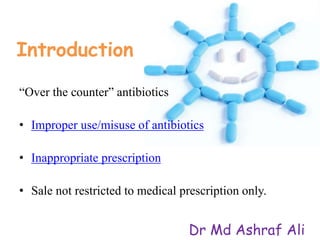
“Over the counter” antibiotics
• Improper use/misuse of antibiotics
• Inappropriate prescription
• Sale not restricted to medical prescription only.
Dr Md Ashraf Ali
What is Misuse
of Antibiotics?
• DOSAGE: Incorrect dosage
• DURATION: too short or too long
• DELAY: antibiotic administration in critically ill patients
• DATA: treatment if not streamlined as per culture and
DST results.
5
Dr Md Ashraf Ali
Inappropriate
prescription
• >40% of all antimicrobials prescribed in teaching
hospitals were considered inappropriate
• Prescribing antibiotics for viral infections
• broad-spectrum antibiotics are used too generously prior
to first choice drugs
Dr Md Ashraf Ali
• This unnecessary use / inappropriate use of antibiotics
encourages the selection and proliferation of resistant
bacterial strains.
• These Spread to other patients (cross infection).
• Transferred between bacterial species
Dr Md Ashraf Ali
• Drug resistance- evolutionary phenomenon
• Not possible to completely eliminate it
• Possible to modify or slow it down by prudent
antibiotic usage.
• Hence importance of inclusion of an antibiotic policy
in the infection control program.
Dr Md Ashraf Ali
A solution to the evolutionary
phenomen
ANTIBIOTIC POLICY
Dr Md Ashraf Ali
Definition
• An antibiotic policy consists of written guidance that
recommends antibiotics and their dose for treating
and preventing specific infections.
Dr Md Ashraf Ali
• In general a hospital antibiotic policy covers
empirical treatment, specific treatment and also
agents for prophylaxis.
• It constitutes one of the most important aspects of
Infection Control program.
• It is evidence based and is drafted by a committee
“The Hospital Infection Control Committee” or
“Hospital Antibiotic Committee”
Dr Md Ashraf Ali
Aims and objectives
• Improve patient care
• Better use of resources
• Retard the emergence & spread of drug resistant bacteria.
• Improve education of junior doctors
• Avoid wasteful expenditure of government/ NGOs.
Dr Md Ashraf Ali
Indian scenario
Dr Md Ashraf Ali
Government hospitals
• Nosocomial infection rate is as high as 40-50%.
• There is an URGENT NEED or a concerted effort to
control and prevent development of drug resistance
within hospital setting.
NABH DATA on Indian Hospitals
As per data available from NABH assessors
“most accredited hospitals, though having a well written
antibiotic policy on paper, are not compliant in practice.”
108
HOSPITAL ANTIBIOTIC
COMMITTEE
Dr Md Ashraf Ali
Hospital antibiotic committee
Formation:
 Medical director / Hospital superintendent should
ensure formation of this committee.
 Implementation of policies drafted by this committee
throughout the hospital.
 Stand alone or subcommittee of Hospital Infection
Control Committee
Dr Md Ashraf Ali
Key members of antibiotic
committee
• Physician
• Clinical microbiologist
• Clinical Pharmacologist
• Pharmacist
• Member of hospital management
• Member of Infection Control Committee
Dr Md Ashraf Ali
Functions of Antibiotic committee
1. To advice on antibiotic use & audit prescribing
2. Formulary restriction and preauthorization
3. Make rational choices amongst “equivalent drugs” &
classes of drugs “least expensive and most effective”.
Patient saves Money
Doctors save Lives.
How to choose the antibiotics ?
• Written by national experts
• Regularly updated every 2 years
• Recommendations concerning the
treatment of choice for common
clinical problems
Dr Md Ashraf Ali
HOSPITAL ANTIBIOTIC
POLICY
Dr Md Ashraf Ali
Policy for EMPERICAL treatment
• Simple, clear and clinically relevant
• Should include optimal dosage, route of administration,
duration, ALTERNATIVES for patients allergic to first
line drugs
• May be ward specific
• Should include levels of prescription
Dr Md Ashraf Ali
Levels of prescription
1. First choice drugs:
can be prescribed by all clinicians working in that hospital.
2. Restricted list of antibiotics:
only after permission from Head of department, clinical
microbiologist, Antibiotic committee representative
3. Reserve antibiotics:
only after permission from Hospital Antibiotic Committee.
Dr Md Ashraf Ali
1. First choice antibiotics
• Also called Unreserved antibiotics
• Directed against specific diseases
Typhoid fever
First choice:
3rd generation cephalosporin
or
Azithromycin
Alternatives
• Cotrimoxazole
• Chloramphenicol
Dr Md Ashraf Ali
Respiratory tract infections
Disease First choice drug
COPD
• mild exacerbations
• if assoc. with purulent sputum,
dyspnea
Not necessary (Viral origin)
Doxycycline 100mg OD
Amoxicillin 500mg TID
PERTUSIS Azithromycin 500mg OD
Erythromycin
Pneumonia (adult) Amoxicillin
Roxithromycin
Doxycycline
Levofloxacin
Pneumonia (child) Amoxicillin
Erythromycin
Ear, nose, throat infections
INFECTION DRUG TO BE USED
OTITIS EXTERNA
•Topical ACETIC ACID 2% (mild cases)
•Ciprofloxacin 500mg BD oral
OTITIS MEDIA
•Antibiotics not advised
•If associated with perforation and otorrhea
Amoxicillin-clavulinic acid
PHARYNGITIS •Erythromycin 400mg
SINUSITIS
•Doxycycline 100mg OD
•Amox-clav
Urinary tract infection
First line
• Norfloxacin
• Nalidixic acid
Alternatives
• Cotrimoxazole
• Cefpodoxime
E. coli
Dr Md Ashraf Ali
Eye infections
Conjunctivitis ( Allergic, Viral / bacterial infection)
If bacterial cause suspected (mucopurulent discharge)
• Gentamicin 2% eye drops
• Chloramphenicol eye drops
Dr Md Ashraf Ali
CNS infections
• Meningoencephalitis- viral origin
• Bacterial meningitis
 Ceftriaxone and Amikacin combination
Dr Md Ashraf Ali
Skin infections
Disease Drug
Bites (Human / animal) • Augmentin
• Metronidazole + Doxycycline
• Metronidazole + co-trimoxazole
Boils, Cellulitis • Flucloxacillin
• Augmentin
• Cotrimoxazole
Diabetic foot • Augmentin
• Cephelexin + Metronidazole
• Cotrimoxazole + clindamycin
Impetigo • Fusidic acid cream 2%
• Oral Cotrimoxazole
Recurrent skin infections • Fusidic acid cream 2%
• Mupirocin
Gastrointestinal tract infections
Disease Drug
Diarrhea No antibiotics
Dysentery Ofloxacin + ornidazole/tinidazole
Dr Md Ashraf Ali
Policy for EMPERICAL treatment
Levels of prescription
1. First choice drugs: can be prescribed by all Dr.
2. Restricted list of antibiotics: only after permission
from Head of Department, clinical microbiologist,
Antibiotic committee representative
3. Reserve antibiotics: only after permission from
hospital antibiotic committee.
Dr Md Ashraf Ali
2. Restricted list
1. Imipenem/Meropenem :
• Used for empirical in very sick patients
• Stop after culture and sensitivity report is available,
if it shows a susceptible pathogen to other classes of
Antibiotics & if patient condition improves.
2. Piperacillin-Tazobactam:
• These have a broad spectrum as carbapenems .
• Used for empirical in very sick patients.
Dr Md Ashraf Ali
3. Vancomycin/Teicoplanin:
• Use as empirical in sick patients may be allowed
where MRSA is prevalent.
• After 48-72hrs culture and sensitivity report
shows no staph aureus or MSSA then they have
absolutely no role and should be discontinued.
Dr Md Ashraf Ali
Policy for EMPERICAL treatment
Levels of prescription
1. First choice drugs: can be prescribed by all Dr.
2. Restricted list of antibiotics: only after permission
from HOD, clinical microbiologist, Antibiotic
committee representative
3. Reserve antibiotics: only after permission from
Hospital Antibiotic Committee.
Dr Md Ashraf Ali
3. Reserve drugs
1. Colistin:
• last resort for managing gram negative MDRs and
its use, dose and duration needs to be rationalized.
• Liberal use should be restricted
2. Doripenem: (FDA approval 2007)
• It is the last FDA approved carbapenem.
• If Imipenem and Doripenem are working, we need
to conserve Doripenem
Dr Md Ashraf Ali
3. Rifampicin:
• Valuable drug for Tuberculosis.
• The use of rifampicin in MDR Pseudomonas,
Acinetobacter or MRSA should be restricted.
4. Linezolid:
• Bacteriostatic and available as oral - more prone
for misuse in VRSA / VRE.
Dr Md Ashraf Ali
5. Daptomycin:
– Moreover for VRSA and VRE but still not a
major cause of concern
6. Tigecycline:
– Bacteriostatic, one of the most Broad spectrum
drugs, has limited role in MDR infections
7. Sulbactam alone:
– Reserved for PDR Acinetobacter.
Dr Md Ashraf Ali
Policy for Prophylaxis
• These antibiotics are given for short duration, free of side
effects and inexpensive.
• Not intended towards therapy.
Example
• Pre-op Kanamycin, neomycin oral antibiotics
• The addition of perioperative gentamicin and clindamycin
following oral antibiotic bowel preparation.
Dr Md Ashraf Ali
CONTRIBUTION FROM
MICROBIOLOGY LABORATORY
Dr Md Ashraf Ali
Samples:
• Physicians need to be advised on proper collection and
transport of the most appropriate specimen.
• Microbiological samples always be sent prior to
initiating antimicrobial therapy.
• Gram stain report, can help determine therapeutic
choices when empiric therapy is required.
• When resources are scarce, priority given to samples
from nosocomial, life threatening cases or sent to
referral hospital. Dr Md Ashraf Ali
• Reports of AST based on the drugs available in agreed
formulary.
• Doubtful pathogen isolated, susceptibility need not be
reported.
• Limited no. of antibiotics are selected to optimize patient
care, cost effectiveness, encourage better prescription.
E.g. Augmentin need not be reported if the organism is
sensitive to ampicillin/amoxicillin
Reports
Dr Md Ashraf Ali
Basic infrastructure should be updated for detection of
• MRSA
• ESBL producers.
Dr Md Ashraf Ali
Reports on drug
resistance
• Assess trends in development of
antimicrobial resistance
• Report should also indicate wherever organisms are
invariably resistant
e.g. MRSA are resistant to all beta-lactams
• Send regular updates /alerts to Hospital Antibiotic
committee, on emergence of resistance to antibiotics
used in hospital.
Dr Md Ashraf Ali
Notifications and documentation
• Microbiology labs should issue Hospital Antibiogram
at pre-defined intervals.
• Notification of communicable diseases.
• Multidrug-resistant bacteria, esp. pan-drug resistant
bacteria, must be considered as a notifiable entity..
Dr Md Ashraf Ali
Hospital Antibiogram:
Periodic summary of antimicrobial
susceptibilities of local bacteria isolates
submitted by the hospital’s clinical
microbiology laboratory.
Dr Md Ashraf Ali
Documentation of all
• Opportunistic infections
• Hospital infection outbreaks
• Emerging infections
Dr Md Ashraf Ali
Education
• Formal meeting, clinical
rounds, formal lectures
• Focus on new antibiotics,
route of administration
Surveillance
• Antibiotic resistance
• Antibiotic usage
DDD (defined daily dose)
• Prescription auditing
Dr Md Ashraf Ali
WHONET
Dr Md Ashraf Ali
What is WHONET
• WHONET is a free software developed by the WHO
Collaborating Centre for Surveillance of Antimicrobial
Resistance.
• Uses
 laboratory-based surveillance of infectious diseases
 antimicrobial resistance.
Dr Md Ashraf Ali
The principal goals of the software are:
1. to enhance local use of laboratory data;
2. to promote national and international collaboration through
the exchange of data.
Advantages
• The understanding of the local
epidemiology of microbial
populations;
• the selection of antimicrobial
agents;
• the identification of hospital and
community outbreaks
• the recognition of quality
assurance problems in laboratory
testing.
Dr Md Ashraf Ali
How it works..??
• The heart of WHONET is a
software package designed to
collect the results of
antibiotic resistance tests.
• Researchers / Microbiologists
feed the results into a
computer and look for trends.
Dr Md Ashraf Ali
Implementation of WHONET CAN HELP
TO MONITOR RESISTANCE
Dr Md Ashraf Ali
MONITORING TREATMENT
Dr Md Ashraf Ali
• The need for antimicrobial therapy should be reviewed daily.
• For most types of infection treatment should continue until
the clinical signs and symptoms of infection have resolved.
• Where treatment is apparently failing, advise from the
microbiologist, pharmacologist and ID Physician should
normally be sought rather than blindly changing to an
alternative choice of antimicrobial agent.
Dr Md Ashraf Ali
ROLE OF MEDICAL COUNCIL
OF INDIA
Dr Md Ashraf Ali
• One of the main reasons for the inappropriate antibiotic
usage by Indian doctors is the lack of adequate
training on the subject during undergraduate courses.
• This deficit in the basic training can only be overcome
if there is a change in the curriculum.
• Prescriptions from RMP, Quacks, AYUSH doctors
should be discouraged.
Dr Md Ashraf Ali
Curriculum change
• Structured training in antibiotic usage and infection
control should be introduced in curriculum.
• Infectious Diseases training in UG and PG
curriculum in all specialties.
Dr Md Ashraf Ali
Role of clinicians- Good practices
• Send for the appropriate investigations, the minimum
required for diagnosis of these infections.
• All antibiotic initiations - after sending appropriate
cultures
• Follow the Hospital policy when choosing antimicrobial
therapy. If alternatives chosen, document the reason in
case sheets.
• Check for factors which will affect drug choice & dose
e.g., renal function, interactions, allergy.
Dr Md Ashraf Ali
• Check that the appropriate dose is prescribed.
If uncertain, contact Infectious disease committee, Pharmacy,
or check in the formulary.
• The need for antimicrobial therapy should be reviewed on a
daily basis.
• Empiric Therapy
Where delay in initiating therapy would be life
threatening. antimicrobial therapy based on a clinically
defined infection is justified.
• Once culture reports are available, step down to the narrowest
spectrum.
Dr Md Ashraf Ali
Antimicrobial Cycling or Rotation:
Deliberate, scheduled removal and replacement of
specific antimicrobials with in institutional environment
to avoid the antimicrobial resistance.
Dr Md Ashraf Ali
Research works:
• Antimicrobial peptides(AMPs), Antimicrobial
lipopeptides (AMLPs)  target bacterial membranes,
making it nearly impossible to develop resistance
• Phage therapy
• Use of the lytic enzymes : in mucus and saliva
• But they are a long way off, as the researches
still in its infancy
Dr Md Ashraf Ali
A WORLD WITHOUT
ANTIBIOTICS- JUST IMAGINE
• A world without effective antibiotics is a terrifying
but real prospect. Overuse of antibiotics has led to
dangerous outbreaks of drug resistant disease, and
puts us in very real danger of a global pandemic. In
future we have to use ???
Dr Md Ashraf Ali
• India needs “An implementable antibiotic policy” and
NOT “A perfect policy”
• Asking for a strict antibiotic policy in a country where
there is currently no functioning antibiotic policy at all
may not be an intelligent or immediately viable option
without the political will to make such a drastic change.
SUMMARY
• Stop over the counter sale of drugs without prescription
• Hospital antibiotic committee should be formed in every hospital,
to draft an Antibiotic policy in hospitals.
• Strict adherence to antibiotic policy- part of infection control
• Microbiology labs- upgraded to detect MDR bacterias.
• Encourage good practices among clinicians.
• Implementation of “WHONET” for laboratory-based
surveillance of infectious diseases and antimicrobial resistance.
• Long term plans -MCI has a role.
• 2011 WHO slogan on antibiotic resistance
“no action today, no cure tomorrow”.
CONCLUSION
Microbiologist
Bacterial sensitivity
test and find out the
Possible cause of
development
Clinician
Treat infection
Sharing of expertise
Microbiologist
Bacterial sensitivity
test and find out the
Possible cause of
development
Physician
Treat infection
Antibiotic
committee
India needs “An implementable antibiotic policy” and NOT
“A perfect policy”.
References
• Infection control: Basic concepts and practices, 2nd edn.
• www.cdc.org
• Antibiotics guide: choices for common infections
• International Clinical Practice Guidelines for the
treatment of urinary tract infections : An Update
• Oxford handbook of infectious diseases
THANK
YOU
Dr Md. Ashraf Ali S N
PG in Microbiology
KIMS, Hubli

Antibiotic policy

  • 1.
  • 2.
    • INTRODUCTION • DEFINITION •AIMS AND OBJECTIVES • INDIAN SCENARIO • HOSPITALANTIBIOTIC COMMITTEE – Formation, Key Members And Functions • HOSPITALANTIBIOTIC POLICY – Policy For Emperical And Prophylactic Therapy • ROLE OF MICROBIOLOGY DEPARTMENT • WHONET • LONG TERM GOALS- Role of MCI • SUMMARY AND CONCLUSION Dr Md Ashraf Ali
  • 3.
    “But I wouldlike to sound one note of warning. Penicillin is to all intents non-poisonous so there is no need to worry about giving an overdose and poisoning the patient.There may be a danger, though, in underdosage. The time may come when penicillin can be bought by anyone in shops, an ignorant man may easily underdose himself and by exposing his microbes to non-lethal quantities of the drug, makes them resistant.” Sir Alexander Fleming http://www.nobelprize.org/nobel_prizes/medicine/laureates/1945/fleming-lecture Dr Md Ashraf Ali
  • 4.
    Introduction “Over the counter”antibiotics • Improper use/misuse of antibiotics • Inappropriate prescription • Sale not restricted to medical prescription only. Dr Md Ashraf Ali
  • 5.
    What is Misuse ofAntibiotics? • DOSAGE: Incorrect dosage • DURATION: too short or too long • DELAY: antibiotic administration in critically ill patients • DATA: treatment if not streamlined as per culture and DST results. 5 Dr Md Ashraf Ali
  • 6.
    Inappropriate prescription • >40% ofall antimicrobials prescribed in teaching hospitals were considered inappropriate • Prescribing antibiotics for viral infections • broad-spectrum antibiotics are used too generously prior to first choice drugs Dr Md Ashraf Ali
  • 7.
    • This unnecessaryuse / inappropriate use of antibiotics encourages the selection and proliferation of resistant bacterial strains. • These Spread to other patients (cross infection). • Transferred between bacterial species Dr Md Ashraf Ali
  • 8.
    • Drug resistance-evolutionary phenomenon • Not possible to completely eliminate it • Possible to modify or slow it down by prudent antibiotic usage. • Hence importance of inclusion of an antibiotic policy in the infection control program. Dr Md Ashraf Ali
  • 9.
    A solution tothe evolutionary phenomen ANTIBIOTIC POLICY Dr Md Ashraf Ali
  • 10.
    Definition • An antibioticpolicy consists of written guidance that recommends antibiotics and their dose for treating and preventing specific infections. Dr Md Ashraf Ali
  • 11.
    • In generala hospital antibiotic policy covers empirical treatment, specific treatment and also agents for prophylaxis. • It constitutes one of the most important aspects of Infection Control program. • It is evidence based and is drafted by a committee “The Hospital Infection Control Committee” or “Hospital Antibiotic Committee” Dr Md Ashraf Ali
  • 12.
    Aims and objectives •Improve patient care • Better use of resources • Retard the emergence & spread of drug resistant bacteria. • Improve education of junior doctors • Avoid wasteful expenditure of government/ NGOs. Dr Md Ashraf Ali
  • 13.
  • 14.
    Government hospitals • Nosocomialinfection rate is as high as 40-50%. • There is an URGENT NEED or a concerted effort to control and prevent development of drug resistance within hospital setting.
  • 15.
    NABH DATA onIndian Hospitals As per data available from NABH assessors “most accredited hospitals, though having a well written antibiotic policy on paper, are not compliant in practice.” 108
  • 16.
  • 17.
    Hospital antibiotic committee Formation: Medical director / Hospital superintendent should ensure formation of this committee.  Implementation of policies drafted by this committee throughout the hospital.  Stand alone or subcommittee of Hospital Infection Control Committee Dr Md Ashraf Ali
  • 18.
    Key members ofantibiotic committee • Physician • Clinical microbiologist • Clinical Pharmacologist • Pharmacist • Member of hospital management • Member of Infection Control Committee Dr Md Ashraf Ali
  • 19.
    Functions of Antibioticcommittee 1. To advice on antibiotic use & audit prescribing 2. Formulary restriction and preauthorization 3. Make rational choices amongst “equivalent drugs” & classes of drugs “least expensive and most effective”. Patient saves Money Doctors save Lives.
  • 20.
    How to choosethe antibiotics ? • Written by national experts • Regularly updated every 2 years • Recommendations concerning the treatment of choice for common clinical problems Dr Md Ashraf Ali
  • 21.
  • 22.
    Policy for EMPERICALtreatment • Simple, clear and clinically relevant • Should include optimal dosage, route of administration, duration, ALTERNATIVES for patients allergic to first line drugs • May be ward specific • Should include levels of prescription Dr Md Ashraf Ali
  • 23.
    Levels of prescription 1.First choice drugs: can be prescribed by all clinicians working in that hospital. 2. Restricted list of antibiotics: only after permission from Head of department, clinical microbiologist, Antibiotic committee representative 3. Reserve antibiotics: only after permission from Hospital Antibiotic Committee. Dr Md Ashraf Ali
  • 24.
    1. First choiceantibiotics • Also called Unreserved antibiotics • Directed against specific diseases
  • 25.
    Typhoid fever First choice: 3rdgeneration cephalosporin or Azithromycin Alternatives • Cotrimoxazole • Chloramphenicol Dr Md Ashraf Ali
  • 26.
    Respiratory tract infections DiseaseFirst choice drug COPD • mild exacerbations • if assoc. with purulent sputum, dyspnea Not necessary (Viral origin) Doxycycline 100mg OD Amoxicillin 500mg TID PERTUSIS Azithromycin 500mg OD Erythromycin Pneumonia (adult) Amoxicillin Roxithromycin Doxycycline Levofloxacin Pneumonia (child) Amoxicillin Erythromycin
  • 27.
    Ear, nose, throatinfections INFECTION DRUG TO BE USED OTITIS EXTERNA •Topical ACETIC ACID 2% (mild cases) •Ciprofloxacin 500mg BD oral OTITIS MEDIA •Antibiotics not advised •If associated with perforation and otorrhea Amoxicillin-clavulinic acid PHARYNGITIS •Erythromycin 400mg SINUSITIS •Doxycycline 100mg OD •Amox-clav
  • 28.
    Urinary tract infection Firstline • Norfloxacin • Nalidixic acid Alternatives • Cotrimoxazole • Cefpodoxime E. coli Dr Md Ashraf Ali
  • 29.
    Eye infections Conjunctivitis (Allergic, Viral / bacterial infection) If bacterial cause suspected (mucopurulent discharge) • Gentamicin 2% eye drops • Chloramphenicol eye drops Dr Md Ashraf Ali
  • 30.
    CNS infections • Meningoencephalitis-viral origin • Bacterial meningitis  Ceftriaxone and Amikacin combination Dr Md Ashraf Ali
  • 31.
    Skin infections Disease Drug Bites(Human / animal) • Augmentin • Metronidazole + Doxycycline • Metronidazole + co-trimoxazole Boils, Cellulitis • Flucloxacillin • Augmentin • Cotrimoxazole Diabetic foot • Augmentin • Cephelexin + Metronidazole • Cotrimoxazole + clindamycin Impetigo • Fusidic acid cream 2% • Oral Cotrimoxazole Recurrent skin infections • Fusidic acid cream 2% • Mupirocin
  • 32.
    Gastrointestinal tract infections DiseaseDrug Diarrhea No antibiotics Dysentery Ofloxacin + ornidazole/tinidazole Dr Md Ashraf Ali
  • 33.
    Policy for EMPERICALtreatment Levels of prescription 1. First choice drugs: can be prescribed by all Dr. 2. Restricted list of antibiotics: only after permission from Head of Department, clinical microbiologist, Antibiotic committee representative 3. Reserve antibiotics: only after permission from hospital antibiotic committee. Dr Md Ashraf Ali
  • 34.
    2. Restricted list 1.Imipenem/Meropenem : • Used for empirical in very sick patients • Stop after culture and sensitivity report is available, if it shows a susceptible pathogen to other classes of Antibiotics & if patient condition improves. 2. Piperacillin-Tazobactam: • These have a broad spectrum as carbapenems . • Used for empirical in very sick patients. Dr Md Ashraf Ali
  • 35.
    3. Vancomycin/Teicoplanin: • Useas empirical in sick patients may be allowed where MRSA is prevalent. • After 48-72hrs culture and sensitivity report shows no staph aureus or MSSA then they have absolutely no role and should be discontinued. Dr Md Ashraf Ali
  • 36.
    Policy for EMPERICALtreatment Levels of prescription 1. First choice drugs: can be prescribed by all Dr. 2. Restricted list of antibiotics: only after permission from HOD, clinical microbiologist, Antibiotic committee representative 3. Reserve antibiotics: only after permission from Hospital Antibiotic Committee. Dr Md Ashraf Ali
  • 37.
    3. Reserve drugs 1.Colistin: • last resort for managing gram negative MDRs and its use, dose and duration needs to be rationalized. • Liberal use should be restricted 2. Doripenem: (FDA approval 2007) • It is the last FDA approved carbapenem. • If Imipenem and Doripenem are working, we need to conserve Doripenem Dr Md Ashraf Ali
  • 38.
    3. Rifampicin: • Valuabledrug for Tuberculosis. • The use of rifampicin in MDR Pseudomonas, Acinetobacter or MRSA should be restricted. 4. Linezolid: • Bacteriostatic and available as oral - more prone for misuse in VRSA / VRE. Dr Md Ashraf Ali
  • 39.
    5. Daptomycin: – Moreoverfor VRSA and VRE but still not a major cause of concern 6. Tigecycline: – Bacteriostatic, one of the most Broad spectrum drugs, has limited role in MDR infections 7. Sulbactam alone: – Reserved for PDR Acinetobacter. Dr Md Ashraf Ali
  • 40.
    Policy for Prophylaxis •These antibiotics are given for short duration, free of side effects and inexpensive. • Not intended towards therapy. Example • Pre-op Kanamycin, neomycin oral antibiotics • The addition of perioperative gentamicin and clindamycin following oral antibiotic bowel preparation. Dr Md Ashraf Ali
  • 41.
  • 42.
    Samples: • Physicians needto be advised on proper collection and transport of the most appropriate specimen. • Microbiological samples always be sent prior to initiating antimicrobial therapy. • Gram stain report, can help determine therapeutic choices when empiric therapy is required. • When resources are scarce, priority given to samples from nosocomial, life threatening cases or sent to referral hospital. Dr Md Ashraf Ali
  • 43.
    • Reports ofAST based on the drugs available in agreed formulary. • Doubtful pathogen isolated, susceptibility need not be reported. • Limited no. of antibiotics are selected to optimize patient care, cost effectiveness, encourage better prescription. E.g. Augmentin need not be reported if the organism is sensitive to ampicillin/amoxicillin Reports Dr Md Ashraf Ali
  • 44.
    Basic infrastructure shouldbe updated for detection of • MRSA • ESBL producers. Dr Md Ashraf Ali
  • 45.
    Reports on drug resistance •Assess trends in development of antimicrobial resistance • Report should also indicate wherever organisms are invariably resistant e.g. MRSA are resistant to all beta-lactams • Send regular updates /alerts to Hospital Antibiotic committee, on emergence of resistance to antibiotics used in hospital. Dr Md Ashraf Ali
  • 46.
    Notifications and documentation •Microbiology labs should issue Hospital Antibiogram at pre-defined intervals. • Notification of communicable diseases. • Multidrug-resistant bacteria, esp. pan-drug resistant bacteria, must be considered as a notifiable entity.. Dr Md Ashraf Ali
  • 47.
    Hospital Antibiogram: Periodic summaryof antimicrobial susceptibilities of local bacteria isolates submitted by the hospital’s clinical microbiology laboratory. Dr Md Ashraf Ali
  • 48.
    Documentation of all •Opportunistic infections • Hospital infection outbreaks • Emerging infections Dr Md Ashraf Ali
  • 49.
    Education • Formal meeting,clinical rounds, formal lectures • Focus on new antibiotics, route of administration Surveillance • Antibiotic resistance • Antibiotic usage DDD (defined daily dose) • Prescription auditing Dr Md Ashraf Ali
  • 50.
  • 51.
    What is WHONET •WHONET is a free software developed by the WHO Collaborating Centre for Surveillance of Antimicrobial Resistance. • Uses  laboratory-based surveillance of infectious diseases  antimicrobial resistance. Dr Md Ashraf Ali
  • 52.
    The principal goalsof the software are: 1. to enhance local use of laboratory data; 2. to promote national and international collaboration through the exchange of data.
  • 53.
    Advantages • The understandingof the local epidemiology of microbial populations; • the selection of antimicrobial agents; • the identification of hospital and community outbreaks • the recognition of quality assurance problems in laboratory testing. Dr Md Ashraf Ali
  • 54.
    How it works..?? •The heart of WHONET is a software package designed to collect the results of antibiotic resistance tests. • Researchers / Microbiologists feed the results into a computer and look for trends. Dr Md Ashraf Ali
  • 55.
    Implementation of WHONETCAN HELP TO MONITOR RESISTANCE Dr Md Ashraf Ali
  • 56.
  • 57.
    • The needfor antimicrobial therapy should be reviewed daily. • For most types of infection treatment should continue until the clinical signs and symptoms of infection have resolved. • Where treatment is apparently failing, advise from the microbiologist, pharmacologist and ID Physician should normally be sought rather than blindly changing to an alternative choice of antimicrobial agent. Dr Md Ashraf Ali
  • 58.
    ROLE OF MEDICALCOUNCIL OF INDIA Dr Md Ashraf Ali
  • 59.
    • One ofthe main reasons for the inappropriate antibiotic usage by Indian doctors is the lack of adequate training on the subject during undergraduate courses. • This deficit in the basic training can only be overcome if there is a change in the curriculum. • Prescriptions from RMP, Quacks, AYUSH doctors should be discouraged. Dr Md Ashraf Ali
  • 60.
    Curriculum change • Structuredtraining in antibiotic usage and infection control should be introduced in curriculum. • Infectious Diseases training in UG and PG curriculum in all specialties. Dr Md Ashraf Ali
  • 61.
    Role of clinicians-Good practices • Send for the appropriate investigations, the minimum required for diagnosis of these infections. • All antibiotic initiations - after sending appropriate cultures • Follow the Hospital policy when choosing antimicrobial therapy. If alternatives chosen, document the reason in case sheets. • Check for factors which will affect drug choice & dose e.g., renal function, interactions, allergy. Dr Md Ashraf Ali
  • 62.
    • Check thatthe appropriate dose is prescribed. If uncertain, contact Infectious disease committee, Pharmacy, or check in the formulary. • The need for antimicrobial therapy should be reviewed on a daily basis. • Empiric Therapy Where delay in initiating therapy would be life threatening. antimicrobial therapy based on a clinically defined infection is justified. • Once culture reports are available, step down to the narrowest spectrum. Dr Md Ashraf Ali
  • 63.
    Antimicrobial Cycling orRotation: Deliberate, scheduled removal and replacement of specific antimicrobials with in institutional environment to avoid the antimicrobial resistance. Dr Md Ashraf Ali
  • 64.
    Research works: • Antimicrobialpeptides(AMPs), Antimicrobial lipopeptides (AMLPs)  target bacterial membranes, making it nearly impossible to develop resistance • Phage therapy • Use of the lytic enzymes : in mucus and saliva • But they are a long way off, as the researches still in its infancy Dr Md Ashraf Ali
  • 65.
    A WORLD WITHOUT ANTIBIOTICS-JUST IMAGINE • A world without effective antibiotics is a terrifying but real prospect. Overuse of antibiotics has led to dangerous outbreaks of drug resistant disease, and puts us in very real danger of a global pandemic. In future we have to use ??? Dr Md Ashraf Ali
  • 66.
    • India needs“An implementable antibiotic policy” and NOT “A perfect policy” • Asking for a strict antibiotic policy in a country where there is currently no functioning antibiotic policy at all may not be an intelligent or immediately viable option without the political will to make such a drastic change.
  • 67.
  • 68.
    • Stop overthe counter sale of drugs without prescription • Hospital antibiotic committee should be formed in every hospital, to draft an Antibiotic policy in hospitals. • Strict adherence to antibiotic policy- part of infection control • Microbiology labs- upgraded to detect MDR bacterias. • Encourage good practices among clinicians. • Implementation of “WHONET” for laboratory-based surveillance of infectious diseases and antimicrobial resistance. • Long term plans -MCI has a role. • 2011 WHO slogan on antibiotic resistance “no action today, no cure tomorrow”.
  • 69.
  • 70.
    Microbiologist Bacterial sensitivity test andfind out the Possible cause of development Clinician Treat infection
  • 71.
    Sharing of expertise Microbiologist Bacterialsensitivity test and find out the Possible cause of development Physician Treat infection Antibiotic committee India needs “An implementable antibiotic policy” and NOT “A perfect policy”.
  • 72.
    References • Infection control:Basic concepts and practices, 2nd edn. • www.cdc.org • Antibiotics guide: choices for common infections • International Clinical Practice Guidelines for the treatment of urinary tract infections : An Update • Oxford handbook of infectious diseases
  • 73.
    THANK YOU Dr Md. AshrafAli S N PG in Microbiology KIMS, Hubli