






WISAM GATEA HANI
B.PHARMACY
SRI VENKTESHWARA COLLEGE OF PHARMACY
Rational Use of Antibiotics
The conference of experts on the rational use of drugs, by the WHO in 1985
defined that
“Rational use of drugs requires that patients
receive medications appropriately to their
clinical needs, in doses that meet their own
individual requirements for an adequate period
of time, at the lowest cost to them and their
community”
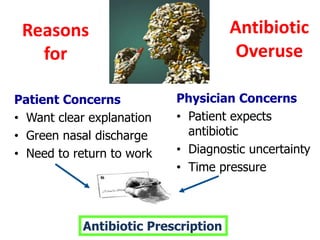
Reasons
for
Patient Concerns
• Want clear explanation
• Green nasal discharge
• Need to return to work
Physician Concerns
• Patient expects
antibiotic
• Diagnostic uncertainty
• Time pressure
Antibiotic Prescription
Antibiotic
Overuse
What is inappropriate use ?
Unnecessary prescription of antibiotics, such as
for viral infections or for prolonged prophylaxis
Using broad-spectrum antibiotics when narrow-
spectrum antibiotics are effective
Prescribing too low or too high dose
Continuing treatment for longer than necessary
What is inappropriate use ?
Not prescribing according to microbiology results
Omitting or delaying administration of doses
Prescribing intravenous therapy when oral
therapy is known to be effective and clinically safe
Not taking antibiotics as prescribed
Antibiotic Resistance
New Resistant Bacteria
Emergence of Antibiotic Resistance
Susceptible
Bacteria
Resistant Bacteria
Resistance Gene Transfer
Resistant Strains
Rare
Resistant Strains
Dominant
Antimicrobial
Exposure
Selection for Antibiotic-Resistant Strains
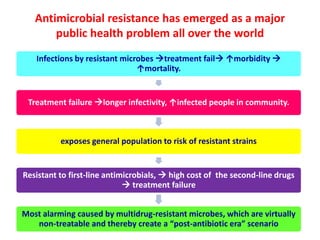
Antimicrobial resistance has emerged as a major
public health problem all over the world
Infections by resistant microbes treatment fail ↑morbidity 
↑mortality.
Treatment failure longer infectivity, ↑infected people in community.
exposes general population to risk of resistant strains
Resistant to first-line antimicrobials,  high cost of the second-line drugs
 treatment failure
Most alarming caused by multidrug-resistant microbes, which are virtually
non-treatable and thereby create a “post-antibiotic era” scenario
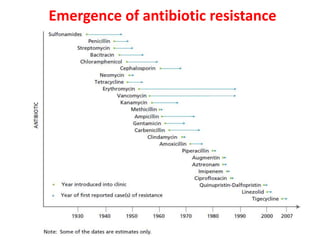
Emergence of antibiotic resistance
5. Pray LA Insight Pharma Reports 2008, in Looke D ‘The Real Threat of Antibiotic Resistance’ 2012
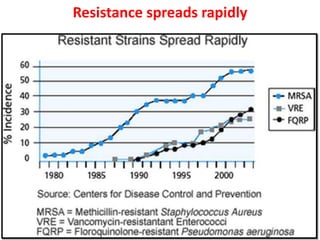
Resistance spreads rapidly
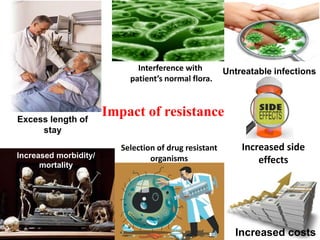
Impact of resistance
Untreatable infections
Excess length of
stay
Increased morbidity/
mortality
Increased costs
Interference with
patient’s normal flora.
Selection of drug resistant
organisms
Increased side
effects
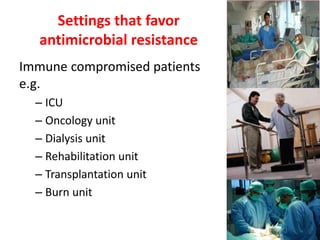
Settings that favor
antimicrobial resistance
Immune compromised patients
e.g.
– ICU
– Oncology unit
– Dialysis unit
– Rehabilitation unit
– Transplantation unit
– Burn unit
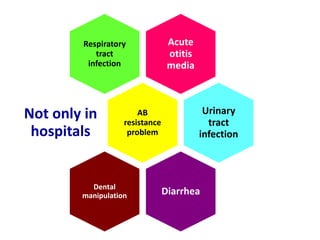
Acute
otitis
media
Respiratory
tract
infection
AB
resistance
problem
Not only in
hospitals
Urinary
tract
infection
DiarrheaDental
manipulation
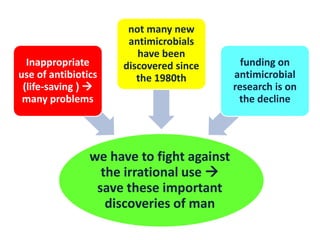
we have to fight against
the irrational use 
save these important
discoveries of man
Inappropriate
use of antibiotics
(life-saving ( 
many problems
not many new
antimicrobials
have been
discovered since
the 1980th
funding on
antimicrobial
research is on
the decline
Antibiotic policy
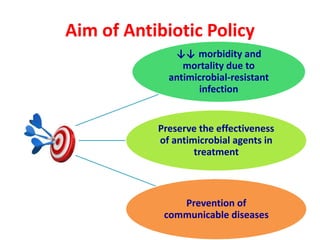
Aim of Antibiotic Policy
↓↓ morbidity and
mortality due to
antimicrobial-resistant
infection
Preserve the effectiveness
of antimicrobial agents in
treatment
Prevention of
communicable diseases
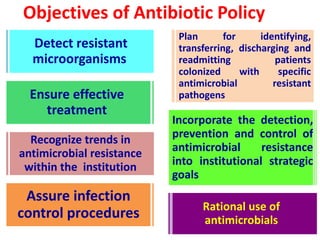
Detect resistant
microorganisms
Ensure effective
treatment
Recognize trends in
antimicrobial resistance
within the institution
Assure infection
control procedures
Plan for identifying,
transferring, discharging and
readmitting patients
colonized with specific
antimicrobial resistant
pathogens
Incorporate the detection,
prevention and control of
antimicrobial resistance
into institutional strategic
goals
Rational use of
antimicrobials
Objectives of Antibiotic Policy
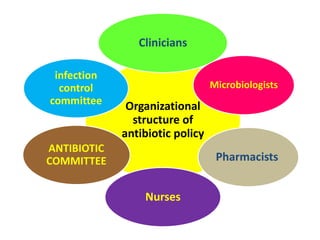
Organizational
structure of
antibiotic policy
Clinicians
Microbiologists
Pharmacists
Nurses
ANTIBIOTIC
COMMITTEE
infection
control
committee
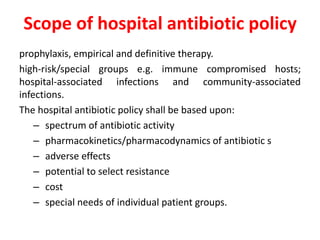
Scope of hospital antibiotic policy
prophylaxis, empirical and definitive therapy.
high-risk/special groups e.g. immune compromised hosts;
hospital-associated infections and community-associated
infections.
The hospital antibiotic policy shall be based upon:
– spectrum of antibiotic activity
– pharmacokinetics/pharmacodynamics of antibiotic s
– adverse effects
– potential to select resistance
– cost
– special needs of individual patient groups.
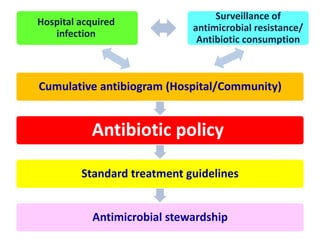
Cumulative antibiogram (Hospital/Community)
Antibiotic policy
Standard treatment guidelines
Antimicrobial stewardship
Hospital acquired
infection
Surveillance of
antimicrobial resistance/
Antibiotic consumption
Surveillance of antimicrobial
resistance
• Use standards
• Generate reliable numerator: only the first positive
culture from the patient for each disease episode
should be reported for surveillance purposes.
• Express resistance as incidence rate
• Participate in external quality assessment schemes
• Prediction of evolution of antimicrobial resistance
• Surveillance of antimicrobial consumption
Cumulative antibiogram
• Analyses of data regularly, at least annually.
• Inclusion of diagnostic isolates.
• It is useful to stratify results by specimens type or
infection site, by nursing unit or site of care, by
organism’s resistance characteristics, by clinical
service or patient population.
• Reviewing the cumulative antibiogram data if clinical
failure occurs after empiric therapy.
• Comparing the cumulative antibiogram with national
data.
Development of standard treatment
guidelines
• Should be based on local antibiograms.
• Should be syndrome/diseased based.
• Should specify type of clinical setting – Outpatient
clinics, Inpatient units, ICU setting.
• Should involve treating physicians to bring ownership
to the guidelines
Direction of antibiotic policy
Frame the hospital own list of therapeutic antibiotic
categories:
• First-line
• Reserved agents
• Restricted agents
• Withdrawn agents
for example, first choice antibiotics can be prescribed by all
doctors
while restricted choice antibiotics can only be prescribed after
consulting the head of the department or the antimicrobial
team (AMT) representative.
Reserve antibiotics, are prescribed only by designated experts.
Minimizing selection of resistant organisms
What should not be done
• Treat non-infectious or nonbacterial
syndrome.
• Treat colonization or contamination.
• Treat longer than necessary.
• Fail to make adjustment in a timely manner.
• Prescribe antibiotic with spectrum of activity
not indicated.
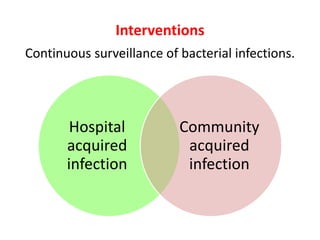
Interventions
Continuous surveillance of bacterial infections.
Hospital
acquired
infection
Community
acquired
infection
Interventions
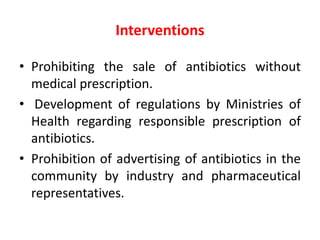
• Prohibiting the sale of antibiotics without
medical prescription.
• Development of regulations by Ministries of
Health regarding responsible prescription of
antibiotics.
• Prohibition of advertising of antibiotics in the
community by industry and pharmaceutical
representatives.
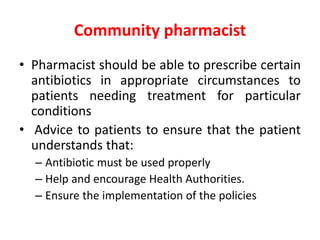
Community pharmacist
• Pharmacist should be able to prescribe certain
antibiotics in appropriate circumstances to
patients needing treatment for particular
conditions
• Advice to patients to ensure that the patient
understands that:
– Antibiotic must be used properly
– Help and encourage Health Authorities.
– Ensure the implementation of the policies
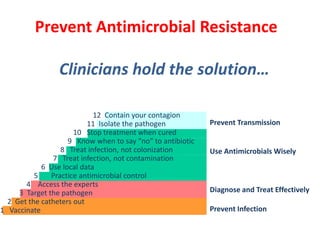
Prevent Antimicrobial Resistance
12 Contain your contagion
11 Isolate the pathogen
10 Stop treatment when cured
9 Know when to say “no” to antibiotic
8 Treat infection, not colonization
7 Treat infection, not contamination
6 Use local data
5 Practice antimicrobial control
4 Access the experts
3 Target the pathogen
2 Get the catheters out
1 Vaccinate
Prevent Transmission
Use Antimicrobials Wisely
Diagnose and Treat Effectively
Prevent Infection
Clinicians hold the solution…
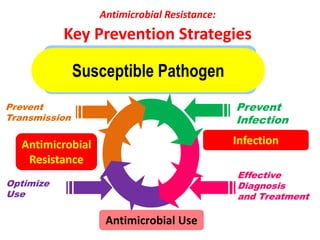
Antimicrobial Resistance:
Key Prevention Strategies
Optimize
Use
Prevent
Transmission
Prevent
Infection
Effective
Diagnosis
and Treatment
Pathogen
Antimicrobial-Resistant
Pathogen
Antimicrobial
Resistance
Antimicrobial Use
Infection
Susceptible Pathogen
Antibiotic
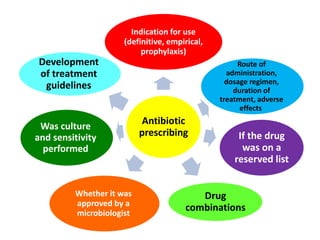
prescribing
Indication for use
(definitive, empirical,
prophylaxis)
Route of
administration,
dosage regimen,
duration of
treatment, adverse
effects
If the drug
was on a
reserved list
Drug
combinations
Whether it was
approved by a
microbiologist
Was culture
and sensitivity
performed
Development
of treatment
guidelines
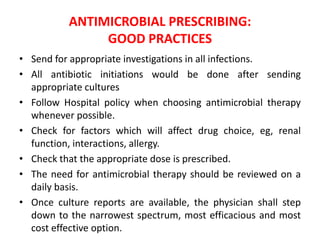
ANTIMICROBIAL PRESCRIBING:
GOOD PRACTICES
• Send for appropriate investigations in all infections.
• All antibiotic initiations would be done after sending
appropriate cultures
• Follow Hospital policy when choosing antimicrobial therapy
whenever possible.
• Check for factors which will affect drug choice, eg, renal
function, interactions, allergy.
• Check that the appropriate dose is prescribed.
• The need for antimicrobial therapy should be reviewed on a
daily basis.
• Once culture reports are available, the physician shall step
down to the narrowest spectrum, most efficacious and most
cost effective option.
Empiric Therapy
Where delay in initiating therapy to await
microbiological results would be life threatening or risk
serious morbidity, antimicrobial therapy based on a
clinically defined infection is justified.
Where empiric therapy is used, the accuracy of
diagnosis should be reviewed regularly and treatment
altered/stopped when microbiological results become
available.
Empiric Therapy
Side effects empirical antibiotics :
• Development of resistance in pathogens infecting the
patient.
• Risk for spread of resistance.
• Suppression of normal flora.
• Development of resistance in normal flora.
• Risk for super infection.
Hand Washing is Important Because…
Hand hygiene compliance rates of 10%-40%
have been observed in the developed
countries.
• Policy should be reviewed by experts
who are not the members of the
policy development group, but are
experts in the relevant field.
Revise
policy
• Policy is not static. It is a living
document. It should be reviewed at
periodic intervals, updated according
to current medical knowledge, clinical
practice and local circumstances.
Revise
policy
THANK YOU

Antibiotic policy

  • 1.
    WISAM GATEA HANI B.PHARMACY SRIVENKTESHWARA COLLEGE OF PHARMACY
  • 2.
    Rational Use ofAntibiotics The conference of experts on the rational use of drugs, by the WHO in 1985 defined that “Rational use of drugs requires that patients receive medications appropriately to their clinical needs, in doses that meet their own individual requirements for an adequate period of time, at the lowest cost to them and their community”
  • 3.
    Reasons for Patient Concerns • Wantclear explanation • Green nasal discharge • Need to return to work Physician Concerns • Patient expects antibiotic • Diagnostic uncertainty • Time pressure Antibiotic Prescription Antibiotic Overuse
  • 4.
    What is inappropriateuse ? Unnecessary prescription of antibiotics, such as for viral infections or for prolonged prophylaxis Using broad-spectrum antibiotics when narrow- spectrum antibiotics are effective Prescribing too low or too high dose Continuing treatment for longer than necessary
  • 5.
    What is inappropriateuse ? Not prescribing according to microbiology results Omitting or delaying administration of doses Prescribing intravenous therapy when oral therapy is known to be effective and clinically safe Not taking antibiotics as prescribed
  • 6.
  • 7.
    New Resistant Bacteria Emergenceof Antibiotic Resistance Susceptible Bacteria Resistant Bacteria Resistance Gene Transfer
  • 8.
  • 9.
    Antimicrobial resistance hasemerged as a major public health problem all over the world Infections by resistant microbes treatment fail ↑morbidity  ↑mortality. Treatment failure longer infectivity, ↑infected people in community. exposes general population to risk of resistant strains Resistant to first-line antimicrobials,  high cost of the second-line drugs  treatment failure Most alarming caused by multidrug-resistant microbes, which are virtually non-treatable and thereby create a “post-antibiotic era” scenario
  • 10.
    Emergence of antibioticresistance 5. Pray LA Insight Pharma Reports 2008, in Looke D ‘The Real Threat of Antibiotic Resistance’ 2012
  • 11.
  • 13.
    Impact of resistance Untreatableinfections Excess length of stay Increased morbidity/ mortality Increased costs Interference with patient’s normal flora. Selection of drug resistant organisms Increased side effects
  • 14.
    Settings that favor antimicrobialresistance Immune compromised patients e.g. – ICU – Oncology unit – Dialysis unit – Rehabilitation unit – Transplantation unit – Burn unit
  • 16.
  • 17.
    we have tofight against the irrational use  save these important discoveries of man Inappropriate use of antibiotics (life-saving (  many problems not many new antimicrobials have been discovered since the 1980th funding on antimicrobial research is on the decline
  • 18.
  • 19.
    Aim of AntibioticPolicy ↓↓ morbidity and mortality due to antimicrobial-resistant infection Preserve the effectiveness of antimicrobial agents in treatment Prevention of communicable diseases
  • 20.
    Detect resistant microorganisms Ensure effective treatment Recognizetrends in antimicrobial resistance within the institution Assure infection control procedures Plan for identifying, transferring, discharging and readmitting patients colonized with specific antimicrobial resistant pathogens Incorporate the detection, prevention and control of antimicrobial resistance into institutional strategic goals Rational use of antimicrobials Objectives of Antibiotic Policy
  • 21.
  • 22.
    Scope of hospitalantibiotic policy prophylaxis, empirical and definitive therapy. high-risk/special groups e.g. immune compromised hosts; hospital-associated infections and community-associated infections. The hospital antibiotic policy shall be based upon: – spectrum of antibiotic activity – pharmacokinetics/pharmacodynamics of antibiotic s – adverse effects – potential to select resistance – cost – special needs of individual patient groups.
  • 23.
    Cumulative antibiogram (Hospital/Community) Antibioticpolicy Standard treatment guidelines Antimicrobial stewardship Hospital acquired infection Surveillance of antimicrobial resistance/ Antibiotic consumption
  • 24.
    Surveillance of antimicrobial resistance •Use standards • Generate reliable numerator: only the first positive culture from the patient for each disease episode should be reported for surveillance purposes. • Express resistance as incidence rate • Participate in external quality assessment schemes • Prediction of evolution of antimicrobial resistance • Surveillance of antimicrobial consumption
  • 25.
    Cumulative antibiogram • Analysesof data regularly, at least annually. • Inclusion of diagnostic isolates. • It is useful to stratify results by specimens type or infection site, by nursing unit or site of care, by organism’s resistance characteristics, by clinical service or patient population. • Reviewing the cumulative antibiogram data if clinical failure occurs after empiric therapy. • Comparing the cumulative antibiogram with national data.
  • 26.
    Development of standardtreatment guidelines • Should be based on local antibiograms. • Should be syndrome/diseased based. • Should specify type of clinical setting – Outpatient clinics, Inpatient units, ICU setting. • Should involve treating physicians to bring ownership to the guidelines
  • 27.
    Direction of antibioticpolicy Frame the hospital own list of therapeutic antibiotic categories: • First-line • Reserved agents • Restricted agents • Withdrawn agents for example, first choice antibiotics can be prescribed by all doctors while restricted choice antibiotics can only be prescribed after consulting the head of the department or the antimicrobial team (AMT) representative. Reserve antibiotics, are prescribed only by designated experts.
  • 28.
    Minimizing selection ofresistant organisms What should not be done • Treat non-infectious or nonbacterial syndrome. • Treat colonization or contamination. • Treat longer than necessary. • Fail to make adjustment in a timely manner. • Prescribe antibiotic with spectrum of activity not indicated.
  • 29.
    Interventions Continuous surveillance ofbacterial infections. Hospital acquired infection Community acquired infection
  • 30.
    Interventions • Prohibiting thesale of antibiotics without medical prescription. • Development of regulations by Ministries of Health regarding responsible prescription of antibiotics. • Prohibition of advertising of antibiotics in the community by industry and pharmaceutical representatives.
  • 31.
    Community pharmacist • Pharmacistshould be able to prescribe certain antibiotics in appropriate circumstances to patients needing treatment for particular conditions • Advice to patients to ensure that the patient understands that: – Antibiotic must be used properly – Help and encourage Health Authorities. – Ensure the implementation of the policies
  • 32.
    Prevent Antimicrobial Resistance 12Contain your contagion 11 Isolate the pathogen 10 Stop treatment when cured 9 Know when to say “no” to antibiotic 8 Treat infection, not colonization 7 Treat infection, not contamination 6 Use local data 5 Practice antimicrobial control 4 Access the experts 3 Target the pathogen 2 Get the catheters out 1 Vaccinate Prevent Transmission Use Antimicrobials Wisely Diagnose and Treat Effectively Prevent Infection Clinicians hold the solution…
  • 33.
    Antimicrobial Resistance: Key PreventionStrategies Optimize Use Prevent Transmission Prevent Infection Effective Diagnosis and Treatment Pathogen Antimicrobial-Resistant Pathogen Antimicrobial Resistance Antimicrobial Use Infection Susceptible Pathogen
  • 34.
    Antibiotic prescribing Indication for use (definitive,empirical, prophylaxis) Route of administration, dosage regimen, duration of treatment, adverse effects If the drug was on a reserved list Drug combinations Whether it was approved by a microbiologist Was culture and sensitivity performed Development of treatment guidelines
  • 35.
    ANTIMICROBIAL PRESCRIBING: GOOD PRACTICES •Send for appropriate investigations in all infections. • All antibiotic initiations would be done after sending appropriate cultures • Follow Hospital policy when choosing antimicrobial therapy whenever possible. • Check for factors which will affect drug choice, eg, renal function, interactions, allergy. • Check that the appropriate dose is prescribed. • The need for antimicrobial therapy should be reviewed on a daily basis. • Once culture reports are available, the physician shall step down to the narrowest spectrum, most efficacious and most cost effective option.
  • 36.
    Empiric Therapy Where delayin initiating therapy to await microbiological results would be life threatening or risk serious morbidity, antimicrobial therapy based on a clinically defined infection is justified. Where empiric therapy is used, the accuracy of diagnosis should be reviewed regularly and treatment altered/stopped when microbiological results become available.
  • 37.
    Empiric Therapy Side effectsempirical antibiotics : • Development of resistance in pathogens infecting the patient. • Risk for spread of resistance. • Suppression of normal flora. • Development of resistance in normal flora. • Risk for super infection.
  • 38.
    Hand Washing isImportant Because… Hand hygiene compliance rates of 10%-40% have been observed in the developed countries.
  • 39.
    • Policy shouldbe reviewed by experts who are not the members of the policy development group, but are experts in the relevant field. Revise policy • Policy is not static. It is a living document. It should be reviewed at periodic intervals, updated according to current medical knowledge, clinical practice and local circumstances. Revise policy
  • 40.