Angina Pectoris
Angina Pectoris Classic angina is characterized by substernal squeezing chest pain, occurring with stress and relieved with rest or nitroglycerin.  May radiate down the left arm  May be associated with nausea, vomiting, or diaphoresis.
Angina
Stable Angina Classification Exertional Variant Anginal Equivalent Syndrome Prinzmetal’s Angina Syndrome-X Silent Ischemia
Angina:  Exertional Coronary artery obstructions are not sufficient to result in resting myocardial ischemia.  However, when myocardial demand increases, ischemia results.
Angina:  Variant Angina Transient impairment of coronary blood supply by vasospasm or platelet aggregation Majority of patients have an atherosclerotic plaque Generalized arterial hypersensitivity Long term prognosis very good
Angina:  Prinzmetal’s Angina Spasm of a large coronary artery Transmural ischemia ST-Segment elevation at rest or with exercise Not very common
Angina:  Syndrome X Typical, exertional angina with positive exercise stress test Anatomically normal coronary arteries Reduced capacity of vasodilation in microvasculature Long term prognosis very good Calcium channel blockers and beta blockers effective
Angina:  Silent Ischemia Very common More episodes of silent than painful ischemia in the same patient Difficult to diagnose Holter monitor Exercise testing
Angina:  Treatment Goals Feel better Live longer
Angina:  Prognosis Left ventricular function Number of coronary arteries with significant stenosis Extent of jeoporized myocardium
Stable Angina Risk stratification Noninvasive testing Cardiac catheterization
Stable Angina Evaluation of LV Function Physical exam CXR Echocardiogram
Stable Angina Evaluation of Ischemia History Baseline Electrocardiogram Exercise Testing
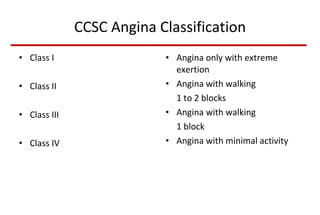
CCSC Angina Classification Class I Class II Class III Class IV Angina only with extreme exertion Angina with walking  1 to 2 blocks Angina with walking 1 block Angina with minimal activity
Angina:  Exercise Testing High Risk Patients Significant ST-segment depression at low levels of exercise and/or heart rate<130 Fall in systolic blood pressure Diminished exercise capacity Complex ventricular ectopy at low level of exercise
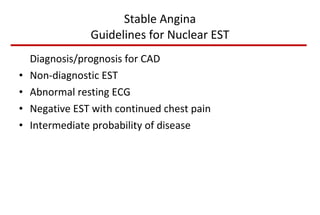
Stable Angina Guidelines for Nuclear EST Diagnosis/prognosis for CAD Non-diagnostic EST Abnormal resting ECG Negative EST with continued chest pain Intermediate probability of disease
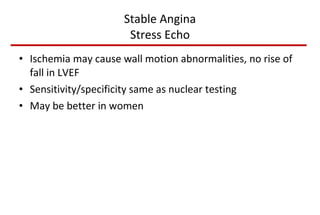
Stable Angina Stress Echo Ischemia may cause wall motion abnormalities, no rise of fall in LVEF Sensitivity/specificity same as nuclear testing May be better in women
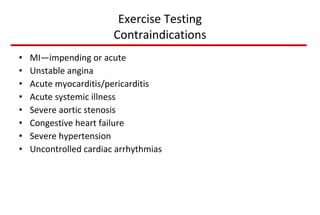
Exercise Testing Contraindications MI—impending or acute Unstable angina Acute myocarditis/pericarditis Acute systemic illness Severe aortic stenosis Congestive heart failure Severe hypertension Uncontrolled cardiac arrhythmias
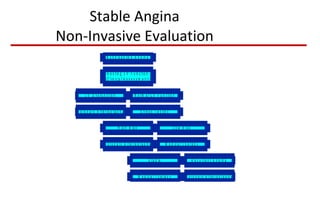
Stable Angina Non-Invasive Evaluation
Cardiac Catheterization Indications Suspicion of multi-vessel CAD Determine if CABG/PTCA feasible Rule out CAD in patients with persistent/disabling chest pain and equivocal/normal noninvasive testing
Risk Factor Modification Hypertension Smoking Dyslipidemia Diabetes Mellitus Obesity Stress Homocysteine
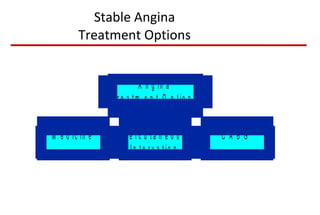
Stable Angina Treatment Options
Stable Angina Current Pharmacotherapy Beta-blockers Calcium channel blockers Nitrates Nicorandil Aspirin Statins ACE inhibitors Metabolic modulators
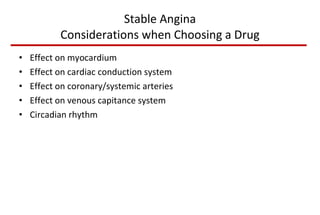
Stable Angina Considerations when Choosing a Drug Effect on myocardium Effect on cardiac conduction system Effect on coronary/systemic arteries Effect on venous capitance system Circadian rhythm
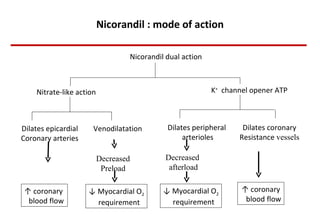
Nicorandil : mode of action Nitrate-like action K +   channel opener ATP Dilates epicardial Coronary arteries Venodilatation Dilates peripheral  arterioles Dilates coronary Resistance  vessels Decreased Preload Decreased  afterload ↑  coronary  blood flow ↓  Myocardial O 2 requirement ↓  Myocardial O 2 requirement ↑  coronary blood flow Nicorandil dual action
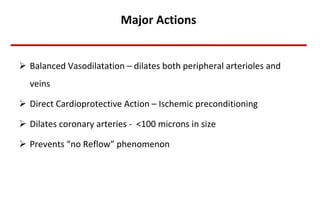
Major Actions  Balanced Vasodilatation – dilates both peripheral arterioles and veins Direct Cardioprotective Action – Ischemic preconditioning Dilates coronary arteries -  <100 microns in size Prevents “no Reflow” phenomenon
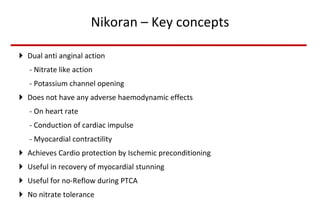
Nikoran – Key concepts Dual anti anginal action  - Nitrate like action - Potassium channel opening Does not have any adverse haemodynamic effects - On heart rate - Conduction of cardiac impulse - Myocardial contractility Achieves Cardio protection by Ischemic preconditioning Useful in recovery of myocardial stunning Useful for no-Reflow during PTCA No nitrate tolerance
Pharmacokinetics Well absorbed. No significant first-pass metabolism. Bioavailability approx 75%,C max  achieved in 30 to 60 mts. Metabolism mainly by de-nitration with less than 20% of an administered dose being excreted in the urine.  Elimination half-life of about 1 hour.  No clinically relevant modifications in the pharmacokinetic profile have been seen in the elderly or in patients with liver disease or chronic renal failure.

IV Indications Management of angina associated with ACS Unstable Angina NSTEMI STEMI Management of No-Reflow / Slow flow associated with  Thrombolysis Angioplasty CABG Oral Indications Chronic Stable Angina
Nicorandil : Oral dose Convenient Bid dosage  Start  with  5 mg twice daily  Upward  titration : 10 – 20 mg twice daily Maximum : 40 mg/ day
New class of Anti-anginals A new class of anti--anginal drugs exert primarily metabolic action. Little or no effect on coronary or hemodynamic  - Does not affect BP, HR Have considerable potential as primary and adjunctive therapy for angina, especially in patients refractory to standard therapies.
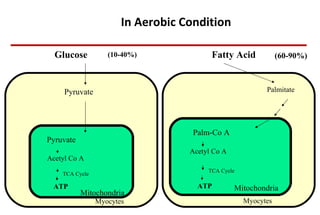
In Aerobic Condition (60-90%) Fatty Acid Myocytes Palmitate ATP Mitochondria TCA Cycle Acetyl Co A Palm-Co A Glucose Pyruvate Myocytes Pyruvate ATP Mitochondria TCA Cycle Acetyl Co A (10-40%)
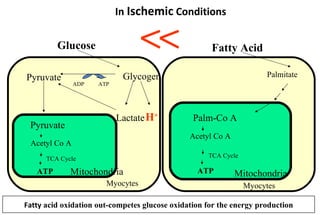
In  Ischemic  Conditions Fatty  acid oxidation out-competes glucose oxidation for the energy production Glucose Pyruvate Myocytes Glycogen Lactate H + Pyruvate ATP Mitochondria TCA Cycle Acetyl Co A ADP ATP Fatty Acid Myocytes Palmitate ATP Mitochondria TCA Cycle Acetyl Co A Palm-Co A
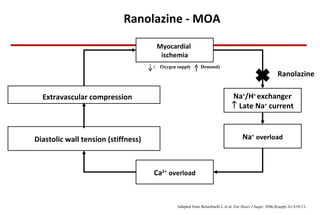
Ranolazine - MOA Adapted from Belardinelli L et al.  Eur Heart J Suppl.  2006;8(suppl A):A10-13 . Na + /H +  exchang er    Late Na +  current    Diastolic wall tension (stiffness) Extravascular  compression Na +   overload Ca 2+   overload Myocardial  ischemia Ranolazine (  Oxygen supply  Demand)
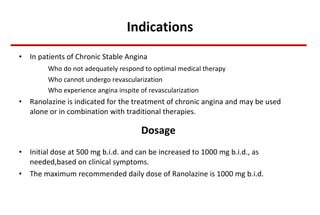
Indications In patients of Chronic Stable Angina Who do not adequately respond to optimal medical therapy Who cannot undergo revascularization Who experience angina inspite of revascularization Ranolazine is indicated for the treatment of chronic angina and may be used alone or in combination with traditional therapies. Dosage   Initial dose at 500 mg b.i.d. and can be increased to 1000 mg b.i.d., as needed,based on clinical symptoms. The maximum recommended daily dose of Ranolazine is 1000 mg b.i.d .
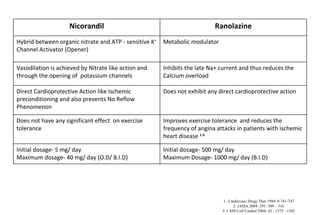
1.  Cardiovasc Drugs Ther 1994: 8 741-747 2. JAMA 2004: 291: 309 – 316 3. J AM Coll Cardiol 2004: 43 : 1375 - 1382 Nicorandil Ranolazine Hybrid between organic nitrate and ATP - sensitive K +  Channel Activator (Opener) Metabolic modulator Vasodilation is achieved by Nitrate like action and through the opening of  potassium channels Inhibits the late Na+ current and thus reduces the Calcium overload Direct Cardioprotective Action like Ischemic preconditioning and also prevents No Reflow Phenomenon Does not exhibit any direct cardioprotective action Does not have any significant effect  on exercise tolerance Improves exercise tolerance  and reduces the frequency of angina attacks in patients with ischemic heart disease   1-3 Initial dosage- 5 mg/ day Maximum dosage- 40 mg/ day (O.D/ B.I.D) Initial dosage- 500 mg/ day Maximum Dosage- 1000 mg/ day (B.I.D)
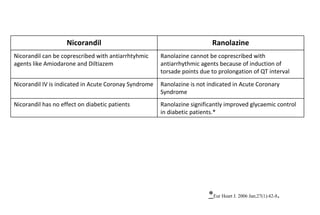
* Eur Heart J. 2006 Jan;27(1):42-8 .  Nicorandil can be coprescribed with antiarrhtyhmic agents like Amiodarone and Diltiazem Ranolazine cannot be coprescribed with antiarrhythmic agents because of induction of torsade points due to prolongation of QT interval Nicorandil IV is indicated in Acute Coronay Syndrome Ranolazine is not indicated in Acute Coronary Syndrome Nicorandil has no effect on diabetic patients Ranolazine significantly improved glycaemic control in diabetic patients.* Nicorandil Ranolazine
Thank You

Antianginals

  • 1.
  • 2.
    Angina Pectoris Classicangina is characterized by substernal squeezing chest pain, occurring with stress and relieved with rest or nitroglycerin. May radiate down the left arm May be associated with nausea, vomiting, or diaphoresis.
  • 3.
  • 4.
    Stable Angina ClassificationExertional Variant Anginal Equivalent Syndrome Prinzmetal’s Angina Syndrome-X Silent Ischemia
  • 5.
    Angina: ExertionalCoronary artery obstructions are not sufficient to result in resting myocardial ischemia. However, when myocardial demand increases, ischemia results.
  • 6.
    Angina: VariantAngina Transient impairment of coronary blood supply by vasospasm or platelet aggregation Majority of patients have an atherosclerotic plaque Generalized arterial hypersensitivity Long term prognosis very good
  • 7.
    Angina: Prinzmetal’sAngina Spasm of a large coronary artery Transmural ischemia ST-Segment elevation at rest or with exercise Not very common
  • 8.
    Angina: SyndromeX Typical, exertional angina with positive exercise stress test Anatomically normal coronary arteries Reduced capacity of vasodilation in microvasculature Long term prognosis very good Calcium channel blockers and beta blockers effective
  • 9.
    Angina: SilentIschemia Very common More episodes of silent than painful ischemia in the same patient Difficult to diagnose Holter monitor Exercise testing
  • 10.
    Angina: TreatmentGoals Feel better Live longer
  • 11.
    Angina: PrognosisLeft ventricular function Number of coronary arteries with significant stenosis Extent of jeoporized myocardium
  • 12.
    Stable Angina Riskstratification Noninvasive testing Cardiac catheterization
  • 13.
    Stable Angina Evaluationof LV Function Physical exam CXR Echocardiogram
  • 14.
    Stable Angina Evaluationof Ischemia History Baseline Electrocardiogram Exercise Testing
  • 15.
    CCSC Angina ClassificationClass I Class II Class III Class IV Angina only with extreme exertion Angina with walking 1 to 2 blocks Angina with walking 1 block Angina with minimal activity
  • 16.
    Angina: ExerciseTesting High Risk Patients Significant ST-segment depression at low levels of exercise and/or heart rate<130 Fall in systolic blood pressure Diminished exercise capacity Complex ventricular ectopy at low level of exercise
  • 17.
    Stable Angina Guidelinesfor Nuclear EST Diagnosis/prognosis for CAD Non-diagnostic EST Abnormal resting ECG Negative EST with continued chest pain Intermediate probability of disease
  • 18.
    Stable Angina StressEcho Ischemia may cause wall motion abnormalities, no rise of fall in LVEF Sensitivity/specificity same as nuclear testing May be better in women
  • 19.
    Exercise Testing ContraindicationsMI—impending or acute Unstable angina Acute myocarditis/pericarditis Acute systemic illness Severe aortic stenosis Congestive heart failure Severe hypertension Uncontrolled cardiac arrhythmias
  • 20.
  • 21.
    Cardiac Catheterization IndicationsSuspicion of multi-vessel CAD Determine if CABG/PTCA feasible Rule out CAD in patients with persistent/disabling chest pain and equivocal/normal noninvasive testing
  • 22.
    Risk Factor ModificationHypertension Smoking Dyslipidemia Diabetes Mellitus Obesity Stress Homocysteine
  • 23.
  • 24.
    Stable Angina CurrentPharmacotherapy Beta-blockers Calcium channel blockers Nitrates Nicorandil Aspirin Statins ACE inhibitors Metabolic modulators
  • 25.
    Stable Angina Considerationswhen Choosing a Drug Effect on myocardium Effect on cardiac conduction system Effect on coronary/systemic arteries Effect on venous capitance system Circadian rhythm
  • 26.
    Nicorandil : modeof action Nitrate-like action K + channel opener ATP Dilates epicardial Coronary arteries Venodilatation Dilates peripheral arterioles Dilates coronary Resistance vessels Decreased Preload Decreased afterload ↑ coronary blood flow ↓ Myocardial O 2 requirement ↓ Myocardial O 2 requirement ↑ coronary blood flow Nicorandil dual action
  • 27.
    Major Actions Balanced Vasodilatation – dilates both peripheral arterioles and veins Direct Cardioprotective Action – Ischemic preconditioning Dilates coronary arteries - <100 microns in size Prevents “no Reflow” phenomenon
  • 28.
    Nikoran – Keyconcepts Dual anti anginal action - Nitrate like action - Potassium channel opening Does not have any adverse haemodynamic effects - On heart rate - Conduction of cardiac impulse - Myocardial contractility Achieves Cardio protection by Ischemic preconditioning Useful in recovery of myocardial stunning Useful for no-Reflow during PTCA No nitrate tolerance
  • 29.
    Pharmacokinetics Well absorbed.No significant first-pass metabolism. Bioavailability approx 75%,C max achieved in 30 to 60 mts. Metabolism mainly by de-nitration with less than 20% of an administered dose being excreted in the urine. Elimination half-life of about 1 hour. No clinically relevant modifications in the pharmacokinetic profile have been seen in the elderly or in patients with liver disease or chronic renal failure.
  • 30.
    IV Indications Managementof angina associated with ACS Unstable Angina NSTEMI STEMI Management of No-Reflow / Slow flow associated with Thrombolysis Angioplasty CABG Oral Indications Chronic Stable Angina
  • 31.
    Nicorandil : Oraldose Convenient Bid dosage Start with 5 mg twice daily Upward titration : 10 – 20 mg twice daily Maximum : 40 mg/ day
  • 32.
    New class ofAnti-anginals A new class of anti--anginal drugs exert primarily metabolic action. Little or no effect on coronary or hemodynamic - Does not affect BP, HR Have considerable potential as primary and adjunctive therapy for angina, especially in patients refractory to standard therapies.
  • 33.
    In Aerobic Condition(60-90%) Fatty Acid Myocytes Palmitate ATP Mitochondria TCA Cycle Acetyl Co A Palm-Co A Glucose Pyruvate Myocytes Pyruvate ATP Mitochondria TCA Cycle Acetyl Co A (10-40%)
  • 34.
    In Ischemic Conditions Fatty acid oxidation out-competes glucose oxidation for the energy production Glucose Pyruvate Myocytes Glycogen Lactate H + Pyruvate ATP Mitochondria TCA Cycle Acetyl Co A ADP ATP Fatty Acid Myocytes Palmitate ATP Mitochondria TCA Cycle Acetyl Co A Palm-Co A
  • 35.
    Ranolazine - MOAAdapted from Belardinelli L et al. Eur Heart J Suppl. 2006;8(suppl A):A10-13 . Na + /H + exchang er  Late Na + current  Diastolic wall tension (stiffness) Extravascular compression Na + overload Ca 2+ overload Myocardial ischemia Ranolazine ( Oxygen supply Demand)
  • 36.
    Indications In patientsof Chronic Stable Angina Who do not adequately respond to optimal medical therapy Who cannot undergo revascularization Who experience angina inspite of revascularization Ranolazine is indicated for the treatment of chronic angina and may be used alone or in combination with traditional therapies. Dosage Initial dose at 500 mg b.i.d. and can be increased to 1000 mg b.i.d., as needed,based on clinical symptoms. The maximum recommended daily dose of Ranolazine is 1000 mg b.i.d .
  • 37.
    1. CardiovascDrugs Ther 1994: 8 741-747 2. JAMA 2004: 291: 309 – 316 3. J AM Coll Cardiol 2004: 43 : 1375 - 1382 Nicorandil Ranolazine Hybrid between organic nitrate and ATP - sensitive K + Channel Activator (Opener) Metabolic modulator Vasodilation is achieved by Nitrate like action and through the opening of potassium channels Inhibits the late Na+ current and thus reduces the Calcium overload Direct Cardioprotective Action like Ischemic preconditioning and also prevents No Reflow Phenomenon Does not exhibit any direct cardioprotective action Does not have any significant effect on exercise tolerance Improves exercise tolerance and reduces the frequency of angina attacks in patients with ischemic heart disease 1-3 Initial dosage- 5 mg/ day Maximum dosage- 40 mg/ day (O.D/ B.I.D) Initial dosage- 500 mg/ day Maximum Dosage- 1000 mg/ day (B.I.D)
  • 38.
    * Eur HeartJ. 2006 Jan;27(1):42-8 . Nicorandil can be coprescribed with antiarrhtyhmic agents like Amiodarone and Diltiazem Ranolazine cannot be coprescribed with antiarrhythmic agents because of induction of torsade points due to prolongation of QT interval Nicorandil IV is indicated in Acute Coronay Syndrome Ranolazine is not indicated in Acute Coronary Syndrome Nicorandil has no effect on diabetic patients Ranolazine significantly improved glycaemic control in diabetic patients.* Nicorandil Ranolazine
  • 39.

Editor's Notes

  • #36 It is proposed that Na + -related Ca 2+ overload mediates a vicious cycle of ischemia begetting more ischemia. Ca 2+ overload may result in increased left ventricular diastolic tension. As a result, myocardial O 2 consumption increases and intramural small vessels are compressed, causing increased O 2 demand and decreased O 2 supply, respectively. Positive feedback during ischemia increases the imbalance between myocardial oxygen supply and demand. Na + /Ca 2+ overload and ischemia