Cardiac  Electrophysiology
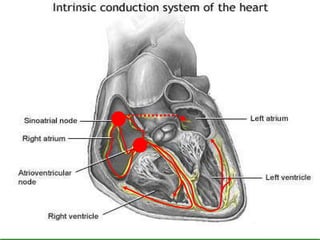
Cardiac Electrophysiology Overview: Electrical Activity in the  normal heart Voltage-activated membrane currents The conducted Action Potential How Pacemaker activity arises Action Potential in ventricular muscle
OVERVIEW: ELECTRICAL ACTIVITY IN THE  NORMAL HEART
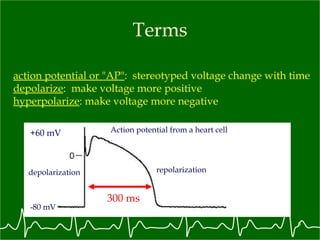
Terms action potential or "AP" :  stereotyped voltage change with time depolarize :  make voltage more positive hyperpolarize : make voltage more negative depolarization repolarization Action potential from a heart cell -80 mV +60 mV 300 ms
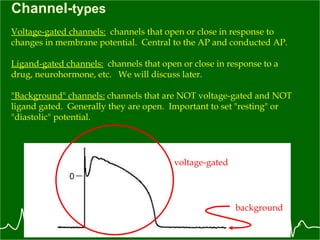
Channel- types Voltage-gated channels:   channels that open or close in response to changes in membrane potential.  Central to the AP and conducted AP. "Background" channels:  channels that are NOT voltage-gated and NOT ligand gated.  Generally they are open.  Important to set "resting" or "diastolic" potential. Ligand-gated channels:   channels that open or close in response to a drug, neurohormone, etc.  We will discuss later. voltage-gated background
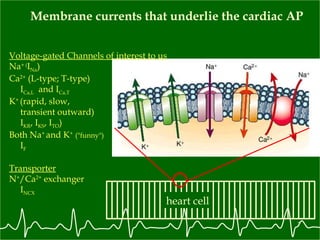
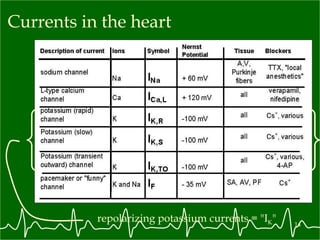
Membrane currents that underlie the cardiac AP Voltage-gated Channels of interest to us Na + ( I Na ) Ca 2+  (L-type; T-type)   I Ca,L   and I Ca,T K +  (rapid, slow,   transient outward)   I KR , I KS , I TO ) Both Na +  and K +   ("funny")   I F Transporter N + /Ca 2+  exchanger   I NCX heart cell
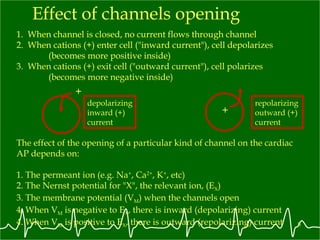
Effect of channels opening 1.  When channel is closed, no current flows through channel  2.  When cations (+) enter cell ("inward current"), cell depolarizes  (becomes more positive inside) The effect of the opening of a particular kind of channel on the cardiac AP depends on: 1. The permeant ion (e.g. Na + , Ca 2+ , K + , etc)  2. The Nernst potential for "X", the relevant ion, (E X ) 3. The membrane potential (V M ) when the channels open 4. When V M  is negative to E X , there is inward (depolarizing) current  4. When V M  is positive to E X , there is outward (repolarizing) current  1.  When channel is closed, no current flows through channel  2.  When cations (+) enter cell ("inward current"), cell depolarizes  (becomes more positive inside) 3.  When cations (+) exit cell ("outward current"), cell polarizes  (becomes more negative inside) depolarizing inward (+)  current + repolarizing outward (+)  current +
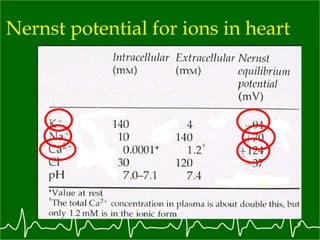
Nernst potential for ions in heart -41
Nernst Potential for Ion "X" if K o  were 1 mM and K i  were 100 mM then E K  = -120 mV For a positive monovalent ion R="gas constant" T=temperature ( o  K) Z=valence F=Faraday  10 5  Coulomb/Mole E X  = 60 mV log ([X + ] o /[X + ] i ) .
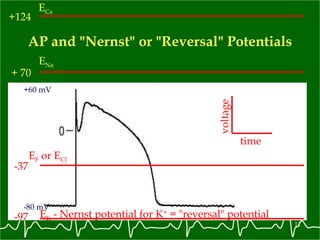
AP and "Nernst" or "Reversal" Potentials -80 mV +60 mV -97 E K  - Nernst potential for K +  = "reversal" potential -37 E F  or E Cl   + 70 E Na   +124  E Ca   time voltage
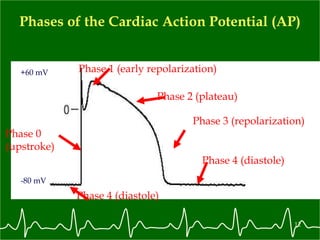
Phases of the Cardiac Action Potential (AP) -80 mV +60 mV Phase 0 (upstroke) Phase 2 (plateau) Phase 1 (early repolarization) Phase 4 (diastole) Phase 4 (diastole) Phase 3 (repolarization)
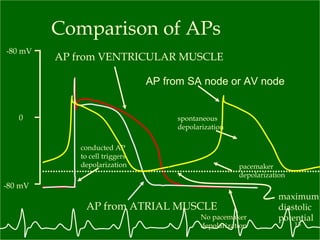
Comparison of APs pacemaker depolarization spontaneous depolarization No pacemaker depolarization conducted AP to cell triggers depolarization No pacemaker depolarization conducted AP to cell triggers depolarization AP from VENTRICULAR MUSCLE -80 mV -80 mV 0 maximum diastolic  potential AP from ATRIAL MUSCLE AP from SA node or AV node
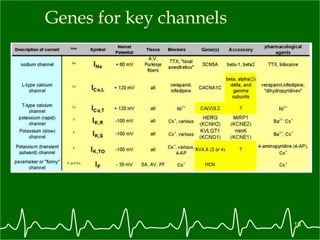
Currents in the heart repolarizing potassium currents = "I K "
Genes for key channels
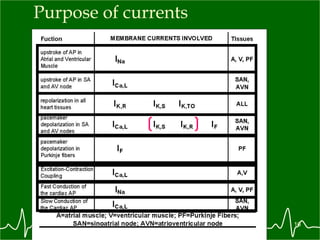
Purpose of currents
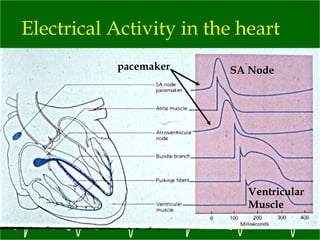
Electrical Activity in the heart SA Node Ventricular Muscle pacemaker
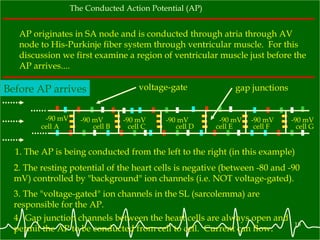
The Conducted Action Potential (AP) AP originates in SA node and is conducted through atria through AV node to His-Purkinje fiber system through ventricular muscle.  For this discussion we first examine a region of ventricular muscle just before the AP arrives....  Before AP arrives 1. The AP is being conducted from the left to the right (in this example) 3. The "voltage-gated" ion channels in the SL (sarcolemma) are responsible for the AP.  voltage-gate 4.  Gap junction channels between the heart cells are always open and permit the AP to be conducted from cell to cell.  Current can flow. gap junctions cell A  cell B  cell C  cell D  cell E  cell F  cell G  2. The resting potential of the heart cells is negative (between -80 and -90  mV) controlled by "background" ion channels (i.e. NOT voltage-gated). -90 mV -90 mV -90 mV -90 mV -90 mV -90 mV -90 mV
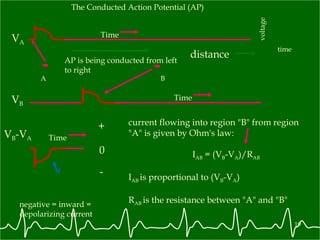
The Conducted Action Potential (AP) AP is being conducted from left to right  B A negative = inward =  depolarizing current distance time voltage V A Time V B Time V B -V A 0 + - Time current flowing into region "B" from region "A" is given by Ohm's law: I AB  = (V B -V A )/R AB I AB  is proportional to (V B -V A ) R AB  is the resistance between "A" and "B"
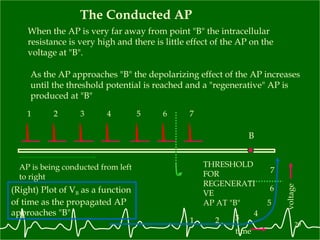
The Conducted AP When the AP is very far away from point "B" the intracellular resistance is very high and there is little effect of the AP on the voltage at "B". As the AP approaches "B" the depolarizing effect of the AP increases until the threshold potential is reached and a "regenerative" AP is produced at "B" AP is being conducted from left to right  6 6 7 7 5 5 2 2 3 3 4 4 1 1 B THRESHOLD FOR REGENERATIVE AP AT "B" voltage time (Right) Plot of V B  as a function of time as the propagated AP approaches "B"
AP propagation is slower when....  There is less inward current fewer Na +  channels activated (V or A muscle).  Example: following use of Na +  channel blocking antiarrhythmics. fewer Ca 2+  channels activated (SA or AV node).  Example: following use of Ca 2+  channel blockers.  The  threshold  for  the regenerative AP is more positive.  Example: following use of Na +  or Ca 2+  channel blockers.
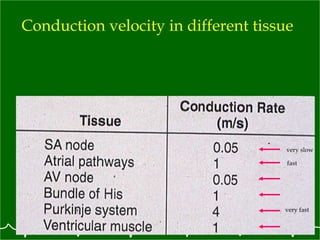
AP conduction velocity in different tissues  Depends on which currents are activated and how much Fastest : Purkinje fibers - largest number of Na +  channels.  Many Ca 2+  channels.  Fast : V and A muscle - large number of Na +  channels. Many Ca 2+  channels.  Slowest : SA and AV node.  No Na +  channels.  Ca 2+  channels underlie conducted AP.  More than enough Ca 2+  channels.
Conduction velocity in different tissue very slow fast very fast
What is V m  when multiple channels are activated?
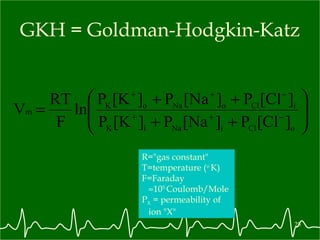
GKH = Goldman-Hodgkin-Katz R="gas constant" T=temperature ( o  K) F=Faraday  10 5  Coulomb/Mole P X  = permeability of   ion "X"
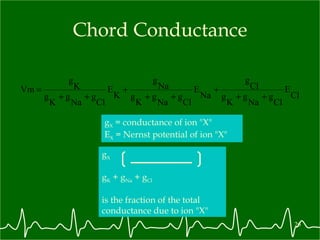
Chord Conductance g X  = conductance of ion "X" E X  = Nernst potential of ion "X" g X   g K  + g Na  + g Cl is the fraction of the total conductance due to ion "X"
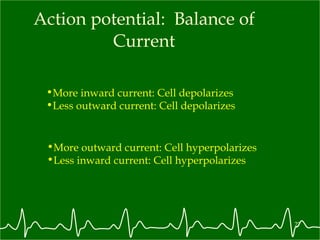
Action potential:  Balance of Current More inward current: Cell depolarizes Less outward current: Cell depolarizes More outward current: Cell hyperpolarizes Less inward current: Cell hyperpolarizes
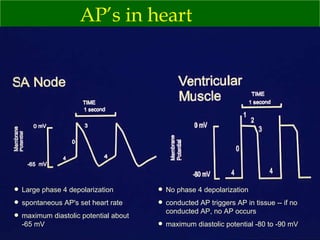
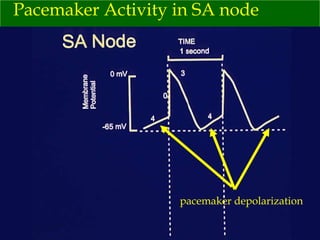
AP’s in heart No phase 4 depolarization conducted AP triggers AP in tissue -- if no conducted AP, no AP occurs maximum diastolic potential -80 to -90 mV Large phase 4 depolarization spontaneous AP's set heart rate maximum diastolic potential about -65 mV
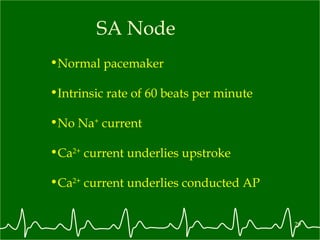
SA Node Normal pacemaker  Intrinsic rate of 60 beats per minute No Na +  current Ca 2+  current underlies upstroke Ca 2+  current underlies conducted AP
How does a pacemaker develop spontaneous activity?
Pacemaker Activity in SA node pacemaker depolarization
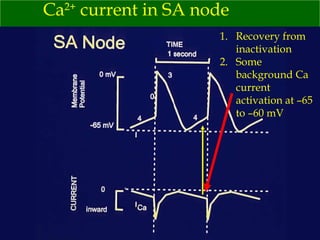
Ca 2+  current in SA node Recovery from inactivation Some background Ca current activation at –65 to –60 mV
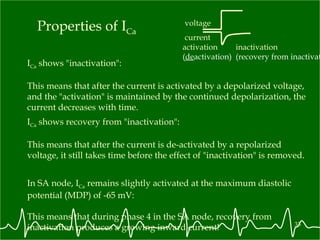
Properties of I Ca I Ca  shows "inactivation": This means that after the current is activated by a depolarized voltage, and the "activation" is maintained by the continued depolarization, the current decreases with time. I Ca  shows recovery from "inactivation": This means that after the current is de-activated by a repolarized voltage, it still takes time before the effect of "inactivation" is removed.  In SA node, I Ca  remains slightly activated at the maximum diastolic potential (MDP) of -65 mV: This means that during phase 4 in the SA node, recovery from inactivation produces a growing inward current!  voltage current inactivation (recovery from inactivation) activation ( de activation)
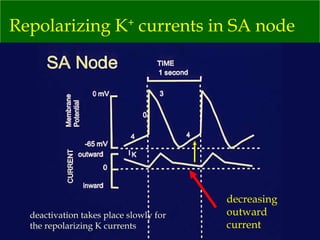
Repolarizing K +  currents in SA node deactivation takes place slowly for the repolarizing K currents decreasing outward current
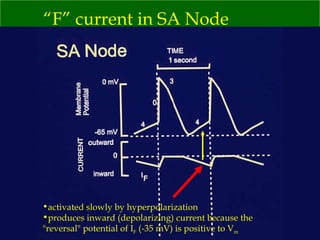
“ F” current in SA Node activated slowly by hyperpolarization produces inward (depolarizing) current because the "reversal" potential of I F  (-35 mV) is positive to V m
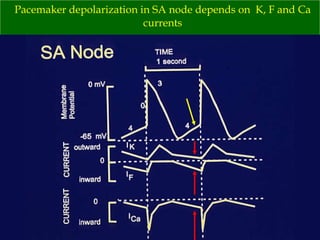
Pacemaker depolarization in SA node depends on  K, F and Ca currents
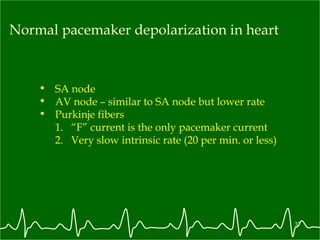
Normal pacemaker depolarization in heart SA node AV node – similar to SA node but lower rate  Purkinje fibers “ F” current is the only pacemaker current Very slow intrinsic rate (20 per min. or less)
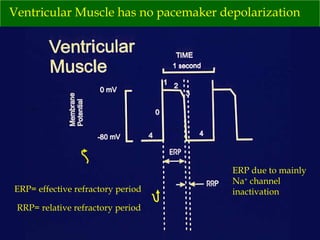
Ventricular Muscle has no pacemaker depolarization RRP= relative refractory period ERP= effective refractory period ERP due to mainly Na +  channel inactivation
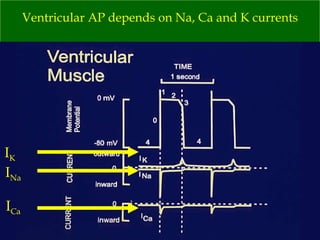
Ventricular AP depends on Na, Ca and K currents I Na I Ca I K
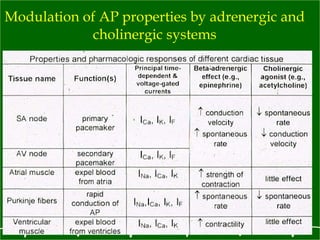
Modulation of AP properties by adrenergic and cholinergic systems
THANK YOU

Cardiac+Electrophysiology

  • 1.
  • 2.
    Cardiac Electrophysiology Overview:Electrical Activity in the normal heart Voltage-activated membrane currents The conducted Action Potential How Pacemaker activity arises Action Potential in ventricular muscle
  • 3.
    OVERVIEW: ELECTRICAL ACTIVITYIN THE NORMAL HEART
  • 5.
    Terms action potentialor "AP" : stereotyped voltage change with time depolarize : make voltage more positive hyperpolarize : make voltage more negative depolarization repolarization Action potential from a heart cell -80 mV +60 mV 300 ms
  • 6.
    Channel- types Voltage-gatedchannels: channels that open or close in response to changes in membrane potential. Central to the AP and conducted AP. "Background" channels: channels that are NOT voltage-gated and NOT ligand gated. Generally they are open. Important to set "resting" or "diastolic" potential. Ligand-gated channels: channels that open or close in response to a drug, neurohormone, etc. We will discuss later. voltage-gated background
  • 7.
    Membrane currents thatunderlie the cardiac AP Voltage-gated Channels of interest to us Na + ( I Na ) Ca 2+ (L-type; T-type) I Ca,L and I Ca,T K + (rapid, slow, transient outward) I KR , I KS , I TO ) Both Na + and K + ("funny") I F Transporter N + /Ca 2+ exchanger I NCX heart cell
  • 8.
    Effect of channelsopening 1. When channel is closed, no current flows through channel 2. When cations (+) enter cell ("inward current"), cell depolarizes (becomes more positive inside) The effect of the opening of a particular kind of channel on the cardiac AP depends on: 1. The permeant ion (e.g. Na + , Ca 2+ , K + , etc) 2. The Nernst potential for "X", the relevant ion, (E X ) 3. The membrane potential (V M ) when the channels open 4. When V M is negative to E X , there is inward (depolarizing) current 4. When V M is positive to E X , there is outward (repolarizing) current 1. When channel is closed, no current flows through channel 2. When cations (+) enter cell ("inward current"), cell depolarizes (becomes more positive inside) 3. When cations (+) exit cell ("outward current"), cell polarizes (becomes more negative inside) depolarizing inward (+) current + repolarizing outward (+) current +
  • 9.
    Nernst potential forions in heart -41
  • 10.
    Nernst Potential forIon "X" if K o were 1 mM and K i were 100 mM then E K = -120 mV For a positive monovalent ion R="gas constant" T=temperature ( o K) Z=valence F=Faraday  10 5 Coulomb/Mole E X = 60 mV log ([X + ] o /[X + ] i ) .
  • 11.
    AP and "Nernst"or "Reversal" Potentials -80 mV +60 mV -97 E K - Nernst potential for K + = "reversal" potential -37 E F or E Cl + 70 E Na +124 E Ca time voltage
  • 12.
    Phases of theCardiac Action Potential (AP) -80 mV +60 mV Phase 0 (upstroke) Phase 2 (plateau) Phase 1 (early repolarization) Phase 4 (diastole) Phase 4 (diastole) Phase 3 (repolarization)
  • 13.
    Comparison of APspacemaker depolarization spontaneous depolarization No pacemaker depolarization conducted AP to cell triggers depolarization No pacemaker depolarization conducted AP to cell triggers depolarization AP from VENTRICULAR MUSCLE -80 mV -80 mV 0 maximum diastolic potential AP from ATRIAL MUSCLE AP from SA node or AV node
  • 14.
    Currents in theheart repolarizing potassium currents = "I K "
  • 15.
    Genes for keychannels
  • 16.
  • 17.
    Electrical Activity inthe heart SA Node Ventricular Muscle pacemaker
  • 18.
    The Conducted ActionPotential (AP) AP originates in SA node and is conducted through atria through AV node to His-Purkinje fiber system through ventricular muscle. For this discussion we first examine a region of ventricular muscle just before the AP arrives.... Before AP arrives 1. The AP is being conducted from the left to the right (in this example) 3. The "voltage-gated" ion channels in the SL (sarcolemma) are responsible for the AP. voltage-gate 4. Gap junction channels between the heart cells are always open and permit the AP to be conducted from cell to cell. Current can flow. gap junctions cell A cell B cell C cell D cell E cell F cell G 2. The resting potential of the heart cells is negative (between -80 and -90 mV) controlled by "background" ion channels (i.e. NOT voltage-gated). -90 mV -90 mV -90 mV -90 mV -90 mV -90 mV -90 mV
  • 19.
    The Conducted ActionPotential (AP) AP is being conducted from left to right B A negative = inward = depolarizing current distance time voltage V A Time V B Time V B -V A 0 + - Time current flowing into region "B" from region "A" is given by Ohm's law: I AB = (V B -V A )/R AB I AB is proportional to (V B -V A ) R AB is the resistance between "A" and "B"
  • 20.
    The Conducted APWhen the AP is very far away from point "B" the intracellular resistance is very high and there is little effect of the AP on the voltage at "B". As the AP approaches "B" the depolarizing effect of the AP increases until the threshold potential is reached and a "regenerative" AP is produced at "B" AP is being conducted from left to right 6 6 7 7 5 5 2 2 3 3 4 4 1 1 B THRESHOLD FOR REGENERATIVE AP AT "B" voltage time (Right) Plot of V B as a function of time as the propagated AP approaches "B"
  • 21.
    AP propagation isslower when.... There is less inward current fewer Na + channels activated (V or A muscle). Example: following use of Na + channel blocking antiarrhythmics. fewer Ca 2+ channels activated (SA or AV node). Example: following use of Ca 2+ channel blockers. The threshold for the regenerative AP is more positive. Example: following use of Na + or Ca 2+ channel blockers.
  • 22.
    AP conduction velocityin different tissues Depends on which currents are activated and how much Fastest : Purkinje fibers - largest number of Na + channels. Many Ca 2+ channels. Fast : V and A muscle - large number of Na + channels. Many Ca 2+ channels. Slowest : SA and AV node. No Na + channels. Ca 2+ channels underlie conducted AP. More than enough Ca 2+ channels.
  • 23.
    Conduction velocity indifferent tissue very slow fast very fast
  • 24.
    What is Vm when multiple channels are activated?
  • 25.
    GKH = Goldman-Hodgkin-KatzR="gas constant" T=temperature ( o K) F=Faraday  10 5 Coulomb/Mole P X = permeability of ion "X"
  • 26.
    Chord Conductance gX = conductance of ion "X" E X = Nernst potential of ion "X" g X g K + g Na + g Cl is the fraction of the total conductance due to ion "X"
  • 27.
    Action potential: Balance of Current More inward current: Cell depolarizes Less outward current: Cell depolarizes More outward current: Cell hyperpolarizes Less inward current: Cell hyperpolarizes
  • 28.
    AP’s in heartNo phase 4 depolarization conducted AP triggers AP in tissue -- if no conducted AP, no AP occurs maximum diastolic potential -80 to -90 mV Large phase 4 depolarization spontaneous AP's set heart rate maximum diastolic potential about -65 mV
  • 29.
    SA Node Normalpacemaker Intrinsic rate of 60 beats per minute No Na + current Ca 2+ current underlies upstroke Ca 2+ current underlies conducted AP
  • 30.
    How does apacemaker develop spontaneous activity?
  • 31.
    Pacemaker Activity inSA node pacemaker depolarization
  • 32.
    Ca 2+ current in SA node Recovery from inactivation Some background Ca current activation at –65 to –60 mV
  • 33.
    Properties of ICa I Ca shows "inactivation": This means that after the current is activated by a depolarized voltage, and the "activation" is maintained by the continued depolarization, the current decreases with time. I Ca shows recovery from "inactivation": This means that after the current is de-activated by a repolarized voltage, it still takes time before the effect of "inactivation" is removed. In SA node, I Ca remains slightly activated at the maximum diastolic potential (MDP) of -65 mV: This means that during phase 4 in the SA node, recovery from inactivation produces a growing inward current! voltage current inactivation (recovery from inactivation) activation ( de activation)
  • 34.
    Repolarizing K + currents in SA node deactivation takes place slowly for the repolarizing K currents decreasing outward current
  • 35.
    “ F” currentin SA Node activated slowly by hyperpolarization produces inward (depolarizing) current because the "reversal" potential of I F (-35 mV) is positive to V m
  • 36.
    Pacemaker depolarization inSA node depends on K, F and Ca currents
  • 37.
    Normal pacemaker depolarizationin heart SA node AV node – similar to SA node but lower rate Purkinje fibers “ F” current is the only pacemaker current Very slow intrinsic rate (20 per min. or less)
  • 38.
    Ventricular Muscle hasno pacemaker depolarization RRP= relative refractory period ERP= effective refractory period ERP due to mainly Na + channel inactivation
  • 39.
    Ventricular AP dependson Na, Ca and K currents I Na I Ca I K
  • 40.
    Modulation of APproperties by adrenergic and cholinergic systems
  • 41.

Editor's Notes

  • #2 W. J. Lederer -- Cardiac electrophysiology
  • #3 W. J. Lederer -- Cardiac electrophysiology
  • #4 W. J. Lederer -- Cardiac electrophysiology
  • #5 W. J. Lederer -- Cardiac electrophysiology
  • #6 W. J. Lederer -- Cardiac electrophysiology
  • #7 W. J. Lederer -- Cardiac electrophysiology
  • #8 W. J. Lederer -- Cardiac electrophysiology
  • #9 W. J. Lederer -- Cardiac electrophysiology
  • #10 W. J. Lederer -- Cardiac electrophysiology
  • #11 W. J. Lederer -- Cardiac electrophysiology
  • #12 W. J. Lederer -- Cardiac electrophysiology
  • #13 W. J. Lederer -- Cardiac electrophysiology
  • #14 W. J. Lederer -- Cardiac electrophysiology
  • #15 W. J. Lederer -- Cardiac electrophysiology
  • #16 W. J. Lederer -- Cardiac electrophysiology
  • #17 W. J. Lederer -- Cardiac electrophysiology
  • #18 W. J. Lederer -- Cardiac electrophysiology
  • #19 W. J. Lederer -- Cardiac electrophysiology
  • #20 W. J. Lederer -- Cardiac electrophysiology
  • #21 W. J. Lederer -- Cardiac electrophysiology
  • #22 W. J. Lederer -- Cardiac electrophysiology
  • #23 W. J. Lederer -- Cardiac electrophysiology
  • #24 W. J. Lederer -- Cardiac electrophysiology
  • #25 W. J. Lederer -- Cardiac electrophysiology
  • #26 W. J. Lederer -- Cardiac electrophysiology
  • #27 W. J. Lederer -- Cardiac electrophysiology
  • #28 W. J. Lederer -- Cardiac electrophysiology
  • #29 W. J. Lederer -- Cardiac electrophysiology
  • #30 W. J. Lederer -- Cardiac electrophysiology
  • #31 W. J. Lederer -- Cardiac electrophysiology
  • #32 W. J. Lederer -- Cardiac electrophysiology
  • #33 W. J. Lederer -- Cardiac electrophysiology
  • #34 W. J. Lederer -- Cardiac electrophysiology
  • #35 W. J. Lederer -- Cardiac electrophysiology
  • #36 W. J. Lederer -- Cardiac electrophysiology
  • #37 W. J. Lederer -- Cardiac electrophysiology
  • #38 W. J. Lederer -- Cardiac electrophysiology
  • #39 W. J. Lederer -- Cardiac electrophysiology
  • #40 W. J. Lederer -- Cardiac electrophysiology
  • #41 W. J. Lederer -- Cardiac electrophysiology