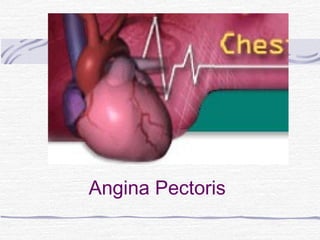

Angina Pectoris
Heart wall
Disease class
IHD
Myocardial Ischemia
Coronary Artery Disease
What this word
Angina – pain
Pectoris – Chest region
What is Angina pectoris ?
Symptom of Cardiac ischemia
Definition:Transient reversible cardiac ischemia
characterized by central chest pain or discomfort may
be radiating to,
• One or both arms
• Neck
• Jaw
• Epigastrium
or not radiating at all
Duration of chest pain
15 sec to 15 min
Generally if chest pain remains for
more than 20 min, than that severe
ischemic condition is recognised as
myocardial infarction
Epidemiology
Nearly 2,400 Americans die of CVD each day, or an
average of 1 death every 33 seconds
The syndrome of angina pectoris is reported to occur
with an average annual incidence rate (number of
new cases per time period/total number of persons in
the population for the same time period) of
approximately 1.5% (range: 0.1 to 5/1,000)
depending on the patient’s age, gender, and risk-
factor profile
Epidemiology
The presenting manifestation in women is
more commonly angina, whereas men more
frequently have myocardial infarction as the
initial event
Given the projection of large increases in IHD
throughout the world, IHD is likely to become the
most common cause of death worldwide by 2020
Epidemiology
AHA estimates that the prevalence of angina
was 8.9 million in 2004
Risk Factors ??
Classification of Angina
1. Stable (Typical/ classical/ exertional)
2. Prinzmetal (Varient)
3. Unstable (Crescendo)
Note: Remember all names, u will be
asked a Q. By any name.
Pathophysiology
Atherosclerotic plaque formation
Fibrous tissue binding
Platelet adhesion, activation and
aggregation
Thrombus formation
Inflammatory markers involvement
(Thromboxane A2, IL-1, cytokines)
Necrosis of myocardium
Pathophysiology of stable angina
Atherosclerotic plaque formation in coronary artery of
heart ( a plaque covers approx. ≥70% diameter of the
lumen)
Obstruct blood supply in coronary artery
This less blood supply is enough during resting
condition
But when there is an exertion/ emotional stress, there
will be more work load of the heart
Pathophysiology of stable angina (Cont.)
This increased workload can’t be full fulfilled as
there would be no dilation of sclerotic point
Decreased blood supply to myocardium – Ischemia
Less oxygen supply
More oxygen demand at the time of exertion can’t be
fulfilled
Resulting into chest pain at the time of exertion
(Note: Draw a figure of atherosclerotic plaque
in coronary artery)
Pathophysiology of variant angina
Vasospasm in coronary artery
Decreased blood supply to myocardium – Ischemia
Less oxygen supply
Myocardial demand wont be fullfilled
Resulting into chest pain
(Note: Draw a figure of vasospasm in coronary
artery)
Pathophysiology of Unstable
angina
Atherosclerotic plaque formation
Fibrous tissue binding
Platelet adhesion, activation and aggregation
Thrombus formation
Inflammatory markers involvement
(Thromboxane A2, IL-1, cytokines)
Finally ischemia and decreased O2 supply
(Note: Draw appropriate labelled figure)
Clinical Presentation
Stable angina: Pain at the time of exertion
Unstable angina: Has symptoms even at rest and
the severity and duration of pain is very high
Variant angina: More likely to experience pain at
rest and early morning hours
Symptoms
Pattern of pain: It mainly causes squeezing,
tightness, pressure, constriction, fullness in the
chest, band-like sensation, heavy weight on
chest
Other symptoms may include nausea,
indigestion, diaphoresis, dizziness, light
headedness, and fatigue
Diagnosis
Clinical presentations
ECG: ST segment elevation/
depression & or T wave inversion
Stress Testing: Using treadmill, chest
discomfort, dyspnea, ST segment
depression, SBP, v. tachycardia
Cardiac Imaging: Thallium 201 and
technetium 99 for perfusion defect
Diagnosis
Coronary Arteriography
For unstable angina,
Cardiac Biomarkers: CK-MB, Troponin
Supplementary test: chest X-ray
Goals of therapy
The major goals of the therapy are as
follows:
To prevent angina pains as much as
possible, and to ease pain quickly if it
occurs
To limit further deposits of atheroma as
much as possible. This prevents or delays
the condition from getting worse
To reduce the risk of having a heart attack
Concept of therapy
Classical: reduce work, will reduce O2
demand – Nitrates
Prinzmetal: vaso-spasm, use coronary
vaso-dilators – CCB
Concept of therapy
Unstable:
1.Anti-platelets
2.thrombolytics
3.O2 supply
4.Decrease work of myocardium
5.Coronary artery dilators
Note: The algorithm in previous slide
was for the management of angina
(esp. Stable) Study and understand it
Nitrates
Rapidly absorbed orally
Nitroglycerine undergoes extensive first
pass metabolism
Isosorbide dinitrate is metabolised
extensively in the liver to isosorbide-5-
mononitrate and 2-mononitrate
5-mononitrate when used as a drug is
completely absorbed.
SHORT-ACTING AGENTS:
Sublingual TNG 0.3–0.6 mg (As
needed)
Aerosol TNG 0.4 mg (1 inhalation) (As
needed)
Sublingual ISDN 2.5–10 mg (As
needed)
LONG-ACTING AGENTS:
ISDN - Oral 5–30 mg tid
-Sustained-action 40 mg bid
(once in A.M., then 7 hr later)
TNG ointment (2%) 0.5–2 qid (with one
7- to 10-h nitrate-free interval)
TNG skin patches 0.1–0.6 mg/h Apply
in morning, remove at bedtime
ISMO- Oral 20–40 mg bid (once in A.M.,
then 7 h later) Sustained-action 30–240
mg qd
ADRs of Nitrates
Headache (throbbing) (Most common)
Facial flushing
Postural hypotension (Orthostatic)
Reflux tachycardia
Monday morning disease
Precautions and counselling points for
nitrates
Contra-indicated with Sildenafil (or other
PDE-5 inhibitors)
Nitrate tolerance – to avoid it keep nitrate free
interval, use beta-blockers
Prophylactic use of nitrare- before exercise
Storage precautions (deteriorates in direct
exposure to air, moisture and sun-light)
Beta blockers
Reduce myocardial oxygen demand by
decreasing the increase in heart rate, arterial
pressure and myocardial contractility caused
by adrenergic stimulation
Action most prominent during exercise; only
small reductions in variables at rest
Drug Dosage ADR
Propranolol Initially 40mg 2-3 times daily;
maintenance 120-240mg daily
Bradycardia, heart failure,
hypotension, bronchospasm,
conduction disorders,
peripheral vasoconstrictionAtenolol 100 mg daily in 1 or 2 doses
Acebutolol Initially 400mg once daily or
200mg twice daily
Bisoprolol Usually 5-10mg once daily, max.
20mg daily
Carvedilol Initially 12.5 twice daily, increased
after 2 days to 25mg twice daily
Metoprolol 50-100 mg 2-3 times daily
Nadolol 40mg daily, increased at weekly
intervals if required; usual max.
160mg daily
Pindolol 2.5-5mg upto 3 times daily
CI of beta-blockers
Chronic lung disease (Use
cardioselective)
Atrioventricular conduction disturbances
Severe bradycardia
Raynaud’s phenomenon
H/o mental depression
Diabetic patient on insulin therapy
DDIs
Verapamil: Left ventricular dysfunction
(decreased myocardial contractility)
Nifedipine (CHF, severe hypotension)
Increased beta blocking action by
cimetidine, oral contraceptives,
furosemide and hydralazine
Smoking: decreasd Propranolol level
Clonidine: Rebound hypertension
Alternative in CI
Use Esmolol: 50-300 mcg/kg per min
(IV)
Ultra short acting, rapid onset, less side
effects
Other option
Ivabradine
Act on If current
Initially 5mg twice daily, increasing to
7.5mg twice daily after 3-4 weeks
depending on therapeutic response
Used when Beta-blockers are CI
ADRs: Visual symptoms
(transient enhanced brightness)
Calcium channel blockers
Act on slow calcium channels (voltage-
gated L-type) – Arterial smooth muscle
and nodal tissue of the heart
Verapamil – nodal tissue & h. muscles
Nifedipine – arteriolar smooth muscles
Diltiazem - intermediate
Calcium channel blockers
Dihydropyridines – nifedipine,
amlodipine
Phenylalkylamines – Verapamil
Benzothiazepines – Diltiazem
Calcium channel blockers
Main role in prinzmetal angina
Used when beta-blockers are contra-
indicated
Drug Dosage ADR
Verapamil 80-120 mg 3 times
daily
Constipation, facial flushing, headache,
dizziness, rarely pain the gums, facial
pain, epigastric pain etc.
Diltiazem 30-80 mg 6 hourly Headache, dizziness, ankle edema,
occassionally skin rash, exfoliative dermatitis,
gingival hyperplasia, sinus bradycardia,
hypotension, palpitations
Amlodipine 2.5-5 mg daily, max.
10 mg daily
Headache, edema, fatigue, nausea, gum
hyperplasia, dry mouth, sweating,
palpitations, myalgia, etc.
Felodipine Initially 5 mg daily in
the morning, increased
if necessary to 10 mg
once daily
Flushing, headache, palpitations,
dizziness, fatigue, gravitational edema,
gum hyperplasia, urinary frequency
Nifedipine
(*long acting)
20-40 mg OD/BD Bilateral ankle edema, flushing,
headache, tachycardia, renal failure,
muscle cramps, myalgia, gingival
hyperplasia
Contra-indications and
precautions
Sick sinus syndrome (Verapamil and
diltiazem)
Second and third degree AV blocks and
hypotension (Verapamil and diltiazem)
Hypersensitivity: Nifedipine
Withdrawal syndrome of nifedipine
Cautious with beta blockers
ADRs
Verapamil: constipation (most
commom)
Other: headache, vertigo, weakness,
nervousness, pruritus, flushing and
gastric disturbances
Orthostatic hyypotension, AV block,
CHF, pedal and pulmonary edema,
ADRs
Verapamil:
Perceptual disorders (feeling of
coldnees and numbness)
Hyperprolactinemia and galactorrhoea
ADRs
Nifedipine:
Headache, tachycardia, dizziness,
fatigue, nausea, oedema, flushing,
orthostatic hypotension, tinnitus, leg
crmaps and skin reactions
Rapid withdrawl: coronary artey spasm
ADRs
Diltiazem:
Bradycardia, dizziness, headache,
flushing, dryness of mouth
Hypersensitivity, CHF, AV conduction
defects, sinus arrest
Drug-drug interactions
Beta-blockers (combined depressant
effect on myocardial contractility and AV
conduction)
Nifedipine elevate digoxin levels
Nifedipine decreases quinidine level
Verapamil with antihypertensive: severe
hypotension
Verapamil with warfarin (protein bound
drug)
Drug-drug interactions
Verapamil: Decrease level by vitamin D
and calcium
Vh
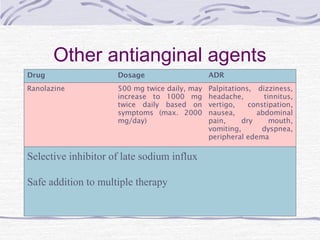
Selective inhibitor of late sodium influx
Safe addition to multiple therapy
Other antianginal agents
Drug Dosage ADR
Ranolazine 500 mg twice daily, may
increase to 1000 mg
twice daily based on
symptoms (max. 2000
mg/day)
Palpitations, dizziness,
headache, tinnitus,
vertigo, constipation,
nausea, abdominal
pain, dry mouth,
vomiting, dyspnea,
peripheral edema
Contra-indications for
Ranolazine
Hepatic impairment
Drugs associated with QTc prolongation
Drugs which inhibit CYP3A enzymes
(Verapamil, diltiazem,
Ketoconazole, macrolide antibiotics,
grape juice)
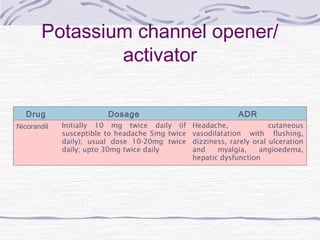
Potassium channel opener/
activator
Drug Dosage ADR
Nicorandil Initially 10 mg twice daily (if
susceptible to headache 5mg twice
daily); usual dose 10-20mg twice
daily; upto 30mg twice daily
Headache, cutaneous
vasodilatation with flushing,
dizziness, rarely oral ulceration
and myalgia, angioedema,
hepatic dysfunction
CI for IHD patients
NSAIDs : small but finite increase in MI
or mortaliy
If required, administer low dose aspirin
NONPHARMACOLOGIC
THERAPY
Revascularization:
PCI (Percutaneous coronary
intervaention)
CABG (Coronary Artery Bypass
Grafting)
Percutaneous Transluminal Coronary
Angioplasty
Non pharmacological
management
Mainly involves identification and modification of
risk factors to ischaemic heart disease.
Weight reduction: Reduction in weight may be
achieved by dietary modification and exercise.
Increased physical activity: Physical exercise
can enhance good cholesterol and reduce the risk
of bad cholesterol and heart disease and
contribute to improvement of overall health. The
patients with angina however have to be
careful and must know the level of
exercising above which it can precipitate
chest pain
Quitting smoking:
Tobacco use lowers HDL cholesterol. This could
lead to an increased risk for heart disease.
Smoking one or more packs of cigarettes per day
for several years increases the death rate by
ischaemic heart disease by 200%.
Smoking cessation reduces the risk of heart attack
to about 15-25% of that associated with continued
smoking.
Some of the techniques of smoking cessation
which are helpful include using nicotine substitutes
or some group programs or self-help programs.
Limiting alcohol consumption: Moderation in
alcohol consumption must be adopted. Ingestion of
alcohol in large amounts increases the risk of
coronary artery disease.
Stress reduction: Stress results in
hypercholesterolemia and therefore increased risk
of angina pectoris. Stress reduction with yoga and
medication is helpful.
Avoiding certain drugs: Certain drugs like
thiazide diuretics increase the risk of
cardiovascular disorders by increasing the
cholesterol levels in the body.
Note: For unstable angina; antiplatelets,
anti-coagulants and fibrinolytics classes
have been discussed in ppt of MI
THANK YOU !!!

Angina pectoris

  • 1.
  • 2.
  • 3.
  • 4.
    What this word Angina– pain Pectoris – Chest region
  • 5.
    What is Anginapectoris ? Symptom of Cardiac ischemia Definition:Transient reversible cardiac ischemia characterized by central chest pain or discomfort may be radiating to, • One or both arms • Neck • Jaw • Epigastrium or not radiating at all
  • 6.
    Duration of chestpain 15 sec to 15 min Generally if chest pain remains for more than 20 min, than that severe ischemic condition is recognised as myocardial infarction
  • 7.
    Epidemiology Nearly 2,400 Americansdie of CVD each day, or an average of 1 death every 33 seconds The syndrome of angina pectoris is reported to occur with an average annual incidence rate (number of new cases per time period/total number of persons in the population for the same time period) of approximately 1.5% (range: 0.1 to 5/1,000) depending on the patient’s age, gender, and risk- factor profile
  • 8.
    Epidemiology The presenting manifestationin women is more commonly angina, whereas men more frequently have myocardial infarction as the initial event Given the projection of large increases in IHD throughout the world, IHD is likely to become the most common cause of death worldwide by 2020
  • 9.
    Epidemiology AHA estimates thatthe prevalence of angina was 8.9 million in 2004
  • 10.
  • 11.
    Classification of Angina 1.Stable (Typical/ classical/ exertional) 2. Prinzmetal (Varient) 3. Unstable (Crescendo) Note: Remember all names, u will be asked a Q. By any name.
  • 12.
    Pathophysiology Atherosclerotic plaque formation Fibroustissue binding Platelet adhesion, activation and aggregation Thrombus formation Inflammatory markers involvement (Thromboxane A2, IL-1, cytokines) Necrosis of myocardium
  • 13.
    Pathophysiology of stableangina Atherosclerotic plaque formation in coronary artery of heart ( a plaque covers approx. ≥70% diameter of the lumen) Obstruct blood supply in coronary artery This less blood supply is enough during resting condition But when there is an exertion/ emotional stress, there will be more work load of the heart
  • 14.
    Pathophysiology of stableangina (Cont.) This increased workload can’t be full fulfilled as there would be no dilation of sclerotic point Decreased blood supply to myocardium – Ischemia Less oxygen supply More oxygen demand at the time of exertion can’t be fulfilled Resulting into chest pain at the time of exertion (Note: Draw a figure of atherosclerotic plaque in coronary artery)
  • 15.
    Pathophysiology of variantangina Vasospasm in coronary artery Decreased blood supply to myocardium – Ischemia Less oxygen supply Myocardial demand wont be fullfilled Resulting into chest pain (Note: Draw a figure of vasospasm in coronary artery)
  • 16.
    Pathophysiology of Unstable angina Atheroscleroticplaque formation Fibrous tissue binding Platelet adhesion, activation and aggregation Thrombus formation Inflammatory markers involvement (Thromboxane A2, IL-1, cytokines) Finally ischemia and decreased O2 supply (Note: Draw appropriate labelled figure)
  • 17.
    Clinical Presentation Stable angina:Pain at the time of exertion Unstable angina: Has symptoms even at rest and the severity and duration of pain is very high Variant angina: More likely to experience pain at rest and early morning hours
  • 18.
    Symptoms Pattern of pain:It mainly causes squeezing, tightness, pressure, constriction, fullness in the chest, band-like sensation, heavy weight on chest Other symptoms may include nausea, indigestion, diaphoresis, dizziness, light headedness, and fatigue
  • 19.
    Diagnosis Clinical presentations ECG: STsegment elevation/ depression & or T wave inversion Stress Testing: Using treadmill, chest discomfort, dyspnea, ST segment depression, SBP, v. tachycardia Cardiac Imaging: Thallium 201 and technetium 99 for perfusion defect
  • 20.
    Diagnosis Coronary Arteriography For unstableangina, Cardiac Biomarkers: CK-MB, Troponin Supplementary test: chest X-ray
  • 21.
    Goals of therapy Themajor goals of the therapy are as follows: To prevent angina pains as much as possible, and to ease pain quickly if it occurs To limit further deposits of atheroma as much as possible. This prevents or delays the condition from getting worse To reduce the risk of having a heart attack
  • 22.
    Concept of therapy Classical:reduce work, will reduce O2 demand – Nitrates Prinzmetal: vaso-spasm, use coronary vaso-dilators – CCB
  • 23.
    Concept of therapy Unstable: 1.Anti-platelets 2.thrombolytics 3.O2supply 4.Decrease work of myocardium 5.Coronary artery dilators
  • 25.
    Note: The algorithmin previous slide was for the management of angina (esp. Stable) Study and understand it
  • 26.
    Nitrates Rapidly absorbed orally Nitroglycerineundergoes extensive first pass metabolism Isosorbide dinitrate is metabolised extensively in the liver to isosorbide-5- mononitrate and 2-mononitrate 5-mononitrate when used as a drug is completely absorbed.
  • 27.
    SHORT-ACTING AGENTS: Sublingual TNG0.3–0.6 mg (As needed) Aerosol TNG 0.4 mg (1 inhalation) (As needed) Sublingual ISDN 2.5–10 mg (As needed)
  • 28.
    LONG-ACTING AGENTS: ISDN -Oral 5–30 mg tid -Sustained-action 40 mg bid (once in A.M., then 7 hr later) TNG ointment (2%) 0.5–2 qid (with one 7- to 10-h nitrate-free interval) TNG skin patches 0.1–0.6 mg/h Apply in morning, remove at bedtime ISMO- Oral 20–40 mg bid (once in A.M., then 7 h later) Sustained-action 30–240 mg qd
  • 29.
    ADRs of Nitrates Headache(throbbing) (Most common) Facial flushing Postural hypotension (Orthostatic) Reflux tachycardia Monday morning disease
  • 30.
    Precautions and counsellingpoints for nitrates Contra-indicated with Sildenafil (or other PDE-5 inhibitors) Nitrate tolerance – to avoid it keep nitrate free interval, use beta-blockers Prophylactic use of nitrare- before exercise Storage precautions (deteriorates in direct exposure to air, moisture and sun-light)
  • 31.
    Beta blockers Reduce myocardialoxygen demand by decreasing the increase in heart rate, arterial pressure and myocardial contractility caused by adrenergic stimulation Action most prominent during exercise; only small reductions in variables at rest
  • 32.
    Drug Dosage ADR PropranololInitially 40mg 2-3 times daily; maintenance 120-240mg daily Bradycardia, heart failure, hypotension, bronchospasm, conduction disorders, peripheral vasoconstrictionAtenolol 100 mg daily in 1 or 2 doses Acebutolol Initially 400mg once daily or 200mg twice daily Bisoprolol Usually 5-10mg once daily, max. 20mg daily Carvedilol Initially 12.5 twice daily, increased after 2 days to 25mg twice daily Metoprolol 50-100 mg 2-3 times daily Nadolol 40mg daily, increased at weekly intervals if required; usual max. 160mg daily Pindolol 2.5-5mg upto 3 times daily
  • 33.
    CI of beta-blockers Chroniclung disease (Use cardioselective) Atrioventricular conduction disturbances Severe bradycardia Raynaud’s phenomenon H/o mental depression Diabetic patient on insulin therapy
  • 34.
    DDIs Verapamil: Left ventriculardysfunction (decreased myocardial contractility) Nifedipine (CHF, severe hypotension) Increased beta blocking action by cimetidine, oral contraceptives, furosemide and hydralazine Smoking: decreasd Propranolol level Clonidine: Rebound hypertension
  • 35.
    Alternative in CI UseEsmolol: 50-300 mcg/kg per min (IV) Ultra short acting, rapid onset, less side effects
  • 36.
    Other option Ivabradine Act onIf current Initially 5mg twice daily, increasing to 7.5mg twice daily after 3-4 weeks depending on therapeutic response Used when Beta-blockers are CI ADRs: Visual symptoms (transient enhanced brightness)
  • 37.
    Calcium channel blockers Acton slow calcium channels (voltage- gated L-type) – Arterial smooth muscle and nodal tissue of the heart Verapamil – nodal tissue & h. muscles Nifedipine – arteriolar smooth muscles Diltiazem - intermediate
  • 38.
    Calcium channel blockers Dihydropyridines– nifedipine, amlodipine Phenylalkylamines – Verapamil Benzothiazepines – Diltiazem
  • 39.
    Calcium channel blockers Mainrole in prinzmetal angina Used when beta-blockers are contra- indicated
  • 40.
    Drug Dosage ADR Verapamil80-120 mg 3 times daily Constipation, facial flushing, headache, dizziness, rarely pain the gums, facial pain, epigastric pain etc. Diltiazem 30-80 mg 6 hourly Headache, dizziness, ankle edema, occassionally skin rash, exfoliative dermatitis, gingival hyperplasia, sinus bradycardia, hypotension, palpitations Amlodipine 2.5-5 mg daily, max. 10 mg daily Headache, edema, fatigue, nausea, gum hyperplasia, dry mouth, sweating, palpitations, myalgia, etc. Felodipine Initially 5 mg daily in the morning, increased if necessary to 10 mg once daily Flushing, headache, palpitations, dizziness, fatigue, gravitational edema, gum hyperplasia, urinary frequency Nifedipine (*long acting) 20-40 mg OD/BD Bilateral ankle edema, flushing, headache, tachycardia, renal failure, muscle cramps, myalgia, gingival hyperplasia
  • 41.
    Contra-indications and precautions Sick sinussyndrome (Verapamil and diltiazem) Second and third degree AV blocks and hypotension (Verapamil and diltiazem) Hypersensitivity: Nifedipine Withdrawal syndrome of nifedipine Cautious with beta blockers
  • 42.
    ADRs Verapamil: constipation (most commom) Other:headache, vertigo, weakness, nervousness, pruritus, flushing and gastric disturbances Orthostatic hyypotension, AV block, CHF, pedal and pulmonary edema,
  • 43.
    ADRs Verapamil: Perceptual disorders (feelingof coldnees and numbness) Hyperprolactinemia and galactorrhoea
  • 44.
    ADRs Nifedipine: Headache, tachycardia, dizziness, fatigue,nausea, oedema, flushing, orthostatic hypotension, tinnitus, leg crmaps and skin reactions Rapid withdrawl: coronary artey spasm
  • 45.
    ADRs Diltiazem: Bradycardia, dizziness, headache, flushing,dryness of mouth Hypersensitivity, CHF, AV conduction defects, sinus arrest
  • 46.
    Drug-drug interactions Beta-blockers (combineddepressant effect on myocardial contractility and AV conduction) Nifedipine elevate digoxin levels Nifedipine decreases quinidine level Verapamil with antihypertensive: severe hypotension Verapamil with warfarin (protein bound drug)
  • 47.
    Drug-drug interactions Verapamil: Decreaselevel by vitamin D and calcium
  • 48.
    Vh Selective inhibitor oflate sodium influx Safe addition to multiple therapy Other antianginal agents Drug Dosage ADR Ranolazine 500 mg twice daily, may increase to 1000 mg twice daily based on symptoms (max. 2000 mg/day) Palpitations, dizziness, headache, tinnitus, vertigo, constipation, nausea, abdominal pain, dry mouth, vomiting, dyspnea, peripheral edema
  • 49.
    Contra-indications for Ranolazine Hepatic impairment Drugsassociated with QTc prolongation Drugs which inhibit CYP3A enzymes (Verapamil, diltiazem, Ketoconazole, macrolide antibiotics, grape juice)
  • 50.
    Potassium channel opener/ activator DrugDosage ADR Nicorandil Initially 10 mg twice daily (if susceptible to headache 5mg twice daily); usual dose 10-20mg twice daily; upto 30mg twice daily Headache, cutaneous vasodilatation with flushing, dizziness, rarely oral ulceration and myalgia, angioedema, hepatic dysfunction
  • 51.
    CI for IHDpatients NSAIDs : small but finite increase in MI or mortaliy If required, administer low dose aspirin
  • 52.
    NONPHARMACOLOGIC THERAPY Revascularization: PCI (Percutaneous coronary intervaention) CABG(Coronary Artery Bypass Grafting) Percutaneous Transluminal Coronary Angioplasty
  • 53.
    Non pharmacological management Mainly involvesidentification and modification of risk factors to ischaemic heart disease. Weight reduction: Reduction in weight may be achieved by dietary modification and exercise. Increased physical activity: Physical exercise can enhance good cholesterol and reduce the risk of bad cholesterol and heart disease and contribute to improvement of overall health. The patients with angina however have to be careful and must know the level of exercising above which it can precipitate chest pain
  • 54.
    Quitting smoking: Tobacco uselowers HDL cholesterol. This could lead to an increased risk for heart disease. Smoking one or more packs of cigarettes per day for several years increases the death rate by ischaemic heart disease by 200%. Smoking cessation reduces the risk of heart attack to about 15-25% of that associated with continued smoking. Some of the techniques of smoking cessation which are helpful include using nicotine substitutes or some group programs or self-help programs.
  • 55.
    Limiting alcohol consumption:Moderation in alcohol consumption must be adopted. Ingestion of alcohol in large amounts increases the risk of coronary artery disease. Stress reduction: Stress results in hypercholesterolemia and therefore increased risk of angina pectoris. Stress reduction with yoga and medication is helpful. Avoiding certain drugs: Certain drugs like thiazide diuretics increase the risk of cardiovascular disorders by increasing the cholesterol levels in the body.
  • 56.
    Note: For unstableangina; antiplatelets, anti-coagulants and fibrinolytics classes have been discussed in ppt of MI
  • 57.

Editor's Notes

  • #58 This slide stays up on the screen during questions until the panel ends.