See discussions, stats, and author profiles for this publication at: https://www.researchgate.net/publication/289251560
ANTILOCK BRAKING SYSTEM (ABS)
Article · October 2014
CITATIONS
14
READS
161,808
1 author:
Some of the authors of this publication are also working on these related projects:
Numerical Study of the Aerodynamic Performance of a Slotted Airfoil View project
Sahil Jitesh
City, University of London
4 PUBLICATIONS 16 CITATIONS
SEE PROFILE
All content following this page was uploaded by Sahil Jitesh on 04 January 2016.
The user has requested enhancement of the downloaded file.
253
Int. J. Mech. Eng. & Rob. Res. 2014 Sahil Jitesh, 2014
ISSN 2278 – 0149 www.ijmerr.com
Vol. 3, No. 4, October, 2014
© 2014 IJMERR. All Rights Reserved
Research Paper
ANTILOCK BRAKING SYSTEM (ABS)
Sahil Jitesh1
*
*Corresponding Author: Sahil Jitesh  sahiljitesh@hotmail.com
Antilock Breaking System (ABS) is used in advanced automobiles to prevent slip and locking of
wheel after brakes applied. It is automobile safety system, the controller is provided to control
the necessary torque to maintain optimum slip ration. The slip ration denote in terms of vehicle
speed and wheel rotation. It’s an automated system that run on principles of threshold braking
and cadence braking which were practiced by skillful drivers with previous generation braking
system. It response time is very faster so that makes easy steering for the driver. ABS generally
offer advanced vehicle control and minimize the stopping distance in slippery and dry surface,
conversely on loose surface like gravel or snow covered pavement,ABS can significantly increase
braking distance, although still improving vehicle control.
Keywords: ABS, Antilock Brakes, Antilock Breaking system, Safety, Slip Factor, Advance
Braking System, Vehicle Stability Control, Electrical Control Unit (ECU)
1
Department of Mechanical Engineer, G.K. Bharad Institute of Engineering, Gujarat Technological University, India.
INTRODUCTION
Antilock braking system (ABS) prevent
brakes from locking during braking. In normal
braking situation the driver control the brakes,
however during severs braking or on slippery
roadways when driver the wheels to
approach lockup, the antilock takes over
here. The ABS modulates the brake line
pressure independent of the pedal force to
bring the wheel speed back to the slip level
range that necessary to the optimal braking
performance. The ABS does not allow full
wheel lock under braking.
In simple terms, during emergency of
braking, the wheel does not get locked even
if you push a full auto brake pedal and hence
the skidding does not takes place. It allowed
driver to control the car easier, even on roads
with low adhesion, such a rain, snow and
muddy road. The brain of antilock braking
system consist Electronic Control Unit (ECU),
wheel speed sensor and hydraulic modulator.
ABS is a closed circuit, hence it used the
feedback control system that modulates the
brake pressure in response to the wheel
deceleration and wheel angular velocity to
prevent the controlled wheel from locking.
SUBSYSTEM OF ANTILOCK
BRAKING SYSTEM (ABS)
Wheel-Speed Sensors
254
Int. J. Mech. Eng.  Rob. Res. 2014 Sahil Jitesh, 2014
Figure 1: ABS in BMW Bike
Figure 2: Car Dashboard Indicating ABS
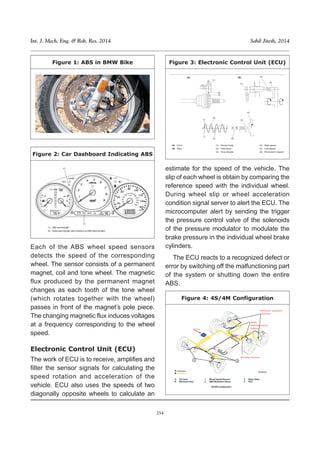
Each of the ABS wheel speed sensors
detects the speed of the corresponding
wheel. The sensor consists of a permanent
magnet, coil and tone wheel. The magnetic
flux produced by the permanent magnet
changes as each tooth of the tone wheel
(which rotates together with the wheel)
passes in front of the magnet’s pole piece.
The changing magnetic flux induces voltages
at a frequency corresponding to the wheel
speed.
Electronic Control Unit (ECU)
The work of ECU is to receive, amplifies and
filter the sensor signals for calculating the
speed rotation and acceleration of the
vehicle. ECU also uses the speeds of two
diagonally opposite wheels to calculate an
Figure 3: Electronic Control Unit (ECU)
estimate for the speed of the vehicle. The
slip of each wheel is obtain by comparing the
reference speed with the individual wheel.
During wheel slip or wheel acceleration
condition signal server to alert the ECU. The
microcomputer alert by sending the trigger
the pressure control valve of the solenoids
of the pressure modulator to modulate the
brake pressure in the individual wheel brake
cylinders.
The ECU reacts to a recognized defect or
error by switching off the malfunctioning part
of the system or shutting down the entire
ABS.
Figure 4: 4S/4M Configuration
255
Int. J. Mech. Eng.  Rob. Res. 2014 Sahil Jitesh, 2014
Hydraulic Pressure Modulator/
Hydraulic Control Unit
The Hydraulic pressure modulator is an
electro-hydraulic device for reducing, restor-
ing and holding the pressure of the wheel by
manipulating the solenoid valve in the hydrau-
lic brake system. ABS hydraulic modulator
unit contain the valve, solenoid and piston.
Under hard braking condition, this assembly
control the holding and release of the differ-
ent hydraulic brake circuit. During the nor-
mal condition the standard braking system
used.
Whenever hard braking situation occur, the
system sense the change in the rotation of
the speed sensor and decide whether to hold
or release pressure to a brake circuit. A tire
has its best traction just before it begin to
skid, once it begins to skid a portion of trac-
tion and steering will be lost.
Figure 5: Hydraulic Control Unit
ANTI-LOCK BRAKE TYPE
Different schemes of anti-lock braking system
uses depending upon the types of brakes
use. Depending upon the channel (valve) and
number of speed sensors the antilock brake
are classified.
Four Channel, Four Sensor ABS
It is a more preferable type, the speed sensor
on all the four wheels and contain separate
valve for all four wheels. By using this setup,
the controller monitors each wheel
individually to make sure it is achieving
maximum braking force.
Three Channel, Three Sensor ABS
This type of system is can be found
commonly in the pickup trucks with four wheel
ABS, on each of the front wheels there is a
valve and a speed sensor, and one valve and
one sensor for both rear wheels. The speed
sensor for rear wheels is located in the rear
axle.
To achieve the maximum braking force,
this system provides individual control to the
front wheels. The rear wheels, however, are
controlled together; they are both have to start
to lock up before the ABS will active on the
rear. With the help of this system, it's possible
that one if the rear wheels will lock during a
stop, reducing brake effectiveness.
One Channel, One Sensor ABS
This Arrangement can be seen in a pickup
trucks and heavy trucks with rear wheelABS.
It consist one valve, which operate both rear
wheel, and one speed sensor located in the
rear axle. This is quite similar as the rear end
of a three channel system. The rear wheel
are monitored together and they both have
to lockup before ABS starts its action. In this
system there is also probability that one of
the rear wheels will lock, results reducing in
brake effectiveness. This system is easy to
identify, usually there will be one brake line
going through a T-fitting to both rear wheels.
256
Int. J. Mech. Eng.  Rob. Res. 2014 Sahil Jitesh, 2014
FUNCTION OF SENSORS AND
ACTUATORS
Figure 6: Sensors and Actuators
(1) ABS control module and hydraulic
control unit (ABSCM  H/U)
(2) Two-way connector
(3) Diagnosis connector
(4) ABS warning light
(5) Data link connector (for SUBARU
select monitor)
(6) Transmission control module (AT
models only)
(7) Tone wheels
(8) ABS wheel speed sensor
(9) Wheel cylinder
(10) G sensor
(11) Stop light switch
(12) Master cylinder
(13) Brake  EBD warning light
(14) Lateral G sensor (STi)
Table 1: Function of Sensors Andactuators
ABS control module and hydraulic
control unit (ABSCM  H/U)
Name Function
ABSCM section
H/U section
Valve relay section
Motor relay section
ABS wheel speed sensors
• It determines the conditions of the wheels and the vehicle
body from the wheel speed data and controls the hydraulic
unit depending on the result.
• When the ABS is active, the ABSCM provides the
automatic transmission control module with control signals
which are used by the module for cooperative control of
the vehicle with the ABSCM.
• Whenever the ignition switch is placed at ON, the module
performs a self-diagnosis sequence. If anything wrong is
detected, the module cuts off the system.
• It communicates with the SUBARU select monitor.
• When the ABS is active, the H/U changes fluid passages
to the wheel cylinders in response to commands from the
ABSCM.
• It constitutes the brake fluid passage from the master
cylinder to the wheel cylinders together with the piping.
• It serves as a power switch for the solenoid valves and
motor relay coil. It operates in response to a command
from the ABSCM.
• It serves as a power switch for the pump motor. It operates
in response to a command from the ABSCM
These sensors detect the wheel speed in terms of a change
in the density of the magnetic flux passing through them and
257
Int. J. Mech. Eng.  Rob. Res. 2014 Sahil Jitesh, 2014
convert it into an electrical signal. The electrical signal is sent
to the ABSCM.
They give a change in the magnetic flux density by the teeth
around themselves to let the ABS wheel speed sensors
generate electrical signals.
It detects a change in acceleration in the longitudinal direction
of the vehicle and outputs it to theABSCM as a voltage signal.
Converts the variation in lateral G on the vehicle into a change
in capacity of the sensor condenser, and outputs a varying
voltage to the ABS ECU.
It provides information on whether the brake pedal is
depressed or not to the ABSCM. The ABSCM uses it to
determine ABS operation.
It alerts the driver to an ABS fault. When the diagnosis
connector and diagnosis terminal are connected, the light
flashes to indicate a diagnostic trouble code stored in the
ABSCM.
It provides gear controls (fixing the speed at 3rd or changing
power transmission to front and rear wheels) in response to
control signals from the ABSCM.
It alerts the driver to an EBD fault. This warning light is also
used for parking brake warning and brake fluid level warning.
Tone wheels
G sensor
Lateral G sensor (STi)
Stop light signal
ABS warning light
Automatic transmission control module
Brake warning light
IMPORTANTCE OF ABS
Stopping Distance
The Stopping distance is a one of the
important factor when it comes for braking.
Stopping distance is the function of vehicle
mass, its initial velocity and the braking force.
Stopping distance can be minimize by
increasing in braking force (keeping all other
factors constant). In all types of road surface
there is always exists a peak in friction
Figure 7: Effect of ABS
coefficient. An antilock system can attain
maximum fictional force and results minimum
stopping distance. This objective of antilock
systems however, is tempered by the need
for vehicle stability and steerability.
Stability
The fundamental purpose of braking system
is to decelerating and stopping of vehicle,
maximum friction force may not be described
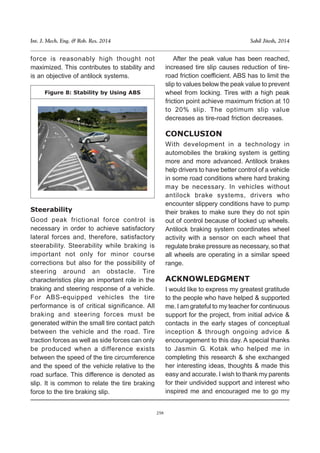
in some cases like asphalt and ice (p-split)
surface, such that significantly more braking
force is obtainable on one side of the vehicle
than on the other side. So when applying full
brake on both the sides will result yaw or
skidding moment that will tend to pull the
vehicle to the high friction side and results
vehicle instability. Here comes the concept
of antilock system that maintain the slip both
rear wheels at the same level and minimize
two friction coefficient peaks, then lateral
258
Int. J. Mech. Eng.  Rob. Res. 2014 Sahil Jitesh, 2014
force is reasonably high thought not
maximized. This contributes to stability and
is an objective of antilock systems.
Figure 8: Stability by Using ABS
Steerability
Good peak frictional force control is
necessary in order to achieve satisfactory
lateral forces and, therefore, satisfactory
steerability. Steerability while braking is
important not only for minor course
corrections but also for the possibility of
steering around an obstacle. Tire
characteristics play an important role in the
braking and steering response of a vehicle.
For ABS-equipped vehicles the tire
performance is of critical significance. All
braking and steering forces must be
generated within the small tire contact patch
between the vehicle and the road. Tire
traction forces as well as side forces can only
be produced when a difference exists
between the speed of the tire circumference
and the speed of the vehicle relative to the
road surface. This difference is denoted as
slip. It is common to relate the tire braking
force to the tire braking slip.
After the peak value has been reached,
increased tire slip causes reduction of tire-
road friction coefficient. ABS has to limit the
slip to values below the peak value to prevent
wheel from locking. Tires with a high peak
friction point achieve maximum friction at 10
to 20% slip. The optimum slip value
decreases as tire-road friction decreases.
CONCLUSION
With development in a technology in
automobiles the braking system is getting
more and more advanced. Antilock brakes
help drivers to have better control of a vehicle
in some road conditions where hard braking
may be necessary. In vehicles without
antilock brake systems, drivers who
encounter slippery conditions have to pump
their brakes to make sure they do not spin
out of control because of locked up wheels.
Antilock braking system coordinates wheel
activity with a sensor on each wheel that
regulate brake pressure as necessary, so that
all wheels are operating in a similar speed
range.
ACKNOWLEDGMENT
I would like to express my greatest gratitude
to the people who have helped  supported
me. I am grateful to my teacher for continuous
support for the project, from initial advice 
contacts in the early stages of conceptual
inception  through ongoing advice 
encouragement to this day. A special thanks
to Jasmin G. Kotak who helped me in
completing this research  she exchanged
her interesting ideas, thoughts  made this
easy and accurate. I wish to thank my parents
for their undivided support and interest who
inspired me and encouraged me to go my
259
Int. J. Mech. Eng.  Rob. Res. 2014 Sahil Jitesh, 2014
own way, at last but not the least I want to
thank my friends who appreciated me for my
work and motivated me.
REFERENCES
1. A B Sharkawy (2010), “Genetic Fuzzy
Self-tuning PID Controllers for Antilock
Braking Systems” Engineering
Applications of Artificial Intelligence, Vol.
23, pp. 1041-1052.
2. A Poursamad (2009), “Adaptive
Feedback Linearization Control of
Antilock Bracking System Using Neural
Networks”, Mechatronics, Vol. 19, pp.
767-773.
3. David W Gilbert (2001), “Magneto-
Resistive Wheel Speed Sensors”, “New
“Active” Wheel Speed Sensors Changing
ABS Diagnostic Procedures”, http://
www.asashop.org/autoinc/aug2001/
mech.cfm
4. H Mirzaeinejad and M Mirzaei (2010), “A
Novel Method for Non-linear Control of
Wheel Slip inAnti-lock Braking Systems’,
Control Engineering Practice, Vol. 18, pp.
918-926.
5. Y Onit, E Kayacan and O Kaynak (2009),
“A Dynamic Method to Forecast Wheel
Slip for ABS  its Experimental
Evaluation”, IEEE Trans. Systems, Man
 Cybernetics, Part B: cybernetics, Vol.
39, pp. 551-560.
View publication stats

AntilockBrakingSystem.pdf

  • 1.
    See discussions, stats,and author profiles for this publication at: https://www.researchgate.net/publication/289251560 ANTILOCK BRAKING SYSTEM (ABS) Article · October 2014 CITATIONS 14 READS 161,808 1 author: Some of the authors of this publication are also working on these related projects: Numerical Study of the Aerodynamic Performance of a Slotted Airfoil View project Sahil Jitesh City, University of London 4 PUBLICATIONS 16 CITATIONS SEE PROFILE All content following this page was uploaded by Sahil Jitesh on 04 January 2016. The user has requested enhancement of the downloaded file.
  • 2.
    253 Int. J. Mech.Eng. & Rob. Res. 2014 Sahil Jitesh, 2014 ISSN 2278 – 0149 www.ijmerr.com Vol. 3, No. 4, October, 2014 © 2014 IJMERR. All Rights Reserved Research Paper ANTILOCK BRAKING SYSTEM (ABS) Sahil Jitesh1 * *Corresponding Author: Sahil Jitesh sahiljitesh@hotmail.com Antilock Breaking System (ABS) is used in advanced automobiles to prevent slip and locking of wheel after brakes applied. It is automobile safety system, the controller is provided to control the necessary torque to maintain optimum slip ration. The slip ration denote in terms of vehicle speed and wheel rotation. It’s an automated system that run on principles of threshold braking and cadence braking which were practiced by skillful drivers with previous generation braking system. It response time is very faster so that makes easy steering for the driver. ABS generally offer advanced vehicle control and minimize the stopping distance in slippery and dry surface, conversely on loose surface like gravel or snow covered pavement,ABS can significantly increase braking distance, although still improving vehicle control. Keywords: ABS, Antilock Brakes, Antilock Breaking system, Safety, Slip Factor, Advance Braking System, Vehicle Stability Control, Electrical Control Unit (ECU) 1 Department of Mechanical Engineer, G.K. Bharad Institute of Engineering, Gujarat Technological University, India. INTRODUCTION Antilock braking system (ABS) prevent brakes from locking during braking. In normal braking situation the driver control the brakes, however during severs braking or on slippery roadways when driver the wheels to approach lockup, the antilock takes over here. The ABS modulates the brake line pressure independent of the pedal force to bring the wheel speed back to the slip level range that necessary to the optimal braking performance. The ABS does not allow full wheel lock under braking. In simple terms, during emergency of braking, the wheel does not get locked even if you push a full auto brake pedal and hence the skidding does not takes place. It allowed driver to control the car easier, even on roads with low adhesion, such a rain, snow and muddy road. The brain of antilock braking system consist Electronic Control Unit (ECU), wheel speed sensor and hydraulic modulator. ABS is a closed circuit, hence it used the feedback control system that modulates the brake pressure in response to the wheel deceleration and wheel angular velocity to prevent the controlled wheel from locking. SUBSYSTEM OF ANTILOCK BRAKING SYSTEM (ABS) Wheel-Speed Sensors
  • 3.
    254 Int. J. Mech.Eng. Rob. Res. 2014 Sahil Jitesh, 2014 Figure 1: ABS in BMW Bike Figure 2: Car Dashboard Indicating ABS Each of the ABS wheel speed sensors detects the speed of the corresponding wheel. The sensor consists of a permanent magnet, coil and tone wheel. The magnetic flux produced by the permanent magnet changes as each tooth of the tone wheel (which rotates together with the wheel) passes in front of the magnet’s pole piece. The changing magnetic flux induces voltages at a frequency corresponding to the wheel speed. Electronic Control Unit (ECU) The work of ECU is to receive, amplifies and filter the sensor signals for calculating the speed rotation and acceleration of the vehicle. ECU also uses the speeds of two diagonally opposite wheels to calculate an Figure 3: Electronic Control Unit (ECU) estimate for the speed of the vehicle. The slip of each wheel is obtain by comparing the reference speed with the individual wheel. During wheel slip or wheel acceleration condition signal server to alert the ECU. The microcomputer alert by sending the trigger the pressure control valve of the solenoids of the pressure modulator to modulate the brake pressure in the individual wheel brake cylinders. The ECU reacts to a recognized defect or error by switching off the malfunctioning part of the system or shutting down the entire ABS. Figure 4: 4S/4M Configuration
  • 4.
    255 Int. J. Mech.Eng. Rob. Res. 2014 Sahil Jitesh, 2014 Hydraulic Pressure Modulator/ Hydraulic Control Unit The Hydraulic pressure modulator is an electro-hydraulic device for reducing, restor- ing and holding the pressure of the wheel by manipulating the solenoid valve in the hydrau- lic brake system. ABS hydraulic modulator unit contain the valve, solenoid and piston. Under hard braking condition, this assembly control the holding and release of the differ- ent hydraulic brake circuit. During the nor- mal condition the standard braking system used. Whenever hard braking situation occur, the system sense the change in the rotation of the speed sensor and decide whether to hold or release pressure to a brake circuit. A tire has its best traction just before it begin to skid, once it begins to skid a portion of trac- tion and steering will be lost. Figure 5: Hydraulic Control Unit ANTI-LOCK BRAKE TYPE Different schemes of anti-lock braking system uses depending upon the types of brakes use. Depending upon the channel (valve) and number of speed sensors the antilock brake are classified. Four Channel, Four Sensor ABS It is a more preferable type, the speed sensor on all the four wheels and contain separate valve for all four wheels. By using this setup, the controller monitors each wheel individually to make sure it is achieving maximum braking force. Three Channel, Three Sensor ABS This type of system is can be found commonly in the pickup trucks with four wheel ABS, on each of the front wheels there is a valve and a speed sensor, and one valve and one sensor for both rear wheels. The speed sensor for rear wheels is located in the rear axle. To achieve the maximum braking force, this system provides individual control to the front wheels. The rear wheels, however, are controlled together; they are both have to start to lock up before the ABS will active on the rear. With the help of this system, it's possible that one if the rear wheels will lock during a stop, reducing brake effectiveness. One Channel, One Sensor ABS This Arrangement can be seen in a pickup trucks and heavy trucks with rear wheelABS. It consist one valve, which operate both rear wheel, and one speed sensor located in the rear axle. This is quite similar as the rear end of a three channel system. The rear wheel are monitored together and they both have to lockup before ABS starts its action. In this system there is also probability that one of the rear wheels will lock, results reducing in brake effectiveness. This system is easy to identify, usually there will be one brake line going through a T-fitting to both rear wheels.
  • 5.
    256 Int. J. Mech.Eng. Rob. Res. 2014 Sahil Jitesh, 2014 FUNCTION OF SENSORS AND ACTUATORS Figure 6: Sensors and Actuators (1) ABS control module and hydraulic control unit (ABSCM H/U) (2) Two-way connector (3) Diagnosis connector (4) ABS warning light (5) Data link connector (for SUBARU select monitor) (6) Transmission control module (AT models only) (7) Tone wheels (8) ABS wheel speed sensor (9) Wheel cylinder (10) G sensor (11) Stop light switch (12) Master cylinder (13) Brake EBD warning light (14) Lateral G sensor (STi) Table 1: Function of Sensors Andactuators ABS control module and hydraulic control unit (ABSCM H/U) Name Function ABSCM section H/U section Valve relay section Motor relay section ABS wheel speed sensors • It determines the conditions of the wheels and the vehicle body from the wheel speed data and controls the hydraulic unit depending on the result. • When the ABS is active, the ABSCM provides the automatic transmission control module with control signals which are used by the module for cooperative control of the vehicle with the ABSCM. • Whenever the ignition switch is placed at ON, the module performs a self-diagnosis sequence. If anything wrong is detected, the module cuts off the system. • It communicates with the SUBARU select monitor. • When the ABS is active, the H/U changes fluid passages to the wheel cylinders in response to commands from the ABSCM. • It constitutes the brake fluid passage from the master cylinder to the wheel cylinders together with the piping. • It serves as a power switch for the solenoid valves and motor relay coil. It operates in response to a command from the ABSCM. • It serves as a power switch for the pump motor. It operates in response to a command from the ABSCM These sensors detect the wheel speed in terms of a change in the density of the magnetic flux passing through them and
  • 6.
    257 Int. J. Mech.Eng. Rob. Res. 2014 Sahil Jitesh, 2014 convert it into an electrical signal. The electrical signal is sent to the ABSCM. They give a change in the magnetic flux density by the teeth around themselves to let the ABS wheel speed sensors generate electrical signals. It detects a change in acceleration in the longitudinal direction of the vehicle and outputs it to theABSCM as a voltage signal. Converts the variation in lateral G on the vehicle into a change in capacity of the sensor condenser, and outputs a varying voltage to the ABS ECU. It provides information on whether the brake pedal is depressed or not to the ABSCM. The ABSCM uses it to determine ABS operation. It alerts the driver to an ABS fault. When the diagnosis connector and diagnosis terminal are connected, the light flashes to indicate a diagnostic trouble code stored in the ABSCM. It provides gear controls (fixing the speed at 3rd or changing power transmission to front and rear wheels) in response to control signals from the ABSCM. It alerts the driver to an EBD fault. This warning light is also used for parking brake warning and brake fluid level warning. Tone wheels G sensor Lateral G sensor (STi) Stop light signal ABS warning light Automatic transmission control module Brake warning light IMPORTANTCE OF ABS Stopping Distance The Stopping distance is a one of the important factor when it comes for braking. Stopping distance is the function of vehicle mass, its initial velocity and the braking force. Stopping distance can be minimize by increasing in braking force (keeping all other factors constant). In all types of road surface there is always exists a peak in friction Figure 7: Effect of ABS coefficient. An antilock system can attain maximum fictional force and results minimum stopping distance. This objective of antilock systems however, is tempered by the need for vehicle stability and steerability. Stability The fundamental purpose of braking system is to decelerating and stopping of vehicle, maximum friction force may not be described in some cases like asphalt and ice (p-split) surface, such that significantly more braking force is obtainable on one side of the vehicle than on the other side. So when applying full brake on both the sides will result yaw or skidding moment that will tend to pull the vehicle to the high friction side and results vehicle instability. Here comes the concept of antilock system that maintain the slip both rear wheels at the same level and minimize two friction coefficient peaks, then lateral
  • 7.
    258 Int. J. Mech.Eng. Rob. Res. 2014 Sahil Jitesh, 2014 force is reasonably high thought not maximized. This contributes to stability and is an objective of antilock systems. Figure 8: Stability by Using ABS Steerability Good peak frictional force control is necessary in order to achieve satisfactory lateral forces and, therefore, satisfactory steerability. Steerability while braking is important not only for minor course corrections but also for the possibility of steering around an obstacle. Tire characteristics play an important role in the braking and steering response of a vehicle. For ABS-equipped vehicles the tire performance is of critical significance. All braking and steering forces must be generated within the small tire contact patch between the vehicle and the road. Tire traction forces as well as side forces can only be produced when a difference exists between the speed of the tire circumference and the speed of the vehicle relative to the road surface. This difference is denoted as slip. It is common to relate the tire braking force to the tire braking slip. After the peak value has been reached, increased tire slip causes reduction of tire- road friction coefficient. ABS has to limit the slip to values below the peak value to prevent wheel from locking. Tires with a high peak friction point achieve maximum friction at 10 to 20% slip. The optimum slip value decreases as tire-road friction decreases. CONCLUSION With development in a technology in automobiles the braking system is getting more and more advanced. Antilock brakes help drivers to have better control of a vehicle in some road conditions where hard braking may be necessary. In vehicles without antilock brake systems, drivers who encounter slippery conditions have to pump their brakes to make sure they do not spin out of control because of locked up wheels. Antilock braking system coordinates wheel activity with a sensor on each wheel that regulate brake pressure as necessary, so that all wheels are operating in a similar speed range. ACKNOWLEDGMENT I would like to express my greatest gratitude to the people who have helped supported me. I am grateful to my teacher for continuous support for the project, from initial advice contacts in the early stages of conceptual inception through ongoing advice encouragement to this day. A special thanks to Jasmin G. Kotak who helped me in completing this research she exchanged her interesting ideas, thoughts made this easy and accurate. I wish to thank my parents for their undivided support and interest who inspired me and encouraged me to go my
  • 8.
    259 Int. J. Mech.Eng. Rob. Res. 2014 Sahil Jitesh, 2014 own way, at last but not the least I want to thank my friends who appreciated me for my work and motivated me. REFERENCES 1. A B Sharkawy (2010), “Genetic Fuzzy Self-tuning PID Controllers for Antilock Braking Systems” Engineering Applications of Artificial Intelligence, Vol. 23, pp. 1041-1052. 2. A Poursamad (2009), “Adaptive Feedback Linearization Control of Antilock Bracking System Using Neural Networks”, Mechatronics, Vol. 19, pp. 767-773. 3. David W Gilbert (2001), “Magneto- Resistive Wheel Speed Sensors”, “New “Active” Wheel Speed Sensors Changing ABS Diagnostic Procedures”, http:// www.asashop.org/autoinc/aug2001/ mech.cfm 4. H Mirzaeinejad and M Mirzaei (2010), “A Novel Method for Non-linear Control of Wheel Slip inAnti-lock Braking Systems’, Control Engineering Practice, Vol. 18, pp. 918-926. 5. Y Onit, E Kayacan and O Kaynak (2009), “A Dynamic Method to Forecast Wheel Slip for ABS its Experimental Evaluation”, IEEE Trans. Systems, Man Cybernetics, Part B: cybernetics, Vol. 39, pp. 551-560. View publication stats