
Hematinics
Dr. Binu Babu
Ph.D, M.Sc. (N), MBA
Mrs. Jincy Ealias
M.Sc. (N)
Hematinics
• Hematinics are the compounds or nutrients
required in the formation of blood (hematopoiesis)
and are used for the treatment of anemia.
• Major Hematinics are;
• Iron
• Vitamin B12
• Folic acid
Iron
Iron
• Iron is essential for the production of hemoglobin.
Daily Requirement of Iron
• Adult male 0.5-1 mg
• Adult female 1-2 mg
• Pregnancy and lactation 3-5 mg
Dietary sources of iron
• Fish, chicken, spinach, liver, egg yolk, meat,
dry fruits, wheat, jaggery, apple, banana.
Pharmacokinetics
• The average Indian diet provides about 10-20 mg
of iron.
• Only 10% of dietary iron is absorbed.
• Inorganic ferrous iron (from non vegetarian
sources) is better absorbed than ferric iron (from
vegetarian sources).
• Maximum absorption taken place in the
duodenum and upper jejunum.
• Iron is transported with the help of a glycoprotein
transferrin and stored as ferritin and hemosiderin,
in the liver, spleen and bone marrow.
• Excretion: Daily 0.5-1 mg of iron is excreted. In
females, iron is also lost in menstruation.
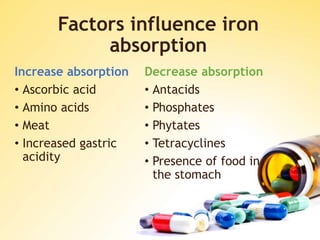
Factors influence iron
absorption
Increase absorption
• Ascorbic acid
• Amino acids
• Meat
• Increased gastric
acidity
Decrease absorption
• Antacids
• Phosphates
• Phytates
• Tetracyclines
• Presence of food in
the stomach
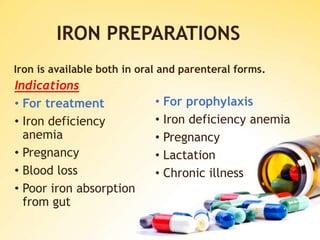
IRON PREPARATIONS
Iron is available both in oral and parenteral forms.
Indications
• For treatment
• Iron deficiency
anemia
• Pregnancy
• Blood loss
• Poor iron absorption
from gut
• For prophylaxis
• Iron deficiency anemia
• Pregnancy
• Lactation
• Chronic illness
Oral Iron Preparations
• Used for long term therapy.
1. Ferrous sulphate-200 mg tab
• Most economical form of iron.
• Available commercially and in government supplies.
2. Ferrous fumarate-200 mg tab
3. Ferrous gluconate-300 mg tab
4. Ferrous succinate-100 mg
5. Iron calcium complex-5% iron
6. Ferric ammonium citrate-45 mg
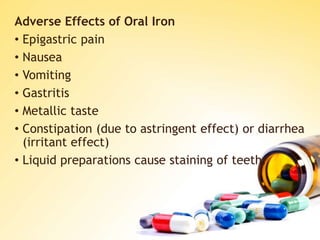
Adverse Effects of Oral Iron
• Epigastric pain
• Nausea
• Vomiting
• Gastritis
• Metallic taste
• Constipation (due to astringent effect) or diarrhea
(irritant effect)
• Liquid preparations cause staining of teeth.
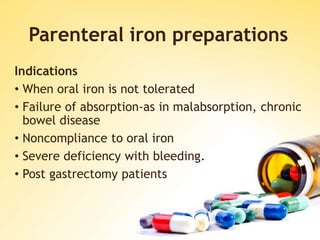
Parenteral iron preparations
Indications
• When oral iron is not tolerated
• Failure of absorption-as in malabsorption, chronic
bowel disease
• Noncompliance to oral iron
• Severe deficiency with bleeding.
• Post gastrectomy patients
Preparations
• Iron dextran
• Given IV/IM
• Iron-sorbitol-citric acid complex
• Given only IM
• Ferrous sucrose
• Given only IM
• Ferric carboxymaltose
Administration
• Given deep IM in the gluteal region using 'Z
technique to avoid staining of the skin.
• Intravenous iron is given slowly over 5-10 minutes
or as infusion (diluted in 500 ml of NS or glucose
and infused over 6-8 hrs) after a test dose.
• Oral iron should be stopped 24 hours before
starting parenteral iron therapy and not restarted
until five days after the last injection.
Adverse effects of parenteral preparation
Local:
• Pain at the site of
injection
• Pigmentation of
the skin
• Abscess at the
site of injection
Systemic:
• Fever
• Headache
• Nausea, vomiting
• Joints pain
• Enlargement of lymph node
• Palpitation
• Difficulty in breathing
• Anaphylaxis (rarely)
Iron poisoning
• Common in infants and children
• Due to accidental ingestion of about 10 iron tablets, can be
lethal.
Manifestations
• Vomiting
• Abdominal pain
• Hematemesis,
• Bloody diarrhea
• Shock
• Drowsiness
• Cyanosis
• Acidosis,
• Dehydration
• Cardiovascular collapse
• Coma
Treatment
• Treatment should be initiated immediately as
death may occur in 6-12 hours.
• Gastric lavage with sodium bicarbonate solution
• Desferrioxamine is the antidote. It is instilled
into the stomach after lavage, to prevent iron
absorption; also injected IV/IM.
• Correction of acidosis and shock.
Vitamin B12
Vitamin B12
• Cyanocobalamin
• Essential for DNA synthesis and RBC maturation.
Dietary sources
• Liver, fish, egg yolk, meat, cheese and pulses
Daily requirement
• Adults 1-3 μg
• Pregnancy and lactation 3-5 μg
Pharmacokinetics
• Vitamin B12 is absorbed with the help of
intrinsic factor, a protein secreted by the
stomach.
• It is carried in the plasma by B12-binding
proteins called transcobalamin and is stored
in the liver.
Preparations
• Cyanocobalamin
• 100 μg/ml injection may be given IM or deep
SC
• Hypersensitivity reactions can occur
• Hydroxocobalamin
• 100, 500, 1000 μg/ml injection
• Has long lasting effect but can result in the
formation of antibodies.
• Multivitamin preparations – oral form
Administration
• Vitamin B12 replacement therapy is given by
intramuscular injection.
• Hydroxocobalamin is preferred, given as an
initial loading dose followed by three monthly
maintenance treatment for life.
Uses
Prophylaxis and treatment
• Megaloblastic anemia
• Pernicious anemia
• Needs life long treatment with vitamin B12
• Prophylactic dose of vitamin B12 is 3-10 mcg
daily.
• Intestinal malabsorption
• B12 neuropathies like subacute combined
degeneration respond to vitamin B12
Folic Acid
Folic Acid
• Essential for DNA synthesis and RBC maturation.
Dietary source:
• Egg, Green vegetables, liver, yeast, milk
Daily requirement
• Adults 50-100 μg
• Pregnancy and lactation 200-400 μg
Pharmacokinetics
• Absorption takes place in the jejunum and is
transported in the blood by active and passive
transport, and is stored in the liver.
Uses
• Megaloblastic anemia
• Folic acid 2-5 mg/day is given orally along with
vitamin B12.
• Malabsorption syndrome
• Folic acid is given IM.
• Prophylactically in pregnancy, lactation,
infancy
• 500 mg daily orally.
Haematopoietic
growth factors
Hematopoietic growth factors
• Hematopoietic growth factors are hormones that
regulate erythropoiesis.
• Hemotapoietic Growth Factors Include:
• Erythropoietin
• Myeloid growth factors
• GM-CSF
• G-CSF
• M-CSF
• Megakaryocyte growth factors
• Thrombopoietin
• Interleukin-II
Erythropoietin
• Stimulates RBC production.
Uses
• Treatment of anemia in chronic renal failure,
bone marrow disorders, malignancies, chronic
inflammation & anemia associated with AIDS.
Mechanism of action
• Erythropoietin binds to erythropoietin
receptors on red cell progenitors and
stimulates RBC production.
Preparations
• Epoetin
• Given thrice weekly in a dose of 25-100 units/kg by
IV/SC route.
• Darbepoetin
• Given once weekly or once every 2-4 wks.
• Given in a dose of 0.45 mcg/kg by IV/SC route once
weekly.
Adverse effects
• Hypertension
• Allergic reaction
• Thrombosis
Myeloid growth factors
Myeloid growth factors include
• Granulocyte - macrophage colony stimulating
factor (GM-CSF)
• Granulocyte colony stimulating factor (G-CSF)
• Monocyte colony stimulating factor (M-CSF)
Mechanism of action
Myeloid growth factors bind to specific receptors
on the myeloid progenitor cells
Stimulates proliferation and differentiation of
neutrophils and monocytes
Adverse effects
• Bone pain
• Fever
• Arthralgia
• Myalgia
• Dyspnea
Uses
• Bone marrow transplantation
• Following cancer chemo-therapy
• Aplastic anemia
• Congenital neutropenia
• Myelodysplasia
• AIDS patients with neutropenia
Megakaryocyte Growth Factors
1. Thrombopoietin
• Increases the production of platelets.
Uses
• Thrombocytopenia following cancer chemotherapy.
• Drug-induced thrombocytopenia
• Bone marrow transplantation
2. Interleukin-II
• Enhances megakaryocyte maturation.
• Given daily via subcutaneous injection until the
platelet count >10000/μl.
Side effects
• Fluid retention and associated cardiac symptoms
• Injection site reactions
• Paraesthesias
• Blurred vision
Uses
• Thrombocytopenia
Nursing implications
• Assess for contraindications or cautions and
any known allergies to the drug to be
administered to avoid hypersensitivity
reactions.
• Ensure that iron deficiency anemia is
confirmed before administering drugs to
ensure proper use of the drug.
• Administer the oral form of iron with meals
that do not include eggs, milk, coffee, and
tea to prevent Gl irritation.
• Nurse should educate the patient, to take iron
with citrus juices to enhance its absorption.
• Patient should be educated regarding good
dietary habits and importance of taking balanced
diet.
• Take measures to alleviate constipation.
• IV infusion of iron should be given slowly to
prevent hypersensitivity.
• Monitor for adverse effects.
Hematinics