Sex and Gender


GS: 138: Introduction to Sociology
Seth Allen                           1
Questions for You…
• How are issues of gender “socially
  constructed” in society?

• How do social institutions such as the family,
  the peer group, educational institutions and
  the media facilitate social expectations of
  gender?

• Is there evidence that gender role
  socialization is becoming more “gender
  neutral?”
                                                   2
Chapter Outline
• Sex: The Biological Dimension
• Gender: The Cultural Dimension
• Gender Stratification in Historical and
  Contemporary Perspective
• Gender and Socialization
• Contemporary Gender Inequality
• Perspectives on Gender Stratification
• Gender Issues in the Future
                                            3
Sex and Gender
• Sex refers to the biological differences between females and
  males.

• Gender refers to the culturally and socially constructed
  differences between females and males.

• The organization and social structures within society
  significantly impact how power, property and prestige are
  distributed based on gender.

• Women make up the world‟s largest minority population as
  women, collectively, do not have the same degrees of power,
  property and prestige as men world wide.


                                                              4
Gender: The Cultural Dimension
• Most “sex differences” are socially
  constructed gender differences.

• Gender is embedded in the images, ideas,
  and language of a society.

• Gender is used as a means to divide up
  work, allocate resources, and distribute
  power.                                     5
Sex Characteristics
• At birth, male and female infants are
  distinguished by primary sex
  characteristics: the genitalia used in the
  reproductive process.

• At puberty, an increased production of
  hormones results in the development of
  secondary sex characteristics: physical
  traits that identify an individual‟s sex.
                                               6
Hermaphrodites
• Caused by a hormone imbalance, a
  hermaphrodite has a combination of male
  and female genitalia.

• Western societies acknowledge two
  sexes, other societies recognize three:
  – Men
  – Women
  – Berdaches - males who behave, dress, work,
                                               7
    and are treated as women.
Sexual Orientation
•Alfred Kinsey (1948) was the first to perform large-scale study of sexuality.
Some highlights of this study included:
     •1/3 of American men have had a homosexual encounter
     •Sexuality exists on a continuum


                                           Eve Kosofky Sedwick later
                                           distinguished between „homosexual‟
                                           and homosocial behavior, an idea
                                           that remains pertinent for
                                           sociologists.


                                                                                 8
Homosexuality vs. Queer Behavior
Sociologists distinguish between a homosexual identity,
  which has been taboo until recently and queer behavior,
  which has been sanctioned in certain
  circumstances/contexts.


Sociologists would ask why homosexuality is so abhorrent while queer acts constitute good,
clean fun.                                                                               9
Sexual Orientation
• An individual‟s preference for emotional–sexual
  relationships with members of the opposite sex
  (heterosexuality), the same sex (homosexuality), or both
  (bisexuality).
Prevalence of Homosexuality in the United States
  (1994) University of Chicago study
  Activity, attraction, or identity   Men (%)   Women (%)
  Find same-sex sexual
                                        4.5        5.6
  relations appealing
  Attracted to people of same
                                        6.2        4.4
  sex
  Identify as gay or bisexual           2.8        1.4

  At least one sex partner of
  same sex during past year             2.7        1.3
  among those sexually active
  At least one sex partner of                               10
                                        4.9        4.1
  same sex since turning 18
Gender Socialization
• The process of learning to be male or female.
• Gender Scripts: The social expectations of
  gender assigned to males and females.


                                                  11
Learning Gender…Early
• The family introduces the child to an expectation of
  gender. Toys play a vital role in this process of gender
  socialization.


                                                        12
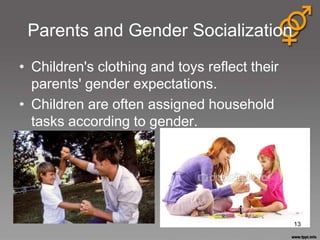
Parents and Gender Socialization
• Children's clothing and toys reflect their
  parents' gender expectations.
• Children are often assigned household
  tasks according to gender.


                                               13
Parents and Gender Socialization
     in Johnny Cash Song


                                   14
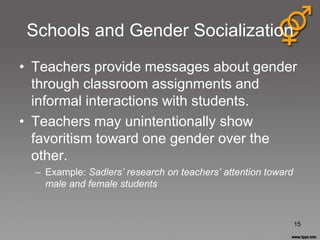
Schools and Gender Socialization
• Teachers provide messages about gender
  through classroom assignments and
  informal interactions with students.
• Teachers may unintentionally show
  favoritism toward one gender over the
  other.
  – Example: Sadlers’ research on teachers’ attention toward
    male and female students


                                                               15
Mass Media and Gender
                     Socialization
Men are portrayed in mass media (even in 2012) as more
  productive and assertive. Ads display idealized gender
  roles.
The Big Bang Theory is a sitcom about a bunch of nerds
and their regular neighbor, Penny. Though they are not
macho, their actions provide fuel for entertainment. How
might this show reinforce gender stereotypes?


                                                       The women in this ad are
                                                        young, slender and are
                                                      portrayed as sexual vixens
                                                       because the young man
                                                                                   16
                                                        wears Tag body spray.
Gender Socialization at Work
• Feminist scholars suggest that the modern workplace
  dismisses the double burden of working women who
  must balance child care and full-time work
• Women are more likely to be „mommy-tracked‟-
  penalized for leaving the workforce to give birth and
  expected to leave the workforce when the dual income
  family model becomes unsustainable


    Arlie Hochschild (1988)
  documented double-shift to
  explain the second shift that
   working mothers perform.
                                                     17
Gendered Division of Labor
Three factors:
• Type of subsistence base.
• Supply of and demand for labor.
• The extent to which women's child-rearing
  activities are compatible with certain types
  of work.


                                             18
Strength Explanations
      • Ability to mobilize strength in quick
        bursts of energy
      • Matches most task done by males
        (slash and burn)
      • However, women handle tasks
        involving heavy labor (!Kung)
      • Fishing (Yahgan)
      • Herd large animals (Maasai)
      • Clear land
      • Carry heavy loads while cultivating
        (Nepal)


                                                19
Compatibility-with-Child Care Explanations

                 •   Women handle tasks compatible with
                     child care (especially at breast-
                     feeding)
                 •   Tasks are interruptible to tend to child
                 •   Tasks do not take them away for long
                 •   Tasks do not place children in danger
                 •   However, main marketers are women,
                     who spend long time away from home
                     (below)
                 •   Child care is often exchanged with
                     others


                                                           20
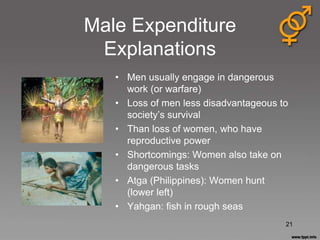
Male Expenditure
 Explanations
   • Men usually engage in dangerous
     work (or warfare)
   • Loss of men less disadvantageous to
     society‟s survival
   • Than loss of women, who have
     reproductive power
   • Shortcomings: Women also take on
     dangerous tasks
   • Atga (Philippines): Women hunt
     (lower left)
   • Yahgan: fish in rough seas
                                       21
The Human Capital Model
• According to this model, individuals vary in
  the amount of human capital they bring to
  the labor market.

• Human capital is acquired by education
  and job training; it is the source of a
  person‟s productivity and can be
  measured in terms of the return on the
  investment (wages) and the cost
  (schooling or training) .                  22
Sociological Trivia
• Do you think that gender equality?
a. Has generally improved over time (since
   the beginning of human history)
b. stayed the same
c. has gone through intervals of equality
   and inequality


                                             23
Sociological Trivia
• C is the correct answer, gender inequality
  has gradually increased over time and
  only recently decreased.
           Gender Inequality Over Time

  4
                                         Hunting and Gathering
 3.5
                                         Societies
  3                                      Horticultural & Pastoral
                                         Socieites
 2.5
                                         Agrarian Societies
  2
                                         Industrial Socieites
 1.5

  1                                      Post-Industrial Societies

 0.5

  0
            1                                                        24
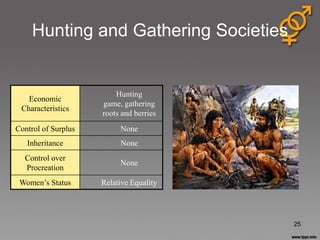
Hunting and Gathering Societies


                         Hunting
   Economic
                     game, gathering
 Characteristics
                     roots and berries
Control of Surplus        None
   Inheritance            None
  Control over
                          None
  Procreation
 Women’s Status      Relative Equality


                                         25
Horticultural and Pastoral Societies


                      Planting crops,
   Economic
                     domestication of
 Characteristics
                     animals for food
                      Men begin to
Control of Surplus
                     control societies
                        Shared—
   Inheritance        patrilineal and
                       matrilineal
  Control over       Increasingly by
  Procreation             men
                      Decreasing in
 Women’s Status         move to
                       pastoralism
                                         26
Agrarian Societies


  Economic          Labor-intensive
Characteristics        farming
  Control of       Men who own land
   Surplus             or herds

 Inheritance           Patrilineal

 Control over        Men—to ensure
 Procreation       legitimacy of heirs
  Women’s
                          Low
   Status


                                         27
Industrial Societies

  Economic            Mechanized
Characteristics    production of goods
  Control of       Men who own means
   Surplus           of production
 Inheritance
                        Bilateral

 Control over      Men—but less so in
 Procreation          later stages
  Women’s
   Status                 Low


                                         28
Postindustrial Societies

  Economic          Information and
Characteristics     service economy
                        Corporate
  Control of        shareholders and
   Surplus              high-tech
                      entrepreneurs

 Inheritance            Bilateral

 Control over
                         Mixed
 Procreation
  Women’s         Varies by class, race,
   Status                and age
                                           29
% of Women and Men in Selected
                     Occupations
        Table11.3.Gender Segregation in the Workplace for Selected Occupations, 2007

Occupation                            Female workers (%)               Male workers (%)
Dental hygienists                             99.2                            0.8
Speech-language pathologists                  98.0                            2.0

Preschool and kindergarten
                                              97.3                            2.7
teachers
Secretaries and administrative
                                              96.7                            3.3
assistants
Registered nurses                             91.7                            9.3
Food servers (waiters/waitresses)             74.0                           26.0
Lawyers                                       32.6                           67.4
Physicians                                    30.0                           70.0
Dentists                                      28.2                           71.8
Computer software engineers                   20.8                           79.2
Carpenters                                    1.9                            98.1

Electricians                                  1.7                            98.3         30
The Wage Gap – By Occupation


                               31
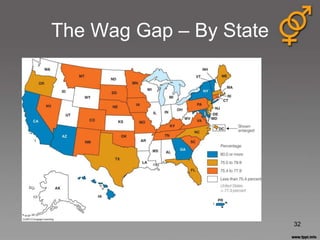
The Wag Gap – By State


                         32
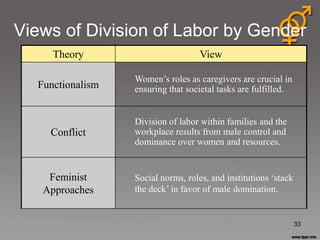
Views of Division of Labor by Gender
     Theory                         View

                  Women’s roles as caregivers are crucial in
  Functionalism   ensuring that societal tasks are fulfilled.


                  Division of labor within families and the
    Conflict      workplace results from male control and
                  dominance over women and resources.


    Feminist      Social norms, roles, and institutions ‘stack
   Approaches     the deck’ in favor of male domination.


                                                                 33
Future of Gender Relations in U.S.
• If current trends persist (women working outside
  home, less breadwinner jobs), the breadwinner-
  homemaker model will become completely
  obsolete
• Women perform 4 times as much household labor
  as men, down from 23 times in 1965
• Women make up 17% of Congress, 25% of state
  legislatures
• Women are gaining more prominent positions in
  evangelical churches
• Largest areas of job growth will be in „female‟
  occupations (See next slide)
                                                34
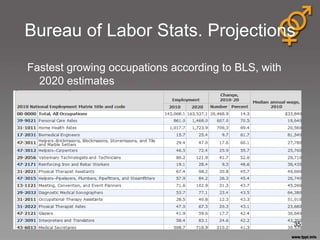
Bureau of Labor Stats. Projections
Fastest growing occupations according to BLS, with
  2020 estimates


                                                     35

Sex & genderrevised333

  • 1.
    Sex and Gender GS:138: Introduction to Sociology Seth Allen 1
  • 2.
    Questions for You… •How are issues of gender “socially constructed” in society? • How do social institutions such as the family, the peer group, educational institutions and the media facilitate social expectations of gender? • Is there evidence that gender role socialization is becoming more “gender neutral?” 2
  • 3.
    Chapter Outline • Sex:The Biological Dimension • Gender: The Cultural Dimension • Gender Stratification in Historical and Contemporary Perspective • Gender and Socialization • Contemporary Gender Inequality • Perspectives on Gender Stratification • Gender Issues in the Future 3
  • 4.
    Sex and Gender •Sex refers to the biological differences between females and males. • Gender refers to the culturally and socially constructed differences between females and males. • The organization and social structures within society significantly impact how power, property and prestige are distributed based on gender. • Women make up the world‟s largest minority population as women, collectively, do not have the same degrees of power, property and prestige as men world wide. 4
  • 5.
    Gender: The CulturalDimension • Most “sex differences” are socially constructed gender differences. • Gender is embedded in the images, ideas, and language of a society. • Gender is used as a means to divide up work, allocate resources, and distribute power. 5
  • 6.
    Sex Characteristics • Atbirth, male and female infants are distinguished by primary sex characteristics: the genitalia used in the reproductive process. • At puberty, an increased production of hormones results in the development of secondary sex characteristics: physical traits that identify an individual‟s sex. 6
  • 7.
    Hermaphrodites • Caused bya hormone imbalance, a hermaphrodite has a combination of male and female genitalia. • Western societies acknowledge two sexes, other societies recognize three: – Men – Women – Berdaches - males who behave, dress, work, 7 and are treated as women.
  • 8.
    Sexual Orientation •Alfred Kinsey(1948) was the first to perform large-scale study of sexuality. Some highlights of this study included: •1/3 of American men have had a homosexual encounter •Sexuality exists on a continuum Eve Kosofky Sedwick later distinguished between „homosexual‟ and homosocial behavior, an idea that remains pertinent for sociologists. 8
  • 9.
    Homosexuality vs. QueerBehavior Sociologists distinguish between a homosexual identity, which has been taboo until recently and queer behavior, which has been sanctioned in certain circumstances/contexts. Sociologists would ask why homosexuality is so abhorrent while queer acts constitute good, clean fun. 9
  • 10.
    Sexual Orientation • Anindividual‟s preference for emotional–sexual relationships with members of the opposite sex (heterosexuality), the same sex (homosexuality), or both (bisexuality). Prevalence of Homosexuality in the United States (1994) University of Chicago study Activity, attraction, or identity Men (%) Women (%) Find same-sex sexual 4.5 5.6 relations appealing Attracted to people of same 6.2 4.4 sex Identify as gay or bisexual 2.8 1.4 At least one sex partner of same sex during past year 2.7 1.3 among those sexually active At least one sex partner of 10 4.9 4.1 same sex since turning 18
  • 11.
    Gender Socialization • Theprocess of learning to be male or female. • Gender Scripts: The social expectations of gender assigned to males and females. 11
  • 12.
    Learning Gender…Early • Thefamily introduces the child to an expectation of gender. Toys play a vital role in this process of gender socialization. 12
  • 13.
    Parents and GenderSocialization • Children's clothing and toys reflect their parents' gender expectations. • Children are often assigned household tasks according to gender. 13
  • 14.
    Parents and GenderSocialization in Johnny Cash Song 14
  • 15.
    Schools and GenderSocialization • Teachers provide messages about gender through classroom assignments and informal interactions with students. • Teachers may unintentionally show favoritism toward one gender over the other. – Example: Sadlers’ research on teachers’ attention toward male and female students 15
  • 16.
    Mass Media andGender Socialization Men are portrayed in mass media (even in 2012) as more productive and assertive. Ads display idealized gender roles. The Big Bang Theory is a sitcom about a bunch of nerds and their regular neighbor, Penny. Though they are not macho, their actions provide fuel for entertainment. How might this show reinforce gender stereotypes? The women in this ad are young, slender and are portrayed as sexual vixens because the young man 16 wears Tag body spray.
  • 17.
    Gender Socialization atWork • Feminist scholars suggest that the modern workplace dismisses the double burden of working women who must balance child care and full-time work • Women are more likely to be „mommy-tracked‟- penalized for leaving the workforce to give birth and expected to leave the workforce when the dual income family model becomes unsustainable Arlie Hochschild (1988) documented double-shift to explain the second shift that working mothers perform. 17
  • 18.
    Gendered Division ofLabor Three factors: • Type of subsistence base. • Supply of and demand for labor. • The extent to which women's child-rearing activities are compatible with certain types of work. 18
  • 19.
    Strength Explanations • Ability to mobilize strength in quick bursts of energy • Matches most task done by males (slash and burn) • However, women handle tasks involving heavy labor (!Kung) • Fishing (Yahgan) • Herd large animals (Maasai) • Clear land • Carry heavy loads while cultivating (Nepal) 19
  • 20.
    Compatibility-with-Child Care Explanations • Women handle tasks compatible with child care (especially at breast- feeding) • Tasks are interruptible to tend to child • Tasks do not take them away for long • Tasks do not place children in danger • However, main marketers are women, who spend long time away from home (below) • Child care is often exchanged with others 20
  • 21.
    Male Expenditure Explanations • Men usually engage in dangerous work (or warfare) • Loss of men less disadvantageous to society‟s survival • Than loss of women, who have reproductive power • Shortcomings: Women also take on dangerous tasks • Atga (Philippines): Women hunt (lower left) • Yahgan: fish in rough seas 21
  • 22.
    The Human CapitalModel • According to this model, individuals vary in the amount of human capital they bring to the labor market. • Human capital is acquired by education and job training; it is the source of a person‟s productivity and can be measured in terms of the return on the investment (wages) and the cost (schooling or training) . 22
  • 23.
    Sociological Trivia • Doyou think that gender equality? a. Has generally improved over time (since the beginning of human history) b. stayed the same c. has gone through intervals of equality and inequality 23
  • 24.
    Sociological Trivia • Cis the correct answer, gender inequality has gradually increased over time and only recently decreased. Gender Inequality Over Time 4 Hunting and Gathering 3.5 Societies 3 Horticultural & Pastoral Socieites 2.5 Agrarian Societies 2 Industrial Socieites 1.5 1 Post-Industrial Societies 0.5 0 1 24
  • 25.
    Hunting and GatheringSocieties Hunting Economic game, gathering Characteristics roots and berries Control of Surplus None Inheritance None Control over None Procreation Women’s Status Relative Equality 25
  • 26.
    Horticultural and PastoralSocieties Planting crops, Economic domestication of Characteristics animals for food Men begin to Control of Surplus control societies Shared— Inheritance patrilineal and matrilineal Control over Increasingly by Procreation men Decreasing in Women’s Status move to pastoralism 26
  • 27.
    Agrarian Societies Economic Labor-intensive Characteristics farming Control of Men who own land Surplus or herds Inheritance Patrilineal Control over Men—to ensure Procreation legitimacy of heirs Women’s Low Status 27
  • 28.
    Industrial Societies Economic Mechanized Characteristics production of goods Control of Men who own means Surplus of production Inheritance Bilateral Control over Men—but less so in Procreation later stages Women’s Status Low 28
  • 29.
    Postindustrial Societies Economic Information and Characteristics service economy Corporate Control of shareholders and Surplus high-tech entrepreneurs Inheritance Bilateral Control over Mixed Procreation Women’s Varies by class, race, Status and age 29
  • 30.
    % of Womenand Men in Selected Occupations Table11.3.Gender Segregation in the Workplace for Selected Occupations, 2007 Occupation Female workers (%) Male workers (%) Dental hygienists 99.2 0.8 Speech-language pathologists 98.0 2.0 Preschool and kindergarten 97.3 2.7 teachers Secretaries and administrative 96.7 3.3 assistants Registered nurses 91.7 9.3 Food servers (waiters/waitresses) 74.0 26.0 Lawyers 32.6 67.4 Physicians 30.0 70.0 Dentists 28.2 71.8 Computer software engineers 20.8 79.2 Carpenters 1.9 98.1 Electricians 1.7 98.3 30
  • 31.
    The Wage Gap– By Occupation 31
  • 32.
    The Wag Gap– By State 32
  • 33.
    Views of Divisionof Labor by Gender Theory View Women’s roles as caregivers are crucial in Functionalism ensuring that societal tasks are fulfilled. Division of labor within families and the Conflict workplace results from male control and dominance over women and resources. Feminist Social norms, roles, and institutions ‘stack Approaches the deck’ in favor of male domination. 33
  • 34.
    Future of GenderRelations in U.S. • If current trends persist (women working outside home, less breadwinner jobs), the breadwinner- homemaker model will become completely obsolete • Women perform 4 times as much household labor as men, down from 23 times in 1965 • Women make up 17% of Congress, 25% of state legislatures • Women are gaining more prominent positions in evangelical churches • Largest areas of job growth will be in „female‟ occupations (See next slide) 34
  • 35.
    Bureau of LaborStats. Projections Fastest growing occupations according to BLS, with 2020 estimates 35

Editor's Notes

  • #13 http://www.barbie.com/
  • #30 http://www.faculty.rsu.edu/~felwell/Theorists/Lenski/Index.htm
  • #35 Joyce Meyer Ministries – 2008 revenues of $112 million, Kay Arthur’s Precept Ministries $12.9 million, and Beth Moore’s Living Proof has $3.8 million of revenue