Race and Ethnicity
True of False
► Race is determined biologically.
► The United States has the most foreign-born
residents of any country in the world.
► People who are prejudiced also discriminate.
► Among Asian Americans, the most
economically successful are Asian Indians.
► About 85 percent of Americans report being
only one race.
► Minority groups are small in number.
Drink Coca Cola
►https://www.youtube.com/watch?v=JchALY
BVEGw
The
Social
Meaning
of
Race and
Ethnicity
• Race is determined by
society
• But is basis it genetic
Race – a socially
constructed
category
composed of
people who share
biologically
transmitted traits
that members of
a society consider
important.
• Ethnicity involves
highlighting cultural
traits.
• Common ancestry
• Common language
• Common religion
Ethnicity – a
shared cultural
heritage.
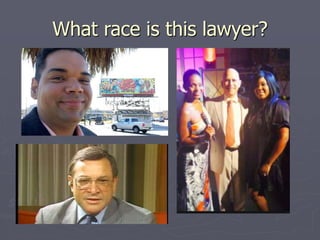
What race is this lawyer?
Minority Group
Any category of people,
distinguished by physical or
cultural
difference, that a society sets
apart and subordinates
► General characteristics:
 Distinct identity
►Race, sex, sexual
orientation, the poor
 Subordination
►Often saddled with
lower status
►Stereotypes, stigma,
and labeling
 Group size not always a
factor
►Women in America
outnumber men
►Blacks in South Africa
outnumber whites
Prejudice
Prejudice: Bias based on a
rigid, irrational
generalization about an
entire category of people
Institutional prejudice &
discrimination: Biases that
are inherent in the
operation of society’s
institutions
• i.e. racial profiling
Stereotypes
and Racism
Stereotyping: An
exaggerated description of
an entire category of people
• All women are bad drivers
• All men are playas (did I say it
right?)
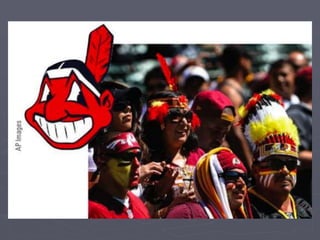
Racism: The belief that one
racial category is innately
superior or inferior to
another
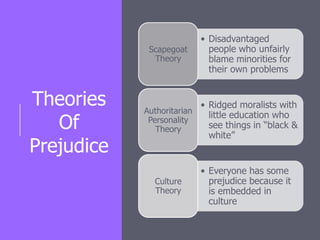
Theories
Of
Prejudice
• Disadvantaged
people who unfairly
blame minorities for
their own problems
Scapegoat
Theory
• Ridged moralists with
little education who
see things in “black &
white”
Authoritarian
Personality
Theory
• Everyone has some
prejudice because it
is embedded in
culture
Culture
Theory
Discrimination
 Treating various categories
of people unequally
 Can occur with prejudice.
Discrimination is acting on
prejudice
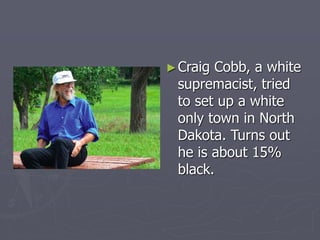
►Craig Cobb, a white
supremacist, tried
to set up a white
only town in North
Dakota. Turns out
he is about 15%
black.
Patterns of
Interaction
► Pluralism: A state in which racial
and ethnic minorities are distinct
but have social parity
► Assimilation: The process by which
minorities gradually adopt patterns
of the dominant category
► Segregation: The physical and
social separation of categories of
people
► Genocide –the systematic killing of
one category of people by another
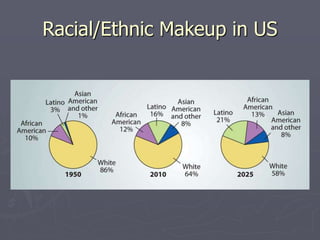
Racial/Ethnic Makeup in US
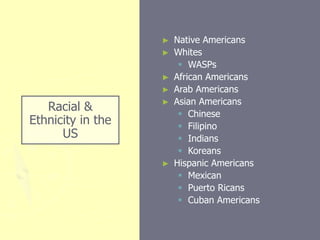
Racial &
Ethnicity in the
US
► Native Americans
► Whites
 WASPs
► African Americans
► Arab Americans
► Asian Americans
 Chinese
 Filipino
 Indians
 Koreans
► Hispanic Americans
 Mexican
 Puerto Ricans
 Cuban Americans
Race and
Ethnicity in
the US:
Native
Americans
When the Europeans
arrived in the fifteenth
century, the Native
Americans numbered
in the millions.
By 1900, they
numbered a mere
250,000.
About 1% of
population. Worst-off
minority
Not until 1924 were
Native Americans
entitled to citizenship.
Race and
Ethnicity
US:
White
Anglo-
Saxon
Protestants
► WASPs were not the first to inhabit
the United States, but they came to
dominate this nation.
► Historically, WASP immigrants were
highly skilled and motivated to
achieve the Protestant work ethic.
► English remains the dominant
language today, and Protestantism
is the majority religion.
► Whites (of all religions) make up
about 72% of population.
Race and Ethnicity
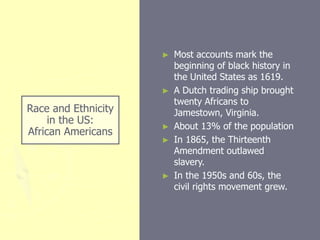
in the US:
African Americans
► Most accounts mark the
beginning of black history in
the United States as 1619.
► A Dutch trading ship brought
twenty Africans to
Jamestown, Virginia.
► About 13% of the population
► In 1865, the Thirteenth
Amendment outlawed
slavery.
► In the 1950s and 60s, the
civil rights movement grew.
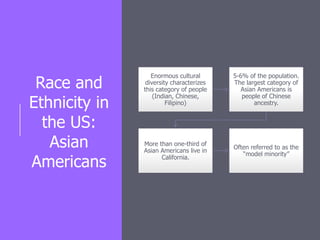
Race and
Ethnicity in
the US:
Asian
Americans
Enormous cultural
diversity characterizes
this category of people
(Indian, Chinese,
Filipino)
5-6% of the population.
The largest category of
Asian Americans is
people of Chinese
ancestry.
More than one-third of
Asian Americans live in
California.
Often referred to as the
“model minority”
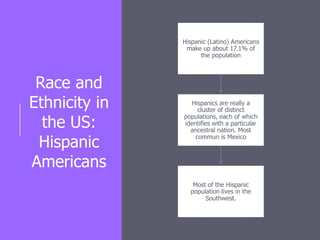
Race and
Ethnicity in
the US:
Hispanic
Americans
Hispanic (Latino) Americans
make up about 17.1% of
the population
Hispanics are really a
cluster of distinct
populations, each of which
identifies with a particular
ancestral nation. Most
commun is Mexico
Most of the Hispanic
population lives in the
Southwest.
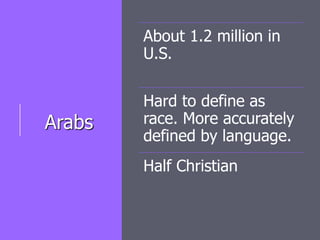
Arabs
About 1.2 million in
U.S.
Hard to define as
race. More accurately
defined by language.
Half Christian
Race and
Ethnicity:
Looking
Ahead
► The United States has been and will
remain a land of immigrants.
► Immigration has generated striking
cultural diversity.
► Many new arrivals face much the
same prejudice as those who came
before them.

Race and ethnicity copy

  • 1.
  • 2.
    True of False ►Race is determined biologically. ► The United States has the most foreign-born residents of any country in the world. ► People who are prejudiced also discriminate. ► Among Asian Americans, the most economically successful are Asian Indians. ► About 85 percent of Americans report being only one race. ► Minority groups are small in number.
  • 3.
  • 4.
    The Social Meaning of Race and Ethnicity • Raceis determined by society • But is basis it genetic Race – a socially constructed category composed of people who share biologically transmitted traits that members of a society consider important. • Ethnicity involves highlighting cultural traits. • Common ancestry • Common language • Common religion Ethnicity – a shared cultural heritage.
  • 5.
    What race isthis lawyer?
  • 6.
    Minority Group Any categoryof people, distinguished by physical or cultural difference, that a society sets apart and subordinates ► General characteristics:  Distinct identity ►Race, sex, sexual orientation, the poor  Subordination ►Often saddled with lower status ►Stereotypes, stigma, and labeling  Group size not always a factor ►Women in America outnumber men ►Blacks in South Africa outnumber whites
  • 7.
    Prejudice Prejudice: Bias basedon a rigid, irrational generalization about an entire category of people Institutional prejudice & discrimination: Biases that are inherent in the operation of society’s institutions • i.e. racial profiling
  • 8.
    Stereotypes and Racism Stereotyping: An exaggerateddescription of an entire category of people • All women are bad drivers • All men are playas (did I say it right?) Racism: The belief that one racial category is innately superior or inferior to another
  • 10.
    Theories Of Prejudice • Disadvantaged people whounfairly blame minorities for their own problems Scapegoat Theory • Ridged moralists with little education who see things in “black & white” Authoritarian Personality Theory • Everyone has some prejudice because it is embedded in culture Culture Theory
  • 11.
    Discrimination  Treating variouscategories of people unequally  Can occur with prejudice. Discrimination is acting on prejudice
  • 12.
    ►Craig Cobb, awhite supremacist, tried to set up a white only town in North Dakota. Turns out he is about 15% black.
  • 13.
    Patterns of Interaction ► Pluralism:A state in which racial and ethnic minorities are distinct but have social parity ► Assimilation: The process by which minorities gradually adopt patterns of the dominant category ► Segregation: The physical and social separation of categories of people ► Genocide –the systematic killing of one category of people by another
  • 14.
  • 15.
    Racial & Ethnicity inthe US ► Native Americans ► Whites  WASPs ► African Americans ► Arab Americans ► Asian Americans  Chinese  Filipino  Indians  Koreans ► Hispanic Americans  Mexican  Puerto Ricans  Cuban Americans
  • 16.
    Race and Ethnicity in theUS: Native Americans When the Europeans arrived in the fifteenth century, the Native Americans numbered in the millions. By 1900, they numbered a mere 250,000. About 1% of population. Worst-off minority Not until 1924 were Native Americans entitled to citizenship.
  • 17.
    Race and Ethnicity US: White Anglo- Saxon Protestants ► WASPswere not the first to inhabit the United States, but they came to dominate this nation. ► Historically, WASP immigrants were highly skilled and motivated to achieve the Protestant work ethic. ► English remains the dominant language today, and Protestantism is the majority religion. ► Whites (of all religions) make up about 72% of population.
  • 18.
    Race and Ethnicity inthe US: African Americans ► Most accounts mark the beginning of black history in the United States as 1619. ► A Dutch trading ship brought twenty Africans to Jamestown, Virginia. ► About 13% of the population ► In 1865, the Thirteenth Amendment outlawed slavery. ► In the 1950s and 60s, the civil rights movement grew.
  • 19.
    Race and Ethnicity in theUS: Asian Americans Enormous cultural diversity characterizes this category of people (Indian, Chinese, Filipino) 5-6% of the population. The largest category of Asian Americans is people of Chinese ancestry. More than one-third of Asian Americans live in California. Often referred to as the “model minority”
  • 20.
    Race and Ethnicity in theUS: Hispanic Americans Hispanic (Latino) Americans make up about 17.1% of the population Hispanics are really a cluster of distinct populations, each of which identifies with a particular ancestral nation. Most commun is Mexico Most of the Hispanic population lives in the Southwest.
  • 21.
    Arabs About 1.2 millionin U.S. Hard to define as race. More accurately defined by language. Half Christian
  • 22.
    Race and Ethnicity: Looking Ahead ► TheUnited States has been and will remain a land of immigrants. ► Immigration has generated striking cultural diversity. ► Many new arrivals face much the same prejudice as those who came before them.