UNIT-II
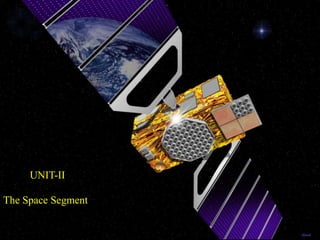
The Space Segment
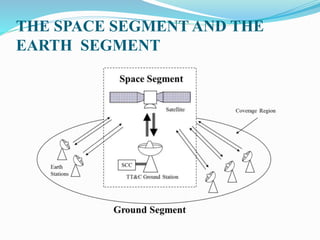
THE SPACE SEGMENT AND THE
EARTH SEGMENT
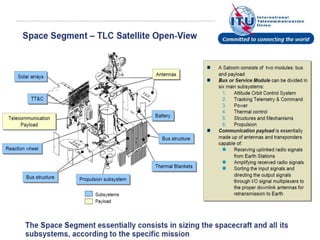
 Payload - the equipment used to provide the
service for which the satellite has been
launched
 bus -refers not only to the vehicle which carries
the payload but also to the various subsystems
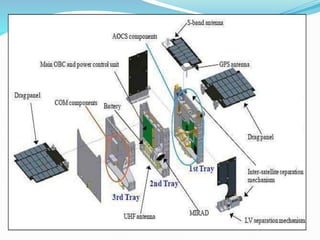
 Subsystems- provide the power, attitude
control, orbital control, thermal control, and
command and telemetry functions required to
service the payload.
TRANSPONDER
 In a communications satellite, the
equipment which provides the connecting
link between the satellite’s transmit and
receive antennas is referred to as the
transponder.
 The transponder forms one of the main
sections of the payload, the other being the
antenna subsystems.
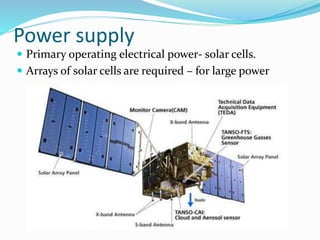
Power supply
 Primary operating electrical power- solar cells.
 Arrays of solar cells are required – for large power
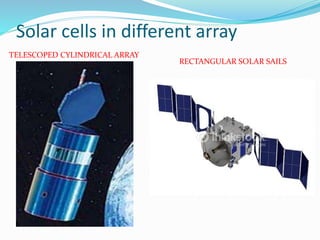
Solar cells in different array
TELESCOPED CYLINDRICAL ARRAY
RECTANGULAR SOLAR SAILS
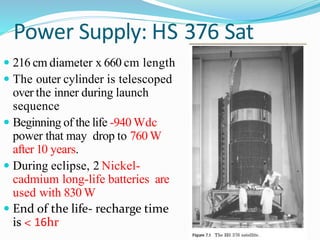
Power Supply: HS 376 Sat
 216 cm diameter x 660 cm length
 The outer cylinder is telescoped
over the inner during launch
sequence
 Beginning of the life -940 Wdc
power that may drop to 760 W
after 10 years.
 During eclipse, 2 Nickel-
cadmium long-life batteries are
used with 830 W
 End of the life- recharge time
is < 16hr
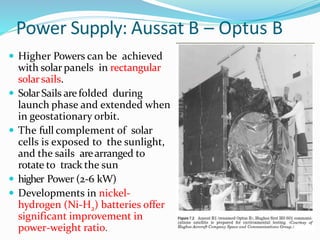
Power Supply: Aussat B – Optus B
 Higher Powers can be achieved
with solar panels in rectangular
solarsails.
 SolarSails arefolded during
launch phase and extended when
in geostationary orbit.
 The full complement of solar
cells is exposed to the sunlight,
and the sails arearranged to
rotate to track the sun
 higher Power (2-6 kW)
 Developments in nickel-
hydrogen (Ni-H2) batteries offer
significant improvement in
power-weight ratio.
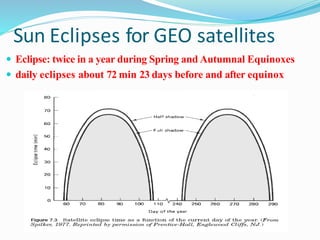
Sun Eclipses for GEO satellites
 Eclipse: twice in a year during Spring and Autumnal Equinoxes
 daily eclipses about 72 min 23 days before and after equinox
Attitude Control
 The attitude of a satellite refers to its orientation in
space.
 Much of the equipment carried aboard a satellite is
there for the purpose of controlling its attitude.
 Attitude control is necessary, for example, to ensure that
directional antennas point in the proper directions.
 In the case of earth environmental satellites, the earth-
sensing instruments must cover the required regions of
the earth, which also requires attitude control.
 A number of forces, referred to as disturbance
torques, can alter the attitude, some examples
 gravitational fields of earth and moon
 Sun radiation, meteorites impacts
To exercise attitude control, there must be available
some measure of a satellite’s orientation in space and of
any tendency for this to shift.
 The attitude control procedure involves:
1. measuring the attitude of the satellite by sensors;
2. comparing the results of these measurements with the
required values;
3. calculating the corrections to be made to reduce
errors;
4. introducing these corrections by operating the
appropriate torque units.
Method
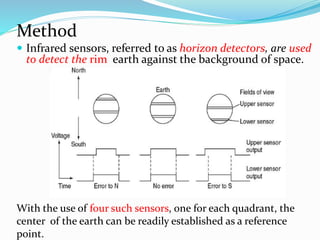
 Infrared sensors, referred to as horizon detectors, are used
to detect the rim earth against the background of space.
With the use of four such sensors, one for each quadrant, the
center of the earth can be readily established as a reference
point.
Attitude maneuver
 If any shift is detected, control signal is generated to
activate a restoring torque.
 Usually, the attitude-control process takes place
aboard the satellite.
 but it is also possible for control signals to be
transmitted from earth, based on attitude data
obtained from the satellite.
 Also, where a shift in attitude is desired, an attitude
maneuver is executed.
 The control signals needed to achieve this maneuver
may be transmitted from an earth station.
Passive attitude control
 Controlling torques may be generated in a number
of ways.
Passive attitude control
 Use the mechanisms which stabilize the satellite
without putting a drain on the satellite’s energy
supplies
 infrequent use is made of these supplies, for
example, when thruster jets are impulsed to
provide corrective torque.
 Examples of passive attitude control are spin
stabilization and gravity gradient stabilization.
Active attitude control
 The other form of attitude control is active control.
 With active attitude control, there is no overall stabilizing
torque present to resist the disturbance torques.
 Instead, corrective torques are applied as required in
response to disturbance torques.
 Methods used to generate active control torques :
- momentum wheels
- electromagnetic coils
- mass expulsion devices, such as gas jets and ion thrusters.
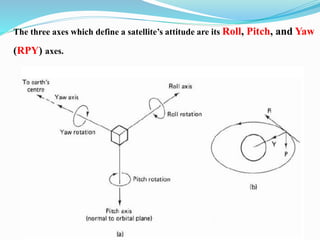
The three axes which define a satellite’s attitude are its Roll, Pitch, and Yaw
(RPY) axes.
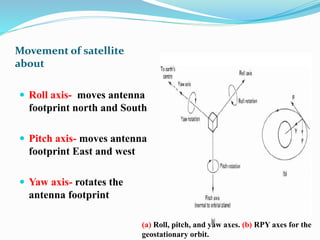
Movement of satellite
about
 Roll axis- moves antenna
footprint north and South
 Pitch axis- moves antenna
footprint East and west
 Yaw axis- rotates the
antenna footprint
(a) Roll, pitch, and yaw axes. (b) RPY axes for the
geostationary orbit.
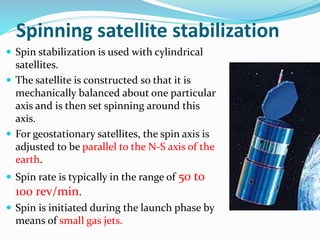
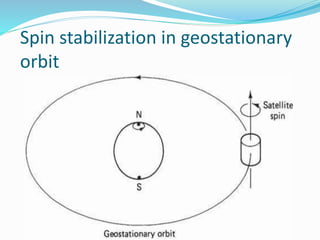
Spinning satellite stabilization
 Spin stabilization is used with cylindrical
satellites.
 The satellite is constructed so that it is
mechanically balanced about one particular
axis and is then set spinning around this
axis.
 For geostationary satellites, the spin axis is
adjusted to be parallel to the N-S axis of the
earth.
 Spin rate is typically in the range of 50 to
100 rev/min.
 Spin is initiated during the launch phase by
means of small gas jets.
Spin stabilization in geostationary
orbit
Spinning satellite stabilization
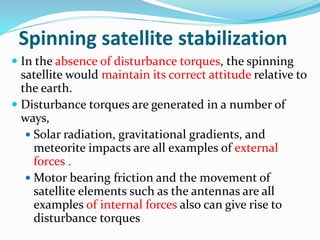
 In the absence of disturbance torques, the spinning
satellite would maintain its correct attitude relative to
the earth.
 Disturbance torques are generated in a number of
ways,
 Solar radiation, gravitational gradients, and
meteorite impacts are all examples of external
forces .
 Motor bearing friction and the movement of
satellite elements such as the antennas are all
examples of internal forces also can give rise to
disturbance torques
 Due to disturbance torque
1) reduction in spin rate
2) change in the direction of spin axis
 Impulse-type thrusters, or jets, can be used to
increase the spin rate again and to shift the axis back
to its correct N-S orientation.
 Nutation, which is a form of wobbling, can occur as a
result of the disturbance torques and/or from
misalignment or unbalance of the control jets.
 This nutation must be damped out by means of
energy absorbers known as nutation dampers.
 Two forms of spin stabilizations are employed.
 Spin stabilization:
- Omni directional antenna- pointing
pitch axis rotates with the satellite.
- Directional antenna- the antenna must be
despun, giving rise to a dual-spin
construction.
- An electrical motor drive is used for
despinning the antenna subsystem.
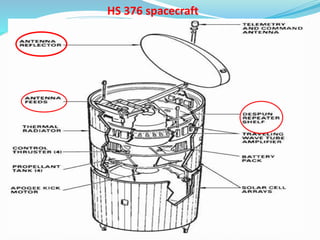
- It is mounted on despun repeater shelf
HS 376 spacecraft
Bearing and power transfer assembly
(BAPTA).
The antenna feeds connected directly to
the transponders without the need for
radiofrequency (RF) rotary joints
control signals and power must be
transferred to the despun section
A mechanical bearing must be provided
The complete assembly for this is known as Bearing
and power transfer assembly (BAPTA)
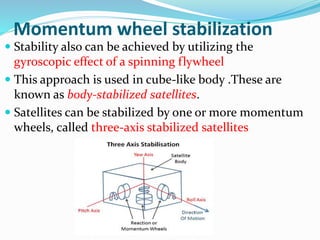
Momentum wheel stabilization
 Stability also can be achieved by utilizing the
gyroscopic effect of a spinning flywheel
 This approach is used in cube-like body .These are
known as body-stabilized satellites.
 Satellites can be stabilized by one or more momentum
wheels, called three-axis stabilized satellites
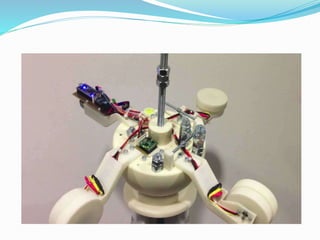
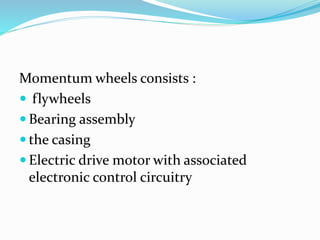
Momentum wheels consists :
 flywheels
 Bearing assembly
 the casing
 Electric drive motor with associated
electronic control circuitry
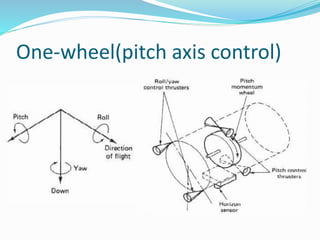
One-wheel(pitch axis control)
 The flywheel is attached to the rotor, which
consists of a permanent magnet providing
the magnetic field for motor action.
 The stator of the motor is attached to the
body of the satellite.
 Thus the motor provides the coupling
between the flywheel and the satellite
structure.
 Speed and torque control of the motor is
exercised through the currents fed to the
stator.
Reaction wheel
 When a momentum wheel is operated with zero
momentum bias, it is generally referred to as a
“reaction wheel”
 Reaction wheels are used in three axis stabilized
systems.
 some disturbance torques that causes a cumulative
increase in wheel momentum, and eventually at some
point the wheel saturates.
 Mass expulsion devices are then used to unload the
wheel, that is, remove momentum from it.
 These device consumes part of the satellite’s fuel supply
Three axis stabilization
Thermal Control
 Satellites are subject to large thermal gradients
1.Receiving the sun’s radiation on one side while the other side
faces into space
2.Thermal radiation from the earth and the earth’s albedo
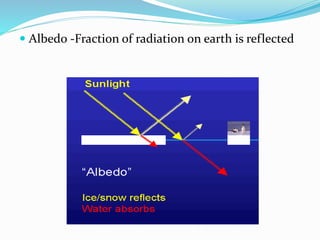
Albedo – the fraction of the radiation falling on earth which is
reflected
Albedo can be significant for LEO satellites & negligible for GEO
satellites.
3.Equipment in the satellite also generates heat.
The most important consideration is that the satellite’s
equipment should operate as nearly as possible in a stable
temperature environment.
 Albedo -Fraction of radiation on earth is reflected
Methods to provide stable temperature
environment
1.Thermal blankets and shields - to provide
insulation.
2.Radiation mirrors - to remove heat from the
communications payload.
•The mirrored drums surround the
communications equipment
•Provide good radiation paths- the generated
heat to escape into the surrounding space.
•Advantage of spinning satellites compared with body-
stabilized - the spinning body provides an averaging of
the temperature extremes experienced from solar flux
and the cold background of deep space
•To maintain constant temperature conditions, heaters
may be switched on (usually on command from
ground) to make up for the heat reduction which
occurs when transponders are switched off.
•The INTELSAT VI satellite used heaters to maintain
propulsion thrusters and line temperatures
TT&C SYSTEM
 The telemetry, tracking and control subsystem
provides vital communication to and from the
spacecraft
 TT&C is the only way to observe and to control the
spacecraft’s functions and condition from the ground
 Telemetry and command may be thought of as
complementary functions.
 The telemetry subsystem transmits information
about the satellite to the earth station, while the
command subsystem receives command signals from
the earth station, often in response to telemetered
information.
 The command subsystem demodulates and, if
necessary, decodes the command signals and
routes these to the appropriate equipment
needed to execute the necessary action.
 Uplink consists of commands and ranging
tones.
 Downlink consists of status telemetry, ranging
tones and even may include payload data.
 The telemetry, or telemetering, function could
be interpreted as measurement at a distance
TT&C subsystem functions :
• Controlling of spacecraft by the operator on
earth (One axis control in our case).
• Receive the uplink commands, process and
send them to other subsystems for implication.
• Receive the downlink commands from
subsystems, process and transmit them to
earth.
• Inform constantly about the spacecraft
position.
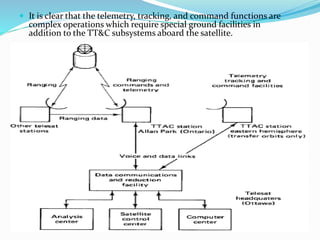
 It is clear that the telemetry, tracking, and command functions are
complex operations which require special ground facilities in
addition to the TT&C subsystems aboard the satellite.
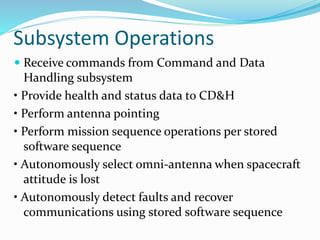
Subsystem Operations
 Receive commands from Command and Data
Handling subsystem
• Provide health and status data to CD&H
• Perform antenna pointing
• Perform mission sequence operations per stored
software sequence
• Autonomously select omni-antenna when spacecraft
attitude is lost
• Autonomously detect faults and recover
communications using stored software sequence
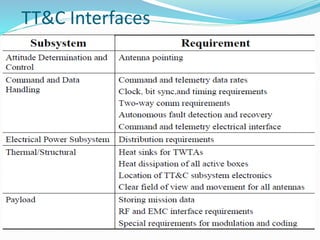
TT&C Interfaces
Telemetry
In one direction (satellite to ground), the
link is used to monitor the satellite
through status reports and anomalies
detected by the onboard computer; this is
telemetry.
Telemetry is a set of measurements taken
on board the satellite and then sent to the
operations control centre.
 Measure physical properties from SATELLITE
temperatures, voltages, currents etc.
 Status of spacecraft resources, health, attitude,
and operation; Scientific data; Spacecraft orbit
and timing data for ground navigation;
Images; Tracked object location; Relayed data.
 For example, if we consider the solar array
subsystem, we need to know the output
voltage and current at all times.
 Telemetry System RF Performance
 Frequencies: S-band (2.2 2.3 GHz); C-band (3.7 4.2
GHz); Ku-band (11.7 12.2 GHz).
 BER = 10-5
 Sensors and Transducers
 Sensors change state as a function of an external
event
 Transducers convert energy from one form to
another
 Outputs can be: Resistance; Capacitance;
Current; Voltage.
 Telemetry Processing
 Compression
 Analysis for autonomous systems
 Formatting
Command Functions
 In the other direction (ground to satellite), the link is used
either for routine programming (commercial imaging
requested by Spot Image) or for sending commands to
carry out specific actions to handle events as required
(orbital maneuvers, equipment tests, anomalies, failures
etc.); this is the command link.
 Although modern satellites operate automatically, they still
need to receive commands from the ground.
 This need is particularly obvious during the satellite
attitude acquisition phase. During this critical phase, the
satellite needs to be very closely controlled from the
operations control centre.
 Once the solar arrays have been automatically deployed,
commands sent by the control centre switch on the
equipment that was off during the launch: recorders,
payloads and passengers if any.
 command signals are often encrypted
•Power on/off subsystems
•Change subsystem operating modes
•Control spacecraft guidance and attitude control
•Deploy booms, antennas, solar cell arrays, protective
covers
•Upload computer programs
•Frequencies
–S-band (1.6 –2.2 GHz)
–C-band (5.9 –6.5 GHz)
–Ku-band (14.0 –14.5 GHz)
•BER = 10-6
Tracking
 Tracking of the satellite is accomplished by having the
satellite transmit beacon signals which are received at the
TT&C earth stations.
 Tracking is obviously important during the transfer and drift
orbital phases of the satellite launch.
 Once it is on station, the position of a geostationary satellite
will tend to be shifted as a result of the various disturbing
forces, as described previously.
 Therefore, it is necessary to be able to track the satellite’s
movement and send correction signals as required.
 Satellite range from the ground station is also required from
time to time. This can be determined by measurement of the
propagation delay of signals especially transmitted for
ranging purposes.
Ec6004 unit 2

Ec6004 unit 2

  • 1.
  • 2.
    THE SPACE SEGMENTAND THE EARTH SEGMENT
  • 5.
     Payload -the equipment used to provide the service for which the satellite has been launched  bus -refers not only to the vehicle which carries the payload but also to the various subsystems  Subsystems- provide the power, attitude control, orbital control, thermal control, and command and telemetry functions required to service the payload.
  • 6.
    TRANSPONDER  In acommunications satellite, the equipment which provides the connecting link between the satellite’s transmit and receive antennas is referred to as the transponder.  The transponder forms one of the main sections of the payload, the other being the antenna subsystems.
  • 7.
    Power supply  Primaryoperating electrical power- solar cells.  Arrays of solar cells are required – for large power
  • 8.
    Solar cells indifferent array TELESCOPED CYLINDRICAL ARRAY RECTANGULAR SOLAR SAILS
  • 9.
    Power Supply: HS376 Sat  216 cm diameter x 660 cm length  The outer cylinder is telescoped over the inner during launch sequence  Beginning of the life -940 Wdc power that may drop to 760 W after 10 years.  During eclipse, 2 Nickel- cadmium long-life batteries are used with 830 W  End of the life- recharge time is < 16hr
  • 10.
    Power Supply: AussatB – Optus B  Higher Powers can be achieved with solar panels in rectangular solarsails.  SolarSails arefolded during launch phase and extended when in geostationary orbit.  The full complement of solar cells is exposed to the sunlight, and the sails arearranged to rotate to track the sun  higher Power (2-6 kW)  Developments in nickel- hydrogen (Ni-H2) batteries offer significant improvement in power-weight ratio.
  • 11.
    Sun Eclipses forGEO satellites  Eclipse: twice in a year during Spring and Autumnal Equinoxes  daily eclipses about 72 min 23 days before and after equinox
  • 12.
    Attitude Control  Theattitude of a satellite refers to its orientation in space.  Much of the equipment carried aboard a satellite is there for the purpose of controlling its attitude.  Attitude control is necessary, for example, to ensure that directional antennas point in the proper directions.  In the case of earth environmental satellites, the earth- sensing instruments must cover the required regions of the earth, which also requires attitude control.  A number of forces, referred to as disturbance torques, can alter the attitude, some examples  gravitational fields of earth and moon  Sun radiation, meteorites impacts
  • 13.
    To exercise attitudecontrol, there must be available some measure of a satellite’s orientation in space and of any tendency for this to shift.  The attitude control procedure involves: 1. measuring the attitude of the satellite by sensors; 2. comparing the results of these measurements with the required values; 3. calculating the corrections to be made to reduce errors; 4. introducing these corrections by operating the appropriate torque units.
  • 14.
    Method  Infrared sensors,referred to as horizon detectors, are used to detect the rim earth against the background of space. With the use of four such sensors, one for each quadrant, the center of the earth can be readily established as a reference point.
  • 15.
    Attitude maneuver  Ifany shift is detected, control signal is generated to activate a restoring torque.  Usually, the attitude-control process takes place aboard the satellite.  but it is also possible for control signals to be transmitted from earth, based on attitude data obtained from the satellite.  Also, where a shift in attitude is desired, an attitude maneuver is executed.  The control signals needed to achieve this maneuver may be transmitted from an earth station.
  • 16.
    Passive attitude control Controlling torques may be generated in a number of ways. Passive attitude control  Use the mechanisms which stabilize the satellite without putting a drain on the satellite’s energy supplies  infrequent use is made of these supplies, for example, when thruster jets are impulsed to provide corrective torque.  Examples of passive attitude control are spin stabilization and gravity gradient stabilization.
  • 17.
    Active attitude control The other form of attitude control is active control.  With active attitude control, there is no overall stabilizing torque present to resist the disturbance torques.  Instead, corrective torques are applied as required in response to disturbance torques.  Methods used to generate active control torques : - momentum wheels - electromagnetic coils - mass expulsion devices, such as gas jets and ion thrusters.
  • 18.
    The three axeswhich define a satellite’s attitude are its Roll, Pitch, and Yaw (RPY) axes.
  • 19.
    Movement of satellite about Roll axis- moves antenna footprint north and South  Pitch axis- moves antenna footprint East and west  Yaw axis- rotates the antenna footprint (a) Roll, pitch, and yaw axes. (b) RPY axes for the geostationary orbit.
  • 20.
    Spinning satellite stabilization Spin stabilization is used with cylindrical satellites.  The satellite is constructed so that it is mechanically balanced about one particular axis and is then set spinning around this axis.  For geostationary satellites, the spin axis is adjusted to be parallel to the N-S axis of the earth.  Spin rate is typically in the range of 50 to 100 rev/min.  Spin is initiated during the launch phase by means of small gas jets.
  • 21.
    Spin stabilization ingeostationary orbit
  • 22.
    Spinning satellite stabilization In the absence of disturbance torques, the spinning satellite would maintain its correct attitude relative to the earth.  Disturbance torques are generated in a number of ways,  Solar radiation, gravitational gradients, and meteorite impacts are all examples of external forces .  Motor bearing friction and the movement of satellite elements such as the antennas are all examples of internal forces also can give rise to disturbance torques
  • 23.
     Due todisturbance torque 1) reduction in spin rate 2) change in the direction of spin axis  Impulse-type thrusters, or jets, can be used to increase the spin rate again and to shift the axis back to its correct N-S orientation.  Nutation, which is a form of wobbling, can occur as a result of the disturbance torques and/or from misalignment or unbalance of the control jets.  This nutation must be damped out by means of energy absorbers known as nutation dampers.
  • 24.
     Two formsof spin stabilizations are employed.  Spin stabilization: - Omni directional antenna- pointing pitch axis rotates with the satellite. - Directional antenna- the antenna must be despun, giving rise to a dual-spin construction. - An electrical motor drive is used for despinning the antenna subsystem. - It is mounted on despun repeater shelf
  • 25.
  • 26.
    Bearing and powertransfer assembly (BAPTA). The antenna feeds connected directly to the transponders without the need for radiofrequency (RF) rotary joints control signals and power must be transferred to the despun section A mechanical bearing must be provided The complete assembly for this is known as Bearing and power transfer assembly (BAPTA)
  • 27.
    Momentum wheel stabilization Stability also can be achieved by utilizing the gyroscopic effect of a spinning flywheel  This approach is used in cube-like body .These are known as body-stabilized satellites.  Satellites can be stabilized by one or more momentum wheels, called three-axis stabilized satellites
  • 29.
    Momentum wheels consists:  flywheels  Bearing assembly  the casing  Electric drive motor with associated electronic control circuitry
  • 30.
  • 31.
     The flywheelis attached to the rotor, which consists of a permanent magnet providing the magnetic field for motor action.  The stator of the motor is attached to the body of the satellite.  Thus the motor provides the coupling between the flywheel and the satellite structure.  Speed and torque control of the motor is exercised through the currents fed to the stator.
  • 32.
    Reaction wheel  Whena momentum wheel is operated with zero momentum bias, it is generally referred to as a “reaction wheel”  Reaction wheels are used in three axis stabilized systems.  some disturbance torques that causes a cumulative increase in wheel momentum, and eventually at some point the wheel saturates.  Mass expulsion devices are then used to unload the wheel, that is, remove momentum from it.  These device consumes part of the satellite’s fuel supply
  • 33.
  • 34.
    Thermal Control  Satellitesare subject to large thermal gradients 1.Receiving the sun’s radiation on one side while the other side faces into space 2.Thermal radiation from the earth and the earth’s albedo Albedo – the fraction of the radiation falling on earth which is reflected Albedo can be significant for LEO satellites & negligible for GEO satellites. 3.Equipment in the satellite also generates heat. The most important consideration is that the satellite’s equipment should operate as nearly as possible in a stable temperature environment.
  • 35.
     Albedo -Fractionof radiation on earth is reflected
  • 36.
    Methods to providestable temperature environment 1.Thermal blankets and shields - to provide insulation. 2.Radiation mirrors - to remove heat from the communications payload. •The mirrored drums surround the communications equipment •Provide good radiation paths- the generated heat to escape into the surrounding space.
  • 37.
    •Advantage of spinningsatellites compared with body- stabilized - the spinning body provides an averaging of the temperature extremes experienced from solar flux and the cold background of deep space •To maintain constant temperature conditions, heaters may be switched on (usually on command from ground) to make up for the heat reduction which occurs when transponders are switched off. •The INTELSAT VI satellite used heaters to maintain propulsion thrusters and line temperatures
  • 38.
    TT&C SYSTEM  Thetelemetry, tracking and control subsystem provides vital communication to and from the spacecraft  TT&C is the only way to observe and to control the spacecraft’s functions and condition from the ground  Telemetry and command may be thought of as complementary functions.  The telemetry subsystem transmits information about the satellite to the earth station, while the command subsystem receives command signals from the earth station, often in response to telemetered information.
  • 39.
     The commandsubsystem demodulates and, if necessary, decodes the command signals and routes these to the appropriate equipment needed to execute the necessary action.  Uplink consists of commands and ranging tones.  Downlink consists of status telemetry, ranging tones and even may include payload data.  The telemetry, or telemetering, function could be interpreted as measurement at a distance
  • 40.
    TT&C subsystem functions: • Controlling of spacecraft by the operator on earth (One axis control in our case). • Receive the uplink commands, process and send them to other subsystems for implication. • Receive the downlink commands from subsystems, process and transmit them to earth. • Inform constantly about the spacecraft position.
  • 41.
     It isclear that the telemetry, tracking, and command functions are complex operations which require special ground facilities in addition to the TT&C subsystems aboard the satellite.
  • 42.
    Subsystem Operations  Receivecommands from Command and Data Handling subsystem • Provide health and status data to CD&H • Perform antenna pointing • Perform mission sequence operations per stored software sequence • Autonomously select omni-antenna when spacecraft attitude is lost • Autonomously detect faults and recover communications using stored software sequence
  • 43.
  • 44.
    Telemetry In one direction(satellite to ground), the link is used to monitor the satellite through status reports and anomalies detected by the onboard computer; this is telemetry. Telemetry is a set of measurements taken on board the satellite and then sent to the operations control centre.
  • 45.
     Measure physicalproperties from SATELLITE temperatures, voltages, currents etc.  Status of spacecraft resources, health, attitude, and operation; Scientific data; Spacecraft orbit and timing data for ground navigation; Images; Tracked object location; Relayed data.  For example, if we consider the solar array subsystem, we need to know the output voltage and current at all times.
  • 46.
     Telemetry SystemRF Performance  Frequencies: S-band (2.2 2.3 GHz); C-band (3.7 4.2 GHz); Ku-band (11.7 12.2 GHz).  BER = 10-5  Sensors and Transducers  Sensors change state as a function of an external event  Transducers convert energy from one form to another  Outputs can be: Resistance; Capacitance; Current; Voltage.
  • 47.
     Telemetry Processing Compression  Analysis for autonomous systems  Formatting
  • 48.
    Command Functions  Inthe other direction (ground to satellite), the link is used either for routine programming (commercial imaging requested by Spot Image) or for sending commands to carry out specific actions to handle events as required (orbital maneuvers, equipment tests, anomalies, failures etc.); this is the command link.  Although modern satellites operate automatically, they still need to receive commands from the ground.  This need is particularly obvious during the satellite attitude acquisition phase. During this critical phase, the satellite needs to be very closely controlled from the operations control centre.  Once the solar arrays have been automatically deployed, commands sent by the control centre switch on the equipment that was off during the launch: recorders, payloads and passengers if any.
  • 49.
     command signalsare often encrypted •Power on/off subsystems •Change subsystem operating modes •Control spacecraft guidance and attitude control •Deploy booms, antennas, solar cell arrays, protective covers •Upload computer programs •Frequencies –S-band (1.6 –2.2 GHz) –C-band (5.9 –6.5 GHz) –Ku-band (14.0 –14.5 GHz) •BER = 10-6
  • 50.
    Tracking  Tracking ofthe satellite is accomplished by having the satellite transmit beacon signals which are received at the TT&C earth stations.  Tracking is obviously important during the transfer and drift orbital phases of the satellite launch.  Once it is on station, the position of a geostationary satellite will tend to be shifted as a result of the various disturbing forces, as described previously.  Therefore, it is necessary to be able to track the satellite’s movement and send correction signals as required.  Satellite range from the ground station is also required from time to time. This can be determined by measurement of the propagation delay of signals especially transmitted for ranging purposes.