ANTENATAL STEROIDS
Introduction
 Preterm deliveries vary from 6-15% of all deliveries
 RDS known to affect 40-50% of babies born before 32 weeks
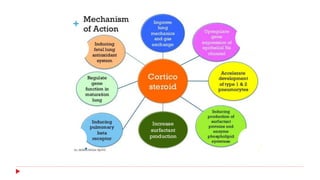
 Steroids will accelerate lung maturation-
 Liggins and Howie (1972)
 Lowering the incidence of respiratory distress/severity
 Large reduction in the incidence of early neonatal death, IVH, and NEC.
Impact of antenatal corticosteroids
 Steroid effects will lost for 7 days
 Responds depends on species , dose and gestational age
 Lung structural maturation – surface area
 Induction of surfactant synthesis
 Induction of enzymes involved in synthesis
 Improved response to postnatal surfactant
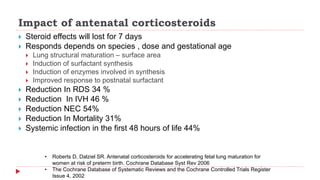
 Reduction In RDS 34 %
 Reduction In IVH 46 %
 Reduction NEC 54%
 Reduction In Mortality 31%
 Systemic infection in the first 48 hours of life 44%
• Roberts D, Dalziel SR. Antenatal corticosteroids for accelerating fetal lung maturation for
women at risk of preterm birth. Cochrane Database Syst Rev 2006
• The Cochrane Database of Systematic Reviews and the Cochrane Controlled Trials Register
Issue 4, 2002
When to give ????
 Should be given- 24+0 and 34+6 weeks
 Can be considered- 23+0 and 23+6 weeks
 the reduction in outcomes other than RDS
 22 weeks or less
 increasing the risk for survival with severe impairment.
 reasonable if delivery in the next seven days is anticipated and the family desires
aggressive neonatal intervention after thorough consultation with maternal-fetal medicine
and neonatology specialists
 34 to 36 weeks of gestation- The Antenatal Late Preterm Steroids Trial
(ALPS)
 Composite of neonatal respiratory treatment in the first 72 hours (11.6 versus 14.4
percent; relative risk [RR] 0.80; 95% CI 0.66-0.97
 Severe respiratory complications (CPAP or high flow nasal cannula for ≥12 hours,
FIO2≥0.30 for at least 24 hours), transient tachypnea of the newborn, surfactant use, and
bronchopulmonary dysplasia.
 Neonatal hypoglycemia
 Rates of respiratory distress syndrome (RDS) and mechanical ventilation- no difference
 ACOG , RCOG
 37 to 39 weeks of gestation -The Antenatal Steroids for Term Caesarean
Section trial (ASTECS)
 reduction in the overall incidence of respiratory problems in the treated group
Drugs
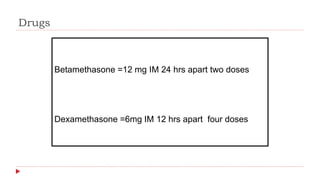
Betamethasone =12 mg IM 24 hrs apart two doses
Dexamethasone =6mg IM 12 hrs apart four doses
Time –Effect
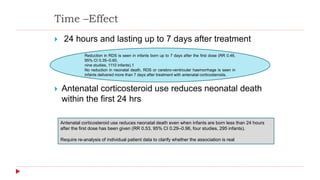
 24 hours and lasting up to 7 days after treatment
 Antenatal corticosteroid use reduces neonatal death
within the first 24 hrs
Reduction in RDS is seen in infants born up to 7 days after the first dose (RR 0.46,
95% CI 0.35–0.60,
nine studies, 1110 infants).1
No reduction in neonatal death, RDS or cerebro-ventricular haemorrhage is seen in
infants delivered more than 7 days after treatment with antenatal corticosteroids.
Antenatal corticosteroid use reduces neonatal death even when infants are born less than 24 hours
after the first dose has been given (RR 0.53, 95% CI 0.29–0.96, four studies, 295 infants).
Require re-analysis of individual patient data to clarify whether the association is real
Timing before Delivery
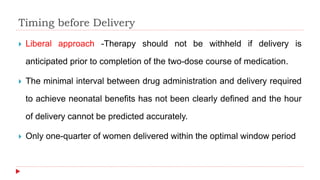
 Liberal approach -Therapy should not be withheld if delivery is
anticipated prior to completion of the two-dose course of medication.
 The minimal interval between drug administration and delivery required
to achieve neonatal benefits has not been clearly defined and the hour
of delivery cannot be predicted accurately.
 Only one-quarter of women delivered within the optimal window period
Betamethasone Vs Dexamethasone
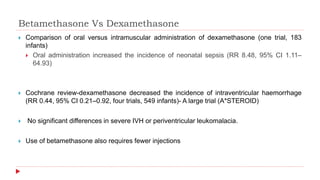
 Comparison of oral versus intramuscular administration of dexamethasone (one trial, 183
infants)
 Oral administration increased the incidence of neonatal sepsis (RR 8.48, 95% CI 1.11–
64.93)
 Cochrane review-dexamethasone decreased the incidence of intraventricular haemorrhage
(RR 0.44, 95% CI 0.21–0.92, four trials, 549 infants)- A large trial (A*STEROID)
 No significant differences in severe IVH or periventricular leukomalacia.
 Use of betamethasone also requires fewer injections
Betamethasone vs Dexamethasone
 The WHO, NIH, ACOG, RCOG, and WAPM
 Used interchangeably, but betamethasone preferred-current WAPM guideline
 The 18th list of WHO Model List of Essential Medicines-Dexamethasone
 The Executive Summary of the WHO Expert Committee explains,
 “While alternative steroids with similar efficacy were available, dexamethasone was
considered the most appropriate product based on availability and cost.”
 Beta and Dexamethasone are preferred over other steroids because
they are less extensively metabolized by the placental enzyme 11 beta-
hydroxysteroid dehydrogenase type 2
 Hydrocortisone is extensively metabolized by placental enzymes
 If both betamethasone and dexamethasone are unavailable due to drug shortages, hydrocortisone 500 mg
intravenously every 12 hours for four doses has been proposed as a last resort
 Thyrotropin-releasing hormones (TRH) provides no additional benefits.
Fetal Effects Maternal effects
 Transient fetal heart rate (FHR) and
behavioral changes
 A transient improvement in umbilical artery
end-diastolic flow (EDF)
 ACT trial - increased neonatal and perinatal
mortality in the overall population,
 Children and adult -potentially adverse
cardiovascular and metabolic effects
 In the ASTECS trial-poor academic
performance
 Transient hyperglycaemia
 The total leukocyte count increases
by about 30 percent within 24 hours
after betamethasone injection, and
the lymphocyte count significantly
decreases
Antenatal Steroids for Term Elective Caesarean Section (ASTECS) Research
contraindications
 Chorioamnioitis
 Caution in case of Systemic infections like TB
•A large meta-analysis of observational studies reports that clinical chorioamnionitis is significantly
associated with both cystic periventricular leucomalacia (RR 2.6, 95% CI 1.7–3.9) and cerebral palsy
(RR, 1.9, 95% CI 1.5–2.5).
•a course of antenatal corticosteroids may be started, but should not delay delivery if indicated by
maternal or fetal condition.
Special occasions
 In multifetal pregnancy>>
 single course of antenatal corticosteroid treatment
 The optimal dose and pharmacokinetics in multiple pregnancies is not clearly understood.
 Evidence suggests that multiple pregnancy attenuates the beneficial effect of antenatal steroids
 Every weeks steroid in twin gestation reduces the mean fetal weight
 GDM
 In pregnancies with fetal growth restriction
 have an effect on cerebral blood flow in growth restricted fetuses that is
different from that in normally grown fetuses
 Survival without disability or handicap at 2 years of age was better in the
corticosteroid group than in the matched group
>>Quist-Therson EC, Myhr TL, Ohlsson A. Antenatal steroids to prevent respiratory distress syndrome: multiple
gestation as an effect modifier. Acta Obstet Gynecol Scand 1999;78:388–92.
REPEAT COURSE
 Weekly repeat courses-
 reduces neonatal respiratory disease,
 associated with a reduction in weight and head circumference.
 A single rescue course when initial course was given at less than 28+0
weeks of gestation
 Clinically estimated to be at high risk of delivery within the next seven
day
 Prior exposure to antenatal corticosteroids at least two weeks earlier
Murphy KE, Hannah ME, Willan AR, Hewson SA, Ohlsson A, Kelly EN, et al.; MACS Collaborative Group.
Multiple courses of antenatal corticosteroids for preterm birth (MACS): a randomised controlled trial.
Lancet 2008;372:2143–51.
 ACOG- a single course of salvage (rescue, booster) steroids in women
who remain at risk of preterm delivery before 34 weeks of gestation and
whose prior course was administered at least 7 days previously
 The Australasian Collaborative Trial of Repeat Doses of Steroids
(ACTORDS) demonstrated that weekly repeat dosing with a single
injection of betamethasone was effective after initial standard therapy
 MACS –No difference
 Decreased incidence of RDS < 24 hrs
 Decreased incidence of mortality and intracerebral haemorrhage if 24-
48 hrs
 PRECISE Study (prenatal repeat corticosteroid international IPD study
group)
 Individual basis
 Best age to maximise
 Optimal dose, number and timing
 Minimal effective and safe dose
 Single or multiple
Antenatal steroids

Antenatal steroids

  • 1.
  • 2.
    Introduction  Preterm deliveriesvary from 6-15% of all deliveries  RDS known to affect 40-50% of babies born before 32 weeks  Steroids will accelerate lung maturation-  Liggins and Howie (1972)  Lowering the incidence of respiratory distress/severity  Large reduction in the incidence of early neonatal death, IVH, and NEC.
  • 4.
    Impact of antenatalcorticosteroids  Steroid effects will lost for 7 days  Responds depends on species , dose and gestational age  Lung structural maturation – surface area  Induction of surfactant synthesis  Induction of enzymes involved in synthesis  Improved response to postnatal surfactant  Reduction In RDS 34 %  Reduction In IVH 46 %  Reduction NEC 54%  Reduction In Mortality 31%  Systemic infection in the first 48 hours of life 44% • Roberts D, Dalziel SR. Antenatal corticosteroids for accelerating fetal lung maturation for women at risk of preterm birth. Cochrane Database Syst Rev 2006 • The Cochrane Database of Systematic Reviews and the Cochrane Controlled Trials Register Issue 4, 2002
  • 5.
    When to give????  Should be given- 24+0 and 34+6 weeks  Can be considered- 23+0 and 23+6 weeks  the reduction in outcomes other than RDS  22 weeks or less  increasing the risk for survival with severe impairment.  reasonable if delivery in the next seven days is anticipated and the family desires aggressive neonatal intervention after thorough consultation with maternal-fetal medicine and neonatology specialists
  • 6.
     34 to36 weeks of gestation- The Antenatal Late Preterm Steroids Trial (ALPS)  Composite of neonatal respiratory treatment in the first 72 hours (11.6 versus 14.4 percent; relative risk [RR] 0.80; 95% CI 0.66-0.97  Severe respiratory complications (CPAP or high flow nasal cannula for ≥12 hours, FIO2≥0.30 for at least 24 hours), transient tachypnea of the newborn, surfactant use, and bronchopulmonary dysplasia.  Neonatal hypoglycemia  Rates of respiratory distress syndrome (RDS) and mechanical ventilation- no difference  ACOG , RCOG  37 to 39 weeks of gestation -The Antenatal Steroids for Term Caesarean Section trial (ASTECS)  reduction in the overall incidence of respiratory problems in the treated group
  • 7.
    Drugs Betamethasone =12 mgIM 24 hrs apart two doses Dexamethasone =6mg IM 12 hrs apart four doses
  • 8.
    Time –Effect  24hours and lasting up to 7 days after treatment  Antenatal corticosteroid use reduces neonatal death within the first 24 hrs Reduction in RDS is seen in infants born up to 7 days after the first dose (RR 0.46, 95% CI 0.35–0.60, nine studies, 1110 infants).1 No reduction in neonatal death, RDS or cerebro-ventricular haemorrhage is seen in infants delivered more than 7 days after treatment with antenatal corticosteroids. Antenatal corticosteroid use reduces neonatal death even when infants are born less than 24 hours after the first dose has been given (RR 0.53, 95% CI 0.29–0.96, four studies, 295 infants). Require re-analysis of individual patient data to clarify whether the association is real
  • 9.
    Timing before Delivery Liberal approach -Therapy should not be withheld if delivery is anticipated prior to completion of the two-dose course of medication.  The minimal interval between drug administration and delivery required to achieve neonatal benefits has not been clearly defined and the hour of delivery cannot be predicted accurately.  Only one-quarter of women delivered within the optimal window period
  • 10.
    Betamethasone Vs Dexamethasone Comparison of oral versus intramuscular administration of dexamethasone (one trial, 183 infants)  Oral administration increased the incidence of neonatal sepsis (RR 8.48, 95% CI 1.11– 64.93)  Cochrane review-dexamethasone decreased the incidence of intraventricular haemorrhage (RR 0.44, 95% CI 0.21–0.92, four trials, 549 infants)- A large trial (A*STEROID)  No significant differences in severe IVH or periventricular leukomalacia.  Use of betamethasone also requires fewer injections
  • 11.
    Betamethasone vs Dexamethasone The WHO, NIH, ACOG, RCOG, and WAPM  Used interchangeably, but betamethasone preferred-current WAPM guideline  The 18th list of WHO Model List of Essential Medicines-Dexamethasone  The Executive Summary of the WHO Expert Committee explains,  “While alternative steroids with similar efficacy were available, dexamethasone was considered the most appropriate product based on availability and cost.”
  • 12.
     Beta andDexamethasone are preferred over other steroids because they are less extensively metabolized by the placental enzyme 11 beta- hydroxysteroid dehydrogenase type 2  Hydrocortisone is extensively metabolized by placental enzymes  If both betamethasone and dexamethasone are unavailable due to drug shortages, hydrocortisone 500 mg intravenously every 12 hours for four doses has been proposed as a last resort  Thyrotropin-releasing hormones (TRH) provides no additional benefits.
  • 13.
    Fetal Effects Maternaleffects  Transient fetal heart rate (FHR) and behavioral changes  A transient improvement in umbilical artery end-diastolic flow (EDF)  ACT trial - increased neonatal and perinatal mortality in the overall population,  Children and adult -potentially adverse cardiovascular and metabolic effects  In the ASTECS trial-poor academic performance  Transient hyperglycaemia  The total leukocyte count increases by about 30 percent within 24 hours after betamethasone injection, and the lymphocyte count significantly decreases Antenatal Steroids for Term Elective Caesarean Section (ASTECS) Research
  • 14.
    contraindications  Chorioamnioitis  Cautionin case of Systemic infections like TB •A large meta-analysis of observational studies reports that clinical chorioamnionitis is significantly associated with both cystic periventricular leucomalacia (RR 2.6, 95% CI 1.7–3.9) and cerebral palsy (RR, 1.9, 95% CI 1.5–2.5). •a course of antenatal corticosteroids may be started, but should not delay delivery if indicated by maternal or fetal condition.
  • 15.
    Special occasions  Inmultifetal pregnancy>>  single course of antenatal corticosteroid treatment  The optimal dose and pharmacokinetics in multiple pregnancies is not clearly understood.  Evidence suggests that multiple pregnancy attenuates the beneficial effect of antenatal steroids  Every weeks steroid in twin gestation reduces the mean fetal weight  GDM  In pregnancies with fetal growth restriction  have an effect on cerebral blood flow in growth restricted fetuses that is different from that in normally grown fetuses  Survival without disability or handicap at 2 years of age was better in the corticosteroid group than in the matched group >>Quist-Therson EC, Myhr TL, Ohlsson A. Antenatal steroids to prevent respiratory distress syndrome: multiple gestation as an effect modifier. Acta Obstet Gynecol Scand 1999;78:388–92.
  • 16.
    REPEAT COURSE  Weeklyrepeat courses-  reduces neonatal respiratory disease,  associated with a reduction in weight and head circumference.  A single rescue course when initial course was given at less than 28+0 weeks of gestation  Clinically estimated to be at high risk of delivery within the next seven day  Prior exposure to antenatal corticosteroids at least two weeks earlier Murphy KE, Hannah ME, Willan AR, Hewson SA, Ohlsson A, Kelly EN, et al.; MACS Collaborative Group. Multiple courses of antenatal corticosteroids for preterm birth (MACS): a randomised controlled trial. Lancet 2008;372:2143–51.
  • 17.
     ACOG- asingle course of salvage (rescue, booster) steroids in women who remain at risk of preterm delivery before 34 weeks of gestation and whose prior course was administered at least 7 days previously  The Australasian Collaborative Trial of Repeat Doses of Steroids (ACTORDS) demonstrated that weekly repeat dosing with a single injection of betamethasone was effective after initial standard therapy  MACS –No difference
  • 18.
     Decreased incidenceof RDS < 24 hrs  Decreased incidence of mortality and intracerebral haemorrhage if 24- 48 hrs  PRECISE Study (prenatal repeat corticosteroid international IPD study group)  Individual basis  Best age to maximise  Optimal dose, number and timing  Minimal effective and safe dose  Single or multiple