Dr. Poly Begum
Assistant Professor
Diabetic Association Medical
College, Faridpur.
Systemic supervision
(examination and advice) of
a women during pregnancy
is called ANC.
Aims
 1. To screen the high risk cases.
 2. To p[revent or to detect and treat at the
earliest any complications.
 3. To ensure continued risk assessment and to
provide ongoing primary preventive health
care.
 4. To educate the mother about the physiology
of pregnancy and labour by demonstration,
charts and diagrams so that fear is removed
and psychology is improved.
 5. To discuss the couple about the
place, time and mode of delivery,
provisionally and care of the newborn.
 6. To motivate the couple about the
need of family planning and also
appropriate advice to couple seeking
medical termination of pregnancy.
Objectives
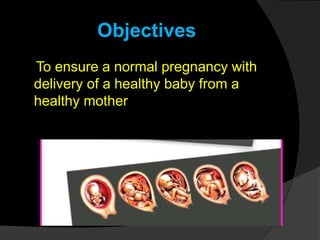
To ensure a normal pregnancy with
delivery of a healthy baby from a
healthy mother
Antenatal care comprises
of-
1.Registration of pregnancy
2. History taking
3. Antenatal examinations
[general and obstetrical]
4. Laboratory investigations
5. Health education
THE FIRST VISIT
History taking
Examination
Investigation
History taking
1. Particulars of the patient
2. Chief complaints with duration
3. Past history
4. Obstetric history
5. Menstrual history
6. Family history
7. Drug History
8. History of immunization
9. Socio-economic history
10. Contraceptive history
11. History of allergy
Ideally – ANC visits
First 28 weeks – once a month
Up to 36 weeks – twice a month
There after weekly till delivery.
 Minimum – 4 ANC visits
1st visit – around 16 weeks
2nd visit – between 24 and 28 weeks
3rd visit – at 32 weeks
4th visit – at 36 weeks.
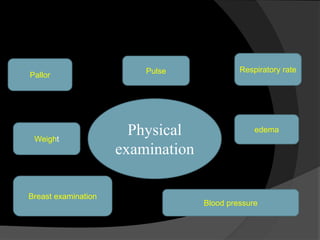
Physical
examination
Pallor Pulse Respiratory rate
Weight
edema
Blood pressure
Breast examination
Pallor – Examine palpebral conjunctiva, nails,
tongue, oral mucosa, palms
Pulse – 60-90 / min.
R.R. – 18-20 breaths / min.
Edema
CONT.D
B.P. – Two consecutive readings – systolic >
140 mmHg and / or diastolic > 90 mmHg
Check urine for the presence of albumin
Pre eclampsia – Hypertension + albuminuria
Imminent eclampsia – D.B.P. > 110 mmHg.
Eclampsia – Hypertension+ albuminuria +
Convulsions
Regular weight monitoring at each visit
11 kg. wt. gain entire pregnancy
After first trimester, wt. gain 2 Kg. / month
Breast examination
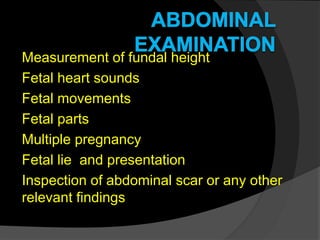
Measurement of fundal height
Fetal heart sounds
Fetal movements
Fetal parts
Multiple pregnancy
Fetal lie and presentation
Inspection of abdominal scar or any other
relevant findings
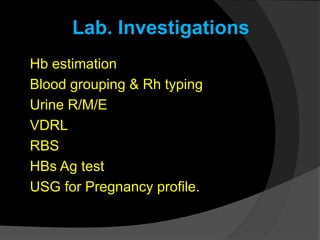
Lab. Investigations
Hb estimation
Blood grouping & Rh typing
Urine R/M/E
VDRL
RBS
HBs Ag test
USG for Pregnancy profile.
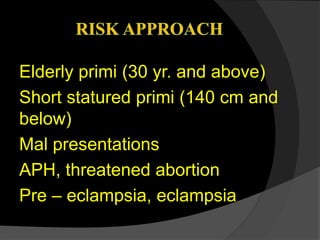
Elderly primi (30 yr. and above)
Short statured primi (140 cm and
below)
Mal presentations
APH, threatened abortion
Pre – eclampsia, eclampsia
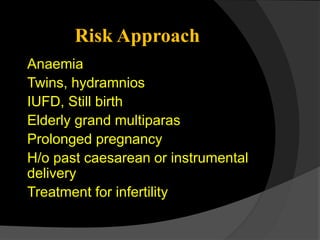
Anaemia
Twins, hydramnios
IUFD, Still birth
Elderly grand multiparas
Prolonged pregnancy
H/o past caesarean or instrumental
delivery
Treatment for infertility
Risk Approach
In subsequent visit
• Patient complains
• General examination
• Gestational age to be calculated
• Identification of problem
• Foetal movement
• SFH measurement
• Health education
• Prophylaxis & treatment of anemia
• Developing individualized birth plan
Second visit (24-28
weeks)
SFH measurement
To detect Multiple pregnancy
Third visit (32 weeks)
Screen for-
1. Preeclampsia
2. Multiple pregnancy
3. anemia
4. IUGR
Fourth visit (36 weeks)
• Identification of foetal
1. Lie
2. Presentation
3. Position
4. Birth plan
Antenatal advice
Entire pregnancy – 300
Kcal/day (extra)
Lactation – 600 Kcal/day
Diet:
Supplementary iron therapy is needed
for all pregnant mothers from 20 weeks
onwards. (30 mg of ferrous / day) (60-
100 mg/day) is given for large women,
twin, and those women who book for
ANC late in pregnancy Anemic woman
should take (200 mg/day
Hygiene:
Daily bath is recommended, as it stimulation
refreshing and relaxing.
Avoid hot water bath.
Bowel care:
As there is increase chance of constipation,
regular bowel movement may be facilitated
by regulation of diet taking plenty of fluids,
vegetables and milk.
Breast Care
Wash the breast with clean tap
water.
Exercise
Walk in moderation.
Avoid lifting heavy things.
Avoid long time standing.
Avoid sitting with crossed
legs as this may impede circulation.
Dressing:
Tight clothes and belts are avoided
The patient should wear
loose but comfortable dresses.
High heel shoes are better avoided.
Alcohol, smoking and drugs should
be avoided as the may affect the
fetal wellbeing
Rest and sleep
8 hour sleep at night
At least 2 hour sleep after mid-day meal
Hard strenuous work should be avoided in first
trimester and last 4 weeks
Coitus
Should be avoided in
• 1st trimester
• last 6 weeks
Warning sign
1. Headache
2. Blurring of vision
3. Convulsion
4. Vaginal bleeding
5. Fever
Thank you

Antenatalcare 161230151017

  • 1.
    Dr. Poly Begum AssistantProfessor Diabetic Association Medical College, Faridpur.
  • 2.
    Systemic supervision (examination andadvice) of a women during pregnancy is called ANC.
  • 3.
    Aims  1. Toscreen the high risk cases.  2. To p[revent or to detect and treat at the earliest any complications.  3. To ensure continued risk assessment and to provide ongoing primary preventive health care.  4. To educate the mother about the physiology of pregnancy and labour by demonstration, charts and diagrams so that fear is removed and psychology is improved.
  • 4.
     5. Todiscuss the couple about the place, time and mode of delivery, provisionally and care of the newborn.  6. To motivate the couple about the need of family planning and also appropriate advice to couple seeking medical termination of pregnancy.
  • 5.
    Objectives To ensure anormal pregnancy with delivery of a healthy baby from a healthy mother
  • 6.
    Antenatal care comprises of- 1.Registrationof pregnancy 2. History taking 3. Antenatal examinations [general and obstetrical] 4. Laboratory investigations 5. Health education
  • 7.
    THE FIRST VISIT Historytaking Examination Investigation
  • 8.
    History taking 1. Particularsof the patient 2. Chief complaints with duration 3. Past history 4. Obstetric history 5. Menstrual history 6. Family history 7. Drug History 8. History of immunization 9. Socio-economic history 10. Contraceptive history 11. History of allergy
  • 9.
    Ideally – ANCvisits First 28 weeks – once a month Up to 36 weeks – twice a month There after weekly till delivery.  Minimum – 4 ANC visits 1st visit – around 16 weeks 2nd visit – between 24 and 28 weeks 3rd visit – at 32 weeks 4th visit – at 36 weeks.
  • 11.
    Physical examination Pallor Pulse Respiratoryrate Weight edema Blood pressure Breast examination
  • 12.
    Pallor – Examinepalpebral conjunctiva, nails, tongue, oral mucosa, palms Pulse – 60-90 / min. R.R. – 18-20 breaths / min. Edema
  • 13.
    CONT.D B.P. – Twoconsecutive readings – systolic > 140 mmHg and / or diastolic > 90 mmHg Check urine for the presence of albumin Pre eclampsia – Hypertension + albuminuria Imminent eclampsia – D.B.P. > 110 mmHg. Eclampsia – Hypertension+ albuminuria + Convulsions
  • 14.
    Regular weight monitoringat each visit 11 kg. wt. gain entire pregnancy After first trimester, wt. gain 2 Kg. / month Breast examination
  • 15.
    Measurement of fundalheight Fetal heart sounds Fetal movements Fetal parts Multiple pregnancy Fetal lie and presentation Inspection of abdominal scar or any other relevant findings
  • 16.
    Lab. Investigations Hb estimation Bloodgrouping & Rh typing Urine R/M/E VDRL RBS HBs Ag test USG for Pregnancy profile.
  • 17.
    Elderly primi (30yr. and above) Short statured primi (140 cm and below) Mal presentations APH, threatened abortion Pre – eclampsia, eclampsia
  • 18.
    Anaemia Twins, hydramnios IUFD, Stillbirth Elderly grand multiparas Prolonged pregnancy H/o past caesarean or instrumental delivery Treatment for infertility Risk Approach
  • 19.
    In subsequent visit •Patient complains • General examination • Gestational age to be calculated • Identification of problem • Foetal movement • SFH measurement • Health education • Prophylaxis & treatment of anemia • Developing individualized birth plan
  • 20.
    Second visit (24-28 weeks) SFHmeasurement To detect Multiple pregnancy
  • 21.
    Third visit (32weeks) Screen for- 1. Preeclampsia 2. Multiple pregnancy 3. anemia 4. IUGR
  • 22.
    Fourth visit (36weeks) • Identification of foetal 1. Lie 2. Presentation 3. Position 4. Birth plan
  • 23.
    Antenatal advice Entire pregnancy– 300 Kcal/day (extra) Lactation – 600 Kcal/day
  • 24.
    Diet: Supplementary iron therapyis needed for all pregnant mothers from 20 weeks onwards. (30 mg of ferrous / day) (60- 100 mg/day) is given for large women, twin, and those women who book for ANC late in pregnancy Anemic woman should take (200 mg/day
  • 25.
    Hygiene: Daily bath isrecommended, as it stimulation refreshing and relaxing. Avoid hot water bath. Bowel care: As there is increase chance of constipation, regular bowel movement may be facilitated by regulation of diet taking plenty of fluids, vegetables and milk.
  • 26.
    Breast Care Wash thebreast with clean tap water. Exercise Walk in moderation. Avoid lifting heavy things. Avoid long time standing. Avoid sitting with crossed legs as this may impede circulation.
  • 27.
    Dressing: Tight clothes andbelts are avoided The patient should wear loose but comfortable dresses. High heel shoes are better avoided. Alcohol, smoking and drugs should be avoided as the may affect the fetal wellbeing
  • 28.
    Rest and sleep 8hour sleep at night At least 2 hour sleep after mid-day meal Hard strenuous work should be avoided in first trimester and last 4 weeks Coitus Should be avoided in • 1st trimester • last 6 weeks
  • 29.
    Warning sign 1. Headache 2.Blurring of vision 3. Convulsion 4. Vaginal bleeding 5. Fever
  • 30.