
Drugs Affecting the Autonomic
Nervous System

Pharmacology 49.222
Bill Diehl-Jones RN, PhD
Faculty of Nursing and Department of Zoology
Agenda
•
•
•
•
•
•

A Zen Review
Overview of CNS and ANS
Neurotransmitters and 2nd Messengers
Cholinergic Agonists and Antagonists
Adrenergic Agonists and Antagonists
Movement Disorder Drugs
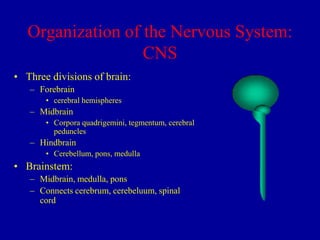
Organization of the Nervous System:
CNS
• Three divisions of brain:
– Forebrain
• cerebral hemispheres

– Midbrain
• Corpora quadrigemini, tegmentum, cerebral
peduncles

– Hindbrain
• Cerebellum, pons, medulla

• Brainstem:
– Midbrain, medulla, pons
– Connects cerebrum, cerebeluum, spinal
cord
Organization of the Nervous System:
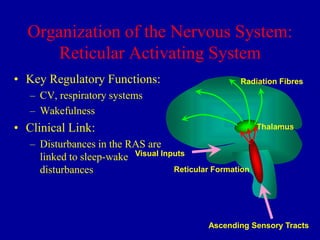
Reticular Activating System
• Key Regulatory Functions:

Radiation Fibres

– CV, respiratory systems
– Wakefulness

• Clinical Link:

Thalamus

– Disturbances in the RAS are
linked to sleep-wake Visual Inputs
Reticular Formation
disturbances

Ascending Sensory Tracts
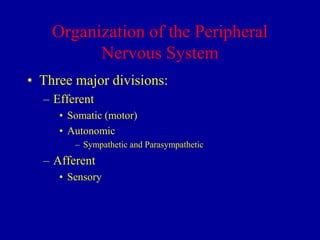
Organization of the Peripheral
Nervous System
• Three major divisions:
– Efferent
• Somatic (motor)
• Autonomic
– Sympathetic and Parasympathetic

– Afferent
• Sensory
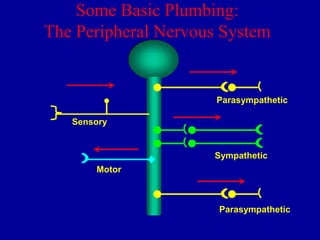
Some Basic Plumbing:
The Peripheral Nervous System

Parasympathetic
Sensory

Sympathetic
Motor

Parasympathetic
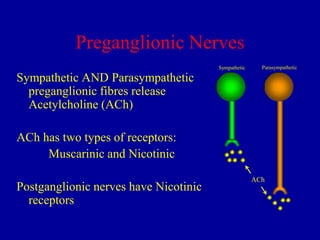
Preganglionic Nerves
Sympathetic

Parasympathetic

Sympathetic AND Parasympathetic
preganglionic fibres release
Acetylcholine (ACh)
ACh has two types of receptors:
Muscarinic and Nicotinic
Postganglionic nerves have Nicotinic
receptors

ACh
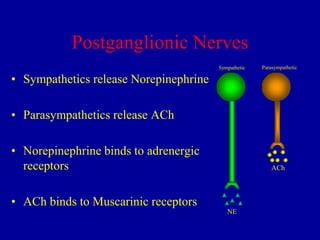
Postganglionic Nerves
Sympathetic

Parasympathetic

• Sympathetics release Norepinephrine
• Parasympathetics release ACh
• Norepinephrine binds to adrenergic
receptors

ACh

• ACh binds to Muscarinic receptors
NE
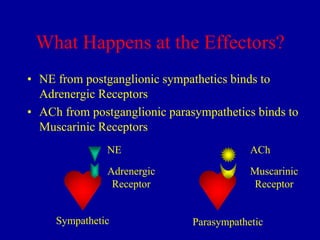
What Happens at the Effectors?
• NE from postganglionic sympathetics binds to
Adrenergic Receptors
• ACh from postganglionic parasympathetics binds to
Muscarinic Receptors
NE

ACh

Adrenergic
Receptor

Muscarinic
Receptor

Sympathetic

Parasympathetic
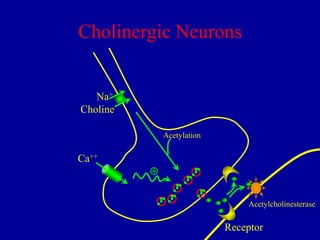
Cholinergic Neurons

Na+
Choline
Acetylation

Ca++


Acetylcholinesterase

Receptor
Cholinergic Receptors
• Muscarinic receptors come in 5 flavours
– M1, M2, M3, M4, M5
– Found in different locations
– Research is on-going to identify specific
agonists and antagonists

• Nicotinic receptors come in 1 flavour
Cholinergic Agonists
•
•
•
•

Acetylcholine
Bethanechol
Carbachol
Pilocarpine
General Effects of Cholinergic
Agonists
• Decrease heart rate and cardiac output
• Decrease blood pressure
• Increases GI motility and secretion
• Pupillary constriction
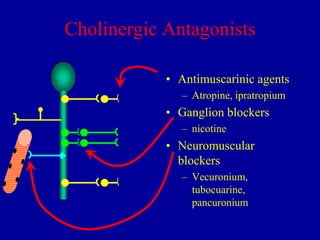
Cholinergic Antagonists
• Antimuscarinic agents
– Atropine, ipratropium

• Ganglion blockers
– nicotine

• Neuromuscular
blockers
– Vecuronium,
tubocuarine,
pancuronium
Where are some of these drugs
used?
Atropine
(a cholinergic antagonist)
• Comes from Belladonna
– High affinity for muscarinic
receptors
– Causes “mydriasis” (dilation of
the pupil) and “cycloplegia”

• Useful for eye exams, tmt of
organophosphate poisoning,
antisecretory effects
• Side effects?
Scopalamine
(also a cholinergic antagonist)

• Also from Belladonna
• Peripheral effects
similar to atropine
• More CNS effects:
– Anti-motion sickness
– amnesiac
Trimethaphan
(yet another cholinergic antagonist)

• Competitive nicotinic
ganglion blocker
• Used to lower blood
pressure in emergencies
Neuromuscular Blockers
• Look like acetylcholine
• Either work as antagonists or agonists
• Two flavours:
– Non-depolarizing (antagonist)
• Eg: tubocurarine
• Block ion channels at motor end plate

– Depolarizing (agonist)
• Eg: succinylcholine
• Activates receptor
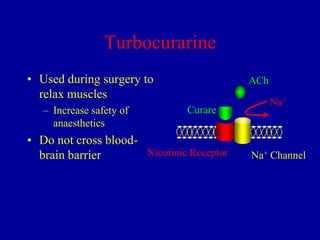
Turbocurarine
• Used during surgery to
relax muscles
– Increase safety of
anaesthetics

ACh
Curare

• Do not cross bloodNicotinic Receptor
brain barrier

Na+

Na+ Channel
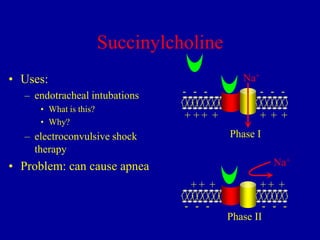
Succinylcholine
• Uses:
– endotracheal intubations
• What is this?
• Why?

Na+
- - -

- - -

+ ++ +

+ + +

Phase I

– electroconvulsive shock
therapy

Na+

• Problem: can cause apnea
++ +

++ +

- - -

- - Phase II
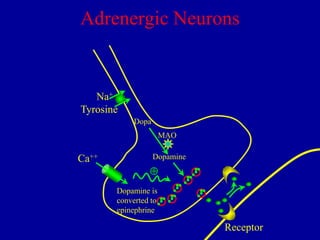
Adrenergic Neurons

Na+
Tyrosine
Dopa
MAO

Ca++

Dopamine


Dopamine is
converted to
epinephrine

Receptor
Word of the Day:
• SYMPATHOMIMETIC
– Adrenergic drug which acts directly on
adrenergic receptor, activating it
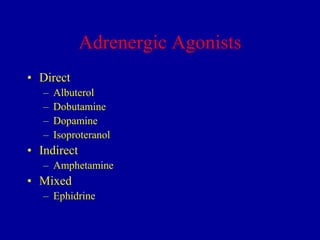
Adrenergic Agonists
• Direct
–
–
–
–

Albuterol
Dobutamine
Dopamine
Isoproteranol

• Indirect
– Amphetamine

• Mixed
– Ephidrine
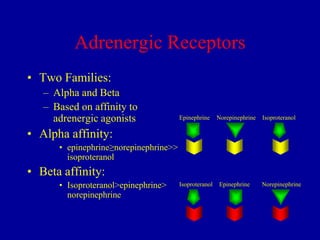
Adrenergic Receptors
• Two Families:
– Alpha and Beta
– Based on affinity to
adrenergic agonists

Epinephrine

Norepinephrine

Isoproteranol

Epinephrine

Isoproteranol

• Alpha affinity:
• epinephrine≥norepinephrine>>
isoproteranol

• Beta affinity:
• Isoproteranol>epinephrine>
norepinephrine

Norepinephrine
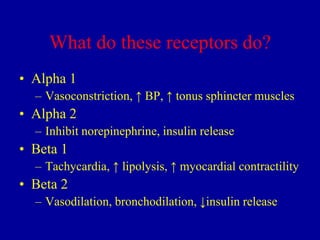
What do these receptors do?
• Alpha 1
– Vasoconstriction, ↑ BP, ↑ tonus sphincter muscles

• Alpha 2
– Inhibit norepinephrine, insulin release

• Beta 1
– Tachycardia, ↑ lipolysis, ↑ myocardial contractility

• Beta 2
– Vasodilation, bronchodilation, ↓insulin release
Adrenergic Angonists
• Direct acting:
– Epinephrine: interacts with both alpha and beta
• Low dose: mainly beta effects (vasodilation)
• High dose: alpha effects (vasoconstriction)
• Therapeutic uses: emerg tmt of asthma, glaucoma,
anaphyslaxis
– (what about terbutaline?)
Adrenergic Agonists
• Indirect:
– Cause NE release only
– Example:
• Amphetamine
– CNS stimulant
– Increases BP by alpha effect on vasculature, beta effect on heart
Mixed-Action
• Causes NE release AND stimulates receptor
• Example:
– Ephedrine:
•
•
•
•

What type of drug?
Alpha and beta stimulant
Use: asthma, nasal sprays
slower action
Adrenergic Antagonists
• Alpha blockers
– Eg: Prazosin
• Selective alpha 1 blocker
• Tmt: hypertension
– relaxes arterial and venous smooth muscle
– Causes “first dose” response (what is this?)
Adrenergic Antagonists
• Beta Blockers
• Example: Propranolol
– Non-selective (blocks beta 1 and beta 2)
– Effects:
• ↓ cardiac output, vasodilation, bronchoconstriction
Adrenergic Antagonists
• Eg: Atenolol, Metoprolol
– Preferentially block beta 1; no beta effects (why
is this good?)

• Partial Agonists:
– Pindolol, acebutolol
• Weakly stimulate beta 1 and beta 2
• Causes less bradycardia
Adrenergic Antagonists
• Eg: Nadolol
– Nonselective beta blocker
– Used for glaucoma

• Eg: Labetolol
– Alpha AND beta blocker
– Used in treating PIH
Drugs that Affect Uptake/Release
• Eg: Cocaine
– Blocks Na+/K+ ATPase
– Prevents reuptake of
epinephrine/norepinephrine
Treatment of Movement
Disorders
What Regulates Movement?
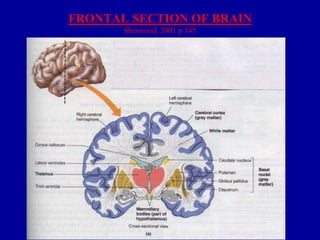
Basal Ganglia are involved
Example:
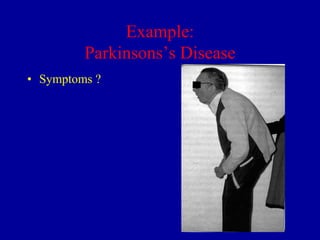
Parkinsons’s Disease
• Symptoms ?
FRONTAL SECTION OF BRAIN
Sherwood, 2001 p 145
BASAL GANGLIA cont’d

• Role of basal ganglia:
1. Inhibit muscle tone throughout the body
2. Select & maintain purposeful motor activity
while suppressing useless/unwanted patterns
of movement
3. Coordination of slow, sustained movements
(especially those related to posture & support)
4. Help regulate activity of the cerebral cortex
BASAL GANGLIA SYSTEM

Feedback loops - complex
- form direct & indirect pathways
- balance excitatory & inhibitory
activities

Neurotransimitters:
Excitatory - ACh
glutamate

Inhibitory - dopamine
GABA
DOPAMINE
• major NT regulating subconscious movements of skeletal
muscles
• majority located in the terminals of pathway stretching
from the neuronal cell bodies in SNc to the striatum
• generally inhibits the function of striatal neurons & striatal
outputs
• when dopamine production is , a chemical imbalance
occurs affecting movement, balance and gait
PATHOPHYSIOLOGY OF PARKINSON’S
DISEASE
• Major pathological features:
1. Death of dopamine producing cells in the SNc
leads to overactivation of the indirect pathway

2. Presence of Lewy bodies –small eosinophilic
inclusions found in the neurons of SNc
Results in:- degeneration of the nigrostriatal
pathway
- decreased thalamic excitation of the
motor cortex
4. Drug of Choice: LEVODOPA
Why is it used?
- virtually all pt’s with PD show a response to
levodopa
- improves quality of life
- in use since 1960’s
- easy to administer (non-invasive)
- relatively inexpensive
- useful in diagnosing PD

• Mechanism of action: is a precursor to dopamine helps
restore the balance of dopamine in striatum
–most effective in combo with Carbidopa ( ’s levodopa’s
peripheral conversion to dopamine)
5. OTHER APPROACHES TO TREATMENT

• Pharmacological:
– Dopamine agonists: ie. Bromocriptine or pergolide
mesylate

– Selective inhibitor of type B monoamine
oxidase: ie.Selegiline
– Antivirals: ie. Amantadine
– Anticholinergics: ie. Trihexyphenidyl
– COMT inhibitors: ie. Entacapone
APPROACHES cont’d

• Surgical:
• Pallidotomy & Thalotomy:
– microelectrode destruction of specific site in the basal
ganglia

• Deep brain stimulation:
– electrode implantation with external pacemaker

• Fetal nigral transplantation:
– Implantation of embryonic dopaminergic neurons into
the substantia nigra for growth and supply of dopamine

Pharm ans

  • 1.
    Drugs Affecting theAutonomic Nervous System Pharmacology 49.222 Bill Diehl-Jones RN, PhD Faculty of Nursing and Department of Zoology
  • 2.
    Agenda • • • • • • A Zen Review Overviewof CNS and ANS Neurotransmitters and 2nd Messengers Cholinergic Agonists and Antagonists Adrenergic Agonists and Antagonists Movement Disorder Drugs
  • 3.
    Organization of theNervous System: CNS • Three divisions of brain: – Forebrain • cerebral hemispheres – Midbrain • Corpora quadrigemini, tegmentum, cerebral peduncles – Hindbrain • Cerebellum, pons, medulla • Brainstem: – Midbrain, medulla, pons – Connects cerebrum, cerebeluum, spinal cord
  • 4.
    Organization of theNervous System: Reticular Activating System • Key Regulatory Functions: Radiation Fibres – CV, respiratory systems – Wakefulness • Clinical Link: Thalamus – Disturbances in the RAS are linked to sleep-wake Visual Inputs Reticular Formation disturbances Ascending Sensory Tracts
  • 5.
    Organization of thePeripheral Nervous System • Three major divisions: – Efferent • Somatic (motor) • Autonomic – Sympathetic and Parasympathetic – Afferent • Sensory
  • 6.
    Some Basic Plumbing: ThePeripheral Nervous System Parasympathetic Sensory Sympathetic Motor Parasympathetic
  • 7.
    Preganglionic Nerves Sympathetic Parasympathetic Sympathetic ANDParasympathetic preganglionic fibres release Acetylcholine (ACh) ACh has two types of receptors: Muscarinic and Nicotinic Postganglionic nerves have Nicotinic receptors ACh
  • 8.
    Postganglionic Nerves Sympathetic Parasympathetic • Sympatheticsrelease Norepinephrine • Parasympathetics release ACh • Norepinephrine binds to adrenergic receptors ACh • ACh binds to Muscarinic receptors NE
  • 9.
    What Happens atthe Effectors? • NE from postganglionic sympathetics binds to Adrenergic Receptors • ACh from postganglionic parasympathetics binds to Muscarinic Receptors NE ACh Adrenergic Receptor Muscarinic Receptor Sympathetic Parasympathetic
  • 10.
  • 11.
    Cholinergic Receptors • Muscarinicreceptors come in 5 flavours – M1, M2, M3, M4, M5 – Found in different locations – Research is on-going to identify specific agonists and antagonists • Nicotinic receptors come in 1 flavour
  • 12.
  • 13.
    General Effects ofCholinergic Agonists • Decrease heart rate and cardiac output • Decrease blood pressure • Increases GI motility and secretion • Pupillary constriction
  • 14.
    Cholinergic Antagonists • Antimuscarinicagents – Atropine, ipratropium • Ganglion blockers – nicotine • Neuromuscular blockers – Vecuronium, tubocuarine, pancuronium
  • 15.
    Where are someof these drugs used?
  • 16.
    Atropine (a cholinergic antagonist) •Comes from Belladonna – High affinity for muscarinic receptors – Causes “mydriasis” (dilation of the pupil) and “cycloplegia” • Useful for eye exams, tmt of organophosphate poisoning, antisecretory effects • Side effects?
  • 17.
    Scopalamine (also a cholinergicantagonist) • Also from Belladonna • Peripheral effects similar to atropine • More CNS effects: – Anti-motion sickness – amnesiac
  • 18.
    Trimethaphan (yet another cholinergicantagonist) • Competitive nicotinic ganglion blocker • Used to lower blood pressure in emergencies
  • 19.
    Neuromuscular Blockers • Looklike acetylcholine • Either work as antagonists or agonists • Two flavours: – Non-depolarizing (antagonist) • Eg: tubocurarine • Block ion channels at motor end plate – Depolarizing (agonist) • Eg: succinylcholine • Activates receptor
  • 20.
    Turbocurarine • Used duringsurgery to relax muscles – Increase safety of anaesthetics ACh Curare • Do not cross bloodNicotinic Receptor brain barrier Na+ Na+ Channel
  • 21.
    Succinylcholine • Uses: – endotrachealintubations • What is this? • Why? Na+ - - - - - - + ++ + + + + Phase I – electroconvulsive shock therapy Na+ • Problem: can cause apnea ++ + ++ + - - - - - Phase II
  • 22.
  • 23.
    Word of theDay: • SYMPATHOMIMETIC – Adrenergic drug which acts directly on adrenergic receptor, activating it
  • 24.
  • 25.
    Adrenergic Receptors • TwoFamilies: – Alpha and Beta – Based on affinity to adrenergic agonists Epinephrine Norepinephrine Isoproteranol Epinephrine Isoproteranol • Alpha affinity: • epinephrine≥norepinephrine>> isoproteranol • Beta affinity: • Isoproteranol>epinephrine> norepinephrine Norepinephrine
  • 26.
    What do thesereceptors do? • Alpha 1 – Vasoconstriction, ↑ BP, ↑ tonus sphincter muscles • Alpha 2 – Inhibit norepinephrine, insulin release • Beta 1 – Tachycardia, ↑ lipolysis, ↑ myocardial contractility • Beta 2 – Vasodilation, bronchodilation, ↓insulin release
  • 27.
    Adrenergic Angonists • Directacting: – Epinephrine: interacts with both alpha and beta • Low dose: mainly beta effects (vasodilation) • High dose: alpha effects (vasoconstriction) • Therapeutic uses: emerg tmt of asthma, glaucoma, anaphyslaxis – (what about terbutaline?)
  • 28.
    Adrenergic Agonists • Indirect: –Cause NE release only – Example: • Amphetamine – CNS stimulant – Increases BP by alpha effect on vasculature, beta effect on heart
  • 29.
    Mixed-Action • Causes NErelease AND stimulates receptor • Example: – Ephedrine: • • • • What type of drug? Alpha and beta stimulant Use: asthma, nasal sprays slower action
  • 30.
    Adrenergic Antagonists • Alphablockers – Eg: Prazosin • Selective alpha 1 blocker • Tmt: hypertension – relaxes arterial and venous smooth muscle – Causes “first dose” response (what is this?)
  • 31.
    Adrenergic Antagonists • BetaBlockers • Example: Propranolol – Non-selective (blocks beta 1 and beta 2) – Effects: • ↓ cardiac output, vasodilation, bronchoconstriction
  • 32.
    Adrenergic Antagonists • Eg:Atenolol, Metoprolol – Preferentially block beta 1; no beta effects (why is this good?) • Partial Agonists: – Pindolol, acebutolol • Weakly stimulate beta 1 and beta 2 • Causes less bradycardia
  • 33.
    Adrenergic Antagonists • Eg:Nadolol – Nonselective beta blocker – Used for glaucoma • Eg: Labetolol – Alpha AND beta blocker – Used in treating PIH
  • 34.
    Drugs that AffectUptake/Release • Eg: Cocaine – Blocks Na+/K+ ATPase – Prevents reuptake of epinephrine/norepinephrine
  • 35.
  • 36.
    What Regulates Movement? BasalGanglia are involved
  • 37.
  • 38.
    FRONTAL SECTION OFBRAIN Sherwood, 2001 p 145
  • 39.
    BASAL GANGLIA cont’d •Role of basal ganglia: 1. Inhibit muscle tone throughout the body 2. Select & maintain purposeful motor activity while suppressing useless/unwanted patterns of movement 3. Coordination of slow, sustained movements (especially those related to posture & support) 4. Help regulate activity of the cerebral cortex
  • 40.
    BASAL GANGLIA SYSTEM Feedbackloops - complex - form direct & indirect pathways - balance excitatory & inhibitory activities Neurotransimitters: Excitatory - ACh glutamate Inhibitory - dopamine GABA
  • 41.
    DOPAMINE • major NTregulating subconscious movements of skeletal muscles • majority located in the terminals of pathway stretching from the neuronal cell bodies in SNc to the striatum • generally inhibits the function of striatal neurons & striatal outputs • when dopamine production is , a chemical imbalance occurs affecting movement, balance and gait
  • 42.
    PATHOPHYSIOLOGY OF PARKINSON’S DISEASE •Major pathological features: 1. Death of dopamine producing cells in the SNc leads to overactivation of the indirect pathway 2. Presence of Lewy bodies –small eosinophilic inclusions found in the neurons of SNc Results in:- degeneration of the nigrostriatal pathway - decreased thalamic excitation of the motor cortex
  • 43.
    4. Drug ofChoice: LEVODOPA Why is it used? - virtually all pt’s with PD show a response to levodopa - improves quality of life - in use since 1960’s - easy to administer (non-invasive) - relatively inexpensive - useful in diagnosing PD • Mechanism of action: is a precursor to dopamine helps restore the balance of dopamine in striatum –most effective in combo with Carbidopa ( ’s levodopa’s peripheral conversion to dopamine)
  • 44.
    5. OTHER APPROACHESTO TREATMENT • Pharmacological: – Dopamine agonists: ie. Bromocriptine or pergolide mesylate – Selective inhibitor of type B monoamine oxidase: ie.Selegiline – Antivirals: ie. Amantadine – Anticholinergics: ie. Trihexyphenidyl – COMT inhibitors: ie. Entacapone
  • 45.
    APPROACHES cont’d • Surgical: •Pallidotomy & Thalotomy: – microelectrode destruction of specific site in the basal ganglia • Deep brain stimulation: – electrode implantation with external pacemaker • Fetal nigral transplantation: – Implantation of embryonic dopaminergic neurons into the substantia nigra for growth and supply of dopamine