


DRUGS ACTING ON
AUTONOMIC NERVOUS SYSTEM
INTRODUCTION:-
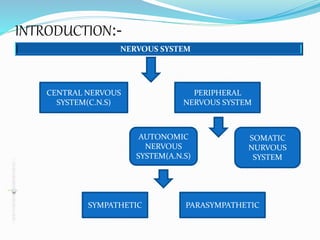
NERVOUS SYSTEM
C
E
N
T
R
A
L
N
E
R
V
O
U
S
S
Y
S
T
E
M
(
C
.
N
.
S
)
P
E
R
I
P
H
E
R
A
L
N
E
R
V
O
U
S
S
Y
S
T
E
M
CENTRAL NERVOUS
SYSTEM(C.N.S)
PERIPHERAL
NERVOUS SYSTEM
AUTONOMIC
NERVOUS
SYSTEM(A.N.S)
SOMATIC
NURVOUS
SYSTEM
SYMPATHETIC PARASYMPATHETIC
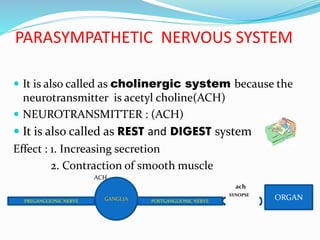
PARASYMPATHETIC NERVOUS SYSTEM
 It is also called as cholinergic system because the
neurotransmitter is acetyl choline(ACH)
 NEUROTRANSMITTER : (ACH)
 It is also called as REST and DIGEST system
Effect : 1. Increasing secretion
2. Contraction of smooth muscle
ACH
ach
SYNOPSE
GANGLIA POSTGANGLIONIC NERVE
ORGANPREGANGLIONIC NERVE
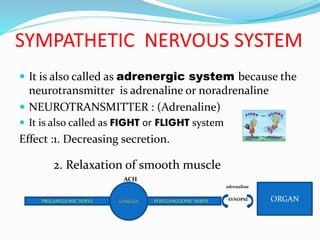
SYMPATHETIC NERVOUS SYSTEM
 It is also called as adrenergic system because the
neurotransmitter is adrenaline or noradrenaline
 NEUROTRANSMITTER : (Adrenaline)
 It is also called as FIGHT or FLIGHT system
Effect :1. Decreasing secretion.
2. Relaxation of smooth muscle
ACH
adrenaline
SYNOPSEPREGANGLIONIC NERVE POSTGANGLIONIC NERVEGANGLIA ORGAN
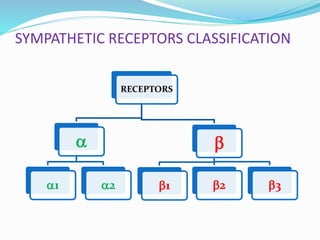
SYMPATHETIC RECEPTORS CLASSIFICATION
RECEPTORS

1 2

1 2 3
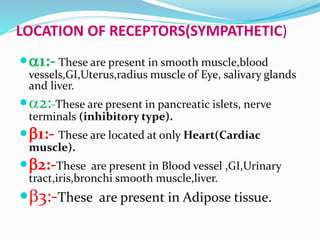
LOCATION OF RECEPTORS(SYMPATHETIC)
1:- These are present in smooth muscle,blood
vessels,GI,Uterus,radius muscle of Eye, salivary glands
and liver.
2:-These are present in pancreatic islets, nerve
terminals (inhibitory type).
1:- These are located at only Heart(Cardiac
muscle).
2:-These are present in Blood vessel ,GI,Urinary
tract,iris,bronchi smooth muscle,liver.
3:-These are present in Adipose tissue.
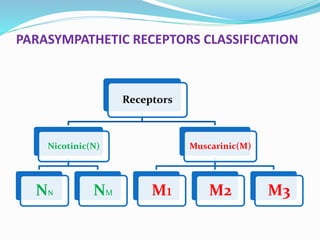
PARASYMPATHETIC RECEPTORS CLASSIFICATION
Receptors
Nicotinic(N)
NN NM
Muscarinic(M)
M1 M2 M3
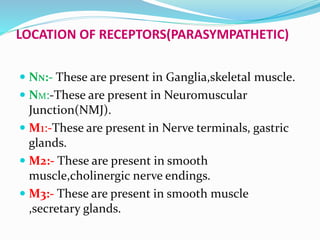
LOCATION OF RECEPTORS(PARASYMPATHETIC)
 NN:- These are present in Ganglia,skeletal muscle.
 NM:-These are present in Neuromuscular
Junction(NMJ).
 M1:-These are present in Nerve terminals, gastric
glands.
 M2:- These are present in smooth
muscle,cholinergic nerve endings.
 M3:- These are present in smooth muscle
,secretary glands.
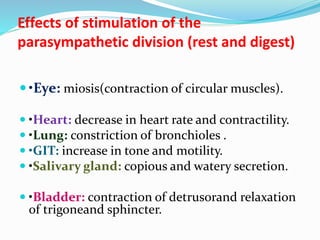
Effects of stimulation of the
parasympathetic division (rest and digest)
 •Eye: miosis(contraction of circular muscles).
 •Heart: decrease in heart rate and contractility.
 •Lung: constriction of bronchioles .
 •GIT: increase in tone and motility.
 •Salivary gland: copious and watery secretion.
 •Bladder: contraction of detrusorand relaxation
of trigoneand sphincter.
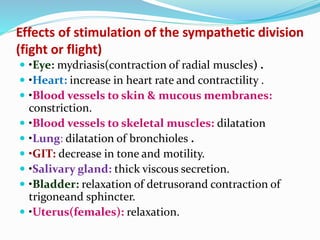
Effects of stimulation of the sympathetic division
(fight or flight)
 •Eye: mydriasis(contraction of radial muscles) .
 •Heart: increase in heart rate and contractility .
 •Blood vessels to skin & mucous membranes:
constriction.
 •Blood vessels to skeletal muscles: dilatation
 •Lung: dilatation of bronchioles .
 •GIT: decrease in tone and motility.
 •Salivary gland: thick viscous secretion.
 •Bladder: relaxation of detrusorand contraction of
trigoneand sphincter.
 •Uterus(females): relaxation.
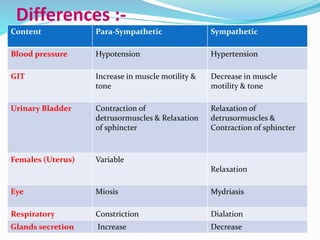
Differences :-
Content Para-Sympathetic Sympathetic
Blood pressure Hypotension Hypertension
GIT Increase in muscle motility &
tone
Decrease in muscle
motility & tone
Urinary Bladder Contraction of
detrusormuscles & Relaxation
of sphincter
Relaxation of
detrusormuscles &
Contraction of sphincter
Females (Uterus) Variable
Relaxation
Eye Miosis Mydriasis
Respiratory Constriction Dialation
Glands secretion Increase Decrease
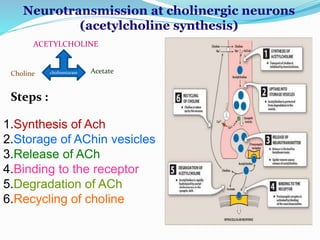
Neurotransmission at cholinergic neurons
(acetylcholine synthesis)
ACETYLCHOLINE
cholinestaraseCholine Acetate
Steps :
1.Synthesis of Ach
2.Storage of AChin vesicles
3.Release of ACh
4.Binding to the receptor
5.Degradation of ACh
6.Recycling of choline
DEFINATIONS :
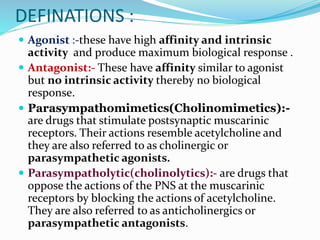
 Agonist :-these have high affinity and intrinsic
activity and produce maximum biological response .
 Antagonist:- These have affinity similar to agonist
but no intrinsic activity thereby no biological
response.
 Parasympathomimetics(Cholinomimetics):-
are drugs that stimulate postsynaptic muscarinic
receptors. Their actions resemble acetylcholine and
they are also referred to as cholinergic or
parasympathetic agonists.
 Parasympatholytic(cholinolytics):- are drugs that
oppose the actions of the PNS at the muscarinic
receptors by blocking the actions of acetylcholine.
They are also referred to as anticholinergics or
parasympathetic antagonists.
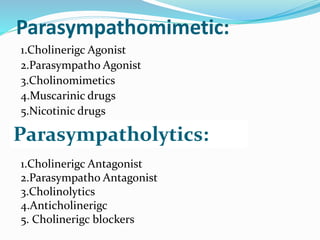
Parasympathomimetic:
1.Cholinerigc Agonist
2.Parasympatho Agonist
3.Cholinomimetics
4.Muscarinic drugs
5.Nicotinic drugs
Parasympatholytics:
1.Cholinerigc Antagonist
2.Parasympatho Antagonist
3.Cholinolytics
4.Anticholinerigc
5. Cholinerigc blockers
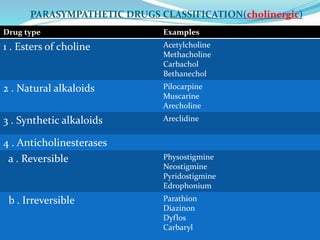
PARASYMPATHETIC DRUGS CLASSIFICATION(cholinergic)
Drug type Examples
1 . Esters of choline Acetylcholine
Methacholine
Carbachol
Bethanechol
2 . Natural alkaloids Pilocarpine
Muscarine
Arecholine
3 . Synthetic alkaloids Areclidine
4 . Anticholinesterases
a . Reversible Physostigmine
Neostigmine
Pyridostigmine
Edrophonium
b . Irreversible Parathion
Diazinon
Dyflos
Carbaryl
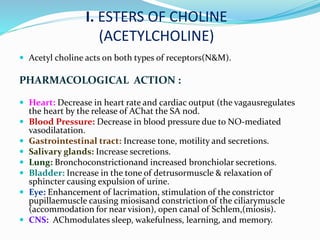
I. ESTERS OF CHOLINE
(ACETYLCHOLINE)
 Acetyl choline acts on both types of receptors(N&M).
PHARMACOLOGICAL ACTION :
 Heart: Decrease in heart rate and cardiac output (the vagausregulates
the heart by the release of AChat the SA nod.
 Blood Pressure: Decrease in blood pressure due to NO-mediated
vasodilatation.
 Gastrointestinal tract: Increase tone, motility and secretions.
 Salivary glands: Increase secretions.
 Lung: Bronchoconstrictionand increased bronchiolar secretions.
 Bladder: Increase in the tone of detrusormuscle & relaxation of
sphincter causing expulsion of urine.
 Eye: Enhancement of lacrimation, stimulation of the constrictor
pupillaemuscle causing miosisand constriction of the ciliarymuscle
(accommodation for near vision), open canal of Schlem,(miosis).
 CNS: AChmodulates sleep, wakefulness, learning, and memory.
Advers effects :
 It causes bradycardia, hypotension, flushing.
 It causes dyspnoea by constrictine the branchioles.
 It also causes diaphoresis
Therapeutic uses :
 Acetylcholine is not used for any therapeutic effect.
 It is used only for experimental purposes.
II.NATURAL ALKALOIDS
Pilocarpine : It is an alkaloid obtained from south
American shrubs,pilocarpus microphyllus and pilocarpus
jaborandi.
•On the eye it produces miosis.
•It is mainly used for the treatment of Glaucoma.
•It is available as eye drops and eye ointments.
III.ANTICHOLINESTERASE DRUGS
 It is also called as cholinesterase inhibitors.
 REVERSIBLE : Eg:- Physostigimine
 These have a structurally similar to Ach .
 So they combined with both anionic and esteratic site of Acetyl
cholinie esterase so this enzyme is temporarly inhibited.
 PHARMACOLOGYCAL ACTIONS:
 Eye: on the eye the anticholinesterase agents produce miosis .
 GI: They produce increase in motility and also secretion of GI.
 Skeletal muscle: These drugs produce stimulation followed by
depression.
 Secretions: Bronchioles, lacrimal, salivary, gastric and
pancreatic secretions are increased.
 Smooth muscles: Bronchioles and ureters are contracted.
THERAPEUTIC USES
 The reversible anticholinesterases are used.
 For reducing introcular tension in glaucoma.
 For the diagnosis and treatment of myasthenia gravis.
 For the treatment of curare and atropine poisoning.
 For the treatment of post-operative paralytic ileus.
 For the treatment of paroxysmal atrial and
supraventricular tahycardia.
IRRIVERSIBLE :
ORGANOPHOSPHORUS COMPOUNDS
 The irreversible anticholinesterases combined only with
estric site they produce phosphorylation of the estratic site.
 This produces an irreverisible inhibition of
acetylcholineestarase.
 These compounds are organic esters of phoshoric acid.
 They are highly lipid soluble .So they can be absorbed
through all routes including the skin and lungs.
 The pharmacological actions of these compounds result due
to inhibition of cholinesterase.
 These compounds have prolonged action and high toxicity, so
they have limited therapeutic use.
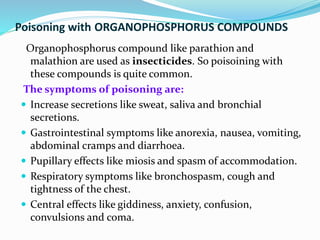
Poisoning with ORGANOPHOSPHORUS COMPOUNDS
Organophosphorus compound like parathion and
malathion are used as insecticides. So poisoining with
these compounds is quite common.
The symptoms of poisoning are:
 Increase secretions like sweat, saliva and bronchial
secretions.
 Gastrointestinal symptoms like anorexia, nausea, vomiting,
abdominal cramps and diarrhoea.
 Pupillary effects like miosis and spasm of accommodation.
 Respiratory symptoms like bronchospasm, cough and
tightness of the chest.
 Central effects like giddiness, anxiety, confusion,
convulsions and coma.
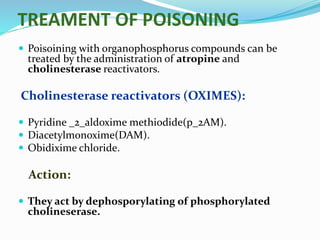
TREAMENT OF POISONING
 Poisoining with organophosphorus compounds can be
treated by the administration of atropine and
cholinesterase reactivators.
Cholinesterase reactivators (OXIMES):
 Pyridine _2_aldoxime methiodide(p_2AM).
 Diacetylmonoxime(DAM).
 Obidixime chloride.
Action:
 They act by dephosporylating of phosphorylated
cholineserase.
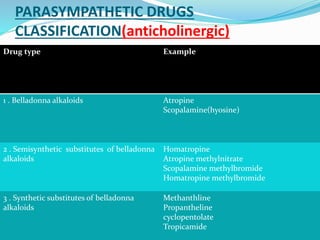
PARASYMPATHETIC DRUGS
CLASSIFICATION(anticholinergic)
Drug type Example
1 . Belladonna alkaloids Atropine
Scopalamine(hyosine)
2 . Semisynthetic substitutes of belladonna
alkaloids
Homatropine
Atropine methylnitrate
Scopalamine methylbromide
Homatropine methylbromide
3 . Synthetic substitutes of belladonna
alkaloids
Methanthline
Propantheline
cyclopentolate
Tropicamide
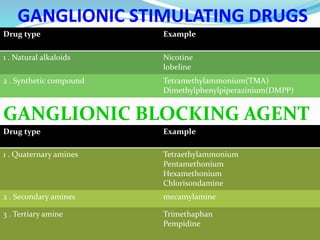
GANGLIONIC STIMULATING DRUGS
Drug type Example
1 . Natural alkaloids Nicotine
lobeline
2 . Synthetic compound Tetramethylammonium(TMA)
Dimethylphenylpiperazinium(DMPP)
GANGLIONIC BLOCKING AGENT
Drug type Example
1 . Quaternary amines Tetraethylammonium
Pentamethonium
Hexamethonium
Chlorisondamine
2 . Secondary amines mecamylamine
3 . Tertiary amine Trimethaphan
Pempidine
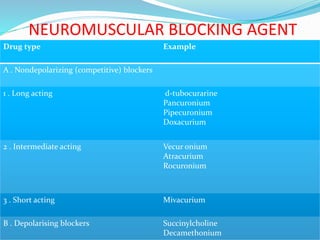
NEUROMUSCULAR BLOCKING AGENT
Drug type Example
A . Nondepolarizing (competitive) blockers
1 . Long acting d-tubocurarine
Pancuronium
Pipecuronium
Doxacurium
2 . Intermediate acting Vecur onium
Atracurium
Rocuronium
3 . Short acting Mivacurium
B . Depolarising blockers Succinylcholine
Decamethonium
PRESENTATIONBY:
V. MAHESH
autonomic nervous system

autonomic nervous system

  • 2.
  • 3.
  • 4.
    PARASYMPATHETIC NERVOUS SYSTEM It is also called as cholinergic system because the neurotransmitter is acetyl choline(ACH)  NEUROTRANSMITTER : (ACH)  It is also called as REST and DIGEST system Effect : 1. Increasing secretion 2. Contraction of smooth muscle ACH ach SYNOPSE GANGLIA POSTGANGLIONIC NERVE ORGANPREGANGLIONIC NERVE
  • 5.
    SYMPATHETIC NERVOUS SYSTEM It is also called as adrenergic system because the neurotransmitter is adrenaline or noradrenaline  NEUROTRANSMITTER : (Adrenaline)  It is also called as FIGHT or FLIGHT system Effect :1. Decreasing secretion. 2. Relaxation of smooth muscle ACH adrenaline SYNOPSEPREGANGLIONIC NERVE POSTGANGLIONIC NERVEGANGLIA ORGAN
  • 6.
  • 7.
    LOCATION OF RECEPTORS(SYMPATHETIC) 1:-These are present in smooth muscle,blood vessels,GI,Uterus,radius muscle of Eye, salivary glands and liver. 2:-These are present in pancreatic islets, nerve terminals (inhibitory type). 1:- These are located at only Heart(Cardiac muscle). 2:-These are present in Blood vessel ,GI,Urinary tract,iris,bronchi smooth muscle,liver. 3:-These are present in Adipose tissue.
  • 8.
  • 9.
    LOCATION OF RECEPTORS(PARASYMPATHETIC) NN:- These are present in Ganglia,skeletal muscle.  NM:-These are present in Neuromuscular Junction(NMJ).  M1:-These are present in Nerve terminals, gastric glands.  M2:- These are present in smooth muscle,cholinergic nerve endings.  M3:- These are present in smooth muscle ,secretary glands.
  • 10.
    Effects of stimulationof the parasympathetic division (rest and digest)  •Eye: miosis(contraction of circular muscles).  •Heart: decrease in heart rate and contractility.  •Lung: constriction of bronchioles .  •GIT: increase in tone and motility.  •Salivary gland: copious and watery secretion.  •Bladder: contraction of detrusorand relaxation of trigoneand sphincter.
  • 11.
    Effects of stimulationof the sympathetic division (fight or flight)  •Eye: mydriasis(contraction of radial muscles) .  •Heart: increase in heart rate and contractility .  •Blood vessels to skin & mucous membranes: constriction.  •Blood vessels to skeletal muscles: dilatation  •Lung: dilatation of bronchioles .  •GIT: decrease in tone and motility.  •Salivary gland: thick viscous secretion.  •Bladder: relaxation of detrusorand contraction of trigoneand sphincter.  •Uterus(females): relaxation.
  • 12.
    Differences :- Content Para-SympatheticSympathetic Blood pressure Hypotension Hypertension GIT Increase in muscle motility & tone Decrease in muscle motility & tone Urinary Bladder Contraction of detrusormuscles & Relaxation of sphincter Relaxation of detrusormuscles & Contraction of sphincter Females (Uterus) Variable Relaxation Eye Miosis Mydriasis Respiratory Constriction Dialation Glands secretion Increase Decrease
  • 13.
    Neurotransmission at cholinergicneurons (acetylcholine synthesis) ACETYLCHOLINE cholinestaraseCholine Acetate Steps : 1.Synthesis of Ach 2.Storage of AChin vesicles 3.Release of ACh 4.Binding to the receptor 5.Degradation of ACh 6.Recycling of choline
  • 14.
    DEFINATIONS :  Agonist:-these have high affinity and intrinsic activity and produce maximum biological response .  Antagonist:- These have affinity similar to agonist but no intrinsic activity thereby no biological response.  Parasympathomimetics(Cholinomimetics):- are drugs that stimulate postsynaptic muscarinic receptors. Their actions resemble acetylcholine and they are also referred to as cholinergic or parasympathetic agonists.  Parasympatholytic(cholinolytics):- are drugs that oppose the actions of the PNS at the muscarinic receptors by blocking the actions of acetylcholine. They are also referred to as anticholinergics or parasympathetic antagonists.
  • 15.
    Parasympathomimetic: 1.Cholinerigc Agonist 2.Parasympatho Agonist 3.Cholinomimetics 4.Muscarinicdrugs 5.Nicotinic drugs Parasympatholytics: 1.Cholinerigc Antagonist 2.Parasympatho Antagonist 3.Cholinolytics 4.Anticholinerigc 5. Cholinerigc blockers
  • 16.
    PARASYMPATHETIC DRUGS CLASSIFICATION(cholinergic) Drugtype Examples 1 . Esters of choline Acetylcholine Methacholine Carbachol Bethanechol 2 . Natural alkaloids Pilocarpine Muscarine Arecholine 3 . Synthetic alkaloids Areclidine 4 . Anticholinesterases a . Reversible Physostigmine Neostigmine Pyridostigmine Edrophonium b . Irreversible Parathion Diazinon Dyflos Carbaryl
  • 17.
    I. ESTERS OFCHOLINE (ACETYLCHOLINE)  Acetyl choline acts on both types of receptors(N&M). PHARMACOLOGICAL ACTION :  Heart: Decrease in heart rate and cardiac output (the vagausregulates the heart by the release of AChat the SA nod.  Blood Pressure: Decrease in blood pressure due to NO-mediated vasodilatation.  Gastrointestinal tract: Increase tone, motility and secretions.  Salivary glands: Increase secretions.  Lung: Bronchoconstrictionand increased bronchiolar secretions.  Bladder: Increase in the tone of detrusormuscle & relaxation of sphincter causing expulsion of urine.  Eye: Enhancement of lacrimation, stimulation of the constrictor pupillaemuscle causing miosisand constriction of the ciliarymuscle (accommodation for near vision), open canal of Schlem,(miosis).  CNS: AChmodulates sleep, wakefulness, learning, and memory.
  • 18.
    Advers effects : It causes bradycardia, hypotension, flushing.  It causes dyspnoea by constrictine the branchioles.  It also causes diaphoresis Therapeutic uses :  Acetylcholine is not used for any therapeutic effect.  It is used only for experimental purposes. II.NATURAL ALKALOIDS Pilocarpine : It is an alkaloid obtained from south American shrubs,pilocarpus microphyllus and pilocarpus jaborandi. •On the eye it produces miosis. •It is mainly used for the treatment of Glaucoma. •It is available as eye drops and eye ointments.
  • 19.
    III.ANTICHOLINESTERASE DRUGS  Itis also called as cholinesterase inhibitors.  REVERSIBLE : Eg:- Physostigimine  These have a structurally similar to Ach .  So they combined with both anionic and esteratic site of Acetyl cholinie esterase so this enzyme is temporarly inhibited.  PHARMACOLOGYCAL ACTIONS:  Eye: on the eye the anticholinesterase agents produce miosis .  GI: They produce increase in motility and also secretion of GI.  Skeletal muscle: These drugs produce stimulation followed by depression.  Secretions: Bronchioles, lacrimal, salivary, gastric and pancreatic secretions are increased.  Smooth muscles: Bronchioles and ureters are contracted.
  • 20.
    THERAPEUTIC USES  Thereversible anticholinesterases are used.  For reducing introcular tension in glaucoma.  For the diagnosis and treatment of myasthenia gravis.  For the treatment of curare and atropine poisoning.  For the treatment of post-operative paralytic ileus.  For the treatment of paroxysmal atrial and supraventricular tahycardia.
  • 21.
    IRRIVERSIBLE : ORGANOPHOSPHORUS COMPOUNDS The irreversible anticholinesterases combined only with estric site they produce phosphorylation of the estratic site.  This produces an irreverisible inhibition of acetylcholineestarase.  These compounds are organic esters of phoshoric acid.  They are highly lipid soluble .So they can be absorbed through all routes including the skin and lungs.  The pharmacological actions of these compounds result due to inhibition of cholinesterase.  These compounds have prolonged action and high toxicity, so they have limited therapeutic use.
  • 22.
    Poisoning with ORGANOPHOSPHORUSCOMPOUNDS Organophosphorus compound like parathion and malathion are used as insecticides. So poisoining with these compounds is quite common. The symptoms of poisoning are:  Increase secretions like sweat, saliva and bronchial secretions.  Gastrointestinal symptoms like anorexia, nausea, vomiting, abdominal cramps and diarrhoea.  Pupillary effects like miosis and spasm of accommodation.  Respiratory symptoms like bronchospasm, cough and tightness of the chest.  Central effects like giddiness, anxiety, confusion, convulsions and coma.
  • 23.
    TREAMENT OF POISONING Poisoining with organophosphorus compounds can be treated by the administration of atropine and cholinesterase reactivators. Cholinesterase reactivators (OXIMES):  Pyridine _2_aldoxime methiodide(p_2AM).  Diacetylmonoxime(DAM).  Obidixime chloride. Action:  They act by dephosporylating of phosphorylated cholineserase.
  • 24.
    PARASYMPATHETIC DRUGS CLASSIFICATION(anticholinergic) Drug typeExample 1 . Belladonna alkaloids Atropine Scopalamine(hyosine) 2 . Semisynthetic substitutes of belladonna alkaloids Homatropine Atropine methylnitrate Scopalamine methylbromide Homatropine methylbromide 3 . Synthetic substitutes of belladonna alkaloids Methanthline Propantheline cyclopentolate Tropicamide
  • 25.
    GANGLIONIC STIMULATING DRUGS Drugtype Example 1 . Natural alkaloids Nicotine lobeline 2 . Synthetic compound Tetramethylammonium(TMA) Dimethylphenylpiperazinium(DMPP) GANGLIONIC BLOCKING AGENT Drug type Example 1 . Quaternary amines Tetraethylammonium Pentamethonium Hexamethonium Chlorisondamine 2 . Secondary amines mecamylamine 3 . Tertiary amine Trimethaphan Pempidine
  • 26.
    NEUROMUSCULAR BLOCKING AGENT Drugtype Example A . Nondepolarizing (competitive) blockers 1 . Long acting d-tubocurarine Pancuronium Pipecuronium Doxacurium 2 . Intermediate acting Vecur onium Atracurium Rocuronium 3 . Short acting Mivacurium B . Depolarising blockers Succinylcholine Decamethonium
  • 27.