ANOVA
Shumail Ayub Qureshi
MPhil Zoology
Biostatistics
AGENDA
Introduction
Terminologies
Types of ANOVA
Important applications of ANOVA
Practical
INTRODUCTION
 ANOVA stands for Analysis of
Variances
 It is also known as Fisher Analysis of
variances and extension of t-tests.
 In 1918, Ronald fisher created
ANOVA.
 Statistical Method (online / manual)
 Analyzed the differences of means of
two or more groups.
 Compares the variations b/w the
INTRODUCTION
 Careful examination/difference b/w
two or more samples.
 Total variance=Variance b/w samples
or within samples.
 Categorical classification type test
describes on the basis of significance
difference.
 Formula=variance b/w
samples/variance within samples.
LETS CONSIDER EXAMPLE
3 medical treatment
Best treatment will take less time to cure .
If possible patient may be taking other
medicine , or they partially cure, having strong
immunity.
For making reliable decision ANOVA plays
important role here.
It check the impacts of two or more factors by
comparing means of different samples.
It will proves and disproves whether all the
medications treatments were equally effective
or not.
TERMINOLOGIES
 Grand mean
 Degree of freedom
 Sample mean
 Hypothesis
 Null hypothesis
 Alternate hypothesis
 Between groups variability
 Within groups variability
 F-test
 F-critical value
 F-Ratio
GRAND MEAN/SAMPLE
MEAN/HYPOTHESIS
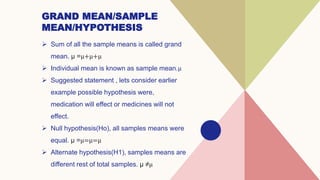
 Sum of all the sample means is called grand
mean. μ =μ+μ+μ
 Individual mean is known as sample mean.μ
 Suggested statement , lets consider earlier
example possible hypothesis were,
medication will effect or medicines will not
effect.
 Null hypothesis(Ho), all samples means were
equal. μ =μ=μ=μ
 Alternate hypothesis(H1), samples means are
different rest of total samples. μ ≠μ
B/W GROUPS AND WITHIN GROUP
VARIABILITY
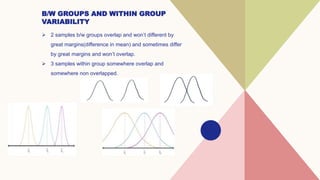
 2 samples b/w groups overlap and won’t different by
great margins(difference in mean) and sometimes differ
by great margins and won’t overlap.
 3 samples within group somewhere overlap and
somewhere non overlapped.
F-TEST/DEGREE OF FREEDOM
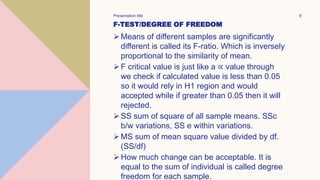
Means of different samples are significantly
different is called its F-ratio. Which is inversely
proportional to the similarity of mean.
F critical value is just like a ∝ value through
we check if calculated value is less than 0.05
so it would rely in H1 region and would
accepted while if greater than 0.05 then it will
rejected.
SS sum of square of all sample means. SSc
b/w variations, SS e within variations.
MS sum of mean square value divided by df.
(SS/df)
How much change can be acceptable. It is
equal to the sum of individual is called degree
freedom for each sample.
Presentation title 9
CONTINUED
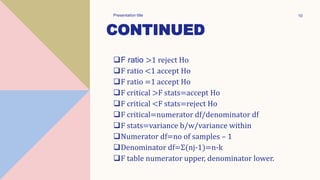
F ratio >1 reject Ho
F ratio <1 accept Ho
F ratio =1 accept Ho
F critical >F stats=accept Ho
F critical <F stats=reject Ho
F critical=numerator df/denominator df
F stats=variance b/w/variance within
Numerator df=no of samples – 1
Denominator df=Σ(nj-1)=n-k
F table numerator upper, denominator lower.
Presentation title 10
THANK YOU
Regards,
Shumail Ayub Qureshi
MPhil zoology
1st semester

ANOVA

  • 1.
    ANOVA Shumail Ayub Qureshi MPhilZoology Biostatistics
  • 2.
  • 3.
    INTRODUCTION  ANOVA standsfor Analysis of Variances  It is also known as Fisher Analysis of variances and extension of t-tests.  In 1918, Ronald fisher created ANOVA.  Statistical Method (online / manual)  Analyzed the differences of means of two or more groups.  Compares the variations b/w the
  • 4.
    INTRODUCTION  Careful examination/differenceb/w two or more samples.  Total variance=Variance b/w samples or within samples.  Categorical classification type test describes on the basis of significance difference.  Formula=variance b/w samples/variance within samples.
  • 5.
    LETS CONSIDER EXAMPLE 3medical treatment Best treatment will take less time to cure . If possible patient may be taking other medicine , or they partially cure, having strong immunity. For making reliable decision ANOVA plays important role here. It check the impacts of two or more factors by comparing means of different samples. It will proves and disproves whether all the medications treatments were equally effective or not.
  • 6.
    TERMINOLOGIES  Grand mean Degree of freedom  Sample mean  Hypothesis  Null hypothesis  Alternate hypothesis  Between groups variability  Within groups variability  F-test  F-critical value  F-Ratio
  • 7.
    GRAND MEAN/SAMPLE MEAN/HYPOTHESIS  Sumof all the sample means is called grand mean. μ =μ+μ+μ  Individual mean is known as sample mean.μ  Suggested statement , lets consider earlier example possible hypothesis were, medication will effect or medicines will not effect.  Null hypothesis(Ho), all samples means were equal. μ =μ=μ=μ  Alternate hypothesis(H1), samples means are different rest of total samples. μ ≠μ
  • 8.
    B/W GROUPS ANDWITHIN GROUP VARIABILITY  2 samples b/w groups overlap and won’t different by great margins(difference in mean) and sometimes differ by great margins and won’t overlap.  3 samples within group somewhere overlap and somewhere non overlapped.
  • 9.
    F-TEST/DEGREE OF FREEDOM Meansof different samples are significantly different is called its F-ratio. Which is inversely proportional to the similarity of mean. F critical value is just like a ∝ value through we check if calculated value is less than 0.05 so it would rely in H1 region and would accepted while if greater than 0.05 then it will rejected. SS sum of square of all sample means. SSc b/w variations, SS e within variations. MS sum of mean square value divided by df. (SS/df) How much change can be acceptable. It is equal to the sum of individual is called degree freedom for each sample. Presentation title 9
  • 10.
    CONTINUED F ratio >1reject Ho F ratio <1 accept Ho F ratio =1 accept Ho F critical >F stats=accept Ho F critical <F stats=reject Ho F critical=numerator df/denominator df F stats=variance b/w/variance within Numerator df=no of samples – 1 Denominator df=Σ(nj-1)=n-k F table numerator upper, denominator lower. Presentation title 10
  • 11.
    THANK YOU Regards, Shumail AyubQureshi MPhil zoology 1st semester