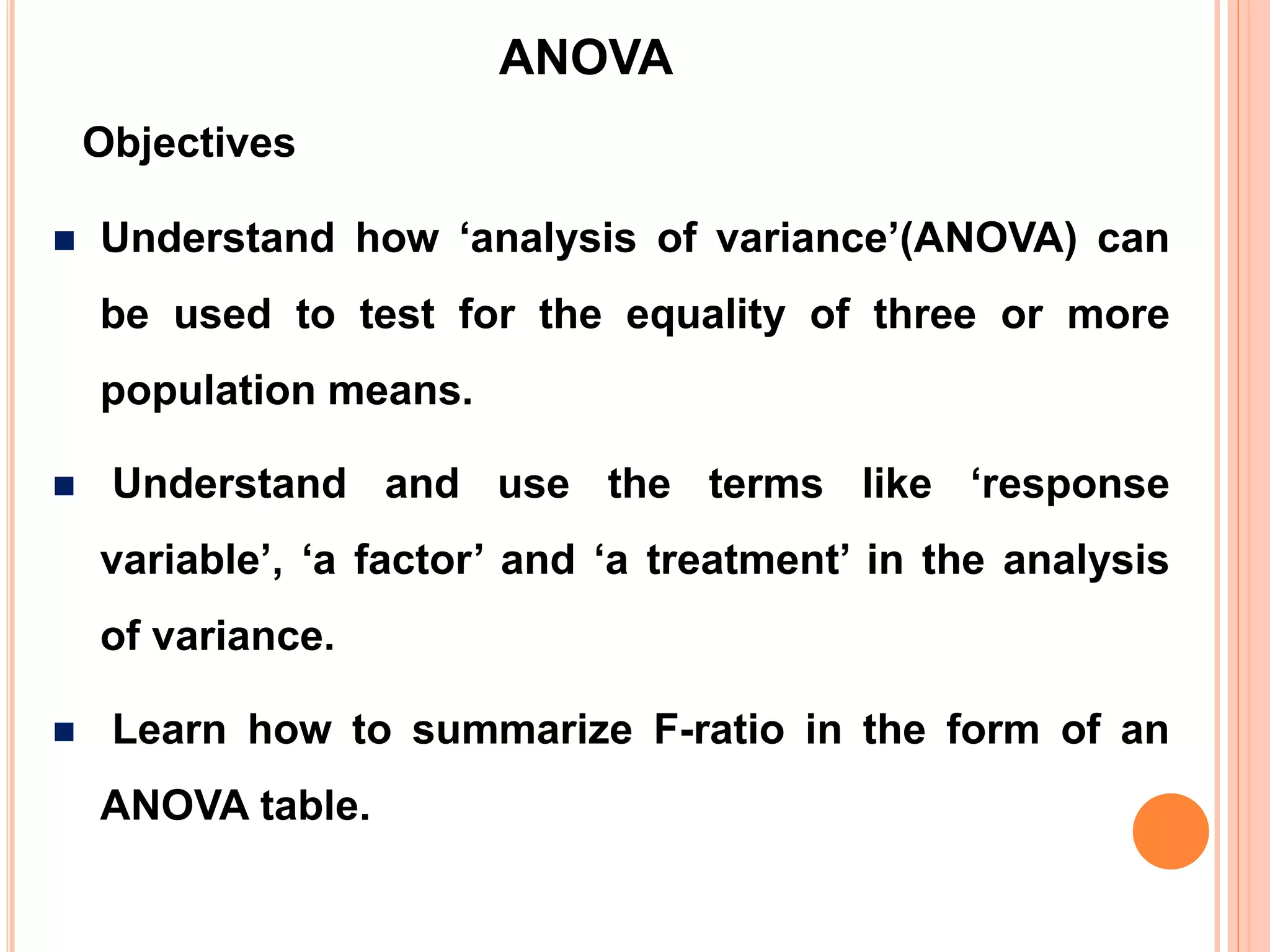
 Understand how ‘analysis of variance’(ANOVA) can
be used to test for the equality of three or more
population means.
 Understand and use the terms like ‘response
variable’, ‘a factor’ and ‘a treatment’ in the analysis
of variance.
 Learn how to summarize F-ratio in the form of an
ANOVA table.
Objectives
ANOVA
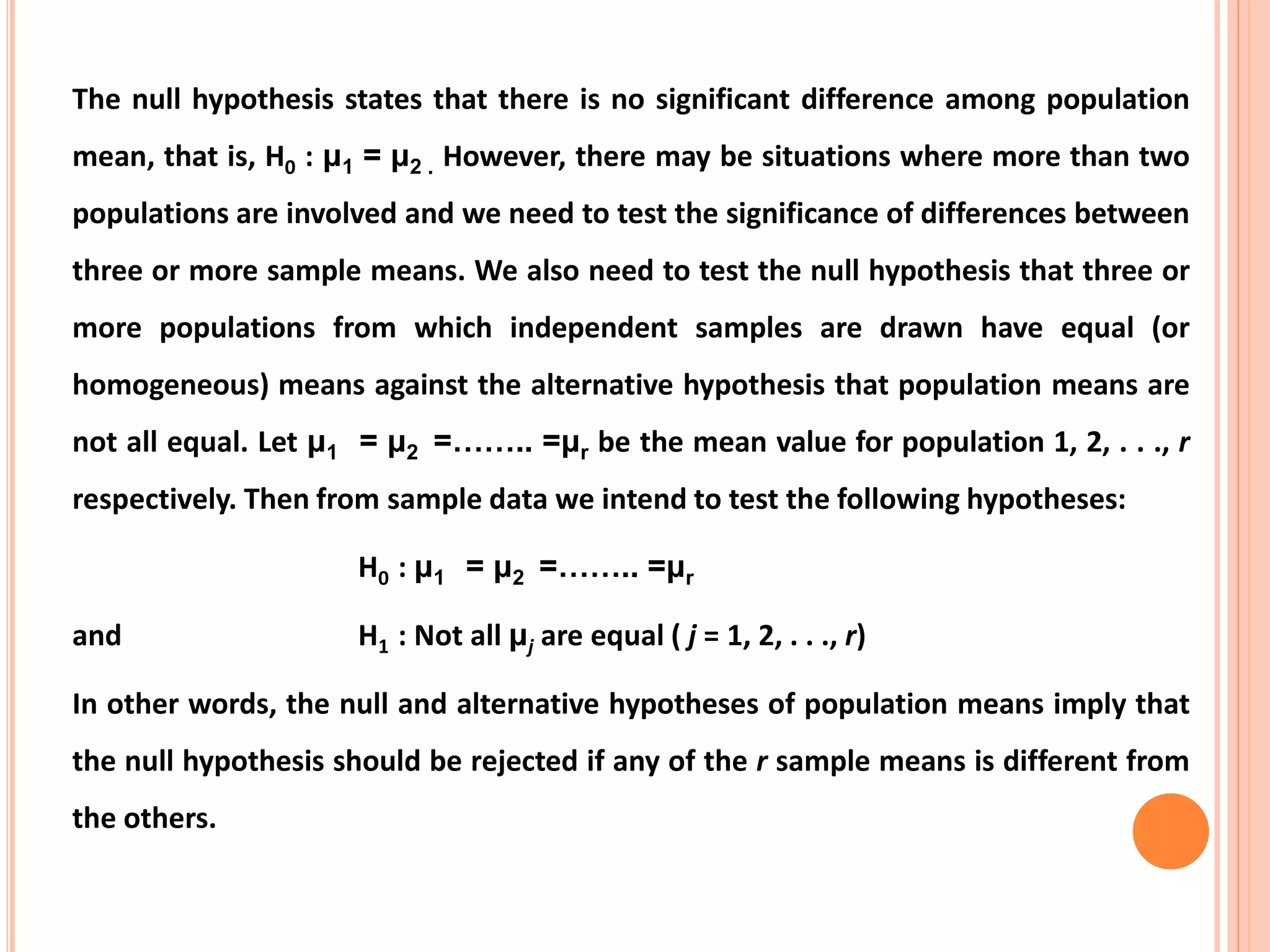
The null hypothesis states that there is no significant difference among population
mean, that is, H0 : μ1 = μ2 . However, there may be situations where more than two
populations are involved and we need to test the significance of differences between
three or more sample means. We also need to test the null hypothesis that three or
more populations from which independent samples are drawn have equal (or
homogeneous) means against the alternative hypothesis that population means are
not all equal. Let μ1 = μ2 =…….. =μr be the mean value for population 1, 2, . . ., r
respectively. Then from sample data we intend to test the following hypotheses:
H0 : μ1 = μ2 =…….. =μr
and H1 : Not all μj are equal ( j = 1, 2, . . ., r)
In other words, the null and alternative hypotheses of population means imply that
the null hypothesis should be rejected if any of the r sample means is different from
the others.
Examples:
• Effectiveness of different promotional devices in terms of sales
• Quality of a product produced by different manufacturers in
terms of attribute
• Production volumes in different shifts in a factory
• Yield from plots of land due to varieties of seeds, fertilizers and
cultivation methods
• Effectiveness of different techniques of improving employees
morale.
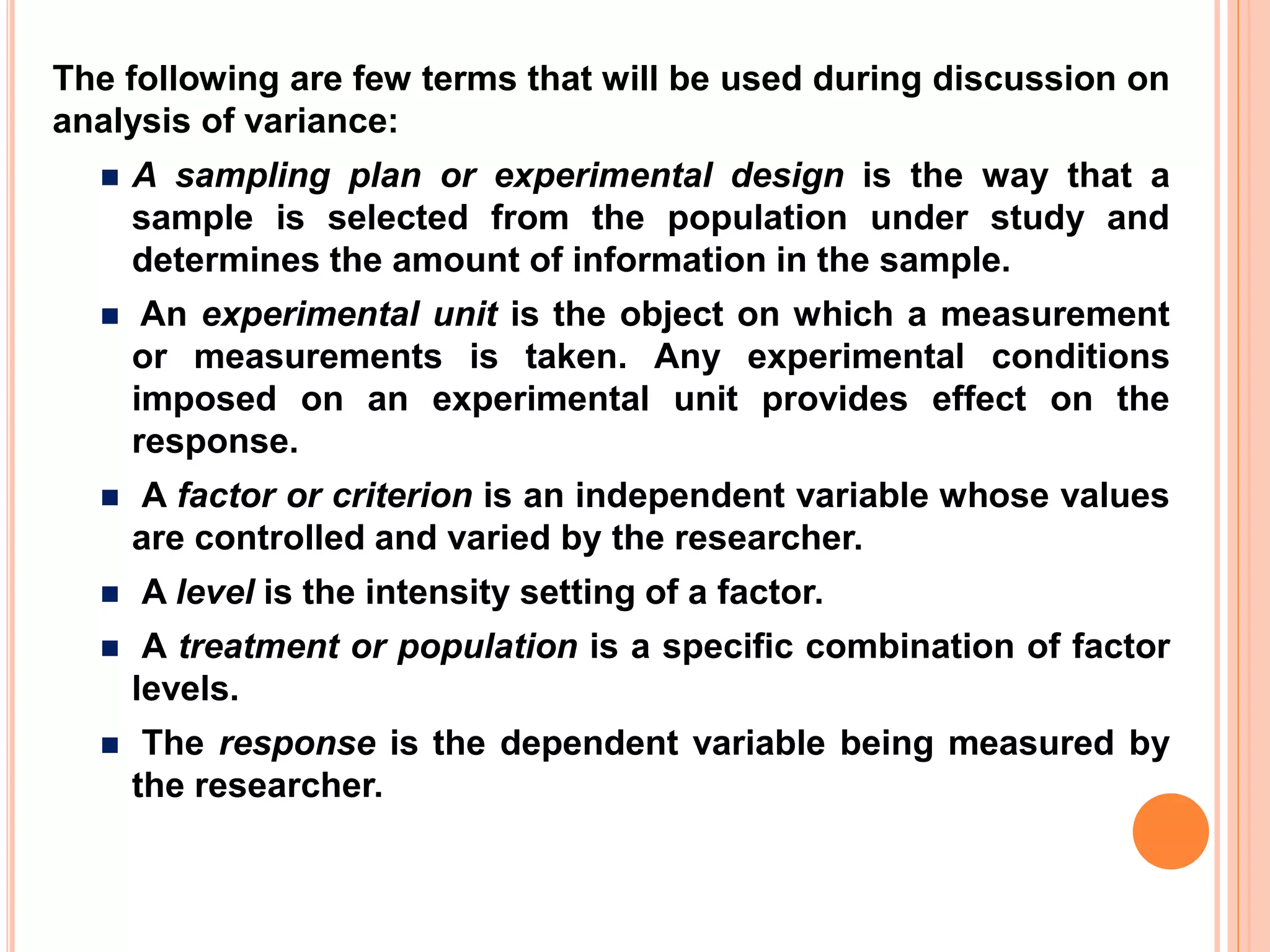
The following are few terms that will be used during discussion on
analysis of variance:
 A sampling plan or experimental design is the way that a
sample is selected from the population under study and
determines the amount of information in the sample.
 An experimental unit is the object on which a measurement
or measurements is taken. Any experimental conditions
imposed on an experimental unit provides effect on the
response.
 A factor or criterion is an independent variable whose values
are controlled and varied by the researcher.
 A level is the intensity setting of a factor.
 A treatment or population is a specific combination of factor
levels.
 The response is the dependent variable being measured by
the researcher.
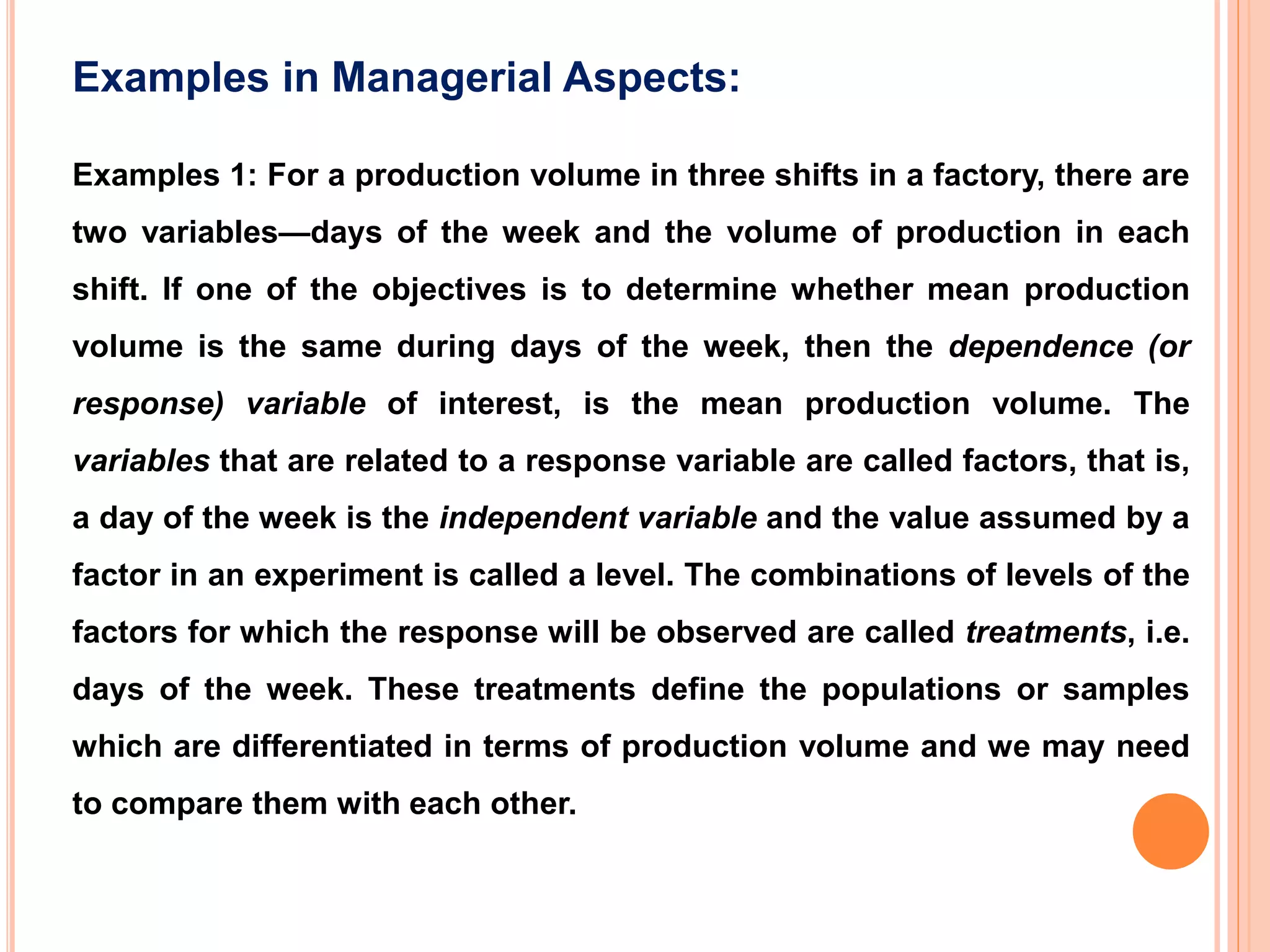
Examples 1: For a production volume in three shifts in a factory, there are
two variables—days of the week and the volume of production in each
shift. If one of the objectives is to determine whether mean production
volume is the same during days of the week, then the dependence (or
response) variable of interest, is the mean production volume. The
variables that are related to a response variable are called factors, that is,
a day of the week is the independent variable and the value assumed by a
factor in an experiment is called a level. The combinations of levels of the
factors for which the response will be observed are called treatments, i.e.
days of the week. These treatments define the populations or samples
which are differentiated in terms of production volume and we may need
to compare them with each other.
Examples in Managerial Aspects:
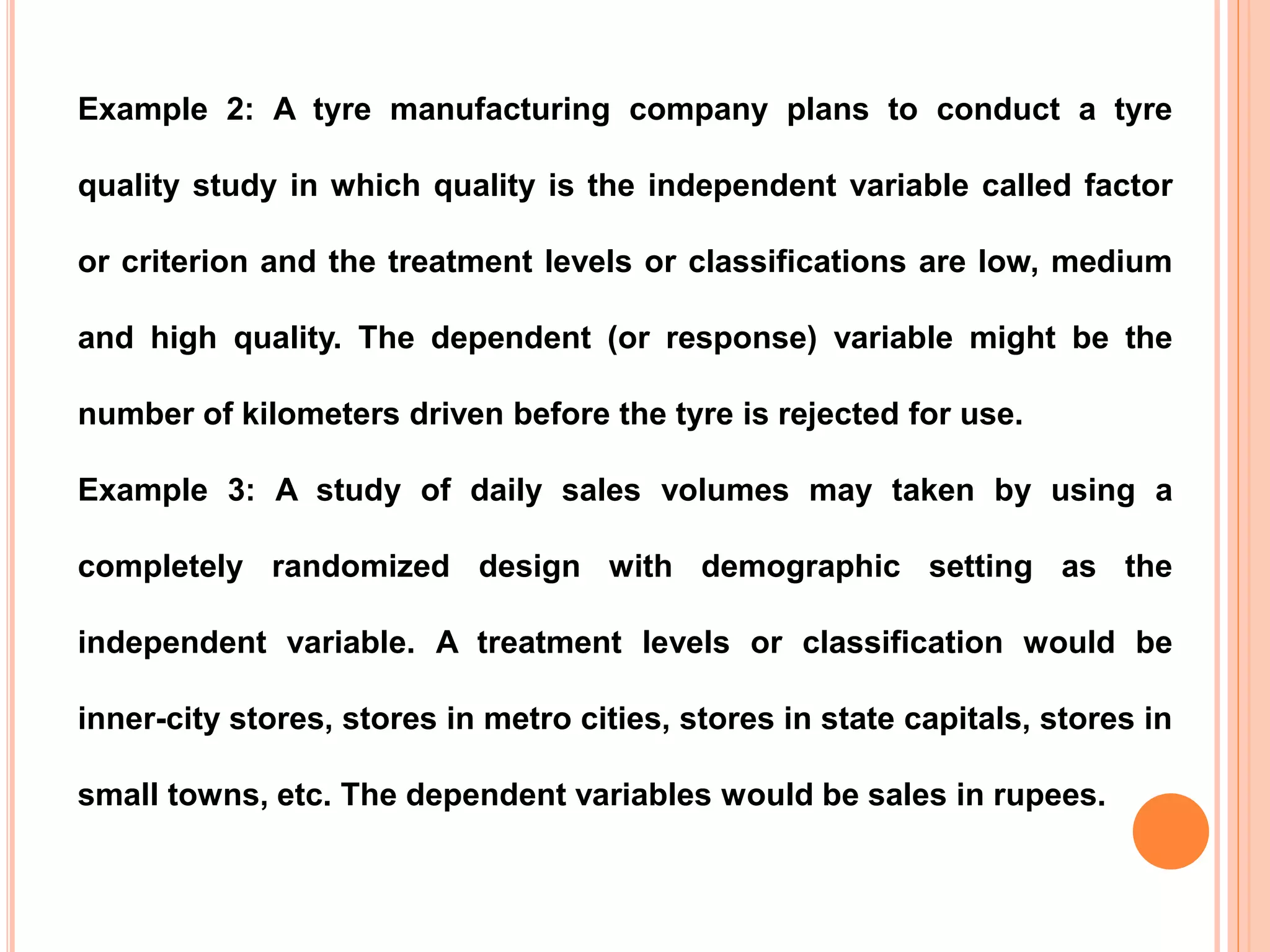
Example 2: A tyre manufacturing company plans to conduct a tyre
quality study in which quality is the independent variable called factor
or criterion and the treatment levels or classifications are low, medium
and high quality. The dependent (or response) variable might be the
number of kilometers driven before the tyre is rejected for use.
Example 3: A study of daily sales volumes may taken by using a
completely randomized design with demographic setting as the
independent variable. A treatment levels or classification would be
inner-city stores, stores in metro cities, stores in state capitals, stores in
small towns, etc. The dependent variables would be sales in rupees.
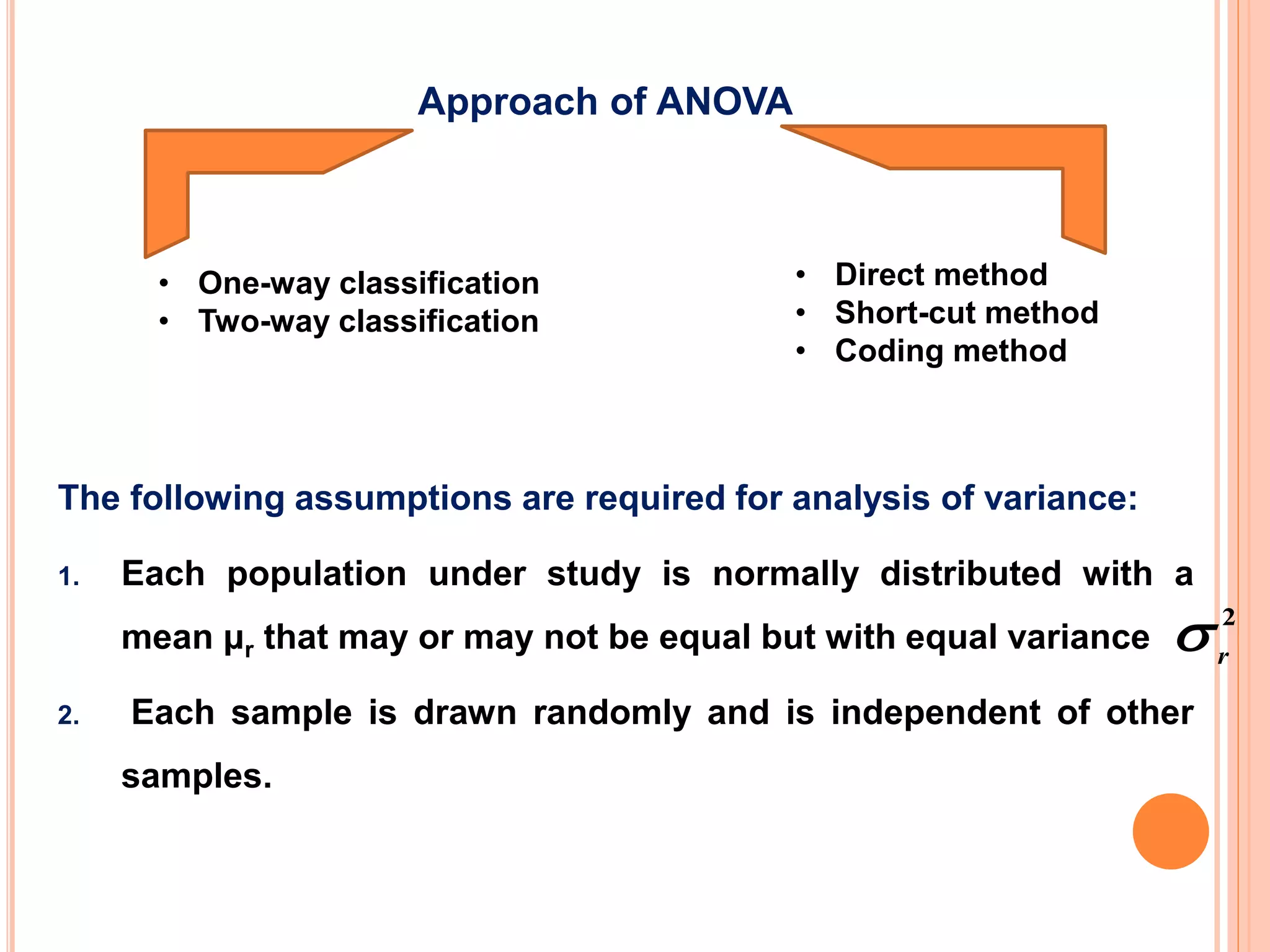
The following assumptions are required for analysis of variance:
1. Each population under study is normally distributed with a
mean μr that may or may not be equal but with equal variance
2. Each sample is drawn randomly and is independent of other
samples.
2
r

Approach of ANOVA
• One-way classification
• Two-way classification
• Direct method
• Short-cut method
• Coding method
Testing Equality of Population Means: One-way
Classification
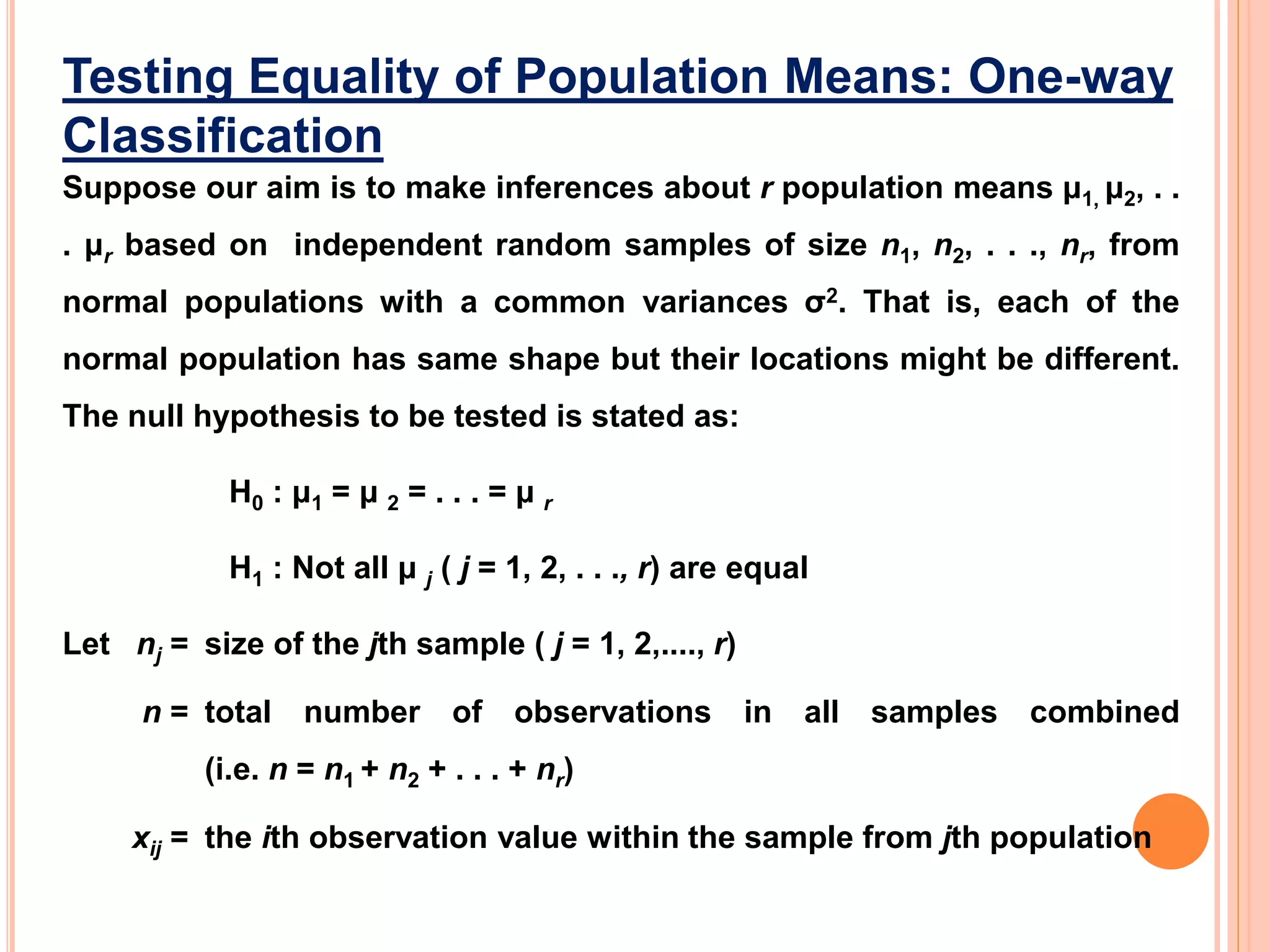
Suppose our aim is to make inferences about r population means μ1, μ2, . .
. μr based on independent random samples of size n1, n2, . . ., nr, from
normal populations with a common variances σ2. That is, each of the
normal population has same shape but their locations might be different.
The null hypothesis to be tested is stated as:
H0 : μ1 = μ 2 = . . . = μ r
H1 : Not all μ j ( j = 1, 2, . . ., r) are equal
Let nj = size of the jth sample ( j = 1, 2,...., r)
n = total number of observations in all samples combined
(i.e. n = n1 + n2 + . . . + nr)
xij = the ith observation value within the sample from jth population
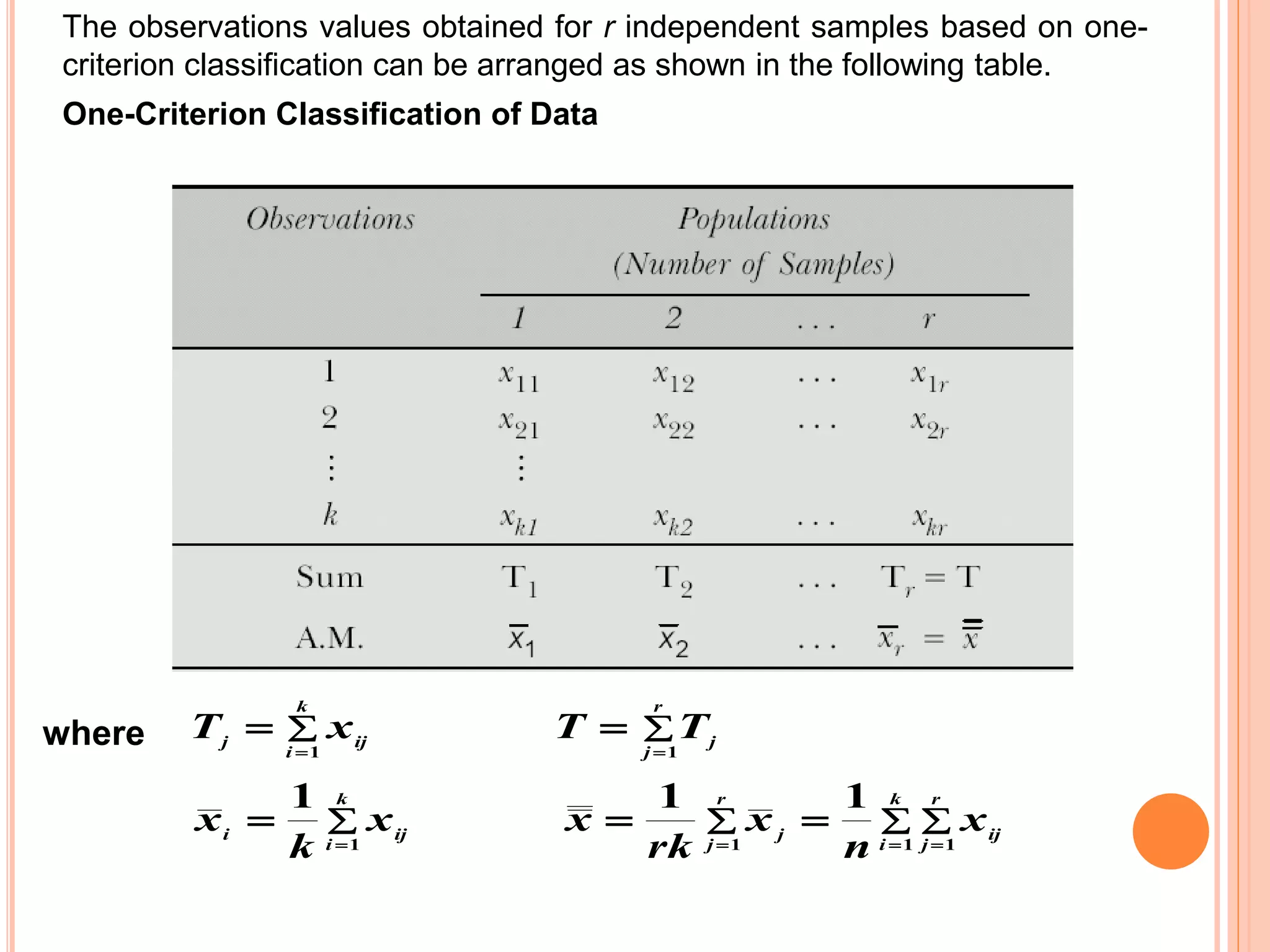
The observations values obtained for r independent samples based on one-
criterion classification can be arranged as shown in the following table.
One-Criterion Classification of Data
 

 



k
i
r
j
ij
r
j
j
k
i
iji
r
j
j
k
i
ijj
x
n
x
rk
xx
k
x
TTxT
1 111
11
111
where
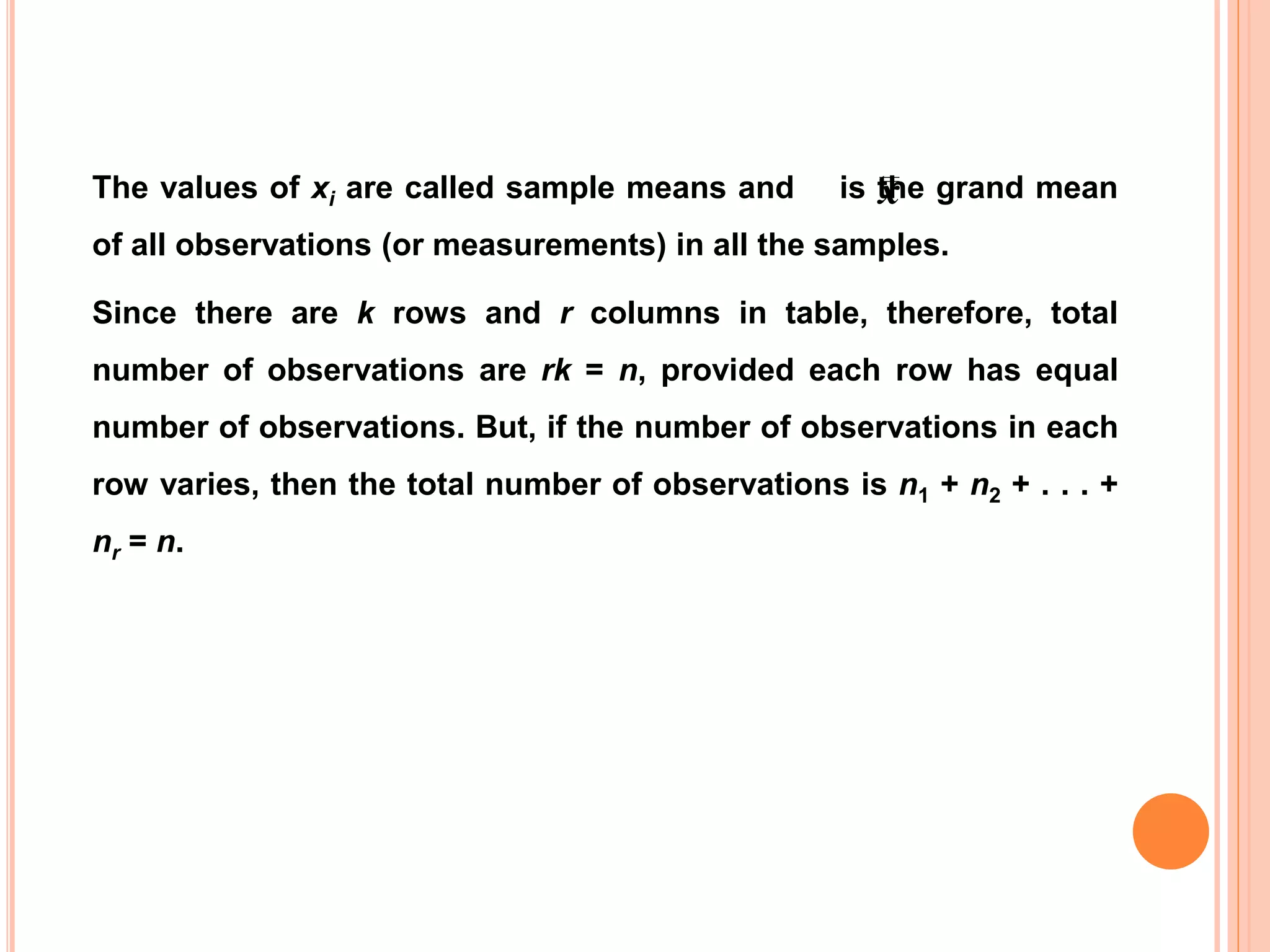
The values of xi are called sample means and is the grand mean
of all observations (or measurements) in all the samples.
Since there are k rows and r columns in table, therefore, total
number of observations are rk = n, provided each row has equal
number of observations. But, if the number of observations in each
row varies, then the total number of observations is n1 + n2 + . . . +
nr = n.
x
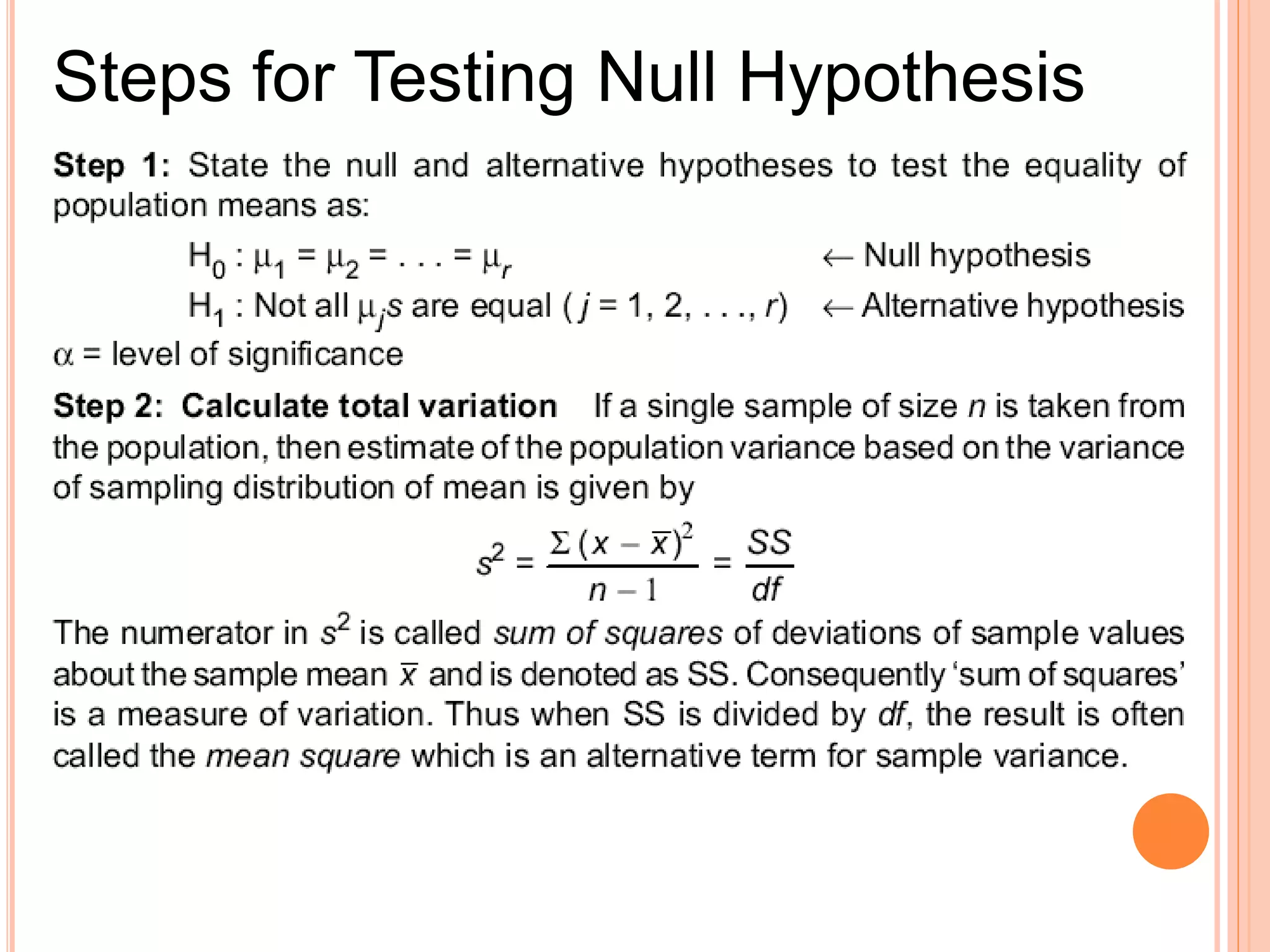
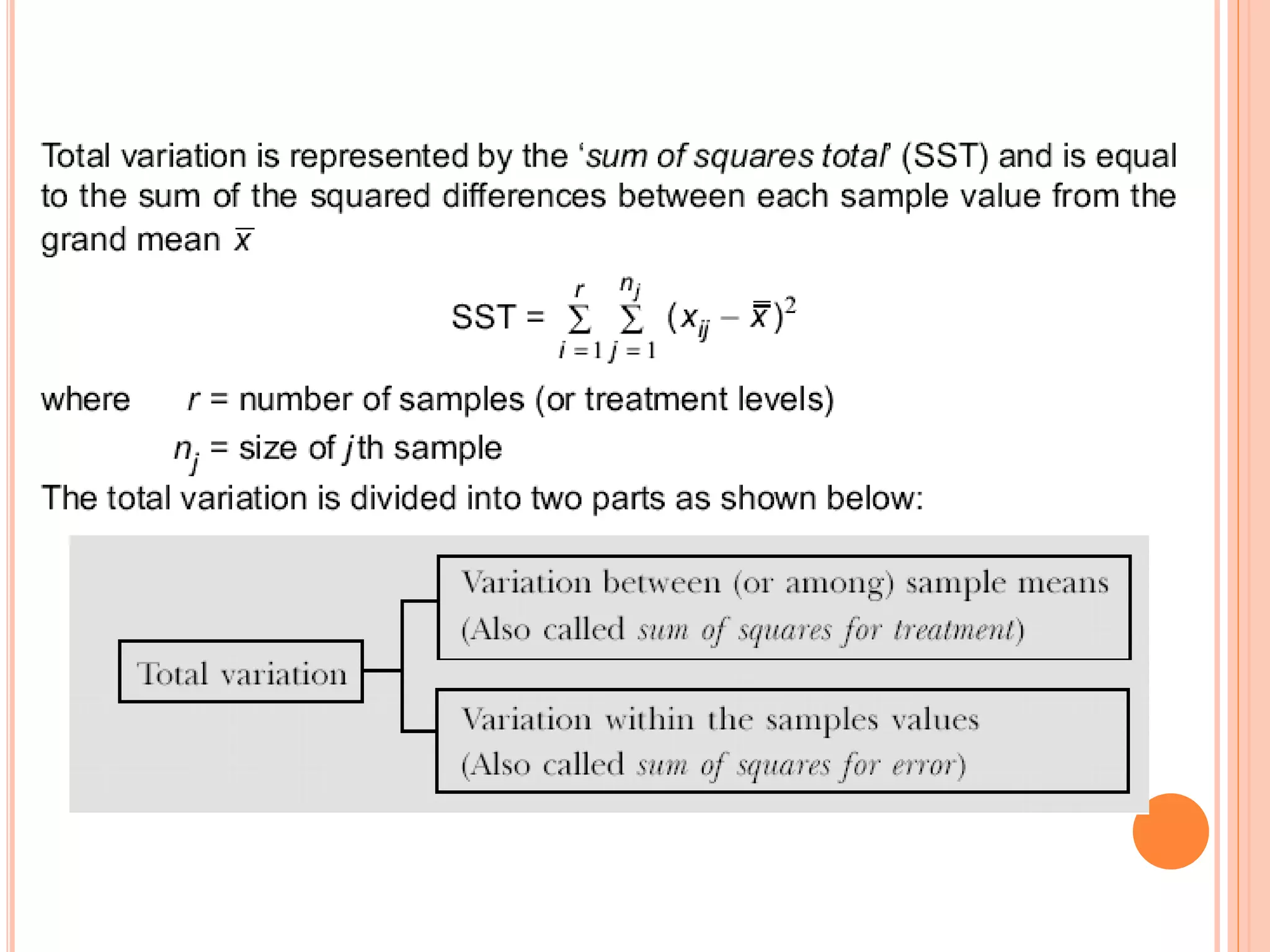
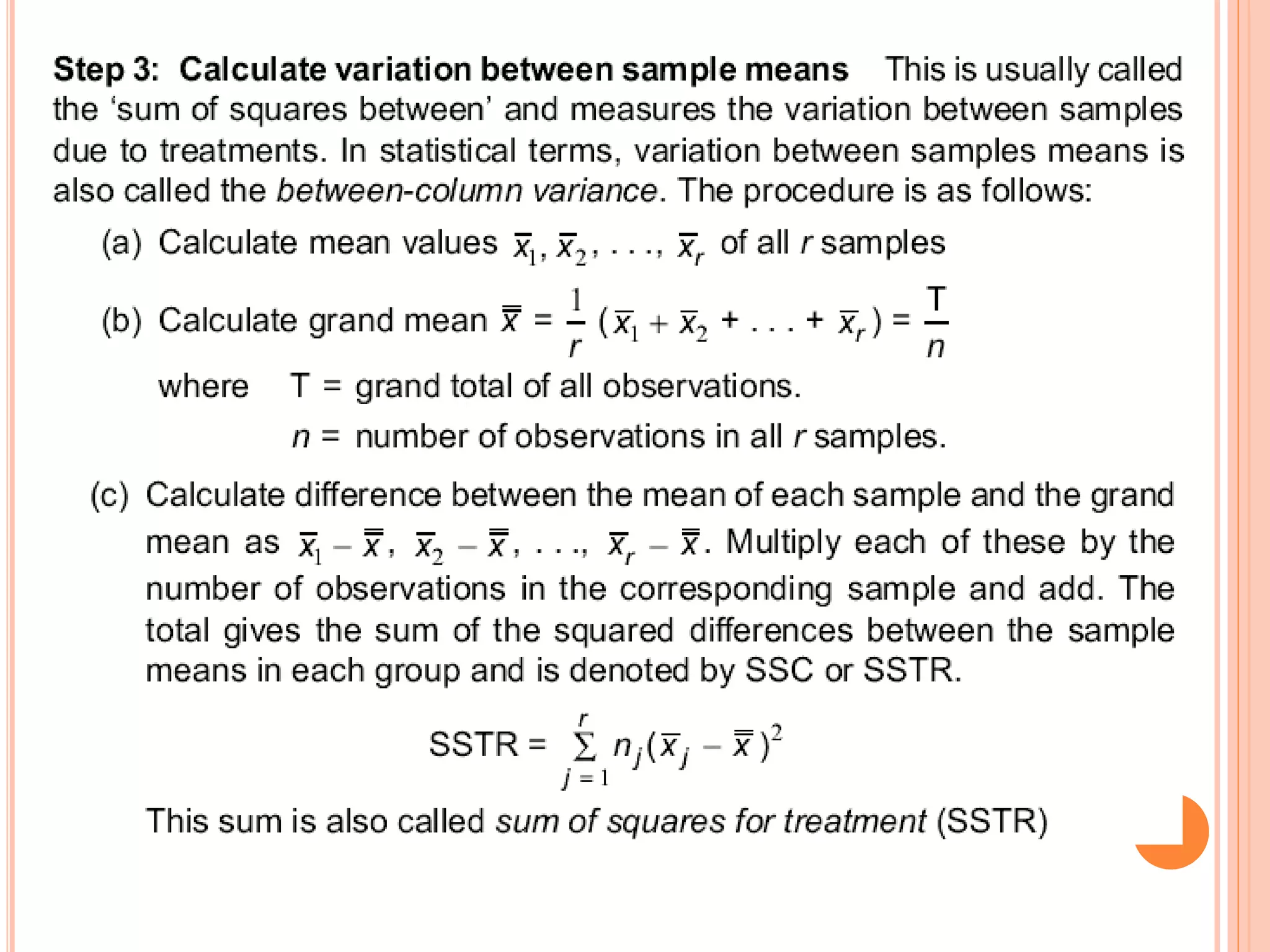
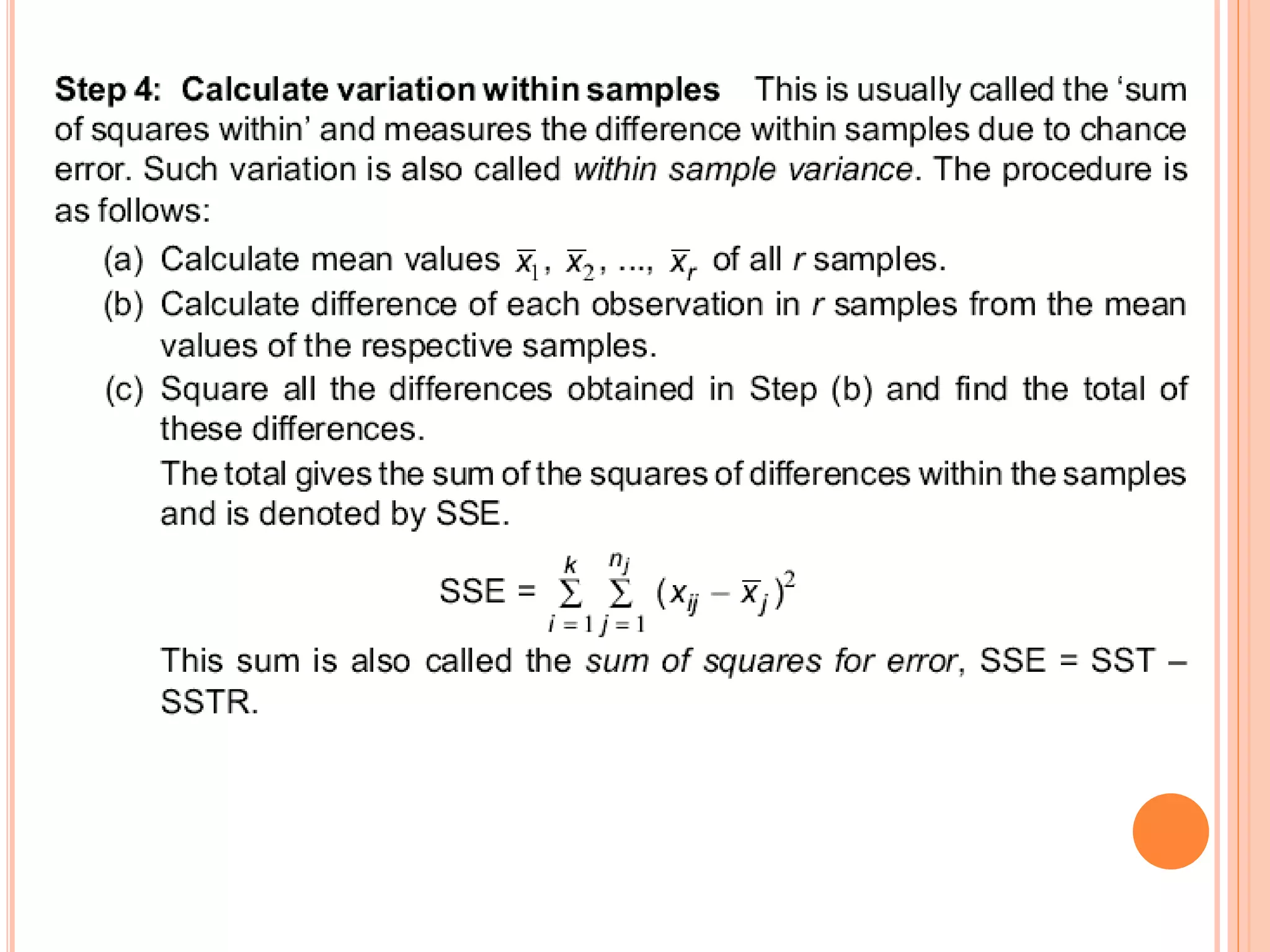
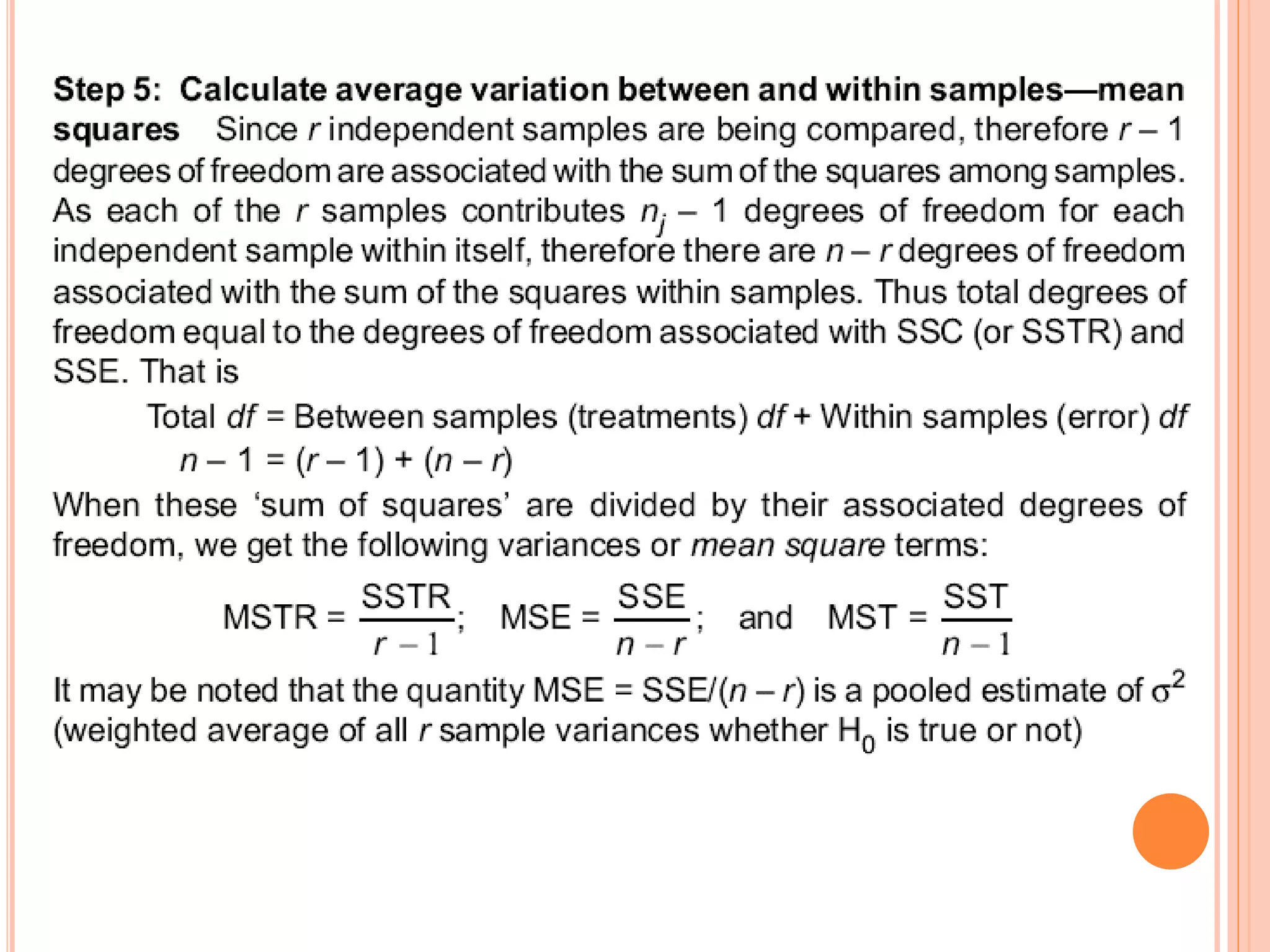
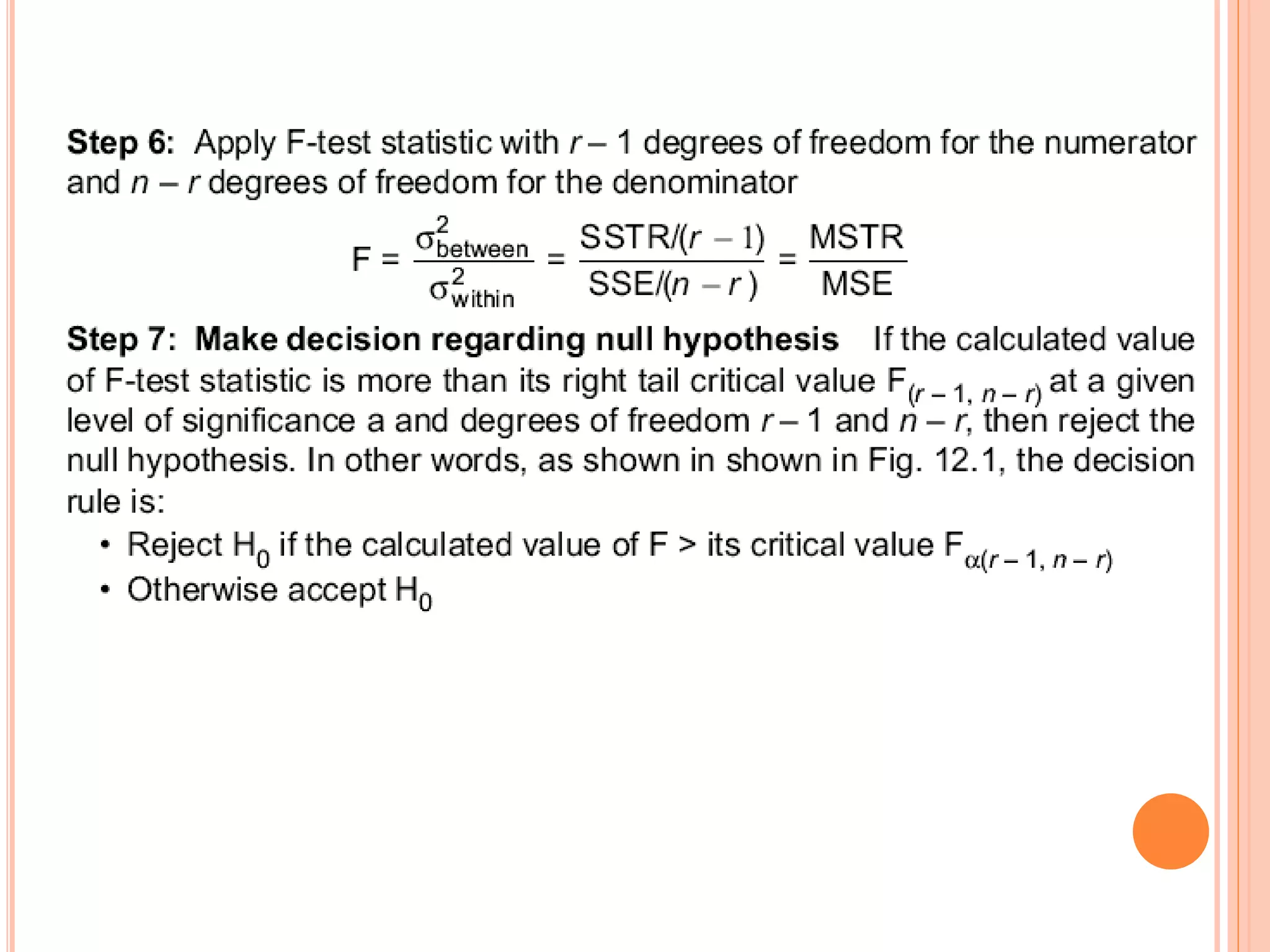
Steps for Testing Null Hypothesis
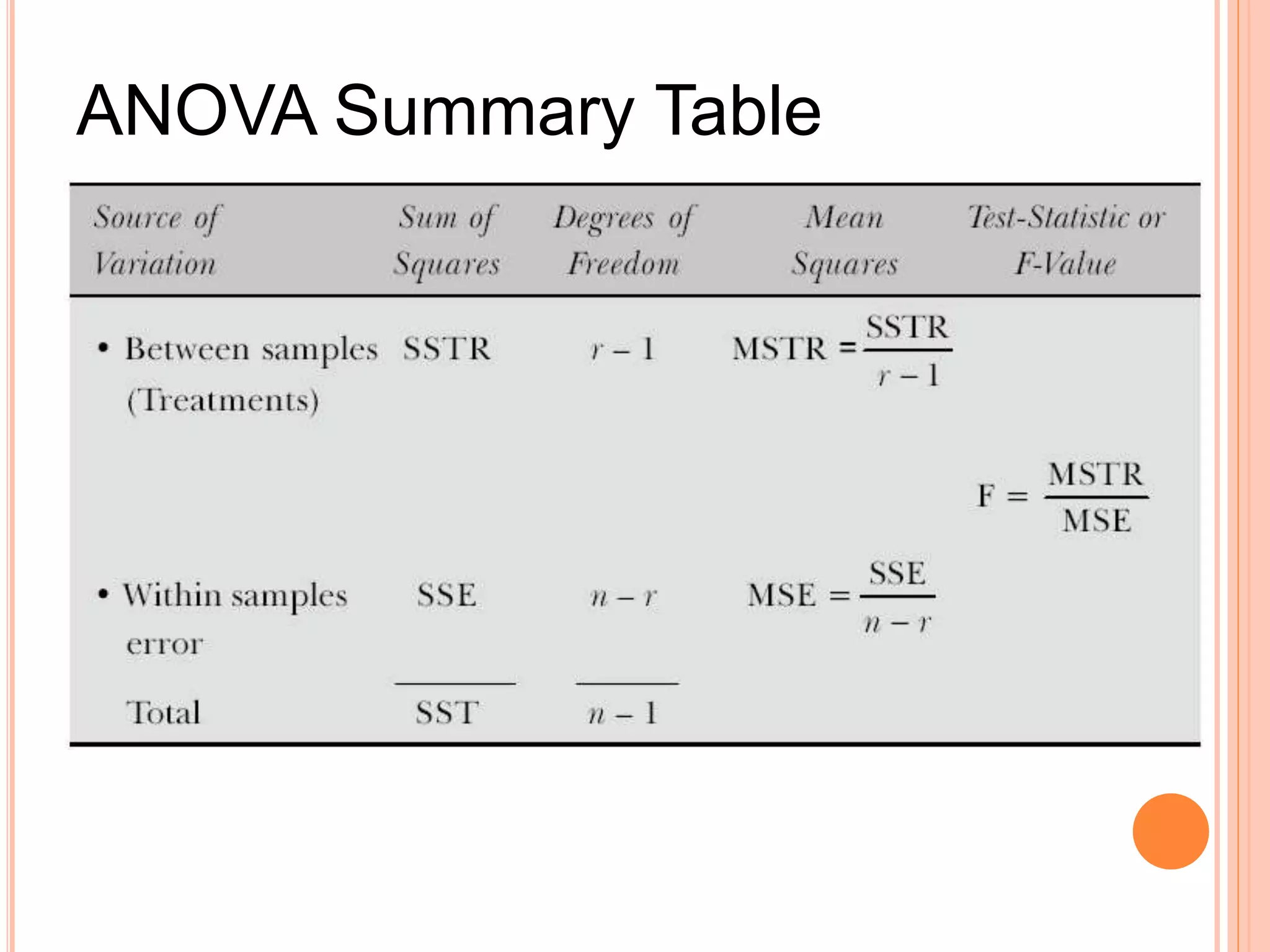
ANOVA Summary Table
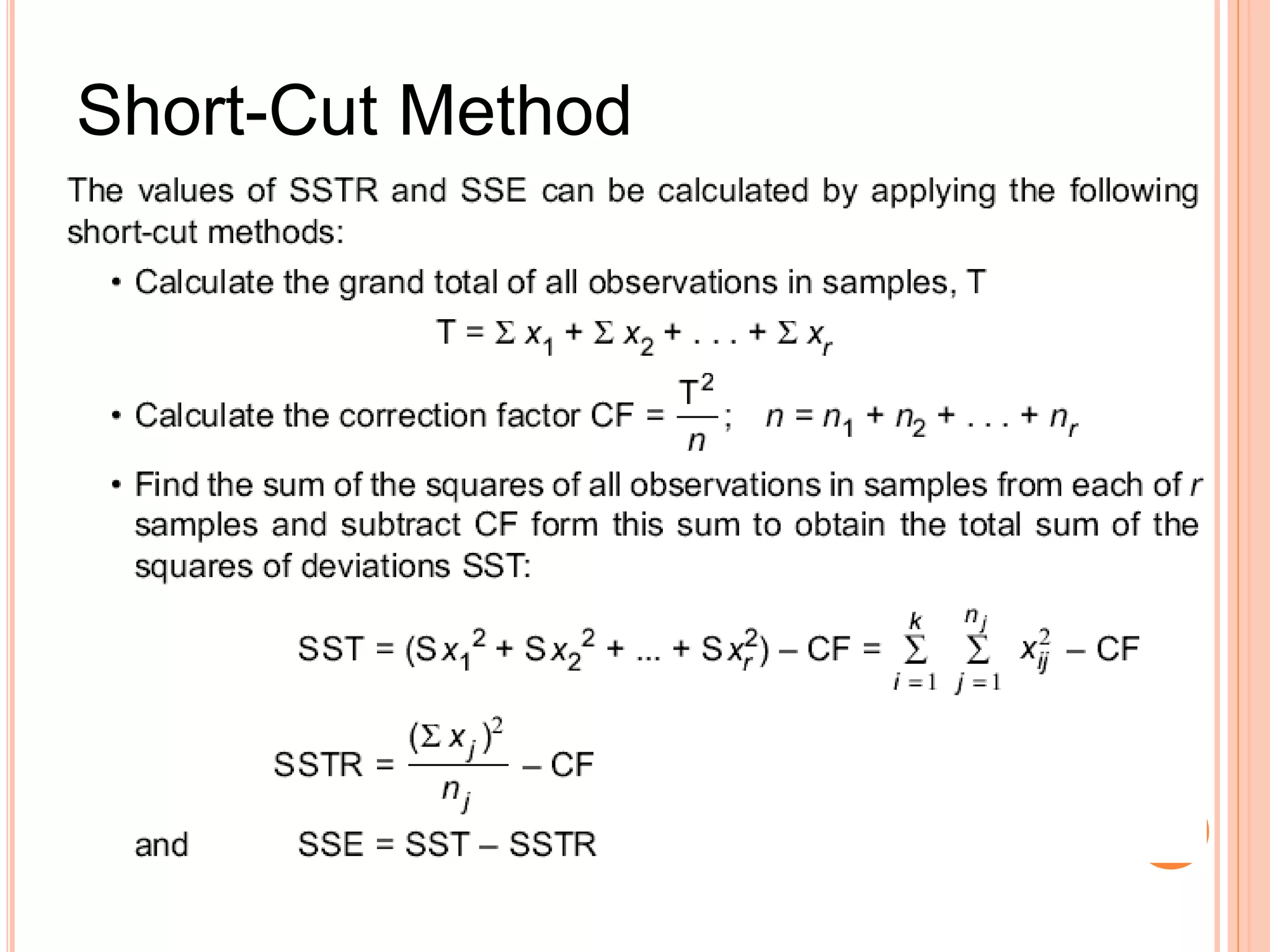
Short-Cut Method
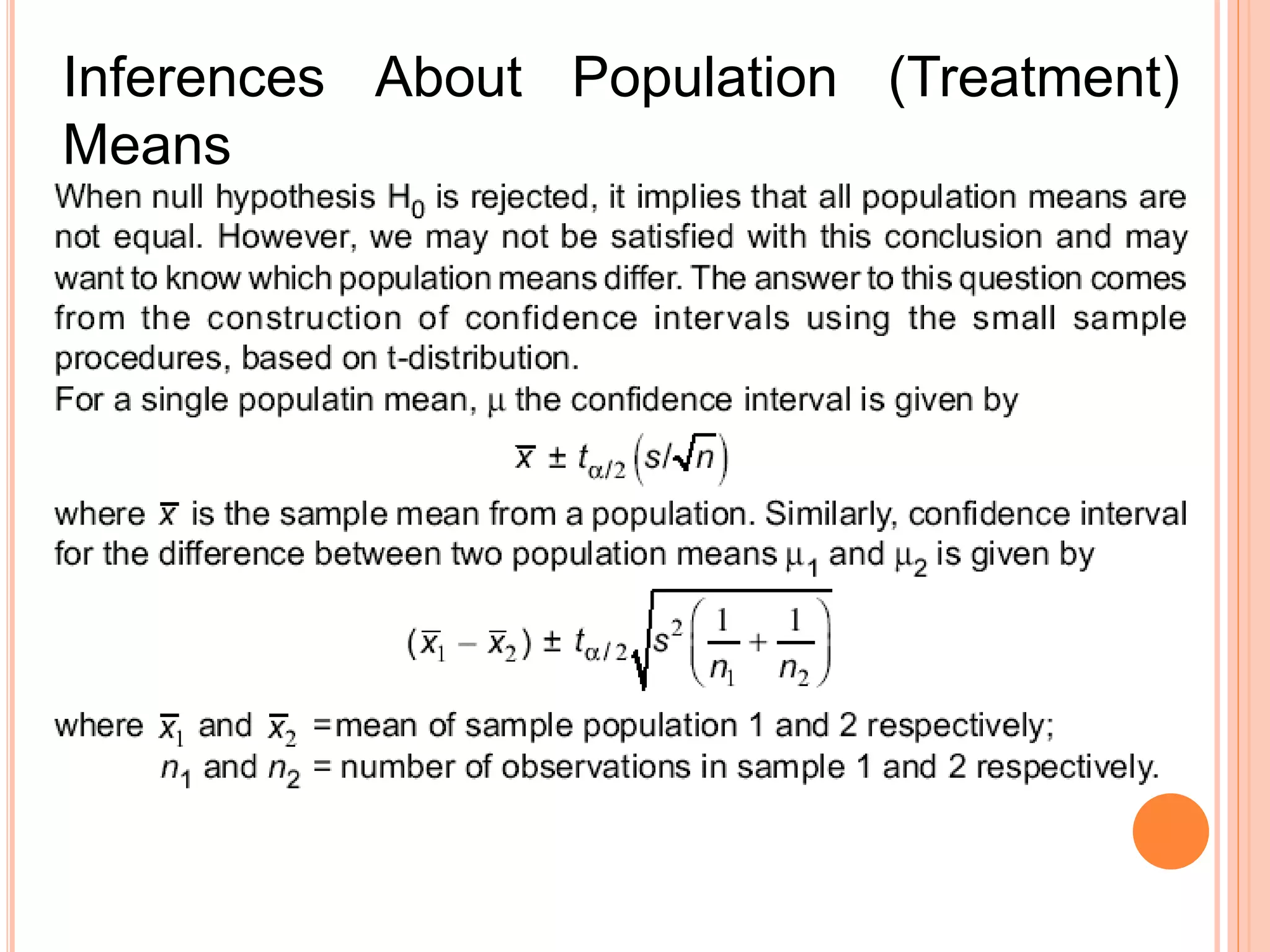
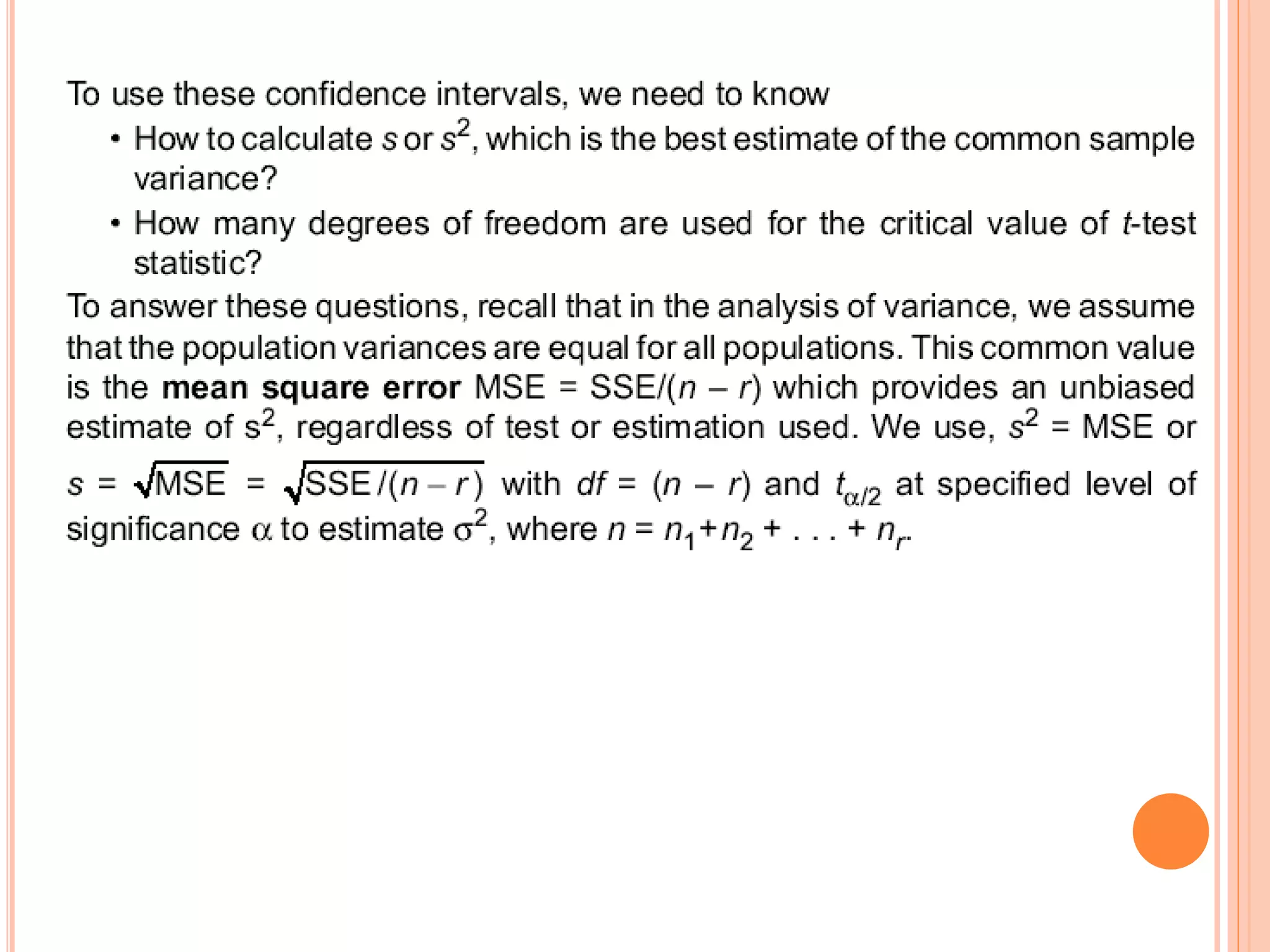
Inferences About Population (Treatment)
Means
Two-way Analysis of Variance
Analysis of variance in which two criteria (or variables) are used to analyze the
difference between more than two population means.
The two-way analysis of variance can be used to
 explore one criterion (or factor) of interest to partition the sample data so
as to remove the unaccountable variation, and arriving at a true
conclusion.
 investigate two criteria (factors) of interest for testing the difference
between sample means.
 consider any interaction between two variables.
In two-way analysis of variance we are introducing another term called ‘blocking variable’ to
remove the undesirable accountable variation. A block variable is the variable that the
researcher wants to control but is not the treatment variable of interest. The term ‘blocking’
refers to block of land and comes from agricultural origin. The ‘block’ of land might make some
difference in the study of growth pattern of varieties of seeds for a given type of land. R. A.
Fisher designated several different plots of land as blocks, which he controlled as a second
variable. Each of the seed varieties were planted on each of the blocks. The main aim of his
study was to compare the seed varieties (independent variable). He wanted only to control the
difference in plots of land (blocking variable). ‘Blocking’ is an extension of the idea of pairing
observations in hypothesis testing. Blocking provides the opportunity for one-to-one
comparison of prices, where any observed difference cannot be due to difference among
blocking variables.
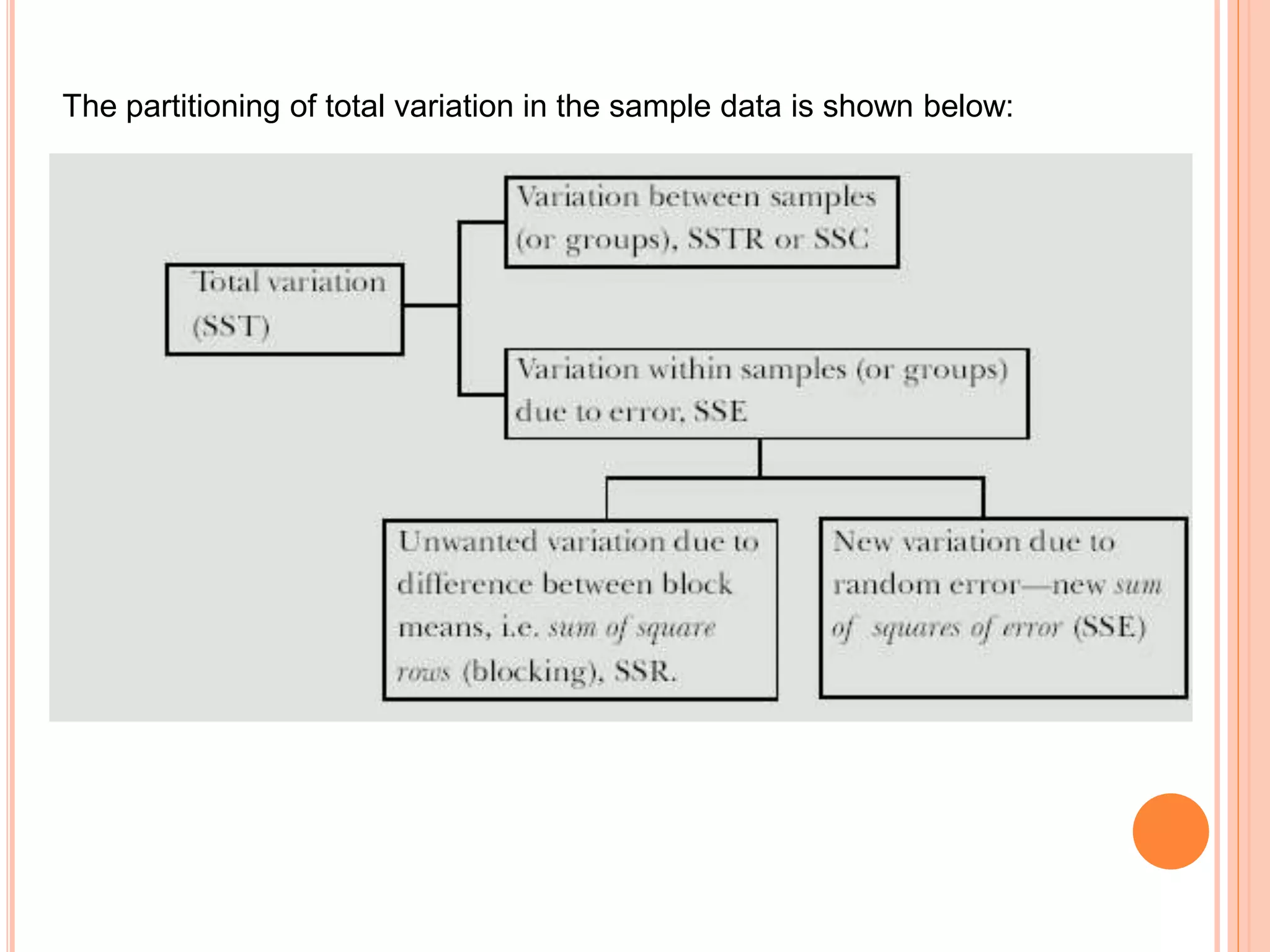
The partitioning of total variation in the sample data is shown below:
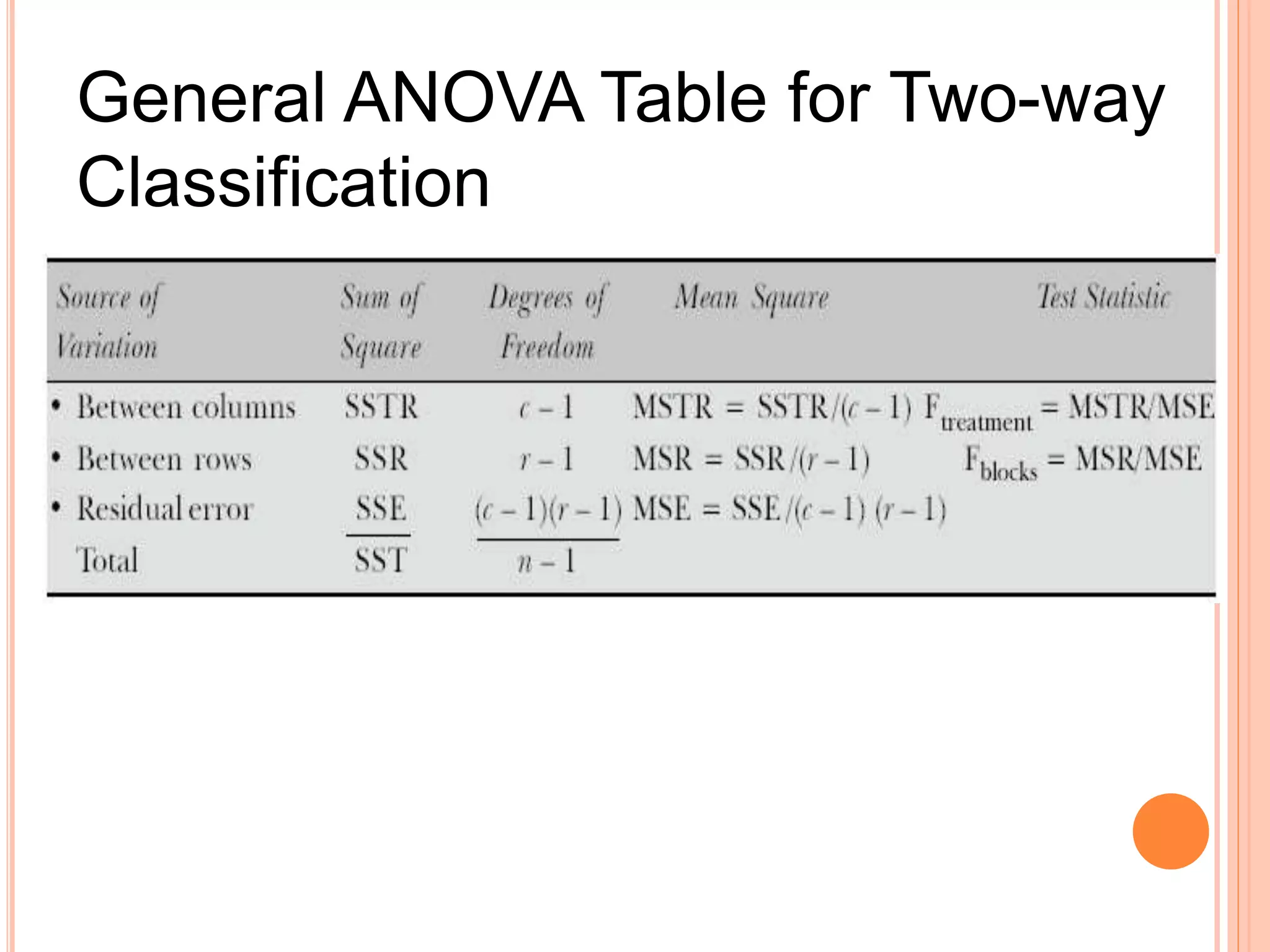
General ANOVA Table for Two-way
Classification
As stated above, total variation consists of three parts: (i) variation between
columns, SSTR; (ii) variation between rows, SSR; and (iii) actual variation due
to random error, SSE. That is
SST = SSTR + (SSR + SSE)
The degrees of freedom associated with SST are cr – 1, where c and r are the
number of columns and rows, respectively
Degrees of freedom between columns = c – 1
Degrees of freedom between rows = r – 1
Degrees of freedom for residual error = (c – 1) (r – 1) = N – n – c + 1
The test-statistic F for analysis of variance is given by
Ftreatment = MSTR/MSE; MSTR > MSE or MSE/MSTR; MSE > MSTR
Fblocks = MSR/MSE; MSR > MSE or MSE/MSR; MSE > MSR
Decision rule
 If Fcal < Ftable, accept null hypothesis H0
 Otherwise reject H0

Anova in easyest way

  • 1.
     Understand how‘analysis of variance’(ANOVA) can be used to test for the equality of three or more population means.  Understand and use the terms like ‘response variable’, ‘a factor’ and ‘a treatment’ in the analysis of variance.  Learn how to summarize F-ratio in the form of an ANOVA table. Objectives ANOVA
  • 2.
    The null hypothesisstates that there is no significant difference among population mean, that is, H0 : μ1 = μ2 . However, there may be situations where more than two populations are involved and we need to test the significance of differences between three or more sample means. We also need to test the null hypothesis that three or more populations from which independent samples are drawn have equal (or homogeneous) means against the alternative hypothesis that population means are not all equal. Let μ1 = μ2 =…….. =μr be the mean value for population 1, 2, . . ., r respectively. Then from sample data we intend to test the following hypotheses: H0 : μ1 = μ2 =…….. =μr and H1 : Not all μj are equal ( j = 1, 2, . . ., r) In other words, the null and alternative hypotheses of population means imply that the null hypothesis should be rejected if any of the r sample means is different from the others.
  • 3.
    Examples: • Effectiveness ofdifferent promotional devices in terms of sales • Quality of a product produced by different manufacturers in terms of attribute • Production volumes in different shifts in a factory • Yield from plots of land due to varieties of seeds, fertilizers and cultivation methods • Effectiveness of different techniques of improving employees morale.
  • 4.
    The following arefew terms that will be used during discussion on analysis of variance:  A sampling plan or experimental design is the way that a sample is selected from the population under study and determines the amount of information in the sample.  An experimental unit is the object on which a measurement or measurements is taken. Any experimental conditions imposed on an experimental unit provides effect on the response.  A factor or criterion is an independent variable whose values are controlled and varied by the researcher.  A level is the intensity setting of a factor.  A treatment or population is a specific combination of factor levels.  The response is the dependent variable being measured by the researcher.
  • 5.
    Examples 1: Fora production volume in three shifts in a factory, there are two variables—days of the week and the volume of production in each shift. If one of the objectives is to determine whether mean production volume is the same during days of the week, then the dependence (or response) variable of interest, is the mean production volume. The variables that are related to a response variable are called factors, that is, a day of the week is the independent variable and the value assumed by a factor in an experiment is called a level. The combinations of levels of the factors for which the response will be observed are called treatments, i.e. days of the week. These treatments define the populations or samples which are differentiated in terms of production volume and we may need to compare them with each other. Examples in Managerial Aspects:
  • 6.
    Example 2: Atyre manufacturing company plans to conduct a tyre quality study in which quality is the independent variable called factor or criterion and the treatment levels or classifications are low, medium and high quality. The dependent (or response) variable might be the number of kilometers driven before the tyre is rejected for use. Example 3: A study of daily sales volumes may taken by using a completely randomized design with demographic setting as the independent variable. A treatment levels or classification would be inner-city stores, stores in metro cities, stores in state capitals, stores in small towns, etc. The dependent variables would be sales in rupees.
  • 7.
    The following assumptionsare required for analysis of variance: 1. Each population under study is normally distributed with a mean μr that may or may not be equal but with equal variance 2. Each sample is drawn randomly and is independent of other samples. 2 r  Approach of ANOVA • One-way classification • Two-way classification • Direct method • Short-cut method • Coding method
  • 8.
    Testing Equality ofPopulation Means: One-way Classification Suppose our aim is to make inferences about r population means μ1, μ2, . . . μr based on independent random samples of size n1, n2, . . ., nr, from normal populations with a common variances σ2. That is, each of the normal population has same shape but their locations might be different. The null hypothesis to be tested is stated as: H0 : μ1 = μ 2 = . . . = μ r H1 : Not all μ j ( j = 1, 2, . . ., r) are equal Let nj = size of the jth sample ( j = 1, 2,...., r) n = total number of observations in all samples combined (i.e. n = n1 + n2 + . . . + nr) xij = the ith observation value within the sample from jth population
  • 9.
    The observations valuesobtained for r independent samples based on one- criterion classification can be arranged as shown in the following table. One-Criterion Classification of Data         k i r j ij r j j k i iji r j j k i ijj x n x rk xx k x TTxT 1 111 11 111 where
  • 10.
    The values ofxi are called sample means and is the grand mean of all observations (or measurements) in all the samples. Since there are k rows and r columns in table, therefore, total number of observations are rk = n, provided each row has equal number of observations. But, if the number of observations in each row varies, then the total number of observations is n1 + n2 + . . . + nr = n. x
  • 11.
    Steps for TestingNull Hypothesis
  • 17.
  • 18.
  • 19.
    Inferences About Population(Treatment) Means
  • 21.
    Two-way Analysis ofVariance Analysis of variance in which two criteria (or variables) are used to analyze the difference between more than two population means. The two-way analysis of variance can be used to  explore one criterion (or factor) of interest to partition the sample data so as to remove the unaccountable variation, and arriving at a true conclusion.  investigate two criteria (factors) of interest for testing the difference between sample means.  consider any interaction between two variables.
  • 22.
    In two-way analysisof variance we are introducing another term called ‘blocking variable’ to remove the undesirable accountable variation. A block variable is the variable that the researcher wants to control but is not the treatment variable of interest. The term ‘blocking’ refers to block of land and comes from agricultural origin. The ‘block’ of land might make some difference in the study of growth pattern of varieties of seeds for a given type of land. R. A. Fisher designated several different plots of land as blocks, which he controlled as a second variable. Each of the seed varieties were planted on each of the blocks. The main aim of his study was to compare the seed varieties (independent variable). He wanted only to control the difference in plots of land (blocking variable). ‘Blocking’ is an extension of the idea of pairing observations in hypothesis testing. Blocking provides the opportunity for one-to-one comparison of prices, where any observed difference cannot be due to difference among blocking variables.
  • 23.
    The partitioning oftotal variation in the sample data is shown below:
  • 24.
    General ANOVA Tablefor Two-way Classification
  • 25.
    As stated above,total variation consists of three parts: (i) variation between columns, SSTR; (ii) variation between rows, SSR; and (iii) actual variation due to random error, SSE. That is SST = SSTR + (SSR + SSE) The degrees of freedom associated with SST are cr – 1, where c and r are the number of columns and rows, respectively Degrees of freedom between columns = c – 1 Degrees of freedom between rows = r – 1 Degrees of freedom for residual error = (c – 1) (r – 1) = N – n – c + 1 The test-statistic F for analysis of variance is given by Ftreatment = MSTR/MSE; MSTR > MSE or MSE/MSTR; MSE > MSTR Fblocks = MSR/MSE; MSR > MSE or MSE/MSR; MSE > MSR Decision rule  If Fcal < Ftable, accept null hypothesis H0  Otherwise reject H0