

OAUTHING:
ANONYMOUS INDIVIDUALINTEGRATION FOR IOT
Paul Fremantle
School of Computing
University of Portsmouth
Agenda
• Motivation and background
• Previous iterations
• Model and architecture
• Prototype and results
• Comparison with related work and conclusions
MOTIVATION
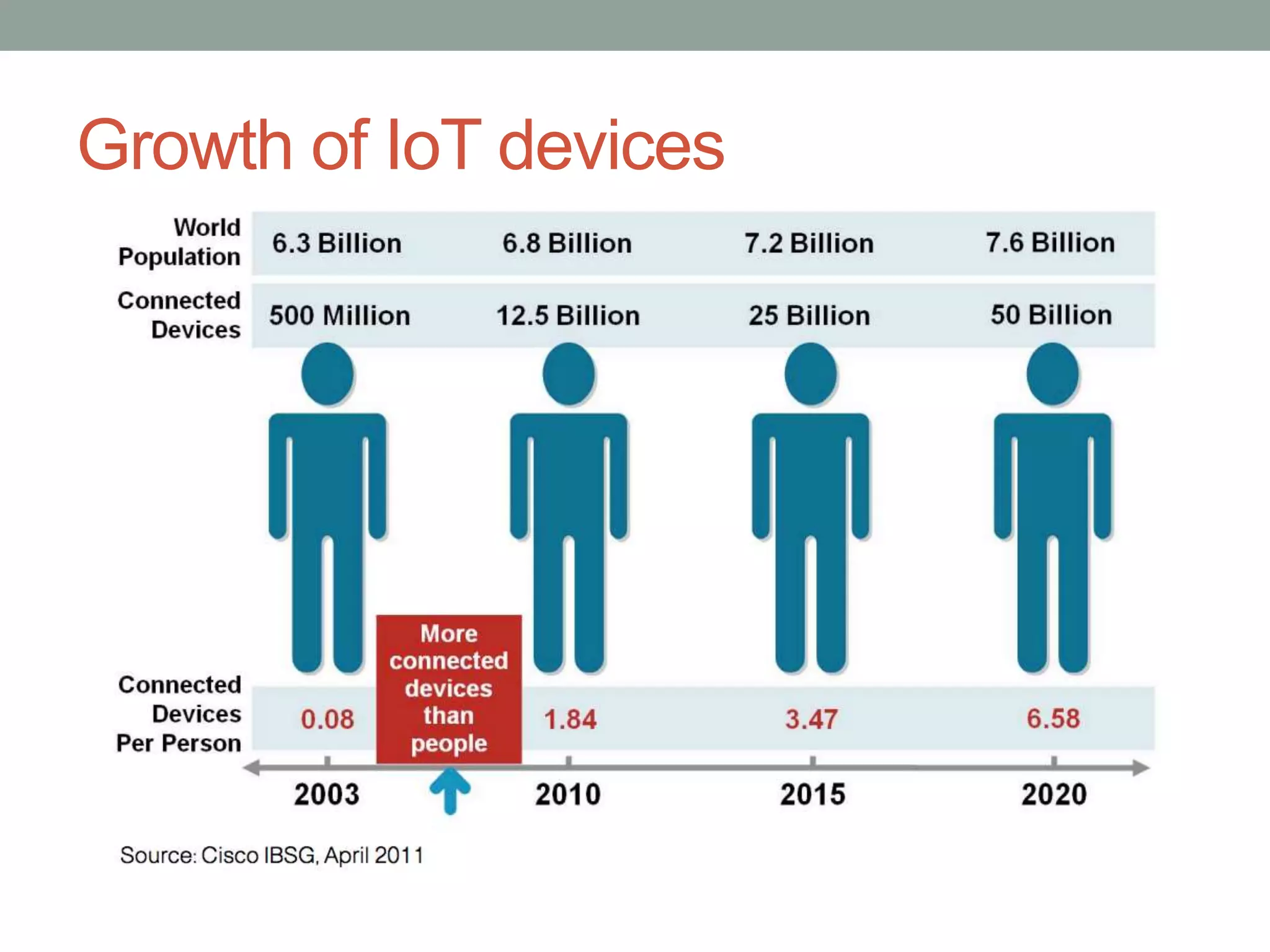
Growth of IoT devices
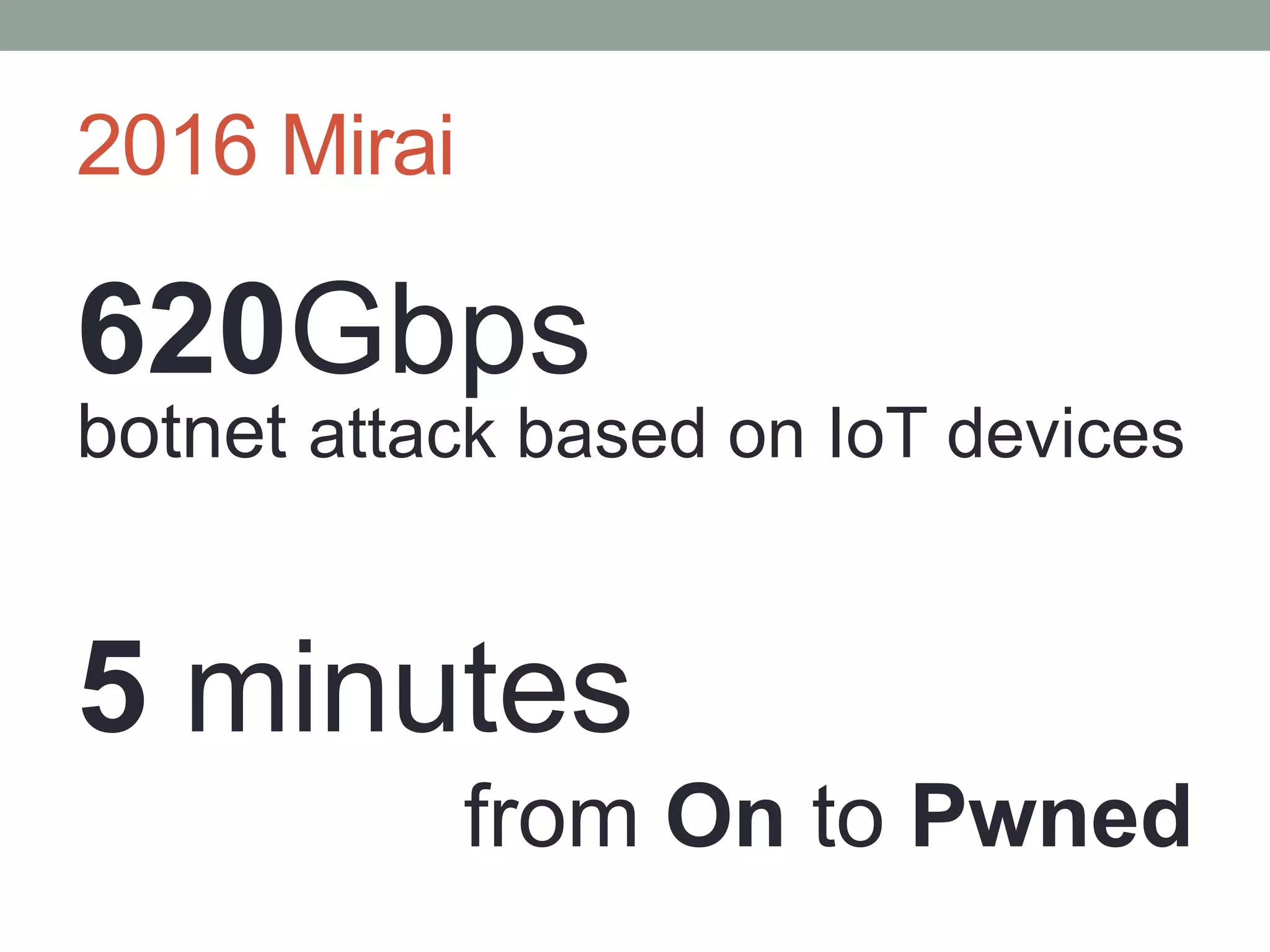
2016 Mirai
620Gbps
botnet attack based on IoT devices
5 minutes
from On to Pwned
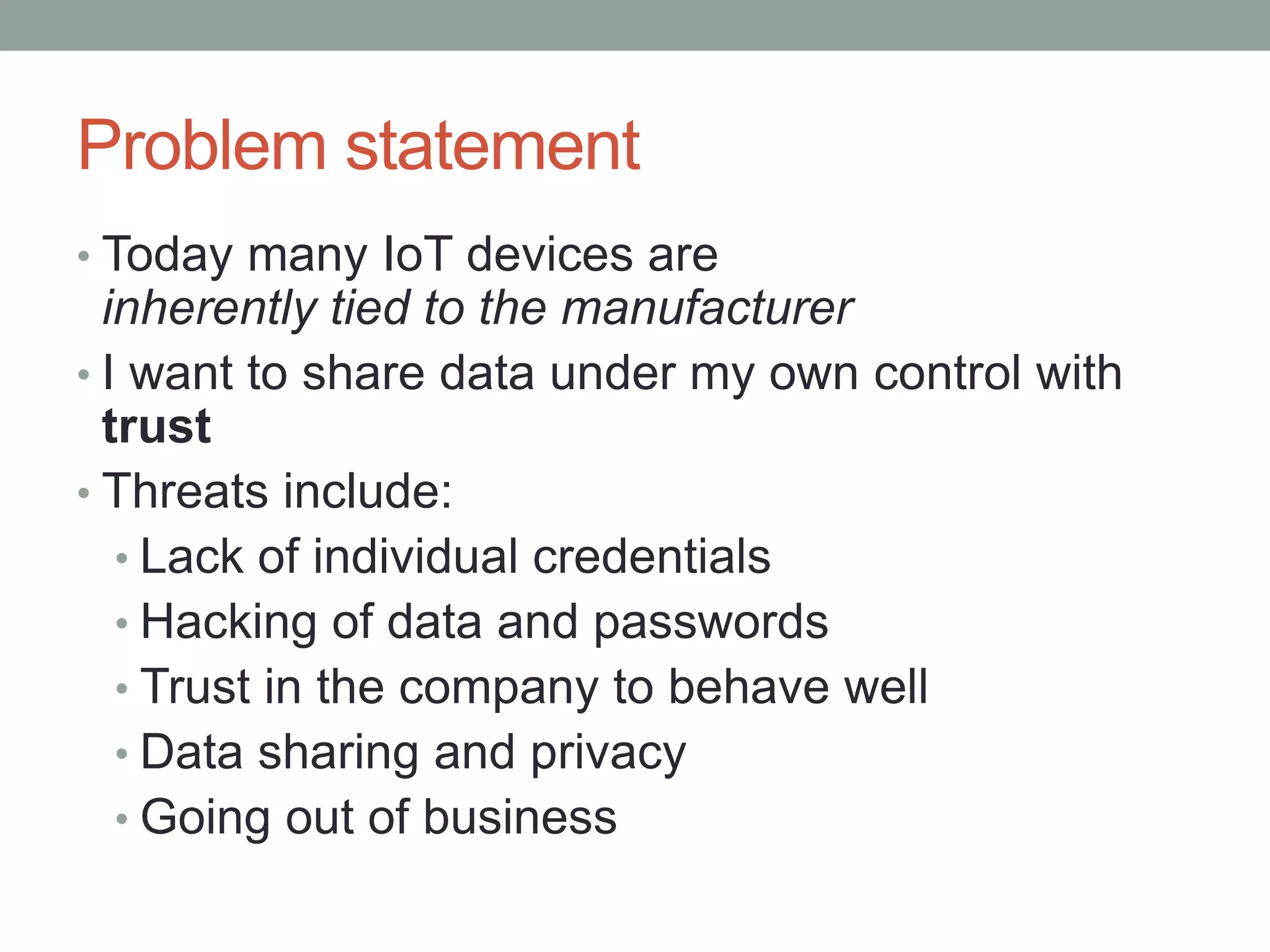
Problem statement
• Today many IoT devices are
inherently tied to the manufacturer
• I want to share data under my own control with
trust
• Threats include:
• Lack of individual credentials
• Hacking of data and passwords
• Trust in the company to behave well
• Data sharing and privacy
• Going out of business
Privacy By Design
• 7 key principles
• Proactive not Reactive; Preventative not Remedial
• Privacy as the Default Setting
• Privacy Embedded into Design
• Full Functionality – Positive-Sum, not Zero-Sum
• End-to-End Security – Full Lifecycle Protection
• Visibility and Transparency – Keep it Open
• Respect for User Privacy – Keep it User-Centric
Cavoukian, Ann, Scott Taylor, and Martin E. Abrams. "Privacy by Design: essential for
organizational accountability and strong business practices."Identity in the Information Society 3.2
(2010): 405-413.
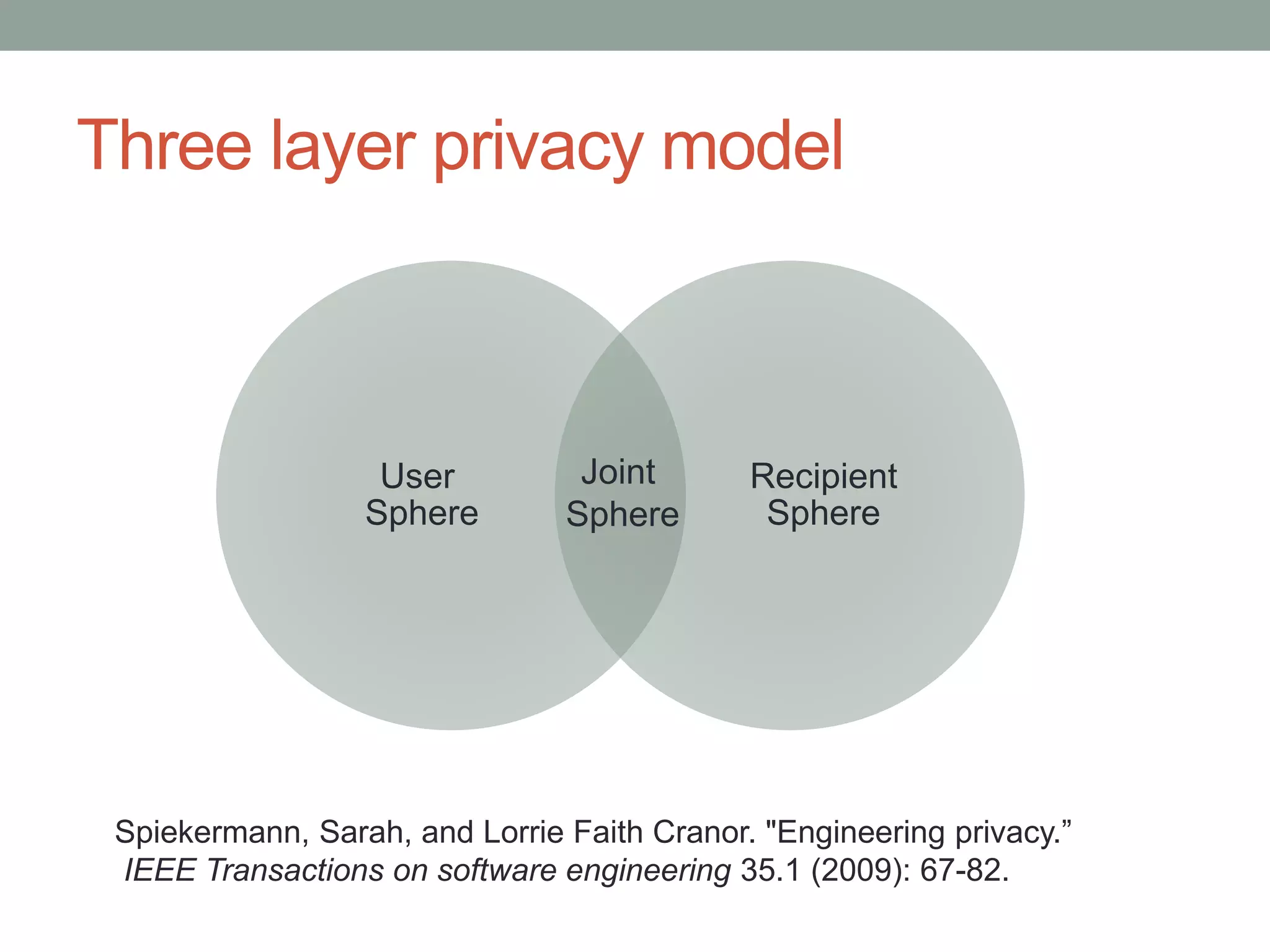
Three layer privacy model
User
Sphere
Recipient
Sphere
Joint
Sphere
Spiekermann, Sarah, and Lorrie Faith Cranor. "Engineering privacy.”
IEEE Transactions on software engineering 35.1 (2009): 67-82.
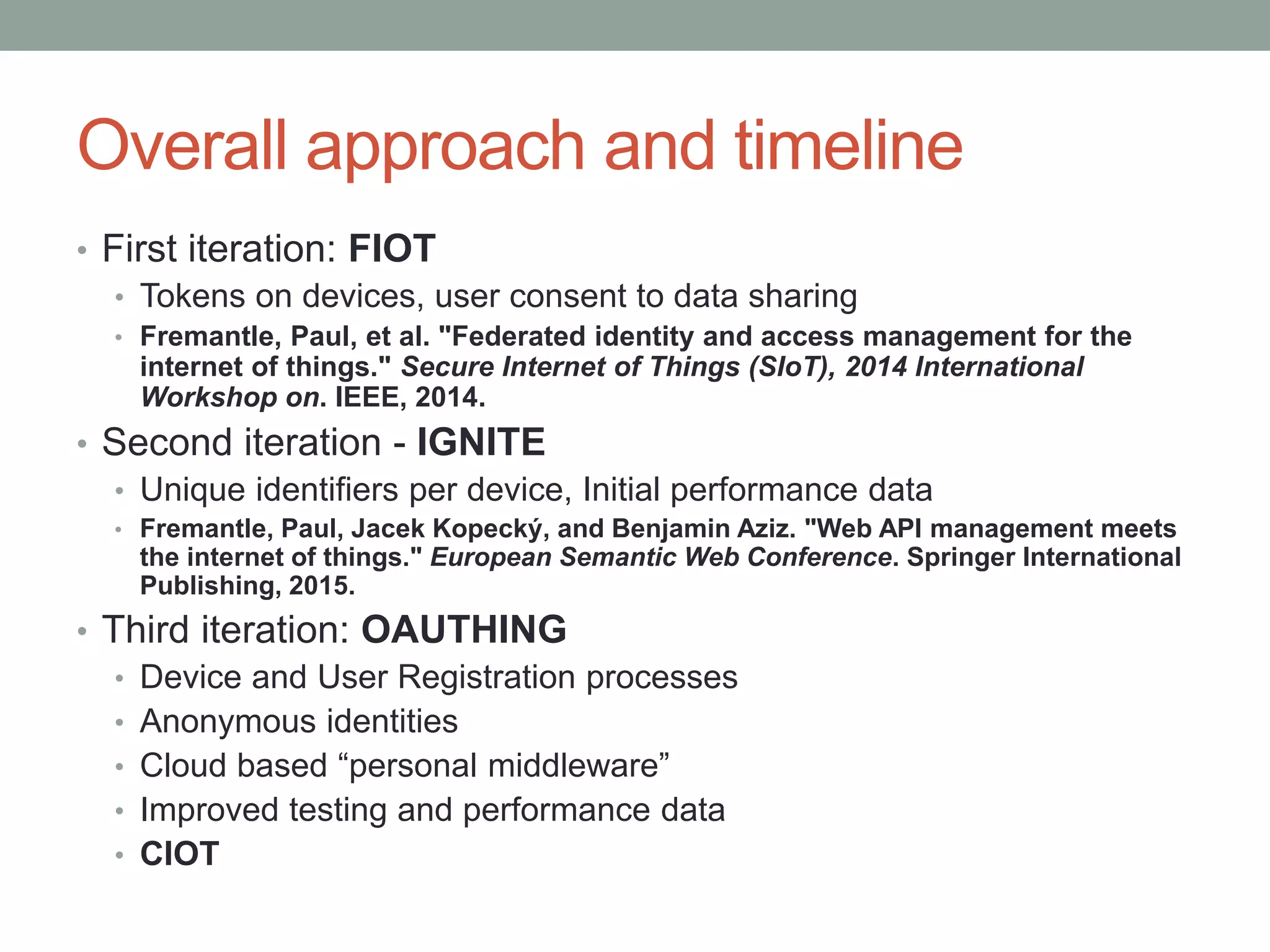
Overall approach and timeline
• First iteration: FIOT
• Tokens on devices, user consent to data sharing
• Fremantle, Paul, et al. "Federated identity and access management for the
internet of things." Secure Internet of Things (SIoT), 2014 International
Workshop on. IEEE, 2014.
• Second iteration - IGNITE
• Unique identifiers per device, Initial performance data
• Fremantle, Paul, Jacek Kopecký, and Benjamin Aziz. "Web API management meets
the internet of things." European Semantic Web Conference. Springer International
Publishing, 2015.
• Third iteration: OAUTHING
• Device and User Registration processes
• Anonymous identities
• Cloud based “personal middleware”
• Improved testing and performance data
• CIOT
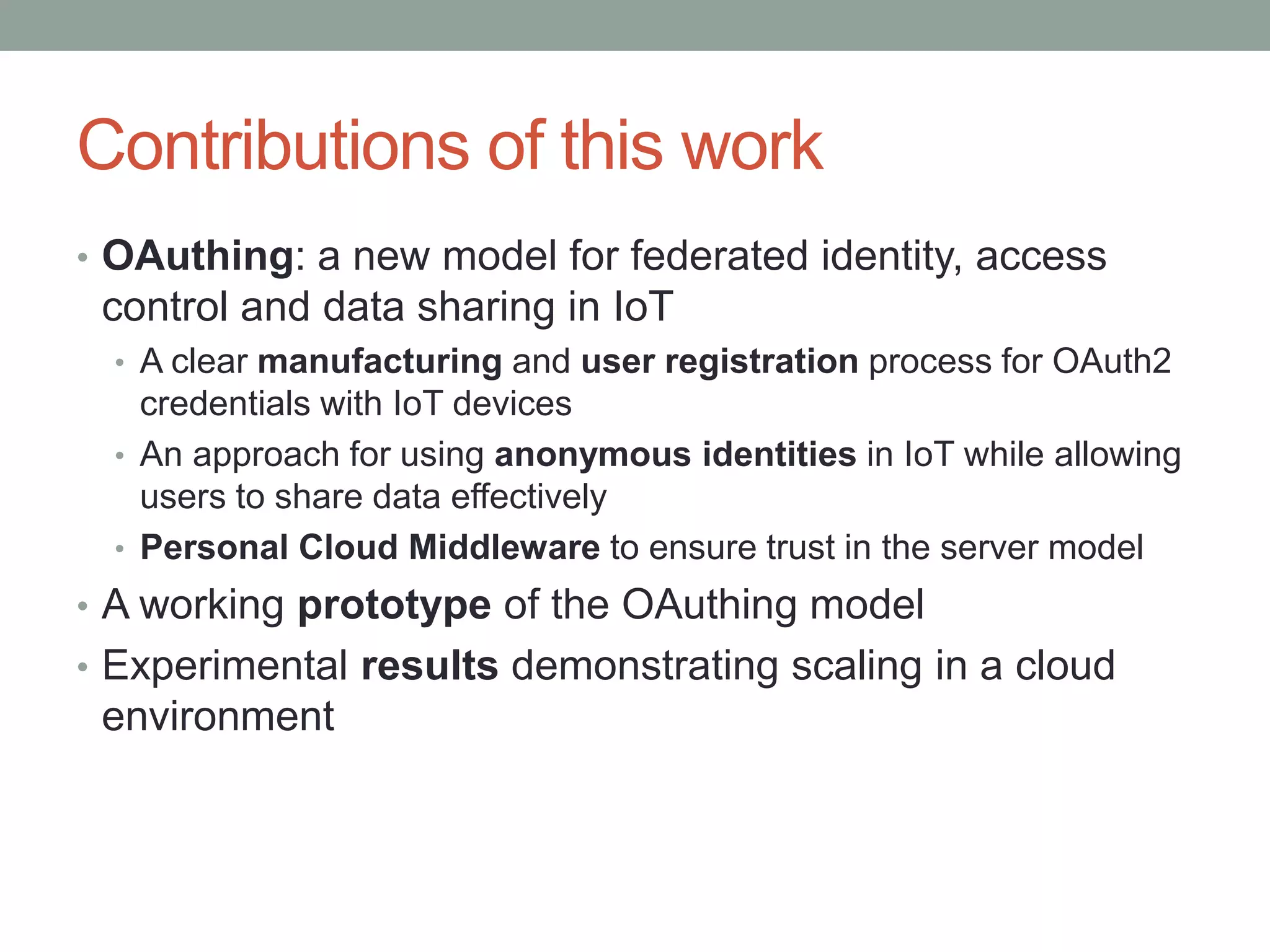
Contributions of this work
• OAuthing: a new model for federated identity, access
control and data sharing in IoT
• A clear manufacturing and user registration process for OAuth2
credentials with IoT devices
• An approach for using anonymous identities in IoT while allowing
users to share data effectively
• Personal Cloud Middleware to ensure trust in the server model
• A working prototype of the OAuthing model
• Experimental results demonstrating scaling in a cloud
environment
MODELAND
ARCHITECTURE
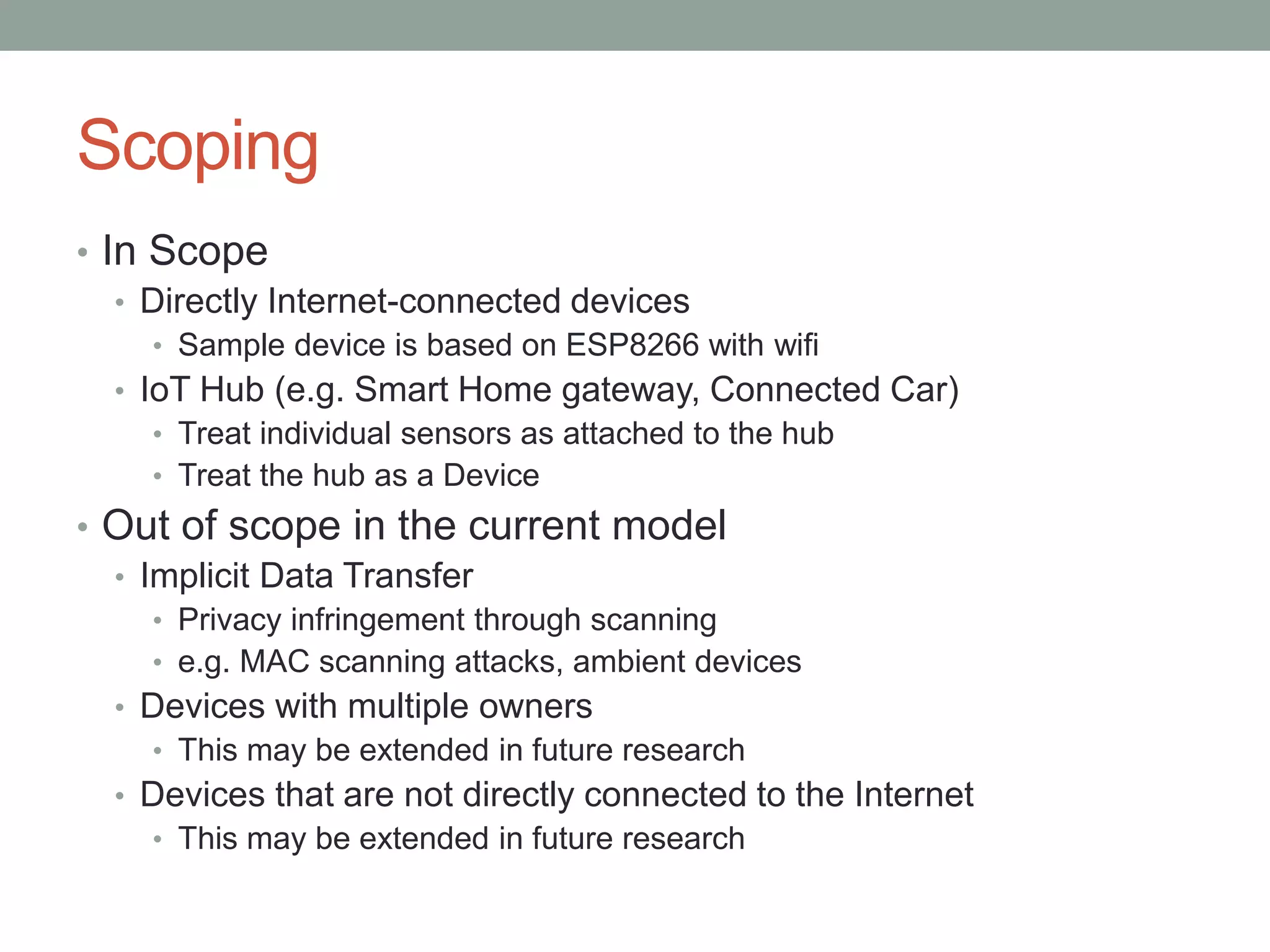
Scoping
• In Scope
• Directly Internet-connected devices
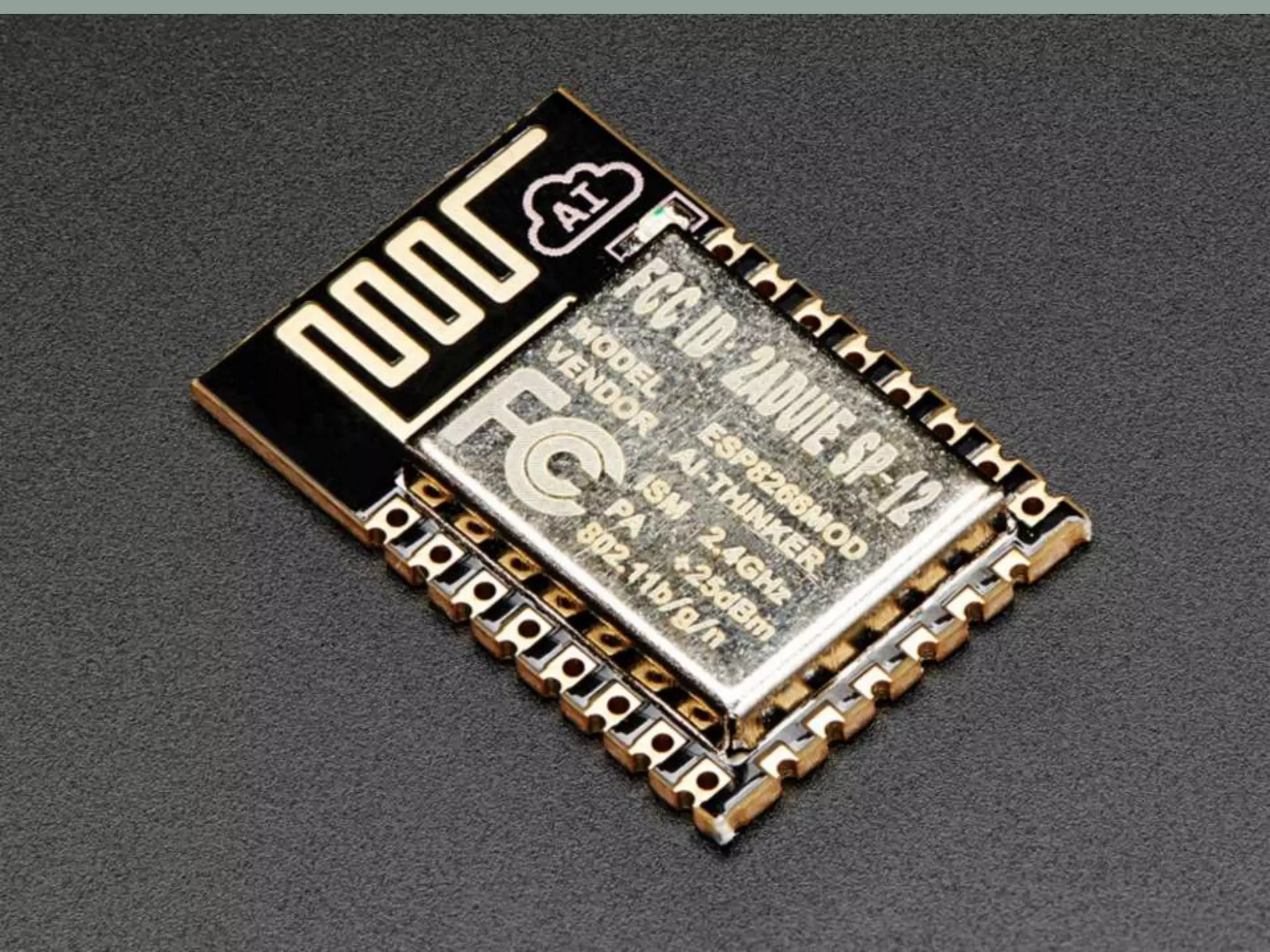
• Sample device is based on ESP8266 with wifi
• IoT Hub (e.g. Smart Home gateway, Connected Car)
• Treat individual sensors as attached to the hub
• Treat the hub as a Device
• Out of scope in the current model
• Implicit Data Transfer
• Privacy infringement through scanning
• e.g. MAC scanning attacks, ambient devices
• Devices with multiple owners
• This may be extended in future research
• Devices that are not directly connected to the Internet
• This may be extended in future research
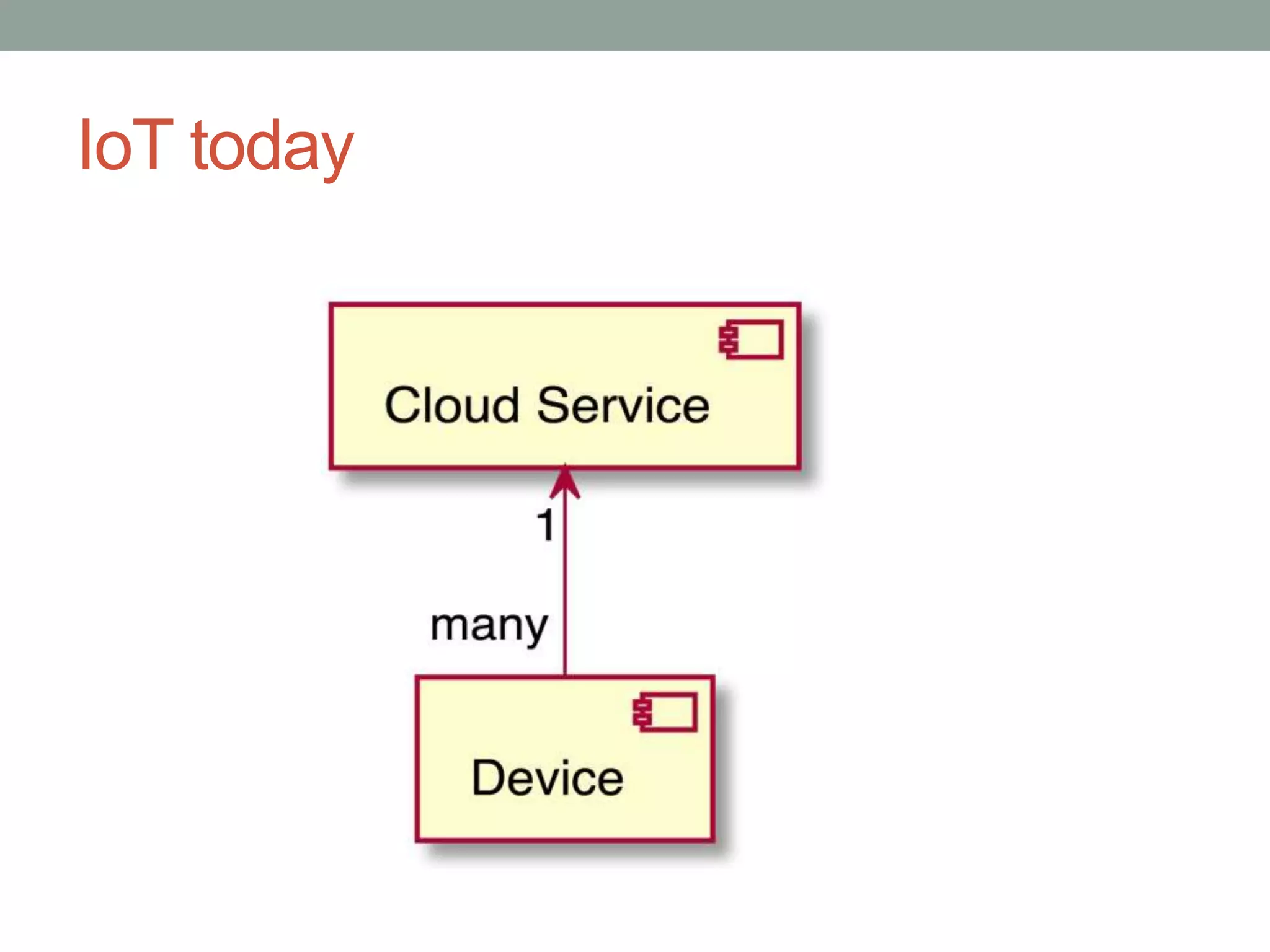
IoT today
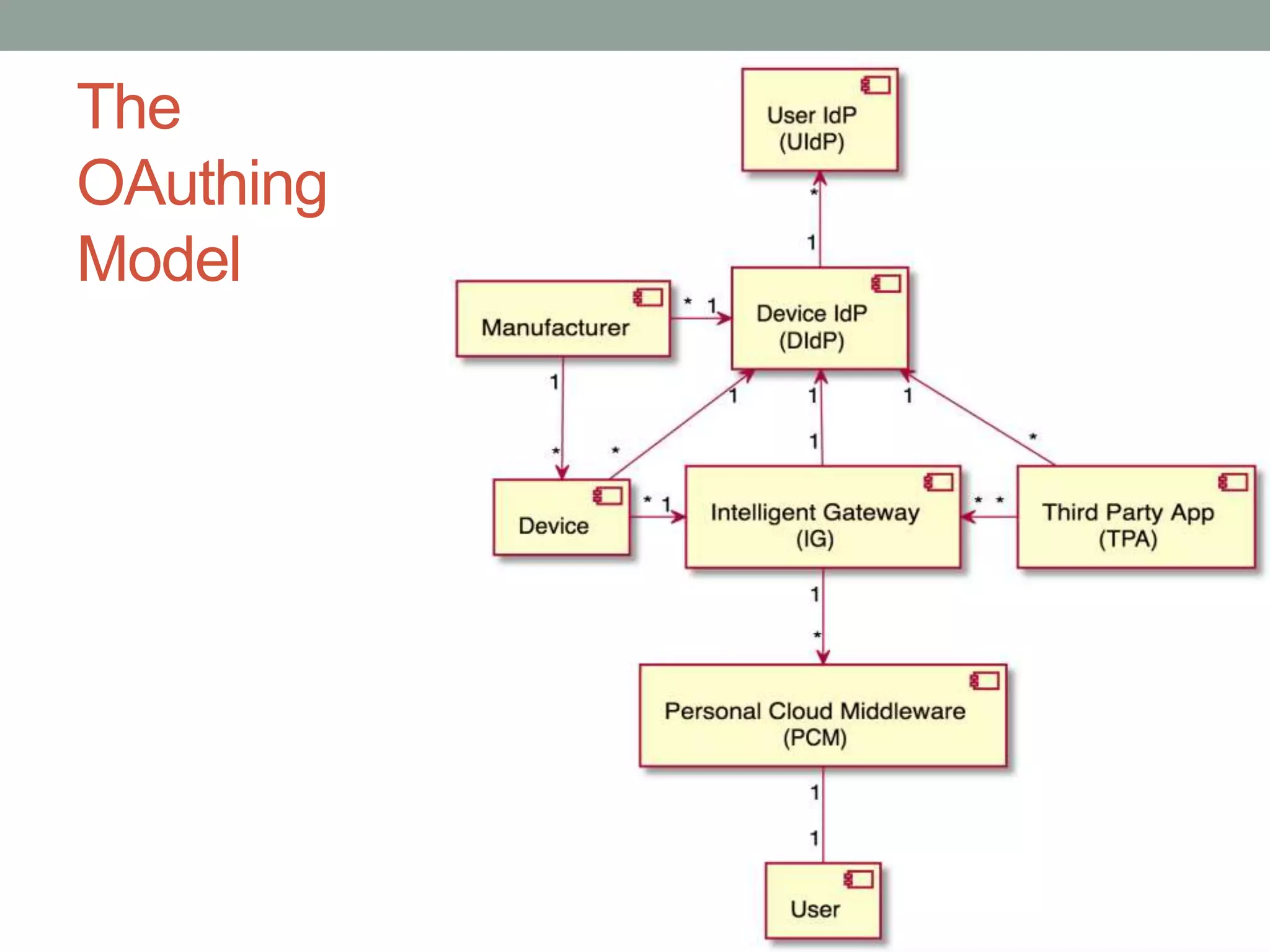
The
OAuthing
Model
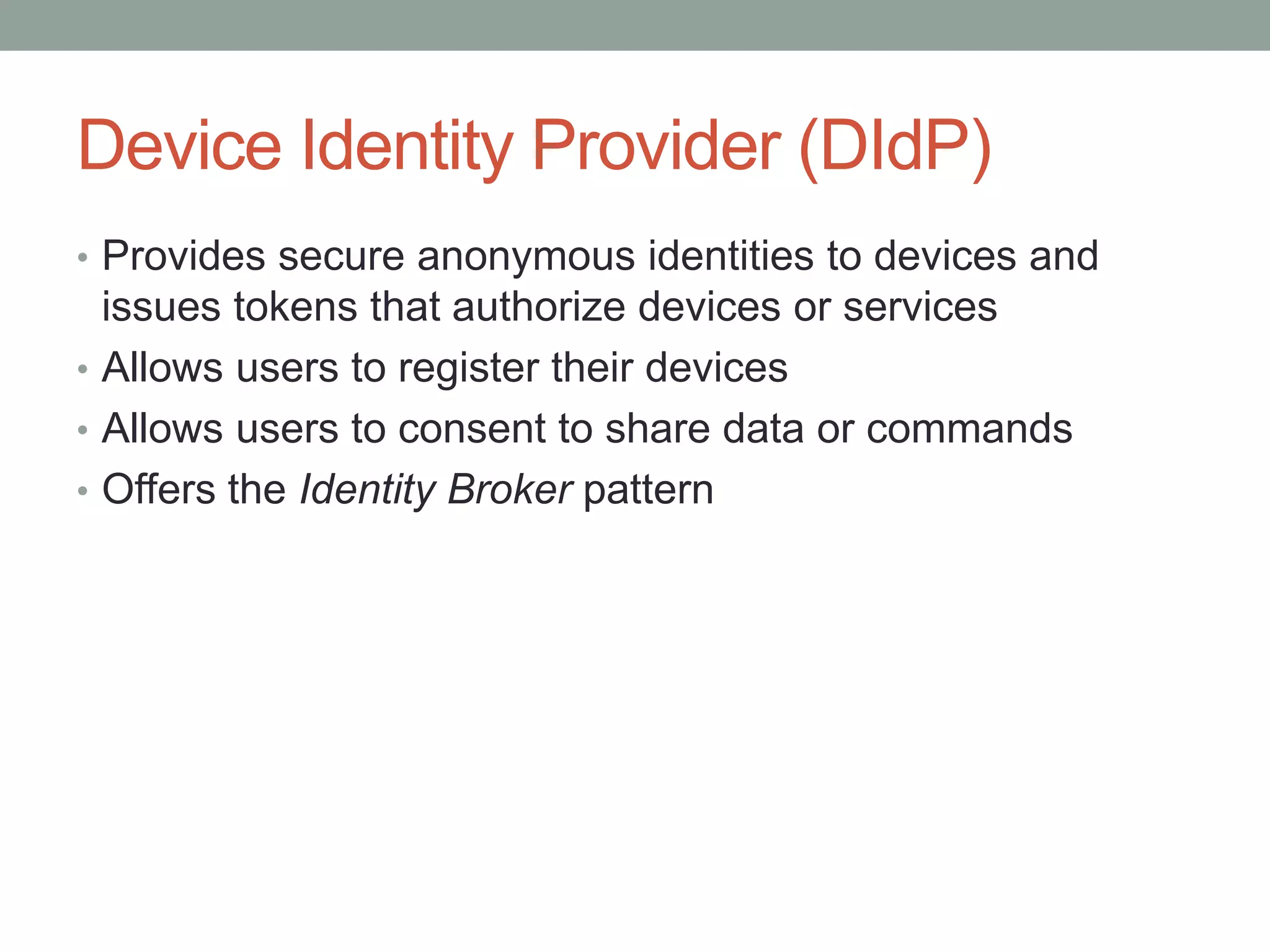
Device Identity Provider (DIdP)
• Provides secure anonymous identities to devices and
issues tokens that authorize devices or services
• Allows users to register their devices
• Allows users to consent to share data or commands
• Offers the Identity Broker pattern
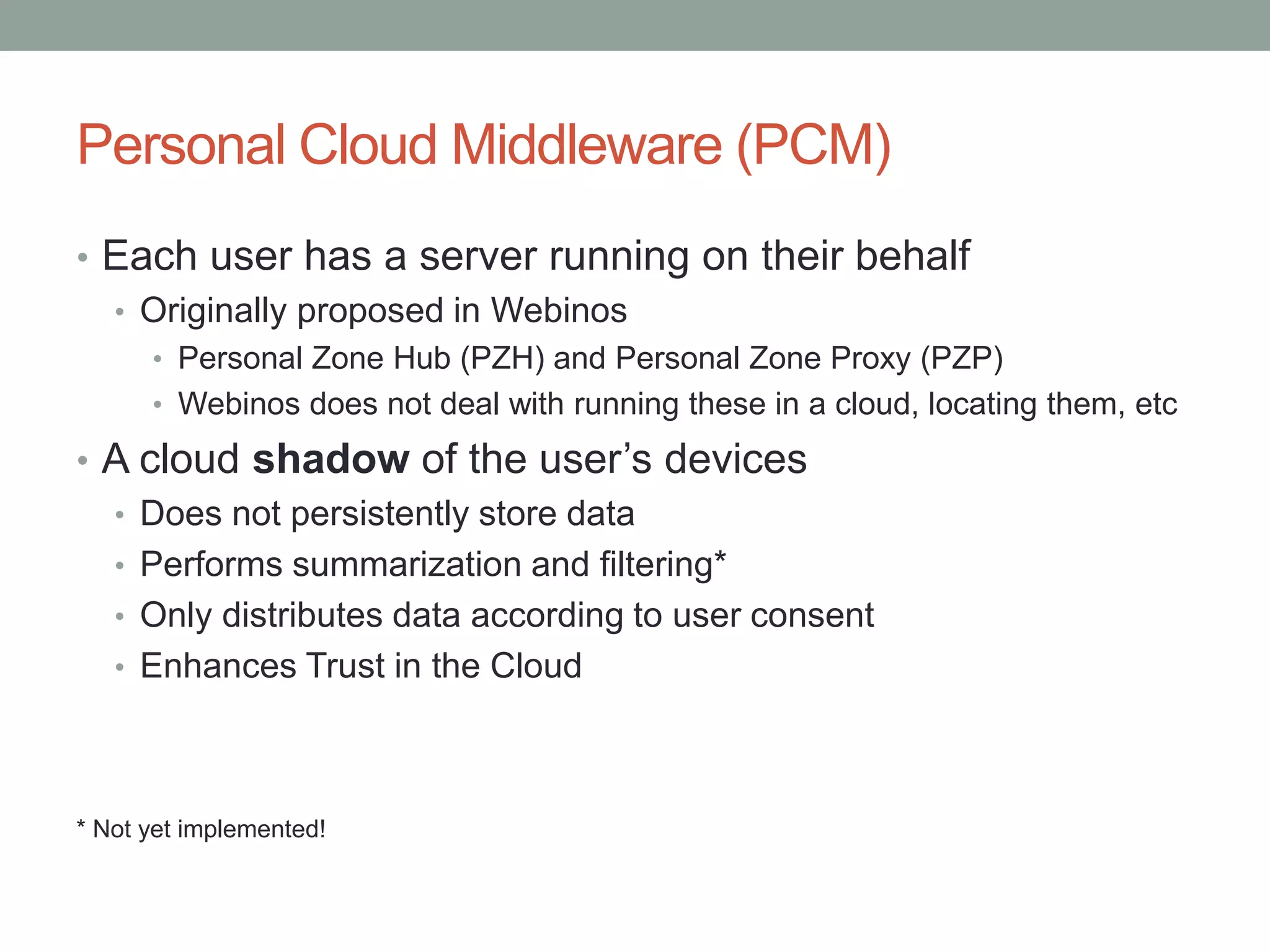
Personal Cloud Middleware (PCM)
• Each user has a server running on their behalf
• Originally proposed in Webinos
• Personal Zone Hub (PZH) and Personal Zone Proxy (PZP)
• Webinos does not deal with running these in a cloud, locating them, etc
• A cloud shadow of the user’s devices
• Does not persistently store data
• Performs summarization and filtering*
• Only distributes data according to user consent
• Enhances Trust in the Cloud
* Not yet implemented!
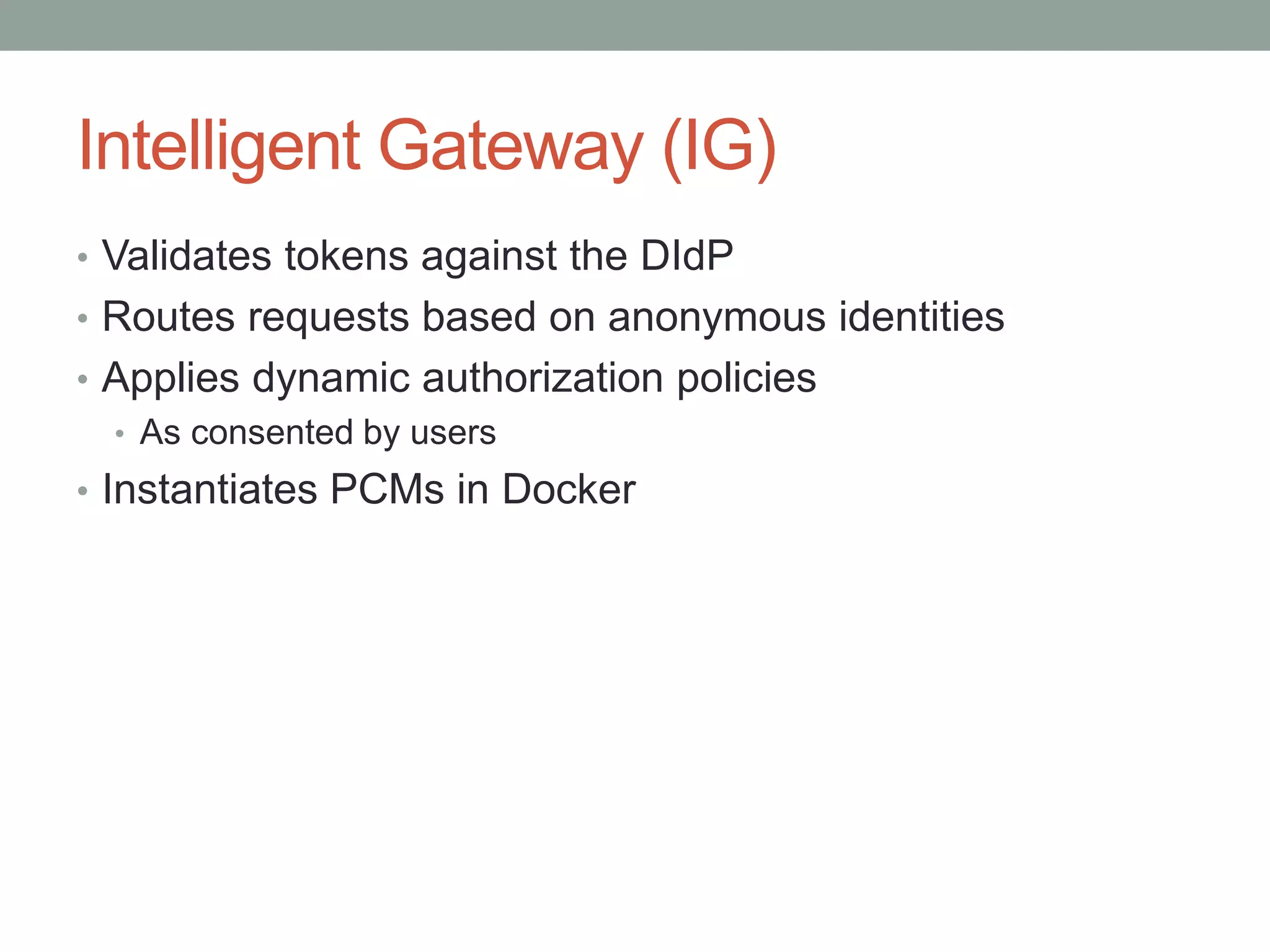
Intelligent Gateway (IG)
• Validates tokens against the DIdP
• Routes requests based on anonymous identities
• Applies dynamic authorization policies
• As consented by users
• Instantiates PCMs in Docker
Device
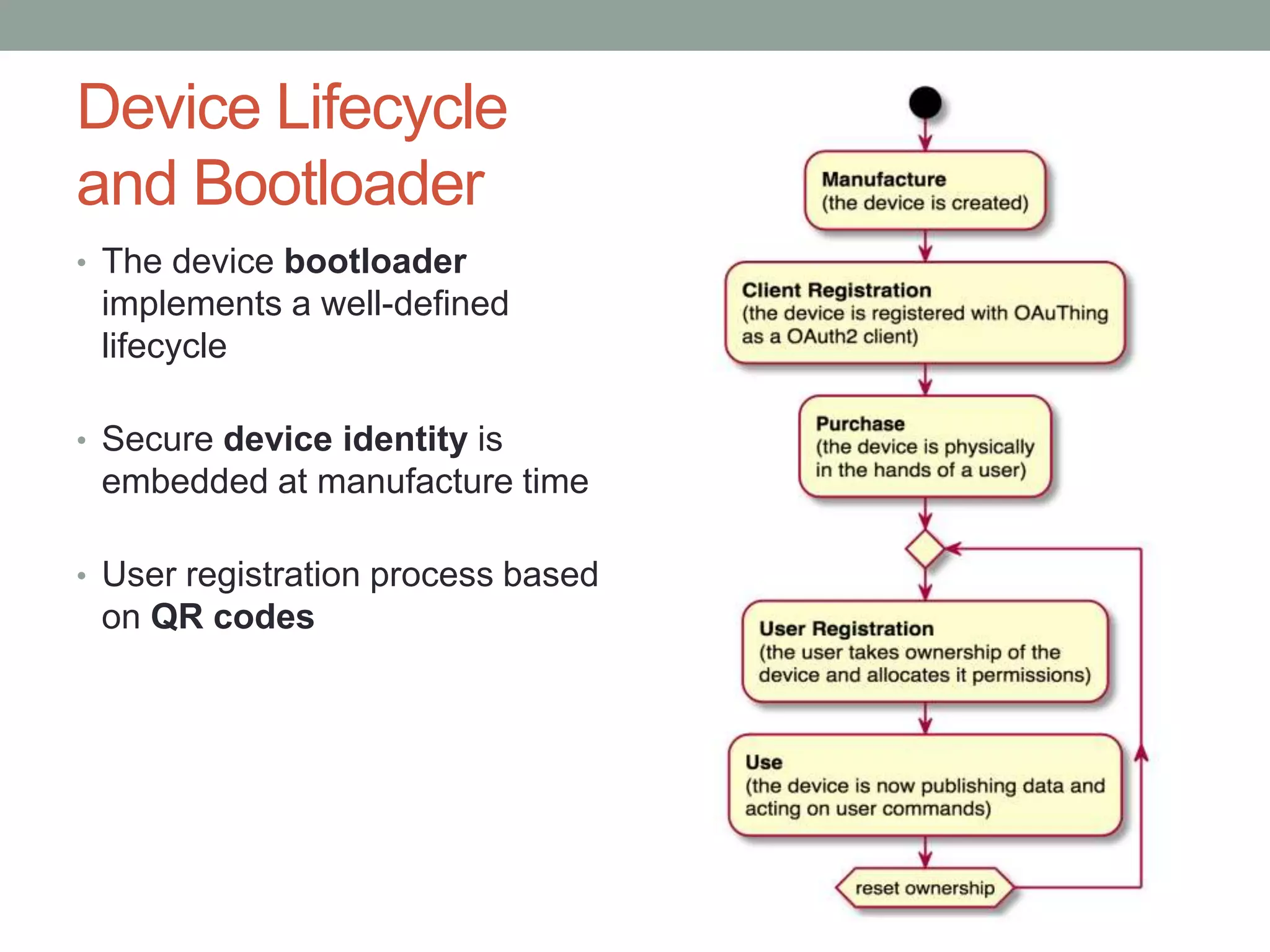
Device Lifecycle
and Bootloader
• The device bootloader
implements a well-defined
lifecycle
• Secure device identity is
embedded at manufacture time
• User registration process based
on QR codes
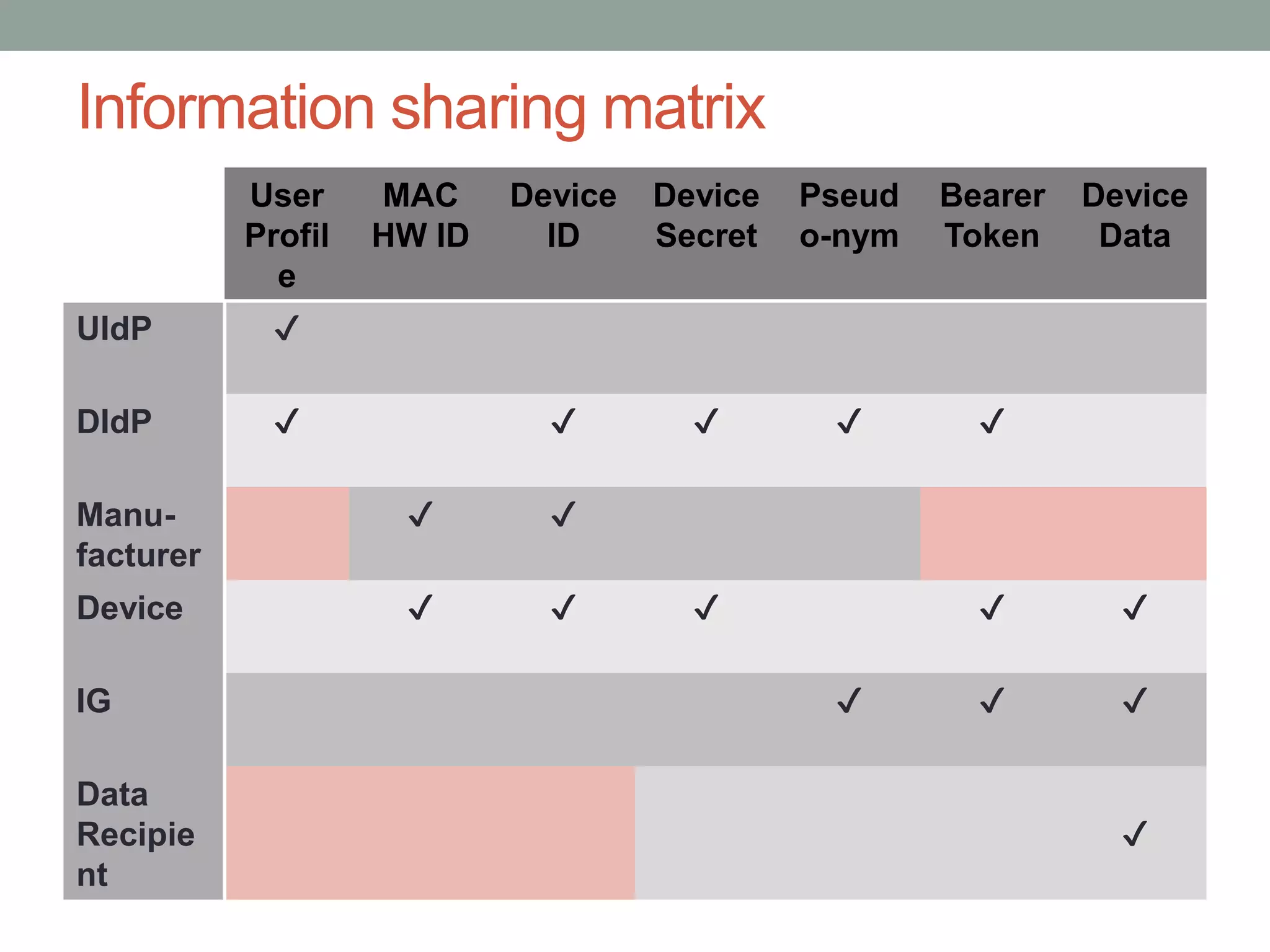
Information sharing matrix
User
Profil
e
MAC
HW ID
Device
ID
Device
Secret
Pseud
o-nym
Bearer
Token
Device
Data
UIdP ✔
DIdP ✔ ✔ ✔ ✔ ✔
Manu-
facturer
✔ ✔
Device ✔ ✔ ✔ ✔ ✔
IG ✔ ✔ ✔
Data
Recipie
nt
✔
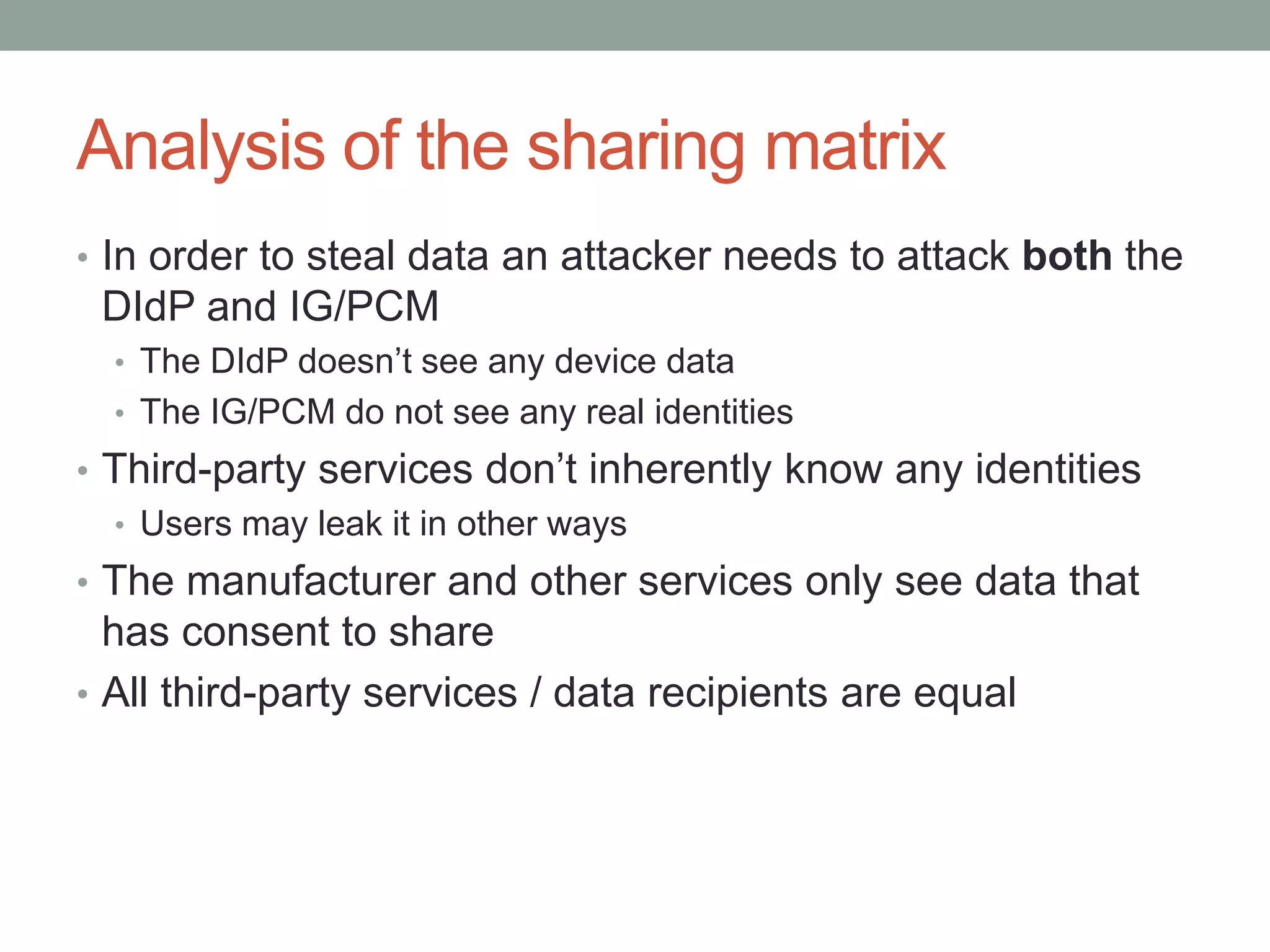
Analysis of the sharing matrix
• In order to steal data an attacker needs to attack both the
DIdP and IG/PCM
• The DIdP doesn’t see any device data
• The IG/PCM do not see any real identities
• Third-party services don’t inherently know any identities
• Users may leak it in other ways
• The manufacturer and other services only see data that
has consent to share
• All third-party services / data recipients are equal
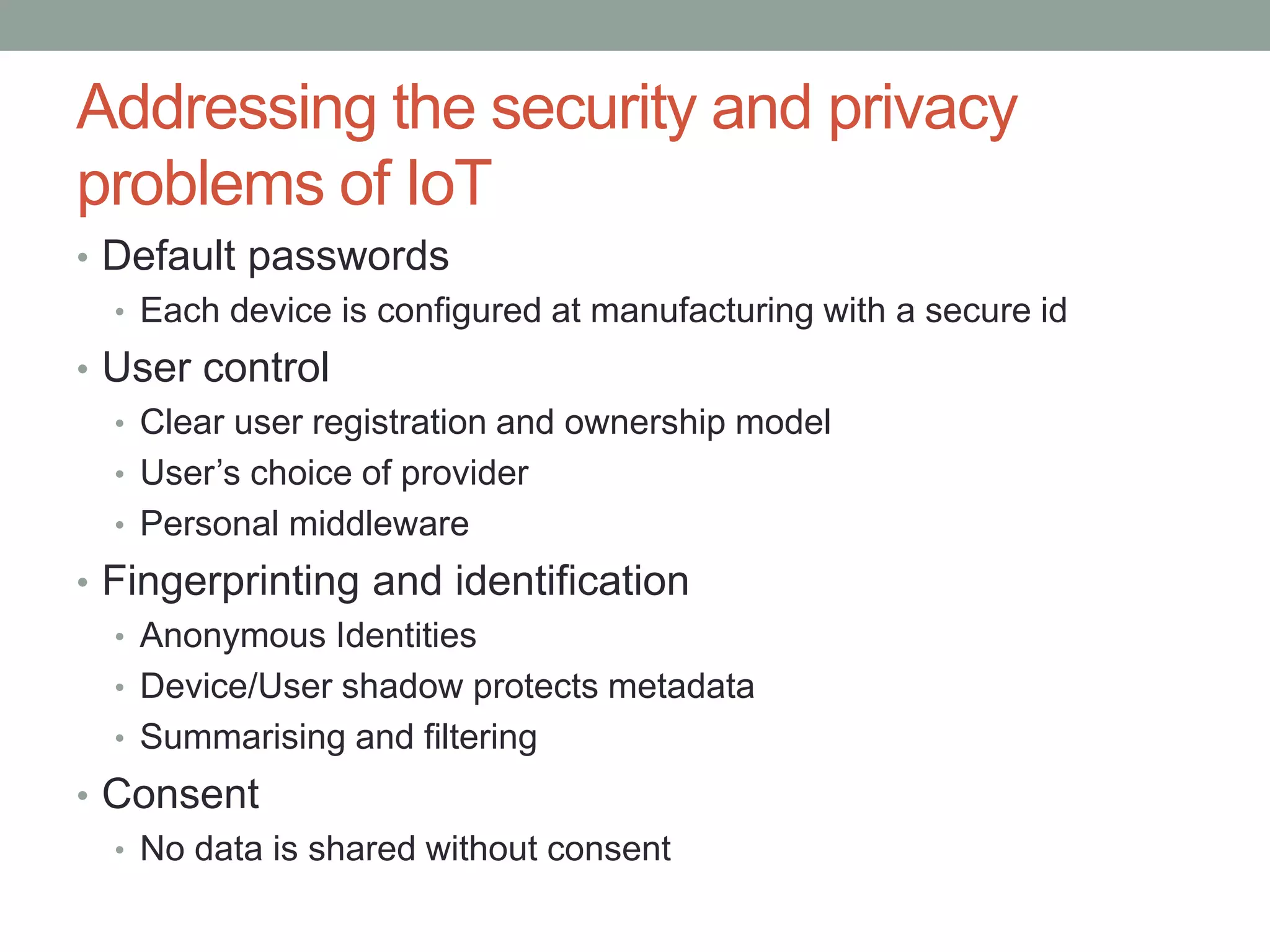
Addressing the security and privacy
problems of IoT
• Default passwords
• Each device is configured at manufacturing with a secure id
• User control
• Clear user registration and ownership model
• User’s choice of provider
• Personal middleware
• Fingerprinting and identification
• Anonymous Identities
• Device/User shadow protects metadata
• Summarising and filtering
• Consent
• No data is shared without consent
IMPLEMENTATION
Implementation
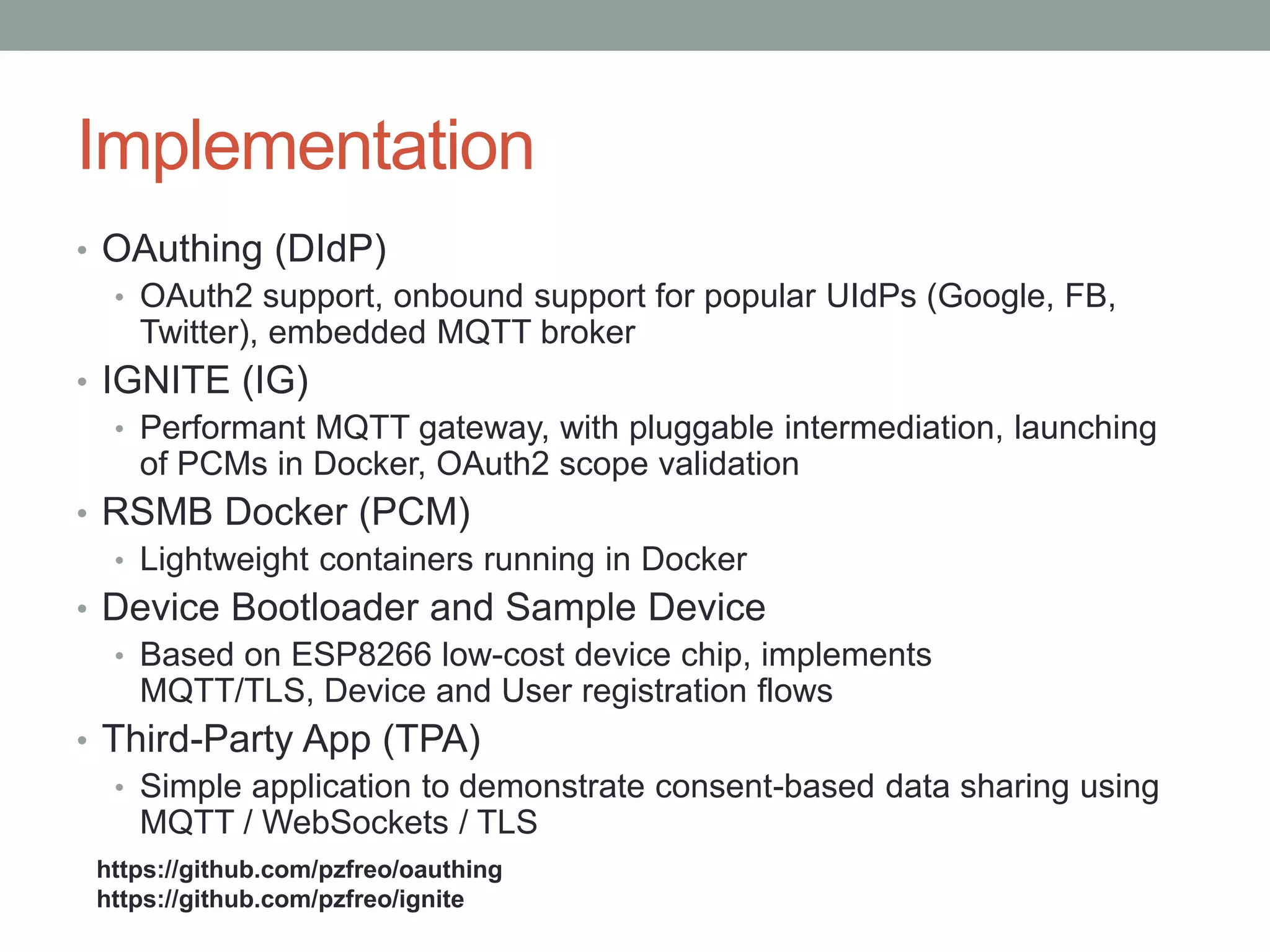
• OAuthing (DIdP)
• OAuth2 support, onbound support for popular UIdPs (Google, FB,
Twitter), embedded MQTT broker
• IGNITE (IG)
• Performant MQTT gateway, with pluggable intermediation, launching
of PCMs in Docker, OAuth2 scope validation
• RSMB Docker (PCM)
• Lightweight containers running in Docker
• Device Bootloader and Sample Device
• Based on ESP8266 low-cost device chip, implements
MQTT/TLS, Device and User registration flows
• Third-Party App (TPA)
• Simple application to demonstrate consent-based data sharing using
MQTT / WebSockets / TLS
https://github.com/pzfreo/oauthing
https://github.com/pzfreo/ignite
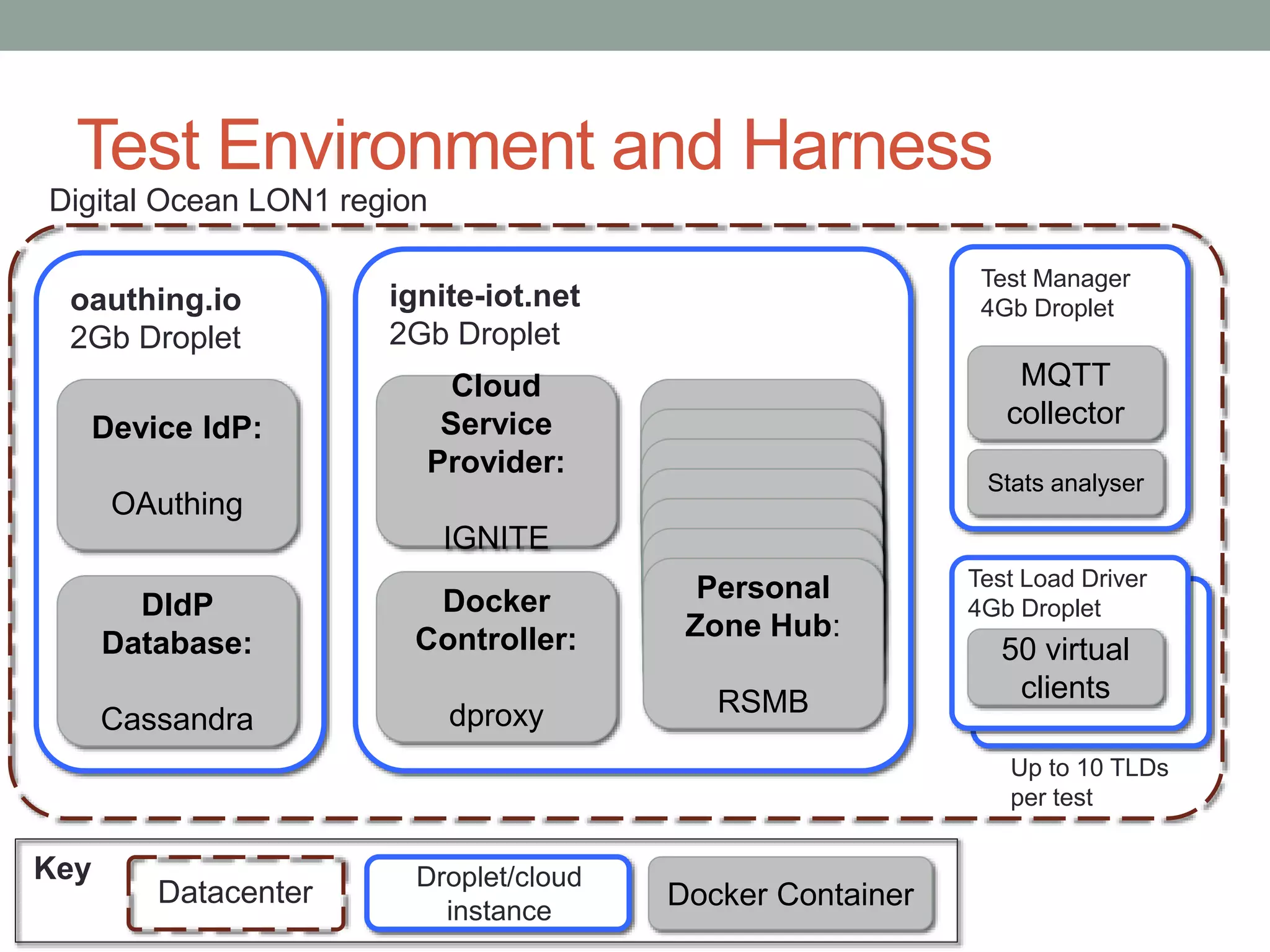
Digital Ocean LON1 region
Device IdP:
OAuthing
DIdP
Database:
Cassandra
oauthing.io
2Gb Droplet
Cloud
Service
Provider:
IGNITE
Docker
Controller:
dproxy
ignite-iot.net
2Gb Droplet
Personal
RSMB
Brokers
Personal
RSMB
Brokers
Personal
RSMB
Brokers
Personal
RSMB
Brokers
Personal
RSMB
Brokers
Personal
RSMB
Brokers
Personal
Zone Hub:
RSMB
MQTT
collector
Test Manager
4Gb Droplet
Stats analyser
Test Load Driver
4Gb Droplet
50 virtual
clients
Up to 10 TLDs
per test
Key
Datacenter
Droplet/cloud
instance
Docker Container
Test Environment and Harness
Live demo?
2 minute demonstration video
Individual anonymous integration
• On a 2Gb Digital Ocean droplet
• 400 MQTT brokers
• Handling 10 messages / second each
• Based on pseudonyms
• With OAuth2 based consent
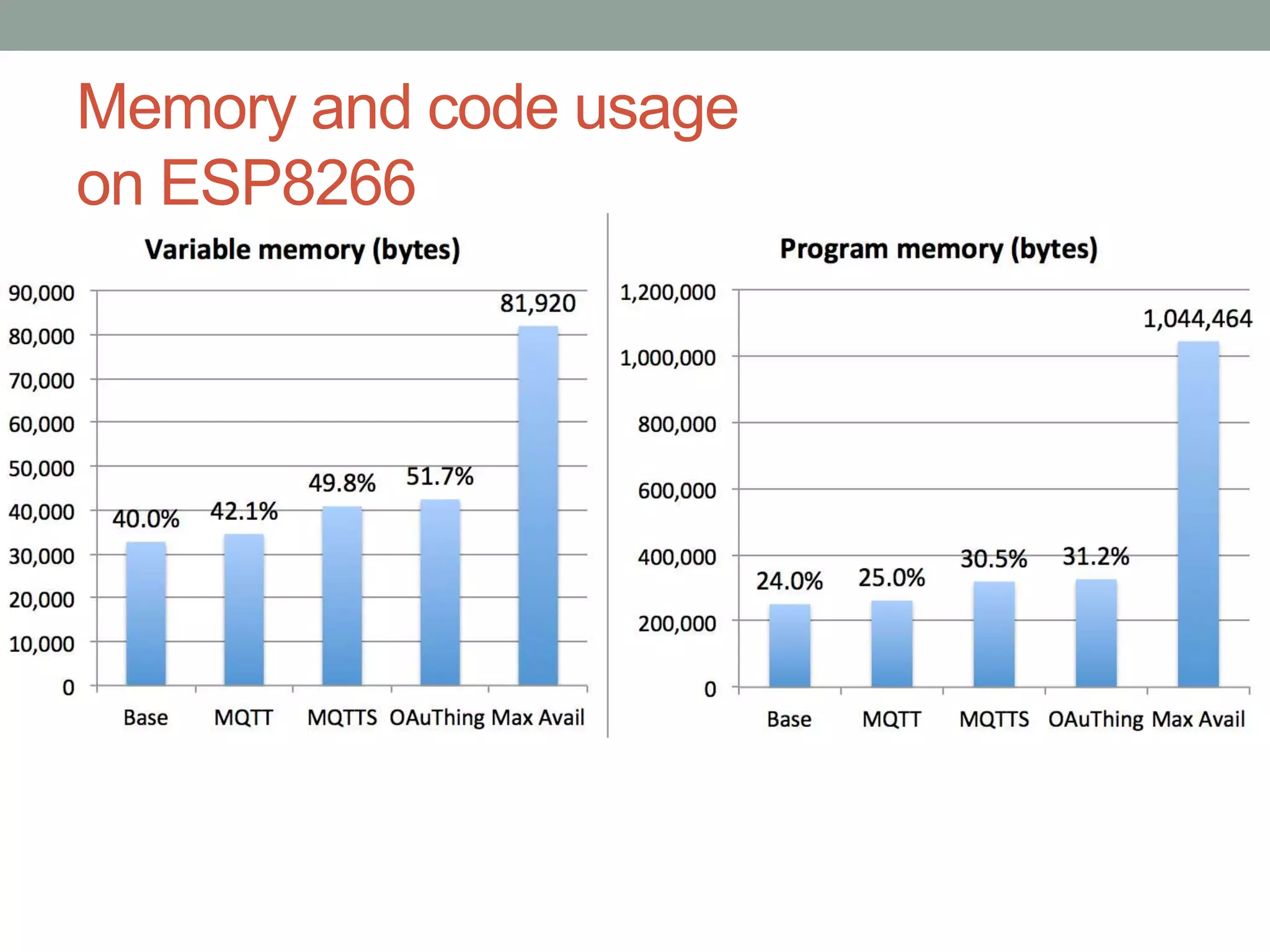
Memory and code usage
on ESP8266
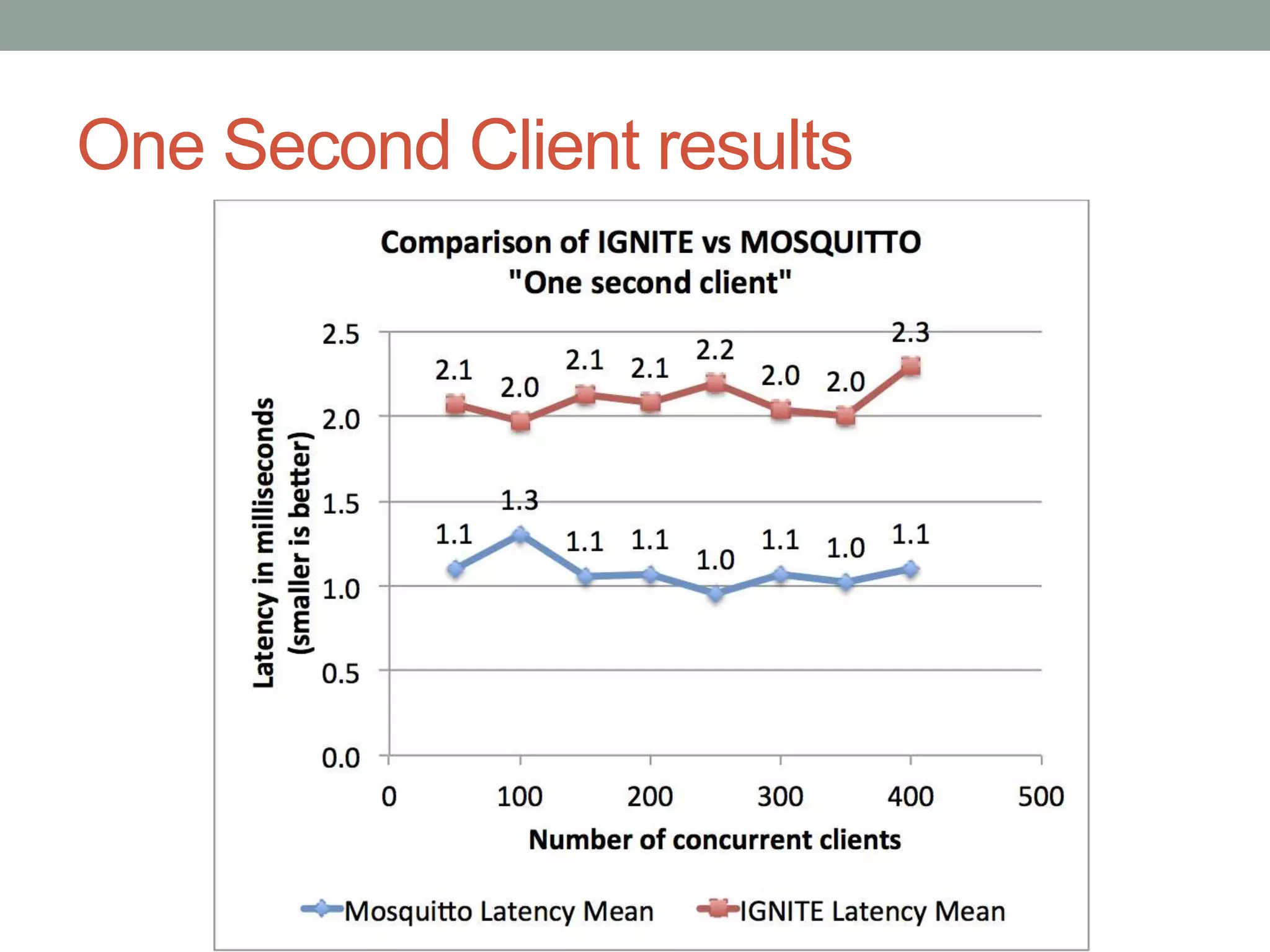
One Second Client results
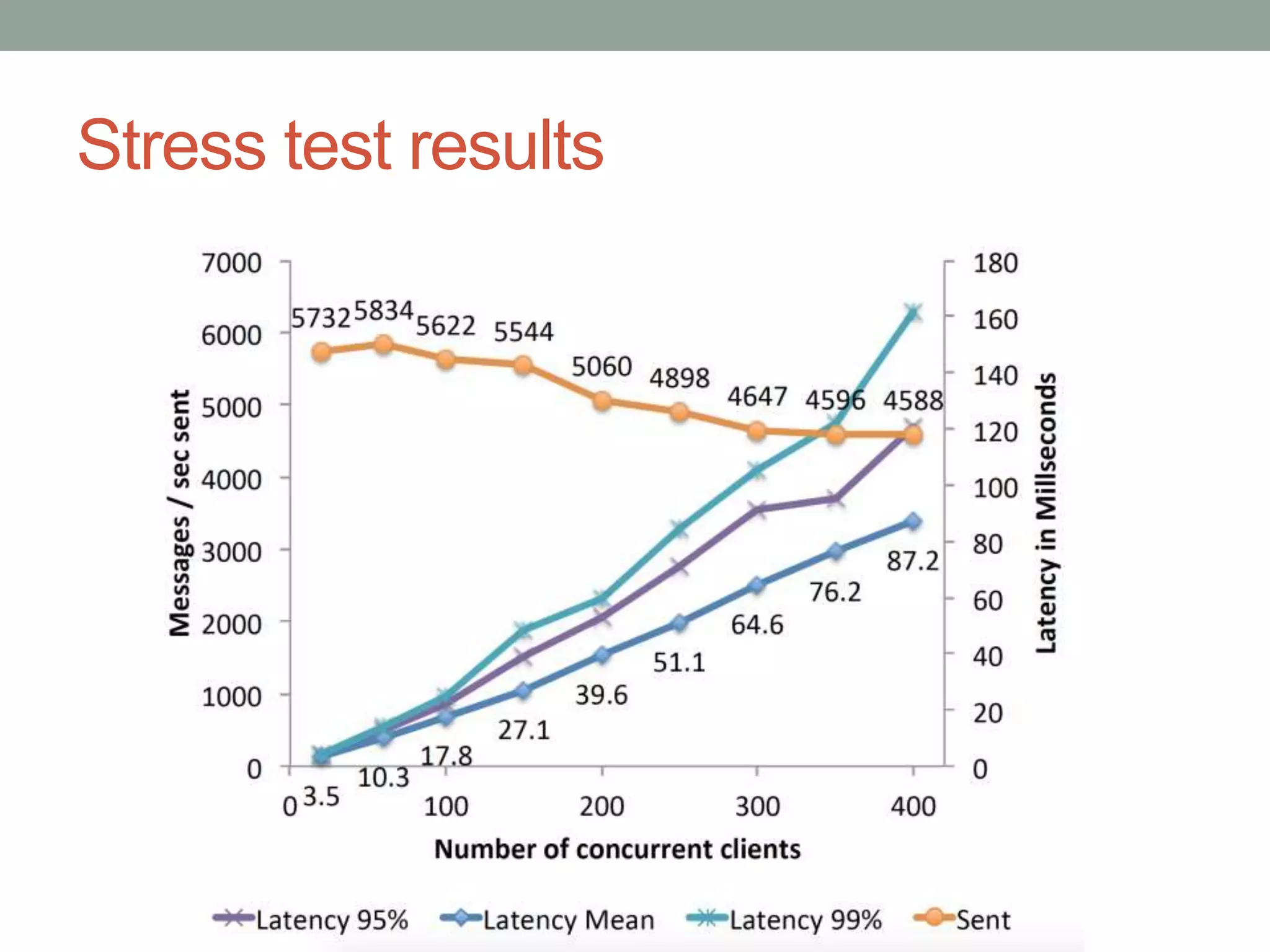
Stress test results
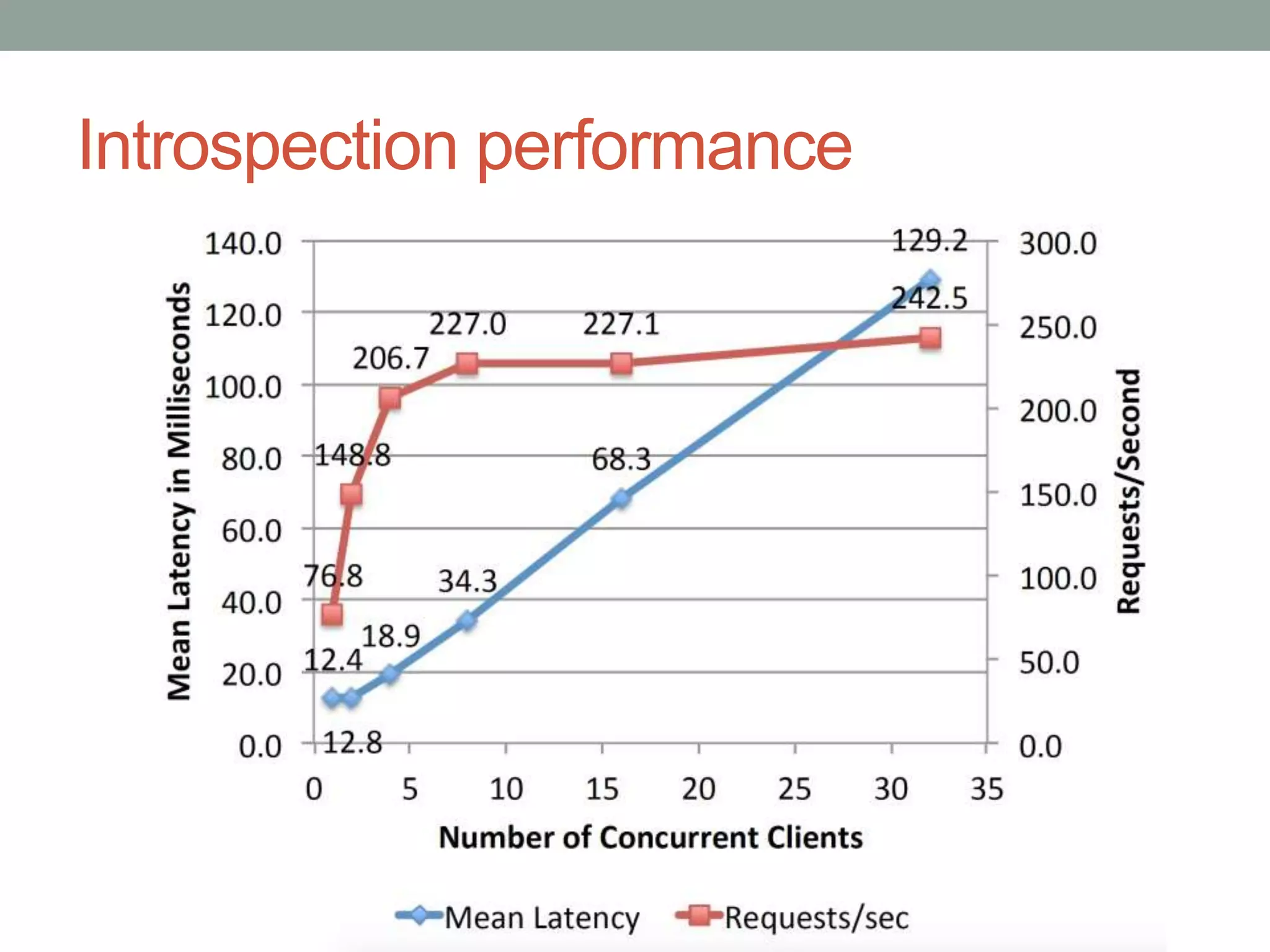
Introspection performance
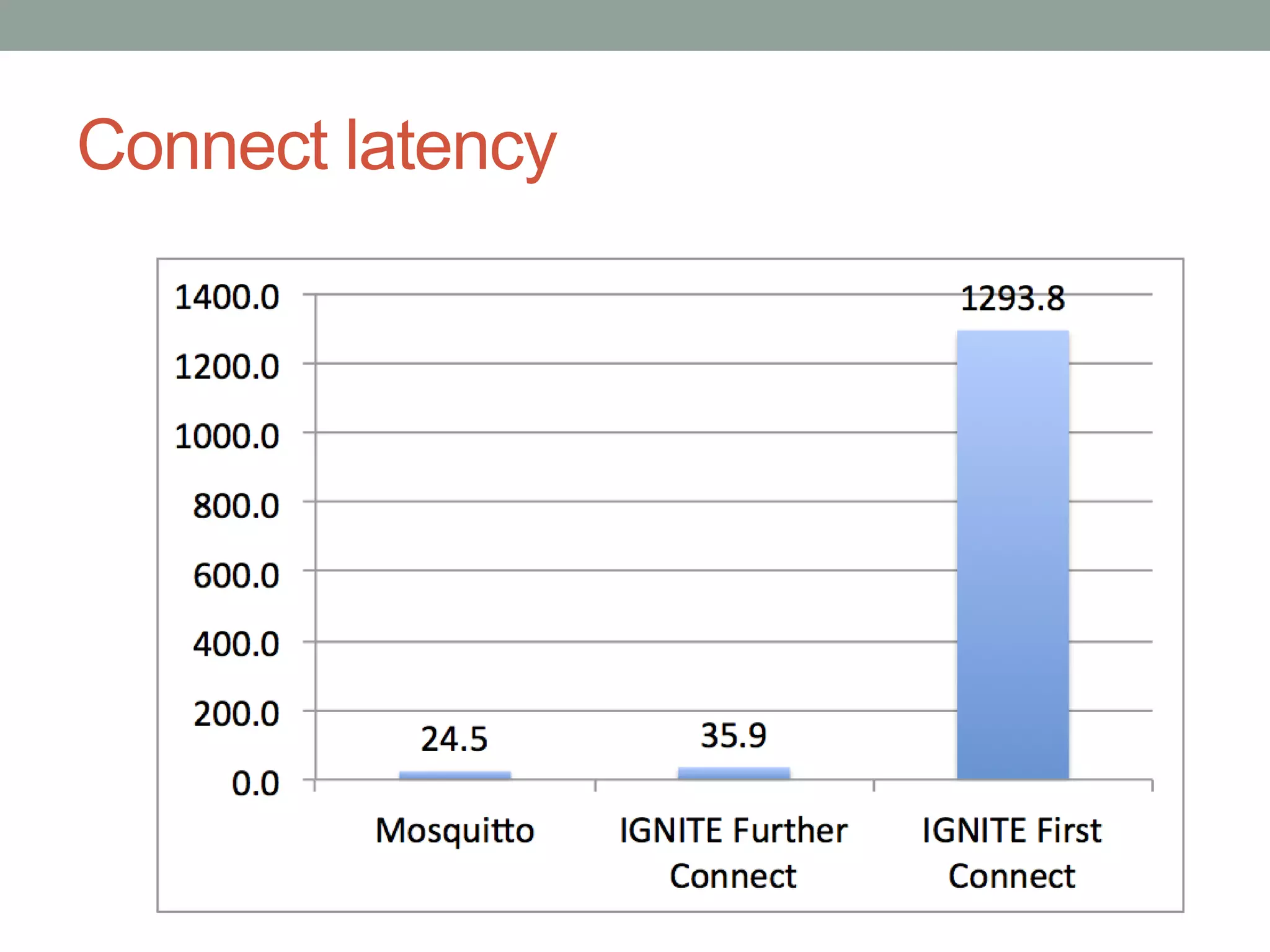
Connect latency
Analysis of results
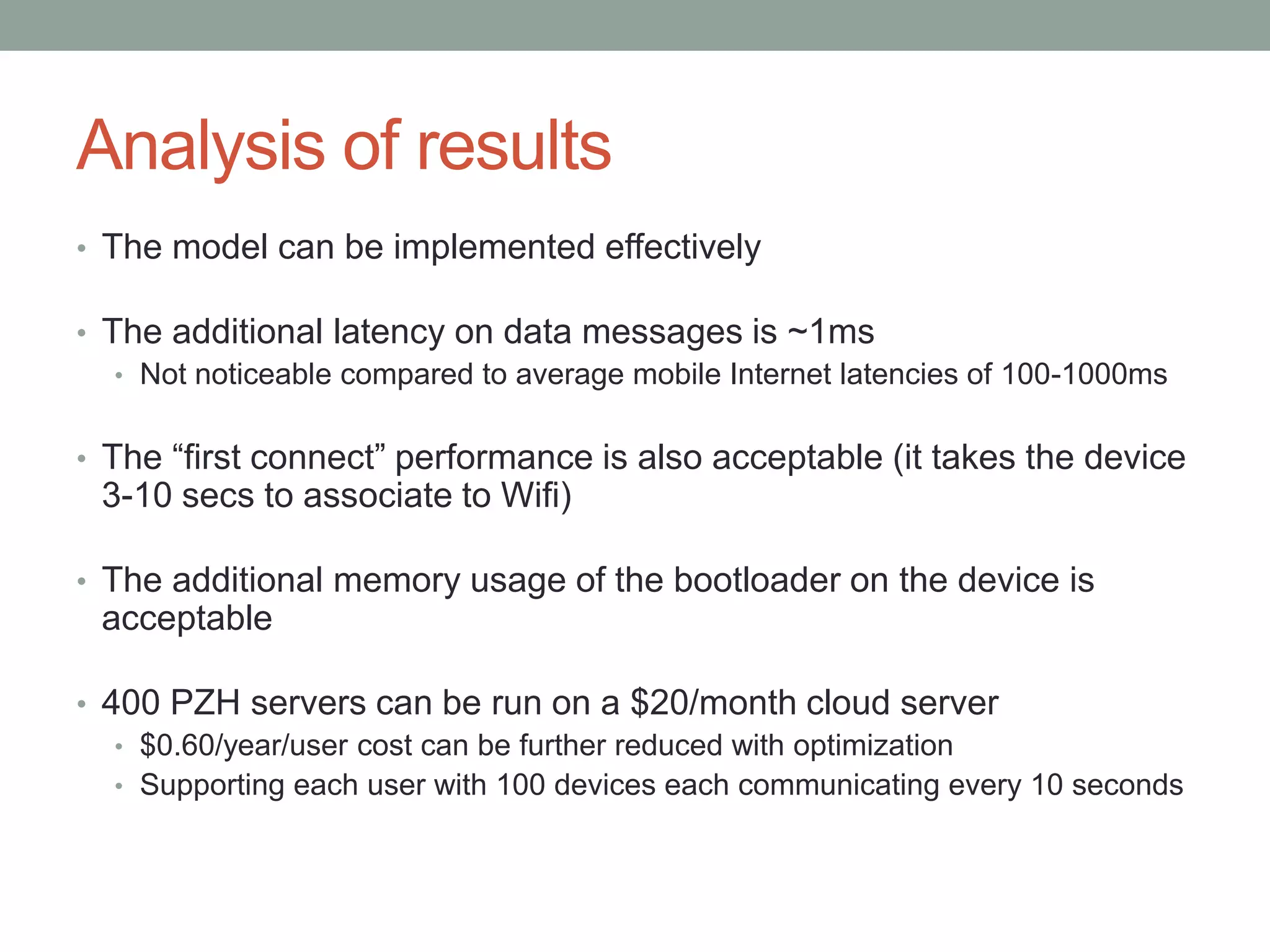
• The model can be implemented effectively
• The additional latency on data messages is ~1ms
• Not noticeable compared to average mobile Internet latencies of 100-1000ms
• The “first connect” performance is also acceptable (it takes the device
3-10 secs to associate to Wifi)
• The additional memory usage of the bootloader on the device is
acceptable
• 400 PZH servers can be run on a $20/month cloud server
• $0.60/year/user cost can be further reduced with optimization
• Supporting each user with 100 devices each communicating every 10 seconds
Potential Use Cases
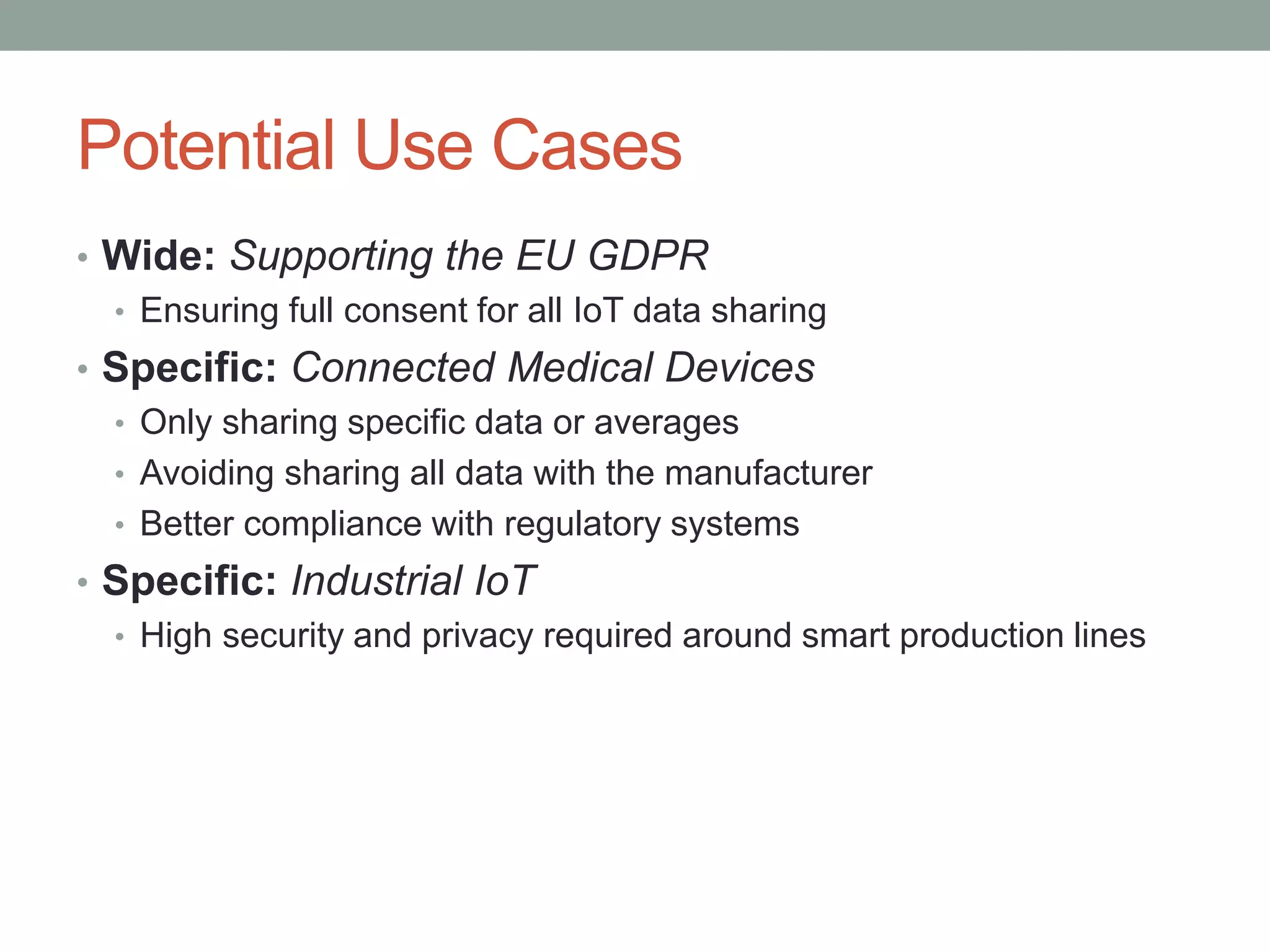
• Wide: Supporting the EU GDPR
• Ensuring full consent for all IoT data sharing
• Specific: Connected Medical Devices
• Only sharing specific data or averages
• Avoiding sharing all data with the manufacturer
• Better compliance with regulatory systems
• Specific: Industrial IoT
• High security and privacy required around smart production lines
Comparison with related work
• OAuth for Devices
• Previous work offers OAuth2 models for devices:
• FIOT [8], IGNITE [9], IOT-OAS [1], COMPOSE[14], OAuth1 for MQTT[13], IBM
Watson, AWS IoT
• None of these provide:
• Anonymous Identities
• Clear automated registration processes or
• Personal Cloud Middleware
• Webinos
• Concept of Personal Zone Hub – personal middleware
• Does not address usability of PZH, how to configure and run in a cloud
• Does not support federated identity to the device
• IoT@Work [16]
• A model for anonymous identities for IoT
• No separation of identity management and data sharing systems
• No federated identity models
[n] References refer to the bibliography in the paper
Further Work
• Formal models
• In one of CSP/Event-B/Tamarin
• Implementation of updated model “OAuthing 2”
• Detailed threat analysis and threat modeling
• Intersection with Blockchains and Distributed Ledgers
• Use of blockchain to validate identity, ownership, manage consent,
provide an audit trail of IoT lifecycles
Questions?

Anonymous Individual Integration for IoT

  • 1.
    OAUTHING: ANONYMOUS INDIVIDUALINTEGRATION FORIOT Paul Fremantle School of Computing University of Portsmouth
  • 2.
    Agenda • Motivation andbackground • Previous iterations • Model and architecture • Prototype and results • Comparison with related work and conclusions
  • 3.
  • 4.
  • 5.
    2016 Mirai 620Gbps botnet attackbased on IoT devices 5 minutes from On to Pwned
  • 7.
    Problem statement • Todaymany IoT devices are inherently tied to the manufacturer • I want to share data under my own control with trust • Threats include: • Lack of individual credentials • Hacking of data and passwords • Trust in the company to behave well • Data sharing and privacy • Going out of business
  • 8.
    Privacy By Design •7 key principles • Proactive not Reactive; Preventative not Remedial • Privacy as the Default Setting • Privacy Embedded into Design • Full Functionality – Positive-Sum, not Zero-Sum • End-to-End Security – Full Lifecycle Protection • Visibility and Transparency – Keep it Open • Respect for User Privacy – Keep it User-Centric Cavoukian, Ann, Scott Taylor, and Martin E. Abrams. "Privacy by Design: essential for organizational accountability and strong business practices."Identity in the Information Society 3.2 (2010): 405-413.
  • 9.
    Three layer privacymodel User Sphere Recipient Sphere Joint Sphere Spiekermann, Sarah, and Lorrie Faith Cranor. "Engineering privacy.” IEEE Transactions on software engineering 35.1 (2009): 67-82.
  • 10.
    Overall approach andtimeline • First iteration: FIOT • Tokens on devices, user consent to data sharing • Fremantle, Paul, et al. "Federated identity and access management for the internet of things." Secure Internet of Things (SIoT), 2014 International Workshop on. IEEE, 2014. • Second iteration - IGNITE • Unique identifiers per device, Initial performance data • Fremantle, Paul, Jacek Kopecký, and Benjamin Aziz. "Web API management meets the internet of things." European Semantic Web Conference. Springer International Publishing, 2015. • Third iteration: OAUTHING • Device and User Registration processes • Anonymous identities • Cloud based “personal middleware” • Improved testing and performance data • CIOT
  • 11.
    Contributions of thiswork • OAuthing: a new model for federated identity, access control and data sharing in IoT • A clear manufacturing and user registration process for OAuth2 credentials with IoT devices • An approach for using anonymous identities in IoT while allowing users to share data effectively • Personal Cloud Middleware to ensure trust in the server model • A working prototype of the OAuthing model • Experimental results demonstrating scaling in a cloud environment
  • 12.
  • 13.
    Scoping • In Scope •Directly Internet-connected devices • Sample device is based on ESP8266 with wifi • IoT Hub (e.g. Smart Home gateway, Connected Car) • Treat individual sensors as attached to the hub • Treat the hub as a Device • Out of scope in the current model • Implicit Data Transfer • Privacy infringement through scanning • e.g. MAC scanning attacks, ambient devices • Devices with multiple owners • This may be extended in future research • Devices that are not directly connected to the Internet • This may be extended in future research
  • 14.
  • 15.
  • 16.
    Device Identity Provider(DIdP) • Provides secure anonymous identities to devices and issues tokens that authorize devices or services • Allows users to register their devices • Allows users to consent to share data or commands • Offers the Identity Broker pattern
  • 17.
    Personal Cloud Middleware(PCM) • Each user has a server running on their behalf • Originally proposed in Webinos • Personal Zone Hub (PZH) and Personal Zone Proxy (PZP) • Webinos does not deal with running these in a cloud, locating them, etc • A cloud shadow of the user’s devices • Does not persistently store data • Performs summarization and filtering* • Only distributes data according to user consent • Enhances Trust in the Cloud * Not yet implemented!
  • 18.
    Intelligent Gateway (IG) •Validates tokens against the DIdP • Routes requests based on anonymous identities • Applies dynamic authorization policies • As consented by users • Instantiates PCMs in Docker
  • 19.
  • 20.
    Device Lifecycle and Bootloader •The device bootloader implements a well-defined lifecycle • Secure device identity is embedded at manufacture time • User registration process based on QR codes
  • 21.
    Information sharing matrix User Profil e MAC HWID Device ID Device Secret Pseud o-nym Bearer Token Device Data UIdP ✔ DIdP ✔ ✔ ✔ ✔ ✔ Manu- facturer ✔ ✔ Device ✔ ✔ ✔ ✔ ✔ IG ✔ ✔ ✔ Data Recipie nt ✔
  • 22.
    Analysis of thesharing matrix • In order to steal data an attacker needs to attack both the DIdP and IG/PCM • The DIdP doesn’t see any device data • The IG/PCM do not see any real identities • Third-party services don’t inherently know any identities • Users may leak it in other ways • The manufacturer and other services only see data that has consent to share • All third-party services / data recipients are equal
  • 23.
    Addressing the securityand privacy problems of IoT • Default passwords • Each device is configured at manufacturing with a secure id • User control • Clear user registration and ownership model • User’s choice of provider • Personal middleware • Fingerprinting and identification • Anonymous Identities • Device/User shadow protects metadata • Summarising and filtering • Consent • No data is shared without consent
  • 24.
  • 25.
    Implementation • OAuthing (DIdP) •OAuth2 support, onbound support for popular UIdPs (Google, FB, Twitter), embedded MQTT broker • IGNITE (IG) • Performant MQTT gateway, with pluggable intermediation, launching of PCMs in Docker, OAuth2 scope validation • RSMB Docker (PCM) • Lightweight containers running in Docker • Device Bootloader and Sample Device • Based on ESP8266 low-cost device chip, implements MQTT/TLS, Device and User registration flows • Third-Party App (TPA) • Simple application to demonstrate consent-based data sharing using MQTT / WebSockets / TLS https://github.com/pzfreo/oauthing https://github.com/pzfreo/ignite
  • 26.
    Digital Ocean LON1region Device IdP: OAuthing DIdP Database: Cassandra oauthing.io 2Gb Droplet Cloud Service Provider: IGNITE Docker Controller: dproxy ignite-iot.net 2Gb Droplet Personal RSMB Brokers Personal RSMB Brokers Personal RSMB Brokers Personal RSMB Brokers Personal RSMB Brokers Personal RSMB Brokers Personal Zone Hub: RSMB MQTT collector Test Manager 4Gb Droplet Stats analyser Test Load Driver 4Gb Droplet 50 virtual clients Up to 10 TLDs per test Key Datacenter Droplet/cloud instance Docker Container Test Environment and Harness
  • 27.
  • 28.
  • 29.
    Individual anonymous integration •On a 2Gb Digital Ocean droplet • 400 MQTT brokers • Handling 10 messages / second each • Based on pseudonyms • With OAuth2 based consent
  • 30.
    Memory and codeusage on ESP8266
  • 31.
  • 32.
  • 33.
  • 34.
  • 35.
    Analysis of results •The model can be implemented effectively • The additional latency on data messages is ~1ms • Not noticeable compared to average mobile Internet latencies of 100-1000ms • The “first connect” performance is also acceptable (it takes the device 3-10 secs to associate to Wifi) • The additional memory usage of the bootloader on the device is acceptable • 400 PZH servers can be run on a $20/month cloud server • $0.60/year/user cost can be further reduced with optimization • Supporting each user with 100 devices each communicating every 10 seconds
  • 36.
    Potential Use Cases •Wide: Supporting the EU GDPR • Ensuring full consent for all IoT data sharing • Specific: Connected Medical Devices • Only sharing specific data or averages • Avoiding sharing all data with the manufacturer • Better compliance with regulatory systems • Specific: Industrial IoT • High security and privacy required around smart production lines
  • 37.
    Comparison with relatedwork • OAuth for Devices • Previous work offers OAuth2 models for devices: • FIOT [8], IGNITE [9], IOT-OAS [1], COMPOSE[14], OAuth1 for MQTT[13], IBM Watson, AWS IoT • None of these provide: • Anonymous Identities • Clear automated registration processes or • Personal Cloud Middleware • Webinos • Concept of Personal Zone Hub – personal middleware • Does not address usability of PZH, how to configure and run in a cloud • Does not support federated identity to the device • IoT@Work [16] • A model for anonymous identities for IoT • No separation of identity management and data sharing systems • No federated identity models [n] References refer to the bibliography in the paper
  • 38.
    Further Work • Formalmodels • In one of CSP/Event-B/Tamarin • Implementation of updated model “OAuthing 2” • Detailed threat analysis and threat modeling • Intersection with Blockchains and Distributed Ledgers • Use of blockchain to validate identity, ownership, manage consent, provide an audit trail of IoT lifecycles
  • 39.

Editor's Notes

  • #21 @startuml start :**Manufacture** (the device is created); :**Client Registration** (the device is registered with OAuThing as a OAuth2 client); :**Purchase** (the device is physically in the hands of a user); repeat :**User Registration** (the user takes ownership of the device and allocates it permissions); :**Use** (the device is now publishing data and acting on user commands); repeat while (reset ownership) @enduml