IoT Mobile App/Device/Field
Gateway and Cloud Identity &
Security architecture
Prepared By Vinod Wilson
Architect, Crestron Electronics
Agenda
• Communication Strategy
• Current Architecture
• Problems in current architecture
• Multiple IDPs
• Usability
• Synchronization
• Identity / Authentication / Authorization ( IAM & IRM )
• Cloud Capabilities
• Proposed Solution
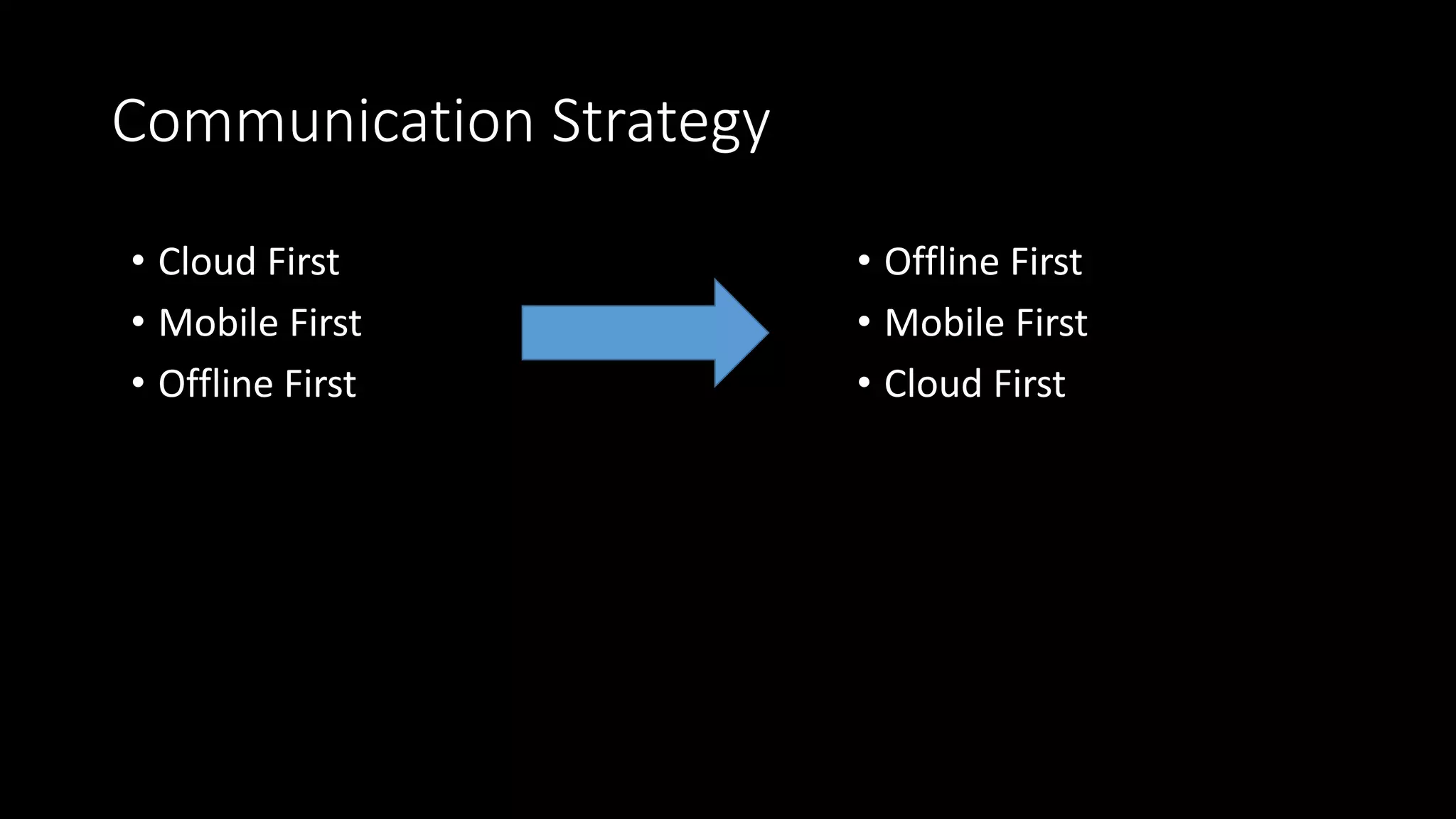
Communication Strategy
• Cloud First
• Mobile First
• Offline First
• Offline First
• Mobile First
• Cloud First
Problems in Security architecture
• Strategy changed from Offline-First to Cloud First
• User Experience
• User has to wait for 10 minutes to really connect to any device
• Multiple IDPs
• Identity
• Identity and Access Management (IAM)
• Roles & Group policy
• Roles & Group policy per device
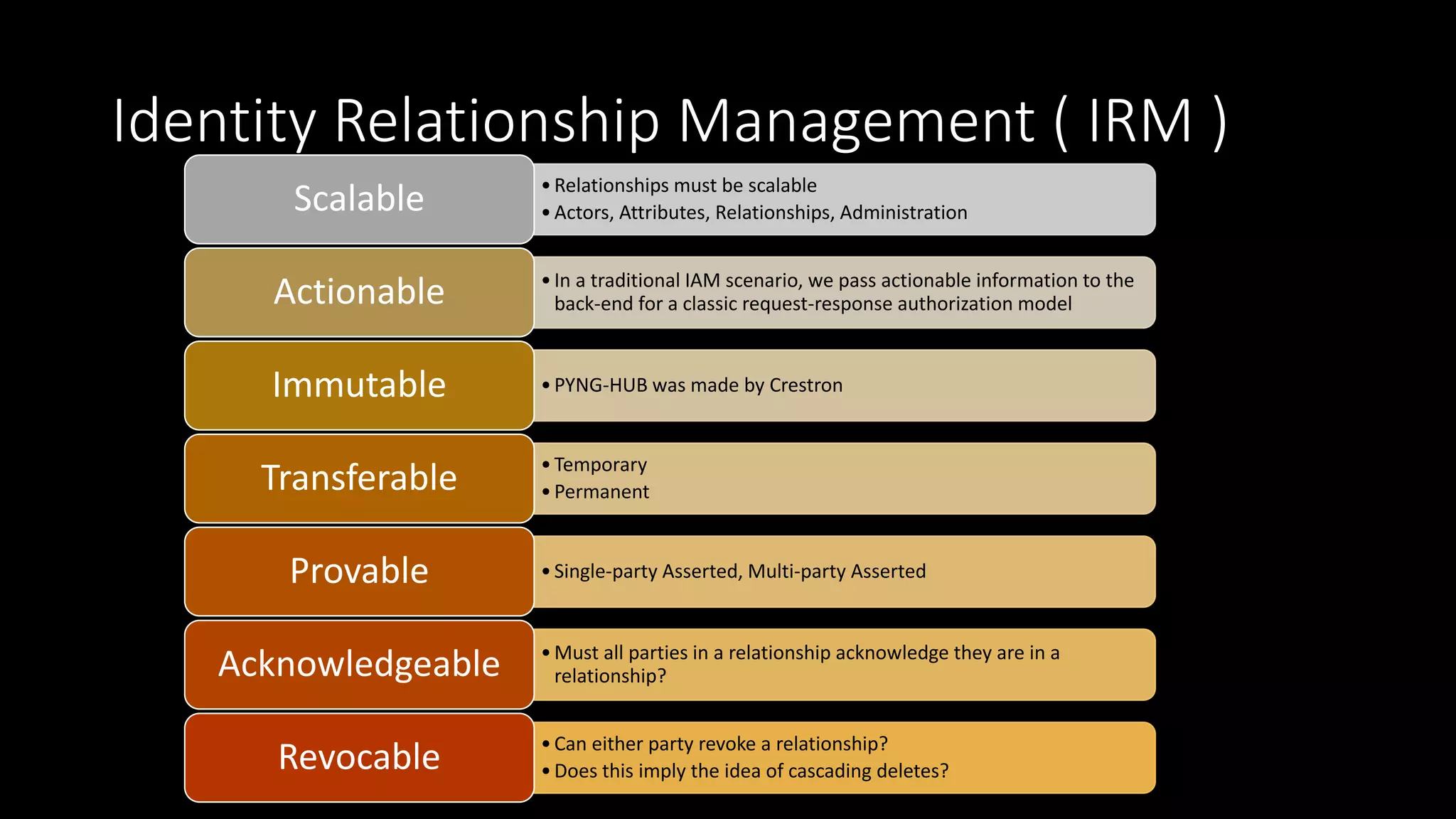
• Identity Relationship Management (IRM)
Identity
• Identity = set of attributes related to an entity [iso 29115]
Entity Identity
6’ 5” Tall
Grey Hair Man
Work
Husband
Father
Women
Mother
Daughter
Wife
Girl FriendFriend
Boss
Collegue
Identity is Context Driven
For each context, the attribute differs
Identity1
Identity2
Identity3
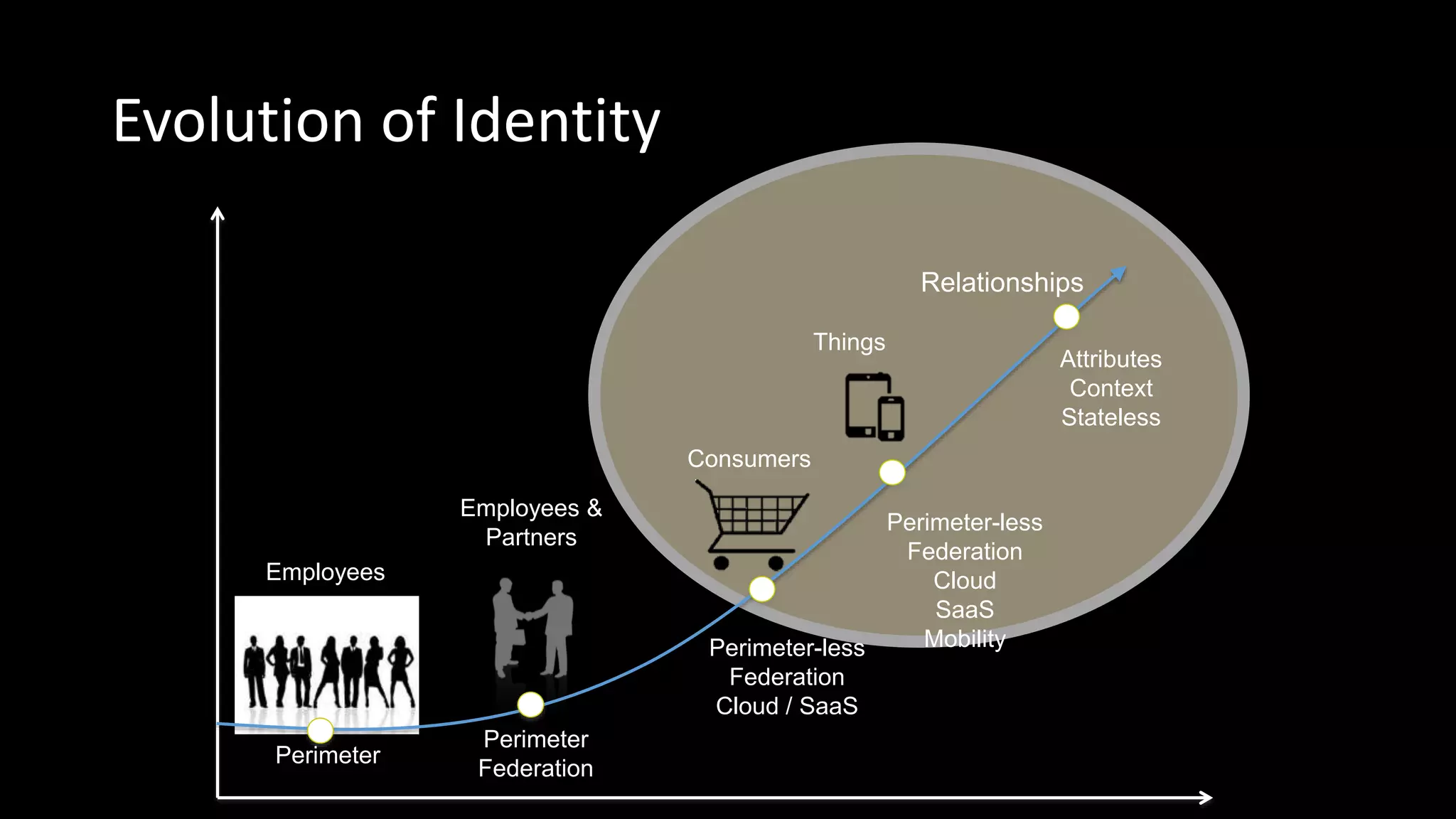
Evolution of Identity
Employees
Consumers
Employees &
Partners
Things
Perimeter
Perimeter
Federation
Perimeter-less
Federation
Cloud / SaaS
Perimeter-less
Federation
Cloud
SaaS
Mobility
Attributes
Context
Stateless
Relationships
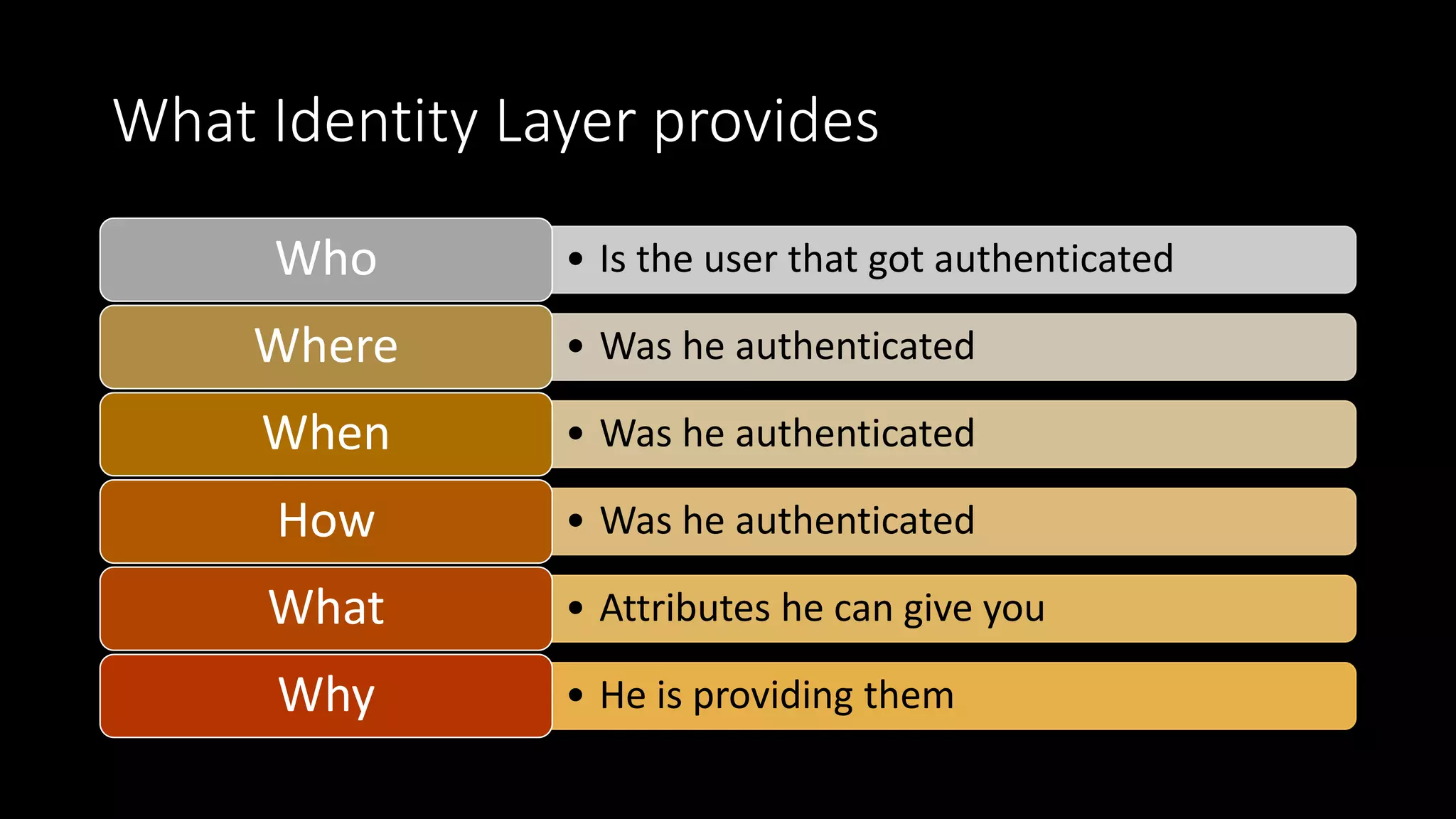
What Identity Layer provides
• Is the user that got authenticatedWho
• Was he authenticatedWhere
• Was he authenticatedWhen
• Was he authenticatedHow
• Attributes he can give youWhat
• He is providing themWhy
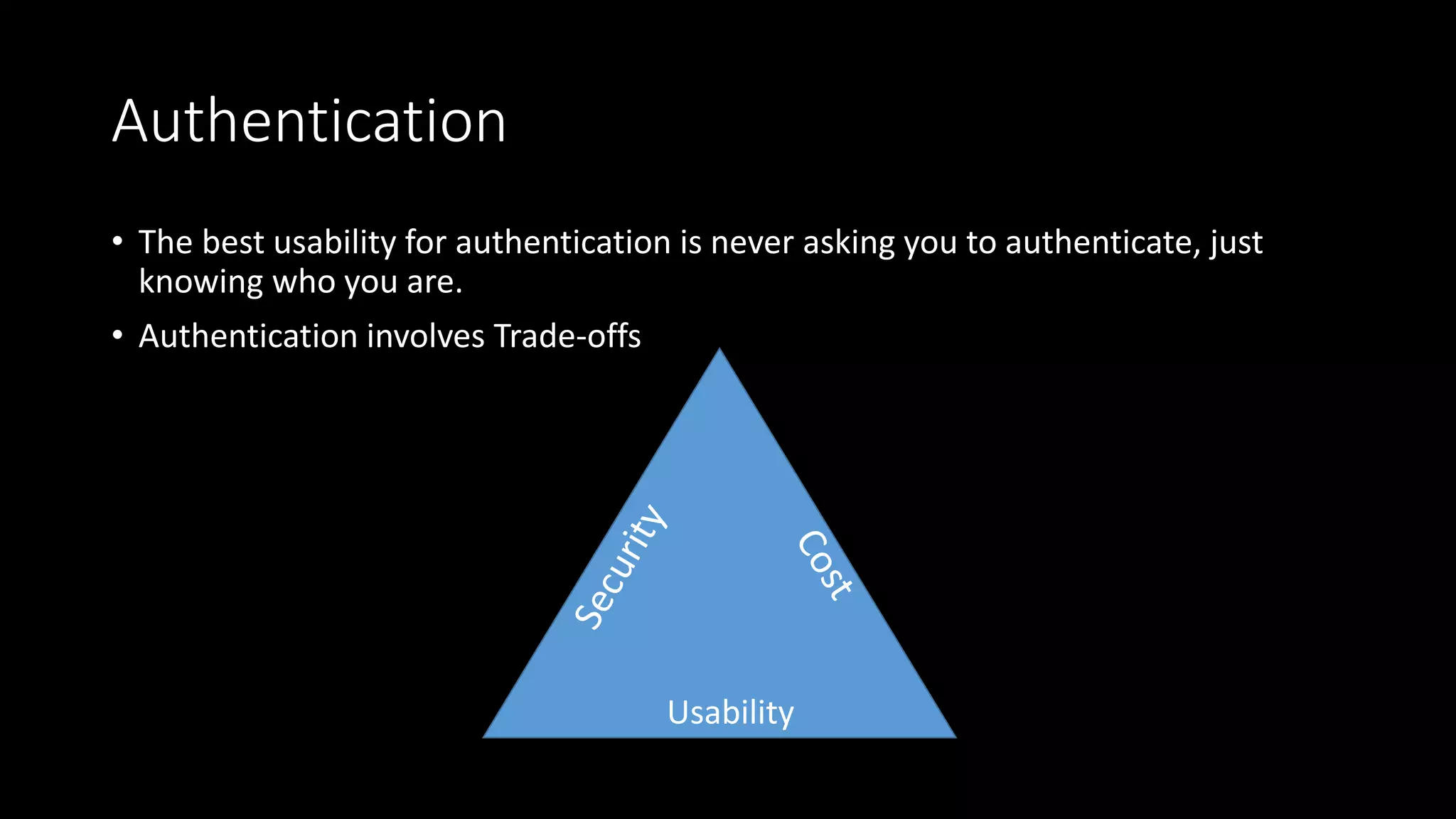
Authentication
• The best usability for authentication is never asking you to authenticate, just
knowing who you are.
• Authentication involves Trade-offs
Usability
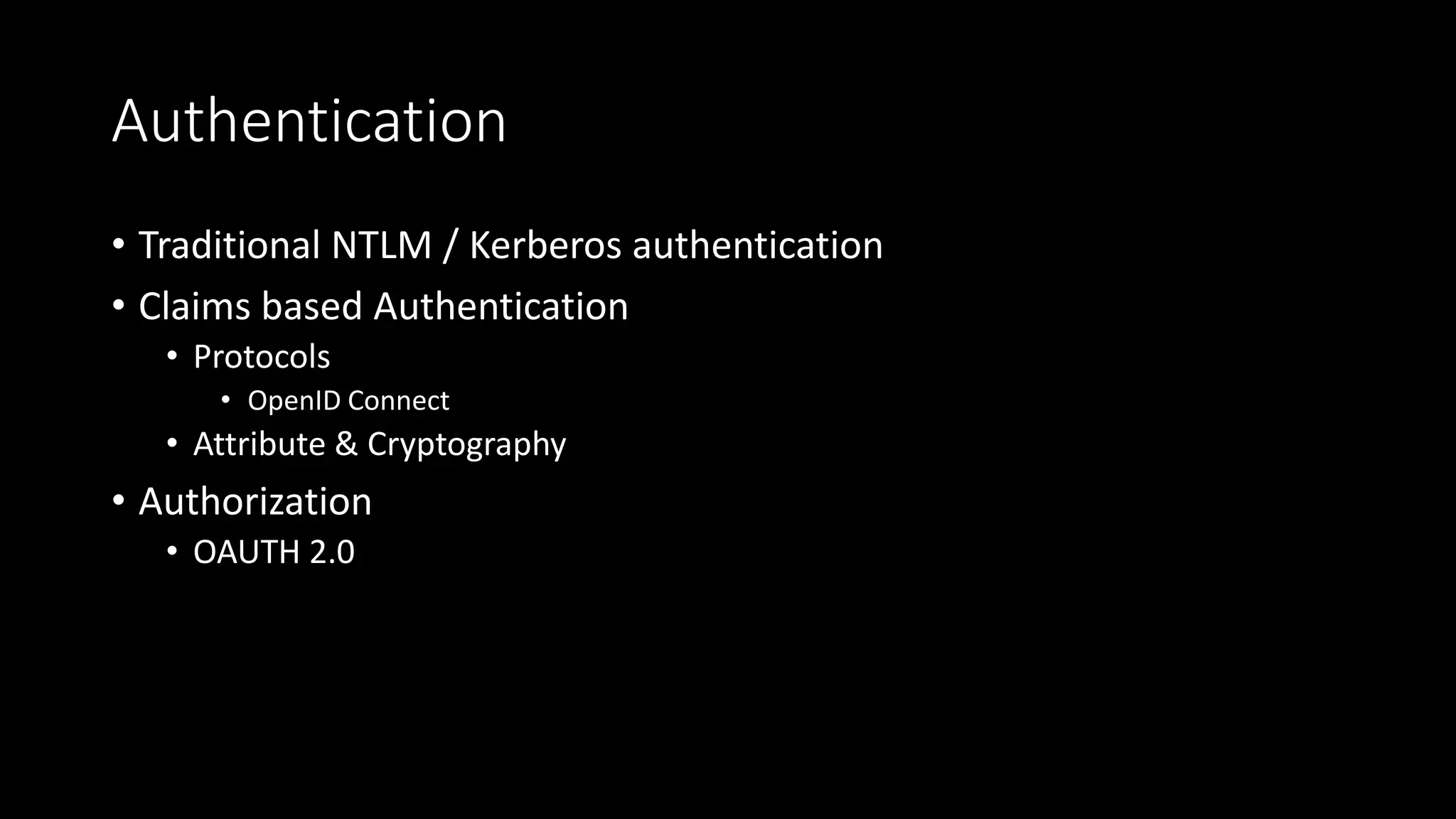
Authentication
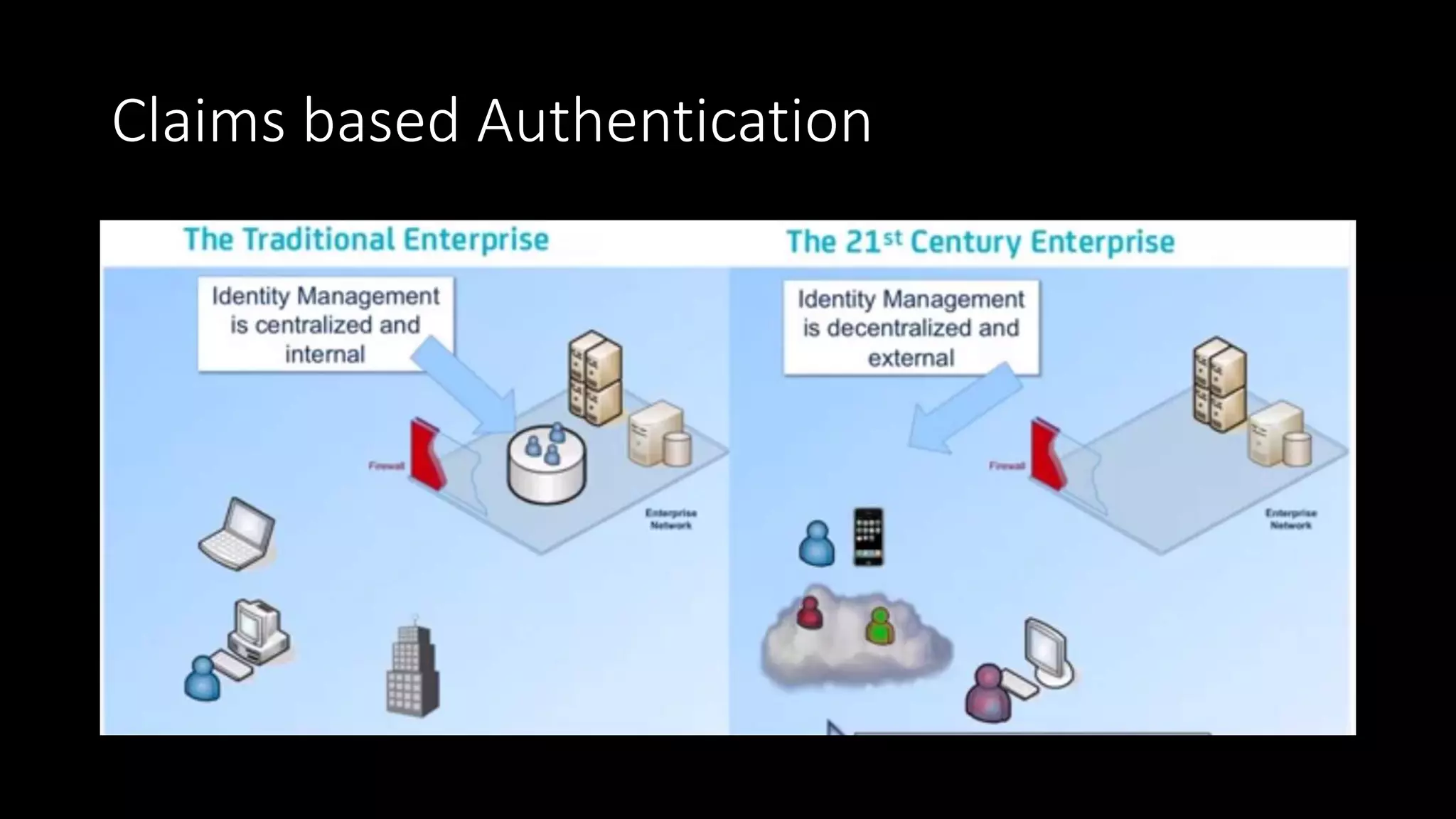
• Traditional NTLM / Kerberos authentication
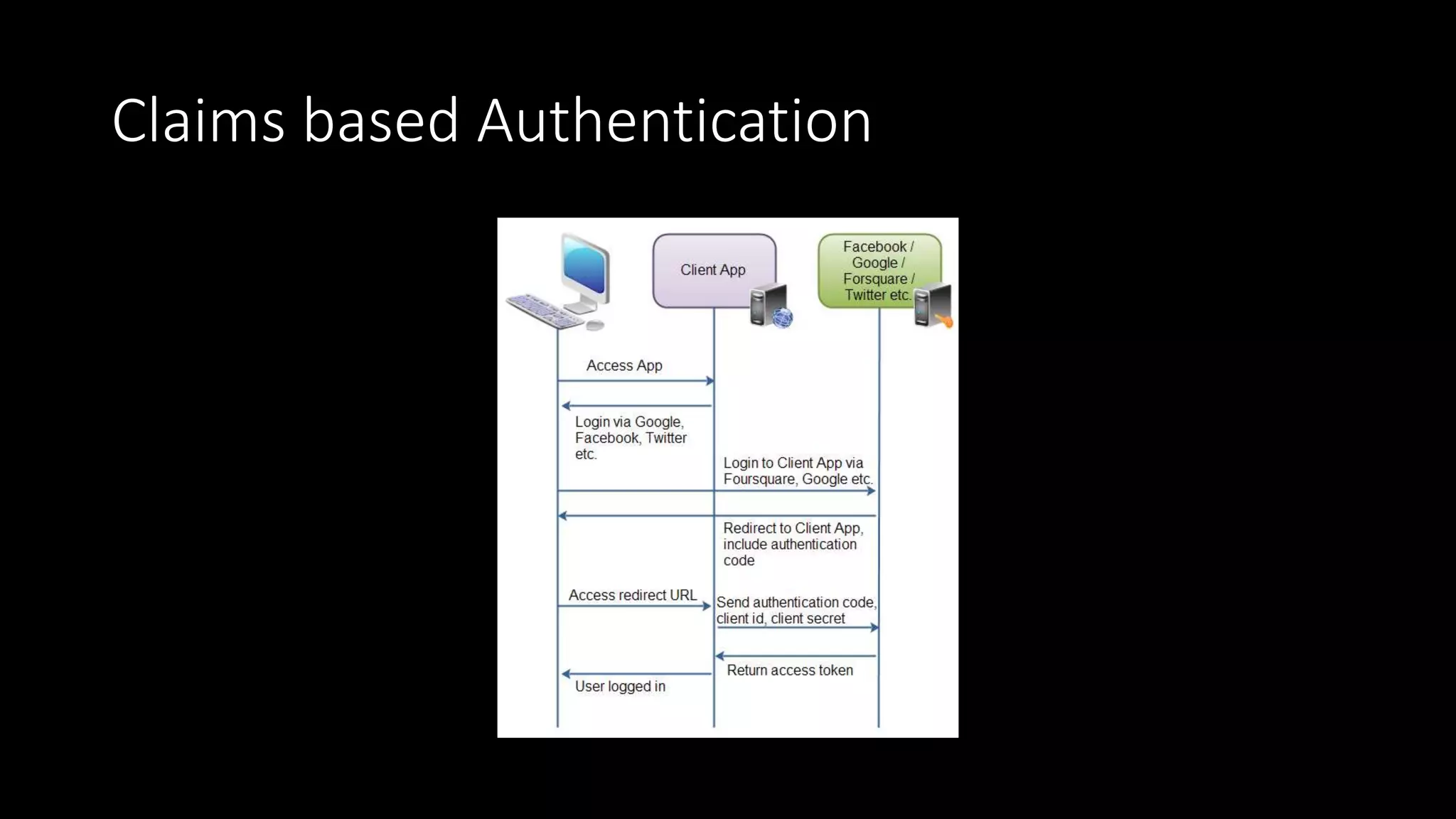
• Claims based Authentication
• Protocols
• OpenID Connect
• Attribute & Cryptography
• Authorization
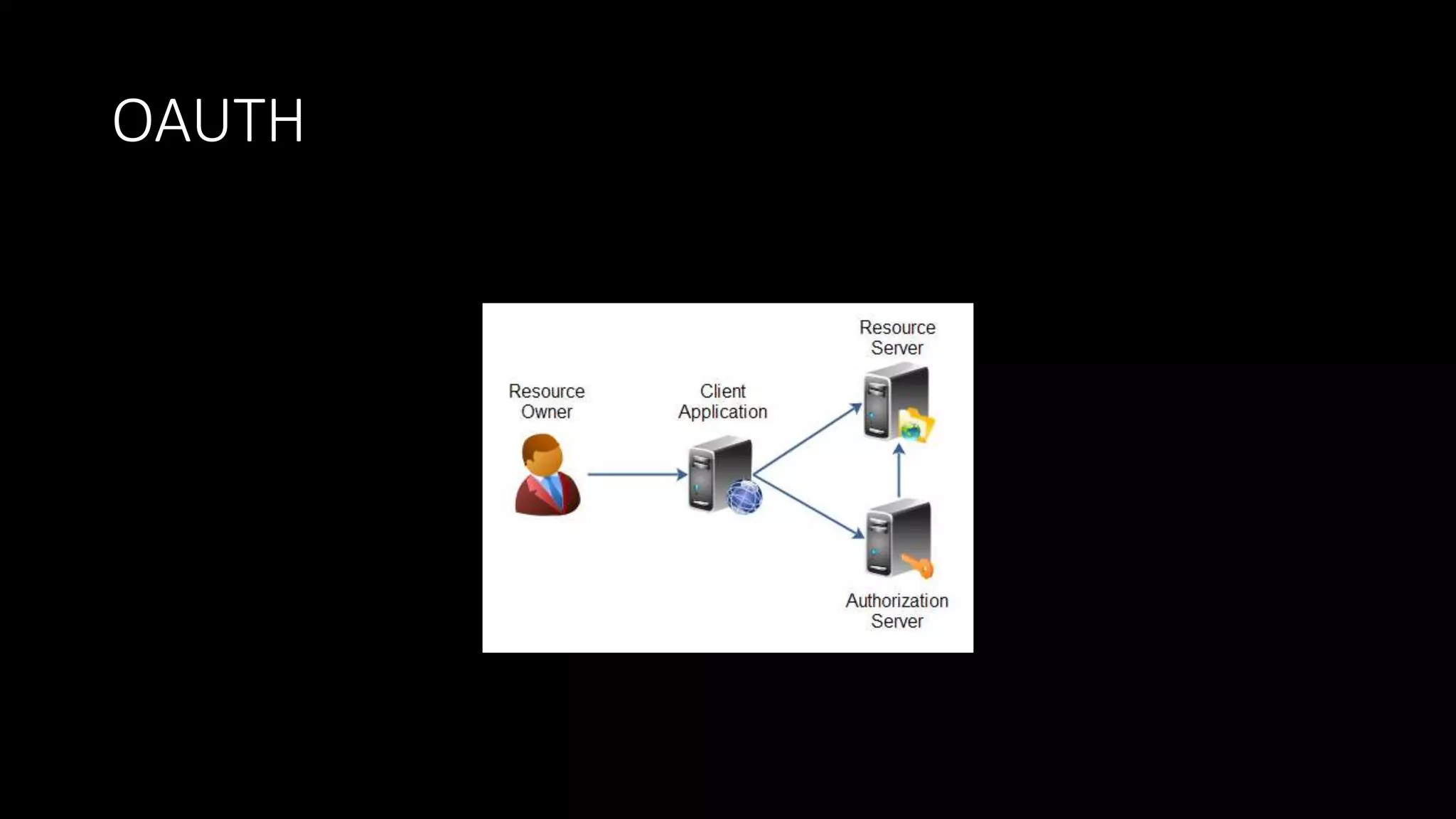
• OAUTH 2.0
Claims based Authentication
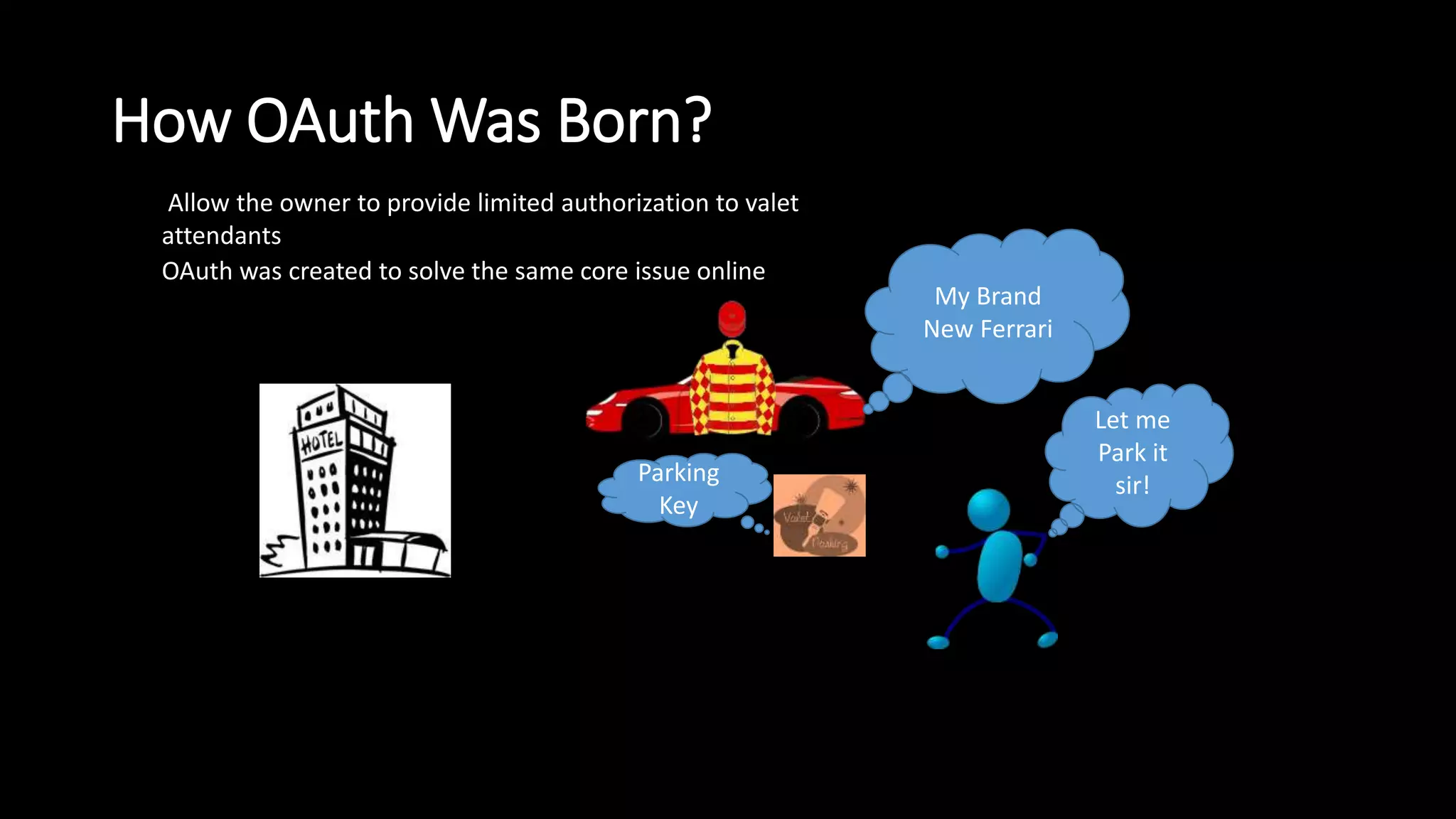
How OAuth Was Born?
My Brand
New Ferrari
Let me
Park it
sir!Parking
Key
Allow the owner to provide limited authorization to valet
attendants
OAuth was created to solve the same core issue online
Claims based Authentication
OAUTH
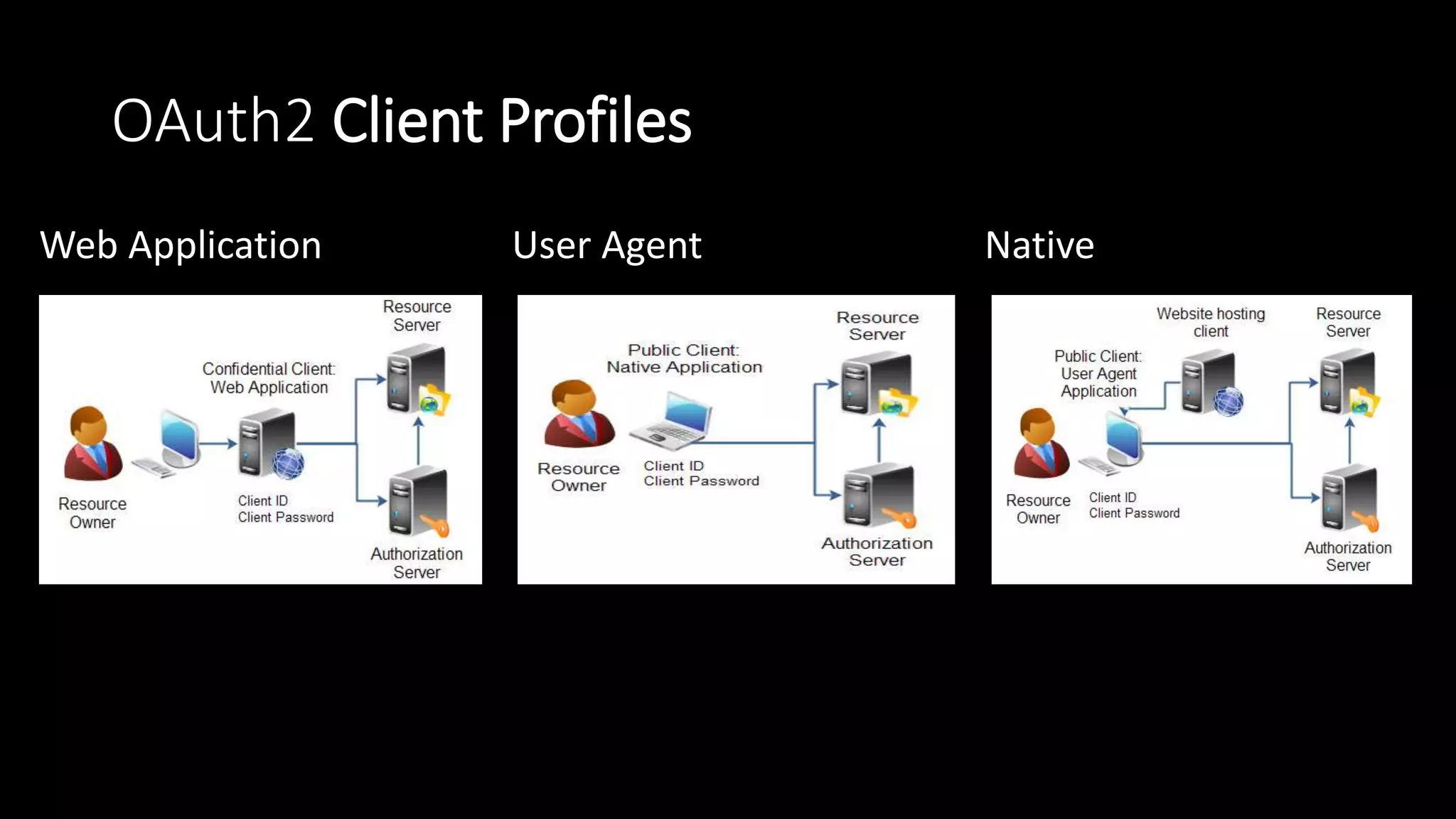
OAuth2 Client Profiles
• Web Application
• User Agent
• Native
OAuth2 Client Profiles
Web Application User Agent Native
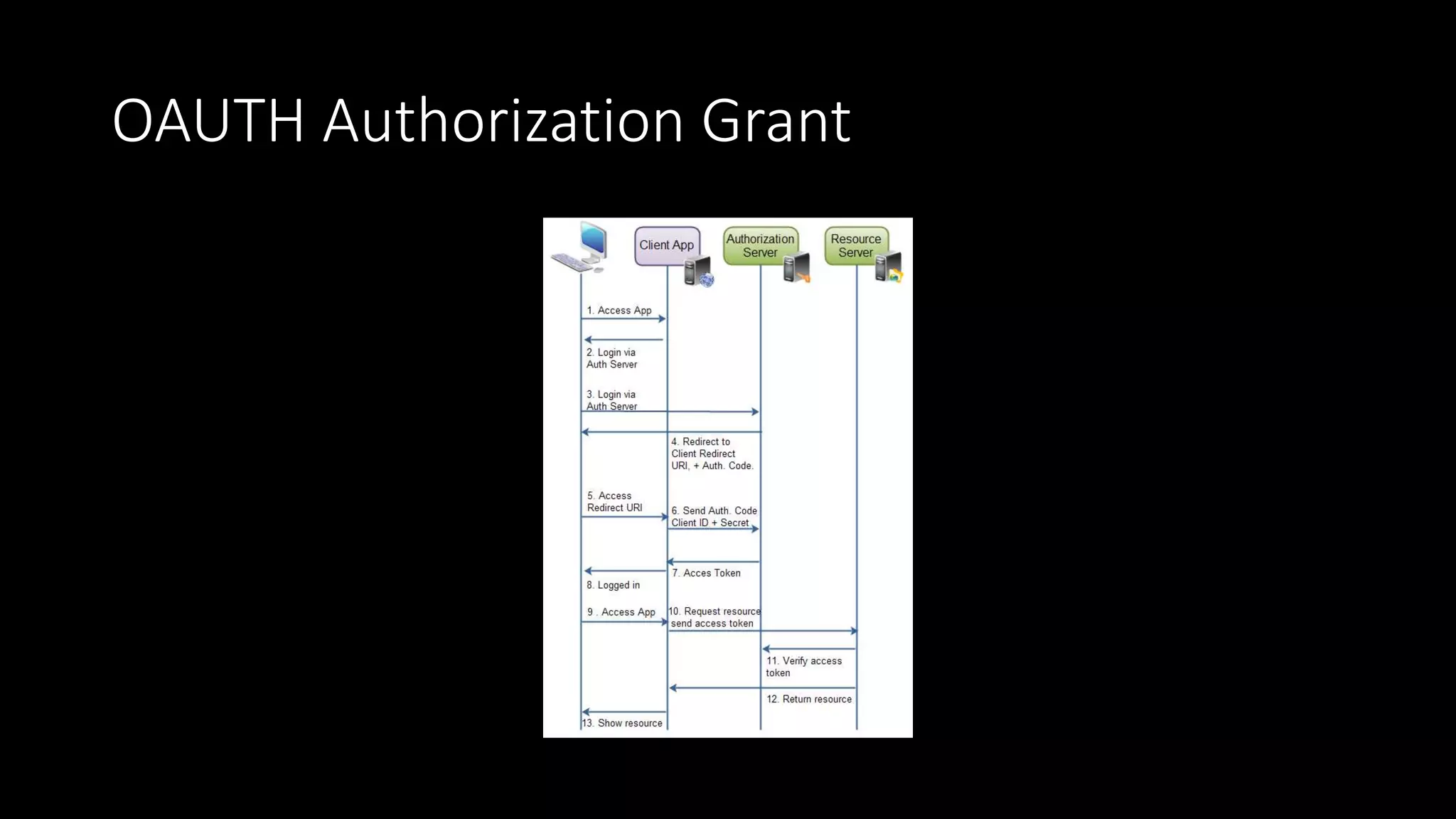
OAUTH Authorization Grant
Mechanics of Token Validation
• Verify that it is well-formed
• Token must be digitally signed
• Verify that it is coming from the intended authority
• Signature verification
• Issuer value
• Verify that it is meant for the current application
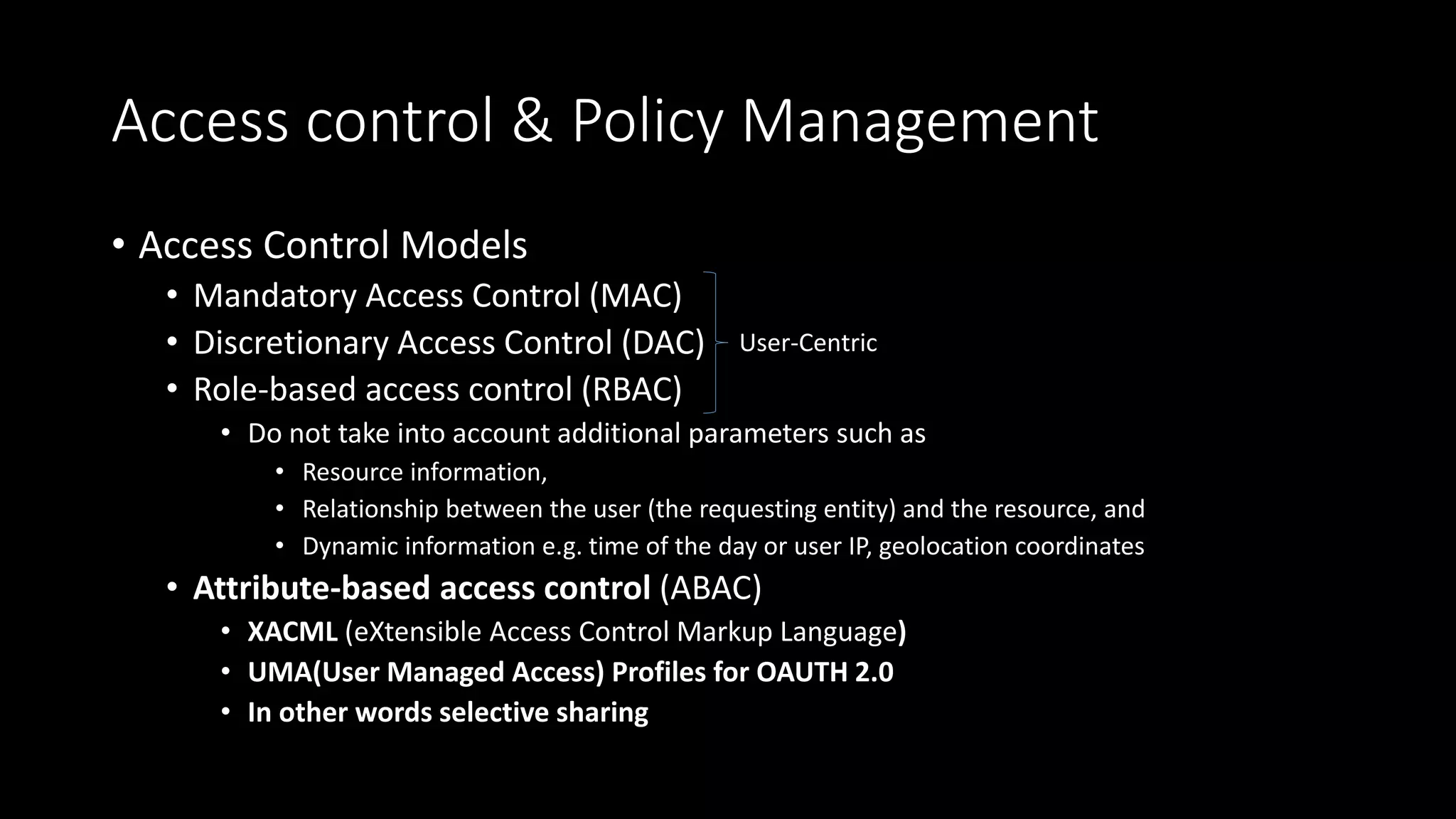
Access control & Policy Management
• Access Control Models
• Mandatory Access Control (MAC)
• Discretionary Access Control (DAC)
• Role-based access control (RBAC)
• Do not take into account additional parameters such as
• Resource information,
• Relationship between the user (the requesting entity) and the resource, and
• Dynamic information e.g. time of the day or user IP, geolocation coordinates
• Attribute-based access control (ABAC)
• XACML (eXtensible Access Control Markup Language)
• UMA(User Managed Access) Profiles for OAUTH 2.0
• In other words selective sharing
User-Centric
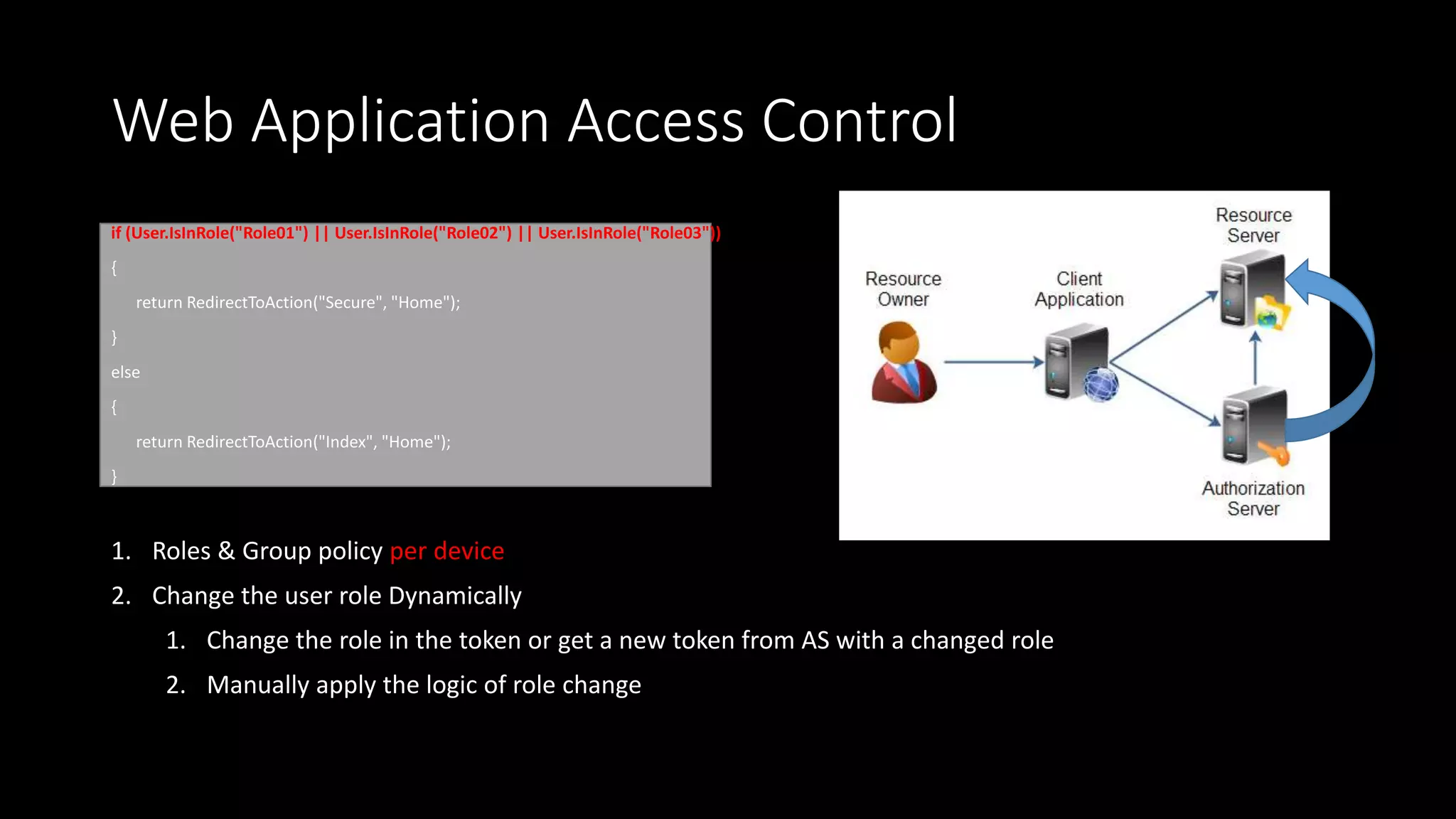
Web Application Access Control
if (User.IsInRole("Role01") || User.IsInRole("Role02") || User.IsInRole("Role03"))
{
return RedirectToAction("Secure", "Home");
}
else
{
return RedirectToAction("Index", "Home");
}
1. Roles & Group policy per device
2. Change the user role Dynamically
1. Change the role in the token or get a new token from AS with a changed role
2. Manually apply the logic of role change
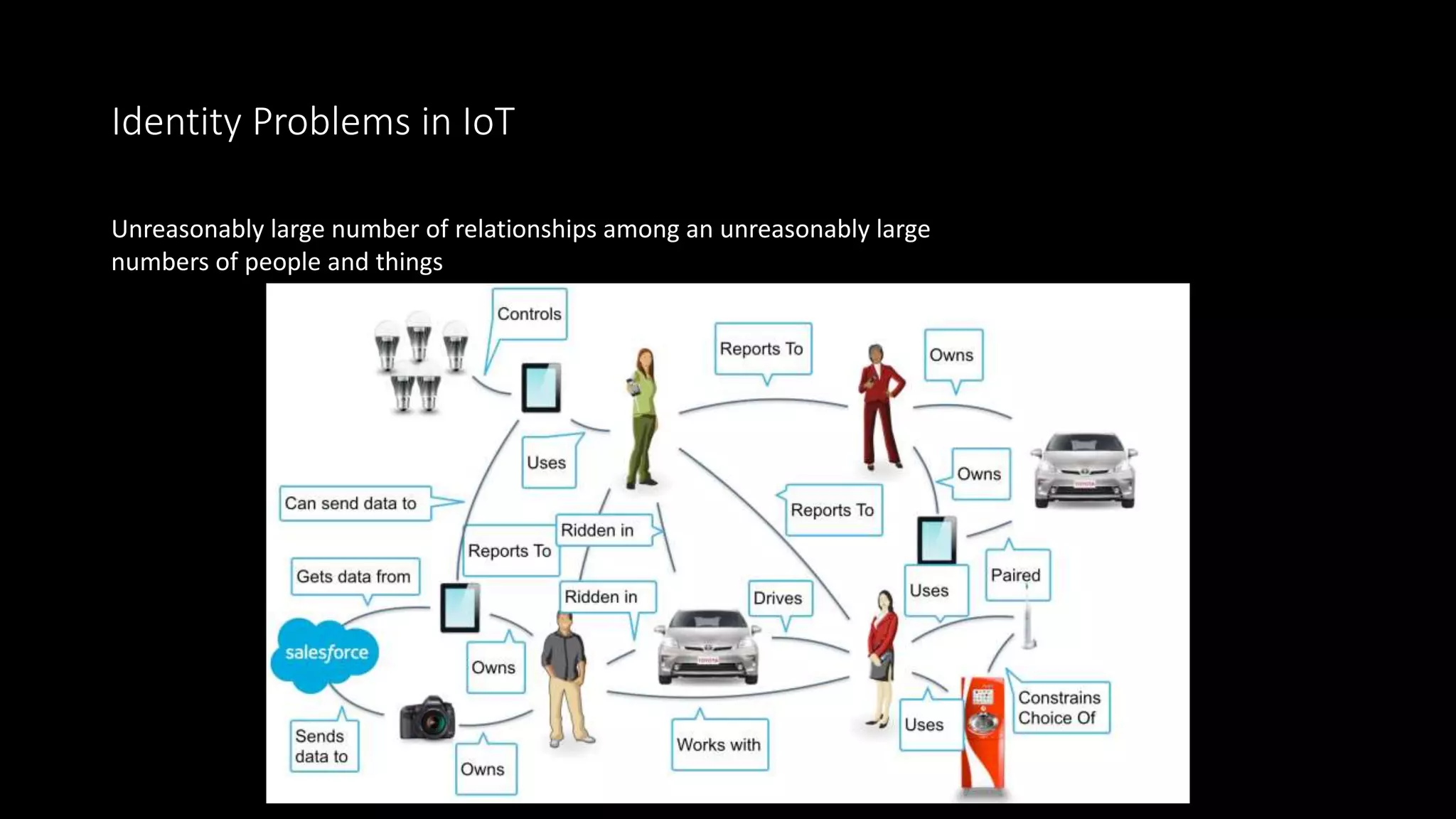
Identity Problems in IoT
Unreasonably large number of relationships among an unreasonably large
numbers of people and things
Identity Relationship Management ( IRM )
• Person-to-Person
• Thing-to-Thing
• Person-to-Thing
Identity Relationship Management ( IRM )
•Relationships must be scalable
•Actors, Attributes, Relationships, AdministrationScalable
•In a traditional IAM scenario, we pass actionable information to the
back-end for a classic request-response authorization modelActionable
•PYNG-HUB was made by CrestronImmutable
•Temporary
•PermanentTransferable
•Single-party Asserted, Multi-party AssertedProvable
•Must all parties in a relationship acknowledge they are in a
relationship?Acknowledgeable
•Can either party revoke a relationship?
•Does this imply the idea of cascading deletes?Revocable
Identity Relationship Management (IRM)
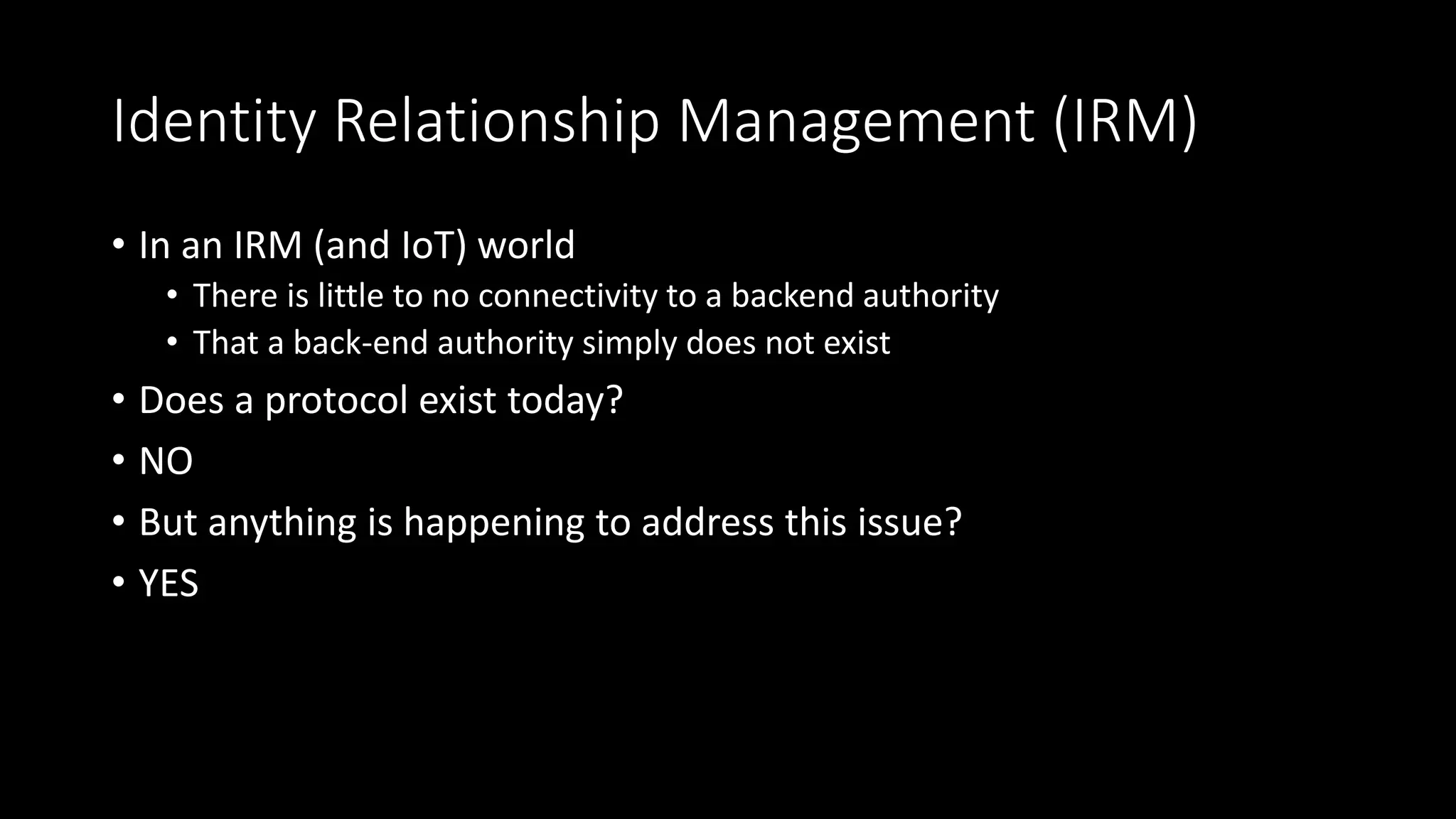
• In an IRM (and IoT) world
• There is little to no connectivity to a backend authority
• That a back-end authority simply does not exist
• Does a protocol exist today?
• NO
• But anything is happening to address this issue?
• YES
So Far - Recap
• Identity
• Authentication
• Access & Policy Management
• Identity relationship management ( IRM)
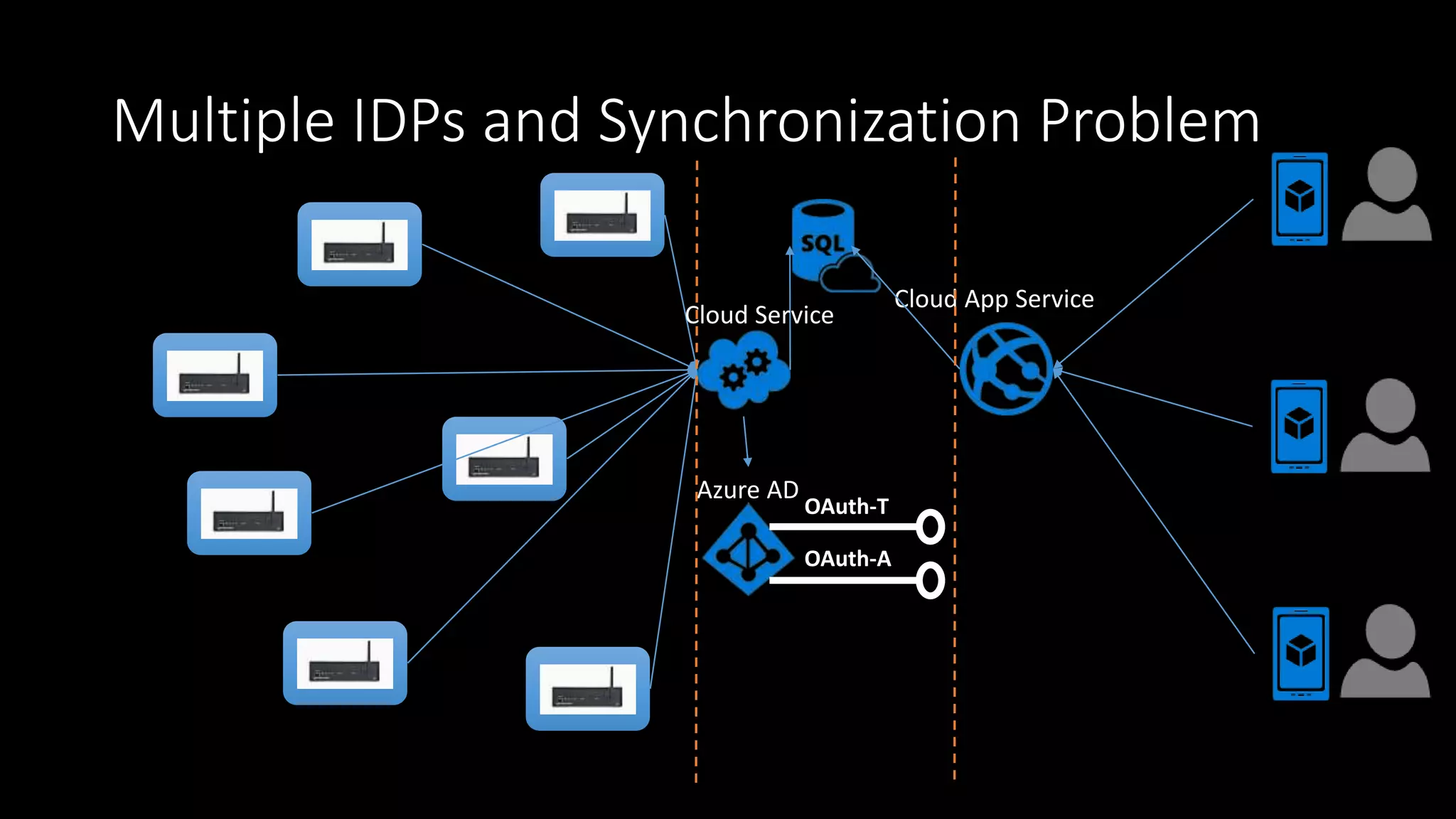
Multiple IDPs and Synchronization Problem
Azure AD
Cloud Service
Cloud App Service
Authentication
• Traditional NTLM / Kerberos authentication
• Claims based Authentication
• Protocols
• OpenID Connect
• Attribute & Cryptography
• Authorization
• OAUTH 2.0
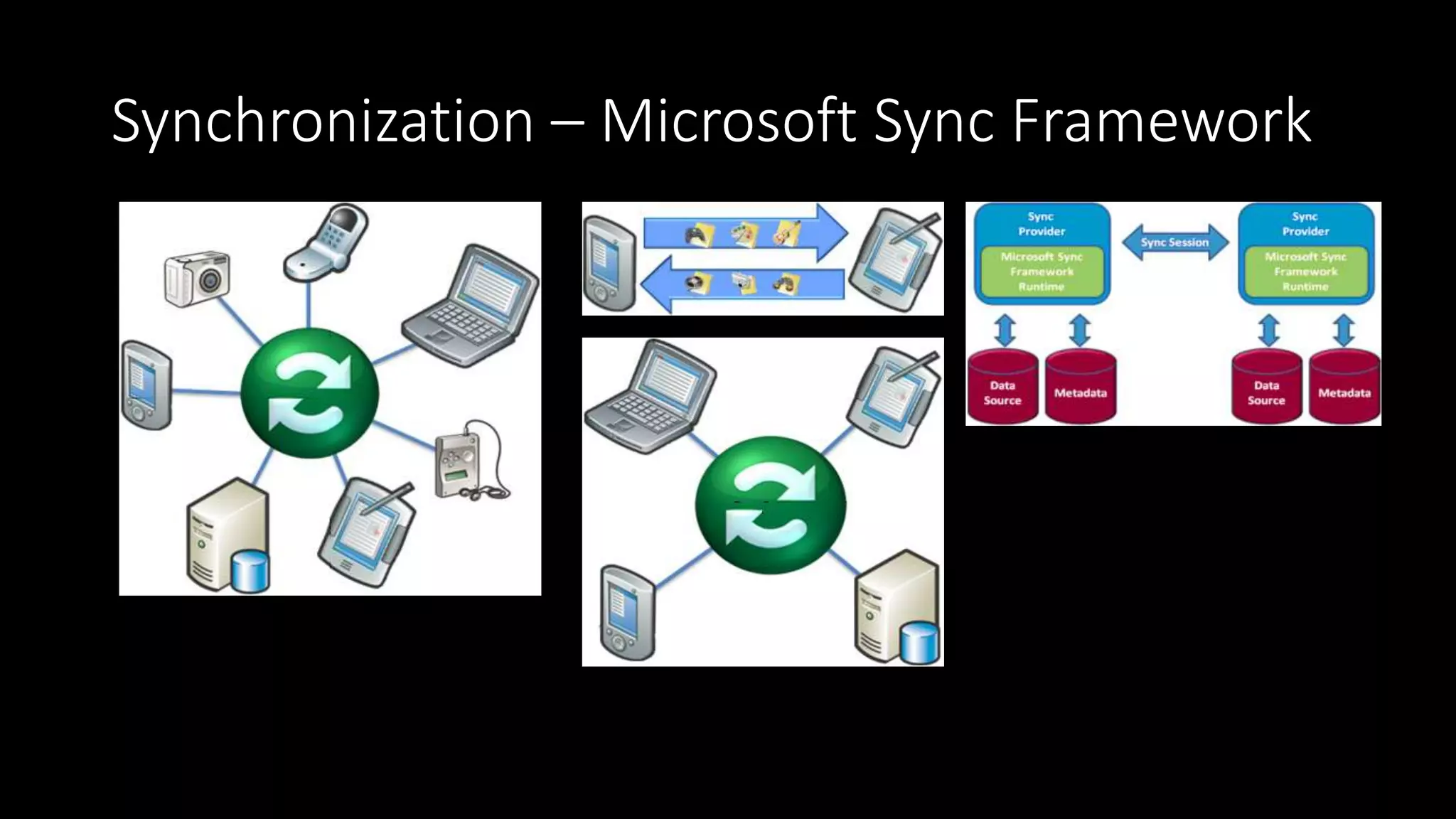
Synchronization – Microsoft Sync Framework
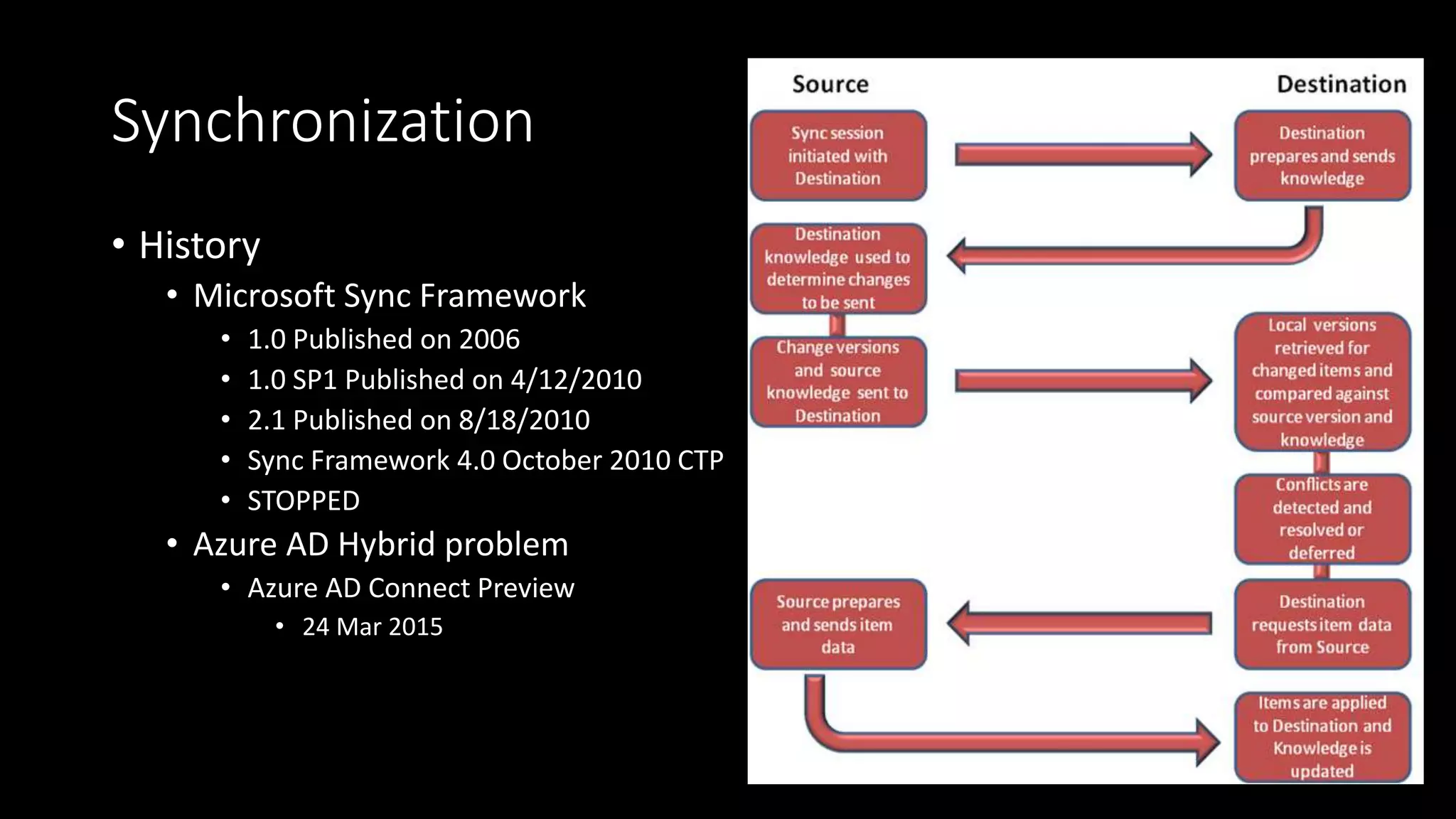
Synchronization
• History
• Microsoft Sync Framework
• 1.0 Published on 2006
• 1.0 SP1 Published on 4/12/2010
• 2.1 Published on 8/18/2010
• Sync Framework 4.0 October 2010 CTP
• STOPPED
• Azure AD Hybrid problem
• Azure AD Connect Preview
• 24 Mar 2015
What others have to say on Identity/Authentication/Authorization?
Security Challenges within IoT Systems
• Designed to operate autonomously in the field with no backup connectivity
if primary connection is lost
• The IoT entities will generally not be a single-use, single-ownership solution
• central security management user interface
• To enable the homeowner to manage who has the capability to access their home
• Can be used to control other IOT devices that have API’s
• If every IOT device in your home has its own security management web interface, it
won’t scale
• Using a central policy decision point (UMA Profile for OAUTH 2.0), people can
manage in one place which policies apply to what, without having to go to the web
admin page of every device
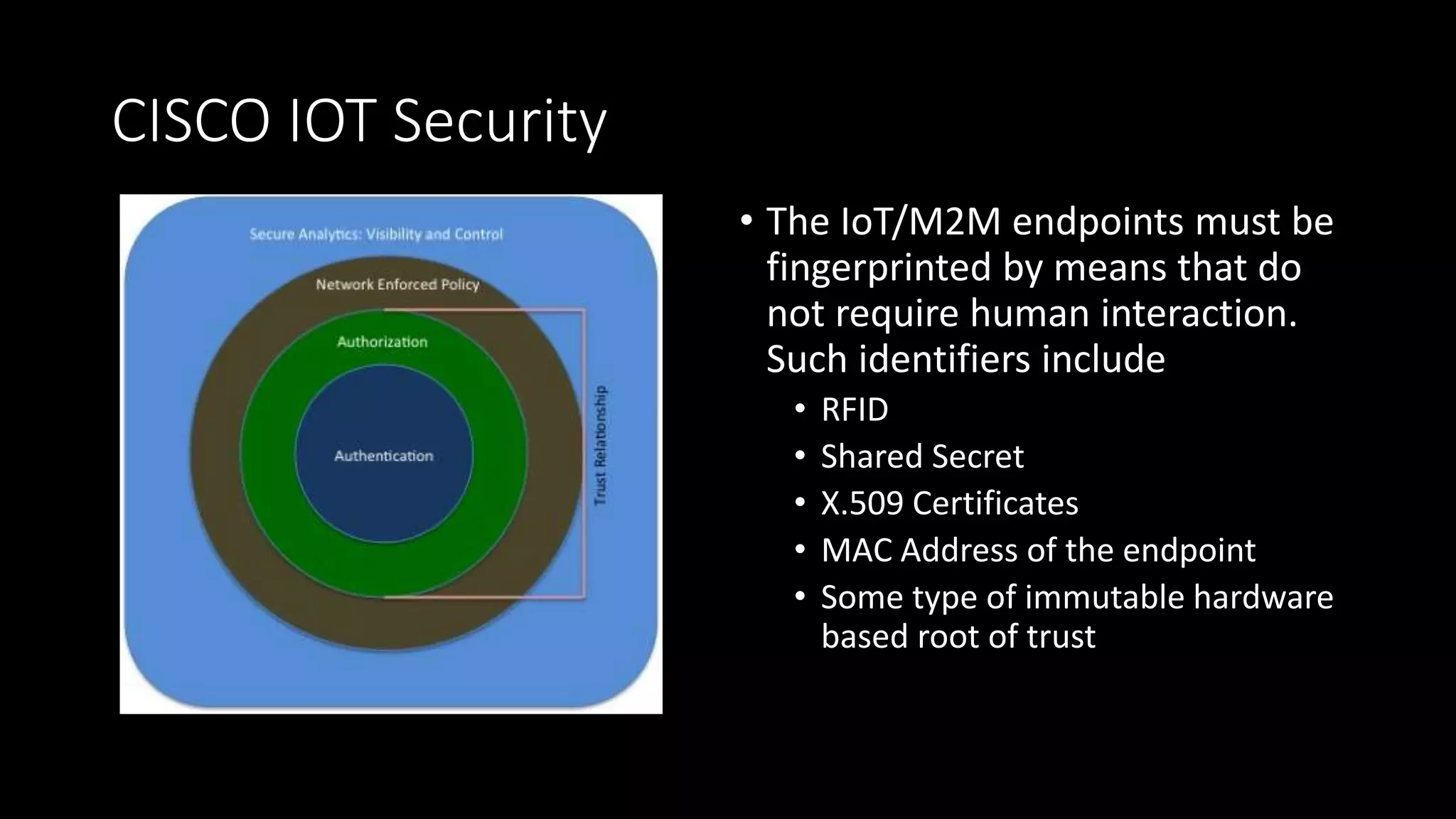
CISCO IOT Security
• The IoT/M2M endpoints must be
fingerprinted by means that do
not require human interaction.
Such identifiers include
• RFID
• Shared Secret
• X.509 Certificates
• MAC Address of the endpoint
• Some type of immutable hardware
based root of trust
Third-Party System comparison
• Philips Hue Lighting System
• Offline-First
• Away from Home authentication
• Single IDP
• SmartThings Hub
• Cloud-First
• Away from Home authentication
• Single IDP
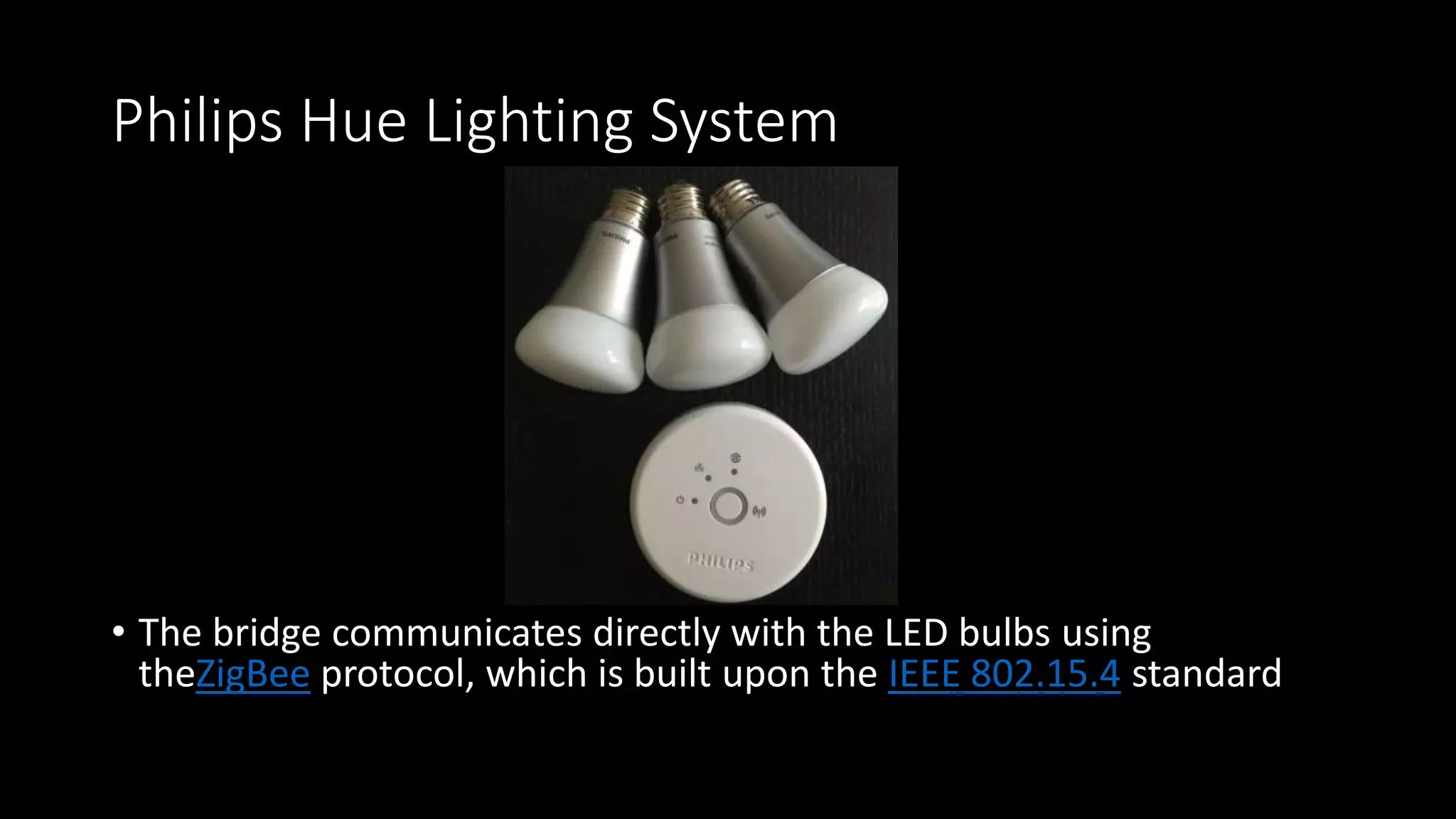
Philips Hue Lighting System
• The bridge communicates directly with the LED bulbs using
theZigBee protocol, which is built upon the IEEE 802.15.4 standard
Bride registering with the cloud service
• id (a unique id is assigned to
every physical bridge
manufactured),
• internal IP address, and
• MAC address (identical to the id)
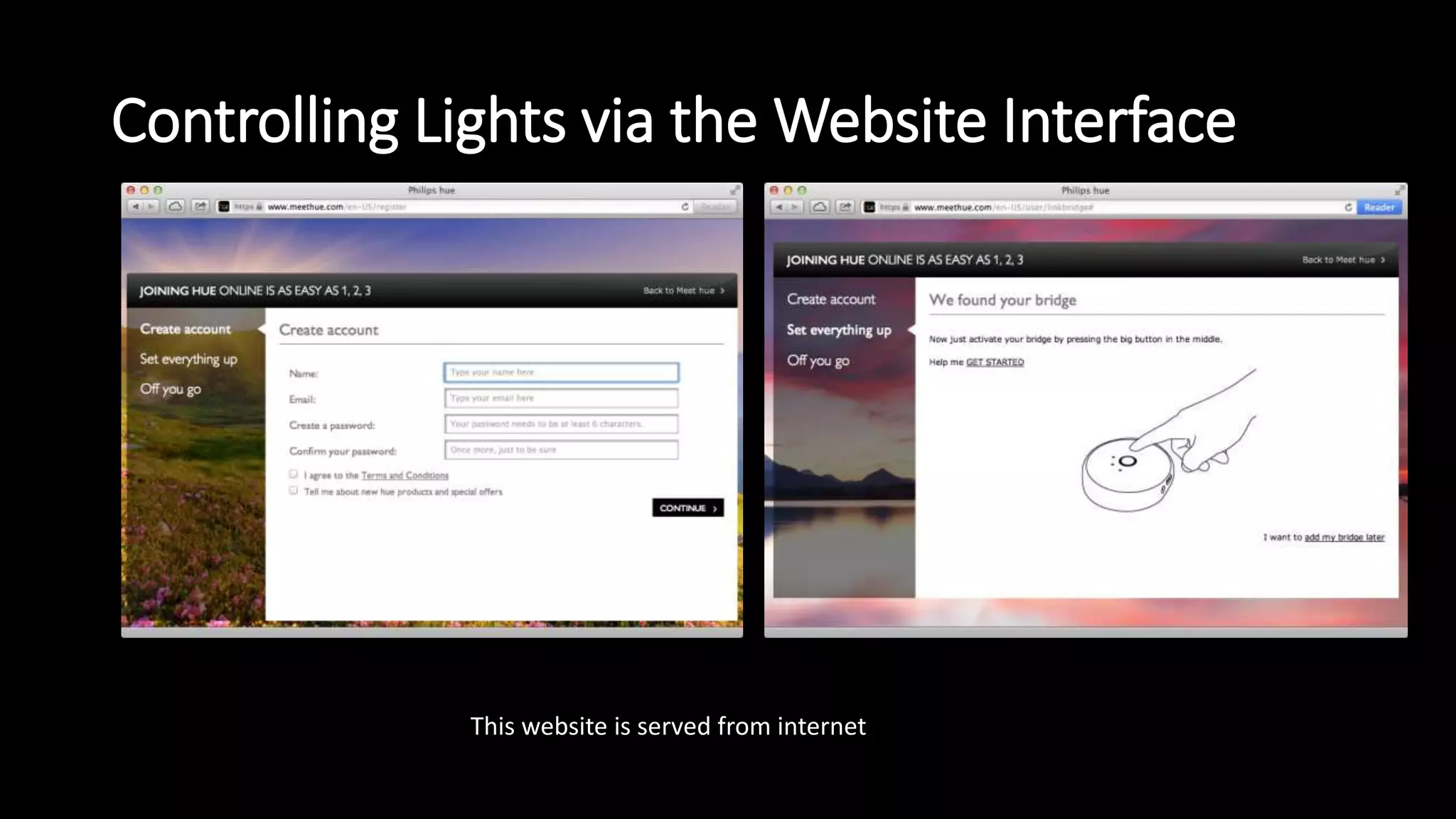
Controlling Lights via the Website Interface
This website is served from internet
Is button Pressed?
GET /en-US/user/isbuttonpressed HTTP/1.1
Host: www.meethue.com
User-Agent: Mozilla/5.0 (Macintosh; Intel Mac OS X 10_8_3) AppleWebKit/536.28.10
(KHTML, like Gecko) Version/6.0.3 Safari/536.28.10
Accept: */*
DNT: 1
X-Requested-With: XMLHttpRequest
Referer: https://www.meethue.com/en-US/user/linkbridge
Accept-Language: en-us
Accept-Encoding: gzip, deflate
Cookie:[DELETED]
Connection: keep-alive
Proxy-Connection: keep-alive
HTTP/1.1 200 OK
Content-Type: application/json; charset=utf-8
Cache-Control: no-cache
Expires: Thu, 01 Jan 1970 00:00:00 GMT
Set-Cookie: PLAY_FLASH=;Path=/;Expires=Thu, 01 Jan 1970 00:00:00 GMT
Set-Cookie: PLAY_ERRORS=;Path=/;Expires=Thu, 01 Jan 1970 00:00:00 GMT
Set-Cookie: [DELETED]
Vary: Accept-Encoding
Date: Mon, 29 Apr 2013 23:30:06 GMT
Server: Google Frontend
Content-Length: 4
true
Request Response
Complete setup
GET /en-US/user/setupcomplete HTTP/1.1
Host: www.meethue.com
User-Agent: Mozilla/5.0 (Macintosh; Intel Mac OS X 10_8_3)
AppleWebKit/536.28.10
(KHTML, like Gecko) Version/6.0.3 Safari/536.28.10
Accept: text/html,application/xhtml+xml,application/xml;
DNT: 1
Referer: https://www.meethue.com/en-US/user/linkbridge
Accept-Language: en-us
Accept-Encoding: gzip, deflate
Cookie: [DELETED]
Connection: keep-alive
Proxy-Connection: keep-alive
HTTP/1.1 200 OK
Content-Type: text/html; charset=utf-8; charset=utf-8
Cache-Control: no-cache
Expires: Thu, 01 Jan 1970 00:00:00 GMT
Set-Cookie: PLAY_FLASH=;Path=/;Expires=Thu, 01 Jan 1970 00:00:00 GMT
Set-Cookie: PLAY_ERRORS=;Path=/;Expires=Thu, 01 Jan 1970 00:00:00 GMT
Set-Cookie: PLAY_SESSION="[DELETED]-%00ip_address%3A[DELETED]__[DELETED]
;Path=/
Vary: Accept-Encoding
Date: Mon, 29 Apr 2013 23:30:08 GMT
Server: Google Frontend
Content-Length: 47369
[DELETED]
app.data.bridge = {"clientMessageState":[DELETED],"config":{"lights":{"15":
{"name":"Bathroom 2","state":{"bri":254,"effect":"none","sat":144,"reachabl
e":true,"alert":"none","hue":14922,"colormode":"ct","on":false,"ct":369,"xy
":[0.4595,0.4105]},"modelid":"LCT001","swversion":"65003148"
Request Response
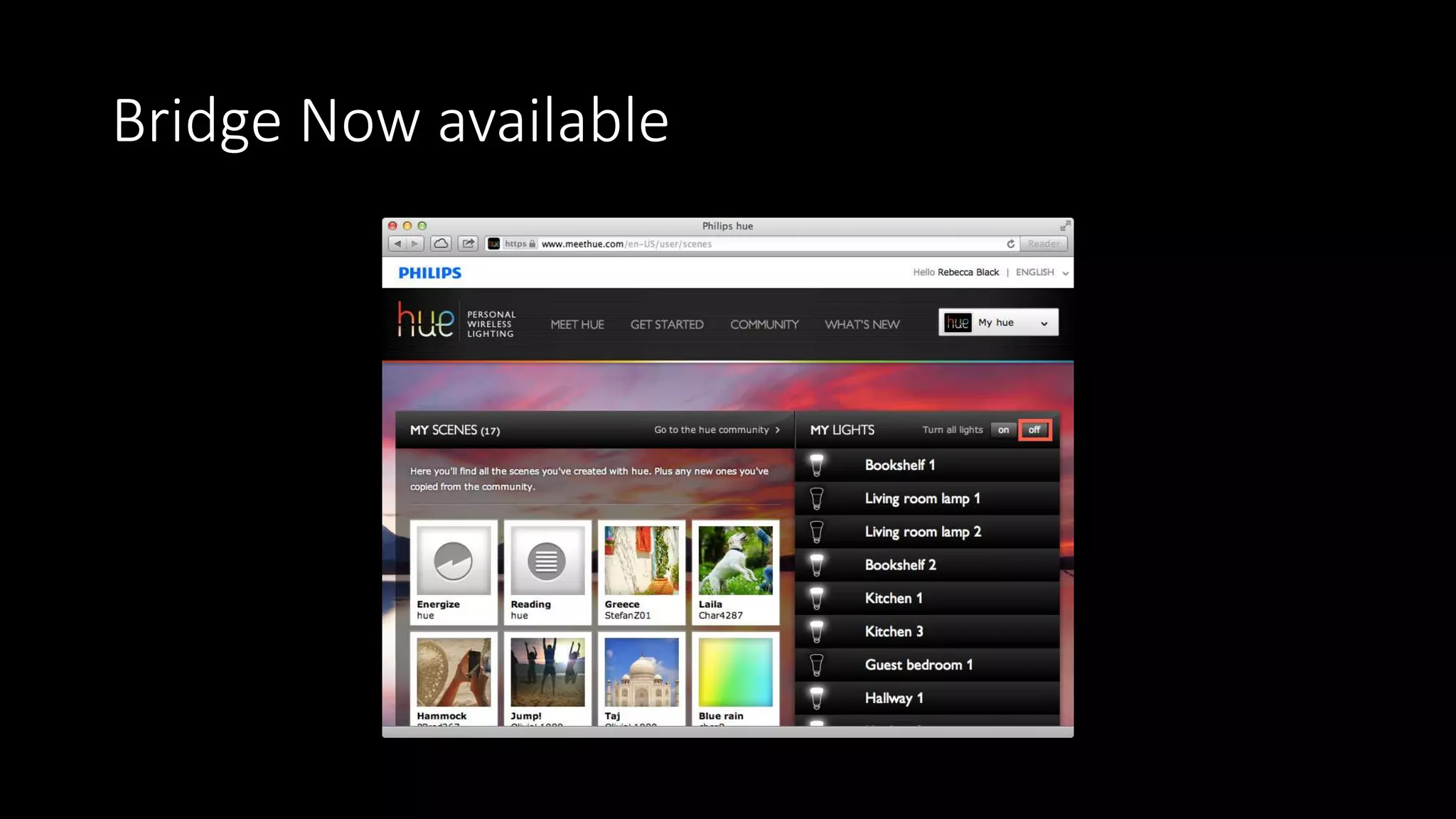
Bridge Now available
Sending commands to the bridge
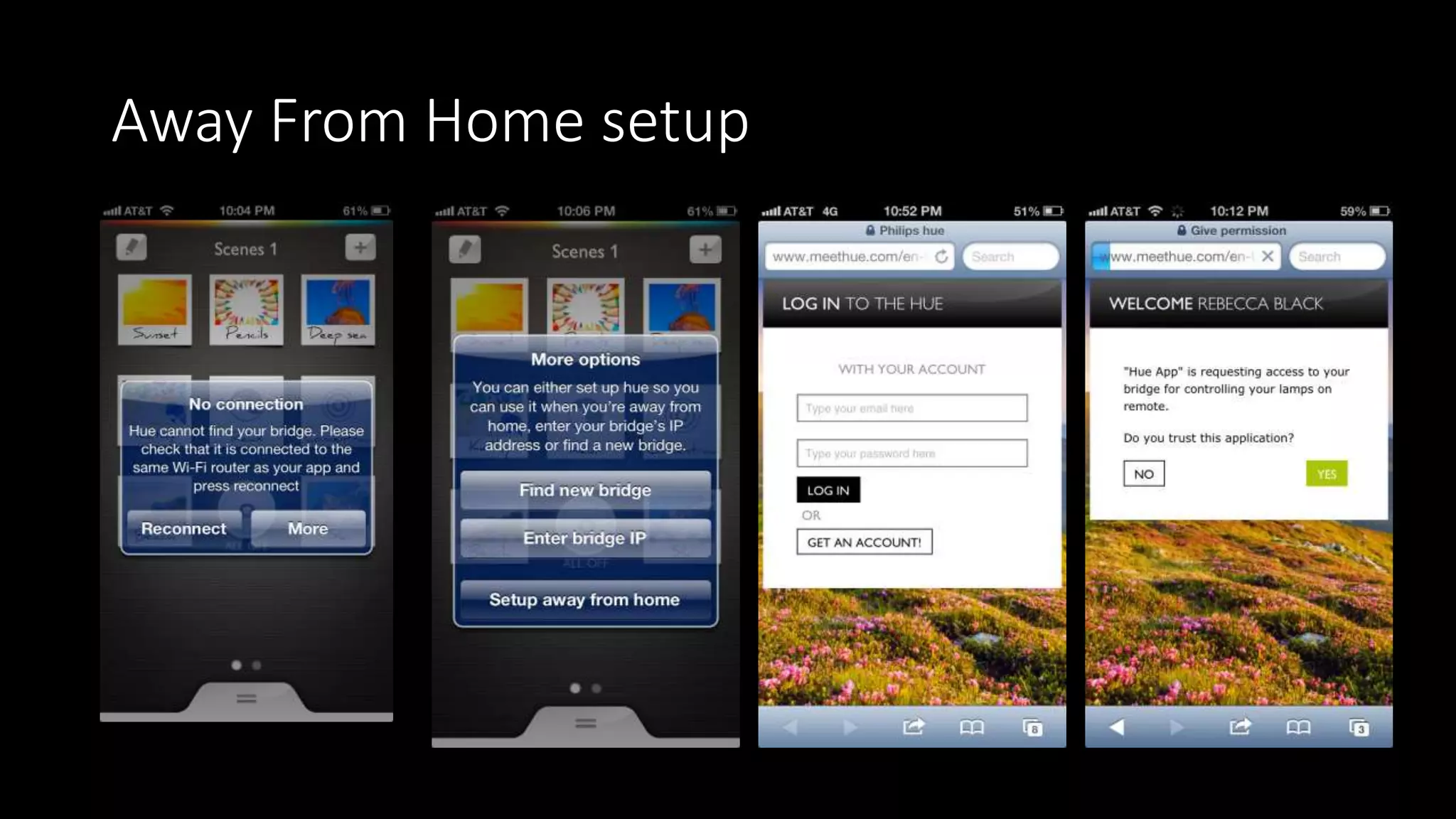
• The token obtained from the previous step is being sent to the bridge
directly along with the commands.
• In Local network
• Commands are directly sent to the bridge
• When Away from Home
• Commands are sent via the cloud
Controlling Lights Using the iOS App
GET /api/[username MD5 Hash of MacID] HTTP/1.1
Host: 10.0.1.2
Proxy-Connection: keep-alive
Accept-Encoding: gzip, deflate
Accept: */*
Accept-Language: en-us
Connection: keep-alive
Pragma: no-cache
User-Agent: hue/1.1.1 CFNetwork/609.1.4 Darwin/13.0.0
HTTP/1.1 200 OK
Cache-Control: no-store, no-cache, must-revalidate, post-
check=0, pre-check=0
Pragma: no-cache
Expires: Mon, 1 Aug 2011 09:00:00 GMT
Connection: close
Access-Control-Max-Age: 0
Access-Control-Allow-Origin: *
Access-Control-Allow-Credentials: true
Access-Control-Allow-Methods: POST, GET, OPTIONS, PUT,
DELETE
Access-Control-Allow-Headers: Content-Type
Content-type: application/json
[{"error":{"type":1,"address":"/","description":"unauthorized
user"}}]
Request Response
Identity / Authentication
POST /api HTTP/1.1
Host: 10.0.1.2
Proxy-Connection: keep-alive
Accept-Encoding: gzip, deflate
Content-Type: application/x-www-
form-urlencoded
Accept-Language: en-us
Accept: */*
Pragma: no-cache
Connection: keep-alive
User-Agent: hue/1.1.1
CFNetwork/609.1.4 Darwin/13.0.0
Content-Length: 71
{"username":"[username
DELETED]","devicetype":"iPhone
5"}
HTTP/1.1 200 OK
Cache-Control: no-store, no-cache,
must-revalidate, post-check=0, pre-
check=0
Pragma: no-cache
Expires: Mon, 1 Aug 2011 09:00:00
GMT
Connection: close
Access-Control-Max-Age: 0
Access-Control-Allow-Origin: *
Access-Control-Allow-Credentials: true
Access-Control-Allow-Methods: POST,
GET, OPTIONS, PUT, DELETE
Access-Control-Allow-Headers:
Content-Type
Content-type: application/json
[{"success":{"username":"[username
DELETED]"}}]
Request Response
Away From Home setup
Away from home setup complete
GET /en-US/api/getaccesstokenpost HTTP/1.1
Host: www.meethue.com
Referer: https://www.meethue.com/en-US/api/getaccesstokengivepermission
Proxy-Connection: keep-alive
Accept-Encoding: gzip, deflate
Accept: text/html,application/xhtml+xml,application/xml;q=0.9,*/*;q=0.8
Cookie: [DELETED]
Accept-Language: en-us
Connection: keep-alive
User-Agent: Mozilla/5.0 (iPhone; CPU iPhone OS 6_1_4 like Mac OS X)
AppleWebKit/536.26 (KHTML, like Gecko) Version/6.0 Mobile/10B350
Safari/8536.25
Request
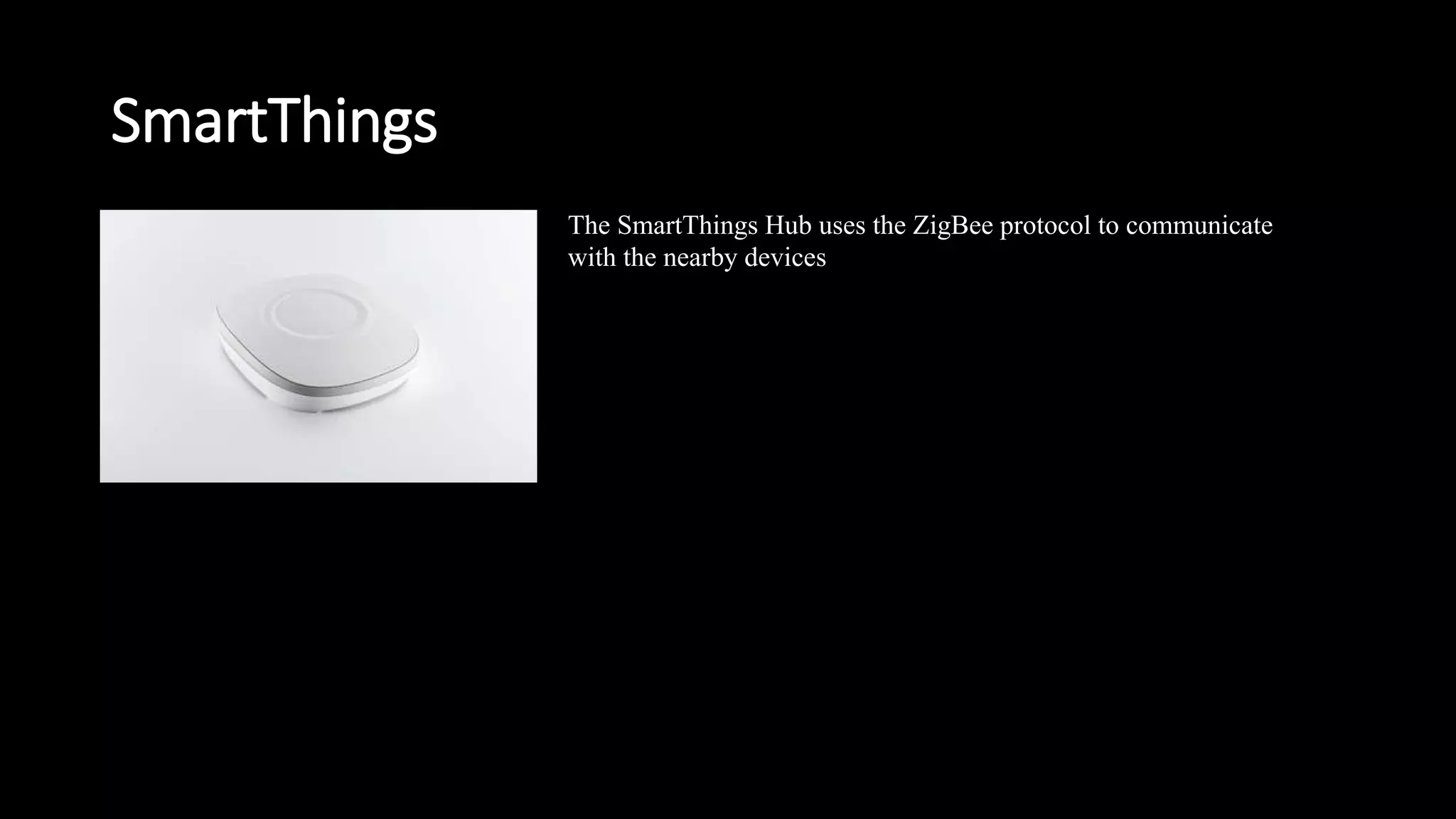
SmartThings
The SmartThings Hub uses the ZigBee protocol to communicate
with the nearby devices
SmartThings Statement
• We made the decision at SmartThings to support a “Cloud First” approach for our platform. This
means that in our initial release, there is a dependency on the Cloud. SmartApps run in the
SmartThings Cloud, so for everything to work, your hub does need to be online and connected to
our cloud. This will generally be the case, even when we implement hub-local capabilities as
described below.
• We believe in a “connected” service where local capabilities in the hub are meant to improve
performance and insulate the customer from intermittent internet outages. We do not plan to
support a perpetually disconnected mode.
• We made the decision to limit SmartApps to the Cloud in our first release because it allowed us to
focus on the experience of writing the applications and less on the mechanics of deploying that
logic locally to the hub.
• That said, we are actively considering implementation scenarios whereby we can distribute
SmartApps to—and execute SmartApps locally on—the SmartThings Hub.
• In all cases, we recognize the critical scenarios where a loss of communications with the
SmartThings Cloud could have a degrading impact on critical, local use cases, and are being
deeply thoughtful on how we minimize the risk of disruption.
Proposed Solution
• If in case the control system also acts as a Identity Provider, other
than the central cloud Identity Provider, then for offline-first scenario
it is better to cache the credentials in the control system
• Currently there is no standard way to synchronize the cloud IDP and
Control System IDP, hence synchronization of identity information
between the control system and the cloud should be done using
versioning
• UMA profiles should be considered for issues related to IRM
IoT mobile app device cloud identity and security architecture

IoT mobile app device cloud identity and security architecture

  • 1.
    IoT Mobile App/Device/Field Gatewayand Cloud Identity & Security architecture Prepared By Vinod Wilson Architect, Crestron Electronics
  • 2.
    Agenda • Communication Strategy •Current Architecture • Problems in current architecture • Multiple IDPs • Usability • Synchronization • Identity / Authentication / Authorization ( IAM & IRM ) • Cloud Capabilities • Proposed Solution
  • 3.
    Communication Strategy • CloudFirst • Mobile First • Offline First • Offline First • Mobile First • Cloud First
  • 4.
    Problems in Securityarchitecture • Strategy changed from Offline-First to Cloud First • User Experience • User has to wait for 10 minutes to really connect to any device • Multiple IDPs • Identity • Identity and Access Management (IAM) • Roles & Group policy • Roles & Group policy per device • Identity Relationship Management (IRM)
  • 5.
    Identity • Identity =set of attributes related to an entity [iso 29115] Entity Identity 6’ 5” Tall Grey Hair Man Work Husband Father Women Mother Daughter Wife Girl FriendFriend Boss Collegue Identity is Context Driven For each context, the attribute differs Identity1 Identity2 Identity3
  • 6.
    Evolution of Identity Employees Consumers Employees& Partners Things Perimeter Perimeter Federation Perimeter-less Federation Cloud / SaaS Perimeter-less Federation Cloud SaaS Mobility Attributes Context Stateless Relationships
  • 7.
    What Identity Layerprovides • Is the user that got authenticatedWho • Was he authenticatedWhere • Was he authenticatedWhen • Was he authenticatedHow • Attributes he can give youWhat • He is providing themWhy
  • 8.
    Authentication • The bestusability for authentication is never asking you to authenticate, just knowing who you are. • Authentication involves Trade-offs Usability
  • 9.
    Authentication • Traditional NTLM/ Kerberos authentication • Claims based Authentication • Protocols • OpenID Connect • Attribute & Cryptography • Authorization • OAUTH 2.0
  • 10.
  • 11.
    How OAuth WasBorn? My Brand New Ferrari Let me Park it sir!Parking Key Allow the owner to provide limited authorization to valet attendants OAuth was created to solve the same core issue online
  • 12.
  • 13.
  • 14.
    OAuth2 Client Profiles •Web Application • User Agent • Native
  • 15.
    OAuth2 Client Profiles WebApplication User Agent Native
  • 16.
  • 17.
    Mechanics of TokenValidation • Verify that it is well-formed • Token must be digitally signed • Verify that it is coming from the intended authority • Signature verification • Issuer value • Verify that it is meant for the current application
  • 18.
    Access control &Policy Management • Access Control Models • Mandatory Access Control (MAC) • Discretionary Access Control (DAC) • Role-based access control (RBAC) • Do not take into account additional parameters such as • Resource information, • Relationship between the user (the requesting entity) and the resource, and • Dynamic information e.g. time of the day or user IP, geolocation coordinates • Attribute-based access control (ABAC) • XACML (eXtensible Access Control Markup Language) • UMA(User Managed Access) Profiles for OAUTH 2.0 • In other words selective sharing User-Centric
  • 19.
    Web Application AccessControl if (User.IsInRole("Role01") || User.IsInRole("Role02") || User.IsInRole("Role03")) { return RedirectToAction("Secure", "Home"); } else { return RedirectToAction("Index", "Home"); } 1. Roles & Group policy per device 2. Change the user role Dynamically 1. Change the role in the token or get a new token from AS with a changed role 2. Manually apply the logic of role change
  • 20.
    Identity Problems inIoT Unreasonably large number of relationships among an unreasonably large numbers of people and things
  • 21.
    Identity Relationship Management( IRM ) • Person-to-Person • Thing-to-Thing • Person-to-Thing
  • 22.
    Identity Relationship Management( IRM ) •Relationships must be scalable •Actors, Attributes, Relationships, AdministrationScalable •In a traditional IAM scenario, we pass actionable information to the back-end for a classic request-response authorization modelActionable •PYNG-HUB was made by CrestronImmutable •Temporary •PermanentTransferable •Single-party Asserted, Multi-party AssertedProvable •Must all parties in a relationship acknowledge they are in a relationship?Acknowledgeable •Can either party revoke a relationship? •Does this imply the idea of cascading deletes?Revocable
  • 23.
    Identity Relationship Management(IRM) • In an IRM (and IoT) world • There is little to no connectivity to a backend authority • That a back-end authority simply does not exist • Does a protocol exist today? • NO • But anything is happening to address this issue? • YES
  • 24.
    So Far -Recap • Identity • Authentication • Access & Policy Management • Identity relationship management ( IRM)
  • 25.
    Multiple IDPs andSynchronization Problem Azure AD Cloud Service Cloud App Service
  • 26.
    Authentication • Traditional NTLM/ Kerberos authentication • Claims based Authentication • Protocols • OpenID Connect • Attribute & Cryptography • Authorization • OAUTH 2.0
  • 27.
  • 28.
    Synchronization • History • MicrosoftSync Framework • 1.0 Published on 2006 • 1.0 SP1 Published on 4/12/2010 • 2.1 Published on 8/18/2010 • Sync Framework 4.0 October 2010 CTP • STOPPED • Azure AD Hybrid problem • Azure AD Connect Preview • 24 Mar 2015
  • 29.
    What others haveto say on Identity/Authentication/Authorization?
  • 30.
    Security Challenges withinIoT Systems • Designed to operate autonomously in the field with no backup connectivity if primary connection is lost • The IoT entities will generally not be a single-use, single-ownership solution • central security management user interface • To enable the homeowner to manage who has the capability to access their home • Can be used to control other IOT devices that have API’s • If every IOT device in your home has its own security management web interface, it won’t scale • Using a central policy decision point (UMA Profile for OAUTH 2.0), people can manage in one place which policies apply to what, without having to go to the web admin page of every device
  • 31.
    CISCO IOT Security •The IoT/M2M endpoints must be fingerprinted by means that do not require human interaction. Such identifiers include • RFID • Shared Secret • X.509 Certificates • MAC Address of the endpoint • Some type of immutable hardware based root of trust
  • 32.
    Third-Party System comparison •Philips Hue Lighting System • Offline-First • Away from Home authentication • Single IDP • SmartThings Hub • Cloud-First • Away from Home authentication • Single IDP
  • 33.
    Philips Hue LightingSystem • The bridge communicates directly with the LED bulbs using theZigBee protocol, which is built upon the IEEE 802.15.4 standard
  • 34.
    Bride registering withthe cloud service • id (a unique id is assigned to every physical bridge manufactured), • internal IP address, and • MAC address (identical to the id)
  • 35.
    Controlling Lights viathe Website Interface This website is served from internet
  • 36.
    Is button Pressed? GET/en-US/user/isbuttonpressed HTTP/1.1 Host: www.meethue.com User-Agent: Mozilla/5.0 (Macintosh; Intel Mac OS X 10_8_3) AppleWebKit/536.28.10 (KHTML, like Gecko) Version/6.0.3 Safari/536.28.10 Accept: */* DNT: 1 X-Requested-With: XMLHttpRequest Referer: https://www.meethue.com/en-US/user/linkbridge Accept-Language: en-us Accept-Encoding: gzip, deflate Cookie:[DELETED] Connection: keep-alive Proxy-Connection: keep-alive HTTP/1.1 200 OK Content-Type: application/json; charset=utf-8 Cache-Control: no-cache Expires: Thu, 01 Jan 1970 00:00:00 GMT Set-Cookie: PLAY_FLASH=;Path=/;Expires=Thu, 01 Jan 1970 00:00:00 GMT Set-Cookie: PLAY_ERRORS=;Path=/;Expires=Thu, 01 Jan 1970 00:00:00 GMT Set-Cookie: [DELETED] Vary: Accept-Encoding Date: Mon, 29 Apr 2013 23:30:06 GMT Server: Google Frontend Content-Length: 4 true Request Response
  • 37.
    Complete setup GET /en-US/user/setupcompleteHTTP/1.1 Host: www.meethue.com User-Agent: Mozilla/5.0 (Macintosh; Intel Mac OS X 10_8_3) AppleWebKit/536.28.10 (KHTML, like Gecko) Version/6.0.3 Safari/536.28.10 Accept: text/html,application/xhtml+xml,application/xml; DNT: 1 Referer: https://www.meethue.com/en-US/user/linkbridge Accept-Language: en-us Accept-Encoding: gzip, deflate Cookie: [DELETED] Connection: keep-alive Proxy-Connection: keep-alive HTTP/1.1 200 OK Content-Type: text/html; charset=utf-8; charset=utf-8 Cache-Control: no-cache Expires: Thu, 01 Jan 1970 00:00:00 GMT Set-Cookie: PLAY_FLASH=;Path=/;Expires=Thu, 01 Jan 1970 00:00:00 GMT Set-Cookie: PLAY_ERRORS=;Path=/;Expires=Thu, 01 Jan 1970 00:00:00 GMT Set-Cookie: PLAY_SESSION="[DELETED]-%00ip_address%3A[DELETED]__[DELETED] ;Path=/ Vary: Accept-Encoding Date: Mon, 29 Apr 2013 23:30:08 GMT Server: Google Frontend Content-Length: 47369 [DELETED] app.data.bridge = {"clientMessageState":[DELETED],"config":{"lights":{"15": {"name":"Bathroom 2","state":{"bri":254,"effect":"none","sat":144,"reachabl e":true,"alert":"none","hue":14922,"colormode":"ct","on":false,"ct":369,"xy ":[0.4595,0.4105]},"modelid":"LCT001","swversion":"65003148" Request Response
  • 38.
  • 39.
    Sending commands tothe bridge • The token obtained from the previous step is being sent to the bridge directly along with the commands. • In Local network • Commands are directly sent to the bridge • When Away from Home • Commands are sent via the cloud
  • 40.
    Controlling Lights Usingthe iOS App GET /api/[username MD5 Hash of MacID] HTTP/1.1 Host: 10.0.1.2 Proxy-Connection: keep-alive Accept-Encoding: gzip, deflate Accept: */* Accept-Language: en-us Connection: keep-alive Pragma: no-cache User-Agent: hue/1.1.1 CFNetwork/609.1.4 Darwin/13.0.0 HTTP/1.1 200 OK Cache-Control: no-store, no-cache, must-revalidate, post- check=0, pre-check=0 Pragma: no-cache Expires: Mon, 1 Aug 2011 09:00:00 GMT Connection: close Access-Control-Max-Age: 0 Access-Control-Allow-Origin: * Access-Control-Allow-Credentials: true Access-Control-Allow-Methods: POST, GET, OPTIONS, PUT, DELETE Access-Control-Allow-Headers: Content-Type Content-type: application/json [{"error":{"type":1,"address":"/","description":"unauthorized user"}}] Request Response
  • 41.
    Identity / Authentication POST/api HTTP/1.1 Host: 10.0.1.2 Proxy-Connection: keep-alive Accept-Encoding: gzip, deflate Content-Type: application/x-www- form-urlencoded Accept-Language: en-us Accept: */* Pragma: no-cache Connection: keep-alive User-Agent: hue/1.1.1 CFNetwork/609.1.4 Darwin/13.0.0 Content-Length: 71 {"username":"[username DELETED]","devicetype":"iPhone 5"} HTTP/1.1 200 OK Cache-Control: no-store, no-cache, must-revalidate, post-check=0, pre- check=0 Pragma: no-cache Expires: Mon, 1 Aug 2011 09:00:00 GMT Connection: close Access-Control-Max-Age: 0 Access-Control-Allow-Origin: * Access-Control-Allow-Credentials: true Access-Control-Allow-Methods: POST, GET, OPTIONS, PUT, DELETE Access-Control-Allow-Headers: Content-Type Content-type: application/json [{"success":{"username":"[username DELETED]"}}] Request Response
  • 42.
  • 43.
    Away from homesetup complete GET /en-US/api/getaccesstokenpost HTTP/1.1 Host: www.meethue.com Referer: https://www.meethue.com/en-US/api/getaccesstokengivepermission Proxy-Connection: keep-alive Accept-Encoding: gzip, deflate Accept: text/html,application/xhtml+xml,application/xml;q=0.9,*/*;q=0.8 Cookie: [DELETED] Accept-Language: en-us Connection: keep-alive User-Agent: Mozilla/5.0 (iPhone; CPU iPhone OS 6_1_4 like Mac OS X) AppleWebKit/536.26 (KHTML, like Gecko) Version/6.0 Mobile/10B350 Safari/8536.25 Request
  • 44.
    SmartThings The SmartThings Hubuses the ZigBee protocol to communicate with the nearby devices
  • 45.
    SmartThings Statement • Wemade the decision at SmartThings to support a “Cloud First” approach for our platform. This means that in our initial release, there is a dependency on the Cloud. SmartApps run in the SmartThings Cloud, so for everything to work, your hub does need to be online and connected to our cloud. This will generally be the case, even when we implement hub-local capabilities as described below. • We believe in a “connected” service where local capabilities in the hub are meant to improve performance and insulate the customer from intermittent internet outages. We do not plan to support a perpetually disconnected mode. • We made the decision to limit SmartApps to the Cloud in our first release because it allowed us to focus on the experience of writing the applications and less on the mechanics of deploying that logic locally to the hub. • That said, we are actively considering implementation scenarios whereby we can distribute SmartApps to—and execute SmartApps locally on—the SmartThings Hub. • In all cases, we recognize the critical scenarios where a loss of communications with the SmartThings Cloud could have a degrading impact on critical, local use cases, and are being deeply thoughtful on how we minimize the risk of disruption.
  • 46.
    Proposed Solution • Ifin case the control system also acts as a Identity Provider, other than the central cloud Identity Provider, then for offline-first scenario it is better to cache the credentials in the control system • Currently there is no standard way to synchronize the cloud IDP and Control System IDP, hence synchronization of identity information between the control system and the cloud should be done using versioning • UMA profiles should be considered for issues related to IRM