Three SOA Case Studies understanding what to use – where Paul Fremantle  Chief Technology Officer WSO2 Inc
Introduction Paul Fremantle, CTO, WSO2 Co-Chair, OASIS WSRX TC VP, Apache Synapse Previously STSM in WebSphere Architecture This is based on projects I’ve worked on at WSO2 Case study #1 Integrating legacy systems for reporting at Concur Case study #2 Building a National SOA – OIO SOI Case study #3  Using SOA to integrate IT Management systems Anti-study  Some lessons learnt NOT on WSO2 projects!
A very short plug for WSO2 Open Source SOA Startup  Since 2005 A complete SOA platform available under the Apache License WSO2 Carbon – OSGi-based runtime including ESB Service Hosting – Web Services Application Server Data Services Registry / SOA Governance Business Process Server No Gimmicks / Gotchas Full 24x7 support  Training and Consultancy Hear more tomorrow  at 16:45 SkillsMatter booth
Case study 1
Integration at the glass
Concur Concur is an online expense management company >$200m revenue Multiple legacy systems: Customer Relationship Management ERP Sales Force Automation In house HR employee application Main requirement – enable better reporting across applications Internal project only – not in the direct flow of external customer systems Needed an approach that supported: Iterative development Support changes to the underlying systems Flexible
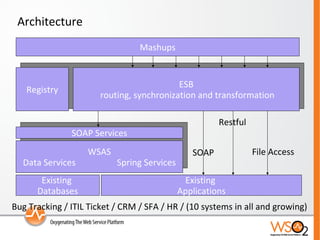
Architecture WSAS Data Services  Spring Services Existing  Databases Existing  Applications SOAP Services ESB routing, synchronization and transformation Registry File Access Mashups SOAP Bug Tracking / ITIL Ticket / CRM / SFA / HR / (10 systems in all and growing) Restful
Technical details Everything deployed on Windows 2003 running on VMWare Internal systems so limited security Basic authentication Some use of digital signature Running in a blade server to simplify test and scaling Currently Hot/Cold but moving to Hot/Hot ~75,000 transactions a day 95% SOAP, 5% Restful at this point WSDLs and Schema’s stored in WSO2 Registry Embedded in the ESB Currently 18 services across 10 backends with 120 operations Growing Looking at moving to a more event-based approach in the future
Iterative development
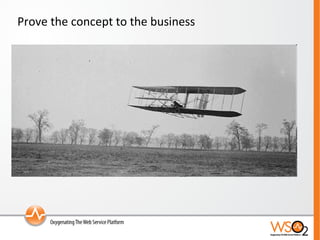
Project Approach Planned for iterative development over phases Staff self-educated on SOA and looked at Open Source systems before talking to vendors One week “kickstart” education and POC session Built a data synchronization application  Proof to the business:  Concur built a prototype that offered real value to executives: Single customer view mashup – pulled open CRM tickets, ERP and CRM data.  The demo was an “instant hit” – gaining an executive sponsor Team identified re-usable services  Put extra effort into the design Several refactoring iterations
Benefits Lower cost of licenses/users on SaaS systems Previously were using licenses for occasional users Intermittent users were being trained on systems that they rarely used – the new mashups replaced this requirement The SOA design has allowed incremental replacement of some legacy systems Existing test plans for Sarbanes-Oxley could be re-used Open source meant that a POC could prove the benefits to the business without upfront expenditure
Lessons Learnt Keep it Simple In-house expertise has paid off Steeper learning curve but Better technology selection Lower overall cost More agility Use of open source projects has  Reduced cost  Been more flexible Given better access to the community and developers
Business to Government
Case Study 2 OIO SOI
OIO SOI Danish Government wanted to simplify electronic business Especially for Business-to-Government (B2G) Potential savings of 630m Euros by digitalizing business Requirements Reliable delivery Secure – encrypted and signed messages Support small businesses
OIO SOI Several aspects A registry for service lookup A profile of transport protocols Open Source toolkits for Java and .NET A reference implementation of a message handler A legal framework Some existing framework A nationwide digital certificate framework A standard XML syntax for invoices and orders (UBL2)
Registry  A profile of OASIS UDDI v3.0 A central registry run by the Danish Government https://publish.uddi.ehandel.gov.dk:12443/registry/uddi/web   Designed to be used by electronic clients Not to be browsed by humans! Requires a Danish Certified Certificate to publish
RASP
RASP Reliable Asynchronous Secure Profile A profile of  SOAP 1.2 WS-Security 1.1 WS-ReliableMessaging 1.0 WS-Addressing  Two bindings: HTTP and SMTP Why SMTP? To allow small businesses to communicate  No requirement to host a web server No 24x7 operation No firewall configuration Only an email address
RASP capabilities Authentication Confidentiality Integrity Non-repudiation / proof of delivery Support for intermediaries Asynchronisity
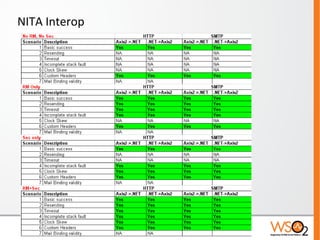
Interoperability RASP includes libraries for both  .NET – based on WCF 3.0 Java – based on Apache Axis2 Defined a set of tests and run using a continuous test environment Biggest problems were found with WSRM and SMTP
NITA Interop
Logical architecture This is logically a complete peer-to-peer architecture With only a central registry Any company can talk to any other company Even those with only mail accounts Cannot track all the requests!
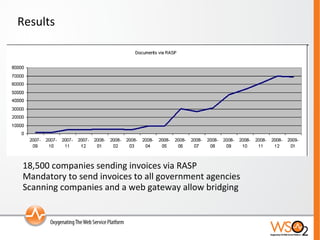
Results 18,500 companies sending invoices via RASP Mandatory to send invoices to all government agencies Scanning companies and a web gateway allow bridging
Lessons learnt SMTP in the real world is tricky Spam filters can modify or drop messages Our email accounts got shut down for “spamming”  i.e. sending many messages in a short time Timeouts were too long for the RM system We made mistakes layering SMTP and WS-Addressing Publishing interoperable reference implementations was a big win Proved interoperability Formed the basis for other implementations to test against The RASP team is now working on a European initiative: PEPPOL  http://peppol.eu   Trying to bring the same results across Europe
Resources RASP specs and pointers to implementations http://tinyurl.com/azwhx5   Peppol http://peppol.eu
Case Study #3 Enterprise IT Management
Enterprise IT Management Problem statement: Customers have multiple installed management systems Network Management User Management Systems Management  All from the same vendor! These are not just “stock” systems – each has been customized for each installation Customers have to keep these systems in sync By data entry Any solution needs to be flexible, extensible, modifiable
This is a difficult problem! Synchronizing multiple different systems But: Systems have different underlying formats Some of the systems may be more accurate than others Need to be able to scale to different numbers of systems Must be extensible / reprogrammable
Event based models
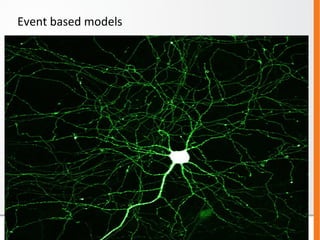
Actuators and Sensors An actuator emits an event A sensor accepts events Each of the systems produces events when something changes within the system An Adapter converts the event into an XML and publishes it The XML can be in an “Application Specific” format These events are transformed by the ESB into “Generic”
Managing the Event Subscriptions A header carries the “Topic” E.g.  /config/hardware/server/windows/xp Subscribers can subscribe to a specific topic, or all sub-events The topic space is represented as a tree in the registry Subscriptions are simply URLs stored as entries at a point in the tree /config/ /software/ /hardware/   /server/ /linux/ /windows /xp/ URL1 / URL2 (etc) The G-message schemas match the structure  /config/hardware/server extends /config/hardware The master data services are all generated from a schema-driven DSL
Feedback!
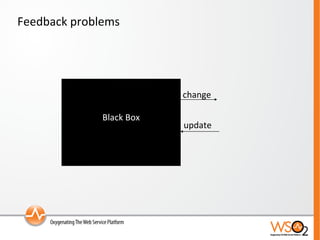
Feedback problems Black Box change update
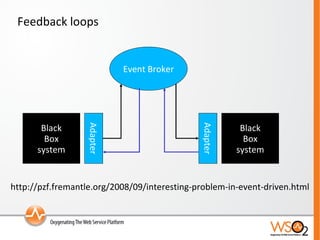
Feedback loops Black Box system Black Box system Adapter Adapter Event Broker http://pzf.fremantle.org/2008/09/interesting-problem-in-event-driven.html
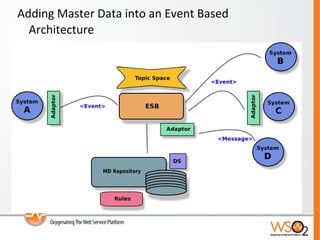
Adding Master Data into an Event Based Architecture
Understanding the flow  Adapter produces an AS-Event ESB transforms to a G-Event and sends to subscribers Master receives the event Decides if it is an echo (and drops) Executes policy based on the topic/message This may execute a business process or ruleset Master updates the master db  Republishes in a second topic space using a G-Event This is now the master event This gets transformed to an update of the other systems using the AS-schema
Technologies used SOAP WS-Transfer for the updates Both the adapters and the master data WS-Eventing for the events WS-Security for authentication, encryption, signatures WS-ReliableMessaging for reliable message delivery The system is manageable using JMX But can also be managed by logging events with a new subscriber
Project approach Kickstart 1 week  “ Thin Slice” end-to-end Several teams  Adapter Master Data Eventing Transformation Integrated  Iterative development Start with two key Use Cases Open Source  In close partnership with WSO2 for support and consultancy
Anti-patterns Use a full waterfall model Don’t budget time for integration test Assume that standard coding unit test->integration test will work Build unit tests that don’t test interoperability E.g. Simulate XML request/response inside the calling system rather than calling a remote system Wait until all the systems are ready before starting any integration test A delay to one system will hold up testing all the others Don’t bother with continuous build and test Even better build by hand Even better  test by hand too Have a nice complex process to hand over from development to test That way each defect will take a long time Wait until the project is failing to find out your team doesn’t have the skills
Conclusions
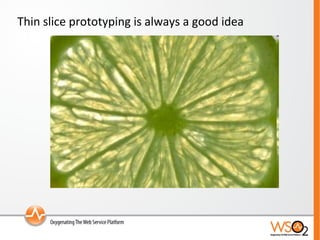
Thin slice prototyping is always a good idea
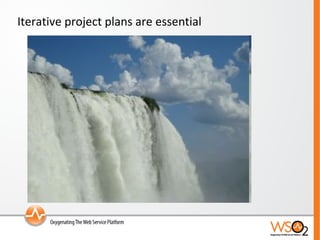
Iterative project plans are essential
Prove the concept to the business
KISS Keep it Simple, Stupid!
Questions?

Three SOA Case Studies

  • 1.
    Three SOA CaseStudies understanding what to use – where Paul Fremantle Chief Technology Officer WSO2 Inc
  • 2.
    Introduction Paul Fremantle,CTO, WSO2 Co-Chair, OASIS WSRX TC VP, Apache Synapse Previously STSM in WebSphere Architecture This is based on projects I’ve worked on at WSO2 Case study #1 Integrating legacy systems for reporting at Concur Case study #2 Building a National SOA – OIO SOI Case study #3 Using SOA to integrate IT Management systems Anti-study Some lessons learnt NOT on WSO2 projects!
  • 3.
    A very shortplug for WSO2 Open Source SOA Startup Since 2005 A complete SOA platform available under the Apache License WSO2 Carbon – OSGi-based runtime including ESB Service Hosting – Web Services Application Server Data Services Registry / SOA Governance Business Process Server No Gimmicks / Gotchas Full 24x7 support Training and Consultancy Hear more tomorrow at 16:45 SkillsMatter booth
  • 4.
  • 5.
  • 6.
    Concur Concur isan online expense management company >$200m revenue Multiple legacy systems: Customer Relationship Management ERP Sales Force Automation In house HR employee application Main requirement – enable better reporting across applications Internal project only – not in the direct flow of external customer systems Needed an approach that supported: Iterative development Support changes to the underlying systems Flexible
  • 7.
    Architecture WSAS DataServices Spring Services Existing Databases Existing Applications SOAP Services ESB routing, synchronization and transformation Registry File Access Mashups SOAP Bug Tracking / ITIL Ticket / CRM / SFA / HR / (10 systems in all and growing) Restful
  • 8.
    Technical details Everythingdeployed on Windows 2003 running on VMWare Internal systems so limited security Basic authentication Some use of digital signature Running in a blade server to simplify test and scaling Currently Hot/Cold but moving to Hot/Hot ~75,000 transactions a day 95% SOAP, 5% Restful at this point WSDLs and Schema’s stored in WSO2 Registry Embedded in the ESB Currently 18 services across 10 backends with 120 operations Growing Looking at moving to a more event-based approach in the future
  • 9.
  • 10.
    Project Approach Plannedfor iterative development over phases Staff self-educated on SOA and looked at Open Source systems before talking to vendors One week “kickstart” education and POC session Built a data synchronization application Proof to the business: Concur built a prototype that offered real value to executives: Single customer view mashup – pulled open CRM tickets, ERP and CRM data. The demo was an “instant hit” – gaining an executive sponsor Team identified re-usable services Put extra effort into the design Several refactoring iterations
  • 11.
    Benefits Lower costof licenses/users on SaaS systems Previously were using licenses for occasional users Intermittent users were being trained on systems that they rarely used – the new mashups replaced this requirement The SOA design has allowed incremental replacement of some legacy systems Existing test plans for Sarbanes-Oxley could be re-used Open source meant that a POC could prove the benefits to the business without upfront expenditure
  • 12.
    Lessons Learnt Keepit Simple In-house expertise has paid off Steeper learning curve but Better technology selection Lower overall cost More agility Use of open source projects has Reduced cost Been more flexible Given better access to the community and developers
  • 13.
  • 14.
    Case Study 2OIO SOI
  • 15.
    OIO SOI DanishGovernment wanted to simplify electronic business Especially for Business-to-Government (B2G) Potential savings of 630m Euros by digitalizing business Requirements Reliable delivery Secure – encrypted and signed messages Support small businesses
  • 16.
    OIO SOI Severalaspects A registry for service lookup A profile of transport protocols Open Source toolkits for Java and .NET A reference implementation of a message handler A legal framework Some existing framework A nationwide digital certificate framework A standard XML syntax for invoices and orders (UBL2)
  • 17.
    Registry Aprofile of OASIS UDDI v3.0 A central registry run by the Danish Government https://publish.uddi.ehandel.gov.dk:12443/registry/uddi/web Designed to be used by electronic clients Not to be browsed by humans! Requires a Danish Certified Certificate to publish
  • 18.
  • 19.
    RASP Reliable AsynchronousSecure Profile A profile of SOAP 1.2 WS-Security 1.1 WS-ReliableMessaging 1.0 WS-Addressing Two bindings: HTTP and SMTP Why SMTP? To allow small businesses to communicate No requirement to host a web server No 24x7 operation No firewall configuration Only an email address
  • 20.
    RASP capabilities AuthenticationConfidentiality Integrity Non-repudiation / proof of delivery Support for intermediaries Asynchronisity
  • 21.
    Interoperability RASP includeslibraries for both .NET – based on WCF 3.0 Java – based on Apache Axis2 Defined a set of tests and run using a continuous test environment Biggest problems were found with WSRM and SMTP
  • 22.
  • 23.
    Logical architecture Thisis logically a complete peer-to-peer architecture With only a central registry Any company can talk to any other company Even those with only mail accounts Cannot track all the requests!
  • 24.
    Results 18,500 companiessending invoices via RASP Mandatory to send invoices to all government agencies Scanning companies and a web gateway allow bridging
  • 25.
    Lessons learnt SMTPin the real world is tricky Spam filters can modify or drop messages Our email accounts got shut down for “spamming” i.e. sending many messages in a short time Timeouts were too long for the RM system We made mistakes layering SMTP and WS-Addressing Publishing interoperable reference implementations was a big win Proved interoperability Formed the basis for other implementations to test against The RASP team is now working on a European initiative: PEPPOL http://peppol.eu Trying to bring the same results across Europe
  • 26.
    Resources RASP specsand pointers to implementations http://tinyurl.com/azwhx5 Peppol http://peppol.eu
  • 27.
    Case Study #3Enterprise IT Management
  • 28.
    Enterprise IT ManagementProblem statement: Customers have multiple installed management systems Network Management User Management Systems Management All from the same vendor! These are not just “stock” systems – each has been customized for each installation Customers have to keep these systems in sync By data entry Any solution needs to be flexible, extensible, modifiable
  • 29.
    This is adifficult problem! Synchronizing multiple different systems But: Systems have different underlying formats Some of the systems may be more accurate than others Need to be able to scale to different numbers of systems Must be extensible / reprogrammable
  • 30.
  • 31.
    Actuators and SensorsAn actuator emits an event A sensor accepts events Each of the systems produces events when something changes within the system An Adapter converts the event into an XML and publishes it The XML can be in an “Application Specific” format These events are transformed by the ESB into “Generic”
  • 32.
    Managing the EventSubscriptions A header carries the “Topic” E.g. /config/hardware/server/windows/xp Subscribers can subscribe to a specific topic, or all sub-events The topic space is represented as a tree in the registry Subscriptions are simply URLs stored as entries at a point in the tree /config/ /software/ /hardware/ /server/ /linux/ /windows /xp/ URL1 / URL2 (etc) The G-message schemas match the structure /config/hardware/server extends /config/hardware The master data services are all generated from a schema-driven DSL
  • 33.
  • 34.
    Feedback problems BlackBox change update
  • 35.
    Feedback loops BlackBox system Black Box system Adapter Adapter Event Broker http://pzf.fremantle.org/2008/09/interesting-problem-in-event-driven.html
  • 36.
    Adding Master Datainto an Event Based Architecture
  • 37.
    Understanding the flow Adapter produces an AS-Event ESB transforms to a G-Event and sends to subscribers Master receives the event Decides if it is an echo (and drops) Executes policy based on the topic/message This may execute a business process or ruleset Master updates the master db Republishes in a second topic space using a G-Event This is now the master event This gets transformed to an update of the other systems using the AS-schema
  • 38.
    Technologies used SOAPWS-Transfer for the updates Both the adapters and the master data WS-Eventing for the events WS-Security for authentication, encryption, signatures WS-ReliableMessaging for reliable message delivery The system is manageable using JMX But can also be managed by logging events with a new subscriber
  • 39.
    Project approach Kickstart1 week “ Thin Slice” end-to-end Several teams Adapter Master Data Eventing Transformation Integrated Iterative development Start with two key Use Cases Open Source In close partnership with WSO2 for support and consultancy
  • 40.
    Anti-patterns Use afull waterfall model Don’t budget time for integration test Assume that standard coding unit test->integration test will work Build unit tests that don’t test interoperability E.g. Simulate XML request/response inside the calling system rather than calling a remote system Wait until all the systems are ready before starting any integration test A delay to one system will hold up testing all the others Don’t bother with continuous build and test Even better build by hand Even better test by hand too Have a nice complex process to hand over from development to test That way each defect will take a long time Wait until the project is failing to find out your team doesn’t have the skills
  • 41.
  • 42.
    Thin slice prototypingis always a good idea
  • 43.
  • 44.
    Prove the conceptto the business
  • 45.
    KISS Keep itSimple, Stupid!
  • 46.