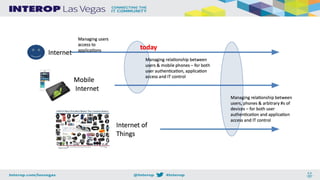

Identity- defined Privacy & Security
for the Internet of Things
Paul Madsen
@paulmadsen
Ping Identity
2
The Internet of Things
connects people and physical
objects together through
applications
What’s driving IoT
• The sensor legacy. Sensors and remote monitoring tools have
existed for decades, in a field known as machine-to-machine (M2M)
communications, monitoring, and control.
• Broadening connectivity. Mainstreaming of home wifi, 4G mobile,
low-power wireless standards such as Bluetooth and ZigBee are
enabling just about everything to be connected together.
• The cloud and big data. Cloud computing and big data allow the
massive data created by things to be sifted, processed, and acted upon
• APIs.  Distributed, loosely coupled, transactional approaches in
software design are allowing things to exist and communicate
autonomously alongside internet-based services
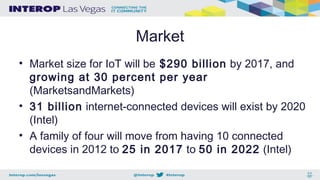
Market
• Market size for IoT will be $290 billion by 2017, and
growing at 30 percent per year
(MarketsandMarkets)
• 31 billion internet-connected devices will exist by 2020
(Intel)
• A family of four will move from having 10 connected
devices in 2012 to 25 in 2017 to 50 in 2022 (Intel)
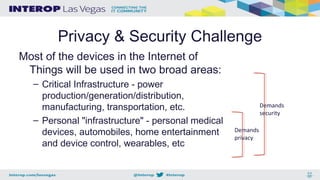
Privacy & Security Challenge
Most of the devices in the Internet of
Things will be used in two broad areas:
– Critical Infrastructure - power
production/generation/distribution,
manufacturing, transportation, etc.
– Personal "infrastructure" - personal medical
devices, automobiles, home entertainment
and device control, wearables, etc
Demands
security
Demands
privacy
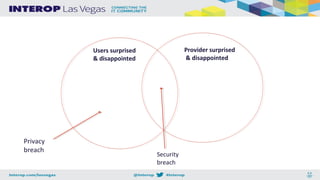
Users surprised
& disappointed
Security
breach
Provider surprised
& disappointed
Privacy
breach
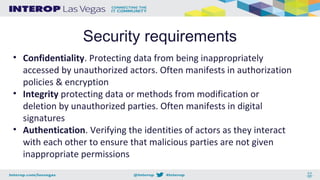
Security requirements
• Confidentiality. Protecting data from being inappropriately
accessed by unauthorized actors. Often manifests in authorization
policies & encryption
• Integrity protecting data or methods from modification or
deletion by unauthorized parties. Often manifests in digital
signatures
• Authentication. Verifying the identities of actors as they interact
with each other to ensure that malicious parties are not given
inappropriate permissions
Security challenges of the IoT
• Life and death implications
• Scale
• Heterogeneity
• Storage, processing, and connectivity constraints
• Usability implications of screenless devices
• Complex relationships between users & devices
• Implications of gateways for end-to-end security
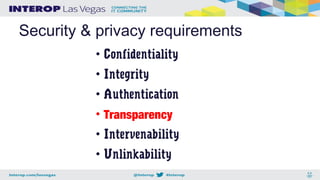
Privacy requirements
• Transparency helps people understand who knows what about them —
give people information on how their data is to be used, with whom it is
shared with; how long is it held; etc
• Intervenability is the ability for users to view, change, correct, block,
revoke consent, and delete personal data stored by providers &
applications.
• Unlinkability is about the separation of informational contexts, such as
work, personal, family, citizen, and social. It’s about preventing undesired
linkages across different contexts.
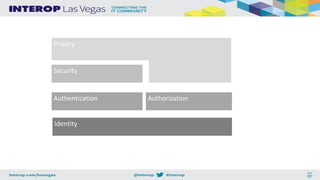
Identity
Security
Privacy
Authentication Authorization
Authentication & Authorization Model
• IoT Actors authenticate by presenting security tokens
on their calls/messages to each other
• Tokens represent relationship between the relevant
user and the calling actor (and any
consents/permissions associated with that relationship
• Upon receiving a message, an actor validates the
token to verify the request is consistent with the
relationship/permissions
• If consent is removed, token is revoked, and access
disabled
OAuth 2.0 & OpenId Connect 1.0
• OAuth 2.0 is an IETF authentication & authorization framework for securing
application access to RESTful APIs
• OAuth allows a Client to send an API query to a Resource Server (RS), the
application hosting the desired information, such that the RS can authenticate
that the message was indeed sent by the Client.
• The Client authenticates to the RS through the inclusion of an access token on
its API call—a token previously provided to the Client by an Authorization
Server (AS).
• In those scenarios that the API in question protects access to a User’s identity
attributes, it may be the case that the access token will only be issued by the
AS after the User has explicitly given consent to the Client accessing those
attributes.
• OpenID Connect 1.0 profiles and extends OAuth 2.0 to add an identity layer—
creating a single framework that promises to secure APIs, mobile native
applications and browser applications in a single, cohesive architecture.
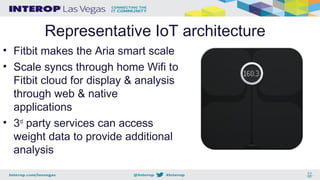
Representative IoT architecture
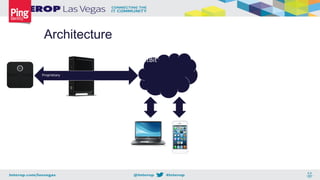
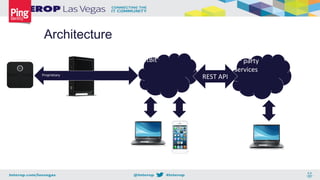
• Fitbit makes the Aria smart scale
• Scale syncs through home Wifi to
Fitbit cloud for display & analysis
through web & native
applications
• 3rd
party services can access
weight data to provide additional
analysis
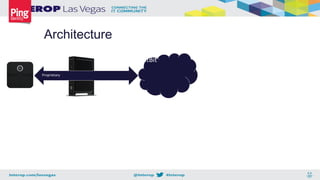
Architecture
FitBit
Proprietary
Architecture
FitBit
Proprietary
Architecture
FitBit 3rd
party
services
REST APIProprietary
Security & privacy requirements
• Confidentiality
• Integrity
• Authentication
• Transparency
• Intervenability
• Unlinkability
Security & privacy requirements
• Confidentiality
• Integrity
• Authentication
• Transparency
• Intervenability
• Unlinkability
Confidentiality & Integrity
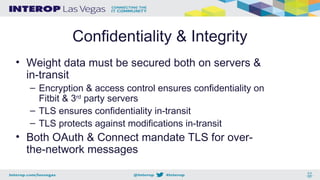
• Weight data must be secured both on servers &
in-transit
– Encryption & access control ensures confidentiality on
Fitbit & 3rd
party servers
– TLS ensures confidentiality in-transit
– TLS protects against modifications in-transit
• Both OAuth & Connect mandate TLS for over-
the-network messages
Security & privacy requirements
• Confidentiality
• Integrity
• Authentication
• Transparency
• Intervenability
• Unlinkability
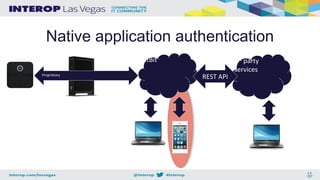
Native application authentication
FitBit 3rd
party
services
REST APIProprietary
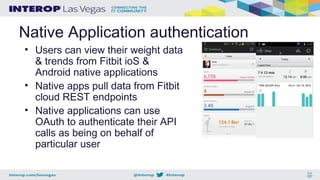
Native Application authentication
• Users can view their weight data
& trends from Fitbit ioS &
Android native applications
• Native apps pull data from Fitbit
cloud REST endpoints
• Native applications can use
OAuth to authenticate their API
calls as being on behalf of
particular user
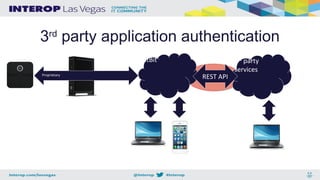
3rd
party application authentication
FitBit 3rd
party
services
REST APIProprietary
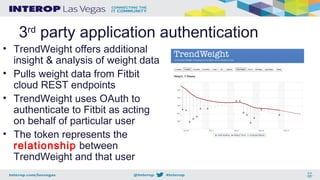
3rd
party application authentication
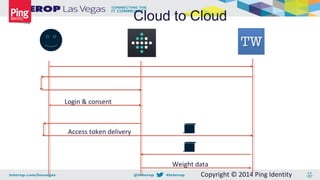
• TrendWeight offers additional
insight & analysis of weight data
• Pulls weight data from Fitbit
cloud REST endpoints
• TrendWeight uses OAuth to
authenticate to Fitbit as acting
on behalf of particular user
• The token represents the
relationship between
TrendWeight and that user
Cloud to Cloud
Copyright © 2014 Ping Identity
Login & consent
Weight data
Login & consent
Weight data
Access token delivery
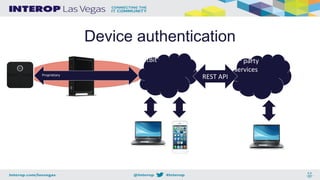
Device authentication
FitBit 3rd
party
services
REST APIProprietary
Copyright © 2014 Ping Identity
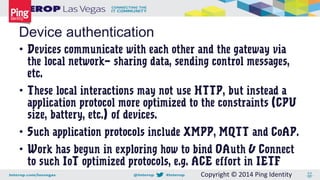
• Devices communicate with each other and the gateway via
the local network— sharing data, sending control messages,
etc.
• These local interactions may not use HTTP, but instead a
application protocol more optimized to the constraints (CPU
size, battery, etc.) of devices.
• Such application protocols include XMPP, MQTT and CoAP.
• Work has begun in exploring how to bind OAuth & Connect
to such IoT optimized protocols, e.g. ACE effort in IETF
Device authentication
Security & privacy requirements
• Confidentiality
• Integrity
• Authentication
• Transparency
• Intervenability
• Unlinkability
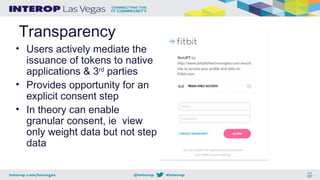
Transparency
• Users actively mediate the
issuance of tokens to native
applications & 3rd
parties
• Provides opportunity for an
explicit consent step
• In theory can enable
granular consent, ie view
only weight data but not step
data
Security & privacy requirements
• Confidentiality
• Integrity
• Authentication
• Transparency
• Intervenability
• Unlinkability
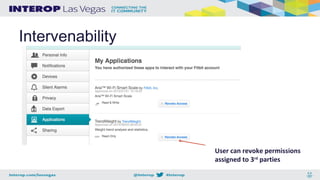
Intervenability
User can revoke permissions
assigned to 3rd
parties
Security & privacy requirements
• Confidentiality
• Integrity
• Authentication
• Transparency
• Intervenability
• Unlinkability
Unlinkability
• Authenticating to Fitbit or sharing weight data to
3rd
party services should not directly enable
inappropriate correlation at some other party ,
eg Facebook
• Linkages must be explicit and consensual, as in
that established between FitBit & TrendWeight
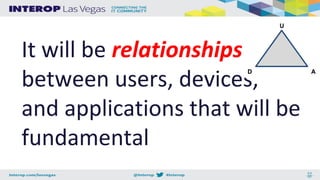
It will be relationships
between users, devices,
and applications that will be
fundamental
THANKS
Conclusion
• Authentication & authorization of actors is
fundamental to enabling IoT security & privacy
• Mechanisms must be secure, scalable and privacy
respecting
• OAuth & Connect promise to provide important
pieces of authentication & authorization framework
for IoT

Identity-Defined Privacay & Security for Internet of Things

  • 1.
    Identity- defined Privacy& Security for the Internet of Things Paul Madsen @paulmadsen Ping Identity
  • 2.
  • 3.
    The Internet ofThings connects people and physical objects together through applications
  • 4.
    What’s driving IoT •The sensor legacy. Sensors and remote monitoring tools have existed for decades, in a field known as machine-to-machine (M2M) communications, monitoring, and control. • Broadening connectivity. Mainstreaming of home wifi, 4G mobile, low-power wireless standards such as Bluetooth and ZigBee are enabling just about everything to be connected together. • The cloud and big data. Cloud computing and big data allow the massive data created by things to be sifted, processed, and acted upon • APIs.  Distributed, loosely coupled, transactional approaches in software design are allowing things to exist and communicate autonomously alongside internet-based services
  • 5.
    Market • Market sizefor IoT will be $290 billion by 2017, and growing at 30 percent per year (MarketsandMarkets) • 31 billion internet-connected devices will exist by 2020 (Intel) • A family of four will move from having 10 connected devices in 2012 to 25 in 2017 to 50 in 2022 (Intel)
  • 6.
    Privacy & SecurityChallenge Most of the devices in the Internet of Things will be used in two broad areas: – Critical Infrastructure - power production/generation/distribution, manufacturing, transportation, etc. – Personal "infrastructure" - personal medical devices, automobiles, home entertainment and device control, wearables, etc Demands security Demands privacy
  • 7.
    Users surprised & disappointed Security breach Providersurprised & disappointed Privacy breach
  • 8.
    Security requirements • Confidentiality.Protecting data from being inappropriately accessed by unauthorized actors. Often manifests in authorization policies & encryption • Integrity protecting data or methods from modification or deletion by unauthorized parties. Often manifests in digital signatures • Authentication. Verifying the identities of actors as they interact with each other to ensure that malicious parties are not given inappropriate permissions
  • 9.
    Security challenges ofthe IoT • Life and death implications • Scale • Heterogeneity • Storage, processing, and connectivity constraints • Usability implications of screenless devices • Complex relationships between users & devices • Implications of gateways for end-to-end security
  • 10.
    Privacy requirements • Transparencyhelps people understand who knows what about them — give people information on how their data is to be used, with whom it is shared with; how long is it held; etc • Intervenability is the ability for users to view, change, correct, block, revoke consent, and delete personal data stored by providers & applications. • Unlinkability is about the separation of informational contexts, such as work, personal, family, citizen, and social. It’s about preventing undesired linkages across different contexts.
  • 11.
  • 12.
    Authentication & AuthorizationModel • IoT Actors authenticate by presenting security tokens on their calls/messages to each other • Tokens represent relationship between the relevant user and the calling actor (and any consents/permissions associated with that relationship • Upon receiving a message, an actor validates the token to verify the request is consistent with the relationship/permissions • If consent is removed, token is revoked, and access disabled
  • 13.
    OAuth 2.0 &OpenId Connect 1.0 • OAuth 2.0 is an IETF authentication & authorization framework for securing application access to RESTful APIs • OAuth allows a Client to send an API query to a Resource Server (RS), the application hosting the desired information, such that the RS can authenticate that the message was indeed sent by the Client. • The Client authenticates to the RS through the inclusion of an access token on its API call—a token previously provided to the Client by an Authorization Server (AS). • In those scenarios that the API in question protects access to a User’s identity attributes, it may be the case that the access token will only be issued by the AS after the User has explicitly given consent to the Client accessing those attributes. • OpenID Connect 1.0 profiles and extends OAuth 2.0 to add an identity layer— creating a single framework that promises to secure APIs, mobile native applications and browser applications in a single, cohesive architecture.
  • 14.
    Representative IoT architecture •Fitbit makes the Aria smart scale • Scale syncs through home Wifi to Fitbit cloud for display & analysis through web & native applications • 3rd party services can access weight data to provide additional analysis
  • 15.
  • 16.
  • 17.
  • 18.
    Security & privacyrequirements • Confidentiality • Integrity • Authentication • Transparency • Intervenability • Unlinkability
  • 19.
    Security & privacyrequirements • Confidentiality • Integrity • Authentication • Transparency • Intervenability • Unlinkability
  • 20.
    Confidentiality & Integrity •Weight data must be secured both on servers & in-transit – Encryption & access control ensures confidentiality on Fitbit & 3rd party servers – TLS ensures confidentiality in-transit – TLS protects against modifications in-transit • Both OAuth & Connect mandate TLS for over- the-network messages
  • 21.
    Security & privacyrequirements • Confidentiality • Integrity • Authentication • Transparency • Intervenability • Unlinkability
  • 22.
    Native application authentication FitBit3rd party services REST APIProprietary
  • 23.
    Native Application authentication •Users can view their weight data & trends from Fitbit ioS & Android native applications • Native apps pull data from Fitbit cloud REST endpoints • Native applications can use OAuth to authenticate their API calls as being on behalf of particular user
  • 24.
    3rd party application authentication FitBit3rd party services REST APIProprietary
  • 25.
    3rd party application authentication •TrendWeight offers additional insight & analysis of weight data • Pulls weight data from Fitbit cloud REST endpoints • TrendWeight uses OAuth to authenticate to Fitbit as acting on behalf of particular user • The token represents the relationship between TrendWeight and that user
  • 26.
    Cloud to Cloud Copyright© 2014 Ping Identity Login & consent Weight data Login & consent Weight data Access token delivery
  • 27.
  • 28.
    Copyright © 2014Ping Identity • Devices communicate with each other and the gateway via the local network— sharing data, sending control messages, etc. • These local interactions may not use HTTP, but instead a application protocol more optimized to the constraints (CPU size, battery, etc.) of devices. • Such application protocols include XMPP, MQTT and CoAP. • Work has begun in exploring how to bind OAuth & Connect to such IoT optimized protocols, e.g. ACE effort in IETF Device authentication
  • 29.
    Security & privacyrequirements • Confidentiality • Integrity • Authentication • Transparency • Intervenability • Unlinkability
  • 30.
    Transparency • Users activelymediate the issuance of tokens to native applications & 3rd parties • Provides opportunity for an explicit consent step • In theory can enable granular consent, ie view only weight data but not step data
  • 31.
    Security & privacyrequirements • Confidentiality • Integrity • Authentication • Transparency • Intervenability • Unlinkability
  • 32.
    Intervenability User can revokepermissions assigned to 3rd parties
  • 33.
    Security & privacyrequirements • Confidentiality • Integrity • Authentication • Transparency • Intervenability • Unlinkability
  • 34.
    Unlinkability • Authenticating toFitbit or sharing weight data to 3rd party services should not directly enable inappropriate correlation at some other party , eg Facebook • Linkages must be explicit and consensual, as in that established between FitBit & TrendWeight
  • 35.
    It will berelationships between users, devices, and applications that will be fundamental
  • 37.
  • 38.
    Conclusion • Authentication &authorization of actors is fundamental to enabling IoT security & privacy • Mechanisms must be secure, scalable and privacy respecting • OAuth & Connect promise to provide important pieces of authentication & authorization framework for IoT