



CONNECTING THE REAL
WORLD WITH THE VIRTUAL
WORLD
The Identity of Things
EIC May 15, 2014
Hans Zandbelt – CTO Office – Ping Identity
Copyright © 2014 Ping Identity Corp. All rights reserved.
1
Overview
1
• Internet- & Identity of Things
2
• Infrastructure & Protocols
3
• Now what?
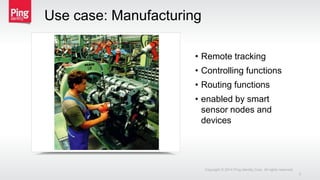
• Remote tracking
• Controlling functions
• Routing functions
• enabled by smart
sensor nodes and
devices
Use case: Manufacturing
Copyright © 2014 Ping Identity Corp. All rights reserved.
3
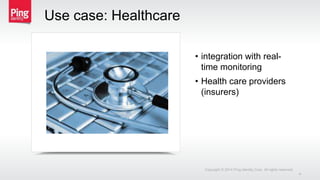
• integration with real-
time monitoring
• Health care providers
(insurers)
Use case: Healthcare
Copyright © 2014 Ping Identity Corp. All rights reserved.
4
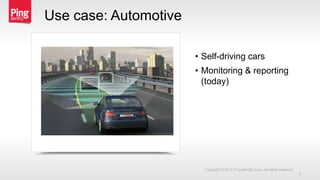
• Self-driving cars
• Monitoring & reporting
(today)
Use case: Automotive
Copyright © 2014 Ping Identity Corp. All rights reserved.
5
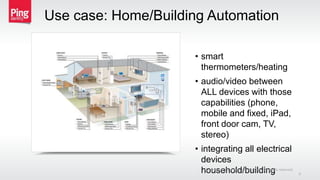
• smart
thermometers/heating
• audio/video between
ALL devices with those
capabilities (phone,
mobile and fixed, iPad,
front door cam, TV,
stereo)
• integrating all electrical
devices
household/building
Use case: Home/Building Automation
Copyright © 2014 Ping Identity Corp. All rights reserved.
6
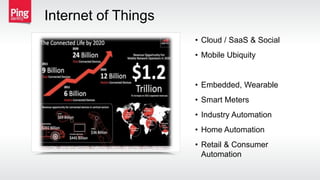
• Cloud / SaaS & Social
• Mobile Ubiquity
• Embedded, Wearable
• Smart Meters
• Industry Automation
• Home Automation
• Retail & Consumer
Automation
Internet of Things
• Security Scalability
– Access & Account
Mgmt
• Discovery, Identification &
Authentication
– Devices & Clients
– Services & Servers
– Users
• Passwords … NOOO!!
Challenges
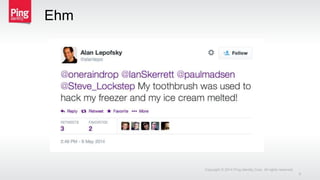
Ehm
Copyright © 2014 Ping Identity Corp. All rights reserved.
9
INFRASTRUCTURE
Building the identity-enabled internet of everything
Consequence
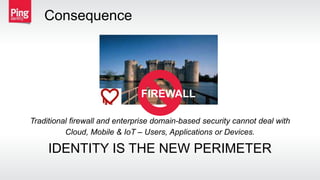
Traditional firewall and enterprise domain-based security cannot deal with
Cloud, Mobile & IoT – Users, Applications or Devices.
IDENTITY IS THE NEW PERIMETER
FIREWALL
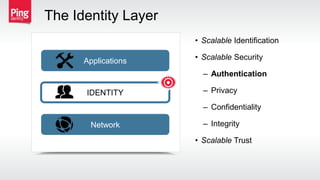
Network
Applications
IDENTITY

• Scalable Identification
• Scalable Security
– Authentication
– Privacy
– Confidentiality
– Integrity
• Scalable Trust
The Identity Layer
PROTOCOLS
Realizing the Identiverse and IoT infrastructure
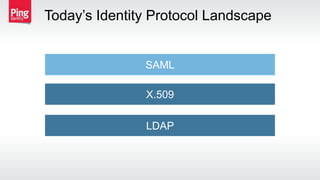
Today’s Identity Protocol Landscape
SAML
LDAP
X.509
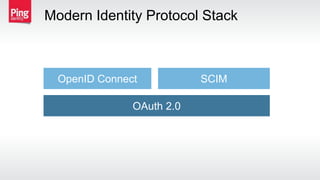
Modern Identity Protocol Stack
OpenID Connect SCIM
OAuth 2.0
OAUTH 2.0
A 30,000 feet overview
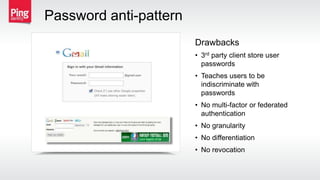
• 3rd party client store user
passwords
• Teaches users to be
indiscriminate with
passwords
• No multi-factor or federated
authentication
• No granularity
• No differentiation
• No revocation
Drawbacks
Password anti-pattern
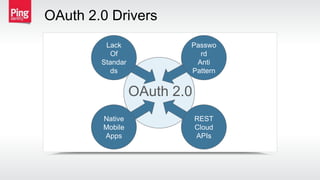
OAuth 2.0 Drivers
Lack
Of
Standar
ds
Passwo
rd
Anti
Pattern
Native
Mobile
Apps
REST
Cloud
APIs
OAuth 2.0
• Secure API authorization
– simple & standard,
secure-enough (Bearer)
– for desktop, mobile, web,
IoT
• Delegated access
– mitigates password anti-
pattern
• Issue tokens for granular
access
– Without divulging your
credentials
Characteristics
OAuth 2.0 Protocol Framework
Open Redirect somewhere
in RP website
+
RP website uses federated
SSO for user login
+
SSO Token callback from
IDP to website is
configurable
=>
Assume the following
Intermezzo: Covert Redirect
Lesson: don’t forward messages that
were meant for you to anyone else…
CONCLUSIONS
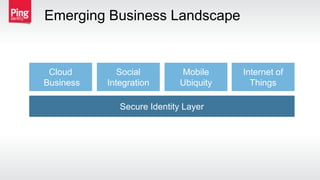
Emerging Business Landscape
Cloud
Business
Mobile
Ubiquity
Social
Integration
Internet of
Things
Secure Identity Layer
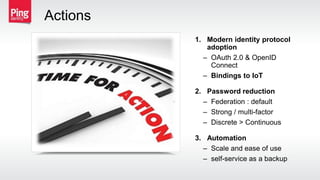
1. Modern identity protocol
adoption
– OAuth 2.0 & OpenID
Connect
– Bindings to IoT
2. Password reduction
– Federation : default
– Strong / multi-factor
– Discrete > Continuous
3. Automation
– Scale and ease of use
– self-service as a backup
Actions
• IoT
– Scale
– Security
– Standards
• Identity Platform
– Spanning Cloud and IoT
– Identity Function APIs
– Multi-protocol
• Don’t Panic
– Let’s Start Moving Today
Summary
Thank You
http://www.pingidentity.com
Hans Zandbelt
hzandbelt@pingidentity.com
Twitter: @hanszandbelt
Ping Identity
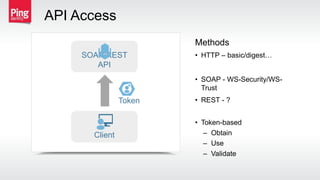
Client
SOAP/REST
API
• HTTP – basic/digest…
• SOAP - WS-Security/WS-
Trust
• REST - ?
• Token-based
– Obtain
– Use
– Validate
Methods
API Access
Token
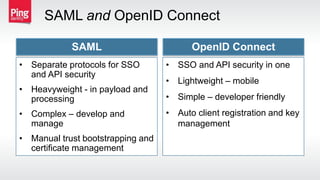
• Separate protocols for SSO
and API security
• Heavyweight - in payload and
processing
• Complex – develop and
manage
• Manual trust bootstrapping and
certificate management
• SSO and API security in one
• Lightweight – mobile
• Simple – developer friendly
• Auto client registration and key
management
SAML and OpenID Connect
SAML OpenID Connect

Connecting The Real World With The Virtual World

Editor's Notes

  • #18 Deprecated way of dealing with API access: hand out your password to a client or third party service. Bad: store pwd, indiscriminate, no multi-factor, no granularity, no differentation, no revocation. Need something better.
  • #20 Enter Oauth 2.0: a protocol for secure API authorization. Simple standard or framework, based on REST and JSON, meant for the mobile web world. Delegated authorization, tokens are issued, obtained and used to mitigate the anti-password pattern. Granular, revokable access to specified parties, without exposing your credentials.
  • #27 How would you secure web apis: SOAP: WS-Security REST: nothing there yet until recently. Only passwords. What we need is a token based method to access APIs: will explain in the next slide.