Disclaimer: This presentation is prepared by trainees of
baabtra as a part of mentoring program. This is not official
document of baabtra –Mentoring Partner
Baabtra-Mentoring Partner is the mentoring division of baabte System Technologies Pvt .
Ltd
Anomalies in Database
Name
@abhishekmenon121989@gmail
.com
www.facebook.com/
Abhishek H menon
twitter.com/Abhishek H
Menon
in.linkedin.com/in/Abhishek
H menon
Anomaly
Normalization is a technique for producing
relational schema with the following
properties.
• no information redundancy.
• no anomalies.
so we are clear when the process of reducing
the anomaly comes into action.
What is an Anomaly?
• Definition
– Problems that can occur in poorly planned, un-
normalized databases where all the data is stored
in one table (a flat-file database).
Types of Anomalies
• Insert
• Delete
• Update
Insert Anomaly
• An Insert Anomaly occurs when certain
attributes cannot be inserted into the
database without the presence of other
attributes.
Insert Anomaly
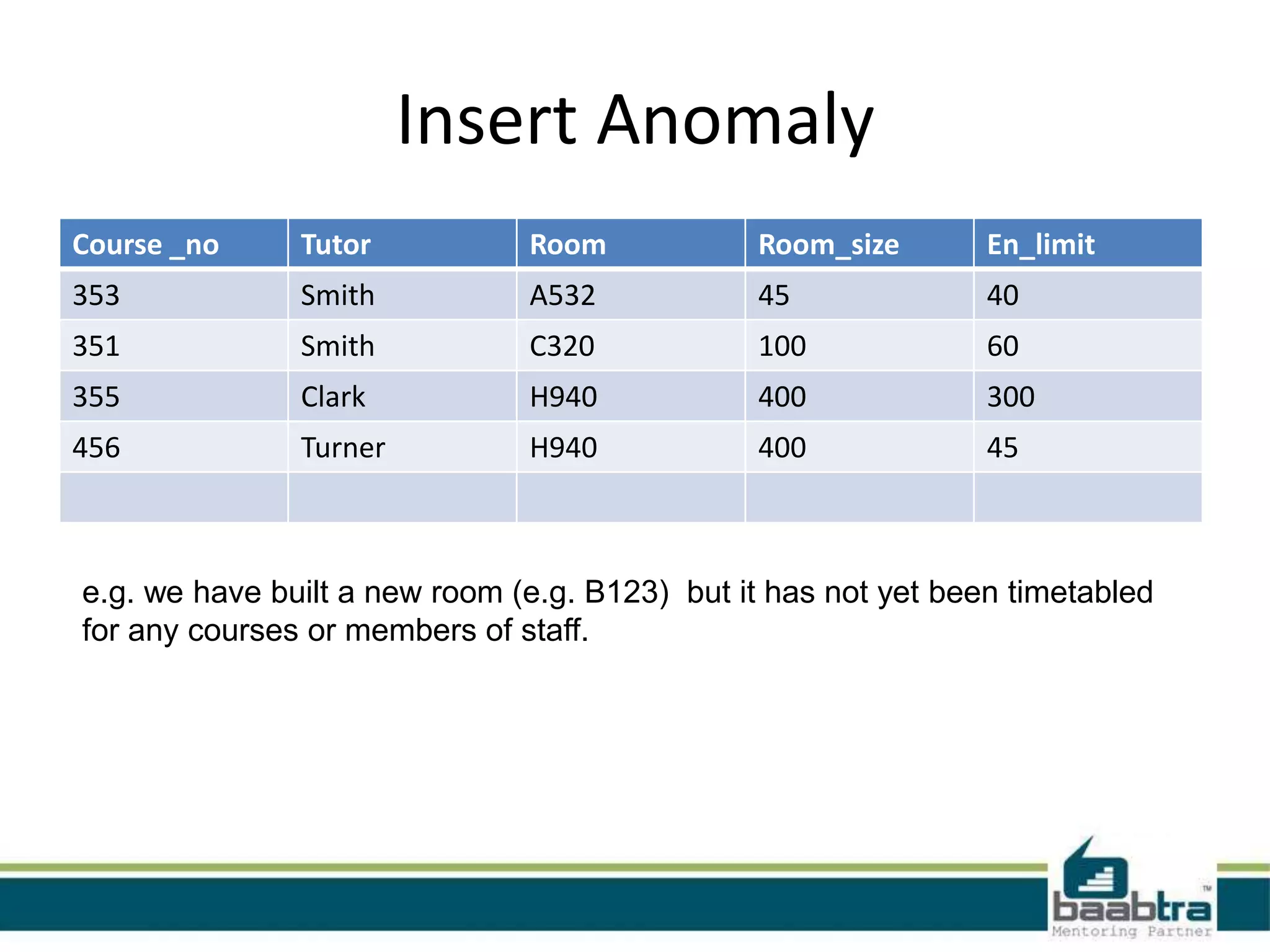
Course _no Tutor Room Room_size En_limit
353 Smith A532 45 40
351 Smith C320 100 60
355 Clark H940 400 300
456 Turner H940 400 45
e.g. we have built a new room (e.g. B123) but it has not yet been timetabled
for any courses or members of staff.
Delete Anomaly
• A Delete Anomaly exists when certain
attributes are lost because of the deletion of
other attributes.
Delete Anomaly
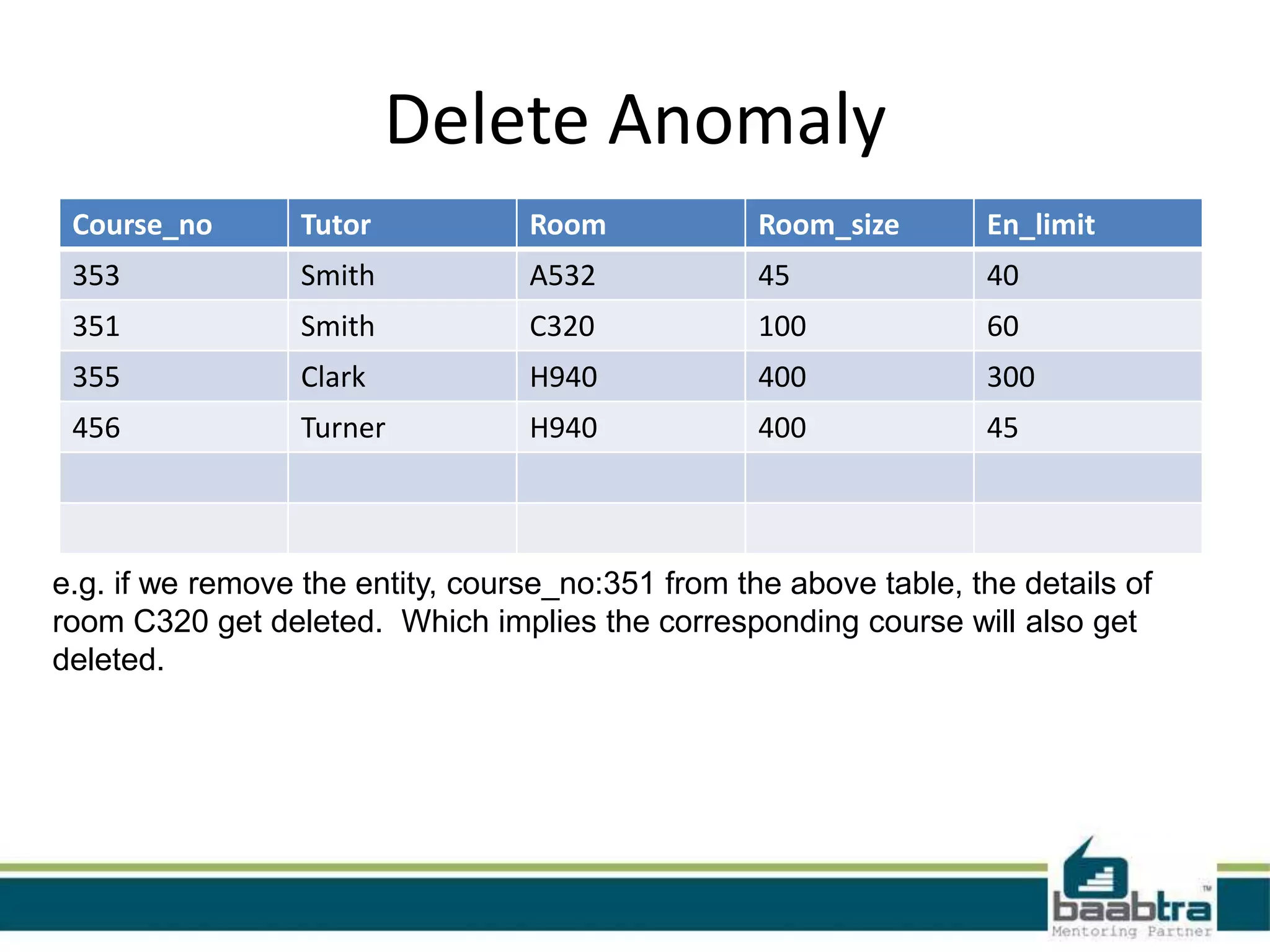
Course_no Tutor Room Room_size En_limit
353 Smith A532 45 40
351 Smith C320 100 60
355 Clark H940 400 300
456 Turner H940 400 45
e.g. if we remove the entity, course_no:351 from the above table, the details of
room C320 get deleted. Which implies the corresponding course will also get
deleted.
Update Anomaly
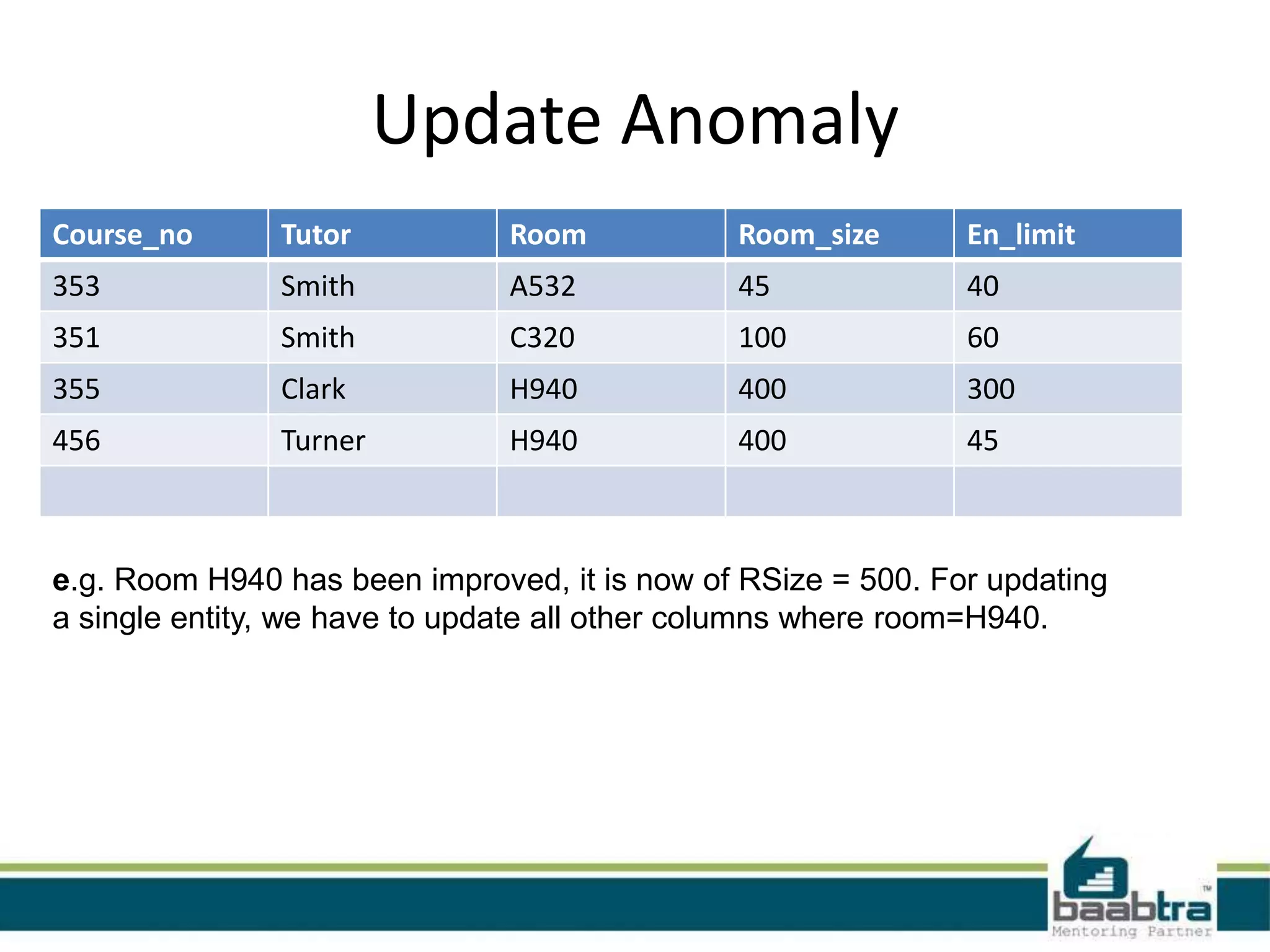
• An Update Anomaly exists when one or more
instances of duplicated data is updated, but
not all.
Update Anomaly
Course_no Tutor Room Room_size En_limit
353 Smith A532 45 40
351 Smith C320 100 60
355 Clark H940 400 300
456 Turner H940 400 45
e.g. Room H940 has been improved, it is now of RSize = 500. For updating
a single entity, we have to update all other columns where room=H940.
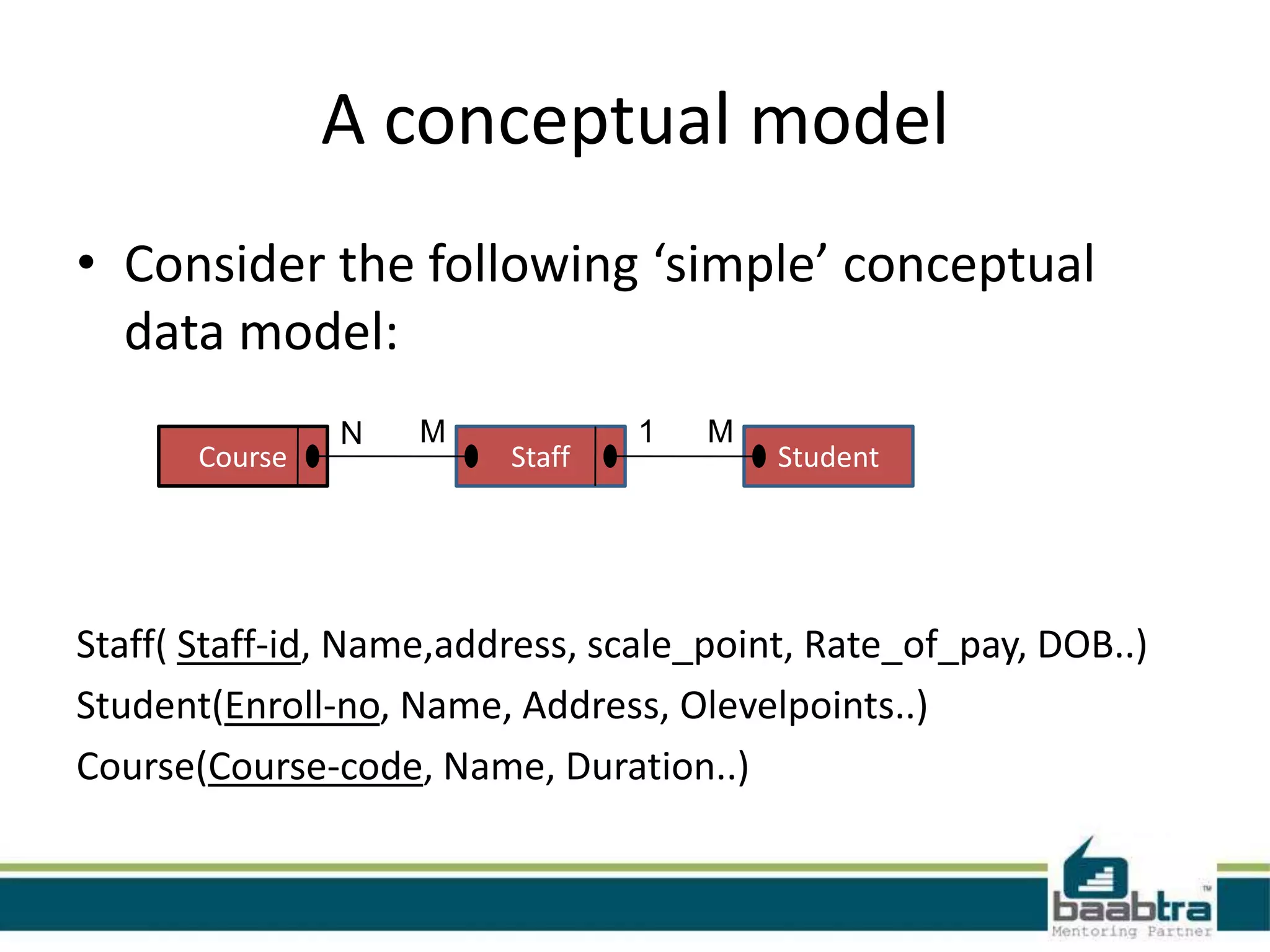
A conceptual model
• Consider the following ‘simple’ conceptual
data model:
Staff( Staff-id, Name,address, scale_point, Rate_of_pay, DOB..)
Student(Enroll-no, Name, Address, Olevelpoints..)
Course(Course-code, Name, Duration..)
Course StudentStaff
M M1N
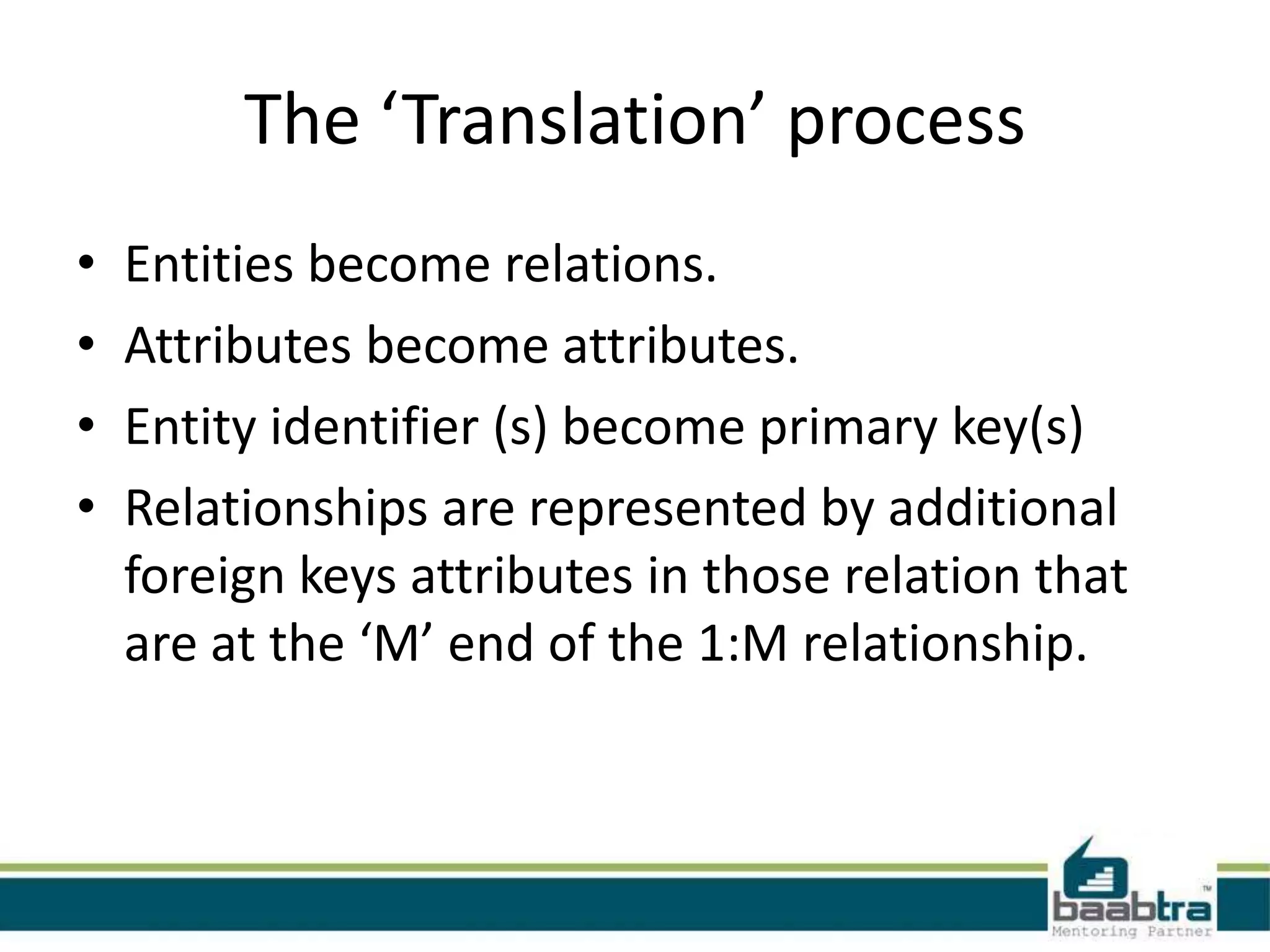
The ‘Translation’ process
• Entities become relations.
• Attributes become attributes.
• Entity identifier (s) become primary key(s)
• Relationships are represented by additional
foreign keys attributes in those relation that
are at the ‘M’ end of the 1:M relationship.
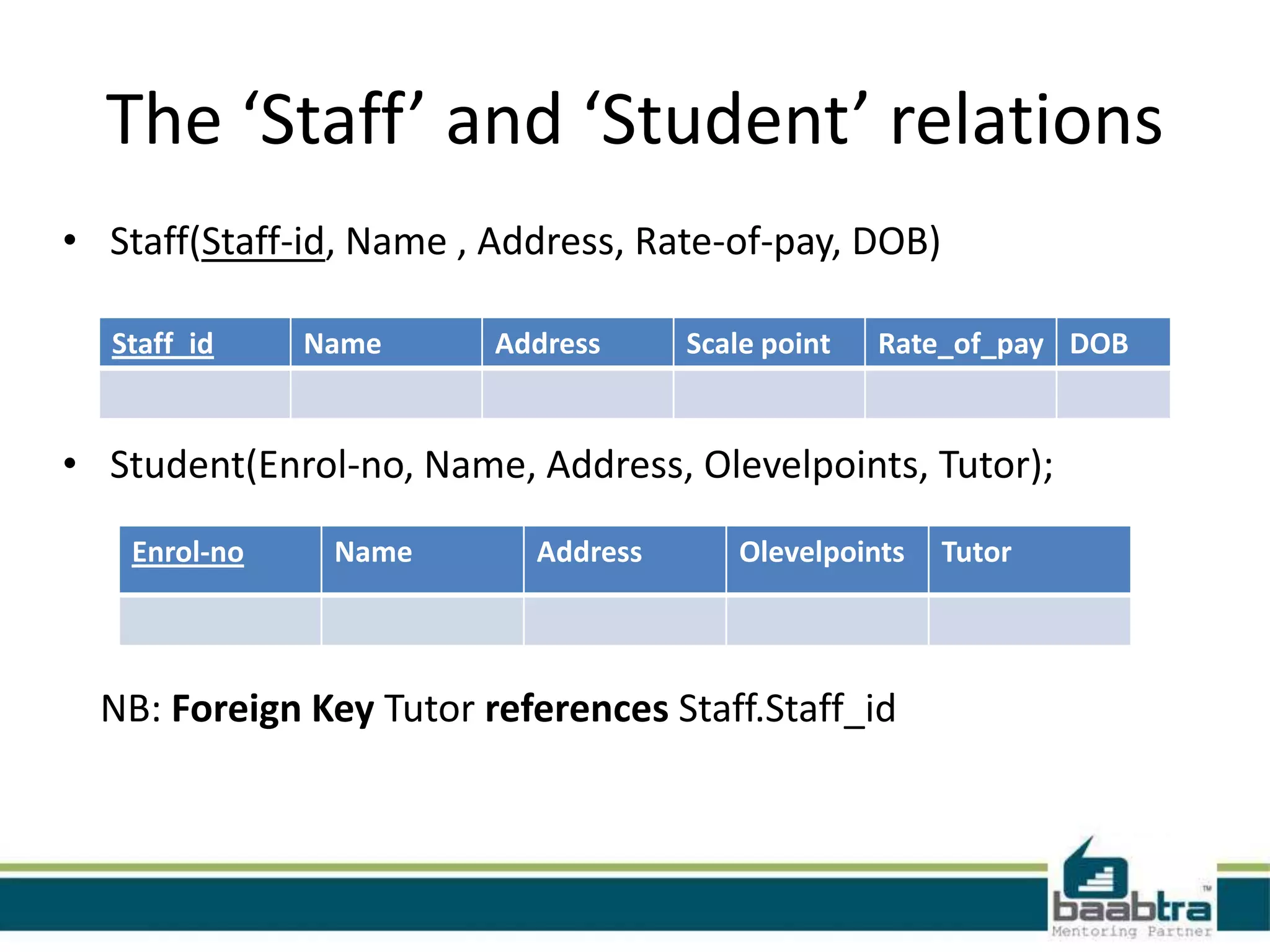
The ‘Staff’ and ‘Student’ relations
• Staff(Staff-id, Name , Address, Rate-of-pay, DOB)
• Student(Enrol-no, Name, Address, Olevelpoints, Tutor);
NB: Foreign Key Tutor references Staff.Staff_id
Staff_id Name Address Scale point Rate_of_pay DOB
Enrol-no Name Address Olevelpoints Tutor
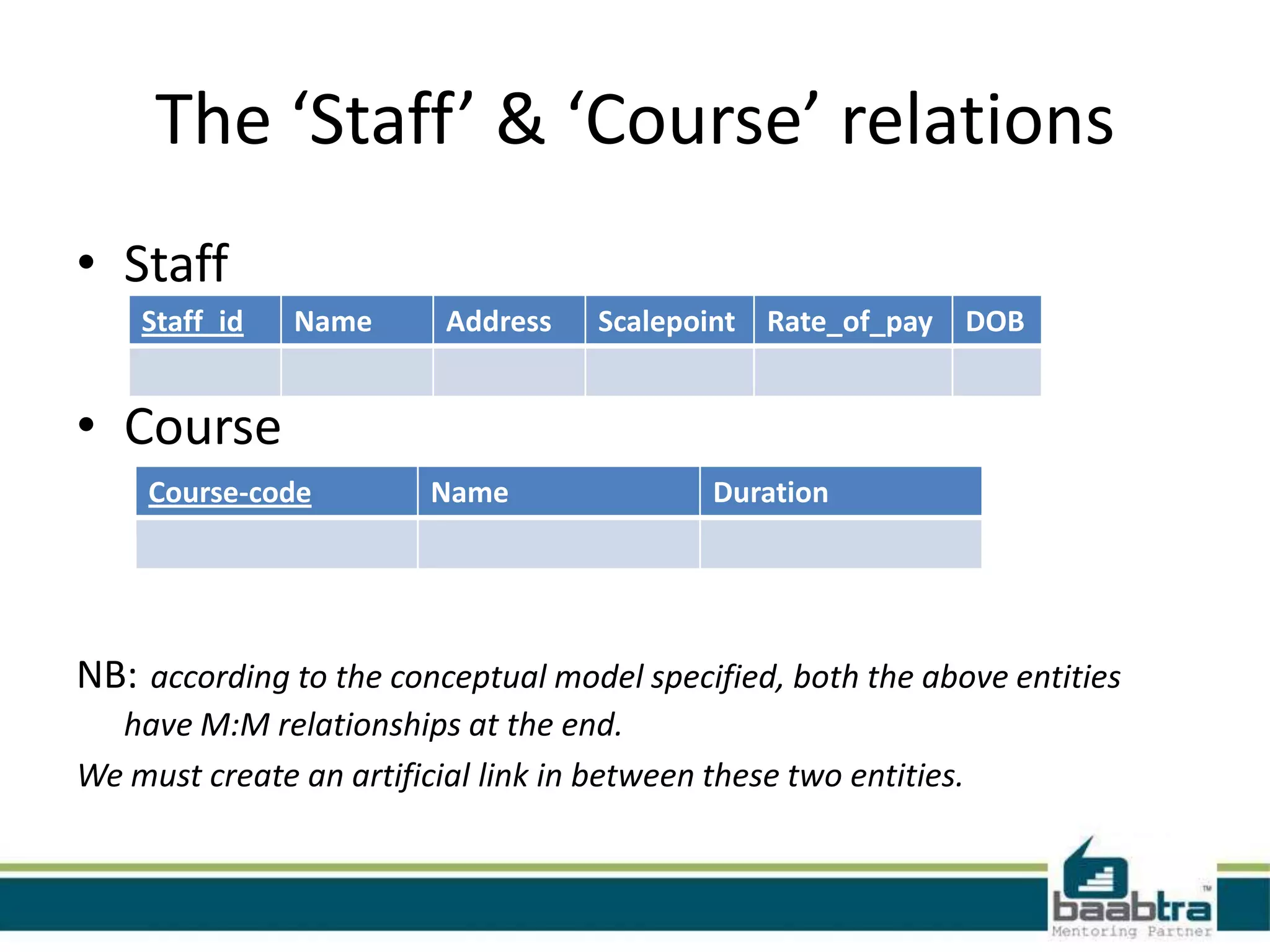
The ‘Staff’ & ‘Course’ relations
• Staff
• Course
NB: according to the conceptual model specified, both the above entities
have M:M relationships at the end.
We must create an artificial link in between these two entities.
Staff_id Name Address Scalepoint Rate_of_pay DOB
Course-code Name Duration
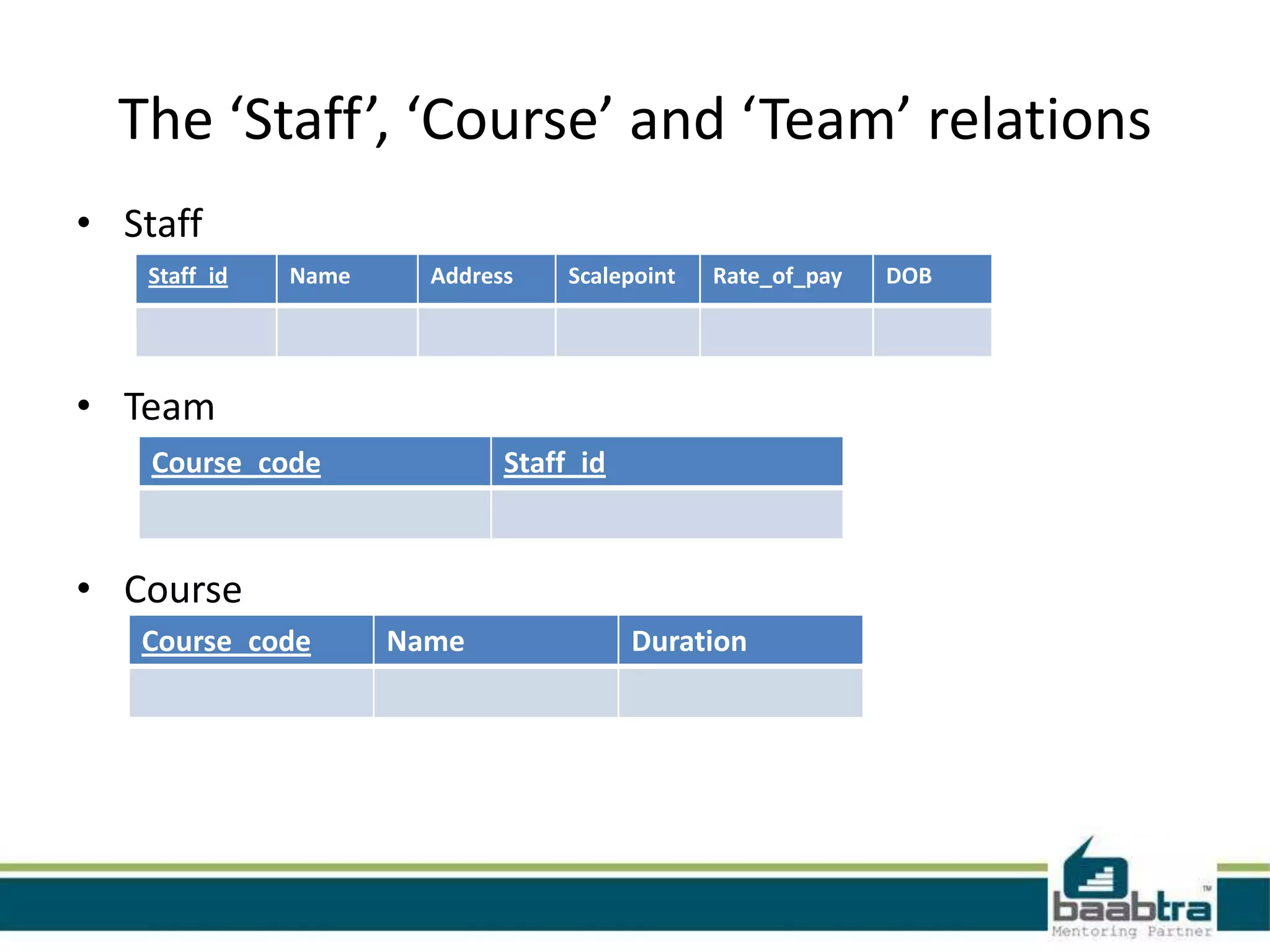
The ‘Staff’, ‘Course’ and ‘Team’ relations
• Staff
• Team
• Course
Staff_id Name Address Scalepoint Rate_of_pay DOB
Course_code Staff_id
Course_code Name Duration
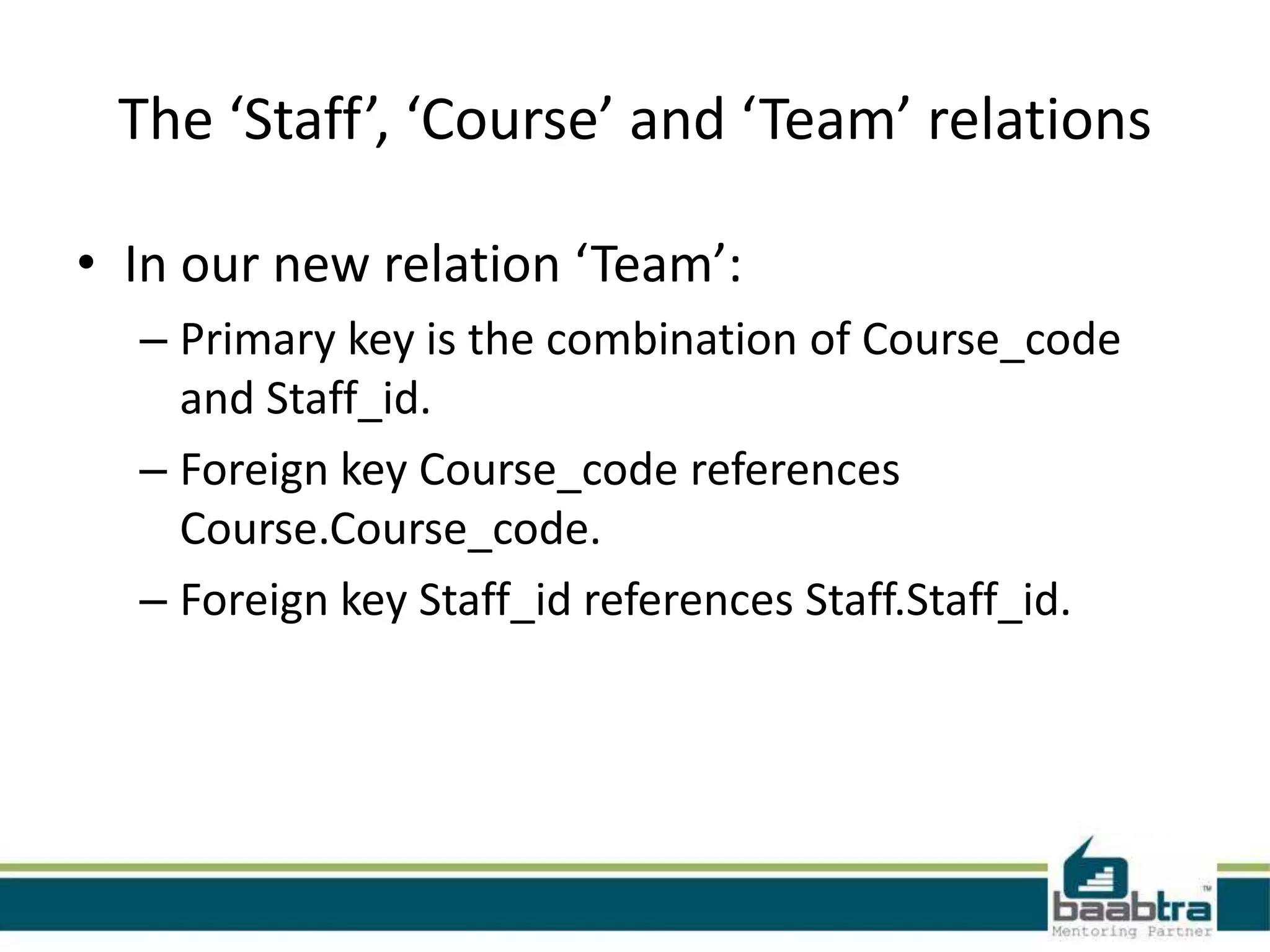
The ‘Staff’, ‘Course’ and ‘Team’ relations
• In our new relation ‘Team’:
– Primary key is the combination of Course_code
and Staff_id.
– Foreign key Course_code references
Course.Course_code.
– Foreign key Staff_id references Staff.Staff_id.
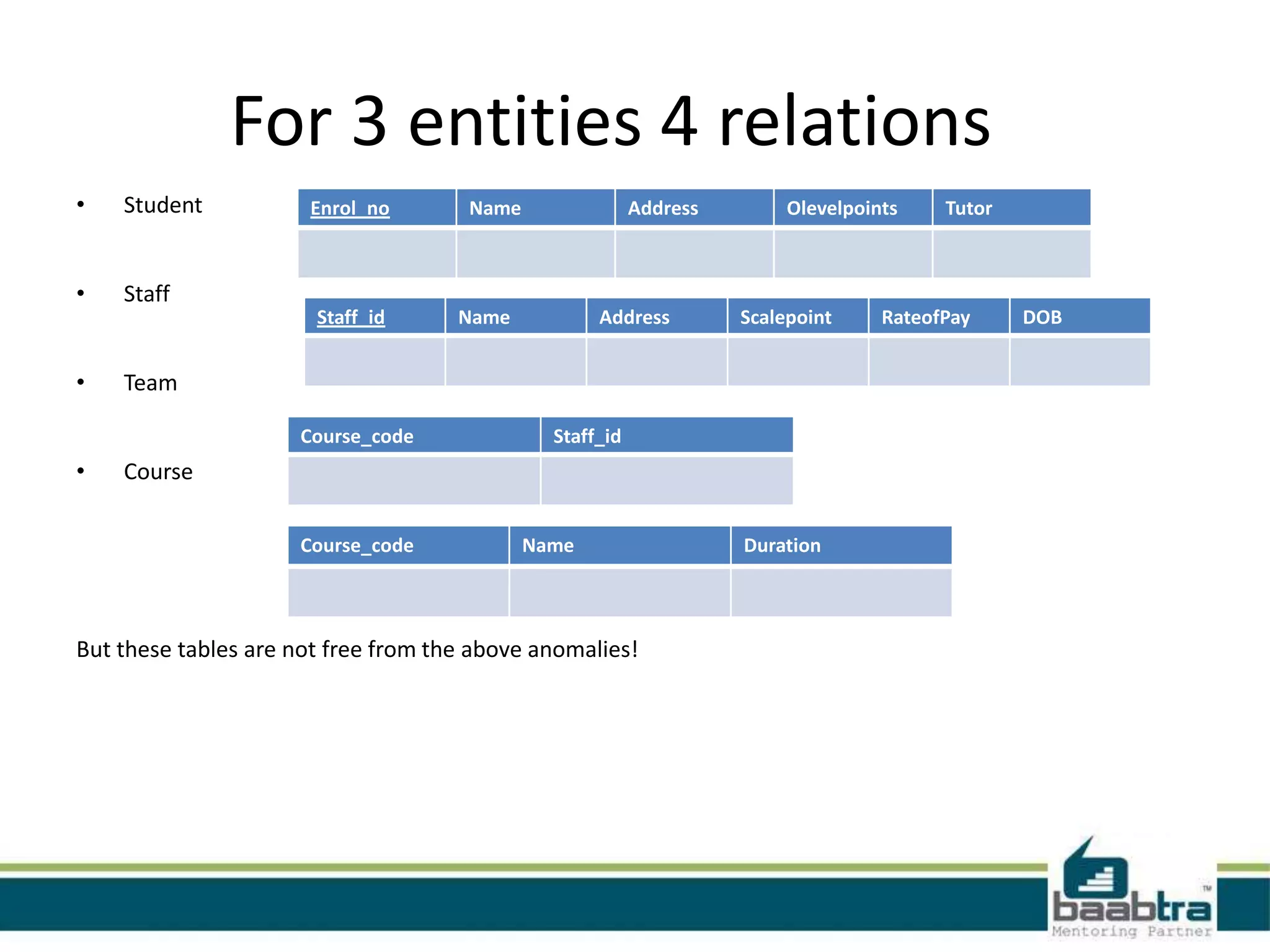
For 3 entities 4 relations
• Student
• Staff
• Team
• Course
But these tables are not free from the above anomalies!
Enrol_no Name Address Olevelpoints Tutor
Staff_id Name Address Scalepoint RateofPay DOB
Course_code Staff_id
Course_code Name Duration
Checking for anomalies
• every tuple unique?
• no hidden meaning from location?
• data cells atomic?
• For relations with single_attribute keys:
– every attribute depends upon the primary key
• For relations with composite keys:
– Every attribute depends upon the whole key(the
components of this key are prime attributes?)
Relation fails
• Especially when we check dependency between
various attributes in a relationship.
• So we must split that relation into two relations.
• And we should create a foreign key in the new table
which references the primary key in the old table.
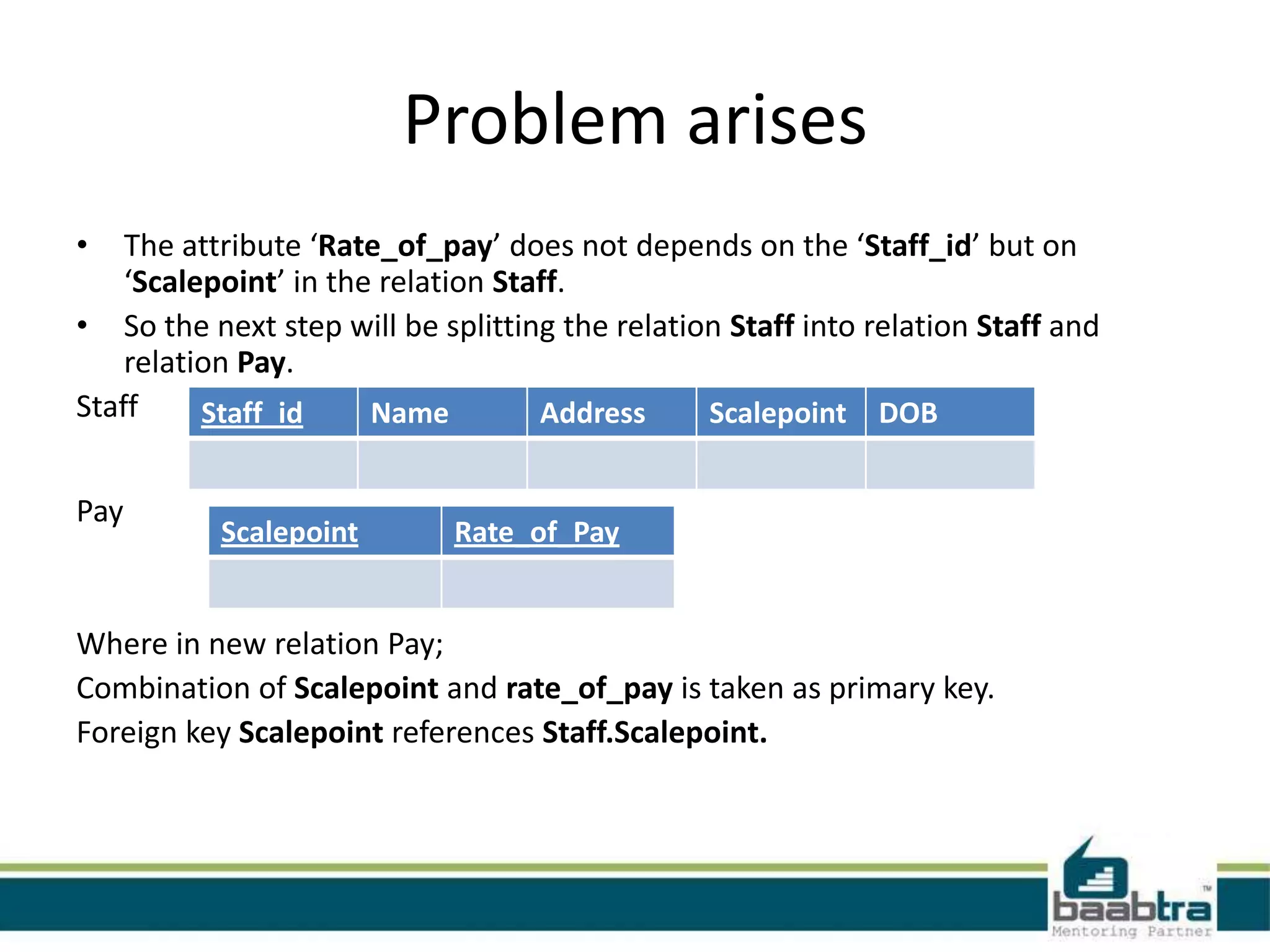
Problem arises
• The attribute ‘Rate_of_pay’ does not depends on the ‘Staff_id’ but on
‘Scalepoint’ in the relation Staff.
• So the next step will be splitting the relation Staff into relation Staff and
relation Pay.
Staff
Pay
Where in new relation Pay;
Combination of Scalepoint and rate_of_pay is taken as primary key.
Foreign key Scalepoint references Staff.Scalepoint.
Staff_id Name Address Scalepoint DOB
Scalepoint Rate_of_Pay
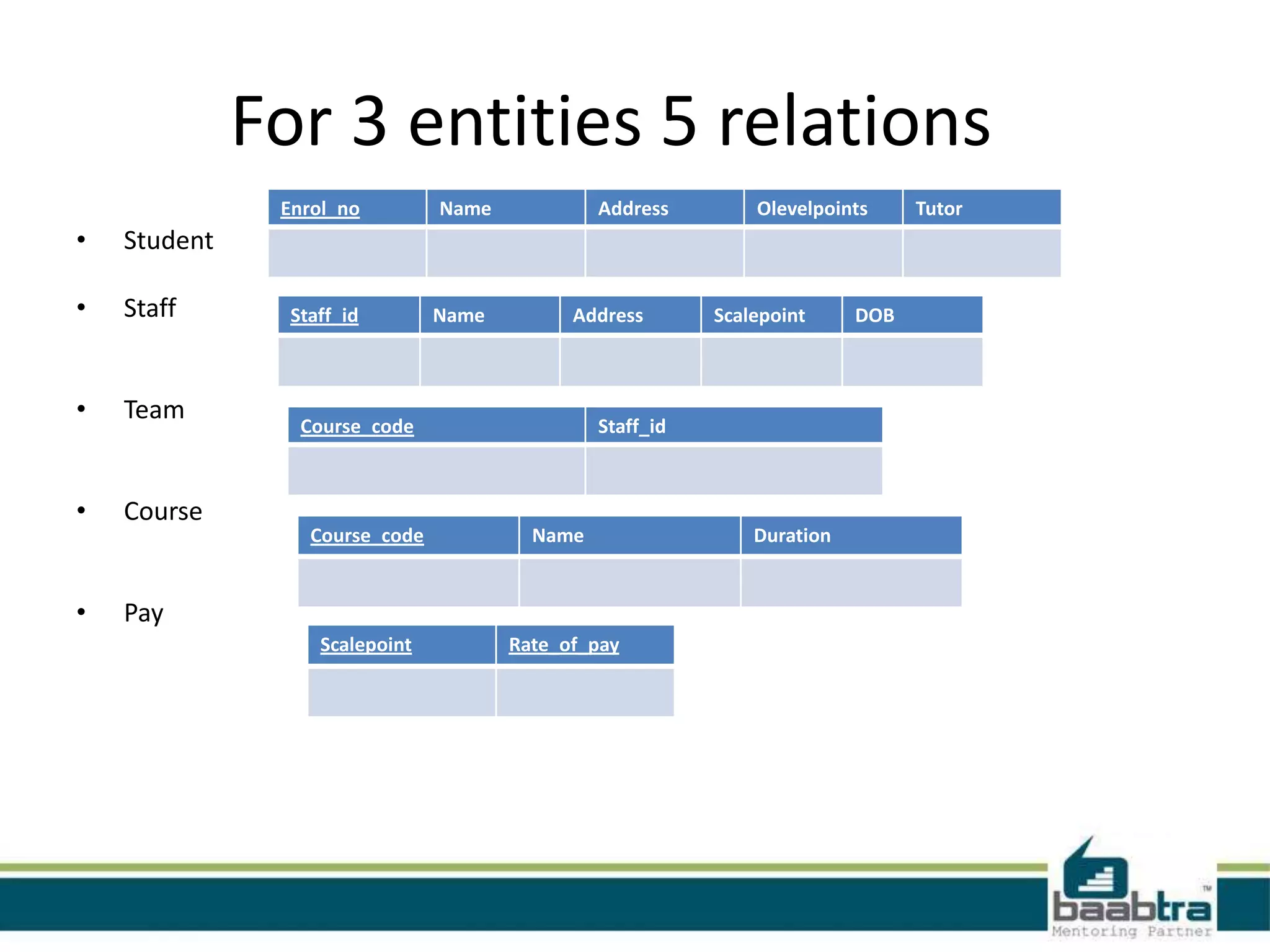
For 3 entities 5 relations
• Student
• Staff
• Team
• Course
• Pay
Enrol_no Name Address Olevelpoints Tutor
Staff_id Name Address Scalepoint DOB
Course_code Staff_id
Course_code Name Duration
Scalepoint Rate_of_pay
If this presentation helped you, please visit our
page facebook.com/baabtra and like it.
Thanks in advance.
www.baabtra.com | www.massbaab.com |www.baabte.com
Contact Us

Anomalies in database

  • 2.
    Disclaimer: This presentationis prepared by trainees of baabtra as a part of mentoring program. This is not official document of baabtra –Mentoring Partner Baabtra-Mentoring Partner is the mentoring division of baabte System Technologies Pvt . Ltd
  • 3.
    Anomalies in Database Name @abhishekmenon121989@gmail .com www.facebook.com/ AbhishekH menon twitter.com/Abhishek H Menon in.linkedin.com/in/Abhishek H menon
  • 4.
    Anomaly Normalization is atechnique for producing relational schema with the following properties. • no information redundancy. • no anomalies. so we are clear when the process of reducing the anomaly comes into action.
  • 5.
    What is anAnomaly? • Definition – Problems that can occur in poorly planned, un- normalized databases where all the data is stored in one table (a flat-file database).
  • 6.
    Types of Anomalies •Insert • Delete • Update
  • 7.
    Insert Anomaly • AnInsert Anomaly occurs when certain attributes cannot be inserted into the database without the presence of other attributes.
  • 8.
    Insert Anomaly Course _noTutor Room Room_size En_limit 353 Smith A532 45 40 351 Smith C320 100 60 355 Clark H940 400 300 456 Turner H940 400 45 e.g. we have built a new room (e.g. B123) but it has not yet been timetabled for any courses or members of staff.
  • 9.
    Delete Anomaly • ADelete Anomaly exists when certain attributes are lost because of the deletion of other attributes.
  • 10.
    Delete Anomaly Course_no TutorRoom Room_size En_limit 353 Smith A532 45 40 351 Smith C320 100 60 355 Clark H940 400 300 456 Turner H940 400 45 e.g. if we remove the entity, course_no:351 from the above table, the details of room C320 get deleted. Which implies the corresponding course will also get deleted.
  • 11.
    Update Anomaly • AnUpdate Anomaly exists when one or more instances of duplicated data is updated, but not all.
  • 12.
    Update Anomaly Course_no TutorRoom Room_size En_limit 353 Smith A532 45 40 351 Smith C320 100 60 355 Clark H940 400 300 456 Turner H940 400 45 e.g. Room H940 has been improved, it is now of RSize = 500. For updating a single entity, we have to update all other columns where room=H940.
  • 13.
    A conceptual model •Consider the following ‘simple’ conceptual data model: Staff( Staff-id, Name,address, scale_point, Rate_of_pay, DOB..) Student(Enroll-no, Name, Address, Olevelpoints..) Course(Course-code, Name, Duration..) Course StudentStaff M M1N
  • 14.
    The ‘Translation’ process •Entities become relations. • Attributes become attributes. • Entity identifier (s) become primary key(s) • Relationships are represented by additional foreign keys attributes in those relation that are at the ‘M’ end of the 1:M relationship.
  • 15.
    The ‘Staff’ and‘Student’ relations • Staff(Staff-id, Name , Address, Rate-of-pay, DOB) • Student(Enrol-no, Name, Address, Olevelpoints, Tutor); NB: Foreign Key Tutor references Staff.Staff_id Staff_id Name Address Scale point Rate_of_pay DOB Enrol-no Name Address Olevelpoints Tutor
  • 16.
    The ‘Staff’ &‘Course’ relations • Staff • Course NB: according to the conceptual model specified, both the above entities have M:M relationships at the end. We must create an artificial link in between these two entities. Staff_id Name Address Scalepoint Rate_of_pay DOB Course-code Name Duration
  • 17.
    The ‘Staff’, ‘Course’and ‘Team’ relations • Staff • Team • Course Staff_id Name Address Scalepoint Rate_of_pay DOB Course_code Staff_id Course_code Name Duration
  • 18.
    The ‘Staff’, ‘Course’and ‘Team’ relations • In our new relation ‘Team’: – Primary key is the combination of Course_code and Staff_id. – Foreign key Course_code references Course.Course_code. – Foreign key Staff_id references Staff.Staff_id.
  • 19.
    For 3 entities4 relations • Student • Staff • Team • Course But these tables are not free from the above anomalies! Enrol_no Name Address Olevelpoints Tutor Staff_id Name Address Scalepoint RateofPay DOB Course_code Staff_id Course_code Name Duration
  • 20.
    Checking for anomalies •every tuple unique? • no hidden meaning from location? • data cells atomic? • For relations with single_attribute keys: – every attribute depends upon the primary key • For relations with composite keys: – Every attribute depends upon the whole key(the components of this key are prime attributes?)
  • 21.
    Relation fails • Especiallywhen we check dependency between various attributes in a relationship. • So we must split that relation into two relations. • And we should create a foreign key in the new table which references the primary key in the old table.
  • 22.
    Problem arises • Theattribute ‘Rate_of_pay’ does not depends on the ‘Staff_id’ but on ‘Scalepoint’ in the relation Staff. • So the next step will be splitting the relation Staff into relation Staff and relation Pay. Staff Pay Where in new relation Pay; Combination of Scalepoint and rate_of_pay is taken as primary key. Foreign key Scalepoint references Staff.Scalepoint. Staff_id Name Address Scalepoint DOB Scalepoint Rate_of_Pay
  • 23.
    For 3 entities5 relations • Student • Staff • Team • Course • Pay Enrol_no Name Address Olevelpoints Tutor Staff_id Name Address Scalepoint DOB Course_code Staff_id Course_code Name Duration Scalepoint Rate_of_pay
  • 24.
    If this presentationhelped you, please visit our page facebook.com/baabtra and like it. Thanks in advance. www.baabtra.com | www.massbaab.com |www.baabte.com
  • 25.