Entity Relationship Modeling

Objectives:
•

To illustrate how relationships between entities are defined and refined.

•

To know how relationships are incorporated into the database design
process.

•

To describe how ERD components affect database design and
implementation.

1
1.0 What is Conceptual Database Design?
• Process of describing the data, relationships
between the data, relationships between the data,
and the constraints on the data.
• After analysis - Gather all the essential data
required and understand how the data are related
• The focus is on the data, rather than on the
processes.
• The output of the conceptual database design is a
Conceptual Data Model ( + Data Dictionary)
2
2.0 Gathering Information for Conceptual Data
Modeling

• Two perspectives
– Top-down
• Data model is derived from an intimate
understanding of the business.

– Bottom-up
• Data model is derived by reviewing specifications
and business documents.

3
2.0 Entity-Relationship (ER) Modeling.
• ER Modeling is a top-down approach to database
design.
• Entity Relationship (ER) Diagram
– A detailed, logical representation of the entities,
associations and data elements for an organization or
business

• Notation uses three main constructs
– Data entities
– Relationships
– Attributes

Chen Model &
Crow’s Foot
Model

4
Chen Notation

Association
between the
instances of one or
more entity types
EntityName

Person, place, object, event
or concept about which data
is to be maintained
Represents a set or collection of
objects in the real world that
share the same properties

Verb Phrase

AttributeName

named property or
characteristic of an
entity
Crow’s Foot Notation

Entity

Attribute

EntityName
EntityName
List of
Attributes

Acceptable

Relationship

Verb phrase
2.1 Entities
• Examples of entities:
–
–
–
–
–

Person: EMPLOYEE, STUDENT, PATIENT
Place: STORE, WAREHOUSE
Object: MACHINE, PRODUCT, CAR
Event: SALE,REGISTRATION, RENEWAL
Concept: ACCOUNT, COURSE

• Guidelines for naming and defining entity types:
–
–
–
–

An entity type name is a singular noun
An entity type should be descriptive and specific
An entity name should be concise
Event entity types should be named for the result of the event, not
the activity or process of the event.

7
2.2 Attributes
• Example of entity types and associated attributes:
STUDENT: Student_ID, Student_Name, Home_Address,
Phone_Number, Major

• Guidelines for naming attributes:
– An attribute name is a noun.

– An attribute name should be unique
– To make an attribute name unique and clear, each attribute name
should follow a standard format
– Similar attributes of different entity types should use similar but
distinguishing names.

8
2.2.1 Identifier Attributes

• Candidate key
– Attribute (or combination of attributes) that uniquely
identifies each instance of an entity type
– Some entities may have more than one candidate key
• Ex: A candidate key for EMPLOYEE is Employee_ID, a second is
the combination of Employee_Name and Address.
• If there is more than one candidate key, need to make a choice.

• Identifier
– A candidate key that has been selected as the unique
identifying characteristic for an entity type

9
2.2.2 Referential Attributes
•

Make Reference to another instance in another table
Referential attribute: Ties the lecturer entity to
another entity that is department.

Name

IdNum

DeptID

Email

Ali

105

LG

ali@a.com

Mary

106

IT

mary@a.com

John

107

ENG

john@a.com

Lim

108

IT

lim@a.com

Instance of Lecturer.

10
Example

Name

Gender

IC

StaffID

Staff

Staff
PK StaffID

Name
Gender
IC

11
2.3 Relationships
 Associations between instances of one or more entity types that is of interest
 Given a name that describes its function.

• relationship name is an active or a passive verb.

Relationship name:
writes
Author

Book

An author writes one or more books
A book can be written by one or more authors.

12
2.3.1 Degree of Relationships
• Degree: number of entity types that participate in a relationship
• Three cases
– Unary: between two instances of one entity type
– Binary: between the instances of two entity types
– Ternary: among the instances of three entity types

13
2.4 Cardinality and Connectivity
• Relationships can be classified as either
• one – to – one
• one – to – many
• many – to –many

Connectivity

• Cardinality : minimum and maximum number of
instances of Entity B that can (or must be)
associated with each instance of entity A.

14
2.4 Cardinality and Connectivity

Professor

Professor

teaches

teaches

Class

Class

A professor teaches class OR
A class is taught by professor

How Many??

15
2.4 Cardinality and Connectivity
Connectivity

1
Professor

M
teaches

(1,4)

Class

(1,1)
Cardinality

Connectivity
teaches

Professor

(1,1)

Class

(1,4)
Cardinality
16
2.4.1 Connectivity

• Chen Model
– 1 to represent one.
– M to represent many

1

M

• Crow’s Foot
One

Mandatory one , means (1,1)

many

One or many
Optional? – we’ll see after this

17
2.5 Binary Relationships
•

1:M relationship
–
Relational modeling ideal
–
Should be the norm in any relational database design

The 1: M relationship between PAINTER and PAINTING
18
The Implemented 1:M relationship between PAINTER and PAINTING
2.5 Binary Relationships
•

1:1 relationship
–
Should be rare in any relational database design
–
A single entity instance in one entity class is related to a single entity
instance in another entity class
–
Could indicate that two entities actually belong in the same table

20
The 1:1 Relationship Between PROFESSOR and DEPARTMENT
The Implemented
1:1 Relationship
Between
PROFESSOR
and
DEPARTMENT
2.5 Binary Relationships
•

M:N relationships
–

Must be avoided because they lead to data redundancies.

–

Can be implemented by breaking it up to produce a set of 1:M
relationships

–

Can avoid problems inherent to M:N relationship by creating a
composite entity or bridge entity
•

This will be used to link the tables that were originally related
in a M:N relationship

•

The composite entity structure includes-as foreign keys-at
least the primary keys of the tables that are to be linked.
23
The M:N Relationship Between STUDENT and CLASS

Bowser

Smithson

Accounting 1 (ACCT-211)
Intro to Microcomputing (CIS-220)
Intro to Statistics (QM-261)

This CANNOT be implemented as shown next…..
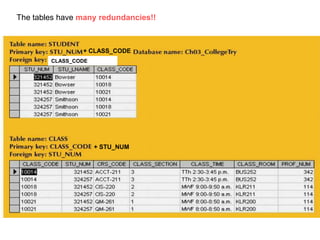
The tables have many redundancies!!

+ CLASS_CODE
CLASS_CODE

+ STU_NUM
Changing the M:N relationship to TWO 1:M relationships
The database designer has 2 main options to
define a composite table’s primary key:
either
use the combination of those foreign
keys or create a new primary key.

Foreign keys reference the primary keys in the
other tables of which it has a relationship with

Converting the M:N relationship into TWO 1:M relationships
2.6 Mandatory vs. Optional Cardinalities
• Specifies whether an instance must exist or can be absent in the
relationship
Mandatory

Optional

handles

Lecturer
(1,1)

(0,N)
M

1

Lecturer

Class

handles
(0,N)

Class
(1,1)

A Lecturer may handle zero or many classes.

A class is handled by one and only one Lecturer.

28
2.7 How to Evaluate a Data Model?
• A good data model has the following:
– Accuracy and completeness
– Non redundancy
– Enforcement of business rules

– Data Reusability
– Stability and Flexibility
– Communication Effectiveness
– Simplicity

29
A Common Mistake
Modeling the business processes or functions
instead of the data.

What data we want to keep??
We are interested in modeling the data,
NOT the processes or functions that use
or generate those data.

30
Example:

M
Member

N
Searches

Books

Is this part of the data requirement?
Are we interested to know the books searched by the members?
If answer is NO, then DO NOT include that as a relationship.
Use other appropriate diagramming techniques to capture the business
processes such as Data Flow Diagram.
Do not mix up the use of ER Modeling with DFD.
31
~The END~
Q&A

32

Entity relationship modelling - DE L300

  • 1.
    Entity Relationship Modeling Objectives: • Toillustrate how relationships between entities are defined and refined. • To know how relationships are incorporated into the database design process. • To describe how ERD components affect database design and implementation. 1
  • 2.
    1.0 What isConceptual Database Design? • Process of describing the data, relationships between the data, relationships between the data, and the constraints on the data. • After analysis - Gather all the essential data required and understand how the data are related • The focus is on the data, rather than on the processes. • The output of the conceptual database design is a Conceptual Data Model ( + Data Dictionary) 2
  • 3.
    2.0 Gathering Informationfor Conceptual Data Modeling • Two perspectives – Top-down • Data model is derived from an intimate understanding of the business. – Bottom-up • Data model is derived by reviewing specifications and business documents. 3
  • 4.
    2.0 Entity-Relationship (ER)Modeling. • ER Modeling is a top-down approach to database design. • Entity Relationship (ER) Diagram – A detailed, logical representation of the entities, associations and data elements for an organization or business • Notation uses three main constructs – Data entities – Relationships – Attributes Chen Model & Crow’s Foot Model 4
  • 5.
    Chen Notation Association between the instancesof one or more entity types EntityName Person, place, object, event or concept about which data is to be maintained Represents a set or collection of objects in the real world that share the same properties Verb Phrase AttributeName named property or characteristic of an entity
  • 6.
    Crow’s Foot Notation Entity Attribute EntityName EntityName Listof Attributes Acceptable Relationship Verb phrase
  • 7.
    2.1 Entities • Examplesof entities: – – – – – Person: EMPLOYEE, STUDENT, PATIENT Place: STORE, WAREHOUSE Object: MACHINE, PRODUCT, CAR Event: SALE,REGISTRATION, RENEWAL Concept: ACCOUNT, COURSE • Guidelines for naming and defining entity types: – – – – An entity type name is a singular noun An entity type should be descriptive and specific An entity name should be concise Event entity types should be named for the result of the event, not the activity or process of the event. 7
  • 8.
    2.2 Attributes • Exampleof entity types and associated attributes: STUDENT: Student_ID, Student_Name, Home_Address, Phone_Number, Major • Guidelines for naming attributes: – An attribute name is a noun. – An attribute name should be unique – To make an attribute name unique and clear, each attribute name should follow a standard format – Similar attributes of different entity types should use similar but distinguishing names. 8
  • 9.
    2.2.1 Identifier Attributes •Candidate key – Attribute (or combination of attributes) that uniquely identifies each instance of an entity type – Some entities may have more than one candidate key • Ex: A candidate key for EMPLOYEE is Employee_ID, a second is the combination of Employee_Name and Address. • If there is more than one candidate key, need to make a choice. • Identifier – A candidate key that has been selected as the unique identifying characteristic for an entity type 9
  • 10.
    2.2.2 Referential Attributes • MakeReference to another instance in another table Referential attribute: Ties the lecturer entity to another entity that is department. Name IdNum DeptID Email Ali 105 LG ali@a.com Mary 106 IT mary@a.com John 107 ENG john@a.com Lim 108 IT lim@a.com Instance of Lecturer. 10
  • 11.
  • 12.
    2.3 Relationships  Associationsbetween instances of one or more entity types that is of interest  Given a name that describes its function. • relationship name is an active or a passive verb. Relationship name: writes Author Book An author writes one or more books A book can be written by one or more authors. 12
  • 13.
    2.3.1 Degree ofRelationships • Degree: number of entity types that participate in a relationship • Three cases – Unary: between two instances of one entity type – Binary: between the instances of two entity types – Ternary: among the instances of three entity types 13
  • 14.
    2.4 Cardinality andConnectivity • Relationships can be classified as either • one – to – one • one – to – many • many – to –many Connectivity • Cardinality : minimum and maximum number of instances of Entity B that can (or must be) associated with each instance of entity A. 14
  • 15.
    2.4 Cardinality andConnectivity Professor Professor teaches teaches Class Class A professor teaches class OR A class is taught by professor How Many?? 15
  • 16.
    2.4 Cardinality andConnectivity Connectivity 1 Professor M teaches (1,4) Class (1,1) Cardinality Connectivity teaches Professor (1,1) Class (1,4) Cardinality 16
  • 17.
    2.4.1 Connectivity • ChenModel – 1 to represent one. – M to represent many 1 M • Crow’s Foot One Mandatory one , means (1,1) many One or many Optional? – we’ll see after this 17
  • 18.
    2.5 Binary Relationships • 1:Mrelationship – Relational modeling ideal – Should be the norm in any relational database design The 1: M relationship between PAINTER and PAINTING 18
  • 19.
    The Implemented 1:Mrelationship between PAINTER and PAINTING
  • 20.
    2.5 Binary Relationships • 1:1relationship – Should be rare in any relational database design – A single entity instance in one entity class is related to a single entity instance in another entity class – Could indicate that two entities actually belong in the same table 20
  • 21.
    The 1:1 RelationshipBetween PROFESSOR and DEPARTMENT
  • 22.
  • 23.
    2.5 Binary Relationships • M:Nrelationships – Must be avoided because they lead to data redundancies. – Can be implemented by breaking it up to produce a set of 1:M relationships – Can avoid problems inherent to M:N relationship by creating a composite entity or bridge entity • This will be used to link the tables that were originally related in a M:N relationship • The composite entity structure includes-as foreign keys-at least the primary keys of the tables that are to be linked. 23
  • 24.
    The M:N RelationshipBetween STUDENT and CLASS Bowser Smithson Accounting 1 (ACCT-211) Intro to Microcomputing (CIS-220) Intro to Statistics (QM-261) This CANNOT be implemented as shown next…..
  • 25.
    The tables havemany redundancies!! + CLASS_CODE CLASS_CODE + STU_NUM
  • 26.
    Changing the M:Nrelationship to TWO 1:M relationships
  • 27.
    The database designerhas 2 main options to define a composite table’s primary key: either use the combination of those foreign keys or create a new primary key. Foreign keys reference the primary keys in the other tables of which it has a relationship with Converting the M:N relationship into TWO 1:M relationships
  • 28.
    2.6 Mandatory vs.Optional Cardinalities • Specifies whether an instance must exist or can be absent in the relationship Mandatory Optional handles Lecturer (1,1) (0,N) M 1 Lecturer Class handles (0,N) Class (1,1) A Lecturer may handle zero or many classes. A class is handled by one and only one Lecturer. 28
  • 29.
    2.7 How toEvaluate a Data Model? • A good data model has the following: – Accuracy and completeness – Non redundancy – Enforcement of business rules – Data Reusability – Stability and Flexibility – Communication Effectiveness – Simplicity 29
  • 30.
    A Common Mistake Modelingthe business processes or functions instead of the data. What data we want to keep?? We are interested in modeling the data, NOT the processes or functions that use or generate those data. 30
  • 31.
    Example: M Member N Searches Books Is this partof the data requirement? Are we interested to know the books searched by the members? If answer is NO, then DO NOT include that as a relationship. Use other appropriate diagramming techniques to capture the business processes such as Data Flow Diagram. Do not mix up the use of ER Modeling with DFD. 31
  • 32.