Disclaimer: This presentation is prepared by
trainees of baabtra as a part of mentoring
program. This is not official document of baabtra –
Mentoring Partner
Baabtra-Mentoring Partner is the mentoring division of baabte System
Technologies Pvt . Ltd
ANOMALIES IN DATABASES


            vishnu.padinjattedath@gmail.com
                             @Vishnu_Kishor
Database Anomalies
• Databases are designed to collect data and
  sort or present it in specific ways to the end
  user
• Database anomalies-unmatched or missing
  information caused by limitations or flaws
  within a given database
• Entering or deleting information cause issues
  if the database is limited or has ‘bugs’.
Modification/Update Anomalies
• They are the data inconsistencies that resulted
  from data redundancy or partial update.
• The Problems resulting from data redundancy in
  database table are known as update anomalies.
• If a modification is not carried out on all the
  relevant rows, the database will become
  inconsistent
• Any database insertion, deletion or modification
  that leaves the database in an inconsistent state
  is said to have caused an update anomaly.
Insertion Anomalies
• Issues that come about when you are inserting
  information into the database for the first time.
• To insert the information into the table
  – Must enter the correct details
  – Must be consistent with the values for the other rows.
  – Missing or incorrectly formatted entries are two of the
    more common insertion errors.
• Most developers acknowledge that this will
  happen and build in error codes that tell you
  exactly what went wrong.
Deletion Anomalies
• Issues with data being deleted either
   – when attempting to delete and being stopped by an
     error or
   – by the unseen drop off of data
• If we delete a row from the table that represents
  the last piece of data, the details about that piece
  are also lost from the Database.
• These are the least likely to be caught or to stop
  you from proceeding
• As many deletion errors go unnoticed for
  extended periods of time, they could be the most
  costly in terms of recovery
• Database anomalies are a fact
• we will all face them in one form or another in
  life.
• The importance of
  – backing up,
  – storing offsite and
  – data consistency checks
  come into full focus when you consider what
  could be lost.
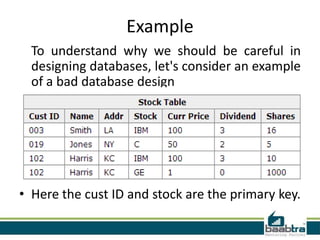
Example
  To understand why we should be careful in
  designing databases, let's consider an example
  of a bad database design


• Here the cust ID and stock are the primary key.
• Insertion Anomalies
  – You may want to add information about a person with
    whom you want to do business.
  – The above table only allows information for customers that
    own a share of stock.
  – If the person does not own stock, then the last four
    columns in the table have to be empty
  – This is not allowed since stock is part of the primary
    identifier
• Deletion Anomalies
  – You may want to delete a record from the above table
    because a customer sold his stock.
  – Consider the second record.
  – If this record were deleted, then information would be lost
    about both Jones's address and the price of C stock.
• Update Anomalies
  – You may want to update a customer's address, the
    price of a stock, or its most recent dividend.
  – To accomplish this update, you would have to
    update several rows in the table.
  – If you miss one of the rows that should be
    updated, then at a later time you will get two
    different answers to a question you ask of the
    data.
  – This is not good. Generally, if there is only
    supposed to be one answer to a question, you
    want to get just that one answer.
How To Avoid Anomalies??
• The use of normalization
• The goal of the normalization process is to
  define relations
• So that each relation is about one kind of
  thing. Not two. Not three. One.
• This seems like a reasonable condition, given
  the problems that it prevents
How Normalization works??
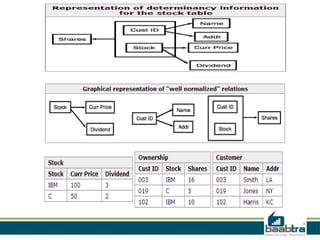
• If you know a customer id, then you know the
  person's name and address.
• If you know a stock identifier, then you know
  its current price and most recent dividend.
• Finally, for any pairing of a customer id and a
  stock identifier, you know how many shares
  that person owns of that stock
QUESTIONS ARE GUARANTEED IN
LIFE BUT ANSWERS ARE NOT…!!
             .
             .


     ANY QUESTIONS????
THANK YOU
Did this presentation help you??? do visit our
  page facebook.com/baabtra, And don’t forget
  to like us.

             • www.baabtra.com
            • www.massbaab.com
              • www.baabte.com
Contact Us

Database anomalies

  • 2.
    Disclaimer: This presentationis prepared by trainees of baabtra as a part of mentoring program. This is not official document of baabtra – Mentoring Partner Baabtra-Mentoring Partner is the mentoring division of baabte System Technologies Pvt . Ltd
  • 3.
    ANOMALIES IN DATABASES vishnu.padinjattedath@gmail.com @Vishnu_Kishor
  • 4.
    Database Anomalies • Databasesare designed to collect data and sort or present it in specific ways to the end user • Database anomalies-unmatched or missing information caused by limitations or flaws within a given database • Entering or deleting information cause issues if the database is limited or has ‘bugs’.
  • 5.
    Modification/Update Anomalies • Theyare the data inconsistencies that resulted from data redundancy or partial update. • The Problems resulting from data redundancy in database table are known as update anomalies. • If a modification is not carried out on all the relevant rows, the database will become inconsistent • Any database insertion, deletion or modification that leaves the database in an inconsistent state is said to have caused an update anomaly.
  • 6.
    Insertion Anomalies • Issuesthat come about when you are inserting information into the database for the first time. • To insert the information into the table – Must enter the correct details – Must be consistent with the values for the other rows. – Missing or incorrectly formatted entries are two of the more common insertion errors. • Most developers acknowledge that this will happen and build in error codes that tell you exactly what went wrong.
  • 7.
    Deletion Anomalies • Issueswith data being deleted either – when attempting to delete and being stopped by an error or – by the unseen drop off of data • If we delete a row from the table that represents the last piece of data, the details about that piece are also lost from the Database. • These are the least likely to be caught or to stop you from proceeding • As many deletion errors go unnoticed for extended periods of time, they could be the most costly in terms of recovery
  • 8.
    • Database anomaliesare a fact • we will all face them in one form or another in life. • The importance of – backing up, – storing offsite and – data consistency checks come into full focus when you consider what could be lost.
  • 9.
    Example Tounderstand why we should be careful in designing databases, let's consider an example of a bad database design • Here the cust ID and stock are the primary key.
  • 10.
    • Insertion Anomalies – You may want to add information about a person with whom you want to do business. – The above table only allows information for customers that own a share of stock. – If the person does not own stock, then the last four columns in the table have to be empty – This is not allowed since stock is part of the primary identifier • Deletion Anomalies – You may want to delete a record from the above table because a customer sold his stock. – Consider the second record. – If this record were deleted, then information would be lost about both Jones's address and the price of C stock.
  • 11.
    • Update Anomalies – You may want to update a customer's address, the price of a stock, or its most recent dividend. – To accomplish this update, you would have to update several rows in the table. – If you miss one of the rows that should be updated, then at a later time you will get two different answers to a question you ask of the data. – This is not good. Generally, if there is only supposed to be one answer to a question, you want to get just that one answer.
  • 12.
    How To AvoidAnomalies?? • The use of normalization • The goal of the normalization process is to define relations • So that each relation is about one kind of thing. Not two. Not three. One. • This seems like a reasonable condition, given the problems that it prevents
  • 14.
    How Normalization works?? •If you know a customer id, then you know the person's name and address. • If you know a stock identifier, then you know its current price and most recent dividend. • Finally, for any pairing of a customer id and a stock identifier, you know how many shares that person owns of that stock
  • 15.
    QUESTIONS ARE GUARANTEEDIN LIFE BUT ANSWERS ARE NOT…!! . . ANY QUESTIONS????
  • 16.
  • 17.
    Did this presentationhelp you??? do visit our page facebook.com/baabtra, And don’t forget to like us. • www.baabtra.com • www.massbaab.com • www.baabte.com
  • 18.