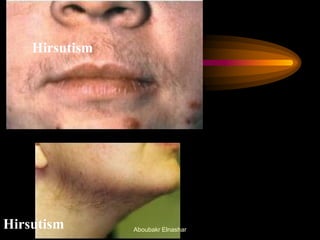
Hirsutism
Aboubakr Elnashar
Benha University Hospital, Egypt
Aboubakr Elnashar
Outline
• Introduction
• Definition
• Causes
• Clinical evaluation
• Investigations
• Treatment
• Guidelines
Aboubakr Elnashar
Introduction
Aboubakr Elnashar
Gynecological,
Endocrinological,
Cosmetic &
Psychogenic: {great anxiety, nature of the
disease, social acceptance}
Aboubakr Elnashar
Incidence
Not known
Mediterranean> Asian
American females: 10%
European: 5%
Aboubakr Elnashar
Cycle growth of hair
Several months 2 weeks 3
months Aboubakr Elnashar
Types of hair
Lanugo
Fetal hair
Vellus
Short,
fine,
Unpigmented
Before puberty
Terminal
Long,
coarse,
pigmented
arises from
vellus hair
Clinically, terminal hairs can be distinguished from vellus
hairs primarily by their length (i.e.`0.5 cm) and the fact
that they are usually pigmented.Aboubakr Elnashar
Non sexual Ambi-sexual Male sexual
Sites Lower parts of
the scalp, eye
brow, lashes,
fore-arms, lower
legs
Temporal &
vertical parts of the
scalp,
axilla,
lower pubic hair.
Ears,
nasal tip,
chin,
sternum,
upper pubic triangle,
back.
Depend on Growth hormone
from pituitary
Androgen in low
concentration from
the adrenals &
ovaries in females &
adrenals in male
Androgen in
high
concentration
Sites of hair
Aboubakr Elnashar
Androgen production
Androstenedione
Testosterone
Adrenal DHEA Ovary
DHEAS
50% 50%
50%
25% 25%
90% 10%
100%
Aboubakr Elnashar
Androgen in the blood
Male Normal female Hirsute female
Free 3% 1% 2%
Albumin 19% 19% 19%
SHBG 78% 80% 79%
Aboubakr Elnashar
Androgen at target cell (hair follicle)
Testosterone (T)
5œ-reductase.
Dihydrtestosterone (DHT)
Androstanediol
Glucuronide
3 alpha androstanediol glucuronide(3 alpha AG)
Aboubakr Elnashar
Definitions
Aboubakr Elnashar
Virilization:
Defiminization:
Atrophy of the breast & vagina
Musculinization:
Hirsutism,
deepening of voice
temporal balding.
Increase: size of the clitoris,
muscular mass &
libido
Aboubakr Elnashar
Aboubakr Elnashar
Main Causes of Virilization
1-CAH
2- Iatrogenic
3- Ovarian tumour
4- Cushing's syndrome.
Aboubakr Elnashar
Hirsutism: Latin hirsutus = shaggy, hairy
Excessive growth of
terminal hair in
male sexual sites.
Excessive: Socially unacceptable to the patient
F& G score >8
Aboubakr Elnashar
Hypertrichosis
Excessive growth of
(Lanugo, vellus or terminal) hair in
non-sexual sites (James et al,
2005)
•Cong
Acquired
•Localized
Generalized
Congenital hypertrichosis
lanuginosa
Drug-induced hypertrichosis
Aboubakr Elnashar
Aboubakr Elnashar
Hirsutism:
•Not an increase in the number of
hair follicles but an alteration in their
character.
•An increase in the transformation
of the vellus to terminal hair.
{Androgens will convert lanugo &
vellus hair to terminal hair}.Aboubakr Elnashar
Hirsutism is a consequence of several factors.
An increase in:
1. Androgen production
2. The sensitivity of the androgen receptors at
the level of the hair follicle.
3. The activity of 5œ-reductase.
Aboubakr Elnashar
Causes
Aboubakr Elnashar
A. Ovarian:
1. PCOS: 90%
2. Tumors: 0.5%
Virilizing ovarian tumors
Luteoma of pregnancy
3. Dysgenesis
B. Adrenal:5%
1. Cong adrenal
hyperplasia
2. Tumors
3. Cushing syndrome
C. Peripheral
1. Idiopathic: Regular
ovulation & normal
androgen levels
2. Insulin resistance
– HAIRAN syndrome:
HyperAndrogenic
Insulin-Resistant
Acanthosis Nigricans
– 5H syndromeAboubakr Elnashar
A. Ovarian:
1. PCOS: 90%
Aboubakr Elnashar
Rotterdam Criteria Of PCOS, 2003
2 out of 3 features are present:
1. Oligomenorrhoea and or Anovulation
2. Clinical Hyperandrogenism and/or
hyperandrogenemia.
3. Polycystic ovaries (U/S).
After exclusion of other etiologies.
Aboubakr Elnashar
 Clinical Hyperandrogenism
1. Hirsutism: The primary
clinical indicator of androgen
excess .
2. Acne : Potential marker
3. Androgenic alopecia: Poor
marker unless with
Oligomenorrhoea.
 Hyperandrogenemia
• FT) or FTI) are the more
sensitive methods
• Routine measurement of
Androstenedione: are not
recommended.
• DHEAS is raised in small
fraction of patient with
PCOS .Aboubakr Elnashar
Hirsutism
Hirsutism Aboubakr Elnashar
Hirsutism
Aboubakr Elnashar
AcneHirsutism
Aboubakr Elnashar
PCOS with hirsutism
Aboubakr Elnashar
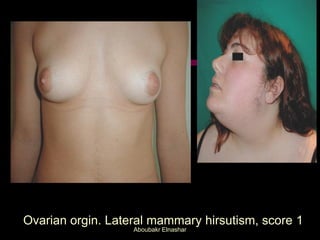
Ovarian orgin. Lateral mammary hirsutism, score 1
Aboubakr Elnashar
Grading scale for female pattern hair loss
mild but obvious female
pattern hair loss
Female androgenic alopecia
Frontal and temporal hair loss
Aboubakr Elnashar
Rotterdam U/S Criteria of PCOS
At least one of the following:
• 12 or more follicles measuring 2–9 mm in diameter
• increased ovarian volume (>10 cm3).
 The distribution of follicles and a description of the
stroma are not required for diagnosis.
 The presence of a single PCO is sufficient to
provide the diagnosis.
Aboubakr Elnashar
Hirsutism in a young woman with PCOS. Note the
acne lesions and excessive hair on her face and
neck.
Aboubakr Elnashar
Aboubakr Elnashar
Aboubakr Elnashar
PCOS with hirsutism (Ferriman and Gallwey
score 4) on the abdomen
Aboubakr Elnashar
Examples of hirsutism
affecting
the back,
chest, and
abdomen
Aboubakr Elnashar
2. Ovarian Tumors:0.5%
Virilizing ovarian tumors
arrhenoblastoma,
hilus cell tumor,
lipod cell tumor,
granulosa cell tumor
Luteoma of pregnancy
{ Not true tumor but an
exaggerated reaction of ovarian
stroma to chorionic gonadotropins.
It is solid, usually unilateral &
regress after labour}
3. Ovarian dysgenesis
Aboubakr Elnashar
Uterus and adnexa during
caesarian section—both
ovaries were enlarged
(mean diameter 8 cm).
Luteoma
Aboubakr Elnashar
B. Adrenal:5%
1. Cong adrenal hyperplasia
2. Tumors
3. Cushing syndrome
Congenital adrenal
hyperplasia
Androgen secreting tumor
Centipetal obesity in Cushing's
syndrome Aboubakr Elnashar
Aboubakr Elnashar
Aboubakr Elnashar
Adrenal SAHA.
Central hirsutism,
score 2
Adrenal SAHA. Severe
papulo-pustular acne and
central hirsutism
Aboubakr Elnashar
Cushing's Syndrome
Aboubakr Elnashar
Aboubakr Elnashar
Centripetal obesity 79-97
Facial plethora 50-94
Glucose intolerance 39-90
Weakness, proximal myopathy 29-90
Hypertension 74-87
Psychological changes 31-86
Easy bruisability 23-84
Hirsutism 64-81
Oligomenorrhea or amenorrhea 55-80
Acne, oily skin 26-80
Abdominal striae 51-71
Ankle edema 28-60
Backache, vertebral collapse,
fracture rare
Clinical manifestations %
Aboubakr Elnashar
Cushing’s Syndrome
One should be aware of the possibility of
Cushing’s syndrome in women with stigmata of
the :
PCOS &
Obesity
as it is a disease of insidious onset and dire
consequences
Aboubakr Elnashar
Forearm of a women man with
Cushing's disease showing multiple
ecchymoses due to minimal trauma.
30-year-old woman with Cushing's
disease showing round, plethoric
"moon" face, facial hirsutism, and
increased supraclavicular fat pads
Aboubakr Elnashar
C. PERIPHERAL
1. Idiopathic: Regular ovulation &
normal androgen levels
2. Insulin resistance
– HAIRAN syndrome:
HyperAndrogenic
Insulin-Resistant Acanthosis Nigricans
– 5H syndrome acanthosis nigricans.
Aboubakr Elnashar
Aboubakr Elnashar
3. Aromatase deficiency
4. Glucocorticoid resistance
5. Hyperprolactinema can cause an
increase in DHEAS. TT with
bromocriptin: dec PRL & DHEAS
Aboubakr Elnashar
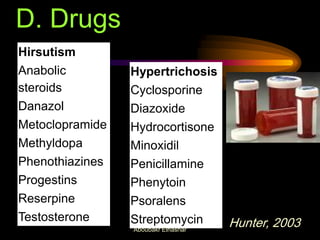
Hirsutism
Anabolic
steroids
Danazol
Metoclopramide
Methyldopa
Phenothiazines
Progestins
Reserpine
Testosterone
Hypertrichosis
Cyclosporine
Diazoxide
Hydrocortisone
Minoxidil
Penicillamine
Phenytoin
Psoralens
Streptomycin Hunter, 2003
D. Drugs
Aboubakr Elnashar
Clinical evaluation
Aboubakr Elnashar
Primary objective:
1. Confirm diagnosis
2. Determine degree
3. Exclude life threatening diseases
Aboubakr Elnashar
History
.Virilization, psychological
.Onset & duration:
Rapidly progressive virilization: androgen secreting tumors
.Menstrual history:
PCOS, Pregnancy
.Family history:
Hair patterns are similar in families
.Drug intake
Aboubakr Elnashar
Examination
.General:
Thyroid disease,
Cushing syndrome,
Signs of virilization,
Signs of insulin resistance e.g.
acanthosis nigricans.
Aboubakr Elnashar
.Breast:
Galactorrhea {Hyperprolactinaemia can be
accompanied by increase in adrenal
androgen}
.Pelvic:
mass
Aboubakr Elnashar
Degree of hirsutism
Photography or scoring systems
a. Ferriman & Gallwey(1961): 9 areas
upper lip,
chin,
chest
upper abdomen,
lower abdomen,
upper arm,
thighs,
upper back,
lower back/buttocks
minimal=1, mild=2, moderate=3, severe=4
>8 = hirsutism
15 = organic cause
Aboubakr Elnashar
Degree of hair growth
(Ferriman & Gallwey,1961)
Aboubakr Elnashar
Aboubakr Elnashar
b. Macnight (1964):
divided the body into 7 areas:
Face
Neck
Shoulders
Chest
Abdomen
back
Aboubakr Elnashar
Investigations
Aboubakr Elnashar
Total testosterone:
measures the ovarian & adrenal activity.
When testing for elevated androgen levels: measure
an early morning plasma total testosterone level as the
initial test.
Aboubakr Elnashar
Free testosterone
Good correlation with total production rate
(= secretion rate + peripheral conversion rate)
Good correlation with degree of virilization
If the plasma total testosterone is normal in the
presence of risk factors for hyperandrogenism or the
presence of hirsutism that progresses despite therapy:
measuring an early morning plasma total and free
testosterone
Free androgen index(FAI)=
TX 100 / SHBG if > 4.5: PCOS
•Not done routinely in presence of hirsutism
Aboubakr Elnashar
17 OHP:
an intermediate metabolite in steroidogensis in the adrenals.
In patients with a high likelihood of congenital
adrenal hyperplasia [positive family history, member of
a high-risk ethnic group such as Ashkenazi Jews
(prevalence 1 in 27), Hispanics
(1 in 40), and Slavics (1 in 50)], we recommend
measurement of an early morning follicular phase level
of 17-hydroxyprogesterone.
 DHEAS:
Good marker of Adrenal A production
Not essential
Aboubakr Elnashar
DHES is not essential (Speroff,2005)
1. If 17 OHP is normal: adrenal enzyme defect can be
excluded .
2. Moderate elevations of DHES can be suppressed by
suppression of ovulation.
3. DHES > 700 ug/dl is rare & is associated with high levels
of T
4. Imaging of the adrenals is more cost-effective than
measuring DHES.
Aboubakr Elnashar
3 alpha androstanediol glucuronide
•Metabolite of DHT
•Good marker of peripheral androgen action
•Inc {increased activity of 5 alpha reductase} {end organ
hypersensitivity}
•Not done routinely:
1. No change in diagnosis & treatment,
2. Values overlap in 20%
Aboubakr Elnashar
Endocrine Society, 2008
Aboubakr Elnashar
Testosterone (ng/dl)
>200 <200
U/S of the ovary Anovulation
(PRL, endom biopsy)
Adenxal mass Nothing
Laparotomy CT of the adrenala & ovaries
Laparotomy
Aboubakr Elnashar
Ovarian tumors should be suspected
1. Rapid onset of virilization
2. Unilateral adenxal mass
3. Testosterone >200 ng/dl.
•TVS, CT or MRI.
Aboubakr Elnashar
Screening for late onset adrenal hyperplasia
•Incidence: 1-5%
•Clinical indication of ACTH stimulation test:
Strong family history
Severe hirsutism from puberty
Flatness of the breast
Hypertension
Short stature
Aboubakr Elnashar
17 oh P(ng/dl) morning
< 200 > 200
Rules out adrenal hyperplasia ACTH stimulation test (0.25
21-hydroxylase deficiency mg ACTH I.V.& 17 oh P at time
zero & after 1 hour)
Normal Abnormal
Rules out adrenal hyperplasia Adrenal hyperplasia
Aboubakr Elnashar
Screening for Cushing syndrome
•Rare
•Indications:
Centripetal obesity, buffalo hump
Moon face, Virilization
Pigmented stria, Hypertension
Aboubakr Elnashar
Dexamethazone suppression test
( 1 mg orally at bed time)
Free cortisol (ug/dl
> 6 < 6
long term dexamethazone test Normal
Aboubakr Elnashar
PCOS T
LH/FSH
usually inc
2/1
Late-onset CAH 17-OH-P >200 ng/dL
Androgen-secreting ov tumor Total T >200 ng/dL
Androgen-secreting ad tumor DHEAS >700 g/dL
Cushing syndrome Cortisol Increased
Exogenous androgen use Toxicology
screen
Increased
Aboubakr Elnashar
Treatment
Aboubakr Elnashar
Androgen
Excess
Society,2012
Aboubakr Elnashar
Lines of treatment
I. General
II. Specific
III. Local
IV. Surgery
Aboubakr Elnashar
I. General
•Reassurance:
•explain the condition, treatment regimen & the time required
•Stop smoking
•Weight reduction:
{Inc SHBG: Dec FT}
Keep BMI around 21 kg / m2
Dec the risk of DM & CVD
Aboubakr Elnashar
II. Specific
I. Ovarian suppression:
1. OCPs 2. Progestagen 3. GnRha
II. Adrenal suppression: Corticosteroids
III. Antiandrogens:
1. Spironolactone 2. Cyproterone acetate
3. Flutamide 4. Ketoconazole
IV. 5 alpha reductase inhibitors: Finasteride
V. Insulin sensitizer: MetforminAboubakr Elnashar
I. Ovarian suppression
1. Oral contraceptive pills
The first line of therapy
Mechanism:
P: suppress ov steroidogenesis
E: inc SHBG: dec FT
Aboubakr Elnashar
Best type:
Avoid OCs containing norethisterone or levonorgestrel
less androgenic or antiandrogenic
high estrogen
Diane (cyproterone acetate),
Yasmin (Drospirenone)
Clordion, Gestafortin, Lormin, NonOvlon, Normenon,
Verton (Chlormadinone acetate)
Gynera (gestodene),
Marvelon (desogestrel),
Cilest (norgestimate).
Effect:
1. Dec T after 1-3 mo.
2. Additional benefitsAboubakr Elnashar
We do not suggest one particular OCP over another for
treating hirsutism (Endocrine Society, 20108)
most androgenic progestin:
Levonorgestrel, norethisterone
low androgenicity:
norgestimate and desogestrel
progestins with antiandrogenic activity
drospirenone and CPA
One small trial did not demonstrate a difference
in hirsutism efficacy between an OCP containing
levonorgestrel and one containing desogestrel
Levonorgestrel may adversely affect metabolic biomarkers
when compared with other less androgenic progestins, but
there are no data to suggest that these effects are associated
with adverse clinical outcomes.Aboubakr Elnashar
OCPs containing either 30–35 g ethinyl estradiol or the
lower-dose 20-g preparations may be used for suppression of
ovarian androgens. There are no clinical trials of 20-g
OCPs for hirsutism, but these lower-dose preparations
appear to be as effective as the 30- to 35-g preparations for
acne.
Aboubakr Elnashar
2. Progestins
Indication: If pills is contraindicated or unwanted
Mechanism:
inhibit ov steroidogenesis,
inc clearance of androgen,
inhibit 5 alpha reductase
dec SHBG:inc FT
Dose: DMPA: 150 mg IM / 3 mo.
MPA: 30 mg PO / d
Effect: comparable to OCPs
Aboubakr Elnashar
3. Gn Rh analogue
Indications:
Failure of usual management
Overweight with severe hirsutism
Dose:
leuprolide acetate depot: IM / mo.
The initial stimulatory effect can be avoided by starting
therapy in the luteal phase when Gnt are already
suppressed by elevated progesterone levels.
Once maximal response has been obtained OCP or
antiandrogen for long term suppression of hair growth.
Treatment should be limited to 6 mo.
Aboubakr Elnashar
Mechanism of action:
Side effects:
of estrogen deficiency
Use with OCPs:
{avoid problems associated with E deficiency & add
benefits}
Effects:
highly effective & better than OCP alone
Aboubakr Elnashar
II. Adrenal suppression
Glucocorticoids
Indication:
1.High not moderate elevation of DHEAS (Sperof,2005)
2. CAH
Mechanism:
inhibit ACTH dependant androgen
Aboubakr Elnashar
Dose:
Nocturnal {maximal suppression of the CNS
adrenal axis that peaks during sleep}
Dexamethazone: 0.3 mg or 0.25 mg/ other evening
Prednisone: 3 mg
Adrenal hyperplasia: higher doses
Effects:
1. No cortisol suppression
2. No Cushingoid side effects
Aboubakr Elnashar
Aboubakr Elnashar
III. Antiandrogens
1. Spironolactone (Aldactone)
Dose:
100-200 mg/d
remission: dec dose to 25-50 mg
100-200 mg/d from D1-D21
Mechanism :
on receptor
ovary & adrenals
Liver
kidney
Aboubakr Elnashar
Side effects: minimal.
Mens irregularities, mastalgia, feminization of
male fetus, transient diuresis, hyperkalemia,
?carcinogenic
Use with OCP:
1. Dramatic effect, but not impressively better
2. Prevent feminization of male fetus
3. Regular menstruation
Effects: maximal by 6mo
Cessation : relapse
Aboubakr Elnashar
2. Cyproterone acetate (androcure)
Dose:
50-100 mg from D5 to D15 &
EE2: 30-50 ug from D5 to D25.
Dec dose after remission
Mechanism:
on receptors
Progestational effect
Weak corticosteroid effect
Aboubakr Elnashar
Side effects:
mens irregularities, mastalgia, feminization of
male fetus, loss of libido, fatigue, edema, weight
gain, decrease HDLP & cholesterol, glucose
intolerance.
Use with EE2 or OCPs
Effects:
maximal by 3mo
improvement in 60-90%
Cessation: relapse
Aboubakr Elnashar
3. Flutamide (Eulexin)
Indication: under tertiary center supervision
Severe cases
Failure of spironolactone & OCPs
Dose:
250 - 500 mg/d
Mechanism:
antiandrogen.
Aboubakr Elnashar
Side effects:
dryness of the skin, increase appetite
hepatotoxicity, expensive.
It is unsuitable for treatment of hirsuitism (Speroff, 2005)
Use with OCPs:
1. Add benefit 2. Avoid block androgen receptors in male fetus.
Effects:
Similar or better than Spironolactone
We do not recommend one antiandrogen over another, except that
we recommend against the use of flutamide.
Aboubakr Elnashar
Aboubakr Elnashar
IV. 5 alpha reductase inhibitors
Finasteride (Proscar)
Indication: under tertiary center supervision.
Severe cases
Mode of action:
Inhibit 5 alpha reductase activity: blocking conversion of T to DHT.
Dose:
2.5 - 5 mg /d
Aboubakr Elnashar
Side effects:
very minimal. Teratogenic
Use with OCPs:
To avoid risk on male fetus & added benefits.
Effects:
Flutamide or Spironolactone is more effective
Drugs in this class:
Finasteride 5 mg (Proscar}
Finasteride 1 mg (Propecia)
Dutasteride (Avodart)
Aboubakr Elnashar
V. Insulin sensitizer
Metformin
•PCOS
IH: {insulin resistance} (Unluhizarci et al, 2004).
•1500 mg/d
•Dec serum insulin & T.
Dec F&G score (Kazerooni et al, 2003 ; Kelly & Gordon, 2003)
•Metformin Vs Dianette (EE2: 35 ug + cyproterone acetate: 2 mg)
Dianette was more effective (Harborne et al, 2003).
Aboubakr Elnashar
Cochrane library (2003)
•Cyprotrone acetate was compared to (spironolactone, flutamide,
finastride, GnRHa, Ketconazole):
No differences in clinical outcomes
Spironolactone 100 mg/d is superior to finastride 5 mg/d & low
dose cypr acetate 12.5 mg/d (first 10 days of the cycle) up to 12
months after the end of the treatment
Aboubakr Elnashar
III. Local
Suppress hair growth:
Eflornithine Hydochloride (Vaniqa)
Remove hair pigment: Bleaching
Temporary depilation:
shaving, chemical depilators
Temporary epilation: plucking, waxing
Permanent removal:
Electrolysis, Laser & intense pulsed light
Aboubakr Elnashar
1. Suppress hair growth
Eflornithine 13.9% (Vaniqa) cream
•Inhibits ornithine decarboxylase (an enzyme in hair
dermal papilla that is essential for hair growth).
•Face, neck
Can be used with other tt e.g. lasers, intense
pulsed light
Regrowth can take 2 ms: Must be continued
indefinitely to prevent regrowth
S effects: stinging, burning, tingling
Aboubakr Elnashar
2. Bleaching (remove hair pigment)
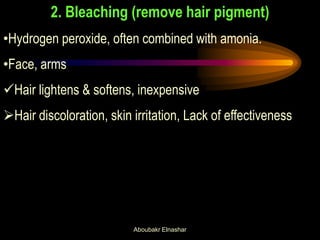
•Hydrogen peroxide, often combined with amonia.
•Face, arms
Hair lightens & softens, inexpensive
Hair discoloration, skin irritation, Lack of effectiveness
Aboubakr Elnashar
3. Temporary depilation
(remove part of hair)
a. Shaving:
•All areas
Inexpensive, effective & does not cause
change in hair quality, quantity or texture.
Daily need, skin irritation, quick regrowth
folliculitis, time consuming, beard stubbleAboubakr Elnashar
b. Chemical depilators:
•Break down & dissolve hair by hydrolysing
disulhide bonds.
•Extremities, groin, face
Quick, inexpensive, effective
Regrowth in days, skin irritation
Aboubakr Elnashar
4. Temporary epilation
(remove the entire hair)
a. Plucking:
•Face, eyebrows, nipples, bikini area
Effective for small amount, inexpensive, regrowth
can take weeks
Pain, skin irritation, postinflam pigmentation,
folliculitis, slow, ingrown hairs, scarring
Aboubakr Elnashar
b. Waxing: group plucking
•Face, eyebrows, groin, trunk, extremities
Regrowth can take 6 weeks
Pain, postinflam pigmentation, scarring, slow,
expense, irritation, folliculitis
Aboubakr Elnashar
5. Permanent removal
(destruction of the dermal papilla)
a. Electrolysis:
•Needle is inserted into the hair follicle & a current
is used to destroy the dermal papilla.
•All areas, usually the face
May give permanent removal
Pain, scarring, painful,
repeat treatments needed
time consuming, expensive, pigmentation
Aboubakr Elnashar
b. Laser & intense pulsed light
•Selective phototricholysis. A light source sufficient to penetrate to
the follicular bulge & the papillae is directed at the hair by probe.
•All areas
May give permanent hair reduction, efficient, painless
Dark hair required, expensive, scarring, skin pigmentation,
repeated treatments usually necessary
Aboubakr Elnashar
Aboubakr Elnashar
IV. Surgery
•Tumor
•LOD
Discrepant & variable response.
Modest & sustained improvement in 25%
(Amer et al, 2002).
Aboubakr Elnashar
Guidelines
Endocrine Society 2008
Diagnosis of hirsutism
1. We suggest against testing for elevated
androgen levels in women with isolated mild
hirsutism because the likelihood of identifying a
medical disorder that would change management
or outcome is low (2).
Aboubakr Elnashar
2. We suggest testing for elevated androgen levels
in women with (2)
• Moderate or severe hirsutism
• Hirsutism of any degree when it is sudden in
onset, rapidly progressive, or when associated with
any of the following:
– menstrual irregularity or infertility
– central obesity
– acanthosis nigricans
– rapid progression
– clitoromegaly
Aboubakr Elnashar
Treatment of hirsutism
1. For women with patient-important hirsutism
despite cosmetic measures, we suggest either
pharmacological therapy or direct hair removal
methods (2).
The choice between these options depends on
(a) patient preferences,
(b) The extent to which the area of hirsutism that
affects wellbeing is amenable to direct hair
removal, and
(c) access to and affordability of these alternatives.
Aboubakr Elnashar
2.Pharmacological treatments
a. Monotherapy
For the majority of women, we suggest oral
contraceptives to treat patient-important hirsutism
(2)
because of its teratogenic potential, we
recommend against antiandrogen monotherapy
unless adequate contraception is used (1| ).
For women who cannot or choose not to
conceive, we suggest the use of either oral
contraceptive preparations (OCPs) or
antiandrogens
The choice between these options
depends on patient preferences regarding efficacy,
side effects, and costs.Aboubakr Elnashar
We suggest against the use of flutamide
therapy (2).
We suggest against the use of topical
antiandrogen therapy for hirsutism (2).
We suggest against using insulin-lowering
drugs as therapy for hirsutism (2).
Aboubakr Elnashar
For women with hirsutism who do not have
classic or nonclassic congenital adrenal
hyperplasia due to 21-hydroxylase deficiency
(CYP21A2), we suggest against glucocorticoid
therapy (2).
We suggest glucocorticoids for women with
hirsutism due to non classic congenital adrenal
hyperplasia (NCCAH) who have a suboptimal
response to OCPs and/or antiandrogens, cannot
tolerate them, or are seeking ovulation induction
(2).
Aboubakr Elnashar
We suggest against using GnRH agonists
except in women with severe forms of
hyperandrogenemia, such as ovarian
hyperthecosis, who have a suboptimal response
to OCPs and antiandrogens (2).
For all pharmacologic therapies for hirsutism,
we suggest a trial of at least 6 months before
making changes in dose, changing medication, or
adding medication (2).
Aboubakr Elnashar
b. Combination therapy
If patient-important hirsutism remains
despite 6 or more months of monotherapy with an
oral contraceptive, we suggest adding an
antiandrogen (2).
Aboubakr Elnashar
3. Direct hair removal methods
For women who choose hair removal therapy,
we suggest laser/photoepilation (2).
For women undergoing photoepilation therapy
who desire a more rapid initial response, we
suggest adding eflornithine cream during
treatment (2).
For women with known hyperandrogenemia
who choose hair removal therapy, we suggest
pharmacologic therapy to minimize hair regrowth
(2).
Aboubakr Elnashar
Benha University Hospital, Egypt
Email: elnashar53@hotmail.com
Aboubakr Elnashar

Hirsutism

  • 1.
    Hirsutism Aboubakr Elnashar Benha UniversityHospital, Egypt Aboubakr Elnashar
  • 2.
    Outline • Introduction • Definition •Causes • Clinical evaluation • Investigations • Treatment • Guidelines Aboubakr Elnashar
  • 3.
  • 4.
    Gynecological, Endocrinological, Cosmetic & Psychogenic: {greatanxiety, nature of the disease, social acceptance} Aboubakr Elnashar
  • 5.
    Incidence Not known Mediterranean> Asian Americanfemales: 10% European: 5% Aboubakr Elnashar
  • 6.
    Cycle growth ofhair Several months 2 weeks 3 months Aboubakr Elnashar
  • 7.
    Types of hair Lanugo Fetalhair Vellus Short, fine, Unpigmented Before puberty Terminal Long, coarse, pigmented arises from vellus hair Clinically, terminal hairs can be distinguished from vellus hairs primarily by their length (i.e.`0.5 cm) and the fact that they are usually pigmented.Aboubakr Elnashar
  • 8.
    Non sexual Ambi-sexualMale sexual Sites Lower parts of the scalp, eye brow, lashes, fore-arms, lower legs Temporal & vertical parts of the scalp, axilla, lower pubic hair. Ears, nasal tip, chin, sternum, upper pubic triangle, back. Depend on Growth hormone from pituitary Androgen in low concentration from the adrenals & ovaries in females & adrenals in male Androgen in high concentration Sites of hair Aboubakr Elnashar
  • 9.
    Androgen production Androstenedione Testosterone Adrenal DHEAOvary DHEAS 50% 50% 50% 25% 25% 90% 10% 100% Aboubakr Elnashar
  • 10.
    Androgen in theblood Male Normal female Hirsute female Free 3% 1% 2% Albumin 19% 19% 19% SHBG 78% 80% 79% Aboubakr Elnashar
  • 11.
    Androgen at targetcell (hair follicle) Testosterone (T) 5œ-reductase. Dihydrtestosterone (DHT) Androstanediol Glucuronide 3 alpha androstanediol glucuronide(3 alpha AG) Aboubakr Elnashar
  • 12.
  • 13.
    Virilization: Defiminization: Atrophy of thebreast & vagina Musculinization: Hirsutism, deepening of voice temporal balding. Increase: size of the clitoris, muscular mass & libido Aboubakr Elnashar
  • 14.
  • 15.
    Main Causes ofVirilization 1-CAH 2- Iatrogenic 3- Ovarian tumour 4- Cushing's syndrome. Aboubakr Elnashar
  • 16.
    Hirsutism: Latin hirsutus= shaggy, hairy Excessive growth of terminal hair in male sexual sites. Excessive: Socially unacceptable to the patient F& G score >8 Aboubakr Elnashar
  • 17.
    Hypertrichosis Excessive growth of (Lanugo,vellus or terminal) hair in non-sexual sites (James et al, 2005) •Cong Acquired •Localized Generalized Congenital hypertrichosis lanuginosa Drug-induced hypertrichosis Aboubakr Elnashar
  • 18.
  • 19.
    Hirsutism: •Not an increasein the number of hair follicles but an alteration in their character. •An increase in the transformation of the vellus to terminal hair. {Androgens will convert lanugo & vellus hair to terminal hair}.Aboubakr Elnashar
  • 20.
    Hirsutism is aconsequence of several factors. An increase in: 1. Androgen production 2. The sensitivity of the androgen receptors at the level of the hair follicle. 3. The activity of 5œ-reductase. Aboubakr Elnashar
  • 21.
  • 22.
    A. Ovarian: 1. PCOS:90% 2. Tumors: 0.5% Virilizing ovarian tumors Luteoma of pregnancy 3. Dysgenesis B. Adrenal:5% 1. Cong adrenal hyperplasia 2. Tumors 3. Cushing syndrome C. Peripheral 1. Idiopathic: Regular ovulation & normal androgen levels 2. Insulin resistance – HAIRAN syndrome: HyperAndrogenic Insulin-Resistant Acanthosis Nigricans – 5H syndromeAboubakr Elnashar
  • 23.
    A. Ovarian: 1. PCOS:90% Aboubakr Elnashar
  • 24.
    Rotterdam Criteria OfPCOS, 2003 2 out of 3 features are present: 1. Oligomenorrhoea and or Anovulation 2. Clinical Hyperandrogenism and/or hyperandrogenemia. 3. Polycystic ovaries (U/S). After exclusion of other etiologies. Aboubakr Elnashar
  • 25.
     Clinical Hyperandrogenism 1.Hirsutism: The primary clinical indicator of androgen excess . 2. Acne : Potential marker 3. Androgenic alopecia: Poor marker unless with Oligomenorrhoea.  Hyperandrogenemia • FT) or FTI) are the more sensitive methods • Routine measurement of Androstenedione: are not recommended. • DHEAS is raised in small fraction of patient with PCOS .Aboubakr Elnashar
  • 26.
  • 27.
  • 28.
  • 29.
  • 30.
    Ovarian orgin. Lateralmammary hirsutism, score 1 Aboubakr Elnashar
  • 31.
    Grading scale forfemale pattern hair loss mild but obvious female pattern hair loss Female androgenic alopecia Frontal and temporal hair loss Aboubakr Elnashar
  • 32.
    Rotterdam U/S Criteriaof PCOS At least one of the following: • 12 or more follicles measuring 2–9 mm in diameter • increased ovarian volume (>10 cm3).  The distribution of follicles and a description of the stroma are not required for diagnosis.  The presence of a single PCO is sufficient to provide the diagnosis. Aboubakr Elnashar
  • 33.
    Hirsutism in ayoung woman with PCOS. Note the acne lesions and excessive hair on her face and neck. Aboubakr Elnashar
  • 34.
  • 35.
  • 36.
    PCOS with hirsutism(Ferriman and Gallwey score 4) on the abdomen Aboubakr Elnashar
  • 37.
    Examples of hirsutism affecting theback, chest, and abdomen Aboubakr Elnashar
  • 38.
    2. Ovarian Tumors:0.5% Virilizingovarian tumors arrhenoblastoma, hilus cell tumor, lipod cell tumor, granulosa cell tumor Luteoma of pregnancy { Not true tumor but an exaggerated reaction of ovarian stroma to chorionic gonadotropins. It is solid, usually unilateral & regress after labour} 3. Ovarian dysgenesis Aboubakr Elnashar
  • 39.
    Uterus and adnexaduring caesarian section—both ovaries were enlarged (mean diameter 8 cm). Luteoma Aboubakr Elnashar
  • 40.
    B. Adrenal:5% 1. Congadrenal hyperplasia 2. Tumors 3. Cushing syndrome Congenital adrenal hyperplasia Androgen secreting tumor Centipetal obesity in Cushing's syndrome Aboubakr Elnashar
  • 41.
  • 42.
  • 43.
    Adrenal SAHA. Central hirsutism, score2 Adrenal SAHA. Severe papulo-pustular acne and central hirsutism Aboubakr Elnashar
  • 44.
  • 45.
  • 46.
    Centripetal obesity 79-97 Facialplethora 50-94 Glucose intolerance 39-90 Weakness, proximal myopathy 29-90 Hypertension 74-87 Psychological changes 31-86 Easy bruisability 23-84 Hirsutism 64-81 Oligomenorrhea or amenorrhea 55-80 Acne, oily skin 26-80 Abdominal striae 51-71 Ankle edema 28-60 Backache, vertebral collapse, fracture rare Clinical manifestations % Aboubakr Elnashar
  • 47.
    Cushing’s Syndrome One shouldbe aware of the possibility of Cushing’s syndrome in women with stigmata of the : PCOS & Obesity as it is a disease of insidious onset and dire consequences Aboubakr Elnashar
  • 48.
    Forearm of awomen man with Cushing's disease showing multiple ecchymoses due to minimal trauma. 30-year-old woman with Cushing's disease showing round, plethoric "moon" face, facial hirsutism, and increased supraclavicular fat pads Aboubakr Elnashar
  • 49.
    C. PERIPHERAL 1. Idiopathic:Regular ovulation & normal androgen levels 2. Insulin resistance – HAIRAN syndrome: HyperAndrogenic Insulin-Resistant Acanthosis Nigricans – 5H syndrome acanthosis nigricans. Aboubakr Elnashar
  • 50.
  • 51.
    3. Aromatase deficiency 4.Glucocorticoid resistance 5. Hyperprolactinema can cause an increase in DHEAS. TT with bromocriptin: dec PRL & DHEAS Aboubakr Elnashar
  • 52.
  • 53.
  • 54.
    Primary objective: 1. Confirmdiagnosis 2. Determine degree 3. Exclude life threatening diseases Aboubakr Elnashar
  • 55.
    History .Virilization, psychological .Onset &duration: Rapidly progressive virilization: androgen secreting tumors .Menstrual history: PCOS, Pregnancy .Family history: Hair patterns are similar in families .Drug intake Aboubakr Elnashar
  • 56.
    Examination .General: Thyroid disease, Cushing syndrome, Signsof virilization, Signs of insulin resistance e.g. acanthosis nigricans. Aboubakr Elnashar
  • 57.
    .Breast: Galactorrhea {Hyperprolactinaemia canbe accompanied by increase in adrenal androgen} .Pelvic: mass Aboubakr Elnashar
  • 58.
    Degree of hirsutism Photographyor scoring systems a. Ferriman & Gallwey(1961): 9 areas upper lip, chin, chest upper abdomen, lower abdomen, upper arm, thighs, upper back, lower back/buttocks minimal=1, mild=2, moderate=3, severe=4 >8 = hirsutism 15 = organic cause Aboubakr Elnashar
  • 59.
    Degree of hairgrowth (Ferriman & Gallwey,1961) Aboubakr Elnashar
  • 60.
  • 61.
    b. Macnight (1964): dividedthe body into 7 areas: Face Neck Shoulders Chest Abdomen back Aboubakr Elnashar
  • 62.
  • 63.
    Total testosterone: measures theovarian & adrenal activity. When testing for elevated androgen levels: measure an early morning plasma total testosterone level as the initial test. Aboubakr Elnashar
  • 64.
    Free testosterone Good correlationwith total production rate (= secretion rate + peripheral conversion rate) Good correlation with degree of virilization If the plasma total testosterone is normal in the presence of risk factors for hyperandrogenism or the presence of hirsutism that progresses despite therapy: measuring an early morning plasma total and free testosterone Free androgen index(FAI)= TX 100 / SHBG if > 4.5: PCOS •Not done routinely in presence of hirsutism Aboubakr Elnashar
  • 65.
    17 OHP: an intermediatemetabolite in steroidogensis in the adrenals. In patients with a high likelihood of congenital adrenal hyperplasia [positive family history, member of a high-risk ethnic group such as Ashkenazi Jews (prevalence 1 in 27), Hispanics (1 in 40), and Slavics (1 in 50)], we recommend measurement of an early morning follicular phase level of 17-hydroxyprogesterone.  DHEAS: Good marker of Adrenal A production Not essential Aboubakr Elnashar
  • 66.
    DHES is notessential (Speroff,2005) 1. If 17 OHP is normal: adrenal enzyme defect can be excluded . 2. Moderate elevations of DHES can be suppressed by suppression of ovulation. 3. DHES > 700 ug/dl is rare & is associated with high levels of T 4. Imaging of the adrenals is more cost-effective than measuring DHES. Aboubakr Elnashar
  • 67.
    3 alpha androstanediolglucuronide •Metabolite of DHT •Good marker of peripheral androgen action •Inc {increased activity of 5 alpha reductase} {end organ hypersensitivity} •Not done routinely: 1. No change in diagnosis & treatment, 2. Values overlap in 20% Aboubakr Elnashar
  • 68.
  • 69.
    Testosterone (ng/dl) >200 <200 U/Sof the ovary Anovulation (PRL, endom biopsy) Adenxal mass Nothing Laparotomy CT of the adrenala & ovaries Laparotomy Aboubakr Elnashar
  • 70.
    Ovarian tumors shouldbe suspected 1. Rapid onset of virilization 2. Unilateral adenxal mass 3. Testosterone >200 ng/dl. •TVS, CT or MRI. Aboubakr Elnashar
  • 71.
    Screening for lateonset adrenal hyperplasia •Incidence: 1-5% •Clinical indication of ACTH stimulation test: Strong family history Severe hirsutism from puberty Flatness of the breast Hypertension Short stature Aboubakr Elnashar
  • 72.
    17 oh P(ng/dl)morning < 200 > 200 Rules out adrenal hyperplasia ACTH stimulation test (0.25 21-hydroxylase deficiency mg ACTH I.V.& 17 oh P at time zero & after 1 hour) Normal Abnormal Rules out adrenal hyperplasia Adrenal hyperplasia Aboubakr Elnashar
  • 73.
    Screening for Cushingsyndrome •Rare •Indications: Centripetal obesity, buffalo hump Moon face, Virilization Pigmented stria, Hypertension Aboubakr Elnashar
  • 74.
    Dexamethazone suppression test (1 mg orally at bed time) Free cortisol (ug/dl > 6 < 6 long term dexamethazone test Normal Aboubakr Elnashar
  • 75.
    PCOS T LH/FSH usually inc 2/1 Late-onsetCAH 17-OH-P >200 ng/dL Androgen-secreting ov tumor Total T >200 ng/dL Androgen-secreting ad tumor DHEAS >700 g/dL Cushing syndrome Cortisol Increased Exogenous androgen use Toxicology screen Increased Aboubakr Elnashar
  • 76.
  • 77.
  • 78.
    Lines of treatment I.General II. Specific III. Local IV. Surgery Aboubakr Elnashar
  • 79.
    I. General •Reassurance: •explain thecondition, treatment regimen & the time required •Stop smoking •Weight reduction: {Inc SHBG: Dec FT} Keep BMI around 21 kg / m2 Dec the risk of DM & CVD Aboubakr Elnashar
  • 80.
    II. Specific I. Ovariansuppression: 1. OCPs 2. Progestagen 3. GnRha II. Adrenal suppression: Corticosteroids III. Antiandrogens: 1. Spironolactone 2. Cyproterone acetate 3. Flutamide 4. Ketoconazole IV. 5 alpha reductase inhibitors: Finasteride V. Insulin sensitizer: MetforminAboubakr Elnashar
  • 81.
    I. Ovarian suppression 1.Oral contraceptive pills The first line of therapy Mechanism: P: suppress ov steroidogenesis E: inc SHBG: dec FT Aboubakr Elnashar
  • 82.
    Best type: Avoid OCscontaining norethisterone or levonorgestrel less androgenic or antiandrogenic high estrogen Diane (cyproterone acetate), Yasmin (Drospirenone) Clordion, Gestafortin, Lormin, NonOvlon, Normenon, Verton (Chlormadinone acetate) Gynera (gestodene), Marvelon (desogestrel), Cilest (norgestimate). Effect: 1. Dec T after 1-3 mo. 2. Additional benefitsAboubakr Elnashar
  • 83.
    We do notsuggest one particular OCP over another for treating hirsutism (Endocrine Society, 20108) most androgenic progestin: Levonorgestrel, norethisterone low androgenicity: norgestimate and desogestrel progestins with antiandrogenic activity drospirenone and CPA One small trial did not demonstrate a difference in hirsutism efficacy between an OCP containing levonorgestrel and one containing desogestrel Levonorgestrel may adversely affect metabolic biomarkers when compared with other less androgenic progestins, but there are no data to suggest that these effects are associated with adverse clinical outcomes.Aboubakr Elnashar
  • 84.
    OCPs containing either30–35 g ethinyl estradiol or the lower-dose 20-g preparations may be used for suppression of ovarian androgens. There are no clinical trials of 20-g OCPs for hirsutism, but these lower-dose preparations appear to be as effective as the 30- to 35-g preparations for acne. Aboubakr Elnashar
  • 85.
    2. Progestins Indication: Ifpills is contraindicated or unwanted Mechanism: inhibit ov steroidogenesis, inc clearance of androgen, inhibit 5 alpha reductase dec SHBG:inc FT Dose: DMPA: 150 mg IM / 3 mo. MPA: 30 mg PO / d Effect: comparable to OCPs Aboubakr Elnashar
  • 86.
    3. Gn Rhanalogue Indications: Failure of usual management Overweight with severe hirsutism Dose: leuprolide acetate depot: IM / mo. The initial stimulatory effect can be avoided by starting therapy in the luteal phase when Gnt are already suppressed by elevated progesterone levels. Once maximal response has been obtained OCP or antiandrogen for long term suppression of hair growth. Treatment should be limited to 6 mo. Aboubakr Elnashar
  • 87.
    Mechanism of action: Sideeffects: of estrogen deficiency Use with OCPs: {avoid problems associated with E deficiency & add benefits} Effects: highly effective & better than OCP alone Aboubakr Elnashar
  • 88.
    II. Adrenal suppression Glucocorticoids Indication: 1.Highnot moderate elevation of DHEAS (Sperof,2005) 2. CAH Mechanism: inhibit ACTH dependant androgen Aboubakr Elnashar
  • 89.
    Dose: Nocturnal {maximal suppressionof the CNS adrenal axis that peaks during sleep} Dexamethazone: 0.3 mg or 0.25 mg/ other evening Prednisone: 3 mg Adrenal hyperplasia: higher doses Effects: 1. No cortisol suppression 2. No Cushingoid side effects Aboubakr Elnashar
  • 90.
  • 91.
    III. Antiandrogens 1. Spironolactone(Aldactone) Dose: 100-200 mg/d remission: dec dose to 25-50 mg 100-200 mg/d from D1-D21 Mechanism : on receptor ovary & adrenals Liver kidney Aboubakr Elnashar
  • 92.
    Side effects: minimal. Mensirregularities, mastalgia, feminization of male fetus, transient diuresis, hyperkalemia, ?carcinogenic Use with OCP: 1. Dramatic effect, but not impressively better 2. Prevent feminization of male fetus 3. Regular menstruation Effects: maximal by 6mo Cessation : relapse Aboubakr Elnashar
  • 93.
    2. Cyproterone acetate(androcure) Dose: 50-100 mg from D5 to D15 & EE2: 30-50 ug from D5 to D25. Dec dose after remission Mechanism: on receptors Progestational effect Weak corticosteroid effect Aboubakr Elnashar
  • 94.
    Side effects: mens irregularities,mastalgia, feminization of male fetus, loss of libido, fatigue, edema, weight gain, decrease HDLP & cholesterol, glucose intolerance. Use with EE2 or OCPs Effects: maximal by 3mo improvement in 60-90% Cessation: relapse Aboubakr Elnashar
  • 95.
    3. Flutamide (Eulexin) Indication:under tertiary center supervision Severe cases Failure of spironolactone & OCPs Dose: 250 - 500 mg/d Mechanism: antiandrogen. Aboubakr Elnashar
  • 96.
    Side effects: dryness ofthe skin, increase appetite hepatotoxicity, expensive. It is unsuitable for treatment of hirsuitism (Speroff, 2005) Use with OCPs: 1. Add benefit 2. Avoid block androgen receptors in male fetus. Effects: Similar or better than Spironolactone We do not recommend one antiandrogen over another, except that we recommend against the use of flutamide. Aboubakr Elnashar
  • 97.
  • 98.
    IV. 5 alphareductase inhibitors Finasteride (Proscar) Indication: under tertiary center supervision. Severe cases Mode of action: Inhibit 5 alpha reductase activity: blocking conversion of T to DHT. Dose: 2.5 - 5 mg /d Aboubakr Elnashar
  • 99.
    Side effects: very minimal.Teratogenic Use with OCPs: To avoid risk on male fetus & added benefits. Effects: Flutamide or Spironolactone is more effective Drugs in this class: Finasteride 5 mg (Proscar} Finasteride 1 mg (Propecia) Dutasteride (Avodart) Aboubakr Elnashar
  • 100.
    V. Insulin sensitizer Metformin •PCOS IH:{insulin resistance} (Unluhizarci et al, 2004). •1500 mg/d •Dec serum insulin & T. Dec F&G score (Kazerooni et al, 2003 ; Kelly & Gordon, 2003) •Metformin Vs Dianette (EE2: 35 ug + cyproterone acetate: 2 mg) Dianette was more effective (Harborne et al, 2003). Aboubakr Elnashar
  • 101.
    Cochrane library (2003) •Cyprotroneacetate was compared to (spironolactone, flutamide, finastride, GnRHa, Ketconazole): No differences in clinical outcomes Spironolactone 100 mg/d is superior to finastride 5 mg/d & low dose cypr acetate 12.5 mg/d (first 10 days of the cycle) up to 12 months after the end of the treatment Aboubakr Elnashar
  • 102.
    III. Local Suppress hairgrowth: Eflornithine Hydochloride (Vaniqa) Remove hair pigment: Bleaching Temporary depilation: shaving, chemical depilators Temporary epilation: plucking, waxing Permanent removal: Electrolysis, Laser & intense pulsed light Aboubakr Elnashar
  • 103.
    1. Suppress hairgrowth Eflornithine 13.9% (Vaniqa) cream •Inhibits ornithine decarboxylase (an enzyme in hair dermal papilla that is essential for hair growth). •Face, neck Can be used with other tt e.g. lasers, intense pulsed light Regrowth can take 2 ms: Must be continued indefinitely to prevent regrowth S effects: stinging, burning, tingling Aboubakr Elnashar
  • 104.
    2. Bleaching (removehair pigment) •Hydrogen peroxide, often combined with amonia. •Face, arms Hair lightens & softens, inexpensive Hair discoloration, skin irritation, Lack of effectiveness Aboubakr Elnashar
  • 105.
    3. Temporary depilation (removepart of hair) a. Shaving: •All areas Inexpensive, effective & does not cause change in hair quality, quantity or texture. Daily need, skin irritation, quick regrowth folliculitis, time consuming, beard stubbleAboubakr Elnashar
  • 106.
    b. Chemical depilators: •Breakdown & dissolve hair by hydrolysing disulhide bonds. •Extremities, groin, face Quick, inexpensive, effective Regrowth in days, skin irritation Aboubakr Elnashar
  • 107.
    4. Temporary epilation (removethe entire hair) a. Plucking: •Face, eyebrows, nipples, bikini area Effective for small amount, inexpensive, regrowth can take weeks Pain, skin irritation, postinflam pigmentation, folliculitis, slow, ingrown hairs, scarring Aboubakr Elnashar
  • 108.
    b. Waxing: groupplucking •Face, eyebrows, groin, trunk, extremities Regrowth can take 6 weeks Pain, postinflam pigmentation, scarring, slow, expense, irritation, folliculitis Aboubakr Elnashar
  • 109.
    5. Permanent removal (destructionof the dermal papilla) a. Electrolysis: •Needle is inserted into the hair follicle & a current is used to destroy the dermal papilla. •All areas, usually the face May give permanent removal Pain, scarring, painful, repeat treatments needed time consuming, expensive, pigmentation Aboubakr Elnashar
  • 110.
    b. Laser &intense pulsed light •Selective phototricholysis. A light source sufficient to penetrate to the follicular bulge & the papillae is directed at the hair by probe. •All areas May give permanent hair reduction, efficient, painless Dark hair required, expensive, scarring, skin pigmentation, repeated treatments usually necessary Aboubakr Elnashar
  • 111.
  • 112.
    IV. Surgery •Tumor •LOD Discrepant &variable response. Modest & sustained improvement in 25% (Amer et al, 2002). Aboubakr Elnashar
  • 113.
    Guidelines Endocrine Society 2008 Diagnosisof hirsutism 1. We suggest against testing for elevated androgen levels in women with isolated mild hirsutism because the likelihood of identifying a medical disorder that would change management or outcome is low (2). Aboubakr Elnashar
  • 114.
    2. We suggesttesting for elevated androgen levels in women with (2) • Moderate or severe hirsutism • Hirsutism of any degree when it is sudden in onset, rapidly progressive, or when associated with any of the following: – menstrual irregularity or infertility – central obesity – acanthosis nigricans – rapid progression – clitoromegaly Aboubakr Elnashar
  • 115.
    Treatment of hirsutism 1.For women with patient-important hirsutism despite cosmetic measures, we suggest either pharmacological therapy or direct hair removal methods (2). The choice between these options depends on (a) patient preferences, (b) The extent to which the area of hirsutism that affects wellbeing is amenable to direct hair removal, and (c) access to and affordability of these alternatives. Aboubakr Elnashar
  • 116.
    2.Pharmacological treatments a. Monotherapy Forthe majority of women, we suggest oral contraceptives to treat patient-important hirsutism (2) because of its teratogenic potential, we recommend against antiandrogen monotherapy unless adequate contraception is used (1| ). For women who cannot or choose not to conceive, we suggest the use of either oral contraceptive preparations (OCPs) or antiandrogens The choice between these options depends on patient preferences regarding efficacy, side effects, and costs.Aboubakr Elnashar
  • 117.
    We suggest againstthe use of flutamide therapy (2). We suggest against the use of topical antiandrogen therapy for hirsutism (2). We suggest against using insulin-lowering drugs as therapy for hirsutism (2). Aboubakr Elnashar
  • 118.
    For women withhirsutism who do not have classic or nonclassic congenital adrenal hyperplasia due to 21-hydroxylase deficiency (CYP21A2), we suggest against glucocorticoid therapy (2). We suggest glucocorticoids for women with hirsutism due to non classic congenital adrenal hyperplasia (NCCAH) who have a suboptimal response to OCPs and/or antiandrogens, cannot tolerate them, or are seeking ovulation induction (2). Aboubakr Elnashar
  • 119.
    We suggest againstusing GnRH agonists except in women with severe forms of hyperandrogenemia, such as ovarian hyperthecosis, who have a suboptimal response to OCPs and antiandrogens (2). For all pharmacologic therapies for hirsutism, we suggest a trial of at least 6 months before making changes in dose, changing medication, or adding medication (2). Aboubakr Elnashar
  • 120.
    b. Combination therapy Ifpatient-important hirsutism remains despite 6 or more months of monotherapy with an oral contraceptive, we suggest adding an antiandrogen (2). Aboubakr Elnashar
  • 121.
    3. Direct hairremoval methods For women who choose hair removal therapy, we suggest laser/photoepilation (2). For women undergoing photoepilation therapy who desire a more rapid initial response, we suggest adding eflornithine cream during treatment (2). For women with known hyperandrogenemia who choose hair removal therapy, we suggest pharmacologic therapy to minimize hair regrowth (2). Aboubakr Elnashar
  • 122.
    Benha University Hospital,Egypt Email: elnashar53@hotmail.com Aboubakr Elnashar