Ankle Pain Workshop
MD Health Physiotherapy
Ankle
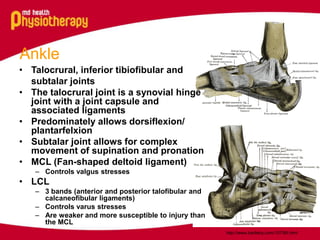
• Talocrural, inferior tibiofibular and
subtalar joints
• The talocrural joint is a synovial hinge
joint with a joint capsule and
associated ligaments
• Predominately allows dorsiflexion/
plantarfelxion
• Subtalar joint allows for complex
movement of supination and pronation
• MCL (Fan-shaped deltoid ligament)
– Controls valgus stresses

• LCL
– 3 bands (anterior and posterior talofibular and
calcaneofibular ligaments)
– Controls varus stresses
– Are weaker and more susceptible to injury than
the MCL
http://www.bartleby.com/107/95.html
Ankle
• Collateral ligament injuries
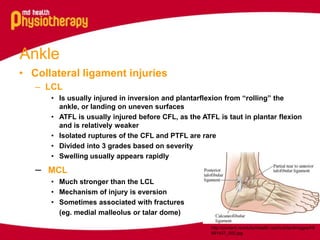
– LCL
• Is usually injured in inversion and plantarflexion from “rolling” the
ankle, or landing on uneven surfaces
• ATFL is usually injured before CFL, as the ATFL is taut in plantar flexion
and is relatively weaker
• Isolated ruptures of the CFL and PTFL are rare
• Divided into 3 grades based on severity
• Swelling usually appears rapidly

– MCL
• Much stronger than the LCL
• Mechanism of injury is eversion
• Sometimes associated with fractures
(eg. medial malleolus or talar dome)
http://content.revolutionhealth.com/contentimages/h9
991457_002.jpg
Ankle
• Anterior shin splints (medial tibial stress syndrome)
– Inflammatory traction phenomena on the medial aspect of the
tibia – can also be called medial tibial traction periostitis
– Chronic traction (usually of the medial soleus) occurs from
excessive pronation or overuse and repetitive impact loading
– Contributing factors include:
• Excessive foot pronation
• Training errors, incl. recent increase in activity
• Incorrect/poor shoe design
• Running on hard/unforgiving surfaces
• Decreased bone mineral density
• Poor hip and knee biomechanics
• Inflexibility
– Inflammation can lead to anterior compartment
http://www.sportsinjuryclinic.net/cybert
herapist/front/lowerleg/shinsplints.htm
syndrome, causing further pain and loss of function
Ankle
• Tenoperiostitis – tibialis posterior
– The tibialis posterior functions to invert the
subtalar joint, is the main dynamic
stabiliser of the hind foot against
valgus, and provides stability to the
longitudinal arch
– The cause of injury is usually overuse, and
is due to:

Tibialis
posterior

• Excessive walking, running or jumping
• Poor foot biomechanics (ie. excessive subtalar
pronation – this increases eccentric tendon
loading during supination for toe-off)

– It may also present as a tenosynovitis
secondary to rheumatoid arthritis, or
seronegative arthropathies

http://www.eorthopod.com/public/patient_
education/6489/posterior_tibial_tendon_pr
oblems.html
Ankle
• Tibial stress fracture
– Continual stresses from running on hard surfaces or from
heavy strain in the tibialis muscles can weaken and
eventually fracture the tibia
– Commonly caused by activities that involve highimpact running and jumping
– Patients with shin pain who try to work
through it sometimes end up developing
a stress fracture in the tibia
– 90% of tibial stress fractures affect the
posteromedial tibia, usually in the middle third
– Anterior tibial stress fractures are quite
resistant to treatment and have a propensity
to develop a non-union
http://www.eorthopod.com/images/ContentImages/
ankle/shinsplints/leg_shinsplints_cause02.jpg
Ankle
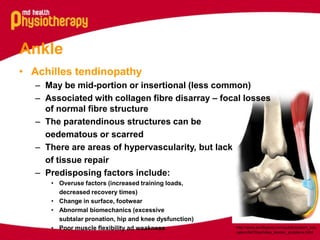
• Achilles tendinopathy
– May be mid-portion or insertional (less common)
– Associated with collagen fibre disarray – focal losses
of normal fibre structure
– The paratendinous structures can be
oedematous or scarred
– There are areas of hypervascularity, but lack
of tissue repair
– Predisposing factors include:
• Overuse factors (increased training loads,
decreased recovery times)
• Change in surface, footwear
• Abnormal biomechanics (excessive
subtalar pronation, hip and knee dysfunction)
• Poor muscle flexibility ad weakness

http://www.eorthopod.com/public/patient_edu
cation/6478/achilles_tendon_problems.html
Ankle
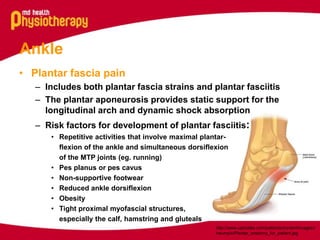
• Plantar fascia pain
– Includes both plantar fascia strains and plantar fasciitis
– The plantar aponeurosis provides static support for the
longitudinal arch and dynamic shock absorption
– Risk factors for development of plantar fasciitis:
• Repetitive activities that involve maximal plantarflexion of the ankle and simultaneous dorsiflexion
of the MTP joints (eg. running)
• Pes planus or pes cavus
• Non-supportive footwear
• Reduced ankle dorsiflexion
• Obesity
• Tight proximal myofascial structures,
especially the calf, hamstring and gluteals
http://www.uptodate.com/patients/content/images/r
heumpix/Plantar_anatomy_for_patient.jpg
Assessing the Ankle
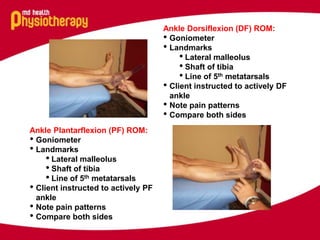
Ankle Dorsiflexion (DF) ROM:
• Goniometer
• Landmarks
• Lateral malleolus
• Shaft of tibia
• Line of 5th metatarsals
• Client instructed to actively DF
ankle
• Note pain patterns
• Compare both sides
Ankle Plantarflexion (PF) ROM:
• Goniometer
• Landmarks
• Lateral malleolus
• Shaft of tibia
• Line of 5th metatarsals
• Client instructed to actively PF
ankle
• Note pain patterns
• Compare both sides
Inferior tib/fib stability:
• Stabilise tib/fib
• Passively invert ankle with PF
• Note quality of
movement, ROM, end-feel and
pain patterns
• Compare both sides

Ankle anterior drawer (ATFL):
• Stabilise tib/fib
• Knee should be slightly flexed
• Anterior drawer calcaneus
through joint line
• Note quality of
movement, ROM, end-feel and
pain patterns
• Compare both sides
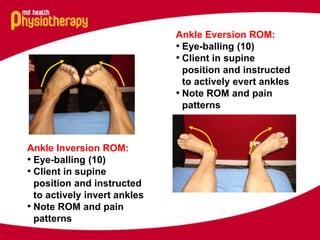
Ankle Eversion ROM:
• Eye-balling (10)
• Client in supine
position and instructed
to actively evert ankles
• Note ROM and pain
patterns

Ankle Inversion ROM:
• Eye-balling (10)
• Client in supine
position and instructed
to actively invert ankles
• Note ROM and pain
patterns
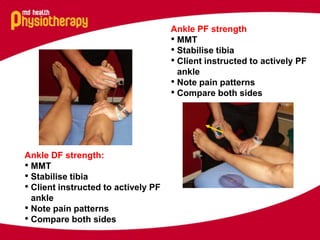
Ankle PF strength
• MMT
• Stabilise tibia
• Client instructed to actively PF
ankle
• Note pain patterns
• Compare both sides

Ankle DF strength:
• MMT
• Stabilise tibia
• Client instructed to actively PF
ankle
• Note pain patterns
• Compare both sides
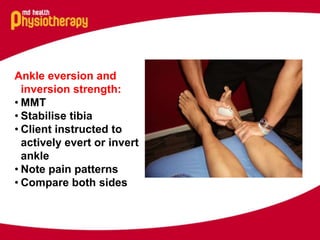
Ankle eversion and
inversion strength:
• MMT
• Stabilise tibia
• Client instructed to
actively evert or invert
ankle
• Note pain patterns
• Compare both sides
Significant Findings from the Ankle
Grades of ankle instability:
• Grade 1
• Ligament Stretch – No tear
• Minimal swelling tenderness
• No function loss
• No mechanical instability
• Grade 2
• Torn ATFL, Intact CFL
• Moderate pain, swelling
• Mild joint instability
• Grade 3
• Torn ATFL, CFL (PTFL)
• Significant pain, swelling, lost ROM
• Functional and mechanical
instability
Shin splint – general:
• Noted from subjective assessment
• Pain produced with palpation of:
• Tib ant and tib post for muscular shin
splints
• Tibia for bony shin splints
• Some pain may be reproduced with weightbearing DF and PF
• Bony shin splints may indicate micro fractures
occurring within the tibia itself
• Resulting inflammatory process causes pain
and localised swelling along the bone
Achilles tendinopathy:
• Pain with jumping/hopping
• Decreased PF strength compared with nonpathological side
• Biomechanical predisposing factors
• Excessive foot pronation
• Calf weakness
• Poor muscle flexibility, eg tight gastrocnemius
• Poor ROM – restricted DF
Lateral ligament tear:
• Positive ligament testing
• Anterior drawer assess ATFL integrity
• Talar tilt test assess integrity of the
calcaneofibular ligament (laterally) and the
deltoid ligament (medially)
• Grades of instability
• I: there is no abnormal ligament laxity
• II: reveal some degree of laxity but have a
firm end feel
• III: gross laxity without a discernible end
point
• Subjective Hx:
• noted trauma
• instability
Plantar fascia pain:
• Subjective
• Pain worse in morning and improves during
the day
• Pain with walking
• Pain reproduced with resisted PF
• Pain reproduced with DF stretch
• Biomechanical factors
• Activities that require maximal PF of the
ankle and simultaneous DF of
metatarsophalangeal joints –
running, dancing
• Excessive pronation
Treating the Ankle
Ankle ROM:
• Aim of Rx is to improve ankle ROM without
compromising pathology
• Can be used for any pathology but note stage of
healing
• STW (gastrocs, peroneals): can ease muscle
spasm and decrease pain inhibition
• Ankle mobs: AP, PA, physiological fl/ext/eve/inv
• Once ankle ROM is improved and ankle joint more
stable, progress to plyometric exercises
• skipping, jumping, running, hopping, side-toside running/hopping
Ankle strengthening:
• Aim of Rx is to improve ankle strength without
compromising pathology
• Can be used for any pathology but note stage of healing
• STW (gastrocs, peroneals): can ease muscle spasm and
decrease pain inhibition
• Strengthening: heel raises, lunges
• AMC: decrease resistance on reformer to maximise
eccentric control when adding HR to exercise
• Plyo: skipping, jumping, running, hopping, side-to-side
running/hopping
• Monitor pain behaviour. If Lx, hip, knee or ankle is
irritated, exercises should be eased off and focussed on
easing pain (RICER) or focus on another joint, eg. knee

Ankle pain workshop

  • 1.
    Ankle Pain Workshop MDHealth Physiotherapy
  • 2.
    Ankle • Talocrural, inferiortibiofibular and subtalar joints • The talocrural joint is a synovial hinge joint with a joint capsule and associated ligaments • Predominately allows dorsiflexion/ plantarfelxion • Subtalar joint allows for complex movement of supination and pronation • MCL (Fan-shaped deltoid ligament) – Controls valgus stresses • LCL – 3 bands (anterior and posterior talofibular and calcaneofibular ligaments) – Controls varus stresses – Are weaker and more susceptible to injury than the MCL http://www.bartleby.com/107/95.html
  • 3.
    Ankle • Collateral ligamentinjuries – LCL • Is usually injured in inversion and plantarflexion from “rolling” the ankle, or landing on uneven surfaces • ATFL is usually injured before CFL, as the ATFL is taut in plantar flexion and is relatively weaker • Isolated ruptures of the CFL and PTFL are rare • Divided into 3 grades based on severity • Swelling usually appears rapidly – MCL • Much stronger than the LCL • Mechanism of injury is eversion • Sometimes associated with fractures (eg. medial malleolus or talar dome) http://content.revolutionhealth.com/contentimages/h9 991457_002.jpg
  • 4.
    Ankle • Anterior shinsplints (medial tibial stress syndrome) – Inflammatory traction phenomena on the medial aspect of the tibia – can also be called medial tibial traction periostitis – Chronic traction (usually of the medial soleus) occurs from excessive pronation or overuse and repetitive impact loading – Contributing factors include: • Excessive foot pronation • Training errors, incl. recent increase in activity • Incorrect/poor shoe design • Running on hard/unforgiving surfaces • Decreased bone mineral density • Poor hip and knee biomechanics • Inflexibility – Inflammation can lead to anterior compartment http://www.sportsinjuryclinic.net/cybert herapist/front/lowerleg/shinsplints.htm syndrome, causing further pain and loss of function
  • 5.
    Ankle • Tenoperiostitis –tibialis posterior – The tibialis posterior functions to invert the subtalar joint, is the main dynamic stabiliser of the hind foot against valgus, and provides stability to the longitudinal arch – The cause of injury is usually overuse, and is due to: Tibialis posterior • Excessive walking, running or jumping • Poor foot biomechanics (ie. excessive subtalar pronation – this increases eccentric tendon loading during supination for toe-off) – It may also present as a tenosynovitis secondary to rheumatoid arthritis, or seronegative arthropathies http://www.eorthopod.com/public/patient_ education/6489/posterior_tibial_tendon_pr oblems.html
  • 6.
    Ankle • Tibial stressfracture – Continual stresses from running on hard surfaces or from heavy strain in the tibialis muscles can weaken and eventually fracture the tibia – Commonly caused by activities that involve highimpact running and jumping – Patients with shin pain who try to work through it sometimes end up developing a stress fracture in the tibia – 90% of tibial stress fractures affect the posteromedial tibia, usually in the middle third – Anterior tibial stress fractures are quite resistant to treatment and have a propensity to develop a non-union http://www.eorthopod.com/images/ContentImages/ ankle/shinsplints/leg_shinsplints_cause02.jpg
  • 7.
    Ankle • Achilles tendinopathy –May be mid-portion or insertional (less common) – Associated with collagen fibre disarray – focal losses of normal fibre structure – The paratendinous structures can be oedematous or scarred – There are areas of hypervascularity, but lack of tissue repair – Predisposing factors include: • Overuse factors (increased training loads, decreased recovery times) • Change in surface, footwear • Abnormal biomechanics (excessive subtalar pronation, hip and knee dysfunction) • Poor muscle flexibility ad weakness http://www.eorthopod.com/public/patient_edu cation/6478/achilles_tendon_problems.html
  • 8.
    Ankle • Plantar fasciapain – Includes both plantar fascia strains and plantar fasciitis – The plantar aponeurosis provides static support for the longitudinal arch and dynamic shock absorption – Risk factors for development of plantar fasciitis: • Repetitive activities that involve maximal plantarflexion of the ankle and simultaneous dorsiflexion of the MTP joints (eg. running) • Pes planus or pes cavus • Non-supportive footwear • Reduced ankle dorsiflexion • Obesity • Tight proximal myofascial structures, especially the calf, hamstring and gluteals http://www.uptodate.com/patients/content/images/r heumpix/Plantar_anatomy_for_patient.jpg
  • 9.
  • 10.
    Ankle Dorsiflexion (DF)ROM: • Goniometer • Landmarks • Lateral malleolus • Shaft of tibia • Line of 5th metatarsals • Client instructed to actively DF ankle • Note pain patterns • Compare both sides Ankle Plantarflexion (PF) ROM: • Goniometer • Landmarks • Lateral malleolus • Shaft of tibia • Line of 5th metatarsals • Client instructed to actively PF ankle • Note pain patterns • Compare both sides
  • 11.
    Inferior tib/fib stability: •Stabilise tib/fib • Passively invert ankle with PF • Note quality of movement, ROM, end-feel and pain patterns • Compare both sides Ankle anterior drawer (ATFL): • Stabilise tib/fib • Knee should be slightly flexed • Anterior drawer calcaneus through joint line • Note quality of movement, ROM, end-feel and pain patterns • Compare both sides
  • 12.
    Ankle Eversion ROM: •Eye-balling (10) • Client in supine position and instructed to actively evert ankles • Note ROM and pain patterns Ankle Inversion ROM: • Eye-balling (10) • Client in supine position and instructed to actively invert ankles • Note ROM and pain patterns
  • 13.
    Ankle PF strength •MMT • Stabilise tibia • Client instructed to actively PF ankle • Note pain patterns • Compare both sides Ankle DF strength: • MMT • Stabilise tibia • Client instructed to actively PF ankle • Note pain patterns • Compare both sides
  • 14.
    Ankle eversion and inversionstrength: • MMT • Stabilise tibia • Client instructed to actively evert or invert ankle • Note pain patterns • Compare both sides
  • 15.
  • 16.
    Grades of ankleinstability: • Grade 1 • Ligament Stretch – No tear • Minimal swelling tenderness • No function loss • No mechanical instability • Grade 2 • Torn ATFL, Intact CFL • Moderate pain, swelling • Mild joint instability • Grade 3 • Torn ATFL, CFL (PTFL) • Significant pain, swelling, lost ROM • Functional and mechanical instability
  • 17.
    Shin splint –general: • Noted from subjective assessment • Pain produced with palpation of: • Tib ant and tib post for muscular shin splints • Tibia for bony shin splints • Some pain may be reproduced with weightbearing DF and PF • Bony shin splints may indicate micro fractures occurring within the tibia itself • Resulting inflammatory process causes pain and localised swelling along the bone
  • 18.
    Achilles tendinopathy: • Painwith jumping/hopping • Decreased PF strength compared with nonpathological side • Biomechanical predisposing factors • Excessive foot pronation • Calf weakness • Poor muscle flexibility, eg tight gastrocnemius • Poor ROM – restricted DF
  • 19.
    Lateral ligament tear: •Positive ligament testing • Anterior drawer assess ATFL integrity • Talar tilt test assess integrity of the calcaneofibular ligament (laterally) and the deltoid ligament (medially) • Grades of instability • I: there is no abnormal ligament laxity • II: reveal some degree of laxity but have a firm end feel • III: gross laxity without a discernible end point • Subjective Hx: • noted trauma • instability
  • 20.
    Plantar fascia pain: •Subjective • Pain worse in morning and improves during the day • Pain with walking • Pain reproduced with resisted PF • Pain reproduced with DF stretch • Biomechanical factors • Activities that require maximal PF of the ankle and simultaneous DF of metatarsophalangeal joints – running, dancing • Excessive pronation
  • 21.
  • 22.
    Ankle ROM: • Aimof Rx is to improve ankle ROM without compromising pathology • Can be used for any pathology but note stage of healing • STW (gastrocs, peroneals): can ease muscle spasm and decrease pain inhibition • Ankle mobs: AP, PA, physiological fl/ext/eve/inv • Once ankle ROM is improved and ankle joint more stable, progress to plyometric exercises • skipping, jumping, running, hopping, side-toside running/hopping
  • 23.
    Ankle strengthening: • Aimof Rx is to improve ankle strength without compromising pathology • Can be used for any pathology but note stage of healing • STW (gastrocs, peroneals): can ease muscle spasm and decrease pain inhibition • Strengthening: heel raises, lunges • AMC: decrease resistance on reformer to maximise eccentric control when adding HR to exercise • Plyo: skipping, jumping, running, hopping, side-to-side running/hopping • Monitor pain behaviour. If Lx, hip, knee or ankle is irritated, exercises should be eased off and focussed on easing pain (RICER) or focus on another joint, eg. knee