Ankle replacement
Dr. Sairamakrishnan S
• Since the first report of total ankle
arthroplasty in the 1970s, more than 20 total
ankle arthroplasty systems have been
introduced
• The first-generation, cemented, constrained
designs were very stable but required
extensive bony resection for implantation and
frequently failed because of loosening and
extensive osteolysis.
• Second-generation, less constrained implants
required less bone resection and did not require
cement fixation; because shear forces and torsion
at the bone-prosthesis were reduced, loosening
was less frequent.
• However, increased polyethylene wear and
failure compromised the stability of the
components, often leading to painful
impingement and subluxation or complete
dislocation of the components.
• Contemporary, third-generation,
semiconstrained total ankle systems consist of
three components:
– a metallic baseplate that is fixed to the tibia,
– a domed or condylar-shaped metallic component
that resurfaces the talus,
– an ultrahigh-molecular-weight polyethylene
bearing surface interposed between the tibial and
talar components.
• Systems in which the polyethylene component
is locked into the baseplate often are referred
to as “two-piece” or “fixed-bearing” designs,
whereas those with the polyethylene
component not attached to the baseplate are
called “three-piece” or mobile or meniscal
bearing systems
• Anatomic problems
– (1) the ankle has significantly less contact area
between joint surfaces than the hip or knee;
– (2) the ankle experiences 5.5 times body weight
with normal ambulation, compared with 3 times
body weight at the knee; and
– (3) the articular cartilage surface of the ankle is
uniformly thinner than that of the knee.
FIXED-BEARING VERSUS MOBILE-
BEARING DESIGN
• Based on movement between the poly and
the tibial component
• “forgiveness” of the implant, which allows
small variances in alignment to be
compensated for by a reorientation of the
prosthesis to accommodate the joint forces.
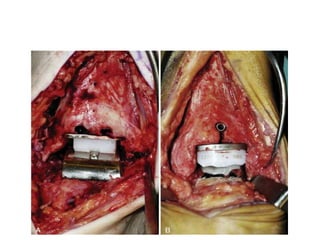
• Proponents of fixed-bearing designs suggest
that the normal ankle joint, as opposed to the
knee, has a more stable central axis of motion
and less need for an additional degree of
freedom of motion.
• Backside polyethylene wear against the tibial
component is a major concern with mobile-
bearing designs and less with fixed designs.
ALIGNMENT
• The most common method of obtaining
correct alignment is an external alignment jig,
using intraoperative fluoroscopy to judge the
alignment.
PREOPERATIVE EVALUATION
• Systemic diseases such as diabetes,
inflammatory arthritis, chronic obstructive
pulmonary disease, and peripheral vascular or
heart disease, active smoking may adversely
affect the outcome and healing of the incision.
• Conditions such as sleep apnea, malnutrition,
vitamin D deficiency, and depression are
associated with decreased functional
outcomes and poor results.
• Adjacent joint problems should be addressed
first
• Clinical assessment of the gastrocsoleus
complex and the Achilles tendon is important.
• The skin should be stable and without lesions
that would impair the healing of the surgical
incision.
• Minimum, standing radiographs of the ankle
in anteroposterior, lateral, and mortise views
should be obtained.
INDICATIONS
• The ideal candidate for ankle arthroplasty has
been described as an older, thin, low-demand
individual with minimal deformity and
retained ankle range of motion.
• Commonly cited contraindications to total ankle
arthroplasty
– age younger than 50 years
– history of poor patient compliance
– heavy industrial laborer
– heavy smoker
– uncontrolled diabetes with neuropathy
– significant ankle instability
– Angular deformity of more than 10 to 15 degrees
– vascular insufficiency
– obesity (over 250 lb),
– significant bone loss, osteonecrosis
– active or previous infection.
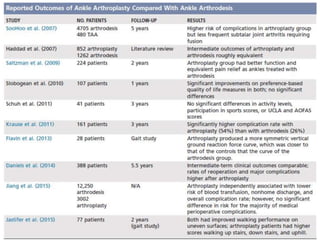
TOTAL ANKLE ARTHROPLASTY OR ANKLE
ARTHRODESIS FOR ANKLE ARTHRITIS
SPECIAL CIRCUMSTANCES
• Inflammatory arthritis
• Obesity
• Diabetes
• Pantalar disease; concomitant hindfoot
arthrodesis
• Takedown of ankle arthrodesis
OUTCOMES
• Overall revision rates according to registry
databases have been cited as 21.8% at 5 years
and 43.5% at 10 years.
• In general, those with a fixed-bearing implant
had more improvements in ankle moment and
ground reaction forces, whereas those with
mobile-bearing implants had more
improvement in patient-reported pain.
COMPLICATIONS
• Wound healing complications
• Osteolysis, loosening, and subsidence
• Malalignment
• Fracture
• Infection
• Deep venous thrombosis
• Heterotopic ossification
• Progression of arthritis in adjacent joints
• Osteophyte formation/impingement

Ankle replacement

  • 1.
  • 2.
    • Since thefirst report of total ankle arthroplasty in the 1970s, more than 20 total ankle arthroplasty systems have been introduced • The first-generation, cemented, constrained designs were very stable but required extensive bony resection for implantation and frequently failed because of loosening and extensive osteolysis.
  • 3.
    • Second-generation, lessconstrained implants required less bone resection and did not require cement fixation; because shear forces and torsion at the bone-prosthesis were reduced, loosening was less frequent. • However, increased polyethylene wear and failure compromised the stability of the components, often leading to painful impingement and subluxation or complete dislocation of the components.
  • 4.
    • Contemporary, third-generation, semiconstrainedtotal ankle systems consist of three components: – a metallic baseplate that is fixed to the tibia, – a domed or condylar-shaped metallic component that resurfaces the talus, – an ultrahigh-molecular-weight polyethylene bearing surface interposed between the tibial and talar components.
  • 5.
    • Systems inwhich the polyethylene component is locked into the baseplate often are referred to as “two-piece” or “fixed-bearing” designs, whereas those with the polyethylene component not attached to the baseplate are called “three-piece” or mobile or meniscal bearing systems
  • 6.
    • Anatomic problems –(1) the ankle has significantly less contact area between joint surfaces than the hip or knee; – (2) the ankle experiences 5.5 times body weight with normal ambulation, compared with 3 times body weight at the knee; and – (3) the articular cartilage surface of the ankle is uniformly thinner than that of the knee.
  • 7.
    FIXED-BEARING VERSUS MOBILE- BEARINGDESIGN • Based on movement between the poly and the tibial component • “forgiveness” of the implant, which allows small variances in alignment to be compensated for by a reorientation of the prosthesis to accommodate the joint forces.
  • 8.
    • Proponents offixed-bearing designs suggest that the normal ankle joint, as opposed to the knee, has a more stable central axis of motion and less need for an additional degree of freedom of motion. • Backside polyethylene wear against the tibial component is a major concern with mobile- bearing designs and less with fixed designs.
  • 10.
    ALIGNMENT • The mostcommon method of obtaining correct alignment is an external alignment jig, using intraoperative fluoroscopy to judge the alignment.
  • 11.
    PREOPERATIVE EVALUATION • Systemicdiseases such as diabetes, inflammatory arthritis, chronic obstructive pulmonary disease, and peripheral vascular or heart disease, active smoking may adversely affect the outcome and healing of the incision. • Conditions such as sleep apnea, malnutrition, vitamin D deficiency, and depression are associated with decreased functional outcomes and poor results.
  • 12.
    • Adjacent jointproblems should be addressed first • Clinical assessment of the gastrocsoleus complex and the Achilles tendon is important. • The skin should be stable and without lesions that would impair the healing of the surgical incision.
  • 13.
    • Minimum, standingradiographs of the ankle in anteroposterior, lateral, and mortise views should be obtained.
  • 14.
    INDICATIONS • The idealcandidate for ankle arthroplasty has been described as an older, thin, low-demand individual with minimal deformity and retained ankle range of motion.
  • 15.
    • Commonly citedcontraindications to total ankle arthroplasty – age younger than 50 years – history of poor patient compliance – heavy industrial laborer – heavy smoker – uncontrolled diabetes with neuropathy – significant ankle instability – Angular deformity of more than 10 to 15 degrees – vascular insufficiency – obesity (over 250 lb), – significant bone loss, osteonecrosis – active or previous infection.
  • 16.
    TOTAL ANKLE ARTHROPLASTYOR ANKLE ARTHRODESIS FOR ANKLE ARTHRITIS
  • 18.
    SPECIAL CIRCUMSTANCES • Inflammatoryarthritis • Obesity • Diabetes • Pantalar disease; concomitant hindfoot arthrodesis • Takedown of ankle arthrodesis
  • 19.
    OUTCOMES • Overall revisionrates according to registry databases have been cited as 21.8% at 5 years and 43.5% at 10 years. • In general, those with a fixed-bearing implant had more improvements in ankle moment and ground reaction forces, whereas those with mobile-bearing implants had more improvement in patient-reported pain.
  • 20.
    COMPLICATIONS • Wound healingcomplications • Osteolysis, loosening, and subsidence • Malalignment • Fracture • Infection • Deep venous thrombosis • Heterotopic ossification • Progression of arthritis in adjacent joints • Osteophyte formation/impingement