Phrase Structure Rules are a way to describe a given language's syntax and
are closely associated with the early stages ofTransformational Grammar. They
are used to break down a natural language sentence into its constituent
parts (also known assyntactic categories) namely phrasal
categories and lexical categories. A grammar that uses phrase structure rules
is a type of phrase structure grammar - except in computer science, where it is
known as just a grammar, usually context-free. Phrase structure rules as they
are commonly employed operate according to the constituency relation and a
grammar that employs phrase structures rules is therefore a constituency
grammar and as such, it stands in contrast to dependency grammars, which
are based on the dependency relation.
Phrase Structure Rules are usually of the following form:
 AB C
 meaning that the constituent is separated into the two subconstituents and . Some
further examples for English are as follows:
 SN P
 NPDet N1
 N1(AP) N1 (PP)
 The first rule reads: An S (sentence) consists of an NP (noun phrase) followed by a VP
(verb phrase). The second rule reads: A noun phrase consists of a Det (determiner)
followed by an N (noun). Some further categories are listed here: AP (adjective phrase),
AdvP (adverb phrase), PP (prepositional phrase), etc. Applying the Phrase Structure Rules
in a neutral manner, it is possible to generate many proper sentences of English. But it is
also quite possible that the rules generate syntactically correct but semantically
nonsensical sentences. The following example sentence is notorious in this regard, since
it is complete nonsense, even though it is syntactically correct:
 Colorless green ideas sleep furiously
 This sentence was constructed by Noam Chomsky as an illustration that Phrase Structure
Rules are capable of generating syntactically
 Colorless green ideas sleep furiously
 This sentence was constructed by Noam
Chomsky as an illustration that Phrase
Structure Rules are capable of generating
syntactically correct but semantically
incorrect sentences. Phrase structure rules
break sentences down into their constituent
parts. These constituents are often
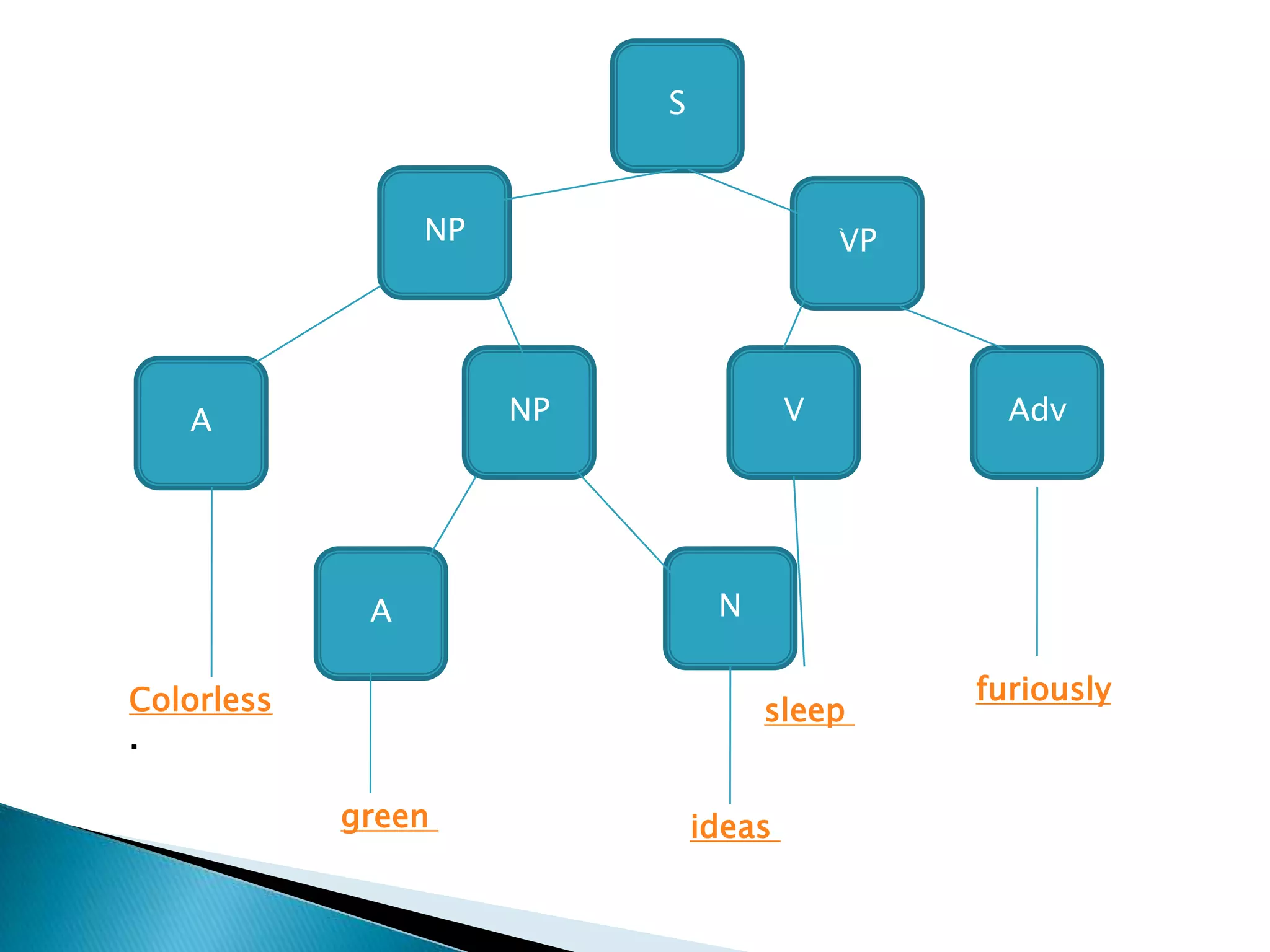
represented as tree structures. The tree for
Chomsky's famous sentence can be
rendered as follows:
S
NP VP
A NP AdvV
A N
Colorless
.
green ideas
sleep
furiously

Animation presentation

  • 1.
    Phrase Structure Rulesare a way to describe a given language's syntax and are closely associated with the early stages ofTransformational Grammar. They are used to break down a natural language sentence into its constituent parts (also known assyntactic categories) namely phrasal categories and lexical categories. A grammar that uses phrase structure rules is a type of phrase structure grammar - except in computer science, where it is known as just a grammar, usually context-free. Phrase structure rules as they are commonly employed operate according to the constituency relation and a grammar that employs phrase structures rules is therefore a constituency grammar and as such, it stands in contrast to dependency grammars, which are based on the dependency relation.
  • 2.
    Phrase Structure Rulesare usually of the following form:  AB C  meaning that the constituent is separated into the two subconstituents and . Some further examples for English are as follows:  SN P  NPDet N1  N1(AP) N1 (PP)  The first rule reads: An S (sentence) consists of an NP (noun phrase) followed by a VP (verb phrase). The second rule reads: A noun phrase consists of a Det (determiner) followed by an N (noun). Some further categories are listed here: AP (adjective phrase), AdvP (adverb phrase), PP (prepositional phrase), etc. Applying the Phrase Structure Rules in a neutral manner, it is possible to generate many proper sentences of English. But it is also quite possible that the rules generate syntactically correct but semantically nonsensical sentences. The following example sentence is notorious in this regard, since it is complete nonsense, even though it is syntactically correct:  Colorless green ideas sleep furiously  This sentence was constructed by Noam Chomsky as an illustration that Phrase Structure Rules are capable of generating syntactically
  • 3.
     Colorless greenideas sleep furiously  This sentence was constructed by Noam Chomsky as an illustration that Phrase Structure Rules are capable of generating syntactically correct but semantically incorrect sentences. Phrase structure rules break sentences down into their constituent parts. These constituents are often represented as tree structures. The tree for Chomsky's famous sentence can be rendered as follows:
  • 4.
    S NP VP A NPAdvV A N Colorless . green ideas sleep furiously