Tissue :
- Agroup of cells similar in form, structure and
embryonic origin which coordinate to perform a
specific function is called a simple tissue,
- while a group of cells, different in their structure and
function but coordinating
to perform a specific function, is called a compound tissue.
- Various tissues combine together in an orderly manner to
form large functional units called organs. Number of
organs work in coordination and give rise to organ-system.
- The branch of science that deals with the microscopic study
of tissues is called
histology.
Definition
3.
T
I
S
S
U
E
Epithelial Tissues
( Coveringtissues. These tissues are present for
protection.)
Connective Tissues
( Supporting tissues. These tissues help in binding
different body structures.)
Muscular Tissues
Contractile tissues. These tissues help in movements
and locomotion.)
Nervous Tissues
( Conducting tissues. These tissues help in conduction of
nerve impulses.)
5.
General position:
-It coversthe outer surface of all the organs of the body and also
lines the cavities of all the hollow organs of the body.
Structure:
- Cells are arranged in one or more layers.
- Cells are compactly arranged and there is no or very little intercellular material
(matrix) between them.
- Cells of the lowermost layer rest on thin, double layered, non-cellular, non-living
basement membrane (or basal lamina)
- Cells may originate from any primary germ layer i.e. ectoderm (e.g. epidermis of
skin), mesoderm (e.g. coelomic i.e body cavity epithelium), endoderm (e.g. mid gut
epithelium).
- Cells are non-vascular or avascular, i.e. they lack their own blood supply. These cells
get their nutrition from the blood capillaries present in the underlying connective
tissue.
- Cells have the power of division and regeneration throughout life. The old injured
dead cells are sloughed off (removed) regularly.
- Free surface of the cells may be smooth, or may have fine hair-like cilia or microvilli.
EPITHELIAL TISSUE
SIMPLE SQUAMOUS EPITHELIUM
Origin:
-It is found in the peritoneum of
coelom and endothelium (i.e.
lining of the blood vessels).
- It is also found on the surface
- of the skin.
-Functions:
- Filtration and diffusion of
material.
- Protection of skin from micro-
organisms and foreign
particles.
8.
SIMPLE CUBOIDAL EPITHELIUM
Origin:
-It is generally found in the
thyroid gland and kidney.
Functions:
- They play an important role in
absorption and secretion.
9.
SIMPLE COLUMNAR EPITHELIUM
Origin:
-It makes the inner lining of
stomach,intestine and other
internal organs.
Functions:
- Microvilli help in increasing the
surface area of absorption
which is the main function of
non-ciliated columnar
epithelium.
10.
CILIATED COLUMNAR EPITHELIUM
Origin:
-It is found in the upper respiratory tract,
fallopian tube of vertebrates.
Functions:
-Since cilia are capable of vibratory
movement, they are able to remove
foreign particles from the surface. Cilia
help in the movement of non-motile
ovum.
11.
NON- CILIATED COLUMNAREPITHELIUM
Structure:
- These are without cilia at their
anterior free end and hence
called non-ciliated columnar
epithelium.
- Columnar cells at their
apical region show presence of
finger like protoplasmic
projections called microvilli.
Functions:
-Microvilli help in increasing the
surface area of absorption which is
the main function of non-ciliated
columnar epithelium.
12.
SIMPLE GLANDULAR EPITHELIUM
-These are specialized epithelial
cells capable of synthesizing
substances like enzymes,
hormones, sweat, oil, etc.
- These secretions are carried into
ducts (tubes) on the surface or
into blood.
- The structure formed by these
specialized epithelial cells is
commonly called a GLAND
- Glands are further classified as:
a)Endocrine glands
b)Exocrine glands
c) Heterocrine Gland
13.
SIMPLE GLANDULAR EPITHELIUM
EndocrineGlands:
- These glands pour their secretion directly into the blood stream. Such
glands lack
ducts and are thus called ductless glands.
- e.g.: pituitary, thyroid, parathyroid, ovary, testis, adrenal, islets of
Langerhans.
Exocrine Glands:
- These glands are with ducts. Their secretion is carried by means of a duct
or tube to the site of action. They are responsible for body secretions.
- e.g.: tear glands, salivary glands, gastric and intestinal glands.
Heterocrine Gland- Mixing of both gland ,Pancreas
Origin: -Arise fromthe mesoderm of the embryo.
Most abundant type of animal tissue
Structure:
- The connective tissues consist of variously shaped cells lying wide apart in a
large, amount of non-living intercellular or extracellular material called the
matrix.
- The matrix is also called ground substance. It is usually secreted by the
connective tissue cells themselves.
- This ground substance permits diffusion of food materials, water, gases and
wastes to and from the cells.
- Thus, connective tissue usually comprises of two components: matrix and
cells.
- The nature and proportion of these two components vary in different kinds
of connective tissues.
- Almost all connective tissues are highly vascular in nature
- In all connective tissues, except blood, the cells secrete fibres of structural
proteins called collagen or elastin.
CONNECTIVE TISSUE
Connective tissue properAreolar connective tissue
Origin:
-It is found below the skin, muscles
and bones.
Functions:
- The areolar tissue, also called
loose connective tissue, is
essentially connective in
function.
- It fixes the skin with the muscles,
attaches the blood vessels and
nerves with the surrounding
tissues, fastens the peritoneum
to the body wall and viscera and
keeps the muscle fibres together.
21.
Connective tissue properAreolar connective tissue
Structure: The transparent jelly-like, sticky matrix
contains numerous fibres and cells and abundant
mucin.
Fibres: The fibres are white and yellow.
White fibres:
- unbranched, wavy and arranged in bundles.
also called collagen fibres as they contain
proteinous substance called collagen
- These collagen fibres give tensile strength to the
tissue. Collagen fibres are formed at the site of
injury for tissue repair (healing).
Yellow fibres:
- Thin, slender and singly arranged.
- These are flexible, elastic and branched, the
branches joining with one another to form an
irregular but large network.
- They possess elastic property due to the
presence of a protein called elastin.
22.
Connective tissue properAreolar connective tissue
Cells: The cells in the matrix are of 4 main
kinds: Fibroblasts, macrophages, mast cells
and adipocytes
Fibroblasts:
- Main cells of the areolar tissue. They are
large, flat and star-shaped cells with long and
branched processes.
- They secrete the matrix and the material of
which the fibres are formed (both white and
yellow fibres).
- Fibroblasts migrate to the site of injury and
secrete more fibres to seal off the wound.
Macrophages or Histiocytes:
- The macrophages are almost as numerous
as the fibroblasts.
- They are large, long-lived and irregular
cells.
- They engulf the microbes, foreign particles and
damaged cells.
- Hence, they are phagocytic in action.
23.
Connective tissue properAreolar connective tissue
Mast Cells:
- The mast cells are also called mastocytes
and they are small oval cells in
mammals.
- They produce heparin and histamine.
- Heparin prevents blood clotting in the
uninjured vessels.
- Histamine is useful in dilating blood
vessels, an inflammatory response to
injury or infection. Histamine is also
involved in allergic reactions. Its release
from the mast cells helps in body
defence by attracting the phagocytes to
the site of injury.
Adipocytes:
- These are useful in storage of fats.
24.
Connective tissue properAdipose connective tissue
Origin:
- The adipose tissue is found in the subcutaneous tissue (under the
skin), in the covering of the heart and around the blood vessels
and kidneys.
- It also forms the yellow bone marrow.
Functions:
- Adipose tissue is primarily a food reserve.
- The subcutaneous fat prevents heat loss from the body,
particularly in polar animals and also rounds off the body
contour (shape).
- It forms a shock absorbing cushion around the kidneys and the
eyeballs.
- It also produces the blood corpuscles.
Structure:
- Adipose tissue is found in association with the areolar
connective tissue.
- It is modified areolar tissue consisting of a large number of
adipocytes i.e. cells specialised for fat storage. A fat cell first
develops in it small fat droplets, which later fuse to form a large
fat globule. These globules push the cytoplasm with its organelles
to the periphery and the nucleus to one side.
25.
Connective tissue properAdipose connective tissue
White Adipose Tissue:
- These appear opaque due to the
presence of a large number of
adipocytes.
- It is commonly seen in adults.
Brown Adipose Tissue:
- These are reddish brown in colour due
to the large number of blood vessels.
- It is mostly found in developing foetus
and infants.
26.
Connective tissue properWhite fibrous tissue
White Fibrous Tissue:
- The white fibrous tissue is especially rich in white collagen
fibres.
- These are similar to but thicker than those found in the areolar
tissue.
- This tissue is very tough and inelastic. It appears as cords or
sheets.
- As cords, the white fibres run parallel to form cords called
tendons.
Tendons connect the skeletal muscles with the bones.
Tendons:
- They are specialized extensions or prolongations of muscles.
- They are formed of bundles of collagen fibres (white fibres).
- At one end, they are formed from the core of the muscles
and the other end is attached to a bone.
- Some of the tendons are – Achilles tendon,
hamstring tendon.
- They play an important role in various movements.
As sheets, it occurs in the pericardium of the heart, dura mater of
the brain and spinal cord, capsule of the kidney, etc.
27.
Connective tissue properYellow elastic tissue
Yellow Elastic Tissue:
- The yellow elastic tissue consists mainly of a loose
network of yellow elastic fibres.
- These elastic fibres are much thicker but similar to
those of areolar tissue.
- This tissue combines strength with great flexibility. It
also has 2 forms: cords and sheets.
- The cords formed by this tissue are called ligaments.
Ligaments serve to bind the bones together.
Ligaments:
- They are formed of bundles of yellow fibres
- They bind two different bones at the joints.
- They play a very important role in preventing
dislocation of bones and at the same time providing
flexibility to joints.
- As sheets formed by this tissue, they occur in the
walls of the blood vessels, lungs and
bronchioles.
- Recovery of these organs after expansion is due to
this tissue’s presence.
28.
Connective tissue properReticular Connective tissue
RETICULAR TISSUE :
- The reticular tissue consists of star-
shaped reticular cells, the protoplasmic
processes of which join to form a cellular
network.
- Reticular fibres are superimposed on
the reticular cells. They are composed of
a protein called reticulin.
- They are branched and inelastic.
- This tissue forms the supporting
framework of lymph glands, spleen and
bone marrow.
- The reticular cells are phagocytic and
form defence mechanism of the body.
29.
Skeletal Tissue Cartilage
Thecartilage is a solid, semi-rigid connective tissue. It is tough, flexible
tissue which forms the endoskeleton in large number of vertebrates.
Structure:
- The cartilage is enclosed in a sheath of white fibrous
tissue called perichondrium. It consists of blood
vessels and nerve fibres.
- The perichondrium encloses a semi-solid matrix
called
chondrin.
- Towards the periphery or the inner margin of the
perichondrium, a layer of small immature cartilage
cells called chondroblasts are seen. The matrix is
secreted by the chondroblasts.
- A chondroblast lies in a fluid-filled space, the
cartilage
lacuna, in the matrix.
- During growth of the cartilage, the chondroblasts
divide and the cells formed by division keep lying in
groups of two or more in the same lacuna
30.
Skeletal Tissue Cartilage
-In the matrix near the perichondrium, the
chondroblasts are small and young and they lie
close together. Later, they become large,
rounded, and mature and occur in groups. Here,
they are called chondrocytes.
- These chondrocytes are enclosed
within lacunae and are seen scattered in the
matrix.
- Each lacuna contains 2 to 8 chondrocytes.
- The exchange of materials (nutrients) between
the chondrocytes and the matrix takes place with
simple diffusion from blood vessels present in
the perichondrium.
Depending on the nature of the matrix, cartilage is classified as:
1.Hyaline Cartilage
2.Fibrous Cartilage
3.Elastic Cartilage
4.Calcified Cartilage
31.
Skeletal Tissue Cartilage
HyalineCartilage:
It is the weakest of the four types or cartilages.
Origin: It is found at the ends of long bones,
anterior ends of ribs, nose tip, larynx, and
bronchial tree, foetal and embryonic skeleton.
Structure: It is compressible and elastic in
nature. It is surrounded by perichondrium. The
matrix, i.e. chondrin, is bluish-white and gel-like
(transparent). It contains very fine collagen
fibres and chondrocytes (2 to 8 in each lacuna).
Functions:
- It provides flexibility and supports the body.
- It helps in reducing friction.
- It also acts as a good shock absorber.
Hyaline cartilage
32.
Skeletal Tissue Cartilage
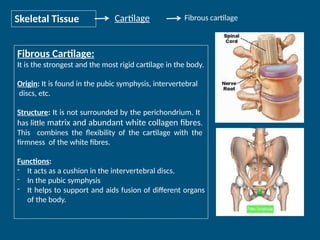
FibrousCartilage:
It is the strongest and the most rigid cartilage in the body.
Origin: It is found in the pubic symphysis, intervertebral
discs, etc.
Structure: It is not surrounded by the perichondrium. It
has little matrix and abundant white collagen fibres.
This combines the flexibility of the cartilage with the
firmness of the white fibres.
Functions:
- It acts as a cushion in the intervertebral discs.
- In the pubic symphysis
- It helps to support and aids fusion of different organs
of the body.
Fibrous cartilage
33.
Skeletal Tissue Cartilage
ElasticCartilage:
Origin:
It is found in the epiglottis (lid on top of the larynx),
external ear (auricle), trachea etc.
Structure:
It is surrounded by perichondrium. The matrix (chondrin)
contains a thread-like network of elastic fibres.. It has
abundant network of yellow fibres in addition to white
fibres. Chondrocytes are few in number and are seen
encircled with elastic fibres. It is opaque and yellowish in
appearance. It readily recovers its shape after distortion.
Functions:
It gives support and maintains shape of the body.
Elastic Cartilage
34.
Skeletal Tissue Cartilage
CalcifiedCartilage:
- It is formed due to deposition of various salts in the matrix.
- Due to this deposition, the cartilage becomes very
hard and inelastic and loses it flexibility.
- This condition is found in old age where the joints lose their
mobility.
- It is also found in the suprascapula of the frog and the
vertebrae of sharks.
Elastic Cartilage
35.
Hyaline Cartilage FibrousCartilage Elastic Cartilage
1. It is bluish green,
translucent in
appearance.
1. It is whitish, opaque in
appearance.
1. Is yellowish, opaque in
appearance.
2. Has fewer, very thin white
fibres in the matrix.
2. Has an abundant white
fibres in the matrix.
2. Has an abundant yellow
fibres in the matrix.
3. It is flexible. 3. It is firm. 3. It is very flexible.
4. Perichondrium is present. 4. Perichondrium is absent. 4. Perichondrium is present.
5. Occurs in sternal ribs,
tracheal and bronchial
rings, laryngeal wall and
nasal septum.
5. Occurs in intervertebral
discs and pubic
symphysis.
5. Occurs in pinna, external
auditory meatus, nose tip
and epiglottis.
36.
Skeletal Tissue Bone
BONE:
Bone is the hardest tissue in the body.
Bone is the main constituent of the skeleton. Bone shows the presence of hard,
solid, calcified matrix called ossein.
The hardness is due to deposition of inorganic mineral salt called hydroxyl-
apatite [ Ca10 (PO4)6 (OH)2 ].
37.
Structure:
- Bone isenclosed in a thin layer of white fibrous connective tissue (i.e. collagen fibre) called
periosteum.
- Blood vessels and nerves pierce through the periosteum. The periosteum is internally lined by
endosteum which surrounds the marrow cavity.
- The matrix is arranged in concentric circles called lamellae.
- These lamellae contain a large number of living cells called osteoblasts or osteocytes which are
present in a fluid filled cavity called lacuna.
- Osteoblasts are active bone cells and osteocytes are inactive bone cells. Each lacuna has fine
cytoplasmic extensions called canaliculli which pass through the lamellae and makes connection
with the adjacent lacunae
Skeletal Tissue Bone
38.
Skeletal Tissue Bone
-The structural unit of bone is the Haversian
system or osteon.
- Presence of a Haversian system is the
characteristic of a mammalian bone.
- Haversian system shows a Haversian canal in
the centre.
- Haversian canal consists of blood vessels of
arteries and veins, lymph vessels and nerves as
well.
- Lacunae containing osteoblasts or osteocytes
are arranged in concentric circles around the
Haversian canal.
- The two adjacent Haversian systems are
interconnected by transverse channels, the
Volkmann’s canal.
39.
Skeletal Tissue Bone
Functions:
-It is the supporting and protective tissue of vertebrates which protects the internal
soft and delicate tissues.
- Besides providing support, bones have a metabolic and protective role too.
- It forms the base for attachment of muscles.
- In long bones, the yellow marrow cavity helps in storage of reserve food material.
- The red marrow cavity in the long bones is useful in haemopioesis
40.
Skeletal Tissue Bone
Spongybone:
Origin:
It is seen in the expanded ends
(epiphyseal region) of long bones.
Structure:
The matrix or ossein is web-like
containing columns of bones called
trabeculae with many small spaces
between them. These spaces contain a
soft tissue called red bone marrow
which is responsible for heamopiosis. It
lacks the Haversian system.
Functions:
The spongy bones provide considerable
strength with minimum of weight.
Compact bone:
Origin: It is seen in the shaft (diaphysis) of long
bones.
Structure: The matrix is hard, solid, and dense
and without spaces in-between. It is filled with
a fatty tissue called the yellow marrow which
stores fat cells. It has many Haversian systems.
Functions: The compact bone stores fat and
produces blood corpuscles in emergencies.
42.
Blood is abody fluid in humans and other animals that delivers necessary substances such
as nutrients and oxygen to the cells and transports metabolic waste products away from
those same cells. In vertebrates, it is composed of blood cells suspended in blood plasma.
45.
what’s in
red bloodcells white blood cells
platelets
plasma
carbon dioxide
digested food
waste (urea)
hormones
oxygen
46.
• Deliver O2
•Remove metabolic wastes
• Maintain temperature, pH, and fluid volume
• Protection from blood loss- platelets
• Prevent infection- antibodies and WBC
• Transport hormones
Plasma
A straw-
coloured liquid
thatcarries
the cells and
the platelets
which help
blood clot.
• carbon dioxide
• glucose
• amino acids
• proteins
• minerals
• vitamins
• hormones
• waste materials
like urea.
It also contains useful
things like;
PLASMA-----PROTEIN (Clotting Protein) = SERUM
Erythrocyte→7.5μm in dia
∙Anucleate- so can't reproduce; however, repro in
red bone marrow
∙ Hematopoiesis- production of RBC
∙ Function- transport respiratory gases
∙ Hemoglobin- quaternary structure, 2 α chains and 2
β chains
∙ Lack mitochondria. Why?
∙ 1 RBC contains 280 million hemoglobin molecules
∙ Men- 5 million cells/mm3
∙ Women- 4.5 million cells/mm3
∙ Life span 100-120 days and then destroyed in spleen
(RBC graveyard)
55.
Erythrocytes or (RBC)
1.Most abundant of all the cells in blood.
2. RBCs are devoid of nucleus in most of the mammals and
are biconcave in shape.
3. A healthy individual has 12-16 gms of haemoglobin in every
100 ml of blood.
4. They are destroyed in the spleen (graveyard of RBCs),Liver
& bone marrow.
5. Haemolysis of RBC formed bile pigments i.e bilirubin &
biliverdin.
6. Each RBC takes about 250,000 circuits before hemolysis
57.
Leucocytes
1. Leucocytes arealso known as white blood cells (WBC)
as they are colourless due to the lack of haemoglobin.
2. They are nucleated and are relatively lesser in number
which averages 6000-8000 mm–3 of blood.
3. Leucocytes are generally short lived.
FUNCTIONS
Neutrophils and monocytesare phagocytic cells which destroy
foreign organisms entering the body.
Basophils secrete histamine, serotonin, heparin, etc., and are
involved in inflammatory reactions.
Eosinophils resist infections and are also associated with allergic
reactions.
62.
Lymphocytes
1. Lymphocytes (20-25per cent) are of two major
types – ‘B’ and ‘T’ forms.
2. Both B and T lymphocytes are responsible for
immune responses of the body.
63.
Leucocytes are capableof coming out of blood capillaries by
amoeboid movement is called DIAPEDESIS
64.
• Leukopenia
• Abnormallylow WBC count—drug induced
• Leukemias
• Cancerous conditions involving WBCs
• Named according to the abnormal WBC clone
involved
• Mononucleosis
• highly contagious viral disease caused by Epstein-
Barr virus; excessive of agranulocytes; fatigue, sore
throat, recover in a few weeks
Platelets
Also called thrombocytes
Smallfragments of megakaryocytes
(special cells in the bone marrow)
Granules contain serotonin, Ca2+
,
enzymes, ADP, and platelet-derived growth
factor (PDGF)
Blood normally contains 1,500,00-3,500,00
platelets mm–3.
Platelets can release a variety of substances
most of which are involved in the coagulation
or clotting of blood.
67.
Factor Common Name
Number
IFibrinogen
II Prothrombin
III Tissue Factor
IV Ca2+
V Proaccelerin
VII Proconvertin
VIII Antihemophilic Factor
IX Christmas Factor
X Stuart Factor
XI Plasma thromboplastin antecedent
XII Hageman factor
XIII Fibrin Stabilizing Factor
Origin:
The muscle tissuearises from the embryonic mesoderm. It makes up about 40% of a
mammals body weight.
General Structure:
- Muscular tissue is made up of thin, elongated, contractile muscle fibres; hence it is
also called contractile tissue.
- The fibres have the ability to contract due to the presence of protein filaments of
myosin and actin. Hence, they play an important role in locomotion and movement.
- Muscle fibres are thin, elongated cells with one or many nuclei.
- The plasma membrane or the outer covering of a muscle fibre is called sarcolemma.
- The cytoplasm of a muscle fibre is called sarcoplasm. The sarcoplasm is largely
occupied by longitudinal, parallel protein threads, called myofibrils, arranged along
the axis of the fibre. These protein threads contain myosin and actin.
- The muscular tissue is innervated (supplied) with nerve fibres. They are vascular and
are supplied with blood vessels which carry nutrients and take away the metabolic
waste.
MUSCULAR TISSUE
71.
Functions:
- It bringsabout movements of the body parts and locomotion of the
organism.
- Many muscles support bones and other structures.
- Facial expressions and gestures also depend on muscles.
- Muscles are responsible for the heartbeat, for the flow of blood
through the vessels, for the passage of food through the alimentary
canal, for the flow of air through the respiratory tract, for the
production of sound, and for the release of secretions and waste
products through the ducts.
- Muscles are required for taking food, passing urine and faeces, mating,
delivering a baby, feeding a young one, maintenance of equilibrium and
a favourable resting posture.
72.
Types of MuscleTissues:
Based on their structure, location
and function, the muscles tissue is
categorized into three types:
1.Striated or striped muscles
2.Non-striated or unstriped or
smooth muscles
3.Cardiac muscles
73.
MuscularTissue Striated Muscle
Location:
-These are seen attached to bones in the head, trunk and limb region and so they are also
called skeletal muscles.
Structure:
- presence of cross striations in the form of light and dark bands.
- large number of peripherally placed nuclei.
- fibres are placed parallel to one another and are connected together by means of connective
tissue to form small muscle bundles.
- Muscle fibres contain a large number of myofibrils within the sarcoplasm covered with a thick
membranous sheath called sarcolemma.
- These myofibrils are marked by the presence of distinct cross-striations in the form of alternately
arranged light and dark bands. Hence they are called striated muscle fibres
- The light band is also called the “I-band” or Isotropic band. They allow the light to pass through
them and so appear light.
- A narrow dark line is seen in the light band and is called “Z-line” or Krause’s membrane.
- The dark band or “A-band” or Anisotropic band does not allow light to pass through and so it
appears dark. The dark band is interrupted with narrow light line called “H-Line” or Hensen’s
line.
- The portion between two “Z-lines” is called sarcomere.
Muscular Tissue SmoothMuscle
Origin:
- These are seen in the walls of all visceral
organs like stomach, intestine, reproductive
and urinary systems etc.
- Therefore, they are also called visceral
muscles. They are involuntary in nature, i.e.
their contractions are not controlled by our
will
Structure:
- elongated, slender and spindle shaped with
tapering ends. arranged in sheets or layers
and are bound by sarcolemma.
- Cross-striations are absent within the
sarcoplasm. centrally placed, single,
large and oval nucleus.
- Each muscle fibre contains many fine
contractile myofibrils arranged longitudinally.
- These myofibrils are innervated by the
autonomous nervous system (sympathetic
and parasympathetic).
78.
Functions:
- These musclefibres are involuntary in
nature.
- They undergo prolonged
but slow contractions and
relaxations.
- The frequency and intensity of contractions
varies.
- They are responsible for the
peristaltic movements which help in the
passage of food in the digestive tract
Muscular Tissue Smooth Muscle
79.
Muscular Tissue CardiacMuscle
Origin:
- These involuntary muscles are found only in the wall
of the heart or in the myocardium.
- It also occurs in the pulmonary veins and the
superior vena cava.
- The unique ability of the heart is to generate its own
wave of excitation that can pass directly from fibre to
fibre.
Structure:
- An individual fibre is intermediate between striated and un-striated muscle fibres.
- These are short, branched fibres with ill-defined sarcolemma.
- The fibres are uni-nucleated but as they are joined together by neighbouring cardiac muscle fibres.
Thus they appear multi-nucleated.
- The branches of different fibres join to form a network.
- The place where these fibres unite is marked by the presence of special zig-zag junctions called
intercalated discs. Intercalated discs are the unique feature of cardiac muscles. They are formed by
transverse thickenings of the sarcolemma. They show the presence of alternate light and dark
bands.
- The contraction of the cardiac muscles is initiated from a particular point in the heart itself which is
known as the pacemaker. Such a type of a heart is called myogenic (i.e. of muscular origin).
- Cardiac muscles in some animals are sometimes seen innervated (supplied) with nerve fibres which
are responsible for triggering the contraction. This type of a heart is known as neurogenic (i.e.
controlled by nervous tissue).
80.
NERVOUS TISSUE
Origin:
The nervoustissue arises from the ectoderm of the embryo.
Special Properties:
- The cells of the nervous tissue (i.e. neurons) provide the quickest means of
communication within the body and help the body to give response to the external
stimulus.
- Thus, the cells of the nervous tissue (i.e. neurons) are considered as impulse
generating and impulse conducting unit.
- Neurons possess two important basic properties: excitability and conductivity.
- Excitability is excitation by external stimulus by changing the action potential of
their membrane.
- Conductivity is to carry a wave of electric impulse from the dendron to axon.
General structure:
- Nervous system is made up of nervous tissue.
- Nervous tissue is composed of nerve cells or neurons and supportive cells called
neuroglia or glia cells.
81.
Nervous Tissue Structure
Neuronis covered by neurilemma and is made up of
two distinct regions: cyton and cytoplasmic
extensions
- Cyton or cell body is also called perikaryon or
soma
- contains granular cytoplasm with large number of
network of neurofibrils, various cell organelles like
mitochondria, Golgi complex, RER (Rough
Endoplasmic Reticulum) and centrally placed
nucleus.
- The granules present in cytoplasm are conical, rich
in RNA and are involved in protein synthesis.
These are called Nissl's granules
cytoplasmic extensions seen arising from the cyton
namely: dendrons and axon.
82.
Nervous Tissue Structure
-Dendrites are thin, small cytoplasmic extensions seen
in the periphery of the cyton.
- These are many in number and break into numerous
fine branches which help to carry impulse towards
the cell body and are provided with few of the
neurofibrils.
- Axon is the single, longest cytoplasmic process useful in
conduction of impulse away from the cell body. It is lined by
axonal membrane and encloses cytoplasm called axoplasm.
- It contains large number of mitochondria, RER
and neurofibrils but lacks Nissl's granules and Golgi
complex.
- The axon, throughout the length is wrapped by Schwann
cells. The Schwann cells secrete a lipid covering which
forms an insulating myelin sheath.
- The terminal end of the axon in both myelinated and non-
myelinated neurons shows presence of many swollen
knob-like structures called telodendrons
- They are filled with neurosecretory material
(acetylcholine and adrenaline) which acts as a
neurotransmitter
85.
Nervous Tissue Synapse
-Stimuli reach the cyton or cell body through dendrites and
the impulses are passed on from cyton towards axons.
- The telodendron of the axon one neuron comes in close
functional apposition between dendrites of another
neuron.
- This type of functional contact between
axons and dendrites of two different neurons is called
a synapse.
- The impulse from one neuron passes to another neuron
only through a synapse.
- The space enclosed between the telodendron of the first
neuron and the cyton of second neuron forms
synaptonemal complex.
- In this region the end bulb of the first neuron releases its
content i.e. neurotransmitter, on excitation.
- The impulse is passed usually in a a “one-way" direction
through this complex.
86.
Nervous Tissue
Neuroglia cells:
-In the central nervous system, the inter-neuronal space is filled with large amount of supporting
non-nervous cells called neuroglia cells (or microglial cells or oligodendrocytes).
- These cells are more in number as compared to the neurons.
- They are capable of regeneration and division which is lacking in nerve cell.
- The glial cells are useful in supporting the neurons, providing nourishment of neurons and provide
protection to neurons by engulfing foreign particles (phagocytosis).
- Nerves consist of several bundles (fasciculi).
- Each bundle is made up of many nerve fibres.
- Each fibre in a fasciculum or bundle is surrounded
and held to the others by a thin layer of connective
tissue called endoneurium.
- Each bundle or fasciculum is enclosed by a coat of
white fibrous tissue termed perineurium.
- Each nerve consisting of all these bundles are
enveloped by another coat of white fibrous tissue
called epineurium.)
Neurons Structure
Depending onthe number and arrangement
of cytoplasmic extensions, the neurons are
classified as:
- Unipolar neuron has single process. It is also
called monopolar neuron.
- Bipolar neurons have two processes
originating from opposite poles of the
cyton.
- Multipolar neurons have more than two
processes.
89.
Neurons Function
- Sensoryneuron responds to external stimulus and carries impulse towards the central nervous
system.
- The axonal parts of sensory neurons terminate in the intermediate neurons which are seen in
brain and spinal cord. These are stimulated by the impulses that are received from the sensory
neuron.
- Motor neurons carry impulses from the central nervous system towards the effector organ which
brings about the response.
90.
Neurons Medullary sheath
Myelinatedor Medullated nerve fibre:
- Schwann cells secrete an insulating fatty layer around the
nerve fibre which forms myelin sheath.
- It is interrupted at regular intervals called Nodes of
Ranvier.
- A thin delicate membrane called neurilemma
surrounds the axon.
- Cranial nerves of vertebrates are of this type.
- Myelinated or Medullated nerve fibres are useful in
conducting impulse at a faster rate.
- As the impulse jumps from one Node of Ranvier to another,
it is called Saltatory conduction.
Non-myelinated or non-medullated nerve fibre:
- The axon of this nerve fibre lacks the myelin sheath as the
Schwann cells present around the nerve fibre does not
secrete the sheath.
- These are present in the autonomous nerves of
vertebrates and invertebrate nervous system.
- These nerve fibres also help in the conduction of
impulses but at much slower rate as compared to
myelinated nerve fibres.




![Skeletal Tissue Bone
BONE :
Bone is the hardest tissue in the body.
Bone is the main constituent of the skeleton. Bone shows the presence of hard,
solid, calcified matrix called ossein.
The hardness is due to deposition of inorganic mineral salt called hydroxyl-
apatite [ Ca10 (PO4)6 (OH)2 ].](https://image.slidesharecdn.com/chapter2tissue1-250831143106-7f107c90/85/CHAPTER-2-Tissue-Tissue-Tissue-Tissue-Tiss-36-320.jpg)