Six Kingdoms of Life
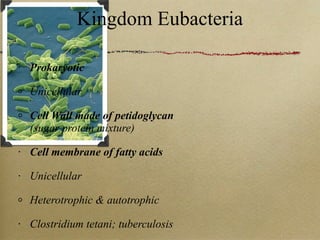
Kingdom Eubacteria Prokaryotic Unicellular Cell Wall made of petidoglycan  (sugar protein mixture) Cell membrane of fatty acids Unicellular Heterotrophic & autotrophic  Clostridium tetani; tuberculosis
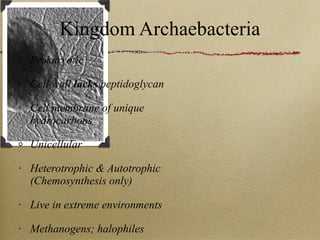
Kingdom Archaebacteria Prokaryotic Cell wall  lacks  peptidoglycan Cell membrane of unique hydrocarbons Unicellular Heterotrophic & Autotrophic (Chemosynthesis only) Live in extreme environments Methanogens; halophiles
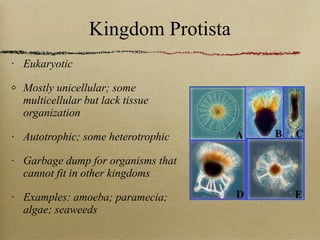
Kingdom Protista Eukaryotic Mostly unicellular; some multicellular but lack tissue organization Autotrophic; some heterotrophic Garbage dump for organisms that cannot fit in other kingdoms Examples: amoeba; paramecia; algae; seaweeds
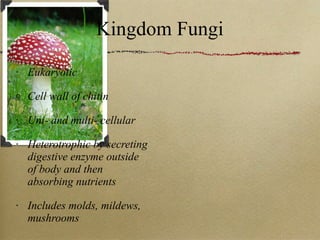
Kingdom Fungi Eukaryotic Cell wall of chitin Uni- and multi- cellular Heterotrophic by secreting digestive enzyme outside of body and then absorbing nutrients Includes molds, mildews, mushrooms
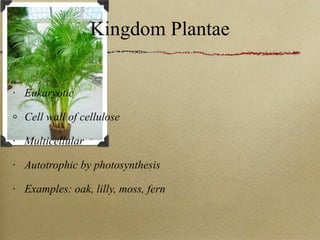
Kingdom Plantae Eukaryotic Cell wall of cellulose Multicellular  Autotrophic by photosynthesis Examples: oak, lilly, moss, fern
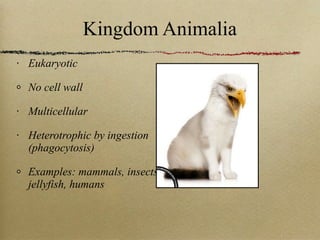
Kingdom Animalia Eukaryotic No cell wall Multicellular Heterotrophic by ingestion (phagocytosis) Examples: mammals, insects, jellyfish, humans

Animal kingdom

  • 1.
  • 2.
    Kingdom Eubacteria ProkaryoticUnicellular Cell Wall made of petidoglycan (sugar protein mixture) Cell membrane of fatty acids Unicellular Heterotrophic & autotrophic Clostridium tetani; tuberculosis
  • 3.
    Kingdom Archaebacteria ProkaryoticCell wall lacks peptidoglycan Cell membrane of unique hydrocarbons Unicellular Heterotrophic & Autotrophic (Chemosynthesis only) Live in extreme environments Methanogens; halophiles
  • 4.
    Kingdom Protista EukaryoticMostly unicellular; some multicellular but lack tissue organization Autotrophic; some heterotrophic Garbage dump for organisms that cannot fit in other kingdoms Examples: amoeba; paramecia; algae; seaweeds
  • 5.
    Kingdom Fungi EukaryoticCell wall of chitin Uni- and multi- cellular Heterotrophic by secreting digestive enzyme outside of body and then absorbing nutrients Includes molds, mildews, mushrooms
  • 6.
    Kingdom Plantae EukaryoticCell wall of cellulose Multicellular Autotrophic by photosynthesis Examples: oak, lilly, moss, fern
  • 7.
    Kingdom Animalia EukaryoticNo cell wall Multicellular Heterotrophic by ingestion (phagocytosis) Examples: mammals, insects, jellyfish, humans