Types of
Anaesthesia
Sushruta 800B.C.
wrote first Surgery textbook
Anesthesiology
Making
Surgery
Painless
Anesthesia
 From Greek anaisthesis means
not sensation
 Listed in Bailey´s English
Dictionary 1721.
 When the effect of ether was
discovered anesthesia” used as a
name for the new phenomenon.
Oxford dictionary
definition
 insensitivity to pain, especially
as artificially induced by the
administration of gases or the
injection of drugs before
surgical operations
World Anesthesia Day 16th Oct
HISTORY OF ANESTHESIA
• General anesthesia was absent until the mid-1800s.
• Ether synthesized in 1540 by Cordus
• Ether used as anesthetic in 1842 by Dr. Crawford
W.Long
• Ether publicized as anesthetic in 1846 by Dr.
William Morton.
• Ether is no longer used in modern practice, yet
considered to be the first ‘ideal’ anesthetic
• Chloroform used as anesthetic in 1853 by Dr. John
Snow
• Endotracheal tube discovered in 1878
• Thiopental first used in 1934
Pre 1846 - The Foundations of
Anaesthesia
……..so the Lord God caused him to fall
into a deep sleep. While the man
was sleeping, the Lord God took out
one of his ribs. He closed up the
opening that was in his side……...
Genesis 2:21 NIrV
Primitive Anesthesia
 Ancient civilizations- opium poppy,
coca leaves, mandrake root,
alcohol
 Regional anesthesia in ancient
times- compression of nerve
trunks or the application of cold
(cryoanalgesia)
World Anaesthesia Day
 On 16 October 1846,
John Collins Warren
removed a tumor from
the neck of a local
printer,Edward Gilbert
Abbott. Warren
reportedly quipped,
"Gentlemen, this is no
humbug.
 MGH Boston
Regional
Anaesthesia
 1884 Sigmund Freud
physiology actions
cocaine
 Carl Koller cocaine
ophthalmological
surgery
Birth of modern Anaesthesia
 1913,Chevalier Jackson-use of direct
laryngoscopy as a means to intubate
the trachea
 Sodium Pentathal - first used in humans
on 8 March 1934 by Ralph M. Waters
Slide master
Your Text here
History
 1845- Horace Wells- N2O
 1846- William Morton- Ether
 1847- Simpson- Chloroform
 1853-John Snow
 1878- ETT
 1884- Cocaine
 1895-98- Spinal
analgesia/anaesthesia
Types Of Anesthesia
Types
.
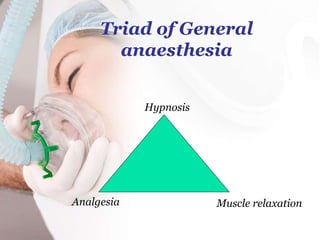
Triad of General
anaesthesia
Hypnosis
Analgesia Muscle relaxation
CLASSIFICATION:
18
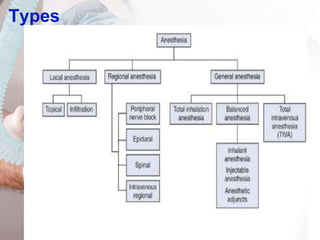
General
anaesthetics
Inhalational Intravenous
INTRODUCTION
• General anaesthetics (GAs) are drugs which produce
reversible loss of all sensations and consciousness. It usually
involves a loss of memory and awareness with insensitivity to
painful stimuli, during a surgical procedure
General anesthesia
need for
unconsciousness
‘Amnesia-hypnosis’
need for analgesia
‘Loss of sensory and
autonomic reflexes’
need for muscle
relaxation
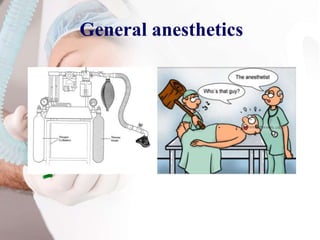
General anesthetics
Amnesia
sedation
Hypnosis
Coma
Death
Awake
Hypnosis
Hypnotic drugs-
intravenous
 Gold standard- thiopentone
 Propofol
others
 Etomidate
 Benzodiazepines
 Ketamine
Inhalational
anaesthetics
 Nitrous oxide-weak
 Isoflurane
 Sevoflurane
 Desflurane
 Halothane
Analgesia
 Good analgesia= good
anaesthesia
 Hypnotic sparing effect
 Opiates
 Local anaesthetics
 NSAIDS
 Paracetamol
Analgesia-Opiates
 Gold standard – morphine
 Derivatives- diamorphine,
codeine
 Synthetic agents
- Pethidine
- Fentanyl/Alfentanil-short
acting
- Remifentanil-ultra short
acting
Analgesia-NSAIDS
 Gold standard- aspirin
 Ibuprofen
 Diclofenac
 Cox-2 inhibitors
Muscle relaxation
 Aids intubation
 Helps surgeon/surgery
 Surgery of long duration
 Reduces maintenance dose of
anaesthetics agents
Muscle relaxants
 Two types
 Depolarising-short acting
e.g.; suxmethonium
 Non-depolarising-
medium/long acting
- Tracurium
- Vecuronium
- Rocuronium
- Cisatracurium (NIMBEX)
Prerequisites
 Oxygen
 Suction
 Tilting trolley
 Resuscitation drugs
 Monitoring
 Anaesthetist
 Skilled assistance
 Drugs and machine
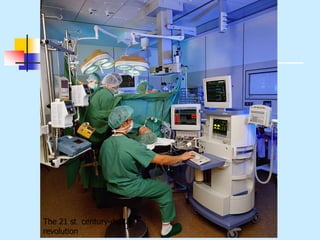
The 21 st century-digital
revolution
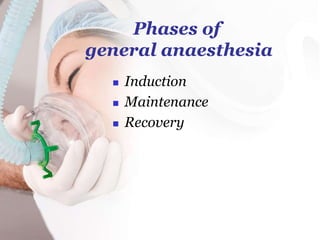
Phases of
general anaesthesia
 Induction
 Maintenance
 Recovery
Induction
 Intravenous- majority
 Inhalational- children, needle
phobics
 Monitoring
 Preoxygenation
 Hypnotic/analgesic and or
relaxant
 Mask/LMA/ET tube
Maintenance
 Intravenous or inhalational
 Oxygen –40%-100%
 Nitrous oxide
 Muscle relaxant
 Analgesia
Recovery
 Turn off agent
 Reverse relaxation
 Cough reflex
 Extubate when awake
 Recovery position
 Monitor until discharge
Advantages
 No absolute contraindications
 Quick to establish
 Never fails to work
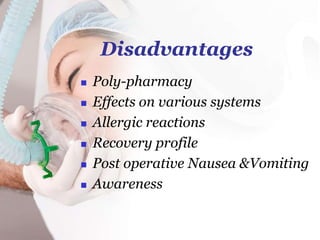
Disadvantages
 Poly-pharmacy
 Effects on various systems
 Allergic reactions
 Recovery profile
 Post operative Nausea &Vomiting
 Awareness
Providing operative conditions
Regional anaesthesia
 Spinal/epidural
- surgery below umbilicus
- Provides analgesia/muscle
relaxation
 Plexus blocks eg brachial plexus
 Intravenous- Bier’s block
40
Spinal Block - Position
Regional anaesthesia
Analgesia Muscle relaxation
Local anaesthetics
 Lignocaine- quick/short acting
 Bupivacaine/levobupicvacaine
- slow and long action
 Ropivacaine- as above
 Amethocaine- topical
 Prilocaine- intravenous
Advantages
 Effective alternative to GA
 Avoids polypharmacy
 Allergic reactions
 Extended analgesia
 Patient can remain awake
 Early drink/feed
Disadvantages
 Limited scope
 Higher failure rate
 Time constraints
 Anticoagulants/Bleeding
diathesis
 Risk of neural injury
Patient is more important
than our ego; call for help,
whenever patient is in
danger
Your Text here
Slide master
Your Text here
Choice of anesthesia
 The patient´s understanding and wishes regarding the type of
anesthesia that could be used
 The type and duration of the surgical procedure
 The patients´s physiologic status and stability
 The presence and severity of coexisting disease
 The patient´s mental and psychologic status
 The postoperative recovery from various kinds of anesthesia
 Options for management of postoperative pain
 Any particular requiremets of the surgeon
 There is major and minor surgery but only major
anesthesia
Types of anesthesia care
General Anesthesia
 Reversible, unconscious state is
characterised by amnesia (sleep,
hypnosis or basal narcosis),
analgesia (freedom from pain)
depression of reflexes, muscle
relaxation
 Put to sleep
Types of anesthesia care
Regional Anesthesia
 A local anethetic is injected to
block or ansthetize a nerve or
nerve fibers
 Implies a major nerve block
administered by an
anesthesiologist (such as spinal,
epidural, caudal, or major
peripheral block)
Types of anesthesia care
Monitored anesthesia care
 Infiltration of the surgical site with a local
anesthesia is performed by the surgeon
 The anasthesiologist may supplement the
local anesthesia with intravenous drugs
that provide systemic analgesia and
sedation and depress the response of the
patient´s autonomic nervous system
Types of anesthesia care
local anesthesia
 Employed for minor procedures in which the
surgical site is infiltrated with a local anesthetic
vital signs
 May injsuch as lidocaine or bupivacaine
 A perioperative nurse usually monitors the
patient´s ect intravenous sedatives or analgesic
drugs
Thank
you
Macintosh noted: “for the
surgeon the spinal ends
with the injection of the
agent; for the anesthetist it
begins with the injection of
the agent.”

Anaesthesia types and classification for tech

  • 1.
  • 2.
  • 3.
  • 4.
    Anesthesia  From Greekanaisthesis means not sensation  Listed in Bailey´s English Dictionary 1721.  When the effect of ether was discovered anesthesia” used as a name for the new phenomenon.
  • 5.
    Oxford dictionary definition  insensitivityto pain, especially as artificially induced by the administration of gases or the injection of drugs before surgical operations
  • 6.
  • 7.
    HISTORY OF ANESTHESIA •General anesthesia was absent until the mid-1800s. • Ether synthesized in 1540 by Cordus • Ether used as anesthetic in 1842 by Dr. Crawford W.Long • Ether publicized as anesthetic in 1846 by Dr. William Morton. • Ether is no longer used in modern practice, yet considered to be the first ‘ideal’ anesthetic • Chloroform used as anesthetic in 1853 by Dr. John Snow • Endotracheal tube discovered in 1878 • Thiopental first used in 1934
  • 8.
    Pre 1846 -The Foundations of Anaesthesia ……..so the Lord God caused him to fall into a deep sleep. While the man was sleeping, the Lord God took out one of his ribs. He closed up the opening that was in his side……... Genesis 2:21 NIrV
  • 9.
    Primitive Anesthesia  Ancientcivilizations- opium poppy, coca leaves, mandrake root, alcohol  Regional anesthesia in ancient times- compression of nerve trunks or the application of cold (cryoanalgesia)
  • 10.
    World Anaesthesia Day On 16 October 1846, John Collins Warren removed a tumor from the neck of a local printer,Edward Gilbert Abbott. Warren reportedly quipped, "Gentlemen, this is no humbug.  MGH Boston
  • 11.
    Regional Anaesthesia  1884 SigmundFreud physiology actions cocaine  Carl Koller cocaine ophthalmological surgery
  • 12.
    Birth of modernAnaesthesia  1913,Chevalier Jackson-use of direct laryngoscopy as a means to intubate the trachea  Sodium Pentathal - first used in humans on 8 March 1934 by Ralph M. Waters
  • 13.
  • 14.
    History  1845- HoraceWells- N2O  1846- William Morton- Ether  1847- Simpson- Chloroform  1853-John Snow  1878- ETT  1884- Cocaine  1895-98- Spinal analgesia/anaesthesia
  • 15.
  • 16.
  • 17.
  • 18.
  • 19.
    INTRODUCTION • General anaesthetics(GAs) are drugs which produce reversible loss of all sensations and consciousness. It usually involves a loss of memory and awareness with insensitivity to painful stimuli, during a surgical procedure General anesthesia need for unconsciousness ‘Amnesia-hypnosis’ need for analgesia ‘Loss of sensory and autonomic reflexes’ need for muscle relaxation
  • 20.
  • 21.
  • 22.
    Hypnotic drugs- intravenous  Goldstandard- thiopentone  Propofol others  Etomidate  Benzodiazepines  Ketamine
  • 23.
    Inhalational anaesthetics  Nitrous oxide-weak Isoflurane  Sevoflurane  Desflurane  Halothane
  • 24.
    Analgesia  Good analgesia=good anaesthesia  Hypnotic sparing effect  Opiates  Local anaesthetics  NSAIDS  Paracetamol
  • 25.
    Analgesia-Opiates  Gold standard– morphine  Derivatives- diamorphine, codeine  Synthetic agents - Pethidine - Fentanyl/Alfentanil-short acting - Remifentanil-ultra short acting
  • 26.
    Analgesia-NSAIDS  Gold standard-aspirin  Ibuprofen  Diclofenac  Cox-2 inhibitors
  • 27.
    Muscle relaxation  Aidsintubation  Helps surgeon/surgery  Surgery of long duration  Reduces maintenance dose of anaesthetics agents
  • 28.
    Muscle relaxants  Twotypes  Depolarising-short acting e.g.; suxmethonium  Non-depolarising- medium/long acting - Tracurium - Vecuronium - Rocuronium - Cisatracurium (NIMBEX)
  • 29.
    Prerequisites  Oxygen  Suction Tilting trolley  Resuscitation drugs  Monitoring  Anaesthetist  Skilled assistance  Drugs and machine
  • 30.
    The 21 stcentury-digital revolution
  • 31.
    Phases of general anaesthesia Induction  Maintenance  Recovery
  • 32.
    Induction  Intravenous- majority Inhalational- children, needle phobics  Monitoring  Preoxygenation  Hypnotic/analgesic and or relaxant  Mask/LMA/ET tube
  • 33.
    Maintenance  Intravenous orinhalational  Oxygen –40%-100%  Nitrous oxide  Muscle relaxant  Analgesia
  • 34.
    Recovery  Turn offagent  Reverse relaxation  Cough reflex  Extubate when awake  Recovery position  Monitor until discharge
  • 36.
    Advantages  No absolutecontraindications  Quick to establish  Never fails to work
  • 37.
    Disadvantages  Poly-pharmacy  Effectson various systems  Allergic reactions  Recovery profile  Post operative Nausea &Vomiting  Awareness
  • 38.
  • 39.
    Regional anaesthesia  Spinal/epidural -surgery below umbilicus - Provides analgesia/muscle relaxation  Plexus blocks eg brachial plexus  Intravenous- Bier’s block
  • 40.
  • 41.
  • 42.
    Local anaesthetics  Lignocaine-quick/short acting  Bupivacaine/levobupicvacaine - slow and long action  Ropivacaine- as above  Amethocaine- topical  Prilocaine- intravenous
  • 43.
    Advantages  Effective alternativeto GA  Avoids polypharmacy  Allergic reactions  Extended analgesia  Patient can remain awake  Early drink/feed
  • 44.
    Disadvantages  Limited scope Higher failure rate  Time constraints  Anticoagulants/Bleeding diathesis  Risk of neural injury
  • 45.
    Patient is moreimportant than our ego; call for help, whenever patient is in danger Your Text here
  • 46.
  • 47.
    Choice of anesthesia The patient´s understanding and wishes regarding the type of anesthesia that could be used  The type and duration of the surgical procedure  The patients´s physiologic status and stability  The presence and severity of coexisting disease  The patient´s mental and psychologic status  The postoperative recovery from various kinds of anesthesia  Options for management of postoperative pain  Any particular requiremets of the surgeon  There is major and minor surgery but only major anesthesia
  • 48.
    Types of anesthesiacare General Anesthesia  Reversible, unconscious state is characterised by amnesia (sleep, hypnosis or basal narcosis), analgesia (freedom from pain) depression of reflexes, muscle relaxation  Put to sleep
  • 49.
    Types of anesthesiacare Regional Anesthesia  A local anethetic is injected to block or ansthetize a nerve or nerve fibers  Implies a major nerve block administered by an anesthesiologist (such as spinal, epidural, caudal, or major peripheral block)
  • 50.
    Types of anesthesiacare Monitored anesthesia care  Infiltration of the surgical site with a local anesthesia is performed by the surgeon  The anasthesiologist may supplement the local anesthesia with intravenous drugs that provide systemic analgesia and sedation and depress the response of the patient´s autonomic nervous system
  • 51.
    Types of anesthesiacare local anesthesia  Employed for minor procedures in which the surgical site is infiltrated with a local anesthetic vital signs  May injsuch as lidocaine or bupivacaine  A perioperative nurse usually monitors the patient´s ect intravenous sedatives or analgesic drugs
  • 53.
    Thank you Macintosh noted: “forthe surgeon the spinal ends with the injection of the agent; for the anesthetist it begins with the injection of the agent.”