Advances in Nursing Doctoral
Education & Research
nursing.jhu.edu/inden ANDER ● FEB 2016 ● Vol. 5 Number 1
Official Journal of the International Network for Doctoral Education in Nursing (INDEN)
inursing.jhu.edu/inden ANDER ● FEB 2016 ● Vol. 5 Number 1 ●
TABLE OF CONTENTS
Page CONTENT
ii Journal purpose
ii Author guidelines
iv Editors and Board Members
1-2 Greetings from INDEN President
3-4 Letter from the Editors
Peer Reviewed Section
5-10 Applying for research Funding: Perils, Pitfalls and Pearls
11-18 2015 Biennial Conference Accepted Abstracts - Oral Presentations
19-25 2015 Biennial Conference Accepted Abstracts - Poster Presentations
26-38 Doctoral Student Perspectives
39-40 What's New in Doctoral Education
41 INDEN Business
IN THIS ISSUE
nursing.jhu.edu/inden ANDER ● FEB 2016 ● Vol. 5 Number 1 ●
The goals of Advances in Nursing Doctoral Education & Research are to:
Promote academic debates and reports about nursing doctoral education
Provide an academic platform for doctoral educators to share their innovations and
experiences in providing nursing doctoral education
Publish high quality nursing and interdisciplinary research
Share best practices and procedures to enhance the diversity and quality in nursing
doctoral education
Journal Purpose
Author Guidelines
Manuscripts submitted will be reviewed for their match to the journal’s aims by the edi-
tors. If the manuscript is a match for the journal’s aims, the editor will identify two editori-
al board members or manuscript reviewers with expertise in the area of the manuscript
topic to review it and make recommendations regarding whether to publish it and any
editing needed. The process will be ‘blinded’, neither the author(s) nor the reviewers will
know the others’ identity.
Papers may be on any topic relevant to the goals of the publication and INDEN. (please
refer to the INDEN website for its aim and objectives in detail) This may include those
focused on research, theory, program evaluation and other scholarly papers related to
nursing doctoral education and research topics. Some issues of the journal may focus
on a particular theme such as “Measuring quality in nursing doctoral education.”
Guidelines for the submission of a manuscript for the peer review section
1. Relevance to aims of this publication
2. Follow format guidelines for manuscripts
3. Length – 2500-3000 words with 12 Arial font and double line spacing.
4. Format for research manuscripts:
Abstract (limited to 350 words)
Key words (3-4)
Introduction and Background
Methodology
Analysis
Conclusions
Discussion
Implications for practice and future research
5. Format for non-research manuscripts:
Abstract (limited to 350 words)
A concise summary of the argument or proposed course of action and conclusions
3-4 key words
iiinursing.jhu.edu/inden ANDER ● FEB 2016 ● Vol. 5 Number 1 ●
Author Guidelines
Guidelines for the submission of a Perspective
The Perspectives section of our ANDER journal invites doctoral students and faculty to
share their experiences in doctoral education or other activities related to their develop-
ment as scholars.
Authors for this section should include their name, credentials, affiliated university and
their email address at the top of page. They also should send a picture and identify all
the individuals in the picture with a text box underneath the image. Authors should briefly
describe their area of research and population of interest.
The format of this writing should be Arial, 12-point font and single-spaced with an extra
space between paragraphs. The Maximum word limit is 400. Authors can send their per-
spectives to the editors through following email: son-inden@jhu.edu
nursing.jhu.edu/inden ANDER ● FEB 2016 ● Vol. 5 Number 1 ●
Editors and Board Members
Editor-in-Chief:
Sonja McIlfatrick, PhD, RGN
President, INDEN
Professor of Nursing
School of Nursing, University of Ulster, Ireland, UK
Associate Editors:
Laurel A. Eisenhauer, PHD, RN, FAAN
Professor Emerita
William F. Connell School of Nursing - Boston College
Chestnut Hill, Massachusetts 02467 USA
laurel.eisenhauer@bc.edu
Kristiina Hyrkas, PhD, LicNSc, MNSc, RN
Director, Center for Nursing Research &
Quality Outcomes
Adjunct Professor, University of Southern Maine
Maine Medical Center
22 Bramhall Street, MGB2, RM2620
Portland, Maine 04102-9954 USA
hyrkak@mmc.org
Marie T. Nolan, PhD, RN, FAAN
Professor and Chair
Department of Acute and Chronic Care
School of Nursing
Johns Hopkins University
mnolan3@jhu.edu
Munikumar Ramasamy Venkatasalu, PhD, RGN, PGDEPP
Professor, PAP Rashidah Sa'adatul Bolkiah Institute of
Health Sciences
Universiti Brunei Darussalam
Jalan Tungku Link Gadong, BE1410
Negara Brunei Darussalam
kumar.venkatasalu@ubd.edu.bn
Editorial Board Members:
Dr. Patricia Davidson
United States
Dr. Judith Erlen
United States
Dr. Caitrin Evans
United Kingdom
Dr. Huaping Liu
China
Dr. Milisa Manojlovich
United States
Dr. Sonja McIlfatrick
Ireland
Dr. Florence Myrick
Canada
Dr. Richard Redman
United States
Dr. Marilyn S. Sommers
United States
Executive Director:
Ms. Tamar Rodney
United States
1nursing.jhu.edu/inden ANDER ● FEB 2016 ● Vol. 5 Number 1 ●
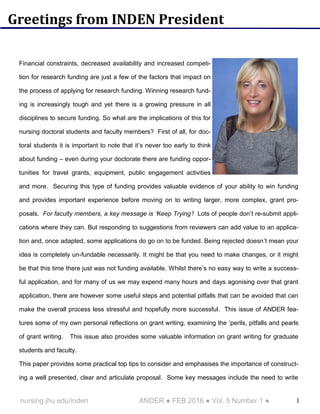
Greetings from INDEN President
Financial constraints, decreased availability and increased competi-
tion for research funding are just a few of the factors that impact on
the process of applying for research funding. Winning research fund-
ing is increasingly tough and yet there is a growing pressure in all
disciplines to secure funding. So what are the implications of this for
nursing doctoral students and faculty members? First of all, for doc-
toral students it is important to note that it’s never too early to think
about funding – even during your doctorate there are funding oppor-
tunities for travel grants, equipment, public engagement activities
and more. Securing this type of funding provides valuable evidence of your ability to win funding
and provides important experience before moving on to writing larger, more complex, grant pro-
posals. For faculty members, a key message is ‘Keep Trying’! Lots of people don’t re-submit appli-
cations where they can. But responding to suggestions from reviewers can add value to an applica-
tion and, once adapted, some applications do go on to be funded. Being rejected doesn’t mean your
idea is completely un-fundable necessarily. It might be that you need to make changes, or it might
be that this time there just was not funding available. Whilst there’s no easy way to write a success-
ful application, and for many of us we may expend many hours and days agonising over that grant
application, there are however some useful steps and potential pitfalls that can be avoided that can
make the overall process less stressful and hopefully more successful. This issue of ANDER fea-
tures some of my own personal reflections on grant writing, examining the ‘perils, pitfalls and pearls
of grant writing. This issue also provides some valuable information on grant writing for graduate
students and faculty.
This paper provides some practical top tips to consider and emphasises the importance of construct-
ing a well presented, clear and articulate proposal. Some key messages include the need to write
nursing.jhu.edu/inden ANDER ● FEB 2016 ● Vol. 5 Number 1 ●
Greetings from INDEN President
positively, without relying on unexplained jargon, and with enthusiasm about what you plan to do,
and why you are the right person, with the right blend of skills and experience to make a success of
it! An important point however increasing for nursing is that we clearly articulate how this proposed
research project is essential in order to improve the health and wellbeing of people, patients and
families. This may require some creativity in terms of other approaches to enhance grant applica-
tions that will ultimately have a significant impact on health care.
Sonja McIlfatrick, PhD, RN
President, INDEN
Professor of Nursing
School of Nursing, University of Ulster, Ireland, UK
3nursing.jhu.edu/inden ANDER ● FEB 2016 ● Vol. 5 Number 1 ●
Letter from the Editors
Greetings to our Readers,
Grant writing and applying for research funding is a topic that all doctoral students and faculty are
discussing continuously. For doctoral students, grant writing is an important skill to learn: sometimes
even a small ‘seed money’ supporting thesis research can be a starting point for capturing bigger
grants and career as a researcher. Applying for research funding is, however, not easy and the com-
petition is hard when applying for larger amounts of money. Faculty searching for funding their re-
search projects has often a lot of valuable experiences and learnings to share, and sometimes even
opportunities to invite doctoral students to join their initiatives starting from grant proposal writing.
We are very pleased to include in this ANDER Issue Dr. Sonja McIlfatrick’s paper that focuses on
discussing the steps of a grant writing process, common pitfalls, perils and pearls.
The 2015 Biennial INDEN conference (July 22-23, 2015) was organized in San Juan, Puerto Rico.
The conference was a success: the podium and poster presentations were very interesting and of
high quality. We are sharing the presenters’ works from this conference in this issue and hope that,
especially those of you who were not able to attend the conference enjoy reading the abstracts.
We are also publishing six doctoral student perspectives in this issue. The doctoral students are
from: Johns Hopkins University School of Nursing (USA), Peking Union Medical College (China), In-
stitute of Nursing Science, University of Basel (Switzerland), and the University of the West Indies
(Trinidad & Tobago).
The “What’s New in Doctoral Education” section, of this issue provides valuable information on grant
writing for graduate students and faculty. The links that are available provide, for example, helpful
grant writing templates and description(s) on grant writing steps.
We once again urge the readers of the ANDER to send feedback to us. We are encouraging the
submission of manuscripts for the peer review section and welcome the submission of perspectives
nursing.jhu.edu/inden ANDER ● FEB 2016 ● Vol. 5 Number 1 ●
Letter from the Editors
from doctoral students and faculty. The theme of the next issue is Internationalization of Nursing
Doctoral Education and the deadline for the submissions is May 15th
, 2016.
Associate Editors:
Kristiina Hyrkäs, PhD, LicNSc, RN
Laurel A. Eisenhauer, PHD, RN, FAAN
Marie Nolan, PhD, RN, FAAN
Munikumar Ramasamy Venkatasalu, PhD, RGN, RMN, RNT, PGDEPP
5nursing.jhu.edu/inden ANDER ● FEB 2016 ● Vol. 5 Number 1 ●
Applying for research Funding: Perils, Pitfalls and Pearls
Sonja McIlfatrick, PhD, MSc, BSc
President of INDEN, Professor of Nursing, Institute of Nursing and Health Research, Ulster
University, UK
Introduction
It is well recognised that research requires funding and money is crucial for enabling research pro-
jects to be undertaken (Amerson, 2013). It can be argued however, that many nurses and academ-
ics receive little, or no, training in the process of writing a successful grant application. Rather, they
are subjected to learning ‘on the job’ and learning from their success and failures. This paper fo-
cuses on my personal reflections on the perils, frequent pitfalls and hopefully what can be construct-
ed pearls of wisdom or some ‘top tips’ when applying for research funding. In an era of financial
constraints and reduction in the availability of research funding, the ability to construct a well pre-
sented, clear, articulate proposal is becoming more important than ever alongside being creative
about other approaches that could be developed to enhance grant applications. Therefore research-
ers need to be equipped to submit grant applications that give them the competitive edge over other
proposals.
Evidence from the percentage of successful funded projects highlights the extremely competitive
nature of applying for research funding. For example, according to the U.S. Department of Health
and Human Services National Institutes of Health (NIH) (2013a), the success rate for research
grants in 2011 was 19%. Similar figures are noted for the UK Medical Research Council, New In-
vestigator Awards for 2014/15 -17% (Medical Research Council, 2015). These statistics indicate the
need to refine grant writing skills and increase knowledge about the ‘rules of the game’.
Peer Reviewed
nursing.jhu.edu/inden ANDER ● FEB 2016 ● Vol. 5 Number 1 ●
Steps of A Grant Writing Process
The first and primary ingredient in a successful proposal is having a significant and innovative re-
search question. A successful grant proposal begins with a clearly defined problem, statistics to
demonstrate the impact of the problem and demonstration of how this proposal will address this
gap. In other words, articulating a clearly defined programme that answers a specific question. A
crucial second step is to then to identify other key researchers in the field and seek to collaborate.
Once you have develop innovative idea and then have the key players in place, then it is time to de-
velop your ‘game plan’ or strategy for applying for funding. This involves asking the question, what
type of award is appropriate and will meet the needs of your proposed project? This requires a clear
understanding of the different types and sources of research funding that are available.
When developing a grant proposal it is important that the applicant considers the review criteria
used by the potential funding agency. Generally these tend to focus on four main propositions:
1. Importance: the proposal asks an important question- in other words a proposal’s significance
impact, relevance and usefulness. What is it that makes this application memorable against other
applications?
2. Success: the project is likely to answer the question? This includes aspects such as scope, ap-
proach to research, soundness of the design and feasibility. This is the most important but often
most neglected aspect of an application.
3. Value: is the likely gain worth the resources requested? This relates to value for money, budget,
sufficiency of resources to complete the project. It is important to note that funding agencies will on-
ly support projects whose resources are necessary & sufficient.
Peer Reviewed
7nursing.jhu.edu/inden ANDER ● FEB 2016 ● Vol. 5 Number 1 ●
4. Competence: the applicant and team - and are they competent to carry out the project as out-
lined? This includes evaluating the expertise of the applicant, knowledge of the field, track record,
and wider team members’ role and expertise. Self-citation is essential and it is important that your
‘competence’ is relevant to the scale of the project and your role within it.
Various pitfalls have been identified when applying for research funding from the perspective of the
research funder and researcher (Proctor et al, 2012). From personal experience and reflections the
following ten pitfalls have been identified, alongside some practical suggestions to address these.
Common Pitfalls
Pitfall 1: Poor Fit. This is where your proposed project has a poor fit with the type of award.
To address this, it is important to read the eligibility criteria and the terms and conditions of the pro-
gramme call.
Pitfall 2: Weak argument. This is when there is a lack of rationale for the project. To address
this, it is important to explain why research is needed and build a compelling argument in every par-
agraph.
Pitfall 3: Excessive jargon. It is important to use clear, accessible language. You want reviewer
‘to get it’. Ways to achieve this are to have direct statements and active voice; avoid abbreviations
and acronyms; and use headings/sub headings to help signpost the reader through the proposal.
Pitfall 4: Vague research plan. It is important to specify major tasks and timelines. This in-
volves the use Gantt charts that illustrates a project schedule. Always think from the reviewer’s per-
spective.
Peer Reviewed
nursing.jhu.edu/inden ANDER ● FEB 2016 ● Vol. 5 Number 1 ●
Pitfall 5: Writing solo. Sometimes owing to various time constraints and deadlines research-
ers may focus on their own writing and requirements. But it is important to get other people to read
and review; seek peer review from all sources and allow time for rewrites.
Pitfall 6: Deviating from guidelines. It is important to follow instructions. For example: font
size; curriculum vitae’s (CVs); signatures etc.
Pitfall 7: Time. It is important to build in time to prepare and plan for the overall grant appli-
cation. This includes working ‘backwards’ with time and factoring in aspects such as gaining signa-
tures, seeking feedback and working out costings.
Pitfall 8: Weak Abstract. The abstract should reflect the entire scope of project and provide a
summary of the project’s purpose and methods. Sometimes this can be last piece of text to be writ-
ten and does not always receive the attention it deserves.
Pitfall 9: Ignoring review criteria. Some of the key aspects have been outlined previously and
they are well recognised but it is important to learn to decipher these further depending on the fun-
der.
Pitfall 10: Choose reviewers carefully. Find a referee who is supportive, but who also does
not have a conflict of interest.
In conclusion, I would like to outline some personal reflections and perhaps some ‘Pearls of Wis-
dom’. It is important to develop a strategy for longer term success. Two approaches to this are a)
begin by serving as a co-investigator on a grant held by more senior investigators, and b) start small
and apply for other types of smaller grants as a principal investigator. For example, this may in-
clude different types of grant awards such as conference awards and travel grants. These can help
Peer Reviewed
9nursing.jhu.edu/inden ANDER ● FEB 2016 ● Vol. 5 Number 1 ●
to build your CV but also demonstrate some success in securing funding and demonstrating an abil-
ity to successfully manage a small grant before attempting to secure a larger grant. Other aspects
when developing a longer term strategy for success are:
fit research and grant writing into your job;
seek out and find a mentor(s);
seek collaborators and maximize network opportunities; read successful grants and attend grant
writing workshops and seminars, ensuring you keep up to date with current practice and require-
ments;
be informed and realistic about different sources of funding helping you to target possible fun-
ders appropriately;
participate in funding panels if possible;
take advantage of ‘new and early stage investigator status’. Combining this status with other,
more experienced investigators, provides a strong potential for successful grant acquisition.
7. Plan applications and be realistic in what is achievable. Plan accordingly.
8. If an application is unsuccessful, read reviewer’s feedback carefully and use the reviewers' com-
ments to improve the proposal for the purpose of resubmission.
9. Persistence: this is ‘the key’ to success! It is important to develop a ‘thick skin’ in terms of rejec-
tion whilst maintaining an inquisitive and creative mind.
References
Amerson, R. (2013). Submitting for dollars: Playing the funding game to promote transcultural nurs-
ing. Online Journal of Cultural Competence in Nursing and Healthcare, 3(3), 16-23. doi:10.9730/
ojccnh.org/v3n3a2
Peer Reviewed
nursing.jhu.edu/inden ANDER ● FEB 2016 ● Vol. 5 Number 1 ●
U.S. Department of Health and Human Services, National Institute of Health (NIH). Funding Facts.
2013a. Retrieved from http://report.nih.gov/fundingfacts/index.cfm on December, 2015.
Medical Research Council (2015) Grant application success rates for New Investigator Awards
2014/2015. Retrieved from: www.mrc.ac.uk/news/funded.research/successrates/#grants on Decem-
ber , 2015.
Proctor, E., Powell, B., Baumann, A., Hamilton, A. & Santens R. (2012) Writing implementation re-
search grant proposals: ten key ingredients. Implementation Science. 7(96): 1-13. Retrieved from:
http://www.implementationscience.com/content/7/1/96 on December , 2015.
Peer Reviewed
11nursing.jhu.edu/inden ANDER ● FEB 2016 ● Vol. 5 Number 1 ●
Oral Presentations
Diana Baptiste - Johns Hopkins University School of Nursing
Increasing scholarly productivity through a heart failure journal club:
Be accountable, improve your science and collaborate!
Diana Baptiste, DNP, RN, Faculty Associate, Johns Hopkins University School of Nursing
Martha Abshire, MS, RN, PhD student, Johns Hopkins University School of Nursing
Journal clubs have been used to help increase nurses’ knowledge and confidence to understand
research and lead changes in practice. We have used the Heart Failure Journal Club to link at-
tendees through the use of online meeting software and in-person sessions for structured discus-
sion of literature related to current trends and issues in cardiovascular nursing, specifically targeting
heart failure. Moderated by a DNP faculty member and a PhD student, the heart failure journal club
provides an opportunity for BSN through doctoral level students, members of the research commu-
nity and faculty attendees to provide accountability regarding progress with their programs of re-
search. Out of these discussions, attendees have formed collaborations to develop research ideas,
submit abstracts and write manuscripts. The once a month meeting allows for participants to make
progress and help each other strategize when a project has lost momentum.
Articles discussed are chosen by the moderators to reflect different research constructs methods
and relevance to the state of heart failure science. Attendees analyze the selected article together,
section by section; each journal club session features a different component of a research article
such as the title or implications for nursing practice. Participants are encouraged to relate the club
discussion to improving their own work. Further, the heart failure journal club is an opportunity to
discuss dissemination of literature through scientific conferences. Participants discuss which con-
ferences are relevant and feasible to attend, how to increase the impact of abstracts, presentations,
posters, and how to network with leading researchers during a conference. This innovative model
for a journal club can be readily translated to a wide variety of settings and across disciplines to ad-
vance nursing education at the doctoral level.
Correspondence: dbaptis1@jhu.edu
Elizabeth Bonham - University of Southern Indiana
How Social Media Change Communication Roles of Doctorally Prepared Nurses
Elizabeth Bonham, PhD, RN, PMHCNS-BC
A current phenomenon in healthcare is the multigenerational composite of nurses working together
in different systems. The same phenomenon is present in doctoral nursing programs where a vast
array of practice and technology experience is presented. Doctor of Nursing Practice (DNP) stu-
dents who “grew up” with electronic technology are considered technology natives while seasoned
practitioners with rich practice portfolios are considered technology immigrants. As in any migra-
tion, immigrants must learn new customs, culture and language for successful assimilation. The
same assimilation for technology users in the 21st century holds true for the doctorally prepared
nurse whose role includes communicating, translating, and interpreting healthcare information to
patients, families, and community stakeholders. The immigrant DNP student previously learned
communication techniques with face to face, personal interactions. The interactions take a different
shape and present diverse challenges when healthcare settings and patients may be at a distance.
INDEN 2015 Biennial Conference Accepted Abstracts
nursing.jhu.edu/inden ANDER ● FEB 2016 ● Vol. 5 Number 1 ●
Oral Presentations
Without knowledge of new information communication strategies, a system of shared governance
will be difficult. In a DNP course, Clinical Appraisal of Practice, students were introduced to two as-
pects of social media as an innovative mechanism to communicate, collect, and disseminate infor-
mation. Two media techniques will be described in this presentation and accompanied with imple-
mentation strategies.
Correspondence: ecbonham@usi.edu
Song Ge - Johns Hopkins University School of Nursing
The Impact of Master’s-Prepared Nurses Make on Patient Care in Inpatient Settings: A Sys-
tematic Review
Song Ge, PhD student, RN, Johns Hopkins University, School of Nursing, United states
Xing Xi, MSN, School of Nursing, Peking University, China
Guifang Guo, PhD, Dean of School of Nursing, Peking University, China
Aim: The aim of this review is to summarize the impact of master’s prepared nurses on patient
outcome in inpatient settings across distinctive healthcare systems and specialties and is a project
of Chinese nursing education reform sponsored by Peking University. The results of this review will
provide support and direction for China to advance its master education in nursing and support Chi-
nese hospitals to make decisions regarding staffing nurses.
Background: The aging population, advancement in medical technologies and increased
complexities in healthcare delivery model have called for healthcare services with better quality and
higher efficiency. Nurses need further education beyond the entry level to achieve this goal. Cur-
rently, there is a great obscurity on to what extent master’s prepared nurses can contribute to im-
proving access to and quality of Chinese healthcare services and how cost effective it is due to the
infancy stage of this profession in China. Method: A systematic review is conducted based on pro-
cesses-specified research evidence from PubMed. There is a step-by-step design to search for rel-
evant studies, review, rate, grade, and synthesize their results for outcomes. Results: A total of 9
papers were included. They demonstrated that care and interventions by master’s prepared nurses
improved patients’ clinical outcome (decreased readmission, hospital cost, incidence of depression,
mortality and length of hospitalization) in the areas of palliative care, continuity of care, mental
health, transition care, post-transplant care and central venous catheter care. Conclusion: Develop-
ing master’s prepared nurses’ education can potentially alleviate many urgent issues that currently
exist in our society. It deserves more attention at the academic and policy level. This review pro-
vides important references for Chinese nursing educators and policy makers.
Correspondence: soph-song@hotmail.com
Linda M. Goodfellow, Duquesne University
International Network for Electronic Theses and Dissertations in Nursing: A Global Initiative
Linda M. Goodfellow, PhD, RN, FAAN Duquesne University School of Nursing, Colin Macduff, PhD,
MSc; RMN, RGN Robert Gordon University School of Nursing and Midwifery, Gavin Leslie, RN,
PhD, Curtin University School of Nursing and Midwifery, David Nolfi, MLS, AHIP, Duquesne Univer-
sity Gumberg Library, Susan Copeland, MA, DipLib, MPhil, PhD, MCLIP, Robert Gordon University
INDEN 2015 Biennial Conference Accepted Abstracts
13nursing.jhu.edu/inden ANDER ● FEB 2016 ● Vol. 5 Number 1 ●
Oral Presentations
Library, Diana Blackwood, BA, DipLib, ALIA, Curtin University, Library
In today’s world of technology, it has become increasingly common for universities to require doc-
toral students to submit their dissertation studies to digital libraries. Yet, most faculty and students
do not know how to best search or utilize electronic theses and dissertations (ETD), nor do they rec-
ognize the creative opportunities electronic media presentations offer. Editors of nursing journals
have also had reservations concerning ETDs. Our international ETD research team, comprised of
nurse scientists and health science librarians from three different English speaking countries includ-
ing Australia, Great Britain, and the United States, conducted two studies. The first surveyed facul-
ty, students and alumni from vanguard universities in four countries. Forty-four percent of respond-
ents knew how to access ETDs in their own institutions; only 18% could access ETD through na-
tional/international repositories; and, 27% had cited an ETD. The second study used a semi-
structured interview. Survey results were confirmed and considerable insight and better understand-
ing of the challenges facing researchers using ETDs was gained. Interestingly, a positive attitude
toward ETDs was clearly noted and there was noticeable interest in accessing ETDs for knowledge
of methodology.
In a global initiative to promote ETD engagement and development, our research team has recently
created the International Network for Electronic Theses and Dissertations in Nursing (INETDIN).
Our website will become an interactive resource for nurse scholars worldwide; provide opportunities
to share knowledge; raise awareness of nursing's diverse repositories of open access electronic
theses and dissertations; act as a conduit to relevant institutional repositories, national portals and
international portals housing these resources; and, foster innovative formatting and content of nurs-
ing theses and dissertations through relevant electronic media. We are excited to launch the
INETDIN and hope through this presentation to inform others about this unique and international
initiative.
Correspondence: goodfellow.linda@gmail.com
Rose Ilesanmi- University of Ibadan, NIGERIA
Tailoring, Implementing and Evaluating International Pressure Ulcer Prevention Guidelines
for Developing Countries: A Knowledge Translation Protocol
Rose Ekama Ilesanmi RN, PhD, IIWCC (Stellenbosch), FWACN
Prisca Olabisi Adejumo RN, PhD, IIWCC (Stellenbosch), FWACN, Department of Nursing, College
of Medicine, University of Ibadan, NIGERIA, Wendy Chaboyer PhD RN MN, Griffith University, Gold
Coast, AUSTRALIA
Background: The 2014 International Pressure Ulcer Prevention (PUP) Clinical Practice Guidelines
(CPG) provides the most current evidence based strategies to prevent PU. The evidence has pre-
dominantly been generated from research conducted in developed countries. Some may not be fea-
INDEN 2015 Biennial Conference Accepted Abstracts
nursing.jhu.edu/inden ANDER ● FEB 2016 ● Vol. 5 Number 1 ●
Oral Presentations
sible in developing countries due to structural and resource issues; therefore there is a need to
adapt these guidelines to the context.
Aim: To present a protocol detailing: 1) the tailoring of PUP CPG into a care bundle in the Nigerian
context; 2) Implementation and evaluation of the PUP care bundle
Methods: Guided by the Knowledge to Action (KTA) framework, a three- phased study will be un-
dertaken. In Phase 1, the Delphi technique with stakeholders (consumers, nurses, doctors) to re-
view the current PUPCPG, identifying core feasible strategies. These core strategies will become
components of a PUP care bundle. In Phase 2, key stakeholder interviews will be used to identify
the barriers, facilitators and potential implementation strategies. In phase 3, a cluster-randomized
trial (c-RT) will be conducted in eight teaching hospitals in South West Nigeria, to implement and
measure the effectiveness of the PUPCB on patient outcome.
Results: A PUP care bundle, with three to eight components is expected to be developed from
Phase 1. Implementation strategies to promote adoption of the PUP care bundle into clinical prac-
tice in Nigeria is expected to result from Phase 2. Engagement of key stakeholders and consumers
in the project should promote successful implementation and translate into better patient care. The
incidence of hospital acquired PU is expected to reduce in the intervention hospitals where the PUP
care bundle is implemented, compared to those in the control hospitals.
Conclusion: Using KTA framework, to guide the implementation of PUPCPG will enhance the likeli-
hood of successful adoption in clinical practice.
Correspondence: ekamailesanmi@yahoo.com
Jalil Johnson - University of Massachusetts, Amherst
A Systematic Review: Culturally Tailored Interventions to Improve Type 2 Diabetes Self Care
in Puerto Rican and Mexican American Adults
Jalil Johnson PhD candidate, ANP-BC
Aims: To synthesize culturally tailored research methods to improve diabetes self care in
Puerto Rican and Mexican American adults; and to illuminate areas that warrant further investiga-
tion.
Background: Hispanic adults are disproportionately affected by T2DM than their white coun-
terparts. Culturally tailored interventions are central to improving self-care for Hispanic populations.
Interventions should be tailored to the targeted Hispanic subgroup.
Design: Systematic Review.
Data Sources: Research published from 1995 to 2014, using search engines: CINAHL, Pub-
Med, HAPI, Sociological Abstracts, Social Science Abstracts, and Psych Info.
INDEN 2015 Biennial Conference Accepted Abstracts
15nursing.jhu.edu/inden ANDER ● FEB 2016 ● Vol. 5 Number 1 ●
Oral Presentations
Review Methods: Publications were deconstructed and organized into a matrix, then ana-
lyzed categorically for themes regarding study designs, description intervention, measure of meta-
bolic control, behavioral improvement components, diabetes-associated risk factors, clinical effec-
tiveness, design, level of evidence, limitations, socioeconomic accommodations, and theoretical un-
derpinning.
Results: Twelve published studies met inclusion criteria and were reviewed in depth. The
randomized controlled trial design and community health worker models were commonly used.
Studies of Mexican Americans were more effective and robust. Cultural components of the interven-
tions were similar between groups and included Spanish language or study staff of similar ethnicity
as the population sample. Cultural foods and exercise regimens were absent from many studies.
Small population samples were unifying limitations for many studies reviewed.
Conclusion: Cultural components of interventions targeting Puerto Rican and Mexican
American populations should accommodate for language, cultural foods, physical activity prefer-
ences and other culturally specific factors. Larger population samples are needed in order to detect
statistically significant improvements in key study measures and improve generalizability if findings.
Correspondence: jalil@nursing.umass.edu
Jeremy Lapham - University of Michigan
An examination of organizational culture, safety climate, and clinician attitudes and percep-
tions toward teamwork before and after a teamwork training intervention.
Richard Redman, PhD, RN, University of Michigan School of Nursing
Rockefeller Oteng, MD, University of Michigan Department of Emergency Medicine, Komfo Anyoke
Teaching Hospital
Sue Anne Bell RN, FNP, PhD, University of Michigan School of Nursing
Paa K. Forson, MD, Komfo Anyoke Teaching Hospital Accident and Emergency Department
Jamila Yakubu, MPH, University of Michigan, Ghana Emergency Medical Collaborative
Nadia Tagoe, MS, PMP, Kwame Nkrumah University of Science and Technology
George Oduro, MD, Head of Department, Komfo Anyoke Teaching Hospital Accident and Emergen-
cy Department
Patience Ampong, MS, RN, Chief Nursing Officer, Komfo Anyoke Teaching Hospital
Victoria Bam, RN, PhD, School of Nursing, Kwame Nkrumah University of Science and Technology
Background and significance: Interdisciplinary team-work and team-training are essential in
order to provide safe, consistent, and high-quality care. Although research has identified opportuni-
ties for improving team-level attributes (e.g. group norms, communication and team structure) in or-
der to impact team processes and outcomes their relationship to organizational outcomes (e.g.
safety climate, organizational culture ) are less understood. Objective: This study study explores as-
pects of general organizational culture, patient safety climate, and other pertinent organizational ef-
fectiveness criteria before and after a TeamSTEPPs team-training intervention.
INDEN 2015 Biennial Conference Accepted Abstracts
nursing.jhu.edu/inden ANDER ● FEB 2016 ● Vol. 5 Number 1 ●
Oral Presentations
Methods: We use a quasi-experimental, a pretest-posttest repeated measures study design; to
evaluate the impact of an 8-hour TeamSTEPPs based team-training intervention to emergency staff
including: medical residents, faculty, nurses, and technicians (N=317) working in an ultramodern
teaching hospital in Ghana. The baseline sample (n=96) as administered in November 2014 and
included: The Hospital Survey on Patient Safety Culture (HSOPS), the TeamSTEPPs Teamwork
Attitudes questionnaire (T-TAQ), the employee opinion and occupational commitment survey ques-
tionnaire (EOS-OCQ), and a measure of organizational culture based on the competing values
framework (CVM) (n=96). The T-TAQ along and the TeamSTEPPS teamwork perceptions ques-
tionnaires (T-TPQ) were administered immediately after the training (n=86). Final sampling will oc-
cur in March 2015.
Results: Preliminary descriptive data analyses are underway including Chi-square and t-tests.
Repeated measures multivariate analysis of covariance (MANCOVA) will examine changes in out-
comes pre and post intervention.
Conclusions: Our findings contribute to knowledge about the relationships amongst organi-
zational culture, teamwork, teamwork-training and other organizational effectiveness criteria. We
expect general improvements in attitudes and perceptions pre and post training, among groups with
higher baseline group orientation an reduced hierarchy will have more favorable attitudes and per-
ceptions of teamwork.
Correspondence: jerelaph@umich.edu
Ann Mitchell - University of Pittsburgh
Simulation Training Applied to Screening, Brief Intervention and Referral to Treatment
(SBIRT) in Interprofessional Groups of Anesthesia Students (InGAS)
Michael W. Neft, DNP, MHA, RN, CRNA University of Pittsburgh School of Nursing
John M. O’Donnell, DrPH, MSN, RN, CRNA University of Pittsburgh School of Nursing
Ann M. Mitchell, PhD, RN, FAAN University of Pittsburgh School of Nursing
Marie Fioravanti, DNP, RN University of Pittsburgh School of Nursing
Kathryn R. Puskar, DrPH, MN, RN, FAAN University of Pittsburgh School of Nursing
Lynn Boucek, MSN, RN, CRNP University of Pittsburgh School of Nursing
Angelina Ricelli, MS, RDH University of Pittsburgh School of Dental Medicine
Michael Cuddy, DMDUniversity of Pittsburgh School of Dental Medicine
Holly Hagle, PhD Institute for Research, Education and Training in Addictions
Dawn Lindsay, PhD Institute for Research, Education and Training in Addictions
Background: The Screening, Brief Intervention and Referral to Treatment-Interprofessional
Groups of Anesthesia Students (SBIRT-InGAS) Project started in September, 2012; its anticipated
end is June 30, 2015. Its purpose is to teach the precepts of chemical dependency screening to in-
terprofessional groups of anesthesia students, to include simulation training as well as didactic ex-
perience. Initially nurse anesthesia students, dental students and dental anesthesia residents were
the target populations. SBIRT training has never been conducted with anesthesia students before,
INDEN 2015 Biennial Conference Accepted Abstracts
17nursing.jhu.edu/inden ANDER ● FEB 2016 ● Vol. 5 Number 1 ●
Oral Presentations
this was one impetus for developing this program.
Purpose: Chemical dependency is a problem that is prevalent internationally. Anesthesia
providers must gain patients trust quickly, while discerning key factors about their health that are
vital to the provision of a safe anesthetic. Dental practitioners usually see patients over time and de-
velop a rapport with them. Both types of providers have a need to hone their screening skills for
chemical dependency.
Methods: All students received didactic training in SBIRT methods. They then applied these
methods in simulation with standardized patients or other actors. Simulation was conducted in an
interdisciplinary mien. Faculty, program staff and peers rated each student on SBIRT and interpro-
fessional competencies, and students completed attitude surveys at three time points, pre-training,
post-training and post-simulation.
Results: Competency ratings showed that students were able to apply SBIRT skills and in-
terprofessional perspectives to the standardized patients. A measure of perception and attitudes
toward working with individuals who use alcohol and other drugs increased significantly from pre-
training to post-training (p<0.01), and again from post-training to post-simulation (p<0.01).
Conclusions: The data revealed that the simulation experience contributed significantly to
improved attitudes, perceptions and competency around working with patients who have alcohol
and other drug use. Therefore, simulation training is a critical aspect of SBIRT curriculum for SRNA
and dental students.
Correspondence: ammi@pitt.edu
Sherily Pereira - University of Massachusetts, Amherst
Acute Pain Symptom Assessment and Management in Nonverbal Patients at Early Postoper-
ative Period
Sherily Pereira, PhD candidate, RNA, University of Massachusetts
Pain is an expected symptom that represents significant concern for surgical patients during the
postoperative period. Acute pain associated with surgical procedures in early postoperative period
remains inadequately assessed and managed, probably due to the use of ineffective instruments or
protocols for assessment in patients with moderate sedation due to general anesthesia. This points
to a need for an instrument that assesses acute pain in the early postoperative period for patients
with moderate sedation and in the establishment of a standard of care.
Continuous post-operative assessment and management of pain by nurses is of utmost importance
because it guides them in the process of providing analgesia before patients reach a maximum
acute pain threshold and develops postoperative complications. The purpose of the proposed re-
search study is to compare the effectiveness of two behavioral acute pain assessment tools during
the early postoperative period for non-verbal patients under moderate sedation. After adequately
testing both tools simultaneously, we will determine the best and most reliable behavioral tool to as-
sess acute pain in the early postoperative period. Patient’s whose early pain is assessed will
INDEN 2015 Biennial Conference Accepted Abstracts
nursing.jhu.edu/inden ANDER ● FEB 2016 ● Vol. 5 Number 1 ●
Oral Presentations
demonstrate more improvement in postoperative outcomes.
The research method of this study is contained within the symptom management theory (SMT),
that guides pain symptom assessment and treatment management as part of the component of
symptom management strategies. The early decrease in acute pain is the expected symptom status
defined in the context of outcome at the framework. The use of adequate pain measurement instru-
ments warrants a better pain assessment, management and a significant decrease in complica-
tions. The ultimate goal when dealing with the acute pain assessment and management is the im-
provement in the quality of care.
Correspondence: sherily@nursing.umass.edu
INDEN 2015 Biennial Conference Accepted Abstracts
19nursing.jhu.edu/inden ANDER ● FEB 2016 ● Vol. 5 Number 1 ●
Poster Presentations
Andrea C. Bostrom, PhD, RN Kirkhof College of Nursing, Grand Valley State University
An Innovative Mental Health Curriculum for Primary Care Nurses Prepared as Doctors of
Nursing Practice
Globally, mental illness is a costly issue. The World Health Organization (WHO) identifies several
major mental health concerns. These include the yearly toll of suicide, the impact of war and disas-
ters, human rights violations against those with mental disorders and disabilities, and the increased
risk for other diseases concomitant with mental illness and psychosocial distress. WHO also identi-
fied significant barriers to treating mental illness and supporting mental health. These include stig-
ma and discrimination, inequity in the distribution of mental health providers across the globe, ab-
sent or inadequate integration in primary care, and inadequate leadership for promoting and funding
mental health within the public health agenda. WHO created an action plan for 2013 to 2020 with
four main objectives to address mental health. These focus on leadership, integrated community-
based care, promoting mental health and preventing illness, and improved information systems and
research. These facts suggest several roles for nurses prepared for mental health and psychiatric
nursing at the doctoral level. They are essential for preparing a workforce who can focus practice
and research on this population. Doctoral level nurses can take leadership in integrating mental
health into curricula for advanced practice nurses to increase exposure to vulnerable individuals.
This will help alleviate stigma toward the mentally ill and provide openness to giving more integrated
care. While not solving a workforce shortage, these efforts can make integrated care more availa-
ble. This presentation describes an innovative curriculum that incorporates foundational mental
health topics and courses throughout the Doctor of Nursing Practice Curriculum at the Kirkhof Col-
lege of Nursing, Grand Valley State University. The outcome is for primary care nurses to better
serve the mental health needs of all clients either through direct intervention or through proper refer-
ral and care coordination. The scholarly projects of several graduates focus on improving integrat-
ed mental health care.
Correspondence: bostroma@gvsu.edu
Jordon Bosse, RN, MSN, PhD student, University of Massachusetts, Amherst
Making your questions count: Measurement issues related to sexual orientation and gender
identity
There are limited data available on large samples of Lesbian, Gay, Bisexual, and Transgender
(LGBT) individuals, making it difficult to understand the true nature of health disparities and health
inequities experienced by this population. Lack of inclusion of sexual orientation and gender identity
(SO/GI) data in research also contributes to the invisibility of the unique characteristics and health
needs of this vulnerable population. Failure to collect SO/GI data in the clinical setting can lead to
INDEN 2015 Biennial Conference Accepted Abstracts
nursing.jhu.edu/inden ANDER ● FEB 2016 ● Vol. 5 Number 1 ●
Poster Presentations
missed opportunities to provide culturally relevant care and patient education, which can contribute
to health disparities in this population. Providers and researchers might hesitate to collect SO/GI
data due to lack of knowledge, discomfort, or lack of place to document the information in the chart,
among other barriers. This presentation will provide an overview of sampling, recruitment, and
measurement challenges related to the LGBT population in research. The attendee will be provided
information regarding the appropriate contexts, purposes, timing, and implications of collecting SO/
GI related information. Two current recommendations for asking about SO/GI in the research and
practice areas will be discussed. Nurses and nurse scientists have the ability to directly impact
health disparities in the LGBT population. Collecting SO/GI data can increase our knowledge about
the unique health experiences and health needs of this population, develop a foundation for identify-
ing best-practices in the clinical setting, and inform health policy that can improve the health and
well-being in the LGBT population.
Correspondence: jbosse@nursing.umass.edu
Jordon Bosse, RN, MSN, PhD student, University of Massachusetts, Amherst
Sexuality matters: Incorporating the unique needs of lesbian, gay, bisexual, and transgender
(LGBT) patients into the health assessment curriculum
The health needs of the lesbian, gay, bisexual and transgender (LGBT) population are traditionally
overlooked by the health care community and are rendered invisible by most nursing school curricu-
la. Initial contact with a nurse during a health history and assessment can have an impact on wheth-
er the person will feel comfortable disclosing a sexual or gender minority identity, returning for ser-
vices, or following plans of care. Because the first interaction with a nurse can be critical, the health
assessment course is an appropriate place in the curriculum to begin discussing the needs of the
LGBT community. This paper includes a discussion of unique health risks to the LGBT population,
benefits and challenges of incorporating these issues into the classroom, and recommendations for
including the care of this population into a health assessment nursing course. Also included are
suggestions for LGBT-specific health history taking questions and guides the reader through some
key aspects of physical assessment for the transgender patient. This current work is relevant to
doctoral education as many graduate programs neglect to cover this information in their curriculum
and the future nurse faculty may not have adequate knowledge or skills to adequately cover this
material in the classroom. Future nurse educators need to be equipped to prepare the next genera-
tion of nurses to provide compassionate care for an increasingly diverse population.
Correspondence: jbosse@nursing.umass.edu
INDEN 2015 Biennial Conference Accepted Abstracts
21nursing.jhu.edu/inden ANDER ● FEB 2016 ● Vol. 5 Number 1 ●
Poster Presentations
Pearl Ed G. Cuevas, PhD, RN University of the Philippines Manila
The Pilot implementation of a nurse-managed adult day care program for Filipino older per-
sons
ABSTRACT: This study aimed to develop a model of a nurse-managed adult day care program for
Filipino older persons to guide nurses in creating meaningful, focused, and structured activities for
them. Participants include Filipino older persons regularly attending at the Manila Department of So-
cial Welfare District V Drop-In Center for Senior Citizens, also called “Bahay Kalinga”. A mixed
methods research design was used. Health needs were determined by profiling, assessment of
quality of life with the use of the World Health Organization (WHO)-Quality of Life (QOL) tool in am-
bulatory community-dwelling Filipino older persons, and followed by a focus group discussion with
the older persons in the study. The results were developed into a training module that trained six
registered nurses for a pilot program implementation. Evaluation of this pilot implementation was
executed through interview with the nurses, focus group discussion with older persons, and the re-
assessment of their quality of life. Findings of the quantitative intervention study showed the profile
of the participants and the significant increase in their over-all rating of quality of life after the pilot
implementation of a nurse-managed adult day care program. / / Findings of the qualitative phenom-
enological inquiry study showed that the older persons in Bahay Kalinga aim to pursue happiness,
maintain human dignity and self-worth, and to belong to a second home. The nurses developed
their own understanding on how it is to be an older person attending at Bahay Kalinga, gained
knowledge on being a program manager in adult day care, and discovered the nurses’ roles in the
program. Furthermore, after the pilot program implementation, the older persons showed their grati-
tude to the nurses and for the program, as well as the discovery of enlivening experiences in adult
day care. The results bring forth the reality that Filipino older persons benefit from a structured
nurse-managed program activity in adult day care. The findings of the study have created a module,
conducted the training of nurses, facilitated a pilot program implementation, and developed a nurs-
ing model for use in adult day care. In conclusion, the study gave evidences to the ability of nurses
to manage an adult day care program for older persons. The study recommends the use of mean-
ing-based nursing care and the nursing model developed to prescribe guidelines in the conduct of
adult day care programs and services. Key Words: Nurse-Managed, Adult Day Care Program, Fili-
pino Older Person, Pilot Program Implementation.
Correspondence: pearled.cuevas@gmail.com
INDEN 2015 Biennial Conference Accepted Abstracts
nursing.jhu.edu/inden ANDER ● FEB 2016 ● Vol. 5 Number 1 ●
Poster Presentations
Song Ge, PhD student, RN Johns Hopkins University
Factors that Influence Self-Care Behaviors among Chinese Elders with Type-II Diabetes in
China: A Systematic Review
Aims: To identify facilitators and barriers to following self-care behaviors among Chinese el-
ders living with type-II diabetes. Background: There is a significant rise of diabetic epidemic, espe-
cially type-II diabetes, in China partly due to China’s economic blooming over the past decade. It
poses a huge health and economic burden to the nation, even to the world. The elders are propor-
tionally more affected by diabetes. Currently 185 million Chinese aged 60-and-above, which roughly
equals 59% of the total US population, are vulnerable to diabetes. This number is projected to in-
crease continuously as China’s population is aging due to one-child-policy and lowered mortality.
Self-care behaviors are vital to diabetic management and prevention of complications; however, the
elders’ geriatric conditions make the diagnosis and self-management of diabetes more challenging
than in any other age group. Although previous studies have focused on self-care behaviors target-
ing population of developed countries, little attention has been paid to studying self-care behaviors
on population of developing countries. Methods: A systematic search was conducted for studies
published between 2003 and 2013 on PubMed and WanFang, two widely used databases in US
and China academia. Studies reporting factors that influence self-care behaviors among Chinese
elders with type-II diabetes were included if they met the pre-defined criteria. Findings and qualities
of these studies were appraised. Results: Those with an advanced age and high education back-
ground have more engagement of self-care behaviors. In addition, long duration of diabetes, con-
current existence of other chronic illnesses, strong social support, psychological well-being, self-
efficacy, participation of community-wised outreach programs and effective provider-patient commu-
nication are associated with more engagement of self-care behaviors. The influence of gender and
economic status is controversial among the findings of the included studies.
Correspondence: soph-song@hotmail.com
Jalil Johnson, PHD candidate, ANP-BC University of Massachusetts Amherst College of
Nursing
The Diabetes Disparity and Puerto Rican Identified Individuals- A Systematic Literature
Review
Abstract Aim: To describe what is known about diabetes disparity affecting Puerto Rican
identified adults and to illuminate areas that warrant further investigation. Background: Puerto Ri-
can identified Hispanic individuals are the second largest Hispanic subgroup in the U.S. and have
the higher rates of diagnosed diabetes compared to the more frequently studied Hispanics of Mexi-
can ancestry. Additionally, this subgroup experiences considerable health disparities including obe-
sity, depressive symptomatology, hypertension, and self reported heart disease than non-Hispanic
INDEN 2015 Biennial Conference Accepted Abstracts
23nursing.jhu.edu/inden ANDER ● FEB 2016 ● Vol. 5 Number 1 ●
Poster Presentations
whites and other Hispanic subgroups. Design: Systematic Review. Review Methods: Research pub-
lished from 2004-2014, using CINAHL and PubMed databases. Key words included- Hispanic, dia-
betes, Puerto Rican, and middle aged. Results were limited peer-reviewed, systematic reviews,
available in English language. The abstracts of 124 articles were reviewed, 8 articles met inclusion
criteria and were reviewed in depth. Publications were deconstructed and organized into a matrix,
then analyzed categorically for themes. Results: The Puerto Rican identified Hispanic subgroup is
disproportionately affected by diabetes compared to non-Hispanic whites as well as other Hispanic
subgroups. Factors including biological, language, socioeconomic, psychosocial, cultural beliefs,
and poor healthcare provider concordance, may be driving the diabetes disparity affecting this His-
panic subgroup. Conclusion: There is agreement throughout the literature regarding the need for
culturally specific interventions to help reduce the disparity for this population. In order to provide
culturally competent interventions and education for the Puerto Rican identified Hispanic subgroup,
more research is needed to understand the unique cultural forces influencing the poor diabetes out-
comes and individual behaviors that contribute to suboptimal self-care.
Correspondence: jalil@nursing.umass.edu
Tamar Rodney PhD student, MSN, RN PMHNP-BC
Johns Hopkins University, School of Nursing
The Pursuit of a Nursing Doctorate Education: The Overseas Student Perspective
The challenge of undertaking a nursing doctoral program overseas can be a strategic life course
decision with predictable challenges and expectant rewards. It involves a large personal, social and
financial investment on the part of individuals, their families and employers. The globalization of
nursing education at the doctoral level, should consider issues related to new models and strategies
to innovatively enhance the delivery of nursing education and increasing opportunities to undertake
a graduate level nursing education. This presentation considers reviewed articles, personal experi-
ence and opinions of other overseas nursing students.
Correspondence: trodney1@jhu.edu
INDEN 2015 Biennial Conference Accepted Abstracts
nursing.jhu.edu/inden ANDER ● FEB 2016 ● Vol. 5 Number 1 ●
Poster Presentations
Ruth Natalia Teresa Turrini, PhD, RN, Associate Professor of School of Nursing of São Pau-
lo University
Doctoral Students Profile of the Adult Health Nursing Graduate Program
The graduate program in Nursing Adult Health (PROESA) of the School of Nursing of São Paulo
University (Brazil) was born in 2000 from the merger of the fields of study "Fundamentals of Nurs-
ing" and "Adult Health Nursing Institutionalized", previously owned by the graduate program Nursing
School of Nursing created in 1973. The PROESA is structured into two main theme axes: Advanced
Clinical Care and Caring Context where the care and teaching practices become effective. The axis
of the Clinical Care is expressed in three research areas: Adult Caring with Noncommunicable
Chronic diseases, Adult Caring with Acute diseases and Technology in Adult Health. The Caring
Context axis is expressed in two lines of research: Work Dynamics in Adult Health and Technology
in Adult Health. The PROESA is among the graduate programs of excellence in Brazil according to
the national assessment of graduate programs with grade 7, the highest score. Objective. The aim
of this study was to evaluate the profile of the doctoral students and the knowledge produced in the
PROESA. Method. A documental, descriptive study from 2009 to 2014 was conducted. Results. In
the period of study, 54 students received the title of Doctors (PHD), 94,4% of them were women
and the average time to get the title was 48 months. About 10% of students performed student mo-
bility program in countries of European Union (England, Spain, Portugal), United States and Chile.
Students exclusively dedicated to the course received scholarships from national financial agencies
(CAPES and CNPq). Research designs of most quantitative studies were classified as non-
intervention and it was observed an increasing in clinical trial studies. Nowadays, about 60% of the
doctors develop academic activities at universities in different regions of the country and, one of
them works at a university in Chile.
Correspondence: rturrini@usp.br
INDEN 2015 Biennial Conference Accepted Abstracts
25nursing.jhu.edu/inden ANDER ● FEB 2016 ● Vol. 5 Number 1 ●
Poster Presentations
Jiayun Xu, PhD candidate, BSN, RN Johns Hopkins University, School of Nursing
Hiring and Training RAs for a Dissertation within Budget
Participant recruitment can be a challenging for researchers, especially for those with limited time
and resources. Doctoral students in need of research assistants to recruit participants and com-
plete data collection in a timely manner are confronted by their lack of experience and skills to ade-
quately employ assistants. By working closely with an adviser or mentor, doctoral students can suc-
cessfully hire and manage a team of research assistants. This poster provides guidance for doctor-
al students to successfully hire and train research assistants for a dissertation study.
Correspondence: jixcerulean@gmail.com
INDEN 2015 Biennial Conference Accepted Abstracts
nursing.jhu.edu/inden ANDER ● FEB 2016 ● Vol. 5 Number 1 ●
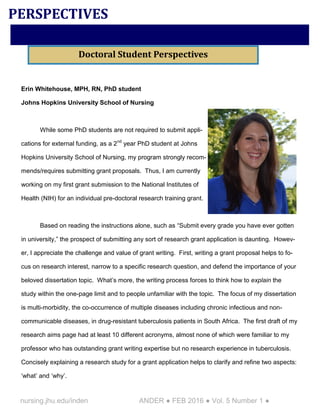
Erin Whitehouse, MPH, RN, PhD student
Johns Hopkins University School of Nursing
While some PhD students are not required to submit appli-
cations for external funding, as a 2nd
year PhD student at Johns
Hopkins University School of Nursing, my program strongly recom-
mends/requires submitting grant proposals. Thus, I am currently
working on my first grant submission to the National Institutes of
Health (NIH) for an individual pre-doctoral research training grant.
Based on reading the instructions alone, such as “Submit every grade you have ever gotten
in university,” the prospect of submitting any sort of research grant application is daunting. Howev-
er, I appreciate the challenge and value of grant writing. First, writing a grant proposal helps to fo-
cus on research interest, narrow to a specific research question, and defend the importance of your
beloved dissertation topic. What’s more, the writing process forces to think how to explain the
study within the one-page limit and to people unfamiliar with the topic. The focus of my dissertation
is multi-morbidity, the co-occurrence of multiple diseases including chronic infectious and non-
communicable diseases, in drug-resistant tuberculosis patients in South Africa. The first draft of my
research aims page had at least 10 different acronyms, almost none of which were familiar to my
professor who has outstanding grant writing expertise but no research experience in tuberculosis.
Concisely explaining a research study for a grant application helps to clarify and refine two aspects:
‘what’ and ‘why’.
PERSPECTIVES
Doctoral Student Perspectives
27nursing.jhu.edu/inden ANDER ● FEB 2016 ● Vol. 5 Number 1 ●
Second, grant writing encourages interdisciplinary collaboration. My research questions
have been made richer by input from other students, faculty, and even family. Seasoned faculty
are very willing to impart grant writing skills to eager PhD students. It’s ironic that the goal of a PhD
is to become an “independent researcher” because in fact most research is a result of partnerships.
Developing a network of researchers now and learning the grant process will help me to be a better
researcher and collaborator in the future. Third, obtaining funding for my dissertation begins a life-
long process of applying for grants. Whether I work in academic research or for a non-
governmental organization, applying for and receiving funding is an important aspect of public
health and nursing. Effectively, I am learning to give my business pitch in the research setting.
Whatever my future career, experience with writing grants is a needed and applicable skill. Yes,
grant writing and submission is a formidable task; however, the skills I am learning in the process
will help me to be a stronger nurse researcher now and in the future.
Acknowledgements: This PhD student is supported by the National Institute of Nursing Research of
the National Institutes of Health under award number T32NR012704. The content is solely the re-
sponsibility of the authors and does not necessarily represent the official views of the National Insti-
tutes of Health.
Correspondence:
Erin Whitehouse, MPH, RN, PhD student
Johns Hopkins University School of Nursing
ewhiteh3@jhmi.edu
PERSPECTIVES
Doctoral Student Perspectives
nursing.jhu.edu/inden ANDER ● FEB 2016 ● Vol. 5 Number 1 ●
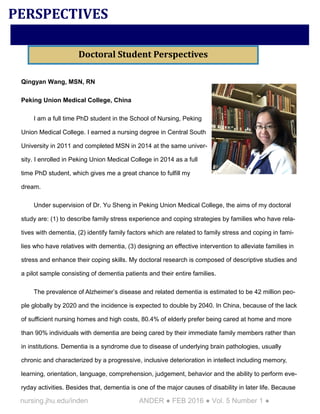
Qingyan Wang, MSN, RN
Peking Union Medical College, China
I am a full time PhD student in the School of Nursing, Peking
Union Medical College. I earned a nursing degree in Central South
University in 2011 and completed MSN in 2014 at the same univer-
sity. I enrolled in Peking Union Medical College in 2014 as a full
time PhD student, which gives me a great chance to fulfill my
dream.
Under supervision of Dr. Yu Sheng in Peking Union Medical College, the aims of my doctoral
study are: (1) to describe family stress experience and coping strategies by families who have rela-
tives with dementia, (2) identify family factors which are related to family stress and coping in fami-
lies who have relatives with dementia, (3) designing an effective intervention to alleviate families in
stress and enhance their coping skills. My doctoral research is composed of descriptive studies and
a pilot sample consisting of dementia patients and their entire families.
The prevalence of Alzheimer’s disease and related dementia is estimated to be 42 million peo-
ple globally by 2020 and the incidence is expected to double by 2040. In China, because of the lack
of sufficient nursing homes and high costs, 80.4% of elderly prefer being cared at home and more
than 90% individuals with dementia are being cared by their immediate family members rather than
in institutions. Dementia is a syndrome due to disease of underlying brain pathologies, usually
chronic and characterized by a progressive, inclusive deterioration in intellect including memory,
learning, orientation, language, comprehension, judgement, behavior and the ability to perform eve-
ryday activities. Besides that, dementia is one of the major causes of disability in later life. Because
PERSPECTIVES
Doctoral Student Perspectives
29nursing.jhu.edu/inden ANDER ● FEB 2016 ● Vol. 5 Number 1 ●
of these characteristics, taking care of a patient with dementia is extremely challenging and time-
consuming and may require performance of tasks that are physically demanding or unpleasant. Re-
sponsibilities of the everyday care pose a considerable stress on demented peoples’ caregivers and
families, which will further lead to physical and psychological problems in these patients and their
family members. Effective coping strategies can promote families to adapt to the stress better and
faster, and thereby prevent the family stress and related negative outcomes. Nurses are in a key
position to support families who have relatives with dementia to cope effectively with family caregiv-
ing stress. It is essential that nurses learn and better understand the importance of their role and
thus more research about the family stress and family coping who have relatives with dementia is
warranted.
I am currently learning the family stress and dynamics theories, and writing my proposal. I an-
ticipate finishing the study by June, 2017. Even though a few challenges may be a head, I am com-
mitted to graduate with my enthusiasm, because I want to help the families who have a relative with
dementia and I love my research very much.
Correspondence:
Qingyan Wang
Doctoral Student (Full time)
Peking Union Medical College, China
PERSPECTIVES
Doctoral Student Perspectives
nursing.jhu.edu/inden ANDER ● FEB 2016 ● Vol. 5 Number 1 ●
Veerle Claes, RN, MScN
Institute of Nursing Science (INS), University of Basel, Switzerland
The graying of our population and increasing burden of
chronic diseases have resulted in a growing number of older
adults with end-stage renal disease, who are evaluated for
and undergo kidney transplantation (KTx). Worldwide, the
number of older KTx candidates has amplified over the last
decade, and currently up to 1 in 5 patients are 65 years or
older at time of KTx. This phenomenon provides a major chal-
lenge for clinicians and policy-makers, given the lack of evidence that can guide KTx candidate se-
lection, pre- and post-Tx management in the older cohort. There is an urgent call for research that
can inform a more comprehensive risk prediction in this patient group.
Older chronological age is frequently applied to predict the risk for adverse outcomes, and
has an expected negative effect on mortality. However, its impact on other major clinical and psy-
chosocial outcomes (e.g. graft loss, acute rejections, quality of life) remains inconclusive and re-
quires further study. Concurrently, it is well known that chronological age does not well capture pa-
tients’ biological age. Hence, it is an inadequate proxy for other factors that better allow identifying
vulnerable KTx patients, such as the frailty syndrome and mild cognitive impairment (MCI). Mount-
ing evidence indicates that both conditions are highly prevalent and predictive for clinical and psy-
chosocial outcomes, and the use of healthcare resources in chronically ill adults. Yet, their study in
PERSPECTIVES
Doctoral Student Perspectives
31nursing.jhu.edu/inden ANDER ● FEB 2016 ● Vol. 5 Number 1 ●
KTx has been limited to few single-center experiences. Importantly, both frailty and MCI are amend-
able for prevention and partial reversibility through behavioral interventions (physical activity and
exercise), and also occur in adult KTx patients of younger age. Despite, interventions to target frail-
ty in KTx are currently non-existent.
In February 2015, I enrolled in the doctoral program in Nursing Science at the University of
Basel. This 3-year program requires a minimum of three publications in international peer-reviewed
journals related to the PhD research project, in addition to the participation in coursework for a total
of 12 European Credit Transfer System (ECTS) points. Given my background and interest in re-
search and clinical practice in the field of geriatrics, I collaborate on the establishment of an innova-
tive research program regarding ageing in KTx. This includes a secondary data analysis of the
Swiss Transplant Cohort Study (STCS) whereby we examine the predictive value of chronological
age at time of KTx for mortality, graft loss and quality of life. Preliminary results hereby confirm its
inadequacy to predict adverse outcomes besides mortality (manuscript in preparation). Secondly, I
collaborate on a multi-center, repeated-measures study nested in the STCS that explores frailty and
mild cognitive impairment to enhance risk prediction for clinical, psychosocial and health economic
outcomes up to 2 years post-KTx (Principal Investigator: Dr. Mauthner Oliver, RN, PhD). The re-
search team consists of clinicians of all Swiss KTx centers and researchers at various partner uni-
versities, including Johns Hopkins University, US. After an intensive year of study preparation, we
will start data collection for this study in February 2016. Thirdly, we are currently preparing the
Move@FrailtyTX project, a single-center, mixed-methods study to inform the development of be-
havioral interventions to prevent and manage frailty in KTx. For this study, I have received first per-
sonal funding through a PhD top-up Stipend of the PhD Educational Platform in Health Sciences,
University of Basel. The outcomes of my research will pave the way for system-wide improvement
PERSPECTIVES
Doctoral Student Perspectives
nursing.jhu.edu/inden ANDER ● FEB 2016 ● Vol. 5 Number 1 ●
in both organ allocation and clinical management for adult KTx candidates and recipients of all ag-
es, and especially in the older cohort.
I am looking forward to two further PhD years, an interesting trajectory which continuously
challenges and stimulates me to expand my knowledge and skills. Hereby, I am supported by the
comprehensive INS research infrastructure, and various opportunities for skill-building. The past
year has included many highly valuable experiences in this regard, such as participation in the An-
telope@University PhD career program at the University of Basel, in the summer school of the Eu-
ropean Academy of Nursing Science (3-year program), and in several international congresses in
the fields of Tx and geriatrics.
Veerle Claes, RN, MScN
Research assistant and PhD student
Institute of Nursing Science (INS)
Department Public Health (DPH)
Faculty of Medicine, University of Basel
Address: Bernouillistrasse 28, 4055 Basel, Switzerland
E-mail: veerle.claes@unibas.ch
Telephone: +41 (0)61 267 09 54, Fax: +41 (0)61 267 09 55
URL: https://nursing.unibas.ch/institut/mitarbeitende/profil/person/claes/
PERSPECTIVES
Doctoral Student Perspectives
33nursing.jhu.edu/inden ANDER ● FEB 2016 ● Vol. 5 Number 1 ●
Xiaohua Xu, PhD student
School of Nursing, Peking Union Medical College, China
It has been seven years since I stepped into Peking Un-
ion Medical College to begin my professional study of nursing.
In 2013, I earned my bachelor’s degree in nursing and now con-
tinue to study in the PhD program. After becoming a PhD stu-
dent, I am keeping my best efforts to study nursing research
and design my own research project. At the beginning of this
year, I finished my thesis proposal under the guidance of my
advisor and presented it to other professors of my thesis committee and my research proposal was
approved. Collecting and analyzing the data for my study have been my main effort now.
My study focuses on exploring mechanisms of internalized stigma among men who have sex
with men with HIV/AIDS (MSMLWHA). The aims of the study are also to develop, based on the re-
sults, appropriate interventions and test the effectiveness.
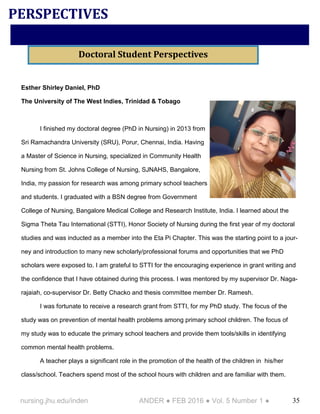
In recent years, the number of people with newly diagnosed HIV-infections has increased
rapidly. Among these people with newly diagnosed HIV/AIDS, the proportion of men who have sex
with men (MSM) has increased year by year. The increasing incidence of MSM with HIV/AIDS and
growing proportion of all the People Living With HIV/AIDS (PLWHA) in China, have starter to attract
more researchers’ attention. HIV stigma is considered to be one of the greatest barriers for PLWHA
in adapting to their HIV positive status, at the same time, HIV stigma will also propel HIV transmis-
sion from PLWHA to others. HIV stigma manifests in three dominant ways: (1) enacted stigma, also
known as external stigma, which refers to actual prejudice and discrimination against PLWHA, (2)
PERSPECTIVES
Doctoral Student Perspectives
nursing.jhu.edu/inden ANDER ● FEB 2016 ● Vol. 5 Number 1 ●
anticipated stigma, which refers to PLWHA’s expectation that they will experience prejudice and
discrimination from others, and (3) internalized stigma, which refers to stigmatizing oneself by en-
dorsing the devaluation from others. Since the beginning of the HIV epidemic in China in the 1980s,
external stigma has involved extensive public attention. Large-scale anti-discrimination campaigns
and interventions specifically targeted to reduce stigma against PLWHA have been implemented.
However, little attention has been given to anticipated or internalized stigma in research surround-
ing HIV-related stigma in China, especially among MSMLWHA. Therefore, the outcomes of my
study will have significance on helping MSMLWHA adapt to their HIV positive status and preventing
HIV transmission.
Correspondence:
Xiaohua Xu, PhD student
School of Nursing, Peking Union Medical College, China
Xuxiaohua99@foxmail.com
PERSPECTIVES
Doctoral Student Perspectives
35nursing.jhu.edu/inden ANDER ● FEB 2016 ● Vol. 5 Number 1 ●
Esther Shirley Daniel, PhD
The University of The West Indies, Trinidad & Tobago
I finished my doctoral degree (PhD in Nursing) in 2013 from
Sri Ramachandra University (SRU), Porur, Chennai, India. Having
a Master of Science in Nursing, specialized in Community Health
Nursing from St. Johns College of Nursing, SJNAHS, Bangalore,
India, my passion for research was among primary school teachers
and students. I graduated with a BSN degree from Government
College of Nursing, Bangalore Medical College and Research Institute, India. I learned about the
Sigma Theta Tau International (STTI), Honor Society of Nursing during the first year of my doctoral
studies and was inducted as a member into the Eta Pi Chapter. This was the starting point to a jour-
ney and introduction to many new scholarly/professional forums and opportunities that we PhD
scholars were exposed to. I am grateful to STTI for the encouraging experience in grant writing and
the confidence that I have obtained during this process. I was mentored by my supervisor Dr. Naga-
rajaiah, co-supervisor Dr. Betty Chacko and thesis committee member Dr. Ramesh.
I was fortunate to receive a research grant from STTI, for my PhD study. The focus of the
study was on prevention of mental health problems among primary school children. The focus of
my study was to educate the primary school teachers and provide them tools/skills in identifying
common mental health problems.
A teacher plays a significant role in the promotion of the health of the children in his/her
class/school. Teachers spend most of the school hours with children and are familiar with them.
PERSPECTIVES
Doctoral Student Perspectives
nursing.jhu.edu/inden ANDER ● FEB 2016 ● Vol. 5 Number 1 ●
They can detect the earliest the signs and symptoms of common mental health problems in the
classroom setting. A teacher who is a member of a school health team has a greater role to play in
the effective implementation of the schools mental health program. In fact, every teacher should
equip her/him -self with knowledge of common mental health problems of school children and thus
help in early prevention. Nearly 360 teachers were recruited for the study and 240 teachers were
trained on how to identify mental health problems among primary school children.
Currently, I am undertaking a study that explores the predictors of smoking and use of
smokeless tobacco among secondary school children and the efficacy of early nursing interventions
in primordial prevention in selected schools of Trinidad. Although cigarettes and smokeless tobacco
are recognized as major problems among school children, few data exist on the prevalence and
patterns of the use of these products. I am also involved in the Post Registration BSc Nursing edu-
cation/curriculum. This will help in the preparation of School Nurses in Trinidad, who will make a
difference in the health of children at schools in Trinidad. I am very grateful to The University of the
West Indies (UWI) and its faculty who have supported and encouraged my research activities and
provided grant funding. For this present study, I have been awarded a research grant from UWI.
Esther Shirley Daniel., PhD (Nursing),
Senior Lecturer, UWI-School of Nursing,
The University of The West Indies, St. Augustine Campus, Trinidad & Tobago.
PERSPECTIVES
Doctoral Student Perspectives
37nursing.jhu.edu/inden ANDER ● FEB 2016 ● Vol. 5 Number 1 ●
Yi Yang, MSN, RN
Peking Union Medical College China, PhD student
I am a full time PhD student at School of Nursing, Peking Union
Medical College (PUMC). During my first two years studying at PUMC,
I realized that the learning-curve is very deep, in a short time, for PhD
student including advanced knowledge of research, team-working
skills, self-learning ability, as well as communication skills for undertak-
ing a high quality research project. Fortunately, PUMC has provided me
a good platform to fully develop my potential with outstanding profes-
sors, rich learning resources, and most importantly, an open and ener-
getic research culture. In 2014, I was supported by PUMC and China Scholarship Council to study
in the University of North Carolina for six months. This experience has greatly broadened my views
on nursing and my own research project.
My research study focuses on patient safety and near misses. Although adverse events
have long been regarded as the main source of learning and improvement in healthcare, near miss-
es have become increasingly compelling because of their “no-harm” nature and high frequency to
highlight system vulnerabilities and as an opportunity to strengthen patient safety. The significance
of near misses is very explicit, just based on an observation, that a growing number of leading
scholars are calling for a focus on the frontline worker’s and how they can use near misses in their
role “as tools” to improve service quality and patient safety.
In China, the patient safety has been “a hot topic” for years; however, near misses have
PERSPECTIVES
Doctoral Student Perspectives
nursing.jhu.edu/inden ANDER ● FEB 2016 ● Vol. 5 Number 1 ●
started to get more attention just recently. Under the supervision of Dr. Huaping Liu, my goal is to
explore how the Chinese nurses respond to near misses in their daily work. The focus of interest is
the second-order problem solving behavioral intention (SOPSBI), which refers to the efforts made
by clinical nurses to prevent future recurrence of the near misses. The overall aim of my study is to
create a model to demonstrate how the individual and organizational factors influence the SOPSBI
related to near misses. I have recently finished the first phase of the study which aimed to clarify
the connotation of SOPSBI related to near misses in Chinese culture. I am currently working on the
second phase: this includes developing an instrument to measure the SOPSBI among Chinese
nurses. The outcomes of my study are expected to encourage Chinese nursing managers to focus
more on near misses as well as acknowledging the important role of first-line nurses in patient safe-
ty and service quality improvement. I hope that the results of my study will help the managers take
effective actions which are promoting nurses’ intention to conduct SOPSB when faced with near
misses. Even though I am a freshman in the field of patient safety, I am eager to study and work
with scholars in this field all over the world and to share our findings and research experience.
Correspondence:
Yi Yang, MSN, RN, PhD student
School of Nursing Peking Union Medical College, China
yangyi_yi@126.com
PERSPECTIVES
Doctoral Student Perspectives
39nursing.jhu.edu/inden ANDER ● FEB 2016 ● Vol. 5 Number 1 ●
Compiled by
Laurel A. Eisenhauer, RN, PhD, FAAN
Professor Emerita, Boston College, Connell School of Nursing
The websites below provide a variety of perspectives on grant writing for graduate students and fac-
ulty.
Bentley, L.P. (November 11, 2010). Grant-Writing Tips for Graduate Students. The Chronicle of
Higher Education:
http://chronicle.com/article/Grant-Writing-Tips-for/125301
5 Steps to Writing Grant Proposals for Grad Students:
http://blog.addgene.org/5-steps-to-writing-grant-proposals-for-grad-students
Get a Life: Three Steps to Getting Grants for Graduate Students:
http://getalifephd.blogspot.com/2015/04/three-steps-to-getting-grants-for.html
Dr. Karen’s Foolproof Grant Template:
http://theprofessorisin.com/2011/07/05/dr-karens-foolproof-grant-template/
Grant Proposals (or Give Me the Money!) (University of North Carolina Chapel Hill):
http://writingcenter.unc.edu/handouts/grant-proposals-or-give-me-the-money/
Stawski, C. (August 31, 2011). The Joy of Grant Writing:
http://www.gradhacker.org/2011/08/31/the-joy-of-grant-writing/
What’s New in Doctoral Education
nursing.jhu.edu/inden ANDER ● FEB 2016 ● Vol. 5 Number 1 ●
Applying for a Grant: The General Approach:
http://ctb.ku.edu/en/table-of-contents/finances/grants-and-financial-resources/grant-application/
tools#funders
Step by Step Guide to Applying for Funding. (University of Oxford):
https://www.admin.ox.ac.uk/researchsupport/applying/guide/
Clark, C. H. International Grant Resources:
http://www.writing-world.com/international/grants.shtml
What’s New in Doctoral Education
41nursing.jhu.edu/inden ANDER ● FEB 2016 ● Vol. 5 Number 1 ●
INDEN BUSINESS
INDEN Membership Renewal
You are now able to renew your membership online at
https://www.regonline.com/Register/Checkin.aspx?EventID=1658452
ANDER Deadline
May 15th, 2016 is our next deadline.
Theme : Internationalization of Nursing Doctoral Education
We welcome your manuscripts and student perspectives

ANDERFebruary2016

  • 1.
    Advances in NursingDoctoral Education & Research nursing.jhu.edu/inden ANDER ● FEB 2016 ● Vol. 5 Number 1 Official Journal of the International Network for Doctoral Education in Nursing (INDEN)
  • 2.
    inursing.jhu.edu/inden ANDER ●FEB 2016 ● Vol. 5 Number 1 ● TABLE OF CONTENTS Page CONTENT ii Journal purpose ii Author guidelines iv Editors and Board Members 1-2 Greetings from INDEN President 3-4 Letter from the Editors Peer Reviewed Section 5-10 Applying for research Funding: Perils, Pitfalls and Pearls 11-18 2015 Biennial Conference Accepted Abstracts - Oral Presentations 19-25 2015 Biennial Conference Accepted Abstracts - Poster Presentations 26-38 Doctoral Student Perspectives 39-40 What's New in Doctoral Education 41 INDEN Business IN THIS ISSUE
  • 3.
    nursing.jhu.edu/inden ANDER ●FEB 2016 ● Vol. 5 Number 1 ● The goals of Advances in Nursing Doctoral Education & Research are to: Promote academic debates and reports about nursing doctoral education Provide an academic platform for doctoral educators to share their innovations and experiences in providing nursing doctoral education Publish high quality nursing and interdisciplinary research Share best practices and procedures to enhance the diversity and quality in nursing doctoral education Journal Purpose Author Guidelines Manuscripts submitted will be reviewed for their match to the journal’s aims by the edi- tors. If the manuscript is a match for the journal’s aims, the editor will identify two editori- al board members or manuscript reviewers with expertise in the area of the manuscript topic to review it and make recommendations regarding whether to publish it and any editing needed. The process will be ‘blinded’, neither the author(s) nor the reviewers will know the others’ identity. Papers may be on any topic relevant to the goals of the publication and INDEN. (please refer to the INDEN website for its aim and objectives in detail) This may include those focused on research, theory, program evaluation and other scholarly papers related to nursing doctoral education and research topics. Some issues of the journal may focus on a particular theme such as “Measuring quality in nursing doctoral education.” Guidelines for the submission of a manuscript for the peer review section 1. Relevance to aims of this publication 2. Follow format guidelines for manuscripts 3. Length – 2500-3000 words with 12 Arial font and double line spacing. 4. Format for research manuscripts: Abstract (limited to 350 words) Key words (3-4) Introduction and Background Methodology Analysis Conclusions Discussion Implications for practice and future research 5. Format for non-research manuscripts: Abstract (limited to 350 words) A concise summary of the argument or proposed course of action and conclusions 3-4 key words
  • 4.
    iiinursing.jhu.edu/inden ANDER ●FEB 2016 ● Vol. 5 Number 1 ● Author Guidelines Guidelines for the submission of a Perspective The Perspectives section of our ANDER journal invites doctoral students and faculty to share their experiences in doctoral education or other activities related to their develop- ment as scholars. Authors for this section should include their name, credentials, affiliated university and their email address at the top of page. They also should send a picture and identify all the individuals in the picture with a text box underneath the image. Authors should briefly describe their area of research and population of interest. The format of this writing should be Arial, 12-point font and single-spaced with an extra space between paragraphs. The Maximum word limit is 400. Authors can send their per- spectives to the editors through following email: son-inden@jhu.edu
  • 5.
    nursing.jhu.edu/inden ANDER ●FEB 2016 ● Vol. 5 Number 1 ● Editors and Board Members Editor-in-Chief: Sonja McIlfatrick, PhD, RGN President, INDEN Professor of Nursing School of Nursing, University of Ulster, Ireland, UK Associate Editors: Laurel A. Eisenhauer, PHD, RN, FAAN Professor Emerita William F. Connell School of Nursing - Boston College Chestnut Hill, Massachusetts 02467 USA laurel.eisenhauer@bc.edu Kristiina Hyrkas, PhD, LicNSc, MNSc, RN Director, Center for Nursing Research & Quality Outcomes Adjunct Professor, University of Southern Maine Maine Medical Center 22 Bramhall Street, MGB2, RM2620 Portland, Maine 04102-9954 USA hyrkak@mmc.org Marie T. Nolan, PhD, RN, FAAN Professor and Chair Department of Acute and Chronic Care School of Nursing Johns Hopkins University mnolan3@jhu.edu Munikumar Ramasamy Venkatasalu, PhD, RGN, PGDEPP Professor, PAP Rashidah Sa'adatul Bolkiah Institute of Health Sciences Universiti Brunei Darussalam Jalan Tungku Link Gadong, BE1410 Negara Brunei Darussalam kumar.venkatasalu@ubd.edu.bn Editorial Board Members: Dr. Patricia Davidson United States Dr. Judith Erlen United States Dr. Caitrin Evans United Kingdom Dr. Huaping Liu China Dr. Milisa Manojlovich United States Dr. Sonja McIlfatrick Ireland Dr. Florence Myrick Canada Dr. Richard Redman United States Dr. Marilyn S. Sommers United States Executive Director: Ms. Tamar Rodney United States
  • 6.
    1nursing.jhu.edu/inden ANDER ●FEB 2016 ● Vol. 5 Number 1 ● Greetings from INDEN President Financial constraints, decreased availability and increased competi- tion for research funding are just a few of the factors that impact on the process of applying for research funding. Winning research fund- ing is increasingly tough and yet there is a growing pressure in all disciplines to secure funding. So what are the implications of this for nursing doctoral students and faculty members? First of all, for doc- toral students it is important to note that it’s never too early to think about funding – even during your doctorate there are funding oppor- tunities for travel grants, equipment, public engagement activities and more. Securing this type of funding provides valuable evidence of your ability to win funding and provides important experience before moving on to writing larger, more complex, grant pro- posals. For faculty members, a key message is ‘Keep Trying’! Lots of people don’t re-submit appli- cations where they can. But responding to suggestions from reviewers can add value to an applica- tion and, once adapted, some applications do go on to be funded. Being rejected doesn’t mean your idea is completely un-fundable necessarily. It might be that you need to make changes, or it might be that this time there just was not funding available. Whilst there’s no easy way to write a success- ful application, and for many of us we may expend many hours and days agonising over that grant application, there are however some useful steps and potential pitfalls that can be avoided that can make the overall process less stressful and hopefully more successful. This issue of ANDER fea- tures some of my own personal reflections on grant writing, examining the ‘perils, pitfalls and pearls of grant writing. This issue also provides some valuable information on grant writing for graduate students and faculty. This paper provides some practical top tips to consider and emphasises the importance of construct- ing a well presented, clear and articulate proposal. Some key messages include the need to write
  • 7.
    nursing.jhu.edu/inden ANDER ●FEB 2016 ● Vol. 5 Number 1 ● Greetings from INDEN President positively, without relying on unexplained jargon, and with enthusiasm about what you plan to do, and why you are the right person, with the right blend of skills and experience to make a success of it! An important point however increasing for nursing is that we clearly articulate how this proposed research project is essential in order to improve the health and wellbeing of people, patients and families. This may require some creativity in terms of other approaches to enhance grant applica- tions that will ultimately have a significant impact on health care. Sonja McIlfatrick, PhD, RN President, INDEN Professor of Nursing School of Nursing, University of Ulster, Ireland, UK
  • 8.
    3nursing.jhu.edu/inden ANDER ●FEB 2016 ● Vol. 5 Number 1 ● Letter from the Editors Greetings to our Readers, Grant writing and applying for research funding is a topic that all doctoral students and faculty are discussing continuously. For doctoral students, grant writing is an important skill to learn: sometimes even a small ‘seed money’ supporting thesis research can be a starting point for capturing bigger grants and career as a researcher. Applying for research funding is, however, not easy and the com- petition is hard when applying for larger amounts of money. Faculty searching for funding their re- search projects has often a lot of valuable experiences and learnings to share, and sometimes even opportunities to invite doctoral students to join their initiatives starting from grant proposal writing. We are very pleased to include in this ANDER Issue Dr. Sonja McIlfatrick’s paper that focuses on discussing the steps of a grant writing process, common pitfalls, perils and pearls. The 2015 Biennial INDEN conference (July 22-23, 2015) was organized in San Juan, Puerto Rico. The conference was a success: the podium and poster presentations were very interesting and of high quality. We are sharing the presenters’ works from this conference in this issue and hope that, especially those of you who were not able to attend the conference enjoy reading the abstracts. We are also publishing six doctoral student perspectives in this issue. The doctoral students are from: Johns Hopkins University School of Nursing (USA), Peking Union Medical College (China), In- stitute of Nursing Science, University of Basel (Switzerland), and the University of the West Indies (Trinidad & Tobago). The “What’s New in Doctoral Education” section, of this issue provides valuable information on grant writing for graduate students and faculty. The links that are available provide, for example, helpful grant writing templates and description(s) on grant writing steps. We once again urge the readers of the ANDER to send feedback to us. We are encouraging the submission of manuscripts for the peer review section and welcome the submission of perspectives
  • 9.
    nursing.jhu.edu/inden ANDER ●FEB 2016 ● Vol. 5 Number 1 ● Letter from the Editors from doctoral students and faculty. The theme of the next issue is Internationalization of Nursing Doctoral Education and the deadline for the submissions is May 15th , 2016. Associate Editors: Kristiina Hyrkäs, PhD, LicNSc, RN Laurel A. Eisenhauer, PHD, RN, FAAN Marie Nolan, PhD, RN, FAAN Munikumar Ramasamy Venkatasalu, PhD, RGN, RMN, RNT, PGDEPP
  • 10.
    5nursing.jhu.edu/inden ANDER ●FEB 2016 ● Vol. 5 Number 1 ● Applying for research Funding: Perils, Pitfalls and Pearls Sonja McIlfatrick, PhD, MSc, BSc President of INDEN, Professor of Nursing, Institute of Nursing and Health Research, Ulster University, UK Introduction It is well recognised that research requires funding and money is crucial for enabling research pro- jects to be undertaken (Amerson, 2013). It can be argued however, that many nurses and academ- ics receive little, or no, training in the process of writing a successful grant application. Rather, they are subjected to learning ‘on the job’ and learning from their success and failures. This paper fo- cuses on my personal reflections on the perils, frequent pitfalls and hopefully what can be construct- ed pearls of wisdom or some ‘top tips’ when applying for research funding. In an era of financial constraints and reduction in the availability of research funding, the ability to construct a well pre- sented, clear, articulate proposal is becoming more important than ever alongside being creative about other approaches that could be developed to enhance grant applications. Therefore research- ers need to be equipped to submit grant applications that give them the competitive edge over other proposals. Evidence from the percentage of successful funded projects highlights the extremely competitive nature of applying for research funding. For example, according to the U.S. Department of Health and Human Services National Institutes of Health (NIH) (2013a), the success rate for research grants in 2011 was 19%. Similar figures are noted for the UK Medical Research Council, New In- vestigator Awards for 2014/15 -17% (Medical Research Council, 2015). These statistics indicate the need to refine grant writing skills and increase knowledge about the ‘rules of the game’. Peer Reviewed
  • 11.
    nursing.jhu.edu/inden ANDER ●FEB 2016 ● Vol. 5 Number 1 ● Steps of A Grant Writing Process The first and primary ingredient in a successful proposal is having a significant and innovative re- search question. A successful grant proposal begins with a clearly defined problem, statistics to demonstrate the impact of the problem and demonstration of how this proposal will address this gap. In other words, articulating a clearly defined programme that answers a specific question. A crucial second step is to then to identify other key researchers in the field and seek to collaborate. Once you have develop innovative idea and then have the key players in place, then it is time to de- velop your ‘game plan’ or strategy for applying for funding. This involves asking the question, what type of award is appropriate and will meet the needs of your proposed project? This requires a clear understanding of the different types and sources of research funding that are available. When developing a grant proposal it is important that the applicant considers the review criteria used by the potential funding agency. Generally these tend to focus on four main propositions: 1. Importance: the proposal asks an important question- in other words a proposal’s significance impact, relevance and usefulness. What is it that makes this application memorable against other applications? 2. Success: the project is likely to answer the question? This includes aspects such as scope, ap- proach to research, soundness of the design and feasibility. This is the most important but often most neglected aspect of an application. 3. Value: is the likely gain worth the resources requested? This relates to value for money, budget, sufficiency of resources to complete the project. It is important to note that funding agencies will on- ly support projects whose resources are necessary & sufficient. Peer Reviewed
  • 12.
    7nursing.jhu.edu/inden ANDER ●FEB 2016 ● Vol. 5 Number 1 ● 4. Competence: the applicant and team - and are they competent to carry out the project as out- lined? This includes evaluating the expertise of the applicant, knowledge of the field, track record, and wider team members’ role and expertise. Self-citation is essential and it is important that your ‘competence’ is relevant to the scale of the project and your role within it. Various pitfalls have been identified when applying for research funding from the perspective of the research funder and researcher (Proctor et al, 2012). From personal experience and reflections the following ten pitfalls have been identified, alongside some practical suggestions to address these. Common Pitfalls Pitfall 1: Poor Fit. This is where your proposed project has a poor fit with the type of award. To address this, it is important to read the eligibility criteria and the terms and conditions of the pro- gramme call. Pitfall 2: Weak argument. This is when there is a lack of rationale for the project. To address this, it is important to explain why research is needed and build a compelling argument in every par- agraph. Pitfall 3: Excessive jargon. It is important to use clear, accessible language. You want reviewer ‘to get it’. Ways to achieve this are to have direct statements and active voice; avoid abbreviations and acronyms; and use headings/sub headings to help signpost the reader through the proposal. Pitfall 4: Vague research plan. It is important to specify major tasks and timelines. This in- volves the use Gantt charts that illustrates a project schedule. Always think from the reviewer’s per- spective. Peer Reviewed
  • 13.
    nursing.jhu.edu/inden ANDER ●FEB 2016 ● Vol. 5 Number 1 ● Pitfall 5: Writing solo. Sometimes owing to various time constraints and deadlines research- ers may focus on their own writing and requirements. But it is important to get other people to read and review; seek peer review from all sources and allow time for rewrites. Pitfall 6: Deviating from guidelines. It is important to follow instructions. For example: font size; curriculum vitae’s (CVs); signatures etc. Pitfall 7: Time. It is important to build in time to prepare and plan for the overall grant appli- cation. This includes working ‘backwards’ with time and factoring in aspects such as gaining signa- tures, seeking feedback and working out costings. Pitfall 8: Weak Abstract. The abstract should reflect the entire scope of project and provide a summary of the project’s purpose and methods. Sometimes this can be last piece of text to be writ- ten and does not always receive the attention it deserves. Pitfall 9: Ignoring review criteria. Some of the key aspects have been outlined previously and they are well recognised but it is important to learn to decipher these further depending on the fun- der. Pitfall 10: Choose reviewers carefully. Find a referee who is supportive, but who also does not have a conflict of interest. In conclusion, I would like to outline some personal reflections and perhaps some ‘Pearls of Wis- dom’. It is important to develop a strategy for longer term success. Two approaches to this are a) begin by serving as a co-investigator on a grant held by more senior investigators, and b) start small and apply for other types of smaller grants as a principal investigator. For example, this may in- clude different types of grant awards such as conference awards and travel grants. These can help Peer Reviewed
  • 14.
    9nursing.jhu.edu/inden ANDER ●FEB 2016 ● Vol. 5 Number 1 ● to build your CV but also demonstrate some success in securing funding and demonstrating an abil- ity to successfully manage a small grant before attempting to secure a larger grant. Other aspects when developing a longer term strategy for success are: fit research and grant writing into your job; seek out and find a mentor(s); seek collaborators and maximize network opportunities; read successful grants and attend grant writing workshops and seminars, ensuring you keep up to date with current practice and require- ments; be informed and realistic about different sources of funding helping you to target possible fun- ders appropriately; participate in funding panels if possible; take advantage of ‘new and early stage investigator status’. Combining this status with other, more experienced investigators, provides a strong potential for successful grant acquisition. 7. Plan applications and be realistic in what is achievable. Plan accordingly. 8. If an application is unsuccessful, read reviewer’s feedback carefully and use the reviewers' com- ments to improve the proposal for the purpose of resubmission. 9. Persistence: this is ‘the key’ to success! It is important to develop a ‘thick skin’ in terms of rejec- tion whilst maintaining an inquisitive and creative mind. References Amerson, R. (2013). Submitting for dollars: Playing the funding game to promote transcultural nurs- ing. Online Journal of Cultural Competence in Nursing and Healthcare, 3(3), 16-23. doi:10.9730/ ojccnh.org/v3n3a2 Peer Reviewed
  • 15.
    nursing.jhu.edu/inden ANDER ●FEB 2016 ● Vol. 5 Number 1 ● U.S. Department of Health and Human Services, National Institute of Health (NIH). Funding Facts. 2013a. Retrieved from http://report.nih.gov/fundingfacts/index.cfm on December, 2015. Medical Research Council (2015) Grant application success rates for New Investigator Awards 2014/2015. Retrieved from: www.mrc.ac.uk/news/funded.research/successrates/#grants on Decem- ber , 2015. Proctor, E., Powell, B., Baumann, A., Hamilton, A. & Santens R. (2012) Writing implementation re- search grant proposals: ten key ingredients. Implementation Science. 7(96): 1-13. Retrieved from: http://www.implementationscience.com/content/7/1/96 on December , 2015. Peer Reviewed
  • 16.
    11nursing.jhu.edu/inden ANDER ●FEB 2016 ● Vol. 5 Number 1 ● Oral Presentations Diana Baptiste - Johns Hopkins University School of Nursing Increasing scholarly productivity through a heart failure journal club: Be accountable, improve your science and collaborate! Diana Baptiste, DNP, RN, Faculty Associate, Johns Hopkins University School of Nursing Martha Abshire, MS, RN, PhD student, Johns Hopkins University School of Nursing Journal clubs have been used to help increase nurses’ knowledge and confidence to understand research and lead changes in practice. We have used the Heart Failure Journal Club to link at- tendees through the use of online meeting software and in-person sessions for structured discus- sion of literature related to current trends and issues in cardiovascular nursing, specifically targeting heart failure. Moderated by a DNP faculty member and a PhD student, the heart failure journal club provides an opportunity for BSN through doctoral level students, members of the research commu- nity and faculty attendees to provide accountability regarding progress with their programs of re- search. Out of these discussions, attendees have formed collaborations to develop research ideas, submit abstracts and write manuscripts. The once a month meeting allows for participants to make progress and help each other strategize when a project has lost momentum. Articles discussed are chosen by the moderators to reflect different research constructs methods and relevance to the state of heart failure science. Attendees analyze the selected article together, section by section; each journal club session features a different component of a research article such as the title or implications for nursing practice. Participants are encouraged to relate the club discussion to improving their own work. Further, the heart failure journal club is an opportunity to discuss dissemination of literature through scientific conferences. Participants discuss which con- ferences are relevant and feasible to attend, how to increase the impact of abstracts, presentations, posters, and how to network with leading researchers during a conference. This innovative model for a journal club can be readily translated to a wide variety of settings and across disciplines to ad- vance nursing education at the doctoral level. Correspondence: dbaptis1@jhu.edu Elizabeth Bonham - University of Southern Indiana How Social Media Change Communication Roles of Doctorally Prepared Nurses Elizabeth Bonham, PhD, RN, PMHCNS-BC A current phenomenon in healthcare is the multigenerational composite of nurses working together in different systems. The same phenomenon is present in doctoral nursing programs where a vast array of practice and technology experience is presented. Doctor of Nursing Practice (DNP) stu- dents who “grew up” with electronic technology are considered technology natives while seasoned practitioners with rich practice portfolios are considered technology immigrants. As in any migra- tion, immigrants must learn new customs, culture and language for successful assimilation. The same assimilation for technology users in the 21st century holds true for the doctorally prepared nurse whose role includes communicating, translating, and interpreting healthcare information to patients, families, and community stakeholders. The immigrant DNP student previously learned communication techniques with face to face, personal interactions. The interactions take a different shape and present diverse challenges when healthcare settings and patients may be at a distance. INDEN 2015 Biennial Conference Accepted Abstracts
  • 17.
    nursing.jhu.edu/inden ANDER ●FEB 2016 ● Vol. 5 Number 1 ● Oral Presentations Without knowledge of new information communication strategies, a system of shared governance will be difficult. In a DNP course, Clinical Appraisal of Practice, students were introduced to two as- pects of social media as an innovative mechanism to communicate, collect, and disseminate infor- mation. Two media techniques will be described in this presentation and accompanied with imple- mentation strategies. Correspondence: ecbonham@usi.edu Song Ge - Johns Hopkins University School of Nursing The Impact of Master’s-Prepared Nurses Make on Patient Care in Inpatient Settings: A Sys- tematic Review Song Ge, PhD student, RN, Johns Hopkins University, School of Nursing, United states Xing Xi, MSN, School of Nursing, Peking University, China Guifang Guo, PhD, Dean of School of Nursing, Peking University, China Aim: The aim of this review is to summarize the impact of master’s prepared nurses on patient outcome in inpatient settings across distinctive healthcare systems and specialties and is a project of Chinese nursing education reform sponsored by Peking University. The results of this review will provide support and direction for China to advance its master education in nursing and support Chi- nese hospitals to make decisions regarding staffing nurses. Background: The aging population, advancement in medical technologies and increased complexities in healthcare delivery model have called for healthcare services with better quality and higher efficiency. Nurses need further education beyond the entry level to achieve this goal. Cur- rently, there is a great obscurity on to what extent master’s prepared nurses can contribute to im- proving access to and quality of Chinese healthcare services and how cost effective it is due to the infancy stage of this profession in China. Method: A systematic review is conducted based on pro- cesses-specified research evidence from PubMed. There is a step-by-step design to search for rel- evant studies, review, rate, grade, and synthesize their results for outcomes. Results: A total of 9 papers were included. They demonstrated that care and interventions by master’s prepared nurses improved patients’ clinical outcome (decreased readmission, hospital cost, incidence of depression, mortality and length of hospitalization) in the areas of palliative care, continuity of care, mental health, transition care, post-transplant care and central venous catheter care. Conclusion: Develop- ing master’s prepared nurses’ education can potentially alleviate many urgent issues that currently exist in our society. It deserves more attention at the academic and policy level. This review pro- vides important references for Chinese nursing educators and policy makers. Correspondence: soph-song@hotmail.com Linda M. Goodfellow, Duquesne University International Network for Electronic Theses and Dissertations in Nursing: A Global Initiative Linda M. Goodfellow, PhD, RN, FAAN Duquesne University School of Nursing, Colin Macduff, PhD, MSc; RMN, RGN Robert Gordon University School of Nursing and Midwifery, Gavin Leslie, RN, PhD, Curtin University School of Nursing and Midwifery, David Nolfi, MLS, AHIP, Duquesne Univer- sity Gumberg Library, Susan Copeland, MA, DipLib, MPhil, PhD, MCLIP, Robert Gordon University INDEN 2015 Biennial Conference Accepted Abstracts
  • 18.
    13nursing.jhu.edu/inden ANDER ●FEB 2016 ● Vol. 5 Number 1 ● Oral Presentations Library, Diana Blackwood, BA, DipLib, ALIA, Curtin University, Library In today’s world of technology, it has become increasingly common for universities to require doc- toral students to submit their dissertation studies to digital libraries. Yet, most faculty and students do not know how to best search or utilize electronic theses and dissertations (ETD), nor do they rec- ognize the creative opportunities electronic media presentations offer. Editors of nursing journals have also had reservations concerning ETDs. Our international ETD research team, comprised of nurse scientists and health science librarians from three different English speaking countries includ- ing Australia, Great Britain, and the United States, conducted two studies. The first surveyed facul- ty, students and alumni from vanguard universities in four countries. Forty-four percent of respond- ents knew how to access ETDs in their own institutions; only 18% could access ETD through na- tional/international repositories; and, 27% had cited an ETD. The second study used a semi- structured interview. Survey results were confirmed and considerable insight and better understand- ing of the challenges facing researchers using ETDs was gained. Interestingly, a positive attitude toward ETDs was clearly noted and there was noticeable interest in accessing ETDs for knowledge of methodology. In a global initiative to promote ETD engagement and development, our research team has recently created the International Network for Electronic Theses and Dissertations in Nursing (INETDIN). Our website will become an interactive resource for nurse scholars worldwide; provide opportunities to share knowledge; raise awareness of nursing's diverse repositories of open access electronic theses and dissertations; act as a conduit to relevant institutional repositories, national portals and international portals housing these resources; and, foster innovative formatting and content of nurs- ing theses and dissertations through relevant electronic media. We are excited to launch the INETDIN and hope through this presentation to inform others about this unique and international initiative. Correspondence: goodfellow.linda@gmail.com Rose Ilesanmi- University of Ibadan, NIGERIA Tailoring, Implementing and Evaluating International Pressure Ulcer Prevention Guidelines for Developing Countries: A Knowledge Translation Protocol Rose Ekama Ilesanmi RN, PhD, IIWCC (Stellenbosch), FWACN Prisca Olabisi Adejumo RN, PhD, IIWCC (Stellenbosch), FWACN, Department of Nursing, College of Medicine, University of Ibadan, NIGERIA, Wendy Chaboyer PhD RN MN, Griffith University, Gold Coast, AUSTRALIA Background: The 2014 International Pressure Ulcer Prevention (PUP) Clinical Practice Guidelines (CPG) provides the most current evidence based strategies to prevent PU. The evidence has pre- dominantly been generated from research conducted in developed countries. Some may not be fea- INDEN 2015 Biennial Conference Accepted Abstracts
  • 19.
    nursing.jhu.edu/inden ANDER ●FEB 2016 ● Vol. 5 Number 1 ● Oral Presentations sible in developing countries due to structural and resource issues; therefore there is a need to adapt these guidelines to the context. Aim: To present a protocol detailing: 1) the tailoring of PUP CPG into a care bundle in the Nigerian context; 2) Implementation and evaluation of the PUP care bundle Methods: Guided by the Knowledge to Action (KTA) framework, a three- phased study will be un- dertaken. In Phase 1, the Delphi technique with stakeholders (consumers, nurses, doctors) to re- view the current PUPCPG, identifying core feasible strategies. These core strategies will become components of a PUP care bundle. In Phase 2, key stakeholder interviews will be used to identify the barriers, facilitators and potential implementation strategies. In phase 3, a cluster-randomized trial (c-RT) will be conducted in eight teaching hospitals in South West Nigeria, to implement and measure the effectiveness of the PUPCB on patient outcome. Results: A PUP care bundle, with three to eight components is expected to be developed from Phase 1. Implementation strategies to promote adoption of the PUP care bundle into clinical prac- tice in Nigeria is expected to result from Phase 2. Engagement of key stakeholders and consumers in the project should promote successful implementation and translate into better patient care. The incidence of hospital acquired PU is expected to reduce in the intervention hospitals where the PUP care bundle is implemented, compared to those in the control hospitals. Conclusion: Using KTA framework, to guide the implementation of PUPCPG will enhance the likeli- hood of successful adoption in clinical practice. Correspondence: ekamailesanmi@yahoo.com Jalil Johnson - University of Massachusetts, Amherst A Systematic Review: Culturally Tailored Interventions to Improve Type 2 Diabetes Self Care in Puerto Rican and Mexican American Adults Jalil Johnson PhD candidate, ANP-BC Aims: To synthesize culturally tailored research methods to improve diabetes self care in Puerto Rican and Mexican American adults; and to illuminate areas that warrant further investiga- tion. Background: Hispanic adults are disproportionately affected by T2DM than their white coun- terparts. Culturally tailored interventions are central to improving self-care for Hispanic populations. Interventions should be tailored to the targeted Hispanic subgroup. Design: Systematic Review. Data Sources: Research published from 1995 to 2014, using search engines: CINAHL, Pub- Med, HAPI, Sociological Abstracts, Social Science Abstracts, and Psych Info. INDEN 2015 Biennial Conference Accepted Abstracts
  • 20.
    15nursing.jhu.edu/inden ANDER ●FEB 2016 ● Vol. 5 Number 1 ● Oral Presentations Review Methods: Publications were deconstructed and organized into a matrix, then ana- lyzed categorically for themes regarding study designs, description intervention, measure of meta- bolic control, behavioral improvement components, diabetes-associated risk factors, clinical effec- tiveness, design, level of evidence, limitations, socioeconomic accommodations, and theoretical un- derpinning. Results: Twelve published studies met inclusion criteria and were reviewed in depth. The randomized controlled trial design and community health worker models were commonly used. Studies of Mexican Americans were more effective and robust. Cultural components of the interven- tions were similar between groups and included Spanish language or study staff of similar ethnicity as the population sample. Cultural foods and exercise regimens were absent from many studies. Small population samples were unifying limitations for many studies reviewed. Conclusion: Cultural components of interventions targeting Puerto Rican and Mexican American populations should accommodate for language, cultural foods, physical activity prefer- ences and other culturally specific factors. Larger population samples are needed in order to detect statistically significant improvements in key study measures and improve generalizability if findings. Correspondence: jalil@nursing.umass.edu Jeremy Lapham - University of Michigan An examination of organizational culture, safety climate, and clinician attitudes and percep- tions toward teamwork before and after a teamwork training intervention. Richard Redman, PhD, RN, University of Michigan School of Nursing Rockefeller Oteng, MD, University of Michigan Department of Emergency Medicine, Komfo Anyoke Teaching Hospital Sue Anne Bell RN, FNP, PhD, University of Michigan School of Nursing Paa K. Forson, MD, Komfo Anyoke Teaching Hospital Accident and Emergency Department Jamila Yakubu, MPH, University of Michigan, Ghana Emergency Medical Collaborative Nadia Tagoe, MS, PMP, Kwame Nkrumah University of Science and Technology George Oduro, MD, Head of Department, Komfo Anyoke Teaching Hospital Accident and Emergen- cy Department Patience Ampong, MS, RN, Chief Nursing Officer, Komfo Anyoke Teaching Hospital Victoria Bam, RN, PhD, School of Nursing, Kwame Nkrumah University of Science and Technology Background and significance: Interdisciplinary team-work and team-training are essential in order to provide safe, consistent, and high-quality care. Although research has identified opportuni- ties for improving team-level attributes (e.g. group norms, communication and team structure) in or- der to impact team processes and outcomes their relationship to organizational outcomes (e.g. safety climate, organizational culture ) are less understood. Objective: This study study explores as- pects of general organizational culture, patient safety climate, and other pertinent organizational ef- fectiveness criteria before and after a TeamSTEPPs team-training intervention. INDEN 2015 Biennial Conference Accepted Abstracts
  • 21.
    nursing.jhu.edu/inden ANDER ●FEB 2016 ● Vol. 5 Number 1 ● Oral Presentations Methods: We use a quasi-experimental, a pretest-posttest repeated measures study design; to evaluate the impact of an 8-hour TeamSTEPPs based team-training intervention to emergency staff including: medical residents, faculty, nurses, and technicians (N=317) working in an ultramodern teaching hospital in Ghana. The baseline sample (n=96) as administered in November 2014 and included: The Hospital Survey on Patient Safety Culture (HSOPS), the TeamSTEPPs Teamwork Attitudes questionnaire (T-TAQ), the employee opinion and occupational commitment survey ques- tionnaire (EOS-OCQ), and a measure of organizational culture based on the competing values framework (CVM) (n=96). The T-TAQ along and the TeamSTEPPS teamwork perceptions ques- tionnaires (T-TPQ) were administered immediately after the training (n=86). Final sampling will oc- cur in March 2015. Results: Preliminary descriptive data analyses are underway including Chi-square and t-tests. Repeated measures multivariate analysis of covariance (MANCOVA) will examine changes in out- comes pre and post intervention. Conclusions: Our findings contribute to knowledge about the relationships amongst organi- zational culture, teamwork, teamwork-training and other organizational effectiveness criteria. We expect general improvements in attitudes and perceptions pre and post training, among groups with higher baseline group orientation an reduced hierarchy will have more favorable attitudes and per- ceptions of teamwork. Correspondence: jerelaph@umich.edu Ann Mitchell - University of Pittsburgh Simulation Training Applied to Screening, Brief Intervention and Referral to Treatment (SBIRT) in Interprofessional Groups of Anesthesia Students (InGAS) Michael W. Neft, DNP, MHA, RN, CRNA University of Pittsburgh School of Nursing John M. O’Donnell, DrPH, MSN, RN, CRNA University of Pittsburgh School of Nursing Ann M. Mitchell, PhD, RN, FAAN University of Pittsburgh School of Nursing Marie Fioravanti, DNP, RN University of Pittsburgh School of Nursing Kathryn R. Puskar, DrPH, MN, RN, FAAN University of Pittsburgh School of Nursing Lynn Boucek, MSN, RN, CRNP University of Pittsburgh School of Nursing Angelina Ricelli, MS, RDH University of Pittsburgh School of Dental Medicine Michael Cuddy, DMDUniversity of Pittsburgh School of Dental Medicine Holly Hagle, PhD Institute for Research, Education and Training in Addictions Dawn Lindsay, PhD Institute for Research, Education and Training in Addictions Background: The Screening, Brief Intervention and Referral to Treatment-Interprofessional Groups of Anesthesia Students (SBIRT-InGAS) Project started in September, 2012; its anticipated end is June 30, 2015. Its purpose is to teach the precepts of chemical dependency screening to in- terprofessional groups of anesthesia students, to include simulation training as well as didactic ex- perience. Initially nurse anesthesia students, dental students and dental anesthesia residents were the target populations. SBIRT training has never been conducted with anesthesia students before, INDEN 2015 Biennial Conference Accepted Abstracts
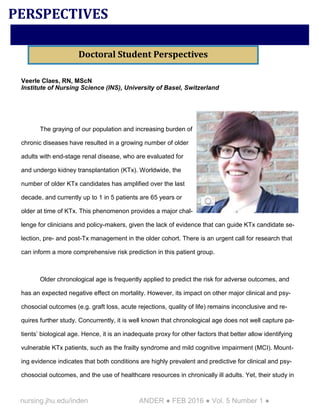
  • 22.
    17nursing.jhu.edu/inden ANDER ●FEB 2016 ● Vol. 5 Number 1 ● Oral Presentations this was one impetus for developing this program. Purpose: Chemical dependency is a problem that is prevalent internationally. Anesthesia providers must gain patients trust quickly, while discerning key factors about their health that are vital to the provision of a safe anesthetic. Dental practitioners usually see patients over time and de- velop a rapport with them. Both types of providers have a need to hone their screening skills for chemical dependency. Methods: All students received didactic training in SBIRT methods. They then applied these methods in simulation with standardized patients or other actors. Simulation was conducted in an interdisciplinary mien. Faculty, program staff and peers rated each student on SBIRT and interpro- fessional competencies, and students completed attitude surveys at three time points, pre-training, post-training and post-simulation. Results: Competency ratings showed that students were able to apply SBIRT skills and in- terprofessional perspectives to the standardized patients. A measure of perception and attitudes toward working with individuals who use alcohol and other drugs increased significantly from pre- training to post-training (p<0.01), and again from post-training to post-simulation (p<0.01). Conclusions: The data revealed that the simulation experience contributed significantly to improved attitudes, perceptions and competency around working with patients who have alcohol and other drug use. Therefore, simulation training is a critical aspect of SBIRT curriculum for SRNA and dental students. Correspondence: ammi@pitt.edu Sherily Pereira - University of Massachusetts, Amherst Acute Pain Symptom Assessment and Management in Nonverbal Patients at Early Postoper- ative Period Sherily Pereira, PhD candidate, RNA, University of Massachusetts Pain is an expected symptom that represents significant concern for surgical patients during the postoperative period. Acute pain associated with surgical procedures in early postoperative period remains inadequately assessed and managed, probably due to the use of ineffective instruments or protocols for assessment in patients with moderate sedation due to general anesthesia. This points to a need for an instrument that assesses acute pain in the early postoperative period for patients with moderate sedation and in the establishment of a standard of care. Continuous post-operative assessment and management of pain by nurses is of utmost importance because it guides them in the process of providing analgesia before patients reach a maximum acute pain threshold and develops postoperative complications. The purpose of the proposed re- search study is to compare the effectiveness of two behavioral acute pain assessment tools during the early postoperative period for non-verbal patients under moderate sedation. After adequately testing both tools simultaneously, we will determine the best and most reliable behavioral tool to as- sess acute pain in the early postoperative period. Patient’s whose early pain is assessed will INDEN 2015 Biennial Conference Accepted Abstracts
  • 23.
    nursing.jhu.edu/inden ANDER ●FEB 2016 ● Vol. 5 Number 1 ● Oral Presentations demonstrate more improvement in postoperative outcomes. The research method of this study is contained within the symptom management theory (SMT), that guides pain symptom assessment and treatment management as part of the component of symptom management strategies. The early decrease in acute pain is the expected symptom status defined in the context of outcome at the framework. The use of adequate pain measurement instru- ments warrants a better pain assessment, management and a significant decrease in complica- tions. The ultimate goal when dealing with the acute pain assessment and management is the im- provement in the quality of care. Correspondence: sherily@nursing.umass.edu INDEN 2015 Biennial Conference Accepted Abstracts
  • 24.
    19nursing.jhu.edu/inden ANDER ●FEB 2016 ● Vol. 5 Number 1 ● Poster Presentations Andrea C. Bostrom, PhD, RN Kirkhof College of Nursing, Grand Valley State University An Innovative Mental Health Curriculum for Primary Care Nurses Prepared as Doctors of Nursing Practice Globally, mental illness is a costly issue. The World Health Organization (WHO) identifies several major mental health concerns. These include the yearly toll of suicide, the impact of war and disas- ters, human rights violations against those with mental disorders and disabilities, and the increased risk for other diseases concomitant with mental illness and psychosocial distress. WHO also identi- fied significant barriers to treating mental illness and supporting mental health. These include stig- ma and discrimination, inequity in the distribution of mental health providers across the globe, ab- sent or inadequate integration in primary care, and inadequate leadership for promoting and funding mental health within the public health agenda. WHO created an action plan for 2013 to 2020 with four main objectives to address mental health. These focus on leadership, integrated community- based care, promoting mental health and preventing illness, and improved information systems and research. These facts suggest several roles for nurses prepared for mental health and psychiatric nursing at the doctoral level. They are essential for preparing a workforce who can focus practice and research on this population. Doctoral level nurses can take leadership in integrating mental health into curricula for advanced practice nurses to increase exposure to vulnerable individuals. This will help alleviate stigma toward the mentally ill and provide openness to giving more integrated care. While not solving a workforce shortage, these efforts can make integrated care more availa- ble. This presentation describes an innovative curriculum that incorporates foundational mental health topics and courses throughout the Doctor of Nursing Practice Curriculum at the Kirkhof Col- lege of Nursing, Grand Valley State University. The outcome is for primary care nurses to better serve the mental health needs of all clients either through direct intervention or through proper refer- ral and care coordination. The scholarly projects of several graduates focus on improving integrat- ed mental health care. Correspondence: bostroma@gvsu.edu Jordon Bosse, RN, MSN, PhD student, University of Massachusetts, Amherst Making your questions count: Measurement issues related to sexual orientation and gender identity There are limited data available on large samples of Lesbian, Gay, Bisexual, and Transgender (LGBT) individuals, making it difficult to understand the true nature of health disparities and health inequities experienced by this population. Lack of inclusion of sexual orientation and gender identity (SO/GI) data in research also contributes to the invisibility of the unique characteristics and health needs of this vulnerable population. Failure to collect SO/GI data in the clinical setting can lead to INDEN 2015 Biennial Conference Accepted Abstracts
  • 25.
    nursing.jhu.edu/inden ANDER ●FEB 2016 ● Vol. 5 Number 1 ● Poster Presentations missed opportunities to provide culturally relevant care and patient education, which can contribute to health disparities in this population. Providers and researchers might hesitate to collect SO/GI data due to lack of knowledge, discomfort, or lack of place to document the information in the chart, among other barriers. This presentation will provide an overview of sampling, recruitment, and measurement challenges related to the LGBT population in research. The attendee will be provided information regarding the appropriate contexts, purposes, timing, and implications of collecting SO/ GI related information. Two current recommendations for asking about SO/GI in the research and practice areas will be discussed. Nurses and nurse scientists have the ability to directly impact health disparities in the LGBT population. Collecting SO/GI data can increase our knowledge about the unique health experiences and health needs of this population, develop a foundation for identify- ing best-practices in the clinical setting, and inform health policy that can improve the health and well-being in the LGBT population. Correspondence: jbosse@nursing.umass.edu Jordon Bosse, RN, MSN, PhD student, University of Massachusetts, Amherst Sexuality matters: Incorporating the unique needs of lesbian, gay, bisexual, and transgender (LGBT) patients into the health assessment curriculum The health needs of the lesbian, gay, bisexual and transgender (LGBT) population are traditionally overlooked by the health care community and are rendered invisible by most nursing school curricu- la. Initial contact with a nurse during a health history and assessment can have an impact on wheth- er the person will feel comfortable disclosing a sexual or gender minority identity, returning for ser- vices, or following plans of care. Because the first interaction with a nurse can be critical, the health assessment course is an appropriate place in the curriculum to begin discussing the needs of the LGBT community. This paper includes a discussion of unique health risks to the LGBT population, benefits and challenges of incorporating these issues into the classroom, and recommendations for including the care of this population into a health assessment nursing course. Also included are suggestions for LGBT-specific health history taking questions and guides the reader through some key aspects of physical assessment for the transgender patient. This current work is relevant to doctoral education as many graduate programs neglect to cover this information in their curriculum and the future nurse faculty may not have adequate knowledge or skills to adequately cover this material in the classroom. Future nurse educators need to be equipped to prepare the next genera- tion of nurses to provide compassionate care for an increasingly diverse population. Correspondence: jbosse@nursing.umass.edu INDEN 2015 Biennial Conference Accepted Abstracts
  • 26.
    21nursing.jhu.edu/inden ANDER ●FEB 2016 ● Vol. 5 Number 1 ● Poster Presentations Pearl Ed G. Cuevas, PhD, RN University of the Philippines Manila The Pilot implementation of a nurse-managed adult day care program for Filipino older per- sons ABSTRACT: This study aimed to develop a model of a nurse-managed adult day care program for Filipino older persons to guide nurses in creating meaningful, focused, and structured activities for them. Participants include Filipino older persons regularly attending at the Manila Department of So- cial Welfare District V Drop-In Center for Senior Citizens, also called “Bahay Kalinga”. A mixed methods research design was used. Health needs were determined by profiling, assessment of quality of life with the use of the World Health Organization (WHO)-Quality of Life (QOL) tool in am- bulatory community-dwelling Filipino older persons, and followed by a focus group discussion with the older persons in the study. The results were developed into a training module that trained six registered nurses for a pilot program implementation. Evaluation of this pilot implementation was executed through interview with the nurses, focus group discussion with older persons, and the re- assessment of their quality of life. Findings of the quantitative intervention study showed the profile of the participants and the significant increase in their over-all rating of quality of life after the pilot implementation of a nurse-managed adult day care program. / / Findings of the qualitative phenom- enological inquiry study showed that the older persons in Bahay Kalinga aim to pursue happiness, maintain human dignity and self-worth, and to belong to a second home. The nurses developed their own understanding on how it is to be an older person attending at Bahay Kalinga, gained knowledge on being a program manager in adult day care, and discovered the nurses’ roles in the program. Furthermore, after the pilot program implementation, the older persons showed their grati- tude to the nurses and for the program, as well as the discovery of enlivening experiences in adult day care. The results bring forth the reality that Filipino older persons benefit from a structured nurse-managed program activity in adult day care. The findings of the study have created a module, conducted the training of nurses, facilitated a pilot program implementation, and developed a nurs- ing model for use in adult day care. In conclusion, the study gave evidences to the ability of nurses to manage an adult day care program for older persons. The study recommends the use of mean- ing-based nursing care and the nursing model developed to prescribe guidelines in the conduct of adult day care programs and services. Key Words: Nurse-Managed, Adult Day Care Program, Fili- pino Older Person, Pilot Program Implementation. Correspondence: pearled.cuevas@gmail.com INDEN 2015 Biennial Conference Accepted Abstracts
  • 27.
    nursing.jhu.edu/inden ANDER ●FEB 2016 ● Vol. 5 Number 1 ● Poster Presentations Song Ge, PhD student, RN Johns Hopkins University Factors that Influence Self-Care Behaviors among Chinese Elders with Type-II Diabetes in China: A Systematic Review Aims: To identify facilitators and barriers to following self-care behaviors among Chinese el- ders living with type-II diabetes. Background: There is a significant rise of diabetic epidemic, espe- cially type-II diabetes, in China partly due to China’s economic blooming over the past decade. It poses a huge health and economic burden to the nation, even to the world. The elders are propor- tionally more affected by diabetes. Currently 185 million Chinese aged 60-and-above, which roughly equals 59% of the total US population, are vulnerable to diabetes. This number is projected to in- crease continuously as China’s population is aging due to one-child-policy and lowered mortality. Self-care behaviors are vital to diabetic management and prevention of complications; however, the elders’ geriatric conditions make the diagnosis and self-management of diabetes more challenging than in any other age group. Although previous studies have focused on self-care behaviors target- ing population of developed countries, little attention has been paid to studying self-care behaviors on population of developing countries. Methods: A systematic search was conducted for studies published between 2003 and 2013 on PubMed and WanFang, two widely used databases in US and China academia. Studies reporting factors that influence self-care behaviors among Chinese elders with type-II diabetes were included if they met the pre-defined criteria. Findings and qualities of these studies were appraised. Results: Those with an advanced age and high education back- ground have more engagement of self-care behaviors. In addition, long duration of diabetes, con- current existence of other chronic illnesses, strong social support, psychological well-being, self- efficacy, participation of community-wised outreach programs and effective provider-patient commu- nication are associated with more engagement of self-care behaviors. The influence of gender and economic status is controversial among the findings of the included studies. Correspondence: soph-song@hotmail.com Jalil Johnson, PHD candidate, ANP-BC University of Massachusetts Amherst College of Nursing The Diabetes Disparity and Puerto Rican Identified Individuals- A Systematic Literature Review Abstract Aim: To describe what is known about diabetes disparity affecting Puerto Rican identified adults and to illuminate areas that warrant further investigation. Background: Puerto Ri- can identified Hispanic individuals are the second largest Hispanic subgroup in the U.S. and have the higher rates of diagnosed diabetes compared to the more frequently studied Hispanics of Mexi- can ancestry. Additionally, this subgroup experiences considerable health disparities including obe- sity, depressive symptomatology, hypertension, and self reported heart disease than non-Hispanic INDEN 2015 Biennial Conference Accepted Abstracts
  • 28.
    23nursing.jhu.edu/inden ANDER ●FEB 2016 ● Vol. 5 Number 1 ● Poster Presentations whites and other Hispanic subgroups. Design: Systematic Review. Review Methods: Research pub- lished from 2004-2014, using CINAHL and PubMed databases. Key words included- Hispanic, dia- betes, Puerto Rican, and middle aged. Results were limited peer-reviewed, systematic reviews, available in English language. The abstracts of 124 articles were reviewed, 8 articles met inclusion criteria and were reviewed in depth. Publications were deconstructed and organized into a matrix, then analyzed categorically for themes. Results: The Puerto Rican identified Hispanic subgroup is disproportionately affected by diabetes compared to non-Hispanic whites as well as other Hispanic subgroups. Factors including biological, language, socioeconomic, psychosocial, cultural beliefs, and poor healthcare provider concordance, may be driving the diabetes disparity affecting this His- panic subgroup. Conclusion: There is agreement throughout the literature regarding the need for culturally specific interventions to help reduce the disparity for this population. In order to provide culturally competent interventions and education for the Puerto Rican identified Hispanic subgroup, more research is needed to understand the unique cultural forces influencing the poor diabetes out- comes and individual behaviors that contribute to suboptimal self-care. Correspondence: jalil@nursing.umass.edu Tamar Rodney PhD student, MSN, RN PMHNP-BC Johns Hopkins University, School of Nursing The Pursuit of a Nursing Doctorate Education: The Overseas Student Perspective The challenge of undertaking a nursing doctoral program overseas can be a strategic life course decision with predictable challenges and expectant rewards. It involves a large personal, social and financial investment on the part of individuals, their families and employers. The globalization of nursing education at the doctoral level, should consider issues related to new models and strategies to innovatively enhance the delivery of nursing education and increasing opportunities to undertake a graduate level nursing education. This presentation considers reviewed articles, personal experi- ence and opinions of other overseas nursing students. Correspondence: trodney1@jhu.edu INDEN 2015 Biennial Conference Accepted Abstracts
  • 29.
    nursing.jhu.edu/inden ANDER ●FEB 2016 ● Vol. 5 Number 1 ● Poster Presentations Ruth Natalia Teresa Turrini, PhD, RN, Associate Professor of School of Nursing of São Pau- lo University Doctoral Students Profile of the Adult Health Nursing Graduate Program The graduate program in Nursing Adult Health (PROESA) of the School of Nursing of São Paulo University (Brazil) was born in 2000 from the merger of the fields of study "Fundamentals of Nurs- ing" and "Adult Health Nursing Institutionalized", previously owned by the graduate program Nursing School of Nursing created in 1973. The PROESA is structured into two main theme axes: Advanced Clinical Care and Caring Context where the care and teaching practices become effective. The axis of the Clinical Care is expressed in three research areas: Adult Caring with Noncommunicable Chronic diseases, Adult Caring with Acute diseases and Technology in Adult Health. The Caring Context axis is expressed in two lines of research: Work Dynamics in Adult Health and Technology in Adult Health. The PROESA is among the graduate programs of excellence in Brazil according to the national assessment of graduate programs with grade 7, the highest score. Objective. The aim of this study was to evaluate the profile of the doctoral students and the knowledge produced in the PROESA. Method. A documental, descriptive study from 2009 to 2014 was conducted. Results. In the period of study, 54 students received the title of Doctors (PHD), 94,4% of them were women and the average time to get the title was 48 months. About 10% of students performed student mo- bility program in countries of European Union (England, Spain, Portugal), United States and Chile. Students exclusively dedicated to the course received scholarships from national financial agencies (CAPES and CNPq). Research designs of most quantitative studies were classified as non- intervention and it was observed an increasing in clinical trial studies. Nowadays, about 60% of the doctors develop academic activities at universities in different regions of the country and, one of them works at a university in Chile. Correspondence: rturrini@usp.br INDEN 2015 Biennial Conference Accepted Abstracts
  • 30.
    25nursing.jhu.edu/inden ANDER ●FEB 2016 ● Vol. 5 Number 1 ● Poster Presentations Jiayun Xu, PhD candidate, BSN, RN Johns Hopkins University, School of Nursing Hiring and Training RAs for a Dissertation within Budget Participant recruitment can be a challenging for researchers, especially for those with limited time and resources. Doctoral students in need of research assistants to recruit participants and com- plete data collection in a timely manner are confronted by their lack of experience and skills to ade- quately employ assistants. By working closely with an adviser or mentor, doctoral students can suc- cessfully hire and manage a team of research assistants. This poster provides guidance for doctor- al students to successfully hire and train research assistants for a dissertation study. Correspondence: jixcerulean@gmail.com INDEN 2015 Biennial Conference Accepted Abstracts
  • 31.
    nursing.jhu.edu/inden ANDER ●FEB 2016 ● Vol. 5 Number 1 ● Erin Whitehouse, MPH, RN, PhD student Johns Hopkins University School of Nursing While some PhD students are not required to submit appli- cations for external funding, as a 2nd year PhD student at Johns Hopkins University School of Nursing, my program strongly recom- mends/requires submitting grant proposals. Thus, I am currently working on my first grant submission to the National Institutes of Health (NIH) for an individual pre-doctoral research training grant. Based on reading the instructions alone, such as “Submit every grade you have ever gotten in university,” the prospect of submitting any sort of research grant application is daunting. Howev- er, I appreciate the challenge and value of grant writing. First, writing a grant proposal helps to fo- cus on research interest, narrow to a specific research question, and defend the importance of your beloved dissertation topic. What’s more, the writing process forces to think how to explain the study within the one-page limit and to people unfamiliar with the topic. The focus of my dissertation is multi-morbidity, the co-occurrence of multiple diseases including chronic infectious and non- communicable diseases, in drug-resistant tuberculosis patients in South Africa. The first draft of my research aims page had at least 10 different acronyms, almost none of which were familiar to my professor who has outstanding grant writing expertise but no research experience in tuberculosis. Concisely explaining a research study for a grant application helps to clarify and refine two aspects: ‘what’ and ‘why’. PERSPECTIVES Doctoral Student Perspectives
  • 32.
    27nursing.jhu.edu/inden ANDER ●FEB 2016 ● Vol. 5 Number 1 ● Second, grant writing encourages interdisciplinary collaboration. My research questions have been made richer by input from other students, faculty, and even family. Seasoned faculty are very willing to impart grant writing skills to eager PhD students. It’s ironic that the goal of a PhD is to become an “independent researcher” because in fact most research is a result of partnerships. Developing a network of researchers now and learning the grant process will help me to be a better researcher and collaborator in the future. Third, obtaining funding for my dissertation begins a life- long process of applying for grants. Whether I work in academic research or for a non- governmental organization, applying for and receiving funding is an important aspect of public health and nursing. Effectively, I am learning to give my business pitch in the research setting. Whatever my future career, experience with writing grants is a needed and applicable skill. Yes, grant writing and submission is a formidable task; however, the skills I am learning in the process will help me to be a stronger nurse researcher now and in the future. Acknowledgements: This PhD student is supported by the National Institute of Nursing Research of the National Institutes of Health under award number T32NR012704. The content is solely the re- sponsibility of the authors and does not necessarily represent the official views of the National Insti- tutes of Health. Correspondence: Erin Whitehouse, MPH, RN, PhD student Johns Hopkins University School of Nursing ewhiteh3@jhmi.edu PERSPECTIVES Doctoral Student Perspectives
  • 33.
    nursing.jhu.edu/inden ANDER ●FEB 2016 ● Vol. 5 Number 1 ● Qingyan Wang, MSN, RN Peking Union Medical College, China I am a full time PhD student in the School of Nursing, Peking Union Medical College. I earned a nursing degree in Central South University in 2011 and completed MSN in 2014 at the same univer- sity. I enrolled in Peking Union Medical College in 2014 as a full time PhD student, which gives me a great chance to fulfill my dream. Under supervision of Dr. Yu Sheng in Peking Union Medical College, the aims of my doctoral study are: (1) to describe family stress experience and coping strategies by families who have rela- tives with dementia, (2) identify family factors which are related to family stress and coping in fami- lies who have relatives with dementia, (3) designing an effective intervention to alleviate families in stress and enhance their coping skills. My doctoral research is composed of descriptive studies and a pilot sample consisting of dementia patients and their entire families. The prevalence of Alzheimer’s disease and related dementia is estimated to be 42 million peo- ple globally by 2020 and the incidence is expected to double by 2040. In China, because of the lack of sufficient nursing homes and high costs, 80.4% of elderly prefer being cared at home and more than 90% individuals with dementia are being cared by their immediate family members rather than in institutions. Dementia is a syndrome due to disease of underlying brain pathologies, usually chronic and characterized by a progressive, inclusive deterioration in intellect including memory, learning, orientation, language, comprehension, judgement, behavior and the ability to perform eve- ryday activities. Besides that, dementia is one of the major causes of disability in later life. Because PERSPECTIVES Doctoral Student Perspectives
  • 34.
    29nursing.jhu.edu/inden ANDER ●FEB 2016 ● Vol. 5 Number 1 ● of these characteristics, taking care of a patient with dementia is extremely challenging and time- consuming and may require performance of tasks that are physically demanding or unpleasant. Re- sponsibilities of the everyday care pose a considerable stress on demented peoples’ caregivers and families, which will further lead to physical and psychological problems in these patients and their family members. Effective coping strategies can promote families to adapt to the stress better and faster, and thereby prevent the family stress and related negative outcomes. Nurses are in a key position to support families who have relatives with dementia to cope effectively with family caregiv- ing stress. It is essential that nurses learn and better understand the importance of their role and thus more research about the family stress and family coping who have relatives with dementia is warranted. I am currently learning the family stress and dynamics theories, and writing my proposal. I an- ticipate finishing the study by June, 2017. Even though a few challenges may be a head, I am com- mitted to graduate with my enthusiasm, because I want to help the families who have a relative with dementia and I love my research very much. Correspondence: Qingyan Wang Doctoral Student (Full time) Peking Union Medical College, China PERSPECTIVES Doctoral Student Perspectives
  • 35.
    nursing.jhu.edu/inden ANDER ●FEB 2016 ● Vol. 5 Number 1 ● Veerle Claes, RN, MScN Institute of Nursing Science (INS), University of Basel, Switzerland The graying of our population and increasing burden of chronic diseases have resulted in a growing number of older adults with end-stage renal disease, who are evaluated for and undergo kidney transplantation (KTx). Worldwide, the number of older KTx candidates has amplified over the last decade, and currently up to 1 in 5 patients are 65 years or older at time of KTx. This phenomenon provides a major chal- lenge for clinicians and policy-makers, given the lack of evidence that can guide KTx candidate se- lection, pre- and post-Tx management in the older cohort. There is an urgent call for research that can inform a more comprehensive risk prediction in this patient group. Older chronological age is frequently applied to predict the risk for adverse outcomes, and has an expected negative effect on mortality. However, its impact on other major clinical and psy- chosocial outcomes (e.g. graft loss, acute rejections, quality of life) remains inconclusive and re- quires further study. Concurrently, it is well known that chronological age does not well capture pa- tients’ biological age. Hence, it is an inadequate proxy for other factors that better allow identifying vulnerable KTx patients, such as the frailty syndrome and mild cognitive impairment (MCI). Mount- ing evidence indicates that both conditions are highly prevalent and predictive for clinical and psy- chosocial outcomes, and the use of healthcare resources in chronically ill adults. Yet, their study in PERSPECTIVES Doctoral Student Perspectives
  • 36.
    31nursing.jhu.edu/inden ANDER ●FEB 2016 ● Vol. 5 Number 1 ● KTx has been limited to few single-center experiences. Importantly, both frailty and MCI are amend- able for prevention and partial reversibility through behavioral interventions (physical activity and exercise), and also occur in adult KTx patients of younger age. Despite, interventions to target frail- ty in KTx are currently non-existent. In February 2015, I enrolled in the doctoral program in Nursing Science at the University of Basel. This 3-year program requires a minimum of three publications in international peer-reviewed journals related to the PhD research project, in addition to the participation in coursework for a total of 12 European Credit Transfer System (ECTS) points. Given my background and interest in re- search and clinical practice in the field of geriatrics, I collaborate on the establishment of an innova- tive research program regarding ageing in KTx. This includes a secondary data analysis of the Swiss Transplant Cohort Study (STCS) whereby we examine the predictive value of chronological age at time of KTx for mortality, graft loss and quality of life. Preliminary results hereby confirm its inadequacy to predict adverse outcomes besides mortality (manuscript in preparation). Secondly, I collaborate on a multi-center, repeated-measures study nested in the STCS that explores frailty and mild cognitive impairment to enhance risk prediction for clinical, psychosocial and health economic outcomes up to 2 years post-KTx (Principal Investigator: Dr. Mauthner Oliver, RN, PhD). The re- search team consists of clinicians of all Swiss KTx centers and researchers at various partner uni- versities, including Johns Hopkins University, US. After an intensive year of study preparation, we will start data collection for this study in February 2016. Thirdly, we are currently preparing the Move@FrailtyTX project, a single-center, mixed-methods study to inform the development of be- havioral interventions to prevent and manage frailty in KTx. For this study, I have received first per- sonal funding through a PhD top-up Stipend of the PhD Educational Platform in Health Sciences, University of Basel. The outcomes of my research will pave the way for system-wide improvement PERSPECTIVES Doctoral Student Perspectives
  • 37.
    nursing.jhu.edu/inden ANDER ●FEB 2016 ● Vol. 5 Number 1 ● in both organ allocation and clinical management for adult KTx candidates and recipients of all ag- es, and especially in the older cohort. I am looking forward to two further PhD years, an interesting trajectory which continuously challenges and stimulates me to expand my knowledge and skills. Hereby, I am supported by the comprehensive INS research infrastructure, and various opportunities for skill-building. The past year has included many highly valuable experiences in this regard, such as participation in the An- telope@University PhD career program at the University of Basel, in the summer school of the Eu- ropean Academy of Nursing Science (3-year program), and in several international congresses in the fields of Tx and geriatrics. Veerle Claes, RN, MScN Research assistant and PhD student Institute of Nursing Science (INS) Department Public Health (DPH) Faculty of Medicine, University of Basel Address: Bernouillistrasse 28, 4055 Basel, Switzerland E-mail: veerle.claes@unibas.ch Telephone: +41 (0)61 267 09 54, Fax: +41 (0)61 267 09 55 URL: https://nursing.unibas.ch/institut/mitarbeitende/profil/person/claes/ PERSPECTIVES Doctoral Student Perspectives
  • 38.
    33nursing.jhu.edu/inden ANDER ●FEB 2016 ● Vol. 5 Number 1 ● Xiaohua Xu, PhD student School of Nursing, Peking Union Medical College, China It has been seven years since I stepped into Peking Un- ion Medical College to begin my professional study of nursing. In 2013, I earned my bachelor’s degree in nursing and now con- tinue to study in the PhD program. After becoming a PhD stu- dent, I am keeping my best efforts to study nursing research and design my own research project. At the beginning of this year, I finished my thesis proposal under the guidance of my advisor and presented it to other professors of my thesis committee and my research proposal was approved. Collecting and analyzing the data for my study have been my main effort now. My study focuses on exploring mechanisms of internalized stigma among men who have sex with men with HIV/AIDS (MSMLWHA). The aims of the study are also to develop, based on the re- sults, appropriate interventions and test the effectiveness. In recent years, the number of people with newly diagnosed HIV-infections has increased rapidly. Among these people with newly diagnosed HIV/AIDS, the proportion of men who have sex with men (MSM) has increased year by year. The increasing incidence of MSM with HIV/AIDS and growing proportion of all the People Living With HIV/AIDS (PLWHA) in China, have starter to attract more researchers’ attention. HIV stigma is considered to be one of the greatest barriers for PLWHA in adapting to their HIV positive status, at the same time, HIV stigma will also propel HIV transmis- sion from PLWHA to others. HIV stigma manifests in three dominant ways: (1) enacted stigma, also known as external stigma, which refers to actual prejudice and discrimination against PLWHA, (2) PERSPECTIVES Doctoral Student Perspectives
  • 39.
    nursing.jhu.edu/inden ANDER ●FEB 2016 ● Vol. 5 Number 1 ● anticipated stigma, which refers to PLWHA’s expectation that they will experience prejudice and discrimination from others, and (3) internalized stigma, which refers to stigmatizing oneself by en- dorsing the devaluation from others. Since the beginning of the HIV epidemic in China in the 1980s, external stigma has involved extensive public attention. Large-scale anti-discrimination campaigns and interventions specifically targeted to reduce stigma against PLWHA have been implemented. However, little attention has been given to anticipated or internalized stigma in research surround- ing HIV-related stigma in China, especially among MSMLWHA. Therefore, the outcomes of my study will have significance on helping MSMLWHA adapt to their HIV positive status and preventing HIV transmission. Correspondence: Xiaohua Xu, PhD student School of Nursing, Peking Union Medical College, China Xuxiaohua99@foxmail.com PERSPECTIVES Doctoral Student Perspectives
  • 40.
    35nursing.jhu.edu/inden ANDER ●FEB 2016 ● Vol. 5 Number 1 ● Esther Shirley Daniel, PhD The University of The West Indies, Trinidad & Tobago I finished my doctoral degree (PhD in Nursing) in 2013 from Sri Ramachandra University (SRU), Porur, Chennai, India. Having a Master of Science in Nursing, specialized in Community Health Nursing from St. Johns College of Nursing, SJNAHS, Bangalore, India, my passion for research was among primary school teachers and students. I graduated with a BSN degree from Government College of Nursing, Bangalore Medical College and Research Institute, India. I learned about the Sigma Theta Tau International (STTI), Honor Society of Nursing during the first year of my doctoral studies and was inducted as a member into the Eta Pi Chapter. This was the starting point to a jour- ney and introduction to many new scholarly/professional forums and opportunities that we PhD scholars were exposed to. I am grateful to STTI for the encouraging experience in grant writing and the confidence that I have obtained during this process. I was mentored by my supervisor Dr. Naga- rajaiah, co-supervisor Dr. Betty Chacko and thesis committee member Dr. Ramesh. I was fortunate to receive a research grant from STTI, for my PhD study. The focus of the study was on prevention of mental health problems among primary school children. The focus of my study was to educate the primary school teachers and provide them tools/skills in identifying common mental health problems. A teacher plays a significant role in the promotion of the health of the children in his/her class/school. Teachers spend most of the school hours with children and are familiar with them. PERSPECTIVES Doctoral Student Perspectives
  • 41.
    nursing.jhu.edu/inden ANDER ●FEB 2016 ● Vol. 5 Number 1 ● They can detect the earliest the signs and symptoms of common mental health problems in the classroom setting. A teacher who is a member of a school health team has a greater role to play in the effective implementation of the schools mental health program. In fact, every teacher should equip her/him -self with knowledge of common mental health problems of school children and thus help in early prevention. Nearly 360 teachers were recruited for the study and 240 teachers were trained on how to identify mental health problems among primary school children. Currently, I am undertaking a study that explores the predictors of smoking and use of smokeless tobacco among secondary school children and the efficacy of early nursing interventions in primordial prevention in selected schools of Trinidad. Although cigarettes and smokeless tobacco are recognized as major problems among school children, few data exist on the prevalence and patterns of the use of these products. I am also involved in the Post Registration BSc Nursing edu- cation/curriculum. This will help in the preparation of School Nurses in Trinidad, who will make a difference in the health of children at schools in Trinidad. I am very grateful to The University of the West Indies (UWI) and its faculty who have supported and encouraged my research activities and provided grant funding. For this present study, I have been awarded a research grant from UWI. Esther Shirley Daniel., PhD (Nursing), Senior Lecturer, UWI-School of Nursing, The University of The West Indies, St. Augustine Campus, Trinidad & Tobago. PERSPECTIVES Doctoral Student Perspectives
  • 42.
    37nursing.jhu.edu/inden ANDER ●FEB 2016 ● Vol. 5 Number 1 ● Yi Yang, MSN, RN Peking Union Medical College China, PhD student I am a full time PhD student at School of Nursing, Peking Union Medical College (PUMC). During my first two years studying at PUMC, I realized that the learning-curve is very deep, in a short time, for PhD student including advanced knowledge of research, team-working skills, self-learning ability, as well as communication skills for undertak- ing a high quality research project. Fortunately, PUMC has provided me a good platform to fully develop my potential with outstanding profes- sors, rich learning resources, and most importantly, an open and ener- getic research culture. In 2014, I was supported by PUMC and China Scholarship Council to study in the University of North Carolina for six months. This experience has greatly broadened my views on nursing and my own research project. My research study focuses on patient safety and near misses. Although adverse events have long been regarded as the main source of learning and improvement in healthcare, near miss- es have become increasingly compelling because of their “no-harm” nature and high frequency to highlight system vulnerabilities and as an opportunity to strengthen patient safety. The significance of near misses is very explicit, just based on an observation, that a growing number of leading scholars are calling for a focus on the frontline worker’s and how they can use near misses in their role “as tools” to improve service quality and patient safety. In China, the patient safety has been “a hot topic” for years; however, near misses have PERSPECTIVES Doctoral Student Perspectives
  • 43.
    nursing.jhu.edu/inden ANDER ●FEB 2016 ● Vol. 5 Number 1 ● started to get more attention just recently. Under the supervision of Dr. Huaping Liu, my goal is to explore how the Chinese nurses respond to near misses in their daily work. The focus of interest is the second-order problem solving behavioral intention (SOPSBI), which refers to the efforts made by clinical nurses to prevent future recurrence of the near misses. The overall aim of my study is to create a model to demonstrate how the individual and organizational factors influence the SOPSBI related to near misses. I have recently finished the first phase of the study which aimed to clarify the connotation of SOPSBI related to near misses in Chinese culture. I am currently working on the second phase: this includes developing an instrument to measure the SOPSBI among Chinese nurses. The outcomes of my study are expected to encourage Chinese nursing managers to focus more on near misses as well as acknowledging the important role of first-line nurses in patient safe- ty and service quality improvement. I hope that the results of my study will help the managers take effective actions which are promoting nurses’ intention to conduct SOPSB when faced with near misses. Even though I am a freshman in the field of patient safety, I am eager to study and work with scholars in this field all over the world and to share our findings and research experience. Correspondence: Yi Yang, MSN, RN, PhD student School of Nursing Peking Union Medical College, China yangyi_yi@126.com PERSPECTIVES Doctoral Student Perspectives
  • 44.
    39nursing.jhu.edu/inden ANDER ●FEB 2016 ● Vol. 5 Number 1 ● Compiled by Laurel A. Eisenhauer, RN, PhD, FAAN Professor Emerita, Boston College, Connell School of Nursing The websites below provide a variety of perspectives on grant writing for graduate students and fac- ulty. Bentley, L.P. (November 11, 2010). Grant-Writing Tips for Graduate Students. The Chronicle of Higher Education: http://chronicle.com/article/Grant-Writing-Tips-for/125301 5 Steps to Writing Grant Proposals for Grad Students: http://blog.addgene.org/5-steps-to-writing-grant-proposals-for-grad-students Get a Life: Three Steps to Getting Grants for Graduate Students: http://getalifephd.blogspot.com/2015/04/three-steps-to-getting-grants-for.html Dr. Karen’s Foolproof Grant Template: http://theprofessorisin.com/2011/07/05/dr-karens-foolproof-grant-template/ Grant Proposals (or Give Me the Money!) (University of North Carolina Chapel Hill): http://writingcenter.unc.edu/handouts/grant-proposals-or-give-me-the-money/ Stawski, C. (August 31, 2011). The Joy of Grant Writing: http://www.gradhacker.org/2011/08/31/the-joy-of-grant-writing/ What’s New in Doctoral Education
  • 45.
    nursing.jhu.edu/inden ANDER ●FEB 2016 ● Vol. 5 Number 1 ● Applying for a Grant: The General Approach: http://ctb.ku.edu/en/table-of-contents/finances/grants-and-financial-resources/grant-application/ tools#funders Step by Step Guide to Applying for Funding. (University of Oxford): https://www.admin.ox.ac.uk/researchsupport/applying/guide/ Clark, C. H. International Grant Resources: http://www.writing-world.com/international/grants.shtml What’s New in Doctoral Education
  • 46.
    41nursing.jhu.edu/inden ANDER ●FEB 2016 ● Vol. 5 Number 1 ● INDEN BUSINESS INDEN Membership Renewal You are now able to renew your membership online at https://www.regonline.com/Register/Checkin.aspx?EventID=1658452 ANDER Deadline May 15th, 2016 is our next deadline. Theme : Internationalization of Nursing Doctoral Education We welcome your manuscripts and student perspectives