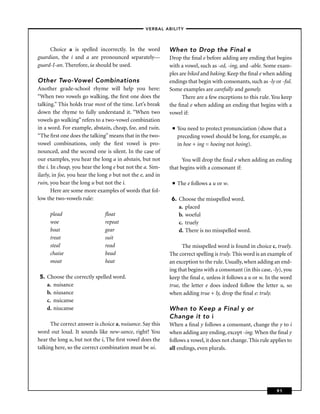
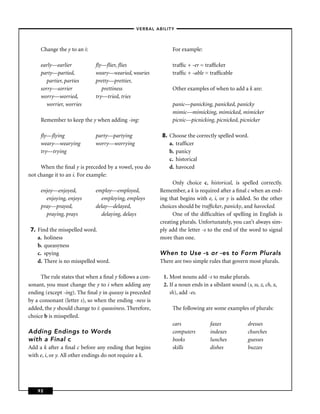
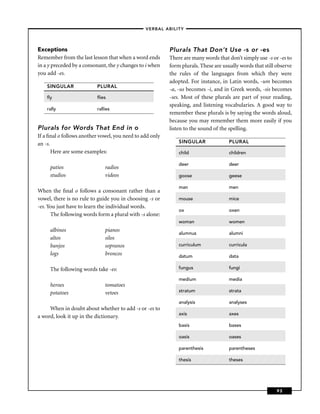
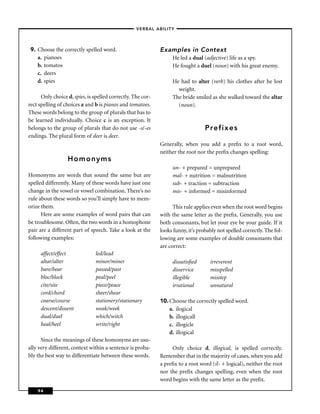
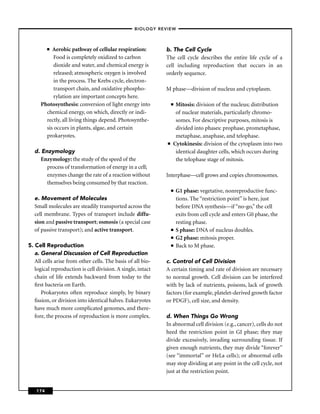
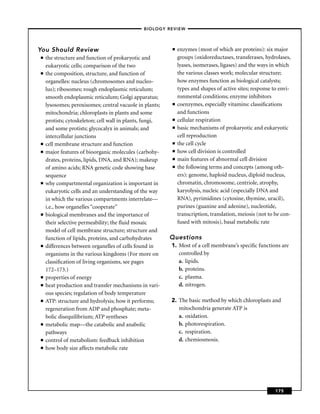
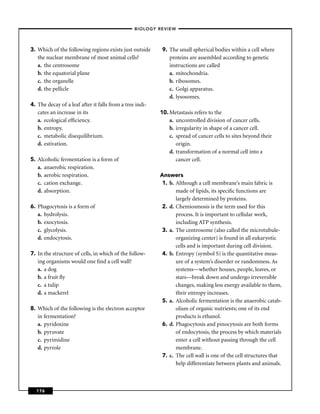
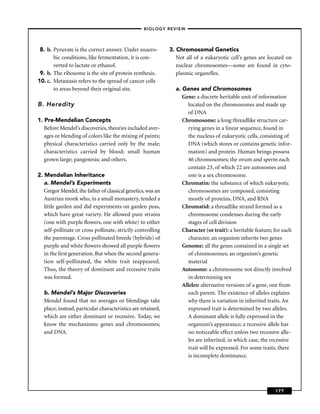
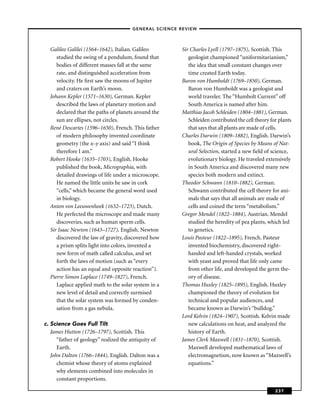
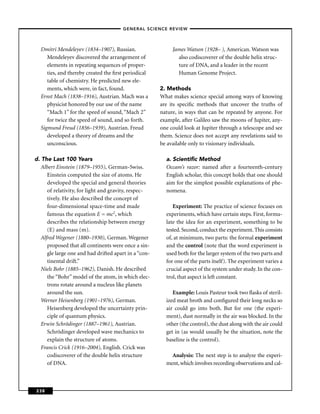
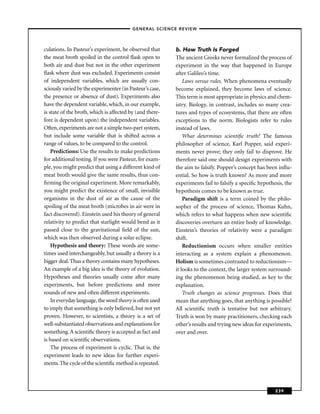
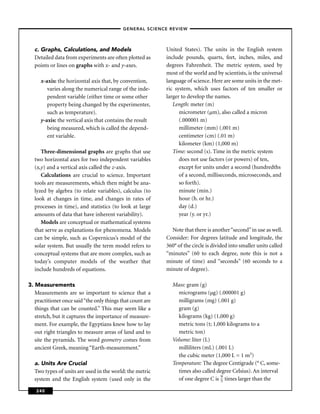
NURSING
    SCHOOL
ENTRANCE EXAM
OTHER TITLES OF INTEREST FROM
      LEARNINGEXPRESS
Nursing Assistant/Nurse Aide Exam, 4th Edition
              Becoming a Nurse
NURSING
SCHOOL
ENTRANCE EXAM

Your Guide to
Passing the Test


                   2nd Edition


                                      ®


                         NEW   YORK
Copyright © 2009 LearningExpress, LLC.

All rights reserved under International and Pan-American Copyright Conventions.
Published in the United States by LearningExpress, LLC, New York.

Library of Congress Cataloging-in-Publication Data

Nursing school entrance exam : your guide to passing the test. — 2nd ed.
    p. : cm.
 Includes bibliographical references and index.
 ISBN-13: 978-1-57685-705-2 (alk. paper)
 ISBN-10: 1-57685-705-0 (alk. paper)
1. Nursing schools—United States—Entrance examinations—Study guides. I. LearningExpress (Organization).
 [DNLM: 1. Nursing—Examination Questions. WY 18.2 N975905 2009]
 RT79.N86 2009
 610.73076—dc22
                                   2009021316

Printed in the United States of America

987654321

2nd Edition

ISBN 13: 978-1-57685-705-2

For more information or to place an order, contact LearningExpress at:
  2 Rector Street
  26th Floor
  New York, NY 10006

Or visit us at:
  www.learnatest.com
Contributors


Mark Kalk is a member of the biology faculty at Washington University in St. Louis. He works in the University’s
Science Outreach program, providing classes, classroom materials, and support to local K–12 teachers. He is a fre-
quent speaker at science education conferences and the author of several books and curriculum materials.

Cindy Phillips has been a high school mathematics teacher for the past eight years. She is currently teaching at
White Plains High School in Westchester County, just north of New York City. She is also a Texas Instruments cer-
tified instructor in graphing calculator technology.

Margaret Muirhead is a writer and editor from Arlington, Massachusetts. She is a contributor for LearningEx-
press’s Healthcare Career Starter and Nursing School Entrance Exam. She has also written about a range of health
topics for the Harvard University Health Services and the University of Virginia Health System.

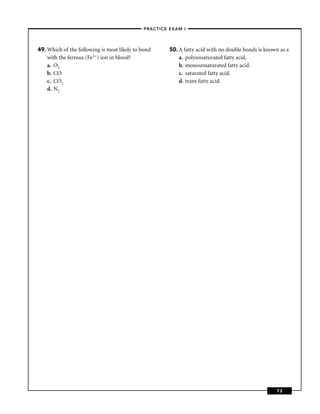
Ghislain Mandouma was educated in France (Orsay) and England (Imperial College) where he graduated with
a B.S. degree in chemistry. He obtained his Ph.D. in chemistry from the City University of New York while teach-
ing at Hunter College. After doing postdoctoral research at the University of Virginia, he joined the faculty of the
department of Natural Sciences at the University of Maryland, Eastern Shore in 2003.

Tyler Volk is Associate Professor of Biology at New York University and co-director of the program in earth and
environmental science. He is the author of the books Gaia’s Body: Toward a Physiology of Earth, What is Death:
A Scientist Looks at the Cycle of Life, and Metapatterns Across Space, Time, and Mind.


                                                                                                             v
Contents


CHAPTER 1    Nursing School Entrance Exam Planner                             1

CHAPTER 2    The LearningExpress Test Preparation System                      9

CHAPTER 3    Practice Exam I                                                 31

CHAPTER 4    Verbal Ability                                                  89

CHAPTER 5    Reading Comprehension                                           97

CHAPTER 6    Math Review                                                    109

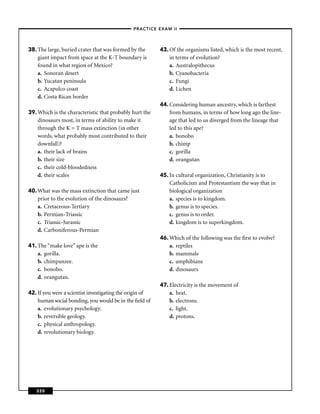
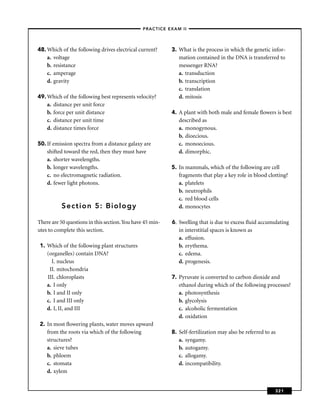
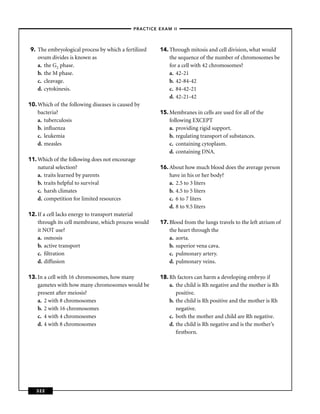
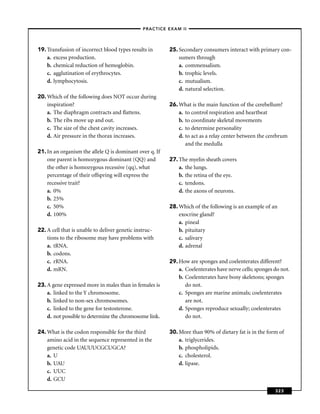
CHAPTER 7    Biology Review                                                 171

CHAPTER 8    Chemistry Review                                               203

CHAPTER 9    General Science Review                                         235

CHAPTER 10   Practice Exam II                                               291

CHAPTER 11   Practice Exam III                                              347


                                                                      vii
1
                                                           NURSING SCHOOL
C H A P T E R


                                                           ENTRANCE
                                                           EXAM PLANNER

                                                       CHAPTER SUMMARY
                                                       In this chapter, you will learn about career opportunities in nurs-
                                                       ing, what to expect on the job, as well as essential information
                                                       about choosing and getting into the nursing school of your
                                                       choice. You will also find out about the types of entrance tests
                                                       that nursing schools use to select students.


I     f you enjoy caring for others and interacting with a wide range of people, and if you cope well when con-
      fronted with challenges, nursing is a great career choice. Nursing is also a secure profession with excellent
      starting salaries and very good job prospects. Job opportunities in nursing abound—registered nurses fill
more than 2.3 million jobs, making up the largest healthcare occupation in the nation. And the need for nurses
is likely to continue to soar—many of today’s nurses are beginning to retire, leaving thousands of job openings.
The U.S. population as a whole is also aging, and because older people require more nursing care, the demand
for skilled nurses willing to work on the front lines of patient care will also increase. Technological advances in
medical care, which allow more medical conditions to be treated, and an emphasis on preventive care also cre-
ate a greater demand for nurses. As you consider your future in nursing, think about these facts:

      ■         More new jobs are likely to be created for registered nurses than for any other occupation.
      ■         Employers in some areas of the country report a nursing shortage, spurring efforts to attract and keep
                nurses on staff.
      ■         Hospital outpatient facilities—like same-day surgery centers or rehabilitation centers—offer the most
                rapid growth in nursing jobs.


                                                                                                                     1
– NURSING SCHOOL ENTRANCE EXAM PLANNER –


       To become a nurse, you need to pursue one of             often work in a specific department of a hospital,
three educational routes—a bachelor’s degree, an asso-          such as pediatrics, emergency care, or cancer care.
ciate’s degree, or a hospital diploma. You may also con-    ■   Office nurses work in doctor’s offices, clinics, out-
sider becoming a licensed practical nurse (LPN),                patient surgical centers, and emergency medicine
which requires only one year of training in a vocational        clinics. Their job tasks include assisting with
or technical school and can be a stepping stone to              exams, giving medications, dressing wounds, and
becoming a registered nurse. Most nursing programs              assisting in minor surgeries. They may also do
require that you take an entrance test, and that’s where        office work and maintain patient records.
this book comes in. Nursing School Entrance Exam was        ■   Nursing facility nurses provide care for residents
designed from real tests, including the admissions test         in nursing homes or long-term rehabilitation
you will face to get into the program of your choice. By        centers. They monitor residents’ progress, develop
tailoring your study plan and using the information in          treatment plans, and oversee nursing aides and
this book, you can achieve your best score and begin            licensed practical nurses.
the path of your desired career—training to become a        ■   Home health nurses see patients in the patients’
nurse.                                                          own homes. They give medications, check the
                                                                patient’s condition and environment, and
                                                                instruct patients and caregivers about care and
       Career Opportunities in                                  treatment. They may supervise home health
              Nursing                                           aides.
                                                            ■   Public health nurses work on the community
Registered nurses (RNs) provide direct patient care             level, in schools, government agencies, retirement
and serve as health educators in the effort to promote          communities, or in other settings, and they edu-
wellness and prevent disease. In giving care, they              cate the public about health promotion and dis-
monitor and record a patient’s symptoms and                     ease prevention strategies in areas like nutrition,
progress, give medications, assist in rehabilitation,           smoking cessation, or childcare.
and teach patients and families about proper care           ■   Occupational health nurses provide care to
practices. They assist physicians in everything from            employees at work locations, giving emergency
routine exams and treatments to surgery. There are              treatments, health counseling, or identifying
limits to what a nurse does—state regulations deter-            potential health problems in the work
mine the scope of tasks a nurse can perform. But the            environment.
factor that most influences a nurse’s daily workload is
the type of healthcare facility in which he or she               Most RNs earn between $47,000 and $68,000
works. Nurses work in a range of settings: in hospitals,   annually, with the highest paid receiving more than
doctor’s offices, outpatient surgical centers, nursing      $80,000 annually. Nurses who earned the highest aver-
homes, schools, or work sites. Home health nurses          age salaries worked in employment services, followed
even work in patients’ homes. The following is an          by hospitals, home healthcare services, physicians’
overview of what you can expect on the job, depend-        offices, and nursing care facilities.
ing on your work setting.                                        Licensed practical nurses (LPNs) care for patients
                                                           under the supervision of a physician or registered
 ■   Hospital nurses make up the largest group of          nurse. They provide routine bedside care, such as tak-
     nurses. They provide bedside care for hospitalized    ing vital signs, preparing injections, applying
     patients, observe and record symptoms, and            dressings, or collecting testing samples. They also aid
     administer treatments and medications. They           patients with feeding, dressing, and bathing. In nursing

      2
– NURSING SCHOOL ENTRANCE EXAM PLANNER –


facilities, LPNs may evaluate the needs of residents and          Which Nursing Program Is
oversee nursing aides. In private offices or clinics, they              Right for You?
may be responsible for some administrative work, such
as making appointments or maintaining records. The          You may need to consider many factors in deciding the
average yearly salary for LPNs is between $31,000 and       nursing program that is right for you. If your financial
$43,000. The highest paying LPN positions were found        situation is tight, you might choose to earn a two-year
in employment services, followed by home healthcare         associate’s degree, land a job as a nurse, and then use
services, nursing care facilities, hospitals, and physi-    tuition benefits that come with your employment to
cians’ offices.                                              take additional courses and work toward a bachelor’s
       Working conditions for nurses depend on the          degree. Whether you are entering the workforce from
type of healthcare facility. For example, work hours        high school or making a mid-career change may be
vary according to work setting. In nursing homes or         another consideration.
long-term rehabilitation centers where residents need             Of the programs described in the following list,
around-the-clock care, nurses may work night or             the bachelor’s degree of science in nursing (BSN)
weekend shifts. Public health nurses and nurses who         offers the most job opportunities. Nurses with
work in offices or on industrial work sites follow           bachelor-level education can more easily advance in
schedules during regular business hours.                    their jobs, and some positions—like administrative
       Risks for nurses in hospitals and clinics include    work or those requiring a clinical specialty—may
coming in contact with patients who have infectious         require a bachelor’s degree or even an advanced
diseases. Nurses must follow a standard set of precau-      degree.
tions to reduce their risk for disease or other kinds of          Nursing programs combine hands-on, super-
danger, like radiation or chemical exposure. Nurses         vised clinical experience at a healthcare facility with
are also susceptible to back injury from moving             traditional coursework. In addition to general
patients.                                                   education requirements, students fulfill courses in


                                          Check Your Basic Skills

   Nursing requires a range of skills and abilities to perform the job well. Nurses face many challenges on
   the job—from heavy workloads to long hours on their feet. Review this checklist to see if you fit these job
   characteristics. Nurses must:

    ■   show caring and sympathy
    ■   look for ways to help others
    ■   demonstrate emotional stability in stressful situations
    ■   have good observational skills
    ■   have physical stamina
    ■   communicate effectively—talking and listening
    ■   be able to direct and supervise (RNs)
    ■   be able to follow orders (LPNs)
    ■   use judgment and make decisions
    ■   know how to problem solve


                                                                                                            3
– NURSING SCHOOL ENTRANCE EXAM PLANNER –


anatomy, physiology, microbiology, chemistry, nutri-            On the other end of the educational spectrum is
tion, psychology, and nursing. After completing a         a master of science in nursing (MSN). These two-year
nursing program, students must pass a licensing           programs give nurses the opportunity to specialize in
exam to become a nurse. Here is an overview of the        clinical training or research. People seeking this degree
degree programs that prepare students for entry-level     typically have a BSN or an RN license.
nurse positions:

 ■   Diploma Programs are run by hospitals and usu-            Selecting a Program That
     ally take three years to complete. These programs            Meets Your Needs
     are few and their numbers are declining. To
     broaden their job opportunities, nurses from         Some considerations for finding a nursing program are
     diploma programs may later opt to earn a bache-      obvious. For example, most applicants limit their
     lor’s degree by completing coursework in an          search by geographic area. Some people need to find a
     RN-to-BSN program. Staff nurse positions often       school within driving distance; others are willing to
     offer tuition reimbursement programs to help         relocate to attend school. An Internet search or a pub-
     allay the cost of additional education.              lished listing of nursing schools will help locate
 ■   Associate’s Degree in Nursing (ADN) programs         schools in the area of your choice.
     are offered by community colleges and last from            Tuition is another factor in choosing a nursing
     two to three years. There are about 700 associate-   school—cost can vary depending on whether the insti-
     level nursing programs throughout the country.       tution is private or public, or whether you qualify as an
     ADN-schooled nurses may also later choose to         in-state student. Financial aid availability also differs
     earn a bachelor’s degree to increase their job       by institution. When you research schools, collect as
     choices.                                             much information as possible considering these and
 ■   A Bachelor’s of Science Degree in Nursing            the factors listed here.
     (BSN) takes four years to complete at a college or
     university. More than 670 programs offer this         ■   Is it approved by the state? Each state determines
     degree. For people who have earned a bachelor’s           the standards for nursing schools and approves
     degree in another field and are interested in              them. Your school must be state-approved. How-
     becoming a nurse, accelerated BSN programs are            ever, state approval does not mean that the institu-
     available; they grant credit for the liberal arts         tion is accredited—for more about accreditation,
     requirements you have already completed. They             see the following paragraph.
     take from one year to 18 months to complete.          ■   Is it accredited? Accreditation means that a
                                                               national accrediting organization, like the
      To become a licensed practical nurse (LPN), you          National League for Nursing Accrediting Com-
must complete a state-approved one-year training pro-          mission (NLNAC) or the Commission on Colle-
gram at a technical or vocational school, community            giate Nursing Education (CCNE), has determined
college, or high school. You must also pass a licensing        that the nursing school has met certain educa-
exam. If you want to become an LPN first, but wish to           tional criteria. Earning your degree from an
continue your education to become an RN, you can               accredited school can give you an edge in the job
enroll in an LPN-to-RN program. These programs                 market—when employers review your educa-
give you credit for your LPN coursework, so you can            tional background, they know you were trained
build upon your training to become an RN.                      according to an established set of standards.
                                                               Attending an accredited school also allows you to

      4
– NURSING SCHOOL ENTRANCE EXAM PLANNER –


     continue your education at a graduate-level          Internet for funding possibilities from a variety of
     accredited school. To find out if your preferred      sources, such as the following:
     school is accredited, contact a school representa-
     tive or go to the NLNAC’s website at                  ■   Government: The U.S. Department of Education
     www.nlnac.org/home.htm.                                   offers a range of loans and scholarships. The U.S.
 ■   Pass rate. What percentage of the school’s stu-           military also offers financial aid for service peo-
     dents passed the nursing licensing exam after             ple. State governments often provide aid for stu-
     graduating? Ask a school representative for infor-        dents attending school in their home state.
     mation about pass rates from the last five years.      ■   Your prospective school: Check with the school of
 ■   What is its focus? Consider what kind of nursing          your choice about its scholarships. In addition to
     program interests you (for example, are you               aid based on your financial need, you may qualify
     interested in a particular clinical specialty?)           for a merit-based grant, scholarship, or fellowship.
     before you begin your school search. After you        ■   Your employer: Find out if your employer offers
     choose what kind of program interests you, look           scholarships or tuition reimbursement benefits
     for the institution that meets your needs.                for education.
 ■   School size and class size. Do you want the close-    ■   Nursing associations: State nursing associations
     knit community of a small school or the wider             and national professional organizations are other
     mix of students you will find at a large school?           possible sources for financial aid.
     Make sure to research the student-to-teacher
     ratios at prospective schools. Smaller class sizes
     often mean more attention from faculty.               How This Book Can Help You
 ■   Clinical experience. What kind of clinical place-
     ments does the school offer? How much time           Nursing School Entrance Exam will help you maximize
     does it allot for clinical experience? You can find   your chances of scoring high on your upcoming
     this information by talking to current students.     exam. Preparing for this important admissions test
                                                          does not have to be overwhelming—this book will
                                                          help you organize your preparation process and break
       Financing Your Nursing                             it down into manageable steps. Not only does it
             Education                                    include hundreds of practice questions and answers, it
                                                          explains study strategies, so that you can better utilize
Planning how you are going to pay for your nursing        your time and better learn the key concepts that will
education is essential to your preparation process. The   appear on your exam. It also offers test-taking tips, a
cost of nursing education can be considerable—a four-     study planner, and practice tests designed from actual
year program at a state university can be $14,000 a       entrance exams used by nursing schools today. The
year, and private schools can be twice as much. Fortu-    explanatory answers that follow the simulated tests
nately, many resources offer financial assistance to       are a study guide of their own—helping you under-
nursing students. Financial aid may be awarded based      stand and review essential ideas and terms. The fol-
on financial need or on merit, and comes in three basic    lowing is an overview of what you can expect in every
forms—scholarships, loans, or student employment.         chapter.
Be sure to fill out a financial aid form when you apply           In Chapter 2, you will learn important test-taking
to nursing school—this form helps schools determine       strategies, such as how to pace yourself during the
your financial need. Plan on visiting the financial aid     exam, when to guess, and how to combat test anxiety.
office at the school of your choice or searching the       This chapter presents specific study techniques, giving

                                                                                                             5
– NURSING SCHOOL ENTRANCE EXAM PLANNER –


                                                Web Resources

   For more information about funding sources,               FedMoney.org
   check out these web resources:                            www.fedmoney.org
                                                             This is an online guide to all U.S. federal govern-
   U.S. Department of Education                              ment financial aid programs.
   www.ed.gov
   This website has an online financial aid form and          American Association of Colleges of Nursing
   offers federal scholarship information.                   (AACN)
                                                             www.aacn.nche.edu
   National Health Service Corps (NHSC)                      In addition to giving information about scholar-
   http://nhsc.bhpr.hrsa.gov/                                ships offered by the AACN, this website has links
   A division of U.S. Department of Health and               to other government funding sources as well as to
   Human Services, the NHSC offers scholarships and          other nursing organizations that offer scholarships.
   loans for students who agree to practice in a med-
   ically underserved area.                                  National Student Nurses’ Association (NSNA)
                                                             www.nsna.org/foundation/
                                                             The NSNA offers a scholarship program for nursing
                                                             students at a range of degree levels.


you several study methods that will aid you in increas-      important terminology and concepts that you need to
ing your understanding and retention of material. Vary-      know for your exam. The biology, chemistry, and gen-
ing your study methods will help you avoid boredom in        eral science chapters present material in a clear, concise
your study sessions and make it easier to learn compli-      outline form, so you can easily peruse each subtopic
cated or difficult topics. You will also learn how to avoid   and focus your attention where you need it most. At
last-minute studying. Be sure to review the helpful          the conclusion of each chapter, you will find a list of
strategies in this chapter before you take the practice      additional resources to help you review topics
tests and begin the self-evaluation process described        comprehensively.
later on in this chapter.                                           Each of these chapters also provides an overview
       Chapter 3 contains the first of three practice         of the kinds of questions you will encounter on the
exams. Use the first practice exam as a self-evaluation.      exam and how to tackle them. In addition, you will
Once you complete this practice test and score your-         find practice questions throughout, so you can hone
self, you can diagnose your strengths and                    your test-taking skills while you review each topic.
weaknesses—those areas in which you need more                       Chapters 10 and 11 contain the last two practice
preparation. You can greatly increase the effectiveness      tests. These sample exams use multiple-choice ques-
of your preparation by targeting your weakest subjects       tions just like the ones you will encounter on exam
and allotting your study time accordingly.                   day. By taking these simulated tests and reviewing the
       Chapters 4–9 cover the subject areas found on         answer explanations, you will familiarize yourself
most nursing school entrance exams: “Verbal Ability,”        with the question types, test format, and subject mat-
“Reading Comprehension,”“Math,”“Biology,”“Chem-              ter, and you’ll feel more prepared and confident on
istry,” and “General Science.” Each chapter breaks           testing day. Read on for more about developing your
down and organizes each review topic, highlighting           own study plan—with suggestions about when to take

     6
– NURSING SCHOOL ENTRANCE EXAM PLANNER –


the practice tests so that you can check your scores        the NET, RNSAE, and APNE. If you know you will
and still have enough time to focus on the areas in         need to take one of these tests, contact the testing
which you need to improve.                                  agencies in each section for more information about
                                                            registration, testing locations, and dates.

               Test Overview                                Registered Nursing School Aptitude
                                                            Exam (RNSAE)
To begin preparing for the test, you need an overview       Nursing programs that offer degrees ranging from the
of the type of exam you are facing, and some tips           bachelor’s level to a master’s degree may require that
about how to use this book to achieve your best test        applicants take the RNSAE. Developed by the Psycho-
score. There is no single test required by all nursing      logical Services Bureau, Inc., this exam consists of five
programs. Schools have different requirements for           parts and takes about two and a half hours to complete.
admission, depending on the institution, your choice        The first section is divided into three subsections.
of study, and whether you are applying for a one-year
LPN degree, a two-year RN degree, a four-year BSN            ■   Part 1: Academic Aptitude
degree, a hospital diploma program, or a graduate                   Verbal, 30 questions
program. Many accredited nursing schools ask candi-                 Math, 30 questions
dates to pass one of these two tests: the Registered                Analytical Reasoning, 30 questions
Nursing School Aptitude Exam (RNSAE) or the                  ■   Part 2: Spelling, 50 questions
Nurses Entrance Test (NET). Community college LPN            ■   Part 3: Reading Comprehension, 40 questions
programs may require applicants to take the Aptitude         ■   Part 4: Natural Sciences (Chemistry, Biology,
for Practical Nursing Exam (APNE). However, even if              Health), 90 questions
the school of your choice uses another exam, you will        ■   Part 5: Vocational Adjustment, 90 questions
most likely need to demonstrate the essential skills
covered in this book. You must show that you can            Aptitude for Practical Nursing Exam
communicate effectively, read and understand college-       (APNE)
level materials, and that you have basic math skills. You   The Psychological Services Bureau test for practical
may also be asked to demonstrate that you have fun-         nursing varies somewhat from the exam for registered
damental knowledge about biology, chemistry, natural        nursing. Many community colleges with practical
science, anatomy, and physiology.                           nursing programs use the APNE.
      Contact the school of your choice immediately to
learn about its admissions requirements and test dates       ■   Part 1: Academic Aptitude
and sites in your area. The dates when the test is                   Verbal, 30 questions
offered in your area may determine when you take the                 Math, 30 questions
exam. However, if you have a choice of test dates, and               Analytical Reasoning, 30 questions
if you have not already applied to take the exam, do         ■   Part 2: Spelling, 50 questions
not apply until you have conducted the self-evaluation       ■   Part 3: Natural Sciences (Chemistry, Biology,
outlined in this chapter. The results of that self-              Health), 90 questions
evaluation can help you decide when to take the exam.        ■   Part 4: Judgment and Comprehension in Practi-
      The following provides contact information and             cal Nursing Situations, 50 questions
an overview of the common nursing aptitude tests—            ■   Part 5: Vocational Adjustment, 90 questions


                                                                                                             7
– NURSING SCHOOL ENTRANCE EXAM PLANNER –


     To register for the RNSAE or the APNE, or to                  In addition to reading comprehension and math
learn about testing sites, contact the school of your        questions, the basic NET includes questions that eval-
choice, or:                                                  uate your learning style, stress, and social skills. These
                                                             nonacademic sections include the following: Test-
     Psychological Services Bureau, Inc.                     Taking Skills (30 questions); Stress Level (45 questions);
     Health Careers Aptitude Tests                           Social Interaction Profile (30 questions); and Learn-
     977 Seminole Trail                                      ing Style (50 questions). These sections are not used to
     PMB 317                                                 determine whether you will be accepted into a nursing
     Charlottesville, VA 22901                               school. The purpose of these sections is to help learn-
     434-293-5865                                            ing institutions after a student has been accepted to
     www.psbtests.com                                        their program—it aids the school in considering how
                                                             a student will best learn—and to increase the likeli-
Nurse Entrance Test (NET)                                    hood that a student will complete the program
Many RN and LPN nursing programs use the NET as              successfully.
a pre-admissions test. This approximately two-and-a-               If you know you need to take the NET, contact
half-hour test measures your ability in two general          the school you are applying to or the testing agency for
academic areas—your critical reading ability and your        more information about the test:
knowledge of basic math. The test includes two aca-
demic sections:                                                   Educational Resources, Inc.
                                                                  7500 West 160th Street
     ■   Mathematics, 60 questions                                Stilwell, KS 66085
     ■   Reading Comprehension, 33 questions                      913-239-2658
                                                                  www.eriworld.com
       Some schools require a different version of this
test that includes a written expression section. Find out
from the training program of your choice whether this
is required. If it is, you will have an additional hour to
complete this section.


     8
THE


                   2
C H A P T E R


                                                      LEARNINGEXPRESS
                                                      TEST PREPARATION
                                                      SYSTEM
                                                       CHAPTER SUMMARY
                                                       Taking a nursing school entrance exam can be tough, and your
                                                       career in nursing depends on your passing the exam. The
                                                       LearningExpress Test Preparation System, developed exclusively
                                                       for LearningExpress by leading test experts, gives you the disci-
                                                       pline and attitude you need to succeed.


F        irst, the bad news: Taking the nursing school entrance exam is no picnic, and neither is getting ready
         for it. Your future career depends on passing the test, but there are all sorts of pitfalls that can keep you
         from doing your best on this all-important exam. Here are some of the obstacles that can stand in the
way of your success:

      ■         Being unfamiliar with the format of the exam
      ■         Being paralyzed by test anxiety
      ■         Leaving your preparation to the last minute
      ■         Not preparing at all!
      ■         Not knowing vital test-taking skills: how to pace yourself through the exam, how to use the process of
                elimination, and when to guess
      ■         Not being in tip-top mental and physical shape
      ■         Arriving late at the test site, having to work on an empty stomach, or shivering through the exam because
                the room is cold


                                                                                                                     9
– THE LEARNINGEXPRESS TEST PREPARATION SYSTEM –


       What’s the common denominator in all these                 Step 1: Get Infor mation
test-taking pitfalls? One word: control. Who’s in con-
trol, you or the exam?                                       Activities: Read Chapter 1,“Nursing School Entrance
       Now the good news: The LearningExpress Test           Exam Planner,” and use the suggestions there to find
Preparation System puts you in control. In just nine         out about your requirements.
easy-to-follow steps, you will learn everything you          Knowledge is power. Therefore, first, you have to find
need to know to make sure that you are in charge of          out everything you can about the nursing school
your preparation and your performance on the exam.           entrance exam. Once you have your information, the
Other test takers may let the test get the better of them;   next steps will show you what to do about it.
other test takers may be unprepared or out of shape—
but not you. You will have taken all the steps you need      Part A: Straight Talk about
to take to get a high score on the nursing school            the Nursing School Entrance Exam
entrance exam.                                               Why do you have to take this exam, anyway? Because
       Here’s how the LearningExpress Test Preparation       an increasing number of people need the kind of care
System works: Nine easy steps lead you through every-        only a nurse can provide. And, since more and more
thing you need to know and do to master your exam.           people need these services, there is growing concern
Each of the steps listed below includes both reading         about the quality of care the patients receive. One way
about the step and one or more activities. It is impor-      to try to ensure quality of care is to test the people who
tant that you do the activities along with the reading,      give that care to find out if they have been well trained.
or you won’t be getting the full benefit of the system.       And that’s why your state or the agency you want to
                                                             work for may require you to take a written exam.
     Step 1. Get Information                                        It is important for you to remember that your
     Step 2. Conquer Test Anxiety                            score on the written exam does not determine how
     Step 3. Make a Plan                                     smart you are or even whether you will make a good
     Step 4. Learn to Manage Your Time                       nurse. There are all kinds of things a written exam like
     Step 5. Learn to Use the Process of Elimination         this can’t test: whether you are likely to show up late or
     Step 6. Know When to Guess                              call in sick a lot, whether you can be patient with a try-
     Step 7. Reach Your Peak Performance Zone                ing client, or whether you can be trusted with confi-
     Step 8. Get Your Act Together                           dential information about people’s health. Those
     Step 9. Do It!                                          kinds of things are hard to evaluate on a written exam.
                                                             Meanwhile, it is easy to evaluate whether you can cor-
      If you have several hours, you can work through        rectly answer questions about your job duties.
the whole LearningExpress Test Preparation System in                This is not to say that correctly answering the
one sitting. Otherwise, you can break it up and do just      questions on the written exam is not important! The
one or two steps a day for the next several days. It is up   knowledge tested on the exam is knowledge you will
to you—remember, you are in control.                         need to do your job, and your ability to enter the pro-
                                                             fession you have trained for depends on your passing
                                                             this exam. And that’s why you are here—to achieve
                                                             control over the exam.


    10
– THE LEARNINGEXPRESS TEST PREPARATION SYSTEM –


Part B: What’s on the Test                                   Stress Management
If you haven’t already done so, stop here and read           before the Test
Chapter 1 of this book, which gives you an overview of       If you feel your level of anxiety getting the best of you
the written exam. Later, you will have the opportunity       in the weeks before the test, here is what you need to
to take the sample practice exams in Chapters 3, 10,         do to bring the level down again:
and 11.
                                                              ■   Get prepared. There’s nothing like knowing what
                                                                  to expect and being prepared for it to put you in
Step 2: Conquer Test Anxiety                                      control of test anxiety. That’s why you are reading
                                                                  this book. Use it faithfully, and remind yourself
Activity: Take the Test Anxiety Quiz on page 12.                  that you are better prepared than most of the
Having complete information about the exam is the                 people taking the test.
first step in getting control of the exam. Next, you have      ■   Practice self-confidence. A positive attitude is a
to overcome one of the biggest obstacles to test success:         great way to combat test anxiety. This is no time
test anxiety. Test anxiety cannot only impair your per-           to be humble or shy. Stand in front of the mirror
formance on the exam itself; it can even keep you from            and say to your reflection, “I’m prepared. I’m full
preparing! In this step, you will learn stress manage-            of self-confidence. I’m going to ace this test. I
ment techniques that will help you succeed on your                know I can do it.” If you hear it often enough, you
exam. Learn these strategies now, and practice them as            will come to believe it.
you complete the exams in this book so that they will         ■   Fight negative messages. Every time someone
be second nature to you by exam day.                              starts telling you how hard the exam is or how it
                                                                  is almost impossible to get a high score, start
Combating Test Anxiety                                            telling them your self-confidence messages above.
The first thing you need to know is that a little test anx-        If the someone with the negative messages is you
iety is a good thing. Everyone gets nervous before a big          telling yourself you don’t do well on exams or you
exam—and if that nervousness motivates you to pre-                just can’t do this, don’t listen.
pare thoroughly, so much the better. Many well-known          ■   Visualize. Imagine yourself reporting for duty on
people throughout history have experienced anxiety or             your first day as a nurse. Think of yourself help-
nervousness—from performers such as actor Sir Lau-                ing patients and making them more comfortable.
rence Olivier and singer Aretha Franklin to writers               Imagine coming home with your first paycheck.
such as Charlotte Brontë and Alfred Lord Tennyson. In             Visualizing success can help make it happen—
fact, anxiety probably gave them a little extra edge—             and it reminds you of why you are working so
just the kind of edge you need to do well, whether on             hard to pass the exam.
a stage or in an examination room.                            ■   Exercise. Physical activity helps calm down your
       Stop here and complete the Test Anxiety Quiz on            body and focus your mind. Besides, being in good
the next page to find out whether your level of test               physical shape can actually help you do well on
anxiety is something you should worry about.                      the exam. Go for a run, lift weights, go
                                                                  swimming—and do it regularly.


                                                                                                               11
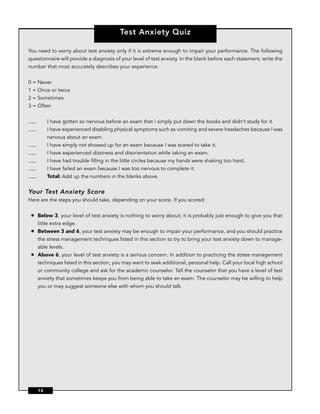
Test Anxiety Quiz

You need to worry about test anxiety only if it is extreme enough to impair your performance. The following
questionnaire will provide a diagnosis of your level of test anxiety. In the blank before each statement, write the
number that most accurately describes your experience.


0 = Never
1 = Once or twice
2 = Sometimes
3 = Often


          I have gotten so nervous before an exam that I simply put down the books and didn’t study for it.
          I have experienced disabling physical symptoms such as vomiting and severe headaches because I was
          nervous about an exam.
          I have simply not showed up for an exam because I was scared to take it.
          I have experienced dizziness and disorientation while taking an exam.
          I have had trouble filling in the little circles because my hands were shaking too hard.
          I have failed an exam because I was too nervous to complete it.
          Total: Add up the numbers in the blanks above.

Your Test Anxiety Score
Here are the steps you should take, depending on your score. If you scored:

 ■   Below 3, your level of test anxiety is nothing to worry about; it is probably just enough to give you that
     little extra edge.
 ■   Between 3 and 6, your test anxiety may be enough to impair your performance, and you should practice
     the stress management techniques listed in this section to try to bring your test anxiety down to manage-
     able levels.
 ■   Above 6, your level of test anxiety is a serious concern. In addition to practicing the stress management
     techniques listed in this section, you may want to seek additional, personal help. Call your local high school
     or community college and ask for the academic counselor. Tell the counselor that you have a level of test
     anxiety that sometimes keeps you from being able to take an exam. The counselor may be willing to help
     you or may suggest someone else with whom you should talk.


     12
– THE LEARNINGEXPRESS TEST PREPARATION SYSTEM –


Stress Management on Test Day                                  accept what has happened. Say to yourself, “Hey,
There are several ways you can bring down your level           I lost it there for a minute. My brain is taking a
of test anxiety on test day. They will work best if you        break.” Put down your pencil, close your eyes, and
practice them in the weeks before the test, so you know        do some deep breathing for a few seconds. Then
which ones work best for you.                                  you will be ready to go back to work.

 ■   Deep breathing. Take a deep breath while you                Try these techniques ahead of time, and see if
     count to five. Hold it for a count of one, then let     they don’t work for you!
     it out for a count of five. Repeat several times.
 ■   Move your body. Try rolling your head in a circle.
     Rotate your shoulders. Shake your hands from                    Step 3: Make a Plan
     the wrist. Many people find these movements
     very relaxing.                                         Activity: Construct a study plan.
 ■   Visualize again. Think of the place where you are      Maybe the most important thing you can do to get
     most relaxed: lying on the beach in the sun, walk-     control of yourself and your exam is to make a study
     ing through the park, or whatever makes you feel       plan. Too many people fail to prepare simply because
     good. Now close your eyes and imagine you are          they fail to plan. Spending hours poring over sample
     actually there. If you practice in advance, you will   test questions the day before the exam not only raises
     find that you only need a few seconds of this           your level of test anxiety, but it also will not replace
     exercise to experience a significant increase in        careful preparation and practice over time.
     your sense of well-being.                                     Don’t fall into the cram trap. Take control of your
                                                            preparation time by mapping out a study schedule. On
      When anxiety threatens to overwhelm you right         the following pages are two sample schedules, based on
there during the exam, there are still things you can do    the amount of time you have before you take the writ-
to manage the stress level.                                 ten exam. If you are the kind of person who needs
                                                            deadlines and assignments to motivate you for a proj-
 ■   Repeat your self-confidence messages. You               ect, here they are. If you are the kind of person who
     should have them memorized by now. Say them            doesn’t like to follow other people’s plans, you can use
     quietly to yourself, and believe them!                 the suggested schedules here to construct your own.
 ■   Visualize one more time. This time, visualize                 Even more important than making a plan is mak-
     yourself moving smoothly and quickly through           ing a commitment. You can’t review everything you
     the test answering every question correctly and        learned in your nursing courses in one night. You need
     finishing just before time is up. Like most visuali-    to set aside some time every day for study and practice.
     zation techniques, this one works best if you have     Try for at least 20 minutes a day. Twenty minutes daily
     practiced it ahead of time.                            will do you much more good than two hours on Satur-
 ■   Find an easy question. Skim over the test until        day—divide your test preparation into smaller pieces
     you find an easy question, and answer it. Getting       of the larger work. In addition, making study notes,
     even one circle filled in gets you into the test-       creating visual aids, and memorizing can be quite useful
     taking groove.                                         as you prepare. Each time you begin to study, quickly
 ■   Take a mental break. Everyone loses concentra-         review your last lesson. This act will help you retain all
     tion once in a while during a long test. It is nor-    you have learned and help you assess if you are studying
     mal, so you shouldn’t worry about it. Instead,         effectively. You may realize you are not remembering


                                                                                                              13
– THE LEARNINGEXPRESS TEST PREPARATION SYSTEM –


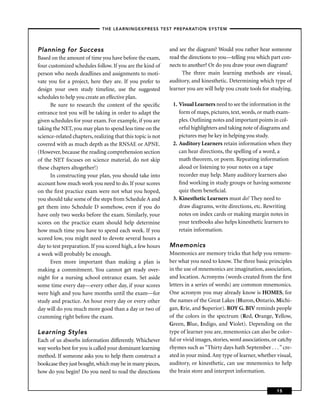
some of the material you studied earlier. Approxi-          ation is within a certain range; that is, it is rare to score
mately one week before your exam, try to determine          under 50% in one section and over 90% in another. If
the areas that are still most difficult for you.             you are one of those rare types, don’t worry; it just
      Don’t put off your study until the day before the     shows you where most of your preparation time
exam. Start now. A few minutes a day, with half an          should go.
hour or more on weekends, can make a big difference               But if you are more typical, where your section
in your score.                                              scores tend to cluster on the following chart should tell
                                                            you something about when you should take the exam,
Self-Evaluation                                             if you have a choice, and how much time you will have
One way to find out how to focus your study time is to       to put in to prepare. If your score in a section clusters
conduct a self-evaluation. Begin by taking the practice     in the “under 25%” category, you should really con-
test in Chapter 3 to highlight areas in which you are       sider postponing taking the exam until you have had
strongest and those in which you need more work. You        some time for serious study. If your score is in the mid-
do not have to time yourself—just make sure you have        dle ranges, then you can go ahead and take the exam,
allotted enough time so that you can complete the test      but you should plan to put aside a fair amount of time
in one sitting. When you have finished, score your exam      to study between now and exam day. Finally, if your
using the answer key at the end of that chapter. Then,      score is in the “over 75%” category, you can still bene-
match your percentages on each section with the fol-        fit from the practice tests and review chapters in this
lowing analysis.                                            book—your study time will most likely ensure a high
      Most people do better on some sections of the         score on the entrance exam.
exam than on others, but most also find that the vari-


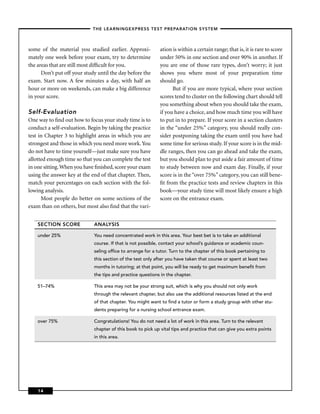
    SECTION SCORE            ANALYSIS

    under 25%                You need concentrated work in this area. Your best bet is to take an additional
                             course. If that is not possible, contact your school’s guidance or academic coun-
                             seling office to arrange for a tutor. Turn to the chapter of this book pertaining to
                             this section of the test only after you have taken that course or spent at least two
                             months in tutoring; at that point, you will be ready to get maximum benefit from
                             the tips and practice questions in the chapter.

    51–74%                   This area may not be your strong suit, which is why you should not only work
                             through the relevant chapter, but also use the additional resources listed at the end
                             of that chapter. You might want to find a tutor or form a study group with other stu-
                             dents preparing for a nursing school entrance exam.

    over 75%                 Congratulations! You do not need a lot of work in this area. Turn to the relevant
                             chapter of this book to pick up vital tips and practice that can give you extra points
                             in this area.


    14
– THE LEARNINGEXPRESS TEST PREPARATION SYSTEM –


Planning for Success                                         and see the diagram? Would you rather hear someone
Based on the amount of time you have before the exam,        read the directions to you—telling you which part con-
four customized schedules follow. If you are the kind of     nects to another? Or do you draw your own diagram?
person who needs deadlines and assignments to moti-                The three main learning methods are visual,
vate you for a project, here they are. If you prefer to      auditory, and kinesthetic. Determining which type of
design your own study timeline, use the suggested            learner you are will help you create tools for studying.
schedules to help you create an effective plan.
      Be sure to research the content of the specific          1. Visual Learners need to see the information in the
entrance test you will be taking in order to adapt the           form of maps, pictures, text, words, or math exam-
given schedules for your exam. For example, if you are           ples. Outlining notes and important points in col-
taking the NET, you may plan to spend less time on the           orful highlighters and taking note of diagrams and
science-related chapters, realizing that this topic is not       pictures may be key in helping you study.
covered with as much depth as the RNSAE or APNE.              2. Auditory Learners retain information when they
(However, because the reading comprehension section              can hear directions, the spelling of a word, a
of the NET focuses on science material, do not skip              math theorem, or poem. Repeating information
these chapters altogether!)                                      aloud or listening to your notes on a tape
      In constructing your plan, you should take into            recorder may help. Many auditory learners also
account how much work you need to do. If your scores             find working in study groups or having someone
on the first practice exam were not what you hoped,               quiz them beneficial.
you should take some of the steps from Schedule A and         3. Kinesthetic Learners must do! They need to
get them into Schedule D somehow, even if you do                 draw diagrams, write directions, etc. Rewriting
have only two weeks before the exam. Similarly, your             notes on index cards or making margin notes in
scores on the practice exam should help determine                your textbooks also helps kinesthetic learners to
how much time you have to spend each week. If you                retain information.
scored low, you might need to devote several hours a
day to test preparation. If you scored high, a few hours     Mnemonics
a week will probably be enough.                              Mnemonics are memory tricks that help you remem-
      Even more important than making a plan is              ber what you need to know. The three basic principles
making a commitment. You cannot get ready over-              in the use of mnemonics are imagination, association,
night for a nursing school entrance exam. Set aside          and location. Acronyms (words created from the first
some time every day—every other day, if your scores          letters in a series of words) are common mnemonics.
were high and you have months until the exam—for             One acronym you may already know is HOMES, for
study and practice. An hour every day or every other         the names of the Great Lakes (Huron, Ontario, Michi-
day will do you much more good than a day or two of          gan, Erie, and Superior). ROY G. BIV reminds people
cramming right before the exam.                              of the colors in the spectrum (Red, Orange, Yellow,
                                                             Green, Blue, Indigo, and Violet). Depending on the
Learning Styles                                              type of learner you are, mnemonics can also be color-
Each of us absorbs information differently. Whichever        ful or vivid images, stories, word associations, or catchy
way works best for you is called your dominant learning      rhymes such as “Thirty days hath September . . . ” cre-
method. If someone asks you to help them construct a         ated in your mind. Any type of learner, whether visual,
bookcase they just bought, which may be in many pieces,      auditory, or kinesthetic, can use mnemonics to help
how do you begin? Do you need to read the directions         the brain store and interpret information.


                                                                                                               15
– THE LEARNINGEXPRESS TEST PREPARATION SYSTEM –


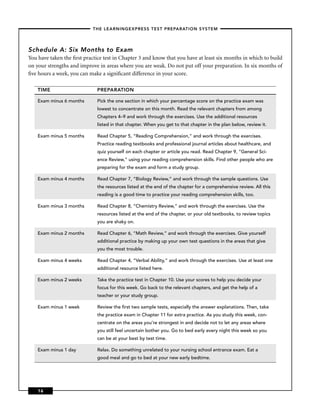
Schedule A: Six Months to Exam
You have taken the first practice test in Chapter 3 and know that you have at least six months in which to build
on your strengths and improve in areas where you are weak. Do not put off your preparation. In six months of
five hours a week, you can make a significant difference in your score.

    TIME                      PREPARATION

    Exam minus 6 months       Pick the one section in which your percentage score on the practice exam was
                              lowest to concentrate on this month. Read the relevant chapters from among
                              Chapters 4–9 and work through the exercises. Use the additional resources
                              listed in that chapter. When you get to that chapter in the plan below, review it.

    Exam minus 5 months       Read Chapter 5, “Reading Comprehension,” and work through the exercises.
                              Practice reading textbooks and professional journal articles about healthcare, and
                              quiz yourself on each chapter or article you read. Read Chapter 9, “General Sci-
                              ence Review,” using your reading comprehension skills. Find other people who are
                              preparing for the exam and form a study group.

    Exam minus 4 months       Read Chapter 7, “Biology Review,” and work through the sample questions. Use
                              the resources listed at the end of the chapter for a comprehensive review. All this
                              reading is a good time to practice your reading comprehension skills, too.

    Exam minus 3 months       Read Chapter 8, “Chemistry Review,” and work through the exercises. Use the
                              resources listed at the end of the chapter, or your old textbooks, to review topics
                              you are shaky on.

    Exam minus 2 months       Read Chapter 6, “Math Review,” and work through the exercises. Give yourself
                              additional practice by making up your own test questions in the areas that give
                              you the most trouble.

    Exam minus 4 weeks        Read Chapter 4, “Verbal Ability,” and work through the exercises. Use at least one
                              additional resource listed here.

    Exam minus 2 weeks        Take the practice test in Chapter 10. Use your scores to help you decide your
                              focus for this week. Go back to the relevant chapters, and get the help of a
                              teacher or your study group.

    Exam minus 1 week         Review the first two sample tests, especially the answer explanations. Then, take
                              the practice exam in Chapter 11 for extra practice. As you study this week, con-
                              centrate on the areas you’re strongest in and decide not to let any areas where
                              you still feel uncertain bother you. Go to bed early every night this week so you
                              can be at your best by test time.

    Exam minus 1 day          Relax. Do something unrelated to your nursing school entrance exam. Eat a
                              good meal and go to bed at your new early bedtime.


    16
– THE LEARNINGEXPRESS TEST PREPARATION SYSTEM –


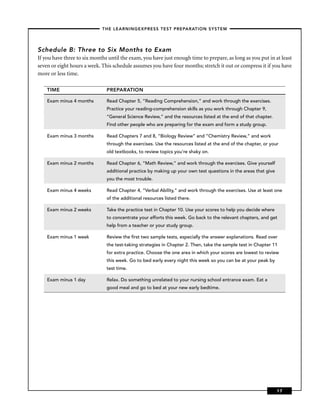
Schedule B: Three to Six Months to Exam
If you have three to six months until the exam, you have just enough time to prepare, as long as you put in at least
seven or eight hours a week. This schedule assumes you have four months; stretch it out or compress it if you have
more or less time.

    TIME                       PREPARATION

    Exam minus 4 months        Read Chapter 5, “Reading Comprehension,” and work through the exercises.
                               Practice your reading-comprehension skills as you work through Chapter 9,
                               “General Science Review,” and the resources listed at the end of that chapter.
                               Find other people who are preparing for the exam and form a study group.

    Exam minus 3 months        Read Chapters 7 and 8, “Biology Review” and “Chemistry Review,” and work
                               through the exercises. Use the resources listed at the end of the chapter, or your
                               old textbooks, to review topics you’re shaky on.

    Exam minus 2 months        Read Chapter 6, “Math Review,” and work through the exercises. Give yourself
                               additional practice by making up your own test questions in the areas that give
                               you the most trouble.

    Exam minus 4 weeks         Read Chapter 4, “Verbal Ability,” and work through the exercises. Use at least one
                               of the additional resources listed there.

    Exam minus 2 weeks         Take the practice test in Chapter 10. Use your scores to help you decide where
                               to concentrate your efforts this week. Go back to the relevant chapters, and get
                               help from a teacher or your study group.

    Exam minus 1 week          Review the first two sample tests, especially the answer explanations. Read over
                               the test-taking strategies in Chapter 2. Then, take the sample test in Chapter 11
                               for extra practice. Choose the one area in which your scores are lowest to review
                               this week. Go to bed early every night this week so you can be at your peak by
                               test time.

    Exam minus 1 day           Relax. Do something unrelated to your nursing school entrance exam. Eat a
                               good meal and go to bed at your new early bedtime.


                                                                                                                 17
– THE LEARNINGEXPRESS TEST PREPARATION SYSTEM –


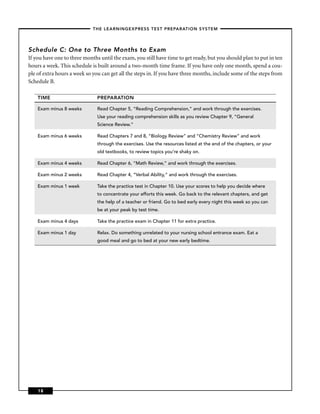
Schedule C: One to Three Months to Exam
If you have one to three months until the exam, you still have time to get ready, but you should plan to put in ten
hours a week. This schedule is built around a two-month time frame. If you have only one month, spend a cou-
ple of extra hours a week so you can get all the steps in. If you have three months, include some of the steps from
Schedule B.

    TIME                       PREPARATION

    Exam minus 8 weeks         Read Chapter 5, “Reading Comprehension,” and work through the exercises.
                               Use your reading comprehension skills as you review Chapter 9, “General
                               Science Review.”

    Exam minus 6 weeks         Read Chapters 7 and 8, “Biology Review” and “Chemistry Review” and work
                               through the exercises. Use the resources listed at the end of the chapters, or your
                               old textbooks, to review topics you’re shaky on.

    Exam minus 4 weeks         Read Chapter 6, “Math Review,” and work through the exercises.

    Exam minus 2 weeks         Read Chapter 4, “Verbal Ability,” and work through the exercises.

    Exam minus 1 week          Take the practice test in Chapter 10. Use your scores to help you decide where
                               to concentrate your efforts this week. Go back to the relevant chapters, and get
                               the help of a teacher or friend. Go to bed early every night this week so you can
                               be at your peak by test time.

    Exam minus 4 days          Take the practice exam in Chapter 11 for extra practice.

    Exam minus 1 day           Relax. Do something unrelated to your nursing school entrance exam. Eat a
                               good meal and go to bed at your new early bedtime.


    18
– THE LEARNINGEXPRESS TEST PREPARATION SYSTEM –


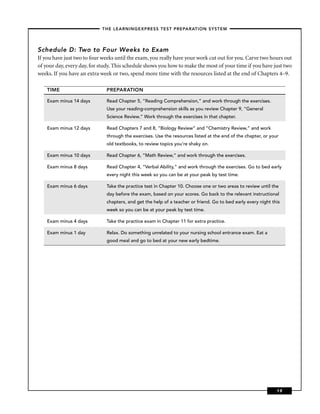
Schedule D: Two to Four Weeks to Exam
If you have just two to four weeks until the exam, you really have your work cut out for you. Carve two hours out
of your day, every day, for study. This schedule shows you how to make the most of your time if you have just two
weeks. If you have an extra week or two, spend more time with the resources listed at the end of Chapters 4–9.

    TIME                      PREPARATION

    Exam minus 14 days        Read Chapter 5, “Reading Comprehension,” and work through the exercises.
                              Use your reading-comprehension skills as you review Chapter 9, “General
                              Science Review.” Work through the exercises in that chapter.

    Exam minus 12 days        Read Chapters 7 and 8, “Biology Review” and “Chemistry Review,” and work
                              through the exercises. Use the resources listed at the end of the chapter, or your
                              old textbooks, to review topics you’re shaky on.

    Exam minus 10 days        Read Chapter 6, “Math Review,” and work through the exercises.

    Exam minus 8 days         Read Chapter 4, “Verbal Ability,” and work through the exercises. Go to bed early
                              every night this week so you can be at your peak by test time.

    Exam minus 6 days         Take the practice test in Chapter 10. Choose one or two areas to review until the
                              day before the exam, based on your scores. Go back to the relevant instructional
                              chapters, and get the help of a teacher or friend. Go to bed early every night this
                              week so you can be at your peak by test time.

    Exam minus 4 days         Take the practice exam in Chapter 11 for extra practice.

    Exam minus 1 day          Relax. Do something unrelated to your nursing school entrance exam. Eat a
                              good meal and go to bed at your new early bedtime.


                                                                                                               19
– THE LEARNINGEXPRESS TEST PREPARATION SYSTEM –


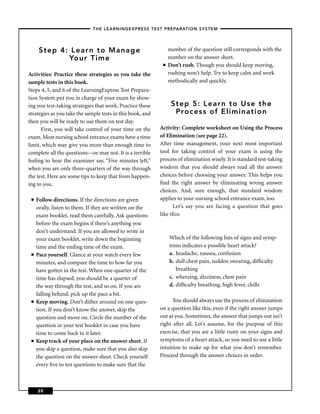
      Step 4: Lear n to Manage                                   number of the question still corresponds with the
             Your Time                                           number on the answer sheet.
                                                             ■   Don’t rush. Though you should keep moving,
Activities: Practice these strategies as you take the            rushing won’t help. Try to keep calm and work
sample tests in this book.                                       methodically and quickly.
Steps 4, 5, and 6 of the LearningExpress Test Prepara-
tion System put you in charge of your exam by show-
ing you test-taking strategies that work. Practice these          Step 5: Lear n to Use the
strategies as you take the sample tests in this book, and          Process of Elimination
then you will be ready to use them on test day.
      First, you will take control of your time on the      Activity: Complete worksheet on Using the Process
exam. Most nursing school entrance exams have a time        of Elimination (see page 22).
limit, which may give you more than enough time to          After time management, your next most important
complete all the questions—or may not. It is a terrible     tool for taking control of your exam is using the
feeling to hear the examiner say, “Five minutes left,”      process of elimination wisely. It is standard test-taking
when you are only three-quarters of the way through         wisdom that you should always read all the answer
the test. Here are some tips to keep that from happen-      choices before choosing your answer. This helps you
ing to you.                                                 find the right answer by eliminating wrong answer
                                                            choices. And, sure enough, that standard wisdom
 ■   Follow directions. If the directions are given         applies to your nursing school entrance exam, too.
     orally, listen to them. If they are written on the           Let’s say you are facing a question that goes
     exam booklet, read them carefully. Ask questions       like this:
     before the exam begins if there’s anything you
     don’t understand. If you are allowed to write in
     your exam booklet, write down the beginning                 Which of the following lists of signs and symp-
     time and the ending time of the exam.                       toms indicates a possible heart attack?
 ■   Pace yourself. Glance at your watch every few               a. headache, nausea, confusion
     minutes, and compare the time to how far you                b. dull chest pain, sudden sweating, difficulty
     have gotten in the test. When one-quarter of the               breathing
     time has elapsed, you should be a quarter of                c. wheezing, dizziness, chest pain
     the way through the test, and so on. If you are             d. difficulty breathing, high fever, chills
     falling behind, pick up the pace a bit.
 ■   Keep moving. Don’t dither around on one ques-                You should always use the process of elimination
     tion. If you don’t know the answer, skip the           on a question like this, even if the right answer jumps
     question and move on. Circle the number of the         out at you. Sometimes, the answer that jumps out isn’t
     question in your test booklet in case you have         right after all. Let’s assume, for the purpose of this
     time to come back to it later.                         exercise, that you are a little rusty on your signs and
 ■   Keep track of your place on the answer sheet. If       symptoms of a heart attack, so you need to use a little
     you skip a question, make sure that you also skip      intuition to make up for what you don’t remember.
     the question on the answer sheet. Check yourself       Proceed through the answer choices in order.
     every five to ten questions to make sure that the


     20
– THE LEARNINGEXPRESS TEST PREPARATION SYSTEM –


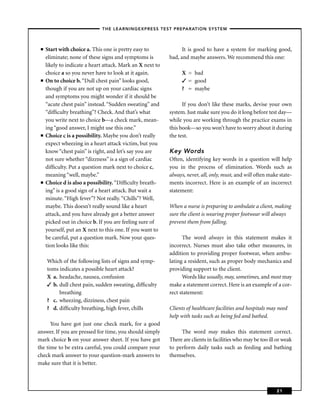
 ■   Start with choice a. This one is pretty easy to              It is good to have a system for marking good,
     eliminate; none of these signs and symptoms is         bad, and maybe answers. We recommend this one:
     likely to indicate a heart attack. Mark an X next to
     choice a so you never have to look at it again.             X = bad
 ■   On to choice b. “Dull chest pain” looks good,               ✓ = good
     though if you are not up on your cardiac signs              ? = maybe
     and symptoms you might wonder if it should be
     “acute chest pain” instead. “Sudden sweating” and            If you don’t like these marks, devise your own
     “difficulty breathing”? Check. And that’s what          system. Just make sure you do it long before test day—
     you write next to choice b—a check mark, mean-         while you are working through the practice exams in
     ing “good answer, I might use this one.”               this book—so you won’t have to worry about it during
 ■   Choice c is a possibility. Maybe you don’t really      the test.
     expect wheezing in a heart attack victim, but you
     know “chest pain” is right, and let’s say you are      Key Words
     not sure whether “dizzness” is a sign of cardiac       Often, identifying key words in a question will help
     difficulty. Put a question mark next to choice c,       you in the process of elimination. Words such as
     meaning “well, maybe.”                                 always, never, all, only, must, and will often make state-
 ■   Choice d is also a possibility. “Difficulty breath-     ments incorrect. Here is an example of an incorrect
     ing” is a good sign of a heart attack. But wait a      statement:
     minute. “High fever”? Not really. “Chills”? Well,
     maybe. This doesn’t really sound like a heart          When a nurse is preparing to ambulate a client, making
     attack, and you have already got a better answer       sure the client is wearing proper footwear will always
     picked out in choice b. If you are feeling sure of     prevent them from falling.
     yourself, put an X next to this one. If you want to
     be careful, put a question mark. Now your ques-              The word always in this statement makes it
     tion looks like this:                                  incorrect. Nurses must also take other measures, in
                                                            addition to providing proper footwear, when ambu-
     Which of the following lists of signs and symp-        lating a resident, such as proper body mechanics and
     toms indicates a possible heart attack?                providing support to the client.
     X a. headache, nausea, confusion                             Words like usually, may, sometimes, and most may
     ✓ b. dull chest pain, sudden sweating, difficulty       make a statement correct. Here is an example of a cor-
          breathing                                         rect statement:
     ? c. wheezing, dizziness, chest pain
     ? d. difficulty breathing, high fever, chills           Clients of healthcare facilities and hospitals may need
                                                            help with tasks such as being fed and bathed.
      You have got just one check mark, for a good
answer. If you are pressed for time, you should simply           The word may makes this statement correct.
mark choice b on your answer sheet. If you have got         There are clients in facilities who may be too ill or weak
the time to be extra careful, you could compare your        to perform daily tasks such as feeding and bathing
check mark answer to your question-mark answers to          themselves.
make sure that it is better.


                                                                                                              21
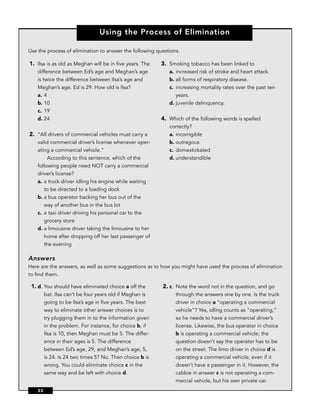
Using the Process of Elimination

Use the process of elimination to answer the following questions.

1. Ilsa is as old as Meghan will be in five years. The     3. Smoking tobacco has been linked to
    difference between Ed’s age and Meghan’s age             a. increased risk of stroke and heart attack.
    is twice the difference between Ilsa’s age and           b. all forms of respiratory disease.
    Meghan’s age. Ed is 29. How old is Ilsa?                 c. increasing mortality rates over the past ten
    a. 4                                                        years.
    b. 10                                                    d. juvenile delinquency.
    c. 19
    d. 24                                                 4. Which of the following words is spelled
                                                             correctly?
2. “All drivers of commercial vehicles must carry a          a. incorrigible
    valid commercial driver’s license whenever oper-         b. outragous
    ating a commercial vehicle.”                             c. domestickated
         According to this sentence, which of the            d. understandible
    following people need NOT carry a commercial
    driver’s license?
    a. a truck driver idling his engine while waiting
       to be directed to a loading dock
    b. a bus operator backing her bus out of the
       way of another bus in the bus lot
    c. a taxi driver driving his personal car to the
       grocery store
    d. a limousine driver taking the limousine to her
       home after dropping off her last passenger of
       the evening

Answers
Here are the answers, as well as some suggestions as to how you might have used the process of elimination
to find them.

 1. d. You should have eliminated choice a off the        2. c. Note the word not in the question, and go
         bat. Ilsa can’t be four years old if Meghan is         through the answers one by one. Is the truck
         going to be Ilsa’s age in five years. The best          driver in choice a “operating a commercial
         way to eliminate other answer choices is to            vehicle”? Yes, idling counts as “operating,”
         try plugging them in to the information given          so he needs to have a commercial driver’s
         in the problem. For instance, for choice b, if         license. Likewise, the bus operator in choice
         Ilsa is 10, then Meghan must be 5. The differ-         b is operating a commercial vehicle; the
         ence in their ages is 5. The difference                question doesn’t say the operator has to be
         between Ed’s age, 29, and Meghan’s age, 5,             on the street. The limo driver in choice d is
         is 24. Is 24 two times 5? No. Then choice b is         operating a commercial vehicle, even if it
         wrong. You could eliminate choice c in the             doesn’t have a passenger in it. However, the
         same way and be left with choice d.                    cabbie in answer c is not operating a com-
                                                                mercial vehicle, but his own private car.
    22
Using the Process of Elimination                           (continued)


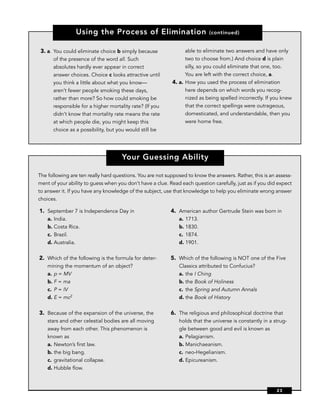
 3. a. You could eliminate choice b simply because               able to eliminate two answers and have only
      of the presence of the word all. Such                      two to choose from.) And choice d is plain
      absolutes hardly ever appear in correct                    silly, so you could eliminate that one, too.
      answer choices. Choice c looks attractive until            You are left with the correct choice, a.
      you think a little about what you know—              4. a. How you used the process of elimination
      aren’t fewer people smoking these days,                    here depends on which words you recog-
      rather than more? So how could smoking be                  nized as being spelled incorrectly. If you knew
      responsible for a higher mortality rate? (If you           that the correct spellings were outrageous,
      didn’t know that mortality rate means the rate             domesticated, and understandable, then you
      at which people die, you might keep this                   were home free.
      choice as a possibility, but you would still be


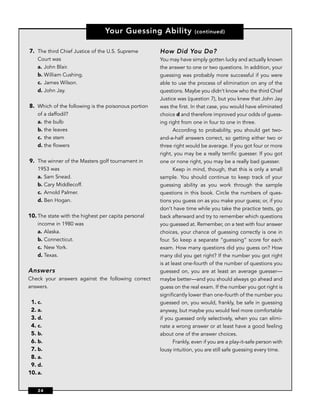
                                     Your Guessing Ability

The following are ten really hard questions. You are not supposed to know the answers. Rather, this is an assess-
ment of your ability to guess when you don’t have a clue. Read each question carefully, just as if you did expect
to answer it. If you have any knowledge of the subject, use that knowledge to help you eliminate wrong answer
choices.

1. September 7 is Independence Day in                      4. American author Gertrude Stein was born in
    a. India.                                                 a. 1713.
    b. Costa Rica.                                            b. 1830.
    c. Brazil.                                                c. 1874.
    d. Australia.                                             d. 1901.


2. Which of the following is the formula for deter-        5. Which of the following is NOT one of the Five
    mining the momentum of an object?                         Classics attributed to Confucius?
    a. p = MV                                                 a. the I Ching
    b. F = ma                                                 b. the Book of Holiness
    c. P = IV                                                 c. the Spring and Autumn Annals
    d. E = mc2                                                d. the Book of History


3. Because of the expansion of the universe, the           6. The religious and philosophical doctrine that
    stars and other celestial bodies are all moving           holds that the universe is constantly in a strug-
    away from each other. This phenomenon is                  gle between good and evil is known as
    known as                                                  a. Pelagianism.
    a. Newton’s first law.                                     b. Manichaeanism.
    b. the big bang.                                          c. neo-Hegelianism.
    c. gravitational collapse.                                d. Epicureanism.
    d. Hubble flow.


                                                                                                          23
Your Guessing Ability               (continued)


7. The third Chief Justice of the U.S. Supreme       How Did You Do?
    Court was                                        You may have simply gotten lucky and actually known
    a. John Blair.                                   the answer to one or two questions. In addition, your
    b. William Cushing.                              guessing was probably more successful if you were
    c. James Wilson.                                 able to use the process of elimination on any of the
    d. John Jay.                                     questions. Maybe you didn’t know who the third Chief
                                                     Justice was (question 7), but you knew that John Jay
8. Which of the following is the poisonous portion   was the first. In that case, you would have eliminated
    of a daffodil?                                   choice d and therefore improved your odds of guess-
    a. the bulb                                      ing right from one in four to one in three.
    b. the leaves                                           According to probability, you should get two-
    c. the stem                                      and-a-half answers correct, so getting either two or
    d. the flowers                                    three right would be average. If you got four or more
                                                     right, you may be a really terrific guesser. If you got
9. The winner of the Masters golf tournament in      one or none right, you may be a really bad guesser.
    1953 was                                                Keep in mind, though, that this is only a small
    a. Sam Snead.                                    sample. You should continue to keep track of your
    b. Cary Middlecoff.                              guessing ability as you work through the sample
    c. Arnold Palmer.                                questions in this book. Circle the numbers of ques-
    d. Ben Hogan.                                    tions you guess on as you make your guess; or, if you
                                                     don’t have time while you take the practice tests, go
10. The state with the highest per capita personal   back afterward and try to remember which questions
    income in 1980 was                               you guessed at. Remember, on a test with four answer
    a. Alaska.                                       choices, your chance of guessing correctly is one in
    b. Connecticut.                                  four. So keep a separate “guessing” score for each
    c. New York.                                     exam. How many questions did you guess on? How
    d. Texas.                                        many did you get right? If the number you got right
                                                     is at least one-fourth of the number of questions you
Answers                                              guessed on, you are at least an average guesser—
Check your answers against the following correct     maybe better—and you should always go ahead and
answers.                                             guess on the real exam. If the number you got right is
                                                     significantly lower than one-fourth of the number you
 1. c.                                               guessed on, you would, frankly, be safe in guessing
 2. a.                                               anyway, but maybe you would feel more comfortable
 3. d.                                               if you guessed only selectively, when you can elimi-
 4. c.                                               nate a wrong answer or at least have a good feeling
 5. b.                                               about one of the answer choices.
 6. b.                                                      Frankly, even if you are a play-it-safe person with
 7. b.                                               lousy intuition, you are still safe guessing every time.
 8. a.
 9. d.
10. a.


    24
– THE LEARNINGEXPRESS TEST PREPARATION SYSTEM –


      Even when you think you are absolutely clueless           Step 7: Reach Your Peak
about a question, you can often use the process of                 Perfor mance Zone
elimination to get rid of at least one answer choice. If
so, you are better prepared to make an educated guess,     Activity: Complete the Physical Preparation Checklist.
as you will see in Step 6. More often, you can eliminate   To get ready for a challenge like a big exam, you have
answers until you have only two possible answers.          to take control of your physical, as well as your men-
Then you are in a strong position to guess.                tal, state. Exercise, proper diet, and rest in the weeks
      Try using your powers of elimination on the          prior to the test will ensure that your body works with,
questions in the following worksheet, Using the Process    rather than against, your mind on test day, as well as
of Elimination. The questions are not about nursing;       during your preparation.
they are just designed to show you how the process of
elimination works. The answer explanations for this        Exercise
worksheet show one possible way you might use the          If you don’t already have a regular exercise program
process to arrive at the right answer.                     going, the time during which you are preparing for an
                                                           exam is actually an excellent time to start one. And if
                                                           you are already keeping fit—or trying to get that
Step 6: Know When to Guess                                 way—don’t let the pressure of preparing for an exam
                                                           fool you into quitting now. Exercise helps reduce stress
Activity: Complete worksheet on Your Guessing              by pumping feel-good hormones, called endorphins,
Ability (see page 23).                                     into your system. It also increases the oxygen supply
Armed with the process of elimination, you are ready       throughout your body, including your brain, so you
to take control of one of the big questions in test tak-   will be at peak performance on test day.
ing: Should I guess? The first and main answer is Yes.            A half hour of vigorous activity—enough to raise
Some exams have what’s called a “guessing penalty,” in     a sweat—every day should be your aim. If you are
which a fraction of your wrong answers is subtracted       really pressed for time, every other day is OK. Choose
from your right answers—but nursing school entrance        an activity you like and get out there and do it. Jogging
exams don’t tend to work like that. The number of          with a friend always makes the time go faster, or take
questions you answer correctly yields your raw score.      your MP3 or CD player.
So you have nothing to lose and everything to gain by            But don’t overdo it. You don’t want to exhaust
guessing.                                                  yourself. Moderation is the key.
      The more complicated answer to the question
“Should I guess?” depends on you—your personality          Diet
and your “guessing intuition.” There are two things you    First, cut out the junk. Go easy on caffeine and nicotine,
need to know about yourself before you go into the         and eliminate alcohol from your system at least two
exam:                                                      weeks before the exam. What your body needs for peak
                                                           performance is simply a balanced diet. Eat plenty of
     Are you a risk-taker?                                 fruits and vegetables, along with protein and carbohy-
     Are you a good guesser?                               drates. Foods that are high in lecithin (an amino acid),
                                                           such as fish and beans, are especially good “brain foods.”
     You will have to decide about your risk-taking               The night before the exam, you might “carbo-
quotient on your own. To find out if you are a good         load” the way athletes do before a contest. Eat a big
guesser, complete the worksheet, Your Guessing Ability,    plate of spaghetti, rice and beans, or whatever your
on page 23.                                                favorite carbohydrate is.
                                                                                                             25
Physical Preparation Checklist

For the week before the test, write down 1) what physical exercise you engaged in and for how long and 2) what
you ate for each meal. Remember, you’re trying for at least half an hour of exercise every other day (preferably
every day) and a balanced diet that’s light on junk food.


Exam minus 7 days                                           Exam minus 3 days
Exercise:    ______ for ______ minutes                      Exercise:    ______ for ______ minutes
Breakfast:                                                  Breakfast:
Lunch:                                                      Lunch:
Dinner:                                                     Dinner:
Snacks:                                                     Snacks:


Exam minus 6 days                                           Exam minus 2 days
Exercise:    ______ for ______ minutes                      Exercise:    ______ for ______ minutes
Breakfast:                                                  Breakfast:
Lunch:                                                      Lunch:
Dinner:                                                     Dinner:
Snacks:                                                     Snacks:


Exam minus 5 days                                           Exam minus 1 day
Exercise:    ______ for ______ minutes                      Exercise:    ______ for ______ minutes
Breakfast:                                                  Breakfast:
Lunch:                                                      Lunch:
Dinner:                                                     Dinner:
Snacks:                                                     Snacks:


Exam minus 4 days
Exercise:    ______ for ______ minutes
Breakfast:
Lunch:
Dinner:
Snacks:


    26
– THE LEARNINGEXPRESS TEST PREPARATION SYSTEM –


Rest                                                         Find Out Where the Test Is and Make
You probably know how much sleep you need every              a Trial Run
night to be at your best, even if you don’t always get it.   The testing agency or your nursing school advisor will
Make sure you do get that much sleep, though, for at         notify you when and where your exam is being held.
least a week before the exam. Moderation is important        Do you know how to get to the testing site? Do you
here, too. Extra sleep will just make you groggy.            know how long it will take to get there? If not, make a
       If you are not a morning person and your exam         trial run, preferably on the same day of the week at the
will be given in the morning, you should reset your          same time of day. Make note, on the worksheet Final
internal clock so that your body doesn’t think you are       Preparations on page 29, of the amount of time it will
taking an exam at 3 A.M. You have to start this process      take you to get to the exam site. Plan on arriving at
well before the exam. The way it works is to get up half     least ten to 15 minutes early so you can get the lay of
an hour earlier each morning, and then go to bed half        the land, use the bathroom, and calm down. Then fig-
an hour earlier that night. Don’t try it the other way       ure out how early you will have to get up that morning,
around; you will just toss and turn if you go to bed         and make sure you get up that early every day for a
early without having gotten up early. The next morn-         week before the exam.
ing, get up another half an hour earlier, and so on.
How long you will have to do this depends on how late        Gather Your Materials
you are used to getting up.                                  The night before the exam, lay out the clothes you will
                                                             wear and the materials you have to bring with you to
                                                             the exam. Plan on dressing in layers; you won’t have
        Step 8: Get Your Act                                 any control over the temperature of the examination
              Together                                       room. Have a sweater or jacket you can take off if it is
                                                             warm. Use the checklist on the worksheet Final Prep-
Activity: Complete Final Preparations worksheet on           arations on page 29 to help you pull together what you
page 29.                                                     will need.
You are in control of your mind and body; you are in
charge of test anxiety, your preparation, and your test-     Don’t Skip Breakfast
taking strategies. Now it is time to take charge of exter-   Even if you don’t usually eat breakfast, do so on exam
nal factors, like the testing site and the materials you     morning. A cup of coffee doesn’t count. Don’t eat
need to take the exam.                                       doughnuts or other sweet foods, either. A sugar high
                                                             will leave you with a sugar low in the middle of the
                                                             exam. A mix of protein and carbohydrates is best:
                                                             Cereal with milk and just a little sugar, or eggs with
                                                             toast, will do your body a world of good.


                                                                                                              27
– THE LEARNINGEXPRESS TEST PREPARATION SYSTEM –


              Step 9: Do It!                                   Just one more thing . . . When you are done with
                                                         the exam, you deserve a reward. Plan a celebration.
Activity: Ace the nursing school entrance exam!          Call up your friends and plan a party, or have a nice
Fast forward to exam day. You are ready. You made a      dinner for two—whatever your heart desires. Give
study plan and followed through. You practiced your      yourself something to look forward to.
test-taking strategies while working through this              And then do it. Go into the exam, full of confi-
book. You are in control of your physical, mental, and   dence, armed with test-taking strategies you have prac-
emotional states. You know when and where to show        ticed until they are second nature. You are in control of
up and what to bring with you. In other words, you are   yourself, your environment, and your performance on
better prepared than most of the other people taking     the exam. You are ready to succeed. So do it. Go in
the nursing school entrance exam with you. You are       there and ace the exam. And look forward to your
psyched.                                                 future career as a nurse!


    28
Final Preparations

Getting to the Exam Site

Location of exam site:


Date:


Departure time:


Do I know how to get to the exam site? Yes      No   (If no, make a trial run.)


Time it will take to get to exam site:


Things to Lay Out the Night Before

Clothes I will wear


Sweater/jacket


Watch


Photo ID


Four #2 pencils


Other Things to Bring/Remember


                                                                                  29
3
C H A P T E R


                                                 PRACTICE EXAM I


                                             CHAPTER SUMMARY
                                             This is the first of three practice exams in this book based on
                                             actual nursing school entrance exams commonly used in the field
                                             today. Use this test to see how you would do if you had to take
                                             the test today.


T              he practice test in this chapter is modeled on real entrance exams required by nursing education pro-
               grams. Like many nursing school entrance exams, this practice test measures your skills, abilities, and
               knowledge of four core subjects: Verbal Ability, Math, Science, and Reading Comprehension. It uses
a multiple-choice format, with four answer choices, a through d. The types of questions in the practice test reflect
the kinds of test questions you will likely encounter on your entrance exam.
       The practice test is divided into four sections, each covering the four main topics outlined above. On the
actual test, each section will be timed separately, and the whole test will last about two to three hours. Here, you
do not have to worry about timing—just try to relax and do your best. Remember: The goal of the practice test
is to familiarize yourself with the test format and type of questions and to highlight the areas where you need to
concentrate your study and preparation. Make sure that you have scheduled enough time to complete the test
without major interruptions, taking only short breaks between sections.
       On the following pages, you will find an answer sheet. Use this sheet to mark your answers, filling in the ovals
that correspond with your answer choices. Each question has only one correct answer, so do not fill in more than
one oval per item. The answer key is located on page 74. Although you should not refer to it while you take the
practice test, be sure to review the answer explanations carefully after you have finished. A section about how to
score your exam follows the answer key.

                                                                                                               31
– LEARNINGEXPRESS ANSWER SHEET –


                        Section 1: Verbal Ability
 1.   a   b   c     d       18.   a     b    c     d        35.   a   b   c    d
 2.   a   b   c     d       19.   a     b    c     d        36.   a   b   c    d
 3.   a   b   c     d       20.   a     b    c     d        37.   a   b   c    d
 4.   a   b   c     d       21.   a     b    c     d        38.   a   b   c    d
 5.   a   b   c     d       22.   a     b    c     d        39.   a   b   c    d
 6.   a   b   c     d       23.   a     b    c     d        40.   a   b   c    d
 7.   a   b   c     d       24.   a     b    c     d        41.   a   b   c    d
 8.   a   b   c     d       25.   a     b    c     d        42.   a   b   c    d
 9.   a   b   c     d       26.   a     b    c     d        43.   a   b   c    d
10.   a   b   c     d       27.   a     b    c     d        44.   a   b   c    d
11.   a   b   c     d       28.   a     b    c     d        45.   a   b   c    d
12.   a   b   c     d       29.   a     b    c     d        46.   a   b   c    d
13.   a   b   c     d       30.   a     b    c     d        47.   a   b   c    d
14.   a   b   c     d       31.   a     b    c     d        48.   a   b   c    d
15.   a   b   c     d       32.   a     b    c     d        49.   a   b   c    d
16.   a   b   c     d       33.   a     b    c     d        50.   a   b   c    d
17.   a   b   c     d       34.   a     b    c     d


                  Section 2: Reading Comprehension
 1.   a   b   c     d       16.   a    b     c     d        31.   a   b   c    d
 2.   a   b   c     d       17.   a    b     c     d        32.   a   b   c    d
 3.   a   b   c     d       18.   a    b     c     d        33.   a   b   c    d
 4.   a   b   c     d       19.   a    b     c     d        34.   a   b   c    d
 5.   a   b   c     d       20.   a    b     c     d        35.   a   b   c    d
 6.   a   b   c     d       21.   a    b     c     d        36.   a   b   c    d
 7.   a   b   c     d       22.   a    b     c     d        37.   a   b   c    d
 8.   a   b   c     d       23.   a    b     c     d        38.   a   b   c    d
 9.   a   b   c     d       24.   a    b     c     d        39.   a   b   c    d
10.   a   b   c     d       25.   a    b     c     d        40.   a   b   c    d
11.   a   b   c     d       26.   a    b     c     d        41.   a   b   c    d
12.   a   b   c     d       27.   a    b     c     d        42.   a   b   c    d
13.   a   b   c     d       28.   a    b     c     d        43.   a   b   c    d
14.   a   b   c     d       29.   a    b     c     d        44.   a   b   c    d
15.   a   b   c     d       30.   a    b     c     d        45.   a   b   c    d


                                                                              33
– LEARNINGEXPRESS ANSWER SHEET –


                   Section 3: Quantitative Ability
 1.    a   b   c   d        18.   a     b    c     d        35.   a   b   c   d
 2.    a   b   c   d        19.   a     b    c     d        36.   a   b   c   d
 3.    a   b   c   d        20.   a     b    c     d        37.   a   b   c   d
 4.    a   b   c   d        21.   a     b    c     d        38.   a   b   c   d
 5.    a   b   c   d        22.   a     b    c     d        39.   a   b   c   d
 6.    a   b   c   d        23.   a     b    c     d        40.   a   b   c   d
 7.    a   b   c   d        24.   a     b    c     d        41.   a   b   c   d
 8.    a   b   c   d        25.   a     b    c     d        42.   a   b   c   d
 9.    a   b   c   d        26.   a     b    c     d        43.   a   b   c   d
10.    a   b   c   d        27.   a     b    c     d        44.   a   b   c   d
11.    a   b   c   d        28.   a     b    c     d        45.   a   b   c   d
12.    a   b   c   d        29.   a     b    c     d        46.   a   b   c   d
13.    a   b   c   d        30.   a     b    c     d        47.   a   b   c   d
14.    a   b   c   d        31.   a     b    c     d        48.   a   b   c   d
15.    a   b   c   d        32.   a     b    c     d        49.   a   b   c   d
16.    a   b   c   d        33.   a     b    c     d        50.   a   b   c   d
17.    a   b   c   d        34.   a     b    c     d


                       Section 4: General Science
 1.    a   b   c   d        18.   a     b    c     d        35.   a   b   c   d
 2.    a   b   c   d        19.   a     b    c     d        36.   a   b   c   d
 3.    a   b   c   d        20.   a     b    c     d        37.   a   b   c   d
 4.    a   b   c   d        21.   a     b    c     d        38.   a   b   c   d
 5.    a   b   c   d        22.   a     b    c     d        39.   a   b   c   d
 6.    a   b   c   d        23.   a     b    c     d        40.   a   b   c   d
 7.    a   b   c   d        24.   a     b    c     d        41.   a   b   c   d
 8.    a   b   c   d        25.   a     b    c     d        42.   a   b   c   d
 9.    a   b   c   d        26.   a     b    c     d        43.   a   b   c   d
10.    a   b   c   d        27.   a     b    c     d        44.   a   b   c   d
11.    a   b   c   d        28.   a     b    c     d        45.   a   b   c   d
12.    a   b   c   d        29.   a     b    c     d        46.   a   b   c   d
13.    a   b   c   d        30.   a     b    c     d        47.   a   b   c   d
14.    a   b   c   d        31.   a     b    c     d        48.   a   b   c   d
15.    a   b   c   d        32.   a     b    c     d        49.   a   b   c   d
16.    a   b   c   d        33.   a     b    c     d        50.   a   b   c   d
17.    a   b   c   d        34.   a     b    c     d


  34
– LEARNINGEXPRESS ANSWER SHEET –


                        Section 5: Biology
 1.   a   b   c   d      18.   a     b    c     d        35.   a   b   c    d
 2.   a   b   c   d      19.   a     b    c     d        36.   a   b   c    d
 3.   a   b   c   d      20.   a     b    c     d        37.   a   b   c    d
 4.   a   b   c   d      21.   a     b    c     d        38.   a   b   c    d
 5.   a   b   c   d      22.   a     b    c     d        39.   a   b   c    d
 6.   a   b   c   d      23.   a     b    c     d        40.   a   b   c    d
 7.   a   b   c   d      24.   a     b    c     d        41.   a   b   c    d
 8.   a   b   c   d      25.   a     b    c     d        42.   a   b   c    d
 9.   a   b   c   d      26.   a     b    c     d        43.   a   b   c    d
10.   a   b   c   d      27.   a     b    c     d        44.   a   b   c    d
11.   a   b   c   d      28.   a     b    c     d        45.   a   b   c    d
12.   a   b   c   d      29.   a     b    c     d        46.   a   b   c    d
13.   a   b   c   d      30.   a     b    c     d        47.   a   b   c    d
14.   a   b   c   d      31.   a     b    c     d        48.   a   b   c    d
15.   a   b   c   d      32.   a     b    c     d        49.   a   b   c    d
16.   a   b   c   d      33.   a     b    c     d        50.   a   b   c    d
17.   a   b   c   d      34.   a     b    c     d


                      Section 6: Chemistry
 1.   a   b   c   d      18.   a    b     c     d        35.   a   b   c    d
 2.   a   b   c   d      19.   a    b     c     d        36.   a   b   c    d
 3.   a   b   c   d      20.   a    b     c     d        37.   a   b   c    d
 4.   a   b   c   d      21.   a    b     c     d        38.   a   b   c    d
 5.   a   b   c   d      22.   a    b     c     d        39.   a   b   c    d
 6.   a   b   c   d      23.   a    b     c     d        40.   a   b   c    d
 7.   a   b   c   d      24.   a    b     c     d        41.   a   b   c    d
 8.   a   b   c   d      25.   a    b     c     d        42.   a   b   c    d
 9.   a   b   c   d      26.   a    b     c     d        43.   a   b   c    d
10.   a   b   c   d      27.   a    b     c     d        44.   a   b   c    d
11.   a   b   c   d      28.   a    b     c     d        45.   a   b   c    d
12.   a   b   c   d      29.   a    b     c     d        46.   a   b   c    d
13.   a   b   c   d      30.   a    b     c     d        47.   a   b   c    d
14.   a   b   c   d      31.   a    b     c     d        48.   a   b   c    d
15.   a   b   c   d      32.   a    b     c     d        49.   a   b   c    d
16.   a   b   c   d      33.   a    b     c     d        50.   a   b   c    d
17.   a   b   c   d      34.   a    b     c     d


                                                                           35
–PRACTICE EXAM I –


    Section 1: Verbal Ability                       8. a.   errantt
                                                       b.   errant
Find the correctly spelled word in the following       c.   errent
questions.                                             d.   erant

 1. a.   weigh                                      9. a.   obssession
    b.   wiegh                                         b.   obsessian
    c.   weaigh                                        c.   obsession
    d.   wieigh                                        d.   obsessiun

 2. a.   procede                                   10. a.   jeoperdy
    b.   proceid                                       b.   jepardy
    c.   proceed                                       c.   jeapardy
    d.   procied                                       d.   jeopardy

 3. a.   pierce                                    11. a.   magnifisint
    b.   pearce                                        b.   magnifisent
    c.   peirce                                        c.   magnificent
    d.   peerce                                        d.   magnifficent

 4. a.   merrily                                   12. a.   mechinically
    b.   merily                                        b.   mechanically
    c.   merilly                                       c.   mechenicaly
    d.   merrilly                                      d.   machanically

 5. a.   manageable                                13. a.   elicitt
    b.   managable                                     b.   ellicit
    c.   manageble                                     c.   illicet
    d.   mannagable                                    d.   illicit

 6. a.   catalog                                   14. a.   inquiry
    b.   catolog                                       b.   inquirry
    c.   catilog                                       c.   enquirry
    d.   catologe                                      d.   enquery

 7. a.   definately                                 15. a.   terminated
    b.   definitely                                     b.   termenated
    c.   defenately                                    c.   terrminated
    d.   defanitely                                    d.   termanated


                                                                           37
–PRACTICE EXAM I –


16. a.   persecution             24. a.   asspirations
    b.   pursecution                 b.   asparations
    c.   presecution                 c.   aspirrations
    d.   persecusion                 d.   aspirations

17. a.   peculior                25. a.   excercise
    b.   peculiar                    b.   exercise
    c.   peculliar                   c.   exersize
    d.   piculear                    d.   exercize

18. a.   psycology               Find the misspelled word in the following questions.
    b.   psycholigy
    c.   psychollogy             26. a.   friend
    d.   psychology                  b.   feirce
                                     c.   cried
19. a.   lisense                     d.   no mistakes
    b.   lisence
    c.   lycence                 27. a.   preperation
    d.   license                     b.   government
                                     c.   quiet
20. a.   concise                     d.   no mistakes
    b.   concize
    c.   consise                 28. a.   foreign
    d.   cuncise                     b.   neither
                                     c.   forfiet
21. a.   nieghbor                    d.   no mistakes
    b.   neihbor
    c.   niehbor                 29. a.   reign
    d.   neighbor                    b.   protein
                                     c.   truly
22. a.   stabilize                   d.   no mistakes
    b.   stablize
    c.   stableize               30. a.   obesity
    d.   stabalize                   b.   bees
                                     c.   quaintly
23. a.   irelevent                   d.   no mistakes
    b.   irelevant
    c.   irrelevant              31. a.   stein
    d.   irrelevent                  b.   hieght
                                     c.   perceive
                                     d.   no mistakes


    38
–PRACTICE EXAM I –


32. a.   suite                     40. a.   geometry
    b.   tedium                        b.   perimeter
    c.   emporer                       c.   circumferance
    d.   no mistakes                   d.   no mistakes

33. a.   incorporate               41. a.   transparent
    b.   contridict                    b.   worrys
    c.   exhale                        c.   lightning
    d.   no mistakes                   d.   no mistakes

34. a.   pertain                   42. a.   primarily
    b.   reversel                      b.   finallity
    c.   memorization                  c.   specifically
    d.   no mistakes                   d.   no mistakes

35. a.   optimum                   43. a.   relegious
    b.   palpable                      b.   insurance
    c.   foriegn                       c.   military
    d.   no mistakes                   d.   no mistakes

36. a.   ravinous                  44. a.   mortar
    b.   miraculous                    b.   outweigh
    c.   wondrous                      c.   pursue
    d.   no mistakes                   d.   no mistakes

37. a.   phenomonal                45. a.   balcony
    b.   emulate                       b.   delenquent
    c.   misconception                 c.   emergency
    d.   no mistakes                   d.   no mistakes

38. a.   mischief                  46. a.   gratitude
    b.   temperture                    b.   horrendous
    c.   lovable                       c.   forcast
    d.   no mistakes                   d.   no mistakes

39. a.   dictionary                47. a.   rightious
    b.   auditorium                    b.   strenuous
    c.   biology                       c.   manageable
    d.   no mistakes                   d.   no mistakes


                                                            39
–PRACTICE EXAM I –


48. a.   sincerly                50. a.   digestion
    b.   faithfully                  b.   resperation
    c.   reliably                    c.   circulation
    d.   no mistakes                 d.   no mistakes

49. a.   label
    b.   vacency
    c.   medal
    d.   no mistakes


    40
–PRACTICE EXAM I –


          Section 2: Reading                                 hypertrophy and hyperplasia of airway smooth
           Comprehension                                     muscle, increase in goblet cell number, and
                                                             enlargement of submucous glands.
Read each passage and answer the accompanying ques-                 Although causes of the initial tendency
tions based solely on the information found in the pas-      toward inflammation in the airways of patients
sage. You have 45 minutes to complete this section.          with asthma are not yet certain, to date the
                                                             strongest identified risk factor is atopy. This
     No longer is asthma considered a condition with         inherited familial tendency to have allergic reac-
     isolated, acute episodes of bronchospasm.               tions includes increased sensitivity to allergens
     Rather, asthma is now understood to be a                that are risk factors for developing asthma. Some
     chronic inflammatory disorder of the airways—            of these allergens include domestic dust mites,
     that is, inflammation makes the airways chroni-          animals with fur, cockroaches, pollens, and
     cally sensitive. When these hyper-responsive            molds. Additionally, asthma may be triggered by
     airways are irritated, air flow is limited, and          viral respiratory infections, especially in children.
     attacks of coughing, wheezing, chest tightness,         By avoiding these allergens and triggers, a person
     and difficulty in breathing occur.                       with asthma lowers the risk of irritating sensitive
            Asthma involves complex interactions             airways. A few avoidance techniques include
     among inflammatory cells, mediators, and the             keeping the home clean and well-ventilated,
     cells and tissues in the airways. The interactions      using an air conditioner in the summer months
     result in airflow limitation from acute bron-            when pollen and mold counts are high, and get-
     choconstriction, swelling of the airway wall,           ting an annual influenza vaccination. Of course,
     increased mucus secretion, and airway remod-            asthma sufferers should avoid tobacco smoke
     eling. The inflammation also causes an increase          altogether. Cigar, cigarette, and pipe smoke are
     in airway responsiveness. During an asthma              triggers whether the patient smokes or breathes
     attack, the patient attempts to compensate by           in the smoke from others. Smoke increases the
     breathing at a higher lung volume in order to           risk of allergic sensitization in children and
     keep the air flowing through the constricted             increases the severity of symptoms in children
     airways, and the greater the airway limitation,         who already have asthma. Many of the risk fac-
     the higher the lung volume must be to keep air-         tors for developing asthma may also provoke
     ways open. The morphologic changes that                 asthma attacks, and people with asthma may
     occur in asthma include bronchial infiltration           have one or more triggers, which vary from indi-
     by inflammatory cells. Key effector cells in the         vidual to individual. The risk can be further
     inflammatory response are the mast cells, lym-           reduced by taking medications that decrease air-
     phocytes, and eosinophils. Mast cells and               way inflammation. Most exacerbations can be
     eosinophils are also significant participants in         prevented by the combination of avoiding trig-
     allergic responses, hence the similarities              gers and taking anti-inflammatory medications.
     between allergic reactions and asthma attacks.          An exception is physical activity, which is a com-
     Other changes include mucus plugging of the             mon trigger of exacerbations in asthma patients.
     airways, interstitial edema, and microvascular          However, asthma patients should not necessarily
     leakage. Destruction of bronchial epithelium            avoid all physical exertion, because some types of
     and thickening of the subbasement membrane              activity have been proven to reduce symptoms.
     is also characteristic. In addition, there may be       Rather, they should work in conjunction with a


                                                                                                          41
–PRACTICE EXAM I –


    doctor to design a proper training regimen          4. Which of the following would be the best
    including the use of medication.                       replacement for the word exacerbations in this
          In order to diagnose asthma, a healthcare        passage?
    professional must appreciate the underlying dis-       a. attacks
    order that leads to asthma symptoms and under-         b. allergies
    stand how to recognize the condition through           c. triggers
    information gathered from the patient’s history,       d. allergens
    physical examination, measurements of lung
    function, and allergic status. Because asthma       5. The passage mentions all of the following bodily
    symptoms vary throughout the day, the respira-         changes during an asthma attack EXCEPT
    tory system may appear normal during physical          a. severe cramping in the patient’s side.
    examination. Clinical signs are more likely to be      b. heavy breathing.
    present when a patient is experiencing symp-           c. airways blocked by fluids.
    toms; however, the absence of symptoms at the          d. constricted airways.
    time of the examination does not exclude the
    diagnosis of asthma.                                6. Which of the following triggers, albeit surpris-
                                                           ing, is mentioned as possibly reducing the symp-
1. What is the name for the familial inclination to        toms of asthma in some patients?
   have hypersensitivity to certain allergens?             a. using a fan instead of an air conditioner
   a. interstitial edema                                   b. second-hand cigarette smoke
   b. hyperplasia                                          c. a family pet
   c. hypertrophy                                          d. physical exercise
   d. atopy
                                                        7. Why might a patient with asthma have an appar-
2. Why does a person suffering from an asthma              ently normal respiratory system during an exam-
   attack attempt to inhale more air?                      ination by a doctor?
   a. to prevent the loss of consciousness                 a. Asthma symptoms come and go throughout
   b. to keep air flowing through shrunken air                 the day.
      passageways                                          b. Severe asthma occurs only after strenuous
   c. to prevent hyperplasia                                  physical exertion.
   d. to compensate for weakened mast cells, lym-          c. Doctors’ offices are usually smoke-free and
      phocytes, and eosinophils                               very clean.
                                                           d. The pollen and mold count may be low that day.
3. The passage suggests that, in the past, asthma
   was regarded as                                      8. Who might be the most logical audience for this
   a. a result of the overuse of tobacco products.         passage?
   b. a hysterical condition.                              a. researchers studying the respiratory system
   c. mysterious, unrelated attacks affecting the          b. healthcare professionals
      lungs.                                               c. a mother whose child has been diagnosed
   d. a chronic condition.                                    with asthma
                                                           d. an anti-smoking activist


   42
–PRACTICE EXAM I –


9. What is the reason given for why second-hand                        Because of inherent limitations of science,
   smoke should be avoided by children?                          the FDA can never be absolutely certain of the
   a. A smoke-filled room is most likely a breeding               absence of any risk from the use of any sub-
      ground for viral respiratory infections.                   stance. Therefore, the FDA must determine—
   b. Smoke can stunt an asthmatic child’s growth.               based on the best science available—if there is a
   c. Breathing smoke can lead to a fatal asthma                 reasonable certainty of no harm to consumers
      attack.                                                    when an additive is used as proposed.
   d. Smoke can heighten the intensity of asthma                       If an additive is approved, the FDA issues
      symptoms.                                                  regulations that may include the types of foods in
                                                                 which the additive can be used, the maximum
    Today, food and color additives are more strictly            amounts to be used, and how it should be iden-
    studied, regulated, and monitored than at any                tified on food labels. In 1999, procedures changed
    other time in history. The Food and Drug                     so that the FDA now consults with the United
    Administration (FDA) has the primary legal                   States Department of Agriculture (USDA) dur-
    responsibility for determining their safe use. To            ing the review process for ingredients that are
    market a new food or color additive (or before               proposed for use in meat and poultry products.
    using an additive already approved for one use in            Federal officials then monitor the extent of
    another manner not yet approved), a manufac-                 Americans’ consumption of the new additive and
    turer or other sponsor must first petition the                results of any new research on its safety to ensure
    FDA for its approval. These petitions must pro-              its use continues to be within safe limits.
    vide evidence that the substance is safe for the                   If new evidence suggests that a product
    ways in which it will be used. Since 1999, indirect          already in use may be unsafe, or if consumption
    additives have been approved via a pre-market                levels have changed enough to require another
    notification process requiring the same data as               look, federal authorities may prohibit the use of
    was previously required by petition.                         that product or conduct further studies to deter-
          When evaluating the safety of a substance              mine if its use can still be considered safe.
    and whether it should be approved, the FDA con-                    Regulations known as Good Manufactur-
    siders: 1) the composition and properties of the             ing Practices (GMP) limit the number of food
    substance, 2) the amount of the substance that               ingredients used in foods to the amount neces-
    would typically be consumed, 3) immediate and                sary to achieve the desired effect.
    long-term health effects, and 4) various safety
    factors. The evaluation determines an appropri-
    ate level of use that includes a built-in safety mar-   10. Which of the following does the FDA take under
    gin—a factor that allows for uncertainty about              consideration when evaluating a substance for
    the levels of consumption that are expected to be           possible approval?
    harmless. In other words, the levels of use that            a. its cost
    gain approval are much lower than what would                b. its chemical makeup
    be expected to have any adverse effect.                     c. its palatability
                                                                d. its possible appeal to the general public


                                                                                                             43
–PRACTICE EXAM I –


11. According to the passage, which of the follow-      14. Federal authorities may call for further studies
    ing is true?                                            on a product or prohibit its use under which
    a. Once an item is approved, manufacturers              circumstances?
       can use it in all products they create.              a. A formal complaint is lobbied by a competi-
    b. Once a product is approved, it is allowed to            tive product.
       be on shelves for five years before another           b. The product grosses more than $50 million
       routine inspection.                                     a year.
    c. You will most likely not be in medical dan-          c. New evidence suggests the product may be
       ger if you slightly exceed the FDA’s recom-             unsafe, or consumption levels have drasti-
       mended level of use of an item.                         cally changed.
    d. If a substance is safe in small amounts, but         d. More than 75 million tons of the product
       dangerous in large amounts, it will not be              are produced a year.
       approved by the FDA.
                                                        15. What is the main idea of the passage?
12. What does reasonable certainty of no harm               a. Current dangerous food practices have
    mean?                                                      caused increased FDA activity in recent
    a. The FDA has only so much capability to test             years.
       a substance fully before it is out on the com-       b. The FDA is the organization responsible for
       mercial market.                                         making sure the substances you consume
    b. The FDA makes a notation of whether or                  are safe.
       not it feels a product is reasonable in the          c. Nineteen-ninety-nine was a year of major
       economic climate.                                       change in the food and drug industry.
    c. An FDA seal of approval means that the               d. The FDA is in charge of setting Good Man-
       government guarantees no danger will come               ufacturing Practices for society.
       from consumption.
    d. There is a 75% assurance that a product is            Medical waste has been a growing concern
       safe for human consumption.                           because of recent incidents of public exposure
                                                             to discarded blood vials, needles (sharps),
13. The FDA does NOT have the right to?                      empty prescription bottles, and syringes. Med-
    a. lower the amount of money charged for a               ical waste can typically include general refuse,
       food product using a recently approved                human blood and blood products, cultures
       additive                                              and stocks of infectious agents, laboratory ani-
    b. set limitations on the amount of a food dye           mal carcasses, contaminated bedding material,
       that can be used in a certain product                 and pathological wastes.
    c. determine the language use on a food’s                       Wastes are collected by gravity chutes,
       nutrition label                                       carts, or pneumatic tubes. Chutes are limited to
    d. have a say in the way beef is commercially            vertical transport, and there is some risk of
       prepared                                              exhausting contaminants into hallways if a
                                                             door is left open during use. Another disadvan-
                                                             tage of gravity chutes is that the waste con-
                                                             tainer may get jammed while dropping or
                                                             broken upon hitting the bottom. Carts are


44
–PRACTICE EXAM I –


primarily for horizontal transport of bagged or              tion is currently the preferred method for on-site
containerized wastes. The main risk here is that             treatment of hospital waste.
bags may be broken or torn during transport,                        Steam sterilization is limited in the types of
potentially exposing the worker to the wastes.               medical waste it can treat but is appropriate for
Using automated carts can reduce the potential               laboratory cultures and/or substances contami-
for exposure. Pneumatic tubes offer the best per-            nated with infectious organisms. The waste is
formance for waste transport in a large facility.            subjected to steam in a sealed, pressurized cham-
Advantages include high-speed movement,                      ber. The liquid that may form is drained off to
movement in any direction, and minimal inter-                the sewer or sent for processing. The unit is then
mediate storage of untreated wastes. However,                reopened after a vapor release to the atmosphere,
some objects cannot be conveyed pneumatically.               and the solid waste is taken out for further pro-
       Off-site disposal of regulated medical                cessing or disposal. One advantage of steam ster-
wastes remains a viable option for smaller hos-              ilization is that it has been used for many years in
pitals (those with fewer than 150 beds). Some                hospitals to sterilize instruments and containers
preliminary on-site processing, such as com-                 and to treat small quantities of waste. However,
paction or hydropulping, may be necessary prior              since sterilization does not change the appear-
to sending the waste off-site. Compaction                    ance of the waste, there could be a problem in
reduces the total volume of solid wastes, often              gaining acceptance of the waste for landfilling.
reducing transportation and disposal costs, but                     A properly designed, maintained, and oper-
does not change the hazardous characteristics of             ated incinerator achieves a relatively high level of
the waste. However, compaction may “not be                   organism destruction. Incineration reduces the
economical if transportation and disposal costs              weight and volume of the waste as much as 95%
are based on weight rather than volume.                      and is especially appropriate for pathological
       Hydropulping involves grounding the                   wastes and sharps. The most common incinera-
waste in the presence of an oxidizing fluid, such             tion system for medical waste is the controlled-air
as hypochlorite solution. The liquid is separated            type. The principal advantage of this type of
from the pulp and discharged directly into the               incinerator is low particulate emissions. Rotary
sewer unless local limits require additional pre-            kiln and grate-type units have been used, but use
treatment prior to discharge. The pulp can often             of grate-type units has been discontinued due to
be disposed of at a landfill. One advantage is that           high air emissions. The rotary kiln also puts out
waste can be rendered innocuous and reduced in               high emissions, and the costs have been prohibi-
size within the same system. Disadvantages are               tive for smaller units.
the added operating burden, difficulty of con-
trolling fugitive emission, and the difficulty of        16. One disadvantage of the compaction method of
conducting microbiological tests to determine               waste disposal is that it
whether all organic matters and infectious organ-           a. cannot reduce transportation costs.
isms from the waste have been destroyed.                    b. reduces the volume of solid waste material.
       On-site disposal is a feasible alternative for       c. does not allow hospitals to confirm that
hospitals generating two tons per day or more of               organic matter has been eliminated.
total solid waste. Common treatment techniques              d. does not reduce the weight of solid waste
include steam sterilization and incineration.                  material.
Although other options are available, incinera-


                                                                                                          45
–PRACTICE EXAM I –


17. For hospitals that dispose of waste on their own    22. The process that transforms waste from haz-
    premises, the optimum treatment method is               ardous to harmless AND diminishes waste
    a. incineration.                                        volume is
    b. compaction.                                          a. sterilization.
    c. sterilization.                                       b. hydropulping.
    d. hydropulping.                                        c. oxidizing.
                                                            d. compacting.
18. Which of the following could be safely disposed
    of in a landfill but might not be accepted by        23. As it is used in the second paragraph of the pas-
    landfill facilities?                                     sage, the word exhausting most nearly means
    a. hydropulped material                                 a. debilitating.
    b. sterilized waste                                     b. disregarding.
    c. incinerated waste                                    c. detonating.
    d. laboratory cultures                                  d. discharging.

19. The two processes mentioned that involve the        24. Budgetary constraints have precluded some
    formation of liquid are                                 small hospitals from purchasing
    a. compaction and hydropulping.                         a. pneumatic tubes.
    b. incineration and compaction.                         b. rotary kilns.
    c. hydropulping and sterilization.                      c. sterilization equipment.
    d. sterilization and incineration.                      d. controlled-air kilns.

20. Two effective methods for treating waste caused          The immune system is equal in complexity to
    by infectious matter are                                 the combined intricacies of the brain and
    a. steam sterilization and incineration.                 nervous system. The success of the immune sys-
    b. hydropulping and steam sterilization.                 tem in defending the body relies on a dynamic
    c. incineration and compaction.                          regulatory-communications network consisting
    d. hydropulping and incineration.                        of millions and millions of cells. Organized into
                                                             sets and subsets, these cells pass information
21. Hospitals can minimize employee contact with             back and forth like clouds of bees swarming
    dangerous waste by switching from                        around a hive. The result is a sensitive system of
    a. a manual cart to a gravity chute.                     checks and balances, which produces an immune
    b. an automated cart to a hydropulping                   response that is prompt, appropriate, effective,
       machine.                                              and self-limiting.
    c. a gravity chute to a manual cart.                           At the heart of the immune system is the
    d. a manual cart to an automated cart.                   ability to distinguish between self and nonself.
                                                             When immune defenders encounter cells or
                                                             organisms carrying foreign or nonself molecules,
                                                             the immune troops move quickly to eliminate the
                                                             intruders. Virtually every body cell carries distinc-
                                                             tive molecules that identify it as self. The body’s


    46
–PRACTICE EXAM I –


immune defenses do not normally attack tissues             immune response. Only in abnormal situations
that carry a self marker. Rather, immune cells and         does the immune system wrongly identify self as
other body cells coexist peaceably in a state              nonself and execute a misdirected immune
known as self-tolerance. When a normally func-             attack. The result can be a so-called autoimmune
tioning immune system attacks a nonself mole-              disease such as rheumatoid arthritis or systemic
cule, the system has the ability to “remember” the         lupus erythematosus. The painful side effects of
specifics of the foreign body. Upon subsequent              these diseases are caused by a person’s immune
encounters with the same species of molecules, the         system actually attacking itself.
immune system reacts accordingly. With the pos-
sible exception of antibodies passed during lacta-    25. Which of the following is the analogy used in the
tion, this so-called immune system memory is not          passage to describe the communications network
inherited. Despite the occurrence of a virus in           among the cells in the immune system?
your family, your immune system must “learn”              a. the immune system’s memory
from experience with the many millions of dis-            b. immune troops eliminating intruders
tinctive nonself molecules in the sea of microbes         c. bees swarming around a hive
in which we live. Learning entails producing the          d. a sea of microbes
appropriate molecules and cells to match up with
and counteract each nonself invader.                  26. The immune cells and other cells in the body
       Any substance capable of triggering an             coexist peaceably in a state known as
immune response is called an antigen. Antigens            a. equilibrium.
are not to be confused with allergens, which are          b. self-tolerance.
most often harmless substances (such as ragweed           c. harmony.
pollen or cat hair) that provoke the immune sys-          d. tolerance.
tem to set off the inappropriate and harmful
response known as allergy. An antigen can be a        27. What is the specific term used in the passage for
virus, a bacterium, a fungus, a parasite, or even a       the substance capable of triggering an inappro-
portion or product of one of these organisms.             priate or harmful immune response to a harm-
Tissues or cells from another individual (except          less substance such as ragweed pollen?
an identical twin, whose cells carry identical self       a. antigen
markers) also act as antigens; because the                b. microbe
immune system recognizes transplanted tissues             c. allergen
as foreign, it rejects them. The body will even           d. autoimmune disease
reject nourishing proteins unless they are first
broken down by the digestive system into their        28. How do the cells in the immune system recog-
primary, non-antigenic building blocks. An anti-          nize an antigen as “foreign” or “nonself ”?
gen announces its foreignness by means of intri-          a. through an allergic response
cate and characteristic shapes called epitopes,           b. through blood type
which protrude from its surface. Most antigens,           c. through fine hairs protruding from the anti-
even the simplest microbes, carry several differ-            gen surface
ent kinds of epitopes on their surface; some may          d. through characteristic shapes on the antigen
even carry several hundred. Some epitopes will               surface
be more effective than others at stimulating an


                                                                                                    47
–PRACTICE EXAM I –


29. After you have had the chicken pox, your                  Notebooks, erasers, pencil sets, and backpacks are
    immune system will be able to do all of the fol-          on most kids’ back-to-school lists. But if your
    lowing EXCEPT                                             child has diabetes, you should add a few extra
    a. protect your offspring from infection by the           tasks to the list. At the top, put “good communi-
       chicken pox virus.                                     cation,” with your child and with the school. Plan-
    b. distinguish between your body cells and those          ning ahead, and getting help from others, will
       of the chicken pox virus.                              help pave the way for a successful year.
    c. “remember” previous experiences with the                       Diabetes is a serious and lifelong condition,
       chicken pox virus.                                     and it’s a growing problem among children and
    d. match up and counteract nonself molecules in           teens. About 186,000 Americans under age 20
       the form of the chicken pox virus.                     have diabetes. Most have type 1 diabetes, which
                                                              usually first appears during childhood. But in
30. Which of the following best expresses the main            recent years, a growing number of kids have been
    idea of this passage?                                     diagnosed with type 2 diabetes, a disease that’s in
    a. The basic function of the immune system is to          the past, primarily struck adults over age 45.
       distinguish between self and nonself.                  Excess weight and inactivity puts children and
    b. An antigen is any substance that triggers an           teens at risk for type 2 diabetes.
       immune response.                                               When you have diabetes, you have too much
    c. One of the immune system’s primary func-               glucose in your blood. Over time, this excess glu-
       tions is the allergic response.                        cose can damage both large and small blood ves-
    d. The human body presents an opportune habi-             sels, leading to heart disease, stroke, nerve damage,
       tat for microbes.                                      blindness, and kidney disease. That’s why people
                                                              with diabetes must regularly check their blood
31. Based on the information in the passage, why              glucose. They need to keep their levels from drop-
    would tissue transplanted from father to daugh-           ping by using strategies like snacking. When their
    ter have a greater risk of being detected as foreign      glucose is too high, insulin can help to bring it
    than tissue transplanted between identical twins?         down. Essentially, they have to manage their blood
    a. The age of the twins’ tissue would be the same         glucose level 24 hours a day, seven days a week.
       and therefore less likely to be rejected.                      This intensive management can be daunting
    b. The twins’ tissue would carry the same self            to kids during school. They may wonder: What
       markers and would therefore be less likely to          happens if I feel light-headed, or need a snack in
       be rejected.                                           the middle of class? Will I be okay in gym class?
    c. The difference in the sex of the father and            When should I go to the nurse? These are all issues
       daughter would cause the tissue to be rejected         you should discuss ahead of time with school staff
       by the daughter’s immune system.                       and with your child. Work with your child’s
    d. The twins’ immune systems would “remem-                healthcare team to develop a written diabetes
       ber” the same encounters with childhood                management plan outlining your child’s specific
       illnesses.                                             medical needs. Make sure key staff members, like
                                                              your child’s teacher, have a copy of the plan.


    48
–PRACTICE EXAM I –


           Heading back to school with diabetes can be    35. Which of the following is not true about glucose?
     a challenge. But by eating regular meals, making         a. After a few years of healthy living, glucose lev-
     healthy food choices, staying active, and taking            els even themselves out.
     medications, kids with diabetes can do all the           b. Too much glucose can eventually destroy kid-
     things their friends do, and then some. With plan-          ney function.
     ning and good communication, you can help                c. Food is a way of raising glucose levels when
     your child have a healthy and happy school year.            they dip too low.
                                                              d. Levels of blood glucose need to be monitored
32. What is a good title for the passage?                        carefully.
    a. The Obesity Epidemic: How Diabetes Is
       Affecting Youth in the Twenty-first Century         36. According to the passage, children with diabetes
    b. Knowledge Is Power: Teaching Your Children             a. should restrict calories and food intake in
       about Their Diabetes                                      order to lose weight.
    c. Healthy and Happy: Good Living Tips for                b. must take care when playing team sports
       Children and Teens                                        because they are susceptible to many diseases.
    d. Snack Your Way to a Healthy Body                       c. need to become very familiar with their own
                                                                 blood glucose levels.
33. Which of the following put(s) children and teens          d. contract the disease by eating too much sugar
    at risk for type 2 diabetes?                                 at an early age.
    a. high estrogen levels
    b. excess weight and inactivity                       37. People with diabetes need insulin when
    c. overactive thyroid                                     a. their glucose levels are too low.
    d. being taller than average                              b. their blood pressure is too low.
                                                              c. their glucose levels are too high.
34. According to the passage, which of the following          d. their blood pressure is too high.
    is true?
    a. It is easier for a child to regulate his or her    38. According to the passage, too much blood glu-
        diabetes if he or she is homeschooled.                cose can lead to all of the following health prob-
    b. Only people with diabetes have glucose in              lems EXCEPT
        their system.                                         a. heart disease.
    c. Diabetes is a private disease that a child             b. kidney disease.
        should learn to regulate on his or her own.           c. stroke.
    d. Children with diabetes should pack snacks in           d. paralysis.
        their schoolbags.
                                                          39. What does the word daunting mean in the fourth
                                                              paragraph?
                                                              a. time-consuming
                                                              b. annoying
                                                              c. overwhelming
                                                              d. bothersome


                                                                                                           49
–PRACTICE EXAM I –


40. According to the passage, the parents of children         42. According to the passage, which of the following
    with diabetes should                                          is true?
    a. keep their child indoors at all times.                     a. When a cell undergoes mitosis, the result is
    b. make sure their child does not do any physical                 the same as its parent cell.
       activity.                                                  b. The most important type of cell division is
    c. develop a diabetes-management plan.                            mitosis.
    d. inject their child with insulin every hour.                c. Mitosis is responsible for forming the gametes
                                                                      that join to make an embryo.
     There are two types of cell division: mitosis and            d. Meiosis creates two identical cells.
     meiosis. Most of the time when people refer to
     “cell division,” they mean mitosis, the process of       43. What is the meaning of the word unite in the
     making new body cells. Meiosis is the type of cell           passage?
     division that creates egg and sperm cells.                   a. to get married
           Mitosis is a fundamental process for life.             b. to fight for a common cause
     During mitosis, a cell duplicates all of its con-            c. to agree
     tents, including its chromosomes, and splits to              d. to join
     form two identical daughter cells. Because this
     process is so critical, the steps of mitosis are care-   44. How many chromosomes does a healthy person
     fully controlled by a number of genes. When                  have?
     mitosis is not regulated correctly, health prob-             a. 11.5
     lems, such as cancer, can result.                            b. 23
           The other type of cell division, meiosis,              c. 46
     ensures that humans have the same number of                  d. 92
     chromosomes in each generation. It is a two-step
     process that reduces the chromosome number by            45. According to the information presented in the
     half-from 46 to 23-to form sperm and egg cells.              passage, which process is responsible for creating
     When the sperm and egg cells unite at concep-                new skin cells when the skin has been cut?
     tion, each contributes 23 chromosomes, so the                a. mitosis
     resulting embryo will have the usual 46. Meiosis             b. meiosis
     also allows genetic variation through a process of           c. mitosis and meiosis
     DNA shuffling during cell division.                           d. neither mitosis or meiosis

41. What is the main idea of this passage?
    a. Meiosis is responsible for variations in physi-
       cal characteristics.
    b. Mitosis can be the cause of fatal health
       problems.
    c. Cells divide through a pair of unique
       processes.
    d. Meiosis and mitosis are delicate biological
       processes that can lead to fatal disease.


    50
–PRACTICE EXAM I –


      Section 3: Quantitative                             6. A boy turned on his radio at 5:30 P.M. on Friday
              Ability                                        night while he was packing for a weekend trip.
                                                             He forgot to switch it off the whole time he was
Use scratch paper if needed to answer the following 50       gone, and finally turned it off on Sunday night at
questions.You have 45 minutes to complete this section.      8:15 P.M. In total, how long was the radio playing?
                                                             a. 1 day, 3 hours
1. What is the reciprocal of 3 4 ?
                               5                             b. 1 day, 2 hours, 45 minutes
   a. 159                                                    c. 2 days, 2 hours, 30 minutes
   b. 159                                                    d. 2 days, 2 hours, 45 minutes
   c. 4 1
        4
   d. 345                                                 7. 3 3 15 is equal to
                                                               4
                                                             a. 230
2. What is the value of y when 12y + 17 = 161?               b. 14
    a. 8.76                                                  c. 13

    b. 12                                                    d. 140

    c. 14.8
                                                          8. Sarah went to the mall and spent $25.20 on a
    d. 14
                                                             shirt, $45.05 on a pair of pants, $3.25 on a
                                                             smoothie, and $32.75 on a pair of shorts. In
3. What is the circumference of a circle with a              total, how much money did Sarah spend on
    radius of 5?                                             clothes?
    a. 5π                                                    a. $102.75
    b. 10π                                                   b. $102.80
    c. 25π                                                   c. $103.00
    d. 50π                                                   d. $106.25


4. A designer buys 180 square feet of wallpaper to        9. Yesterday, 15% of a 40-person staff was home
   cover a square wall with a length of 12 feet. How         sick from work with the same cold. How many
   much wallpaper will be left over when he’s done           people were present at work?
   covering the wall?                                        a. 6
   a. 6 sq. ft.                                              b. 25
   b. 12 sq. ft.                                             c. 34
   c. 36 sq. ft.                                             d. 36
   d. 144 sq. ft.
                                                          10. Lara biked 12 miles per hour for the first two
5. A man is 6 feet 2 inches and his daughter is 4 feet        hours of a long ride through the country and 14
   9 inches. How much taller is the man than his              miles per hour for the last hour. What was her
   daughter?                                                  average speed for the trip in miles per hour?
                                                              a. 8 2
                                                                   3
    a.   1 ft., 3 in.                                         b. 12
    b.   1 ft., 5 in.                                         c. 12 23
    c.   2 ft., 3 in.                                         d. 13
    d.   2 ft., 5 in.

                                                                                                         51
–PRACTICE EXAM I –


11. What is the estimated product when 157 and              16. A gram of fat contains 9 calories. An 1,800-
    817 are rounded to the nearest hundred and                  calorie diet allows no more than 20% of calories
    multiplied?                                                 from fat. How many grams of fat are allowed in
    a. 180,000                                                  that diet?
    b. 160,000                                                  a. 40 g
    c. 16,000                                                   b. 90 g
    d. 80,000                                                   c. 200 g
                                                                d. 360 g
12. The perimeter of a rectangle is 148 feet. Its two
    longest sides add up to 86 feet. What is the length     17. How much water must be added to 1 liter of a
    of each of its two shortest sides?                          5% saline solution to get a 2% saline solution?
    a. 31 ft.                                                   a. 1L
    b. 42 ft.                                                   b. 1.5 L
    c. 62ft.                                                    c. 2 L
    d. 74 ft.                                                   d. 2.5 L

13. The list of costs for supplies for a hospital ward is   18. A 15 cc dosage must be increased by 20%. What
    as follows: $19.98, $52.20, $12.64, and $7.79. What         is the new dosage?
    is the total cost?                                          a. 17 cc
    a. $91.30                                                   b. 18 cc
    b. $92.61                                                   c. 30 cc
    c. $93.60                                                   d. 35 cc
    d. $93.61
                                                            19. What is the volume of liquid that is remaining in
14. If jogging for one mile uses 150 calories and               this cylinder?
    brisk walking for one mile uses 100 calories, a
    jogger has to go how many times as far as a
    walker to use the same number of calories?
                                                                                 10 cm
    a. 12
         2
    b.   3
         3
    c.   2                                                              8 cm
    d. 2                                                        a.   64π cm3
                                                                b.   80π cm3
15. A dosage of a certain medication is 12 cc per               c.   96π cm3
    100 pounds. What is the dosage for a patient                d.   160π cm3
    who weighs 175 pounds?
    a. 15 cc
    b. 18 cc
    c. 21 cc
    d. 24 cc


    52
–PRACTICE EXAM I –


20. The following figure contains both a circle and a         24. The percent increase from 8 to 10 is equal to the
    square. What is the area of the entire shaded                percent increase from 16 to what number?
    figure?                                                       a. 18
                                                                 b. 20
                                                                 c. 22
                    8                                            d. 24

                                                             25. If (0.0013)x = 13, then x =
                                                                 a. 0.001
    a.   16 + 4π
                                                                 b. 0.01
    b.   16 + 16π
                                                                 c. 1,000
    c.   24+ 2π
    d.   24 + 4π                                                 d. 10,000


21. At a carnival, each ride costs $1.50. However, a         26. 470 is equal to
    dozen ride tickets can be bought for $15.50 at               a. 0.0175
    the park entrance. How much money can be                     b. 0.175
    saved by buying a dozen tickets at once rather               c. 1.75
    than buying each ticket separately?                          d. 17.5
    a. $2.50
    b. $3.00                                                 27. A certain water pollutant is unsafe at a level of
    c. $10.30                                                    20 ppm (parts per million). A city’s water
    d. $18.00                                                    supply now contains 50 ppm of this pollutant.
                                                                 What percentage improvement will make the
22. If Jules earns $3,000 a month and spends $750 a              water safe?
    month on rent, what percent of his monthly                   a. 30%
    earnings does he have left after he pays rent each           b. 40%
    month?                                                       c. 50%
    a. 20%                                                       d. 60%
    b. 25%
    c. 33 1 %                                                28. In half of migraine sufferers, a certain drug
          3
    d. 75%                                                       reduces the number of migraines by 50%. What
                                                                 percentage of all migraines can be eliminated by
23. If t is 4 more than s, and s is 2 less than r, what is       this drug?
    t when r = 8?                                                a. 25%
    a. 2                                                         b. 50%
    b. 6                                                         c. 75%
    c. 10                                                        d. 100%
    d. 14


                                                                                                              53
–PRACTICE EXAM I –


29. Nationwide, in one year, there were about 21,500     34. The basal metabolic rate (BMR) is the rate at
    fire-related injuries associated with furniture. Of       which our body uses calories. The BMR for a
    these, 11,350 were caused by smoking materials.          man in his twenties is about 1,700 calories per
    About what percent of the fire-related injuries           day. If 204 of those calories should come from
    were smoking-related?                                    protein, about what percentage of this man’s diet
    a. 47%                                                   should be protein?
    b. 49%                                                   a. 1.2%
    c. 51%                                                   b. 8.3%
    d. 53%                                                   c. 12%
                                                             d. 16%
30. 0.63 0.42 is equal to
    a. 26.46                                             35. One lap on a particular outdoor track measures
    b. 2.646                                                 a quarter of a mile around. To run a total of 3 1
                                                                                                             2
    c. 0.2646                                                miles, how many complete laps must a person
    d. 0.02646                                               finish?
                                                             a. 7
      21
31.    4
       2    is equal to                                      b. 10
       3
      a.    8                                                c. 13
           27
                                                             d. 14
      b.   112

      c.   338                                           36. Down’s syndrome occurs in about 1 in 1,500
      d.   31                                                children when the mothers are in their twenties.
             2
                                                             About what percentage of all children born to
32. 3 196 – 1 7 is equal to                                  mothers in their twenties are likely to have
              8
                                                             Down’s syndrome?
      a. 1 11
           16                                                a. 0.0067%
      b. 2 1
           8                                                 b. 0.067%
      c. 2 1                                                 c. 0.67%
           4
                                                             d. 6.7%
      d. 2 156
                                                         37. If a population of yeast cells grows from ten to
33. If the average woman burns 8.2 calories per              320 in a period of five hours, what is the rate of
    minute while riding a bicycle, how many calories         growth?
    will she burn if she rides for 35 minutes?               a. It doubles its numbers every hour.
    a. 286                                                   b. It triples its numbers every hour.
    b. 287                                                   c. It doubles its numbers every two hours.
    c. 387                                                   d. It triples its numbers every two hours.
    d. 980


      54
–PRACTICE EXAM I –


                                                                                                            13
38. Which value of x will make this number sentence       44. Which of the following is the equivalent of   25 ?
    true? x + 25 ≤ 13                                         a. 0.38
    a. –13                                                    b. 0.4
    b. –11                                                    c. 0.48
    c. 12                                                     d. 0.52
    d. 38
                                                          45. What is another way to write 0.32    103?
39. How many faces does a cube have?                          a. 3.2
    a. 4                                                      b. 32
    b. 6                                                      c. 320
    c. 8                                                      d. 3,200
    d. 12
                                                          46. Which of the following statements is true?
40. What is the length of a rectangle if its width is         a. Parallel lines intersect at right angles.
    9 feet and its area is 117 square feet?                   b. Parallel lines never intersect.
    a. 1.3 ft.                                                c. Perpendicular lines never intersect.
    b. 10.5 ft.                                               d. Intersecting lines have two points in common.
    c. 12 ft.
    d. 13 ft.                                             47. 3.6 – 1.89 is equal to
                                                              a. 1.47
41. Which of the following numbers is the smallest?           b. 1.53
    a. 185                                                    c. 1.71
    b.   6                                                    d. 2.42
         10
         33
    c.   60                                               48. If a particular woman’s resting heartbeat is
         11
    d.   20                                                   72 beats per minute and she is at rest for 6 1
                                                                                                           2
                                                              hours, about how many times will her heart beat
42. 2 1 + 4 5 +
      4     8
                  1
                  2   is equal to                             during that period of time?
    a. 6 7                                                    a. 4,320
         8
                                                              b. 4,680
    b. 7 1
         4                                                    c. 28,080
    c. 7 3
         8                                                    d. 43,200
    d. 7 3
         4


43. What percentage of 600 is 750?
    a. 80%
    b. 85%
    c. 110%
    d. 125%


                                                                                                            55
–PRACTICE EXAM I –


49. The number of red blood corpuscles in one             50. 152 –     3
                                                                        8   is equal to
    cubic millimeter is about 5 million, and the              a.    1
                                                                   10
    number of white blood corpuscles in one cubic                   1
    millimeter is about 8,000. What, then, is the ratio       b.   24
                                                                    5
    of white blood corpuscles to red blood                    c.   48
    corpuscles?                                               d.   19
                                                                   24
    a. 1:625
    b. 1:40
    c. 4:10
    d. 5:1,250


    56
–PRACTICE EXAM I –


  Section 4: General Science                           4. How many micrograms are in one gram?
                                                          a. 100
This section will test your accumulated knowledge in      b. 1,000
general science.                                          c. 100,000
                                                          d. 1,000,000
1. Which of the following scientists is best known
   for describing the laws of planetary motion?        5. Which of the following statements correctly
   a. Sir Charles Lyell                                   relates our present understanding of the uni-
   b. Gregor Mendel                                       verse?
   c. Johann Kepler                                       a. The universe is about five billion years old.
   d. Robert Hooke                                        b. The universe is getting smaller with time.
                                                          c. The universe is expanding.
2. Suppose you conduct a scientific investigation to       d. The universe consists of only a few hundred
   find out how daily intake of vitamin C affects a           galaxies.
   person's resistance to developing flu symptoms.
   You test 100 people, all of the same age and same   6. Hippocrates
   general health. You give 25 people one vitamin         a. discovered the right triangle.
   tablet a day, another 25 people two vitamin            b. is called the “father” of geology.
   tablets a day, another 25 people three vitamin         c. is called the “father” of medicine.
   tablets a day, and the final 25 people get four         d. discovered colors in light.
   vitamin tablets a day. You carry this out for two
   months and observe the health of all 100 people     7. What did Galileo do?
   over time. Which of the following is your experi-      a. first split light into its colors
   mental factor?                                         b. first used the x- and y-axis
   a. number of people studied                            c. first realized the antiquity of Earth
   b. number of vitamin tablets a person gets             d. first observed the moons of Jupiter
      each day
   c. the age of the people in the study               8. If you want to test the effect of a new malaria
   d. the health of each person at the beginning of       vaccine, the group of people who receive shots
      the study                                           but the shots contain no vaccine is called the
                                                          a. control group.
3. Which of the following is the standard metric          b. experiment group.
   unit of volume?                                        c. fake group.
   a. gram                                                d. zero group.
   b. joule
   c. liter                                            9. The search in science for the simplest possible
   d. metric ton                                          explanation is said to use the principle of
                                                          a. relativity.
                                                          b. predictability.
                                                          c. Pasteur’s flasks.
                                                          d. Occam’s razor.


                                                                                                     57
–PRACTICE EXAM I –


10. The biggest concepts in science are called             16. The typical human hair is about 50 micrometers
    a. predictions.                                            in diameter. That means it is 50        of a
    b. theories.                                               meter.
    c. experiments.                                            a. billionths
    d. hypotheses.                                             b. thousandths
                                                               c. parts
11. Which of the following best describes the atmos-           d. millionths
    phere of the planet Venus?
    a. very light and oxygen-rich                          17. Humans are putting about 6 billion tons of
    b. filled with water vapor                                  carbon into the atmosphere each year in the
    c. dominated by CO2 (carbon dioxide)                       form of carbon dioxide. Another way of saying
    d. thin and cold                                           this number is how many tons of carbon?
                                                               a. 6 megatons
12. Scientists estimate that most of the universe is           b. 6 kilotons
    made of                                                    c. 6 petatons
    a. ordinary matter.                                        d. 6 gigatons
    b. dark energy.
    c. dark matter.                                        18. Which unit is not in the metric system?
    d. light matter.                                           a. second
                                                               b. joule
13. Which U.S. space shuttle led to humans landing             c. kilogram
    on the moon for the first time?                             d. foot
    a. Apollo
    b. Gemini                                              19. What exponent or power of ten would you use to
    c. Mercury                                                 express how many meters are in a kilometer?
    d. Voyager                                                 a. 105
                                                               b. 103
14. Two atoms both have 92 electrons as well as 92             c. 104
    protons in their nuclei, but one atom has 146              d. 102
    neutrons and the other has 144 neutrons. These
    two atoms are                                          20. Compute the number of seconds in a year.
    a. ions.                                                   a. about one million
    b. compounds.                                              b. about thirty million
    c. molecules.                                              c. about one hundred thousand
    d. isotopes.                                               d. about three million

15. If a substance gains electrons during a chemical       21. If you feel waves of warmth coming from a
    reaction, the substance is said to be                      campfire, which of the following means of heat
    a. oxized.                                                 transfer are you experiencing?
    b. acidified.                                               a. conduction
    c. reduced.                                                b. radiation
    d. fused.                                                  c. electricity
                                                               d. nuclear fusion

    58
–PRACTICE EXAM I –


22. Which of the following is our best understanding     27. In the stages of nuclear fusion inside stars, which
    of why the dinosaurs became extinct?                     element in the list, compared to the others, is
    a. impact of a massive meteor on Earth                   formed last?
    b. intense volcanic activity                             a. hydrogen
    c. disease                                               b. helium
    d. severe and prolonged storms                           c. carbon
                                                             d. oxygen
23. A rock that contains a fossil is most likely
    a. igneous.                                          28. Which is the best answer for the events or
    b. sedimentary.                                          processes that disperse elements born in the
    c. volcanic.                                             internal nuclear fires of stars, making those
    d. metamorphic.                                          elements available for subsequent formations
                                                             of new stars and planets?
24. In which layer of the atmosphere does weather            a. supernovas
    occur?                                                   b. expanding universe
    a. troposphere                                           c. fusion reactions
    b. stratosphere                                          d. red shift
    c. mesosphere
    d. thermosphere                                      29. Which element is not made in stars?
                                                             a. aluminum
25. Which of the following carry out photosynthesis?         b. boron
    a. nektons                                               c. carbon
    b. heterotrophs                                          d. hydrogen
    c. zooplanktons
    d. autotrophs                                        30. Which element in the universe (including inside
                                                             our sun) is both primordial (meaning some of it
26. In the electromagnetic spectrum, infrared wave-          was made shortly after the Big Bang, before any
    lengths are slightly longer than those of visible        stars formed) and made inside stars during
    red, and ultraviolet wavelengths are slightly            fusion reactions?
    shorter than visible blue. If an absorption spec-        a. carbon
    trum from a calcium atom here on Earth has a             b. hydrogen
    characteristic pattern in the red wavelengths,           c. helium
    looking at calcium in the absorption spectrum of         d. iron
    a distant galaxy will show the same characteristic
    pattern toward the                                   31. Which increases in density as the universe ages?
    a. ultraviolet.                                          a. energy
    b. blue.                                                 b. microwave radiation
    c. red (the same).                                       c. hydrogen
    d. infrared.                                             d. carbon


                                                                                                         59
–PRACTICE EXAM I –


32. About how long after the Big Bang did our sun       37. What important event happened in 1969?
    form?                                                   a. first landing a rover on Mars
    a. 14 billion years ago                                 b. first human landing on the Moon
    b. 4 billion years ago                                  c. first satellite to be put into orbit
    c. 9 billion years ago                                  d. first human to orbit Earth
    d. 36 billion years ago
                                                        38. Which body in our solar system has very good
33. Astronomers sometimes make units that fit the            evidence for the presence, at one time in the past,
    large scales of space and time. Consider the time       for liquid water?
    interval from today back to the formation of            a. the moon
    Earth (in other words, Earth’s condensation from        b. Mars
    the gas cloud that also formed the sun). For just       c. Venus
    this question, call this amount of time one Earth       d. Mercury
    Formation Unit (1 EFU). About how many EFUs
    from today must you go back in time to reach        39. The Cassini space probe will explore the planet
    the Big Bang?                                          with rings. Before reaching that planet, Cassini
    a. 1 EFU                                               has to pass the orbit of which planet?
    b. 3 EFUs                                              a. Pluto
    c. 8 EFUs                                              b. Saturn
    d. 15 EFUs                                             c. Jupiter
                                                           d. Neptune
34. Our best dates for the origin of the solar system
    come from                                           40. We know there is matter that cannot be seen by
    a. rocks found on the moon.                             any means available to us, including the
    b. the oldest rocks on Earth.                           different wavelengths of the electromagnetic
    c. meteorites.                                          spectrum. Yet we know this so-called “dark
    d. gases in the sun.                                    matter” exists. How?
                                                            a. Black holes have consumed much of the mat-
35. The planet nearest to the sun is                           ter that once existed.
    a. the asteroids.                                       b. At the origin of the universe was a large
    b. Phobos.                                                 amount of antimatter that became hidden.
    c. Venus.                                               c. Einstein’s equation shows us the equivalence
    d. Mercury.                                                of energy that could also be considered
                                                               matter.
36. Humans are currently in space on the                    d. The spins of galaxies cannot be explained by
    a. Mir space station.                                      the amount of known, ordinary matter.
    b. international space station.
    c. space shuttle.
    d. Apollo capsule.


    60
–PRACTICE EXAM I –


41. Today, we know fairly well the composition of the    46. Protons and neutrons are made of what?
    universe, in terms of types of matter (or types of       a. electrons
    energy that can be put into amounts of equiva-           b. neutrinos
    lent matter, using Einstein’s equation E = mc2).         c. quarks
    What percentage of the universe is dark energy?          d. mesons
    a. 98%
    b. 73%                                               47. Parts of the atomic nucleus are sometimes col-
    c. 23%                                                   lectively called nucleons. Nucleons are therefore
    d. 4%                                                    a. protons and mesons.
                                                             b. electrons and neutrons.
42. One element crucial to life is carbon, which             c. mesons and electrons.
    forms about 40% of our body’s dry weight. If             d. neutrons and protons.
    planets had formed around the very earliest stars
    in the universe, why would it have been unlikely     48. In measuring electricity, the unit for resistance
    for life to start on those earliest planets?             is the
    a. Carbon is made slowly as the expanding                a. volt.
       energy is converted to matter.                        b. ohm.
    b. Carbon leaks into our universe through                c. amp.
       black holes.                                          d. watt.
    c. Carbon is made by fusion reactions in stars.
    d. Carbon is made by the fission of oxygen.           49. The momentum of Earth spinning is measured as
                                                             a. rotational momentum.
43. The geographical region of the ocean that meets          b. gyrate momentum.
    the deep ocean floor is the                               c. angular momentum.
    a. continental alluvium.                                 d. circular momentum.
    b. continental abyss.
    c. continental slope.                                50. Which fundamental force of physics could be
    d. continental shelf.                                    called the secret behind the chemical bond of
                                                             molecules?
44. What word in ancient Greek meant indivisible?            a. gravity
    a. atom                                                  b. weak nuclear force
    b. molecule                                              c. electromagnetism
    c. ion                                                   d. strong nuclear force
    d. isotope

45. The radioactive isotope of carbon is
    a. carbon-11.
    b. carbon-12.
    c. carbon-13.
    d. carbon-14.


                                                                                                          61
–PRACTICE EXAM I –


         Section 5: Biology                             6. The loop of Henle is part of which of the follow-
                                                           ing organs?
There are 50 questions in this section. You have 45        a. heart
minutes to complete this section.                          b. kidney
                                                           c. pancreas
1. Which of the following represents a human               d. liver
   nucleotide base pairing?
   a. T-U                                               7. Which of the following animals is an ectotherm?
   b. A-U                                                  a. lemur
   c. G-T                                                  b. wren
   d. A-G                                                  c. opossum
                                                           d. salamander
2. Adipose tissue is composed of
   a. amino acids.                                      8. What is 10–12 meters?
   b. nucleotides.                                         a. a picometer
   c. white blood cells.                                   b. a nanometer
   d. lipids.                                              c. a micrometer
                                                           d. a femtometer
3. Viruses appear to be living organisms for the fol-
   lowing characteristics EXCEPT                        9. Which of the following is an air- or fluid-filled
   a. cellular reproduction.                               space in the cytoplasm of a living cell?
   b. enzymes.                                             a. a vacuum
   c. adaptation.                                          b. a vacuole
   d. nucleic acids.                                       c. a centriole
                                                           d. a centrosome
4. What is the correct order of classification from
   general to specific?                                  10. Which of the following structures is part of a
   a. Kingdom, Phylum, Class, Order, Genus,                 plant cell but not of an animal cell?
      Family, Species                                       a. a mitochondrion
   b. Kingdom, Phylum, Class, Genus, Family,                b. a ribosome
      Order, Species                                        c. a chloroplast
   c. Kingdom, Phylum, Order, Class, Family,                d. an endoplasmic reticulum
      Genus, Species
   d. Kingdom, Phylum, Class, Order, Family,            11. The ribosome structures in all cell types are
      Genus, Species                                        responsible for
                                                            a. producing energy.
5. Which accessory organ detoxifies substances in            b. digesting food.
   the blood absorbed through the intestines?               c. storing water.
   a. kidney                                                d. producing protein.
   b. liver
   c. pancreas
   d. spleen


    62
–PRACTICE EXAM I –


12. Cells of various organ systems                       17. Hepatitis is an inflammation of the
    a. have completely different DNA.                        a. joints.
    b. have the same DNA.                                    b. lungs.
    c. express different parts of their DNA.                 c. liver.
    d. choices b and c                                       d. large intestine.

13. Which adaptation differentiates mammals from         18. Which of the following statements is true?
    other animals?                                           a. Cells form organs, which form tissues, which
    a. regulation of body temperature                           form systems.
    b. terrestrial mobility                                  b. Cells form tissues, which form organs, which
    c. specialized communication                                form systems.
    d. birth to live young                                   c. Tissues form cells, which form organs, which
                                                                form systems.
14. A characteristic that differentiates prokaryotes         d. Systems form cells, which form tissues, which
    from eukaryotes is                                          form organs.
    a. lack of ribosomes.
    b. lack of DNA.                                      19. The principal function of blood platelets is to
    c. lack of cell membrane.                                a. help clot blood.
    d. lack of nucleus.                                      b. carry oxygen.
                                                             c. produce antibodies.
15. Why might flowering plants (angiosperms)                  d. phagocytize bacteria.
    recovery be faster than conifers from a devastat-
    ing environmental phenomenon?                        20. The two or more related genes that control a
    a. Conifers requires more sunlight.                      trait are known as
    b. Angiosperms reproduce more quickly.                   a. chromosomes.
    c. Angiosperms depend on mammals to spread               b. chromatids.
       seeds.                                                c. phenotypes.
    d. Conifers have tougher seeds.                          d. alleles.

16. What type of cell is shown in the following          21. Once the amount of oxygen in the atmosphere
    figure?                                                   was increased, which adaptation helped organ-
                                                             isms evolve to more advanced forms?
                                                             a. photosynthesis
                                                             b. anaerobic respiration
                                                             c. oxidation
                                                             d. aerobic respiration


    a.   a blood cell
    b.   a fat cell
    c.   a muscle cell
    d.   a nerve cell


                                                                                                         63
–PRACTICE EXAM I –


22. A fossil is found that is believed to be at least       27. Which of the following is characteristic of
    three billion years old. Which of the following             viruses?
    modern organisms would it most likely resemble?             I. Viruses lack most of the structural and
    a. primitive aquatic plants                                     functional features of a cell.
    b. protists                                                 II. Viruses can reproduce only when they are
    c. bacteria                                                     within living cells.
    d. protozoa                                                 III.Nearly all viruses cause diseases.
                                                                a. I only
23. A father presents an X-linked trait and a mother            b. II only
    does not. What is the probability the mother is a           c. I and II only
    carrier of this trait if they produce a son that also       d. I, II, and III
    presents the X-linked trait?
    a. 0%                                                   28. Initial classification of a bacterium is based on its
    b. 25%                                                      a. size.
    c. 50%                                                      b. shape.
    d. 100%                                                     c. color.
                                                                d. ability to cause disease.
24. Which organ system is responsible for producing
    white blood cells in humans?                            29. Which of the following is NOT caused by a virus?
    a. skeletal                                                 a. polio
    b. immune                                                   b. rabies
    c. circulatory                                              c. malaria
    d. integumentary                                            d. cold sores (herpes simplex)

25. Which trait would prevent a new, unidentified            30. Which of the following is NOT true of most
    species from being categorized in the kingdom               bacteria?
    Animalia?                                                   a. They are single-celled.
    a. no backbone                                              b. They belong to the Kingdom Monera.
    b. lack of specialized organ systems                        c. They are eukaryotes.
    c. hard exoskeleton                                         d. They are systematically classified by their bio-
    d. cell walls                                                  chemical makeup.

26. Which of the following is NOT a member of the           31. Which of the following animals is bipedal?
    class of fungi?                                             a. salmon
    a. common bread mold                                        b. cat
    b. mushrooms                                                c. robin
    c. kelp                                                     d. rattlesnake
    d. yeast


    64
–PRACTICE EXAM I –


32. When part of a chromosome breaks off and           37. During a latent period in muscle tissue, what is
    attaches to another chromosome, some genetic           released from the sarcoplasmic reticulum?
    information is transferred. What is this occur-        a. calcium
    rence called?                                          b. sodium
    a. aneuploidy                                          c. lactic acid
    b. transcription                                       d. acetylcholine
    c. translation
    d. translocation                                   38. Beriberi is caused by a deficit of which vitamin?
                                                           a. vitamin B1
33. The structure formed by the union of male and          b. vitamin C
    female gametes is the                                  c. vitamin E
    a. zoospore.                                           d. vitamin D
    b. zygote.
    c. ova.                                            39. Which of the following are the thigh muscles
    d. oocyte.                                             responsible for the knee-jerk response?
                                                           a. brachii
34. The stamen on a flower consists of which of the         b. quadriceps femoris
    following?                                             c. biceps femoris
    a. stigma and anther                                   d. gastrocnemius
    b. anther and filament
    c. filament and stigma                              40. Which of the following is NOT characteristic of
    d. style and stigma                                    anaphylaxis?
                                                           a. circulatory shock
35. During strenuous exercise, a build-up of what          b. bronchospasm
    substance may cause muscle cramps?                     c. hives
    a. lactic acid                                         d. hypertension
    b. lactose
    c. adrenaline                                      41. What is the generic term for any substance which
    d. serotonin                                           blocks ONLY the sensory perception of pain?
                                                           a. analgesic
36. Which of the following organs functions to             b. general anesthetic
    absorb water and create feces from undigested          c. local anesthetic
    food?                                                  d. acetylcholine
    a. small intestine
    b. liver                                           42. In mammals, the heart consists primarily of
    c. large intestine                                     which of the following?
    d. stomach                                             a. smooth muscle
                                                           b. myocardium
                                                           c. cartilage
                                                           d. pericardium


                                                                                                      65
–PRACTICE EXAM I –


43. Cells that remove dead and dying red blood cells   49. What is the light-sensitive pigment found in the
    from the liver are known as                            vertebrate retina?
    a. leukocytes.                                         a. cytochrome
    b. erythrocytes.                                       b. hemoglobin
    c. eosinophils.                                        c. rhodopsin
    d. Kupffer cells.                                      d. melanin

44. Drosophila melanogaster, the subject of many       50. What is another term for excessively high blood
    studies in inheritance and development, is a           pressure?
    a. rabbit.                                             a. cardiomyopathy
    b. fruit fly.                                           b. hypertension
    c. pea plant.                                          c. hypoglycemia
    d. orangutan.                                          d. hemophilia

45. In humans, an extra copy of chromosome 21
    causes
    a. Turner’s syndrome.
    b. Lesch-Nyhan syndrome.
    c. Down’s syndrome.
    d. Klinefelter’s syndrome.

46. The primary component of alcoholic beverages
    that acts as a central nervous system (CNS)
    depressant is
    a. isopropyl alcohol.
    b. methanol.
    c. methionine.
    d. ethanol.

47. A hepatectomy involves the surgical removal of
    a. the hip.
    b. the liver.
    c. the kidney.
    d. a stomach tumor.

48. A benign tumor usually caused by a papilloma-
    virus is a
    a. wart.
    b. sarcoma.
    c. adenoma.
    d. cold sore.


    66
–PRACTICE EXAM I –


                                                                     Section 6: Chemistry

There are 50 questions in this section. You have 45 minutes to complete this section. Use the periodic table on
this page when necessary to help you answer the following questions.

   IA                                                                                                                                                                             VIIA       VIIIA
    1                                                                                                                                                                               1             2
   H                                                                                                                                                                               H          He
  1.00794      IIA                                                                                                                     IIIA       IVA         VA        VIA       1.00794    4.002602

    3           4                                                                                                                        5          6          7          8         9          10
   Li          Be                                                                                                                        B          C          N         O          F         Ne
   6.941     9.012182                                                                                                                  10.811     12.0107   14.00674    15.9994 18.9984032 20.1797

    11         12                                                                                                                       13          14         15        16         17         18
   Na         Mg                                                                          VIIIB                                         A1         Si          P          S        Cl         Ar
 22.989770   24.3050      IIIB       IVB         VB        VIB        VIIB                                         IB        IIB      26.981538   28.0855   30.973761   32.066    35.4527     39.948

    19         20         21          22         23         24         25         26        27         28         29         30          31        32          33        34         35         36
    K          Ca         Sc          Ti          V         Cr        Mn          Fe        Co         Ni         Cu        Zn          Ga         Ge         As         Se        Br         Kr
  39.0983     40.078    44.955910    47.867     50.9415    51.9961   54.938049   55.845   58.933200   58.6934    63.546      65.39     69.723      72.61    74.92160    78.96     79.904      83.80

    37         38         39          40         41         42         43         44        45         46          47        48         49         50          51        52         53         54
   Rb          Sr          Y         Zr          Nb        Mo          Tc        Ru         Rh         Pd         Ag        Cd          In         Sn         Sb         Te         I         Xe
  85.4678      87.62    88.90585     91.224    92.90638    95.94       (98)      101.07   102.90550   106.42    107.8682    112.411    114.818    118.710    121.760    127.60   126.90447    131.29

    55         56         57          72         73         74          75        76        77         78         79         80          81        82         83         84        85          86
   Cs          Ba        La*         Hf          Ta         W          Re        Os         Ir         Pt         Au        Hg          Tl         Pb         Bi         Po        At         Rn
 132.90545    137.327   138.9055     178.49    180.9479    183.84     186.207    190.23    192.217    195.078   196.96655   200.59    204.3833     207.2    208.98038   (209)      (210)      (222)

   87          88         89         104         105       106         107       108        109        110        111        112                   114                   116                  118
   Fr          Ra       Ac**          Rf        Db          Sg         Bh        Hs         Mt         Ds       Uuu Uub                           Uug                   Uuh                  Uuo
                                                                                                                                                   (289)
   (223)      (226)       (227)      (261)       (262)     (263)       (262)     (265)      (266)      (269)      (272)      (277)                 (287)                (289)                 (293)


             * Lanthanide 58                     59         60          61        62        63         64         65         66         67         68         69         70         71
               series      Ce                    Pr        Nd         Pm         Sm         Eu        Gd          Tb        Dy         Ho          Er        Tm         Yb         Lu
                          140.116              140.90765   144.24      (145)     150.36    151.964    157.25    158.92534   162.50    164.93032   167.26    168.93421   173.04    174.967


             ** Actinide              90          91        92         93         94        95         96          97        98         99         100        101        102       103
                series               Th          Pa         U          Np        Pu        Am         Cm          Bk         Cf         Es        Fm         Md         No         Lr
                                    232.0381   231.03588 238.0289      (237)     (244)      (243)      (247)      (247)      (251)      (252)      (257)      (258)     (259)      (262)


1. Which of the following substances has a pH                                                            3. Which of the following groups is common to the
   closest to 7?                                                                                            majority of amino acids?
   a. ammonia                                                                                               a. CH3
   b. blood                                                                                                 b. H2O
   c. lemon juice                                                                                           c. NH2
   d. vinegar                                                                                               d. SO4–2

2. Which of the following ions is NOT important                                                          4. When amino acids polymerize to make a pro-
   in the conduction of nerve impulses in the body?                                                         tein, which of the following is produced as a
   a. Cl–                                                                                                   byproduct?
   b. K+                                                                                                    a. H2O
   c. Mg+2                                                                                                  b. H2
   d. Na                                                                                                    c. O2
                                                                                                            d. CO2


                                                                                                                                                                                             67
–PRACTICE EXAM I –


5. Which of the following describes the primary        10. Which of the following represents t-butane?
   structure of proteins?                                  a. CH3 – CH2 – CH2 – CH3
   a. the collective shape assumed by all of the
                                                           b.       CH3
      chains in a protein containing multiple chains
                                                                      |
   b. the folding of an individual protein molecule
                                                                CH3 – C – CH3
   c. the regular repeated shape of the protein mol-
                                                                      |
      ecule’s backbone
                                                                    CH3
   d. the sequence of amino acids bonded together
      by peptide bonds                                     c. CH3 – CH2 – CH3

     23Na
                                                           d.         H
6.        has an atomic number of 11. How many
                                                                      |
     neutrons does it have?
                                                                CH3 – C – CH3
     a. 11
                                                                      |
     b. 12
                                                                    CH3
     c. 23
     d. 34
                                                       11. Which electron configuration describes the most
                                                           reactive element?
7. The number of protons in an atom is always
                                                           a. 1s2 2s2 2p6
   equal to its
                                                           b. 1s2 2s2 2p5
   a. mass number.
                                                           c. 1s2 2s2 2p4
   b. atomic number.
                                                           d. 1s2 2s2 2p3
   c. number of isotopes
   d. number of neutrons
                                                       12. Which of the following is NOT a Lewis base?
                                                           a. C6H10O
8. NaOH HCl NaCl + H2O
                                                           b. H-O-CH3
   The reaction shown here is best described as
                                                           c. Na
   which of the following?
                                                           d. CH3-CH2-CH2-CH(NH2)-CH3
   a. base acid salt water
   b. metal acid salt hydrogen
                                                       13. Which of the following is the correct, balanced
   c. metal oxide acid salt water
                                                           equation for the combustion of propane?
   d. metal carbonate acid salt carbonate
                                                           a. C3H8(g) + 5O2(g) + N2(g) → 3CO2(g) + 2NO2(g)
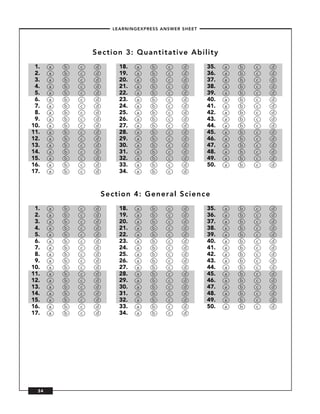
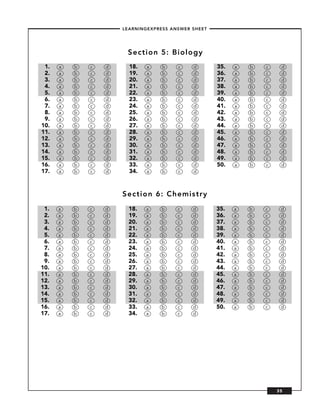
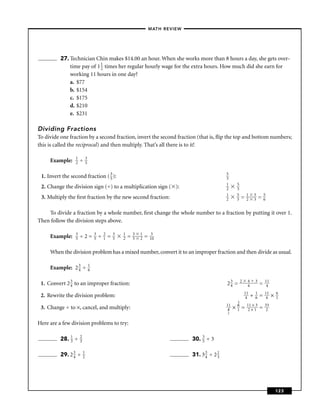
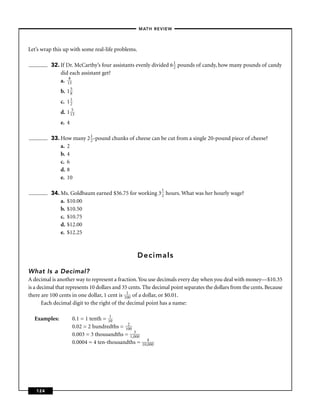
      acid (unstable)
                                                              + 4H2(g)
                                                           b. C3H8(g) + 502(g) → 3CO2(g) + 4H2O(g)
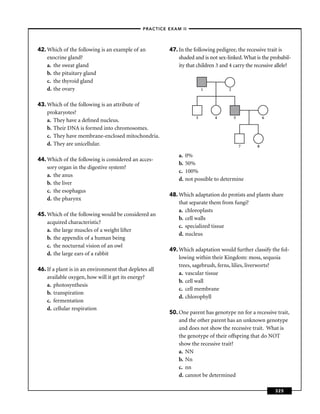
9. Chlorine, atomic number 17, becomes an ion
                                                           c. C3H8(g) + 6O2(g) + 2H2(g) → 3CO2(g) +
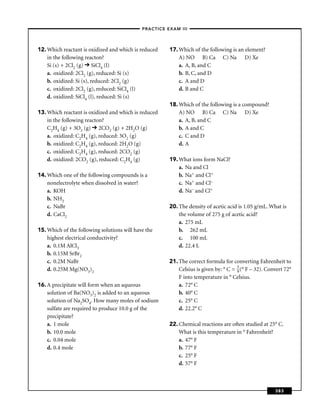
   when it bonds with Sodium to form salt. How
                                                              6H2O(g)
   many electrons does that ion have?
                                                           d. C3H8(g) + O2(g) + 4H2O(g) → 3CO2(g) + 6H2(g)
   a. 0
   b. 1
                                                       14. What is the electron configuration of a Cl– ion?
   c. 17
                                                           a. [Ne]3s23p5
   d. 18
                                                           b. [Ne]Ss2p63d1
                                                           c. [Ne]3s23p4
                                                           d. [Ne]3s23p6

     68
–PRACTICE EXAM I –


15. Which of the following is the hybridization of         20. Given that the density of water at 25° Celsius is
    the carbon atom in methane, CH4?                           0.997 g/cm3, what is the approximate mass of
    a. sp                                                      110 ml of water?
    b. sp2                                                     a. 11.0 g
    c. sp3                                                     b. 110 g
    d. sp4                                                     c. 32.9 g
                                                               d. 329 g
16. Which of the following elements is the most
    electronegative?                                       21. Which of the following is the chemical symbol
    a. Na                                                      for the species that has 16 protons, 17 neutrons,
    b. S                                                       and 18 electrons?
    c. Cl                                                         33
                                                               a. 16S
    d. Br                                                         33
                                                               b. 17Cl
                                                               c.   35
17. When a liquid is at its boiling point, the vapor                17Cl

    pressure of the liquid                                     d. 16S2–
                                                                  33

    a. is less than the external pressure on the liquid.
    b. is equal to the external pressure on the liquid.    22. Which of the following equations correctly
    c. is greater than the external pressure on the            describes the reaction between SO3(g) and
       liquid.                                                 KOH(aq)?
    d. can be either less or greater than the external         a. 4SO3(g) + 4KOH(aq) → 2H2SO4(aq) + 4K(s) + O2(g)
       pressure on the liquid.                                 b. SO3(g) + 2KOH(aq) → K2SO4(aq) + H2O(1)
                                                               c. 2SO3 + 4KOH(aq) → 2K2SO3(aq) + 2H2O(1) + O2(g)
18. Which of the following is the formula for the              d. No reaction occurs.
    compound cobalt (II) nitride?
    a. CoN2                                                23. How many moles are contained in a 54.0 g
    b. Co3N2                                                   sample of Al?
    c. CoNO3                                                   a. 1.0
    d. CoNO2                                                   b. 2.0
                                                               c. 0.5
19. Which of the following is the empirical formula            d. 4.0
    for ethylene glycol, C2H6O2?
    a. CH3O                                                24. Butane, C4H10, combusts to form CO2 and H2O.
    b. C2H6O2                                                  Which of the following is the balanced chemical
    c. C4H12O4                                                 equation that describes this reaction?
    d. CH2                                                     a. C4H10 + O2 CO2 + H2O
                                                               b. C4H10 +7O2 + H2 4CO2 + 6H2O
                                                               c. C4H10 + 7O2 4CO2 + 5H2O
                                                               d. 2C4H10 13O2 + 8CO2 + 10H2O


                                                                                                           69
–PRACTICE EXAM I –


25. One liter of solution is made by dissolving 29.2 g      30. What does the number 36 represent on the
    of NaCl in water. What is the molarity of the               periodic table entry for krypton?
    solution?                                                   a. atomic number
    a. 0.5M                                                     b. relative atomic mass
    b. 2.0 M                                                    c. group number
    c. 1.3 M                                                    d. electron configuration
    d. 0.82 M
                                                            31. How many valence electrons does an atom with
26. If a 2.0 M solution is diluted to 0.5 M, and the            the following electron configuration have: 1s2 2s2
    final volume is 100 ml, what was the original                2p4?
    volume?                                                     a. two
    a. 400 ml                                                   b. four
    b. 200 ml                                                   c. five
    c. 50 ml                                                    d. six
    d. 25 ml
                                                            32. Which of the following is the best Lewis struc-
27. Which of the following is the oxidation number              ture for methanol, CH3OH?
    of sulfur in the compound sodium thiosulfate,               a.        H
    Na2S2O3?                                                              | ..
    a. +1                                                          H – C – O– H
    b. –1                                                                 | ..
    c. +2                                                                 H
    d. –2
                                                                b.      H
                                                                        | ..
28. Two liters of air at a pressure of two atm are con-
                                                                     C–O–H–H
    densed to 0.5 liters. If the temperature is con-
                                                                        | ..
    stant, what is the new pressure?
                                                                        H
    a. 16 atm
    b. 8 atm                                                    c.     H
    c. 2 atm                                                             
    d. 0.5 atm                                                          C    O–H:
                                                                         /    |
29. The composition of dry air consists of approxi-                    H     H
    mately 78% nitrogen, N2, and 21% oxygen, O2.
                                                                d.        H
    If the air pressure of a 5-liter sample of dry air is
                                                                           | ..
    800 torr, what is the approximate partial pressure
                                                                     H – C – O– H
    of oxygen?
                                                                           |
    a. 620 torr
                                                                          H
    b. 720 torr
    c. 210 torr
    d. 170 torr


    70
–PRACTICE EXAM I –


33. A single atom of an element in group VI is most      Answer questions 37 and 38 based on the following
    likely to form an ionic bond with a single atom of   phase diagram for a compound.
    an element in group
    a. I
    b. II                                                                                    D             C
    c. III
    d. IV

34. What bond is responsible for water tension and                          G                    H


                                                           Pressure
    the formation of water drops?
    a. ionic bond                                                     1 atm         E
    b. nuclear bond                                                                                  F
    c. covalent bond                                                            B
    d. hydrogen bond
                                                                        J               I
35. Which of the following will do the least damage
                                                                        A
    to the hemoglobin in blood?
    a. pH of 1.60                                                                           Temperature
    b. pH of 2.50
    c. pH of 4.90                                        37. At which point is the compound a solid?
    d. pH of 7.40                                            a. F
                                                             b. G
36. Which of the following variables are inversely           c. H
    proportional for an ideal gas if all other condi-        d. I
    tions are constant?
    a. pressure and volume                               38. Sublimation occurs when moving from
    b. pressure and temperature                              a. G to H.
    c. pressure and the number of moles                      b. I to J.
    d. No two variables are inversely proportional.          c. J to I.
                                                             d. I to H.

                                                         39. Which of following is the balanced equation for
                                                             the reaction between NH3 and O2?
                                                             a. 4NH3 + 5O2 → 4NO + 6H2O
                                                             b. 2NH3 + 3O2 → 2NO + 3H2O
                                                             c. 2NH3 + 2O2 → N2O + 3H2O
                                                             d. NH3 + O2 → N2O + 3H2O


                                                                                                          71
–PRACTICE EXAM I –


40. In the reaction 4A1 +3O2 → 2A12O3, how many        45.
    grams of O2 are needed to completely react with
    1.5 moles of Al?
    a. 24 g
    b. 36 g
    c. 48 g
    d. 60 g

41. Appropriate protection from exposure to alpha
    particles is provided by
    a. thin clothing and breathing protection.
    b. thick layered clothing and breathing
       protection.
    c. concrete and/or lead walled containment.
    d. No material provides appropriate protection.          Which of these sets of measurements shows the
                                                             greatest precision?
42. The Cl– ion is correctly called                          a. 112 mL, 125 mL, 130 ml, 127 mL
    a. chloride.                                             b. 122 mL, 121 mL, 121 mL, 121 mL
    b. chlorate.                                             c. 125 mL, 123 mL, 126 mL, 125 mL
    c. chlorine                                              d. 132 mL, 126 mL, 124 mL, 122 mL
    d. chlorase.
                                                       46. Which of the following is the most reactive with
43. Convert 8.26     102
                    nm to pm.                              water?
    a. 8.26 103 pm                                         a. Cs
    b. 8.26 105 pm                                         b. Ba
    c. 8.26 10–3 pm                                        c. Fr
    d. 8.26 10–5 pm                                        d. Ra

44. HPO4–2 + H+ H2PO–4                                 47. Which of the following is the most likely charge
    The above system would be most effective for           on an ion of Sr? (Sr is a group IIA molecule.)
    a. preventing a drop in blood pH below 7.40.           a. Sr–
    b. preventing a rise in blood pH above 7.40.           b. Sr2–
    c. holding the blood pH significantly above 7.40.       c. Sr+
    d. holding the blood pH significantly below 7.40.       d. Sr2+

                                                       48. Which of the following ions is essential in the
                                                           clotting of blood?
                                                           a. Ca2+
                                                           b. F–
                                                           c. Na+
                                                           d. OH–


    72
–PRACTICE EXAM I –


49. Which of the following is most likely to bond     50. A fatty acid with no double bonds is known as a
    with the ferrous (Fe2+) ion in blood?                 a. polyunsaturated fatty acid.
    a. O2                                                 b. monounsaturated fatty acid.
    b. CO                                                 c. saturated fatty acid.
    c. CO2                                                d. trans fatty acid.
    d. N2


                                                                                                   73
–PRACTICE EXAM I –


                   Answers                              40. c.   The correct spelling is circumference.
                                                        41. b.   The correct spelling is worries.
Section 1: Verbal Ability                               42. b.   The correct spelling is finality.
 1. a. weigh                                            43. a.   The correct spelling is religious.
 2. c. proceed                                          44. d.   no mistakes
 3. a. pierce                                           45. b.   The correct spelling is delinquent.
 4. a. merrily                                          46. c.   The correct spelling is forecast.
 5. a. manageable                                       47. a.   The correct spelling is righteous.
 6. a. catalog                                          48. a.   The correct spelling is sincerely.
 7. b. definitely                                        49. b.   The correct spelling is vacancy.
 8. b. errant                                           50. b.   The correct spelling is respiration.
 9. c. obsession
10. d. jeopardy                                         Section 2: Reading Comprehension
11. c. magnificent                                        1. d. Many asthma sufferers have an inherited ten-
12. b. mechanically                                            dency to have allergies, referred to as atopy in
13. d. illicit                                                 the third paragraph.
14. a. inquiry                                           2. b. The second paragraph explains that during an
15. a. terminated                                              attack, the asthmatic will compensate for con-
16. a. persecution                                             stricted airways by breathing a greater volume
17. b. peculiar                                                of air.
18. d. psychology                                        3. c. The first sentence of the passage begins, No
19. d. license                                                 longer . . . , indicating that in the past, asthma
20. a. concise                                                 was considered an anomalous inflammation
21. d. neighbor                                                of the bronchi. Now asthma is considered a
22. a. stabilize                                               chronic condition of the lungs.
23. c. irrelevant                                        4. a. An exacerbation is usually defined as an aggra-
24. d. aspirations                                             vation of symptoms or increase in the severity
25. b. exercise                                                of a disease. However, in this passage, exacer-
26. b. The correct spelling is fierce.                          bations is interchangeable with asthma attacks.
27. a. The correct spelling is preparation.              5. a. Although cramping may occur during asthma
28. c. The correct spelling is forfeit.                        attacks, it is not mentioned in the passage. See
29. d. no mistakes                                             the bottom half of the second paragraph for a
30. d. no mistakes                                             full explanation of the morphological effects
31. b. The correct spelling is height.                         of an attack.
32. c. The correct spelling is emperor.                  6. d. The third paragraph discusses triggers in
33. b. The correct spelling is contradict.                     detail. Only physical activity is listed as a
34. b. The correct spelling is reversal.                       possible symptom reducer.
35. c. The correct spelling is foreign.                  7. a. Since asthma symptoms vary throughout the
36. a. The correct spelling is ravenous.                       day, relying on the presence of an attack or
37. a. The correct spelling is phenomenal.                     even just on the presence of a respiratory
38. b. The correct spelling is temperature.                    ailment to diagnose asthma is flawed logic.
39. d. no mistakes


    74
–PRACTICE EXAM I –


 8. b. All of the individuals listed would glean a cer-   18. b. See the last sentence of the sixth paragraph,
       tain amount of knowledge from the passage;                which points out that steam sterilization does
       however, a healthcare professional would find              not change the appearance of the waste, thus
       the broad overview of the effects of asthma,              perhaps raising questions at a landfill.
       combined with the trigger-avoidance and            19. c. The fourth paragraph states that liquid is sep-
       diagnosis information, most relevant.                     arated from pulp in the hydropulping process.
 9. d. According to the third paragraph, second-                 The sixth paragraph says that liquid may form
       hand smoke can increase the risk of allergic              during the sterilization process.
       sensitization in children.                         20. a. This response relies on an understanding of
10. b. According to paragraph 2, when reviewing a                pathological wastes, which are wastes gener-
       new substance, the FDA considers its safety in            ated by infectious materials. The seventh
       terms of factors like the composition and prop-           paragraph points out that incineration is
       erties of the substance.                                  especially appropriate for pathological wastes.
11. c. See the last sentence of paragraph 2, which               Previously, the sixth paragraph had said that
       states that the levels of use that gain approval          steam sterilization is appropriate for
       are much lower than what would be expected to             substances contaminated with infectious
       have any adverse effect.                                  organisms.
12. a. According to paragraph 3, the limitations of       21. d. The second paragraph says that the main risk
       science mean that the FDA can never be 100%               of manual carts is potential exposure from
       sure of the absence of any risk from the use of           torn bags but automated carts can reduce that
       any substance.                                            potential.
13. a. Nowhere in the passage is the FDA’s involve-       22. b. See the next-to-last sentence of the fourth
       ment in the amount of money charged for                   paragraph. Sterilization does not change the
       products using their approved additives dis-              appearance of waste. While compacting does
       cussed.                                                   change the volume of the waste, it is not
14. c. According to paragraph 5, federal authorities             appropriate for eliminating hazardous
       may prohibit use or conduct further studies               materials.
       on a product if new evidence suggests that a       23. d. See the second sentence of the second para-
       product already in use may be unsafe, or if               graph: There is some risk of exhausting contam-
       consumption levels have changed.                          inants into hallways, meaning waste might be
15. b. The passage as a whole introduces the FDA                 discharged.
       and talks about its function in society.           24. b. See the last sentence of the passage, which
16. d. See the last sentence of the third paragraph.             states, regarding the rotary kiln, that the costs
       Compaction may well reduce transportation                 have been prohibitive for smaller units.
       costs (choice a) according to the third para-      25. c. In the first paragraph, the communication
       graph. That it reduces the volume of waste                network of the millions of cells in the
       (choice b) is an advantage, not a disadvantage.           immune system is compared to bees swarm-
       Compaction is not designed to eliminate                   ing around a hive.
       organic matter, so confirming that it has been      26. b. All of the answers indicate peaceful coexis-
       eliminated (choice c) is not an issue.                    tence. However, according to the fifth sentence
17. a. See the last sentence of the fifth paragraph,              of the second paragraph, in this instance, the
       which states that incineration is . . . the pre-          state is referred to as self-tolerance.
       ferred method for on-site treatment.

                                                                                                           75
–PRACTICE EXAM I –


27. c. See the last paragraph. Allergens are responsi-    37. c. People with diabetes have too much glucose in
       ble for triggering an inappropriate immune                their blood. As stated in paragraph 3, insulin
       response to otherwise harmless substances                 is used to help bring blood glucose levels
       such as ragweed pollen.                                   down.
28. d. The last paragraph of the passage mentions         38. d. Paragraph 3 states that excess glucose can lead
       that an antigen announces its foreignness with            to heart disease, stroke, nerve damage, blind-
       intricate shapes called epitopes that protrude            ness, and kidney disease because of damage to
       from the surface.                                         large and small blood vessels. Paralysis is not
29. a. Every individual’s immune system must learn to            listed as an ailment.
       recognize and deal with nonself molecules          39. c. Intensive diabetes management combined
       through experience. However, the last section of          with the stresses of school and youth can be
       the second paragraph mentions that the                    very daunting, or overwhelming, for students.
       immune system is capable of choices b, c, and d.   40. c. According to paragraph 4, parents should
30. a. According to the second paragraph, the ability            develop a diabetes management plan with
       to distinguish between self and nonself is the            their child’s healthcare team that outlines the
       heart of the immune system. This topic is fur-            child’s specific medical needs. Nowhere in the
       ther elucidated throughout the body of the                passage does it say that children with diabetes
       passage.                                                  need to stay indoors, avoid physical activity, or
31. b. The last paragraph mentions that tissues or               inject insulin every hour.
       cells from another individual may act as anti-     41. c. As a whole, the passage introduces and
       gens except in the case of identical twins,               explains meiosis and mitosis, the two types of
       whose cells carry identical self markers.                 cell division.
32. b. The passage is a message to parents about how      42. a. According to paragraph 2, during mitosis, a cell
       important it is to inform their children about            duplicates all of its contents, including its chro-
       their condition and how best to handle it.                mosomes, and splits to form two identical daugh-
33. b. According to paragraph 2, excess weight and               ter cells.
       inactivity put children and teens at risk for      43. d. When the sperm and the egg unite during
       type 2 diabetes.                                          conception, they physically come together, or
34. d. According to paragraph 3, people with dia-                join.
       betes need to keep their glucose levels from       44. c. See the third paragraph, which explains that
       dropping by snacking.                                     after meiosis, the sperm and the egg each have
35. a. The passage does not say anything about glu-              23 chromosomes. When they unite, each con-
       cose levels regulating themselves. It makes a             tributes 23 for a total of 46.
       point to say that monitoring glucose levels is a   45. d. According to paragraph 1, mitosis is the
       24 hours a day, seven days a week task.                   process responsible for making new body
36. c. Paragraph 3 makes a point to specify that peo-            cells; meiosis is the process responsible for
       ple with diabetes must regularly check their              creating egg and sperm cells.
       blood glucose.


    76
–PRACTICE EXAM I –


Section 3: Quantitative Ability                             10. c. Add together his miles per hour for each hour
1. a.   First, change 3 4 into an improper fraction: 3 4
                        5                              5
                                                                   traveled and then divide by 3 to get the aver-
        19
         5 . The reciprocal of 159 is 159 .                        age speed: 12 for hour one + 12 for hour two
2. b. To solve for y, you must isolate it on one side of              14 for hour three = 338 12 2 .     3
      the equation. Subtract 17 from both sides to get      11. b. 157 is rounded to 200; 817 is rounded to 800.
      12y 144. Divide both sides by 12 to find that                 To get the product, multiply 200(800), which
      y 12.                                                        is 160,000.
3. b. The formula for circumference is 2πr. Since           12. a. The first step in solving the problem is to sub-
      the radius is 5, the circumference is 2π (5) or              tract 86 from 148. The remainder, 62, is then
      10π.                                                         divided by 2 to get 31.
4. c. First, find the total area of the wall. Since the      13. b. You simply add all the numbers together to
      wall is square, all sides are the same. The area             get the correct answer, $92.61.
      of a square is length width, so the area of           14. b. 150x = (100)(1), where x is the part of a mile a
      the wall is 12 12 144. If the designer buys                  jogger has to go to burn the calories a walker
      180 square feet and only uses 144, he has 180                burns in 1 mile. If you divide both sides of
          144 36 feet left.                                        this equation by 150, you get x = 100 . Cancel
                                                                                                            150
5. b. Be careful to keep track of the units with                   50 from the numerator and denominator to
      which you are working in. An easy way to                     get 2 . This means that a jogger has to jog only
                                                                       3
                                                                   2
      compute is to change all units to inches: 6 feet,            3 of a mile to burn the same number of calo-
      2 inches = 6(12) 2 74 inches. 4 feet, 9                      ries a walker burns in a mile of brisk walking.
      inches 4(12) 9 57 inches. 74 inches                   15. c. The ratio is 100 lcbs. = 17x5clc , where x is the num-
                                                                                  12 c
                                                                                                  bs.
      57 inches 17 inches, or 1 foot 5 inches.                     ber of cc’s per 175 lbs. Multiply both sides by 175
6. d. First, find the number of complete days—all                   in order to get 175 11020 = x, so x = 21.
      day Saturday is one full day. Next, subtract          16. a. 20% of 1,800 = (0.2)(1,800) = 360 calories
      5:30 from the 12:00 (midnight) that follows to               from fat. Since there are 9 calories in each
      get 6 hours 30 minutes. Next, subtract 8:15                  gram of fat, you should divide 360 by 9 to find
      from the previous midnight to get 20 hours                   that 40 grams of fat are allowed.
      15 minutes. Add them all together: 1 day + 6          17. b. 5% of 1 liter = (0.05)(1) = 0.02x, where x is the
      hours 30 minutes + 20 hours 15 minutes 1                     total amount of water in the resulting 2%
      day + 26 hours 45 minutes 2 days, 2 hours,                   solution. Solving for x, you get 2.5. Subtracting
      45 minutes.                                                  the 1 liter of water already present in the 5%
7. b. Change the first fraction into an improper                    solution, you will find that 1.5 liters need to be
      fraction: 3 3 145 . To divide by 15, multiply by
                  4
                                                                   added.
      its reciprocal: 145 15 145 115 . Cancel out           18. b. 20% of 15 cc = (0.20)(15) = 3. Adding 3 to 15
      the 15s to get 1 .
                      4
                                                                   gives 18 cc.
8. c. Read the question carefully; it asks how much         19. c. The volume of a cylinder πr2h, where r is the
      Sarah spent on clothes only: $25.20 $45.05                   radius of the cylinder and h is the height. The
          $32.75 $103.00.                                          radius is half the diameter, so the radius of
9. c. Read the question carefully; it asks how many                this cylinder is ( 1 )(8 cm) = 4 cm. The height
                                                                                        2
      people were present at work: 0.15 40 6                       of the volume is 10 – 4 = 6 (the height of the
      people who were home sick. That means 40                     whole cylinder minus the height of space in
      6 34 people were present.                                    which the liquid has been poured out). So the
                                                                   volume πr2h = π(4)2(6) = π(16)(6) = 96π cm3.

                                                                                                                 77
–PRACTICE EXAM I –


20. c. The easiest way to calculate the volume is to      31. c. First, change 2 1 to an improper fraction: 9 .
                                                                                     4                           4
       realize that the shaded figure is made up of               Next, in order to divide by 2 , invert that
                                                                                                  3
       half a circle of diameter 4 or radius 2 on top            fraction to 3 and multiply: 9 3 = 287 = 3 3 .
                                                                                2                 4   2           8
       of a rectangle that is 4 units wide and 6 units    32. a. First, find the least common denominator, 16;
                                                                 7    14
       tall. The area of a rectangle is length times             8 = 16 , so you can rewrite the problem as
       width. The area of a half circle is πr2. So the           (3 + 196 ) – (1 + 14 ). To get a large enough
                                                                                       16
       shaded area = (4)(6) + 1 π22 = 24 + 2π.
                                 2                               numerator from which to subtract 14, you
21. a. First, find out what 12 rides would cost if you            borrow 1 from the 3 to rewrite the problem as
       bought each ride individually: 12 $1.50                   2 26 – 1 14 = 1 11 .
                                                                   16     16        16
       $18.00. $18.00 $15.50 = $2.50.                     33. b. This is a simple multiplication problem,
22. d. After Jules pays rent, he has $3,000 – $750 =             which is solved by multiplying 35 8.2 in
       $2,250 dollars left. 1% = of , so 1% = $2,,250 .
                             00
                                   is
                                          00   $3 000            order to get 287.
       Solve for % to find that % = 75.                    34. c. The problem is solved by dividing 204 by
23. c. Write out the words into equations. t s + 4;              1,700. The answer, 0.12, is then converted to a
       s r 2. When r 8, then s 6. When s                         percentage, 12%.
       6, then t = 6 + 4 10.                              35. d. To solve this problem, you must convert 3 1 to   2
                                                                 7
24. b. First, find the percent increase from 8 to 10.             2  and then divide 7 by 1 , which is the same as
                                                                                          2  4
       10 8 2 2 1 25%. How do you
                    8    4                                       multiplying 7 by 4.
                                                                                  2
       increase 16 by 25%? Find 25% of 16: 16             36. b. The simplest way to solve this problem is to
       0.25 4. Add this 25 to 16: 16 4 20.                       divide 1 by 1,500, which is 0.0006667, and
25. d. Solve the equation by isolating x: 13 0.0013              then count off two decimal places to arrive at
          10,000.                                                the percentage 0.06667%. Since the question
26. b. Simply estimating the value of 470 will proba-            asks about what percentage, the nearest value is
       bly let you know that 0.0175 is much too                  0.067%.
       small and 1.75 is much too large. If that did      37. a. You can use trial and error to arrive at a solu-
       not work for you, however, you could divide               tion to this problem. Using choice a, after the
       7.0 by 40 in order to get 0.175.                          first hour, the number would be 20, after the
27. d. 30 ppm of the pollutant would have to be                  second hour 40, after the third hour 80, after
       removed to bring the 50 ppm down to                       the fourth hour 160, and after the fifth hour
       20 ppm; 30 ppm represents 60% of 50 ppm.                  320. The other answer choices do not have the
28. a. The drug is 50% effective for half (or 50%) of            same outcome.
       migraine sufferers, so it eliminates               38. a. Since the solution to the problem x + 25 = 13
       (0.50)(0.50) = 0.25 = 25% of all migraines.               is –12, choices b, c, and d are all too large to
29. d. Division is used to arrive at a decimal, which            be correct.
       can then be rounded to the nearest hundredth       39. b. A cube has four sides, a top, and a bottom,
       and converted to a percentage: 11,350 ÷                   which means that it has six faces.
       21,500 = 0.5279; 0.5279 rounded to the near-       40. d. To solve this problem, you should use the for-
       est hundredth is 0.53, or 53%.                            mula A = lw, or 117 = 9l. Next, you must
30. c. Since there are two decimal places in each                divide 117 by 9 to find the answer, 13.
       number you are multiplying, you need a total       41. a. Fractions must be converted to the lowest
       of four decimal places in the answer, 0.2646.             common denominator, which is 60; 160 = 36 ;     60
                                                                 11
                                                                 20  = 33 ; 185 = 32 , which is the smallest fraction.
                                                                       60           60


    78
–PRACTICE EXAM I –


42. c. Add the whole numbers: 2 + 4 = 6. Use the           4. d. There are 1,000,000 micrograms in one gram.
       least common denominator of 8 to add the                  The prefix micro- means million.
       fractions: 2 + 5 + 4 = 181 = l 3 . Add 1 to the
                   8   8    8         8                    5. c. The universe is expanding outward.
       whole number sum: 1 + 6 = 7, and then add           6. c. Hippocrates learned all about the body and
       the fraction to get 7 3 .
                              8                                  diseases, as much as he could in ancient
43. d. 750 is n% of 600, expressed as an equation, is            Greece, and so is called the “father” of
       750 = ( 1n )(600). Cancel 100 in the right side
                00                                               medicine.
       of the equation: 750 = 6n. Divide both sides        7. d. Galileo made himself a small—but for that
       by 6 to arrive at the answer, n = 125.                    time powerful—telescope, turned it skyward,
44. d. Multiply the numerator and denominator of                 and made many discoveries, including the
       13              52
       25 by 4 to get 100 .                                      moons of Jupiter, craters of our moon, and
45. c. 0.32 103 is equal to 0.32 (10 10 10),                     sunspots.
       or 320.                                             8. a. The control in an experiment is the baseline
46. b. Because parallel lines never intersect, choice a          not subjected to the variable under study.
       is incorrect. Perpendicular lines do intersect,           Choices c and d are made up.
       so choice c is incorrect. Choice d is incorrect     9. d. Occam’s razor is the principle modeled after
       because intersecting lines have only one point            the philosophy of Englishman William of
       in common.                                                Occam.
47. c. This is a simple subtraction problem, as long      10. b. Theories are the biggest concepts, such as Ein-
       as the decimals are lined up correctly: 3.60 –            stein’s theory of relativity or Darwin’s theory
       1.89.                                                     of evolution. Theories can contain more
48. c. This is a two-step multiplication problem. To             detailed hypotheses and good theories make
       find out how many heartbeats there would be                predictions.
       in one hour, you must multiply 72 by 60 min-       11. c. The atmosphere of Venus is dominated by
       utes, and then multiply this result, 4,320, by            CO2. It has no water vapor and is very thick.
       6.5 hours in order to get 28,080.                  12. b. Most of the universe is made of dark energy.
49. a. The unreduced ratio is 8,000:5,000,000 or          13. a. The Apollo program landed a human on
       8:5,000; 5,000 ÷ 8 = 625, for a ratio of 1:625.           the moon. The first moon landing was in
50. b. The correct answer is 214 . Before subtracting,           June 1969.
       you must convert both fractions to 24ths.          14. d. If atoms have the same number of protons but
                                                                 different numbers of neutrons, they are iso-
Section 4: General Science                                       topes.
 1. c. Johann Kepler gave us the laws of planetary        15. a. If a substance gains electrons, it is oxidized. If
       motion. Lyell studied changes in Earth over               it loses electrons, it is said to be reduced
       time; Mendel studied the heredity of plants;              (because it loses its negative charge).
       and Hooke studied biological cells.                16. d. The prefix micro- refers to millionths.
 2. b. The experimental factor is the one you change      17. d. The prefix giga- refers to billions.
       or manipulate. All the others are held con-        18. d. The foot is a unit of length found only in the
       stant.                                                    English system.
 3. c. The standard unit of volume is the liter.          19. b. There are 1,000 or 103 meters in a kilometer.


                                                                                                            79
–PRACTICE EXAM I –


20. b. Multiplying 60 seconds per minute by 60 min-                   tures and pressures of the supernova explo-
       utes per hour times 24 hours per day by 365                    sion itself.
       days in a year (actually 365.25) yields the           29. d.   Hydrogen is primordial, made shortly after
       answer of between 31 and 32 million seconds                    the Big Bang when the universe cooled
       per year.                                                      enough for atoms to condense. The other ele-
21. b. Radiation is the means of heat transfer by                     ments are all made by nuclear fusion reactions
       which heat moves outward from a hot body.                      in stars. These reactions consume hydrogen.
22. a. We believe the dinosaurs became extinct               30. c.   Helium is both primordial and made during
       because of a massive meteor that impacted                      fusion reactions when two hydrogen nuclei
       Earth. Evidence for this includes a layer of                   are fused together inside stars. This fusion
       iridium in the rock layer from the same time                   reaction is the main source of energy for stars.
       period—iridium being found primarily only             31. d.   Carbon increases in density because as time
       in meteorites. Also, a giant impact crater has                 passes, more and more carbon is made in the
       been found from that time.                                     fusion reactions inside stars. Choices a and b
23. b. If a rock contains fossils, it is most likely sedi-            actually decrease in density as the universe
       mentary. Igneous, metamorphic, and volcanic                    expands, and choice c also decreases in density
       rocks have been exposed to too much heat                       as hydrogen is consumed in fusion reactions.
       and/or pressure for any traces of life to be left     32. c.   Because the Big Bang was 13.7 billion years ago
       behind.                                                        and the sun formed between 5 and 4.5 billion
24. a. Weather occurs in the troposphere.                             years ago, then, subtracting, the sun formed
25. d. Autotrophs are plants and algae that produce                   about 9 billion years after the Big Bang.
       their own food through photosynthesis. The            33. b.   If the time when the Big Bang occurred was
       other choices are all animals, which do not                    13.7 billion years ago, the formation of Earth
       carry out photosynthesis.                                      occurred about 4.5 billion years ago. There-
26. d. Patterns from distant galaxies are shifted                     fore, taking 1 EFU as 4.5 billion years (by defi-
       “red,” which means toward longer wave-                         nition from the question), there were 143..57 or
       lengths. In this case, going from a pattern in                 about 3 EFUs back to the Big Bang.
       the red toward a pattern in longer wavelengths        34. c.   Meteorites formed along with Earth at the
       means the infrared.                                            beginning of the solar system. But on Earth,
27. d. Oxygen is formed last because it is the most                   no rocks go back that far. The dates from
       massive and complex. Fusion reactions build                    meteorites give us the best estimate of the ori-
       from the simplest to the most complex, and                     gin of our solar system.
       the stages of fusion take hydrogen and then           35. d.   Mercury is the nearest planet. The asteroids
       the other elements built in sequence as start-                 are between Mars and Jupiter. Phobos is a
       ing points for more complex elements.                          moon of Mars.
28. a. Supernova explosions, which are catastrophic          36. b.   Of the possibilities, the only one in space right
       events at the end of the lives of giant stars,                 now is the international space station. Hope-
       scatter elements previously made by fusion                     fully, the space shuttles will be put back into
       reactions in the star over their lifetimes, as                 active service, but it’s Russian rockets that are
       well as elements born in the intense tempera-                  taking new astronauts to the space station at
                                                                      this time.


    80
–PRACTICE EXAM I –


37. b. In July 1969, Neil Armstrong set foot on the                 neutron—a nuclear change). Using its half-life
       moon and pronounced, “One small step for                     decay rate, we can measure the amount of
       man, one giant leap for mankind.”                            carbon-14 in ancient wood to determine the
38. b. In 2004, rovers on the surface of Mars discov-               dates of wood architecture of ancient peoples
       ered types of minerals that, as far as we know,              as well as their campfires and even bones.
       could have been formed only with the activity       46. c.   Quarks are the constituents of protons and
       of water. Also, previously, channels on Mars                 neutrons.
       had been seen that looked much like the             47. d.   Neutrons and protons are the parts of the
       branching slow patterns of Earth’s rivers.                   nucleus of an atom.
39. c. Jupiter comes before the planet with rings,         48. b.   The unit of resistance is the ohm.
       Saturn. Choices a and d are planets farther         49. c.   An important topic in physics is the angular
       away than Saturn. And obviously, Saturn itself               properties of objects that spin or turn in arcs.
       (choice b) makes no sense.                                   Angular momentum is one such property.
40. d. The spins of galaxies cannot be explained by        50. c.   Electromagnetism governs interactions
       the amount of known, ordinary matter. Some-                  between charged particles, the situation that
       thing out there (the “dark matter”) is creating              occurs when atoms possessing different num-
       more gravity than we can account for with the                bers of valence electrons interact.
       known, ordinary matter.
41. b. 73% of the universe is dark energy.                 Section 5: Biology
42. c. Carbon is made by fusion reactions in stars.         1. b. A-U is a nucleotide base-pairing. This repre-
       Therefore, before stars and supernovas can                 sents the pairing in RNA with tyrosine (T)
       disperse that carbon, there would have been                replaced by uracil (U).
       no carbon in the earliest planets (in fact, plan-    2. d. Adipose tissue is the connective tissue other-
       ets as solid bodies could not have formed                  wise known as fat. Adipose is made up of
       either). Life is so dependent on carbon that               lipids, also referred to as fatty acids or triglyc-
       without carbon is seems likely there could not             erides.
       have been life.                                      3. a. Viruses are unable to reproduce because they
43. d. The continental slope is still part of the conti-          lack cells. Viruses rely on host cells to express
       nent, but it does head downward to the ocean               their genetic material. Viruses contain
       floor itself.                                               enzymes, nucleic acid, and have evolved
44. a. The word atom came from the Greek word                     through natural selection.
       that meant indivisible. Though atoms are now         4. d. Kingdoms are general categories and species
       known to have parts (they are divisible), they             are very specific groups.
       still are the fundamental units of any element.      5. b. One of the primary functions of the liver is
45. d. Carbon-14 is the radioactive form of carbon                to process toxins absorbed in the digestive
       (the most common form is carbon-12).                       system.
       Carbon-14 is formed in the atmosphere when           6. b. The loop of Henle is a component of the
       cosmic rays hit nitrogen and convert small                 nephron of the kidney, the excretory organ in
       amounts of it (by changing a proton to a                   vertebrates.


                                                                                                              81
–PRACTICE EXAM I –


 7. d. All animals except mammals and birds are            17. c. Hepatitis is a disease marked by a inflamma-
       cold-blooded or ectotherms.                                tion of the liver, as indicated by the Greek
 8. a. The following are the SI units: 10–l = deci; 10–2          roots hepato meaning liver and itis meaning
       = centi; 10–3 = milli; 10–6 = micro; 10–9 = nano;          inflammation.
       10–12 = pica; 10–15 = femto; l0–18 = atto.          18. b. Tissues, such as bone and skin, are made from
 9. b. A compartment filled with air or watery fluid                cells. Organs, such as the heart and lungs, are
       in the cytoplasm is referred to as a vacuole.              made from tissues. One example of a system is
       Centrioles and centrosomes are associated                  the digestive system, which involves organs
       with the process of cell division.                         such as the stomach, which is made up of
10. c. Chloroplasts contain chlorophyll and are                   smooth muscle plus epithelial and connective
       found only in plant cells.                                 tissues.
11. d. Ribosomes are structures that are present in        19. a. The primary function of a blood platelet is to
       all cells and are responsible for producing                aid in the blood clotting process. Platelets
       proteins. Ribosomes are not considered                     scrape against the rough edges of broken tis-
       organelles.                                                sue and release a substance to promote clot-
12. b. All cells undergo mitosis to reproduce into                ting. Red blood cells carry oxygen. Antibodies
       identical cells with the same DNA. Cells spe-              are produced by B lymphocytes. Phagocytic
       cialize into different tissue by expressing dif-           cells include neutrophils and macrophages
       ferent parts of their DNA. Only gametes may                (monocytes).
       have different DNA from their parent cells          20. d. An expressed trait is determined by two
       due to meiosis.                                            alleles. A phenotype is the physical or visual
13. a. Mammals and birds are the only animals that                expression of the genotype.
       can regulate body temperature (warm-blooded).       21. d. Organisms that adapted to use oxygen
       Although nearly all mammals give birth to live             through aerobic respiration made energy
       young, the duck-billed platypus lays eggs.                 more efficiently than those that used anaero-
14. d. Prokaryotes are simple, single-celled microor-             bic respiration, giving them an evolutionary
       ganisms, but contain ribosomes for protein                 advantage.
       synthesis, cell membrane, and DNA. How-             22. c. Early cells were prokaryotic and resemble the
       ever, they do not contain a nucleus.                       bacteria found today. The other options are
15. b. Flowering plants (angiosperms) might repro-                simple life forms evolved from single-cell
       duce faster because their reproductive process             prokaryotes.
       involves flowers, which attract insects to help      23. d. The father gives only his Y chromosome to the
       spread pollen and other animals to spread                  son so the mother must have given the son the
       seeds. Also, the seeds of angiosperms have a               X-linked trait. Because the mother does not
       tough skin, which may help them tolerate                   show the X-linked trait, she is considered a
       harsh conditions.                                          carrier of the trait.
16. d. The figure is a nerve cell. Note the long exten-     24. a. Marrow produces red and white blood cells
       sions (axons and dendrites) unique to neu-                 and platelets, and is located in the bones of
       rons. Blood, fat, and muscle cells have very               the skeletal system.
       different shapes.


    82
–PRACTICE EXAM I –


25. d. Animal cells do not have cell walls. Species                  converted to glucose by the liver. Lactose is
       with no backbone; lock of specialized organ                   milk sugar. Adrenaline is a hormone produced
       systems; and/or a hard exoskeleton are catego-                in the adrenal medulla that stimulates the
       rized in the Animal kingdom.                                  sympathetic nervous system, while serotonin,
26. c. Kelp is a brown algae; the others are fungi.                  also a hormone, is produced in many parts of
27. c. Viruses are noncellular, and they must enter a                the body.
       living cell to replicate. However, not all viruses   36. c.   The large intestine’s main functions are water
       are disease-causing; many viruses do no                       absorption and feces production. The large
       apparent harm.                                                intestine consists of the rectum, colon, and
28. b. Bacteria can be placed in three groups (cocci,                caecum. Almost all the digestion and absorp-
       bacilli, spirilla) based on their shape.                      tion of nutrients occur in the small intestine.
29. c. Malaria is caused by Plasmodium, which is a                   The liver has numerous functions including
       protist. The others are viruses.                              the metabolism of carbohydrates, lipids, and
30. c. All bacteria are prokaryotes, meaning that                    proteins, as well as the removal of drugs and
       they lack a nucleus. Eukaryotes contain a                     hormones and the production of bile. The
       nucleus and other organelles. Some eukary-                    stomach is the holding reservoir in which
       otes are single-celled (protists).                            saliva, food, and gastric juices mix prior to
31. c. Birds and humans are the only animals that                    continuing the digestive process in the small
       can stand erect and move around on two legs.                  intestine.
       Bi- is a combining form meaning two. Ped is          37. a.   Calcium ions are released in the interim
       the combining form for foot.                                  between the time when a stimulus is received
32. d. Translocation is a type of mutation in which a                and a response occurs in muscle tissue.
       section of a chromosome breaks off and joins         38. a.   Beriberi, most common in countries where
       with another. In aneuploidy, one has an                       white rice is the main food source, is caused
       abnormal number of chromosomes. Tran-                         by a lack of vitamin B1. Deficiencies in vita-
       scription is the process in which genetic infor-              min C can cause scurvy and deficiencies in
       mation is transferred from DNA to mRNA.                       vitamin D can cause rickets. Hemolytic ane-
       Translation is a process used in the synthesis                mia is a possible consequence of vitamin E
       of new proteins on ribosomes.                                 deficiency.
33. b. A zygote is the product of a sperm nucleus           39. b.   The quadriceps femoris join at the base of the
       fused with an ovum nucleus. A zoospore is                     femur. The triceps brachii extends the fore-
       found in certain fungi. Ova is the plural of                  arm, the biceps femoris is one of the ham-
       ovum, a female egg, while an oocyte is a cell in              string muscles that flexes the leg and extends
       the ovary that produces an ovum after under-                  the thigh, and the gastrocnemius flexes the leg
       going meiosis.                                                and foot.
34. b. A section of the male part of a flower is the         40. d.   Anaphylaxis is an immune system response
       stamen, consisting of the anther and filament.                 such as that which occurs in a person who gets
       The stigma and style are both parts of the                    stung by a bee and is allergic to the venom.
       carpel.                                                       Hypertension is another term for high blood
35. a. When there is a shortage of oxygen in muscle                  pressure.
       tissue, pyruvic acid produces lactic acid to be


                                                                                                             83
–PRACTICE EXAM I –


41. a. The correct answer is analgesic. Anesthetics        Section 6: Chemistry
       block perception of all sensory stimuli either      1. b. It is very important for blood to be close to
       generally (all over) or locally (in a specific             neutral, as variance outside a small pH range
       area). Acetycholine is a neurotransmitter.                can cause death. Ammonia is a well-known
42. b. The hollow, four-chambered heart consists                 base, while lemon juice and vinegar contain
       primarily of cardiac muscle or myocardium.                citric and acetic acids, respectively, giving
       Pericardium is a membranous sac that sur-                 them low pH.
       rounds the heart. There is no smooth muscle         2. c. Cl–, Na+, and K+ all interact to form various
       or cartilage in the heart.                                cellular potentials that are important in the
43. d. Kupffer cells remove red blood cells, otherwise           conduction of nerve impulses. Mg+2 is not
       known as erythrocytes, and other degenerat-               involved in this process.
       ing matter from the liver. Leukocytes and           3. c. NH2 is an amino group, which gives an amino
       eosinophils are white blood cells.                        acid the first part of its name. It is found in 19
44. b. In the past decade, geneticists have manipu-              of the 20 amino acids. The other prevalent
       lated the chromosomes of countless fruit flies.            group is carboxylic acid, or COOH, which is
45. c. Down’s syndrome is also known as trisomy 21               not one of the answer choices.
       syndrome.                                           4. a. When two amino acids come together, the
46. d. Ethanol or ethyl alcohol depresses the CNS,               carboxylic acid group of one reacts with the
       thereby affecting the neural activity of the con-         amine group of the other. An OH from the
       sumer. Isopropyl alcohol is for external                  carboxylic acid combines with an H from the
       use only and is found in cosmetics. Methanol              amine group to form H2O. The remaining
       is wood alcohol used as a solvent. Methionine             C=O of the carboxylic acid then bonds with
       is an organic compound used in dietary                    the remaining N-H of the amine to form a
       supplements.                                              peptide bond.
47. b. Hepatic means of or relating to the liver. For      5. d. Choice d describes primary structure. Choice
       instance, hepatitis is a liver disease.                   a describes quaternary structure, choice b
48. a. Warts are usually insignificant growths caused             tertiary structure, and choice c secondary
       by a virus. Sarcomas are malignant tumors                 structure.
       arising from connective tissue, while adeno-        6. b. The number 23 shown in the question is the
       mas are glandlike benign tumors. A cold sore              mass number. Atomic mass is calculated by
       is a lesion caused by the herpes simplex virus.           combining the number of protons with the
49. c. Rhodopsin or visual purple is the light-                  number of neutrons. Since sodium always has
       sensitive pigment in vertebrate eyes. Cyto-               11 protons, it must have 12 neutrons to have
       chrome is a respiratory enzyme, hemoglobin                an atomic mass of 23.
       is the oxygen-bearing protein in red blood          7. b. The atomic number is the number of protons
       cells that gives them their red color, and                in any given element.
       melanin is the dark pigment found in skin,          8. a. Sodium hydroxide, a strong base, forms
       hair, and the retina.                                     sodium chloride, table salt, and water when
50. b. People suffering from high blood pressure, or             combined with hydrochloric acid, a strong
       hypertension, have an increased risk of stroke            acid.
       and heart attack. Cardiomyopathy is a form of       9. d. According to the octet rule, the atom tends to
       muscle damage that leads to heart failure.                be most stable when it has eight valence elec-
                                                                 trons. Chlorine, a group VII element on the
    84
–PRACTICE EXAM I –


       periodic table, will have to gain one electron                 table, with Cl being rightmost. Cl is also above
       to have eight valence electrons. This gives it a               Br, so it is the most electronegative atom.
       total of 18 electrons.                                17. b.   This is the definition of the boiling point. At
10. d. A butane is an alkane with four carbon atoms.                  temperatures higher than the boiling point,
       The t in t-butane stands for a tertiary carbon.                the vapor pressure of the liquid is greater than
       The central carbon of choice d is tertiary                     external pressure and molecules begin to
       because it has three other carbon atoms                        escape in the gaseous phase.
       bonded to it. Choice a is also a butane mole-         18. b.   Because the question is written with (II) after
       cule, but it is n-butane. Choices b and c are                  cobalt, the Co ion must be +2. Since the
       not butanes.                                                   nitride ion is always –3, the formula must be
11. b. The most highly reactive element is fluorine,                   Co3N2 to have a balanced compound.
       1s2 2s2 2p5, which, because of its small size and     19. a.   The empirical formula of a compound is the
       high electronegativity, will form many com-                    formula written with the simplest form possi-
       pounds, and even oxidize hydrocarbons at                       ble. C2H6O2 has one molecule of both C and
       room temperature.                                              O for every three molecules of H, so the
12. c. A Lewis base is defined as a species that has a                 empirical formula is CH3O.
       nonbonding pair or pairs of electrons that it         20. b.   The key to this problem is that 1 ml is equal to
       can donate to form new bonds. Sodium is the                    1 cm3. Multiplying 110 ml by 0.cm3 g gives
                                                                                                         997

       only choice that does not have at least one                    approximately 110 grams.
       lone pair of electrons.                               21. d.   The complete chemical symbol includes two
13. b. Combustion is a reaction in which an alkane                    numbers. The lower number is the atomic
       burns in excess oxygen to give carbon dioxide                  number, or the number of protons in the
       and water. Hydrogen gas, present in all three                  nucleus. The upper number is the mass num-
       incorrect equations, is not a participant in                   ber, or the sum of the protons and neutrons in
       combustion reactions.                                          the nucleus. Therefore, the answer is 16S2–,
                                                                                                               33

14. d. The configuration of a chlorine atom in the                     because there are 18 electrons present.
       ground state is [Ne]3s23p5. A Cl– ion has an          22. b.   Nonmetal oxides (SO3) and bases (KOH)
       additional electron, giving it the same electron               react to form salts and water. The solution in
       configuration as an argon atom in the ground                    choice a forms an acid and that in choice c
       state, which can also be written as [Ne]3s23p6.                forms a salt, but such a reaction would not
15. d. The carbon atom in methane has four sigma                      give off oxygen.
       bonds around it, meaning that it uses its s atomic    23. b.   According to the periodic table, the molar
       orbital and all three p atomic orbitals to form                mass of Al is 26.98, or approximately 27
       four sp3 molecular orbitals. The number of                     grams. Therefore, there are 2 moles (54
       atomic orbitals combining always equals the                    divided by 27) of Al.
       number of molecular orbitals formed.                  24. d.   This problem is simply an equation-balancing
16. c. Electronegativity is a measure of the ability of an            problem. The number of molecules of each
       atom to attract shared electrons to itself. It                 element must be the same on each side of the
       increases across rows of the periodic table to the             equation. Choice d has 8 carbons, 20 hydro-
       right and decreases going down columns of the                  gens, and 26 oxygens on each sicle of the
       table. Na, S, and Cl are all in the same row of the            equation.


                                                                                                               85
–PRACTICE EXAM I –


25. a. The molar mass of the compound NaCl is              33. b. Group VI elements will fill their outer shells by
       approximately 58.4 g/mol; 29.2 grams is one-               gaining two electrons, giving them a charge of
       half the molar mass of NaCl, so the solution is               2. They will most likely form ionic bonds
       0.5 M because there is one liter of the solu-              with atoms from group II, which will lose two
       tion. Molarity is moles/liter.                             electrons to have a full outer shell and a charge
26. d. The equation M1V1 = M2V2 must be used;                     of 2.
       2.0 (V1) = 0.5(100); V1 = 25 ml.                    34. d. The hydrogen bond causes an attraction
27. c. The sum of the oxidation numbers must be                   between the positive and negative poles of
       equal to the net charge on the compound, so                water molecules, making the surface of water
       the sum must be equal to zero. The charge on               sticky.
       the cation is the same as its oxidation number,     35. d. The pH of blood is naturally 7.40 and must
       so the oxidation number of Na is +1 and the                always remain near that pH to prevent shock
       oxidation number for S2O3 is –2. Oxygen                    and/or death.
       almost always has an oxidation number of –2,        36. a. This question refers to the ideal gas law, or
       so the oxidation number of sulfur must be +2.              the equation PV = nRT. Solving for P gives
28. b. The formula P1V1 = P2V2 must be used. Solv-                P = nRT/V. Therefore, pressure is inversely
       ing 2(2 l) = P2(0.5 l) for P2 gives 8 atm.                 proportional to volume.
29. d. The sum of the partial pressures is the total       37. b. Compounds are solids in the upper left por-
       pressure, or in this case the air pressure. Since          tion of the diagram.
       the sample is 21% oxygen, and there is a total      38. c. To sublime is to go directly from the solid to
       pressure of 800 torr, the partial pressure is              the gas state. The gas state is the farthest down
       800 0.21, or 170 torr.                                     on the phase diagram.
30. a. Thirty-six is the atomic number of krypton.         39. a. NH3 and O2 form NO. Choice a is the only
       The atomic mass of krypton is 83.80, and the               equation that is balanced.
       electronic configuration is represented by the       40. b. 36 grams of O2 are needed; the molar mass of
       numbers listed on the left. The group number               O2 is 32 g/mol.
       of VIII refers to the element’s placement on a                            3 moles O2   32 g O2
                                                                  1.5 mole Al    4 moles Al   mole O2   = 36 g O2
       vertical column on the periodic table.
31. d. The valence electrons of the atom represented       41. a. Only a thin layer of clothing and breathing
       here are in the outermost shell which is the               protection are necessary to protect the body
       second shell, indicated by the 2 in front of the           from exposure to alpha particles.
       s and in front of the p. The two orbitals in that   42. a. Negatively charged ions, known as anions, are
       shell are the s and p orbitals. The number of              given the “-ide” suffix.
       electrons in those orbitals are represented by      43. b. 8.26 102 103 pm = 8.26 105 pm
       the exponents: 1s2 2s2 2p4. Those exponents         44. a. This system shows one of the blood’s acid
       totaled are the valence.                                   buffers preventing a rise in acidity, which
32. a. Only choice a has all the octets filled and no              alsomeans that it is preventing a drop in pH.
       formal charges. Other choices leave impossi-               This system is preventing the pH from drop-
       ble or unstable structure (i.e., choice b),                ping below 7.40, which is the pH of blood.
       unfilled octets (i.e., choice d), or formal          45. b. Precision is the degree to which the measure-
       charges.                                                   ments are repeated, regardless of how close
                                                                  those measurements are to the true value. The


    86
– PRACTICE EXAM 1 –


         group of measurements closest to each other,            Your purpose in taking this first practice exam—
         although not necessarily 125, are 122 mL,         in addition to getting practice in answering the kinds
         121 mL, 121 mL, and 121 mL.                       of questions found on nursing school entrance
46. c.   Reactivity with water increases down and to       exams—is to identify your strengths and weaknesses.
         the left on the periodic table.                   In order to do so, convert your raw scores above into
47. d.   Group IIA elements tend to lose two elec-         percentages. (Note that this percentage is not the same
         trons, giving a net charge of 2+.                 as the percentile that will appear on your score report.
48. a.   Calcium ions convert prothrombin to throm-        The percentage is simply the number you would have
         bin, which causes fibrinogen to convert to fib-     gotten right if there had been 100 questions in the sec-
         rin. Fibrin causes coagulation of the blood.      tion; it will enable you to compare your raw scores
49. b.   The ferrous ions (Fe2+) in hemoglobin have        among the various sections. The percentile compares
         two hundred times more affinity for CO than        your score with that of other candidates.)
         O2. This is the cause of carbon monoxide poi-           To get percentages for the sections with 50 ques-
         soning; the hemoglobin is unable to carry         tions, simply multiply your raw score by two. (Since
         oxygen.                                           each section has 50 questions, your percentage is twice
50. c.   The definition of a saturated fatty acid is a      your raw score.)
         fatty acid with no double bonds.                        For section 2, divide your raw score by 45, and
                                                           then move the decimal point two places to the right to
                                                           arrive at a percentage.
                     Scoring                                     Now that you know what percentage of the ques-
                                                           tions on each section you got right, you’re ready to out-
Your score on each section is reported both as a raw       line your study plan. The sections on which you got the
score, the number of questions you got right in that       lowest percentages are the ones you should plan on
section, and as a percentile, a number that indicates      studying hardest. Sections on which you got higher
what percent of other test takers scored lower than you    percentages may not need as much of your time. How-
did on this section. No total score is reported, only      ever, unless you scored over 95% on a given section,
scores for individual sections. Furthermore, there is no   you can’t afford to skip studying that section alto-
such thing as a “passing” raw or percentile score. Indi-   gether. After all, you want the highest score you can
vidual schools set their own standards.                    manage in the time left before the exam.
      For purposes of comparison, you’ll work with               Use your percentage scores in conjunction with
raw scores in this book. So the first thing you should      the Nursing School Entrance Exam Planner in Chap-
do is count up the number of questions you got right       ter 1 of this book to help you devise a study plan. Then
in each section, and record them in the following          turn to the chapters that follow this one, which cover
blanks.                                                    each of the areas tested on the nursing school entrance
                                                           exam. These chapters contain valuable information on
     Section 1: _____ of 50 questions right                each section of the exam, along with study and test-
     Section 2: _____ of 45 questions right                taking tips and lots of practice questions, to help you
     Section 3: _____ of 50 questions right                score your best.
     Section 4: _____ of 50 questions right
     Section 5: _____ of 50 questions right
     Section 6: _____ of 50 questions right


                                                                                                             87
4
C H A P T E R


                                                   VERBAL ABILITY


                                                CHAPTER SUMMARY
                                                In order to be a successful health professional, you have to express
                                                ideas clearly and accurately. Because written expression is an
                                                important part of your ability to communicate, your nursing school
                                                entrance exam will contain a spelling section. In the Verbal Ability
                                                section, you will not be required to spell out words, but rather, you will
                                                be asked to identify the correct spelling of a word from four choices.


T               his chapter is designed to help you refresh your spelling skills by teaching you rules you can use to
                spell your best. You’ll learn strategies to help you spell words with tricky letter combinations, unusual
                plurals, prefixes, and hyphenated and compound words.


                             What Spelling Questions Are Like

The spelling part of the Verbal Ability section of your exam will test your capacity to spell correctly and recog-
nize properly and improperly spelled words. For example, you may be given four differently spelled versions of
the same word and asked to find the choice that is spelled correctly.

   1. Select the correctly spelled word.
      a. peice
      b. piece
      c. peece
      d. peise

                                                                                                                  89
–VERBAL ABILITY–


      The correct answer is choice b, piece. Knowing        ie and ei
the rule for when to use ie or ei could have helped you     If you’ve never heard the old rhyme, “I before e except
answer this question. Read on to learn the rule.            after c, or when sounding like a as in neighbor or weigh,”
      Your exam might also present you with a set of        be sure to learn it now—it works. Another way to think
different words and ask you to pick out the one word        about ie vs. ei is to remember that you use ie to make a
that is spelled incorrectly. For example:                   long e sound and ei to make a long a sound. Words with
                                                            the long e sound include: wield, fierce, and cashier. Words
 2. Choose the misspelled word.                             with the long a sound include: eight, vein, and deign.
    a. destructive
    b. decisive                                              3. Choose the correctly spelled word.
    c. distinguished                                            a. yeild
    d. There is no misspelled word.                             b. mischeivous
                                                                c. achieve
     If your spelling skills are sharp, you know that the       d. percieve
correct answer is choice d; all three choices are spelled
correctly.                                                        If you remember the rhyme and the long a/long e
     Another version of this question type may ask          rule above, it’s easy to see the correct answer is choice c,
you to find the correctly spelled word from a group of       achieve.
misspelled words. When you are taking your exam,                  But beware! There are some words that are
always be sure to read each question carefully so you       exceptions to this rule. Memorize the following words
know exactly what the question is asking.                   so you’ll recognize them if they come up on the exam.

                                                                  friend            piety              fiery
 How to Prepare for Spelling                                      quiet             notoriety          society
         Questions                                                science           ancient            deficient
                                                                  conscience        either             seize
Reading as much as you can, using your eyes to look at            weird             sheik              seizure
words carefully, visualizing the words, listening for the         leisure           height             sleight
sounds of words, and learning the most common pre-                stein             seismology         heifer
fixes, suffixes, and roots—these are all simple and effec-          their             foreign            forfeit
tive ways to naturally improve your spelling skills. But          neither           protein            Fahrenheit
if you want to ensure that you ace the spelling portion           Codeine
of your entrance exam, nothing beats learning the rules.
                                                            ia and ai
                                                            Use ai when the vowel combination makes the sound
               Spelling Rules                               “uh,” like the word villain. Use ia when each vowel is
                                                            pronounced separately, like the word median.
Most of the spelling questions found on your nursing
school entrance exam will test your knowledge of             4. Which of the following words is misspelled?
spelling rules, so getting a good grasp on these rules is       a. guardain
essential. Following are the most common rules the              b. Britain
test will cover.                                                c. controversial
                                                                d. There is no misspelled word.
    90
–VERBAL ABILITY–


     Choice a is spelled incorrectly. In the word           When to Drop the Final e
guardian, the i and a are pronounced separately—            Drop the final e before adding any ending that begins
guard-I-an. Therefore, ia should be used.                   with a vowel, such as -ed, -ing, and -able. Some exam-
                                                            ples are biked and baking. Keep the final e when adding
Other Two-Vowel Combinations                                endings that begin with consonants, such as -ly or -ful.
Another grade-school rhyme will help you here:              Some examples are carefully and gamely.
“When two vowels go walking, the first one does the                There are a few exceptions to this rule. You keep
talking.” This holds true most of the time. Let’s break     the final e when adding an ending that begins with a
down the rhyme to fully understand it. “When two            vowel if:
vowels go walking” refers to a two-vowel combination
in a word. For example, abstain, cheap, foe, and ruin.       ■   You need to protect pronunciation (show that a
“The first one does the talking” means that in the two-           preceding vowel should be long, for example, as
vowel combinations, only the first vowel is pro-                  in hoe + ing = hoeing not hoing).
nounced, and the second one is silent. In the case of
our examples, you hear the long a in abstain, but not             You will drop the final e when adding an ending
the i. In cheap, you hear the long e but not the a. Sim-    that begins with a consonant if:
ilarly, in foe, you hear the long o but not the e, and in
ruin, you hear the long u but not the i.                     ■   The e follows a u or w.
       Here are some more examples of words that fol-
low the two-vowels rule:                                     6. Choose the misspelled word.
                                                                a. placed
     plead                     float                             b. woeful
     woe                       repeat                           c. truely
     boat                      gear                             d. There is no misspelled word.
     treat                     suit
     steal                     read                               The misspelled word is found in choice c, truely.
     chaise                    bead                         The correct spelling is truly. This word is an example of
     moat                      heat                         an exception to the rule. Usually, when adding an end-
                                                            ing that begins with a consonant (in this case, -ly), you
 5. Choose the correctly spelled word.                      keep the final e, unless it follows a u or w. In the word
    a. nuisance                                             true, the letter e does indeed follow the letter u, so
    b. niusance                                             when adding true + ly, drop the final e: truly.
    c. nuicanse
    d. niucanse                                             When to Keep a Final y or
                                                            Change it to i
      The correct answer is choice a, nuisance. Say this    When a final y follows a consonant, change the y to i
word out loud. It sounds like new-sance, right? You         when adding any ending, except -ing. When the final y
hear the long u, but not the i, The first vowel does the     follows a vowel, it does not change. This rule applies to
talking here, so the correct combination must be ui.        all endings, even plurals.


                                                                                                              91
–VERBAL ABILITY–


     Change the y to an i:                                     For example:

     early—earlier            fly—flier, flies                    traffic + -er = trafficker
     party—partied,           weary—wearied, wearies           traffic + -able = trafficable
        partier, parties      pretty—prettier,
     sorry—sorrier               prettiness                    Other examples of when to add a k are:
     worry—worried,           try—tried, tries
        worrier, worries                                       panic—panicking, panicked, panicky
                                                               mimic—mimicking, mimicked, mimicker
     Remember to keep the y when adding -ing:                  picnic—picnicking, picnicked, picnicker

     fly—flying                 party—partying              8. Choose the correctly spelled word.
     weary—wearying           worry—worrying                 a. trafficer
     try—trying                                              b. panicy
                                                             c. historical
     When the final y is preceded by a vowel, you do          d. havoced
not change it to an i. For example:
                                                                Only choice c, historical, is spelled correctly.
     enjoy—enjoyed,           employ—employed,            Remember, a k is required after a final c when an end-
       enjoying, enjoys         employing, employs        ing that begins with e, i, or y is added. So the other
     pray—prayed,             delay—delayed,              choices should be trafficker, panicky, and havocked.
       praying, prays           delaying, delays                One of the difficulties of spelling in English is
                                                          creating plurals. Unfortunately, you can’t always sim-
7. Find the misspelled word.                              ply add the letter -s to the end of the word to signal
   a. holiness                                            more than one.
   b. queasyness
   c. spying                                              When to Use -s or -es to Form Plurals
   d. There is no misspelled word.                        There are two simple rules that govern most plurals.

      The rule states that when a final y follows a con-    1. Most nouns add -s to make plurals.
sonant, you must change the y to i when adding any         2. If a noun ends in a sibilant sound (s, ss, z, ch, x,
ending (except -ing). The final y in queasy is preceded        sh), add -es.
by a consonant (letter s), so when the ending -ness is
added, the y should change to i: queasiness. Therefore,        The following are some examples of plurals:
choice b is misspelled.
                                                               cars              faxes             dresses
Adding Endings to Words                                        computers         indexes           churches
with a Final c                                                 books             lunches           guesses
Add a k after a final c before any ending that begins           skills            dishes            buzzes
with e, i, or y. All other endings do not require a k.


    92
–VERBAL ABILITY–


Exceptions                                                Plurals That Don’t Use -s or -es
Remember from the last lesson that when a word ends       There are many words that don’t simply use -s or -es to
in a y preceded by a consonant, the y changes to i when   form plurals. These are usually words that still observe
you add -es.                                              the rules of the languages from which they were
                                                          adopted. For instance, in Latin words, -um becomes
    SINGULAR              PLURAL
                                                          -a, -us becomes -i, and in Greek words, -sis becomes
    fly                    flies                            -ses. Most of these plurals are part of your reading,
                                                          speaking, and listening vocabularies. A good way to
    rally                 rallies
                                                          remember these plurals is by saying the words aloud,
                                                          because you may remember them more easily if you
Plurals for Words That End in o                           listen to the sound of the spelling.
If a final o follows another vowel, you need to add only
an -s.                                                        SINGULAR               PLURAL

       Here are some examples:                                child                  children

                                                              deer                   deer
     patios                   radios
     studios                  videos                          goose                  geese

                                                              man                    men
When the final o follows a consonant rather than a
vowel, there is no rule to guide you in choosing -s or        mouse                  mice
-es. You just have to learn the individual words.
                                                              ox                     oxen
      The following words form a plural with -s alone:
                                                              woman                  women
     albinos                  pianos
                                                              alumnus                alumni
     altos                    silos
     banjos                   sopranos                        curriculum             curricula
     logs                     broncos                         datum                  data

     The following words take -es:                            fungus                 fungi

                                                              medium                 media
     heroes                   tomatoes
     potatoes                 vetoes                          stratum                strata

                                                              analysis               analyses
     When in doubt about whether to add -s or -es to
                                                              axis                   axes
a word, look it up in the dictionary.
                                                              basis                  bases

                                                              oasis                  oases

                                                              parenthesis            parentheses

                                                              thesis                 theses


                                                                                                           93
–VERBAL ABILITY–


 9. Choose the correctly spelled word.                       Examples in Context
    a. pianoes                                                    He led a dual (adjective) life as a spy.
    b. tomatos                                                    He fought a duel (noun) with his great enemy.
    c. deers
    d. spies                                                      He had to alter (verb) his clothes after he lost
                                                                    weight.
      Only choice d, spies, is spelled correctly. The cor-        The bride smiled as she walked toward the altar
rect spelling of choices a and b is pianos and tomatoes.            (noun).
These words belong to the group of plurals that has to
be learned individually. Choice c is an exception. It
belongs to the group of plurals that do not use -s/-es                            Prefixes
endings. The plural form of deer is deer.
                                                             Generally, when you add a prefix to a root word,
                                                             neither the root nor the prefix changes spelling:
                  Homonyms
                                                                  un- + prepared = unprepared
Homonyms are words that sound the same but are                    mal- + nutrition = malnutrition
spelled differently. Many of these words have just one            sub- + traction = subtraction
change in the vowel or vowel combination. There’s no              mis- + informed = misinformed
rule about these words so you’ll simply have to mem-
orize them.                                                        This rule applies even when the root word begins
      Here are some examples of word pairs that can          with the same letter as the prefix. Generally, you use
be troublesome. Often, the two words in a homophone          both consonants, but let your eye be your guide. If it
pair are a different part of speech. Take a look at the      looks funny, it’s probably not spelled correctly. The fol-
following examples:                                          lowing are some examples of double consonants that
                                                             are correct:
     affect/effect             led/lead
     altar/alter               minor/miner                        dissatisfied       irreverent
     bare/bear                 passed/past                        disservice        misspelled
     bloc/block                peal/peel                          illegible         misstep
     cite/site                 piece/peace                        irrational        unnatural
     cord/chord                sheer/shear
     coarse/course             stationery/stationary         10. Choose the correctly spelled word.
     descent/dissent           weak/week                         a. ilogical
     dual/duel                 which/witch                       b. illogicall
     heal/heel                 write/right                       c. illogicle
                                                                 d. illogical
      Since the meanings of these homonyms are usu-
ally very different, context within a sentence is proba-          Only choice d, illogical, is spelled correctly.
bly the best way to differentiate between these words.       Remember that in the majority of cases, when you add
                                                             a prefix to a root word (il- + logical), neither the root
                                                             nor the prefix changes spelling, even when the root
                                                             word begins with the same letter as the prefix.
    94
–VERBAL ABILITY–


Practice Questions                                      18. a.   anouncement
Here are some practice spelling questions. The              b.   advisement
answers follow.                                             c.   description
                                                            d.   There is no misspelled word.
Choose the correctly spelled word in questions 11–15.
                                                        19. a.   omission
11. a.   magically                                          b.   aisle
    b.   magickelly                                         c.   litrature
    c.   majicelly                                          d.   There is no misspelled word.
    d.   magicaly
                                                        20. a.   oases
12. a.   beleif                                             b.   tomatoes
    b.   bilief                                             c.   heroes
    c.   belief                                             d.   gooses
    d.   beleaf
                                                        Answers to Practice Questions
13. a.   nieghbor                                       11. a. magically
    b.   neihbor                                        12. c. belief
    c.   niehbor                                        13. d. neighbor
    d.   neighbor                                       14. c. efficient
                                                        15. a. collaborate
14. a.   eficient                                        16. c. The correct spelling is babies.
    b.   eficeint                                        17. d. There is no misspelled word.
    c.   efficient                                       18. a. The correct spelling is announcement.
    d.   efficeint                                       19. c. The correct spelling is literature.
                                                        20. d. The correct spelling is geese.
15. a.   collaborate
    b.   colaborate
    c.   collaborat                                          Tips for Answering Verbal
    d.   colabarate                                              Ability Questions

Find the misspelled word in questions 16–20.             ■   Practice using the sample questions in this
                                                             chapter.
16. a.   women                                           ■   Read widely to improve your general vocabulary
    b.   people                                              and spelling.
    c.   babys                                           ■   Say the words silently to yourself. If it sounds
    d.   There is no misspelled word.                        wrong, it probably is wrong.
                                                         ■   Dissect the words to find their roots, prefixes,
17. a.   radios                                              and suffixes.
    b.   leaves                                          ■   Learn the rules of spelling and memorize words
    c.   alumni                                              that are exceptions.
    d.   There is no misspelled word.


                                                                                                       95
– VERBAL ABILITY –


         Additional Resources                              ■   Vocabulary and Spelling Success, 3rd Edition
                                                           ■   1001 Vocabulary and Spelling Questions
If you’d like to improve your verbal ability, your best    ■   Goof-Proof Spelling
resource is your public or college library. Any chal-      ■   501 Synonym and Antonym Questions
lenging reading will improve your vocabulary and
spelling, but following are some LearningExpress
books specifically about building those skills.


    96
5
C H A P T E R


                                                READING
                                                COMPREHENSION


                                             CHAPTER SUMMARY
                                             Because reading is such a vital skill, many nursing school entrance
                                             exams include a reading comprehension section that tests your
                                             ability to understand what you read. The tips and exercises in this
                                             chapter will help you improve your comprehension of written pas-
                                             sages so that you can increase your score in this area.


A                  s a nursing professional, you will do a lot of reading—memos, policies, and manuals, as well
                   as medical and technical reports, charts, and procedures. Understanding written material is a
                   key part of the job. Reading comprehension is also an essential skill for students of nursing pro-
grams—most likely, you will need to read and understand scientific and medical textbooks as part of the train-
ing for your career. As a result, nursing school entrance exams attempt to measure how well applicants understand
what they read.
      The reading comprehension section of your test will look much like reading comprehension segments you
have encountered before on other standardized tests. You read a passage one to five paragraphs long, usually sci-
entific in nature, and then answer one or more questions based on what you have read. You do not need to have
any prior or specific knowledge to answer the questions—you need only the information presented in the pas-
sage. You will be asked to interpret passages, identify the author’s purpose, look at how ideas are organized and
presented, and draw conclusions based on the information in the passage.


                                                                                                              97
– READING COMPREHENSION –


        Types of Reading                                   ized.” Notice that this main idea is not something
     Comprehension Questions                               indisputable; it is an opinion. The writer thinks all
                                                           departments should be reorganized, and because this
As a test taker, you have two advantages when answer-      is his opinion (and not everyone shares it), he needs to
ing multiple-choice questions about reading passages:      support his opinion with facts and details.
                                                                  An inference is a conclusion that can be drawn
 1. Before you start reading, you don’t have to know       based on facts or evidence. For example, you can infer—
    anything about the topic of the passage.               based on the fact that workers became 50% more pro-
 2. You’re being tested only on the information the        ductive after the reorganization, which is a dramatic
    passage provides.                                      change—that prior to the reorganization, the depart-
                                                           ment had not been efficiently organized. The fact sen-
      The disadvantage is that you have to know where      tence, “After the department’s reorganization, workers
and how to find that information quickly in an unfa-        were 50% more productive,” also implies that the reor-
miliar text. This makes it easy to fall for one of the     ganization of the department was the reason workers
wrong answer choices, especially since they are            became more productive. There may, of course, have
designed to mislead you.                                   been other reasons, but we can infer only one from this
      The best way to do well on this passage/question     sentence.
format is to be very familiar with the kinds of ques-             As you might expect, vocabulary questions ask
tions that are typically asked on the test. Questions      you to determine the meanings of particular words. If
most frequently ask you to:                                you have read carefully, you can determine the mean-
                                                           ing of a word from its context—that is, how the word
 ■   Identify a specific fact or detail in the passage.     is used in the sentence or paragraph.
 ■   Note the main idea of the passage.                           Because most of the texts you will read as a nurs-
 ■   Make an inference based on the passage.               ing student and professional are scientific in nature,
 ■   Define a vocabulary word from the passage.             you are most likely to find fact or detail and vocabulary
                                                           questions on your entrance exam. However, because all
      Facts and details are the specific pieces of infor-   four types of questions are important to reading com-
mation that support the passage’s main idea. The main      prehension (because not all scientific texts are objec-
idea is the thought, opinion, or attitude that governs     tive fact, and because analysis and interpretation are
the whole passage. Generally speaking, facts and           important parts of the scientific process), you will find
details are indisputable—things that don’t need to be      main idea and inference questions on the tests as well.
proven, like statistics (18 million people) or descrip-           The following is a sample test passage, followed
tions (a green overcoat). Let’s say, for example, you      by four questions. Read the passage carefully, and then
read a sentence that says, “After the department’s reor-   answer the questions, based on your reading of the
ganization, workers were 50% more productive.” A           text, by circling your choice. Note under your answer
sentence like this, which gives you the fact that 50% of   which type of question has been asked (fact or detail,
workers were more productive, might support a main         main idea, inference, or vocabulary). Correct answers
idea that says, “Every department should be reorgan-       appear immediately after the questions.


     98
– READING COMPREHENSION –


Practice Passage 1:                                    3. Which of the following best expresses the main
Using the Four Question Types                             idea of the passage?
 The immune system, which protects the body               a. The immune system is very sensitive and reg-
 from infections, diseases, and other injuries, is           isters minute sensations.
 composed of the lymphatic system and the skin.           b. The skin and its glands are responsible for
 Lymph nodes, which measure about 1 to 25 cen-               preventing most infections.
 timeters across, and small vessels called lym-           c. The lymphatic system and the skin work
 phatics compose the lymphatic system. The                   together to protect the body from infection.
 nodes are located in the groin, armpits, throat,         d. Communication between the lymphatic sys-
 and trunk, and are connected by the lymphatics.             tem and the brain is essential in preventing
 The nodes work with the body’s immune system                and fighting infection.
 to fight off infectious agents like bacteria and          Question type:
 fungus. When infected, the lymph nodes are
 often swollen and sensitive. The skin, the largest    4. As it is used in this passage, the word compose
 organ of the human body, is also considered part         most nearly means
 of the immune system. Hundreds of small nerves           a. create, construct.
 in the skin send messages to the brain to com-           b. arrange, put in order.
 municate pressure, pain, and other sensations.           c. control, pull together.
 The skin encloses the organs to prevent injuries         d. form, constitute.
 and forms a protective barrier that repels dirt and      Question type:
 water and stops the entry of most harmful chem-
 icals. Sweat glands in the skin help regulate the     Answers and Explanations for
 body’s temperature, and other glands release oils     Practice Passage 1
 that can kill or impede the growth of certain bac-    Don’t just look at the right answers and move on. The
 teria. Hair follicles in the skin also provide pro-   explanations are the most important part, so read
 tection, especially of the skull and groin.           them carefully. Use these explanations to help you
                                                       understand how to tackle each kind of question the
1. Lymph nodes are connected by                        next time you come across it.
   a. blood vessels.
   b. smaller nodes.                                   1. d. Question type: fact or detail. The third
   c. nerves.                                                sentence of the passage says that the nodes are
   d. small vessels.                                         connected by the lymphatics, which are defined
   Question type:                                            in the second sentence as small vessels. You
                                                             may know that nerves and blood vessels make
2. According to the passage, pain in the lymph               a web of connections in our bodies, but the
   nodes most likely indicates that the                      passage specifically states that lymphatics—
   a. skin is dirty or saturated with water.                 small vessels, not blood vessels (choice a)—
   b. nodes are battling an infection.                       connect the nodes.
   c. brain is not responding properly to infection.   2. b. Question type: inference. The passage says
   d. lymphatics are not properly connected to the           that when lymph nodes are infected, they are
      nodes.                                                 often swollen and sensitive. Thus, if nodes are
   Question type:                                            painful, they are probably swollen and sensitive,


                                                                                                       99
– READING COMPREHENSION –


      and they are swollen and sensitive because          Detail or Fact Questions
      they are fighting an infection. This is also the     In detail or fact questions, you have to identify a specific
      best answer because none of the other answers       item of information from the text. This is usually the
      are clearly connected to pain in the lymph          simplest kind of question. You just have to be able to
      nodes. Dirty or saturated skin (choice a) may       separate important information from less important
      indeed result in infection, but that is not what    information. However, the choices may often be very
      the question is asking. Choices c and d             similar, so you must be careful not to get confused.
      describe malfunctions of the immune system,                Be sure you read the passage and questions care-
      a subject that is not discussed in the passage.     fully. In fact, it is usually a good idea to read the ques-
3. c. Question type: main idea. The idea that the         tions first, before you even read the passage, so you will
      lymphatic system and the skin work together         know what details to look out for.
      to protect the body from infection is the only
      answer that can serve as a “net” for the whole      Main Idea Questions
      passage. The other three answers are limited        The main idea of a passage, like that of a paragraph or
      to specific aspects of the immune system and         a book, is what it is mostly about. The main idea is like
      therefore are too restrictive to be the main        an umbrella that covers all of the ideas and details in
      idea. For example, choice b refers only to the      the passage, so it is usually something general, not spe-
      skin, so it does not encompass all of the ideas     cific. For example, in Practice Passage 1, question 3
      in the passage.                                     asked about the main idea, and the correct answer was
4. d. Question type: vocabulary. Although all of the      the choice that said the skin and the lymphatic system
      answers can mean compose in certain circum-         work together to prevent infection. This is the best
      stances, choice d is the only meaning that          answer because it is the only one that includes both the
      really works in the context of the passage,         skin and the lymphatic system, both of which are dis-
      which says that the lymph nodes and the lym-        cussed in the passage.
      phatics “compose the lymphatic system.” The               Sometimes, the main idea is stated clearly, often
      passage makes it clear that the lymph nodes         in the first or last sentence of the passage. The main
      and the lymphatics are the two parts of the         idea is expressed in the first sentence of Practice Pas-
      lymphatic system. Thus, they form or consti-        sage 1, for example. The sentence that expresses the
      tute the lymphatic system. They don’t create        main idea is often referred to as the topic sentence.
      it, arrange it, or control it; they are it.               At other times, the main idea is not stated in a
                                                          topic sentence but is implied in the overall passage, and
                                                          you will need to determine the main idea by inference.
         Detail and Main Idea                             Because there may be a lot of information given in the
              Questions                                   passage, the trick is to understand what all that infor-
                                                          mation adds up to—the gist of what the author wants
Detail or fact questions and main idea questions both     you to know. Often, some of the wrong answers on
ask you for information that is right there in the pas-   main idea questions are specific facts or details from
sage. All you have to do is find it.                       the passage. A good way to test yourself is to ask, “Can
                                                          this answer serve as a net to hold the whole passage
                                                          together?” If not, chances are you have chosen a fact or
                                                          detail, not a main idea.


   100
– READING COMPREHENSION –


      Practice answering main idea and detail ques-       1. Which type(s) of allergic reactions result in
tions by working on the questions that follow this pas-      swelling?
sage. Check your answers against the key that appears        a. Types I and III
immediately after the questions.                             b. Types III and IV
                                                             c. Type III only
Practice Passage 2: Detail and Main                          d. Types II and IV
Idea Questions
  Because the body responds differently to different      2. IgE, IgG, and IgM can be classified as
  allergens, allergic reactions have been divided into       a. allergens.
  four categories. Type I allergies, the most com-           b. mediators.
  mon, are characterized by the production of                c. antibodies.
  immunoglobulin E (IgE), a type of antibody the             d. medications.
  immune system releases when it thinks a sub-
  stance is a threat to the body. IgE releases chemi-     3. Which of the following would be the best title
  cals called mediators, like histamine, which cause         for this passage?
  blood vessels to dilate and release fluid into the          a. Preventing Allergic Reactions
  surrounding tissues, usually resulting in a runny          b. Determining the Causes of Allergies
  nose and sneezing. Type I allergies include aller-         c. Allergens and the Human Body
  gic asthma and hay fever as well as reactions to           d. Four Types of Allergic Reactions
  insect stings and dust. Type II allergies, far more
  rare, are usually reactions to medications and can      4. Which of the following best expresses the main
  cause liver and kidney damage or anemia. The               idea of the passage?
  body sends immunoglobulin M (IgM) and                      a. Allergies cause different responses in the body.
  immunoglobulin G (IgG) to the site to fight the             b. People should avoid things that may cause
  infection. Type III allergies are usually caused by           allergic reactions.
  reactions to drugs like penicillin. The body               c. Type I allergies affect the most people.
  releases IgM and IgG, but these allergens cause            d. Mediators play an important role in allergic
  IgM and IgG to bind away from cell surfaces. This             reactions.
  creates clumps of allergens and antibodies that get
  caught in the tissues and cause swelling, which         Answers and Explanations for
  can affect the kidneys, joints, and skin. Type IV       Practice Passage 2
  allergies cause the release of mediators that create    1. b. The passage says that both Type III and Type
  swelling as well as itchy rashes. These are usually           IV allergic reactions cause swelling. In Type
  skin reactions to irritants like poison ivy, soaps,           III allergies, IgM and IgG bind away from cell
  cosmetics, and other contact allergens.                       surfaces. This creates clumps of allergens and
                                                                antibodies that . . . cause swelling. Type IV
                                                                allergies also cause the release of mediators that
                                                                create swelling as well as itchy rashes.
                                                          2. c. The passage says that immunoglobulin E (IgE)
                                                                is a type of antibody the immune system releases.
                                                                The Ig in IgE, IgG, and IgM stands for


                                                                                                          101
– READING COMPREHENSION –


      immunoglobulin; all three are different types of        Inference and Vocabulary
      immunoglobulin and therefore different types                    Questions
      of antibodies. The immunoglobulins then
      release the mediators, like histamine, so choice    Questions that ask you about the meaning of vocabu-
      b is incorrect. Further, immunoglobulins are        lary words in the passage and those that ask what the
      produced in response to allergens, so choice a      passage suggests or implies (inference questions) are
      cannot be correct. And the passage clearly indi-    different from detail or main idea questions. In vocab-
      cates that immunoglobulins are produced by          ulary and inference questions, you usually have to pull
      the body, so choice d is also incorrect.            ideas that are not expressly stated in the passage, some-
3. d. Titles generally reflect the main idea of a pas-     times from more than one place in the passage.
      sage and must therefore be general enough to
      cover everything in that passage. The passage       Inference Questions
      does not discuss how to prevent allergic reac-      Inference questions can be the most difficult to answer
      tions, so choice a is not a good answer. The        because they require you to draw meaning from the
      passage does discuss what causes allergic reac-     text when that meaning is implied rather than directly
      tions, but that is only part of what the passage    stated. Inferences are conclusions that we draw based
      covers, and it does not discuss how to deter-       on the clues the writer has given us. When you draw
      mine the specific causes of a reaction, so           inferences, you have to be something of a detective,
      choice b is incorrect. Choice c is not right        looking for clues such as word choice, tone, and specific
      because the passage does not focus on aller-        details that suggest a certain conclusion, attitude, or
      gens; in fact, specific allergens aren’t even        point of view. You have to read between the lines in
      mentioned for Type II allergies. Finally, it is     order to make a judgment about what an author is
      clear that choice d is the best answer because      implying in the passage.
      the first sentence in the passage is a topic sen-           A good way to test whether you have drawn an
      tence: Because the body responds differently to     acceptable inference is to ask,“What evidence do I have
      different allergens, allergic reactions have been   for this inference?” If you can’t find any, you probably
      divided into four categories. This indicates that   have the wrong answer. You need to be sure that your
      the passage is primarily about the four types       inference is logical and that it is based on something
      of allergic reactions and not about allergens.      that is suggested or implied in the passage itself—not
4. a. This choice best expresses the main idea of the     by what you or others might think. Like a good detec-
      passage because it restates the topic sentence,     tive, you need to base your conclusions on evidence—
      which tells us the body responds differently to     facts, details, and other information—not on random
      different allergens. Choice b is not a good         hunches or guesses.
      answer because the passage does not discuss
      ways to avoid allergic reactions, and although      Vocabulary Questions
      choices c and d are mentioned in the passage,       There are generally two types of vocabulary questions.
      they are too specific to encompass the whole         The first tests to see how carefully you have read a pas-
      passage. Remember, the main idea should be          sage that may contain a number of new or technical
      general enough to include all of the ideas in       terms and definitions. If you see that a passage has a
      the passage.                                        number of unfamiliar terms, mark each term as it is


  102
– READING COMPREHENSION –


defined. This will make it easier for you to go back and     meaning of this word depends entirely upon the con-
find the right answer.                                       text in which it is used, as you can see from the fol-
       The second type of vocabulary question is            lowing sentences.
designed to measure how well you can figure out the
meaning of a word from its context. Context refers to           a. The patient manipulated the wheelchair
how the word is used in the sentence—how it works                  around the obstacles.
with the words and ideas that surround it. If the con-          b. The media’s manipulation of the facts has a
text is clear enough, you should be able to substitute a           powerful effect on politics.
nonsense word for the one being sought, and you
would still make the right choice because you could               Sentence a uses the first definition of the word,
determine meaning strictly from the sense of the sen-       while sentence b uses the second.
tence. For example, you should be able to determine               When you are confronted with this type of ques-
the meaning of the following italicized nonsense word       tion, your best bet is to take each possible answer and
based on its context:                                       substitute it for the word in question in the sentence.
                                                            Whichever answer makes the most sense in the context
      The speaker noted that it gave him great              of the sentence should be the correct answer.
terivinix to announce the winner of the Outstanding               The questions that follow this passage are strictly
Leadership Award.                                           vocabulary and inference questions. Circle the answers
                                                            to the questions, and then check your answers against
In this sentence, terivinix most likely means               the key that appears immediately after the questions.
    a. pain.
    b. sympathy.                                            Practice Passage 3: Inference and
    c. pleasure.                                            Vocabulary Questions
    d. anxiety.                                               The rise of science in the seventeenth century
                                                              ushered in the modern world. Four men are pri-
      Clearly, the context of an award makes choice c,        marily responsible for the discoveries that form
pleasure, the best answer. Awards don’t usually bring         the foundation of scientific and philosophical
pain, sympathy, or anxiety.                                   thought today: Copernicus, Kepler, Galileo, and
      When confronted with an unfamiliar word, try            Newton. Copernicus overthrew the geocentric
substituting a nonsense word and see if the context gives     notion of the universe which held that the
you the clue. If you are familiar with prefixes, suffixes,      earth—and therefore humanity—was at the cen-
and word roots, you can also use this knowledge to help       ter of the universe and showed that the planets
you determine the meaning of an unfamiliar word.              revolve around the sun. Kepler, the first major
      More often, however, you will be asked about            astronomer to adopt Copernicus’s heliocentric
how familiar words or phrases are used in context.            theory, discovered three laws of planetary motion
These questions can be very tricky because words often        that helped validate Copernicus’s theory. Galileo
have more than one acceptable meaning. Your job is to         revealed the role of acceleration in dynamics and
figure out which meaning makes the most sense in the           established the law of falling bodies. Finally,
context of the sentence. For example, the word manip-         Newton’s studies of motion—made possible
ulate can mean either (a) to handle or manage skillfully      only by the work of the three scientists before
or (b) to arrange or influence cleverly or craftily. The       him—led to his laws of motion and the universal


                                                                                                             103
– READING COMPREHENSION –


 law of gravitation: “Everybody attracts every          Answers and Explanations for
 other body with a force directly proportional to       Practice Passage 3
 the product of their masses and inversely pro-         1. b. Look at how adopt is used in the sentence:
 portional to the square of the distance between              Kepler, the first major astronomer to adopt
 them.” It is these theories upon which much of               Copernicus’s heliocentric theory, discovered
 modern science is based.                                     three laws of planetary motion that helped vali-
                                                              date Copernicus’s theory. Because Kepler
1. As it is used in the passage, the word “adopt”             helped validate this theory, choice a can’t be
   most nearly means to                                       correct, and neither can choice d; the passage
   a. take and use as one’s own.                              clearly indicates that it’s Copernicus’s theory,
   b. approve or accept.                                      not Kepler’s. Furthermore, there’s no indica-
   c. make suitable for a new situation.                      tion from the context that Kepler changed the
   d. take guardianship for.                                  theory to make it suitable for another situa-
                                                              tion, so choice c cannot be correct either.
2. From the passage, which of the following can be      2. c. We can infer that Copernicus’s theory went
   inferred about Copernicus’s heliocentric theory?           against established ideas because the passage
   a. It supported the religious doctrine of                  says that Copernicus overthrew the notion
      the time.                                               that humanity was at the center of the uni-
   b. It was accepted only because of Kepler.                 verse, suggesting that the geocentric theory
   c. It went against established ideas.                      was the accepted theory of the time and that
   d. It revealed the laws of planetary motion.               Copernicus’s idea was revolutionary. There is
                                                              no suggestion in the passage that Copernicus’s
3. Information contained in the passage supports              theory supported the religious doctrine of the
   which of the following statements about the four           time, so choice a cannot be correct. Further-
   scientists?                                                more, the passage says that Kepler’s discovery
   a. Their scientific discoveries contributed to the          helped validate Copernicus’s theory, but this
      philosophical and social turmoil of the seven-          does not imply that it was accepted only
      teenth century.                                         because of Kepler (choice b). Finally, the laws
   b. Of the four, Newton’s theories have been most           of planetary motion were discovered by
      instrumental in modern science.                         Kepler, not Copernicus, so choice d cannot be
   c. Their primary goal was to refute the theory             correct.
      that Earth was the center of the universe.        3. a. The passage discusses scientific discoveries
   d. They recognized that their achievements                 that challenged and changed the way human
      were based on the achievements of those                 beings saw themselves in the universe and
      before them.                                            how the motion of bodies on Earth and in the
                                                              universe was understood. We can thus infer
4. As it is used in the passage, the word established         that these discoveries greatly altered ideas in
   most nearly means                                          both philosophy and, of course, in science.
   a. instituted or ordained by law or agreement.             Again, the word overthrew suggests upheaval,
   b. set up permanently, brought into existence.             so choice a is the best answer. Choice b can-
   c. settled in a place or position.                         not be correct because the passage does not
   d. introduced and secured acceptance of.                   favor one scientist over the others; in fact, the
                                                              passage tells us that Newton could not have
  104
– READING COMPREHENSION –


     done his work without those who came                 4. d. If you insert the possible answers into the sen-
     before him. Furthermore, although these men                tence, it should be clear that choice d makes
     did refute the theory that Earth was the cen-              the most sense in context. Galileo “established
     ter of the universe, there’s no indication in              the law of falling bodies”—a law of gravity
     this passage that that was what the men were               and motion that naturally exists in the uni-
     out to prove, as in choice c. Finally, while the           verse—so he could not have personally insti-
     writer of the passage recognizes that the                  tuted these laws by law or agreement (choice
     achievements of these men were based only                  a), set them up or brought them into existence
     on the achievements of the others before                   (choice b), or settled them in a place or posi-
     them, there is no indication here of what the              tion (choice c). Instead, he introduced them
     men themselves thought, so choice d cannot                 to the public and secured acceptance of them
     be correct.                                                by revealing the role of acceleration in dynam-
                                                                ics (choice d).


If English Is Not Your First Language
A major problem for non-native English speakers is difficulty in recognizing vocabulary and idioms (expres-
sions like “chewing the fat”) that assist comprehension. In order to read with good understanding, it’s impor-
tant to have an immediate grasp of as many words as possible in the text. Test takers need to be able to
recognize vocabulary and idioms immediately so that the ideas those words express are clear.


The Day-to-Day
Read newspapers, magazines, and other periodicals that deal with current events and matters of local, state,
and national importance. Pay special attention to articles related to the career you want to pursue.
      Be alert to new or unfamiliar vocabulary or terms that occur frequently in the popular press. Use a high-
lighter pen to mark new or unfamiliar words as you read. Keep a list of those words and their definitions.
Review them for 15 minutes each day. Though at first you may find yourself looking up a lot of words, don’t
be frustrated—you will look up fewer and fewer as your vocabulary expands.


During the Test
When you are taking the test, make a picture in your mind of the situation being described in the passage.
Ask yourself, “What did the writer want me to think about this subject?”
     Locate and underline the topic sentence that carries the main idea of the passage. Remember that the
topic sentence—if there is one—may not always be the first sentence. If there doesn’t seem to be one, try
to determine what idea summarizes the whole passage.


                                                                                                         105
– READING COMPREHENSION –


         Review: Putting It All                             2. Main idea question:
               Together
                                                                a.
A good way to solidify what you have learned about              b.
reading comprehension questions is for you to write             c.
the questions. Here is a passage, followed by space for         d.
you to write your own questions. Write one question of
each of the four types: fact or detail, main idea, infer-   3. Inference question:
ence, and vocabulary.
                                                                a.
  In the years since it was first proposed, the free             b.
  radical theory of aging has gained wide accept-               c.
  ance. But hypotheses that attempt to explain                  d.
  exactly how free radicals are involved in the aging
  process are muddled by the lack of a clear defi-           4. Vocabulary question:
  nition of aging. Is aging a programmed stage of
  cellular differentiation, or is it the result of phys-        a.
  iological processes impaired by free radical or               b.
  other damage to cells? Despite the want of a clear            c.
  definition, few question that free radical damage              d.
  to cell nucleic acids and lipids are an important
  factor in aging. A recent study shows that oxygen         Possible Questions
  free radicals cause approximately 10,000 DNA              Here is one question of each type based on the previ-
  base modifications per cell per day. Perhaps the           ous passage. Your questions may be very different, but
  accumulation of unrepaired damage of this type            these will give you an idea of the kinds of questions
  accounts for the deterioration of physiological           that could be asked.
  function. A new theory, however, indicates that
  free radicals also damage cell proteins and that          1. Detail: DNA modification can occur
  the accumulation of oxidized protein is an                   a. 10,000 times in the life of a cell.
  important factor in aging.                                   b. 1,000 times every second.
                                                               c. thousands of times a day.
 1. Detail question:                                           d. once a day.

    a.                                                      2. Main idea: Which sentence best sums up this
    b.                                                         passage?
    c.                                                         a. There are many theories, but no one knows
    d.                                                            how free radicals really affect aging.
                                                               b. Free radicals are deadly.
                                                               c. Scientists need a clearer definition of aging.
                                                               d. Free radicals will lead scientists to the foun-
                                                                  tain of youth.


   106
– READING COMPREHENSION –


3. Inference: The passage suggests which of the fol-            Additional Resources
   lowing about the aging process?
   a. A clear definition of aging must be found in      Here are some other ways you can build the vocabulary
      order to determine the cause of aging.           and knowledge that will help you do well on reading
   b. DNA controls the aging process.                  comprehension questions.
   c. Free radical damage to proteins increases
      with age.                                         ■   Practice asking the four sample question types
   d. Aging is somehow related to free radical dam-         about passages you read for information or
      age to cells.                                         pleasure.
                                                        ■   Using a computer search engine such as Google
4. Vocabulary: The phrase want of as used in the            or Yahoo!, search out articles and forums related
   fourth sentence most nearly means                        to the career you would like to pursue. Exchange
   a. desire for.                                           views with others through online forums and
   b. lack of.                                              message boards. All of these exchanges will help
   c. requirement of.                                       expand your knowledge of job-related material
   d. request for.                                          that may appear in a passage on the test.
                                                        ■   Begin now to build a broad knowledge of your
Answers                                                     potential profession. Get in the habit of reading
1.   c.                                                     articles in newspapers and magazines on job-
2.   a.                                                     related issues. Keep a clipping file of those arti-
3.   d.                                                     cles. This will help keep you informed of trends
4.   b.                                                     in the profession and familiarize you with perti-
                                                            nent vocabulary.
                                                        ■   Consider reading or subscribing to professional
                                                            journals. They are usually available for a reason-
                                                            able annual fee. They may also be available in
                                                            your library.
                                                        ■   If you need more help building your reading
                                                            skills and taking reading comprehension tests,
                                                            consider Reading Comprehension Success in 20
                                                            Minutes a Day, 4th Edition, published by
                                                            LearningExpress.


                                                                                                        107
6
C H A P T E R


                                          MATH REVIEW


                                           CHAPTER SUMMARY
                                           This chapter gives you important tips for dealing with math ques-
                                           tions on your nursing school entrance exam and reviews some of
                                           the most commonly tested concepts. If you have forgotten most of
                                           your high school math or have math anxiety, this chapter is for you.


T             he math section of any nursing school entrance exam covers concepts that you probably studied in
              high school, with an emphasis on arithmetic, algebra, and geometry. Nurses need to be comfortable
              with numbers and be able to compute sums quickly. Both your ability to learn the scientific concepts
that form the foundation of your work and your on-the-job performance will depend on your ability to reason
logically using numbers.
      For an entrance exam to the educational program of your choice, you need to know how to work not only
with whole numbers, but also with fractions and decimals. You will have to be able to figure percentages, solve
algebraic equations, and work with geometric figures. The tests assume that you know some basic terminology—
words such as sum and perimeter—and some basic formulas, such as the area of a square or circle. Some admis-
sions tests have a separate analytical reasoning section that measures your ability to recognize relationships
between shapes or objects through visualization. This chapter will also prepare you for these types of questions.
      Before you review those concepts, however, take a look at some strategies you can use to help you answer
multiple-choice math questions.


                                                                                                         109
–MATH REVIEW–


                                           Math Strategies

 ■   Don’t work in your head! Use your test book or scratch paper to take notes, draw pictures, and calculate.
     Although you might think that you can solve math questions more quickly in your head, that’s a good way
     to make mistakes. Write out each step.
 ■   Read a math question in chunks rather than straight through from beginning to end. As you read each
     chunk, stop to think about what it means and make notes or draw a picture to represent that chunk.
 ■   When you get to the actual question in the middle of a word problem, circle it. This will keep you more
     focused as you solve the problem.
 ■   Glance at the answer choices for clues. If they’re fractions, you probably should do your work in fractions;
     if they’re decimals, you should probably work in decimals; etc.
 ■   Before you begin doing any math, make a plan of attack to help you solve the problem.
 ■   If a question stumps you, try one of the backdoor approaches explained in the next section. These are
     particularly useful for solving word problems.
 ■   When you get your answer, reread the circled question to make sure you’ve answered it. This helps avoid
     the careless mistake of answering the wrong question.
 ■   Check your work after you get an answer. Test takers get a false sense of security when they get an answer
     that matches one of the multiple-choice answers. Here are some good ways to check your work if you
     have time:
       ■ Ask yourself if your answer is reasonable, if it makes sense.

       ■ Plug your answer back into the problem to make sure the problem holds together.

       ■ Do the question a second time, but use a different method.

 ■   Approximate when appropriate. For example:
       ■ $5.98 + $8.97 is a little less than $15. (Add: $6 + $9)

       ■ 0.9876     5.0342 is close to 5. (Multiply: 1 5)
 ■   Skip hard questions and come back to them later. Mark them in your test book so you can find them
     quickly. Make sure you also skip the question on your answer sheet!
Backdoor Approaches for Answering Questions
Remember those word problems you dreaded in high school? Many of them are actually easier to solve using back-
door approaches. The two techniques that follow are terrific ways to solve multiple-choice word problems. The first
technique, nice numbers, is useful when there are unknowns (like x) in the text of the word problem, making the
problem abstract. The second technique, working backward, presents a quick way to substitute numeric answer
choices into the problem to see which one works.

Nice Numbers
 1. When a question contains unknowns, like x, plug “nice numbers” in for the unknowns. A nice number is
    one that is easy to calculate with and makes sense in the problem.
 2. Read the question with the nice numbers in place. Then solve it.
 3. If the answer choices are all numbers, the choice that matches your answer is the right one.
 4. If the answer choices contain unknowns, substitute the same nice numbers into all the answer choices.
    The choice that matches your answer is the right one. If more than one answer matches, do the problem
    again with different nice numbers. You’ll only have to check the answer choices that have already matched.

     110
–MATH REVIEW–


  Example:
   Judi went shopping with p dollars in her pocket. If the price of shirts was s shirts for d dollars, what is the
   maximum number of shirts Judi could buy with the money in her pocket?
   a. psd
         ps
    b.   d
         pd
    c.    s
         ds
    d.   p


    To solve this problem, let’s try these nice numbers: p = $100, s = 2 shirts; d = $25. Now reread it with the
numbers in place:

    Judi went shopping with $100 in her pocket. If the price of shirts was 2 shirts for $25, what is the maxi-
    mum number of shirts Judi could buy with the money in her pocket?

Since 2 shirts cost $25, that means that 4 shirts cost $50, and 8 shirts cost $100. So our answer is 8. Let’s substi-
tute the nice numbers into all four answers:

    a. 100     2   25 = 5,000
         100 2
    b.     25  =8
         100 25
    c.      2   = 1,250
         25 2   1
    d.    100 = 2


The answer is choice b because it is the only one that matches our answer of 8.

Working Backward
You can frequently solve a word problem by plugging the given answer choices into the text of the problem to see
which one fits all the facts stated in the problem. The process is faster than you think because you’ll probably only
have to substitute one or two answers to find the right one.

This approach works only when:
 ■ All of the answer choices are numbers.

 ■ You’re asked to find a simple number—not a sum, product, difference, or ratio.


     Here’s what to do:

 1. Look at all the answer choices and begin with the one in the middle of the range. For example, if the
    answers are 14, 8, 2, 20, and 25, begin by plugging 14 into the problem.
 2. If your choice doesn’t work, eliminate it. Determine if you need a bigger or smaller answer.
 3. Plug in one of the remaining choices.
 4. If none of the answers works, you may have made a careless error. Begin again or look for your mistake.


                                                                                                             111
– MATH REVIEW–


  Example:
   Juan ate 1 of the jelly beans. Maria then ate
            3
                                                      3
                                                      4   of the remaining jelly beans, which left 10 jelly beans. How
   many jelly beans were there to begin with?
   a. 60
   b. 80
   c. 90
   d. 120
   e. 140

          Starting with the middle answer, let’s assume there were 90 jelly beans to begin with:
          Since Juan ate 1 of them, that means he ate 30 ( 1 90 = 30), leaving 60 of them (90 – 30 = 60). Maria then
                          3                                3
      3
ate   4   of the 60 jelly beans, or 45 of them ( 3 60 = 45). That leaves 15 jelly beans (60 – 45 = 15).
                                                 4


                                             Glossary of Terms

      Denominator             the bottom number in a fraction. Example: 2 is the denominator in 1 .         2
      Difference              subtract. The difference of two numbers means subtract one number from the
                              other.
      Divisible by            a number is divisible by a second number if that second number divides evenly
                              into the original number. Example: 10 is divisible by 5 (10 ÷ 5 = 2, with no remain-
                              der). However, 10 is not divisible by 3. (See multiple of)
      Even Integer            integers that are divisible by 2, like . . . –4, –2, 0, 2, 4, . . . (See integer)
      Integer                 numbers along the number line, like . . . –3, –2, –1, 0, 1, 2, 3, . . . Integers include
                              the whole numbers and their opposites. (See whole number)
      Multiple of             a number is a multiple of a second number if that second number can be multi-
                              plied by an integer to get the original number. Example: 10 is a multiple of 5
                              (10 = 5 2); however, 10 is not a multiple of 3. (See divisible by)
      Negative Number         a number that is less than zero, like . . . –1, –18.6, – 3 , . . .
                                                                                         4
      Numerator               the top part of a fraction. Example: 1 is the numerator of 1 .      2
      Odd Integer             integers that aren’t divisible by 2, like . . . –5, –3, –1, 1, 3, . . .
      Positive Number         a number that is greater than zero, like . . . 2, 42, 1 , 4.63, . . .
                                                                                       2
      Prime Number            an integer that is divisible only by 1 and itself, like . . . 2, 3, 5, 7, 11, . . .
      Product                 multiply. The product of two numbers means the numbers are multiplied together.
      Quotient                the answer you get when you divide. Example: 10 divided by 5 is 2; the quotient
                              is 2.
                                                                                   1
      Real Number             all the numbers you can think of, like . . . 17, –5, 2 , –23.6, 3.4329, 0, . . . Real num-
                              bers include integers, fractions, and decimals. (See integer)
      Remainder               the number left over after division. Example: 11 divided by 2 is 5, with a remain-
                              der of 1.
      Sum                     add. The sum of two numbers means the numbers are added together.
      Whole Number            numbers you can count on your fingers, like . . . 1, 2, 3, . . . All whole numbers
                              are positive.


      112
–MATH REVIEW–


      The problem states that there were 10 jelly beans left, and we wound up with 15 of them. That indicates that
we started with too big a number. Thus, 90, 120, and 140 are all wrong! With only two choices left, let’s use com-
mon sense to decide which one to try. The next lower answer is only a little smaller than 90 and may not be small
enough. So, let’s try 60:
      Since Juan ate 1 of them, that means he ate 20 ( 1 60 = 20), leaving 40 of them (60 – 20 = 40). Maria then
                      3                                3
ate 4 of the 40 jelly beans, or 30 of them ( 3 40 = 30). That leaves 10 jelly beans (40 – 30 = 10).
    3
                                             4
      Because this result of 10 remaining jelly beans agrees with the original problem, the right answer is
choice a.


                                           Word Problems

Many of the math problems on tests are word problems. A word problem can include any kind of math, includ-
ing simple arithmetic, fractions, decimals, percentages, and even algebra and geometry.
      The hardest part of any word problem is translating English into math. When you read a problem, you can
frequently translate it word for word from English statements into mathematical statements. At other times, how-
ever, a key word in the word problem only hints at the mathematical operation to be performed. Here are the
translation rules:

EQUALS keywords: is, are, has
   English                                                   Math
   Bob is 18 years old.                                      b = 18
   There are 7 hats.                                         h=7
   Judi has 5 cats.                                          c=5

ADDITION keywords: sum, more than, greater than, older than, total, altogether
   English                                            Math
   The sum of two numbers is 10.                      x + y = 10
   Karen has $5 more than Sam.                        k=5+s
   The base is 3 inches greater than the height.      b=3+h
   Judi is 2 years older than Tony.                   j=2+t
   The total of three numbers is 25.                  a + b + c = 25
   How much do Joan and Tom have altogether?          j+t=?

SUBTRACTION keywords: difference, fewer than, less than, younger than, remain, left over
    English                                              Math
    The difference between two numbers is 17.            x – y = 17
    Mike has 5 fewer cats than twice the number Jan has. m = 2j – 5
    Jay is 2 years younger than Brett.                   j=b–2
    After Carol ate 3 apples, r apples remained.         r=a–3


                                                                                                          113
–MATH REVIEW–


MULTIPLICATION keywords: of, product, times, each, at
   English                                            Math
   20% of the samples                                 0.20 s
                                                      1
   Half of the bacteria                               2   b
   The product of two numbers is 12.                  a b = 12

DIVISION keyword: per
    English                                                        Math
                                                                    15 drops
    15 drops per teaspoon                                           teaspoon
                                                                    22 miles
       22 miles per gallon                                           gallon


DISTANCE FORMULA: DISTANCE = RATE                                    TIME
You know you will need to use the distance formula when you see movement words like: plane, train, boat, car,
walk, run, climb, or swim.

 ■   How far did the plane travel in 4 hours if it averaged 300 miles per hour?
     D = 300 4
     D = 1,200 miles
 ■   Ben walked 20 miles in 4 hours. What was his average speed?
     20 = r 4
     5 miles per hour = r

Solving a Word Problem Using the Translation Table
Remember the problem at the beginning of this chapter about the jelly beans?

     Juan ate 1 of the jelly beans. Maria then ate
              3
                                                     3
                                                     4   of the remaining jelly beans, which left 10 jelly beans. How
     many jelly beans were there to begin with?
     a. 60
     b. 80
     c. 90
     d. 120

       We solved it by working backward. Now let’s solve it using our translation rules.
       Assume Juan started with J jelly beans. If Juan ate 1 of them, that means there were 2 of them left, or 2
                                                             3                                  3                 3
J jelly beans. Maria ate a fraction of the remaining jelly beans, which means we must subtract to find out how
many are left. Maria ate 3 , leaving 1 of the 2 J jelly beans, or 1 2 J jelly beans. Multiplying out 1 2
                           4          4         3                     4   3                                  4    3
J gives 1 J as the number of jelly beans left. The problem states that there were 10 jelly beans left, meaning that we
         6
set 1 J equal to 10:
     6
                                                          1
                                                          6    J = 10
       Solving this equation for J gives J = 60. Thus, the right answer is choice a (the same answer we got when we
worked backward). As you can see, both methods—working backward and translating from English to math—
work. You should use whichever method is more comfortable for you.

     114
–MATH REVIEW–


Practice Word Problems
You will find word problems using fractions, decimals, and percentages as these specific sections come up later
in this chapter. For now, practice using the translation table on problems that just require you to work with basic
arithmetic. Answers are at the end of the chapter.

           1. Joan went shopping with $100 and returned home with only $18.42. How much money did she
              spend?
              a. $81.58
              b. $72.68
              c. $72.58
              d. $71.68
              e. $71.58

           2. Each of five physical therapists at the therapy center works six hours per day. Each therapist can
              work with three patients per hour. In total, how many patients can be seen each day at the center?
              a. 18
              b. 30
              c. 60
              d. 75
              e. 90

           3. The office secretary can type 80 words per minute on his word processor. How many minutes
              will it take him to type a report containing 760 words?
              a. 8
              b. 8 1
                   2
              c. 9
              d. 9 1
                   2
              e. 10

           4. Mr. Wallace is writing a budget request to upgrade his personal computer system. He wants to
              purchase a cable modem, which will cost $100, two new software programs at $350 each, a color
              printer for $249, and an additional color cartridge for $25. What is the total amount Mr. Wallace
              should write on his budget request?
              a. $724
              b. $974
              c. $1,049
              d. $1,064
              e. $1,074


                                                                                                           115
–MATH REVIEW–


                                         Fraction Review

Problems involving fractions may be straightforward calculation questions, or they may be word problems. Typ-
ically, they ask you to add, subtract, multiply, divide, or compare fractions.

Working with Fractions
A fraction is a part of something.

  Example:
   Let’s say that a pizza was cut into 8 equal slices and you ate 3 of them. The fraction 3 tells you what part of
                                                                                          8
   the pizza you ate. The following pizza shows 3 of the 8 pieces (the ones you ate) shaded.


Three Kinds of Fractions
Proper fraction:   The top number (numerator) is less than the bottom number (denominator):
                   1 2 4 8
                   2 ; 3 ; 9 ; 13
                   The value of a proper fraction is less than 1.
Improper fraction: The top number is greater than or equal to the bottom number:
                   3 5 14 12
                   2 ; 3 ; 9 ; 12
                   The value of an improper fraction is 1 or more.
Mixed number:      A fraction written to the right of a whole number:
                     1     2      3      3
                   3 2 ; 4 3 ; 12 4 ; 24 4
                   The value of a mixed number is more than 1: It is the sum of the whole number plus the
                   fraction.

Changing Improper Fractions into Mixed or Whole Numbers
It’s easier to add and subtract fractions that are mixed numbers rather than improper fractions. To change an
improper fraction, say 123 , into a mixed number, follow these steps:
                                                                                           6
 1. Divide the denominator (2) into the numerator (13) to get the whole                 2 13
                                                                                          12
    number portion (6) of the mixed number:
                                                                                           1
                                                                                           1
 2. Write the remainder of the division (1) over the old denominator (2):                 62
 3. Check: Change the mixed number back into an improper fraction (see steps
    that follow).
   116
– MATH REVIEW–


Changing Mixed Numbers into Improper Fractions
It’s easier to multiply and divide fractions when you’re working with improper fractions rather than mixed num-
                                          3
bers. To change a mixed number, say 2 4 , into an improper fraction, follow these steps:

 1. Multiply the whole number (2) by the denominator (4):                                     2 4=8
 2. Add the result (8) to the numerator (3):                                                  8 + 3 = 11
                                                                                              11
 3. Put the total (11) over the denominator (4):                                               4
 4. Check: Reverse the process by changing the improper fraction into a mixed
    number. If you get the number you started with, your answer is right.

Reducing Fractions
Reducing a fraction means writing it in lowest terms, that is, with the smallest numbers possible. For instance, 50¢
is 15000 of a dollar, or 1 of a dollar. Reducing a fraction does not change its value.
                         2


      Follow these steps to reduce a fraction:

 1. Find a whole number that divides evenly into both the numerator and the denominator.
 2. Divide that number into the numerator, and replace the numerator with the quotient (the answer you got
    when you divided).
 3. Repeat the same division step for the denominator.
 4. Repeat steps 1–3 until you can’t find a number that divides evenly into both numbers of the fraction.

      For example, let’s reduce 284 . We could do it in two steps 284÷ 44 = 2 ; then
                                                                     ÷      6
                                                                                       2÷2
                                                                                       6÷2   = 1 . Or we could do it in a sin-
                                                                                               3
gle step 284÷ 88 = 1 .
            ÷      3


      Shortcut: When the numerator and denominator both end in zeros, cross out the same number of zeros in
      both numbers to begin the reducing process. For example 43000 reduces to 430 when you cross out two zeros
                                                               ,0
                                                                  0

      in both numbers.

     Whenever you do arithmetic with fractions, reduce your answer. On a multiple-choice test, don’t panic if
your answer isn’t listed. Try to reduce it and then compare it to the choices.

Reduce these fractions to lowest terms:

            5. 132

            6. 14
               35


            7. 27
               72


                                                                                                                      117
– MATH REVIEW–


Raising Fractions to Higher Terms
Sometimes before you can add and subtract fractions, you have to know how to raise a fraction to higher terms.
This is actually the opposite of reducing a fraction.
      Follow these steps to raise 2 to 24ths:
                                   3


 1. Divide the old denominator (3) into the new one (24):                                    3 24 = 8
 2. Multiply the answer (8) by the old numerator (2):                                    2        8 = 16
                                                                                                  16
 3. Put the answer (16) over the new denominator (24):                                            24 =
                                                                                         16       8    2
 4. Check: Reduce the new fraction to see if you get back the original one:              24       8 = 3


        Raise these fractions to higher terms:

                 8. 152 =    ?
                            24


                 9. 2 =
                    9
                           ?
                          27


                10. 2 =
                    5
                           ?
                          500


Adding Fractions
If the fractions have the same denominators, just add the numerators together and write the total over the denom-
inator.

  Examples:
   2   4  2+4               6
   9 + 9 = 9 =              9    Reduce the sum: 2 .
                                                 3
    5       7       12
    8   +   8   =   8            Change the sum to a mixed number: 1 4 ; then reduce: 1 1 .
                                                                     8                  2


        There are a few extra steps to add mixed numbers with the same denominators, say 2 3 + 1 4 :
                                                                                           5     5

                                                                                         3        4
 1. Add the fractions:                                                                   5    +=755
                                                                                                  7
 2. Change the improper fraction into a mixed number:                                          = 12
                                                                                                  55
 3. Add the whole numbers:                                                               2+1=3
 4. Add the results of steps 2 and 3:                                                   12 + 3 = 42
                                                                                         5         5


Finding the Least Common Denominator
If the fractions you want to add don’t have the same denominator, you will have to raise some or all of the frac-
tions to higher terms so that they do; this number is then called the common denominator. All of the original
denominators divide evenly into the common denominator. If it is the smallest number that they all divide evenly
into, it is called the least common denominator (LCD).


   118
– MATH REVIEW–


       Here are a few tips for finding the LCD, the smallest number into which all the denominators evenly divide:

 ■   First, see if all the denominators divide evenly into the biggest one.
 ■   Inspect multiples of the largest denominator until you find a number into which all the other ones evenly
     divide.
 ■   When all else fails, multiply all the denominators together.

                  2       4
       Example:   3   +   5


 1. Find the LCD. Multiply the denominators:                  3   5 = 15
                                                                  2       10
 2. Raise each fraction to 15ths:                                 3   =   15
                                                                  4       12
                                                                  5   =   15
                                                                          22
 3. Add as usual:                                                         15


Try these addition problems:

           11. 3 +
               4
                      4
                      6


           12. 7 +
               8
                      2
                      3   +   3
                              4


           13. 4 1 + 2 3 +
                 3     4
                                  1
                                  6


Subtracting Fractions
If the fractions have the same denominators, just subtract the numerators and write the difference over the
denominator.

                  4       3       4–3       1
       Example:   9   –   9   =    9    =   9


      If the fractions you want to subtract don’t have the same denominator, you will have to raise some or all of
the fractions to higher terms so that they all have the same denominator, or LCD. If you forgot how to find the
LCD, just reread the section on adding fractions with different denominators.

                  5       3
       Example:   6   –   4

                                                                                        5       10
 1. Raise each fraction to 12ths because 12 is the LCD, the smallest number             6   =   12
                                                                                        3        9
     that 6 and 4 both divide into evenly:                                          –   4   =   12
                                                                                                 1
 2. Subtract as usual:                                                                          12


                                                                                                          119
– MATH REVIEW–


     Subtracting mixed numbers with the same denominator is similar to adding mixed numbers.

     Example: 4 3 – 1 2
                5     5

                                                                            3
 1. Subtract the fractions:                                                 5 –2=1
                                                                                5   5
 2. Subtract the whole numbers:                                             4–1=3
                                                                            1         1
 3. Add the results of steps 1 and 2:                                       5 + 3 = 35


     Sometimes, there is an extra “borrowing” step when you subtract mixed numbers with the same denomi-
nators, say 7 3 – 2 4 :
              5     5


 1. You can’t subtract the fractions the way they are because 4 is bigger than 3 .
                                                              5                5
    So you borrow 1 from the 7, making it 6, and change that 1 to 5 because
                                                                    5
    5 is the denominator:                                                    73 = 65 +
                                                                               5   5
                                                                                              3
                                                                                              5

 2. Add the numbers from step 1:                                            65 +
                                                                             5
                                                                                     3
                                                                                     5   =   68
                                                                                              5

 3. Now you have a different version of the original problem:               68 – 24
                                                                              5   5
                                                                            8   4   4
 4. Subtract the fractional parts of the two mixed numbers:                 5 – 5 = 5

 5. Subtract the whole number parts of the two mixed numbers:               6–2=4
                                                                                 4
 6. Add the results of the last two steps together:                         4+   5   = 44
                                                                                        5


Try these subtraction problems:

         14. 4 –
             5
                   2
                   3


         15. 7 –
             8
                   1
                   4   –   1
                           2


         16. 4 1 – 2 3
               3     4


Now, let’s put what you have learned about adding and subtracting fractions to work in some real-life problems:

         17. Visiting nurse Alan drove 3 1 miles to the office to check his assignments for the day. Then he
                                           2
             drove 4 3 miles to his first patient. When he left there, he drove 2 miles to his next patient. Then
                       4
             he drove 3 2 miles back to the office for a meeting. Finally, he drove 3 1 miles home. How many
                         3                                                           2
             miles did he travel in total?
             a. 17 152
              b. 16 152
              c. 15 172
              d. 15 152
              e. 13 11
                    12


   120
– MATH REVIEW–


          18. Before leaving the hospital, the ambulance driver noted that the mileage gauge on Ambulance 2
              registered 4,357 140 miles. When he arrived at the scene of the accident, the mileage gauge then
              registered 4,400 110 miles. How many miles did he drive from the hospital to the accident?
              a. 42 130
              b. 42 170
              c. 43 170
              d. 47 120

Multiplying Fractions
Multiplying fractions is actually easier than adding them. All you do is multiply the numerators and then mul-
tiply the denominators. You do not need to find a common denominator.

                      2        5       2   5       10   1   3   7       1   3   7       21
     Examples:        3        7   =   3   7   =   21   2   5   4   =   2   5   4   =   40


       Sometimes, you can cancel before multiplying. Canceling is a shortcut that makes the multiplication go faster
because you’re multiplying with smaller numbers. It’s very similar to reducing: If there is a number that divides
evenly into the numerator and denominator, do that division before multiplying. If you forget to cancel, you will
still get the right answer, but you will have to reduce it.

                  5           9
     Example:     6           20
                                                                                                     3
                                                                                             5        9
 1. Cancel the 6 and the 9 by dividing 3 into both of them: 6 ÷ 3 = 2 and                    6       20
                                                                                             2
    9 ÷ 3 = 3. Cross out the 6 and the 9 and replace with the reduced numbers:               1       3
                                                                                             5        9
 2. Cancel the 5 and the 20 by dividing 5 into both of them: 5 ÷ 5 = 1 and                   6       20
                                                                                             2       4
    20 ÷ 5 = 4. Cross out the 5 and the 20 and replace with the reduced numbers:
                                                                                             1   3        3
 3. Multiply across the new numerators and the new denominators:                             2   4        8


Try these multiplication problems:

          19. 1
              5
                          2
                          3


          20. 2
              3
                          4
                          7
                                   3
                                   5


          21. 3
              4
                          8
                          9


                                                                                                              121
– MATH REVIEW–


      To multiply a fraction by a whole number, first rewrite the whole number as a fraction with a denomina-
tor of 1.

                      2        5   2       10                        10
     Example: 5       3   =    1   3   =   3    (Optional: Convert    3   to a mixed number: 3 1 )
                                                                                               3


     To multiply with mixed numbers, it’s easier to change them to improper fractions before multiplying.

     Example: 4 2
                3         51
                           2


 1. Convert 4 2 to an improper fraction:
              3                                                                                42 =
                                                                                                3
                                                                                                      4    3
                                                                                                           3
                                                                                                               2
                                                                                                                   =   14
                                                                                                                        3

 2. Convert 5 1 to an improper fraction:
              2                                                                                51 =
                                                                                                2
                                                                                                      5    2
                                                                                                           2
                                                                                                               1
                                                                                                                   =   11
                                                                                                                        2
                                                                                                7
                                                                                                14    11               77
 3. Cancel and multiply the fractions:                                                           3     2           =    3
                                                                                                      1
                                                                                                77
 4. Optional: Convert the improper fraction to a mixed number:                                   3                 = 25 2
                                                                                                                        3


Now, try these multiplication problems with mixed numbers and whole numbers:

          22. 4 1
                3
                     2
                     5


          23. 2 1
                2   6

          24. 3 3
                4   42
                     5


Here are a few more real-life problems to test your skills:

          25. After driving 2 of the 15 miles to work, Dr. Stone received an emergency call from the hospital.
                            3
              How many miles had he driven when he got the call?
              a. 5
              b. 7 1
                   2
              c. 10
              d. 12
              e. 15 23


          26. If Henry spent 3 of a 40-hour week learning to use new laboratory equipment, how many hours
                             4
              did he spend in training?
              a. 7 1
                   2
              b. 10
              c. 20
              d. 25
              e. 30


   122
– MATH REVIEW–


          27. Technician Chin makes $14.00 an hour. When she works more than 8 hours a day, she gets over-
              time pay of 1 1 times her regular hourly wage for the extra hours. How much did she earn for
                            2
              working 11 hours in one day?
              a. $77
              b. $154
              c. $175
              d. $210
              e. $231

Dividing Fractions
To divide one fraction by a second fraction, invert the second fraction (that is, flip the top and bottom numbers;
this is called the reciprocal) and then multiply. That’s all there is to it!

                 1           3
     Example:    2   ÷       5


 1. Invert the second fraction ( 3 ):
                                 5
                                                                                                          5
                                                                                                          3
                                                                                                          1        5
 2. Change the division sign (÷) to a multiplication sign ( ):                                            2        3
                                                                                                          1        5        1       5       5
 3. Multiply the first fraction by the new second fraction:                                                2        3   =    2       3   =   6


    To divide a fraction by a whole number, first change the whole number to a fraction by putting it over 1.
Then follow the division steps above.

                 3                   3       2       3   1       3   1        3
     Example:    5   ÷2=             5   ÷   1   =   5   2   =   5   2   =   10


     When the division problem has a mixed number, convert it to an improper fraction and then divide as usual.

     Example: 2 3 ÷
                4
                                 1
                                 6


 1. Convert 2 3 to an improper fraction:
              4                                                                                           23 =
                                                                                                           4
                                                                                                                       2    4
                                                                                                                            4
                                                                                                                                    3
                                                                                                                                        =   11
                                                                                                                                             4
                                                                                                                           11       1       11       6
 2. Rewrite the division problem:                                                                                           4   ÷   6   =    4   ×   1
                                                                                                                   3
                                                                                                          11       6        11 × 3          33
 3. Change ÷ to ×, cancel, and multiply:                                                                   4   ×   1   =     2×1        =    2
                                                                                                          2


Here are a few division problems to try:

          28. 1 ÷
              3
                     2
                     3                                                                    30. 3 ÷ 3
                                                                                              5


          29. 2 3 ÷
                4
                         1
                         2                                                                31. 3 3 ÷ 2 1
                                                                                                4     3


                                                                                                                                                     123
– MATH REVIEW–


Let’s wrap this up with some real-life problems.

          32. If Dr. McCarthy’s four assistants evenly divided 6 1 pounds of candy, how many pounds of candy
                                                                 2
              did each assistant get?
              a. 183
              b. 1 5
                   8

              c. 1 1
                   2

              d. 1 153
              e. 4

          33. How many 2 1 -pound chunks of cheese can be cut from a single 20-pound piece of cheese?
                         2
              a. 2
              b. 4
              c. 6
              d. 8
              e. 10

                                                              1
          34. Ms. Goldbaum earned $36.75 for working 3 2 hours. What was her hourly wage?
              a. $10.00
              b. $10.50
              c. $10.75
              d. $12.00
              e. $12.25


                                                   Decimals

What Is a Decimal?
A decimal is another way to represent a fraction. You use decimals every day when you deal with money—$10.35
is a decimal that represents 10 dollars and 35 cents. The decimal point separates the dollars from the cents. Because
there are 100 cents in one dollar, 1 cent is 11 of a dollar, or $0.01.
                                              00
       Each decimal digit to the right of the decimal point has a name:

  Examples:          0.1 = 1 tenth = 110
                     0.02 = 2 hundredths = 12
                                            00
                                               3
                     0.003 = 3 thousandths = 1,000
                                                        4
                     0.0004 = 4 ten-thousandths =    10,000


   124
– MATH REVIEW–


      When you add zeros after the rightmost decimal place, you don’t change the value of the decimal. For exam-
ple, 6.17 is the same as all of the following:

     6.170
     6.1700
     6.17000000000000000

      If there are digits on both sides of the decimal point (like 10.35), the number is called a mixed decimal. If
there are digits only to the right of the decimal point (like 0.53), the number is called a decimal. A whole num-
ber (like 15) is understood to have a decimal point at its right (15.). Thus, 15 is the same as 15.0, 15.00, 15.000,
and so on.

Changing Fractions to Decimals
To change a fraction to a decimal, divide the denominator into the numerator after you put a decimal point and
a few zeros to the right of the numerator. When you divide, bring the decimal point into your answer.

                          3
     Example: Change      4   to a decimal.

 1. Add a decimal point and 2 zeros to the numerator (3):                               3.00
 2. Divide the denominator (4) into 3.00:                                                  .75
                                                                                         ––––
                                                                                        4)3. 00
                                                                                          28
                                                                                            20
                                                                                            20
                                                                                              0
 3. The quotient (result of the division) is the answer:                                0.75

Some fractions may require you to add many decimal zeros in order for the division to come out evenly. In fact,
when you convert a fraction like 2 to a decimal, you can keep adding decimal zeros to the numerator forever
                                     3
because the division will never come out evenly. As you divide 3 into 2, you will keep getting 6s:
                                              2 ÷ 3 = 0.6666666666 etc.
                                                                              2
This is called a repeating decimal, and it can be written as 0.666 or as 0.66 3 . You can approximate it as 0.67, 0.667,
0.6667, and so on. When a bar is written above a digit or digits in a repeating decimal, those numbers are under-
stood to repeat (for example, 0.42 means 0.42424242 . . . ).


                                                                                                                125
– MATH REVIEW–


Changing Decimals to Fractions
To change a decimal to a fraction, write the digits of the decimal as the numerator and write the decimal’s name
as the denominator. Then reduce the fraction, if possible.

     Example: .018

                                                                                   18
 1. Write 18 as the numerator:
 2. Three places to the right of the decimal means thousandths, so write
                                                                                     18
    1,000 as the denominator:                                                      1,000
                                                                                     18 2         9
 3. Reduce by dividing 2 into the numerator and denominator:                       1,000 2   =   500


     Change these decimals or mixed decimals to fractions:

           35. 0.005

           36. 3.48

           37. 123.456

Comparing Decimals
Because decimals are easier to compare when they have the same number of digits after the decimal point, you
can tack zeros onto the end of the shorter decimals without it affecting the number value. Then all you have to
do is compare the numbers as if the decimal points weren’t there:

     Example: Compare 0.08 and 0.1.

 1. Tack one zero at the end of 0.1:                                              0.10
 2. To compare 0.10 to 0.08, just compare 10 to 8.
 3. Since 10 is larger than 8, 0.1 is larger than 0.08.

Adding and Subtracting Decimals
To add or subtract decimals, line them up so their decimal points are aligned. You may want to tack on zeros at
the end of shorter decimals so you can keep all your digits lined up evenly. Remember, if a number doesn’t have
a decimal point, then put one at the right end of the number and add zeros after it.

     Example: 1.23 + 57 + 0.038

 1. Line up the numbers like this:                                                1.230
                                                                                 57.000
                                                                                 + .038
 2. Add:                                                                         58.268


   126
– MATH REVIEW–


     Example: 1.23 − 0.038

 1. Line up the numbers like this:                                                   1.230
                                                                                    − .038
 2. Subtract:                                                                        1.192

Try these addition and subtraction problems:

          38. 0.905 + 0.02 + 3.075

          39. 0.005 + 8 + 0.3

          40. 3.48 – 2.573

          41. 123.456 – 122

          42. James drove 3.7 miles to his physical therapist’s office. He then walked 1.6 miles on the treadmill
              to strengthen his legs. He got back into the car, drove 2.75 miles to his radiology appointment,
              and then drove 2 miles back home. How many miles did he drive in total?
              a. 8.05
              b. 8.45
              c. 8.8
              d. 10
              e. 10.05

          43. The average number of emergency room visits at City Hospital fell from 486.4 per week to 402.5
              per week. By how many emergency room visits per week did the average fall?
              a. 73.9
              b. 83
              c. 83.1
              d. 83.9
              e. 84.9

Multiplying Decimals
To multiply decimals, ignore the decimal points and just multiply the numbers. Then count the total number of
decimal digits (the digits to the right of the decimal point) in all of the numbers you are multiplying. Count off
that total number of digits in your answer beginning at the right side and put the decimal point to the left of those
digits.


                                                                                                             127
– MATH REVIEW–


     Example: 215.7         2.4

 1. Multiply 2157 times 24:                                                                 2157
                                                                                            × 24
                                                                                            8628
                                                                                           43140
                                                                                           51768
 2. Because there are a total of two decimal digits in 215.7 and 2.4, count off
    two places from the right in 51768, placing the decimal point to the left
    of the last two digits:                                                                517.68

     If your answer doesn’t have enough digits, tack zeros on to the left of the answer.

     Example: 0.03 × 0.006

 1. Multiply 3 times 6:                                                             3 × 6 = 18
 2. You need 5 decimal digits in your answer, so tack on 3 zeros:                   00018
 3. Put the decimal point at the front of the number (which is 5 digits in
    from the right):                                                                0.00018

You can practice multiplying decimals with these:

         44. 0.05     0.6

         45. 0.053     6.4

         46. 38.1     0.0184

         47. Joe earns $14.50 per hour as an occupational therapist. Last week, he worked 37.5 hours. How
             much money did he earn that week?
             a. $518.00
             b. $518.50
             c. $525.00
             d. $536.50
             e. $543.75

         48. Nuts cost $3.50 per pound. Approximately how much will 4.25 pounds of nuts cost?
             a. $12.25
             b. $12.50
             c. $12.88
             d. $14.50
             e. $14.88


   128
– MATH REVIEW–


Dividing Decimals
To divide a decimal by a whole number, set up the division (8 .256) and immediately bring the decimal point
                               .
straight up into the answer (8 ↑ 56 ). Then divide as you would normally divide whole numbers:
                               .2

       Example:     .032
                  8↑
                   |. 256
                   0
                   25
                   24
                     16
                     16
                      0


     To divide any number by a decimal, there is an extra step to perform before you can divide. Move the dec-
imal point to the very right of the number you’re dividing by, counting the number of places you’re moving it.
Then move the decimal point the same number of places to the right in the number you’re dividing into. In other
words, first change the problem to one in which you’re dividing by a whole number.

       Example: .06 1.218

 1. Because there are 2 decimal digits in 0.06, move the decimal point 2 places              .
    to the right in both numbers and move the decimal point straight up into        .06. 1.21↑8
                                                                                             .
    the answer:
 2. Divide using the new numbers:                                                            20.3
                                                                                          6 121.8
                                                                                            120
                                                                                             01
                                                                                             00
                                                                                              18
                                                                                              18
                                                                                                0
      Under certain conditions, you have to tack on zeros to the right of the last decimal digit in the number you
are dividing into:

 ■   If there aren’t enough digits for you to move the decimal point to the right
 ■   If you are dividing a whole number by a decimal. Then you will have to tack on the decimal point as well as
     some zeros.
 ■   If the answer doesn’t come out evenly when you do the division


                                                                                                          129
– MATH REVIEW–


Try your skills on these division problems:

          49. 7 9.8

          50. 0.0004 .0512

          51. 0.05 28.6

          52. 0.14 196

          53. If James Worthington drove the mobile blood bank unit 92.4 miles in 2.1 hours, what was his
              average speed in miles per hour?
              a. 41
              b. 44
              c. 90.3
              d. 94.5
              e. 194.04

          54. Mary Sanders walked a total of 18.6 miles in 4 days. On average, how many miles did she walk
              each day?
              a. 4.15
              b. 4.60
              c. 4.65
              d. 22.60
              e. 74.40


                                                  Percents

What Is a Percent?
A percent is another way to represent a fraction or part of something. When you write percents as fractions, the
denominator is always 100. For example, 17% is the same as 11070 . Literally, the word percent means per 100 parts.
The root cent means 100: A century is 100 years; there are 100 cents in a dollar, etc. Thus, 17% means 17 parts out
of 100. Because fractions can also be expressed as decimals, 17% is also equivalent to 0.17, which is 17 hundredths.
     You come into contact with percents every day. Sales tax, interest, and discounts are just a few common
examples.
     If you’re shaky on fractions, you may want to review the fraction section before reading further.


   130
– MATH REVIEW–


Changing a Decimal to a Percent and Vice Versa
To change a decimal to a percent, move the decimal point two places to the right and tack on a percent sign (%)
at the end. If the decimal point moves to the very right of the number, you don’t have to write the decimal point.
If there aren’t enough places to move the decimal point, add zeros on the right before moving the decimal point.
        To change a percent to a decimal, drop off the percent sign and move the decimal point two places to the
left. If there aren’t enough places to move the decimal point, add zeros on the left before moving the decimal point.

Try changing these decimals to percents:

          55. 0.45

          56. 0.008

          57. 0.16 2
                   3


Now, change these percents to decimals:

          58. 12%

          59. 87 1 %
                 2


          60. 250%
                                              CONVERSION TABLE
                                   DECIMAL             %            FRACTION
                                                                         1
                                   0.25               25%                4

                                                                         1
                                   0.50               50%                2

                                                                         3
                                   0.75               75%                4

                                                                          1
                                   0.10               10%                10

                                                                         1
                                   0.20               20%                5

                                                                         2
                                   0.40               40%                5

                                                                         3
                                   0.60               60%                5

                                                                         4
                                   0.80               80%                5

                                   0.333              33 1 %
                                                         3
                                                                         1
                                                                         3

                                   0.666              66 2 %
                                                         3
                                                                         2
                                                                         3


                                                                                                             131
– MATH REVIEW–


Changing a Fraction to a Percent and Vice Versa
To change a fraction to a percent, there are two techniques.


     Technique 1:        Multiply the fraction by 100%.
                         Multiply 1 by 100%:
                                   4   25
                                 1    100%
                                 4      1    = 25%
                                 1


     Technique 2:        Divide the fraction’s denominator into the numerator; then move the decimal point two
                         places to the right and tack on a percent sign (%).
                         Divide 4 into 1 and move the decimal point two places to the right:
                                     .25
                                  4 1.00
                                 0.25 = 25%

     To change a percent to a fraction, remove the percent sign and write the number over 100. Then reduce if
possible.

     Example: Change 4% to a fraction.

                                                                                  4
 1. Remove the % and write the fraction 4 over 100:                              100
                                                                                  4÷4            1
 2. Reduce:                                                                      100 ÷ 4   =    25


Here’s a more complicated example: Change 16 2 % to a fraction.
                                             3
                                                                                 16 2
                                                                                    3
 1. Remove the % and write the   fraction 16 2
                                             3   over 100:                       100

 2. Since a fraction means “numerator divided by denominator,”
    rewrite the fraction as a division problem:                                  16 2 ÷ 100
                                                                                    3

 3. Change the mixed number (16 2 ) to an improper fraction ( 530 ):
                                3
                                                                                 50
                                                                                  3   ÷   100
                                                                                           1

 4. Flip the second fraction and multiply:                                        1
                                                                                 50        1         1
                                                                                  3       100   =    6
                                                                                           2


Try changing these fractions to percents:

          61. 1
              8


          62. 13
              25


          63. 172


   132
– MATH REVIEW–


Now, change these percents to fractions:

           64. 95%

           65. 37 1 %
                  2


           66. 125%

      Sometimes it is more convenient to work with a percentage as a fraction or a decimal. Rather than having
to calculate the equivalent fraction or decimal, consider memorizing the conversion table on page 131. Not only
will this increase your efficiency on the math test, but it will also be practical for real-life situations.

Percent Word Problems
Word problems involving percents come in three main varieties:

 ■   Find a percent of a whole.
     Example: What is 30% of 40?
 ■   Find what percent one number is of another number.
     Example: 12 is what percent of 40?
 ■   Find the whole when the percent of it is given.
     Example: 12 is 30% of what number?

      While each variety has its own approach, there is a single shortcut formula you can use to solve each of these:

                                                         is        %
                                                         of   =   100


The is is the number that usually follows or is just before the word is in the question.
The of is the number that usually follows the word of in the question.
The % is the number that is in front of the % or percent in the question.
     Or you may think of the shortcut formula as:
                                                        part    %
                                                       whole = 100


      To solve each of the three varieties, we’re going to use the fact that the cross products of these two func-
tions are always equal. The cross products are the products of the numbers diagonally across from each other.
Remembering that product means multiply, here’s how to create the cross products for the percent shortcut:

                                                       part
                                                       whole= 1%
                                                               00
                                                 part × 100 = whole × %


                                                                                                             133
– MATH REVIEW–


       Here’s how to use the shortcut with cross products:

 ■   Find a percent of a whole.
     What is 30% of 40?
                                                                                   is
     30 is the % and 40 is the of number:                                          40 = 13000
     Cross multiply and solve for is:                                              is × 100 = 40 × 30
                                                                                   is × 100 = 1,200
                                                                                   12 × 100 = 1,200
     Thus, 12 is 30% of 40.

 ■   Find what percent one number is of another number.
     12 is what percent of 40?
                                                                                   12
     12 is the is number and 40 is the of number:                                  40 = 1%
                                                                                         00
     Cross multiply and solve for %:                                               12 × 100 = 40 × %
                                                                                   1,200 = 40 × %
                                                                                   1,200 = 40 × 30
     Thus, 12 is 30% of 40.

 ■   Find the whole when the percent of it is given.
     12 is 30% of what number?
                                                                                   12
     12 is the is number and 30 is the %:                                          of = 13000
     Cross multiply and solve for the of number:                                   12 × 100 = of × 30
                                                                                   1,200 = of × 30
                                                                                   1,200 = 40 × 30
     Thus, 12 is 30% of 40.

     You can use the same technique when asked to find a percent increase or decrease. The is number is the
actual increase or decrease, and the of number is the original amount.

       Example: If a merchant puts his $20 hats on sale for $15, by what percent does he decrease the
                selling price?

 1. Calculate the actual decrease, the is number:                                  $20 − $15 = $5
 2. The of number is the original amount, $20.
                                                                                    5
 3. Set up the equation and solve for of by cross multiplying:                     20 = 1%
                                                                                         00
                                                                                   5 × 100 = 20 × %
                                                                                   500 = 20 × %
                                                                                   500 = 20 × 25
 4. Thus, he decreased the selling price by 25%.
                                                                                    5
     If the merchant later raises the price of the hats from $15 back to $20,      15 = 1%
                                                                                         00
     don’t be fooled into thinking that the percent increase is also 25%! It’s     5 × 100 = 15 × %
     actually more, because the increase amount of $5 is now based on a lower      500 = 15 × %
     original price of only $15:                                                   500 = 15 × 33 1
                                                                                                 3
     Thus, the selling price is increased by 33%.

     134
–MATH REVIEW–


Find a percent of a whole:

          67. 1% of 25

          68. 18.2% of 50

          69. 37 1 % of 100
                 2


          70. 125% of 60

Find what percent one number is of another number:

          71. 10 is what % of 20?

          72. 4 is what % of 12?

          73. 12 is what % of 4?

Find the whole when the percent of it is given:

          74. 15% of what number is 15?

          75. 37 1 % of what number is 3?
                 2


          76. 200% of what number is 20?

Now, try your percent skills on some real-life problems:

          77. Last Monday, 20% of the 140-member nursing staff was absent. How many nurses were absent
              that day?
              a. 14
              b. 20
              c. 28
              d. 112
              e. 126

          78. Forty percent of General Hospital’s medical technologists are women. If there are 80 female
              medical technologists, how many medical technologists are male?
              a. 32
              b. 112
              c. 120
              d. 160
              e. 200

                                                                                                       135
–MATH REVIEW–


           79. Of the 840 biopsies performed last month, 42 were positive. What percent of the biopsies were
               positive?
               a. .5%
               b. 2%
               c. 5%
               d. 20%
               e. 50%

           80. Sam’s Shoe Store put all of its merchandise on sale for 20% off. If Jason saved $10 by purchasing
               one pair of shoes during the sale, what was the original price of the shoes before the sale?
               a. $12
               b. $20
               c. $40
               d. $50
               e. $70


                                                  Averages

An average, also called an arithmetic mean, is a number that typifies a group of numbers and functions as a meas-
ure of central tendency. You come into contact with averages on a regular basis: your bowling average, the aver-
age grade on a test, the average number of hours you work per week.

       To calculate an average, add up the number of items being averaged and divide by the total number of items.

       Example: What is the average of 6, 10, and 20?

                                                                              6 + 10 + 20
       Solution: Add the three numbers together and divide by 3:                   3        = 12

Shortcut
Here are a few neat shortcuts for average problems.

 ■   Look at the numbers being averaged. If they are equally spaced, like 5, 10, 15, 20, and 25, then the average is
     the number in the middle, or 15 in this case.
 ■   If there are an even number of such numbers, say 10, 20, 30, and 40, then there is no middle number. In
     this case, the average is halfway between the two middle numbers. In this case, the average is halfway
     between 20 and 30, or 25.
 ■   If the numbers are almost evenly spaced, you can probably estimate the average without going to the trou-
     ble of actually computing it. For example, the average of 10, 20, and 32 is just a little more than 20, the
     middle number.


     136
–MATH REVIEW–


Try these average questions:

          81. Bob’s bowling scores for the last five games were 180, 182, 184, 186, and 188. What was his aver-
              age bowling score?
              a. 182
              b. 183
              c. 184
              d. 185
              e. 186

          82. Ambulance Driver Conroy averaged 30 miles an hour for the two hours he drove in town and 60
              miles an hour for the two hours he drove on the highway. What was his average speed in miles
              per hour?
              a. 18
              b. 22 1
                    2
              c. 45
              d. 60
              e. 90

          83. There are ten females and 20 males in the first aid course. If the females achieved an average
              score of 85 and the males achieved an average score of 95, what was the class average? (Hint:
              Don’t fall for the trap of taking the average of 85 and 95; there are more 95s being averaged than
              85s, so the average is closer to 95.)
              a. 90 2
                    3

              b. 91 2
                    3

              c. 92
              d. 92 2
                    3

              e. 95


                        Working with Length and Time Units

The United States uses the English system to measure length; however, most other countries use the metric sys-
tem, which is also prevalent in scientific use in the United States. The English system requires knowing many dif-
ferent equivalences, but you’re probably used to dealing with these equivalences on a daily basis. Mathematically,
however, it’s simpler to work in metric units because their equivalences are all multiples of 10. The meter is the
basic unit of length, with all other length units defined in terms of the meter.


                                                                                                          137
–MATH REVIEW–


Length Conversions
Math questions on standardized tests, especially geometry word problems, may require conversions within a par-
ticular system. An easy way to convert from one unit of measurement to another is to multiply by an equivalence
ratio.

                 ENGLISH SYSTEM                                                                            METRIC SYSTEM
    UNIT               EQUIVALENCE                                             UNIT                        EQUIVALENCE

    foot (ft.)         1 ft.          12 in.                                   meter (m)                   Basic unit
                                                                                                           A giant step is about 1 meter long.
    yard (yd.)         1 yd.          3 ft.
                       1 yd.          36 in.                                   centimeter                  100 cm              1m
                                                                                   (cm)                    Your index finger is about 1 cm wide.
    mile (mi.)         1 mi.          5,280 ft.
                       1 mi.          1,760 yds.                               millimeter                  10 mm           1 cm; 1,000 mm                   1m
                                                                                   (mm)                    Your fingernail is about 1 mm thick.

                                                                               kilometer                   1 km         1,000 m
                                                                                   (km)                    Five city blocks are about 1 km long.


                 ENGLISH SYSTEM                                                                             METRIC SYSTEM
    TO CONVERT         MULTIPLY BY THIS                                              TO CONVERT                                 MULTIPLY BY THIS
    BETWEEN            RATIO                                                         BETWEEN                                    RATIO
                       12 i n.          1 ft.                                                                                      10 mm           1 cm
    inches and feet     1 ft.    or    12 i n.                                       millimeters and                                1 cm    or    10 mm

                       36 in.          1 yd.                                         centimeters
    inches and yards   1 yd.     or    36 in.
                                                                                                                                   1,000 mm              1m
                       3 ft.          1 yd .                                         meters and millimeters                           1m         or   1,000 mm
    feet and yards     1 yd .    or   3 ft.
                                                                                                                                   100 cm           1m
                       5,280 ft.             1 mi.                                   meters and centimeters                          1m      or   100 cm
    feet and miles       1 mi.        or   5,280 ft.
                                                                                                                                   1,000 m           1 km
                       1,760 yds.                 1 mi.                              meters and kilometers                           1 km    or    1,000 m
    yards and miles       1 mi.        or      1,760 yds.


     Example: Convert 3 yards to feet.

                                                 3 f t.                        3 f t.                                 1 y d.
     Multiply 3 yards by the ratio               1 y d. . Notice that we chose 1 y d.             rather than         3 f t.   because the yards cancel dur-
     ing the multiplication:

                                                                       3 ft.       3 yds. 3 ft.
                                                        3 yds.         1 yd.   =       1 yd.      = 9 ft.

     Example: Convert 31 inches to feet and inches.

                                                             1 ft.                                              1 ft .         31 in. 1 ft.            31           7
 1. First, multiply 31 inches by the ratio                  12 in. :                              31 in.       12 in.     =        12 in.          =   12   ft. = 2 12 ft.
                       7                                                                          7 ft.     12 in.         7 ft.     12 in.
 2. Then change the    12   portion to inches:                                                     12        1 ft .   =      12      1 ft.        = 7 in.

 3. Thus, 31 inches is equivalent to both 2 172 ft. and 2 feet 7 inches.
   138
–MATH REVIEW–


Convert as indicated.

84. 2 ft. =             in.

85. 3 cm =               mm

86. 16 m =               cm

87. 294 cm =                  m

Addition and Subtraction with Length Units
Finding the perimeter of a figure may require adding lengths of different units.
                                                                                     3 ft. 5 in.

      Example: Find the perimeter of the figure at right.

To add the lengths, add each column of length units separately:

                     5 ft. 7 in.
                     2 ft. 6 in.                                                                    5 ft. 7 in.
                     6 ft. 9 in.                                       6 ft. 9 in.
                   + 3 ft. 5 in.
                    16 ft. 27 in.
Since 27 inches is more than 1 foot, the total of 16 ft. 27 in. must
be simplified:
■   Convert 27 inches to feet and inches:
    27 in. 11 fitn. 27 ft. 2 132 ft. 2 ft. 3 in.
             2
                 .
                     12
                                                                                      2 ft. 6 in.

■   Add: 16 ft.
    +     2 ft. 3 in.
         18 ft. 3 in.     Thus, the perimeter is 18 feet 3 inches.


                                                                                                      139
–MATH REVIEW–


Finding the length of a line segment may require subtracting lengths of different units.

       Example: Find the length of line segment AB to the right.                                         A

To subtract the lengths, subtract each column of length units separately,
starting with the rightmost column.
                       9 ft. 3 in.                                                                           9 ft. 3 in.
                       3 ft. 8 in.                                                                  B
                                                                                           3 ft. 8 in.
      Warning: You can’t subtract 8 inches from 3 inches because 8 is larger than 3!
As in regular subtraction, you have to borrow 1 from the column on the left. However,                   C
borrowing 1 ft. is the same as borrowing 12 inches; adding the borrowed 12 inches to
the 3 inches gives 15 inches. Thus:
                    15
           8   12
                2
           9 ft. 3 in.
           3 ft. 8 in.
           5 ft. 7 in.            Thus, the length of AB is 5 feet 7 inches.


Add and simplify.

88.     5 ft. 3 in.                                         89.     7 km 220 m
      + 2 ft. 9 in.                                                 4 km 180 m
                                                                  + 9 km 770 m

Subtract and simplify.

90.     4 ft. 1 in.                                         91.     14 cm 2 mm
      – 2 ft. 9 in.                                               – 6 cm 4 mm

Time Conversions
Word problems involving time typically ask you to determine how long something takes. You might have to add
together the amount of time several activities take in order to determine the total amount of time the entire
process takes or calculate the elapsed time from the start to the finish of a particular activity.
      Adding and subtracting time units is a lot like adding and subtracting length units. You have to make sure
that you are adding hours to hours, minutes to minutes, and seconds to seconds. If the given information is in
different time units, then you’ll have to convert to a common time unit before you can proceed. Use the follow-
ing conversion ratios:

                                    1 hour
 ■   To convert minutes to hours: 60 minutes
 ■   To convert hours to minutes: 601miourtes
                                      h
                                        nu

 ■   To convert seconds to minutes: 61 micnutds
                                      0 se on
                                              e


     140
–MATH REVIEW–


 ■   To convert minutes to seconds: 61 micnutds
                                     0 se on
                                             e
                           1
       Example: Convert 2 4 hours to seconds.
                                          2 1 hr.
                                            4        60 mi n.
 1. Convert hours to minutes:                1        1 hr. = 135 min.
                                          135 min.     60 sec.
 2. Convert minutes to seconds:               1        1 min. = 8,100 sec.


       The hours and minutes cancel, giving an answer in seconds.

Calculating Elapsed Time
Calculating elapsed time when you’re given the starting and ending time can be a bit tricky, depending on the
starting and ending time. If the starting and ending times are both a.m. or both p.m. of the same day, you can
calculate the elapsed time by simply subtracting the starting time from the ending time. However, you may have
to “regroup,” or “borrow.”

       Example: Radiology Associates opens at 6:45 a.m. and closes for lunch at 11:35 a.m. How long are they
                open in the morning?
                                                                                       10 95
 1. Set up the subtraction:                                                            11:35
 2. You can’t subtract 45 minutes from 35 minutes, so you have to                      – 6:45
    “borrow” 1 hour from the 11 hours. Borrowing 1 hour from 11 hours                    4:50
    is equivalent to borrowing 60 minutes. Thus, you’re actually subtracting
    45 minutes from 95 minutes (that is, 35 + 60 minutes).

       Radiology Associates is open for 4 hours 50 minutes in the morning.

     If the starting time is a.m. and ending time is p.m. of the same day, you have to calculate the elapsed time
in two steps and then add the results together. Calculate the elapsed morning time by subtracting the starting time
from noon. The elapsed afternoon time is equivalent to the ending time. So you add the elapsed morning time
and the elapsed afternoon time to get the total elapsed time.

       Example: If Radiology Associates opens at 7:15 a.m. and closes at 5:30 p.m., how long are they open?
                                                                                           5
                                                                                         1 6 10
 1. Subtract the starting time from noon:                                              12:00
    (You’ll have to “borrow” 60 minutes from 12.)                                      – 7:15
                                                                                         4:45
    Radiology Associates is open for 4 hours 45 minutes in the morning.
 2. Radiology Associates closes at 5:30 p.m. Thus, they’re open for 5 hours
    30 minutes in the afternoon.
 3. Add the results together:                                                            4:45
                                                                                       + 5:30
                                                                                         9:75


                                                                                                           141
–MATH REVIEW–


 4. The sum of 9 hours 75 minutes needs to be adjusted because 75 minutes
    is more than an hour. There’s a “carry” of 1 hour: the 75 minutes is equivalent
    to 1 hour 15 minutes. Thus, 9 hours 75 minutes is the same as 10 hours
    15 minutes.

      You follow the same procedure when the starting time is p.m. of one day and the ending time is a.m. of the
next day. Calculate the elapsed p.m. time by subtracting the starting time from midnight. Then add the elapsed
A.M. time, which is equivalent to the ending time.
      If the starting and ending times are on different days, you calculate the elapsed time in three steps: elapsed
time on the starting day, elapsed time on the ending day, and the time of the intervening days. Then you add the
results of the three steps together.

     Example: Each week, employees of Radiology Associates turn their computers on at 6:45 A.M. on Monday
              and turn them off for the weekend at 5:30 P.M. on Friday. How long are the computers on, in hours?

 1. Starting day, Monday
                                                                                            5
                                                                                          1 6 10
    a. For the A.M. hours, subtract the starting time from noon:                        12:00
                                                                                       – 6:45
                                                                                         5:15
    b. For the p.m. hours, there are 12 hours from noon until midnight.                  12
    c. Add the a.m. and p.m. hours to get the total hours on the starting day:           5:15
                                                                                      + 12:00
                                                                                        17:15
    On Monday, 17 hours 15 minutes elapse.

 2. Ending day, Friday
    a. For the a.m. hours, there are 12 hours from midnight until noon:                 12:00
    b. For the p.m. hours, the ending time is the elapsed time:                        + 5:30
    c. Add the a.m. and p.m. hours to get the total hours on the ending day:            17:30
    On Friday, 17 hours 30 minutes elapse.

 3. The intervening days: Tuesday, Wednesday, and Thursday
    3 days 24 hours per day = 72 hours

 4. Add the results of steps 1–3 together:                                              17:15
                                                                                        17:30
                                                                                      + 72:00
                                                                                       106:45
    The total elapsed time is 106 hours 45 minutes.


   142
–MATH REVIEW–


 5. Since the question asks for the amount of time the computers are on in hours, the 45 minutes portion of
    the answer must be converted to a fraction of an hour:
                           1 hour         3
      45 minutes         60 minutes   =   4   hour

     Thus, the computers were on for a total of 106 3 hours.
                                                    4


Now, try these time problems:

           92. Jan ran three tests in the lab that each required 45 minutes. If she then ran a final test and all
               four tests required a total of 3 1 hours, how long did the final test take?
                                                4
               a. 1 hour
                  2
                    2
               b.   3   hour
                    3
               c.   4   hour
               d. 1 hour
               e. 1 1 hours
                    4


           93. If each of eight radiology rooms is in use for 5 hours 15 minutes per day, and a total of 84 proce-
               dures are performed, how long does each procedure take on average?
               a. 20 minutes
               b. 30 minutes
               c. 40 minutes
               d. 50 minutes
               e. 1 hour

           94. Clara cultured a particular virus at 2:30 P.M. on Monday and stored the culture in the refrigera-
               tor until 11:30 A.M. on Wednesday. How long was the culture in the refrigerator?
               a. 3 hours
               b. 21 hours
               c. 27 hours
               d. 45 hours
               e. 69 hours


                                                      Algebra

Popular topics for algebra questions on nursing school exams include:

 ■   Solving equations
 ■   Positive and negative numbers
 ■   Algebraic expressions


                                                                                                             143
–MATH REVIEW–


What Is Algebra?
Algebra is a way to express and solve problems using numbers and symbols. These symbols, called unknowns or
variables, are letters of the alphabet that are used to represent numbers.
      For example, let’s say you are asked to find out what number, when added to 3, gives you a total of 5. Using
algebra, you could express the problem as x + 3 = 5. The variable x represents the number you are trying to find.
      Here’s another example, but this one uses only variables. To find the distance traveled, multiply the rate of
travel (speed) by the amount of time traveled: d = r t. The variable d stands for distance, r stands for rate, and
t stands for time.
      In algebra, the variables may take on different values. In other words, they vary, and that’s why they’re called
variables.

Operations
Algebra uses the same operations as arithmetic: addition, subtraction, multiplication, and division. In arithmetic,
we might say 3 + 4 = 7, while in algebra, we would talk about two numbers whose values we don’t know that add
up to 7, or x + y = 7. Here’s how each operation translates to algebra:

                                            ALGEBRAIC OPERATIONS

                 The sum of 2 numbers                                a    b

                 The difference of 2 numbers                         a    b

                 The product of 2 numbers                            a    b or a · b or ab
                                                                      a
                 The quotient of 2 numbers                            b


Equations
An equation is a mathematical sentence stating that two quantities are equal. For example:

                                                      2x = 10
                                                      x+5=8

     The idea is to find a replacement for the unknown that will make the sentence true. That’s called solving the
equation. Thus, in the first example, x = 5 because 2 5 = 10. In the second example, x = 3 because 3 + 5 = 8.
     Sometimes you can solve an equation by inspection, as with the above examples. Other equations may be
more complicated and require a step-by-step solution, for example:

                                                    n+2
                                                     4    +1=3

       The general approach is to consider an equation like a balance scale, with both sides equally balanced. Essen-
tially, whatever you do to one side, you must also do to the other side to maintain the balance. Thus, if you were
to add 2 to the left side, you would also have to add 2 to the right side.


   144
–MATH REVIEW–


      Let’s apply this balance concept to our previous complicated equation. We want to solve for n, which means
we must somehow rearrange it so the n is isolated on one side of the equation. Its value will then be on the other
side. Looking at the equation, you can see that n has been increased by 2 and then divided by 4 and ultimately
added to 1. Therefore, we will undo these operations to isolate n.

                                                                                n+2
Begin by subtracting 1 from both sides of the equation:                          4    +1 = 3
                                                                                      –1 –1
                                                                                n+2
                                                                                 4       = 2
                                                                                n+2
Next, multiply both sides by 4:                                            4     4     = 2             4
                                                                                   n+2 = 8
Finally, subtract 2 from both sides:                                                –2 –2
This isolates n and solves the equation:                                             n = 6

     Notice that each operation in the original equation was undone by using its inverse operation. That is, addi-
tion was undone by subtraction, and division was undone by multiplication. In general, each operation can be
undone by its inverse.

                                            ALGEBRAIC INVERSES
    OPERATION                INVERSE                       OPERATION                  INVERSE

    Addition                 Subtraction                   Subtraction                Addition

    Multiplication           Division                      Division                   Multiplication

    Square                   Square Root                   Square Root                Square


      After you solve an equation, check your work by plugging the answer back into the original equation to make
sure it balances. Let’s see what happens when we plug 6 in for n:

                                              6+2
                                               4     +1=3 ?
                                                 8
                                                 4   +1=3 ?
                                                 2+1=3 ?
                                                   3=3 ✓

Solve each equation:

          95. x + 5 = 12

          96. 3x + 6 = 18

          97. 1 x = 7
              4


                                                                                                           145
–MATH REVIEW–


Positive and Negative Numbers
Positive and negative numbers, also known as signed numbers, are best shown as points along the number line:


         −5       −4       −3        −2       −1         0       +1        +2       +3       +4        +5


      Numbers to the left of (smaller than) 0 are negative and those to the right are positive. Zero is neither neg-
ative nor positive. If a number is written without a sign, it is assumed to be positive. Notice that when you are on
the negative side of the number line, bigger numbers have smaller values. For example, –5 is less than –2. You come
into contact with negative numbers more often than you might think; for example, very cold temperatures are
recorded as negative numbers.
      As you move to the right along the number line, the numbers get larger. Mathematically, to indicate that one
number, say 4, is greater than another number, say –2, the greater than sign (>) is used:

                                                       4 > –2

     On the other hand, to say that –2 is less than 4, we use the less than sign (<):

                                                       –2 < 4

Arithmetic with Positive and Negative Numbers
The table on the next page illustrates the rules for doing arithmetic with signed numbers. Notice that when a neg-
ative number follows an operation, it is often enclosed in parentheses to avoid confusion.
      When more than one arithmetic operation appears, you must know the correct sequence in which to per-
form the operations. For example, do you know what to do first when calculating 2 + 3 4? You’re right if you
said, “Multiply first.” The correct answer is 14. If you add first, you’ll get the wrong answer of 20! The correct
sequence of operations is:


                                                             }
 1. Parentheses
 2. Exponents
                                                                      If you remember this saying, you’ll know
 3. Multiplication or Division
                                                                      the order of operations: Please Excuse
    (whichever comes first when reading left to right)
                                                                      My Dear Aunt Sally.
 4. Addition or Subtraction
    (whichever comes first when reading left to right)

      Even when signed numbers appear in an equation, the step-by-step process works exactly as it does for pos-
itive numbers. You just have to remember the arithmetic rules for negative numbers. For example, let’s solve
–14x + 2 = 5.


   146
–MATH REVIEW–


1. Subtract 2 from both sides:                                             −14x     +2=−5
                                                                                    −2=−2
                                                                            −14x        −
                                                                            −14       = −174
                                                                                              1
2. Divide both sides by −14:                                               −14x     +2=       2


  RULE                                                                EXAMPLE
                       ADDITION

  If both numbers have the same sign, just add them. The               3   ((–5)        8
  answer has the same sign as the numbers being added.                 3   ( 5)         8

  If both numbers have different signs, subtract the smaller           3   ( (–5)       2
  number from the larger. The answer has the same sign as              3   ( 5)         2
  the larger number.

  If both numbers are the same but have opposite signs, the            3   ( 3)     0
  sum is zero.

                       SUBTRACTION

  Change the subtraction sign to addition. Then change the             3   ( 5)         3    ( 5)   2
  sign of the second number. Add as above.                             3   ( 5)         3    ( 5)   8
                                                                       3   ( 5)         3    ( 5)   2

                       MULTIPLICATION

  Multiply the numbers together. If both numbers have the same         3   ( 5)         15
  sign, the answer is positive; otherwise, it is negative.             3   ( 5)         15
                                                                       3   ( 5)         15
                                                                       3   ( 5)         15

  If one number (or both) is zero, the answer is zero.                 3   ( 0)         01

                       DIVISION

  Divide the numbers. If both numbers have the same sign,              15 ÷ ( 3)        5
  the answer is positive; otherwise, it is negative.                   15 ÷ ( 3)        5
                                                                       15 ÷ ( 3)        5
                                                                       15 ÷ ( 3)        5

  If the number to be divided (or the numerator of a fraction)         3 ÷ 0 is meaningless
  is zero, the answer is zero. But you cannot divide by zero; thus,
  the denominator of a fraction cannot be zero.


                                                                                                    147
–MATH REVIEW–


Algebraic Expressions
An algebraic expression is a group of numbers, unknowns, and arithmetic operations, like 3x – 2y. This one may
be translated as “3 times some number minus 2 times another number.” To evaluate an algebraic expression,
replace each variable with its value. For example, if x = 5 and y = 4, we would evaluate 3x – 2y as follows:
                                             3(5) – 2(4) = 15 – 8 = 7

Now, solve these problems with signed numbers.

          98. 1 – 3(–4) = x

          99. –3x + 6 = –18

                x
         100. – 4 + 3 = –7

Evaluate these expressions.

         101. 4a + 3b; a = 2 and b = –1

         102. 3mn – 4m + 2n; m = 3 and n = –3

                     1
         103. –2x – 2 y + 4z; x = 5, y = –4, and z = 6

         104. The volume of a cylinder is given by the formula V=πr2h, where r is the radius of the base and h
              is the height of the cylinder. What is the volume of a cylinder with a base radius of 3 and height
              of 4? (Leave π in your answer.)

Squares and Square Roots
It’s not uncommon to see squares and square roots on standardized math tests, especially on questions that involve
right triangles.
       To find the square of a number, multiply that number by itself. For example, the square of 4 is 16, because
4 4 = 16. Mathematically, this is expressed as:

                                                     42 = 16
                                               4 squared equals 16.


   148
–MATH REVIEW–


    To find the square root of a number, ask yourself, “What number times itself equals the given number?” For
example, the square root of 16 is 4 because 4 4 16. Mathematically, this is expressed as:

                                                        16 = 4
                                              The square root of 16 is 4.

      Because certain squares and square roots tend to appear more often than others on standardized tests, the
best course is to memorize the most common ones.

                                    COMMON SQUARES AND SQUARE ROOTS

                     SQUARES                                                    SQUARE ROOTS

    12 = 1               72 = 49         132 = 169                 1=1              49 = 7      169 = 13

    22 = 4               82 = 64         142 = 196                 4=2              64 = 8      196 = 14

    32 = 9               92 = 81         152 = 225                 9=3              81 = 9      225 = 15

    42 = 16          102 = 100           162 = 256                16 = 4            100 = 10    256 = 16

    52 = 25          112 = 121           202 = 400                25 = 5            121 = 11    400 = 20

    62 = 36          122 = 144           252 = 625                36 = 6            144 = 12    625 = 25


     You can multiply and divide square roots, but you cannot add or subtract them:


                                    a+   b≠      a+b         a      b=      a   b
                                                                    a       a
                                    a–   b≠     a–b                 b   =
                                                                            b


Use the previous rules to solve these problems in squares and square roots.

        105.    4          9= ?

                1
        106.    4   =?

        107.    9+         16 = ?


                                                                                                       149
–MATH REVIEW–


How to Solve an Equation
     Example: 5 – 2(3x + 1) = 7x – 8

 1. Remove parentheses by distributing the value                            5 – 6x – 2 = 7x – 8
    outside to both values within:
 2. If there are like terms on the same side
    of the equal sign, combine them:                                            3 – 6x = 7x – 8
 3. Decide where you want all of the x terms.
    Put all the x terms on one side by                                           + 6x = + 6x
    addition and subtraction:                                                       3 = 13x – 8
 4. Get all the constants on the other side
    by addition and subtraction:                                                    3 = 13x – 8
                                                                                   +8=+8
                                                                                   11 = 13x
                                                                                    11       13x
 5. Isolate the x by performing the opposite operation:                             13   =   13
                                                                                    11
                                                                                    13   =x

         108.    9+x=5

         109. (3 + x)2 = 49


                                                 Geometry

Geometry questions cover points, lines, planes, angles, triangles, rectangles, squares, and circles. You may be asked
to determine the area or perimeter of a particular shape, the size of an angle, the length of a line, and so forth.
Some word problems may also involve geometry.

Points, Lines, and Planes
What Is a Point?
A point has position but no size or dimension. It is usually represented
by a dot named with an uppercase letter:                                                           •A

What Is a Line?
A line consists of an infinite number of points that extend endlessly in both directions.

A line can be named in two ways:                                                         l         •      •
 1. By a letter at one end (typically in lowercase): l                                             A      B
 2. By two points on the line: AB or BA


   150
–MATH REVIEW–


The following terminology is frequently used on math tests:              l        •         •       •        •
■  Points are collinear if they lie on the same line. Points J, U, D,             J         U       D        I
   and I are collinear.                                                                         •                       •
■  A line segment is a section of a line with two endpoints. The                                A                       B
   line segment at right is indicated as AB.                                                    •        •              •
■  The midpoint is a point on a line segment that divides it into                               A        M              B
   two line segments of equal length. M is the midpoint of line segment AB.
   Two line segments of the same length are said to be congruent. Congruent
   line segments are indicated by the same mark on each line segment
   (like the double marks shown below on AB).                                               X
                                                                                            •

■   A line segment (or line) that divides another line segment into two       •        ll                    ll         •
    congruent line segments is said to bisect it. XY bisects AB.              A                                         B


                                                                                                     •
                                                                                                     Y

■   A ray is a section of a line that has one endpoint. The ray at the                      A                           B
    right is indicated as AB .


What Is a Plane?
A plane is like a flat surface with no thickness. Although a
plane extends endlessly in all directions, it is usually                  K
represented by a four-sided figure and named by an
uppercase letter in a corner of the plane: K.                                                       •A
                                                                                  •B
Points are coplanar if they lie on the same plane.
Points A and B are coplanar.

Angles
An angle is formed when two lines, segments, or rays meet at a point:
The lines are called the sides of the angle, and the point where they meet
is called the vertex of the angle.

The symbol used to indicate an angle is     .


                                                                                                                  151
–MATH REVIEW–


There are three ways to name an angle:                                                                   A

 ■   By the letter that labels the vertex: B
 ■   By the three letters that label the angle:   ABC or    CBA, with the
     vertex letter in the middle                                                  1
                                                                             B                           C
 ■   By the number inside the vertex:      1

     An angle’s size is based on the opening between its sides. Size is measured in degrees (°). The smaller the
                                                                                          (
angle, the fewer degrees it has. Angles are classified by size. Notice how the arc (     shows which of the two
angles is indicated:

Acute angle: less than 90°                Right angle: exactly 90°                Straight angle: exactly 180°

                                                                                              180°

                                                                                              •

                                          A little box indicates a right angle.
Obtuse angle: more than 90°               A right angle is formed by two
and less than 180°                        perpendicular lines.


Special Angle Pairs
 ■   Congruent angles: Two angles that have the same degree
     measure.

Congruent angles are indicated by identical markings.                    A                    B

The symbol       is used to indicate that two angles are congruent:
 A     B.
                                                                                                     A
 ■   Complementary angles: Two angles whose sum is 90°.                                                          D

  ABD and       DBC are complementary angles.

                                                                                                  B              C
  ABD is the complement of         DBC, and vice versa.


     152
–MATH REVIEW–


 ■   Supplementary angles: Two angles whose sum is 180°.                                                     D

  ABD and     DBC are supplementary angles.

                                                                                 A                               C
  ABD is the supplement of     DBC, and vice versa.                                              B

Hint: To avoid confusion between complementary and supplementary:
      C comes before S in the alphabet, and 90 comes before 180.
                    Complementary: 90°
                    Supplementary: 180°

 ■  Vertical angles: Two angles that are opposite each other when two lines cross.
Two sets of vertical angles are formed:                                                                 1
         1 and 4                                                                                       2 3
                                                                                                        4
         2 and 3
Vertical angles are congruent.
When two lines cross, the adjacent angles are supplementary and the sum
of all four angles is 360°.

Angle-pair problems tend to ask for an angle’s complement or supplement.

      Example: If the measure of     2 = 70°, what are the measures of the other three angles?

 1.    2   3 because they’re vertical angles.
      Therefore, 3 = 70°.                                                                               1
 2. 1 and 2 are adjacent angles and therefore supplementary.                                           2 3
                                                                                                        4
      Thus, 1 = 110° (180° – 70° = 110°).
 3. 1      4 because they’re also vertical angles.
      Therefore, 4 = 110°.
   Check: Add the angles to be sure their sum is 360°.

      To solve geometry problems more easily, draw a picture if one is not provided. Try to draw the picture to
scale. As the problem presents information about the size of an angle or line segment, label the corresponding
part of your picture to reflect the given information. As you begin to find the missing information, label your pic-
ture accordingly.


                                                                                                          153
–MATH REVIEW–


These word problems require you to find the measures of angles.

           110. In order to paint the second story of his house, Alex leaned a
                ladder against the side of his house, making an acute angle of                               58°
                58° with the ground. Find the size of the obtuse angle the
                ladder made with the ground.


           111. Confusion Corner is an appropriately named intersection
                that confuses drivers unfamiliar with the area. Referring to
                the street plan on the right, find the size of the marked                              70°
                angle.
                                                                                     20°


Special Line Pairs

Parallel Lines
Parallel lines lie in the same plane and never cross at any point.
                                                                                                         t
The arrowheads on the lines indicate that they are parallel. The
symbol || is used to indicate that two lines are parallel: l || m.               l                 1 2          >
                                                                                                  3 4

      When two parallel lines are crossed by another line, two groups                           5 6
                                                                                 m                              >
of four angles each are formed. One group consists of 1, 2, 3,                                 7 8
and 4; the other group contains 5, 6, 7, and 8.

       These angles have special relationships:

 ■   The four obtuse angles are always congruent: 1       4      5     8.
 ■   The four acute angles are always congruent: 2      3      6     7.
 ■   The sum of any one acute angle and any one obtuse angle is always 180° because the acute angles lie on the
     same line as the obtuse angles.

     Don’t be fooled into thinking two lines are parallel just because they look parallel. Either the lines must be
marked with similar arrowheads or there must be an angle pair as just described.
                                                                                                     A
Perpendicular Lines
Perpendicular lines lie in the same plane and cross to form four right angles.
                                                                                           C                    D
      The little box where the lines cross indicates a right angle. Because vertical
angles are equal and the sum of all four angles is 360°, each of the four angles is
a right angle and 90°. However, only one little box is needed to indicate this.                         B

     154
–MATH REVIEW–


     The symbol ⊥ is used to indicate that two lines are perpendicular: AB ⊥ CD .

     Don’t be fooled into thinking two lines are perpendicular just because they look perpendicular. The
problem must indicate the presence of a right angle (by stating that an angle measures 90° or by the little right
angle box in a corresponding diagram), or you must be able to prove the presence of a 90° angle.

     Determine the measure of the marked angles.

        112.                                                               113.
                            >


                                       >


                 >>             120°


                 >>
                                                                                                 89°


                                                                                         >


                                                                                                >
Polygons
A polygon is a closed, plane (flat) figure formed by three or more connected line segments that don’t cross each
other. Familiarize yourself with the following polygons; they are the four most common polygons appearing on
standardized tests—and in life.

               Triangle                                   Square                                Rectangle
                                                            5                                      12

              height
                                                   5                   5          4                                    4


                 base                                        5                                      12
         Three-sided polygon               Four-sided polygon with four           Four-sided polygon with four right
                                           right angles; all sides are con-       angles; each pair of opposite sides is
                                           gruent (equal), and each pair of       parallel and congruent.
                                           opposite sides is parallel.
        Parallelogram


Four-sided polygon; each pair of opposite sides is parallel.


                                                                                                                 155
–MATH REVIEW–


Perimeter
Perimeter is the distance around a polygon. The word perimeter is derived from peri, which means around (as
in periscope and peripheral vision), and meter, which means measure. Thus perimeter is the measure around some-
thing. There are many everyday applications of perimeter. For instance, a carpenter measures the perimeter of a
room to determine how many feet of ceiling molding she needs. A farmer measures the perimeter of a field to
determine how many feet of fencing he needs to surround it.
      Perimeter is measured in length units, like feet, yards, inches, meters, etc.


                        To find the perimeter of a polygon, add the lengths of the sides.


     Example: Find the perimeter of the following polygon:
                                                     3"    2"
                                              2"


                                                  4"          7"

Write down the length of each side and add:
                                                           3 inches
                                                           2 inches
                                                           7 inches
                                                           4 inches
                                                         + 2 inches
                                                          18 inches

     Note: The notion of perimeter also applies to a circle; however, the perimeter of a circle is referred to as its
circumference. We will take a closer look at circles and circumference later in this chapter.

Find the perimeters for these word problems:

         114. Maryellen has cleared a 10-foot-by-6-foot rectangular plot of ground for her herb garden. She
              must completely enclose it with a chain-link fence to keep her dog out. How many feet of fenc-
              ing does she need, excluding the 3-foot gate at the south end of the garden?

         115. Terri plans to hang a wallpaper border along the top of each wall in her square dressing room.
              Wallpaper border is sold only in 12-foot strips. If each wall is 8 feet long, how many strips
              should she buy?


   156
–MATH REVIEW–


Area
                                                                                                        1
Area is the total amount of space taken by a figure’s surface. Area is measured in square units.
For instance, a square that is 1 unit on all sides covers 1 square unit. If the unit of             1        1
measurement for each side is feet, for example, then the area is measured in square feet;
other possibilities are units like square inches, square miles, square meters, and so on.               1
  You could measure the area of any figure by counting the number of square units the figure occupies.
The first two figures are easy to measure because the square units fit into them evenly, while the following two
figures are more difficult to measure because the square units don’t fit into them evenly.


      Because it’s not always practical to measure a particular figure’s area by counting the number of square units
it occupies, an area formula is used. As each figure is discussed, you’ll learn its area formula. Although there are
perimeter formulas as well, you don’t really need them (except for circles) if you understand the perimeter con-
cept: It is merely the sum of the lengths of the sides.


                                                                                                           157
–MATH REVIEW–


Triangles
A triangle is a polygon with three sides, like those shown here:


      The symbol used to indicate a triangle is . Each vertex—the point at which                    B
two lines meet—is named by a capital letter. The triangle is named by the three
                                                                                                c             a
letters at the vertices, usually in alphabetical order: ABC.
                                                                                           A                    C
      There are two ways to refer to a side of a triangle:                                          b
■   By the letters at each end of the side: AB
■   By the letter—typically a lowercase letter—next to the side: c
    Notice that the name of the side is the same as the name of the angle opposite it, except the angle’s name is
    a capital letter.

      There are two ways to refer to an angle of a triangle:
■   By the letter at the vertex: ∠A
■   By the triangle’s three letters, with that angle’s vertex letter in the middle: ∠BAC or ∠CAB

Types of Triangles
A triangle can be classified by the size of its angles and sides.

Equilateral Triangle
■ three congruent angles, each 60°
■ three congruent sides
                                                                                                          l


                                                                                                                  l
Hint to help you remember: The word equilateral comes from equi,                                              l

meaning equal, and lat, meaning side. Thus, all equal sides.

Isosceles Triangle
■  two congruent angles, called base angles; the third angle is the vertex angle.
                                                                                                                  l
                                                                                                        l


■  Sides opposite the base angles are also congruent.
■  An equilateral triangle is also isosceles, since it always has two congruent angles.             (                 (


Right Triangle
■  one right (90°) angle, the largest angle in the triangle                                               hypotenuse
                                                                                          leg
■  The side opposite the right angle is the hypotenuse, the longest side
   of the triangle. (Hint: The word hypotenuse reminds us of
   hippopotamus, a very large animal.)                                                              leg
■  The other two sides are called legs.


    158
–MATH REVIEW–


Area of a Triangle
To find the area of a triangle, use this formula:


                                                     1
                                              Area = 2 (base    height)


      Although any side of a triangle may be called its base, it’s often easiest to use the side on the bottom. To use
another side, rotate the page and view the triangle from another perspective.
      A triangle’s height is represented by a perpendicular line drawn from the angle opposite the base to the base.
Depending on the triangle, the height may be inside, outside, or on the triangle. Notice the height of the second
triangle: We extended the base to draw the height perpendicular to the base. The third triangle is a right trian-
gle: One leg may be its base and the other its height.


               height                                           height
                                                                                    height

               base                                base    base                                  base
                                                           extension
                                                                                                                 1
                                                                                                                 2
     Hint: Think of a triangle as being half a rectangle.                                            1
                                                                                                     2
     The area of that triangle is half the area of the rectangle.

     Example: Find the area of a triangle with a 2-inch base
     and a 3-inch height.
                                                                                                             3"
 1. Draw the triangle as close to scale as you can.
 2. Label the size of the base and height.                                                                  2"
 3. Write the area formula; then substitute the base and height numbers
    into it:                                                                             Area = 1 (base height)
                                                                                                2
 4. The area of the triangle is 3 square inches.                                         Area = 1 (2 3) = 1 6
                                                                                                2         2
                                                                                         Area = 3

Find the area of the following triangles:

          116.                                                      117.

                                                                                    4
                        6
                                                                                     9
                      4
                                                                                                                 159
–MATH REVIEW–


Triangle Rules
The following rules tend to appear more frequently on standardized tests than other rules. A typical test ques-
tion follows each rule.


                                                                              B

          The sum of the angles in a triangle is 180°:
           A + B + C = 180°
                                                                   A                          C

     Example: One base angle of an isosceles triangle is 30°. Find the vertex angle.

 1. Draw a picture of an isosceles triangle. Drawing it to scale helps:
    Since it is an isosceles triangle, draw both base angles the same size                    l        l

                    ° as you can) and make sure the sides opposite them                   30°            30°
    (as close to 30
    are the same length. Label one base angle as 30°.
 2. Since the base angles are congruent, label the other base angle as 30°.
 3. There are two steps needed to find the vertex angle:
    ■ Add the two base angles together: 30° + 30° = 60°

    ■ The sum of all three angles is 180°. To find the vertex angle, subtract the sum of the two base angles

       (60°) from 180°: 180° – 60° = 120°
Thus, the vertex angle is 120°.

     Check: Add all three angles together to make sure their sum is 180°:
            30° + 30° + 120° = 180° ✔


                                                                        largest angle
         The longest side of a triangle is opposite the largest
         angle. This rule implies that the second-longest          shortest
         side is opposite the second-largest angle, and the        side
         shortest side is opposite the shortest angle.                                            smallest
                                                                              largest side        angle


                                                                                              A


     Example: In the triangle shown at the right, which side is the shortest?
                                                                                                        46° B
 1. Determine the size of A, the missing angle, by adding the                                C
    two known angles and then subtracting their sum from 180°:                               90° + 46° = 136°
    Thus, A is 44°.                                                                          180° – 136° = 44°
 2. Since A is the smallest angle, side BC, which is opposite A, is the shortest side.


   160
–MATH REVIEW–


Find the missing angles:

         118.                                          119.               N
                             K

                             40°
                        l
                                                                   M 75°               25°     P

                                   l
                    J                  L
Right Triangles

                   To find the missing side of a RIGHT triangle,
                         use the Pythagorean theorem:
                                                                                        c
                                    a2 + b2 = c2                              a
                              (c is the hypotenuse)
                                                                                    b

     Example: What is the perimeter of the triangle shown at the right?                            5
                                                                                        3
 1. Since the perimeter is the sum of the lengths of the sides, we must
    first find the missing side. Use the Pythagorean theorem since you                   a2    b2    c2
    know this is a right triangle.
 2. Substitute the given sides for two of the letters. Remember: Side c
    is always the hypotenuse.                                                           32    b2        52
                                                                                         9    b2        25
 3. To solve this equation, subtract 9 from both sides:                                  9               9
                                                                                              b2        16
 4. Then, take the square root of both sides.                                                 b2         16
    Thus, the missing side has a length of 4 units:                                            b       4
 5. Adding the three sides yields a perimeter of 12:                               3        4 5        12

Simplifying Radicals
                                                              Radical sign
                                           Index   3
                                                       48
                                                       Radicand
A radical is simplified if there is no perfect square factor of the radicand. For example, 10 is simplified because
10 has no perfect square factors. But, 20 is not simplified because 20 has a perfect square factor of 4.
     In order to simplify a radical, rewrite the radical as the product of two radicals, one of which is the largest
perfect square factor of the radicand. The square root of a perfect square always simplifies to a rational number.
Simplify the perfect square radical to get your final answer.

     Example: Simplify           50.

  50 =    25    2=      25         2=5 2
                                                                                                              161
–MATH REVIEW–


Find the perimeter and area of each triangle (Hint: Use the Pythagorean theorem):

          120.                                            121.                        13

                       3                                                         12


                               3
          122. Irene is fishing at the edge of a 40-foot-wide river, directly across from her friend Sam, who is
               fishing at the edge of the other side. Sam’s friend Arthur is fishing 30 feet down the river from
               Sam. How far is Irene from Arthur?
                                                 A
                                                 )
                                                 )       30 ft.   S
                                                 )
                                                 )
                                                 )
                                                 )
                                                 )
                                                 )
                                                 )
                                                 )
                                                 )
                                                 )
                                                 )
                                                 )
                                                 )
                                                 )
                                                 )
                                                 )
                                                 )
                                                 )
                                                 )
                                                 )
                                                                  40 ft.
                                                 )
                                                 )
                                                 )
                                                 )
                                                 )
                                                 )
                                                 )
                                                 )
                                                 )
                                                 )
                                                 )

                                                                  I


Quadrilaterals
A quadrilateral is a four-sided polygon. Following are examples of quadrilaterals that are most likely to appear
on standardized tests (and in everyday life):

Rectangle                                  Square                          Parallelogram
                  8                                  4                                       8


4                                    4     4                      4        4.5                                   4.5


                  8                                  4                                              8

Rhombus                                    Trapezoid                                  Isosceles Trapezoid


Four-sided polygon with each pair          Four-sided polygon with                    Trapezoid whose nonparallel sides
of opposite sides parallel and all         exactly one pair of opposite               are congruent. Base angles are ≅.
sides congruent. A square is an            sides parallel.
example of a rhombus.

    162
–MATH REVIEW–


These quadrilaterals have something in common beside having four sides:
■  Opposite sides are the same size and parallel.
■  Opposite angles are the same size.

     However, each quadrilateral has its own distinguishing characteristics:
                                                   QUADRILATERALS
                  RECTANGLE                          SQUARE                      PARALLELOGRAM

    SIDES         Adjacent sides are not             All four sides are the      Adjacent sides are not
                  necessarily the same length.       same size.                  necessarily the same length.
    ANGLES        All the angles are right           All the angles are right    The opposite angles are the same
                  angles.                            angles.                     size, but they don’t have to be
                                                                                 right angles. (A rectangle leaning
                                                                                 to one side is a parallelogram.)


The naming conventions for quadrilaterals are similar to those for triangles:
■  The figure is named by the letters at its four consecutive corners,
   usually in alphabetic order: rectangle ABCD.                            A                                              B
■  A side is named by the letters at its ends: side AB.
■  An angle is named by its vertex letter: ∠A.

The sum of the angles of a quadrilateral is 360°:
∠A ∠B ∠C ∠D 360°                                                                 D                                        C

Perimeter
To find the perimeter of a quadrilateral, follow this simple rule:


                                             Perimeter = sum of all four sides


Shortcut: Take advantage of the fact that the opposite sides of a rectangle and a parallelogram are equal: Just add
two adjacent sides and double the sum. Similarly, multiply one side of a square by four.

Following are two word problems involving perimeters of quadrilaterals:

        123. What is the length of a side of a square room whose perimeter is 58 feet?
             a. 8 ft.
             b. 14 ft.
             c. 14.5 ft.
             d. 29 ft.
             e. 232 ft.


                                                                                                                    163
–MATH REVIEW–


         124. Find the dimensions of a rectangle with perimeter of 16 feet and whose long size is three times
              its short side.
              a. 4 ft. by 4 ft.
              b. 4 ft. by 12 ft.
              c. 3 ft. by 5 ft.
              d. 2 ft. by 6 ft.
              e. 2 ft. by 8 ft.

Area
To find the area of a rectangle, square, or parallelogram, use this formula:


                                                Area = base       height


       The base is the size of one of the sides. It is easiest if you call the side on the bottom the base, but any side
can be a base. The height (or altitude) is the size of a perpendicular line drawn from the base to the side oppo-
site it. The height of a rectangle and a square is the same as the size of its non-base side.


                  Rectangle                                                    Square


                                          height                                           height


                    base                                                       base

   Caution: A parallelogram’s height is not usually the same
 as the size connecting the base to its opposite side (called the                                              slant
                                                                                        height
slant height), but the size of a perpendicular line drawn from                                                 height
 the base to the side opposite it.

                                                                                                 base

     Example: Find the area of a rectangle with a base of 4 meters and a height of 3 meters.

 1. Draw the rectangle as close to scale as possible.
 2. Label the size of the base and height.                                                       3
 3. Write the area formula; then substitute                   A     b      h
    the base and height numbers into it:                      A     4      3    12
    Thus, the area is 12 square meters.                                                                    4


   164
–MATH REVIEW–


Now, try some area word problems:

         125. Tristan is laying 12-inch by 18-inch tiles on the laboratory floor. If the lab measures 15 feet by 18
              feet, how many tiles does Tristan need, assuming there’s no waste? (Hint: Do all your work in
              either feet or inches.)
              a. 12
              b. 120
              c. 180
              d. 216
              e. 270

         126. What is the length in feet of a rectangular parking lot that has an area of 8,400 square feet and a
              width of 70 feet?
              a. 12
              b. 120
              c. 1,200
              d. 4,000
              e. 4,130

Circles
We can all recognize a circle when we see one, but its definition is a bit technical. A circle is a set of points that
are all the same distance from a given point called the center. That distance is called the radius. The diameter is
twice the length of the radius; it passes through the center of the circle.


                                                        diameter
                                                           •
                                                          ra
                                                            di
                                                              us


                                               center


                                                                                                             165
–MATH REVIEW–


Circumference
The circumference of a circle is the distance around the circle (it is the perimeter of the circle). To determine the
circumference of a circle, use either of these two equivalent formulas:

                                                      ■   r is the radius
                  Circumference       2πr             ■   d is the diameter (which is the same as 2x the radius)
                             or                       ■   π is approximately equal (denoted by the symbol )
                   Circumference      πd                  to 3.14 or 272


      Note: Math often uses letters of the Greek alphabet, like π (pi). Perhaps that’s what makes math seem like
Greek to some people! In the case of the circle, you can use π as a hint to recognize a circle question: A pie is shaped
like a circle.


     Example: Find the circumference of a circle whose radius is 7 inches.

 1. Draw this circle and write the radius version of the circumference                                        • 7 in.
    formula (because you’re given the radius):                                 C     2πr
 2. Substitute 7 for the radius:                                               C     2 π        7
 3. On a multiple-choice test, look at the answer choices to determine
    whether to leave π in your answer or substitute the value of π
    in the formula.
    If the answer choices don’t include π, substitute 272 or 3.14 for π
    and multiply:                                                   C 2 272 7; C 44
                                                                    C 2 3.14 7; C 43.96
    If the answer choices include π, just multiply:                 C 2 π 7; C = 14
    All the answers—44 inches, 43.96 inches, and 14 inches—are considered correct.

     Example: What is the diameter of a circle with a circumference of
              62.8 centimeters? Use 3.14 for π.
                                                                                                             •
 1. Draw a circle with its diameter and write the diameter version of the
    circumference formula (because you’re asked to find the diameter):                C     πd
 2. Substitute 62.8 for the circumference, 3.14 for π, and solve the
    equation:                                                                      62.8    3.14     d
    The diameter is 20 centimeters.                                                62.8    3.14     20


   166
–MATH REVIEW–


These word problems require you to find the circumference:

         127. What is the circumference of a circular room whose diameter is 15 feet?
              a. 7.5π ft.
              b. 15π ft.
              c. 30π ft.
              d. 45π ft.
              e. 225π ft.

         128. What is the approximate circumference of a round tower whose radius is 3 121 feet?
              a. 10 ft.
              b. 20 ft.
              c. 33 ft.
              d. 40 ft.
              e. 48 ft.

         129. Find the circumference of a water pipe whose radius is 1.2 inches.
              a. 1.2π in.
              b. 1.44π in.
              c. 2.4π in.
              d. 12π in.
              e. 24π in.

Area
The area of a circle is the space its surface occupies. To determine the area of a circle, use this formula:

                                                       Area     πr2

Hint: To avoid confusing the area and circumference formulas, just remember that area is always measured in
      square units, like 12 square yards of carpeting. Thus, the area formula is the one with the squared term in it.

     Example: Find the area of the circle at right, rounded to the nearest tenth:

 1. Write the area formula:                                         A πr 2
                                                                                              • 2.3 in.
 2. Substitute 2.3 for the radius:                                  A π 2.3 2.3
 3. On a multiple-choice test, look at the answer choices to determine
    whether to use π or an approximate value of π (decimal or fraction) in the formula.
    If the answers don’t include π, use 3.14 for π (because the radius
    is a decimal):                                                                A 3.14 2.3 2.3
                                                                                  A 16.6
    If the answers include π, multiply and round:                                 A π 2.3 2.3
                                                                                  A 5.3π
    Both answers—16.6 square inches and 5.3π square inches—are correct.

                                                                                                               167
–MATH REVIEW–


     Example: What is the diameter of a circle with an area of 9π square centimeters?

 1. Draw a circle with its diameter (to help you remember that the question
    asks for the diameter); then write the area formula:                               A πr 2
 2. Substitute 9π for the area and solve the equation:                                 9π πr 2
                                                                                       9 r2
    Since the radius is 3 centimeters, the diameter is 6 centimeters.                  3 r

Try these word problems on the area of a circle:

         130. What is the area in square inches of the bottom of a beaker with a diameter of 6 inches?
              a. 6π
              b. 9π
              c. 12π
              d. 18π
              e. 36π

         131. James Band is believed to be hiding within a 5-mile radius of his home. What is the approximate
              area, in square miles, of the region in which he may be hiding?
              a. 15.7
              b. 25
              c. 31.4
              d. 78.5
              e. 157

         132. If a circular parking lot covers an area of 2,826 square feet, what is the size of its radius? (Use
              3.14 for π.)
              a. 30 ft.
              b. 60 ft.
              c. 90 ft.
              d. 450 ft.
              e. 900 ft.


   168
–MATH REVIEW–


                      Answers to Math Practice Problems
Word Problems                29. 5 1
                                   2                            Percents
 1.   a.                     30. 1                              55. 45%
                                 5
 2.   e.
                             31. 45 or 1 17                     56. 0.8%
 3.   d.                         28      28

 4.   e.                     32. b.                             57. 16.6% or 16 2 %
                                                                                3
                             33. d.                             58. 0.12
Fractions
                             34. b.                             59. 0.875
      1
 5.   4
      2
                                                                60. 2.5
 6.   5
                             Decimals
      3                            5           1                61. 12.5% or 12 1 %
                                                                                2
 7.   8
                             35. 1,000   or   200
                                                                62. 52%
 8. 10                       36. 3 12
                                   25
                                                                63. 58.3% or 58 1 %
                                                                                3
 9. 6                        37. 123 14500
                                      ,0
                                         6
                                              or    123 15275
                                                                64. 19
                                                                    20
10. 200                      38. 4
                                                                65. 3
                                                                    8
11. 11
    12
                             39. 8.305
                                                                66. 5 or 1 1
                                                                    4      4
12. 55 or
    24        2 274          40. 0.907
                                                                67. 1 or 0.25
                                                                    4
13. 7 1
      4
                             41. 1.456
     2
                                                                68. 9.1
14. 15                       42. b.
                                                                69. 37 1 or 37.5
                                                                       2
15. 1
    8
                             43. d.
                                                                70. 75
16. 19 or
    12        1 172          44. .03
                                                                71. 50%
17. a.                       45. .3392
                                                                72. 33 1 %
                                                                       3
18. b.                       46. .70104
       2
                                                                73. 300%
19.   15
                             47. e.
       8
                                                                74. 100
20.   35
                             48. e.
      2
                                                                75. 8
21.   3
                             49. 1.4
      26
                                                                76. 10
22.   15   or 1 11
                15
                             50. 128
                                                                77. c.
23. 15                       51. 572
                                                                78. c.
24. 323 or 16 1
              2
                             52. 1,400
                                                                79. c.
25. c.                       53. b.
                                                                80. d.
26. e.                       54. c.
27. c.
28. 1
    2


                                                                                      169
–MATH REVIEW–


Averages          Algebra                   Geometry
81. c.            95. 7                     110. 122°
82. c.                                      111. 20°
83. b.            96. 4                     112. 60°
                  97. 28                    113. 91° (The horizontal lines are
Length and Time   98. 13                         not parallel.)
84. 24                                      114. 29 feet
85. 30            99. 8                     115. 3 strips (She will have some
86. 1,600         100. 40                        extra.)
87. 2.94          101. 5                    116. 12 square units
88. 8 ft.                                   117. 18 square units
89. 21 km 170 m   102. –45                  118. J = L = 70°
90. 1 ft. 4 in.   103. 16                   119. N = 80°
91. 7 cm 8 mm     104. 36π                  120. Perimeter = 6 + 3 2 units
92. d.                                           Area = 4.5 square units
93. b.            105. 6                    121. Perimeter = 30 units
94. d.            106. 1
                       2                         Area = 30 square units
                  107. 7                    122. 50 feet
                                            123. c.
                  108. 16                   124. d.
                  109. 4                    125. c.
                                            126. b.
                                            127. b.
                                            128. b.
                                            129. c.
                                            130. b.
                                            131. d.
                                            132. a.


   170
7
C H A P T E R


                                                  BIOLOGY REVIEW


                                              CHAPTER SUMMARY
                                              This chapter reviews the key biology concepts tested by nursing
                                              school entrance exams. After surveying the important concepts
                                              and testing yourself with the sample questions in this chapter,
                                              you will know where to concentrate your studies.


                        Biology Review: Important Concepts

                                     I. General Introduction

A. Description of How Nursing School Entrance Exams Test Biology
All nursing school entrance exams do not measure scientific knowledge in the same way. The natural sciences sec-
tion (which is comprised of chemistry, biology, and health) of the Registered Nursing School Aptitude Exam
(RNSAE) and the Aptitude for Practical Nursing Exam (APNE) is made up of approximately 90 multiple-choice
questions. The Nurse Entrance Test (NET) has reading comprehension questions that focus on the sciences.

B. How to Use This Chapter
This chapter includes major biology concepts you will encounter on the exam. There is also a section on other con-
tent areas that will be helpful to you in taking the test: the scientific method, the origin of life, a brief description
of taxonomic classification systems, and the social behavior of animals. The general discussions in this chapter,
lists of terms and concepts, and “You Should Review’’ sections are meant to guide you in your studies—they are
not exhaustive and must be supplemented with a good college textbook, a reliable medical dictionary and dictionary


                                                                                                                171
–BIOLOGY REVIEW –


of biology, and a fair amount of general reading on the        b. Eukaryotic Cells
subject. Suggested sources of study materials are              Eukaryotic cells: cells found in all organisms except
found at the end of this chapter.                              bacteria. These cells are differentiated by mem-
      After each main subject heading in this chapter,         branes into subcellular structures called organelles,
you will find several sample questions that represent           including a nucleus.
the content and level of difficulty of the questions that
will appear on the test. You should first read through        3. Organization of a Cell
the outline and try to answer the sample questions,             a. Prokaryotic Cells
and then make notes on those areas in which you need            Prokaryotes (bacteria and cyanobacteria) do not have:
more work. After that, you will want to go to your
source material and review all subject areas, with spe-           ■   a nucleus (DNA is throughout the cell and in
cial emphasis on those areas where you feel least                     rings called plasmids.)
confident.                                                         ■   mitochondria
      Allow yourself plenty of time to prepare before             ■   chloroplasts
the exam. Remember that thorough preparation is the               ■   Golgi apparatus
most important factor in test-taking success. By study-           ■   lysosomes
ing and taking practice tests, you become familiar with           ■   vacuoles
subject areas and typical test questions, boosting your           ■   cilia or flagella
ability to do your best on the exam.                              ■   centrioles

                                                               Prokaryotes do have:
                II. Main Topics
                                                                  ■   a cell membrane
A. Cell Biology                                                   ■   a cell wall
                                                                  ■   single chromosome, with DNA only
1. Definition of a Cell                                            ■   ribosomes
   The cell is the structural and functional unit of life.
   The Cell Doctrine, generally credited to Schleiden          b. Eukaryotic Cells
   (1838) and Schwann (1839), maintains that:                  Eukaryotes include animals and plants.
                                                                  Animal cells do not have:
     ■   All living things are made up of cells and the
         products formed by cells.                                ■   a cell wall
     ■   Cells are units of structure and function.               ■   chloroplasts
     ■   All cells arise from preexisting cells.
                                                               Animal cells do have:
2. Two Types of Cells
   a. Prokaryotic Cells                                           ■   a cell membrane
   Prokaryotic cells: cells found only in bacteria and            ■   a nucleus
   cyanobacteria (formerly known as blue-green                    ■   chromosomes (multiple, with DNA and
   algae). These cells lack a true nucleus and                        protein)
   organelles, and have a cell wall and a cell membrane.          ■   ribosomes


   172
–BIOLOGY REVIEW –


    ■   mitochondria                                      b. Thermodynamics
    ■   Golgi apparatus                                      Thermodynamics: the physics of what is and is
    ■   lysosomes (often)                                      not possible with regard to energy.
    ■   vacuoles (sometimes—they may be small or               First law of thermodynamics: Energy can be
        there may be none)                                        transferred and transformed, but it can-
    ■   cilia or flagella (often)                                  not be created or destroyed (conservation
    ■   centrioles                                                of energy).
                                                               Second law of thermodynamics: Every
  Plant cells do not have:                                        energy transfer or transformation results
                                                                  in the release of heat from the system to
    ■   cilia or flagella                                          the rest of the universe.
    ■   centrioles
                                                          c. Cell Metabolism
  Plant cells do have:                                       Cell metabolism: energy management by a cell.
                                                               The complex structure of a cell includes
    ■   a cell membrane                                        pathways along which metabolism proceeds,
    ■   a nucleus                                              aided by enzymes.
    ■   a cell wall                                          Bioenergetics: the study of how organisms
    ■   chromosomes (multiple, with DNA and                    manage energy, including heat production
        protein)                                               and transfer; and regulation of body temper-
    ■   ribosomes                                              ature (endothermy and ectothermy).
    ■   mitochondria                                         Metabolism: the totality of chemical reactions
    ■   chloroplasts (in photosynthetic cells)                 that take place in an organism.
    ■   Golgi apparatus                                      Anabolism: the metabolic synthesis of pro-
    ■   plastids                                               teins, fats, etc., from simpler molecules;
    ■   lysosomes                                              requires energy in the form of adenosine
    ■   vacuoles (one large single vacuole in a                triphosphate (ATP).
        mature cell)                                         Catabolism: the metabolic breakdown of mole-
                                                               cules (for example, respiration).
4. Energy Transformation in a Cell                           Cellular respiration: a catabolic pathway for
   a. General Discussion of Energy                             the production of ATP, in which oxygen is
      The two concepts most basic to science are               sometimes consumed as a reactant along
      matter and energy.                                       with an organic fuel (food). At other times,
      Matter: anything that has mass and takes up              the process proceeds without atmospheric
        space (volume).                                        oxygen, but this is less efficient.
      Energy: the capacity to do work; a more                  ■ Anaerobic pathway of cellular respira-

        abstract concept that can be described only               tion: Food (especially carbohydrates) is
        as it affects matter.                                     partially oxidized and chemical energy is
                                                                  released; however, atmospheric oxygen is
    There are two types of energy: kinetic and                    not involved in the process.
  potential.


                                                                                                    173
–BIOLOGY REVIEW –


         ■Aerobic pathway of cellular respiration:           b. The Cell Cycle
          Food is completely oxidized to carbon              The cell cycle describes the entire life cycle of a
          dioxide and water, and chemical energy is          cell including reproduction that occurs in an
          released; atmospheric oxygen is involved           orderly sequence.
          in the process. The Krebs cycle, electron-
          transport chain, and oxidative phospho-            M phase—division of nucleus and cytoplasm.
          rylation are important concepts here.
     Photosynthesis: conversion of light energy into              ■Mitosis: division of the nucleus; distribution
       chemical energy, on which, directly or indi-                of nuclear materials, particularly chromo-
       rectly, all living things depend. Photosynthe-              somes. For descriptive purposes, mitosis is
       sis occurs in plants, algae, and certain                    divided into phases: prophase, prometaphase,
       prokaryotes.                                                metaphase, anaphase, and telophase.
                                                              ■   Cytokinesis: division of the cytoplasm into two
  d. Enzymology                                                    identical daughter cells, which occurs during
     Enzymology: the study of the speed of the                     the telophase stage of mitosis.
       process of transformation of energy in a cell;
       enzymes change the rate of a reaction without         Interphase—cell grows and copies chromosomes.
       themselves being consumed by that reaction.
                                                                  ■   G1 phase: vegetative, nonreproductive func-
  e. Movement of Molecules                                            tions. The “restriction point’’ is here, just
  Small molecules are steadily transported across the                 before DNA synthesis—if “no-go,’’ the cell
  cell membrane. Types of transport include diffu-                    exits from cell cycle and enters G0 phase, the
  sion and passive transport; osmosis (a special case                 resting phase.
  of passive transport); and active transport.                    ■   S phase: DNA of nucleus doubles.
                                                                  ■   G2 phase: mitosis proper.
5. Cell Reproduction                                              ■   Back to M phase.
   a. General Discussion of Cell Reproduction
   All cells arise from other cells. The basis of all bio-   c. Control of Cell Division
   logical reproduction is cell division. A single, intact   A certain timing and rate of division are necessary
   chain of life extends backward from today to the          to normal growth. Cell division can be interfered
   first bacteria on Earth.                                   with by lack of nutrients, poisons, lack of growth
      Prokaryotes often reproduce simply, by binary          factors (for example, platelet-derived growth factor
   fission, or division into identical halves. Eukaryotes     or PDGF), cell size, and density.
   have much more complicated genomes, and there-
   fore, the process of reproduction is more complex.        d. When Things Go Wrong
                                                             In abnormal cell division (e.g., cancer), cells do not
                                                             heed the restriction point in GI phase; they may
                                                             divide excessively, invading surrounding tissue. If
                                                             given enough nutrients, they may divide “forever’’
                                                             (see “immortal’’ or HeLa cells); or abnormal cells
                                                             may stop dividing at any point in the cell cycle, not
                                                             just at the restriction point.


   174
–BIOLOGY REVIEW –


You Should Review                                         ■   enzymes (most of which are proteins): six major
■   the structure and function of prokaryotic and             groups (oxidoreductases, transferases, hydrolases,
    eukaryotic cells; comparison of the two                   lyases, isomerases, ligases) and the ways in which
■   the composition, structure, and function of               the various classes work; molecular structure;
    organelles: nucleus (chromosomes and nucleo-              how enzymes function as biological catalysts;
    lus); ribosomes; rough endoplasmic reticulum;             types and shapes of active sites; response to envi-
    smooth endoplasmic reticulum; Golgi apparatus;            ronmental conditions; enzyme inhibitors
    lysosomes; peroxisomes; central vacuole in plants;    ■   coenzymes, especially vitamins: classifications
    mitochondria; chloroplasts in plants and some             and functions
    protists; cytoskeleton; cell wall in plants, fungi,   ■   cellular respiration
    and some protists; glycocalyx in animals; and         ■   basic mechanisms of prokaryotic and eukaryotic
    intercellular junctions                                   cell reproduction
■   cell membrane structure and function                  ■   the cell cycle
■   major features of bioorganic molecules (carbohy-      ■   how cell division is controlled
    drates, proteins, lipids, DNA, and RNA); makeup       ■   main features of abnormal cell division
    of amino acids; RNA genetic code showing base         ■   the following terms and concepts (among oth-
    sequence                                                  ers): genome, haploid nucleus, diploid nucleus,
■   why compartmental organization is important in            chromatin, chromosome, centriole, atrophy,
    eukaryotic cells and an understanding of the way          karyolysis, nucleic acid (especially DNA and
    in which the various compartments interrelate—            RNA), pyrimidines (cytosine, thymine, uracil),
    i.e., how organelles “cooperate’’                         purines (guanine and adenine), nucleotide,
■   biological membranes and the importance of                transcription, translation, meiosis (not to be con-
    their selective permeability; the fluid mosaic             fused with mitosis), basal metabolic rate
    model of cell membrane structure; structure and
    function of lipids, proteins, and carbohydrates       Questions
■   differences between organelles of cells found in      1. Most of a cell membrane’s specific functions are
    organisms in the various kingdoms (For more on           controlled by
    classification of living organisms, see pages             a. lipids.
    172–173.)                                                b. proteins.
■   properties of energy                                     c. plasma.
■   heat production and transfer mechanisms in vari-         d. nitrogen.
    ous species; regulation of body temperature
■   ATP: structure and hydrolysis; how it performs;       2. The basic method by which chloroplasts and
    regeneration from ADP and phosphate; meta-               mitochondria generate ATP is
    bolic disequilibrium; ATP syntheses                      a. oxidation.
■   metabolic map—the catabolic and anabolic                 b. photorespiration.
    pathways                                                 c. respiration.
■   control of metabolism: feedback inhibition               d. chemiosmosis.
■   how body size affects metabolic rate


                                                                                                          175
–BIOLOGY REVIEW –


3. Which of the following regions exists just outside      9. The small spherical bodies within a cell where
   the nuclear membrane of most animal cells?                 proteins are assembled according to genetic
   a. the centrosome                                          instructions are called
   b. the equatorial plane                                    a. mitochondria.
   c. the organelle                                           b. ribosomes.
   d. the pellicle                                            c. Golgi apparatus.
                                                              d. lysosomes.
4. The decay of a leaf after it falls from a tree indi-
   cates an increase in its                               10. Metastasis refers to the
   a. ecological efficiency.                                   a. uncontrolled division of cancer cells.
   b. entropy.                                                b. irregularity in shape of a cancer cell.
   c. metabolic disequilibrium.                               c. spread of cancer cells to sites beyond their
   d. estivation.                                                origin.
                                                              d. transformation of a normal cell into a
5. Alcoholic fermentation is a form of                           cancer cell.
   a. anaerobic respiration.
   b. aerobic respiration.                                Answers
   c. cation exchange.                                     1. b. Although a cell membrane’s main fabric is
   d. absorption.                                                made of lipids, its specific functions are
                                                                 largely determined by proteins.
6. Phagocytosis is a form of                               2. d. Chemiosmosis is the term used for this
   a. hydrolysis.                                                process. It is important to cellular work,
   b. exocytosis.                                                including ATP synthesis.
   c. glycolysis.                                          3. a. The centrosome (also called the microtubule-
   d. endocytosis.                                               organizing center) is found in all eukaryotic
                                                                 cells and is important during cell division.
7. In the structure of cells, in which of the follow-      4. b. Entropy (symbol S) is the quantitative meas-
   ing organisms would one find a cell wall?                      ure of a system’s disorder or randomness. As
   a. a dog                                                      systems—whether houses, people, leaves, or
   b. a fruit fly                                                 stars—break down and undergo irreversible
   c. a tulip                                                    changes, making less energy available to them,
   d. a mackerel                                                 their entropy increases.
                                                           5. a. Alcoholic fermentation is the anaerobic catab-
8. Which of the following is the electron acceptor               olism of organic nutrients; one of its end
   in fermentation?                                              products is ethanol.
   a. pyridoxine                                           6. d. Phagocytosis and pinocytosis are both forms
   b. pyruvate                                                   of endocytosis, the process by which materials
   c. pyrimidine                                                 enter a cell without passing through the cell
   d. pyrrole                                                    membrane.
                                                           7. c. The cell wall is one of the cell structures that
                                                                 help differentiate between plants and animals.


  176
–BIOLOGY REVIEW –


 8. b. Pyruvate is the correct answer. Under anaero-         3. Chromosomal Genetics
       bic conditions, like fermentation, it is con-            Not all of a eukaryotic cell’s genes are located on
       verted to lactate or ethanol.                            nuclear chromosomes—some are found in cyto-
 9. b. The ribosome is the site of protein synthesis.           plasmic organelles.
10. c. Metastasis refers to the spread of cancer cells
       to areas beyond their original site.                    a. Genes and Chromosomes
                                                                  Gene: a discrete heritable unit of information
B. Heredity                                                          located on the chromosomes and made up
                                                                     of DNA
1. Pre-Mendelian Concepts                                         Chromosome: a long threadlike structure car-
   Before Mendel’s discoveries, theories included aver-              rying genes in a linear sequence, found in
   ages or blending of colors like the mixing of paints;             the nucleus of eukaryotic cells, consisting of
   physical characteristics carried only by the male;                DNA (which stores or contains genetic infor-
   characteristics carried by blood; small human                     mation) and protein. Human beings possess
   grown large; pangenesis; and others.                              46 chromosomes; the ovum and sperm each
                                                                     contain 23, of which 22 are autosomes and
2. Mendelian Inheritance                                             one is a sex chromosome.
   a. Mendel’s Experiments                                        Chromatin: the substance of which eukaryotic
   Gregor Mendel, the father of classical genetics, was an           chromosomes are composed, consisting
   Austrian monk who, in a small monastery, tended a                 mostly of proteins, DNA, and RNA
   little garden and did experiments on garden peas,              Chromatid: a threadlike strand formed as a
   which have great variety. He allowed pure strains                 chromosome condenses during the early
   (one with purple flowers, one with white) to either                stages of cell division
   self-pollinate or cross pollinate, strictly controlling        Character (or trait): a heritable feature; for each
   the parentage. Cross pollinated breeds (hybrids) of               character, an organism inherits two genes
   purple and white flowers showed all purple flowers               Genome: all the genes contained in a single set
   in the first generation. But when the second genera-               of chromosomes; an organism’s genetic
   tion self-pollinated, the white trait reappeared.                 material
   Thus, the theory of dominant and recessive traits              Autosome: a chromosome not directly involved
   was formed.                                                       in determining sex
                                                                  Alleles: alternative versions of a gene, one from
  b. Mendel’s Major Discoveries                                      each parent. The existence of alleles explains
  Mendel found that no averages or blendings take                    why there is variation in inherited traits. An
  place; instead, particular characteristics are retained,           expressed trait is determined by two alleles.
  which are either dominant or recessive. Today, we                  A dominant allele is fully expressed in the
  know the mechanisms: genes and chromosomes;                        organism’s appearance; a recessive allele has
  and DNA.                                                           no noticeable effect unless two recessive alle-
                                                                     les are inherited, in which case, the recessive
                                                                     trait will be expressed. For some traits, there
                                                                     is incomplete dominance.


                                                                                                             177
–BIOLOGY REVIEW –


     Phenotype: an organism’s appearance; its              pedigrees, one can analyze genetic traits, from
       observable, physical and physiological traits;      harmless (such as eye color and texture of hair) to
       often depends on environment as well as genes       harmful or lethal (such as the diseases discussed
     Genotype: an organism’s genetic makeup (which         below). Various tests for genetic defects are also use-
       is not always apparent), its genetic composi-       ful in the study of human genetics.
       tion; the combination of alleles it possesses
                                                         5. Treatment of Genetic Diseases and
  b. DNA and RNA                                         Genetic Engineering
     DNA (deoxyribonucleic acid): a double-                 a. Genetic Diseases
       stranded, helical nucleic acid molecule capa-        Although most harmful alleles are recessive, some
       ble of replicating. DNA makes up the genetic         genetic combinations can lead to lethal conditions.
       material of most living organisms and plays          Examples are Huntington’s disease, Tay-Sachs dis-
       a central role in determining heredity.              ease, sickle-cell anemia, cystic fibrosis, and others,
     RNA (ribonucleic acid): a single-stranded              along with sex-linked disorders such as hemophilia.
       nucleic acid molecule involved in protein            Two carriers of the same harmful allele may mate;
       synthesis, the structure of which is specified        the likelihood of this happening is increased in con-
       by DNA. Messenger RNA (mRNA) is                      sanguineous (“same blood’’) mating—i.e., mating
       responsible for carrying the genetic code            between two close relatives (for example, siblings or
       transcribed from DNA to specialized sites            first cousins). However, consanguineous mating can
       within a cell (ribosomes) where the informa-         also lead to concentration of favorable alleles.
       tion is translated into protein composition.             In addition to simple Mendelian disorders, there
                                                            are multifactorial disorders, resulting from effects of
4. Molecular and Human Genetics                             harmful alleles along with environmental factors—
   a. Molecular Genetics                                    for example, heart disease, diabetes, cancer, alco-
   Molecular genetics is a specialized type of molecu-      holism, schizophrenia, and bipolar disorder.
   lar biology, concerned with the analysis of genes.           Genetic engineering (discussed next) may be
   Perhaps the most famous molecule in the world is         important in the treatment of some genetic diseases.
   the double-stranded helix, DNA, the substance of         Already, genetic screening and counseling is being
   genes.                                                   undertaken in many hospitals, using tests along with
                                                            family history to compute the odds. Trait recognition
  b. Human Genetics                                         is now possible through various tests, such as amnio-
  Because human beings are much more complex                centesis and chorionic villi sampling. Likewise, new-
  organisms than the ones Mendel studied, and               borns can be screened for genetic disorders, most of
  because experimental breeding of humans is                which are untreatable, but a few of which—for exam-
  socially unacceptable, study of human genetics            ple, phenylketonuria—can be treated.
  must be done by analyzing the results of matings
  that have already occurred. This is done by examin-      b. Genetic Engineering
  ing the pedigree of the subjects involved—the inter-     Begun in the 1970s, genetic engineering is the
  relationships of parents and children across             manipulation of genes—i.e., inserting new genes
  generations—and constructing a pedigree chart to         into DNA, removing existing genes, or changing
  study both past and future. Through the study of         part of a gene. Examples are:


   178
–BIOLOGY REVIEW –


      ■ The gene for human insulin has been added to        ■   mutation
        a common bacterium, so that the bacterium           ■   the Punnett square: a grid representing all possi-
        produces insulin; bacteria is grown in tanks            ble genotypic combinations in the second genera-
        and the insulin is then removed for treatment           tion produced by a male (gametes listed
        of diabetes.                                            horizontally) and a female (gametes listed verti-
      ■ Human protein (hormones, enzymes, and                   cally) of the first generation
        other biological chemicals) made in the same        ■   the process of hybridization
        manner can be used to treat hemophilia, mul-        ■   Mendel’s Law of Segregation (named after the
        tiple sclerosis, and other diseases previously          sorting of alleles into separate gametes)
        untreatable.                                        ■   Mendel’s Law of Independent Assortment
      ■ New genes can be introduced into farm ani-          ■   segregation of genes during gamete production
        mals to make them larger, or into plants to         ■   recessively inherited disorders and dominantly
        make them disease- or insect-resistant.                 inherited disorders; multifactorial disorders
       Scientists have set up regulating and ethics com-    ■   Thomas Hunt Morgan’s experiments with
    mittees to regulate genetic engineering because of          Drosophila melanogaster (the fruit fly)
    the worry that the process might set up dangerous       ■   genetic mapping
    new life forms.                                         ■   the process of transcribing DNA to mRNA
                                                            ■   discovery of the double helix by James Watson
You Should Review                                               and Francis Crick and what the discovery has
■   Mendel’s experiments with garden peas—self-                 meant to the study of genetics
    pollination and cross pollination; dominant and         ■   processes of DNA replication and DNA repair
    recessive characteristics                               ■   process of protein synthesis
■   meiosis versus mitosis                                  ■   the genetic code
■   the genetic basis of variation among individuals        ■   the basics of genetic engineering
    in a population                                         ■   recombinant DNA and gene cloning
■   genetic probability determined from a Punnett           ■   the following terms and concepts (among others):
    square                                                      homozygous and heterozygous; genotypic ratio;
■   how to use probability to determine inherited               protein synthesis; transcription; translation;
    characteristics; the statistical nature of inheri-          linked genes; crossing over; Barr body; karyotype;
    tance or inheritance as a game of chance; the rule          complete dominance, incomplete dominance, and
    of multiplication and the rule of addition                  codominance; pleiotropy; epistasis; quantitative
■   the testcross: breeding of a recessive homozygote           characters; polygenetic inheritance; norm of reac-
    with an organism of dominant phenotype but                  tion; gene sequencing; pedigree chart
    unknown genotype
■   inheritance patterns based on dominant and             Questions
    recessive alleles                                      11. The probabilities for all possible outcomes of an
■   the “particulate model’’—i.e., parents pass on dis-        event must add up to
    crete heritable units                                      a. 0.1
■   aneuploidy (chromosomal aberration); also,                 b. 1
    polyploidy (triploidy and tetraploidy), deletion,          c. 10
    duplication, inversion, and translocation                  d. 100
■   genomic imprinting


                                                                                                          179
–BIOLOGY REVIEW –


12. When a red snapdragon is crossed with a white         17. When, in the 1960s, molecular biologists per-
    one, all the F1 hybrids have pink flowers. This is         formed a series of experiments that showed the
    an example of                                             amino acid translations of each of the codons of
    a. inheritance of acquired characteristics.               nucleic acids, they
    b. the blending theory of inheritance.                    a. created a model for most later genetic studies.
    c. incomplete dominance.                                  b. called into question an important Mendelian law.
    d. codominance.                                           c. cracked the code of life.
                                                              d. established the first link between practical and
13. While doing his experiments on garden peas,                  applied genetics.
    Gregor Mendel was unaware of the
    a. laws of probability.                               18. Lethal recessive mutations are perpetuated by the
    b. statistical nature of inheritance.                     reproduction of carriers with normal
    c. existence of particulate inheritance.                  a. genotypes.
    d. role of chromosomes in inheritance.                    b. Barr bodies.
                                                              c. linked genes.
14. Which of the following is NOT a feature of                d. phenotypes.
    Mendel’s Law of Segregation?
    a. The variation in inherited characters is caused    19. In helping determine whether a genetic disorder
       by alternative versions of heritable factors.          is present in a fetus, which of the following is an
    b. For each character, an organism inherits two           alternative to amniocentesis?
       heritable factors, one from each parent.               a. chorionic villi sampling
    c. The two heritable factors for each character           b. carrier recognition testing
       segregate during gamete production.                    c. RFLP analysis
    d. When heritable factors cannot segregate, they          d. use of labeled DNA probes
       must be linked together and then passed on.
                                                          20. Which of the following is NOT a sex-linked
15. Sometimes, a gene at one locus on the chromo-             genetic disorder?
    some suppresses the phenotypic expression of a            a. color-blindness
    gene at a different locus. This is called                 b. Duchenne’s muscular dystrophy
    a. epistasis.                                             c. syphilis
    b. meiosis.                                               d. hemophilia
    c. carrier recognition.
    d. consanguinity.

16. Traits that are alternatives to the wild type (for
    example, white eyes in a fruit fly as opposed to
    the usual red) are called
    a. point mutations.
    b. mutant phenotypes.
    c. missense mutations.
    d. frameshift mutations.


   180
–BIOLOGY REVIEW –


Answers                                                    17. c. Cracking the genetic code was one of the most
11. b. The probabilities for all possible outcomes of             important steps taken in the field of molecu-
       an event, added together, must equal 1. For                lar biology. Marshall Nirenberg, of the
       example, in the toss of a two-headed coin, the             National Institutes of Health, deciphered the
       probability of tossing tails is 1 and of tossing
                                       2                          first codon in 1961.
       heads 1 ; in the throw of a six-sided die, the
                2                                          18. d. Unlike lethal dominant alleles, lethal recessive
       probability of rolling the number 3 is 1 , and
                                                 6                alleles are masked in the heterozygous carriers.
       the probability of rolling a number other than      19. a. Chorionic villi sampling is the suctioning off
       3 is 5 .
            6                                                     of a small amount of fetal tissue from the villi
12. c. Incomplete dominance is the correct answer.                of the embryonic membrane. It yields more
       Characteristics acquired during an individ-                rapid results than amniocentesis, but its risks
       ual’s lifetime (choice a)—for example,                     have not yet been fully assessed.
       increased muscle mass in a runner’s legs due        20. c. Syphilis is caused by infection by the bac-
       to running—are not genetically controlled                  terium Treponema pallidum.
       and are therefore not heritable. The blending
       theory of inheritance (choice b) is discredited     C. Structure and Function of Human
       by Mendel’s experiments with garden peas.              Systems
       The blending theory would predict only pink
       offspring from this crossing, whereas the real-     1. Integumentary System
       ity is that the red or white traits can appear in      a. Definition and Structure
       the next generation—that is, one can predict a         The integument is the outermost covering of the
       phenotypic ratio of 1 red to 2 pink to 1 white.        body and is its largest organ. It consists of the epi-
       Codominance (choice d) arises when both                dermis (thinner, outermost layer) and dermis
       alleles in a heterozygous organism are domi-           (thicker, innermost layer). It also includes special-
       nant and shown in the phenotype.                       ized structures, the hair, and nails. Within the layers,
13. d. Until 1918, most biologists dismissed the              there are also other structures. Beneath the skin is
       importance of chromosomes in inheritance.              the subcutaneous tissue.
       Mendel died in 1884.
14. d. The discovery of linked heritable factors (now         b. Function
       called genes) did not occur until after Mendel’s       The integumentary system has the following
       death. The discovery was made by Bateson and           functions:
       Punnett of Cambridge University in 1906.
15. a. Epistasis (Greek for standing still on) is the           ■   In cooperation with the immune system, it
       correct answer.                                              provides protection for the body from injury,
16. b. Phenotypes are the observable physical and                   dehydration, and invasion by harmful agents
       physiological traits of an organism. A trait                 such as bacteria.
       alternative to the normal phenotypic charac-             ■   As a sense organ, it provides sensitivity to
       ter (the “wild type’’) is a mutant phenotype.                pain, temperature, and pressure.
                                                                ■   It aids in the regulation of body temperature.


                                                                                                              181
–BIOLOGY REVIEW –


2. Skeletal System                                               ■   involuntary (visceral, smooth), which cannot
   a. Definition and Structure                                        be controlled by the will
   The skeleton is the chief structural system which,            ■   cardiac (heart muscles, striated, and smooth),
   along with the skin, provides form and shape to the               which are specialized and particular to the
   body. Comprised of 206 bones in adults, along with                heart, contract spontaneously, and are regu-
   cartilage and ligaments, the skeletal system is rigid,            lated by nervous system intervention
   yet flexible because of joints; the bones form levers
   that are moved by muscles. There are three types           b. Function
   of bone:                                                   Along with the skeletal system, the muscular system
                                                              is responsible for flexibility, movement, and tension.
     ■   long, or cortical
     ■   flat, or compact                                    4. Circulatory System
     ■   trabecular, which has features that fall some-        a. Definition and Structure
         where between long and flat                            The circulatory system consists of the cardiovascu-
                                                               lar and lymphatic systems: the heart; blood vessels
     The cartilage is the flexible but strong substance         (tubes through which blood is carried to and from
  found in the joints, nose, and ears. The ligaments,          the heart, including arteries, arterioles, capillaries,
  comprised of softer, flexible tissue, attach bones to         venules, and veins); blood; lymphatic vessels and
  each other. Tendons attach muscles to bones.                 sinuses; and lymph nodes.

  b. Function                                                 b. Function
  The skeletal system has the following functions:            The circulatory system distributes blood and asso-
                                                              ciated chemicals throughout the body and underlies
     ■   It provides mechanical support.                      all aspects of function within the human body.
     ■   It protects vulnerable organs within the body.
     ■   Along with the muscular system, it makes           5. Immunological System
         body movement possible.                               a. Definition and Structure
     ■   It stores calcium in the bones, which contain         The immunological system is the body’s protective
         marrow for production of red and white                mechanism. It consists of the lymphatic system; the
         blood cells and platelets.                            white cells of the blood and bone marrow; the thy-
                                                               mus gland; and the outer fortress, the skin. There
3. Muscular System                                             are two types of immunity, inherited (natural or
   a. Definition and Structure                                  innate) and acquired (active and passive).
   The muscular system is made up of muscle tissue                The basic characteristics of the immune system
   in sheets or bundles of cells. Muscles can only             include the concepts of:
   contract—expansion is passive—and are attached
   to the skeleton, generally in pairs that work against         ■   Specificity: the immune system’s capacity to
   each other. There are three major types:                          recognize and get rid of antigens—harmful
                                                                     pathogens and molecules—by producing lym-
     ■   voluntary (skeletal), which can be controlled               phocytes and antibodies (specific proteins).
         by conscious thought                                        An antigen (literally meaning “antibody-


   182
–BIOLOGY REVIEW –


        generating’’) can include anything “foreign’’ to      b. Function
        the body, such as the molecules of viruses, bac-      The respiratory system functions to take in oxygen
        teria, fungi, protozoans, parasitic worms,            and eliminate carbon dioxide.
        pollen, insect poison, and, unfortunately, tissue
        that has been transplanted from another person.     7. Digestive (or Gastrointestinal) System
    ■   Diversity: the immune system’s capacity to             a. Definition and Structure
        respond to literally millions of invaders, due         The digestive system includes the gastrointestinal
        to the great variety of lymphocytes keyed to           tract (or alimentary canal), a tube with two open-
        particular antigen markers.                            ings, the mouth and anus, for intake of food and
    ■   Self/nonself recognition: the immune system’s          elimination of waste; as well as accessory structures
        ability to distinguish its own body’s molecules        and organs such as teeth, tongue, liver, pancreas,
        (“self’’) from antigens (“nonself’’).                  and gallbladder.
    ■   Memory: the immunological system’s capacity
        to remember formerly encountered antigens             b. Function
        and react more quickly when exposed again—            The digestive system’s function is to break down
        called acquired immunity. There are two kinds         food for energy, reabsorb water and nutrients, and
        of acquired immunity: active, as a response by        eliminate waste.
        the individual’s own immune system, either
        naturally or artificially acquired as through        8. Renal System
        vaccines; and passive, as a response by anti-          a. Definition and Structure
        bodies transferred from one person to                  The renal system consists of:
        another—for example, a mother’s passing
        antibodies to the fetus or the artificial intro-          ■   two kidneys: compact, bean-shaped organs
        duction of antibodies from an immune animal                  through which blood is cycled for removal of
        or human.                                                    nitrogenous waste and other substances
                                                                 ■   the nephrons or excretory tubules contained
  b. Function                                                        within the kidneys
  The immunological system protects the body                     ■   the blood vessels that serve the kidneys
  from infection (invasion by pathologic agents—                 ■   the structures that carry waste, in the form of
  microorganisms or viruses), diseases, and injury-                  urine, out of the body. Urine is 95% water and
  causing agents.                                                    5% solids in solution, including organic con-
                                                                     stituents (urea, hippuric acid, uric acid, creati-
6. Respiratory System                                                nine) and inorganic constituents (mainly salts
   a. Definition and Structure                                        of sodium and potassium)
   The respiratory system consists of the organs
   responsible for the interchange of gases between           b. Function
   body and atmosphere—the lungs (its center), the            The kidneys remove nitrogenous waste or toxic
   nose, pharynx, larynx, trachea, bronchi, and               byproducts from the blood and maintain home-
   diaphragm.                                                 ostasis of blood and body fluids.


                                                                                                               183
–BIOLOGY REVIEW –


9. Nervous System                                             ■   Hormones: substances that regulate growth
   a. Definition and Structure                                     or functioning of a specific tissue or organ in
   The nervous system is one of two coordinating sys-             a distant part of the body—for example,
   tems. (The other is the endocrine system, with                 insulin, sex hormones, corticosteroids, adren-
   which the nervous system interacts and cooperates.)            aline, thyroxine, and growth hormone
   It is made up of the nerves, brain, and sense organs       ■   the ductless glands that secrete hormones
   for sight, sound, smell, taste, and touch. The nerv-           directly into the interstitial spaces: the pitu-
   ous system is divided into two parts:                          itary, adrenal, thyroid, parathyroid, ovary,
                                                                  testis, placenta, and part of the pancreas
    ■   the central nervous system: the brain and             ■   the molecular receptors on or in target cells
        spinal cord                                               that respond to hormones
    ■   the peripheral nervous system: the rest of the
        neural network—the cervical, thoracic, lum-         b. Function
        bar, and sacral nerves that branch from the         In concert with the nervous system, the endocrine
        spine                                               system effects internal regulation and maintains
                                                            homeostasis. Hormones affect the rate of metabo-
    The brain is the nervous system’s main control          lism and metabolism of specific substances, growth
  center and consists of three parts:                       and developmental processes, development and
                                                            functioning of reproductive organs and sexual
    ■   the cerebral hemispheres, which are responsi-       characteristics, development of higher nervous
        ble for the higher functions, such as speech        functions (for example, personality), and the ability
        and hearing                                         of the body to handle stress and resist disease.
    ■   the cerebellum, which is responsible for
        subconscious activities and some balance          11. Reproductive System
        functions                                           a. Definition and Structure
    ■   the brain stem, which is responsible for            Reproduction is the method by which new individ-
        necessary functions such as breathing and           uals are created from existing ones. In humans, this
        circulation                                         involves two sets of organs, the internal reproduc-
                                                            tive organs and the external genitalia. Reproduction
    The cells of the nervous system consist of neu-         involves the fusion of two haploid gametes—the
  rons and supporting cells.                                female ovum and the male spermatozoon—to
                                                            form a diploid zygote.
  b. Function                                                  The male reproductive system is made up of:
  The nervous system controls the flow of informa-
  tion in the body between the sensory and motor              ■   the external genitalia: the scrotum and penis
  cells and organs.                                           ■   the internal reproductive organs: the gonads
                                                                  (testes) and hormones, accessory glands, and a
10. Endocrine System                                              set of ducts that carry sperm and glandular
  a. Definition and Structure                                      secretions
  The endocrine system is the internal system of
  chemical communication, involving:


   184
–BIOLOGY REVIEW –


  The female reproductive system is made up of:                ops until it comprises all the organs necessary for
                                                               life outside the womb.
  ■   the external genitalia: the clitoris and two sets
      of labia                                             You Should Review
  ■   the internal system: the fallopian tubes, ovaries,   ■   the structure of the skin, including sweat pores,
      uterus, vagina, and related organs. The ovaries          high and low temperature receptors, pain recep-
      contain thousands of eggs. During a female’s             tors, papillary region, hair and hair follicles, seba-
      fertile years, an egg is released by one of the          ceous glands, arrector pili, Meissner’s corpuscle,
      ovaries into the fallopian tube about once a             stratum corneum, stratum granulosum, Malpi-
      month. If fertilization occurs, the egg attaches         ghian layer, sweat glands and sweat ducts, blood
      to the wall of the uterus and grows into a fetus.        capillaries, the Pacinian corpuscles (pressure recep-
                                                               tors), sensory nerves, adipose (fat) tissue
b. Function                                                ■   the way the skin functions in the immune system
The reproductive system functions to create new indi-      ■   the main parts of the skeleton and a little about
viduals from existing ones and propagate the species.          their individual functions, including the cranium
                                                               and its parts, and the mandible, sternum, clavicle,
c. Fertilization, Descriptive Embryology,                      rib cage, vertebrae, carpals, metacarpals, pha-
and Developmental Mechanics                                    langes, femur, patella, tibia, fibula, metatarsals,
   Fertilization (syngamy): the union of male and              tarsals, phalanges, scapula, humerus, iliac crest,
     female gametes to form a zygote, in human                 ulna, radius, pelvis, coccyx, ischium
     sexual reproduction. Each gamete contains             ■   the synovial joints, their structure and function:
     half the correct number of chromosomes;                   the ball-and-socket, ellipsoidal, gliding, hinged,
     together, they form a full complement.                    pivot, saddle, sutures/immovable joints
   Embryology: the science that studies the devel-         ■   the way bones, muscle, and cartilage work
     opment of the human embryo                                together to support weight and enable movement
                                                           ■   axial versus appendicular skeletal components
The development of the embryo occurs roughly in            ■   the location, size, and shape of the main muscle
the second through eighth week after fertilization.            groups, their action, origin, insertion, and inner-
During the first week, the zygote is formed and                 vation (You needn’t memorize all—there are
enters the uterus, where implantation occurs. In the           about 700 of them!)
second through eighth weeks, the embryo develops           ■   the structure and action of a voluntary muscle:
and begins to show human form. The development                 the tendon, epimysium, bundle of muscle fibers,
of the embryo occurs in the following stages:                  nucleus, single muscle fiber, and myofibril (light
                                                               band, dark band, sarcomere unit containing con-
  ■   Cleavage: zygote divides to form the blastula            tractile proteins); flexor versus extensor muscles
  ■   Gastrulation: cells become arranged into             ■   the structure and action of an involuntary mus-
      three primary germ layers                                cle; location is in the skin, around hair follicles,
  ■   Organogenesis or organogeny: further cell                and in the internal organs (digestive tract, respi-
      division and differentiation results in the for-         ratory tract, urogenital tract, and circulatory sys-
      mation of organs                                         tem); the way an involuntary muscle is supplied
                                                               by the autonomic nervous system; its composi-
   At this point, we refer to the growing organism as          tion of fusiform or spindle-shaped cells without
a fetus. In the third to ninth months, the fetus devel-        striations

                                                                                                             185
–BIOLOGY REVIEW –


■   the structure and function of the cardiac muscle:       ■   the nature of antibodies (a class of proteins called
    for example, Purkinje fibers; intercalated discs;            immunoglobulins or Igs—includes IgM, IgG,
    pacemaker channels; action of the vagus nerve to            IgA, IgD, and IgE) and how they work in the
    produce bradycardia; action of cholinergic stimu-           human body
    lation to increase blood pressure and heart rate        ■   the cellular basis for specificity and diversity
■   the structures of the heart; how the cardiac mus-       ■   the humoral response and activation of B cells;
    cle works; how blood circulates; and names of               T-dependent and T-independent antigens
    major blood vessels and lymphatic vessels               ■   the main immune disorders—autoimmune dis-
■   the makeup of blood: (1) plasma—90% water;                  eases, immunodeficiency, especially AIDS
    also contains fibrinogen (plasma protein to help             (acquired immunodeficiency syndrome) and
    clotting), inorganic ions, dissolved gases (for             HIV—and their treatment
    example, oxygen and carbon dioxide), organic            ■   the following terms and concepts related to the
    nutrients (amino acids and fats), hormones, anti-           immune system (among others): humoral immu-
    bodies, enzymes, and waste materials (for exam-             nity, cell-mediated immunity, effector cells,
    ple, uric acid and urea); (2) erythrocytes (red             plasma cells, clonal selection, primary and sec-
    blood cells); (3) leukocytes and phagocytes (white          ondary immune responses, memory cells, self-
    blood cells); and (4) platelets. You should become          tolerance, cytokines (for example, interleukin-1
    familiar with what each type of blood cell does.            and -2), interferon
■   the makeup of lymph (called tissue fluid in the          ■   the organs of respiration (especially the lungs)
    intercellular spaces): alkaline, colorless (or yel-         and their specific structures and functions
    lowish or milky), and consisting mostly of water;       ■   how breathing is controlled (nerves in the breath-
    also contains (1) proteins (serum albumin, serum            ing center)
    globulin, serum fibrinogen); (2) salts; and (3)          ■   gas exchange in humans
    organic substances (urea, creatinine, neutral fats,     ■   the following terms and concepts related to the
    glucose). You should become familiar with what              respiratory system (among others): oxygen trans-
    each component contributes.                                 port and carbon dioxide transport, negative pres-
■   general facts about blood groups, blood banks,              sure breathing, tidal volume, volume capacity,
    tissue and organ transplants                                residual volume
■   general facts about blood types/antigens (for           ■   major structures of the digestive system and the
    example, ABO, Rh factor) and blood transfusion;             function of each: oral cavity, esophagus,
    why blood typing is important                               diaphragm, liver, gallbladder, stomach, pancreas,
■   some common blood disorders: for example, var-              spleen, large intestine (colon), small intestine,
    ious kinds of anemia, hemophilia, leukemia,                 cecum, sigmoid colon, appendix, rectum, anus.
    polycythemia, or thrombosis                                 The alimentary canal and accessory organs—the
■   basics of homeostasis: acids, bases, normal blood           salivary glands (saliva, salivary amylase), pan-
    pH, fluid and electrolyte balance                            creas, liver, and gallbladder—and their functions
■   the basic characteristics of the immune system          ■   the various sphincters and the mechanism of
■   characteristics and importance of B cells and               peristalsis
    T cells (the two main classes of lymphocytes) and       ■   the function and composition of gastric juices
    their antigen receptors; the central role of T cells—       (for example, pepsin/pepsinogen, hydrochloric
    cytotoxic or killer T cells and helper T cells              acid), zymogens, gastrin, acid chyme
■   the molecular basis of antigen-antibody                 ■   hormones and enzymes involved in the digestive
    specificity                                                  process

    186
–BIOLOGY REVIEW –


■   how digestive secretions are regulated                 ■   the origin of electrical membrane potential
■   absorption and distribution of nutrients—the           ■   the endocrine glands: hypophysis/pituitary,
    villi, microvilli, lacteal, chylomicrons, lipopro-         parathyroid, thyroid, suprarenal/adrenal glands,
    teins, capillaries, and hepatic portal vein leading        islet of Langerhans in the pancreas, and gonads
    to the liver                                               (ovaries/testes)
■   the process of elimination of waste                    ■   the hormones (chemical signals transmitted
■   the structure and function of the renal                    throughout the body via the circulatory system;
    system, especially the kidneys (collecting duct,           act upon body structures more or less distant)
    cortex, medulla, glomeruli, Bowman’s capsule,              and their target cells
    loop of Henle, and others) and the renin-              ■   the three general classes of hormones based on
    angiotensin-aldosterone axis                               chemical structure: (1) steroid hormones, includ-
■   renal fluid composition                                     ing sex hormones; (2) amino acid derivatives,
■   concepts of pressure gradients, diffusion, osmo-           generally from tyrosine, which include epineph-
    sis, active transport, filtration, concentration,           rine/adrenaline, the “fight or flight’’ hormone;
    diuresis                                                   and (3) peptides, the most diverse class, which
■   the nervous system and functions of its main               includes insulin
    parts—for example, the spinal cord and its             ■   the hormone receptors
    regions (cervical, thoracic, lumbar, sacral); and      ■   the male and female reproductive structures and
    nerves (ulnar, median, radial, cauda equina, sci-          functions
    atic, femoral, saphenous, vagus)                       ■   the hormonal control of human reproduction:
■   the brain and functions of main parts—frontal              (1) in males, androgens, especially testosterone;
    lobe, temporal lobe, parietal lobe, occipital lobe,        (2) in females, the menstrual cycle, consisting of
    cerebellum, brain stem                                     menstrual flow phase, proliferative phase, secre-
■   the various areas of control in the brain—for              tory phase; and the ovarian cycle, consisting of
    example, the voluntary motor area, frontal lobe,           the follicular phase/ovulation and the luteal
    speech center, olfactory area, somatic sensory             phase, hormones, in particular, estrogen, proges-
    area, visual area, cerebellum, auditory area               terone, and oxytocin
■   the cells of the nervous system, i.e., the neurons     ■   spermatogenesis and oogenesis
    and supporting cells                                   ■   the main aspects of fertilization, embryo forma-
■   neurons—cell body, dendrites, axons, Schwann’s             tion, and development from zygote to fetus
    cells, myelin sheath (covers the axons of nerve        ■   the three trimesters of pregnancy
    cells, composed of lipids and proteins), synaptic
    terminals, synapses. The three kinds of neurons:      Questions
    sensory neurons, motor neurons, and interneurons      21. Which of the following is one of the functions of
■   supporting cells (glial cells—meaning “glue               Meissner’s corpuscles?
    cells’’)—for example, in the central nervous sys-         a. to detect light touch
    tem, astrocytes (which contribute to the blood-           b. to detect pain
    brain barrier) and oligodendrocytes; in the               c. to detect heat
    peripheral nervous system, Schwann cells                  d. to detect cold
■   how electrical signals are transmitted along a
    neuron


                                                                                                          187
–BIOLOGY REVIEW –


22. Which of the following structures is part of the    28. Which of the following is a disorder of body flu-
    axial skeleton?                                         ids common in renal disease?
    a. the bones of the limbs                               a. acidocytosis
    b. the pectoral girdle                                  b. phagocytosis
    c. the pelvic girdle                                    c. acidosis
    d. the skull                                            d. polyposis

23. Repetitive muscle contraction depends upon a        29. Much of typically human emotion is thought to
    phosphate group being added to ADP by                   rely on interactions between the cerebral cortex
    a. phosphagens.                                         and the
    b. phosphorylases.                                      a. hindbrain.
    c. phospholipids.                                       b. R-complex.
    d. phosphokinase.                                       c. corpus callosum.
                                                            d. limbic system.
24. The inner layer of squamous cells that lines the
    blood vessels is called the                         30. The area of the brain that integrates endocrine
    a. endoderm.                                            and neural functions is the
    b. endothelium.                                         a. hippocampus.
    c. endometrium.                                         b. gyrus.
    d. endomembrane.                                        c. hypothalamus.
                                                            d. pons.
25. Which of the following aspects of the immune
    system is responsible for the rejection of organ    31. LH and FSH are both
    transplants?                                            a. pituitary gonadotropins.
    a. phagocytosis                                         b. placental hormones.
    b. the formation of antibodies                          c. steroids.
    c. the major histocompatibility complex                 d. androgens.
    d. the activation of B cells
                                                        32. Which of the following structures is partially
26. The enzyme that hydrolyzes protein in the diges-        responsible for the fact that a mother does not
    tive system is called                                   reject the embryo as a foreign body, as she would
    a. erepsin.                                             a tissue or organ graft?
    b. steapsin.                                            a. the endometrium
    c. ptyalin.                                             b. the erythroblast
    d. pepsin.                                              c. the placenta
                                                            d. the trophoblast
27. The process of inhaling air begins with stimula-
    tion of the diaphragm by the
    a. phrenic nerve.
    b. trigeminal nerve.
    c. pressor nerve.
    d. splanchnic nerve.


   188
–BIOLOGY REVIEW –


Answers                                                     31. a. LH (luteinizing hormone) and FSH (follicle-
21. a. Meissner’s corpuscles, which lie relatively                 stimulating hormone) are pituitary
       close to the surface of the skin, detect light              gonadotropins, hormones whose levels affects
       touch.                                                      oogenesis and spermatogenesis.
22. d. The vertebrate frame has two parts, the axial        32. d. The trophoblast is a barrier that prevents the
       skeleton and the appendicular skeleton. The                 embryo from coming into contact with
       skull, vertebral column, and rib cage make up               maternal tissue.
       the axial skeleton. The other answer choices
       make up the appendicular skeleton.                   D. Bacteria and Viruses
23. a. Phosphagens are high-energy phosphate com-
       pounds, found in animal tissues, that supply a       1. Definitions
       phosphate group to ADP to make ATP.                     a. Viruses
24. b. Endothelium is the correct answer. The other               Viruses: the simplest of all genetic systems, infec-
       choices relate to systems other than the                tious particles the largest of which can barely be
       human circulatory system.                               seen with a light microscope
25. c. The major histocompatibility complex is part
       of the cell-mediated response system. Choice              Viruses hover between life and nonlife, being
       a, phagocytosis, is involved in the inflamma-           either very complex molecules or very simple life
       tory response; choices b and d are part of the         forms. They lack the structure and most of the
       humoral immune response system.                        equipment of cells, including ribosomes, and they
26. d. Pepsin is the chief enzyme found in gastric            lack enzymes for metabolism; they are merely
       juice and is responsible for hydrolyzing pro-          aggregates of nucleic acids and proteins—cores of
       tein. Choices a, b, and c are enzymes present          nucleic acid packaged in protein coats called capsids.
       in intestinal juice, pancreatic juice, and saliva,     Some also bear an outer envelope of proteins and
       respectively.                                          lipids. Viruses are parasites of animals, plants, and
27. a. The phrenic nerve arises in the cervical               some bacteria, and can only metabolize and repro-
       plexus, enters the thorax, and passes into the         duce within a living host cell. The discovery of
       diaphragm. Choices b, c, and d are involved in         viruses began with the German scientist Adolf
       processes of nonrespiratory organs.                    Mayer in 1883; however, most of the research done
28. c. Acidosis is the excess acidity of body fluids           with viruses has been done in the last twenty years.
       found in renal disease and diabetes.
29. d. The limbic system is that area of the human            Structure: nucleic acid coated with a shell of pro-
       brain midway between the R-complex and the             tein called a capsid, and sometimes a membranous
       neocortex in both locale and evolutionary age.         envelope (shell of protein and lipids) coating the
       It is thought to play a major role in the gener-       capsid. The envelope may help the virus enter the
       ation of strong, vivid emotions. Some scien-           host cell. Whereas other genes are made of double-
       tists believe that the beginnings of altruistic        stranded DNA, genomes of the virus may consist
       behavior are to be found in the limbic system.         of double-stranded DNA, single-stranded DNA,
30. c. The hypothalamus initiates endocrine signals           double-stranded RNA, or single-stranded RNA.
       after receiving information about the environ-
       ment from the peripheral nerves and other
       parts of the brain.


                                                                                                              189
–BIOLOGY REVIEW –


  Kinds of virus: DNA virus and RNA virus                           ■   Photoautotrophs harness light energy for
                                                                        synthesis of organic compounds from carbon
  b. Bacteria                                                           dioxide—for example, cyanobacteria (for-
     Bacteria: unicellular organisms—prokaryotes—                       merly called blue-green algae).
  with no true nucleus                                              ■   Photoheterotrophs use light to generate ATP
                                                                        but can get carbon only in organic form.
      Bacteria are classified into two groups, gram-                 ■   Chemoautotrophs obtain energy by oxidizing
  positive and gram-negative, based on differences in                   inorganic substances, although they need only
  cell wall composition detected by Gram’s staining.                    CO2 as source of carbon—for example, Sul-
  Gram-negative bacteria are more dangerous to other                    fobolus, which oxidizes sulfur.
  life forms than gram-positive bacteria. Bacteria are              ■   Chemoheterotrophs use organic molecules
  extremely adaptable with regard to their physiologi-                  for both energy and carbon—the majority of
  cal adjustment to changes in the environment. They                    bacteria are in this category.
  are the principal decomposers of most ecosystems.
  Bacteria were discovered by the Dutch maker of                   Bacteria also vary in the effect oxygen has on
  microscopes, Antoni van Leeuwenhoek (1632–1723).               metabolism (obligate aerobes, facultative anaerobes,
                                                                 obligate anaerobes), and in nitrogen metabolism.
2. Structure, Shapes, Metabolism, and Life
Cycle of Bacteria                                                c. Life Cycle
   a. Structure                                                  In their life cycle, bacteria do not undergo mitosis or
   The bacterial genome is mainly a single double-               meiosis, although they may undergo genetic recom-
   stranded DNA molecule. Prokaryotes lack membrane-             bination by three mechanisms: transformation,
   enclosed organelles. (See Section A for more detail.)         conjugation, and transduction. Instead, they repro-
                                                                 duce by binary fission, each daughter cell receiving
  b. Shapes and Metabolic Requirements                           a copy of the single parental chromosome. Bacteria
  Bacteria are initially grouped according to:                   are exceptionally resistant to environmental destruc-
                                                                 tion; some cannot even be killed by boiling water,
     ■   Shape. Bacteria can be placed in three groups:          and endospores may remain dormant for centuries.
         cocci, with a spherical shape; bacilli, with a rod-     Unchecked by unfavorable environmental condi-
         like shape; and spirilla, with a spiral shape.          tions, their growth is geometric. Generation times
     ■   Metabolic requirements. Bacteria are further            are usually one to three hours, but some species may
         classified as to, for example, whether they              double every 20 minutes.
         require oxygen. (For more on groupings of
         bacteria, see Classification of Bacteria.)             3. Classification of Bacteria
                                                                  Bacteria used to be classified as plants; however,
    Bacteria have greater metabolic diversity than all            prokaryotes and plants have a completely different
  eukaryotes combined. With regard to procurement of              molecular composition. Instead of cellulose, bacte-
  energy and carbon, they fall into four categories:              rial walls are composed of peptidoglycan, which
                                                                  consists of polymers of modified sugars cross linked
                                                                  by short polypeptides that vary according to species.
                                                                  Classification of bacteria is still in flux. They are
                                                                  usually classified in the Kingdom Monera and are
                                                                  generally divided into two subkingdoms.

   190
–BIOLOGY REVIEW –


   a. Archaebacteria                                            b. Bacterial Diseases
   Archaebacteria may be descendants of the earliest            Approximately half of all human diseases are caused
   forms of life. They include methanogens, extreme             by bacteria; they may be intruders from outside or
   halophiles, and thermoacidophiles.                           opportunistic—that is, they live inside the body of a
                                                                healthy host, becoming destructive only when the
   b. Eubacteria                                                host’s defenses are weakened. Pathogenic bacteria
   Eubacteria (or “true’’ bacteria) are sometimes said          can disrupt the physiology of the host by growing
   to belong to the order Schizomycetes, although, as           inside and invading the tissues. Others exude poisons
   noted previously, classification of bacteria is in flux.       that are one of two types: exotoxins or endotoxins.
   Eubacteria include, among others, actinomycetes              (See Mechanisms of Infection/Bacteria.)
   (e.g., Mycobacterium), chemoautotrophic bacteria                Examples of diseases caused by bacteria include
   (e.g., Nitrobacter), cyanobacteria (e.g., Chroococcus),      pneumonia, caused by the bacterium Streptococcus
   endospore-forming bacteria (e.g., Bacillus), enteric         pneumoniae; tuberculosis, caused by the bacterium
   bacteria (e.g., Escherichia), mycoplasmas (e.g.,             Mycobacterium tuberculosis, which destroys parts of
   Mycoplasma), myxobacteria (e.g., Myxococcus),                the lung tissue and is spread through inhalation and
   nitrogen-fixing aerobic bacteria (e.g., Azotobacter),         exhalation; syphilis, caused by the bacterium Tre-
   pseudomonads (e.g., Pseudomonas), rickettsias and            ponema pallidum; and many others.
   chlamydias (e.g., Rickettsia and Chlamydia), and
   spirochetes (e.g., Borrelia).                              5. Mechanisms of Infection
                                                                 a. Viruses
4. Diseases                                                      Lock-and-key fit is the method by which viruses
   a. Viral Diseases                                             identify their host. Some viruses can infect several
   Not all viruses are disease-causing; many viruses do          species, for instance, the swine flu virus and the
   no apparent harm. Diseases caused by viruses                  rabies virus; some can infect only a single species,
   include the common cold, influenza, AIDS, herpes,              for example, the human cold virus and HIV. Some
   viral pneumonia, meningitis, hepatitis, polio, and            viruses depend on coinfection by other viruses. The
   rabies in animals, and tobacco mosaic disease in              host range is the range of host cells a particular type
   plants. Types of viruses include adenovirus,                  of virus can infect.
   arbovirus, herpesvirus, human immunodeficiency
   virus (HIV, the retrovirus that causes AIDS), myx-              ■   Lytic cycle: the reproductive cycle of virulent
   ovirus, papillomavirus, picornavirus, poxvirus,                     viruses that ends in the death of the host
   retrovirus, and (in plants) the tobacco mosaic virus.           ■   Lysogenic cycle: the reproductive cycle of
      Bacterial viruses are called bacteriophages or sim-              temperate viruses, which coexist with the host
   ply phages and include, among many others, seven                    rather than killing it
   that infect Escherichia coli. Most E. coli are harmless,        ■   Vaccines: variants or derivatives of pathogenic
   while some can cause serious food poisoning. E. coli                microbes that help the cell defend against
   is widely used in laboratory experiments and                        infection (e.g., polio, rubella, measles, and
   biotechnology.                                                      mumps). There is little that can be done to
                                                                       cure a viral infection once it begins, as antibi-
                                                                       otics are powerless; however, many new
                                                                       antiviral agents have been developed in recent
                                                                       years.


                                                                                                                191
–BIOLOGY REVIEW –


b. Bacteria                                              You Should Review
One mechanism of infection is growing and invad-         ■   the structure and evolutionary origin of viruses
ing tissues. Bacteria that use this mechanism include    ■   reproduction mechanism of viruses
rickettsias that cause Rocky Mountain spotted            ■   plant viruses and viroids (even simpler pathogens
fever and typhus, and actinomycetes that cause               than viruses)
tuberculosis and leprosy. Others produce toxins of       ■   characteristics of the two kinds of virus, DNA
two types:                                                   and RNA
                                                         ■   Gram’s staining
  ■   Exotoxins: proteins secreted by the bacterial      ■   metabolic processes of prokaryotes
      cell; examples are Clostridium botulinum,          ■   nutritional needs of prokaryotes: Some are very
      which causes the often fatal disease botulism,         specific in their needs (for example, Lactobacillus
      and Vibrio cholerae, which causes cholera              needs all 20 amino acids, several vitamins, and
  ■   Endotoxins: not secreted by the bacterium,             various organic compounds); some are not spe-
      but are merely components of its outer mem-            cific (for example E. coli can grow on a medium
      brane; examples are the various species of Sal-        containing glucose or a substitute for glucose as
      monella, which cause food poisoning, and               the only organic component).
      Salmonella typhi, which causes typhoid fever       ■   process of nitrogen fixation
                                                         ■   kinds of chemoheterotrophic bacteria—for
    Many bacteria are harmless or even beneficial;            example, saprophytes (decomposers) and parasites;
certainly they have had wide-ranging benefits                 there are no known present-day phagotrophic
to humankind. From bacteria, we have learned                 bacteria
much about metabolism and molecular biology.             ■   life cycle of bacteria
Methanogens are used for sewage treatment by aer-        ■   reproductive process of binary fission
ating sewage. Some soil species of pseudomonads          ■   the various diseases caused by viruses and bacteria
are used to decompose pesticides and certain harm-       ■   Koch’s postulates
ful synthetic substances. Bacteria are used to make      ■   the reproductive cycle of the HIV virus
vitamins, antibiotics, and certain foods—e.g., to        ■   the lytic cycle and defense mechanisms of certain
convert milk to yogurt and some types of cheese.             bacteria against certain phages (e.g., restriction
    Whether destructive or beneficial, bacteria do not        enzymes)
act alone but form relationships with other bacter-      ■   the many variations of viral infection among ani-
ial species and organisms from other kingdoms                mal viruses, especially viruses with envelopes and
through symbiosis, which means “living together’’—           viruses with RNA genomes, and the reproductive
if one symbiont is larger than another, it is known as       cycle of each
the host. There are three categories of symbiotic        ■   retroviruses; reverse transcriptase
relationships:                                           ■   viruses and cancer; tumor viruses: HIV (the
                                                             AIDS-causing virus)
  ■   Mutualism: both symbionts benefit                   ■   the main groups of bacteria and kinds of bacteria
  ■   Commensalism: one symbiont receives                    in these groups
      benefits while neither harming nor helping          ■   sizes of various bacteria, along with motility; cap-
      the other                                              sules; spores; reproduction; colony formation; food,
  ■   Parasitism: one symbiont benefits but harms             oxygen, and temperature requirements; and activi-
      the host                                               ties (enzyme production, toxin production, etc.)


192
–BIOLOGY REVIEW –


Questions                                                 37. Which of the following groups of microorgan-
33. Which of the following is NOT a reason gram-              isms is an example of an obligate anaerobe?
    negative bacteria are more threatening to other           a. methanogens
    life forms than gram-positive bacteria?                   b. cyanobacteria
    a. The lipopolysaccharides on the walls of gram-          c. chemoautotrophs
        negative bacteria are often toxic.                    d. chemoheterotrophs
    b. The outer membrane provides protection for
        gram-negative bacteria against the defenses       38. The ability, possessed by certain bacteria, to
        of their hosts.                                       assimilate atmospheric nitrogen into nitroge-
    c. Gram-negative bacteria are more resistant to           nous compounds that can be used by plants is
        antibiotics than are gram-positive bacteria.          called nitrogen
    d. Gram-negative bacteria cause hemolysis of              a. production.
        blood, whereas gram-positive bacteria do not.         b. fixation.
                                                              c. cycling.
34. Which of the following is NOT a factor differen-          d. equilibrium.
    tiating bacteria and viruses?
    a. Bacteria are susceptible to antibiotics, whereas   39. Which of the following microorganisms encodes
       viruses are not.                                       the enzyme reverse transcriptase?
    b. The mechanism of replication is different in           a. the ECHO virus
       bacteria than in viruses.                              b. the masked virus
    c. Unlike viruses, bacteria are true cells.               c. the HIV virus
    d. Bacteria are often parasitic, whereas viruses          d. the attenuated virus
       cannot be.
                                                          40. Which of the following is a kind of movement of
35. The resistant cells some bacteria form to resist          which certain bacteria are capable?
    environmental destruction are called                      a. chemotaxis
    a. endospores.                                            b. chemosmosis
    b. coenocytes.                                            c. chemosynthesis
    c. coenobia.                                              d. chemylosis
    d. endosomes.
                                                          41. Destruction of bacteria by a lytic agent is called
36. If one member of an isolated bacterial colony             a. bacteriogenesis.
    is found to be genetically different from the             b. bacteriophagia.
    rest, which of the following is the most likely           c. bacteremia.
    explanation?                                              d. bacteriostasis.
    a. Mitosis has taken place.
    b. Mutation has taken place.
    c. Sexual reproduction has taken place.
    d. Cloning has taken place.


                                                                                                          193
–BIOLOGY REVIEW –


42. The discovery of the virus began with German          41. b. Bacteriophages are viruses that are parasitic to
    scientist Adolf Mayer, while he was seeking the              bacteria. The lytic cycle of a bacteriophage
    cause of                                                     culminates in the death of the host.
    a. Rocky Mountain spotted fever.                      42. c. Mayer noted that tobacco mosaic disease was
    b. rabies.                                                   contagious, but he could find no microbe in
    c. tobacco mosaic disease.                                   the infectious sap. He concluded that the
    d. fungal blight.                                            causal agent was a bacterium too small to be
                                                                 seen with a microscope. Only later were scien-
Answers                                                          tists able to discern the characteristics that set
33. d. Some gram-positive bacteria do cause                      viruses apart from bacteria.
       hemolysis—for example, the very common
       Streptococcus.                                     E. Plants
34. d. Viruses are parasites, often even of bacteria.
35. a. The resistant cells, called endospores, can sur-   1. Distinction between Plants
       vive almost anything, including boiling water,        and Animals
       lack of nutrients or water, and most poisons.         Plants are multicellular eukaryotes, nearly all ter-
36. b. Since bacteria reproduce asexually by binary          restrial in origin, though some have evolved so that
       fission, generally in an isolated colony all will      they can live in water. They differ from animals in
       be genetically identical. Differences in off-         structure, life cycle, and modes of nutrition, and are
       spring in an isolated colony can, however, be         the mainstay of most ecosystems on Earth. They
       caused by mutation. Neither mitosis nor sex-          draw their energy directly from light—mainly sun-
       ual reproduction (choices a and c) take place         light—and directly or indirectly feed the rest of the
       in bacteria; cloning (choice d) produces              creatures on Earth, including animals; without
       genetically identical individuals.                    them most ecosystems would simply die. They are
37. a. Methanogens produce methane and are obli-             autotrophic in nutrition, making their food by pho-
       gate or strict anaerobes, found in oxygen-            tosynthesis, or the conversion of light energy into
       deficient environments such as marshes,                chemical energy, a property they share with algae
       swamps, sludge, and the digestive systems of          and certain prokaryotes.
       ruminants (such as cows).
38. b. Nitrogen fixation is important to the nutri-        2. Photosynthesis
       tion of plants and can only be performed by           a. Definition
       certain bacteria. In terms of nutrition, this            Photosynthesis: the process by which light
       ability makes cyanobacteria the most self-            energy, captured by the chloroplasts of plants, is
       sufficient organisms on Earth.                         converted to chemical energy
39. c. The retrovirus HIV encodes the enzyme
       reverse transcriptase, which uses RNA as a           b. Process
       template for DNA synthesis.                          Plants are equipped with the light-absorbing
40. a. The word chemotaxis is derived from the              molecules chlorophyll a and chlorophyll b and
       Greek chemeia (chemistry) + taxis (arrange-          certain carotenoid pigments that are accessory in
       ment). Positive chemotaxis is the moving             photosynthesis.
       toward a chemical; negative chemotaxis is the
       moving away from a chemical.


   194
–BIOLOGY REVIEW –


3. Cellular Anatomy                                                  dominant plant form today (about 235,000
   The cell walls of plants consist mostly of cellulose,             species). Angiosperms have the most
   and they store food in the form of starch. See Sec-               advanced structural form; seeds are enclosed
   tion A of this chapter for more on the structure of               in carpels; animals and insects are employed
   plant cells.                                                      for transfer of pollen in order to achieve fertil-
                                                                     ization. Important structures of flowering
4. Nutritional Requirements                                          plants include its flower, which is the repro-
   In order to live, plants require both macronutrients,             ductive structure (includes the stamen, with
   including carbon, oxygen, hydrogen, nitrogen, sulfur,             filament and anthers, petals, pistil with its
   phosphorus, calcium, potassium, and magnesium;                    stigma, style, ovary, and sepal); and the fruit,
   and micronutrients, including iron, chlorine, copper,             which is the structure formed from the ovary
   manganese, zinc, molybdenum, boron, and nickel.                   of a flower, usually after ovules have been fer-
                                                                     tilized, and which protects dormant seeds and
5. Structure and Function                                            aids dispersal.
   Plants are classified as either nonvascular or vascular.
                                                             6. Reproduction and Development
  a. Nonvascular Plants                                         Some plants reproduce sexually; seeded plants hold
  Nonvascular plants have simpler tissues than vascu-           an egg, which, after the plant matures, is fertilized
  lar plants. They are covered by a waxy cuticle to pre-        by pollen from itself or another plant. Others repro-
  vent dehydration, require water to reproduce, and             duce asexually by cloning; bulbs, feelers, and rhi-
  lack woody tissue and so do not grow tall but rather          zomes require only one plant; there is no change in
  grow in mats low to the ground. The nonvascular               the chromosome number; and the offspring is
  plants include mosses, liverworts, and hornworts.             exactly the same genetically as the parent. Fixed
                                                                nitrogen is important to all aspects of a plant’s life
  b. Vascular Plants                                            cycle.
  Vascular plants have much more elaborate tissues,
  including vascular tissue; cells are joined into tubes     You Should Review
  for transport of nutrients and water throughout.            ■   the process of photosynthesis
  There are two types of vascular tissue: phloem,             ■   plant cellular anatomy
  which transports sugars from leaves to other parts          ■   main characteristics of nonvascular and vascular
  of the plant; and xylem, which transports water and             plants
  dissolved mineral nutrients from roots to other             ■   plant morphology and anatomy, especially of
  parts of the plant. Vascular plants are of two types:           flowering plants
  seedless, including horsetails and ferns, and seed          ■   the processes of sexual and asexual reproduction
  plants. Seed plants in turn fall into two categories:           in plants
                                                              ■   division of plants into monoecious plants (have
     ■   Gymnosperms: seeds are uncovered; plants                 both male and female reproductive organs in the
         achieve fertilization mainly through wind-               same flower) and dioecious plants (have either
         borne pollen. This category includes conifers            male or female reproductive organs in separate
         and cyads, pines, firs, and spruce.                       flowers)
     ■   Angiosperms: flowering plants such as garden          ■   symbiotic relationships that exist between certain
         and wild flowers and hardwood trees; the                  plants and animals


                                                                                                               195
–BIOLOGY REVIEW –


 ■   the various types of plants cells—for example,         47. The term morphogenesis, an area particularly
     parenchyma cells, collenchyma cells, scle-                 important in plant development, refers to the
     renchyma cells, water-conducting cells, food-              development of an organism’s
     conducting cells                                           a. external form.
 ■   the transport systems of plants                            b. reproductive organs.
 ■   plant hormones                                             c. cytoskeleton.
 ■   the following concepts and terms (among oth-               d. nutritional uptake system.
     ers): autotrophic nutrition; photoautotrophy;
     light reactions; the Calvin cycle; nitrogen fixation;   48. The orientation of a plant toward or away from
     dermal, vascular, and ground tissue systems;               light is called
     sporophyte and gametophyte                                 a. photogenesis.
                                                                b. phototropism.
Questions                                                       c. photosynthesis.
43. The sticky tip of the carpel of a flower, which              d. photoautotrophism.
    receives the pollen, is called the
    a. stigma.                                              49. Which of the following could be called a plant
    b. filament.                                                 “antiaging hormone’’?
    c. anther.                                                  a. cytokinin
    d. style.                                                   b. gibberellin
                                                                c. auxin
44. The Calvin cycle is one of the two stages of plant          d. florigen
    a. germination.
    b. photoperiodism.                                      50. The major sites of photosynthesis in most plants
    c. photosynthesis.                                          are the
    d. flowering.                                                a. stems.
                                                                b. seeds.
45. A representation of the most recent evolutionary            c. leaves.
    stage of plants is                                          d. taproots.
    a. the cypress tree.
    b. the orchid.                                          51. The least specialized of all plant cells are the
    c. the ostrich fern.                                        a. sclerenchyma cells.
    d. the liverwort.                                           b. water-conducting cells.
                                                                c. food-conducting cells.
46. The European butterwort, sundew, and pitcher                d. parenchyma cells.
    plant are examples of plants that are
    a. medicinal.                                           52. Angiosperms respond physiologically to day
    b. poisonous.                                               length by flowering. This response is called
    c. parasitic.                                               a. the circadian rhythm.
    d. carnivorous.                                             b. day-neutrality.
                                                                c. photoperiodism.
                                                                d. vernalization.


     196
–BIOLOGY REVIEW –


Answers                                                        III. Other Concepts You
43. a. The stigma, located at the carpel, one of the                Should Be Familiar With
       reproductive organs of a flower, receives
       pollen.                                           The following are not formal divisions of your nursing
44. c. Photosynthesis consists of two stages: light      school entrance exam; however, concepts within them
       reactions and the Calvin cycle.                   overlap with the subjects mentioned above and may
45. b. The orchid is an angiosperm, a type of flower-     find their way into some of the questions.
       ing plant. Flowering plants came into exis-
       tence about 140 to 125 million years ago. The     A. The Scientific Method
       other choices are considerably older.
46. d. All these plants are carnivorous, supplementing   1. General
       their nutrition (usually in nutrient-poor habi-      The scientific method is employed by all sciences to
       tats such as acid bogs) by feeding on insects.       study the natural world, regardless of the particular
47. a. The term morphogenesis is related to the term        subject matter. Science studies only those aspects of
       morphology, which is the study of the external       nature that can be apprehended by the senses.
       structure of an organism.
48. b. Phototropism (photo means light and tropos        2. Steps
       means turning) is the correct answer. Positive       Ideally, the scientific method involves the following
       phototropism is the turning of a plant shoot         steps, though the process is never as smooth as that
       toward light, negative phototropism the turn-        outlined here, and steps may be taken out of order:
       ing away from light.
49. a. Cytokinins inhibit protein breakdown, stimu-           ■   Formulate the problem, the solution to which
       late RNA and protein synthesis, and mobilize               explains an order or process in nature.
       nutrients. These attributes are thought to be          ■   Collect data via observations, measurements,
       involved in the retardation of aging in some               and review of the past—look for regularity
       plant organs.                                              and relationships between the data.
50. c. Although green stems do perform photosyn-              ■   Form a hypothesis, an educated guess as to
       thesis, the leaves are the most important pho-             what is going on, using inductive logic (spe-
       tosynthetic organs in most plants.                         cific to general) to infer a general or universal
51. d. Parenchyma cells, relatively unspecialized and             premise. The hypothesis must be logical and
       usually lacking secondary walls, carry on most             testable. Then formulate the hypothesis using
       of the plant’s metabolic functions.                        deductive logic (general to specific—If . . . ,
52. c. Photoperiodism is the physiological response               then . . . ).
       of any organism to day length.                         ■   Test the hypothesis by experimentation and
                                                                  gathering of new data. A hypothesis can be
                                                                  disproved, but never absolutely proved—it
                                                                  may change with tomorrow’s evidence. Exper-
                                                                  iments must be free of bias and sampling
                                                                  error, with control and experimental groups.
                                                                  An adequate amount of data and/or adequate
                                                                  numbers of individuals must be tested, and


                                                                                                          197
–BIOLOGY REVIEW –


         experiments must be reproducible by other            C. Classification of Living Entities
         scientists.
     ■   Decide whether the hypothesis is to be               1. Systems of Classification
         accepted, modified, or denied.                           The classification of living entities is an artificial
                                                                 construct. There are various systems, ranging from
3. The Science of Biology                                        2- to 13-kingdom classifications. Following are three
   Biology applies the scientific method to living organ-         examples:
   isms in order to attempt to arrive at an understand-
   ing of them. It looks at life using chemical and                ■   5-kingdom classification: Monera, Protista,
   physical approaches, mainly those processes that                    Fungi, Plantae, Animalia
   involve transformation of matter and energy. There              ■   6-kingdom classification: Prokaryotae, Archae-
   are vast numbers of kinds of living entities and there-             bacteria, Protista, Fungi, Plantae, Animalia
   fore many branches of biology.                                  ■   Ecological classification: Autotrophs, includ-
                                                                       ing green plants and some bacteria; het-
B. The Origin of Life                                                  erotrophs, including herbivores, carnivores,
                                                                       omnivores, scavengers, decomposers, and
1. The Mechanistic View                                                parasites
   Held by most scientists, the mechanistic view of the
   origin of life holds that Earth is billions of years old   2. Linnaean System
   and that life occurred at a point in time along a con-        The hierarchical system most widely used is the Lin-
   tinuum of increasingly complex matter. Biologists             naean system, devised by Swedish botonist Carolus
   postulate a natural origin for life, but they do not          Linnaeus (Carl Linné, 1707–1778). This system
   deny the existence of other phenomena that arise in           consists of Kingdom, Phylum, Class, Order, Family,
   human beings, which cannot be measured exactly—               Genus, and Species.
   love, faith, morality, etc.
                                                              3. Binomial Nomenclature
2. Distinction between Living and Nonliving                      A system also devised by Linnaeus, binomial
   Entities                                                      nomenclature is still used for naming genus and
   Many biologists regard the distinction between liv-           species of an organism. The first part is the generic
   ing and nonliving entities as arbitrary, believing            name, the second the specific—the creature’s genus
   instead that there is a continuum, generally involv-          (capitalized) and species (lowercase) are reflected in
   ing complexity.                                               the name. For example, the common house cat is
      Overall, however, there is a difference, in that liv-      called Felis silvestris; a bacterium that causes one
   ing entities ordinarily are capable of self-regulation,       type of streptococcal pneumonia is called Strepto-
   metabolism, movement; irritability (response to               coccus pneumoniae.
   stimuli in its internal and external environments);
   growth (increase in mass through use of materials
   from the environment); adaptation (a tendency to
   change, resulting in improved capacity to survive);
   and reproduction (production of new individuals
   like themselves).


   198
–BIOLOGY REVIEW –


D. Social Behavior of Animals                                  Questions
                                                               53. In science, which of the following is most nearly
1. Humans                                                          synonymous with the word “theory’’?
   A heated debate continues to rage over the distinc-             a. a proven fact
   tion termed “nature versus nurture.’’ Some scien-               b. a hypothesis that has withstood repeated testing
   tists, particularly sociobiologists, believe that aspects       c. an untested supposition
   of human behavior shared across cultures, such as               d. a body of published data
   avoidance of incest, can be viewed as innate, some-
   how evolutionarily programmed. Others insist that           54. A distinguishing feature of the Kingdom Monera
   such cultural features as taboos would be unneces-              is that the cells of the organisms in that kingdom
   sary if behavior were truly innate; therefore, they             a. contain many specialized parts.
   say, much of what we view as particularly human                 b. contain mitochondria.
   behavior is learned. Those on the “nurture’’ side of            c. obtain food through photosynthesis.
   the debate often point to altruistic behavior, which            d. lack nuclei.
   exists to a much greater extent in humans than in
   any other species. Those on the “nature’’ side of the       55. The majority of primary producers in an ecosys-
   debate insist that most altruistic behavior, if care-           tem are
   fully looked at, does in some way enhance the indi-             a. autotrophs.
   vidual, even when it causes that individual’s death.            b. carnivores.
                                                                   c. detrivores.
2. Other Species                                                   d. herbivores.
   Although much of the social behavior between
   members of a species involves cooperation, it is still      56. When rattlesnakes engage in “combat’’ in which
   the case that individuals act in their own best inter-          one tries to pin the other to the ground, but nei-
   est, and that a good deal of competitive behavior               ther uses its deadly fangs, such behavior is called
   arises in all animal populations. Important aspects             a. survival of the fittest.
   of social interaction include:                                  b. territoriality.
                                                                   c. ritualistic agonistic behavior.
     ■   agnostic behavior/competitive behavior—for                d. a mating dance.
         example, for food or a mate—involving a
         contest in which individuals threaten one             57. An alternative view of the mechanistic origin of
         another until one backs down. Often such                  life holds that at least some organic compounds,
         behavior is ritualistic, as natural selection             including amino acids, originated in the hun-
         would favor individuals able to settle a contest          dreds of thousands of meteorites and comets
         without injury.                                           that hit the earth during its early formation—
     ■   dominance hierarchies                                     that is, that life had extraterrestrial origins. This
     ■   territoriality                                            idea is called
     ■   courtship rituals                                         a. abiotic synthesis.
     ■   communication among individuals                           b. panspermia.
     ■   altruistic behavior, though to a lesser extent            c. protobiotic aggregation.
         than in humans                                            d. the Oparin hypothesis.


                                                                                                                 199
–BIOLOGY REVIEW –


58. From the point of view of the scientific method,                 dependent on photosynthetic products for
    the most important requirement for a sound                      nutrition.
    hypothesis is that it be                               56. c.   This kind of ritualistic or symbolic combat
    a. able to be confirmed.                                         has an advantage, in that even the loser lives to
    b. intuitively possible.                                        reproduce.
    c. useful in a practical sense.                        57. b.   The theory of panspermia gained strength in
    d. testable through experimentation.                            1986 when spacecraft flying near Halley’s
                                                                    Comet showed that the comet contained far
59. The category of classification of organisms that                 more organic material than had previously
    contains one or several similar or closely related              been thought.
    families is the                                        58. d.   A hypothesis that is not testable is useless
    a. phylum.                                                      from a scientific point of view. Hypotheses
    b. class.                                                       can never be absolutely confirmed (choice a).
    c. order.                                                       Hypotheses frequently fly in the face of intu-
    d. genus.                                                       ition (choice b); for instance, a flat Earth
                                                                    probably seems more intuitively right than a
60. The primary feature that distinguishes life from                spherical one. Many scientific hypotheses have
    nonlife is that living organisms are capable of                 no immediately recognizable practical appli-
    a. reproduction.                                                cations (choice c); an example might be David
    b. entropy.                                                     Reznik’s hypotheses concerning guppy popu-
    c. chemical evolution.                                          lations in Trinidad.
    d. atomic bonding.                                     59. c.   Order is the category that holds one or several
                                                                    similar or closely related families of organ-
Answers                                                             isms. Order names typically end in -ales for
53. b. A theory has undergone testing. The word is                  botany, -a for zoology (for example, Rosales
       often mistakenly used to mean “just a guess.’’               and Carnivora).
       This misuse is seen in such a statement as          60. a.   All the other choices are properties of both
       “Evolution is just a theory.’’ In fact, evolution            living and nonliving entities.
       is regarded in the scientific community as a
       hypothesis that is so well-supported by data as
       to be fact.                                            IV. Suggested Sources for
54. d. The Kingdom Monera consists of simple,                         Further Study
       single-celled prokaryotic organisms, whose
       cells lack nuclei and certain other specialized     All of the following are available in bookstores, as
       parts.                                              well as through the Internet from Amazon Books
55. a. The primary producers of an ecosystem are           (www.amazon.com).
       autotrophs, most of them photosynthetic
       organisms that synthesize organic compounds         Textbooks
       directly from light energy. All the other             Campbell, Neil L. Biology, 7th Edition. (Redwood
       choices are consumers, directly or indirectly           City, CA: Benjamin/Cumming, 2004). This is an


   200
– BIOLOGY REVIEW –


   excellent 1,200-page basic college textbook:              Kaplan MCAT All-in-One: Test Prep Plus Medical
   authoritative, thorough, clear, and readable (even           School Admissions. (New York: Bantam Double-
   enjoyable). It will be an excellent main source for          day Dell, 2005). This study guide for the Medical
   you to study. The 6th edition (2001) is still a good         College Admission Test includes much of the
   reference and less expensive.                                information you will need for the biology section
 Gould, James L. and Keeton, William T. with Carol              of your nursing school entrance exam. It is well
   Grant Gould. Biological Science, 6th Edition. (New           organized and user-friendly and includes a book
   York: Norton, 1996). This is a very fine textbook,            and CD-ROM with sample tests.
   well organized, thorough, and authoritative.              Silver, Theodore and James L. Flowers. The Prince-
                                                                ton Review: Flowers Annotated MCATs with Sam-
Reference Works                                                 ple Tests on Computer Disks 1997. (Princeton, NJ:
 Barnes-Svarney, Patricia, ed. The New York Public              Princeton Review, 1996). This is a clear, well-
    Library Science Desk Reference. (New York:                  organized study guide that includes sample tests
    Macmillan, 1995). The sections on “Biology’’ and            on disk and boasts online and telephone support.
    “The Human Body and Biomedical Science’’ will               Although it is technically a preparation guide
    make good supplements to more detailed works                for the Medical College Admission Test, it con-
    and will help you create an organized outline of            tains much of the information you will need for
    subject areas.                                              the biology section of your nursing school
 Martin, Elizabeth, ed. A Dictionary of Biology, 4th            entrance exam.
    Edition. Oxford Paperback Reference Series.
    (Oxford: Oxford University Press, 2000). This is        Supplemental Works
    an up-to-date and well-respected dictionary of           Gould, Stephen Jay. Dinosaur in a Haystack: Reflec-
    biology—though by no means the only one—                   tions in Natural History. (New York: Crown, 1996).
    which contains the majority of the terms you will        Gould, Stephen Jay. The Panda’s Thumb: More
    need to be familiar with on your nursing school            Reflections in Natural History. (New York: Nor-
    entrance exam.                                             ton, 1992). Stephen Jay Gould is known for his
 Stedman, Thomas. Stedman’s Concise Medical Dictio-            provocative and authoritative essays on biology
    nary for the Health Professions, 4th Edition. (Balti-      and natural history. Both this collection and the
    more: Williams and Wilkins, 2001). Stedman’s is            previous one will make good supplements to the
    an excellent, user-friendly medical dictionary,            more detailed textbooks mentioned.
    illustrated and with a CD-ROM.                           Sagan, Carl. Broca’s Brain: Reflections on the Romance
                                                               of Science. (New York: Ballantine, 1993). Both
Study Guides                                                   works by Sagan contain knowledgeable, readable
 Fried, George. Schaum’s Outline of Biology, 2nd Edi-          essays that make biology and natural history
    tion. Schaum’s Outline Series. (New York:                  topics accessible to the layperson but never talk
    McGraw-Hill, 1999). As part of a popular college           down. Like Stephen Jay Gould’s books, these
    course series, this book contains a detailed               collections will be good additions to the other
    overview of the subject of biology. It is well             more complete, technical works in this list.
    organized and readable.


                                                                                                          201
8
C H A P T E R


                                              CHEMISTRY
                                              REVIEW


                                           CHAPTER SUMMARY
                                           This chapter is a general outline and review of the important
                                           chemistry concepts that are tested by many nursing school
                                           entrance exams.


                    Chemistry Review: Important Concepts

                                   I. General Introduction

A. Description of How Nursing School Entrance Exams Test Chemistry
This chapter reviews essential concepts in chemistry that are covered in many nursing school entrance exams.
Some tests contain specific chemistry or science sections; others ask you to be able to recognize important ideas
and terms.
     Some of these key concepts are atomic structure, periodic table, chemical bonds, chemical equations, sto-
ichiometry, energy and states of matter, reaction rates, equilibrium, acids, bases, oxidation-reduction, nuclear
chemistry, and organic compounds.


                                                                                                        203
–CHEMISTRY REVIEW–


B. How to Use This Chapter                                         Read each topic and answer the questions that
This chapter is presented in outline format as a sys-        follow. After answering the sample test questions, you
tematic presentation of important chemistry topics to        can pinpoint where you want to concentrate your
help you review for your exam. This does not consti-         efforts. If a question poses particular difficulty for you,
tute a comprehensive chemistry review—use it as an           study more problems of this type. The more you hone
aid to help you recall concepts you have studied and to      your problem-solving skills, understand basic princi-
identify areas in which you need more study. At the          ples, and recognize core terms, the more relaxed and
end of this chapter, you will find a list of references and   confident you will feel on test day.
resources for a more complete review.


                                         Study Tips for Chemistry

    ■   Review the topics covered in this chapter carefully. Keep a copy of one or more of the suggested
        resource books handy for more extensive review.
    ■   Don’t try to review all topics in one or two study sessions. Tackle a couple of topics at a time. Focus
        more in-depth study on the items within a topic about which you feel least confident first.
    ■   Complete each group of practice questions after you study each topic, and check your answers. If you
        experience particular difficulty with one type of question, choose similar questions from the other
        resources listed to practice some more.
    ■   Review all the answer choices carefully before making your selection. The wrong answers often give
        you hints at the correct one, and also help you confirm that you really do know the correct answer.
        Remember that recognition is not necessarily understanding.
    ■   When checking your answers to practice questions with the answer key, be sure you understand why
        the identified choice is the correct one. Practice writing out your reasoning for choosing a particular
        answer and checking it against the reasoning given in the answer key.
    ■   Practice pronouncing chemical terminology aloud. If you can pronounce a term with ease, you are
        more likely to remember the term and its meaning when reading it.
    ■   Review carefully the visual aspects of chemistry, such as the use of symbols, arrows, and sub- and
        superscripts. If you know the circumstances under which particular symbols are used, you will have
        immediate clues to right and wrong answers.
    ■   Focus on developing problem-solving skills. Almost all chemical problems require the analysis, sorting,
        and understanding of details.


   204
–CHEMISTRY REVIEW–


               II. Main Topics                                   ■   J. J. Thomson discovered the electron.
                                                                 ■   E. Rutherford established that the atom is
A. Atoms                                                             composed of negatively charged electrons
                                                                     moving in the empty space surrounding a
1. Atomic Structure                                                  dense, positively charged nucleus.
   An atom is the basic unit of an element that retains          ■   A. Becquerel and Marie Curie discovered
   all the element’s chemical properties. An atom is                 that the decay of radioactive (unstable)
   composed of a nucleus (which contains one or                      nuclei resulted in the release of particles
   more protons and neutrons) and one or more elec-                  and energy.
   trons in motion around it.
        An electron is of negligible mass compared to the   3. Mass Number
   mass of the nucleus and has a negative charge of –1.        Mass number is the sum of protons and neutrons in
        A proton has a mass of 1 amu (atomic mass              the nucleus of the atom. It varies with the isotopes
   unit) and a positive charge of +1.                          of each element. The mass number is indicated
        A neutron has a mass of 1 amu also but no              by the number to the upper right of the element
   charge.                                                     symbol: Na23.
        Atoms are electrically neutral because they are
   made of equal numbers of protons and electrons.          4. Atomic Number
                                                               Atomic number is the number of protons in the
2. Dalton’s Atomic Theory                                      atom, specific for each element. The atomic number
   In 1808, John Dalton proposed his hypotheses                is indicated by the number in the lower left of the
   about the nature of matter that became the basis of         element symbol: 11Na.
   Dalton’s atomic theory:
                                                            5. Isotopes
     ■   All elements are made of tiny, indivisible par-       Isotopes are atoms of the same element that have
         ticles called atoms (from the Greek atomos,           the same number of protons (same atomic number)
         meaning indivisible).                                 but different number of neutrons (different mass
     ■   Atoms of one element are identical in size,           number). Isotopes have identical chemical properties
         mass, and chemical properties.                        (same reactivity) but different physical properties
     ■   Atoms of different elements have different            (for example, some decay while others are stable).
         masses and chemical properties.
     ■   Compounds are made up of atoms of differ-                            ISOTOPES OF HYDROGEN
         ent elements in a ratio that is an integer (a          1H                  protium (simply proton)
         whole number) or a simple fraction.
                                                                2H   (or D)         deuterium
     ■   Atoms cannot be created or destroyed. They
         can be combined or rearranged in a chemical            3H (or   T)         tritium
         reaction.

        Later experiments completed the understand-                 The atomic weight (or mass) of an element is
  ing of atoms:                                               given by the weighted average of the isotopes’ masses.


                                                                                                              205
–CHEMISTRY REVIEW–


6. Classification of Matter                                 2. What is the mass number of an atom with 60
   a. Elements                                                protons, 60 electrons, and 75 neutrons?
   Elements are substances that are composed of only          a. 120
   one type of atom. Elements have chemical symbols           b. 135
   (letters of their names) that are used for their rep-      c. 75
   resentation in the periodic table. For example, the        d. 195
   element Darmstadtium is displayed as Ds.
         The element hydrogen, or H, is made of two        3. What is the atomic number of an atom with 17
   hydrogen atoms (H or H2 in its simplest, elemental         protons, 17 electrons, and 20 neutrons?
   form). The element sodium is made of one sodium            a. 37
   atom, Na.                                                  b. 34
                                                              c. 54
     b. Compounds                                             d. 17
     A compound is a combination of two or more
     atoms of different elements in a precise proportion   4. Two atoms, L and M, are isotopes. Which of the
     by mass. In a compound, atoms are held together by       following properties would they NOT have in
     attractive forces called chemical bonds.                 common?
                                                              a. atomic number
     c. Mixtures                                              b. atomic mass
     A mixture is a combination of two or more com-           c. chemical reactivity
     pounds (or substances) interacting but not bonded        d. the number of protons in the nucleus
     chemically with one another. Substances that make
     up a mixture can be separated.                        5. An atom with an atomic number of 58 and an
                                                              atomic mass of 118 has
You Should Review                                             a. 58 neutrons.
 ■   law of conservation of mass                              b. 176 neutrons.
 ■   law of constant proportion                               c. 60 neutrons.
 ■   law of multiple proportions                              d. 116 neutrons.
 ■   chemical symbols
                                                           6. According to Dalton’s theory, the only way a
Questions                                                     compound can consist of its elements in a defi-
 1. Which of the following statements about atoms             nite ratio by mass is that it is made from the ele-
    is true?                                                  ments in
    a. They have more protons than electrons.                 a. a definite ratio by volume.
    b. They have more electrons than protons.                 b. a definite ratio by number of atoms.
    c. They are electrically neutral.                         c. multiple whole-number ratios by mass.
    d. They have as many neutrons as they have                d. multiple whole-number ratios by volume.
        electrons.


     206
–CHEMISTRY REVIEW–


 7. Which of the following is a mixture?                     6. b. This is part of Dalton’s atomic theory.
    a. sodium chloride                                       7. b. Rice and beans are not chemically combined
    b. rice and beans                                              and can be separated into their constituent
    c. magnesium sulfate                                           parts by physical means.
    d. water                                                 8. a. The protons and neutrons of an atom are
                                                                   found in the nucleus.
 8. The mass of an atom is almost entirely con-              9. c. Atoms are electrically neutral. If there are 9
    tributed by its                                                protons, each with a +1 charge, 9 electrons
    a. nucleus.                                                    with a –1 charge are needed to balance.
    b. protons.                                             10. a. An atom consists of protons, neutrons, and
    c. electrons and protons.                                      electrons; the nucleus contains protons and
    d. neutrons.                                                   neutrons. The protons are equal in number to
                                                                   the electrons, but the nucleus itself is not elec-
 9. If an atom consists of 9 protons and 10 neutrons, its          trically neutral.
    a. atomic number is 10.
    b. mass number is 10.                                   B. Periodic Table (page 208)
    c. number of electrons is 9.
    d. electrical charge is 9.                              1. Periodic Law
                                                                 Periodic law is when the properties of the
10. Which of the following is true of an atom?                     elements are a periodic function of their
    a. It consists of protons, neutrons, and electrons.            atomic number.
    b. It has a nucleus consisting of protons, neu-              Periodic table is an arrangement of the elements
       trons, and electrons.                                       according to similarity in their chemical
    c. The protons are equal in number to the elec-                properties and in order of increasing atomic
       trons, so the nucleus is electrically neutral.              number.
    d. All of the above are true.
                                                            2. Properties of the Periodic Table
Answers                                                        a. Periods
 1. c. Atoms are electrically neutral; the number of           Periods are one of the seven horizontal rows of a
       electrons is equal to the number of protons.            periodic table of elements having the same number
 2. b. Mass number is the number of protons plus               of electron shells (or levels).
       the number of neutrons: 60 + 75 = 135.
 3. d. The atomic number is the number of pro-                b. Groups
       tons—in this case, 17.                                 Groups are the vertical column of elements with the
 4. b. By definition, isotopes have different numbers          same number of electron(s) in their outermost
       of neutrons. Therefore, they differ in atomic          shell. The group number indicates the number of
       weight.                                                valence (or outermost) electrons. Elements in the
 5. c. The number of neutrons is equal to the                 same group share similar chemical properties.
       atomic mass minus the atomic number (the
       number of protons): 118 – 58 = 60.


                                                                                                             207
–CHEMISTRY REVIEW–


  IA                                                                                                                                                                              VIIA       VIIIA
   1                                                                                                                                                                                1           2
  H                                                                                                                                                                                H          He
 1.00794      IIA                                                                                                                      IIIA       IVA         VA        VIA       1.00794    4.002602

   3           4                                                                                                                         5          6          7          8         9          10
  Li          Be                                                                                                                         B          C          N         O          F         Ne
  6.941     9.012182                                                                                                                   10.811     12.0107   14.00674    15.9994 18.9984032 20.1797

   11         12                                                                                                                        13          14         15        16         17         18
  Na         Mg                                                                          VIIIB                                          A1         Si          P          S        Cl         Ar
22.989770   24.3050      IIIB       IVB         VB        VIB        VIIB                                          IB        IIB      26.981538   28.0855   30.973761   32.066    35.4527     39.948

   19         20         21          22         23         24         25         26        27         28          29         30          31        32          33        34         35         36
   K          Ca         Sc          Ti          V         Cr        Mn          Fe        Co         Ni          Cu        Zn          Ga         Ge         As         Se        Br         Kr
 39.0983     40.078    44.955910    47.867     50.9415    51.9961   54.938049   55.845   58.933200   58.6934     63.546      65.39     69.723      72.61    74.92160    78.96     79.904      83.80

   37         38         39          40         41         42         43         44        45         46           47        48         49         50          51        52         53         54
  Rb          Sr          Y         Zr          Nb        Mo          Tc        Ru         Rh         Pd          Ag        Cd          In         Sn         Sb         Te         I         Xe
 85.4678      87.62    88.90585     91.224    92.90638    95.94       (98)      101.07   102.90550   106.42     107.8682    112.411    114.818    118.710    121.760    127.60   126.90447    131.29

   55         56         57          72         73         74          75        76        77         78          79         80          81        82         83         84        85          86
  Cs          Ba        La*         Hf          Ta         W          Re        Os         Ir         Pt          Au        Hg          Tl         Pb         Bi         Po        At         Rn
132.90545    137.327   138.9055     178.49    180.9479    183.84     186.207    190.23    192.217    195.078    196.96655   200.59    204.3833     207.2    208.98038   (209)      (210)      (222)

  87          88         89         104         105       106         107       108        109        110         111        112                   114                   116                  118
  Fr          Ra       Ac**          Rf        Db          Sg         Bh        Hs         Mt         Ds        Uuu Uub                           Uug                   Uuh                  Uuo
                                                                                                                                                   (289)
  (223)      (226)       (227)      (261)       (262)     (263)       (262)     (265)      (266)      (269)       (272)      (277)                 (287)                (289)                 (293)


            * Lanthanide 58                     59         60          61        62        63         64          65         66         67         68         69         70         71
              series      Ce                    Pr        Nd         Pm         Sm         Eu        Gd           Tb        Dy         Ho          Er        Tm         Yb         Lu
                         140.116              140.90765   144.24      (145)     150.36    151.964    157.25     158.92534   162.50    164.93032   167.26    168.93421   173.04    174.967


            ** Actinide              90          91        92         93         94        95         96           97        98         99         100        101        102       103
               series               Th          Pa         U          Np        Pu        Am         Cm           Bk         Cf         Es        Fm         Md         No         Lr
                                   232.0381   231.03588 238.0289      (237)     (244)      (243)      (247)       (247)      (251)      (252)      (257)      (258)     (259)      (262)


   c. Metals                                                                                                  found between metals and nonmetals in the peri-
   A metal is an element that is a good conductor of                                                          odic table.
   heat and electricity in addition to being shiny
   (reflecting light), malleable (easily bent), and duc-
   tile (made into wire). Metals are electropositive,                                                 3. Electronic Structure of Atoms
   having a greater tendency to lose their valence elec-                                                 a. Bohr Atom
   trons. They are grouped in the left of the periodic                                                   Niels Bohr’s planetary model of the hydrogen atom,
   table (groups I–III).                                                                                 in which a nucleus was surrounded by orbits of elec-
                                                                                                         trons, resembles the solar system. Electrons could be
   d. Nonmetals                                                                                          excited by quanta of energy and move to an outer
   A nonmetal is an element with poor conducting                                                         orbit (excited level). They could also emit radiation
   properties. They are electronegative and accept elec-                                                 when falling to their original orbit (ground state).
   trons in their valence shell. They are found in the
   upper right-hand corner of the periodic table.                                                             b. Energy Level
                                                                                                              Energy level is the volume of space where certain
   e. Metalloids                                                                                              electrons of specific energy are restricted to move
   A metalloid is an element with properties that are                                                         around the nucleus. Energy levels consist of one or
   intermediate between those of metals and non-                                                              more orbitals.
   metals, such as semiconductivity. They are also


     208
–CHEMISTRY REVIEW–


    c. Orbitals                                              ■   the maximum number of electrons that can be
    An orbital is the space where one or two paired              held in each energy level
    electrons can be located. These are mathematical
    functions (or figures) with restricted zones, called     Questions
    nodes, and specific shapes—for example, s orbitals       11. If the electron configuration of an element is
    are spherical; p orbitals are dumbbell-shaped).             written 1s2 2s2 2px2 2py2 2pz2 3s1, the element’s
                                                                atomic
    d. Outer Shell (or valence shell)                           a. number is 11.
    The outer shell is the last energy level in which           b. number is 12.
    loosely held electrons are contained. These are the         c. weight is 11.
    electrons that engage in bonding and are therefore          d. weight is 12.
    characteristic of the element.
                                                            12. Choose the proper group of symbols for the
    e. Hund Rule                                                following elements: potassium, silver, mercury,
    Hund’s Rule states that the most stable arrange-            lead, sodium, iron.
    ment of electrons in the same energy level is the           a. Po, Ar, Hr, Pm, So, Fm
    one in which electrons have parallel spins (same            b. Pb, Sl, Me, Le, Su, Io
    orientation).                                               c. Pt, Sr, My, Pd, Sd, In
                                                                d. K, Ag, Hg, Pb, Na, Fe
    f. Pauli’s Exclusion Principle
    Pauli’s Exclusion Principle states that an orbital      13. What is the maximum number of electrons that
    can hold a maximum of two electrons if they are of          each p orbital can hold?
    opposite spins.                                             a. 8
                                                                b. 2
    g. Electron Configuration                                    c. 6
    Electron Configuration describes the exact arrange-          d. 4
    ment of electrons (given in a superscript number) in
    successive shells (indicated by numbers 1, 2, 3, and    14. What is the maximum number of electrons that
    so on) and orbitals (s, p, d, f) of an atom, starting       the second energy level can hold?
    with the innermost orbital.                                 a. 8
       For example, 1s2 2s2 2p6.                                b. 6
                                                                c. 2
You Should Review                                               d. 16
■   periodic table: structure; specific names of the
    different groups (group I: alkali metal, group II:      15. What is the name of the individual who pro-
    alkaline earth, group VII: halogens, etc); the loca-        posed that the atom was similar to a solar sys-
    tion of metals, nonmetals, and metalloids                   tem, with a dense nucleus and concentric circles
■   Bohr atom                                                   around it?
■   ground state                                                a. Hund
■   quantization of energy                                      b. Dalton
■   quantum number                                              c. Pauli
■   Heisenberg uncertainty principle                            d. Bohr


                                                                                                              209
–CHEMISTRY REVIEW–


16. The horizontal rows of the periodic table are         Answers
    called                                                11. a. Since there are 11 electrons in the element’s
    a. families.                                                 electron configuration, the element has 11 pro-
    b. groups.                                                   tons and, therefore, an atomic number of 11.
    c. representative elements.                           12. d. See the periodic table.
    d. periods.                                           13. b. Each p orbital holds two electrons. There are
                                                                 three p orbitals, holding a total of six electrons.
17. Which of the following is an alkali metal             14. a. The second energy level has one s orbital and
    (group IA)?                                                  three p orbitals, holding a total of eight electrons.
    a. calcium                                            15. d. Bohr proposed the model defined in the question.
    b. sodium                                             16. d. By definition, the periods are the horizontal
    c. aluminum                                                  rows on the periodic table.
    d. alkanium                                           17. b. Sodium is an alkali metal.
                                                          18. c. The question defines Pauli’s exclusion principle.
18. Who stated that an orbital can hold as many as        19. a. Metals, by definition, conduct electricity.
    two electrons if they have opposite spins, one        20. a. Since the element has 15 electrons, it also has
    clockwise and one counterclockwise?                          15 protons and an atomic number of 15.
    a. Hund
    b. Dalton                                             C. Chemical Bonds
    c. Pauli
    d. Bohr                                               1. Octet Rule
                                                             Octet rule states that atoms bond by surrounding
19. Which elements conduct electricity?                      themselves with eight (octet) outer electrons (two
    a. metals                                                electrons for H). They tend to acquire the stability
    b. nonmetals                                             of their closest noble gases in the periodic table,
    c. metalloids                                            either by losing (metals), gaining (nonmetals), or
    d. ions                                                  sharing electrons in their valence shell.

20. If the electron configuration of an element is         2. Ions
    written: 1s2 2s2 2p6 3s2 3p3, the element’s atomic       a. Anions
    a. number is 15.                                         When an atom gains one or more electrons, it
    b. number is 5.                                          becomes a negatively charged entity called an
    c. weight is 15.                                         anion. Most anions are nonmetallic. Their names
    d. weight is 5.                                          are derived from the elemental name with an ending
                                                             in the suffix, -ide. For example, a chloride ion (Cl–)
                                                             occurs when a chlorine atom Cl has gained one
                                                             electron to achieve the octet structure of Argon, or
                                                             Ar. An oxide ion (O2–) occurs when an oxygen atom
                                                             (O) has acquired two electrons in its valence shell
                                                             and has the same, stable electron configuration as
                                                             Neon, or Ne.


   210
–CHEMISTRY REVIEW–


  b. Cations                                                    d. Electronegativity and Dipoles
  A cation results when an atom loses one or more               Electronegativity is the ability of an atom in a bond
  electrons, becoming positively charged. Most cations          to attract the electron density more than the other
  are metallic and have the same name as the metallic           atom(s) in the bond. Electronegativity increases
  element. For example, lithium ion Li+ has one elec-           from left to right and from bottom to top in
  tron fewer than lithium atom Li, having acquired the          the periodic table. Thus, fluorine (F) is the most
  noble gas electron structure of Helium, or He.                electronegative element of the periodic table,
                                                                with the maximum value of 4.0 in the Pauling scale
3. Ionic Compounds                                              of electronegativity. The Pauling scale is a range of
   Ionic compounds are compounds formed by com-                 electronegativity values based on fluorine having
   bining cations and anions. The attractive electro-           the highest value at 4.0. These values have no units.
   static forces between a cation and an anion is called        Metals are electropositive (with a minimum value
   an ionic bond.                                               of 0.8 for most alkali metals).
                                                                   A dipole results in a covalent bond between two
4. Molecular Compounds                                          atoms of different electronegativity. Partial positive
   a. Covalent Bonds                                            (+ ) and negative charge (– ) develop at both ends
   A covalent bond is a type of bond formed when                of the bond, creating a dipole (i.e., two poles) ori-
   two atoms share one or more pairs of electrons to            ented from the positive end to the negative end.
   achieve an octet of electrons.                               For example: H+ –Cl–

  b. Lewis Structures                                      5. Hydrogen Bonds
  Lewis structures are formulas for compounds in              Hydrogen bonds are weak bonds that form
  which each atom exhibits an octet of valence elec-          between dipoles of consecutive polar molecules
  trons. These are represented as dots (or a line for         (intermolecular) or polar groups of macromole-
  every shared pair of electrons, leaving unshared            cules (intramolecular), such as proteins and DNA,
  pairs of electrons as dots).                                in which they play an important structural role.

                 unshared pairs of electrons               You Should Review
                                                            ■   polyatomic ions
  H2O:                      . .                             ■   molecular structures
                            .O.
                                                            ■   structures of water molecules and of biological
                     H               H
                                                                compounds
                  shared pairs of electrons
                                                           Questions
  c. Valence Shell Electron Pair Repulsion                 21. The bond between oxygen and hydrogen atoms
     (VSEPR) Theory                                            in a water molecule is
  The VSEPR model is based on electrostatic repul-             a. a hydrogen bond.
  sion between electron pair orbitals. By pushing each         b. a polar covalent bond.
  other as far as possible, electron pairs dictate which       c. a nonpolar covalent bond.
  geometry or shape a molecule will adopt. Molecules           d. an ionic bond.
  should be written as Lewis structures (see the elec-
  tron-dot notation above).


                                                                                                              211
–CHEMISTRY REVIEW–


22. Which of the following is a nonpolar                  27. The most common ions of the elements of group
    covalent bond?                                            VIIA have electrical charges of
    a. the bond between two carbons                           a. +7.
    b. the bond between sodium and chloride                   b. –7.
    c. the bond between two water molecules                   c. +1.
    d. the bond between nitrogen and hydrogen                 d. –1.

23. The type of bond formed between two molecules         28. Which of the following is true according to the
    of water is a                                             octet rule?
    a. polar covalent bond.                                   a. Ions of all Group IIA elements have electron
    b. hydrogen bond.                                            configurations that conform to those of the
    c. nonpolar covalent bond.                                   noble gases and have charges of +1.
    d. peptide bond.                                          b. The reactions of the active atoms of the repre-
                                                                 sentative elements of the periodic table gener-
24. Which of the following lists contains the formu-             ally lead to noble gas configurations.
    las for these ions, in the order given:                   c. An ion of a metallic element that has lost elec-
    ammonium, silver, bicarbonate/hydrogen car-                  trons to achieve noble gas configuration is less
    bonate, nitrate, calcium, fluoride?                           active than an atom of the same element.
    a. Am–, Si++, HCO3–, NA+, CM–, F+                         d. The most reactive elements are generally those
    b. AM+, Ag+, CO32–, NO3–, Cal+, Fl–                          whose atoms are nearest, but not equal, to
    c. NH4–, Ag+, HCO3–, NO3–, Cal+, Fl–                         noble gas configurations.
    d. NH4+, Ag+, HCO3–, NO3–, Ca2+, F–
                                                          29. Electron transfer is best described as a process
25. If X (atomic number 4) and Y (atomic number               a. by which ionic compounds are formed from
    17) react, the formula of the compound formed                atoms of their elements.
    will be                                                   b. in which a covalent bond is made.
    a. XY2.                                                   c. that occurs between two nonmetals.
    b. YX2.                                                   d. that occurs between two metals.
    c. X2Y2.
    d. XY4.                                               30. How many electrons do the following have in
                                                              their outer levels: S2–, Na+, Cl–, Ar, Mg2+, and Al3+?
26. To acquire an outer octet, an atom of element 19          a. three
    has to                                                    b. five
    a. lose one electron (and acquire a charge of +1).        c. seven
    b. lose two electrons (and acquire a charge of +2).       d. eight
    c. gain one electron (and acquire a charge of –1).
    d. gain two electrons (and acquire a charge of –2).


   212
–CHEMISTRY REVIEW–


Answers                                                     2. Moles
21. b. A covalent bond exists between H and O in               A mole of a particular substance is equal to the
       the H2O molecule. Since the bond is formed              number of as many atoms as there are atoms in
       between two elements with different elec-               exactly 12 g of the carbon-12 atom. Experiments
       tronegativities, it is polar.                           established that number to be 6.02214199 1023
22. a. The bond formed is covalent. Since it is                particles (Avogadro’s number).
       between two identical elements, it is
       nonpolar.                                            3. Chemical Equations
23. b. Hydrogen bonds from the H of one water                  a. Balancing Equations
       molecule to the O of another hold water mol-            The method of balancing equations is called “trial
       ecules together.                                        and error.”
24. d. The other choices give incorrect symbols for              ■ Write the correct formulas for all reactants

       the elements or for the charge.                             and products.
25. a. The electron configuration of X is 1s22s 2, and            ■ Compare the number of atoms on the reac-

       the electron configuration of Y is                           tant and product(s) sides.
       1s22s22p63s23p5. X needs to give away two elec-           ■ Rebalance and recheck if necessary.

       trons to achieve the stable noble gas configu-             ■ Always balance the heavier atoms before try-

       ration of He, which is 1s2. Y needs to accept               ing to balance lighter ones, such as H.
       one electron to achieve the outer octet. There-           ■ Use fractions if necessary to reduce coefficients

       fore, two Y are needed to accept two electrons.             or use the smallest possible whole number.
26. a. The electron configuration of element 19 is                ■ Verify (again!) that the number of atoms of

       1s22s22p 63s 23p 64s1. To achieve the outer octet,          each element is balanced.
       it must give away one electron.
27. d. Group VIIA elements need to accept one elec-           b. Use of Moles in Chemical Equations
       tron to achieve the outer octet.                       Stoichiometry establishes the quantities of reac-
28. d. The alkali metals (group I) and the halogens           tants used and products obtained based on a bal-
       (VIIA) have atoms that are near but not equal          anced chemical equation.
       to noble gas configurations.
                                                                           mass (in g)          g
29. a. Ionic compounds are formed between a metal             # moles =    molar mass    (in   mol )
       and a nonmetal by electron transfer.
30. d. There are eight electrons in the outer octet of      4. Percentage Yield
       these ions.                                             Percentage yield is a ratio of the actual yield of a
                                                               product over the expected one, called a theoretical
D. Chemical Equations and                                      yield.
   Stoichiometry
                                                              % yield = ( theoruailcalieylid )
                                                                            act y
                                                                               et          eld     100%
1. Molecular Weight
   Molecular weight is the sum of the atomic weights
   of all the atoms in a molecular formula. It is the
   same as the molar mass (in grams) without the unit.


                                                                                                           213
–CHEMISTRY REVIEW–


5. Basic Types of Chemical Reactions                    34. The symbol 5 O2 signifies
    ■ Combination reactions:                                a. 5 atoms of oxygen.
      A+B C                                                 b. 80 grams of oxygen.
      H2 + 1 O2 H2O
            2                                               c. 160 grams of oxygen.
    ■ Decomposition reactions:                              d. 5 grams of oxygen.
      C A+B
      CaCO3 CaO + CO2                                   35. In the reaction CaCl2 + Na2CO3 CaCO3 +
    ■ Single displacement reactions:                        2NaCl, if 0.5 mole of NaCl is to be formed,
      A + BC B + AC                                         a. 1 mole of Na2CO3 is needed.
      Zn + 2HCl H2 + ZnCl2                                  b. 0.5 mole of CaCO3 is also formed.
    ■ Double displacement reactions:                        c. 0.5 mole of Na2CO3 is needed.
      AB + CD AC + BD                                       d. 0.25 mole of CaCl2 is needed.
      HCl + NaOH H2O + NaCl
                                                        36. In the reaction 2Cu2S + 3O2 2Cu2O + 2SO2, if
You Should Review                                           24 moles of Cu2O are to be prepared, then how
 ■   balancing equations and using polyatomic ions in       many moles of O2 are needed?
     balancing equations                                    a. 24
                                                            b. 36
Questions                                                   c. 16
31. The molecular weight (in amu) of aluminum               d. 27
    carbonate, Al2(CO3)3, is
    a. 55                                               37. Which of the following equations is balanced?
    b. 114                                                  a. 2H2O2 2H2O + O2
    c. 234                                                  b. Ag + Cl2 2AgCl
    d. 201                                                  c. KClO3 KCl + O2
                                                            d. Na + H2O NaOH + H2
32. The formula of carbon dioxide is CO2. Its molec-
    ular weight is 44 amu. A sample of 11 grams of      38. Butane (C4H10) burns with oxygen in the air
    CO2 contains                                            according to the following equation:
    a. 1.0 mole of carbon dioxide.                          2C4H10 + 13O2 8CO2 + 10H2O.
    b. 1.5 grams of carbon.                                 In one experiment, the supply of oxygen was
    c. 3.0 grams of carbon.                                 limited to 98.0 g. How much butane can be
    d. 6.0 grams of oxygen.                                 burned by this much oxygen?
                                                            a. 15.1 g C4H10
33. How many grams are contained in 0.200 mol of            b. 27.3 g C4H10
    calcium phosphate, Ca3(PO4)2?                           c. 54.6 g C4H10
    a. 6.20                                                 d. 30.2 g C4H10
    b. 62.0
    c. 124
    d. 31.0


     214
–CHEMISTRY REVIEW–


39. What type of chemical equation is                  E. Energy and the States of Matter
    2NH3 N2 + 3H2?
    a. combination reaction                            1. Properties of Gases
    b. decomposition reaction                             All gases behave according to the following
    c. single displacement reaction                       characteristics:
    d. double displacement reaction
                                                            ■   When contained in a container, they expand
40. Which of the following equations is balanced?               to assume the volume and shape of their
    a. Mg + N2 Mg3N2                                            container.
    b. Fe + O2 Fe2O3                                        ■   Many gases mix evenly and completely when
    c. C12H22O11 12C + 11H2O                                    confined in the same container.
    d. Ca + H2O Ca(OH)2 + H2                                ■   Gas molecules collide with each other; they do
                                                                not attract or repel each other.
Answers                                                     ■   Gas molecules have higher kinetic energy at
31. c. There are 2 atoms of Al; 3 atoms of C; and 9             higher temperatures.
       atoms of O. Look at the atomic weights in the
       periodic table:                                 2. Pressure
       2 Al = 2 27 = 54 amu                               Pressure is the force that is exerted over a unit area.
       3 C = 3 12 = 36 amu                                The atmospheric pressure exerted by Earth’s atmos-
       9 O = 9 16 = 144 amu                               phere is a function on the planet and the weather
       Then add them up to get the formula weight,        conditions. It decreases with higher altitude. Some
       which is 234 amu.                                  useful units of pressure are the atmosphere (atm): 1
                               12 g
32. c. 11 g CO2 44 goCC
                     m l
                         O    mol C = 3.0 g               atm = 760 mm Hg = 760 torr = 101,325 Pa (pascals).
                         2

33. b. 1 mole of Ca23(PO4) 2 = 310 g;
      0.200 mol
                    310 g                              3. Gas Laws
                     mol = 62 g
                       32 g                               a. Boyle’s Law (at constant temperature)
34. c. 5O2 = 5 mol     mol = 160    g
                                                          The volume of a sample of gas decreases as its pres-
35. d. One mole of CaCl2 would be needed to get 2                            1
                                                          sure increases. (P V ): P1V1 = P2V2
       mol NaCl. Since 0.5 mol of NaCl, or 25% of 2
       moles, is to be formed, 0.25 mol CaCl2 (25%       b. Charles’s Law (at constant pressure)
       of 1 mole) is needed.                             The volume of a sample of gas maintained at
                           3 mol O
36. b. 24 mol Cu2O 2 mol Cu 2O = 36 mol O2               constant pressure increases with its temperature.
                                  2
37. a. There are 4 H in the reactants and 4 H in the                   V1       V2
                                                         (V      T):   T1   =   T2
       products, and 4 O in the reactants and 4 O in
       the products.
                                                         c. Gay-Lussac’s Law (at constant volume)
38. b. Normally, 2 moles of C4H10 react with 13
                                                         The pressure of any sample of gas increases (main-
       moles of O2. The supply of oxygen is limited
                                           mol O2        tained at constant volume) with the temperature.
       to 98 g, or 3.06 moles; 98.0 g O2 32.0 g O                 P    P
       2 mol C4H10     58.0 g                     2      (P T): T1 = T2
                      mol C4H10 = 27.3 g
                                                                       1        2
        13 mol O2
39. b. A decomposition reaction takes the form
       C A + B.
40. c. There are 12 C on both sides, 22 H on both
       sides, and 11 O on both sides.

                                                                                                         215
–CHEMISTRY REVIEW–


  d. Avogadro’s Law (at constant T and P)                   You Should Review
  The volume of gas increases with the number of             ■   properties of gases, liquids, and solids
  moles of gas present at constant temperature and           ■   kinetic theory of gases
                    V    V
  pressure. (V n): n 1 = n 2                                 ■   kinetic theory and chemical reactions
                      1   2
     Standard temperature and pressure (STP) con-
  dition is achieved at 273 K and 1 atm (760 torr)          Questions
  when one mole (or 6.02 3 1023 particles) of any gas       41. A pressure of 740 mm Hg is the same as
  occupies a volume of 22.4 liters (molar volume                a. 1 atm.
  at STP).                                                      b. 0.974 atm.
                                                                c. 1.03 atm.
  e. Dalton’s Law of Partial Pressure                           d. 0.740 atm.
  In a mixture of gases, individual gases behave inde-
  pendently so that the total pressure is the sum of        42. What volume will 500 mL of gas initially at 25° C
  partial pressures; PT = P1 + P2 + P3 + . . .                  and 750 mm Hg occupy when conditions change
                                                                to 25° C and 650 mm Hg?
  f. Graham’s Law of Gas Diffusion                              a. 477 mL
  Graham’s law of gas diffusion states that:                    b. 400 mL
               2
   (Diffusion rate of A)   MW of B
   (Diffusion rate of B) = MW of A
               2                                                c. 577 mL
                                                                d. 570 mL
  g. Ideal Gas Law
  An ideal gas is a gas whose pressure, volume, and         43. Which law predicts that if the temperature (in
  temperature obey the relation, PV = nRT (a combi-             Kelvin) doubles, the pressure will also double?
  nation of Boyle’s, Charles’s, and Avogadro’s laws), R         a. Boyle’s law
  being the gas constant. The same relation can also            b. Charles’s law
                    PV     PV
  be expressed by: 1 1 = 2 2                                    c. Gay-Lussac’s law
                      T1     T2
                                                                d. Dalton’s law
4. Liquids
   A liquid is a fluid state of matter characterized by a    44. Which of the following laws is related to this
   definite volume but no definite shape. Liquids are             expression: PT = P1 + P2 + P3?
   also slightly compressible.                                  a. Boyle’s law
                                                                b. Charles’s law
5. Solids                                                       c. Gay-Lussac’s law
   A solid is the state of matter characterized by a def-       d. Dalton’s law
   inite volume and shape. Solids are not compressible.
                                                            45. Which of the following is NOT characteristic of
                                                                gases?
                                                                a. They have a definite volume and shape.
                                                                b. They are low in density.
                                                                c. They are highly compressible.
                                                                d. They mix rapidly.


   216
–CHEMISTRY REVIEW–


46. Gases that conform to the assumptions of kinetic    Answers
    theory are referred to as                           41. b. 760 mm Hg is equal to 1 atmosphere;
                                                               740 mm
    a. kinetic gases.                                          760 mm = 0.974.
    b. natural gases.                                   42. c. Since temperature is constant, use Boyle’s law:
    c. ideal gases.                                            P1V1 = P2V2. In this case P1 = 750 mm; P2 =
    d. real gases.                                             650 mm; V1 = 500 ml; V2 = x.
                                                               750 500 = 650x
47. What does the term pressure mean when applied              375,000 = 650x
                                                               375,000
    to a gas?                                                    650 = x
    a. weight                                                  577 = x
    b. how heavy the gas is                             43. c. This is Gay-Lussac’s law.
    c. mass divided by volume                           44. d. Dalton’s law states that PT = P1 + P2 + P3.
    d. force exerted per unit area                      45. a. Gases have low density, are highly compressi-
                                                               ble, and mix rapidly, but they do not have a
48. A sample of helium at 25° C occupies a volume              definite volume and shape.
    of 725 ml at 730 mm Hg. What volume will it         46. c. The assumptions are applied to ideal gases.
    occupy at 25° C and 760 mm Hg?                      47. d. Pressure refers to the force exerted per unit area.
    a. 755 ml                                           48. c. Use Boyle’s law: P1V1 = P2V2.
    b. 760 ml                                                  730 725 = 760V2
    c. 696 ml                                                  529,250 = 760V2
                                                               529,250
    d. 730 ml                                                    760 = V2
                                                               696 ml = V2
49. A sample of nitrogen at 20° C in a volume of        49. d. Again, use Boyle’s law: P1V1 = P2V2.
    875 ml has a pressure of 730 mm Hg. What will              730 875 = P1 955
    be its pressure at 20° C if the volume is changed          638,750 = 955 P1
                                                               638,750
    to 955 ml?                                                   955 = P1
    a. 750 mm Hg                                               669 mm = P1
    b. 658 mm Hg                                        50. d. 8.0 g O2
                                                                               mol O2
                                                                                          = 0.25 mol O2; 14 g N2
                                                                              32.0 g O2
    c. 797 mm Hg                                                mol N2                                 0.25
    d. 669 mm Hg                                               28.0 g N2
                                                                           = 0.50 mol N2; PO2 =     0.25 + 0.50     750
                                                               mm Hg = 250 mm Hg
50. A mixture consisting of 8.0 g of oxygen and 14 g
    of nitrogen is prepared in a container such that    F. Solutions
    the total pressure is 750 mm Hg. The partial
    pressure of oxygen in the mixture is                1. Properties
    a. 125 mm Hg.                                            Solution is a homogeneous mixture.
    b. 500 mm Hg.                                            Solute is a substance dissolved in a solvent.
    c. 135 mm Hg.                                            Solvent is a medium in which a solute is
    d. 250 mm Hg.                                              dissolved.
                                                             Solvation is the process of dissolving solute
                                                               molecules in a solvent.


                                                                                                                  217
–CHEMISTRY REVIEW–


2. Solubility                                               6. Colloids
   Solubility is the maximum amount of solute (in              Colloids are stable mixtures in which particles, of
   grams) that can be dissolved in a certain amount of         rather large sizes (ranging from 1 nm (nanometer) to
   solvent (in ml) at a particular temperature.                1 (micrometer) are dispersed throughout another
                                                               substance. Aerosol (liquid droplets or solid parti-
  a. Pressure                                                  cles dispersed in a gas) such as fog can scatter a
  Solubility increases with pressure for a gas                 beam of light. This is called the Tyndall effect.
  immersed in a liquid. Solubility of solids and liquids
  does not vary significantly with pressure.                 7. Water
                                                               a. Properties
  b. Temperature                                               Water is the most abundant (and important, besides
  Solubility of most solids and liquids increases with         oxygen) substance on Earth. The O-H bonds are
  increasing temperature while decreasing for gases            highly polar, and water forms networks of hydrogen
  dissolved in liquids (gas molecules tend to escape).         bonds. It is found in large amounts in cells and
                                                               blood. Water is an excellent solvent and has a high
3. Concentration of Solutions                                  boiling point, high surface tension, high heat of
   Percent concentration expresses the concentration           vaporization, and low vapor pressure.
   as a ratio of the weight (or the volume) of the solute
   over the weight (or the volume) of the solution.           b. High Heat Capacity and High Heat of
   This ratio is then multiplied by 100.                         Vaporization
       Weight        grams of solute
      vol ume % = 100 ml of solvent                           Heat capacity is the amount of energy required to
      Volume              volume of solute                    raise the temperature of a substance by 1° Celsius.
      volume % = 100 ml volume of final solution               Water has high heat capacity, absorbing and releas-
      Weight       grams of solute
      weig ht % = 100 g of solution                           ing large amounts of heat before changing its own
                                                              temperature. It thus allows the body to maintain a
4. Molarity                                                   steady temperature even when internal and/or
   Molarity (M) expresses the number of moles of              external conditions would increase body tempera-
   solute per liter of solution. A 0.1 M NaOH aqueous         ture.
   (water) solution has 0.1 mol of solute (NaOH) in              Heat of vaporization is the heat required to
   1 liter of water.                                          evaporate 1 gram of a liquid. Water’s large heat of
                                                              vaporization (540 calories/gram) requires large
5. Dilution                                                   amounts of heat in order to vaporize it into gas.
   MiVi = MfVf (i = initial; f = final) established the        During perspiration, water evaporates from the skin
   equivalence between the initial and final concen-           and large amounts of heat are lost.
   trations. In dilution, equivalence must be achieved
   between the initial and final concentrations.               c. Reactivity
                                                              Water is not reactive with most substances, so it can
                                                              serve to transport substances in the body. It takes
                                                              part in most metabolic transformations (hydrolysis
                                                              and dehydration reactions).


   218
–CHEMISTRY REVIEW–


You Should Review                                          55. Which of the following properties of water is not
 ■   the characteristics of solutions and the properties       dependent on the polar nature of water?
     of true solutions                                         a. color
 ■   the types of solutions and how they compare               b. high boiling point
 ■   saturated solutions                                       c. solvent power
 ■   supersaturated solutions                                  d. high heat of vaporization
 ■   dilute solutions
 ■   concentrated solutions                                56. A substance has the formula MgSO4 7H2O.
 ■   how water dissolves ionic compounds                       How many grams of water are in 5.00 moles of
 ■   how water dissolves covalent compounds                    this substance?
 ■   hydrates                                                  a. 7.00
                                                               b. 35.0
Questions                                                      c. 126
51. In a dilute solution of sodium chloride in water,          d. 630
    the sodium chloride is the
    a. solvent.                                            57. How many grams of sugar are needed to make
    b. solute.                                                 500 ml of a 5% (weight/volume) solution of
    c. precipitate.                                            sugar?
    d. reactant.                                               a. 20
                                                               b. 25
52. To prepare 100 ml of 0.20 M NaCl solution from             c. 50
    stock solution of 1.00 M NaCl, you should mix              d. 10
    a. 20 ml of stock solution with 80 ml of water.
    b. 40 ml of stock solution with 60 ml of water.        58. Which of the following types of bonds forms
    c. 20 ml of stock solution with 100 ml of water.           when a hydrogen atom binds to a highly elec-
    d. 25 ml of stock solution with 75 ml of water.            tronegative atom and also partially binds to
                                                               another atom?
53. How many grams of NaOH would be needed to                  a. coordinate covalent bond
    make 250 ml of 0.200 M solution? (molecular                b. hydrogen bond
    weight of NaOH = 40.0)                                     c. ionic bond
    a. 8.00 g                                                  d. covalent bond
    b. 4.00 g
    c. 2.00 g                                              59. Which of the following is NOT true of a
    d. 2.50 g                                                  solution?
                                                               a. Each component of a solution retains its orig-
54. The number of moles of NaCl in 250 ml of a                    inal properties.
    0.300 M solution of NaCl is                                b. A solution is a heterogeneous mixture.
    a. 0.0750                                                  c. A solution is composed of a solute and solvent.
    b. 0.150                                                   d. A solution involves two or more pure
    c. 0.250                                                      substances.
    d. 1.15


                                                                                                          219
–CHEMISTRY REVIEW–


60. Which of the following is NOT a factor that          G. Reaction Rates and Equilibrium
    affects solubility?
    a. temperature                                       1. Equilibrium
    b. pressure                                             Equilibrium is when two opposing reactions occur
    c. particle size                                        at the same rate. No change is observed in the system.
    d. properties of the solvent
                                                         2. Activation Energy
Answers                                                     Activation energy is the minimum amount of
51. b. The substance being dissolved is the solute, by      energy required for reactants to be transformed into
       definition.                                           products (i.e., to overcome the energy barrier
52. a. You need 20 ml of stock solution; you would          between reactants and products). The higher the
       fill the container with water to the 100 ml           activation energy, the slower the reaction.
       mark (80 ml H2O).
       Mi Vi = Mf Vf                                     3. Endothermic vs. Exothermic Reactions
       1.0 M Vi = 0.2 M 100 ml                              Endothermic reactions are reactions that consume
       1.0 Vi = 20                                          energy in order to take place. Anabolic reactions are
         Vi = 210                                           examples.
53. c.   250 ml 0.2 M Nml H = 0.05 mol; 0.05 moles
                           aO                                  Exothermic reactions are energy-releasing reac-
                     1,000
         40 g = 2.00 g                                      tions. Most catabolic and oxidative reactions are
54. a.   250 ml 0.1,000NaCl = 0.0750 mol
                     3M                                     examples.
                          ml
55. a.   The other properties listed are due to the
         polar nature of water.                          4. Factors Affecting the Rate of Reaction
56. d.   There are 5 moles of MgSO4 7H2O. There             a. Temperature
         are 7 moles of water of MgSO4 7H2O; 7 5            Rates of reactions increase with temperature, as
         = 35 moles; 35 18 g = 630 g.                       more collisions between particles occur at higher
                                                            temperatures.
57. b. 5% w = 1005mlssolution
          v
                  g olute

           5g           x (solute needed)
         100 ml   =   500 ml (final volume)                 b. Particle Size
         5 500
              =x                                           Smaller particles react faster, as they collide often at
           25
       25 g = x                                            any given temperature and concentration.
58. b. Hydrogen atoms are capable of forming a par-
       tial bond between a highly electronegative          c. Concentration
       atom and another atom.                              A high concentration of reacting particles increases
59. b. A solution is a homogeneous mixture.                the rate of chemical reactions between them.
60. c. Temperature, pressure, and the properties of
       the solvent all affect solubility.                  d. Catalysis
                                                           Catalysts speed the reaction rate by lowering the
                                                           activation energy of the reaction. They are not con-
                                                           sumed in the reaction.


   220
–CHEMISTRY REVIEW–


5. Reversible Reactions                                    Answers
   A double arrow (       ) designates reversible (two-    61. c. The fact that a reaction is complete does not
   way) chemical reactions. If arrows differ in length,           mean that both reactants and products are
   the longer arrow indicates the major (faster) direc-           present in equal amounts.
   tion in which the reaction proceeds.                    62. b. Condensation is an example of a reaction in
                                                                  which energy is given off.
You Should Review                                          63. c. Freezing does not absorb energy.
 ■   Le Chatelier’s principle and the different stresses   64. b. When the temperature is increased, the equi-
     that can be placed on chemical processes                     librium shifts to the left.
 ■   equilibrium constants
 ■   energy diagrams                                       H. Acids and Bases

Questions                                                  1. Definitions
61. Which of the following is NOT true of reversible          Acids are proton donors (according to Bronsted
    chemical reactions?                                       Theory) or electron acceptors (according to Lewis
    a. A chemical reaction is never complete.                 Theory). Strong acids are completely dissociated in
    b. The products of the reaction also react to             water. These acids release protons (H+) and form
       reform the original reactants.                         anionic conjugate bases (negatively charged ions).
    c. When the reaction is finished, both reactants           Acids have a sour taste.
       and products are present in equal amounts.                Bases are proton acceptors (Bronsted) or elec-
    d. The reaction can result in an equilibrium.             tron donors (Lewis). When dissolved in water,
                                                              strong bases such as NaOH dissociate to release
62. Which is an example of an exothermic change?              hydroxide ions and sodium cation. Bases have a bit-
    a. sublimation                                            ter taste and feel slippery like soap.
    b. condensation
    c. melting                                             2. Reactions of Acids
    d. evaporation                                            Common reactions include:

63. Which is NOT an example of an endothermic                   ■   metal + acid salt + hydrogen
    change?                                                         Zn + 2HCl ZnCl2 + H2
    a. melting                                                  ■   base + acid salt + water
    b. sublimation                                                  NaOH + HNO3 NaNO3 + H2O
    c. freezing                                                 ■   metal oxide + acid salt + water
    d. evaporation                                                  CaO + 2HNO3 Ca(NO3)2 + H2O
                                                                ■   metal carbonate + acid salt + carbonic
64. The following reaction is exothermic: AgNO3 +                   acid (unstable)
    NaCl        AgCl + NaNO3. How will the equilib-                 NaHCO3 + HCl NaCl + H2CO3 (H2CO3
    rium be changed if the temperature is increased?                   H2O + CO2 )
    a. Equilibrium will shift to the right.
    b. Equilibrium will shift to the left.
    c. The reaction will not proceed.
    d. Equilibrium will not change.


                                                                                                         221
–CHEMISTRY REVIEW–


3. Autoionization of Water                                      Neutralization of acid:
   In pure water, 2H2O       H3O+ + OH–.                        HPO4–2 + H+ H2PO4–
      Molar concentration of H3O+ = molar concen-
   tration of OH–.                                              Neutralization of base:
      The ion product of water is Kw; Kw = [H3O+]               H2PO4– + OH– HPO4–2 + H2O
   [OH–] = 1 10–14. Thus, in pure water: [H3O+] =
   [OH–] = 1 10–7 moles/liter.                             6. Titration
                                                              a. Equivalent
4. pH                                                         Equivalent is the gram equivalent weight of any
   pH = – log [H+] The pH measures the negative log-          base is the amount in grams that can be neutralized
   arithm (for presentation of very small numbers in a        by 1 mole of H+ ions.
   large scale) of the hydrogen ion concentration (in            The gram equivalent weight of any acid is the
   moles/liter). The pH scale runs from 0 to 14 with          amount in grams that can be neutralized by 1 mole
   acids in the lower end of the scale (smaller than          of OH– ions.
   pH 7), whereas bases are at the higher end (greater
   than pH 7).                                                  b. Normality (N)
                                                                Normality is the number of equivalents of the
5. Buffers                                                      solute per liter of solution. 1N solution of acid (or
   Buffer is a solution of a weak base and its conjugate        base) contains 1 equivalent of an acid (or base) per
   acid (weak also) that prevents drastic changes in            liter of solution.
   pH. The weak base reacts with any H+ ions that
   could increase acidity, and the weak conjugate acid     You Should Review
   reacts with OH– ions that may increase the basicity      ■   monoprotic, diprotic, and triprotic acids
   of the solution.                                         ■   organic and inorganic acids
                                                            ■   Arrhenius acids and bases
  a. Carbonic Acid/Bicarbonate Buffer                       ■   Bronsted-Lowry acids and bases
  Blood pH must be maintained at pH 7.40 by a               ■   reactions of acids
  buffer system consisting of the couple H2CO3 and          ■   activity series of metals
  HCO3–.                                                    ■   solubilities of salts
                                                            ■   ionic equations
  Neutralization of acid:                                   ■   buffer systems in the body
  HCO3– + H+ H2CO3                                          ■   metabolic acidosis and alkalosis
                                                            ■   respiratory acidosis and alkalosis
  Neutralization of base:
  H2CO3 + NaOH NaHCO3 + H2O                                Questions
                                                           65. What is the formula of sulfuric acid?
  b. Phosphate Buffer                                          a. HNO3
  The principal buffer system inside cells in blood            b. H2SO4
  consists of the couple [H2PO4– and HPO4–2.]                  c. HCl
                                                               d. H2CO3


   222
–CHEMISTRY REVIEW–


66. What is the formula of the hydronium ion?          72. A pH of 4 denotes                times fewer
    a. H+                                                                 than a pH of 3.
    b. NH4+                                                a. 10 . . . hydrogen ions
    c. H3O+                                                b. 4 . . . hydrogen ions
    d. H2O+                                                c. 10 . . . water molecules
                                                           d. 20 . . . hydroxide ions
67. The pH of a blood sample is 7.40 at room tem-
    perature. The pOH is therefore                     73. Which of the following is considered to be neu-
    a. 6.60                                                tral on the pH scale?
    b. 7.40                                                a. pure water
    c. 6 10–6                                              b. pure saliva
    d. 4 10–7                                              c. pure blood
                                                           d. pure urine
68. As the concentration of hydrogen ions in a solu-
    tion decreases,                                    74. A substance that functions to prevent rapid,
    a. the pH numerically decreases.                       drastic changes in the pH of a body fluid by
    b. the pH numerically increases.                       changing strong acids and bases into weak acids
    c. the product of the concentrations [H+]              and bases is called a(n)
       [OH–] comes closer to 1 10–14.                      a. salt.
    d. the solution becomes more acidic.                   b. buffer.
                                                           c. enzyme.
69. The pH of an alkaline solution is                      d. coenzyme.
    a. 14.
    b. less than 7.                                    75. Complete the following equation: NaHCO3 +
    c. more than 14.                                       HCl NaCl +
    d. more than 7.                                        a. HCO3
                                                           b. H2CO3
70. A base is a substance that dissociates in water        c. HCl
    into one or more               ions and one or         d. H2PO4
    more                .
    a. hydrogen . . . anions                           Answers
    b. hydrogen . . . cations                          65. b. The formula is H2SO4.
    c. hydroxide . . . anions                          66. c. The formula is H3O+.
    d. hydroxide . . . cations                         67. a. The ion product contrast of H2O is 1 10–14;
                                                                                   –14
                                                              [H+] [OH–] = 11 1100–7.40 = 1 10–6.60; pOH =
71. An acid is a substance that dissociates in water          6.60
    into one or more               ions and one or            or
    more                .                                     pH + pOH = 14.00
    a. hydrogen . . . anions                                  pOH = 14.00 – 7.40 = 6.60
    b. hydrogen . . . cations                          68. b. As the concentration of hydrogen ions
    c. hydroxide . . . anions                                 decreases, the pH increases.
    d. hydroxide . . . cations


                                                                                                      223
–CHEMISTRY REVIEW–


69. d. On the pH scale, 1–7 is acidic, 7 is neutral,              Example:
       and 7–14 is alkaline.                                                        Cl + e–        Cl–
70. d. By definition, when a base dissociates in water,            Oxidation Number: 0 –1           –1 (Cl is
       it produces one or more OH– and one or                       reduced to Cl–)
       more cations.                                              Sum: Na + Cl Na+ + Cl–
71. a. By definition, when an acid dissociates in
       water, it produces one or more H+ and one or        You Should Review
       more anions.                                         ■   redox reactions: cellular respiration, combustion,
72. a. An increase of one pH unit is a tenfold                  rusting
       decrease in hydrogen ions.                           ■   oxidizing agents
73. a. The pH of pure H2O is 7. [H+] = [OH–]                ■   reducing agents
74. b. This is the definition of a buffer.
75. b. Metal bicarbonate + an acid salt +                  Questions
       carbonic acid.                                      76. The number of electrons lost during oxidation
                                                               must always equal the
I. Oxidation-Reduction                                         a. charge of the ion.
                                                               b. total change in oxidation number.
1. Oxidation State                                             c. number of electrons gained in the reduction.
   Oxidation state (or oxidation number) is the num-           d. number of electrons gained by the reducing
   ber of charges carried by an ion in an atom, or the            agent.
   number of charges that an atom would have in a
   [neutral] molecule if electrons were transferred com-   77. What is the oxidation number for nitrogen in
   pletely. Oxidation numbers enable the identification         HNO3?
   of oxidized (increase in oxidation number) and              a. –2
   reduced (reduction in oxidation number) elements.           b. +5
         The sum of the oxidation numbers of all atoms         c. –1
   in the formula of a neutral compound is zero (or            d. –5
   equal to the charge on the ion for a polyatomic ion).
                                                           Answers
2. Oxidation-Reduction (Redox) Reactions                   76. c. The number of electrons lost during oxida-
   Oxidation corresponds to a loss of electrons.                  tion must always equal the number of elec-
      Reduction corresponds to a gain of electrons.               trons gained in the reduction.
      Redox (reduction-oxidation) reaction involves        77. b. H = +1; O3 = 3 –2 = –6
   an electron transfer between the oxidizing (oxidizes           +1 + N – 6 = 0
   another by accepting its electrons) and the reducing           N = +5
   (reduces another by donating electrons) agents.

     Example:
                        Na        Na+ + e–
     Oxidation Number: 0          +1    –1 (Na is
       oxidized to Na+)


   224
–CHEMISTRY REVIEW–


J. Nuclear Chemistry                                        5. Transmutation
                                                               Nuclear transmutation is another type of radioac-
1. Characteristics of Radioactivity                            tivity occurring when nuclei are bombarded by
   Radioactivity is the process by which unstable nuclei       other particles (protons or neutrons) or nuclei. By
   breakdown spontaneously, emitting particles and/or          this process, lighter elements can be enriched and
   electromagnetic radiation (i.e., energy) also called        thus converted to heavier ones or vice versa with
   nuclear radiation.                                          emission of alpha or beta particles and gamma rays.
      Heavy elements (from atomic numbers 83 to 92)               During nuclear reaction, there is
   are naturally radioactive and many more (the
   transuranium elements: atomic number 93 to 118)               1. conservation of mass number
   have been generated in laboratories.                          2. conservation of atomic number

2. Alpha Emission                                           6. Half-Life
   An alpha particle (symbol: 2He4 or 2 4) corre-              Half-life (symbol: t1) is the time required for the
                                                                                     2
   sponds to the nucleus of a helium atom (having two          concentration of the nuclei in a given sample to
   protons and two neutrons) that is spontaneously             decrease to half of its initial concentration. Half-life
   emitted by a nuclear breakdown or decay.                    is specific to a radioactive element and varies widely
       -particles are of low energy and therefore low          (from a fraction of a second for Tc-43 to millions of
   penetrating (a lab coat is sufficient to block their         years for U-238).
   penetration), but dangerous if inhaled or ingested.
                                                            7. Nuclear Fusion
3. Beta Emission                                               Nuclear fusion is the process in which small nuclei
   A beta particle (symbol: –1e0 or – 0) is an electron        are combined (fused) into larger, more stable ones
   released with high speed by a radioactive nucleus in        with the release of a large amount of energy. Fusion
   which neutrons (in excess) are converted into pro-          reactions take place at very high temperatures. They
   tons and electrons ( -particles). -particles are            are also known as thermonuclear reactions. Exam-
   medium-penetrating radiation requiring dense                ples are our Sun and H-bombs.
   material and several layers of clothing to block their
   penetration. They are dangerous if inhaled or            8. Nuclear Fission
   ingested.                                                   Nuclear fission is the process in which a heavier,
                                                               usually less stable, nucleus splits into smaller nuclei
4. Gamma Emission                                              and neutrons. The process releases a large amount of
   Gamma rays (symbol: ) are a massless and chargeless         energy and neutrons that can set up a chain reaction
   form of radiation (pure energy). They are the most-         (or self-sustaining nuclear fission reaction) with a
   penetrating form of radiation, similar to X-rays, and       more and more uncontrollable release of energy (a
   can only be stopped by barriers of heavy materials          highly exothermic reaction) and neutrons.
   such as concrete or lead. They are extremely danger-
   ous and can cause damage to the human body.


                                                                                                               225
–CHEMISTRY REVIEW–


9. Radioactive Isotopes                                     80. The half-life of a given element is 70 years. How
   Radioactive isotope (radioisotope) is an unstable            long will it take 5.0 g of this element to be
   isotope of an element that decays into a more stable         reduced to 1.25 g?
   isotope of the same element. They are of great use in        a. 70 years
   medicine as tracers in the body to help monitor par-         b. 140 years
   ticular atoms in chemical and biological reactions. In       c. 210 years
   this way, they aid with diagnosis and treatment. Doc-        d. 35 years
   tors use Iodine (-131 and -123) and Technetium-99
   because of their short half-lives. A short half-life     81. If element A gives off an alpha particle, what is
   means a radioisotope decays into a stable (nonra-            the atomic number and mass of the resulting
   dioactive) substance in a relatively short time.             element B?
                                                                210A
                                                                     83
You Should Review                                               a. B21081
 ■   nuclear reactions                                          b. B20681
 ■   writing balanced nuclear equations                         c. B20683
 ■   radiocarbon dating                                         d. B20481
 ■   the principles of nuclear power
 ■   the use of radioisotopes and their detection in        82. If element B gives off a beta particle and gamma
     nuclear medicine                                           rays, what is the resulting element?
 ■   the dangers of ionizing radiation                          B23892
 ■   radiation sickness/biological effects of radiation         a.   B23893
 ■   units of radiation measurement                             b.   B23490
                                                                c.   B23992
Questions                                                       d.   B23991
78. The time required for 1 of the atoms in a sample
                           2
    of a radioactive element to disintegrate is known       83. What is the missing product?
    as the element’s                                            X4217 Y4218 + ?
    a. decay period.
                                                                a. He42
    b. life time.
                                                                b.
    c. radioactive period.
                                                                c. e01
    d. half-life.
                                                                d. 0–1

79. The least penetrating radiation given off by a
                                                            84. What is the missing product?
    radioactive substance consists of
                                                                A6024 B6024 + ?
    a. alpha particles.
    b. beta particles.                                          a. He42
    c. gamma rays.                                              b.
    d. X-rays.                                                  c. e0–1
                                                                d. 01


     226
–CHEMISTRY REVIEW–


Answers                                                    b. Monosaccharides
78. d. The question gives the definition of half-life.      Monosaccharides are the simplest carbohydrate
79. a. Alpha particles give off the least penetrating      structures made of one ring that can contain five C
       radiation.                                          atoms, called a pentose, or six C atoms, called a
80. b. In 70 years, there will be 1 5.0 = 2.5 g. In 70
                                  2                        hexose. An example of a pentose is ribose which is
       more years (140 total), there will be 1 2.5 =
                                             2             a constituent of RNA. One example of a hexose is
       1.25 g.                                             galactose, that is derived from milk-sugar lactose.
81. b. Giving off an alpha particle is equivalent to
       giving off a helium nucleus.                        c. Disaccharides
       A21083 – He42 = B20681                              Disaccharides are dimeric sugars made of two
82. a. When a beta particle is given off, the nucleus      monosaccharides joined together in a reaction that
       has the same mass number, but the atomic            releases a molecule of water (dehydration). The bond
       number is greater by one since a neutron is         between the two sugar molecules is called glycosidic
       converted to a proton and an electron.              linkage and can have either an axial ( -glycoside) or
83. d. A beta particle allows the mass to remain the       an equatorial ( -glycoside) orientation with respect
       same and increases the atomic number by 1.          to the ring conformation.
84. b. Gamma rays are not particles and therefore
       do not change the atomic number or                    Examples:
       atomic mass.                                          Maltose is two glucose molecules joined
                                                               together, found in starch.
K. Organic Compounds                                         Lactose is one galactose joined to one glucose,
                                                               found in milk.
1. Definition                                                 Sucrose is one fructose joined to one glucose,
   Organic compounds are compounds made of car-                found in table sugar.
   bon and hydrogen (hydrocarbon) and heteroatoms
   such as oxygen, nitrogen, the halogens, phosphorus,     d. Polysaccharides
   sulfur, and others.                                     Polysaccharides are polymers or a long chain of
                                                           repeating monosaccharide units.
2. Stereoisomers
   Stereoisomers are two molecules having the same           ■   Starch is a mixture of two kinds of polymers of
   molecular formula and structure but different spatial           glucose (linear amylose and amylopectin).
   orientation with respect to the median axis or plane          Amylose contains glucose molecules joined
   of the molecule. Their three-dimensional shapes               together by -glycosidic linkages while amy-
   are, therefore, very different.                               lopectin has an addition of branching at C-6.
                                                                 They are storage polysaccharides in plants.
3. Carbohydrates                                             ■   Glycogen consists of glucose molecules linked
   a. Function                                                   by -glycosidic linkage (C-1 and C-4) and
   Carbohydrates (or sugars) serve as the main source            branched (C-6) by -glycosidic linkage.
   of energy for living organisms. They are made of              Glycogen is the storage form of glucose in ani-
   one, two, or more rings of carbon, hydrogen, and              mals (in liver and skeletal muscle).
   oxygen. The names of carbohydrates end with the
   suffix, -ose (for example, glucose and fructose).


                                                                                                        227
–CHEMISTRY REVIEW–


    ■   Cellulose consists of glucose molecules joined        removed by the kidneys (ketosuria), but if they are
        together by -glycosidic linkage. Cellulose is         found in excess in the blood (ketonemia), ketone bod-
        found in plants and is not digested by humans         ies can cause a decrease of the blood pH and ketoaci-
        (since they lack the necessary enzyme).               dosis may result. In ketouria, acetone is exhaled
                                                              via the lungs. The whole process is called ketosis.
  e. Condensation and Hydrolysis                              Ketosuria and ketonemia are common in patients with
  Condensation is the process of bonding together             diabetes mellitus and cases of prolonged starvation.
  separate monosaccharide subunits into a disaccha-
  ride and/or a polysaccharide. It is also called dehy-       d. Phospholipids
  dration synthesis, as one molecule of water is lost         Phospholipids are lipids containing a phosphate
  in the process. It is carried out by specific enzymes.       group. They are the main constituents of cellular
     Hydrolysis is the reverse process of condensation        membranes.
  as a water molecule and specific enzymes break all
  the glycosidic linkages in disaccharides and polysac-       e. Steroids
  charides into their constituting monosaccharides.           Steroids are organic compounds characterized by a
                                                              core structure known as gonane (three cyclo-
4. Lipids                                                     hexane—six carbon rings and one cyclopentane—
   a. Function                                                or five C rings fused together). Steroids differ by the
   Lipids are a diverse group of compounds that are           functional groups attached to the gonane core. Cho-
   insoluble in water and polar solvents but soluble in       lesterol is an example of a steroid and is a precursor
   nonpolar solvents. Lipids are stored in the body as        for the steroid hormones such as the sex hormones
   a source of energy (twice the energy provided by           (androgens and estrogens) and the corticosteroids
   equal amounts of carbohydrates).                           (hormones of the adrenal cortex).

  b. Triglycerides                                          5. Proteins
  Triglycerides are lipids formed by condensation of           a. Functions
  glycerol (one molecule) with fatty acids (three mol-         Every organism contains thousands of different
  ecules). They can be saturated (from fatty acid con-         proteins with a variety of functions: structure (col-
  taining only C-C single bonds) or unsaturated                lagen, histones), transport (hemoglobin, serum
  (presence of one or more C=C double bonds).                  albumin), defense (antibodies, fibrinogen for blood
  Triglycerides are found in the adipose cells of the          coagulation), control and regulation (insulin),
  body (neutral fat) and are metabolized by the                catalysis (enzymes), and storage.
  enzyme lipase (an esterase) during hydrolysis, pro-
  ducing fatty acids and glycerol.                            b. Structure
                                                              Proteins (also called polypeptides) are long chains
  c. Ketone Bodies                                            of amino acids joined together by covalent bonds of
  There are three ketone bodies formed during                 the same type (peptide or amide bonds). There are
  the breakdown (metabolism) of fats: acetoacetate,           20 naturally occurring amino acids, each characterized
    -hydroxybutyrate, and acetone. They are produced          by an amino group at one end and a carboxylic acid
  to meet the energy requirements of other tissues. Fatty     group at the other end. Different proteins have different
  acids—produced by hydrolysis of triglycerides—are           numbers and kinds of additional functional groups.
  converted to ketone bodies in the liver. They are


   228
–CHEMISTRY REVIEW–


   The sequence of amino acids in the long chain                  Enzyme names are derived from their substrate
defines the primary structure of a protein.                     names with the addition of the suffix, -ase. An
   A secondary structure is determined when sev-               example is sucrase (substrate is sucrose). There are
eral residues, linked by hydrogen bonds, conform to            categories of enzymes according to the reactions
a given combination (for example, the -helix or                they catalyze (for example, the kinases, or phos-
  -turns).                                                     phorylation).
   Tertiary structure refers to the three-dimensionally           Enzymes are often found in multienzyme sys-
folded conformation of a protein. This is the bio-             tems that operate by simple negative feedback.
logically active conformation (crystal structure).
   A quaternary structure can result when two or               enzyme 1 enzyme 2        enzyme 3     enzyme 4
more individual proteins assemble into two or more             A    B    B   C           C   D       D    E1
polypeptide chains.                                                                                  D    E2
   Conjugated proteins are complexes of proteins                                                     enzyme 5
with other biomolecules (for example, glycopro-
teins, also called sugar proteins).                            d. Protein Denaturation
                                                               Protein denaturation occurs when the protein con-
c. Enzymes                                                     figuration is changed by the destruction of the sec-
Enzymes are biological catalysts whose role is to              ondary and tertiary structures (reduced to the
increase the rate of chemical (metabolic) reactions            primary structure). Common denaturing agents are
without being consumed in the reaction. They do so             alcohol, heat, and heavy metal salts.
by lowering the activation energy of a reaction by
binding specifically (in the active site) to their sub-    You Should Review
strates in a “lock and key” or “induced-fit” mecha-         ■   stereoisomers
nism. They do not change the nature of the reaction        ■   the structure of monosaccharides and hemiacetals
(in fact, any change is associated with a malfunc-         ■   the structure of disaccharides and acetals, glycosides
tioning enzyme, the onset of a disease) or its out-        ■   reducing sugars
come. (See the following.)                                 ■   stereoisomers and enzymes in carbohydrate
                                                               metabolism
  Enzyme activity is influenced by:                         ■   digestion and synthesis of carbohydrates
                                                           ■   ketoacidosis, ketonemia, acetone breath, chemical
  ■   temperature; proteins can be destroyed at                structures of ketone bodies, gluconeogenesis
      high temperatures and their action is slowed         ■   functions of proteins
      at low temperature.                                  ■   protein synthesis and amino acid structures
  ■   pH; enzymes are active in a certain range of         ■   organic functional groups in proteins
      the pH.                                              ■   enzyme-catalyzed reactions
  ■   concentration of cofactors and coenzymes             ■   vitamins, metal ion activators
      (vitamins)                                           ■   enzyme nomenclature
  ■   concentration of enzymes and substrates              ■   multienzyme systems, simple negative feedback
  ■   feedback reactions
                      E        +       S               ES                   E       +       P
                   enzyme          substrate     enzyme-substrate        enzyme          product
                                                     complex


                                                                                                             229
–CHEMISTRY REVIEW–


Questions                                              91. The site on an enzyme molecule that does the
85. The elements found in carbohydrates are                catalytic work is called the
    a. oxygen, carbon, and hydrogen.                       a. binding site.
    b. zinc, hydrogen, and iron.                           b. allosteric site.
    c. carbon, iron, and oxygen.                           c. lock.
    d. hydrogen, iron, and carbon.                         d. active site.

86. Steroids are classified as                          92. In the multienzyme sequence shown here,
    a. carbohydrates.                                      molecules of E are able to fit to the enzyme E1
    b. nucleic acids.                                      and prevent the conversion of A to B. What is
    c. lipids.                                             this action of
    d. proteins.                                           E called?
                                                              E1       E2       E3     E4
87. The primary function of food carbohydrates in          A       B        C       D       E
    the body is to                                         a. effector inhibition
    a. provide for the storage of glycogen in cells.       b. allosteric inhibition
    b. maintain the constancy of the blood sugar.          c. feedback inhibition
    c. maintain energy production within the cells.        d. competitive inhibition by nonproduct
    d. contribute to the structure of the cells.
                                                       93. The carbohydrate sucrose is broken down by the
88. A high level of ketone bodies in urine indicates       enzyme sucrase into
    marked increase in the metabolism of                   a. glucose and fructose.
    a. carbohydrates.                                      b. galactose and glucose.
    b. fats.                                               c. two glucose molecules.
    c. proteins.                                           d. glucose and zylose.
    d. nucleic acids.
                                                       94. The bonds between amino acids in a poly-
89. Which polysaccharide is a branched polymer of          peptide are
      -glucose found in the liver and muscle cells?        a. glycosidic bonds.
    a. amylase                                             b. ester bonds.
    b. cellulose                                           c. peptide bonds.
    c. glycogen                                            d. hydrogen bonds.
    d. amylopectin
                                                       Answers
90. An enzyme that catalyzes the hydrolysis of a       85. a. By definition, carbohydrates are made of oxy-
    triglyceride (fat) is                                     gen, carbon, and hydrogen.
    a. a catalose.                                     86. c. Steroids are a subcategory of lipids.
    b. an esterase.                                    87. c. Glucose, the monosaccharide, is the primary
    c. an amidose.                                            energy source in the body.
    d. lactose.                                        88. b. Ketone bodies are formed from free fatty acids.
                                                       89. c. Glycogen is a branched polymer of -glucose,
                                                              which is found stored in limited amounts in
                                                              the liver and muscle cells.

   230
–CHEMISTRY REVIEW–


90. b. A fat is formed from one molecule of glycerol       C. Unit Conversion: The Factor Label
       and three fatty acids, which are combined by           Method
       three ester bonds. To break these bonds, an
       esterase is needed.                                  Conversion factor establishes a relationship of
91. d. The active site is where the substrate is broken     equivalence in measurement between two different
       down.                                                units. It is expressed as a fraction. For instance,
92. c. E stops E1 from converting A to B.                   for 1 kg = 2.2 lb., the conversion factor is: 2.1 kgs. or
                                                                                                            2 lb
                                                            2.2 lbs.
93. a. The disaccharide sucrose is broken down into          1 kg .
       glucose and fructose by sucrase.
94. c. Peptide bonds are formed between adjacent               Example:
       amino acids in a polypeptide chain.                     Convert 50 cm to m:
                                                               Since 100 cm = 1 m, the conversion factor is
                                                                1m           100 cm
      III. Other Concepts You                                  100 cm   or    1m
      Should Be Familiar With                                  So, 50 cm        ( 101m ) = 0.50 m
                                                                                    0 cm


A. The Scientific Method                                       Example:
                                                               How many grams are in 0.45 lbs.? (1 lb. = 453.6 g)
1. General                                                     Conversion factor: 453l.b. g or 453l.b. g
                                                                                       1
                                                                                          6      1
                                                                                                    6

   The scientific method is based upon observations             Since we need an answer in grams, we will use
   that lead to the formulation of a hypothesis in an             the conversion factor that has the grams in
   attempt to make a comprehensive guess. Only experi-            the numerator.
   ments (reproducible ones) will confirm the hypothesis        So, 0.45 lb. ( 453l.b. g ) = 204.1 g.
                                                                               1
                                                                                   6

   and develop into a theory supported by all the facts.
                                                           D. Significant Figures
2. The Science of Chemistry
   Chemistry is the study of the structures, properties,    The number of significant figures in any physical
   and transformation of atoms and molecules.               quantity or measurement is the number of digits
                                                            known precisely to be accurate. The last digit to the
B. Metric System                                            right is inaccurate. The rules for counting signifi-
                                                            cant figures are the following:
Metric system is the standard system for recording
measurements. It is a decimal system (the basic unit          ■   Zeros sandwiched between nonzero digits are
and its subunits are separated by increasing and                  significant figures. For example, both 400.005
decreasing powers of ten). Some of the basic units of             and 400,005 have six significant figures.
measurement are:                                              ■   Zeros that locate the decimal place (place
                                                                  holder) on the left are not significant. For
 ■   Length: meter (m)                                            example, 0.045 ml, 0.0045 ml, and 0.00045 ml
 ■   Volume: liter (l)                                            each have two significant figures.
 ■   Mass: kilogram (kg)                                      ■   Trailing zeros to the right of the decimal point
 ■   Time: the second (s)                                         are significant if the number is greater than 1.
 ■   Temperature: Kelvin (° K)                                    For example, 4.56000 has six significant
 ■   Amount of substance: mole (mol)                              figures.
                                                                                                            231
–CHEMISTRY REVIEW–


    ■   For numbers smaller than 1, only zeros to the     4. Ketone
        right of the first significant digit are signifi-                                 O


                                                                                   ===
        cant. For example, 0.020 has two significant
        figures.                                                                        C
    ■   Trailing zeros are not significant in a non-
        decimal number. For example, 5,500 has two        5. Carboxylic Acid
        significant figures.                                                         O


                                                                               ===
E. Error, Accuracy, Precision, and                                                 C
   Uncertainty                                                                             OH


Error is the difference between a value obtained exper-   6. Amine
imentally and the standard value accepted by the sci-
entific community.                                                                      N
      Accuracy establishes how close in agreement a
measurement is with the accepted value.
      Precision of a measurement is the degree to         7. Amide
                                                                               O
which successive measurements agree with each other


                                                                               ===
(average deviation is minimized).
                                                                               C
      Uncertainty expresses the doubt associated with                                      NH2
the accuracy of any single measurement.

                                                          8. Ester
F. Functional Groups in Organic                                                    O
   Chemistry
                                                                               ===


                                                                                   C
1. Alkene                                                                                  OR

                        C === C                           9. Aromatic


2. Alcohol
                           OH                             10. Alkyne
                                                                               C === C
3. Aldehyde
                          O
                                                          11. Ether
                         ===


                                                                                       O
                          C
                                  H
                                                          12. Disulfide
                                                                               S           S


   232
– CHEMISTRY REVIEW –


  IV. Suggested Sources for                            Kotz, John C., and Paul M. Treichel. Chemistry and
          Further Study                                  Chemical Reactivity, 5th Edition (Pacific Grove,
                                                         CA: Brooks/Cole, 2003).
Study Guides                                           Timberlake, Karen C. General, Organic, and Bio-
 Klein, David R. Organic Chemistry as a Second           logical Chemistry: Structures of Life, Platinum
   Language (New York: John Wiley & Sons, 2004).         Edition (Redwood City, CA: Benjamin-
 Varma-Nelson, Pratibha and Mark S. Cracolice.           Cummings, 2004).
   Peer-Led Team Learning General, Organic, and        Wade, Leroy G. Jr. Organic Chemistry, Fifth Edition
   Biological Chemistry (New York: Prentice Hall,        (New York: Prentice Hall, 2003).
   2001).
                                                    CD-ROM
Textbooks                                              Francis A. Carey’s Digital Content Manager,
 Chang, Raymond. General Chemistry: The Essen-           Organic Chemistry, 5th Edition (New York:
   tial Concepts, 3rd Edition (New York: McGraw-         McGraw-Hill, 2003).
   Hill, 2003).


                                                                                                  233
9
C H A P T E R


                                              GENERAL
                                              SCIENCE REVIEW


                                          CHAPTER SUMMARY
                                          This chapter highlights the core concepts you need to know for
                                          the general science section of most nursing school entrance
                                          exams—essential topics such as the scientific method, formation
                                          of the universe, evolution, and biodiversity. Use this chapter as a
                                          study aid to review important concepts, and test yourself with
                                          sample questions.


                General Science Review: Important Concepts

                                  I. General Introduction

A. Description of How Nursing School Entrance Exams Test General Science
Nursing school entrance exams do not measure scientific knowledge in the same way. The natural sciences sec-
tion (which is comprised of chemistry, biology, and health) of the Registered Nursing School Aptitude Exam
(RNSAE) and the Aptitude for Practical Nursing Exam (APNE) is made up of approximately 90 multiple-choice
questions. The Nurse Entrance Test (NET) has reading comprehension questions that focus on the sciences.
      The following subject areas are important for you to know for your exam: history and methods of science,
the cosmos, basics of matter, evolution and life, earth works, biodiversity, ecology, and global environmental
challenges.


                                                                                                       235
–GENERAL SCIENCE REVIEW–


B. How to Use This Chapter                                   a. Ancient Greeks
This chapter covers all the subject areas just listed. Use   (Some dates are approximate.)
the information about core topics and the practice
questions in this chapter to guide you as you prepare          Thales (624–546 BCE), called the “father of phi-
for your exam, but remember that this chapter should              losophy” said the universe was ultimately
not be your only resource. Review scientific concepts              made of water (one of the three ancient
more comprehensively in the suggested materials listed            Greek elements of water, fire, earth, and air).
at the end of this chapter or in your own textbooks.           Pythagorus (560–480 BCE) discovered the math-
      After you read each subject heading in this chap-           ematics of musical harmony and the proper-
ter, answer the practice questions that follow. These             ties of right triangles (triangles with one 90°
questions are designed to reflect the type of questions            angle in them).
you will find on your nursing school entrance exam.             Hippocrates (460–370 BCE) was called the
Once you have answered the sample questions, you can              “father of medicine.”
target the content areas where you need the most               Plato (427–347 BCE) was a major philosopher
review.                                                           who wrote the dialogues of Socrates, cham-
      Plan your study time effectively so that you have           pioning logical thinking.
enough preparation for the test. Familiarizing yourself        Aristotle (384–322 BCE) was a student of Plato
with real test questions and brushing up on important             and tutor of Alexander the Great. He wrote
natural science topics in a good college-level textbook           volumes on the knowledge of everything,
will build your confidence and lessen your test anxiety.           from plants to the heavens and politics.
                                                               Euclid (325–270 BCE) created major work in
                                                                  geometry.
               II. Main Topics                                 Archimedes (287–212 BCE) discovered the law of
                                                                  buoyancy and density, legend has it, during a
A. History and Methods of Science                                 bath, which allowed a king to verify the
Everywhere you look in our present world, science is              amount of gold in a crown. He accomplished
evident, from the technology of medicine to our                   major work in geometry and was first to
understanding of how stars are made. Here you have                calculate the surface area and volume of a
an overview of what science is and how it works.                  sphere.

1. Giants of Science                                         b. Originators of Modern Science
How did science begin? Who were the early discover-             Nicholas Copernicus (1473–1543), Polish. His
ers of this way of exploring nature? It is important to            book showed that the motions of sun, moon,
look back and review some of these giants of                       and planets in the sky could be explained by
science.                                                           assuming that the planets go around the sun
                                                                   and that Earth is a planet as well. The book
                                                                   had so much influence that we still talk about
                                                                   the “Copernican Revolution.”
                                                                Francis Bacon (1561–1626), English. He wrote
                                                                   early books on how to do science, emphasiz-
                                                                   ing experiment and inductive reasoning (to
                                                                   make generalizations).


   236
–GENERAL SCIENCE REVIEW–


  Galileo Galilei (1564–1642), Italian. Galileo        Sir Charles Lyell (1797–1875), Scottish. This
     studied the swing of a pendulum, found that          geologist championed “uniformitarianism,”
     bodies of different masses fall at the same          the idea that small constant changes over
     rate, and distinguished acceleration from            time created Earth today.
     velocity. He first saw the moons of Jupiter        Baron von Humboldt (1769–1850), German.
     and craters on Earth’s moon.                         Baron von Humboldt was a geologist and
  Johann Kepler (1571–1630), German. Kepler               world traveler. The “Humbolt Current” off
     described the laws of planetary motion and           South America is named after him.
     declared that the paths of planets around the     Matthias Jacob Schleiden (1804–1881), German.
     sun are ellipses, not circles.                       Schleiden contributed the cell theory for plants
  René Descartes (1596–1650), French. This father         that says that all plants are made of cells.
     of modern philosophy invented coordinate          Charles Darwin (1809–1882), English. Darwin’s
     geometry (the x–y axis) and said “I think            book, The Origin of Species by Means of Nat-
     therefore I am.”                                     ural Selection, started a new field of science,
  Robert Hooke (1635–1703), English. Hooke                evolutionary biology. He traveled extensively
     published the book, Micrographia, with               in South America and discovered many new
     detailed drawings of life under a microscope.        species both modern and extinct.
     He named the little units he saw in cork          Theodor Schwann (1810–1882), German.
     “cells,” which became the general word used          Schwann contributed the cell theory for ani-
     in biology.                                          mals that says that all animals are made of
  Anton von Leeuwenhoek (1632–1723), Dutch.               cells and coined the term “metabolism.”
     He perfected the microscope and made many         Gregor Mendel (1822–1884), Austrian. Mendel
     discoveries, such as human sperm cells.              studied the heredity of pea plants, which led
  Sir Isaac Newton (1643–1727), English. Newton           to genetics.
     discovered the law of gravity, discovered how     Louis Pasteur (1822–1895), French. Pasteur
     a prism splits light into colors, invented a         invented biochemistry, discovered right-
     new form of math called calculus, and set            handed and left-handed crystals, worked
     forth the laws of motion (such as “every             with yeast and proved that life only came
     action has an equal and opposite reaction”).         from other life, and developed the germ the-
  Pierre Simon Laplace (1749–1827), French.               ory of disease.
     Laplace applied math to the solar system in a     Thomas Huxley (1825–1895), English. Huxley
     new level of detail and correctly surmised           championed the theory of evolution for
     that the solar system was formed by conden-          technical and popular audiences, and
     sation from a gas nebula.                            became known as Darwin’s “bulldog.”
                                                       Lord Kelvin (1824–1907), Scottish. Kelvin made
c. Science Goes Full Tilt                                 new calculations on heat, and analyzed the
   James Hutton (1726–1797), Scottish. This               history of Earth.
      “father of geology” realized the antiquity of    James Clerk Maxwell (1831–1870), Scottish.
      Earth.                                              Maxwell developed mathematical laws of
   John Dalton (1766–1844), English. Dalton was a         electromagnetism, now known as “Maxwell’s
      chemist whose theory of atoms explained             equations.”
      why elements combined into molecules in
      constant proportions.

                                                                                                  237
–GENERAL SCIENCE REVIEW–


  Dmitri Mendeleyev (1834–1907), Russian.                   James Watson (1928– ), American. Watson was
     Mendeleyev discovered the arrangement of                 also codiscoverer of the double helix struc-
     elements in repeating sequences of proper-               ture of DNA, and a leader in the recent
     ties, and thereby created the first periodical            Human Genome Project.
     table of chemistry. He predicted new ele-
     ments, which were, in fact, found.                2. Methods
  Ernst Mach (1838–1916), Austrian. Mach was a         What makes science special among ways of knowing
     physicist honored by our use of the name          are its specific methods that uncover the truths of
     “Mach 1” for the speed of sound, “Mach 2”         nature, in ways that can be repeated by anyone. For
     for twice the speed of sound, and so forth.       example, after Galileo saw the moons of Jupiter, any-
  Sigmund Freud (1856–1939), Austrian. Freud           one could look at Jupiter through a telescope and see
     developed a theory of dreams and the              them. Science does not accept any revelations said to
     unconscious.                                      be available only to visionary individuals.

d. The Last 100 Years                                    a. Scientific Method
   Albert Einstein (1879–1955), German-Swiss.            Occam’s razor: named after a fourteenth-century
      Einstein computed the size of atoms. He            English scholar, this concept holds that one should
      developed the special and general theories         aim for the simplest possible explanations of phe-
      of relativity, for light and gravity, respec-      nomena.
      tively. He also described the concept of
      four-dimensional space-time and made                  Experiment: The practice of science focuses on
      famous the equation E = mc2, which                 experiments, which have certain steps. First, formu-
      describes the relationship between energy          late the idea for an experiment, something to be
      (E) and mass (m).                                  tested. Second, conduct the experiment. This consists
   Alfred Wegener (1880–1930), German. Wegener           of, at minimum, two parts: the formal experiment
      proposed that all continents were once a sin-      and the control (note that the word experiment is
      gle large one and had drifted apart in a “con-     used both for the larger system of the two parts and
      tinental drift.”                                   for one of the parts itself). The experiment varies a
   Niels Bohr (1885–1962), Danish. He described          crucial aspect of the system under study. In the con-
      the “Bohr” model of the atom, in which elec-       trol, that aspect is left constant.
      trons rotate around a nucleus like planets
      around the sun.                                       Example: Louis Pasteur took two flasks of steril-
   Werner Heisenberg (1901–1976), German.                ized meat broth and configured their long necks so
      Heisenberg developed the uncertainty prin-         air could go into both. But for one (the experi-
      ciple of quantum physics.                          ment), dust normally in the air was blocked. In the
   Erwin Schrödinger (1887–1961), Austrian.              other (the control), the dust along with the air could
      Schrödinger developed wave mechanics to            get in (as would usually be the situation, note the
      explain the structure of atoms.                    baseline is the control).
   Francis Crick (1916–2004), English. Crick was
      codiscoverer of the double helix structure           Analysis: The next step is to analyze the experi-
      of DNA.                                            ment, which involves recording observations and cal-


238
–GENERAL SCIENCE REVIEW–


culations. In Pasteur’s experiment, he observed that      b. How Truth Is Forged
the meat broth spoiled in the control flask open to        The ancient Greeks never formalized the process of
both air and dust but not in the other experiment         experiment in the way that happened in Europe
flask where dust was excluded. Experiments consist         after Galileo’s time.
of independent variables, which are usually con-              Laws versus rules. When phenomena eventually
sciously varied by the experimenter (in Pasteur’s case,   become explained, they become laws of science.
the presence or absence of dust). Experiments also        This term is most appropriate in physics and chem-
have the dependent variable, which, in our example,       istry. Biology, in contrast, includes so many crea-
is state of the broth, which is affected by (and there-   tures and types of ecosystems, that there are often
fore is dependent upon) the independent variables.        exceptions to the norm. Biologists refer to rules
Often, experiments are not a simple two-part system,      instead of laws.
but include some variable that is shifted across a            What determines scientific truth? The famous
range of values, to be compared to the control.           philosopher of science, Karl Popper, said experi-
    Predictions: Use the results to make predictions      ments never prove; they only fail to disprove. He
for additional testing. If you were Pasteur, for exam-    therefore said one should design experiments with
ple, you might predict that using a different kind of     the aim to falsify. Popper’s concept has been influ-
meat broth would give the same results, thus con-         ential. So how is truth known? As more and more
firming the original experiment. More remarkably,          experiments fail to falsify a specific hypothesis, the
you might predict the existence of small, invisible       hypothesis comes to be known as true.
organisms in the dust of air as the cause of the              Paradigm shift is a term coined by the philo-
spoiling of the meat broth (microbes in air were in       sopher of the process of science, Thomas Kuhn,
fact discovered). Einstein used his theory of general     which refers to what happens when new scientific
relativity to predict that starlight would bend as it     discoveries overturn an entire body of knowledge.
passed close to the gravitational field of the sun,        Einstein’s theories of relativity were a paradigm
which was then observed during a solar eclipse.           shift.
    Hypothesis and theory: These words are some-              Reductionism occurs when smaller entities
times used interchangeably, but usually a theory is a     interacting as a system explain a phenomenon.
bigger deal. Thus a theory contains many hypotheses.      Holism is sometimes contrasted to reductionism—
An example of a big idea is the theory of evolution.      it looks to the context, the larger system surround-
Hypotheses and theories usually come after many           ing the phenomenon being studied, as key to the
experiments, but before predictions and more              explanation.
rounds of new and often different experiments.                Truth changes as science progresses. Does that
    In everyday language, the word theory is often used   mean that anything goes, that anything is possible?
to imply that something is only believed, but not yet     All scientific truth is tentative but not arbitrary.
proven. However, to scientists, a theory is a set of      Truth is won by many practitioners, checking each
well-substantiated observations and explanations for      other’s results and trying new ideas for experiments,
something. A scientific theory is accepted as fact and     over and over.
is based on scientific observations.
    The process of experiment is cyclic. That is, the
experiment leads to new ideas for further experi-
ments. The cycle of the scientific method is repeated.


                                                                                                       239
–GENERAL SCIENCE REVIEW–


  c. Graphs, Calculations, and Models                       United States). The units in the English system
  Detailed data from experiments are often plotted as       include pounds, quarts, feet, inches, miles, and
  points or lines on graphs with x- and y-axes.             degrees Fahrenheit. The metric system, used by
                                                            most of the world and by scientists, is the universal
     x-axis: the horizontal axis that, by convention,       language of science. Here are some units in the met-
        varies along the numerical range of the inde-       ric system, which uses factors of ten smaller or
        pendent variable (either time or some other         larger to develop the names.
        property being changed by the experimenter,            Length: meter (m)
        such as temperature).                                     micrometer (µm), also called a micron
     y-axis: the vertical axis that contains the result           (.000001 m)
        being measured, which is called the depend-               millimeter (mm) (.001 m)
        ent variable.                                             centimeter (cm) (.01 m)
                                                                  kilometer (km) (1,000 m)
     Three-dimensional graphs are graphs that use              Time: second (s). Time in the metric system
  two horizontal axes for two independent variables               does not use factors (or powers) of ten,
  (x,y) and a vertical axis called the z-axis.                    except for units under a second (hundredths
     Calculations are crucial to science. Important               of a second, milliseconds, microseconds, and
  tools are measurements, which then might be ana-                so forth).
  lyzed by algebra (to relate variables), calculus (to            minute (min.)
  look at changes in time, and changes in rates of                hour (h. or hr.)
  processes in time), and statistics (to look at large            day (d.)
  amounts of data that have inherent variability).                year (y. or yr.)
     Models are conceptual or mathematical systems
  that serve as explanations for phenomena. Models            Note that there is another “second” in use as well.
  can be simple, such as Copernicus’s model of the          Consider: For degrees latitude and longitude, the
  solar system. But usually the term model refers to        360° of the circle is divided into smaller units called
  conceptual systems that are more complex, such as         “minutes” (60 to each degree, note this is not a
  today’s computer models of the weather that               minute of time) and “seconds” (60 seconds to a
  include hundreds of equations.                            minute of degree).

3. Measurements                                               Mass: gram (g)
   Measurements are so important to science that a              micrograms (µg) (.000001 g)
   practitioner once said “the only things that count are       milligrams (mg) (.001 g)
   things that can be counted.” This may seem like a            gram (g)
   stretch, but it captures the importance of measure-          kilograms (kg) (1,000 g)
   ment. For example, the Egyptians knew how to lay             metric tons (t; 1,000 kilograms to a
   out right triangles to measure areas of land and to          metric ton)
   site the pyramids. The word geometry comes from            Volume: liter (L)
   ancient Greek, meaning “Earth-measurement.”                  milliliters (mL) (.001 L)
                                                                the cubic meter (1,000 L = 1 m3)
  a. Units Are Crucial                                        Temperature: The degree Centigrade (° C, some-
  Two types of units are used in the world: the metric          times also called degree Celsius). An interval
  system and the English system (used only in the               of one degree C is 9 times larger than the
                                                                                    5

   240
–GENERAL SCIENCE REVIEW–


                                                                                          23
    interval of one degree F. To convert the                  Avogadro number: 6.0mol10 . In a “mole” of atoms
                                                                                         e
    numerical scale of ° F into the numerical scale        of any element, for example, there is an Avogadro’s
    of ° C, use the equation x° C = 5 (y° F-32). The
                                     9                     number of atoms. This number can also be used for
    freezing point of water is 0° C or 32° F.              the number of molecules of a substance in a chem-
  Energy: The joule (J), or calorie (cal); 1 cal =         ical mix.
    4.184 J. Note that 1 calorie of energy in food            Speed of light in a vacuum (c): 3.0 108 m .    s
    (Cal) is actually a kilocalorie of energy in the          Universal gas constant (R): used to relate pres-
    metric system. Therefore, 1 Cal = 1,000 cal =          sure, temperature, and volume of a gas in the gas law.
    1 kcal. Also, power is energy summed up                [8.314 Jmol K or 0.08206 L atmmol K]
                                                                                                  10–8
    over time. Therefore, another term for                    Stefan-Boltzman constant 5.672 – K4–s J . It is used
                                                                                              m
    energy is the kilowatt-hour (kW-h) [or joule           to relate the energy of radiation of a material body
    second (J.S.)].                                        (say, the sun) to its surface temperature.
  Power: watt (W)
    milliwatts (mW)                                    You Should Review
    kilowatts (kW)                                     ■   major scientists
                                                       ■   major experiments and findings
b. Powers of Ten and Constants                         ■   units of metric system
Powers of ten with prefix names in the metric system:   ■   powers of ten

  10–12 pico (p), one-trillionth                       Questions
  10–9 nano (n), one-billionth                         1. Who wrote The Origin of Species by Means of
  10–6 micro (µ), one-millionth                           Natural Selection, which established the theory of
  10–3 milli (m), one-thousandth                          evolution?
  10–2 centi (c), one-hundredth                           a. Charles Darwin
  103 kilo (k), thousand                                  b. William Gilbert
  106 mega (M), million                                   c. Aristotle
  109 giga (G), billion                                   d. René Descartes
  1012 tera (T), trillion
  1015 peta (P), quadrillion                           2. If you are measuring how water chemistry
                                                          changes in a river in the days after a flood, the
   Constants: Relating properties in the calcula-         time measurement is the
tions of science has resulted in universal constants      a. independent variable.
for major laws. These constants are units that work       b. independent constant.
out to multiply the other properties in a way that        c. dependent variable.
makes the total units equal on both sides of scien-       d. dependent constant.
tific equations. You do not have to memorize the
numbers, but you should be familiar with the exis-     3. The prefix tera- refers to which unit in the metric
tence and use of these constants.                         system?
                                                          a. thousand
                                                          b. trillion
                                                          c. ten thousand
                                                          d. three


                                                                                                          241
–GENERAL SCIENCE REVIEW–


4. This codiscoverer published one of the giant       10. What famous equation did Einstein write?
   papers in the history of science in 1953, on the       a. F = ma
   double helix of DNA.                                   b. E = mc2
   a. Albert Einstein                                     c. PV = nRT
   b. Francis Crick                                       d. A = r2
   c. Ernst Mach
   d. Niels Bohr                                      Answers
                                                       1. a. Darwin’s world-shaking book on evolution
5. Mathematics provides science with analytical              was published in 1859, in England. William
   tools. The branch of mathematics that deals with          Gilbert (1544–1603), also English, theorized
   changes in the rates of changes of variables in           correctly that Earth was a giant magnet,
   time is                                                   thereby explaining why compass needles work
   a. algebra.                                               as they do. See pages 236–238 for the others.
   b. calculus.                                        2. a. The independent variable in this case is time,
   c. statistics.                                            because that is what is changing by itself. On
   d. tensor analysis.                                       the other hand, the river chemistry is the
                                                             dependent variable, changing as a function of
6. To compute the number of molecules in 2 moles             time. Choices b and d are made up.
   of oxygen gas, you would use                        3. b. The prefix tera- refers to trillion. For example,
   a. Avogadro’s number.                                     a teragram is a trillion grams.
   b. Einstein’s speed of light.                       4. b. Francis Crick not only discovered the double
   c. the Stefan-Boltzman constant.                          helix of DNA, but went on to figure out the
   d. Planck’s constant.                                     genetic code that coded for amino acids that
                                                             are assembled into proteins. He died in 2004.
7. Who discovered the circulation of the blood?              See pages 236–238 for the others.
   a. Galileo                                          5. b. Calculus can take derivatives of variables,
   b. Archimedes                                             which gives rates of changes in the variables.
   c. Schleiden                                        6. a. Avogadro’s number is a unit of a specific
   d. Harvey                                                 number of atoms or molecules (a very large
                                                             number!). Planck’s constant is a constant of
8. Which sequence best described the sequence of             quantum physics. See pages 236–238 for the
   the classical scientific method?                           others.
   a. experiment, prediction, idea, hypothesis         7. d. William Harvey (1578–1657) was an English
   b. idea, experiment, hypothesis, prediction               physician who discovered that blood makes a
   c. prediction, idea, hypothesis, experiment               closed circuit around the body. See pages
   d. hypothesis, prediction, idea, experiment               236–238 for the others.
                                                       8. b. First, you have an idea, then create an experi-
9. How many milliwatts are in 10 watts?                      ment, derive an hypothesis of why the experi-
   a. 10,000                                                 ment worked (or did not work), and finally
   b. 1,000                                                  make predictions, leading to another experi-
   c. 100                                                    ment. Language can be tricky, because “idea”
   d. 10                                                     and “hypothesis” can have similar meanings.


  242
–GENERAL SCIENCE REVIEW–


       However, the sequences in the other answer          teristic of that element, and which might be called
       choices do not make sense.                          photon-prints, after the patterns of the E-M pho-
 9. a. Because there are 1,000 milliwatts in one watt,     tons. As the numerous E-M emissions from a star
       in 10 watts there are 10,000 milliwatts.            passes through gases that contain particular ele-
10. b. E = mc2 computes the energy (E) inherent in         ments, elements also absorb wavelengths in their
       mass (M) itself, which is multiplied by one of      characteristic patterns. Thus both emission spectra
       the important constants of physics, the speed       and absorption spectra can provide astronomers
       of light (c), in this case squared. The equation    with information about the elements in outer space.
       in choice a was by Newton. The equation in             By examining spectra, Hubble found that com-
       choice c is the universal gas law, using the con-   pared to the photon-prints of elements on Earth,
       stant R and pressure (P), volume (V), tempera-      those elements found in the galaxies of deep space
       ture (T), and the number of moles (n). The          are shifted toward the red; in other words, the wave-
       equation in choice d is for the area of a circle.   lengths are longer. This could only occur if the
                                                           galaxies were moving away from Earth. (If the
B. The Cosmos                                              galaxies were moving toward us, the shift in the
                                                           wavelengths of the patterns would have been
1. First Billion Years of the Universe                     toward the blue, which was not observed.)
   It is believed that our universe began with an event       Hubble had discovered the expanding universe.
   called the Big Bang, which was followed by the for-     By extrapolating the expansion back in time,
   mation of galaxies about a billion years or so later.   astronomers concluded that the expansion started
       The Big Bang Theory is a set of explanations for    with a single explosive event known as the Big Bang.
   how the universe began. It states that the universe        If all galaxies are moving away from us, does that
   was once very small and densely compacted. The          imply that we are at the center? No, because inhab-
   theory goes on to explain that about fourteen bil-      itants of any galaxy would also observe that they
   lion years ago, it began expanding outward, and it      appear to be at the center. It is like raisins in an
   continues to expand outward today.                      expanding raisin cake. To each raisin, all the others
                                                           are moving away.
  a. Evidence for the Expanding Universe                      We can look back in time, as we look out into
  In the 1920s, American astronomer Edwin Hubble           space, because the light reaching us was emitted
  measured the distances to a number of galaxies and       long ago. Because the speed of light is finite (fast but
  their spectra of light, which provided crucial evi-      finite), the light from stars in our own galaxy hun-
  dence that the universe is expanding.                    dred of thousands of years ago or stars in other
     Spectra: All elements, if above 0° K (absolute        galaxies billions of years ago is just now reaching us.
  zero, the K or Kelvin scale of temperature, which is
  referenced to absolute zero, approximately –273° C),     b. The Big Bang
  glow at particular wavelengths. These are along dif-     The Big Bang occurred about 13.7 billion years ago
  ferent wavelengths of the electromagnetic (E-M)          (with an uncertainty of a few hundred million years).
  spectrum, which spans from the very long wave-               At one microsecond (following the Big Bang): The
  lengths of radio waves to the ultra short wave-          universe as a whole had a temperature of about a
  lengths of X-rays. The wavelengths that our eyes         trillion degrees K. Matter as we know it, as stable
  see are called visible light. Visible red is a longer    atoms, does not exist at this temperature.
  wavelength than blue. The particular wavelengths             Between the first microsecond and one second: Mat-
  for each element form patterns, which are charac-        ter and antimatter nearly annihilated each other.

                                                                                                          243
–GENERAL SCIENCE REVIEW–


   Antimatter is a form of matter that is the mirror      throughout the universe ever since, stretching and
opposite of matter in all aspects. For a positively       cooling with the ongoing expansion.
charged particle, for example, the antiparticle is neg-      In 1965, this radiation was detected. It is called
atively charged. There are also opposite values for       the cosmic background radiation. Its temperature,
other quantum properties, such as quantum spin            which represents the average temperature of the
(not really a spin, but a quantum property). Particles    current state of the universe, is 2.7° K, very close to
and their antiparticles have the same masses. The key     absolute zero. (Locally, places like Earth and the sun,
point is that when particles and antiparticles meet,      of course, are much hotter.)
they explode into pure energy, in an amount accord-             At this point of formation of atoms, both the-
ing to Einstein’s famous equation E = mc2. We know        oretical calculations and actual measurements have
that antiparticles exist because they can be made in      shown that matter consisted of 76 percent hydrogen
high-energy physics experiments.                          and 24 percent helium (with a trace of lithium). No
   In the early universe, there was an imbalance          other elements existed.
between matter and antimatter, to the extent of
about one part in 200 million. Therefore, in the          d. Formation of Stars and Galaxies
matter-antimatter annihilation, only one part in          Stars and galaxies formed between 1 million and a
200 million remained as matter, and the rest              billion years after the Big Bang. Stars are created
became energy.                                            when gas clouds in space condense, pulled together
   At one second: The universe was about a billion        by gravity. During the condensation, the gas
degrees K. This was “cool” enough for protons, neu-       becomes hotter and hotter. If the density and tem-
trons, and electrons to exist as stable particles, what   perature are high enough, the protostar ignites and
physicists call “subatomic” particles, because they       is sustained as a glowing star by nuclear fusion.
are basic constituents of atoms.                              Stars are within large gravitationally bound
   Note that the proton by itself is the nucleus of a     groupings called galaxies. Our Milky Way galaxy
hydrogen atom.                                            has about 100 billion stars, which go through births
                                                          and lifetimes. In special cases, extremely large
c. Formation of First Atoms                               masses can contract so much that light itself cannot
At around 300,000 years after the Big Bang, the tem-      escape; they are called black holes. Many galaxies
perature of the universe had dropped to about             are believed to have black holes in their centers. Our
3,000° K (close to the temperature of our sun’s sur-      galaxy has a central black hole.
face). This was cool enough for electrons to remain           The contraction of the matter of the universe
bound to nuclei of protons and neutrons, creating         into galaxies could only have occurred from some
atoms. (In contrast, at hotter temperatures, electrons    initial lumpiness in the universe, which was pre-
are stripped off nuclei and atoms cannot exist.)          dicted to be still present in the cosmic background
   Astronomers talk about this event by saying that       radiation. Satellites such as the Cosmic Background
the “universe became transparent.” Before this            Explorer did indeed find such inhomogeneities,
point, freely moving electrons (in the state of mat-      which indicate differences in the distribution of
ter known as plasma, a kind of matter-energy “fog”)       energy in space from the time the universe became
blocked the propagation of electromagnetic radia-         transparent. These differences are small, only + or
tion (such as light and other wavelengths). This cru-     –27 microdegrees warmer and cooler than the aver-
cial event separated matter and energy. Except for        age 2.7° K, but they are a crucial confirmation for
small amounts absorbed over time by interactions          the Big Bang theory. Our universe now contains
with matter, this ongoing energy has been traveling       about 100 billion galaxies.

244
–GENERAL SCIENCE REVIEW–


2. Birth of Chemical Elements in Stars                     in our galaxy in A.D. 1066, which is now the Crab
   All elements heavier than the primordial triplet of     Nebula. Ancient people observed this bright new
   elements, primarily hydrogen and helium with a          star in the sky before it faded.
   trace of lithium, are created in stars.                    Supernovas are important parts of how our uni-
                                                           verse works. They do two special things. First, all
  a. Nuclear Fusion                                        elements heavier than iron (such as gold and ura-
  Stars are hot and are able to emit radiation into        nium) are made in the intense heat and pressure of
  space because of fusion reactions deep within their      the supernova. Second, the supernovas disperse all
  cores. Nuclear fusion is a type of chemical reaction     the elements inside the former star out into space.
  in which the nuclei of relatively light atoms com-       We can see these elements in the emission and
  bine to form a heavier atom. In the process,             absorption spectra in the regions surrounding for-
  tremendous amounts of energy are given off. For          mer sites of supernovas. In the dispersal of elements
  atoms from hydrogen up to the atomic weight of           by supernovas, there are elements made earlier in
  iron, energy is released when atoms are fused to         fusion reactions during the long, ordinary lifetime
  make larger atoms. This is because the protons and       of the star, as well as the new elements made only in
  neutrons inside the nuclei of the larger atoms           the supernova itself.
  (again, up to iron) contain less mass per subatomic         The elements dispersed into space can eventually
  particle and therefore less energy according to Ein-     gather into gas clouds and might contract, after
  stein’s equation. The excess energy of fusion is         mixing with remnants of other supernovas, into
  released as heat and radiation.                          totally new stars and their planets.

  b. Sequence of Births of Elements                      3. Formation of Earth
  Inside stars, the first element to be fused is hydro-      a. Age of Sun and Earth
  gen, the most abundant primordial element. Under          About five billion years ago, a gas cloud condensed
  intense temperature and pressure, two hydrogen            into the star that is now our sun, which has been
  atoms are fused into one atom of helium, releasing        burning since that birth.
  energy and making stars hot, thus sustaining further         Around the sun, the gas cloud condensed into
  fusion reactions. When the hydrogen is used up,           smaller bodies (picture small whirlpools of con-
  helium is fused into carbon, and then the carbon          traction around a large, central one). What started
  and some helium are fused into oxygen. All the ele-       as dust grains coalesced into rocks, then boulders,
  ments up to iron can be made in this way. Note the        then objects the size of mountains. By collisions and
  sequence of how elements are made: Hydrogen (H)           gravitational attraction, which held the bodies
     Helium (He) Carbon (C) Oxygen (O). All                 together, the objects grew. Sometimes, the collisions
  these fusion reactions release energy.                    created smaller bodies but, on the whole, growth in
                                                            size ruled. Earth formed about 4.5 billion years ago.
  c. Supernovas and the Dispersal of
     Elements                                              b. Methods of Dating
  Stars can run out of matter to fuel fusion; they can     To date the formation of stars and planets, scientists
  “die.” Some stars die by throwing off gases, then        use radioactive clocks. Very large atoms, such as
  withering into small, smoldering white dwarfs.           those of uranium, can have unstable nuclei. These
     Very massive stars, on the order of ten times the     unstable nuclei restructure into nuclei that are
  mass of our sun, can create supernova explosions at      slightly smaller by giving off radioactive particles
  their deaths. One supernova, for example, occurred       (there is also a kind of radioactive decay that only

                                                                                                         245
–GENERAL SCIENCE REVIEW–


  gives off energy). The new atom might also be                 In the manned U.S. space program, the Mercury
  radioactive, and thus, the process continues until it      program put solo humans in orbit, the Gemini pro-
  reaches an atom that is perfectly stable. Lead-206,        gram put teams of two into orbit, and the Apollo
  for example, is the stable daughter-product of what        program, with teams of three, aimed for the moon.
  started as Uranium-238 (the numbers refer to the           The first manned moon landing came in 1969. The
  atomic weights or the number of protons and neu-           Russians had the first space station, called Mir (for
  trons in the atom’s nucleus). When molten or               “peace”), but eventually it could not be maintained
  gaseous, the lead-206 is driven off; the radioactive       and fell to Earth. The international space station, led
  clock is thereby “reset.” We can use the clock to date     by the efforts of the United States, is currently in
  when rocks formed. The oldest Earth rocks are 3.9          orbit, and every half year or so, there are changes of
  billion years old, the oldest moon rocks 4.1 billion       crew. Russia has supplied the rockets for these
  years old, and most meteorites about 4.6 billion           changes in recent years, following the grounding of
  years old. Because Earth and the moon would have           the U.S. space shuttles, after the second total loss of
  been molten even after they formed (see the fol-           a space shuttle crew in 2003, during a disastrous
  lowing paragraph), the date of the meteorites is           reentry into Earth’s atmosphere.
  taken to be the time that Earth condensed (4.6 bil-
  lion years ago, or, rounded to the nearest half billion,   b. Discoveries from Venus
  about four and a half billion years ago).                  Astronomers cannot see surface features of the
                                                             planet Venus because of its thick clouds. Several U.S.
  c. Formation of the Moon                                   and Russian probes have measured properties of the
  Though it was once thought that the moon might             Venusian atmosphere and even mapped the surface
  have condensed separately around the Earth, the            from orbit, using various wavelengths that can pen-
  following scenario is now known to be true (from           etrate the clouds. Despite its similar size to Earth,
  multiple lines of evidence). A few hundred million         Venus is very different from Earth. It is extremely
  years after the formation of Earth, a rogue body           hot, partly because it is closer to the Sun, but mostly
  about the size of Mars, which had an odd orbit             because the atmosphere is about 600 times more
  around the Sun, smashed into Earth. Material from          massive than that of Earth, and is mostly carbon
  both the colliding body and Earth flew off and con-         dioxide. This amount of CO2 produces an intense
  densed around Earth to form the moon. The moon             greenhouse effect, keeping the planet hot. There is
  was much closer and has been slowly moving away            no water vapor or oxygen in the atmosphere.
  from Earth ever since.
                                                             c. Discoveries from Mars
4. Exploration of the Solar System                           In the mid-1970s, the Viking probe successfully
   From the dawn of time, humans have looked up at           landed on Mars and measured properties of the soil,
   the stars. Only in the past half century have we been     seeking signs of life. None was found, but scientists
   able to look back on Earth itself with satellite cam-     now believe there is a possibility for life in cracks in
   eras and even human eyes.                                 rocks, well beneath the surface. Unusual bacteria are
                                                             found in similar sites deep under the surface of Earth.
  a. From Satellites to Humans in Space                         In 2004, the United States successfully deployed
  Sputnik, which means “fellow traveler” in Russian,         two more rovers on the surface of Mars. They have
  was launched by the U.S.S.R. in 1957. It was the first      analyzed minerals and concluded, through multiple
  artificial satellite in orbit.                              lines of evidence, that Mars was once wet. Rivers
     Vanguard was the first U.S. satellite, in 1958.          flowed; there was possibly a shallow ocean. Again,

   246
–GENERAL SCIENCE REVIEW–


  compared to Earth, the atmosphere of Mars is very           c. Life and Intelligence Elsewhere
  foreign. The thin atmosphere (about 7% that of              Are we alone? The research program called SETI
  Earth) is, like that of Venus, mostly carbon dioxide.       (the Search for Extraterrestrial Intelligence) seeks
  There is only a faint trace of oxygen and little            answers to this question. It assumes that other intel-
  nitrogen (the two most abundant gases in Earth’s            ligent civilizations might send out signals to space.
  atmosphere).                                                So far, no definite signals have been found.
                                                                 By measuring wobbles in stars, which are caused
5. Mysteries of the Cosmos                                    by planets circling the stars and perturbing the stars
                                                              with their gravity, astronomers do know that many
  a. Dark Matter                                              stars have planets around them. To date, this tech-
  When astronomers use the law of gravity to com-             nique locates only very large planets, assumed to be
  pute what the spin of galaxies (such as ours) should        similar to the gas giants of our solar system, Jupiter
  be, given the presence of a known amount of matter,         and Saturn. More than 100 planets around other
  they find that there must be a significant amount of          stars are currently known. The first stars of the uni-
  matter that is “dark,” unseen, and unknown.                 verse could not have had planets of heavy elements,
     The dark matter is about six times the mass of           such as iron. Early planets could not have had car-
  the known, ordinary matter of stars and gas clouds.         bon, a crucial element for life as we know it. This is
                                                              because iron and carbon are made in the fusion
  b. Dark Energy                                              reactions inside stars. Therefore, the density of car-
  Certain kinds of supernovas explode with a fixed             bon increases over time, as stars go through life-
  real brilliance. Astronomers have mapped these              times and more stars form. Is there a critical density
  “standard candles,” and, knowing their real bril-           of carbon needed for life? Perhaps we are alone (or
  liance, their apparent brilliance to us on Earth, and       nearly so), because just around the time of forma-
  their red shifts, can calculate their distances and         tion of Earth the density of carbon reached a value
  ages. A startling fact has emerged, which has been          high enough to form life. This is a possible expla-
  borne out by other lines of evidence as well: The           nation for our apparent aloneness, but more work
  expansion of the universe has been accelerating             on the history and composition of the cosmos
  since the Big Bang.                                         needs to be done.
     What is causing the expansion? It is some kind of
  energy that we cannot currently see. It is therefore    You Should Review
  known as dark energy.                                   ■   Big Bang theory
     Using Einstein’s equation E = mc2, any amount of     ■   formation of stars and galaxies
  energy can be computed as an equivalent mass.           ■   dating methods
  Therefore, scientists can ask about the amounts of      ■   supernovas
  dark energy, dark matter, and the universe’s third      ■   formation of Earth and moon
  constituent of known, ordinary matter and energy.       ■   characteristics of planets in the solar system
  Here are the results:                                   ■   discoveries from space exploration
                                                          ■   dark matter and dark energy
    Dark energy: 73% (the most of the substance of
      the universe)
    Dark matter: 23%
    Ordinary matter and energy: 4%


                                                                                                           247
–GENERAL SCIENCE REVIEW–


Questions                                                 16. We can date very old rocks because of what fact?
11. What feature of our universe is demonstrated by           a. Uranium turns into platinum.
    the “red shift”?                                          b. Uranium turns into lead.
    a. an increase in supernovas                              c. Lead turns into uranium.
    b. the contraction of black holes                         d. Gold turns into uranium.
    c. the expansion of the universe
    d. the decrease in gravity                            17. How did the moon form?
                                                              a. A large body crashed into Earth soon after its
12. What of the following did not occur at about                 own formation.
    300,000 years after the Big Bang?                         b. A gas cloud condensed around Earth at the
    a. Matter was left over from matter-antimatter               same time Earth itself condensed.
       annihilation.                                          c. Early Earth was unstable and split into the
    b. The universe became transparent.                          moon and what became Earth.
    c. The first atoms formed.                                 d. The moon was captured by Earth early on.
    d. Electrons started orbits around atomic nuclei.
                                                          18. Which planet is about the same size as Earth, has
13. What is the current temperature of the universe,          a blanket of thick clouds, and has a surface tem-
    as indicated by the cosmic background                     perature that could melt lead?
    radiation?                                                a. Mercury
    a. 2.7° C                                                 b. Jupiter
    b. –2.7 K                                                 c. Titan
    c. –2.7° C                                                d. Venus
    d. 2.7 K
                                                          19. Which country was the first to launch a satellite?
14. In the stages of nuclear fusion inside stars, which       a. Union of Soviet Socialist Republics (U.S.S.R.)
    element in the list, compared to the others, is the       b. United States
    ultimate building block for all the others?               c. China
    a. hydrogen                                               d. European Union
    b. helium
    c. carbon                                             20. What is the main piece of evidence for dark
    d. oxygen                                                 energy?
                                                              a. black holes found in the centers of most
15. A supernova is observed in a star that is a dis-             galaxies
    tance of 500 light years from Earth. That means           b. discovery of cosmic background radiation
    we now see the star                                       c. rotations of galaxies not explained by our
    a. as it was 500 years in the past.                          known, ordinary matter and energy
    b. as it was 500 years after the Big Bang.                d. acceleration of the expansion of the universe
    c. as it will be 500 years in the future.
    d. as it is, basically, today.


   248
–GENERAL SCIENCE REVIEW–


Answers                                                     18. d. Venus has a super-thick atmosphere of carbon
11. c. All galaxies have red shifts in the signatures of           dioxide that creates high surface temperatures.
       elements in their spectra of light, which shows             Choice c is not a planet but a moon of Saturn.
       us that the galaxies are all moving away from        19. a. The Union of Soviet Socialist Republics first
       each other and therefore that the universe is               launched a satellite into Earth orbit. (This
       expanding.                                                  country has broken up into a number of
12. a. This event (matter left over from matter-                   countries today, but the largest part of the
       antimatter annihilation) occurred in less than a            U.S.S.R. is Russia.) Choice d, the European
       second after the Big Bang. Choices c and d are              Union, did not exist at the time of the first
       two ways of describing the same event, which                satellite.
       happened at about 300,000 years following the        20. d. The existence of dark energy is evidenced by
       Big Bang. Choice b describes what happens                   the accelerating expansion of the universe. We
       during atom formation, which occurred at the                know this by measuring the distances to cer-
       same time period as choices c and d.                        tain types of supernovas in distant galaxies,
13. d. 2.7 K. K for Kelvin refers to the temperature               which serve as standard candles of known
       scale that uses absolute zero as the “zero” point.          brightness.
       Note that it is written as just “K” not “° K.” You
       can figure this out if you know that 0 K refers to    C. Basics of Matter
       absolute zero and that the average temperature
       of the universe is very close to absolute zero.      1. Physics
       Negative K makes no sense. The choices a and c          Physics is the study of the constituents and forces
       are too warm, given that 0° C is about 273 K.           that govern matter at its most elementary level.
14. a. Hydrogen is the building block for other ele-
       ments inside stars. It is the simplest element,        a. Atoms
       with one proton and one electron.                      The word atom comes from the ancient Greek,
15. a. We see the star as it was 500 years in the past,       meaning “indivisible.” Atoms are the most finely
       because light can only travel at a finite speed         divided parts of matter that possess the characteris-
       (fast but finite, the c in Einstein’s famous            tics of a particular element, such as copper, gold,
       equation). A light year is the distance that           carbon, or hydrogen.
       light travels in a year. When we look out into            Atoms are not actually indivisible. Atoms not in
       space, we also are looking back in time.               molecules or ions are electrically neutral and con-
16. b. Uranium, a radioactive element, turns into             tain equal amounts of positive and negative electri-
       lead, which is stable. The amount of a particu-        cal charges. The positive charge is concentrated in a
       lar isotope of lead gives the amount of time           tiny central massive region called the nucleus. The
       that has passed since the rock formed and any          negative charge is in one or more tiny electrons,
       lead prior would have been purged during a             which “whir” around the nucleus, bound to it by
       gaseous or molten state.                               electrical attraction.
17. a. A large body crashed into Earth soon after                The nucleus, too, has parts: protons and neu-
       its own formation. From this collision,                trons. Protons are positively charged, neutrons are
       material went into space and recondensed to            neutral. Their masses are nearly (but not exactly)
       form the moon as well as restructuring the             the same. The mass of a proton or neutron is about
       surface of Earth. This was after Earth had             2,000 times the mass of an electron.
       already condensed.

                                                                                                           249
–GENERAL SCIENCE REVIEW–


   Quantum theory made the picture of the atom           b. Quarks and Charges
more complete though more difficult to visualize.         From the discoveries of quantum mechanics, pro-
According to quantum mechanics, the electrons do         tons and neutrons were found to be made of
not orbit the nucleus like planets around a star, but    quarks. The proton is made of two “up” quarks and
are more like clouds of probability, in which an elec-   one “down” quark. The neutron is one “up” quark
tron can exist anywhere in its cloud (its range of       and two “down” quarks. Other numbers of quarks
possible places), popping in and out of existence in     create other kinds of particles in a quantum
different sites within its cloud, which fades out with   mechanical “zoo,” such as mesons. This zoo also
distance from the nucleus.                               contains chargeless particles called neutrinos with
   The atoms of a particular element all have the        much less mass than electrons. There are other
same number of protons in their nuclei (which            types of quarks, too, such as strange and charm.
determines the charge of the nucleus, thus the num-
ber of electrons around the nucleus, and thus the        c. Essential Concepts
chemistry of the element). But atoms of elements         Velocity (v) is distance (s) covered per unit time (t):
can vary in the number of neutrons in their nuclei.      v = s.
                                                             t
Therefore atoms of an element can vary in their             Acceleration is the change in velocity over an
masses. These different atomic masses of the same        interval of time. It can be written as a = v d = dif-
                                                                                                    t
element are called isotopes.                             ference, or, in the terms of calculus, derivative). If
                                                         velocity is a change in position, acceleration is the
   Example:                                              change in velocity.
Most atoms of the element carbon contain 6                  Newtonian concept of force (F): F = m a. It
protons and 6 neutrons in their nuclei. This is          takes force to accelerate a mass (m) (stepping on the
carbon-12 (atomic number 6, atomic weight 12).           gas pedal of a car, which causes more gasoline to be
About 1 in 100 atoms of carbon have 6 protons            burned and converted into the car’s forward
and 7 neutrons in their nuclei. This is carbon-13        motion). Honoring Newton, the metric unit of
                                                                                                    kg m
(atomic number 6, atomic weight 13). An even             force is called a Newton (N). Its units are s s (the
smaller fraction of carbon is carbon-14. It has 6        force it takes to accelerate one kilogram by one
protons and 8 neutrons in the nucleus. Also, it is       meter by second over the course of one second).
radioactive, which means it is inherently unstable          Momentum is mass times velocity. A car travel-
and will decay in the following manner. One neu-         ing at 60 mph has twice the momentum of a car of
tron converts to a proton plus an electron that is       the same mass traveling at 30 mph.
shot out at great energy from the nucleus (note             Objects traveling not in straight lines but in
that the electron was created by the conversion, it      curved paths have properties called angular,
was not “in” the nucleus.) This is beta decay, gov-      because in the governing equations one must also
erned by the weak nuclear force. After beta decay,       account for the change in the angle; thus, angular
the atom is no longer carbon, it is nitrogen, with 7     velocity, angular acceleration, and angular
protons and 7 neutrons, and now is perfectly sta-        momentum. Earth has a huge angular momentum
ble. Other radioactive isotopes, such as those of        because of its huge mass.
uranium, can decay in another manner called                 Forces can be static as well as dynamic. Pressure
alpha decay, when a bound particle of 2 protons          (for example, the pressure that exists inside a bal-
                                                                                                     N
and 2 neutrons is ejected.                               loon blown up with air) is expressed as m2 , a force


250
–GENERAL SCIENCE REVIEW–


per area on the inner surface of the balloon. But               tive when the charges are opposite (positive
once it is blown up, the balloon does not keep                  and negative) and repulsive when the charges
expanding. This is because there is an equal and                are the same (both positive or both negative).
opposite force exerted by the stretched skin of the             Electromagnetism holds atoms together—the
balloon. The balloon remains at the same size                   EM force in various forms is the secret to the
(except for slowly leaking) because the two forces,             chemical bond. The EM force, like gravity,
from air and skin, exactly balance each other.                  obeys an inverse square law. Its main theoreti-
   Electricity is an entire special topic in physics.           cal formulation is in Maxwell’s equations.
   Voltage is the difference in electrical force that        3. Weak nuclear force, which has a very short
can drive electrons from one place to another; the              range and is responsible for certain kinds of
unit is the volt.                                               interactions in the atom, governs a particular
   Amperage is the actual amount of flow of elec-                kind of radioactive decay called beta decay, in
tricity, or electrons; the unit is the amp or ampere.           which a neutron converts to a proton plus an
   Resistance is the resistance to the flow of elec-             electron and antineutrino.
tricity, which varies among materials; the unit is the       4. Strong nuclear force is the major stabilizer of
ohm. The watt (W) is the amount of power that                   the atomic nucleus, governing interactions
flows when 1 amp flows by an electrical force of                  among the quarks that make up the protons
1 volt.                                                         and neutrons. Unlike forces such as gravity
   Another important topic in physics is waves.                 and EM that diminish with distance, strong
Waves are characterized by frequency (cycles per                nuclear force strengthens with distance. The
unit of time) and by wavelength (distance traveled              more quarks are separated, the more strongly
by one cycle). Amplitude (strength) is another char-            they are bound to each other. This is why free
acteristic. For example, sound consists of traveling            quarks have never been observed.
waves of compression and expansion in air (or
water). Light waves (standing waves) are electro-        2. Chemistry
magnetic, which can travel in a vacuum.                     Chemistry studies the interactions of atoms, how
                                                            they form molecules, and the interactions of those
d. Basic Forces                                             molecules, which range from simple ions to com-
Physicists recognize four forces that are ultimately        plex organic molecules.
fundamental.
                                                           a. Atoms and the Periodic Table
 1. Gravity attracts two masses toward each                The naturally occurring elements contain from 1
    other. Newton wrote the main equation of               proton (hydrogen) to 92 protons (uranium) in the
    gravity, and Einstein’s general theory of rela-        nuclei of their atoms. Elements with more protons
    tivity more completely explained gravity as a          have been made artificially in experiments of high-
    warping by matter of space-time. The force of          energy physics.
    gravity obeys an inverse-square law: The force            The electrons around each nucleus fill, in
    falls off as the square of the distance from the       sequence, what are called shells. These shells, and
    source.                                                the number of electrons in them, determine the
 2. Electromagnetism (EM) is the force that                chemical properties of the elements, such as crys-
    exists between charged particles. It is attrac-        tal geometry, electrical conductivity, and, most


                                                                                                        251
–GENERAL SCIENCE REVIEW–


important, their bonding properties with other                  Depending on the strength of the tendency to
atoms into molecules.                                        gain or lose electrons, and on the “needs” of chem-
   The first shell, K, can hold two electrons. The sec-       ical partners, chemical bonds can occur in different
ond shell, L, can hold eight electrons (in two sub-          types. Ionic bonds are when one element gives up
shells of s with two and p with six). The third shell,       electrons and the other element gains. An example
M, can also hold eight electrons (in two subshells of        is table salt, where the sodium atoms, having lost
s with two and p with six), and so on. Things                electrons, become ions with a positive charge (of 1),
become more complicated as the elements move                 and the chlorine atoms, having gained electrons,
into higher atomic numbers (the number of pro-               become ions with a negative charge (of –1). In
tons in their nuclei), with, for example, phenomena          another kind of bond, called a covalent bond, elec-
such as a lower subshell filling after a more outer           trons are shared in pairs. In a covalent bond, the
shell contains electrons. But basically, for most            resulting atoms in the bond do not become ions,
chemistry we need to consider, the outermost shell           but still can have a slight charge polarization. The
will have eight electrons when it is “full.” (Note that      complexities of forces between atoms in chemical
the first shell only holds two electrons.)                    bonds and between molecules with charged surfaces
   These shells of electrons, and the fact that shells       create other types of bonds (for example, hydrogen
can be full or less than full, creates cycles in the prop-   bonds and the bonds from van der Waal forces).
erties of elements. For example, elements with full
shells include helium, neon, and argon. These ele-           b. Chemical Reactions
ments are in the family of elements called noble             Chemical reactions occur when chemical reactants
gases, which almost never combine with other ele-            change into products. Reactions can be as simple as
ments (they don’t need the other elements to create          salt dissolving its ions into water, or as complex as
a full shell of electrons, because they already are full).   two organic molecules brought together into a
   There is a tendency, driven by energy considera-          larger one in the presence of an enzyme. In a chem-
tions, for atoms to achieve complete shells of elec-         ical reaction, substances called reactants undergo a
trons. They may do this by either losing or gaining          chemical change so that new chemical substances
electrons, depending on which direction makes cre-           are formed. The new substances are called products.
ating the full shell “easier.”                               Chemical reactions can be expressed with chemical
   For example, elements with one electron in an             equations, in which the reactants are on the right
outer shell will tend to give up that electron in a          side of the equation and products are on the left
chemical bond with a different atom. Elements with           side. By convention, chemical equations are written
seven electrons in the outer shell will tend to grab an      with an arrow taking the reactants into the state of
electron in a chemical bond with another atom. An            products.
example is table salt, NaCl. By themselves, atoms of            Chemical reactions must be balanced according
sodium (Na) have one outer electron, whereas those           to the law of conservation of matter: Matter can be
of chlorine (Cl) have seven outer electrons. In              neither created nor destroyed. (Changes in the
chemical contact, sodium gives up an electron to             nucleus, for example, from nuclear fusion, nuclear
chlorine, thereby both achieving full shells. They           fission, or radioactive decay, are not considered here
bond into a solid crystal (salt) of an alternating,          in these ordinary chemical reactions that involve
three-dimensional lattice of Na ions and Cl ions.            only the electrons of atoms, and not their nuclei.)
   The outer shell that is chemically active by virtue       For instance, the number of atoms of oxygen in the
of this tendency to give up or gain electrons is called      reactants has to equal the number of atoms of oxy-
the valence shell of atoms.                                  gen in the products.

252
–GENERAL SCIENCE REVIEW–


   Reactions can give off energy (exothermic).             requires energy to heat water to the boiling point,
These tend to occur spontaneously (but not                 but then more energy is needed—at that constant
instantaneously). Some reactions require energy            boiling point temperature—to turn the water into
supplied from the environment—these are called             steam. Only after the water has become steam can
endothermic.                                               more energy raise the temperature of the steam
   Many important chemical reactions are known             itself. These heats of fusion and vaporization are
as oxidation-reduction reactions. One element              unique for all substances, as are the freezing and
gains electrons (is reduced). A different element          boiling temperatures.
loses electrons (is oxidized). The word reduced                For water, for example, the heat of vaporization
refers to the fact that the gain in electrons reduces      is 549 calories per gram. This is the same amount of
the charge of the element to a more negative value.        energy it takes to raise 10 grams of water by 54.9° C
   Acids are substances whose dissolution in water         (or one gram by 549° C, but that is not possible,
creates hydrogen ions (H+) in water. Bases are sub-        given that the freezing point is 0° C and the boiling
stances whose dissolution accepts hydrogen ions            point is 100° C).
(H+) ions in water. The pH scale is the measure of             When temperatures are extreme (as in the center
acidity or basicity, and it ranges from 0 to 14, with      of the sun), electrons are stripped from their nuclei.
7 being neutral, values below 7 being acidic, and          The resulting state of matter is called a plasma (often,
those above 7 being basic.                                 plasma is called a fourth state of matter).

c. States of Matter                                        d. Organic and Inorganic Molecules
Solid: the state of matter in which the atoms or           Basically, organic molecules contain a reduced
molecules are bound tightly and move together as a         form of carbon, in other words, carbon with a
unit. Some solids are mathematically regular in            slightly negative charge from the stronger attraction
their atomic structure (such as crystals). Other           (electron affinity) of electrons in sharing with other
solids can be more amorphous (such as coal).               atoms, notably hydrogen. Carbon has four electrons
   Liquid: the state of matter in which the atoms or       in an outer energy level, thus requiring four more to
molecules can glide past each other, loosely bound         complete the shell of eight. It is special. Carbon can
but not attached to specific neighbors. However, in         bond with itself in chains, a virtually unique feature
liquids, the molecules still have some degree of           of its atomic structure (silicon also has this special
coherence to each other.                                   characteristic). Pure forms of carbon include dia-
   Gas: the state of matter in which atoms or mol-         monds, graphite, and the recently discovered form
ecules are totally free of each other. In air, for exam-   of carbon in hollow spheres of 60 atoms called
ple, the molecules of nitrogen and oxygen travel as        “buckyballs.”
independent units, only bumping into other mole-               Organic molecules are the stuff of life. Therefore,
cules (this bumping creates the gas pressure).             organic chemistry is the chemistry of life itself.
   The different states of matter contain different        There are important classes of organic molecules in
amounts of energy. The energy required to change           living things.
a substance from solid to liquid is called the heat of         Proteins are organic molecules made from
fusion (fusion here means melting). The energy             smaller organic components called amino acids.
required to change a substance from liquid to gas is       Amino acids contain the element nitrogen. Enzymes
called the heat of vaporization. The heats of fusion       and many structural parts of cells are all types of pro-
and vaporization occur at constant temperatures. It        teins. Hemoglobin in our blood is a protein.


                                                                                                           253
–GENERAL SCIENCE REVIEW–


     Carbohydrates are organic molecules of carbon          of the first law). How can the warmth of our body
  in chains that are fairly short, with side groups that    or the strength of our arms come from the food we
  branch off the chains and consist of hydrogen and         eat? Joule discovered the mechanical equivalent to
  hydrogen-oxygen pairs. The chemical formulae for          heat—that, indeed, mechanical motion and heat
  carbohydrates often look like they consist of carbon      could be put into equivalent terms as forms of
  plus multiples of water (for example, C6H12O6)—           energy. In heat, the unit is the calorie. In the
  thus, the name carbo-hydrates. Examples are sug-          mechanical equivalent of heat, 4.18 J = 1 calorie.
  ars such as sucrose and lactose, and starch. The          One feature shared by all forms of energy is that
  important structural molecule of plants—cellu-            they can be converted into heat, or work.
  lose—is also a carbohydrate.
     Lipids are very long chains of carbon atoms, with      b. Second Law of Thermodynamics
  side groups that are primarily single hydrogen            All forms of energy can be converted to heat; heat
  atoms. Other side groups also occur. Examples of          cannot be converted to all other forms of energy with
  lipids are the molecules in various kinds of oils (sat-   equal efficiency. In a sense, heat is the most degraded
  urated versus unsaturated). Lipids are crucial in the     form of energy, because it is least convertible into the
  membranes of cells, which all consist of complex          other forms. This fact—that not all forms of energy
  lipids called phospholipids, because they have a          are equal in “quality”—led to what is known today as
  phosphate group at one end. Most lipids are insol-        the second law of thermodynamics.
  uble in water.                                               The key property is entropy. This is often taken
     Nucleic acids, such as DNA and RNA, form               to mean “disorder.” Indeed, there is a relationship
  important coding molecules inside cells for the           between the order of matter and its entropy con-
  genetics of living things.                                tent. Thus, a gas has a higher entropy than a solid,
     Inorganic chemistry deals with the chemistry of        because compared to the molecular chaos of a gas,
  everything that is not organic. This includes, for        the solid has atoms and molecules in relatively neat
  example, the chemical reactions between simple            arrangements.
  charged ions dissolved in water, and the structures          Physicist Ludwig Boltzman (1844–1906) worked
  of crystals, with their different planes of cleavage.     out the relationship between entropy and the
  Inorganic chemistry includes many kinds of reac-          number of states possibly occupied by a state of
  tions among molecules in Earth’s atmosphere.              matter. He had the equation for entropy put on his
                                                            gravestone.
3. Energy                                                      In general, entropy will increase over time. Dis-
                                                            order increases. A hot cup of tea placed in an ordi-
  a. First Law of Thermodynamics                            nary room will cool off. Its energy went into the
  Work is force times distance, which has the same units    room’s air. Thus, the tea cooled off by many degrees
  as energy. The metric unit of energy is the joule (J,     as the room warmed up a tiny amount of tempera-
  therefore 1 J = 1 N – m). The unit is named after James   ture (because it has a bigger mass). Because the heat,
  Prescott Joule (1818–1889), one of the founders of the    as energy, went from a more concentrated state (in
  concept of the conservation of energy.                    the tea) to a more diffuse state (in the room’s air),
     In the first law of thermodynamics, energy is nei-      there was an increase in entropy of the tea-and-
  ther created nor destroyed, but only transformed.         room considered as a system. A concentrated
     One of the amazing discoveries in the history of       amount of heat at a high temperature is not as
  science was the gradual realization that types of         degraded as a diffuse amount of heat at a lower tem-
  energy can be equivalent in value (the manifestation      perature. In fact, the unit of entropy is the heat per

  254
–GENERAL SCIENCE REVIEW–


unit degree Celsius, in other words, the ca°lorie . (Note
                                             C              the molecules. As a cup of hot tea cools, the fast
from this definition that one calorie of heat at a           molecules of the tea hit the molecules of the tea cup,
lower temperature has a higher entropy than one             which causes them to vibrate faster; these, in turn,
calorie at a higher temperature.) A state of higher         come in contact with the molecules of air around the
entropy is a more disorderly and a more degraded            cup, causing the air molecules to move faster. The air
state of energy. These considerations are essential for     molecules that are faster collide into the slower
the industrial world—for example, in the design and         ones, causing them to move. Thus, the heat moves
operation of the electrical power plants.                   outward as the cup cools. In addition to this con-
   Entropy can sometimes decrease. Energy can               duction of heat, heat can also move by convection, as
become more useful (less degraded). For example,            when waves of air waft upward from a hot highway
in plant photosynthesis, carbon dioxide and water           during midday in summer. Heat can also move by
are transformed into carbohydrates, which are               radiation, which is why your hands held even to the
food energy that we can eat. The carbon dioxide and         sides of a campfire perimeter are warmed.
water have a higher entropy than the same atoms                Mechanical energy is the energy of motion (for
arranged into the carbohydrate molecules. In this           example, water in a waterfall that can turn a tur-
case, entropy decreased, an apparent violation of the       bine). As a very high quality (low entropy) form of
second law. But photosynthesis takes sunlight—              energy, mechanical motion can be easily converted
solar energy—which itself is a very low form of             into other high quality forms, such as electricity.
entropy. One can compute the efficiency of photo-               Light is an electromagnetic wave that travels in a
synthesis, which is the efficiency of the conversion         vacuum at the universal constant velocity, the speed
of solar energy into chemical energy of food. The           of light. The energy of an individual quantum
wasted light (this waste is an unavoidable part of the      packet of light in this wave (the photon) is higher
process) goes off as heat from the plant. This heat is      for shorter wavelengths. Thus, a blue photon has
an increase in entropy. When we combine the                 higher energy than a red photon, and an ultraviolet
entropies for the two processes (1. some part of the        photon has even higher energy. A very high energy
sunlight, along with carbon dioxide and water go            photon would be the X-ray. A low energy photon is
into carbohydrates in an entropy decrease, 2. the           the microwave.
other part of sunlight goes into heat in an entropy            Electricity is moving electrons. In direct current
increase), it turns out that the increase dominates.        (DC, as from a battery), electrons actually move
      Local decreases in entropy have always been           from the negative pole to the positive pole. Eventu-
found to co-occur with increases in entropy at a            ally, the battery becomes dead when the electrons
larger scale, when more factors are included. There-        that can move have all done so. In alternating cur-
fore, some prefer to state the second law as the fact       rent (AC, 60 cycles per second here in the United
that in any process that transforms energy, the             States), electrons are vibrated back and forth, first
entropy of the universe always increases.                   toward one direction in the wire, then toward the
                                                            other direction. So they do not actually travel. We
c. Types of Energy                                          use AC for most power needs, because it is safer at
Heat (also called thermal energy), on a molecular           the high voltages needed for long distance trans-
scale, whether for a solid, liquid, or gas, is the          mission from the power plants to individual homes.
motion of molecules. In a solid, the atoms or mole-            Nuclear energy is the energy inherent in the
cules do not go anywhere, they vibrate in place. In a       nuclei of certain atoms. For example, nuclear
gas, higher temperatures mean faster velocities for         power plants use the nuclear energy of a uranium


                                                                                                          255
–GENERAL SCIENCE REVIEW–


isotope (U-235), which can be split in a controlled        You Should Review
chain reaction of nuclear fission. This source of            ■   laws of motion, gravitation, momentum
energy turns water to steam to spin the turbine and         ■   light and magnetism
thereby generates electricity. In the sun, the form of      ■   electricity
nuclear energy is nuclear fusion, in which hydrogen         ■   structure of the atom
is fused to helium, with the release of energy.             ■   periodic table
    Work is formally defined as force times distance.        ■   chemical bonds
For example, to lift a heavy box from the ground is         ■   forms of energy
work. You exert a force, counter to that of gravity, to     ■   first and second laws of energy thermodynamics
lift the mass through a distance. Work has the same
units as energy. Work requires the expenditure of          Questions
energy. Where has the energy gone? Some went into          21. Which variant of the most common type of
body heat as your muscles were used. Some went                 atom of an element has a different number of
into lifting the box, now above the ground, and now            neutrons in the nucleus?
a form of potential energy.                                    a. epitope
    Gravitational and mechanical potential energy:             b. isotope
There are many forms of potential energy, which                c. moletope
usually means that energy is held in a static arrange-         d. entrope
ment of matter in some form, with the potential to
be released and turned into some other form of             22. Which of the following is a true statement?
energy, such as kinetic or electrical or heat (thermal).       a. Velocity is the rate of change of time.
An object lifted above the ground has potential                b. Acceleration is the rate of change of velocity.
energy (thus, every leaf on a tree has potential               c. Velocity is the rate of change of acceleration.
energy). Potential energy also resides in the mechan-          d. Acceleration is the rate of change of time.
ical tension of a pressed or stretched spring.
    Chemical potential energy exists when any two          23. A bicycle tire has air pressure inside it. Which
or more substances are capable of undergoing a                 concept in physics is the pressure most closely
chemical reaction that could potentially release               related to?
energy in an exothermic reaction. One example is               a. energy
food and the oxygen in the air. That pair has the              b. momentum
chemical potential to “burn” together and release              c. wave
energy. We do this when consuming the food. Our                d. force
cells convert the energy into other molecules that
can store energy. This stored energy can then be used      24. Which force gets stronger as the distance
to construct the other molecules we need to live.              increases?
    Kinetic energy is similar to mechanical energy             a. strong nuclear force
and is called the energy of motion. It is proportional         b. gravity
to the square of the velocity of an object.                    c. weak nuclear force
                                                               d. electromagnetism


256
–GENERAL SCIENCE REVIEW–


25. When a sodium atom gives up an electron to           Answers
    enter into an ionic bond with chorine in table       21. b. Epitope refers to cell biology; the others are
    salt, it does so because                                    nonsense words.
    a. it requires a electrical charge of +1.            22. b. Velocity is a change in distance; acceleration is
    b. it requires an electrical charge of –1.                  a change in velocity.
    c. it creates a negative potential energy.           23. d. Pressure is, in fact, a force, usually expressed
    d. it achieves a full electron shell.                       as force per unit of area (force per square inch
                                                                or force per square centimeter, in the case of
26. Dissolving H2SO4 in water creates an acid by                the tire).
    increasing the                                       24. a. The strong nuclear force exhibits this counter-
    a. sulfate ions.                                            intuitive behavior.
    b. water ions.                                       25. d. The sodium atom has 1 electron in its outer-
    c. hydrogen ions.                                           most shell; by losing 1 electron, it achieves a
    d. oxygen ions.                                             full shell (the next innermost one was already
                                                                full). The sodium atom achieves an electrical
27. Which organic molecule contains nitrogen?                   charge of +1, which is the result of, not the
    a. carbohydrate                                             reason for, giving up an electron.
    b. lipid                                             26. c. Hydrogen ions come directly from putting
    c. cellulose                                                H2SO4 into solution.
    d. protein                                           27. d. The amino acids that make up proteins all
                                                                have nitrogen atoms in them. Cellulose is a
28. What is the first law of thermodynamics?                     form of carbohydrate.
    a. Matter can be neither created nor destroyed,      28. c. Thermodynamics covers the properties of
       but only transformed.                                    energy, and the first law is about the conserva-
    b. Energy moves from higher forms to lower                  tion of energy.
       forms.                                            29. b. In the teacup example, even though it involves
    c. Energy can be neither created nor destroyed,             the transfer of energy, the governing rule is
       but only transformed.                                    the law of the increase in entropy.
    d. Matter moves from higher forms to lower forms.    30. a. Electricity is electrons in motion.

29. It is a fact that heat leaving a teacup never goes   D. Evolution and Life
    back in. Some have called this the “arrow of
    time.” This concept is most closely related to       1. Origin of Life
    a. energy.                                              Life on Earth has persisted for nearly four billion
    b. entropy.                                             years. How did it begin?
    c. reactions.
    d. expanding universe.                                 a. Formation of Organic Molecules
                                                           In 1953, a Nobel Prize–winning experiment by
30. Moving electrons are best described as                 Harold Urey and Stanley Miller created organic
    a. electricity.                                        molecules by passing a spark through a mixture of
    b. heat.                                               gases, such as methane and ammonia, presumed
    c. kinetic energy.                                     constituents of an early Earth atmosphere. Zapping
    d. light.                                              inorganic molecules with energy—a possible

                                                                                                         257
–GENERAL SCIENCE REVIEW–


analogy to lightning in ancient Earth’s atmos-                 The details of how the origin of life went from
phere—could create certain constituents for life.           simple organic molecules, perhaps enclosed in
   Other possible sources of organic molecules are          membranes, to real cells with the genetic machinery
(1) from space, because organic molecules do                of proteins and DNA, are still unknown. Many sci-
occur in certain types of meteorites, and (2) at deep       entists claim that RNA served as the first genetic
sea vents, where raw chemicals from inner Earth             material, only later supplanted by DNA, at which
provide a source of materials and chemical energy.          time RNA then took on the role of helper molecules
                                                            in that machinery.
b. Concentration of Organic Molecules
To form life, organic molecules need to be concen-          d. Evidence in the Rocks
trated. Darwin had the concept of a warm, little pond       Evidence for early life is of two types.
as a site for the origin of life. Lagoons that periodi-        An isotope of carbon, carbon-13, is set in a spe-
cally flooded and then dried up might have concen-           cial ratio to ordinary carbon-12 when carbon
trated organic molecules during the dry stages.             passes through living metabolisms. Some evidence
   Scientists are not sure of the temperature of early      of this isotopic signature of early life has been found
Earth at the time of the formation of life. Some say        in rocks as old as 3.9 billion years old.
that were early Earth cold enough for ice to at least          Scientists (micropaleontologists) find ancient
occasionally form, the freezing of water, which             rocks, slice them, and look then through a micro-
excludes any organic molecules present, could have          scope to seek direct visual evidence of cells. There
concentrated organic molecules at the surfaces of ice.      are indications of cells in rocks from 3.5 billion
   Clay minerals are complex, and some scientists           years ago.
have suggested clay as a template for the concentra-           To gain clues to the origin of life, scientists seek
tion and even organization of organic molecules             organisms generally known as extremophiles
into more complex networks, on the way to life.             across Earth. These are bacteria or archaea adapted
   As a possible source of organic molecules, deep          to (and requiring) extreme conditions of acid or
sea vents are also candidates for their necessary con-      temperature to live (acidophiles, thermophiles, and
centration. In fact, in recent years, various lab           others).
experiments have increased the odds that the
vents—with hot water rich with minerals and abun-         2. Recipe for Evolution
dant complex minerals—were sites for key steps in
the origin of life.                                         a. Inheritance, Variation, and Selection
                                                            Inheritance is when organisms in each generation
c. Membranes                                                share many of the same features of their predeces-
All cells today have membranes that separate inside         sors, because the DNA is copied from parent to off-
from outside and regulate the exchange of matter            spring.
and energy.                                                    Variation: Often, offspring are not exactly like
   Organic molecules (lipids) from certain kinds of         the parents. Variation is key because this serves as
meteorites, when added in water, spontaneously              the raw material that can be molded by evolution
form spherical vesicles (liposomes). According to           into new types of creatures.
some, these gifts from space could have created the            Selection (natural selection) is defined as sur-
molecular vesicles that became protocells, within           vival of the fittest. Not all offspring live long enough
which ran self-perpetuating chemical reactions, a           for themselves to put forth the next generation.
step on the way to real life.                               Those that can withstand drought, or seek out food

258
–GENERAL SCIENCE REVIEW–


most efficiently, or run the swiftest, survive. The fil-      read off and code for single amino acids (there are
tering process of death upon life selects certain           about 20 of these). Amino acids are assembled in
types of creatures to carry on.                             chains that then fold into complex, bulbous shapes
   In summary, evolution is modification by natu-            of final proteins. Many proteins are active enzymes,
ral selection. The process repeats: inheritance, vari-      others are structural. Enzymes facilitate the assem-
ation, selection. It operates over and over, as             bly of other types of molecules through chemical
generations roll along, and it has been doing so for        reactions inside cells.
nearly four billion years.
                                                            c. “Blind Watchmaker” of Natural Selection
b. DNA and Mutations                                        Before evolution was accepted, a story about a
The molecule DNA (deoxyribonucleic acid) is key to          watch found on a beach was used as a parable to
inheritance and variation. It is the famous double          suggest the presence of a creator for all life forms. A
helix, with double strands of alternating sugar and         watch, being so complex, obviously had a watch-
phosphate units, between which are set rungs of the         maker. The scientist and master writer of evolution,
genetic code. The code is made of four bases: adenine       Richard Dawkins, coined the phrase the “blind
(A), cytosine (C), tyrosine (T), and guanine (G).           watchmaker.” Evolution creates wondrous organ-
Base A always pairs with base T, base C always pairs        isms, even though there is no maker, because the
with base G. The double helix allows a way for DNA          process is “blind,” it doesn’t know where it is going.
to make copies. In the copying process, DNA unravels,
and because of the rule of pairing (A-T, C-G), the        3. Types of Cells
code on both individual strands can be completed
and both made double again, as the complemen-               a. Prokaryotes
tary bases are added, rung by rung. This copying            Prokaryotic cells were the earliest type of cell. They
creates faithful inheritance.                               are small and simple. The word prokaryote means
    Mistakes, or mutations, in the copying some-            “before” (pro) and “kernel” (karyote), signifying that
times occur randomly. Most mutations are detri-             the prokaryotes are single cells with no central
mental to the offspring. But some can be beneficial          nucleus (in other words, no kernel). Prokaryotes
(for example, a mutation might create a more effec-         have their DNA floating inside, and do not contain
tive pore in the cell membrane for the transport of         membrane-bound organelles. Today, there are two
nutrients into the cell).                                   types of prokaryotic organisms: archaea and bac-
    The simplest type is base substitution, in which,       teria. Prokaryotes reproduce primarily by fission of
say, a T is removed and an A, C, or G is substituted.       the cell into two equal daughter cells in a process
In another kind of mutation, entire genes can be            called mitosis. Bacteria also have ways to exchange
duplicated and put somewhere else into the DNA. If          parts of their genomes with different bacteria of the
the original gene continues with its function, the          same species or even other species.
duplicated gene is free to mutate into possibly a new
and beneficial function.                                     b. Eukaryotes
    There can be insertions and deletions from sec-         Eukaryotes are larger cells that make up animal and
tions of the code.                                          plant matter and fungi. Some types of single-celled
    All the types of mutations potentially serve as         creatures, such as amoebas and paramecia, are also
variation in the process of evolution.                      eukaryotes. The word eukaryote means “good” (eu)
    How does the genetic code become the stuff of           and “kernel” (karyote), signifying that eukaryotic cells
life, the metabolism of proteins? Triplets of bases are     have a central, membrane-bound nucleus, which

                                                                                                            259
–GENERAL SCIENCE REVIEW–


houses the DNA for these complex cells. Eukaryotic             The chloroplast also came about from a symbiotic
cells also have other membrane-bound organelles             merger between something like today’s cyanobacteria
inside them, which support special functions for the        (a type of photosynthesizing, chlorophyll-containing
cells. All eukaryotic cells have mitochondria, power-       bacterium). As in the case of the mitochondrion,
plant organelles that take food nutrients and create        most of the DNA from the symbiotic cyanobacteria
high-energy molecules used elsewhere in the cell for        migrated into the genome of the larger host cell, but
various metabolic tasks. Plant cells have another           there still exists a remnant DNA for a few proteins
organelle, called the chloroplast. It is also membrane      in the modern cell’s chloroplast. Again, the size is
bound and contains the photosynthetic machinery             also about right for the theory.
for the plant cell. Eukaryotic cells have internal struc-      Because all eukaryotic cells have mitochondria
tures, like wires and tent posts, called, respectively,     but only some have chloroplasts, the symbiotic
microfilaments and microtubules. These allow the             event that created the mitochondria came first. Sci-
big cells to take on complex shapes (even creep along       entists do not know how the nucleus itself evolved.
as the amoeba does).
   Eukaryotic cells can reproduce by mitosis (for           d. The Universal Tree of Life
example, paramecia or our skin cells). In addition,         All life possesses DNA and much the same genetic
multicellular eukaryotes (animals, plants, fungi)           machinery. This is strong evidence that all current
have sexual reproduction for the entire organism,           life shares a universal ancestry. In addition, all
which uses meiosis to generate sex cells with half          organisms manufacture proteins at cell sites called
the genetic components (sperm and egg).                     ribosomes (where the amino acids are linked into
                                                            chains, on the way to forming proteins). The ribo-
c. Cell Evolution by Symbiosis                              some contains some structural RNA as a permanent
The eukaryotic cell evolved about two billion years         subunit. All organisms thus contain rRNA (for ribo-
ago, at about the same time that Earth’s atmosphere         somal RNA). This rRNA varies from creature to
shifted from anaerobic (with virtually no oxygen) to        creature, because the rRNA mutated over time. The
a level of oxygen about ten percent of today’s              closer in structure the rRNA is between two crea-
amount. The eukaryotic cell evolved from a symbi-           tures, the more closely related they are.
otic merger between a large prokaryote and a                    Scientists can construct a tree of all life, using the
smaller prokaryote, which eventually became the             degree of similarity of rRNA as the metric to dis-
mitochondrion of the new, eukaryotic type of cell.          tinguish and group organisms. The rRNA tree of life
Symbiosis means working together, and the two               reveals three major lobes: the eukaryotes, the
cells that merged had specific ways to help the other        archaea (a type of prokaryote), and the bacteria
(probably sharing metabolic products that were              (another type of prokaryote). Eukaryotes most
needed by the other). Eventually, this merger               likely gained some of their genetic material from the
became permanent. Genes were transferred from               archaea and some from the bacteria.
the small, embedded cell into the genome of the                 The universal tree of life constructed from the
larger host. One strong piece of evidence of this           patterns of rRNA shows that most of the organisms
ancient merger is the fact that today’s mitochondria        near the trunk (prokaryotes living today that pre-
still have a remnant of still useful DNA inside them.       sumably are similar to those that lived long ago,
Also, the mitochondria are about the same size as           when the tree was near its trunk stage in evolution-
typical bacteria.                                           ary time) are hyperthermophilic (they require high
                                                            temperatures). These creatures might indicate a


260
–GENERAL SCIENCE REVIEW–


  very high temperature origin for life. Such temper-        c. Evolution of Trees and Fungi
  atures would have occurred at the deep sea vents, or       The Devonian period was a period roughly
  possibly over the entire Earth.                            between 300 and 400 million years ago, in which
                                                             new types of creatures emerged. Important adapta-
4. Multicellular Life                                        tions made this evolution possible. For land plants,
   The eukaryotic cells gave rise in evolution to true       these changes included: (1) molecules such as cel-
   multicellular life forms: fungi, plants, and animals.     lulose and lignin that could give structure to stems
                                                             and trunks and lift plants up into the air and (2)
  a. Earliest Evidence                                       vascular tissues in the stems, trunks, and roots that
  Evidence of the first multicelled creatures is obscure      could transport water and mineral ions up from the
  because their soft bodies meant they were only             roots to the photosynthetic parts (via tubes called
  rarely preserved as fossils. Scientists use fossil and     the xylem) and could transport manufactured
  genetic evidence (the universal tree of life) to esti-     food downward from the photosynthetic parts to
  mate the date of origin of multicellularity at about       the roots (via tubes called the phloem).
  one billion years ago. That means that for nearly             The fossil record shows that plants evolved from
  three-fourths of the history of life, all creatures were   tiny, moss-sized beings into tall trees over a period
  single-celled.                                             that was only about 20 million years long. No flow-
     Ediacaran fauna was an early type of multicel-          ering plants (angiosperms)—like deciduous trees—
  lular life, which lived about 600 million years ago        existed yet. Fossil evidence shows that fungal cells
  (MYA). Scientists named these strange, flat crea-           (visible as microscopic fossils) occurred inside the
  tures found in many shapes and sizes after the Edi-        roots of ancient plants. Apparently, these fungi lived
  acara Hills of Australia, where their fossils were first    like some kinds of fungus do today, in a symbiotic
  found. Some scientists believe that the Ediacarans         partnership with plants. Most fungi live as micro-
  went extinct when predators evolved.                       scopic underground threads, called hyphae.

  b. Cambrian Explosion                                      d. Animals
  The Cambrian explosion was the geological time             What makes an animal? One defining characteristic
  period of ten million years that began around 540          is a blastula stage (a hollow ball of cells) during
  million years ago, in which suddenly all kinds of          early embryonic development.
  animals with hard parts (that is why they were pre-           Vertebrates evolved in the ocean as fish.
  served) “exploded” into the fossil record. The hard           Animal life came ashore during the Devonian, as
  parts—shells of various types—used calcium from            fishlike creatures with four legs (tetrapods). Besides
  ocean water. Except for the absence of vertebrates,        the legs, lungs were another key development for
  the Cambrian explosion formed most of the                  what became amphibians.
  basic body plans of animals. The action was all               To become fully terrestrial, vertebrates had to
  underwater, with arthropods (such as crustaceans           solve the problem of living in the desiccating air.
  called trilobites) and bizarre creatures crawling on       Reptiles became terrestrial with adaptations like a
  the sea floor while others swam and sported formi-          water-retaining amnion (sac) in their embryo stages,
  dable jaws. Scientists have not yet determined the         a waterproof egg, and a watertight skin of scales.
  trigger for this blossoming of life.                          Mammals evolved by around 200 million years
                                                             ago, from mammal-like reptiles, which had split off


                                                                                                           261
–GENERAL SCIENCE REVIEW–


  as a branch of reptiles about 260 million years ago.      impactor (comet or asteroid) as the cause of the
  Adaptations of mammals include hair and nursing           iridium and the mass extinction. Such an object
  the young with mammary glands.                            would have smashed into Earth at a speed of 20
                                                            km/sec, and is estimated to have been about the size
5. Mass Extinctions                                         of Manhattan (say 10 km or 6 miles in diameter).
   In just the last 20 years, we have discovered what          A few years later, evidence from gravity patterns
   caused the extinction of the dinosaurs. The answer       (mapped by a Mexican oil company, during
   has given new understanding to what factors con-         prospecting) revealed a crater buried under sedi-
   tributed to the story of life.                           ments in the Yucatan Peninsula of Mexico. About
                                                            200 km in diameter (about the estimated size of the
  a. Origin of the Dinosaurs                                crater made by a 10 km object), it dates to exactly 65
  Dinosaurs are a group of reptiles that diverged from      million years ago, the end of what geologists call the
  early reptiles by 220 million years ago. An adapta-       Cretaceous (K) and the beginning of the Tertiary
  tion of dinosaurs was a new kind of hip joint that        (T). A wealth of other types of evidence for the K-
  allowed many early (and late) dinosaurs to run            T impact has been found, including material
  bipedally. Species of dinosaurs came and went over        ejected close to the impact and shocked minerals, as
  more than one hundred and fifty million years of           well as chemical evidence for worldwide fires and
  time, until their sudden extinction at 65 million         other environmental disruptions.
  years ago.                                                   At the K-T boundary, 65 million years ago, many
                                                            other types of life also went extinct, on all scales, all
  b. Evidence for Impacts from Space                        the way down to the plankton. One group of crea-
  Objects from space occasionally strike Earth—evi-         tures survived that had been alive at the time of the
  dence includes the meteor crater in northern Ari-         K-T extinction and were directly descended from
  zona and the Sudbury crater in Canada (the result         the dinosaurs. These are the birds. And, fortunately
  of a much larger impact occurring about two billion       for us, mammals survived, too, probably because
  years ago). The longer the time period between            the mammals back then were only the size of rats,
  impacts, the more chance for a devastating impact.        and could weather the catastrophe underground in
  (Small objects enter Earth’s atmosphere every night,      burrows.
  and burn up—shooting stars.) On the moon and
  Mars where little or no geological change occurs,         d. End of Permian
  scientists see evidence (craters) of large impacts. On    Another large extinction occurred 250 million
  Earth, as wind and water shift sediments, as conti-       years ago, at the end of the Permian era, and begin-
  nents rise and fall, most craters are buried or erased.   ning of the Triassic (the P-T boundary). It came
                                                            just before either dinosaurs or mammals existed,
  c. End of Cretaceous and End of Dinosaurs                 during an age of giant amphibians and early rep-
  In the 1980s, an unusually large amount of a rare         tiles. Some paleontologists have called this the
  element called iridium (Ir) was discovered in a cen-      mother of all mass extinctions. What caused it is not
  timeter-thick clay layer in rocks in Italy, dating from   yet known.
  the time of the dinosaur extinction. This anomaly of
  iridium was subsequently found all over the world.
     Iridium only occurs at such concentrations in
  meteorites. This discovery pointed to a large


   262
–GENERAL SCIENCE REVIEW–


e. Other Mass Extinctions                               b. Many Species of Hominids
Species are always going extinct. But once in a while   Australopithecus is the genus that evolved in Africa
comes a mass extinction, which we know from the         after the hominids’ divergence with chimps.
fossil record. In some cases, scientists name climate      Australopithecus africanus is the species thought
change or large impacts as the cause.                   to be a human ancestor; the fossil called “Lucy” was
    Though the stories of individual mass extinctions   this species, which lived about 3.5 million years ago.
are still being assembled from field data, the discov-   It had a brain size equivalent to the modern
ery of the K-T impact and the mass extinction of the    chimp’s (humans’ famed evolutionary brain growth
dinosaurs has given us new insight into how precar-     had not yet begun), but the species stood upright
ious life on Earth has been and how evolution has       and its legs, feet, spine, pelvis, and skull were
been subjected to random shocks from space. What        adapted to upright living. Some paleontologists
if the impact had been larger? And what if it had not   suggest that living upright freed the hands to carry
taken place? Before the dinosaurs went extinct,         objects (but no real stone tools yet), and that caused
mammals had remained small for over a hundred           selective pressure for more braininess.
million years. In the millions of years following the      Homo is the genus of modern human, which
demise of the dinosaurs, mammals evolved into a         evolved by 1.5 million years ago. An early important
huge variety of species, some of them as big as hip-    species in genus Homo is Homo erectus, which
popotamuses and elephants. In terms of evolutionary     evolved in Africa but spread over wide parts of the
biology, the mammals radiated. Without the K-T          world, as far as China and other parts of Asia. Some
extinction, this radiation would not have occurred.     paleontologists think a closely related species,
                                                        Homo ergaster, is more likely our direct ancestor.
6. Human Evolution                                      Compared to Australopithecus, the brains and bod-
                                                        ies of Homo erectus and Homo ergaster are larger.
a. Chimps, Gorillas, and the Hominid Tree               Scientists have found evidence of the first stone
    of Life                                             tools—crudely chipped rocks—which were likely
The molecular clock, the rate at which certain pro-     made for cutting meat, scraping, and pounding.
teins mutate over time, has been used to date the             There were other species of genus Homo in the
divergences of evolutionary lineages of humans          time between 500,000 to 200,000 years ago. Paleon-
from the great apes: orangutans, gorillas, and chim-    tologists are still sorting out (and discovering) evi-
panzees. These are all modern creatures. The point      dence. Some of these species reached Europe and
is to know the time of the common ancestors.            evolved, by 150,000 years ago, into Homo nean-
                                                        derthalis, the Neanderthals. They were large and
  At about 12–15 MYA, the lineage leading to            powerfully muscular, with brow ridges above their
     orangutans diverges.                               eyes, and slightly bigger brains than humans have
  At about 8–10 MYA, the lineage leading to             today. Though the word Neanderthal is sometimes
     modern gorillas diverges.                          used to mean “dumb,” these creatures are consid-
  At about 5–7 MYA, humans and chimps share a           ered intelligent. Why did they go extinct? Was it
     common ancestor. Many lines of evidence—           from competition with our species? Was it climate
     from morphology to genetics—show that              change? They did survive in Europe and Russia dur-
     chimpanzees are our closest living animal          ing a deep ice age.
     relative.


                                                                                                      263
–GENERAL SCIENCE REVIEW–


      Homo sapiens, the species of modern humans,            d. Evolutionary Psychology
originated in Africa by about 150,000 years ago.             Evolutionary psychology is the study of the evolu-
Homo sapiens migrated from Africa into the mid-              tion of human behavior; considered controversial
east and even shared land with Neanderthals in               by some because scientists are limited in studying
some cases. Over this span of human evolution,               the minds and emotions of ancestral humans. No
from Australopithecus africanus to Homo sapiens,             other mammal species wages war—although male
brain size increased about threefold. Human brains           chimps have been observed in similar behavior,
(relative to body size) are way above the mam-               forming a band to kill a solitary individual in a
malian average and enormous even for the brains of           competing band. Humans also cooperate to an
primates.                                                    unprecedented degree. In a central African jungle
                                                             lives another kind of chimp called the bonobo.
c. The Creative Explosion                                    Unlike the male-dominated chimp, the bonobo has
A creative explosion occurred between about 60,000           a female-bonded society and uses sex as a social
to 30,000 years ago and included complex tool mak-           lubricant. Chimps and bonobos genetically
ing (using animal bones for needles, harpoons, and           diverged 2 to 3 million years ago, after their shared
other craft items), clothing, and elaborate burial           lineage diverged from the lineage that led to us. Evo-
practices. An early sculpture from Germany shows             lutionary psychologists study chimps and bonobos
what seems to be a standing man with a lion’s head.          to investigate how the behavior of humans may
Was this a shaman? Does this signal the birth of             have evolved.
myths? (Some scholars claim we will find evidence                   The human brain contains an organ that
for art even earlier, when the time period of                senses danger and creates the emotion of fear (the
100,000 years ago is examined more carefully in              brain organ is the amygdala). Humans share this
Africa.) By 30,000 years ago, we have evidence of            with other mammals and most vertebrates. But
paintings deep within caves, elaborate color paint-          humans can also project into the future more than
ings of animals, usually the animals that were               any other creature. We know we are going to die.
hunted. Were these the sites for rituals? For initia-        Evolutionary psychologists investigate whether this
tion ceremonies?                                             knowledge is lined with the origin of religion.
      A find in the Ukraine, dated at about 15,000
years ago, shows that these people constructed dome     You Should Review
homes out of mammoth bones, probably covered             ■   cell evolution
with mammoth hides. Thus, they had architecture.         ■   prokaryotic and eukaryotic cells
      What was their language? Scholars tend to          ■   major events of evolution
agree that by the time of cave art and elaborate bone    ■   major adaptations leading to new kinds of
tools and carvings, language was used to educate the         organisms
young and to organize complex social dynamics. But       ■   steps in human evolution
did language come even earlier? And was the creative     ■   mass extinctions
explosion due to a final genetic advance or was it all
cultural? Scientists do not yet have the answers.       Questions
                                                        31. The four bases of DNA are
                                                            a. ACEG.
                                                            b. CMEP.
                                                            c. TAGC.
                                                            d. MGPA.

264
–GENERAL SCIENCE REVIEW–


32. Considering the problem of the origin of life on    38. Which animal today is the direct descendant of
    Earth, which is NOT a possible source of organic        the dinosaurs?
    molecules?                                              a. ostrich
    a. dissolution of rocks                                 b. white shark
    b. lightning in the atmosphere                          c. African lion
    c. deep sea vents                                       d. humpback whale
    d. meteorites from space
                                                        39. About how many times larger are the brains
33. Which cell type has a nucleus?                          of humans today, compared to our Australop-
    a. bikaryotic                                           ithecine ancestors about three million years ago?
    b. prokaryotic                                          a. 2
    c. eukaryotic                                           b. 5
    d. postkaryotic                                         c. 8
                                                            d. 3
34. For what fraction of the span of life’s existence
    on Earth was life only microbial?                   40. Which is the second oldest, in terms of evolution?
    a. 1
       1                                                    a. Homo erectus
    b.   3                                                  b. Homo sapiens
         4
         1
                                                            c. Neanderthal
    c.   2                                                  d. Australopithecus
         1
    d.   5
                                                        Answers
35. A lichen is a symbiosis between which two           31. c. The four DNA bases are tyrosine, adenine,
    organisms?                                                 guanine, and cytosine.
    a. animal-plant                                     32. a. Dissolution of rocks creates ions in water, but
    b. algae-fungi                                             this has nothing to do with actually forming
    c. plant-fungi                                             organic molecules. All the other choices are
    d. animal-algae                                            definite possibilities.
                                                        33. c. Eukaryotic cells have a nucleus in each cell.
36. What was the mass extinction that ended the                The word means “good (or true) kernel.”
    reign of the dinosaurs?                             34. b. Life became single celled nearly four billion
    a. Cretaceous-Tertiary                                     years ago, but multicellular life did not evolve
    b. Permian-Triassic                                        until about one billion years ago. Therefore,
    c. Triassic-Jurassic                                       the time period over which life was only
    d. Carboniferous-Permian                                   microbial was 3 of the total time of life.
                                                                              4
                                                        35. b. A lichen on a rock (often flat) is a working
37. The most direct ancestor of the mammals was a              partnership (a symbiosis) between a green
    a. mammal-like amphibian.                                  algae and a nutrient-gathering fungi.
    b. mammal-like reptile.                             36. a. The Cretaceous-Tertiary event caused the
    c. mammal-like fish.                                        extinction of the dinosaurs, about 65 million
    d. mammal-like crocodile.                                  years ago. (This is also called the K-T
                                                               boundary—K for Cretaceous, in geologist’s
                                                               terminology.)

                                                                                                        265
–GENERAL SCIENCE REVIEW–


37. b. Because fish evolved into amphibians, which               On both sides of the Atlantic Ocean’s mid-ocean
       evolved into reptiles, the ancestor of mammals       ridge, stripes showed times when Earth’s magnetic
       was a mammal-like reptile. Crocodiles came           field was normal and reversed. The ocean’s floor had
       much later.                                          been growing over time, and the Atlantic Ocean
38. a. The ostrich, like all birds, is a descendent of      slowly increasing in size. This ocean floor was like a
       the dinosaurs.                                       tape recorder of the history of seafloor spreading.
39. d. 3 is the amount that brain size increased            The Atlantic Ocean spreads at a rate of 1–2 inches
       during human evolution.                              per year (consider that rate over tens of millions of
40. a. Homo erectus came after Australopithecus but         years). They also analyzed the seafloor to find out its
       well before Neanderthal and Homo sapiens.            age at various points outward from the mid-ocean
                                                            ridge. They saw that the seafloor is very young close
E. Earth Works                                              to the ridge and gets progressively older as you
                                                            move outward from the ridge in both directions.
1. Continental Drift and Plate Tectonics                    This implies that new seafloor is being created at the
                                                            ridge, and that the seafloor is spreading outward
  a. History                                                from the ridge.
  In 1912, German scientist Alfred Wegener proposed             Finally, scientists had a mechanism for continen-
  that continents could move around, or “drift.” One        tal drift. It wasn’t that the continents drifted, but that
  of Wegener’s clues to the drift was the fact that the     they were moved by changes in the ocean’s floor.
  east coast of South America could fit into the lower       Seafloor spreading replaced continents drifting.
  half of the west coast of Africa, almost like puzzle
  pieces. Wegener also pointed to evidence in South         c. Subduction Zones and Plate Tectonics
  America, Africa, India, and Australia for ice sheets at   If the Atlantic Ocean is growing, what about the
  about the same time, 300 million years ago, which         other oceans? Because Earth is a constant size, the
  made no sense with the continents in their present        other oceans cannot be growing, too. However, there is
  positions, because some of these sites are at today’s     a north-south underwater volcanic ridge in the Eastern
  equator.                                                  Pacific, and that is spreading even several times faster
     Modern geologists have evidence that continents        than the Mid-Atlantic Ridge. Eventually, the solution
  have shifted positions radically throughout Earth’s       was found in the discovery of what are called sub-
  history. For example, if molten rock (magma) is           duction zones. These are regions (“lines”) where
  slightly magnetic when it cools to become solid           ocean crust disappears by diving down into the
  rock, it takes on the magnetic field of Earth, which       depths of Earth, by subducting. The loss of ocean
  depends on latitude. Rocks near the poles have sig-       floor (crust) in subduction zones balances the cre-
  natures of ancient latitudes near the equator and         ation of new ocean floor (crust) in mid-ocean ridges.
  vice versa.                                                  The modern theory of plate tectonics was thus
                                                            born. Earth’s geological activities have always been
  b. Seafloor Spreading                                      called tectonism. What about the term plate?
  In the 1960s, new lines of evidence supported the         Think of an egg shell with patterns of cracks in it,
  idea of shifting continents, but the focus changed to     creating zones of the shell, and that’s the crust of
  the spreading ocean floor. Ships drilled and brought       Earth. Earth’s surface is divided into a number of
  to the surface cores from the ocean’s rocky floor and      major plates. Sometimes, continents ride within the
  analyzed them for periodic reversals in Earth’s mag-      areas of the plates; sometimes edges of continents
  netic fields in the lava that came to the surface.         coincide with edges of other plates. From some of

   266
–GENERAL SCIENCE REVIEW–


the edges of the plates emerges new ocean crust             evolved. There is also evidence for massive ice ages,
from mid-ocean ridges and seafloor spreading. Into           which came close to covering the entire Earth in ice
other cracks, ocean crust subducts (the western             sheets.
coast of South America and the ocean trench                    The Paleozoic eon (545–250 MYA) started with
regions of the western Pacific are examples). Plates         the Cambrian explosion of life and by its end, plants
grow and shrink in size with the geological ages.           had evolved into tall trees. Giant amphibians and
Thus, continents shift positions.                           early reptiles were the dominant life on land.
   South America, Africa, and Antarctica were all              The Phanerozoic is the current eon, further
joined as recently as 200 million years ago.                divided into eras. The Mesozoic era (250–65 MYA) is
   Plate tectonics is an overarching theory that solves     subdivided into three main periods called the Triassic,
many separate mysteries about geology. What made            Jurassic, and Cretaceous. The Jurassic was the reign of
mountain ranges? Why do earthquakes and volca-              dinosaurs. The mass extinction at 65 MYA ended the
noes occur where they do? Why is there a “ring of           dinosaurs’ existence and the Mesozoic period.
fire” around the outer edge of the Pacific Ocean, a              The Cenozoic period (from 65 MYA to today) is
ring with huge numbers of earthquakes and volca-            the age of mammals. The Pleistocene epoch (a sub-
noes? It turns out that earthquakes and volcanoes           division of the Cenozoic period) lasting from two
tend to occur at the boundaries between two plates,         MYA to 10,000 years ago, is a time of the growth
because that is where geological activity happens.          and then retreat of giant ice sheets, in cycles of
The Pacific ring of fire occurs because the Pacific            about 100,000 years each. During the height of the
Ocean is ringed by many plate edges. The famous             last ice age, for example, ice sheets a mile thick cov-
San Andreas fault in California, which is the origin        ered all of Canada and extended as far as New York
of California’s earthquakes, is a plate boundary (here      City. Sea level was 100 meters lower, and the ocean
the two plates are sliding past each other, neither         was therefore far offshore of its present location. At
subducting nor spreading apart). The towering               the final deglaciation, about 10,000 years ago, geol-
Andes mountain chain along the western coast of             ogists end the Pleistocene and start a new epoch,
South America has been lifted up by a plate plung-          called the Holocene (for “wholly recent”). Because
ing under South America from the west, putting              humans are perturbing so much of the planet, there
pressure from below to lift the mountains up.               has been the suggestion that we have inaugurated
                                                            what should be called a new epoch, perhaps the
d. Earth Over Time and the Geological                       “anthropocene,” the “human-made recent.”
    Time Scale
Planet Earth coalesced from planetary materials           2. Earth’s Layers
brought together by gravity about 4.6 billion years
ago (BYA).                                                  a. Core and Mantle
   Hadean (4.6–4 billion years ago) was the earliest        When Earth formed 4.6 billion years ago, the heat
eon and means “time of hell.” Earth still experienced       generated from all the impacts that formed it, and
many bombardments from space.                               heat from the high levels of radioactive rock, put
   The Archean eon (4–2.5 BYA) was when single-             Earth into a molten state. Being molten, elements
celled life originated.                                     and minerals could separate according to their den-
   The Proterozoic eon (about 2,500–545 millions            sity. The heavier materials sunk toward Earth’s cen-
of years ago) was the time of the first great rise in        ter. The lighter materials floated, so to speak, nearer
oxygen and evolution of eukaryotic cell about 2,000         the surface.
MYA. Near the end of the eon, multicelled life

                                                                                                           267
–GENERAL SCIENCE REVIEW–


   Earth’s metallic core is solid near the center and     100 to 300 meters deep. This so-called continental
liquid farther out. It is about 1,200 kilometers thick    shelf is really part of the continental mass. Heading
and mostly iron, with smaller amounts of nickel           seaward from the continental shelf, the bottom of
and other elements.                                       the ocean drops downward in a steep slope. This
   Circulation of the liquid iron in the core gener-      region is called the continental slope.
ates Earth’s magnetic field. This field is related to           Much of the ocean, at its deepest, is in the 3 to 5
Earth’s spin, but the north and south magnetic poles      km range of depth. Exceptions are the very deep
are not in the same locations as the north and south      trenches, formed where slabs of ocean floor are sub-
poles of Earth’s spin axis.                               ducting downward into the mantle at plate bound-
   Outside the core is the layer called the mantle.       aries. Other exceptions are the mid-ocean ridges,
With a thickness of about 2,800 km, the mantle            which are mountains ranges underwater where new
reaches to 10 to 50 km below the surface. The upper       crust is forming, as described above.
layer of the mantle belongs to the lithosphere (see the       At places on Earth, plumes of magma in semi-
following section). Then, below the lithosphere and       permanent tubes from the mantle rise into the lith-
about 250 km thick, is a layer of the mantle called the   osphere. These are the hotspots. For example, the
aesthenosphere. This is crucial because although          Hawaiian islands have been formed by one of these
made of rock, the aesthenosphere can move like            hotspots. As the Pacific plate moves westward (its
putty over long time periods. The circulation of the      motion created by plate tectonics), the plate moves
aesthenosphere is one main factor in plate tectonics.     over the hotspot (which remains approximately sta-
   When Earth’s crust enters subduction zones, the        tionary). The Hawaiian islands have been formed,
material sinks back down into the aesthenosphere          one by one, sequentially, as the Pacific plate moved
(in other words, into the mantle), melting and join-      over the hotspot over tens of millions of years.
ing with the deep Earth material.                         Therefore, the oldest Hawaiian island is the one fur-
                                                          thest to the west, Kauai. The most recent Hawaiian
b. Lithosphere                                            island, with active volcanoes, is the “big island,”
Lithosphere (literally “rock-sphere”), the upper-         called Hawaii itself. Because new ocean floor (crust)
most and lightest layer, consists of the outermost        is continually being formed and then subducted, the
crust and a thin upper part of mantle. Below the          average age of the oldest ocean floor is about 100
lithosphere, the rock is malleable (the putty of the      million years.
aesthenosphere). The lithosphere itself, being
cooler, is brittle. The border between lithosphere        d. Continents
and aesthenosphere is defined by this change in            The continents are also part of the crust, much
behavior of the rock, from brittle to malleable.          thicker than the ocean-floor crust. Continents that
   The crust under the ocean’s water is thin, about       are elevated because of mountain ranges also have
10 km deep.                                               deep roots below. The continental masses, in a
   The crust under the continents is thick, about 50      sense, float on the heavier aesthenosphere.
km deep.                                                     Continents form when relatively light magma
                                                          bursts from below to the surface, solidifying as rock.
c. Oceans                                                 Plate movements that rub bits of crust together can
The average depth of the ocean is about four km.          cause continents to grow as the lightest material
Around the continents, the ocean is shallow, about        ends up staying on the surface.


268
–GENERAL SCIENCE REVIEW–


     Geologists believe that early Earth had almost no         Some types of sedimentary rock are made from
  continents or, at most, very small ones. Continents       physical particles cemented together: conglomerate
  have generally been growing throughout time,              (from sedimented gravel), sandstone (from sedi-
  because once the light rock reaches the surface it        mented sand), siltstone (from sedimented silt), and
  tends to stay there.                                      shale (from sedimented mud). Note that this
     A distinctive feature of continents is mountain        sequence progresses from coarse to fine particles.
  ranges, which rise and then are eroded over tens of          Some types of sedimentary rock are made pri-
  millions of years or more. Rocks on continents can        marily from chemical precipitation: limestone
  be very old. Some of the oldest, more than three bil-     (from the mineral calcite) and dolostone (from the
  lion years old, are found in Canada and Australia.        mineral dolomite). Calcite and dolomite are cal-
                                                            cium carbonate and calcium-magnesium carbon-
3. Rocks and Minerals                                       ate, respectively. These precipitates are biogenic,
                                                            created by organisms that precipitate shells. The
  a. Igneous                                                shells later were fused into rock. Examples of lime-
  Igneous rock, which was once very hot and molten,         stone are the white cliffs of Dover in England and
  makes up most of Earth’s crust. Molten magma              much of Indiana, Illinois, and Florida. Other types
  from under Earth’s surface, when it cools and solidi-     of sedimentary rock are created from precipitation
  fies, becomes igneous rock. Volcanoes create               during the evaporation of seawater: halite (salt) and
  igneous rock (extrusive igneous rock). Molten             gypsum (calcium sulfate).
  intrusions under the surface also create igneous
  rock (intrusive igneous rock). The base of the            c. Metamorphic
  ocean’s floor is igneous rock, having emerged at           Metamorphic rock is created when either igneous,
  mid-ocean ridges. Types of igneous rock include           sedimentary, or another metamorphic rock is sub-
  granite, rhyolite, gabbro, and basalt.                    jected to great heat and pressure. Rock already at
     Igneous rocks have crystals of minerals, which         Earth’s surface can be buried deep, creating heat and
  form when the magma cools and becomes rock. The           pressure, or trapped in a mountain-building event,
  slower the cooling, the larger the crystals. Therefore,   which squeezes the rock and twists the sediments.
  crystals are larger in intrusive igneous rocks.           The mineral structure is changed though the rock is
                                                            not melted (that would turn it back into igneous
  b. Sedimentary                                            rock). Some types of metamorphic rock include
  Sedimentary rock is formed by the processes of            slate (from shale), marble (from limestone), and
  weathering, erosion, and sedimentation. Over time,        quartzite (from sandstone).
  little pieces of rock and soil are broken down into
  even smaller pieces by the forces of wind, water, and     d. Element Abundances
  living organisms. These pieces are called sediments.      Rocks are made of specific minerals, with definite
  The sediments pile up and eventually become so            chemical compositions and crystal structures. The
  numerous that the weight of sediments on top com-         minerals can be classed by hardness. Diamond, of
  pacts those below into solid rock. Sedimentary rock       course, is the hardest—a number ten on Mohs Scale
  may also be formed by the precipitation of chemi-         of Hardness. Talc is the softest, at number one on
  cals from seawater. It makes up most of Earth’s sur-      the scale. Other examples include calcite (hardness
  face. Fossil evidence for the origin of life comes        of 3) and quartz (hardness of 7).
  from sedimentary rocks (3.5–3.9 BYA).


                                                                                                         269
–GENERAL SCIENCE REVIEW–


      What elements make up the crust of the conti-            1. Troposphere: the lowest layer, about 15 km
  nents? Here are the main elements and their percent-            high (which varies with latitude and seasons).
  ages, rounded off to whole numbers: oxygen (45%),               Weather takes place in the troposphere;
  silicon (27%), aluminum (8%), iron (6%), calcium                almost all clouds are in the troposphere.
  (5%), magnesium (3%), sodium (2%), potassium                    Temperature decreases with height in the
  (2%), and titanium (1%). Hydrogen, manganese,                   troposphere.
  phosphorus, and all the others make up the rest.             2. Stratosphere: next layer, up to about 50 km
      The large amount of oxygen and silicon in the               (between troposphere and stratosphere is a
  crust means that many minerals are silicon oxides,              thin transition zone called the tropopause).
  or silicates. Other elements join in to create differ-          Temperature increases with height in the
  ent kinds of silicates, such as magnesium-iron sili-            stratosphere, primarily because in the upper
  cates, magnesium-aluminum silicates, and so forth.              regions the gas ozone (O3) absorbs much of
      Elements are shifted from rock to the ocean by              the ultraviolet energy in the sun’s spectrum.
  two processes. In physical weathering, bits of rock          3. Mesophere: layer up to about 80 km (between
  are sloughed off and transported by rivers to the               stratosphere and mesosphere is a transition
  ocean. In chemical weathering, minerals are actually            zone called the stratopause). Temperatures
  dissolved in water, and are then transported to the             again drop with increasing altitude.
  ocean. In this way, one kind of rock contributes to          4. Thermosphere: in this layer, temperatures
  the chemistry of future kinds of rock. Rocks are                rise with altitude. The air in this zone is
  thereby recycled and reformed.                                  extremely thin.

4. Structure of the Biosphere                                    Air pressure drops exponentially with altitude.
   The biosphere is the thin, dynamic upper layer of          For example, at the top of Mount Everest, it is only
   our planet, which includes air, water, soil, and life.     about 40% that of the pressure at sea level. If one
                                                              were to compress the atmosphere to a uniform pres-
  a. Atmosphere                                               sure equal to that at sea level, the atmosphere would
  The atmosphere has a mixture of gases: nitrogen             only be about 10 km thick (6 miles).
  (N2, 78.08%), oxygen (O2, 20.95%), and argon (Ar,              The winds, which move air from surface regions
  0.93%). These three gases make up most of dry air;          of high pressure to regions of low pressure, mix the
  all the other gases are only 0.04% of the total. Of         entire atmosphere, even between northern and
  these, the most abundant is carbon dioxide or CO2           southern hemispheres, in about a year.
  (0.037%). Water vapor is not included in the dry air           The spinning of Earth creates the Coriolis force,
  percentages, because it varies with the humidity,           which makes winds around low pressure systems in
  from 0.3% to 4%.                                            the northern hemisphere turn counterclockwise
     Clouds consist of huge numbers of condensed              and winds around high pressure systems turn clock-
  water droplets, or microscopic aerosols. Clouds are         wise. The directions are reversed in the southern
  important to climate, not only as the sources of pre-       hemisphere.
  cipitation but as reflectors of sunlight. Globally, clouds
  reflect about 30% of sunlight back into space.               b. Hydrosphere
     The atmosphere has four layers:                          The oceans are also mixed by surface currents,
                                                              moved by the winds and tides. Large-scale, ocean-
                                                              wide gyres (a circular ocean current) turn the water,
                                                              and in places near certain western coasts of the

   270
–GENERAL SCIENCE REVIEW–


ocean the flow intensifies to true currents: the Gulf         ical material such as dead leaves. The amount of
Stream off the American Atlantic coast, the Pacific’s        organic matter in the soil (from leaves and parts of
Kuroshio Current off Japan, and the South                   organisms, for example) decreases with depth in the
Atlantic’s Brazil Current off Brazil.                       soil. Soil is typically about a meter thick, but this
    The large, basin-wide ocean gyres circulate             varies tremendously from place to place.
clockwise in the northern hemisphere (North                     The amount of organic matter in the soil
Pacific, North Atlantic) and counterclockwise in the         depends on the vegetation and, most crucially, on
southern hemisphere (South Pacific, South                   the temperature. Bacteria and fungi in the soil feed
Atlantic). Again, Earth’s spin and the resulting Cori-      upon and thus break down the organic matter. This
olis force are the cause of these patterns.                 rate of breakdown changes with temperature. At
    The oceans have a second, different kind of circu-      higher temperatures, the bacteria are more active,
lation: the thermohaline, (“temperature” (thermo) +         and at lower temperatures, less so. Because of this,
“salt” (haline)—the factors that determine the density      some soils in cold areas, like northern Canada and
of water). When water gets cold, for example, in            Siberia, are very thick and have a high percentage of
winter at high latitudes, it becomes more dense and         organic matter. Tropical soils, however, have very lit-
tends to sink. When sea ice forms, also in winter at        tle organic matter because the breakdown (decom-
high latitudes, the freezing of fresh water into ice        position) by microbes is rapid. Organic matter plays
leaves the remaining ocean water more salty. Saltier        a large role in making soils fertile, though, and so
water is heavier water, and also tends to sink. These       maintaining organic matter is crucial for maintain-
two factors create the densest water at certain high        ing soil fertility and enabling plants to grow. The
latitude regions, particularly in the north Atlantic        widespread cutting down of trees and removal of
and around Antarctica, in winter. This dense water          vegetation in tropical areas robs the area of the vital
plunges downward, flooding the deep basins of the            organic material needed to maintain high-nutrient
world’s oceans with cold water. Thus, surprisingly, if      soils.
one goes downward from the hot water at the sur-                Soils hold water, to greater or lesser degrees. This
face of the equator, one finds near the bottom a thick       water dissolves elements from the mineral grains in
layer of water that is just a couple degrees above freez-   the soil (the material that came from parent rocks).
ing. This cold water has come from the polar regions.       The resulting dissolved ions serve as new sources of
    Considering the surface gyres and the deep ther-        nutrients for the plants. The dissolved ions can also
mohaline circulation, the world’s oceans circulate in       move away from the soil and into groundwater.
about 1,000 years. In that time period, all is mixed        These ions are carried by the flow of groundwater
from surface to deep.                                       into streams and then rivers, eventually depositing
    Oceans cover about 71% of Earth’s surface.              them into the ocean.
    The dominant ions in seawater are chloride (55%             The soil is key to the recycling of elements from
by weight), sodium (30%), sulfate (8%), magne-              vegetation to ions and then back to vegetation. As
sium (4%), and calcium (1%). When precipitated,             bacteria and fungi feed on the detritus from vege-
the sodium and chloride form salt, though the other         tation (leaves, dead roots, branches), they return
elements are present as well.                               elements to ionic forms in the soil water, making
                                                            these nutrients again available for the plants.
c. Soil                                                         Organisms in the soil must breathe. They can do
Soil is derived from two factors: rock that has been        so because air circulates between atmosphere and
physically weathered to small particles and biolog-         soil, via pores in the soil.


                                                                                                            271
–GENERAL SCIENCE REVIEW–


     d. Life                                                  42. The San Andreas fault in California is a
     Life is an active part of the biosphere, and it makes        a. subduction zone.
     a huge difference to the surface state of the planet—        b. spreading ridge.
     in fact, to soil, ocean, and atmosphere.                     c. place of magnetic reversal.
        Without life, there would be essentially no soil,         d. site of plate slippage.
     only sand piles here and there between large zones
     of bedrock. The roots of plants and the organic          43. Key evidence for the modern theory of plate tec-
     matter from the detritus of plants create a matrix           tonics came from
     that holds soil together, a matrix that can retain           a. the apparent fitting together of continents.
     water. Furthermore, the acids put forth by certain           b. mapping of depth contours on the ocean
     forms of soil life increase the rate of chemical                bottom.
     weathering of soil minerals.                                 c. magnetic field stripes in the Atlantic ocean’s
        Regarding the oceans, algae photosynthesize at               floor.
     the surface where the sunlight is. Other creatures           d. chemical analysis of volcanoes.
     feed on the algae. Their waste and also the dead
     bodies of algae sink downward. This removes ele-         44. Earth has layers because
     ments from the surface of the ocean and places               a. all planets have layers when they form.
     them into deep water. The elements circulate back            b. elements were in layers in the gas nebula that
     up to the surface via the currents and the thermo-              formed the solar system.
     haline circulation. Life, therefore, affects the chem-       c. it was once molten.
     istry of the ocean.                                          d. plate tectonics causes geological shifts.
        Life affects the atmosphere. Oxygen would be
     virtually nonexistent without photosynthesis. Other      45. The Hawaiian islands are in a chain because
     gases, such as carbon dioxide and methane are also           a. the volcanism that made them came from a
     altered by the presence of life. Compared to the                long crack.
     CO2-rich atmospheres of Mars and Venus (with                 b. they were made over millions of years.
     hardly any oxygen), Earth’s atmosphere is low in             c. the Pacific plate has moved over a hotspot.
     CO2 and high in O2.                                          d. they are part of the East Pacific rise.

You Should Review                                             46. Which type of rock emerges from a volcano?
 ■   basic geological structure of Earth                          a. igneous
 ■   theory of plate tectonics                                    b. sedimentary
 ■   geological time scale                                        c. metamorphic
 ■   types of rocks                                               d. hadean
 ■   structure and composition of atmosphere, ocean,
     and soil                                                 47. What kind of rock is marble?
                                                                  a. igneous
Questions                                                         b. sedimentary
41. The Atlantic Ocean is                                         c. metamorphic
    a. growing at several kilometers per year.                    d. hadean
    b. shrinking at several kilometers per year.
    c. shrinking at several centimeters per year.
    d. growing at several centimeters per year.

     272
–GENERAL SCIENCE REVIEW–


48. When magma cools slowly,                            48. c. The crystals grow relatively large when the
    a. its mineral crystals are small.                         magma cools slowly. Whether it has streaks or
    b. it has streaks.                                         bubbles cannot be determined from the infor-
    c. its mineral crystals grow large.                        mation given.
    d. it has bubbles.                                  49. b. At about 21%, oxygen is number two, after
                                                               nitrogen. Even under the most conditions,
49. Which is the second most abundant gas in                   water vapor does not become as high as oxygen.
    Earth’s atmosphere?                                 50. b. The thermohaline (referring to temperature
    a. carbon dioxide                                          and salt) creates dense water that sinks in the
    b. oxygen                                                  polar regions of the ocean, thereby mixing the
    c. nitrogen                                                deep ocean.
    d. water vapor
                                                        F. Biodiversity and Ecology
50. The thermohaline circulation is
    a. the way the polar atmosphere mixes.              1. Species and Biodiversity
    b. the way the deep ocean mixes.                       One can note biodiversity on a number of scales,
    c. the way the lithosphere mixes.                      from genes to ecosystems. But the focus at some
    d. the way the soil mixes.                             point always comes down to that of species.

Answers                                                   a. What Is a Species?
41. d. The Atlantic Ocean is growing in width, as         In its classic sense, a species is a group of genetically
       magma at the mid-ocean ridge spreads the           related organisms with the potential for mating and
       ocean floor, at a very slow rate.                   producing offspring who are themselves capable of
42. d. At the San Andreas fault, two continental          successfully mating. For example, robins can only
       plates are slipping past each other. This hap-     reproduce with other robins. A species is thus repro-
       pens in occasional jolts, causing Earthquakes      ductively isolated.
       in that region.                                       Reproductive isolation is brought about by any
43. c. Magnetic field stripes in the Atlantic ocean’s      number of evolved mechanisms: physical mating
       floor showed that the floor was growing in size,     apparatus, mating rituals, genetic compatibility. Geo-
       spreading away from the Mid-Atlantic Ridge.        graphical separation often plays a role in allowing dif-
44. c. Earth, in its early “years,” was molten which      ferent populations of a species to genetically diverge
       caused heavier materials to sink toward the        and separate into two different species over time.
       center, segregating Earth into layers.                A subspecies is a taxonomic level within a
45. c. The chain of Hawaiian islands demonstrates         species that is genetically distinct but not repro-
       what happens when a tectonic plate moves           ductively isolated. In other words, members of dif-
       over a stationary plume of magma (a hotspot)       ferent subspecies can reproduce. For example, the
       in the underlying mantle.                          Florida panther is a subspecies of the mountain
46. a. Rock that solidifies from the molten state is       lion, which lives in the western United States (but
       igneous rock. Hadean (choice d) does not at        formerly lived all across the United States).
       all apply here.                                       In 1973, the Endangered Species Act was passed
47. c. Marble is a classic metamorphic rock, having       to protect any species whose population is declining
       been transformed from limestone.                   to such a level that the existence of the species is
                                                          threatened.

                                                                                                          273
–GENERAL SCIENCE REVIEW–


b. How Many Species?                                    d. Tropical Biodiversity
Today, we have catalogued and defined about 1.5          The tropics, in particular the rain forests, are famed
million species. Total species estimates range from 3   for their biodiversity. Maps of the numbers of
to 30 million. Most ecologists think the number is      species, from poles to tropics, for amphibians, trees,
somewhere in between, perhaps ten or more mil-          and others show species diversity increasing in
lion. Occasionally, a new primate is discovered (for    almost all cases toward the tropics. A single forest
example, a new monkey was discovered recently in        plot in South America could have as many species of
South America), but most undiscovered species are       butterfly or tree as all of England. There are many
insects.                                                possible reasons for the high diversity in the tropics.
   Estimates are made by surveying regions where           The high amount of sun in the tropics supplies
new species are found. One technique kills all the      energy to the plants, which, in turn, supports more
insects on a specific tree, say in the tropics. The      animals. The larger the amount of mass that can be
insects are surveyed for new species that seem to be    supported, the larger is the potential number of
specific for that tree. Then, knowing how many           species.
trees are in the area, one can estimate the number of      Stability of climate allows species to enter into
unknown insects in that area.                           highly specific arrangements with each other. Species
   Here are some different groups of organisms and      of fig tree, for instance, are pollinated with a single
the number of species currently known: plants           species of fig wasp. Both depend on each other. Also,
(250,000), insects (750,000), fungi (50,000), mam-      during the recent ice ages, the tropical rain forests
mals (4,000), and birds (8,000).                        might have dried up into zones called refugia, where
                                                        pressures to evolve made many new species.
c. Classification                                           The high latitudes experience large seasonal
Organisms are classified according to a nested hier-     changes, which makes those species more adapted
archy of named groups. Each species has a double        to wide geographical ranges, creating less diversity.
name of genus and species. Humans are Homo sapi-
ens. The word species gets applied in two different     e. Biomes
ways: The species is Homo sapiens, which consists of    Biomes are large geographical regions within which
a genus (Homo) and the species name (sapiens).          are relatively similar basic types of plant and ani-
Within any genus, there can be many species. The        mals. A biome is larger than an ecosystem. The
ancient Neanderthals, Homo neanderthalensis, are        main determining factors that give shape to biomes
the same genus as modern humans, but a different        are temperature and rainfall.
species.                                                   Tundra is characterized by polar regions with
   Levels of classification (in increasing levels of     tiny plants produced during short summer growing
inclusivity):                                           seasons. It has thick soils of peat because of slow
                                                        decomposition.
      family (more inclusive than genus)                   Boreal forest is characterized by evergreen trees
      order                                             such as spruce and fir across Canada and Russia. It
      class                                             has cold winters but warm summers.
      phylum                                               Temperate deciduous forest is characterized by
      kingdom                                           trees such as maple, birch, and oak, which lose
                                                        their leaves each winter. It has cold winters and hot


274
–GENERAL SCIENCE REVIEW–


  summers with adequate rainfall for trees. Despite the     habitats (such as mountains and swamps) have a
  loss of the leaves, deciduous trees in these regions      great number of species. For all else equal, smaller
  fare better than evergreen trees because flat leaves are   islands have a greater rate of extinctions, because
  more efficient solar collectors than needles.              the smaller populations are more susceptible to
     Prairies and grasslands are characterized by           environmental stressors or disease, which leads to a
  warmer summers than areas of deciduous forests,           smaller number of species.
  but less rainfall. Hot dry summers create conditions          For example, in the Caribbean, Cuba, the largest
  for fires, which is often an important part of the         island, has the greatest number of species of reptiles
  structure of these biomes. Clearing native grass-         and amphibians. Furthermore, plotting the sizes of
  lands has created some of the great “breadbasket”         islands versus their number of species shows a
  farmlands of the world.                                   mathematical law, allowing scientists to count on
     Deserts are very dry biomes with little rain.          some theory behind the distributions.
  Plants and animals have special adaptations. Many             Data roughly along lines compatible with the
  plants are bulbous (cacti) to store water in their        theory of island biogeography from other regions
  bodies for times of extended drought.                     on continents show that the theory has some appli-
     Tropical seasonal forests and rain forests: Some       cability to what will happen to species as humans
  areas of the tropics have wet and dry seasons. In         fragment the landscape more and more. The theory
  these areas, many trees can also be deciduous             will help in the design of nature preserves. For
  because they lose their leaves during the dry sea-        example, butterflies increase in English woodlands
  sons. In the rain forests, enough year-round mois-        as the sizes of the woodlands increase.
  ture supports green vegetation all year. Species
  diversity is at a maximum.                                b. Predators and Prey
                                                            A key kind of interaction in nature is the food
2. Principles of Biodiversity                               chain, the chain of eating: mouse eats seed, snake
                                                            eats mouse, hawk eats snake. In real nature, we find
  a. Island Biogeography                                    not simple chains but webs, more complex net-
  In the 1960s, MacArthur and Wilson developed the          works because predators often (not always) feed
  theory of island biogeography, by studying the rela-      upon many different kinds of prey, and prey often
  tionship between numbers of species and areas of          can be fed upon by many different kinds of preda-
  islands. They found that larger islands held a greater    tors. Are there principles to the food webs?
  number of species, when specific groups were
  examined, such as birds or amphibians.                        Level 1—trophic levels can be distinguished
      The theorists went farther. What determines the             because they turn sunlight, carbon dioxide,
  number of species on islands? Species die (go locally           and nutrients into their bodies upon which
  extinct) and species originate (they migrate from               all other terrestrial life depends.
  the mainland, fly over in the case of insects and              Level 2—herbivores, creatures such as deer
  birds, are blown over by the winds in the case of               and many insects that feed on plants
  small insects, and come aboard from floating logs              Level 3—carnivores that prey on the herbivores
  and other debris, in the case of lizards).                    Level 4—also carnivores, which in the ideal-
      For islands of the same size, islands closer to the         ized situation, feed on other carnivores of
  mainland have a greater number of species because               level 3
  the immigration rate is higher. Islands with diverse


                                                                                                          275
–GENERAL SCIENCE REVIEW–


   As food passes from trophic level to trophic level      But when sex mixes genes, offspring are all different.
(from gut to gut), it is converted into new animal         There is good evidence that sexual species can have
bodies with an efficiency that is typically about           lower susceptibility to parasites and other diseases.
10%. In other words, it might take 10 kg of plant          What is gained in producing lots of genetic variation
matter to make 1 kilogram of herbivore, and then           seems to make up for what is lost in efficiency of
10 kg of herbivore to make 1 kg of carnivore. This is      gene transfer for each individual during sex.
why the spectacular predators of ecosystems are rare          In higher organisms, such as plants and animals,
and why there will always be far fewer eagles, for         sex cells (pollen and egg in plants, sperm and egg in
example, than mice.                                        animals), have half the chromosomes and therefore
                                                           half the genes of the cells of the adults they derive
c. Sex                                                     from, in a special process of cell division called
Many creatures reproduce without sex between               meiosis.
males and females. Bacteria, for instance, can repro-
duce by cell splitting, creating two clones in a           d. Invasive, Umbrella, and Keystone
process called mitosis. Each daughter cell has the             Species
same DNA as the mother cell.                               Keystone species are species that play a key role
   Many plants can reproduce by vegetation prop-           (like the keystone in an arch) by holding the struc-
agation (for example, taking a cutting from a              ture of the ecosystem together. Many top predators
houseplant, rooting it in water, and then planting it      are keystone species because they affect the popula-
in soil), making a clone of the original plant. Some       tions of their prey, which affects the populations
trees, such as aspens, reproduce with underground          lower in the trophic levels. For example, the starfish
runners. So what looks like a patch of individual          along rocky coastlines can be a keystone species
trees is actually a family of clones. Certain inverte-     because starfish affect the populations of many
brates, such as hydra, can also reproduce asexually,       species of mollusks and barnacles.
by budding off small replicas, which fall off or swim         Umbrella species are species that have a role in
away to form new individuals. Some insects and             conservation. Preserving an umbrella species that
even some vertebrates (several species of lizards, for     needs a particular habitat will automatically act like
example) are capable of asexual reproduction in            an umbrella to save many other species that also use
which the females lay eggs that are capable of grow-       that habitat. A classic example is the northern spot-
ing into new adults.                                       ted owl of the old-growth forests of the Pacific
   For the individual of an asexual species, repro-        Northwest. (An old-growth forest is forest that has
duction is more efficient than in the sexual mode,          never been cut.) The owl requires holes in old
because, in sex, each parent is only putting half its      growth trees for its nests and will not nest elsewhere.
genes into the offspring. In the asexual mode, the            A poster or flagship species is a particularly
sole parent is putting one hundred percent of its          charismatic species that people tend to naturally
genes into each offspring.                                 rally around for its preservation. The giant panda of
   However, sexual reproduction has the benefit of          China is an example.
mixing genes, which creates variation, one of the             Invasive species are also called alien or intro-
stages in the recipe for evolution. Mitosis relies on      duced species, because they come from other
mutations for variation (except in some cases in           regions of the world, transported by humans. The
which bacteria exchange genes)—but sex creates             introduction could have been intentional (Euro-
variation by its very nature. Parasites and diseases can   pean starlings into Central Park in New York City),
evolve quickly, putting populations of clones at risk.     but is often unintentional, as species hitch rides on

276
–GENERAL SCIENCE REVIEW–


  ships or even in airplane wheel cases. A classic         metapopulations in the context of the larger, more
  example is the zebra mussel, originally from waters      loosely linked species system.
  in Russia, now all over the Great Lakes of the United       A community is the locally interacting system of
  States and even up stretches of the Missouri River.      organisms of different species, usually considered as
  Its huge, dense populations clog pipes of factories      the plants, animals, and fungi. But there can also be
  and power plants, and cause billions of dollars of       soil communities that include species of bacteria.
  damage each year.                                           An ecosystem can be a pond, swamp, local area
     Introduced species can be successful invaders         of prairie, local woods, and so forth. It usually does
  when they come into an area with no natural pred-        not have defined boundaries (except in cases like
  ators and where the prey lacks evolved defenses          ponds), but consists of the community or commu-
  against the new species. Invasive species are a seri-    nities of creatures and the nonliving parts of the
  ous problem for the world’s healthy maintenance of       environment they are in contact with, such as water
  biodiversity and economies.                              and soil.
     Extinct species are a natural part of Earth’s past.      Ecosystems can become disturbed, by natural
  But humans are causing extinctions at a far greater      events such as volcanoes or by humans. If left to
  rate than the “background” rate of nature (not           restore themselves, they undergo a process of suc-
  counting mass extinctions from impacts, for              cession. Early, colonizing species come in first, fol-
  instance, like the one that took out the dinosaurs).     lowed by later species that often require the
  The passenger pigeon and the dodo bird are two           conditions created by the earlier species. Eventually,
  bird species that humans (or the animals humans          a stable endpoint community of organisms is
  introduced) caused to go extinct.                        reached, called a climax community.
     Endemic species are species that occur in a              Carrying capacity is the maximum number of
  rather small region and nowhere else. Islands often      organisms of a particular species that an ecosystem
  have large numbers of endemic species. Lemurs, for       can support.
  example, are endemic to the island of Madagascar.           Reserves are parts of nature set aside by humans
  Special regions where there are a large number of        for the preservation of species or wilderness in gen-
  endemic species that are under threat (and which         eral. Reserves include National Parks and National
  are unusually rich in overall biodiversity) are called   Wildlife Refuges in the United States and various
  hotspots.                                                regions with different names in other countries.
                                                              Fragmentation occurs when a force (primarily
3. Basics of Ecology                                       human) fragments the natural landscape into patches
   Ecology is the study of the interactions of organisms   (examples: construction of interstate highways and
   with each other and with their physical and chem-       other roads, housing and urban developments,
   ical environments.                                      draining parts of wetlands, or cutting down parts of
                                                           forests for farmlands). Habitat fragmentation can
  a. Definitions                                            be harmful to a species because it may disrupt
  A population is the system of locally interacting        migration routes, leave individuals with fewer
  members of the same species. When individuals in         opportunities for mating and reproduction, and
  a local population have substantial interaction          may cut a population off from food and water
  among them (say, as potential mates) but only occa-      sources.
  sional links to other populations (say, in another          A watershed is a region that includes all the
  valley), the populations are then said to be             drainage of tributaries that feed a larger stream or


                                                                                                         277
–GENERAL SCIENCE REVIEW–


river. For example, the very large Mississippi water-       Special areas called upwelling zones occur off
shed would include the watershed of the Missouri         certain coasts, such as Chile and the coast of north-
River, because the Missouri River empties into the       west Africa. Here, deep, nutrient-rich waters are
Mississippi.                                             brought up and fish are hugely abundant.
                                                            Tiny organisms in the ocean constitute the plank-
b. Soil Ecology                                          ton, which generally drift with the currents. There are
When leaves die from trees in autumn or grasses die      phytoplankton, which are green because they have
for winter, they fall to the ground. This material       chlorophyll and perform photosynthesis (eukaryotic
contains carbon and other elements that start to         algae and prokaryotic cyanobacteria), and zoo-
decompose and become part of the soil.                   plankton (“animal-plankton”). Zooplankton include
   The new material is called detritus. Organisms in     tiny multicellular swimming crustaceans as well as
the soil that perform decomposition are called detri-    the swimming larvae of creatures that will grow to
tus feeders, and include various insects, worms,         adult sizes out of the plankton range, such as jellyfish
fungi, and bacteria. Though we normally know             and mollusks. Zooplankton feed on phytoplankton,
fungi as their visible forms of mushrooms (the           and all are fed upon by a variety of fish and other
reproductive bodies), they normally occur as invisi-     organisms, making a marine food web.
ble threads (called hyphae) throughout the soil.            A fishery is a species of fish that occurs in a cer-
   Organisms in the soil breathe because air enters      tain region and is abundant enough to be commer-
and leaves the soil through openings between its         cially fished (examples: northwest salmon fishery,
grains. The deeper one goes in the soil, the air has     the New England cod fishery). Many fisheries are in
less oxygen, because the oxygen has been used by         decline as the stocks of fish have been depleted.
the soil organisms.                                         Aquaculture is the commercial raising of fish,
   Soil has layers. The uppermost, rich layer is top-    shrimp, or oysters in tanks or fenced-off areas of the
soil, which is important to preserve in farmlands.       ocean.
Farmers must beware of losing topsoil to erosion by
wind and water.                                          d. Ecology and Energy
                                                         Sunlight is captured by plants using the chlorophyll
c. Marine Ecology                                        molecule. Plants are green because chlorophyll
The continental shelf regions of oceans tend to be       absorbs the red and blue wavelengths of light,
richer in life because they obtain increased nutrients   reflecting some of the green. The energy thus cap-
from rivers and from the winds and tides that stir       tured is used to drive the process of photosynthesis,
the shallow water, thereby mixing up nutrients from      which creates simple sugar molecules from carbon
below to the surface. The open ocean is sometimes        dioxide and water. Plants get water from the soil
considered a marine desert; life is more sparse there.   (through their xylem) and carbon dioxide from the
   At the top of the ocean is a zone called the mixed    air, through pores in their leaves called stomata (or
layer, varying in depth but usually about 100 meters     stomates). Marine algae are also green because of
thick. It is well mixed, having been stirred by the      chlorophyll, but they get the carbon dioxide from
winds. The upper part that receives light is called      the water.
the pelagic zone, which varies depending on how             Terrestrial plants and marine algae are called
far light penetrates down. The deep parts are called     autotrophs, for “self-feeders,” because they create
the benthos. Thus, marine biologists distinguish         their own food, in a sense, from inorganic mole-
organisms as pelagic species and benthic species.        cules. Insects and humans are heterotrophs, requir-
                                                         ing autotrophs for food.

278
–GENERAL SCIENCE REVIEW–


   The molecules of organisms are high energy            4. Biogeochemical Cycles
molecules, because they can be “burned” by the              Biogeochemical cycles are the cycles of elements
metabolisms of organisms to maintain their bodies           essential to life. These cycles are thus biological (bio)
and exert force upon the environment, for move-             and include geological processes (geo) and chemical
ment and food capture. The energy comes from the            reactions (chemical).
sun. Thus, when we walk, we are using transformed
and stored solar energy. Life runs on solar energy.         a. Carbon on Land
   The mass of a living thing or a collection of liv-       The most important biogeochemical cycle is that of
ing things is called biomass, or biological mass. One       carbon, the essential element in the organic mole-
can ask about the biomass of trees in a forest, or the      cules of life. Carbon moves in and out of various
insect biomass of an ecosystem.                             forms. Photosynthesis and respiration form a cou-
   When plants convert their simple sugars made by          pled pair of processes that convert carbon from car-
photosynthesis into more complex organic mole-              bon dioxide into organic molecules and back again.
cules that they need, such as proteins and starches,        Most respiration takes place in the soil, as respira-
they use some of the sugar as a source of carbon for        tion from bacteria and fungi releases carbon dioxide.
this next generation of organic molecules. They also        The cycle is more complex with other forms of car-
“burn” some of the sugar for energy, to drive the           bon as well. Some bacteria release waste carbon in
chemical reactions inside their cells that create the       the form of methane (CH4). Other types of bacte-
next generations of molecules. This burning uses up         ria consume methane.
some of the sugars and requires oxygen, and results
in the chemical products of carbon dioxide and              b. Carbon in the Biosphere
water, thus reversing the process of photosynthesis.        The atmosphere contains about 700 billion tons of
This is called respiration. Heterotrophs perform            carbon, primarily in the form of carbon dioxide.
respiration, too (but not photosynthesis).                  The carbon in all biomass is about the same
   The amount of sugar created by the photosyn-             amount. The carbon in the world’s soils is about
thesis in a plant is called gross primary production        three times that amount. The oceans contain the
(GPP). It is usually expressed in terms of carbon.          largest pool or reservoir of carbon, because seawa-
The carbon that actually goes into the full metabo-         ter has carbon in yet other forms: bicarbonate and
lism of molecules inside a plant is less—that is            carbonate ions. Atmosphere, plants, algae, soil, and
called net primary production (NPP).                        ocean—these are all considered pools, between
                                                            which carbon is shuffled in and out of various
  GPP = NPP – respiration                                   forms, in amounts known as fluxes. Global net pri-
                                                            mary productivity is the flux of carbon from the
   NPP can be calculated at the level of ecosystem          atmosphere into all photosynthesizers, for example.
and biome, as well. It varies across ecosystems and
biomes, being highest in tropical rain forests and          c. Nitrogen in the Biosphere
lowest in deserts.                                          Nitrogen, which is important in the proteins of organ-
   Limiting factors limit the amount of net primary         isms, is another element that has a biogeochemical
production. Depending on the ecosystem or biome,            cycle. Like carbon, there are pools (or reservoirs) of
limiting factors could include water, nitrate, phos-        nitrogen, in the atmosphere (as N2 gas), in organisms
phate, and other nutrients. Farmers overcome limiting       (primarily in proteins), in the soil (in the detritus),
factors—in particular, in soils—by adding fertilizers.


                                                                                                            279
–GENERAL SCIENCE REVIEW–


and in water (as nitrate and ammonium ions). Fluxes             (K, 1%), calcium (Ca, 0.5%), magnesium (Mg,
convert the nitrogen from one form to another.                  0.2%), and iron (Fe, 0.01%). The elements N, S, P, K,
   Nitrogen fixation occurs when soil or marine                  Ca, and Mg are the macronutrients, because they
bacteria take nitrogen gas and convert it into the              occur in relatively large amounts. Iron and other ele-
useful ammonium ion for their bodies. Some eco-                 ments not listed, such as manganese, molybdenum,
logically and agriculturally important soil bacteria            and copper, are micronutrients. Hydrogen and
live within the roots of plants, in a symbiotic rela-           oxygen, though essential elements, are not considered
tionship. When we say that bean plants or clover can            nutrients because they occur abundantly in water. In
fix nitrogen, it is really the bacteria in the nodules           humans, the percentages change somewhat but not
on their roots that perform that function, not the              drastically (not so much that iron is larger than phos-
plants themselves.                                              phorus, for example). More proteins in humans
   Ammoniafication is also done by bacteria, in the              means more nitrogen, to cite one element’s differ-
soil, as the bacteria process proteins in detritus and          ences between humans and plants.
converts the organic nitrogen into ammonium ions.
   Nitrogen assimilation occurs when organisms             You Should Review
take up nitrogen as ammonium ions or nitrate ions           ■   principles of biodiversity and ecology
from the environment of soil or water.                      ■   numbers of species
   In denitrification, other kinds of bacteria spe-          ■   classification system
cialists convert nitrate ions in soil or water into         ■   biome types
nitrogen gas. Denitrifiers live in places of no or lit-      ■   food webs in ocean and on land
tle oxygen. Finally, nitrifying bacteria take ammo-         ■   interaction of predators and prey
nium ions and make nitrate ions.                            ■   asexual versus sexual reproduction
                                                            ■   biogeochemical cycles of carbon and nitrogen
d. Phosphorus in the Biosphere
Phosphorus is another crucial element for all living       Questions
things. It has a cycle, too, which is relatively simpler   51. Which category contains the fewest number of
than the cycles of carbon and nitrogen, because                species?
phosphorus does not have a gaseous form. It pri-               a. birds
marily cycles between its ion (phosphate ions in soil          b. primates
and water) and its form in life (various molecules             c. mammals
inside cells). Phosphorus is used as part of the lad-          d. fungi
der of DNA and is essential for energy molecules
inside cells, such as ATP.                                 52. Which one is NOT one of the possible theories
                                                               that at least partially explains the high diversity
e. Bioessential Elements                                       in the tropics, such as rain forests?
All the dozen or so elements that are essential to liv-        a. high solar energy
ing things have their biogeochemical cycles. The               b. Pleistocene refugia
major elements and their approximate mass per-                 c. low seasonal variability
centages in a typical plant are: carbon (C, 45%), oxy-         d. Permian-Triassic extinction
gen (O, 45%), hydrogen (H, 6%), nitrogen (N, 1.6%),
sulfur (S, 0.1%), phosphorus (P, 0.2%), potassium


280
–GENERAL SCIENCE REVIEW–


53. Fire can be an important part in the structure of   57. Which is NOT true about marine ecology?
    an ecosystem. This is particularly true in which        a. Phytoplankton are functionally equal to land
    of the following biomes?                                   plants.
    a. tundra                                               b. Fish eat zooplankton.
    b. chaparral                                            c. Zooplankton grow up into plankton.
    c. boreal forest                                        d. Fish are part of the food web.
    d. prairie
                                                        58. The term fragmentation refers to which of the
54. Food chains are parts of food webs, in which we         following?
    go from plants at the first trophic level (primary       a. invasive species that divide the structure of
    producers) to a second trophic level, and so on.           ecosystems
    Why do food chains in nature rarely exceed 4 or         b. the dispersed nature of marine food webs
    5 levels?                                               c. successive waves of species as an ecosystem
    a. because evolution has not yet created that              develops
       degree of complexity                                 d. humans segregating up nature into chunks
    b. because organisms die more easily at the
       higher levels                                    59. In considering the pools of the biogeochemical
    c. because of inefficiencies, the available energy       carbon cycle, which has the most carbon in it?
       becomes less and less at higher levels               a. ocean
    d. because food chains limit the levels of              b. soil
       food webs                                            c. plants
                                                            d. atmosphere
55. The California sea otter, native to the coast,
    controls the populations of starfish, which con-     60. Which bacteria thrive in places in the ocean with
    trol the populations of many other marine crea-         low oxygen?
    tures among the kelp beds. The otter is an              a. nitrogen fixers
    example of a(n)                                         b. denitrifiers
    a. umbrellate species.                                  c. nitrifiers
    b. invasive species.                                    d. ammoniaficators
    c. keystone species.
    d. mammal species.                                  Answers
                                                        51. b. Compared to birds and fungi, mammals have
56. Consider the following food web: oak seedlings             fewer species. Because only a small fraction of
    eaten by rabbits; rabbits eaten by wolves. What            all mammals are primates, primates have the
    happens to the oak seedlings if the wolf popula-           fewest in the list.
    tion suddenly declines from a disease?              52. d. The Permian-Triassic extinction occurred 250
    a. Seedlings decrease.                                     million years ago, and has nothing to do with
    b. Seedlings are eaten by something else.                  the differences today between tropical and
    c. Seedlings increase.                                     high-latitude biodiversity. The other answer
    d. Seedlings are also hit by a disease.                    choices are all possible contributing reasons to
                                                               the diversity pattern.


                                                                                                        281
–GENERAL SCIENCE REVIEW–


53. d. Prairies have dense vegetation and often long        By the late 1950s, the world held two billion
       intervals of summer drought. Fires started by     people.
       lightning are a natural part of these grass-         The third, fourth, and fifth billion marks were
       lands, and many plants have even become           reached by the late 1950s, the early 1970s, and the
       evolutionarily adapted by having seeds that       mid-1980s, respectively.
       germinate after a fire.                               The six billion mark occurred in the late 1990s,
54. c. Typically, each level only converts 10% of the    and seven billion is expected around 2012, because
       energy of the previous level. As the levels       of a growth rate of about 85 million people a year
       progress, the energy available is very small,     (ten times the population of New York or Los Ange-
       thus limiting the levels reached.                 les). However, the population growth rate is starting
55. c. The otter is a keystone species, because like     to decline. Factors that cause the growth rate to
       the top stone in an arch, it holds much of the    decline include a higher standard of living and bet-
       rest of the ecosystem in its structure.           ter education (for women, in particular). Scientists
56. a. If the wolves decline, the rabbits increase in    expect the world population to reach eight billion,
       population. If the rabbits increase, they eat     but variables may influence how high the popula-
       more seedlings, so the seedlings decline.         tion climbs.
57. c. Zooplankton are a type of plankton; they do
       not grow up into plankton.                        b. Land Use
58. d. Human activities fragment nature.                 Global land = 140 million square kilometers = 14
59. a. The ocean has about 10 to 50 times more car-      billion hectares (about four acres per person).
       bon than any of the other pools. In the ocean,       Usable land: 31% of the world’s land (4.4 billion
       carbon is found mostly in the form of the         hectares) is unusable, because it is rock, ice, tundra,
       bicarbonate ion (with the carbonate ion num-      or desert, leaving 9.6 billion hectares for potential
       ber two).                                         human use.
60. b. Denitrifiers live in places of low oxygen, and        Agricultural use: The major human land use is
       use nitrate as a source of oxygen, creating       for agricultural production, which is currently 4.7
       nitrogen gas.                                     billion hectares. Of that, 70% is permanent pasture
                                                         and 30% is crop land. So agriculture (pasture +
G. Global Environmental Challenges                       crops) takes 34% of the world’s land.
                                                            Urbanized land: Globally, only about 1% of land
1. Population and Land Use                               (about 140 million hectares) is considered urban-
                                                         ized, including highways. In some local areas, the
  a. Population                                          urbanized land approaches 100% of coverage.
  Prior to the invention of agriculture, some 10,000        Therefore, 14 billion hectares – 4.4 (unusable) –
  years ago, humans in their hunting and gathering       4.7 (agriculture) – 0.14 (urbanized) = 4.8 hectares
  phase were limited to about ten million people         of potential usable land remains.
  worldwide. But by the pyramid days of ancient             This is about 34% of the total land, or about as
  Egypt, 5,000 years ago, global population had          much as humans currently use for all agriculture.
  grown tenfold, to about 100 million, an increase due   However, much of the prime land for agriculture
  to agriculture.                                        has already been used, so what remains is not as
     By 1830, the population had reached the first        high in quality.
  billion.


   282
–GENERAL SCIENCE REVIEW–


2. Humans Alter the Biosphere                               b. Ozone and Ultraviolet Radiation
   Unlike other species, humans deploy vast arrays of       Ozone is O3, a molecule with three oxygen atoms,
   chemical processes (factories, residences, and forms     unlike the regular oxygen (O2) that is 21% of Earth’s
   of transportation). In our use of energy and in the      atmosphere. Ozone is made naturally, by cosmic
   ways we process matter, we create substances that        rays that cause chemical conversions in Earth’s
   alter the chemistry of the biosphere.                    stratosphere. Ozone readily absorbs the ultraviolet
                                                            portions of the sun’s spectrum that enters Earth’s
  a. Carbon Dioxide and the Greenhouse                      atmosphere. This absorption also destroys some of
     Effect                                                 the ozone, so a balance is reached between creation
  Carbon dioxide (CO2) is typically measured in units       and destruction, resulting in a natural amount of
  of ppm (parts per million), because there are only        ozone that is constantly present.
  small amounts of it in the atmosphere. Million               Without this protective ozone layer, biologically
  refers to a million randomly selected molecules of        damaging ultraviolet (UV) rays would reach the
  air (such as N2, O2, and so forth). Today, CO2 is         surface of the planet. UV exposure is a main cause,
  somewhat more that 370 ppm (which is equal to             for example, of skin cancer.
  0.037%).                                                     Until recently, ozone was on a worrisome
     CO2, though such a small amount of the atmos-          decline across decades. Human-made gases called
  phere, is of critical importance because it is a green-   chlorofluorocarbons (CFCs, containing chlorine,
  house gas. Oxygen and nitrogen gases are not. A           fluorine, and carbon) used in refrigerators, air-
  greenhouse gas lets in visible radiation (light,          conditioners, and some aerosol cans, when
  short-wave radiation) from the sun, which enters          released, travel up into the stratosphere. There, the
  the atmosphere, and passes directly through to the        chlorine acts as a catalyst to destroy the ozone at a
  ground (therefore we can’t see the CO2). But a            rate much faster than its natural rate of destruc-
  greenhouse gas absorbs infrared radiation. Infrared       tion. Humans had altered the balance, and global
  radiation (long-wave radiation) is what Earth uses        ozone levels started dropping, particularly in the
  to cool to space and to balance the energy received       ozone “hole” area above Antarctica, endangering
  from the sun. Greenhouse gases are like one-way           people in Australia and New Zealand.
  insulation, letting light in but blocking the escape of      In 1987, many nations signed the Montreal Pro-
  infrared radiation. Earth’s surface will warm up to       tocol, a global agreement to phase out the produc-
  compensate for any extra insulation in the atmos-         tion and use of CFCs. Substitute gases were invented
  phere.                                                    to replace the technological uses of CFCs. As a
     Without CO2, Earth would be very cold, below           result, the ozone decline has been halted. Over the
  the freezing point of water. So present conditions        coming decades, the ozone layer should be able to
  require CO2.                                              repair itself and return to its natural level.
     But there can also be too much: CO2, emitted as
  a waste gas from the combustion of fossil fuels           c. Acid Rain
  (coal, oil, natural gas), is rising. Data from bubbles    Acid rain is yet another human perturbation to the
  trapped in ice at Antarctica show that for 10,000         atmosphere, related to the combustion of fossil
  years prior to the industrial revolution, CO2 was         fuels, coal in particular. Coal, the remains of
  fairly constant at about 280 ppm. Now it is above         ancient plants from hundreds of millions of years
  370 ppm and rising from human activities at the           ago, contains sulfur (one of the bio-essential ele-
  rate of 1.5 to 2 ppm per year.                            ments). When the coal is burned in power plants to


                                                                                                         283
–GENERAL SCIENCE REVIEW–


obtain energy (most of which comes from convert-              Primary pollutants can be altered chemically by
ing carbon to CO2), the sulfur also combines with          interactions with sunlight, and become photo-
oxygen to create sulfur dioxide (SO2), a gas that          chemical pollutants (or photochemical oxidants).
enters the atmosphere. The SO2 further combines
with water vapor and then becomes sulfuric acid              ■   Tropospheric ozone is one such oxidant. Dif-
(H2SO4) in cloud droplets. The rain that falls from              ferent from the natural, much-higher-up
these clouds is acidic—acid rain.                                stratospheric ozone, tropospheric ozone is
   Nitrogen also contributes to acid rain, as nitric             ozone or pollution in an urban area.
acid, derived from nitrogen oxides created from the          ■   Photochemical smog, another secondary pol-
high temperature reactions with air in power plants              lutant, is created when car exhaust is acted
and automobiles.                                                 upon by sunlight to form a brown haze that is
   Acid rain falls mostly in the regions downwind of             highly irritating to the lungs. Smog is particu-
power plants. It has been responsible for ecological             larly troublesome in cities that lie in valleys
damage to many streams and lakes.                                and are subject to air inversions, in which a lid
   Laws governing the release of acids from power                of air sits over the city and does not move for a
plants are in place, but could be strengthened fur-              long period of time.
ther. Acid rain is a problem that potentially could be
controlled, with adequate environmental regula-               After cigarette smoke, radon gas is the second
tion. Emissions of pollutants from automobiles             leading cause of lung cancer. Radon, a daughter
have been improved, for example, with better               product of uranium in Earth’s rocks, is a radioactive
technology.                                                gas that leaks from particular kinds of soils. It can
                                                           accumulate indoors, for example, in basements.
d. Toxins                                                     Scrap rocks from uranium mining are a form of
Primary pollutants are chemicals released directly         radioactive waste. Of even more concern are the
into the atmosphere.                                       waste byproducts from nuclear power plants. These
   Besides some of the gases already discussed, pri-       are daughter products of the process of controlled
mary pollutants include the following:                     nuclear fission, which uses uranium but then creates
                                                           radioactive iodine, cesium, plutonium, and others
  ■   Suspended particulate matter (PM) consists of        as wastes. This material is secured and stored on the
      all kinds of tiny particles from smog stacks         site of the nuclear power plants, but plans are being
      and even from metals.                                created for long-term, permanent storage. The most
  ■   Volatile organic compounds (VOC, hydrocar-           planning has been done for a site in Nevada, at
      bons) are organic gases from a variety of            which the material would have to be kept safe from
      sources, such as leaks into the air that you         earthquakes and groundwater for many thousands
      smell when you fill your car with gasoline and        of years.
      even gases from lighter fluids used to start
      barbeques.                                         3. Energy Systems
  ■   Carbon monoxide (CO) derives from incom-              Our lives are dependent on external sources of
      plete combustion of fossil fuels (organic car-        energy, as we burn fossil fuels at a total rate that is
      bon is oxidized to CO, rather than CO2 during         many times greater than all the metabolisms of all
      complete combustion); odorless, CO is the             humans.
      leading annual cause of death by poisoning in
      the United States.

284
–GENERAL SCIENCE REVIEW–


a. Energy versus Power                                     c. Energy Today
   Power is the rate of energy flow; unit is kilowatts.     The global primary energy supply consists of the
   Energy is the summation of power over time;             following (total is 99% because numbers are
     measured in kilowatt-hours or BTU (for                rounded off):
     British thermal unit, the energy it takes to raise
     1 pound of water by 1° Fahrenheit).                    ■   oil (35%)
                                                            ■   coal (23%)
b. Fossil Fuel Combustion                                   ■   natural gas (21%)
All fossil fuels contain carbon and hydrogen. When          ■   wood and combustible wastes (11%)
a fossil fuel is reacted (burned) with oxygen (from         ■   nuclear (7%)
the air), the chemical products are carbon dioxide          ■   hydroelectric (2%)
and water (as a vapor). Because the produced CO2
and H2O together have a lower molecular energy                How is energy used? One-third of it is used for
than the reactants of fossil fuel and oxygen, energy is    industry, one-third for transportation, and one-
released in the reaction. Fossil fuel energy is the main   third for residential (varies by country).
source of energy for all the processes of civilization.       Hydroelectric energy uses vertical drops in rivers.
   Types of fossil fuels differ in their relative          Water is diverted, usually from behind dams, into
amounts of carbon and hydrogen. The more carbon            turbines, which turn generators to produce elec-
a fossil fuel has, the more carbon dioxide it releases     tricity. (All mechanical electricity-generating power
for a given amount of energy. In this regard, coal is      plants turn turbines to make electricity.)
the worst fuel and natural gas (which is primarily            Nuclear power plants generate intense heat from
methane) is the best fuel, with oil rating somewhere       the controlled splitting (fission) of uranium atoms.
in the middle.                                             The heat creates steam, which turns turbines to
   Fossil fuels come from biological sources of            make electricity.
many millions of years ago. Oil is from marine                Fossil fuel power plants work the same way,
algae, buried and transformed. Coal is from terres-        except that the source of heat is the combustion of
trial plants that lived in vast swampy environments,       the fuel.
buried and transformed. Natural gas (methane) is
mostly derived as a breakdown product of either            d. Efficiency from Supply to Use
coal or oil. All occur underground and must be dug         Efficiency is output of useful energy during con-
up or piped to the surface, transported, and               version of energy input, measured in percent. For
processed for human use.                                   example, how much of the energy in oil goes into
   A significant factor in world politics is the            making the automobile travel, and how much is
uneven distribution of fossil fuels, especially oil.       wasted as heat in the exhaust system and from the
This shows how geological processes from hundreds          cooling engine?
of millions of years ago affect human life today.             For fossil fuel power plants, a typical efficiency is
                                                           about 33%. Although better engineering can
                                                           improve this number, it cannot and will not ever be
                                                           100%, because the Second Law of Thermodynam-
                                                           ics limits how much of one kind of energy can be
                                                           converted into a different kind of energy.


                                                                                                          285
–GENERAL SCIENCE REVIEW–


   All devices, from refrigerators to light bulbs to            Nuclear fusion would use energy from fusing
cars, can be quantified in terms of efficiency.                hydrogen into helium, fusing the nuclei of atoms
Improvements in energy efficiency can cut down on             (which is the process that takes place in the center of
pollutants and the use of fossil fuels, which not only       the sun). Fusion requires enormous temperatures
are limited but produce the greenhouse gas carbon            and pressures in the fusion reactor’s center, which
dioxide.                                                     will probably use incredibly high-tech magnetic
                                                             “bottles” to hold the reactants (because nothing
e. Future Energy Technologies                                material could withstand those conditions). Fusion
Research continues on future energy technologies,            has been accomplished in high-energy physics labs,
on sources of energy that do not emit carbon diox-           but no fusion energy plants exist yet.
ide and are renewable.                                          Carbon sequestration is a technology that stops
   Hydrogen can be burned with oxygen to pro-                the emission of CO2 (by trapping and disposing of
duce harmless water (vapor). However, hydrogen               carbon dioxide waste) and would allow humans to
does not occur naturally. To have a hydrogen econ-           continue burning fossil fuels, depending on supply.
omy in the future, therefore, we need to make                One possibility is to pipe carbon dioxide deep into
hydrogen from the splitting of water, which requires         the ocean (but this might make conditions intoler-
an energy source, like fossil fuel or solar energy.          ably acidic for some benthic marine life). Another
(Hydrogen can also be made from natural gas                  possibility is to pipe it into deep aquifers of salty,
[methane], but this creates CO2, so to avoid the             unusable water far beneath the land surface. But
emission of CO2, it would have to be sequestered,            would the CO2 leak back up into the atmosphere? A
see the next column.)                                        small industrial project off the shores of Scandi-
   Wind energy uses the pressure of air motions to           navia is currently injecting CO2 into the ocean.
turn turbines to make electricity. Many large wind           Much remains to be tested with these technologies
turbines are going up all over the world, particularly       as well.
in northern Europe. These have blades 100 feet or
more in length. Wind energy is site-specific. In the        4. Systems of Matter and Life
United States, for example, states such as the Dako-          The biosphere is an interacting system of matter
tas and the western part of Texas have particular             and energy, of humans and nature.
potential for wind development. If set up in farm
fields, only a small percent of the land is used, and         a. Waste Disposal
farmers can still grow their crops under the tur-            Municipal solid waste describes general garbage.
bines; the land would then do double duty.                   Disposal methods include landfills, combustion,
   Solar energy has two main types: solar thermal            recycling, and the composting of organics.
energy that uses sunlight to heat water or air for              Sewage describes liquid and solid body wastes
direct use, mainly for domestic water heating or             treated in sewage treatment plants. A number of
wintertime home heating; and solar photovoltaic              steps are involved: Preliminary and primary treat-
energy that uses solar cells (silicon cells, originally      ments remove debris and organic particles, respec-
perfected by NASA for space use) to create electric-         tively. Secondary treatment involves bacteria in
ity directly from the photons of the sun. Like wind          aqueous slurries. The bacteria consume the dis-
electricity, photovoltaic electricity is increasing, but     solved organics in the sewage. Before the treated
not as much because the costs are still quite high.          waste water is put back into a natural water system,


286
–GENERAL SCIENCE REVIEW–


it is disinfected. Many variations exist, and new              c. Nature’s Services
technologies, often using more advanced biological             Nonrenewable resources are resources that cannot
processes to help, are being explored. In sewage               be renewed in anywhere close to the time in which
treatment, we are mimicking (and using) the natu-              we are depleting them. For example, though oil is
ral recycling capabilities of bacteria in nature, in the       formed continuously during the geological ages, the
soil, and in the deep ocean.                                   rate is infinitesimal compared to our rate of extrac-
                                                               tion and burning it. Minerals are also nonrenewable
b. Deforestation                                               resources, as are the fossil fuels oil, coal, and gas, and
Deforestation is the cutting of areas of forest. This          they all take millions of years to form.
occurs at a rate of ten million hectares per year.                 Renewable resources, on the other hand, can be
Deforestation occurs to supply raw material for the            regenerated by natural processes. For example, fresh
lumber and paper industries, or it can also take               water is reformed by the water cycle, in which water
place when trees are burned to create open land for            from the ocean is evaporated (leaving the salt
pasture or crops.                                              behind) and then forms droplets in clouds, which in
   Clear-cutting is the term used when patches of              turn rain over land. Thus, the fresh water in rivers is
forest are completely cut for industrial use. The              renewed. Of course, humans can still exert stress
other approach is selective cutting, when only cer-            upon the water systems when deep, underground
tain trees (say large trees or a certain species) are          aquifers are pumped faster than they are being
harvested, leaving the rest to grow for future har-            renewed, or when water is drawn from watersheds
vests or just remain as forest.                                at rates that do not allow enough water for the fish
   Certain regions, such as the New England states,            in the natural stream to survive.
are undergoing reforestation. Farming, which was                   Trees would be considered a renewable resource,
a strong part of their economy up to a hundred                 because they can regrow. However, old-growth
years ago, eventually could not compete with the               forests are nonrenewable, because they take many
midwestern and western farms. Through reforesta-               hundreds of years to develop to the full climax state.
tion, much land in New England is returning to                     Nature is our basic life support system. It is
forest.                                                        important to preserve the services of nature. Much
   Deforestation usually releases CO2. If trees are            is not yet understood, but it is clear that biodiversity
burned, CO2 goes right into the atmosphere. Even if            is crucial for the healthy continuation of most nat-
the trees are to be used for paper or lumber, the              ural systems.
twigs and dead roots decay fairly rapidly, and thus
are a lesser, though still important, source of CO2        You Should Review
from these areas of deforestation. Reforestation, on       ■   human population
the other hand, removes CO2 from the atmosphere,           ■   land use
because it puts living plants back into the environ-       ■   greenhouse effect
ment. Through the process of photosynthesis, the           ■   acid rain
plants take CO2 from the atmosphere and use it to          ■   toxins
make their food. This can help mitigate the rising         ■   ozone depletion
threat of a greenhouse effect.                             ■   energy technologies
                                                           ■   waste disposal and deforestation
                                                           ■   renewable versus nonrenewable resources


                                                                                                                287
–GENERAL SCIENCE REVIEW–


Questions                                             67. Which is mostly methane?
61. What is the global population today?                  a. oil
    a. between seven and eight billion                    b. natural gas
    b. between four and five billion                       c. coal waste
    c. between five and six billion                        d. propane
    d. between six and seven billion
                                                      68. Which is not a future possibility as a primary
62. Which of the following statements about global        source of energy?
    land use is NOT true?                                 a. fusion
    a. Cropland is increasing.                            b. hydrogen
    b. Old-growth forest is decreasing.                   c. wind
    c. Unusable land (rock, ice, desert) is greater       d. photovoltaic
       than urbanized land area.
    d. Pasture is less common than cropland.          69. A good future source of energy for farmers to
                                                          consider as a source of profit is
63. Considering the unit ppm as parts per million,        a. fission.
    how many ppm is oxygen in Earth’s atmosphere?         b. fusion.
    a. 21 ppm                                             c. wind.
    b. 21,000 ppm                                         d. hydrogen.
    c. 210,000 ppm
    d. 2,100 ppm                                      70. The systems in nature that help purify water do
                                                          not include
64. Stratospheric ozone absorbs                           a. solar energy.
    a. infrared radiation.                                b. infrared radiation.
    b. visible light.                                     c. clouds.
    c. ultraviolet radiation.                             d. the ocean.
    d. green radiation.
                                                      Answers
65. The Montreal Protocol limited                     61. d. The population reached six billion in the late
    a. the production of carbon dioxide.                     1990s and will not be at seven billion until
    b. the production of acid rain.                          about 2012.
    c. the production of dimethyl sulfide.             62. d. Pasture is about twice the area of cropland, for
    d. the production of chlorofluorocarbons.                 the world average. The other statements are
                                                             true.
66. Which of the following requires storage for       63. c. Oxygen gas is 21% of Earth’s atmosphere,
    thousands of years to be safe?                           which converts to 210,000 ppm; ( 12100,000 =
                                                                                                 ,0
                                                                                                    0,000

    a. radon                                                 0.21 = 21%).
    b. radioactive waste                              64. c. Stratospheric ozone is a natural protective
    c. photochemical waste                                   shield because it absorbs the ultraviolet wave-
    d. greenhouse poisons                                    lengths of solar radiation that would other-


   288
– GENERAL SCIENCE REVIEW –


         wise cause great damage to living things at the       evolution. You learn about the characters who
         surface.                                              made history at the same time that you learn
65. d.   The Montreal Protocol was a global agree-             much of the science.
         ment to phase out the production and release       Bush, Mark B. Ecology of a Changing Planet, 3rd
         of the ozone-destroying chlorofluorocarbons.           Edition (Prentice Hall, 2004). This is an excel-
66. b.   Radioactive waste, from weapons production            lent textbook covering ecology, evolution, and
         and nuclear power plants requires very long-          biodiversity.
         term storage, to allow the radioactivity to        Mathez, Edmond A. and James D Webster. Earth
         decrease to safe levels.                              Machine: Science of a Dynamic Planet (Columbia
67. b.   Natural gas is predominantly methane, piped           University Press, 2004). An excellent new book
         up from underground reservoirs, sometimes             about geology and plate tectonics.
         from gas domes at the top of oil pools under       Trefil, James The Nature of Science: An A-Z Guide to
         Earth.                                                the Laws and Principles Governing our Universe
68. b.   Hydrogen cannot be a primary source of                (Houghton Mifflin, 2003). Trefil is an accom-
         energy because there are no natural supplies          plished science writer as well as scientist. This
         of hydrogen. Hydrogen must be made from               book contains many key concepts of science,
         water, by splitting water (or using methane)          including how science works.
         via a primary energy source. Hydrogen is
         therefore best considered a possible energy           There are many textbooks on environmental sci-
         storage material.                                  ence, and they all cover much the same material
69. c.   Wind energy could be particularly attractive       relevant to general science: some chemistry evolu-
         to farmers because the wind turbines take up       tion, biodiversity, the chemical cycles, human
         little space and thus the land can still be used   impacts, often with some geology, and the science
         for farming as well. Thus, the land does           of atmosphere and ocean. They are fairly expensive,
         double duty.                                       but you should be able to find used books or earlier
70. b.   Infrared radiation is how Earth cools itself to    editions for a fraction of the new book price.
         space, which of all the answers has least to do    Slightly older editions will be fine for your needs.
         with the water cycle, whereby solar energy         Some popular tects include the following.
         evaporates water from the ocean. The water
         vapor forms clouds, which shower purified           Skinner, Brian J., Stephen C. Porter, and Daniel B.
         water onto the land as rain.                          Botkin. The Blue Planet: An Introduction to Earth
                                                               System Science, 2nd Edition (Wiley, 1999).
                                                            Daniel B. Botkin, and Edward A. Keller. Enviromen-
   III. Suggested Sources for                                  tal Science: Earth as a Living Planet, 3rd Edition
            Further Study                                      (John Wiley & Sons, 2000).
                                                            Wright Richard T. Enviromental Science, 9th Edition
  Bryson, Bill. A Short History of Nearly Everything           (Pearson/Prentice-Hall, 2005).
    (Broadway, 2003). Bryson is a simply fabulous           Raven, Peter H. and Linda R. Berg. Environment
    writer. This book focuses on the history of major          (Harcourt College Publishers, 2001).
    discoveries, from physics to geology and


                                                                                                         289
10
C H A P T E R


                                                PRACTICE EXAM II


                                           CHAPTER SUMMARY
                                           This is the second of three practice exams based on actual nurs-
                                           ing school entrance exams used today. Take this test to see how
                                           much you have improved since you took the first exam.


T             he practice test that follows is closely modeled on real entrance exams used to admit candidates to
              nursing programs throughout the country. This test will help prepare you for admissions tests like
              the NET, the APNE, the RNSAE, and other entrance tests. As with the first practice test in Chapter 3,
it covers four essential topics—Verbal Ability, Math, Science, and Reading Comprehension—and uses a multiple-
choice format, with four answer choices, a through d. Although the practice tests in this book will prepare you
for any nursing school entrance exam, be sure to learn the specifics for the exam that you are facing—it may vary
somewhat in content and format (number of questions or sections) from this practice test.
      For this second exam, simulate an actual test-taking experience as much as possible. First, find a quiet place
where you can work undisturbed for three hours. Keep a timer or alarm clock on hand to observe the time lim-
its specified in the directions. Time each section separately, according to the directions set out at the beginning
of each segment. Stop working when the alarm goes off even if you have not completed the section. Between sec-
tions, take five minutes to clear your mind, and take a 15-minute break after Section 3. These breaks, and the time
limits given for each section, approximate the testing schedule of commonly used entrance exams for nursing
programs.


                                                                                                           291
– PRACTICE EXAM II –


       Using a number 2 pencil, mark your answers on     to it until you have completed the test. A section on
the answer sheet on the following page. The answer key   how to score your test follows the answer key.
is located on page 332—of course, you should not refer


   292
– LEARNINGEXPRESS ANSWER SHEET –


                        Section 1: Verbal Ability
 1.   a   b   c     d       18.   a     b    c     d        35.   a   b   c     d
 2.   a   b   c     d       19.   a     b    c     d        36.   a   b   c     d
 3.   a   b   c     d       20.   a     b    c     d        37.   a   b   c     d
 4.   a   b   c     d       21.   a     b    c     d        38.   a   b   c     d
 5.   a   b   c     d       22.   a     b    c     d        39.   a   b   c     d
 6.   a   b   c     d       23.   a     b    c     d        40.   a   b   c     d
 7.   a   b   c     d       24.   a     b    c     d        41.   a   b   c     d
 8.   a   b   c     d       25.   a     b    c     d        42.   a   b   c     d
 9.   a   b   c     d       26.   a     b    c     d        43.   a   b   c     d
10.   a   b   c     d       27.   a     b    c     d        44.   a   b   c     d
11.   a   b   c     d       28.   a     b    c     d        45.   a   b   c     d
12.   a   b   c     d       29.   a     b    c     d        46.   a   b   c     d
13.   a   b   c     d       30.   a     b    c     d        47.   a   b   c     d
14.   a   b   c     d       31.   a     b    c     d        48.   a   b   c     d
15.   a   b   c     d       32.   a     b    c     d        49.   a   b   c     d
16.   a   b   c     d       33.   a     b    c     d        50.   a   b   c     d
17.   a   b   c     d       34.   a     b    c     d


                  Section 2: Reading Comprehension
 1.   a   b   c     d       16.   a    b     c     d        31.   a   b   c     d
 2.   a   b   c     d       17.   a    b     c     d        32.   a   b   c     d
 3.   a   b   c     d       18.   a    b     c     d        33.   a   b   c     d
 4.   a   b   c     d       19.   a    b     c     d        34.   a   b   c     d
 5.   a   b   c     d       20.   a    b     c     d        35.   a   b   c     d
 6.   a   b   c     d       21.   a    b     c     d        36.   a   b   c     d
 7.   a   b   c     d       22.   a    b     c     d        37.   a   b   c     d
 8.   a   b   c     d       23.   a    b     c     d        38.   a   b   c     d
 9.   a   b   c     d       24.   a    b     c     d        39.   a   b   c     d
10.   a   b   c     d       25.   a    b     c     d        40.   a   b   c     d
11.   a   b   c     d       26.   a    b     c     d        41.   a   b   c     d
12.   a   b   c     d       27.   a    b     c     d        42.   a   b   c     d
13.   a   b   c     d       28.   a    b     c     d        43.   a   b   c     d
14.   a   b   c     d       29.   a    b     c     d        44.   a   b   c     d
15.   a   b   c     d       30.   a    b     c     d        45.   a   b   c     d


                                                                              293
– LEARNINGEXPRESS ANSWER SHEET –


                   Section 3: Quantitative Ability
 1.    a   b   c   d        18.   a     b    c     d        35.   a   b   c   d
 2.    a   b   c   d        19.   a     b    c     d        36.   a   b   c   d
 3.    a   b   c   d        20.   a     b    c     d        37.   a   b   c   d
 4.    a   b   c   d        21.   a     b    c     d        38.   a   b   c   d
 5.    a   b   c   d        22.   a     b    c     d        39.   a   b   c   d
 6.    a   b   c   d        23.   a     b    c     d        40.   a   b   c   d
 7.    a   b   c   d        24.   a     b    c     d        41.   a   b   c   d
 8.    a   b   c   d        25.   a     b    c     d        42.   a   b   c   d
 9.    a   b   c   d        26.   a     b    c     d        43.   a   b   c   d
10.    a   b   c   d        27.   a     b    c     d        44.   a   b   c   d
11.    a   b   c   d        28.   a     b    c     d        45.   a   b   c   d
12.    a   b   c   d        29.   a     b    c     d        46.   a   b   c   d
13.    a   b   c   d        30.   a     b    c     d        47.   a   b   c   d
14.    a   b   c   d        31.   a     b    c     d        48.   a   b   c   d
15.    a   b   c   d        32.   a     b    c     d        49.   a   b   c   d
16.    a   b   c   d        33.   a     b    c     d        50.   a   b   c   d
17.    a   b   c   d        34.   a     b    c     d


                       Section 4: General Science
 1.    a   b   c   d        18.   a     b    c     d        35.   a   b   c   d
 2.    a   b   c   d        19.   a     b    c     d        36.   a   b   c   d
 3.    a   b   c   d        20.   a     b    c     d        37.   a   b   c   d
 4.    a   b   c   d        21.   a     b    c     d        38.   a   b   c   d
 5.    a   b   c   d        22.   a     b    c     d        39.   a   b   c   d
 6.    a   b   c   d        23.   a     b    c     d        40.   a   b   c   d
 7.    a   b   c   d        24.   a     b    c     d        41.   a   b   c   d
 8.    a   b   c   d        25.   a     b    c     d        42.   a   b   c   d
 9.    a   b   c   d        26.   a     b    c     d        43.   a   b   c   d
10.    a   b   c   d        27.   a     b    c     d        44.   a   b   c   d
11.    a   b   c   d        28.   a     b    c     d        45.   a   b   c   d
12.    a   b   c   d        29.   a     b    c     d        46.   a   b   c   d
13.    a   b   c   d        30.   a     b    c     d        47.   a   b   c   d
14.    a   b   c   d        31.   a     b    c     d        48.   a   b   c   d
15.    a   b   c   d        32.   a     b    c     d        49.   a   b   c   d
16.    a   b   c   d        33.   a     b    c     d        50.   a   b   c   d
17.    a   b   c   d        34.   a     b    c     d


 294
– LEARNINGEXPRESS ANSWER SHEET –


                        Section 5: Biology
 1.   a   b   c   d      18.   a     b    c     d        35.   a   b   c     d
 2.   a   b   c   d      19.   a     b    c     d        36.   a   b   c     d
 3.   a   b   c   d      20.   a     b    c     d        37.   a   b   c     d
 4.   a   b   c   d      21.   a     b    c     d        38.   a   b   c     d
 5.   a   b   c   d      22.   a     b    c     d        39.   a   b   c     d
 6.   a   b   c   d      23.   a     b    c     d        40.   a   b   c     d
 7.   a   b   c   d      24.   a     b    c     d        41.   a   b   c     d
 8.   a   b   c   d      25.   a     b    c     d        42.   a   b   c     d
 9.   a   b   c   d      26.   a     b    c     d        43.   a   b   c     d
10.   a   b   c   d      27.   a     b    c     d        44.   a   b   c     d
11.   a   b   c   d      28.   a     b    c     d        45.   a   b   c     d
12.   a   b   c   d      29.   a     b    c     d        46.   a   b   c     d
13.   a   b   c   d      30.   a     b    c     d        47.   a   b   c     d
14.   a   b   c   d      31.   a     b    c     d        48.   a   b   c     d
15.   a   b   c   d      32.   a     b    c     d        49.   a   b   c     d
16.   a   b   c   d      33.   a     b    c     d        50.   a   b   c     d
17.   a   b   c   d      34.   a     b    c     d


                      Section 6: Chemistry
 1.   a   b   c   d      18.   a    b     c     d        35.   a   b   c     d
 2.   a   b   c   d      19.   a    b     c     d        36.   a   b   c     d
 3.   a   b   c   d      20.   a    b     c     d        37.   a   b   c     d
 4.   a   b   c   d      21.   a    b     c     d        38.   a   b   c     d
 5.   a   b   c   d      22.   a    b     c     d        39.   a   b   c     d
 6.   a   b   c   d      23.   a    b     c     d        40.   a   b   c     d
 7.   a   b   c   d      24.   a    b     c     d        41.   a   b   c     d
 8.   a   b   c   d      25.   a    b     c     d        42.   a   b   c     d
 9.   a   b   c   d      26.   a    b     c     d        43.   a   b   c     d
10.   a   b   c   d      27.   a    b     c     d        44.   a   b   c     d
11.   a   b   c   d      28.   a    b     c     d        45.   a   b   c     d
12.   a   b   c   d      29.   a    b     c     d        46.   a   b   c     d
13.   a   b   c   d      30.   a    b     c     d        47.   a   b   c     d
14.   a   b   c   d      31.   a    b     c     d        48.   a   b   c     d
15.   a   b   c   d      32.   a    b     c     d        49.   a   b   c     d
16.   a   b   c   d      33.   a    b     c     d        50.   a   b   c     d
17.   a   b   c   d      34.   a    b     c     d


                                                                           295
–PRACTICE EXAM II –


    Section 1: Verbal Ability                             8. a.   concede
                                                             b.   conceed
Find the correctly spelled word in the following ques-       c.   consede
tions. You have 15 minutes to answer the 50 questions        d.   conseed
in this section.
                                                          9. a.   encouredging
 1. a.   worrying                                            b.   encouraging
    b.   worying                                             c.   incurraging
    c.   worreying                                           d.   incouraging
    d.   worriing
                                                         10. a.   phenomina
 2. a.   impeed                                              b.   phenominna
    b.   impeede                                             c.   phenomena
    c.   impied                                              d.   phinomina
    d.   impede
                                                         11. a.   compatibel
 3. a.   feiry                                               b.   compatable
    b.   fiery                                                c.   compatible
    c.   firey                                                d.   commpatible
    d.   fierey
                                                         12. a.   skeptical
 4. a.   funges                                              b.   skeptikal
    b.   fungus                                              c.   skepticle
    c.   funngus                                             d.   skepticil
    d.   funguss
                                                         13. a.   comencement
 5. a.   openning                                            b.   commencement
    b.   oppening                                            c.   commencment
    c.   opening                                             d.   comencment
    d.   oppenning
                                                         14. a.   superviser
 6. a.   admitted                                            b.   supervizer
    b.   admited                                             c.   supervizor
    c.   addmitted                                           d.   supervisor
    d.   addmited
                                                         15. a.   neumonia
 7. a.   spear                                               b.   pneumonia
    b.   speer                                               c.   pnumonia
    c.   spier                                               d.   newmonia
    d.   speir


                                                                                 297
–PRACTICE EXAM II –


16. a.   annoid                   24. a.   viewpoint
    b.   anoyed                       b.   veiwpoint
    c.   annoyed                      c.   viewpointe
    d.   annoyd                       d.   veiupoint

17. a.   apperatus                25. a.   agravated
    b.   aparatus                     b.   agravaeted
    c.   apparatus                    c.   aggravated
    d.   aparratus                    d.   aggravatid

18. a.   coedeine                 Find the misspelled word in the following questions.
    b.   codine
    c.   codeine                  26. a.   panicking
    d.   codiene                      b.   licking
                                      c.   mimicing
19. a.   acompany                     d.   no mistakes
    b.   acommpany
    c.   accompeny                27. a.   relys
    d.   accompany                    b.   toys
                                      c.   lies
20. a.   incessent                    d.   no mistakes
    b.   insessant
    c.   incesant                 28. a.   misstep
    d.   incessant                    b.   irrelevant
                                      c.   unnatural
21. a.   delemma                      d.   no mistakes
    b.   dilemma
    c.   dilema                   29. a.   pizzas
    d.   dilemna                      b.   analyses
                                      c.   patioes
22. a.   eficient                      d.   no mistakes
    b.   eficeint
    c.   efficient                 30. a.   wreckage
    d.   efficeint                     b.   ilegible
                                      c.   united
23. a.   ameliorate                   d.   no mistakes
    b.   amiliorate
    c.   amieliorate              31. a.   pianos
    d.   amielierate                  b.   heros
                                      c.   banjos
                                      d.   no mistakes


   298
–PRACTICE EXAM II –


32. a.   cried                      40. a.   ajournment
    b.   busier                         b.   tournament
    c.   toyed                          c.   confinement
    d.   no mistakes                    d.   no mistakes

33. a.   lattitude                  41. a.   vague
    b.   attitude                       b.   trepidation
    c.   rattled                        c.   vengence
    d.   no mistakes                    d.   no mistakes

34. a.   intrigued                  42. a.   tuition
    b.   hypnotized                     b.   mediocre
    c.   fasinated                      c.   tramendous
    d.   no mistakes                    d.   no mistakes

35. a.   distructive                43. a.   integrity
    b.   decisive                       b.   ingenuity
    c.   distinguished                  c.   immortality
    d.   no mistakes                    d.   no mistakes

36. a.   evaporate                  44. a.   conjunction
    b.   vanish                         b.   preposition
    c.   disolve                        c.   capitolization
    d.   no mistakes                    d.   no mistakes

37. a.   illuminate                 45. a.   skien
    b.   enlighten                      b.   knobby
    c.   clarify                        c.   blemished
    d.   no mistakes                    d.   no mistakes

38. a.   abolish                    46. a.   brackets
    b.   forfit                          b.   parenthisis
    c.   negate                         c.   ellipsis
    d.   no mistakes                    d.   no mistakes

39. a.   zoology                    47. a.   visionary
    b.   meterology                     b.   virtuoso
    c.   anthropology                   c.   wierd
    d.   no mistakes                    d.   no mistakes


                                                              299
–PRACTICE EXAM II –


48. a.   language                                             Menstrual periods stop, blood pressure rates
    b.   philosophy                                           drop, and thyroid function slows. Excessive thirst
    c.   sonet                                                and frequent urination may occur. Dehydration
    d.   no mistakes                                          contributes to constipation, and reduced body fat
                                                              leads to lowered body temperature and the
49. a.   depo                                                 inability to withstand cold. Mild anemia, swollen
    b.   aisle                                                joints, reduced muscle mass, and light-headedness
    c.   knight                                               also commonly occur in those having anorexia
    d.   no mistakes                                          nervosa.
                                                                    Anorexia nervosa sufferers can exhibit sud-
50. a.   perscribe                                            den angry outbursts or become socially with-
    b.   deviate                                              drawn. One in ten cases of anorexia nervosa leads
    c.   plausible                                            to death from starvation, cardiac arrest, other
    d.   no mistakes                                          medical complications, or suicide. Clinical
                                                              depression and anxiety place many individuals
                                                              with eating disorders at risk for suicidal behavior.
           Section 2: Reading                                       People with bulimia nervosa consume large
            Comprehension                                     amounts of food and then rid their bodies of the
                                                              excess calories by vomiting, abusing laxatives or
Read each passage and answer the accompanying ques-           diuretics, taking enemas, or exercising obses-
tions based solely on the information found in the pas-       sively. Some use a combination of all these forms
sage. You have 45 minutes to complete this section.           of purging. Individuals with bulimia who use
                                                              drugs to stimulate vomiting, bowel movements,
     Millions of people in the United States are              or urination may be in considerable danger, as
     affected by eating disorders. More than 90% of           this practice increases the risk of heart failure.
     those afflicted are adolescent or young adult             Dieting heavily between episodes of binging and
     women. While all eating disorders share some             purging is common.
     common manifestations, anorexia nervosa,                       Because many individuals with bulimia
     bulimia nervosa, and binge eating each have dis-         binge and purge in secret and maintain normal
     tinctive symptoms and risks.                             or above normal body weight, they can often suc-
           People who intentionally starve themselves         cessfully hide their problem for years. But
     (even while experiencing severe hunger pains)            bulimia nervosa patients—even those of normal
     suffer from anorexia nervosa. The disorder, which        weight—can severely damage their bodies by fre-
     usually begins around the time of puberty,               quent binge eating and purging. In rare instances,
     involves extreme weight loss to at least 15%             binge eating causes the stomach to rupture; purg-
     below the individual’s normal body weight.               ing may result in heart failure due to loss of vital
     Many people with the disorder look emaciated             minerals such as potassium. Vomiting can cause
     but are convinced they are overweight. In                the esophagus to become inflamed and glands
     patients with anorexia nervosa, starvation can           near the cheeks to become swollen. As in anorexia
     damage vital organs such as the heart and brain.         nervosa, bulimia may lead to irregular menstrual
     To protect itself, the body shifts into slow gear:       periods. Psychological effects include compulsive


   300
–PRACTICE EXAM II –


stealing as well as possible indications of obsessive-   1. Fatalities occur in what percent of people with
compulsive disorder, an illness characterized by            anorexia nervosa?
repetitive thoughts and behaviors. Obsessive-               a. 2%
compulsive disorder can also accompany                      b. 10%
anorexia nervosa. As with anorexia nervosa,                 c. 15%
bulimia typically begins during adolescence.                d. 30%
Eventually, half of those with anorexia nervosa
will develop bulimia. The condition occurs most          2. Which of the following consequences do all the
often in women but is also found in men.                    eating disorders mentioned in the passage have
      Binge-eating disorder is found in about 2%            in common?
of the general population. As many as one-third             a. heart ailments
of this group are men. It also affects older                b. stomach rupture
women, though with less frequency. Recent                   c. swollen joints
research shows that binge-eating disorder occurs            d. diabetes
in about 30% of people participating in med-
ically supervised weight control programs. This          3. People with binge-eating disorder are prone to
disorder differs from bulimia because its suffer-           all of the following EXCEPT
ers do not purge. Individuals with binge-eating             a. loss of control.
disorder feel that they lose control of themselves          b. depression.
when eating. They eat large quantities of food              c. low blood pressure.
and do not stop until they are uncomfortably                d. high cholesterol.
full. Most sufferers are overweight or obese and
have a history of weight fluctuations. As a result,       4. Which of the following is NOT a true statement
they are prone to the serious medical problems              about people with eating disorders?
associated with obesity, such as high cholesterol,          a. People with anorexia nervosa commonly have
high blood pressure, and diabetes. Obese indi-                 a blood-related deficiency.
viduals also have a higher risk for gallbladder dis-        b. People with anorexia nervosa perceive them-
ease, heart disease, and some types of cancer.                 selves as overweight.
Usually, they have more difficulty losing weight             c. The female population is the primary group
and keeping it off than do people with other                   affected by eating disorders.
serious weight problems. Like anorexics and                 d. Fifty percent of people with bulimia have had
bulimics who exhibit psychological problems,                   anorexia nervosa.
individuals with binge-eating disorder have high
rates of simultaneously occurring psychiatric            5. People who have an eating disorder but never-
illnesses—especially depression.                            theless appear to be of normal weight are most
                                                            likely to have
                                                            a. obsessive-compulsive disorder.
                                                            b. bulimia nervosa.
                                                            c. binge-eating disorder.
                                                            d. anorexia nervosa.


                                                                                                      301
–PRACTICE EXAM II –


6. Glandular functions of anorexia patients slow                        This unprecedented “elder boom” will have
   down as a result of                                           a profound effect on American society, particu-
   a. lowering body temperatures.                                larly the field of healthcare. Is the U.S. health sys-
   b. excessive thirst and urination.                            tem equipped to deal with the demands of an
   c. protective measures taken by the body.                     aging population? Although we have adequate
   d. the loss of essential minerals.                            physicians and nurses, many of them are not
                                                                 trained to handle the multiple needs of older
7. The inability to eliminate body waste is related to           patients. Today, we have about 9,000 geriatricians
   a. dehydration.                                               (physicians who are experts in aging-related
   b. an inflamed esophagus.                                      issues). Some studies estimate a need for 36,000
   c. the abuse of laxatives.                                    geriatricians by 2030.
   d. weight control programs.                                          Many doctors today treat a patient of 75 the
                                                                 same way they would treat a 40-year-old patient.
8. Which of the following is true of bulimia                     However, although seniors are healthier than
   patients?                                                     ever, physical challenges often increase with age.
   a. They may demonstrate unpredictable social                  By age 75, adults often have two to three medical
      behavior.                                                  conditions. Diagnosing multiple health problems
   b. They often engage in compulsive exercise.                  and knowing how they interact is crucial for
   c. They are less susceptible to dehydration than              effectively treating older patients. Healthcare
      are anorexia patients.                                     professionals—often pressed for time in hectic
   d. They frequently experience stomach ruptures.               daily practices—must be diligent about asking
                                                                 questions and collecting “evidence” from their
9. Which of the following represent up to two-                   elderly patients. Finding out about a patient’s
   thirds of the binge-eating disorder population?               over-the-counter medications or living condi-
   a. older males                                                tions could reveal an underlying problem.
   b. older females                                                     Lack of training in geriatric issues can result
   c. younger males                                              in healthcare providers overlooking illnesses or
   d. younger females                                            conditions that may lead to illness. Inadequate
                                                                 nutrition is a common, but often unrecognized,
    The U.S. population is going gray. A rising demo-            problem among frail seniors. An elderly patient
    graphic tide of aging baby boomers—those born                who has difficulty preparing meals at home may
    between 1946 and 1964—and increased longevity                become vulnerable to malnutrition or another
    have made adults age 65 and older the fastest                medical condition. Healthcare providers with
    growing segment of today’s population. In 30                 training in aging issues may be able to address
    years, this segment of the population will be                this problem without the costly solution of
    nearly twice as large as it is today. By then, an esti-      admitting a patient to a nursing home.
    mated 70 million people will be over age 65. The                    Depression, a treatable condition that
    number of “oldest old”—those age 85 and                      affects nearly five million seniors, also goes unde-
    older—is 34 times greater than in 1900 and likely            tected by some healthcare providers. Some
    to expand fivefold by 2050.                                   healthcare professionals view depression as “just
                                                                 part of getting old.” Untreated, this illness can


  302
–PRACTICE EXAM II –


     have serious, even fatal consequences. According      11. In the third paragraph, the author implies that
     to the National Institute of Mental Health, older         doctors who treat elderly patients as they would
     Americans account for a disproportionate share            a 40-year-old patient
     of suicide deaths, making up 18% of suicide               a. provide equitable, high-quality care.
     deaths in 2000. Healthcare providers could play           b. avoid detrimental stereotypes about older
     a vital role in preventing this outcome—several              patients.
     studies have shown that up to 75% of seniors              c. encourage middle-age adults to think about
     who die by suicide visited a primary care physi-             the long-term effects of their habits.
     cian within a month of their deaths.                      d. do not offer the most effective care to their
           Healthcare providers face additional chal-             older patients.
     lenges to providing high-quality care to the aging
     population. Because the numbers of ethnic             12. In the fourth paragraph, the word address most
     minority elders are growing faster than the aging         nearly means
     population as a whole, providers must train to            a. manage.
     care for a more racially and ethnically diverse           b. identify.
     population of elderly. Respect and understanding          c. neutralize.
     of diverse cultural beliefs is necessary to provide       d. analyze.
     the most effective healthcare to all patients.
     Providers must also be able to communicate            13. In the fifth paragraph, the author cites the exam-
     complicated medical conditions or treatments to           ple of untreated depression in elderly people in
     older patients who may have a visual, hearing, or         order to
     cognitive impairment.                                     a. prove that mental illness can affect people of
           As older adults make up an increasing pro-             all ages.
     portion of the healthcare caseload, the demand            b. undermine the perception that mental illness
     for aging specialists must expand as well. Health-           only affects young people.
     care providers who work with the elderly must             c. support the claim that healthcare providers
     understand and address not only the physical but             need age-related training.
     also the mental, emotional, and social changes of         d. show how mental illness is a natural conse-
     the aging process. They need to be able to distin-           quence of growing old.
     guish between “normal” characteristics associ-
     ated with aging and illness. Most crucially, they     14. According to the passage, which of the following
     should look beyond symptoms and consider                  is NOT a possible benefit of geriatric training for
     ways that will help a senior maintain and                 healthcare providers?
     improve his or her quality of life.                       a. improved ability to explain a medical treat-
                                                                  ment to a person with a cognitive problem
10. The author uses the phrase going gray in order to          b. knowledge of how heart disease and diabetes
    a. maintain that everyone’s hair loses its color              may act upon each other in an elderly patient
       eventually.                                             c. improved ability to attribute disease symp-
    b. suggest the social phenomenon of an aging                  toms to the natural changes of aging
       population.                                             d. more consideration for ways to improve the
    c. depict older Americans in a positive light.                quality of life for seniors
    d. demonstrate the normal changes of aging.


                                                                                                          303
–PRACTICE EXAM II –


 Anthrax is an infectious disease caused by spores           vaccine similar to the licensed anthrax vaccine
 of the bacterium Bacillus anthracis. The B.                 was conducted in U.S. millworkers processing
 anthracis spores are highly resistant to inactiva-          imported animal hair. During the trial, 26 cases
 tion and may be present in the soil, for decades,           of anthrax were reported at the mills-five inhala-
 occasionally infecting grazing animals that ingest          tion and 21 cutaneous cases. Of the five inhala-
 the spores. Goats, sheep, and cattle are examples           tion cases, two individuals had received the
 of animals that may become infected. Human                  placebo, while three individuals were just in the
 infection may occur by three routes of exposure             observational group. Four of the five people who
 to anthrax spores: cutaneous (through the skin),            developed inhalation anthrax died. No cases of
 gastrointestinal (by ingestion), and pulmonary              inhalation anthrax occurred in vaccine recipi-
 (inhalation). In North America, human cases of              ents. Based upon a comparison between the
 anthrax are infrequent. However, the United                 anthrax vaccine and placebo recipients, the
 States military views anthrax as a potential bio-           authors calculated a vaccine efficacy level of 92.5
 logical terrorism threat because the spores are so          percent.
 resistant to destruction and can be easily spread                 The licensed anthrax vaccine, termed
 by release into the air. The development of                 Anthrax Vaccine Adsorbed (or AVA) is recom-
 anthrax as a biological weapon by several foreign           mended for individuals who may come in con-
 countries has been documented.                              tact with animal products that may be
        Human anthrax cases can occur in three               contaminated with anthracis spores, as well as for
 forms. Cutaneous infection is the most common               individuals engaged in diagnostic or investiga-
 manifestation of anthrax in humans, accounting              tional activities that may bring them in contact
 for more than 95% of cases. Ingestion of under-             with anthracis spores. It is also recommended for
 cooked or raw, infected meat can cause gastroin-            persons at high risk, such as veterinarians and
 testinal anthrax infection. Breathing in airborne           others handling potentially infected animals.
 spores may lead to inhalation anthrax. The mor-             There is only a single anthrax vaccine licensed in
 tality rates from anthrax vary, depending on expo-          the United States. New vaccines using current
 sure, and are approximately 20% for cutaneous               technology are under development.
 anthrax without antibiotics and 25% to 75% for
 gastrointestinal anthrax; inhalation anthrax has a
 fatality rate of is 80% or higher. Cutaneous           15. Why did the author write this passage?
 anthrax can usually be successfully treated with           a. to scare readers into getting frequently tested
 antibiotics, and some antibiotics have also been              for anthrax poisoning
 approved for postexposure prophylaxis.                     b. to persuade the government to be more active
        The only known effective preexposure pre-              about promoting AVA
 vention against anthrax is the anthrax vaccine.            c. to inform about anthrax, its causes, and its
 The vaccine was developed from a strain of B.                 possible prevention
 anthracis. The vaccine derives from the cell-free          d. to scientifically prove the potential danger of
 culture filtrate of this strain and, in its final for-          anthrax poisoning when working with animals
 mulation, is absorbed onto an aluminum salt. A
 well-controlled clinical trial using an anthrax


304
–PRACTICE EXAM II –


16. Which of the following is NOT true, according         20. Which of the following people should be the
    to the passage?                                           most worried?
    a. The most fatal type of anthrax is gastrointesti-       a. a man who brushed his forearm against con-
       nal anthrax.                                              taminated materials
    b. Bacillus anthracis spores can be transmitted           b. a woman who was working in a factory where
       through eating meat.                                      the air was found to have traces of anthrax
    c. Pulmonary anthrax can usually be treated                  residue
       with medicine.                                         c. a child who ate a rare hamburger that was
    d. Animals are often infected through tainted                found to come from a contaminated animal
       soil.                                                  d. a man who petted a baby sheep who was
                                                                 found to have anthrax poisoning
17. Based on paragraph three, what was a finding in
    the clinical trial of the millworkers?                21. What is the purpose of the third paragraph of
    a. The vaccine had no effect on the health of the         the passage?
       millworkers.                                           a. to further prove the fatality of inhalation
    b. The vaccine was effective in preventing                   anthrax
       inhalation anthrax.                                    b. to demonstrate how a controlled clinical trial
    c. The vaccine was effective in preventing gas-              is set up to test new drugs
       trointestinal anthrax.                                 c. to introduce a possible prevention for anthrax
    d. The vaccine was just as effective as the placebo          and prove its effectiveness
       in preventing cutaneous anthrax.                       d. to explain the widespread search for an
                                                                 anthrax cure
18. What does the word strain mean as it is used in
    the passage?                                               The dystonias are movement disorders in which
    a. subgroup                                                sustained muscle contractions cause twisting and
    b. stress                                                  repetitive movements or abnormal postures.
    c. injury                                                  The movements, which are involuntary and
    d. exertion                                                sometimes painful, may affect a single muscle; a
                                                               group of muscles such as those in the arms, legs,
19. According to the the first paragraph, which of              or neck; or the entire body. Diminished intelli-
    the following is true?                                     gence and emotional imbalance are not usually
    a. Anthrax has not been a major worry for the              features of the dystonias.
       U.S. military for many years.                                 Generalized dystonia affects most or all of
    b. B. anthracis spores lose their danger when              the body. Focal dystonia is localized to a specific
       underground for many years                              body part. Multifocal dystonia involves two or
    c. Anthrax is a common and constant disease in             more unrelated body parts. Segmental dystonia
       the United States.                                      affects two or more adjacent parts of the body.
    d. Goats, sheep, and cattle are most often                 Hemidystonia involves the arm and leg on the
       infected gastrointestinally.                            same side of the body.
                                                                     Early symptoms may include a deteriora-
                                                               tion in handwriting after writing several lines,
                                                               foot cramps, and a tendency of one foot to pull up
                                                               or drag after running or walking some distance.

                                                                                                         305
–PRACTICE EXAM II –


 The neck may turn or pull involuntarily, espe-              dystonia, it causes strained and difficult speaking
 cially when the person is tired. Other possible             or breathy and effortful speech. Meige’s syndrome
 symptoms are tremor and voice or speech diffi-               is the combination of blepharospasm and oro-
 culties. The initial symptoms can be very mild              mandibular dystonia and sometimes spasmodic
 and may be noticeable only after prolonged exer-            dysphonia.
 tion, stress, or fatigue. Over a period of time, the              Dopa-responsive dystonia (DRD) is a con-
 symptoms may become more noticeable and                     dition successfully treated with drugs. Typically,
 widespread and may be unrelenting; however,                 DRD begins in childhood or adolescence with
 sometimes, there is little or no progression.               progressive difficulty in walking and, in some
        Torsion dystonia, previously called dystonia         cases, spasticity. In Segawa’s dystonia, the symp-
 musculum deformans or DMD, is a rare, general-              toms fluctuate during the day from relative
 ized dystonia that may be inherited, usually                mobility in the morning to increasingly worse
 begins in childhood, and becomes progressively              disability in the afternoon and evening as well as
 worse. It can leave individuals seriously disabled          after exercise. Some scientists feel DRD is not
 and confined to a wheelchair.                                only rare but also rarely diagnosed since it mim-
        Spasmodic torticollis, or torticollis, is the        ics many of the symptoms of cerebral palsy.
 most common of the focal dystonias. In torticol-
 lis, the muscles in the neck that control the posi-    22. The type of dystonia that may disappear imme-
 tion of the head are affected, causing the head to         diately is
 twist and turn to one side. In addition, the head          a. dopa-responsive dystonia.
 may be pulled forward or backward. Torticollis             b. spasmodic torticollis.
 can occur at any age, although most individuals            c. torsion dystonia.
 first experience symptoms in middle age. It often           d. cranial dystonia.
 begins slowly and usually reaches a plateau.
 About 10% to 20% of those with torticollis expe-       23. One symptom not typically experienced by dys-
 rience a spontaneous remission; however, the               tonia patients is
 remission may not be lasting.                              a. enunciation difficulties.
        Blepharospasm, the second most common               b. hampered mobility.
 focal dystonia, is the involuntary, forcible closure       c. optical deficiencies.
 of the eyelids. The first symptoms may be                   d. emotional instability.
 uncontrollable blinking. Only one eye may be
 affected initially, but eventually both eyes are       24. Genetics may be implicated in
 usually involved. The spasms may leave the eye-            a. torsion dystonia.
 lids completely closed, causing functional blind-          b. torticollis.
 ness even though the eyes and vision are normal.           c. oromandibular dystonia.
        Cranial dystonia is a term used to describe         d. DRD.
 dystonia that affects the muscles of the head, face,
 and neck. Oromandibular dystonia affects the           25. Meige’s syndrome directly affects both
 muscles of the jaw, lips, and tongue. The jaw may          a. speech and mobility.
 be pulled either open or shut, and speech and              b. mobility and vision.
 swallowing can be difficult. Spasmodic dysphonia            c. vision and speech.
 involves the muscles of the throat that control            d. hearing and vision.
 speech. Also called spastic dysphonia or laryngeal

306
–PRACTICE EXAM II –


26. The symptoms of torticollis are most similar to           parasites that require blood for sustenance. They
    those of                                                  feed three times during a two-year life cycle (the
    a. cranial dystonia.                                      larva, nymph, and adult stages), and feedings can
    b. DRD.                                                   last up to several days. As many as 3,000 eggs
    c. blepharospasm.                                         hatch into larvae, the first stage of the life cycle.
    d. oromandibular dystonia.                                The larvae then attach to host organisms, such as
                                                              mice. Human infection by a tick at this stage is a
27. A person with DRD usually                                 rare occurrence.
    a. has difficulty verbalizing.                                    Following the first blood meal, larvae molt
    b. experiences writer’s cramp.                            into nymphs. These transformed organisms are
    c. improves following exercise.                           about the size of a bread crumb. During this and
    d. responds well to medication.                           subsequent stages of the life cycle, the tick chooses
                                                              larger hosts on which to feed, including humans.
28. All dystonia patients experience                          Because of their tiny size, nymphs present the
    a. uncontrolled movement.                                 greatest danger to humans. Some studies indicate
    b. progressive deterioration.                             that as many as 80% of human hosts are infected
    c. symptoms at an early age.                              by nymphs. As the life cycle progresses, nymphs
    d. incessant discomfort.                                  engorged with blood become adults. During this
                                                              stage, adults will mate, assuring continuance of the
29. Cranial dystonia is an example of a                       life cycle. Ticks generally rely on humid conditions
    a. hemidystonia.                                          and temperatures above 40° Fahrenheit to survive.
    b. multifocal dystonia.                                          Human infection occurs when the tick
    c. segmental dystonia.                                    attaches itself to the body, feeding on blood while
    d. generalized dystonia.                                  transmitting the bacteria. Since this process can
                                                              take up to 48 hours, it is possible for an individ-
30. The least common forms of dystonia mentioned              ual to remove the tick before infection occurs.
    in the passage are                                        When infection does occur, one of the early vis-
    a. spasmodic and torsion dystonia.                        ible signs is a rash called erythema migrans,
    b. dopa-responsive and cranial dystonia.                  although in some cases, there is no rash at all.
    c. oromandibular and spasmodic dystonia.                  The mark left by the tick, often taking a bull’s-eye
    d. torsion and dopa-responsive dystonia.                  shape, can range from the size of a quarter to one
                                                              foot across. Some rashes disappear temporarily
     Lyme disease is sometimes called the “great imi-         and then return. This inconsistent symptom adds
     tator” because its many symptoms mimic those             to the perplexing nature of the disease.
     of other illnesses. When treated, this disease usu-             Symptoms can materialize within a few
     ally presents few or no lingering effects. Left          days to a few weeks following bacterial transmis-
     untreated, it can be extremely debilitating and          sion and include flu-like aches and pains, fever,
     sometimes fatal.                                         and weakness. As the illness progresses, problems
            Lyme disease is caused by a bacterium car-        such as respiratory distress, irregular heartbeat,
     ried and transmitted by the Ixodes dammini fam-          liver infection, bladder discomfort, and double
     ily of ticks. In 1982, the damaging microorganism        vision can occur. Infected individuals may expe-
     was identified as Borrelia burgdorferi. Ticks are         rience all, none, or a combination of symptoms.


                                                                                                           307
–PRACTICE EXAM II –


            Early diagnosis and antibiotic treatment of    35. Transmission of Borrelia burgdorferi to humans
     the earliest acute stage of Lyme disease generally        during the larva stage
     leads to rapid recovery. An inaccurate diagnosis          a. accounts for the majority of infections.
     or lack of early treatment can lead to health             b. is a relatively infrequent phenomenon.
     problems such as heart muscle damage, severe              c. generally occurs at temperatures below 40° F.
     joint pain, and meningitis. Lyme disease that             d. lasts up to several days.
     reaches a chronic stage can lead to severe arthri-
     tis, paralysis, brain infection, and nervous system   36. One early symptom of Lyme disease is
     disorders; however, symptoms of chronic Lyme              a. arthritis.
     disease, despite lasting six months or longer, are        b. meningitis.
     generally treatable with antibiotics, and long-           c. fever.
     term illness is rare. Researchers are working on a        d. difficulty breathing.
     vaccine, but its completion remains uncertain.
                                                                Tai chi developed in China in about the twelfth
31. When tick larvae molt, they                                 century A.D. It started as a martial art, or a prac-
    a. infect hosts.                                            tice for fighting or self-defense, usually without
    b. hatch from eggs.                                         weapons. Over time, people began to use tai chi
    c. mate with nymphs.                                        for health purposes as well. Many different styles
    d. become nymphs.                                           of tai chi, and variations of each style, developed.
                                                                The term tai chi has been translated in various
32. Lyme disease that reaches the chronic stage tends           ways, including “internal martial art,” “supreme
    to exhibit symptoms for                                     ultimate boxing,” “boundless fist,” and “balance
    a. 48 hours or less.                                        of the opposing forces of nature.” While accounts
    b. a few days.                                              of tai chi’s history often differ, the most consis-
    c. six months or more.                                      tently important figure is a Taoist monk (and
    d. at least two years.                                      semi-legendary figure) in twelfth-century China
                                                                named Chang San-Feng. Chang is said to have
33. It can be inferred from the passage that Ixodes             observed five animals—the tiger, dragon, leop-
    dammini ticks are LEAST likely to infect people             ard, snake, and crane—and to have concluded
    in temperate zones during the                               that the snake and the crane, through their
    a. spring.                                                  movements, were the ones most able to over-
    b. summer.                                                  come strong, unyielding opponents. Chang
    c. fall.                                                    developed an initial set of exercises that imitated
    d. winter.                                                  the movements of animals. He also brought flex-
                                                                ibility and suppleness in place of strength to the
34. Diagnosis of Lyme disease is made difficult                  martial arts, as well as some key philosophical
    by the                                                      concepts.
    a. similarities between it and other ailments.                     A person practicing tai chi moves his or her
    b. changing shape of the erythema migrans.                  body in a slow, relaxed, and graceful series of
    c. unpredictable life cycle of the tick.                    movements. One can practice on one’s own or in
    d. lack of prolonged effects produced.                      a group. The movements make up what are called


   308
–PRACTICE EXAM II –


forms (or routines). Some movements are                  37. From the passage it can be inferred that tai chi
named for animals or birds, such as “White                   a. is a very personal meditative act that is best
Crane Spreads Its Wings.” The simplest style of                 performed alone.
tai chi uses 13 movements; more complex styles               b. is the ideal form of self-protection for women
can have dozens.                                                who are not very strong.
       In tai chi, each movement flows into the               c. is a simple practice that does not take a lot of
next. The entire body is always in motion, with                 study to pick up.
the movements performed gently and at uniform                d. helps maintain inner equilibrium for those
speed. It is considered important to keep the body              who practice.
upright, especially the upper body—many tai chi
practitioners use the image of a string that goes        38. Which of the following is NOT true, according
from the top of the head into the heavens—and                to paragraph four?
to let the bodys weight sink to the soles of the feet.       a. Meditation might be recommended for some-
       In addition to movement, two other                       one with stomach problems.
important elements in tai chi are breathing and              b. Tai chi is best done in a quiet setting.
meditation. In tai chi practice, it is considered            c. Snakes and cranes are highly meditative ani-
important to concentrate; put aside distracting                 mals.
thoughts; and breathe in a deep, relaxed, and                d. Breathing exercises are a good idea for some-
focused manner. Practitioners believe that this                 one in a high-stress job.
breathing and meditation have many benefits,
such as massaging the internal organs, aiding the        39. What is the main idea of this passage?
exchange of gases in the lungs, helping the diges-           a. Tai chi is an ideal way to lose weight while
tive system work better, increasing calmness and                honing self-defense skills.
awareness, and improving balance.                            b. Tai chi is a method through which people can
       Another concept in tai chi is that the forces            balance their yin and yang.
of yin and yang should be in balance. In Chinese             c. Tai chi is a practice through which partici-
philosophy, yin and yang are two principles or                  pants enjoy both physical and mental benefits.
elements that make up the universe and every-                d. Tai chi is an ancient martial art used to com-
thing in it and that also oppose each other. Yin is             bat many health problems.
believed to have the qualities of water—such as
coolness, darkness, stillness, and inward and            40. What is the best definition of the word elements
downward directions—and to be feminine in                    in paragraph four?
character. Yang is believed to have the qualities of         a. forces of nature
fire-such as heat, light, action, and upward and              b. principles
outward movement—and to be masculine in                      c. chemical building blocks
character. In this belief system, an individual’s            d. simple substances
yin and yang need to be in balance in order for
him or her to be healthy, and tai chi is a practice      41. How many movements will an instructor teach a
that supports this balance.                                  beginner practicing a tai chi form?
                                                             a. 1
                                                             b. 10
                                                             c. 13
                                                             d. 24
                                                                                                         309
–PRACTICE EXAM II –


42. Chang San-Feng derived the movements of tai                   Section 3: Quantitative
    chi from a snake and a crane because                                  Ability
    a. their graceful style was effective in besting
       their enemies.                                    There are 50 questions in this section. You have 45
    b. they had the strongest and most powerful          minutes to complete this section.
       upper bodies of all the animals he studied.
                                                              2          1   3
    c. they were the most flexible of the animals he       1. 4 5 + 3 2 +         is equal to
                                                                             8
       studied.                                                      3
                                                             a.   7 20
    d. their temperament was an ideal balance of yin                2
       and yang.                                             b.   75
                                                                    11
                                                             c.   8 40
43. Which of the following is most likely true about                7
                                                             d.   88
    those who are longtime devotees to tai chi?
    a. They are Chinese.
                                                          2. What is another way to write 2.75      1002?
    b. They are vegetarians.
                                                             a. 275
    c. They pay attention to their posture.
                                                             b. 2,750
    d. They are either very masculine or very
                                                             c. 27,500
       feminine.
                                                             d. 275,000

44. Which of the following is not a characteristic of
                                                          3. A licensed practical nurse has to lift four patients
    tai chi teachings?
                                                             during his eight-hour shift. The patients weigh
    a. balance
                                                             152 pounds, 168 pounds, 182 pounds, and 201
    b. a kind personality
                                                             pounds. Approximately how many pounds will
    c. flexibility
                                                             the nurse have to lift during his shift?
    d. grace
                                                             a. 690 pounds
                                                             b. 700 pounds
45. Which of the following is not one of the benefits
                                                             c. 710 pounds
    that practitioners of tai chi get from breathing
                                                             d. 750 pounds
    and meditation?
    a. more efficient exchange of gases in the lungs
                                                          4. If x = 6, y = –2, and z = 3, what is the value of the
    b. better functioning digestive system
                                                             following expression?
    c. increased calmness and awareness                      xz – xy
    d. higher blood glucose levels                              z2
                                                             a. 5
                                                             b. 3 1
                                                                  3
                                                                  2
                                                             c.   3

                                                             d. – 2
                                                                  3


   310
–PRACTICE EXAM II –


5. What is the area of a triangle with a height of 10     10. The track at a local high school is 1 of a mile
                                                                                                  4
   inches and a base of 2 inches?                             around. For a training run for a 10-mile race, a
   a. 10 square inches                                        competitor wants to run half the total distance of
   b. 12 square inches                                        the upcoming race. How many laps will she have
   c. 20 square inches                                        to run?
   d. 22 square inches                                        a. 10

6. 4 112 + 3 1 is equal to                                    b. 20
             4
   a. 7 16                                                    c. 30
   b. 7 13                                                    d. 40
   c. 7 152
   d. 7 12                                                11. What is the area of the following figure?
                                                                                    5 ft.
7. There are only nine empty spots on a university
                                                                           2 ft.
   bowling team. If 60 people try out, what percent-
   age of those who try out will not make the team?
   a. 15%                                                                                       7 ft.
   b. 16%
   c. 17%
   d. 85%
                                                                                        2 ft.
8. What percentage of 225 is 5?                               a.   19 sq. ft.
   a. 2.2%                                                    b.   20 sq. ft.
   b. 20%                                                     c.   24 sq. ft.
   c. 45%                                                     d.   38 sq. ft.
   d. 4,500%
                                                          12. What is 7 1 % of 465, rounded to the nearest
                                                                        5
9. 33.33 3.3        0.333    333 is equal to                  tenth?
   a. 69.963                                                  a. 32.5
   b. 339.963                                                 b. 33
   c. 366.933                                                 c. 33.5
   d. 369.963                                                 d. 34

                                                          13. 3 170 – 2 3 is equal to
                                                                        8

                                                              a. 1 13
                                                                   40

                                                              b. 1 270
                                                              c. 1 11
                                                                   18

                                                              d. 2 810


                                                                                                         311
–PRACTICE EXAM II –


14. On the following number line, point L is to be            19. Which of these is equivalent to 35° C ?
    located halfway between points M and N. What                  (F = 9 C + 32)
                                                                       5
    number will correspond to point L?                            a. 105° F
             M                             N                      b. 95° F
                                                                  c. 63° F
            –3 –2 –1        0    1     2       3                  d. 19° F

      a. – 1
           4                                                  20. Serena planted 1 of the tulip seeds in the packet.
                                                                                  4
      b. – 1                                                      Her mother planted 1 of the remaining seeds. If
                                                                                        3
           2
                                                                  there are 30 seeds left in the packet, how many
      c. –1 1
            4                                                     were there to begin with?
      d. 0                                                        a. 40
                                                                  b. 60
15.        What kind of polygon is the following figure?           c. 90
                                                                  d. 180

                                                              21. There are 25 students in a first-grade class. If 2 of
                                                                                                                  5
                                                                  the class is in Reading Group A and 20% of the
                                                                  class is in Reading Group B, how many total stu-
      a.   pentagon                                               dents are in Groups A and B combined?
      b.   octagon                                                a. 10
      c.   hexagon                                                b. 15
      d.   heptagon                                               c. 18
                                                                  d. 20
16. Which of the following is equivalent to 2y2?
    a. 2y(y)                                                  22. Mary’s average time to run a mile is 9 minutes 32
    b. 2(y + y)                                                   seconds. How long will it take her to run 10
    c. y2 + 2                                                     miles?
    d. y + y + y + y                                              a. 1 hour 6 minutes
                                                                  b. 1 hour 32 minutes
17. 367.08 0.15 is equal to                                       c. 1 hour 36 minutes
    a. 22.0248                                                    d. 1 hour 46 minutes
    b. 55.051
    c. 55.062                                                 23. 2 2 1 1     3 1 is equal to
                                                                    3    4      2
    d. 540.62                                                     a. 152

18. (–10) + (–4) + ( 1 ) – (– 1 ) is equal to                     b. 1 152
                     2        4
    a. –5 3
          4                                                       c. 3 3
                                                                       4

      b. –6 1
            4                                                     d. 7 152
      c. –13 1
             4

      d. –13 3
             4


   312
–PRACTICE EXAM II –


24. Dried mango costs $6.30 per pound at the local    29. A person can be scalded by hot water at a tem-
    market. If Kendra wants to buy 2.5 pounds and         perature of about 122° F. At about what temper-
    has only a $20 bill, how much change will she         ature Centigrade could a person be scalded?
    receive?                                              C = 5 (F – 32)
                                                               9
    a. $4.25                                              a. 35.5° C
    b. $5.00                                              b. 50° C
    c. $5.45                                              c. 55° C
    d. $15.75                                             d. 216° C

25. Of the 1,125 nurses who work in the hospital,     30. New nursing staff have to buy shoes to wear on
    135 speak fluent Spanish. What percentage of the       duty at the full price of $84.50, but nurses who
    nursing staff speaks fluent Spanish?                   have worked in the hospital at least a year can get
    a. 7.3%                                               a 15% discount at a local shoe store, and nurses
    b. 8.3%                                               who have worked at least three years get an addi-
    c. 12%                                                tional 10% off the discounted price. How much
    d. 14%                                                does a nurse who has worked at least three years
                                                          have to pay for shoes?
26. A hospital emergency room receives an admis-          a. $63.78
    sion on August 3 at 10:42 P.M. and another            b. $64.65
    admission at 1:19 A.M. on August 4. How much          c. $71.83
    time has elapsed between admissions?                  d. $72.05
    a. 1 hour 37 minutes
    b. 2 hours 23 minutes                             31. There are 176 men and 24 women serving in a
    c. 2 hours 37 minutes                                 U.S. Army hospital. What percentage of the hos-
    d. 3 hours 23 minutes                                 pital’s staff is women?
                                                          a. 12%
27. Second-year hospital resident Ann Green earns         b. 14%
    $26,000 a year. If she receives a 4.5% salary         c. 16%
    increase, how much will she earn?                     d. 24%
    a. $26,450
    b. $27,170                                        32. Body mass index (BMI) is equal to weight in kg
    c. $27,260                                            divided by (height in m)2. A man who weighs
    d. $29,200                                            64.8 kg has a BMI of 20. How tall is he?
                                                          a. 0.9 m
28. Which of the following hospital rooms has the         b. 1.8 m
    greatest perimeter?                                   c. 2.16 m
    a. a rectangular room 12 feet 8 feet                  d. 3.24 m
    b. a rectangular room 14 feet 7 feet
    c. a square room 10 feet 10 feet
    d. a square room 11 feet 11 feet


                                                                                                     313
–PRACTICE EXAM II –


33. A patient’s hospice stay costs one-fourth as much     37. What is the value of x in the following figure?
    as his visit to the emergency room. His home
    nursing costs twice as much as his hospice stay. If                             10
    his total health care bill was $140,000, how much                     1
    did his home nursing cost?
    a. $10,000                                                                       x
    b. $20,000                                                  a.   2
    c. $40,000                                                  b.   3
    d. $80,000                                                  c.   5
                                                                d.   9
34. An insurance policy pays 80% of the first
                                                                31
                                                                 9
    $20,000 of a certain patient’s medical expenses,      38.        is equal to
                                                                11
                                                                 6
    60% of the next $40,000, and 40% of the $40,000                  4
                                                                a.   9
    after that. If the patient’s total medical bill is               2
                                                                b.   3
    $92,000, how much will the policy pay?
    a. $36,800                                                  c. 1 1
                                                                     3
    b. $49,600                                                  d. 2 2
                                                                     3
    c. $52,800
    d. $73,600                                            39. Ron is half as old as Sam, who is three times as
                                                              old as Ted. The sum of their ages is 55. How old
35. A doctor can treat four Alzheimer’s patients per          is Ron?
    hour; however, stroke patients need three times           a. 5
    as much of the doctor’s time. If the doctor treats        b. 10
    patients six hours per day and has already treated        c. 15
    ten Alzheimer’s patients and three stroke patients        d. 30
    today, how many more stroke patients will she
    have time to treat today?                             40. At a certain school, one-half of the students are
    a. one                                                    female and one-twelfth of the students are from
    b. two                                                    outside the state. What proportion of the stu-
    c. three                                                  dents would you expect to be females from out-
    d. five                                                    side the state?
                                                              a. 214
36. If an ambulance travels at the speed of 62 mph                    1
                                                                b.   12
    for 15 minutes, how far will it travel?
                                                                     1
    a. 9.3 miles                                                c.   6
    b. 15.5 miles                                                    1
                                                                d.   3
    c. 16 miles
    d. 24.8 miles                                         41. 54 1 % is equal to
                                                                 2
                                                              a. 0.545
                                                              b. 5.45
                                                              c. 54.5
                                                              d. 545


   314
–PRACTICE EXAM II –


42. If (2x+2)       4, what does x equal?                  45. If the figure below is a regular decagon with a
    a. 1                                                       center at Q, what is the measure of the indicated
                                                               angle?
    b. 2
    c. 7
    d. 10

43. A man turns on his daughter's nightlight at 7:15
                                                                                      Q
    P.M., right before he puts her to bed. When he
    wakes her up at 8 A.M., he turns off the nightlight.
    In total, how many minutes was the light on?
    a. 720 minutes
    b. 735 minutes
    c. 765 minutes                                             a.   36°
    d. 775 minutes                                             b.   45°
                                                               c.   90°
44. What is the value of x in the following figure?             d.   108°

                                                           46. Based on the following information, estimate the
                                  x                            weight of a person who is 5'5" tall.
           0
         15


                                                                      HEIGHT               WEIGHT

                                                                           5'               110 lbs.
         90                     160                                        6'               170 lbs.
    a.   200
                                                               a.   125 lbs.
    b.   210
                                                               b.   130 lbs.
    c.   240
                                                               c.   135 lbs.
    d.   270
                                                               d.   140 lbs.

                                                           47. Alena has $10 and wants to buy 12 oranges at
                                                               $0.40 each and 11 apples at $0.60 each. If there is
                                                               no sales tax, how much more money does she
                                                               need?
                                                               a. $1.40
                                                               b. $1.60
                                                               c. $11.40
                                                               d. $13.00


                                                                                                           315
–PRACTICE EXAM II –


48. What is the value of 3xy when y = 2 and x = 34?
                                      x                      Section 4: General Science
    a. 5
    b. 6                                                   There are 50 questions in this section. You have 45
    c. 51                                                  minutes to complete this section.
    d. 204
                                                           1. Considering the four fundamental forces of
49. To lower a fever of 105°, ice packs are applied for       physics, this one governs beta decay of radio-
    1 minute and then removed for 5 minutes before            active atoms.
    being applied again. Each application lowers the          a. strong nuclear force
    fever by half a degree. How long will it take to          b. electromagnetism
    lower the fever to 99°?                                   c. gravity
    a. 1 hour                                                 d. weak nuclear force
    b. 1 hour 12 minutes
    c. 1 hour 15 minutes                                   2. In sending an unmanned probe to Mars, which
    d. 1 hour 30 minutes                                      force would figure most prominently in the
                                                              equations of the engineers and physicists plan-
50. Fifteen milliliters of a solution separates into two      ning the voyage?
    liquids as shown in the following figure. The              a. weak nuclear force
    lighter liquid makes up what percentage of the            b. strong nuclear force
    total solution?                                           c. electromagnetism
                                                              d. gravity

                                                           3. What table would you set not with plates and
         15                                                   forks but with rows of types of atoms?
                                                              a. periodic table
                                                              b. molecular table
                                                              c. valence table
         10                                                   d. bonding table

                                                           4. The parts of an atom that create the chemical
          5                                                   bonds with other atoms is
                                                              a. valence shells.
                                                              b. nuclei.
                                                              c. quark triplets.
          0
                                                              d. isotopes.
    a.   33%
    b.   40%
                                                           5. In what kind of atomic bond between atoms are
    c.   60%
                                                              electrons shared in pairs?
    d.   66%
                                                              a. ionic
                                                              b. hydrogen
                                                              c. van der Waals
                                                              d. covalent


   316
–PRACTICE EXAM II –


6. Consider the chemical reaction for photosynthe-      11. The idea that Earth’s continents were once all
   sis: 6CO2 + 6H2O C6H12O6 +               O2.             joined together and later drifted apart in a “con-
   How many molecules of oxygen (O2) are made               tinental drift” was first proposed by
   on the right hand side (what number goes in the          a. Alfred Wegener.
   blank space)?                                            b. Niels Bohr.
   a. 6                                                     c. James Watson.
   b. 1                                                     d. Erwin Schrodinger.
   c. 12
   d. 4                                                 12. In a scientific investigation, which variable is the
                                                            one you consciously manipulate or change over
7. In photosynthesis, the charge on the carbon in           time?
   the reactant carbon dioxide is +4, the charge on         a. control
   the carbon in the resulting carbohydrate product         b. dependent
   is –4. In this reaction, the carbon is said to           c. independent
   have been                                                d. analytical
   a. stripped.
   b. increased.                                        13. The prefix centi- before a unit of measurement
   c. neutralized.                                          means
   d. reduced.                                              a. one tenth.
                                                            b. one hundredth.
8. Applying an amount of energy less than the heat          c. one thousandth.
   of fusion to a liquid at the melting point of a          d. one millionth.
   particular substance does what?
   a. settles the liquid                                14. Which of the following is a renewable resource?
   b. warms the liquid                                      a. coal
   c. starts to solidify the liquid                         b. minerals
   d. evaporates the liquid                                 c. natural gas
                                                            d. water
9. The state of matter at the center of the sun is
   a. gas.                                              15. Which of the following is a drawback of using
   b. liquid.                                               hydrogen gas as an alternative fuel source?
   c. plasma.                                               a. It cannot be made from any natural product.
   d. solid.                                                b. It is extremely polluting.
                                                            c. It is not found naturally.
10. Which is an example of an inorganic molecular           d. It is too heavy to use in cars.
    state of matter?
    a. blood hemoglobin                                 16. All forms of energy can be converted at maxi-
    b. quartz                                               mum efficiency into
    c. DNA                                                  a. mechanical motion.
    d. wood                                                 b. electricity.
                                                            c. potential energy.
                                                            d. heat.


                                                                                                        317
–PRACTICE EXAM II –


17. When entropy decreases, what else must be true?       23. Which is not one of three main, largest group-
    a. Entropy must increase on some larger scale.            ings of life, as discovered by forming a tree of
    b. The decrease must be at the level of the               genetic relationships, derived from the ribosomal
       universe.                                              RNA (the rRNA) of all types of organisms, from
    c. A mistake was made in the calculation.                 giant sequoia trees to the tiniest microbe?
    d. Entropy is adjusted to a flow of heat.                  a. eukaryotes
                                                              b. protista
18. Faster molecular motion of the molecules in a             c. bacteria
    gas creates                                               d. archaea
    a. higher heat of vaporization.
    b. higher temperature.                                24. In the ribosomes, which all cells have, what
    c. the same equivalence in energy.                        important cell process occurs?
    d. lower covalent bonds.                                  a. DNA is duplicated.
                                                              b. Proteins are assembled.
19. When a crane at a building site lifts a beam to its       c. Cell membranes are synthesized.
    top height, what type of energy is created?               d. Cell nuclei are degraded.
    a. kinetic energy
    b. potential energy                                   25. Groups of DNA bases that code for types of
    c. chemical energy                                        amino acids occur as
    d. electrical energy                                      a. quintuplets.
                                                              b. doublets.
20. Your body operates by                                     c. triplets.
    a. gravitational potential energy.                        d. quadruplets.
    b. electrical energy.
    c. chemical potential energy.                         26. In the universal tree of life, derived from com-
    d. nuclear energy.                                        paring the rRNA possessed by all living forms,
                                                              what does the r stand for?
21. A hydroelectric power plant creates energy from           a. rhizocyclic
    a. kinetic energy.                                        b. retrospiral
    b. chemical energy.                                       c. recentible
    c. nuclear energy.                                        d. ribosomal
    d. heat energy.
                                                          27. Liposomes formed from lipids might be natu-
22. Approximately when did life begin?                        rally occurring structures that formed the pre-
    a. 3.7 million years ago                                  cursors for what later structure of cells?
    b. 37 million years ago                                   a. immune systems
    c. 370 million years ago                                  b. enzymes
    d. 3,700 billion years ago                                c. nuclei
                                                              d. membranes


   318
–PRACTICE EXAM II –


28. Which of the following modern-day life-forms is        33. Which of the following best represents the age of
    most closely related to Tyrannosaurus rex, in              Earth?
    terms of closeness in the evolutionary sense?              a. 4.5 thousand years
    a. rattlesnakes                                            b. 4.5 million years
    b. pigeons                                                 c. 4.5 billion years
    c. lobsters                                                d. 4.5 trillion years
    d. frogs
                                                           34. The type of rock that is formed by changes to
29. If a cell has an organelle called a chloroplast,           another rock through extreme heat and/or pres-
    which type of cell is it?                                  sure is known as
    a. bikaryotic                                              a. igneous.
    b. prokaryotic                                             b. sedimentary.
    c. eukaryotic                                              c. metamorphic.
    d. postkaryotic                                            d. biogenic.

30. The cells of a human body are                          35. During which era did single-celled life originate?
    a. bikaryotic cells.                                       a. Archean
    b. prokaryotic cells.                                      b. Hadean
    c. unkaryotic cells.                                       c. Paleozoic
    d. eukaryotic cells.                                       d. Holocene

31. Which of the following nutrient cycles is most         36. In plants, which type of vascular tissue takes
    dependent on microorganisms?                               food made in the leaves all the way down to the
    a. water                                                   roots?
    b. phosphorus                                              a. xylem
    c. carbon                                                  b. trachea
    d. nitrogen                                                c. capillaries
                                                               d. phloem
32. Burmese pythons are a type of snake not nor-
    mally found in Florida, but pet owners have            37. We know that the Cretaceous-Tertiary mass
    brought them to the state and sometimes set                extinction, which killed off the dinosaurs and
    them free in the wild. Once in the wild, the               many other species, including many species of
    snakes reproduce and cause harm to the natural             ocean algae, was caused by the impact of a giant
    Florida ecosystem. In Florida, Burmese pythons             object from space, because of
    are an example of a(n)                                     a. a worldwide clay layer that contains lots of the
    a. keystone species.                                          element iridium.
    b. invasive species.                                       b. charcoal evidence of worldwide forest fires.
    c. umbrella species.                                       c. chemical signatures of massive amounts of
    d. flagship species.                                           sulfuric acid aerosols in the atmosphere.
                                                               d. mutations in the surviving organisms caused
                                                                  by UV radiation after the ozone layer was
                                                                  destroyed.


                                                                                                          319
–PRACTICE EXAM II –


38. The large, buried crater that was formed by the       43. Of the organisms listed, which is the most recent,
    giant impact from space at the K-T boundary is            in terms of evolution?
    found in what region of Mexico?                           a. Australopithecus
    a. Sonoran desert                                         b. Cyanobacteria
    b. Yucatan peninsula                                      c. Fungi
    c. Acapulco coast                                         d. Lichen
    d. Costa Rican border
                                                          44. Considering human ancestry, which is farthest
39. Which is the characteristic that probably hurt the        from humans, in terms of how long ago the line-
    dinosaurs most, in terms of ability to make it            age that led to us diverged from the lineage that
    through the K = T mass extinction (in other               led to this ape?
    words, what probably most contributed to their            a. bonobo
    downfall)?                                                b. chimp
    a. their lack of brains                                   c. gorilla
    b. their size                                             d. orangutan
    c. their cold-bloodedness
    d. their scales                                       45. In cultural organization, Christianity is to
                                                              Catholicism and Protestantism the way that in
40. What was the mass extinction that came just               biological organization
    prior to the evolution of the dinosaurs?                  a. species is to kingdom.
    a. Cretaceous-Tertiary                                    b. genus is to species.
    b. Permian-Triassic                                       c. genus is to order.
    c. Triassic-Jurassic                                      d. kingdom is to superkingdom.
    d. Carboniferous-Permian
                                                          46. Which of the following was the first to evolve?
41. The “make love” ape is the                                a. reptiles
    a. gorilla.                                               b. mammals
    b. chimpanzee.                                            c. amphibians
    c. bonobo.                                                d. dinosaurs
    d. orangutan.
                                                          47. Electricity is the movement of
42. If you were a scientist investigating the origin of       a. heat.
    human social bonding, you would be in the field of         b. electrons.
    a. evolutionary psychology.                               c. light.
    b. reversible geology.                                    d. protons.
    c. physical anthropology.
    d. revolutionary biology.


   320
–PRACTICE EXAM II –


48. Which of the following drives electrical current?      3. What is the process in which the genetic infor-
    a. voltage                                                mation contained in the DNA is transferred to
    b. resistance                                             messenger RNA?
    c. amperage                                               a. transduction
    d. gravity                                                b. transcription
                                                              c. translation
49. Which of the following best represents velocity?          d. mitosis
    a. distance per unit force
    b. force per unit distance                             4. A plant with both male and female flowers is best
    c. distance per unit time                                 described as
    d. distance times force                                   a. monogynous.
                                                              b. dioecious.
50. If emission spectra from a distance galaxy are            c. monoecious.
    shifted toward the red, then they must have               d. dimorphic.
    a. shorter wavelengths.
    b. longer wavelengths.                                 5. In mammals, which of the following are cell
    c. no electromagnetic radiation.                          fragments that play a key role in blood clotting?
    d. fewer light photons.                                   a. platelets
                                                              b. neutrophils
                                                              c. red blood cells
          Section 5: Biology                                  d. monocytes

There are 50 questions in this section. You have 45 min-   6. Swelling that is due to excess fluid accumulating
utes to complete this section.                                in interstitial spaces is known as
                                                              a. effusion.
 1. Which of the following plant structures                   b. erythema.
    (organelles) contain DNA?                                 c. edema.
      I. nucleus                                              d. progenesis.
     II. mitochondria
    III. chloroplasts                                      7. Pyruvate is converted to carbon dioxide and
    a. I only                                                 ethanol during which of the following processes?
    b. I and II only                                          a. photosynthesis
    c. I and III only                                         b. glycolysis
    d. I, II, and III                                         c. alcoholic fermentation
                                                              d. oxidation
 2. In most flowering plants, water moves upward
    from the roots via which of the following              8. Self-fertilization may also be referred to as
    structures?                                               a. syngamy.
    a. sieve tubes                                            b. autogamy.
    b. phloem                                                 c. allogamy.
    c. stomata                                                d. incompatibility.
    d. xylem


                                                                                                          321
–PRACTICE EXAM II –


9. The embryological process by which a fertilized     14. Through mitosis and cell division, what would
   ovum divides is known as                                the sequence of the number of chromosomes be
   a. the G2 phase.                                        for a cell with 42 chromosomes?
   b. the M phase.                                         a. 42-21
   c. cleavage.                                            b. 42-84-42
   d. cytokinesis.                                         c. 84-42-21
                                                           d. 42-21-42
10. Which of the following diseases is caused by
    bacteria?                                          15. Membranes in cells are used for all of the
    a. tuberculosis                                        following EXCEPT
    b. influenza                                            a. providing rigid support.
    c. leukemia                                            b. regulating transport of substances.
    d. measles                                             c. containing cytoplasm.
                                                           d. containing DNA.
11. Which of the following does not encourage
    natural selection?                                 16. About how much blood does the average person
    a. traits learned by parents                           have in his or her body?
    b. traits helpful to survival                          a. 2.5 to 3 liters
    c. harsh climates                                      b. 4.5 to 5 liters
    d. competition for limited resources                   c. 6 to 7 liters
                                                           d. 8 to 9.5 liters
12. If a cell lacks energy to transport material
    through its cell membrane, which process would     17. Blood from the lungs travels to the left atrium of
    it NOT use?                                            the heart through the
    a. osmosis                                             a. aorta.
    b. active transport                                    b. superior vena cava.
    c. filtration                                           c. pulmonary artery.
    d. diffusion                                           d. pulmonary veins.

13. In a cell with 16 chromosomes, how many            18. Rh factors can harm a developing embryo if
    gametes with how many chromosomes would be             a. the child is Rh negative and the mother is Rh
    present after meiosis?                                    positive.
    a. 2 with 8 chromosomes                                b. the child is Rh positive and the mother is Rh
    b. 2 with 16 chromosomes                                  negative.
    c. 4 with 4 chromosomes                                c. both the mother and child are Rh negative.
    d. 4 with 8 chromosomes                                d. the child is Rh negative and is the mother’s
                                                              firstborn.


   322
–PRACTICE EXAM II –


19. Transfusion of incorrect blood types results in       25. Secondary consumers interact with primary con-
    a. excess production.                                     sumers through
    b. chemical reduction of hemoglobin.                      a. commensalism.
    c. agglutination of erythrocytes.                         b. trophic levels.
    d. lymphocytosis.                                         c. mutualism.
                                                              d. natural selection.
20. Which of the following does NOT occur during
    inspiration?                                          26. What is the main function of the cerebellum?
    a. The diaphragm contracts and flattens.                   a. to control respiration and heartbeat
    b. The ribs move up and out.                              b. to coordinate skeletal movements
    c. The size of the chest cavity increases.                c. to determine personality
    d. Air pressure in the thorax increases.                  d. to act as a relay center between the cerebrum
                                                                 and the medulla
21. In an organism the allele Q is dominant over q. If
    one parent is homozygous dominant (QQ) and            27. The myelin sheath covers
    the other is homozygous recessive (qq), what              a. the lungs.
    percentage of their offspring will express the            b. the retina of the eye.
    recessive trait?                                          c. tendons.
    a. 0%                                                     d. the axons of neurons.
    b. 25%
    c. 50%                                                28. Which of the following is an example of an
    d. 100%                                                   exocrine gland?
                                                              a. pineal
22. A cell that is unable to deliver genetic instruc-         b. pituitary
    tions to the ribosome may have problems with              c. salivary
    a. tRNA.                                                  d. adrenal
    b. codons.
    c. rRNA.                                              29. How are sponges and coelenterates different?
    d. mRN.                                                   a. Coelenterates have nerve cells; sponges do not.
                                                              b. Coelenterates have bony skeletons; sponges
23. A gene expressed more in males than in females is            do not.
    a. linked to the Y chromosome.                            c. Sponges are marine animals; coelenterates
    b. linked to non-sex chromosomes.                            are not.
    c. linked to the gene for testosterone.                   d. Sponges reproduce sexually; coelenterates
    d. not possible to determine the chromosome link.            do not.

24. What is the codon responsible for the third           30. More than 90% of dietary fat is in the form of
    amino acid in the sequence represented in the             a. triglycerides.
    genetic code UAUUUCGCUGCA?                                b. phospholipids.
    a. U                                                      c. cholesterol.
    b. UAU                                                    d. lipase.
    c. UUC
    d. GCU

                                                                                                         323
–PRACTICE EXAM II –


31. The ventricles are actively filled during which           37. On some invertebrates, which of the following
    phase of the cardiac cycle?                                  are the bristle-like, hollow, or chitinous out-
    a. atrial systole                                            growths of the epidermis?
    b. atrial diastole                                           a. the setae
    c. ventricular systole                                       b. the cilia
    d. valvular stenosis                                         c. the hair
                                                                 d. the whiskers
32. In humans, which of the following is the only
    layer of skin that contains actively dividing cells?     38. Where are the reproductive organs of a tape-
    a. subcutaneous cuticle                                      worm located?
    b. basement membrane                                         a. the head
    c. stratum corneum                                           b. the proglottids
    d. stratum basale                                            c. the scolex
                                                                 d. the attachment hooks
33. Which of the following is the site of protein syn-
    thesis within a eukaryotic cell?                         39. What are the tiny air sacs where exchange of res-
    a. the ribosomes                                             piratory gases occurs in mammals and reptiles?
    b. the nucleus                                               a. the bronchioles
    c. the mitochondria                                          b. the bronchi
    d. the Golgi apparatus                                       c. the sinuses
                                                                 d. the alveoli
34. The Streptococcus bacteria cause all of the fol-
    lowing diseases EXCEPT                                   40. Bioluminescence, which occurs in deep-sea fish,
    a. pneumonia.                                                bacteria, and fireflies, occurs during the oxida-
    b. scarlet fever.                                            tion of which of the following substances?
    c. endocarditis.                                             a. chlorophyll
    d. typhoid fever.                                            b. hemoglobin
                                                                 c. luciferin
35. Nutrients, wastes, and gases are exchanged                   d. melanin
    between maternal and fetal blood via the
    a. placenta.                                             41. Which of the following is the bony material per-
    b. amnion.                                                   forated by tiny canals containing nerve cells in
    c. yolk sac.                                                 human teeth?
    d. fallopian tube.                                           a. gingiva
                                                                 b. pulp
36. The gene for blue eyes is recessive. If your mother          c. enamel
    has blue eyes and your brown-eyed father has one             d. dentin
    gene for blue eyes and one for brown eyes, what
    are your chances of having blue eyes?
    a. 100%
    b. 75%
    c. 50%
    d. 25%

   324
–PRACTICE EXAM II –


42. Which of the following is an example of an           47. In the following pedigree, the recessive trait is
    exocrine gland?                                          shaded and is not sex-linked. What is the probabil-
    a. the sweat gland                                       ity that children 3 and 4 carry the recessive allele?
    b. the pituitary gland
    c. the thyroid gland
    d. the ovary                                                          1         2


43. Which of the following is an attribute of
    prokaryotes?
                                                                      3       4         5             6
    a. They have a defined nucleus.
    b. Their DNA is formed into chromosomes.
    c. They have membrane-enclosed mitochondria.
    d. They are unicellular.                                                                7     8

                                                             a.   0%
44. Which of the following is considered an acces-
                                                             b.   50%
    sory organ in the digestive system?
                                                             c.   100%
    a. the anus
                                                             d.   not possible to determine
    b. the liver
    c. the esophagus
                                                         48. Which adaptation do protists and plants share
    d. the pharynx
                                                             that separate them from fungi?
                                                             a. chloroplasts
45. Which of the following would be considered an
                                                             b. cell walls
    acquired characteristic?
                                                             c. specialized tissue
    a. the large muscles of a weight lifter
                                                             d. nucleus
    b. the appendix of a human being
    c. the nocturnal vision of an owl
                                                         49. Which adaptation would further classify the fol-
    d. the large ears of a rabbit
                                                             lowing within their Kingdom: moss, sequoia
                                                             trees, sagebrush, ferns, lilies, liverworts?
46. If a plant is in an environment that depletes all
                                                             a. vascular tissue
    available oxygen, how will it get its energy?
                                                             b. cell wall
    a. photosynthesis
                                                             c. cell membrane
    b. transpiration
                                                             d. chlorophyll
    c. fermentation
    d. cellular respiration
                                                         50. One parent has genotype nn for a recessive trait,
                                                             and the other parent has an unknown genotype
                                                             and does not show the recessive trait. What is
                                                             the genotype of their offspring that do NOT
                                                             show the recessive trait?
                                                             a. NN
                                                             b. Nn
                                                             c. nn
                                                             d. cannot be determined

                                                                                                          325
–PRACTICE EXAM II –


  IA                                                                                                                                                                             VIIA       VIIIA
   1                                                                                                                                                                               1           2
  H                                                                                                                                                                               H          He
 1.00794      IIA                                                                                                                     IIIA       IVA         VA        VIA       1.00794    4.002602

   3           4                                                                                                                        5          6          7          8         9          10
  Li          Be                                                                                                                        B          C          N         O          F         Ne
  6.941     9.012182                                                                                                                  10.811     12.0107   14.00674    15.9994 18.9984032 20.1797

   11         12                                                                                                                       13          14         15        16         17         18
  Na         Mg                                                                          VIIIB                                         A1         Si          P          S        Cl         Ar
22.989770   24.3050      IIIB       IVB         VB        VIB        VIIB                                         IB        IIB      26.981538   28.0855   30.973761   32.066    35.4527     39.948

   19         20         21          22         23         24         25         26        27         28         29         30          31        32          33        34         35         36
   K          Ca         Sc          Ti          V         Cr        Mn          Fe        Co         Ni         Cu        Zn          Ga         Ge         As         Se        Br         Kr
 39.0983     40.078    44.955910    47.867     50.9415    51.9961   54.938049   55.845   58.933200   58.6934    63.546      65.39     69.723      72.61    74.92160    78.96     79.904      83.80

   37         38         39          40         41         42         43         44        45         46          47        48         49         50          51        52         53         54
  Rb          Sr          Y         Zr          Nb        Mo          Tc        Ru         Rh         Pd         Ag        Cd          In         Sn         Sb         Te         I         Xe
 85.4678      87.62    88.90585     91.224    92.90638    95.94       (98)      101.07   102.90550   106.42    107.8682    112.411    114.818    118.710    121.760    127.60   126.90447    131.29

   55         56         57          72         73         74          75        76        77         78         79         80          81        82         83         84        85          86
  Cs          Ba        La*         Hf          Ta         W          Re        Os         Ir         Pt         Au        Hg          Tl         Pb         Bi         Po        At         Rn
132.90545    137.327   138.9055     178.49    180.9479    183.84     186.207    190.23    192.217    195.078   196.96655   200.59    204.3833     207.2    208.98038   (209)      (210)      (222)

  87          88         89         104         105       106         107       108        109        110        111        112                   114                   116                  118
  Fr          Ra       Ac**          Rf        Db          Sg         Bh        Hs         Mt         Ds       Uuu Uub                           Uug                   Uuh                  Uuo
                                                                                                                                                  (289)
  (223)      (226)       (227)      (261)       (262)     (263)       (262)     (265)      (266)      (269)      (272)      (277)                 (287)                (289)                 (293)


            * Lanthanide 58                     59         60          61        62        63         64         65         66         67         68         69         70         71
              series      Ce                    Pr        Nd         Pm         Sm         Eu        Gd          Tb        Dy         Ho          Er        Tm         Yb         Lu
                         140.116              140.90765   144.24      (145)     150.36    151.964    157.25    158.92534   162.50    164.93032   167.26    168.93421   173.04    174.967


            ** Actinide              90          91        92         93         94        95         96          97        98         99         100        101        102       103
               series               Th          Pa         U          Np        Pu        Am         Cm          Bk         Cf         Es        Fm         Md         No         Lr
                                   232.0381   231.03588 238.0289      (237)     (244)      (243)      (247)      (247)      (251)      (252)      (257)      (258)     (259)      (262)


              Section 6: Chemistry                                                                      2. CuO H2SO4 CuSO4 H2O
                                                                                                           The reaction shown here is best described by
There are 50 questions in this section. You have 45                                                        which of the following?
minutes to complete this section. Use the periodic                                                         a. base acid salt water
table on this page when necessary to help you answer                                                       b. metal acid salt hydrogen
the following questions.                                                                                   c. metal oxide acid salt water
                                                                                                           d. metal carbonate acid salt carbonate
 1. The best example of a strong acid is                                                                      acid (unstable)
    a. KOH.
    b. HNO2.                                                                                           3. The three elements that share the most chemical
    c. H2SO4.                                                                                             properties are
    d. Ca(OH)2.                                                                                           a. Li, C, and O.
                                                                                                          b. B, Si, and As.
                                                                                                          c. Ce, Pr, and Nd.
                                                                                                          d. Be, Mg and Ra.


     326
–PRACTICE EXAM II –


4. Which of the following best describes the reac-      9. Osmotic pressure is defined as
   tion between NaOH and H2SO4?                            a. the change in pressure of a liquid undergoing
   a. NaOH + 2H2SO4 H2O + Na2SO4                              osmosis.
   b. 2NaOH + H2SO4 H2O + Na2SO4                           b. pressure that must be applied to prevent net
   c. NaOH + H2SO4 H2O + 2Na2SO4                              diffusion of pure solvent through a semi-
   d. 2NaOH + H2SO4 2H2O + Na2SO4                             permeable membrane into solution.
                                                           c. the combined pressure of gases in the external
5. Balance the following reaction: AlBr3 K2SO4                atmosphere of a system undergoing osmosis.
   KBr Al2 (SO4)3.                                         d. pressure that is proportional to osmotic
   a. I2AlBr3 2K2SO4 4KBr Al2 (SO4)2                          potential.
   b. 2AlBr3 3K2SO4 4KBr Al2 (SO4)3
   c. 2AlBr3 2K2SO4 6KBr Al2 (SO4)3                    10. Which of the following is classified as an aldehyde?
   d. 2AlBr3 3K2SO4 6KBr Al2 (SO4)3                        a. CH4
                                                           b. CH2Cl2
6. Which of the following functional groups is             c. CH3C(O)CH3
   found in all aldehydes?                                 d. CH3CH2C(O)H
   a. NH2
   b. COOH                                             11. Which of the following molecules is the least
   c. C=O                                                  stable?
   d. OH                                                   a. cyclobutane
                                                           b. cyclopentane
7. Which of the following molecules could be con-          c. cyclohexane
   sidered a polymer?                                      d. cycloheptane
   a. PCl5
   b. CH3OH                                            12. What is the formula for bismuth (III) hydroxide?
   c. NaCl                                                 a. Bi3OH
   d. CH3CH2CH2CH2CH2CH3                                   b. Bi(OH)3
                                                           c. Bi(OH)2
8. Which of the following choices best describes the       d. BiOH
   structure of the class of molecules that is the
   major constituent of cell membranes?                13. What are the products of the reaction between
   a. a carboxylic acid bonded to an amino group           sodium metal and water?
   b. one molecule of glycerol bonded to three             a. NaH+(aq) + OH–(aq)
      fatty acids                                          b. NaOH(aq) + H2
   c. one molecule of glycerol bonded to two fatty                           (g)

      acids and one phosphate group                        c. Na(s) + H2(g) + O2(g)
   d. one molecule of glycerol bonded to one fatty         d. NaOH(aq) + H2        + O2 (g)
                                                                             (g)
      acid and two hydroxyl groups


                                                                                                       327
–PRACTICE EXAM II –


14. Which best describes the following redox reaction:   20. Which of the following species is being oxidized
    Br–(aq) + MnO4–(aq) Br2(l) + Mn+2(aq)?                   in this redox reaction?
    a. Br and Mn are both reduced.                           Zn(s) + Cu2+(aq) Zn2+(aq) + Cu(s)
    b. Br is oxidized and Mn is reduced.                     a. Zn(s)
    c. Br is oxidized and O is reduced.                      b. Cu2+(aq)
    d. Br is reduced and Mn is oxidized.                     c. Zn2+
                                                                      (aq)
                                                             d. Cu(s)
15. Rank the following atoms in order of increasing
    atomic size: Cs, F, Li, N.                           21. Which of the following is the strongest acid?
    a. Li < Cs < N < F                                       a. H2PO4–
    b. F < N < Li < Cs                                       b. KOH
    c. F < Li < Cs < N                                       c. NH4+
    d. Cs < F < N < Li                                       d. H3PO4

16. Which of the following is NOT characteristic of      22. In which of the following solutions is Ag2CO3
    a good buffer solution?                                  most soluble?
    a. It can absorb OH–.                                    a. 0.2 M Na2CO3
    b. It can absorb H+.                                     b. 0.3 M KCl
    c. It does not react with itself.                        c. 0.1 M Na2CO3
    d. It contains a strong acid and a strong base.          d. 0.01 M AgNO3

17. What is the molecular formula of a compound          23. The isotope 234 U decays by releasing an alpha
                                                                          92
    with empirical formula CH2O and molar mass               particle. What is the resulting isotope?
    90 g?                                                    a.   234 Np
                                                                   93
    a. CH2O
                                                             b.   233 Pa
    b. C3H3O3                                                      91

    c. C3H6O3                                                c.   234   Pa
                                                                   91
    d. C6H14O                                                d.   230 Th
                                                                   90

18. Which of the following has the largest radius?       24. When titrating 50 ml of 0.2 M HCl, what quan-
    a. K                                                     tity of 0.5 M NaOH is needed to bring the solu-
    b. Rb                                                    tion to the equivalence point?
    c. Ca                                                    a. 80 ml
    d. Sr                                                    b. 40 ml
                                                             c. 20 ml
19. In which of the following states of matter are           d. 10 ml
    molecules most likely to move freely?
    a. solid
    b. liquid
    c. gas
    d. All have similar freedom of movement.


   328
–PRACTICE EXAM II –


25. Which of the following are the general products    30. Give the number of valence electrons for a sulfur
    of a combustion reaction?                              atom (S).
    a. C(s), O2, and H2                                    a. 2
    b. C(s), H2O, and O2                                   b. 4
    c. CO2 and H2                                          c. 6
    d. CO2 and H2O                                         d. 16

26. Compounds have a set volume but an unset           31. Which of the following is the electron configura-
    shape when they are                                    tion of a neutral atom of Ca?
    a. solid.                                              a. [Ar] 3s2
    b. liquid.                                             b. [Ar] 3d2
    c. gas.                                                c. [Ar] 4p2
    d. Molecules always behave this way.                   d. [Ar] 4s2

27. For every three moles of P2O5 produced by the      32. Which of the following bonds is the most polar?
    following reaction, how many molecules of P            a. Cl2
    are required?                                          b. NaCl
    4P 5O2 2P2O5                                           c. F2
    a. 6.02 1023                                           d. HF
    b. 1.20 1024
    c. 3.01 1023                                       33. Which of the following is the correct name for
    d. 3.61 1024                                           Li2SO3?
                                                           a. lithium sulfite
28. LiOH + HBr LiBr + H2O                                  b. lithium sulfide
    How many grams of lithium hydroxide will you           c. lithium sulfate
    need to add to your reaction to produce exactly        d. lithium disulfate
    72.6 grams of lithium bromide?
    a. 10                                              34. What is the oxidation number of sodium in the
    b. 20                                                  following reaction?
    c. 30                                                  Pb(NO3)2(aq) + 2NaI(aq) PbI2(s) + 2NaNO3(aq)
    d. 40                                                  a. +1
                                                           b. +2
29. Convert 4.12 102 nm to meters.                         c. –1
    a. 4.12 104 m                                          d. –2
    b. 4.12 107 m
    c. 4.12 10–4 m                                     35. Carbon dating involves the decay of a carbon-14
    d. 4.12 10–7 m                                         isotope with a beta particle. Which of the follow-
                                                           ing equations describes this decay?
                                                           a. 14 C 13 B + 1 H
                                                               6       5
                                                                            1
                                                              14 C
                                                           b. 6       14 N + 0
                                                                       7    –1
                                                           c. 14 C 13 B + 0 n
                                                               6       5
                                                                            1

                                                           d. 14 N + 0 n 14 C + 1 H
                                                               7
                                                                     1
                                                                            6
                                                                                 1


                                                                                                      329
–PRACTICE EXAM II –


36. A dating technique involves electron capture by         40. What is the effect of the addition of a catalyst to
    potassium-40 isotope according to the following             a reaction in equilibrium?
    equation: 40 K +–1 e 40 Ar. If the half-life is
               19
                       0
                            18                                  a. The reaction favors the formation of the
    1.2 10   9 years, how long does it take for only 10 g          products.
    to remain of the original 40 g of potassium-40 in           b. The reaction favors the formation of the
    a rock sample?                                                 reactants.
    a. 1.2 109 years                                            c. There is no change in composition of the
    b. 0.6 109 years                                               reaction.
    c. 2.4 109 years                                            d. The rate of the reaction slows.
    d. 1.8 109 years
                                                            41. Which of the following pairs are allotropes?
37. Which of the following is an alkaline earth                 a. O2 and O3
    metal?                                                      b. Fe2+ and Fe3+
    a. Na                                                       c. OH– and H3O+
    b. Mg                                                       d. H2O2 and H2O
    c. Sc
    d. Ti                                                   42. Which of the following will have the highest
                                                                boiling point?
38. Which of the following is the symbol for the iso-           a. H2S
    tope with 18 protons and 22 neutrons?                       b. H2Se
    a. 40 Ar
       18                                                       c. H2O
    b. 22 Ar
       18                                                       d. H2Te
    c. 40 Ti
       22
    d. 90 Zr
       40                                                   43. Which of the following is the name of the oxy-
                                                                acid HClO4?
       ..      ..                                               a. perchloric acid
39.   :O: :C: :O:                                               b. chloric acid
      Using the Lewis dot structure above, estimate the         c. chlorous acid
      total bond energy of the compound CO2 given               d. hypochlorous acid
      the following bond strengths:
      C O 358 kJ/mol                                        44. Which of the following is an example of a
      C O 799 kJ/mol                                            decomposition reaction?
      C O 1,072 kJ/mol                                          a. C3H8(g) + 5O2(g) 3CO2(g) + 4H2O(l)
      a. 358                                                    b. N2(g) + 3H2(g) 2NH3(g)
      b. 579                                                    c. CaCO3(s) CaO(s) + CO2(g)
      c. 799                                                    d. CaO(s) + H2O(l) Ca(OH)2(s)
      d. 1,598


   330
–PRACTICE EXAM II –


45. Which of the following does NOT have the elec-      47. Write the correct answer, including correct sig-
    tron configuration [Ne] 3s2 3p6?                         nificant figures, for the following calculation:
    a. Cl                                                   4.12 10–3 + 9.54 10–5
    b. S2–                                                  a. 4.22 10–3
    c. K+                                                   b. 4.22 10–8
    d. Ca2+                                                 c. 1.37 10–8
                                                            d. 13.66 10–2
46. Write the Lewis dot structure for ethylene, C2H4.
    a.                                                  48. What is the formula for thallium (III) hydroxide?
      H       H                                             a. TlOH3
            /                                              b. Tl(OH)3
         C=C                                                c. Tl3(OH)
        /                                                  d. Tl3(OH)3
       H      H
    b.                                                  49.      H2PO–4 OH               HPO4–2 H2O
      H        H                                              Part of the blood’s buffer system is shown above.
             /                                               What is the conjugate acid in this system?
         C-C                                                  a. H2PO–4
        /                                                    b. OH
       H       H                                              c. HPO4–2
                                                              d. H2O
    c.
         H       H                                      50. Balance the following reaction: C3H8      O2
               /                                           CO2 H2O
          :C-C:                                             a. C3H8 5O2 3CO2 4H2O
          /                                                b. C3H8 6O2 3CO2 2H2O
         H       H                                          c. C3H8 6O2 4CO2 3H2O
                                                            d. C3H8 4O2 3CO2 4H2O
    d.
      H      H
           /
        :C=C:
        /   
       H     H


                                                                                                        331
–PRACTICE EXAM II –


                      Answers                              39. b.   The correct spelling is meteorology.
                                                           40. a.   The correct spelling is adjournment.
Section 1: Verbal Ability                                  41. c.   The correct spelling is vengeance.
 1. a.   worrying                                          42. c.   The correct spelling is tremendous.
 2. d.   impede                                            43. d.   no mistakes
 3. b.   fiery                                              44. c.   The correct spelling is capitalization.
 4. b.   fungus                                            45. a.   The correct spelling is skein.
 5. c.   opening                                           46. b.   The correct spelling is parenthesis.
 6. a.   admitted                                          47. c.   The correct spelling is weird.
 7. a.   spear                                             48. c.   The correct spelling is sonnet.
 8. a.   concede                                           49. a.   The correct spelling is depot.
 9. b.   encouraging                                       50. a.   The correct spelling is prescribe.
10. c.   phenomena
11. c.   compatible                                        Section 2: Reading Comprehension
12. a.   skeptical                                          1. b. See the third paragraph: One in ten (10% of)
13. b.   commencement                                             cases of anorexia end in death.
14. d.   supervisor                                         2. a. See the second and third paragraphs for refer-
15. b.   pneumonia                                                ence to heart problems with anorexia, the
16. c.   annoyed                                                  fourth and fifth paragraphs for discussion of
17. c.   apparatus                                                heart problems with bulimia, and the last
18. c.   codeine                                                  paragraph, where heart disease is mentioned
19. d.   accompany                                                as a risk in obese people who suffer from
20. d.   incessant                                                binge-eating disorder.
21. b.   dilemma                                            3. c. Near the end of the last paragraph, the pas-
22. c.   efficient                                                 sage indicates that binge-eating disorder
23. a.   ameliorate                                               patients experience high blood pressure.
24. a.   viewpoint                                          4. d. It is the other way around—50% of people
25. c.   aggravated                                               with anorexia develop bulimia, as stated near
26. c.   The correct spelling is mimicking.                       the end of the fifth paragraph.
27. a.   The correct spelling is relies.                    5. b. The first sentence of the fifth paragraph tells
28. d.   no mistakes                                              us that bulimia sufferers are often able to keep
29. c.   The correct spelling is patios.                          their problem a secret, partly because they
30. b.   The correct spelling is illegible.                       maintain a normal or above-normal weight.
31. b.   The correct spelling is heroes.                    6. c. In the second paragraph, the thyroid gland
32. d.   no mistakes                                              function is mentioned as slowing down—one
33. a.   The correct spelling is latitude.                        effort on the part of the body to protect itself.
34. c.   The correct spelling is fascinated.                7. a. According to the second paragraph, dehydra-
35. a.   The correct spelling is destructive.                     tion contributes to constipation.
36. c.   The correct spelling is dissolve.                  8. b. As stated in the opening sentence of the
37. d.   no mistakes                                              fourth paragraph, bulimia patients may exer-
38. b.   The correct spelling is forfeit.                         cise obsessively.


   332
–PRACTICE EXAM II –


 9. d. See the second sentence of the sixth para-         19. d. The first paragraph states that the dangerous
       graph. If as many as one-third of the binge-              spores may be present in the soil occasionally
       eating disorder population are men, it stands             infecting grazing animals that ingest the spores.
       to reason that up to two-thirds are younger               Animals that eat tainted spores would be
       women, given that about 90% of all eating                 affected by gastrointestinal anthrax.
       disorder sufferers are adolescent and young        20. b. According to paragraph 2, the most dangerous
       adult women.                                              type of anthrax is inhalation anthrax. The
10. b. The author uses the phrase going gray as a                woman in choice b would be exposed to
       metaphor for growing older. It describes the              anthrax in the air, and thus would be in dan-
       phenomenon of a large segment of a popula-                ger of inhaling it.
       tion growing older.                                21. c. The introduction of the clinical trial is used
11. d. The passage emphasizes the need for age-                  to show that there is a vaccine available for
       specific care.                                             anthrax and that it proved successful when
12. a. In this context, address most nearly means man-           tested.
       age, or treat. The sentence implies that some      22. b. The last sentence of the fifth paragraph states
       kind of action is taken after the problem has             that 10% to 20% of torticollis patients experi-
       first been identified, analyzed, and dissected.             ence spontaneous remission.
13. c. Although choices a and b may be correct state-     23. d. Emotional imbalance is not usually a feature
       ments, they do not reflect the author’s purpose            of the dystonias, as stated in the last sentence
       in citing the example of untreated depression             of the first paragraph.
       in the elderly. Choice d is incorrect.             24. a. According to the fourth paragraph, torsion
14. c. According to the passage, geriatric training              dystonia may be inherited.
       improves a healthcare provider’s ability to dis-   25. c. Meige’s syndrome combines symptoms of ble-
       tinguish between “normal” characteristics asso-           pharospasm (affecting the eyes) and oro-
       ciated with aging and illness.                            mandibular dystonia (affecting the lips and
15. c. This is an informative passage, neutral in                tongue).
       tone, which explains what anthrax is, what         26. a. Both torticollis and cranial dystonia affect the
       causes it, and what is being done to find a pre-           neck and head, as indicated in the fifth and
       ventative vaccine.                                        seventh paragraphs.
16. c. According to paragraph two, pulmonary              27. d. The first sentence of the last paragraph states
       anthrax, or inhalation anthrax has a fatality             that DRD patients can be successfully treated
       rate of 80% or higher. It is cutaneous anthrax            with drugs.
       that can usually be treated successfully with      28. a. The second sentence states that dystonia-
       antibiotics.                                              related movements are involuntary.
17. b. According to paragraph three, although four        29. c. Cranial dystonia affects muscles in the head,
       of the five people who contracted inhalation               face, and neck. Since it affects two or more
       anthrax died, no cases of inhalation anthrax              adjacent body parts, cranial dystonia is a seg-
       occurred in vaccine recipients.                           mental dystonia.
18. a. In paragraph three, strain is a noun that          30. d. In the fourth paragraph, torsion dystonia is
       means a subgroup, breed, or type, of the bac-             referred to as a rare ailment. Dopa-responsive
       terium.


                                                                                                          333
–PRACTICE EXAM II –


         dystonia is also labeled rare in the last sen-              Chang's introduction of flexibility to martial
         tence of the passage.                                       arts, and the gracefulness of the sport. Noth-
31. d.   See the first two sentences of the third                     ing is mentioned about the personalities of tai
         paragraph.                                                  chi participants.
32. c.   See the last paragraph of the passage.               45. d. According to paragraph four, practitioners of
33. d.   The end of the third paragraph says that ticks              tai chi believe that breathing and meditation
         prefer humid, relatively warm weather.                      have many benefits, such as massaging the
34. a.   See the first sentence of the passage.                       internal organs, aiding the exchange of gases
35. b.   The end of the second paragraph says that lar-              in the lungs, helping the digestive system work
         val infection is a rare occurrence.                         more efficiently, increasing calmness and
36. c.   After the rash, which may or may not appear,                awareness, and improving balance.
         the next symptoms are the flu-like symptoms
         listed in the fifth paragraph.                        Section 3: Quantitative Ability
                                                                      2      1   3                           2     1    3
37. d.   Several times in the passage, it states that tai     1. c. 4 5 + 3 2 + 8 can be rewritten: 4 + 3 + 5 + 2 + 8 .
         chi is used to maintain balance through                    To add the fractions, find the least common
         breathing, meditation, and concentration.                  multiple of 5, 2, and 8, which is 40. Next, rewrite
                                                                                        16  20   15     51      11
38. c.   Paragraph four states that meditation helps                the problem: 7 + 40 + 40 + 40 = 7 40 = 8 40 .
         the digestive system and increases calmness. It      2. c. 1002 = 100 100 = 10,000; 10,000 2.75
         also states that in tai chi practice, it is impor-         = 27,500.
         tant to concentrate and put aside distraction,       3. b. Add all four weights for a total of 703; 703
         thus a quiet setting would be ideal. It says               rounded to the nearest tenth is 700.
         nothing about the temperament of animals.            4. b. Substitute the values into the given expres-
39. c.   The passage, when taken as a whole, intro-                 sion: 6(3) –96(–2) then becomes 18 – 9 (–12)
                                                                                                                  = 390 ,
         duces tai chi and talks about its influences on             or 3 1 .
                                                                          3
         the mind and body of its participants..              5. a. The formula to use here is A = 1 bh or
                                                                                                        2
40. b.   Two important elements of tai chi, or princi-              A = 1 (10)(2) = 10 square inches.
                                                                          2
         ples that define it, are breathing and medita-        6. b. It’s easiest to change all fractions to improper
         tion.                                                      fractions: 4 112 49 ; 3 1 143 . To add, you must
                                                                                        12   4
41. c.   According to paragraph two, the simplest style             then find the common denominator of 12: 143
                                                                        39                      49     39     88      22
         of tai chi uses 13 movements. A beginner will                  12 . Add the fractions: 12     12     12 , or 3 .
         start with the simplest style and will learn a             Change to a mixed number for your final
         form using 13 movements.                                   answer of 7 1 .3
42. a.   According to the first paragraph, Chang con-          7. d. If 60 people try out and only nine can make
         cluded that the snake and the crane, through               the team, then 60 – 9 51 people who will
         their movements, were the ones most able to                not make the team: 1%   00
                                                                                                  51 5,100
                                                                                                  60 , 60       85.
                                                                     x         5
         overcome strong, unyielding opponents.               8. a. 100 225
43. c.   Paragraph three discusses the importance of
                                                                     5     100
         posture in longtime tai chi devotees and how                    225           2.222222
         important it is to keep the body upright.
                                                                     2.2          5
44. b.   The passage mentions the importance of                      100         225
         maintaining the balance of yin and yang,


   334
–PRACTICE EXAM II –


 9. d. Line up your decimal points carefully when                            seeds and Serena planted 1 of them, then she
                                                                                                           4
       adding.                                                               planted 22.5 Already, this answer doesn’t
        33.330                                                               make sense. Try choice b. If they started with
         3.300                                                               60 and Serena planted 1 , then 60 640 or
                                                                                                       4
         0.333                                                               60 15 or 45 remained. If her mother then
       333.000                                                               planted 1 of the remaining, then 45 435 or
                                                                                         3
       369.963                                                               45 15 or 30 remained. This matches the
                                                                             question, so choice b is correct.
10. b. If the runner wants to travel half the total dis-            21. b.   If 2 of the students are in Group A, then 2
                                                                                5                                          5
       tance, she wants to run five miles. In order to                        25 10 are in Group A. If 20% of the class is
       run one mile, she would have to run around                            in Group B, then .20(25) 5 students are in
       the track four times around, so in order to run                       Group B: 10 5 15.
       five miles, she would have to run 4(5) 20                     22. c.   Multiply both parts of the time by 10, then fix
       times around.                                                         your units: 9 minutes 10 90 minutes; 32
11. b. To solve this problem, find the area of two rec-                       seconds 10 320 seconds. Next, changes
       tangles and then add the results. Use an imag-                        the seconds into minutes: 320 seconds 60
       inary line to block off the first rectangle at the                        6 minutes; 90 minutes 6 minutes 96
       top of the figure. This rectangle measures 5                           minutes; 96 minutes 1 hour (60 of the min-
       feet by 2 feet. Using the formula A = lw, this                        utes) 36 minutes.
       comes to 10 square feet. The second rectangle                23. a.   First, changes all the fractions to improper
       is also 5 feet by 2 feet. Add the two together                        fractions: 2 2 8 ; 1 1 5 ; 3 1 7 . Then,
                                                                                           3   3    4    4     2  2
       for a total of 20 square feet.                                        adjust all of the fractions to have a common
12. c. Change the percent to a decimal and then                              denominator of 12: 8 32 ; 5 15 ; 7 42 .
                                                                                                    3    12 4    12 2      12
       multiply: 0.072 465 = 33.48, which,                                   Your new equation is 32  12
                                                                                                             15
                                                                                                             12
                                                                                                                 42
                                                                                                                 12 , or 47
                                                                                                                         12
                                                                             42      5
       rounded to the nearest tenth, is 33.5.                                12     12 .
13. a. First, find the least common denominator, 40,                 24. a.   If Kendra wants to buy 2.5 pounds and mango
       and rewrite the problem as 3 28 – 2 15 . Subtract
                                       40    40                              costs $6.30 per pound, her purchase will cost
       the whole numbers, then the fractions, and                            $6.30(2.5) = $15.75. $20.00 – $15.75 = $4.25.
       then add the results to get 1 13 .
                                      40                            25. c.   Divide 135 (the number of Spanish-speaking
14. a. The halfway point on the number line is                               nurses at the hospital) by 1,125 (the total
       between 0 and – 1 , which is – 1 .
                          2            4                                     numbers of nurses at the hospital) to arrive at
15. d. A heptagon has seven sides.                                           0.12 or 12%.
16. a. To square y, multiply y times y.                             26. c.   From 10:42 to 12:42, two hours have elapsed.
17. c. This is a simple multiplication problem as                            From 12:42 to 1:00, another 18 minutes have
       long as you keep the decimal values straight.                         elapsed (60 – 42 = 18). Next, between 1:00
18. c. Do the operations in order from left to right:                        and 1:19, there is another 19 minutes, for a
                                              1
       –10 + (–4) = –14. Next, –14 +          2 =   –13 1 . Then,
                                                        2
                                                                             total of 2 hours 37 minutes.
       –13 1 – (– 1 ) = –13 1 +   1
                                      =       1
                                          –13 4 .                   27. b.   First, convert 4.5% to a decimal: 0.045. Multi-
           2      4         2     4
                                                                             ply that by $26,000 to find out how much the
19. b. Use 35 for C: F = ( 9 35) + 32. Therefore,
                           5
                                                                             salary increases. Finally, add the result
       F = 63 + 32 = 95.
                                                                             ($1,170) to the original salary of $26,000 to
20. b. Use the answers provided and work back-
                                                                             find out the new salary, $27,170.
       ward. Start with choice c. If there were 90

                                                                                                                     335
–PRACTICE EXAM II –


28. d. First, you have to determine the perimeters of              = 4 3 hours with patients today. Her six-hour
                                                                       4
       all four rooms. This is done by using the for-              schedule minus 4 3 hours leaves 1 1 hours left
                                                                                      4               4
       mula for a square (P = 4s), or for a rectangle              to see patients. Since each stroke patient takes
                                                                   3
       (P = 2l + 2w), as follows: (2 12) + (2 8) =                 4 hour, the doctor has time to treat only one
       40 for choice a; (2 14) + (2 7) = 42 for                    more stroke patient in the 1 1 hours
                                                                                                 4
       choice b; 4 10 = 40 for choice c; 4 11 =                    remaining.
       44 for the correct choice, d.                        36. b. Solving this problem requires converting 15
29. b. Convert Fahrenheit to Centigrade using the                  minutes to 0.025 hour, which is the time, then
       formula given: C = 5 (122 – 32); that is,
                               9                                   using the formula distance = rate time: 62
       C = 5 90; so C = 50.
             9                                                     mph 0.25 hour = 15.5 miles.
30. b. You cannot just take 25% off the original            37. b. Use the Pythagorean theorem: 12 + x2 =
       price, because the 10% discount after three                 ( 10)2; 1 + x2 = 10, so x2 = 9. Thus, x = 3.
       years of service is taken off the price that has     38. d. First, convert the mixed numbers to improper
       already been reduced by 15%. Figure the                                    31
                                                                                   9
                                                                                           28
                                                                     fractions:        =   9
                                                                                                . Next, invert the denomi-
       problem in two steps: After the 15% discount,                              11
                                                                                   6
                                                                                           7
                                                                                           6
       the price is $71.83. Ninety percent of that—                  nator and multiply, canceling where possible:
       subtracting 10%—is $64.65.                                    28    6
                                                                              = 8 = 22.
                                                                      9    7     3     3
31. a. Add the number of men and number of                  39. c.   Let T = Ted’s age; S = Sam’s age = 3T; R =
       women to get the total number of staff: 200.                                 S
                                                                     Ron’s age = 2 = 32 . The sum of the ages is 32
                                                                                          T                        T
       The number of women, 24, is 12% of 200.                       + 3T + T = 32 + 62 + 22 = 11T , which is equal
                                                                                     T     T   T
                                                                                                     2
32. b. Substituting known quantities into the for-                   to 55. Now multiply both sides of the resulting
       mula yields 20 = 6x2 . Next, multiply both
                             4.8
                                                                     equation, 55 = 11T , by 2 to get 110 = 11T.
                                                                                         2
       sides by x2 to get 20x2 = 64.8, and then divide               Divide through by 11 to get 10 = T. That is
       through by 20 to get x2 = 3.24. Now take the                  Ted’s age, so Sam is 3T = 3(10) = 30 years old,
       square root of both sides to get x = 1.8.                                   S
                                                                     and Ron is 2 = 320 = 15 years old.
33. c. Let E = emergency room cost; H = hospice             40. a.   If half the students are female, then you would
       cost; N = home nursing cost; H = 1 E, and N =
                                               4                     expect half of the out-of-state students to be
       2H = 2( 1 E) = 1 E. The total bill is E + H + N =
                 4       2                                           female. One-half of 112 ( 1 )( 112 ) 214 .
                                                                                                   2
       E + ( 1 ) E + ( 2 )E = 140,000. So ( 7 )E =
              4        4                    4               41. a.   54 1 % is the same as 54.5%. Move the decimal
                                                                        2
       140,000. Multiplying both sides by 4 yields
                                                 7                   point two places to the left to get 0.545%.
       E = 80,000. Therefore, H = ( 1 )E = 20,000 and
                                       4                    42. c.   First, get rid of the square root sign by squar-
       N = 2H = 40,000.                                              ing both sides of the equation: 2x 2 16.
34. c. You must break the 92,000 into the amounts                    Subtract 2 from both sides to find that 2x
       mentioned in the policy: 92,000 = 20,000 +                    14. Divide both sides by 2 to find that x 7.
       40,000 + 32,000. The amount the policy will          43. c.   Measure the distance of both times from mid-
       pay is (0.8)(20,000) + (0.6)(40,000) +                        night, then add them together. 7:15 is 4 hours
       (0.4)(32,000) = 16,000 + 24,000 + 12,800 =                    45 minutes from midnight. 8 A.M. is 8 hours
       52,800.                                                       from midnight. The total is 12 hours 45 min-
35. a. Each Alzheimer’s patient takes 1 hour. Each
                                          4                          utes: 12 hours 12(60) minutes or 720 min-
       stroke patient thus takes 3 hour. The doctor
                                   4                                 utes; 720 45 765 minutes.
       has already spent 10( 1 ) + 3( 3 ) = 140 + 9 = 149
                                 4     4           4


   336
–PRACTICE EXAM II –


44. a. First, find the length of the side that is com-          Section 4: General Science
       mon to both of the right triangles in the fig-            1. d. The weak nuclear force determines beta decay,
       ure. Call that side y. Apply the Pythagorean                   which occurs when a neutron converts to a
       theorem to the triangle on the left: 902 + y2 =                proton, with the ejection of an electron.
       1502, so that y2 = 1502 – 902 = 22,500 – 8,100           2. d. Gravity must be accounted for in great detail,
       = 14,400. If y2 = 14,400, then y = 120. Now                    to guide the probe across the vastness of the
       you know the lengths of the two legs of the                    solar system, in the presence of the gravita-
       triangle on the right, so apply the Pythagorean                tional field of the massive sun.
       theorem again: 1202 + 1602 = x2, which means             3. a. The periodic table has rows of the elements,
       that 14,400 + 25,600 = x2. Thus, 40,000 = x2,                  arranged by their properties, derived mainly
       and x is therefore 200. (If you realize that both              from the patterns of electrons inside their atoms.
       triangles are 3-4-5 triangles, your work will be         4. a. The valence shell either gains or loses elec-
       easier.)                                                       trons to create the atomic bonds with other
45. d. If the figure is a regular decagon, it can be                   atoms. Valence means strength (think value).
       divided into ten equal sections by lines pass-           5. d. The covalent bond is a shared pair of elec-
       ing through the center. Two such lines form                    trons, which “spend time”in both atoms,
       the indicated angle, which includes three of                   though often in one more than the other.
       the ten sections; 130 of 360° = 108°.                    6. a. The number 6 brings the total number of oxy-
46. c. A foot in height makes a difference of 60 lbs.,                gen atoms on the right-hand side to 18, the
       or 5 lbs. per inch of height over 5'. A person                 same as the total on the left-hand side, thereby
       who is 5'5" is (5)(5 lbs.) = 25 lbs. heavier than              balancing the reaction.
       the person who is 5', so add 25 lbs. to 110 lbs.         7. d. Reduction of an element in a chemical reac-
       to get 135 lbs.                                                tion occurs when its charge is numerically
47. a. Twelve oranges at $0.40 each is 12(.4) = $4.80.                lowered (in this case, from +4 to –4).
       Eleven apples at $0.60 each is 11(.6) = $6.60.           8. b. The liquid is warmed. The heat of fusion is
       $6.60 + $4.80 = $11.40. If Alena has only $10,                 the amount of energy is takes to melt a solid,
       she needs $1.40 more.                                          to turn it into liquid at the same temperature.
48. b. When x 34, then y = 324 . (3)(34)( 324 )                       Because our example is already liquid, apply-
       (3)(2) 6.                                                      ing any heat at all only warms it up. This may
49. b. The difference between 105° and 99° is 6° .                    or may not also evaporate the liquid, we don’t
       Application of the ice pack plus a resting                     know without more information.
       period of five minutes before reapplication               9. c. Matter at the center of the sun is in a plasma,
       means that the temperature is lowered by half                  because the electrons are stripped away from
       a degree every six minutes, or 1° every 12                     the nuclei of the atoms.
       minutes. Six degrees times 12 minutes per               10. b. Only quartz contains no carbon, a necessary
       degree is 72 minutes, or 1 hour 12 minutes.                    condition for an organic molecule. Therefore,
50. b. The lighter liquid is 165 , or 2 , of the total solu-
                                      5                               quartz is an inorganic molecule.
       tion; 2 = 0.4, or 40%.
              5                                                11. a. Wegener first proposed the idea of Continen-
                                                                      tal Drift. Bohr gave us the Bohr model of the
                                                                      atom; Schrodinger developed wave mechanics
                                                                      to help explain the structure of atoms, and
                                                                      Watson studied the structure of DNA.


                                                                                                                337
–PRACTICE EXAM II –


12. c. The independent variable is the one you             26. d. The r in rRNA stands for ribosomal. The ribo-
       change. The dependent variable then changes                somes are used to construct the universal tree
       in response to that.                                       of life because all organisms possess ribosomes.
13. b. The prefix centi- means one hundredth.               27. d. Liposomes are hollow spheres of lipid mole-
14. d. Water is a renewable resource through the                  cules, which are similar to (though simpler
       water cycle; the others are all non-renewable.             than) membranes of cells. Liposomes might
15. c. Hydrogen gas does not occur naturally; it can              have played a role in the origin of life and the
       be made from splitting water molecules.                    evolution of cells.
16. d. Though all forms of energy can be converted         28. b. Perhaps, strangely, it is modern-day pigeons
       into all other forms, the efficiency varies and is          that descended from ancestral birds, which
       sometimes very low. Heat, the most degraded                descended directly from bipedal dinosaurs.
       form of energy, according to the law of entropy,    29. c. Eukaryotic cells have organelles; prokaryotic
       can be made from the other forms with a con-               cells do not. The other answers do not make
       version rate that is theoretically 100%.                   sense.
17. a. Entropy can decrease only if the decrease is        30. d. The human body, like the bodies of plants and
       strictly local and is more than balanced by an             fungi, is made of eukaryotic cells, or cells with
       increase on some larger scale.                             nuclei.
18. b. Temperature is molecular motion on the              31. d. The nitrogen cycle depends on microorganisms
       atomic scale.                                              for the processes of nitrogen fixation, nitrifica-
19. b. Potential energy is created at the top, when the           tion, and ammonification. The other nutrient
       crane stops. Kinetic energy would occur were               cycles depend much less on microorganisms.
       the beam dropped.                                   32. b. The pythons are invasive species because they
20. c. Chemical potential energy is released from the             have been placed in an environment in which
       food we eat, when combined with oxygen in                  they do not normally occur.
       the air.                                            33. c. Earth is about 4.5 billion years old.
21. a. The power plant harnesses the kinetic energy        34. c. Metamorphic rocks are formed when a preex-
       in the falling water.                                      isting rock is changed through extreme heat
22. d. 3,700 million years ago (equal to 3.7 billion              and/or pressure. Igneous rocks are formed by
       years ago) is right between the two kinds of               the cooling and solidification of magma, and
       evidence for the origin of life, from fossils and          sedimentary rocks are formed by the com-
       from carbon isotopes.                                      paction of sediments.
23. b. Protista are single-celled eukaryotes. Eukary-      35. a. Single-celled life originated in the Archean era.
       otes, bacteria, and archaea are the three main      36. d. Phloem is the special tube-like tissue in plants
       groupings in the universal tree of life.                   that transports food downward. Xylem con-
24. b. Proteins are assembled at ribosomes, from                  ducts water and minerals up from the soil.
       amino acids brought to the ribosomes by trans-             The other choices are found in animals.
       fer molecules, according to the genetic code.       37. a. The evidence of a worldwide clay layer that
25. c. Triplets of bases—for example AAT or CGT                   contains lots of the element iridium was
       or GAC—code for amino acids. This was dis-                 found first in Italy, and then in many parts of
       covered by, among others, English biologist                the world. Iridium at those concentrations
       Francis Crick, who many years earlier, first                must have come from an impactor from
       discovered the double helix structure of DNA.              space.


   338
–PRACTICE EXAM II –


38. b. It is found on the Yucatan peninsula. The              Section 5: Biology
       crater is no longer visible at the surface              1. d. All these organelles contain DNA. Mitochon-
       because it is covered with millions of years of               dria and chloroplasts contain their own DNA
       sediment. But geologists still found it.                      independent of the nuclear DNA.
39. b. It was their size. Being so large made them             2. d. Xylem tissue conducts water and minerals
       vulnerable to perturbations in their environ-                 from the roots to the rest of the plant, while
       ment, because they required lots of food and                  phloem tissue carries sugars from the leaves to
       their populations would have been relatively                  other parts of the plant. Sieve tubes are
       smaller than the tiny, rat-sized mammals,                     phloem components. Stomata are minute
       which made it through the mass extinction.                    openings in leaves that allow air to enter.
40. b. An older mass extinction than the one that              3. b. Genetic information is relayed to mRNA dur-
       did away with the dinosaurs came at the end                   ing transcription. Afterward, the information
       of the Permian stage of geological time, at the               in the mRNA undergoes translation into
       Permian-Triassic boundary, about 250 million                  codons, thus continuing the process of protein
       years ago.                                                    synthesis.
41. c. The bonobo in central Africa is a species               4. c. An individual monoecious plant has both
       related to the chimp. But unlike the aggressive               male and female reproductive organs. A dioe-
       chimp, the bonobo uses lots and lots of sex to                cious plant has either male or female flowers.
       smooth social relations and bond the band.              5. a. Platelets are cell fragments (with no nucleus)
42. a. The field that studies the evolution of human                  that release serotonin and other chemicals,
       behavior and the evolution of the human                       thus instigating the blood-clotting process.
       mind as it originated back in time is called            6. c. Edema, also known as dropsy, is the interstitial
       evolutionary psychology.                                      collection of watery fluid.
43. a. Australopithecus, a human ancestor (a                   7. c. Alcoholic fermentation occurs during anaero-
       hominid), is the most recent by far.                          bic respiration, producing ethanol and carbon
44. d. The orangutan is most distantly related to us,                dioxide.
       of those in the list.                                   8. b. Remember that the prefix auto- means self.
45. b. “Genus is to species” is like “Christianity to                Autogamy is a common method of fertiliza-
       Catholicism and Protestantism” because both                   tion used in plants. Syngamy is the union of
       genus and Christianity are the larger grouping                male and female gametes also known as fertil-
       that contain the smaller types.                               ization, and allogamy is cross-fertilization.
46. c. Amphibians evolved first, then reptiles, and             9. c. A single fertilized egg cell divides and
       then mammals.                                                 becomes multicellular during cleavage. The
47. b. Electricity is the movement of electrons.                     other answers are all stages that a cell passes
48. a. Voltage drives electrical current. It is the differ-          through during the four-staged cell cycle: G2
       ence in electrical potential between two                      phase, M phase (mitosis and cytokinesis), G1
       objects.                                                      phase, and S phase.
49. c. Velocity is distance per unit time, or v = d .
                                                    t         10. a. Tuberculosis is caused by the bacterium
50. b. Spectra shifted toward the red have longer                    Mycobacterium tuberculosis, which destroys
       wavelengths.                                                  parts of the lung tissue. The bacteria are
                                                                     spread through inhalation and exhalation.


                                                                                                             339
–PRACTICE EXAM II –


11. a. Natural selection occurs through genetic traits     20. d. The opposite occurs: Air pressure in the tho-
       passed on to offspring that are beneficial to               rax decreases according to Boyle’s law, which
       survival, like adapting to harsh climates or liv-          states that as the volume of a gas increases, the
       ing with limited resources. Traits learned by              pressure decreases at a constant rate.
       parents are not passed on to future genera-         21. a. The homozygous dominant parent has a
       tions of offspring.                                        genotype of QQ, and will always give Q to its
12. b. Active transport requires energy to transport a            offspring. The homozygous recessive parent
       substance through the membrane. Diffusion                  has a genotype of qq, and will always give q to
       and osmosis rely on concentration differences,             its offspring. Therefore, all the offspring will
       and filtration relies on pressure differences.              have the genotype Qq and the chance of off-
13. d. Meiosis results in four haploid gametes with               spring expressing the recessive trait is 0%.
       half the number of chromosomes as their par-        22. d. mRNA is responsible for taking the genetic
       ent. This is unlike mitosis, which results in              code from DNA out of the nucleus and trans-
       two daughter cells with the same number of                 ferring into the cytoplasm of the cell.
       chromosomes.                                        23. d. The gene appears to be sex-linked, but with-
14. b. Mitosis is the process of duplicating chromo-              out more information about the genotype of
       somes and separating them out for cell divi-               an individual’s parents or offspring it is not
       sion into two daughter cells with the same                 possible to determine to which chromosome
       number of chromosomes as the parent.                       it is linked to.
15. a. Membranes are not rigid and do not provide          24. d. Genetic code is broken down into codons of
       support like cells walls do. The cell mem-                 three base-pairs. It is helpful to separate the
       brane is responsible for transporting sub-                 codons as follows: UAU UUC GCU GCA.
       stances and forming structures to contain           25. b. Secondary consumers eat primary consumers
       cytoplasm and DNA.                                         for energy. This transfer of energy is repre-
16. b. Every person’s body contains an average of 4.5             sented by trophic levels.
       to 5 liters of blood.                               26. b. The cerebellum coordinates impulses sent out
17. d. Oxygen-rich blood collects into venules and                from the cerebrum. Its main function is to
       finally into a pulmonary vein from each lung.               coordinate skeletal movements.
       Veins return blood to the heart, while arteries     27. d. The myelin sheath is the outer layer that
       carry blood away from the heart.                           encloses the axon of many neurons.
18. b. During the tissue trauma that occurs during         28. c. The salivary glands have ducts and are called
       the birth of an Rh-negative mother’s first Rh-              exocrine glands. The others are endocrine
       positive child, some of the child’s red blood              glands, which are ductless and pour their
       cells may enter the mother’s circulatory sys-              secretions directly into the blood.
       tem. In response, the mother produces anti-         29. a. A sponge does not have a nervous system; other
       bodies, which may pass across the placenta                 animals have some kind of nervous system.
       into the bloodstream of subsequent fetuses.                Choice b is incorrect because neither sponges
19. c. If incorrect blood types are transfused (for               nor coelenterates have a bony skeleton. Choice c
       example, if type B blood is injected into a per-           is incorrect because both are marine animals.
       son with type A blood), red cells will clump               Choice d is incorrect because coelenterates can
       together. This process is called agglutination.            reproduce sexually.


   340
–PRACTICE EXAM II –


30. a. Triglycerides are the major constituent in            41. d. Dentin is the thick, bony layer underneath the
       dietary fat. To a lesser extent, phospholipids and           calcium phosphate deposit that makes up the
       cholesterol are also present in dietary fat. Lipase          enamel of teeth.
       is an enzyme in vertebrates that catalyzes the        42. a. Exocrine glands, such as sweat glands and diges-
       breakdown of fats into fatty acids and glycerol.             tive glands, discharge secretions onto a surface
31. b. The diastole phase of a heartbeat occurs                     via a duct. Endocrine glands release hormones
       between two contractions of the heart during                 directly into the interstitial fluid, from which
       which the heart muscles relax and the ventricles             they diffuse into the bloodstream.
       fill up with blood.                                    43. d. Prokaryotes include only unicellular organisms:
32. d. The Malpighian layer—synonymous with stra-                   bacteria and cyanobacteria (blue-green algae).
       tum basale—is the only layer of the skin in                  All other characteristics listed are seen only in
       which mitosis occurs.                                        eukaryotic cells.
33. a. Ribosomes, located on the endoplasmic reticu-         44. b. Digestive organs called accessory organs con-
       lum (ER) and the cytoplasm, are where protein                tribute to the digestive process, but food does
       synthesis occurs.                                            not pass through them. Choice b, the liver, is an
34. d. Typhoid fever is caused by Salmonella typhi.                 example. The other choices are part of the ali-
       Pneumonia is caused by Streptococcus pneumo-                 mentary canal or gastrointestinal tract, which is
       niae, scarlet fever by S. pyogenes, and endocardi-           the tube through which food passes as it is
       tis by S. viridans.                                          digested.
35. a. The placenta is the organ in viviparous animals       45. a. Acquired characteristics are features that
       which connects the embryo to its mother’s                    develop within the lifetime of an individual
       uterus.                                                      organism, as do large muscles in a weight lifter.
36. c. Draw a Punnett square diagram. Blue eye color                The large ears of rabbits and nocturnal vision of
       (b) is a recessive trait and brown (B) is domi-              owls have developed over generations to help
       nant. Your mother must be homozygous reces-                  these animals survive. The human appendix is a
       sive to have blue eyes (bb) and your father is               vestigial organ.
       heterozygous (Bb). Therefore, your chances of         46. c. Fermentation is an anaerobic process that uses
       having blue eyes is 50%.                                     glucose for energy without oxygen. Choice a
37. a. Setae (singular seta) are the bristle-like projec-           uses light energy to make glucose. Choice d uses
       tions on some invertebrates. Hair only occurs on             glucose for energy when oxygen is used.
       mammals, and whiskers are a type of hair.             47. c. Individual 1 definitely has two recessive alleles,
38. b. Tapeworms consist of a head and repeating seg-               say rr. Therefore, every offspring will receive an
       ments. The head, called a scolex, has hooks and              “r” from him, making all the offspring carriers of
       suckers for attachment to a host. The segments,              the recessive trait.
       or proglottids, contain the male and female           48. a. Fungi and plants evolved from protists. Some
       reproductive organs.                                         protists are autotrophs and contain chloroplasts
39. d. The alveoli, where carbon dioxide and oxygen                 like plants. Fungi are not autotrophic. Protists
       are exchanged, are located at the ends of tubes              do not have specialized tissue.
       called bronchioles.                                   49. a. Moss and liverworts lack vascular tissue.
40. c. Light is produced without heat in bioluminscent              Although this is not one of the choiuces given,
       animals when luciferin is oxidized.                          ferns have vascular tissue but lack seeds like
                                                                    moss and liverworts.


                                                                                                              341
–PRACTICE EXAM II –


50. b. The first parent showing the recessive trait has     10. d. An aldehyde is a molecule containing a carbonyl
       genotype nn and will always give its offspring n.          group, C=O, a hydrogen atom, and an alkyl
       The second parent not showing the recessive                group. The only choice that fits this definition is
       trait has at least one N (the possible genotypes           choice d.
       are Nn and NN). If the offspring do not show        11. a. Cyclobutane is the least stable of these molecules
       the recessive trait they received N from the sec-          because it has both angle strain and torsional
       ond parent and the first parent gave n, making              strain. Sp3 hybridized carbon atoms, like the
       the genotype Nn.                                           ones in cyclobutane, require bond angles of
                                                                  109.5° to achieve maximum overlap and stabil-
Section 6: Chemistry                                              ity. However, cyclobutane’s carbon atoms have
 1. c. Sulfuric acid (H2SO4) is a strong acid. The other          bond angles of 88°, causing great angle strain
       acid given, HNO2, is a weak acid. The other                and reducing stability. Cyclobutane also has
       choices are bases.                                         reduced stability because of its torsional strain,
 2. c. Copper oxide, a metal oxide, forms copper sul-             which is caused by all four of its carbons being
       phate, a salt, and water when combined with sul-           in the same plane.
       phuric acid.                                        12. b. Bismuth (III) has an oxidation number of +3,
 3. d. Be, Mg, and Ra are all in the same group,                  and the hydroxide ion has an oxidation number
       which means they share the same number of                  of –1. Therefore, three hydroxide ions must
       valence electrons, and thus, the most similar              bond to each bismuth atom to form an
       chemical properties.                                       uncharged compound.
 4. d. This is the only balanced option.                   13. b. When an alkali metal such as sodium reacts with
 5. d. This is the only balanced option.                          water, an explosive reaction takes place, and the
 6. c. Aldehydes consist of a central carbon atom                 result is a metal hydroxide and hydrogen gas.
       bonded to a lone hydrogen atom and a carbon         14. b. When an atom loses electrons, it is said to be
       chain, and double bonded to an oxygen. Thus,               oxidized; and when an atom gains electrons, it is
       choice c is correct.                                       said to be reduced. In this reaction, Br goes from
 7. d. Polymers, molecules which make up many of                  negatively charged to neutral, thus losing an
       the important compounds in the human                       electron and being oxidized. Mn goes from a
       body, are defined as large molecules consisting             charge of +7 to a charge of +2, gaining electrons
       of many identical or similar subunits strung               in the process and becoming reduced.
       together. Choice d, although not important          15. b. Atoms decrease in radius across rows of the
       in the body, is the choice that best fits the               periodic table to the right. For any row, the out-
       definition.                                                 ermost orbital of electrons is the same for all ele-
 8. c. Phospholipids, the major components of cell                ments in the row, and each added electron fills
       membranes, are made up of one molecule of                  that orbital. However, each atom gains a proton,
       glycerol bonded to two fatty acids and one phos-           as well, which increases the attraction between
       phate group. Choice a describes a peptide bond,            the nucleus and electrons, reducing the atomic
       and choice b describes a fat.                              radius. Atoms increase in radius going down a
 9. b. Choice b is the definition of osmotic pressure.             column because each successive atom adds an
       Osmotic potential, mentioned in choice d, is               orbital of electrons, increasing in size. Since Li,
       inversely proportional to osmotic pressure and             N, and F are in the same row, and Li is the left-
       is the Gibbs free energy value for the osmosis             most atom, it is the largest of the three. However,
       reaction.                                                  Cs is below Li and is therefore the largest.

   342
–PRACTICE EXAM II –


16. d. The buffer solution should definitely not con-         27. d. The coefficients in the balanced reaction above
       tain a strong acid or a strong base, much less               show that for every four P molecules reacted,
       both of them. A buffer solution is intended to               there are two P2O5 molecules produced—a ratio
       keep pH at a fairly constant level, and addition             of 2:1, as shown by the coefficients. If three
       of a small quantity of strong acid or base can               moles of P2O5 are to be produced by this reac-
       greatly alter pH.                                            tion, twice as many moles of P are required: six
17. c. The mass of the empirical compound CH2O =                    moles. Using Avogadro’s number to calculate the
       (1C 12 g) + (2H 1 g) + (1O 16 g) = 30 g.                     number of molecules, this means:
       Since the molar mass of the compound is 90 g,                6.02 1023 molecules/mole 6 moles of P
       the multiplier is 90 = 3, yielding a molecular for-
                            30                                      3.61 1024 molecules P required.
       mula of C3H6O3.                                       28. b. The first comparison finds that the given
18. b. As a general rule, radius increases as you go                amount of LiBr is 0.836 moles:
       down and to the left in the periodic table. Rb is
                                                                                        (1 mol LiBr)
       the farthest down and to the right.                             72.6g LiBr      (86.841g LiBr)   0.836 mol LiBr
19. c. Gases move freely compared with solids and
                                                                      The molar ratio for LiBr and LiOH is 1:1, so if
       liquids.
                                                                      0.836 mol LiBr is a reactant, then 0.836 mol
20. a. In redox reactions, atoms that lose electrons are
                                                                      LiOH is the product. The next step converts
       being oxidized. The half reaction Zn(s)
                                                                      0.836 mol LiOH to grams LiOH in order to
       Zn2+(aq) + 2e– shows that Zn(s) is losing two elec-
                                                                      calculate the mass necessary: 20.01g.
       trons in this reaction.
21. d. Both KOH and NH4+ are basic, leaving only
                                                                             0.836 mol LiOH (23.molgLLiOH)
                                                                                                     (1
                                                                                                        941
                                                                                                            iOH)
       H3PO4 and H2PO4–. Because acidic compounds
                                                                                        20.01g LiOH
       are generally H+ donors, and H2PO4– has already
                                                             29. d.   4.12 102 10–9 m 4.12 10–7 m
       lost one H+, H3PO4 is the more acidic.
                                                             30. c.   Sulfur is in group VI so it has six valence
22. b. Because there are already either Ag2+ or CO32–
                                                                      electrons.
       ions in the solutions in choices a, c, and d,
                                                             31. d.   Ca has two valence shells, which occur in the
       AgCO3 will be apt to form some solid. However,
                                                                      4s shell.
       neither of these ions exist in the solution of KCl,
                                                             32. d.   Choices a and c are not polar bonds. Fluorine
       allowing AgCO3 to dissolve.
                                                                      will always form more polar bonds than chlo-
23. d. An alpha particle is of the form 4 He, giving the
                                         2
                                                                      rine in covalent compounds.
       atomic equation 234 U 4 He + 230 Th.
                             92   2       90
                                                             33. a.   The SO32– anion is named sulfite; Li is
24. c. Because HCl and NaOH are a strong acid and a
                                                                      lithium.
       strong base, respectively, the same number of
                                                             34. a.   The oxidation numbers of NO3– and I– are
       moles of each will bring the solution to the
                                                                      generally both –1; to make the net charge zero,
       equivalence point; 0.050 l 0.2 M HCl = 0.001
                                                                      the oxidation number for Na must be +1.
       mol HCl; 00.0M NMoH = 20 ml.
                    .5
                       001
                           aO
                               l
                                                             35. b.   Choice b is the only one involving a beta
25. d. Combustion reactions produce CO2 and H2O.
                                                                      particle.
26. b. A liquid will change shape according to the
                                                             36. c.   It will take one half-life to go from 40 g to 20 g;
       container it is in, whereas a gas will spread out
                                                                      it will take another half-life to go from 20 g to
       to fill its container, and a liquid, will sit at the
                                                                      10 g. This gives a total of 2.4 109 years.
       bottom of its container, retaining the same vol-
       ume. A solid always retains shape and volume.


                                                                                                                 343
–PRACTICE EXAM II –


37. b. The alkaline earth metals are in the second                              Scoring
       group; Mg is the only choice from this group.
38. a. The number of protons is the atomic number,        After you take your nursing school entrance exam, a
       or the lower number; the upper number is the       complicated formula will be used to convert your raw
       sum of the protons and neutrons.                   score on each section of the test into a percentile. The
39. d. The Lewis dot structure shows that there are       raw score is simply the number you get right on each
       two double bonds in the molecule. Therefore,       section; wrong answers don’t count against you. A per-
       the total bond strength is 799 2 = 1,598.          centile is a way of comparing your score with that of
40. c. The only effect of the addition of a catalyst is   other test takers; this number indicates what percent of
       to increase the rate of reaction. There is no      other test takers scored lower than you did on this section.
       change in the composition.                               First, count the number of questions you got
41. a. Allotropes are two different formats of an ele-    right in each section, and record them in the following
       ment. Ozone and O2 are two different formats       blanks:
       for the element oxygen.
42. c. Hydrogen bonds greatly increase the boiling              Section 1:            of 50 questions right
       point of a compound. Hydrogen bonds occur                Section 2:            of 45 questions right
       between molecules that have hydrogen as well             Section 3:            of 50 questions right
       as F, O, or N.                                           Section 4:            of 50 questions right
43. a. Oxyacids of halogens are named by the num-               Section 5:            of 50 questions right
       ber of oxygens attached. HClO is hypochlor-              Section 6:            of 50 questions right
       ous acid, HClO2 is chlorous acid, HClO3 is
       chloric acid, and HClO4 is perchloric acid.              Next, convert your raw score into a percentage for
44. c. A decomposition reaction involves a single         each section of the exam. (Remember that this per-
       molecule breaking down into two separate           centage is not the same as a percentile.) By now, your
       molecules.                                         quantitative ability should be good enough to tell you
45. a. The electron configuration for Cl is [Ne]           how to arrive at a percentage, but if you’ve forgotten,
       3s23p5.                                            refer back to the Scoring instructions in Chapter 3.
46. a. Only choice a has all the octets filled and no            Now, you can compare your scores on this test
       formal charges. Other choices leave impossi-       with those on the first practice exam. Chances are, your
       ble or unstable structure (choice d), unfilled      scores went up. If they didn’t, it’s probably because you
       octets (choice b), or formal charges.              took the first practice exam without having to worry
47. a. 4.12 10–3 9.54 (10–3 10–2) = (4.12                 about time, whereas in this exam, you had some fairly
          9.54 10–2) 10–3 = 4.22 10–3                     tight time limits to meet.
       (two decimal places as in 4.12 and 9.54)                 So if your scores went down between the first
48. b. The weak base thallium (III) hydroxide has a       practice exam and this one, the problem is not so much
       formula of Tl(OH)3 which only changes to           the limits of your knowledge as your ability to work
       TI3+ in a very strong acid.                        quickly without sacrificing accuracy. In that case,
49. a. The conjugate acid, or proton donor, in the        reread Chapter 2, “LearningExpress Test Prep System,”
       system shown here is H2PO–4.                       for tips on how to improve your time management
50. a. This is the only balanced option.                  during the exam. Then, practice your time manage-
                                                          ment skills on the sample exam in the next chapter.


   344
–PRACTICE EXAM II –


Before you begin each section, figure out the average        ■   For sections on which you scored 50–70%, more
amount of time allotted for each question by dividing           review and practice is in order. Find a tutor, or
the number of minutes allowed by the number of                  form a study group with other students who are
questions. Then, as you work through the section, keep          preparing for the nursing school entrance exam.
yourself moving according to the schedule you’ve                Go to the library or bookstore for other books
worked out. Remember to rack up the easy points by              that review the relevant areas; if those books also
answering the easiest questions first, leaving the harder        contain practice test questions, all the better.
questions for last.                                             When you’ve done a fair amount of review, go
      On the other hand, if your scores went up, you’re         back to the appropriate chapters of this book to
probably wondering if they went up enough and, if               review the practice questions and strategies.
not, what you should do about it. First of all, remem-      ■   For sections on which you scored 70–80%,
ber than no one is expected to score 100% on a section,         you’re on your way to a score that will look good
so don’t be too hard on yourself. Here’s what you               to the admissions department of your chosen
should do, based on your percentage scores on this              program, but a little more work wouldn’t hurt.
practice exam:                                                  Start by reviewing the appropriate chapters in
                                                                this book. If you feel at all shaky about the mate-
 ■   For sections on which you scored less than 50%,            rial, use other resources: additional books, a
     you need some concentrated work in those areas.            friend who’s good at the appropriate subject, a
     (If you scored under 50% on all five sections, you          study group, or a peer tutor.
     might have to postpone taking the exam while           ■   For sections on which you scored more than 80%,
     you work on your skills.) If biology and chem-             you’re in pretty good shape. But you should keep
     istry were your problem areas, more work with              studying and practicing up to the day before the
     your textbooks and other materials might be                test, so you’ll know that you’re as prepared as pos-
     enough, especially if you weren’t especially con-          sible to score as well as you can. Keep reviewing
     scientious about reviewing before you took this            Chapters 4–9 of this book right up until test day,
     practice exam. For other areas, and for biology            and use additional resources whenever you can.
     and chemistry if you did review your textbooks,
     an extra college course is your best bet. If you           One of the biggest keys to your success on the
     don’t have time or money for a complete course,       exam is your self-confidence. The more comfortable
     find a tutor who will work with you individually.      you are with your ability to perform, the more likely
     Most colleges have free or low-cost peer tutorial     you are to do well on the exam. You know what to
     programs, or you may be able to get help from a       expect, you know your strengths and weaknesses, and
     professional teacher for a reasonable hourly fee.     you can work to turn those weaknesses into strengths
                                                           before the actual exam. Your preparedness should give
                                                           you the confidence that you’ll need to do well on
                                                           exam day.


                                                                                                            345
11
C H A P T E R


                                                 PRACTICE
                                                 EXAM III


                                            CHAPTER SUMMARY
                                            How ready are you? This is the last of the three practice exams
                                            presented in this book. Use this test for extra practice and to
                                            determine the areas where you should concentrate your attention
                                            in the time leading up to exam day.


T            his practice test will give you additional preparation and help you focus your study in the final days
             before the exam. As with the two earlier practice exams, this multiple-choice test is designed to reflect
             the topics and format of the entrance exams used by nursing programs. The four test areas include
Verbal Ability, Math, Science, and Reading Comprehension. Although this practice test is general enough to pre-
pare you for any nursing school entrance exam, be sure to investigate the specifics of the test you will be taking.
The more you know, the better prepared you will be.
      Before you take this third exam, find a quiet place where you can work undisturbed for three hours. Set a
timer, stopwatch, or alarm clock to time yourself according to the directions in each section. Work as quickly as
you can to meet the time limits, but do not sacrifice accuracy. Stop working when you run out of time, even if
you have not answered all of the questions. Allow yourself a five-minute break between each section, and a 15-
minute break after Section 3.
      Using a number 2 pencil, mark your answers on the answer sheet on the following page. The answer key is
located on page 388—refer to this only once you have completed the test. A section about how to score your exam
follows the answer key.


                                                                                                             347
– LEARNINGEXPRESS ANSWER SHEET –


                         Section 1: Verbal Ability
 1.   a   b   c     d         18.    a    b     c    d     35.   a   b   c     d
 2.   a   b   c     d         19.    a    b     c    d     36.   a   b   c     d
 3.   a   b   c     d         20.    a    b     c    d     37.   a   b   c     d
 4.   a   b   c     d         21.    a    b     c    d     38.   a   b   c     d
 5.   a   b   c     d         22.    a    b     c    d     39.   a   b   c     d
 6.   a   b   c     d         23.    a    b     c    d     40.   a   b   c     d
 7.   a   b   c     d         24.    a    b     c    d     41.   a   b   c     d
 8.   a   b   c     d         25.    a    b     c    d     42.   a   b   c     d
 9.   a   b   c     d         26.    a    b     c    d     43.   a   b   c     d
10.   a   b   c     d         27.    a    b     c    d     44.   a   b   c     d
11.   a   b   c     d         28.    a    b     c    d     45.   a   b   c     d
12.   a   b   c     d         29.    a    b     c    d     46.   a   b   c     d
13.   a   b   c     d         30.    a    b     c    d     47.   a   b   c     d
14.   a   b   c     d         31.    a    b     c    d     48.   a   b   c     d
15.   a   b   c     d         32.    a    b     c    d     49.   a   b   c     d
16.   a   b   c     d         33.    a    b     c    d     50.   a   b   c     d
17.   a   b   c     d         34.    a    b     c    d


                  Section 2: Reading Comprehension
 1.   a   b   c     d         16.   a     b     c    d     31.   a   b   c     d
 2.   a   b   c     d         17.   a     b     c    d     32.   a   b   c     d
 3.   a   b   c     d         18.   a     b     c    d     33.   a   b   c     d
 4.   a   b   c     d         19.   a     b     c    d     34.   a   b   c     d
 5.   a   b   c     d         20.   a     b     c    d     35.   a   b   c     d
 6.   a   b   c     d         21.   a     b     c    d     36.   a   b   c     d
 7.   a   b   c     d         22.   a     b     c    d     37.   a   b   c     d
 8.   a   b   c     d         23.   a     b     c    d     38.   a   b   c     d
 9.   a   b   c     d         24.   a     b     c    d     39.   a   b   c     d
10.   a   b   c     d         25.   a     b     c    d     40.   a   b   c     d
11.   a   b   c     d         26.   a     b     c    d     41.   a   b   c     d
12.   a   b   c     d         27.   a     b     c    d     42.   a   b   c     d
13.   a   b   c     d         28.   a     b     c    d     43.   a   b   c     d
14.   a   b   c     d         29.   a     b     c    d     44.   a   b   c     d
15.   a   b   c     d         30.   a     b     c    d     45.   a   b   c     d


                                                                             349
– LEARNINGEXPRESS ANSWER SHEET –


                   Section 3: Quantitative Ability
 1.    a   b   c   d        18.   a     b    c     d        35.   a   b   c   d
 2.    a   b   c   d        19.   a     b    c     d        36.   a   b   c   d
 3.    a   b   c   d        20.   a     b    c     d        37.   a   b   c   d
 4.    a   b   c   d        21.   a     b    c     d        38.   a   b   c   d
 5.    a   b   c   d        22.   a     b    c     d        39.   a   b   c   d
 6.    a   b   c   d        23.   a     b    c     d        40.   a   b   c   d
 7.    a   b   c   d        24.   a     b    c     d        41.   a   b   c   d
 8.    a   b   c   d        25.   a     b    c     d        42.   a   b   c   d
 9.    a   b   c   d        26.   a     b    c     d        43.   a   b   c   d
10.    a   b   c   d        27.   a     b    c     d        44.   a   b   c   d
11.    a   b   c   d        28.   a     b    c     d        45.   a   b   c   d
12.    a   b   c   d        29.   a     b    c     d        46.   a   b   c   d
13.    a   b   c   d        30.   a     b    c     d        47.   a   b   c   d
14.    a   b   c   d        31.   a     b    c     d        48.   a   b   c   d
15.    a   b   c   d        32.   a     b    c     d        49.   a   b   c   d
16.    a   b   c   d        33.   a     b    c     d        50.   a   b   c   d
17.    a   b   c   d        34.   a     b    c     d


                       Section 4: General Science
 1.    a   b   c   d        18.   a     b    c     d        35.   a   b   c   d
 2.    a   b   c   d        19.   a     b    c     d        36.   a   b   c   d
 3.    a   b   c   d        20.   a     b    c     d        37.   a   b   c   d
 4.    a   b   c   d        21.   a     b    c     d        38.   a   b   c   d
 5.    a   b   c   d        22.   a     b    c     d        39.   a   b   c   d
 6.    a   b   c   d        23.   a     b    c     d        40.   a   b   c   d
 7.    a   b   c   d        24.   a     b    c     d        41.   a   b   c   d
 8.    a   b   c   d        25.   a     b    c     d        42.   a   b   c   d
 9.    a   b   c   d        26.   a     b    c     d        43.   a   b   c   d
10.    a   b   c   d        27.   a     b    c     d        44.   a   b   c   d
11.    a   b   c   d        28.   a     b    c     d        45.   a   b   c   d
12.    a   b   c   d        29.   a     b    c     d        46.   a   b   c   d
13.    a   b   c   d        30.   a     b    c     d        47.   a   b   c   d
14.    a   b   c   d        31.   a     b    c     d        48.   a   b   c   d
15.    a   b   c   d        32.   a     b    c     d        49.   a   b   c   d
16.    a   b   c   d        33.   a     b    c     d        50.   a   b   c   d
17.    a   b   c   d        34.   a     b    c     d


 350
– LEARNINGEXPRESS ANSWER SHEET –


                            Section 5: Biology
 1.   a   b   c   d         18.    a    b     c    d     35.   a   b   c     d
 2.   a   b   c   d         19.    a    b     c    d     36.   a   b   c     d
 3.   a   b   c   d         20.    a    b     c    d     37.   a   b   c     d
 4.   a   b   c   d         21.    a    b     c    d     38.   a   b   c     d
 5.   a   b   c   d         22.    a    b     c    d     39.   a   b   c     d
 6.   a   b   c   d         23.    a    b     c    d     40.   a   b   c     d
 7.   a   b   c   d         24.    a    b     c    d     41.   a   b   c     d
 8.   a   b   c   d         25.    a    b     c    d     42.   a   b   c     d
 9.   a   b   c   d         26.    a    b     c    d     43.   a   b   c     d
10.   a   b   c   d         27.    a    b     c    d     44.   a   b   c     d
11.   a   b   c   d         28.    a    b     c    d     45.   a   b   c     d
12.   a   b   c   d         29.    a    b     c    d     46.   a   b   c     d
13.   a   b   c   d         30.    a    b     c    d     47.   a   b   c     d
14.   a   b   c   d         31.    a    b     c    d     48.   a   b   c     d
15.   a   b   c   d         32.    a    b     c    d     49.   a   b   c     d
16.   a   b   c   d         33.    a    b     c    d     50.   a   b   c     d
17.   a   b   c   d         34.    a    b     c    d


                          Section 6: Chemistry
 1.   a   b   c   d         18.   a     b     c    d     35.   a   b   c     d
 2.   a   b   c   d         19.   a     b     c    d     36.   a   b   c     d
 3.   a   b   c   d         20.   a     b     c    d     37.   a   b   c     d
 4.   a   b   c   d         21.   a     b     c    d     38.   a   b   c     d
 5.   a   b   c   d         22.   a     b     c    d     39.   a   b   c     d
 6.   a   b   c   d         23.   a     b     c    d     40.   a   b   c     d
 7.   a   b   c   d         24.   a     b     c    d     41.   a   b   c     d
 8.   a   b   c   d         25.   a     b     c    d     42.   a   b   c     d
 9.   a   b   c   d         26.   a     b     c    d     43.   a   b   c     d
10.   a   b   c   d         27.   a     b     c    d     44.   a   b   c     d
11.   a   b   c   d         28.   a     b     c    d     45.   a   b   c     d
12.   a   b   c   d         29.   a     b     c    d     46.   a   b   c     d
13.   a   b   c   d         30.   a     b     c    d     47.   a   b   c     d
14.   a   b   c   d         31.   a     b     c    d     48.   a   b   c     d
15.   a   b   c   d         32.   a     b     c    d     49.   a   b   c     d
16.   a   b   c   d         33.   a     b     c    d     50.   a   b   c     d
17.   a   b   c   d         34.   a     b     c    d


                                                                           351
–PRACTICE EXAM III –


    Section 1: Verbal Ability                             8. a.   porcelain
                                                             b.   porcelin
Find the correctly spelled word in the following ques-       c.   porcilin
tions. You have 15 minutes to complete 50 questions.         d.   porcilain

 1. a.   compete                                          9. a.   delirious
    b.   compeet                                             b.   delerious
    c.   compeete                                            c.   delireous
    d.   compet                                              d.   delireous

 2. a.   audable                                         10. a.   pleed
    b.   audible                                             b.   plede
    c.   audiable                                            c.   plead
    d.   auddable                                            d.   plaed

 3. a.   innate                                          11. a.   inundated
    b.   inate                                               b.   innundated
    c.   innatte                                             c.   inondatted
    d.   inatte                                              d.   inundatid

 4. a.   gingerley                                       12. a.   lazyness
    b.   gingerely                                           b.   lazeness
    c.   gingerrly                                           c.   laziness
    d.   gingerly                                            d.   lazyiness

 5. a.   preambel                                        13. a.   incunspicuous
    b.   preamble                                            b.   inconspicuous
    c.   priambel                                            c.   inconspicus
    d.   priamble                                            d.   inconspicious

 6. a.   stomacheache                                    14. a.   prosecuted
    b.   stomacache                                          b.   prossecuted
    c.   stomachache                                         c.   prosecutted
    d.   stomackache                                         d.   prosecuited

 7. a.   madness                                         15. a.   counterfiet
    b.   maddness                                            b.   counterfit
    c.   maddnes                                             c.   countirfit
    d.   madnesse                                            d.   counterfeit


                                                                                  353
–PRACTICE EXAM III –


16. a.   symetricaly                24. a.   penicillen
    b.   symetrically                   b.   penicillin
    c.   symmetricully                  c.   penicillen
    d.   symmetrically                  d.   penicilin

17. a.   dalaying                   25. a.   adolescense
    b.   delaing                        b.   adolessents
    c.   deleying                       c.   adolescence
    d.   delaying                       d.   adolscence

18. a.   vacuum                     Find the misspelled word in the following questions.
    b.   vaccuum
    c.   vacum                      26. a.   eloquent
    d.   vacume                         b.   eased
                                        c.   cheesey
19. a.   acomodate                      d.   no mistakes
    b.   acommodate
    c.   acommedate                 27. a.   potatoes
    d.   accommodate                    b.   sopranoes
                                        c.   albinos
20. a.   coleagues                      d.   no mistakes
    b.   collegues
    c.   colleagues                 28. a.   improbable
    d.   colleages                      b.   align
                                        c.   relief
21. a.   souveniers                     d.   no mistakes
    b.   suovenirs
    c.   suvenirs                   29. a.   excivate
    d.   souvenirs                      b.   unalienable
                                        c.   mortician
22. a.   marrigeable                    d.   no mistakes
    b.   marrageable
    c.   marriageable               30. a.   coughing
    d.   mariageable                    b.   oases
                                        c.   laughable
23. a.   ilegible                       d.   no mistakes
    b.   illegible
    c.   ilegable                   31. a.   encapsulate
    d.   illegable                      b.   thesises
                                        c.   braided
                                        d.   no mistakes


   354
–PRACTICE EXAM III –


32. a.   debateable                 40. a.   judge
    b.   enviable                       b.   ilegal
    c.   despicable                     c.   magistrate
    d.   no mistakes                    d.   no mistakes

33. a.   flys                        41. a.   correspondent
    b.   business                       b.   corrosivness
    c.   acquisition                    c.   coronation
    d.   no mistakes                    d.   no mistakes

34. a.   border                     42. a.   acrobat
    b.   bullitin                       b.   somersault
    c.   acquisition                    c.   gymnist
    d.   no mistakes                    d.   no mistakes

35. a.   ambassador                 43. a.   woful
    b.   dignitary                      b.   blinking
    c.   embasy                         c.   acquire
    d.   no mistakes                    d.   no mistakes

36. a.   nevertheless               44. a.   lair
    b.   neutral                        b.   wasteing
    c.   neurotic                       c.   peasant
    d.   no mistakes                    d.   no mistakes

37. a.   problematic                45. a.   panicy
    b.   questionniare                  b.   jittery
    c.   controversial                  c.   nervous
    d.   no mistakes                    d.   no mistakes

38. a.   pungaent                   46. a.   spiteful
    b.   aromatic                       b.   hungrier
    c.   spicy                          c.   crazyness
    d.   no mistakes                    d.   no mistakes

39. a.   hybrid                     47. a.   yellowish
    b.   hypnosis                       b.   spoiled
    c.   hygeinic                       c.   returnable
    d.   no mistakes                    d.   no mistakes


                                                             355
–PRACTICE EXAM III –


48. a.   chiase                                               negative health consequences. Excess cortisol
    b.   lounge                                               may cause shrinking of the hippocampus, a brain
    c.   seat                                                 structure required for the formation of certain
    d.   no mistakes                                          types of memory.
                                                                     In experiments with animals, scientists have
49. a.   extremly                                             shown that a well-defined period of early postna-
    b.   abundance                                            tal development may be an important determi-
    c.   dancing                                              nant of the capacity to handle stress throughout
    d.   no mistakes                                          life. In one set of studies, rat pups were removed
                                                              from their mothers each day for a period as brief
50. a.   spiteful                                             as 15 minutes and then returned. The natural
    b.   freindly                                             maternal response of instinctively licking and
    c.   laughing                                             grooming the returned pup was shown to alter the
    d.   no mistakes                                          brain chemistry of the pup in a positive way, mak-
                                                              ing the animal less reactive to stressful stimuli.
                                                              While these pups are able to mount an appropri-
           Section 2: Reading                                 ate stress response in the face of threat, their
            Comprehension                                     response does not become excessive or inappro-
                                                              priate. Rat mothers who spontaneously lick and
Read each passage and answer the accompanying ques-           groom their pups with the same intensity even
tions based only on the information found in the pas-         without human handling of the pups also produce
sage. You have 45 minutes to complete this section.           pups that have a similarly stable reaction, includ-
                                                              ing an appropriate stress hormone response.
     It is well known that the early months and years                Striking differences were seen in rat pups
     of life are critical for brain development. But the      removed from their mothers for periods of three
     question remains: Just how do early influences            hours a day, a model of maternal neglect, when
     act on the brain to promote or challenge the             compared to pups that were not separated. After
     developmental process? Research has suggested            three hours, the mother rats tended to ignore the
     that both positive and negative experiences,             pups, at least initially, upon their return. In sharp
     chronic stressors, and various other environ-            contrast to those pups that were greeted attentively
     mental factors may affect a young child’s devel-         by their mothers after a short absence, the “neg-
     oping brain. And now, studies involving animals          lected” pups were shown to have a more profound
     are revealing in greater detail how this may occur.      and excessive stress response in subsequent tests.
            One important line of research has focused        This response appeared to last into adulthood.
     on brain systems that control stress hormones—                  It is far too early to draw firm conclusions
     cortisol, for example. Cortisol and other stress         from these animal studies about the extent to
     hormones play an important role in emergencies:          which early life experience produces a long-lived
     They help our bodies make energy available to            or permanent set point for stress responses, or
     enable effective responses, temporarily suppress         influences the development of the cerebral cor-
     the immune response, and sharpen attention.              tex in humans. However, animal models that
     However, a number of studies conducted in peo-           show the interactive effect of stress and brain
     ple with depression indicate that excess cortisol        development deserve serious consideration and
     released over a long time span may have many             continued study.

   356
–PRACTICE EXAM III –


1. As used in paragraph 3, what does the word            5. Which of the following is true, according to
   mount mean?                                              paragraphs 3 and 4?
   a. to climb                                              a. The animals removed from their parents for
   b. to produce                                               only 15 minutes did not show signs of stress.
   c. to increase                                           b. Scientists found that the pups removed for
   d. to ascend                                                three hours had heightened amount levels of
                                                               cortisol compared with those removed for 15
2. Which of the following is NOT true of cortisol?             minutes.
   a. An excess of cortisol might lead to memory            c. Rat pups are used to being licked and
      problems.                                                groomed by their mothers.
   b. Cortisol is responsible for a heightened energy       d. The goal of the experiment was to eliminate
      during a scary event.                                    stress levels from the pups in order to apply
   c. Cortisol makes your body more sensitive to               their findings to humans.
      stimulation.
   d. Heightened amounts of cortisol cause mem-          6. What is the best definition of the word promote
      ory to peak.                                          in paragraph 1?
                                                            a. endorse
3. What was the overall point of the study dis-             b. advance
   cussed in the passage?                                   c. affect
   a. to show that rats facing stressful experiences        d. hinder
      when young remained distressed as they aged
   b. to study how the parenting skills of rats differ   7. According to the passage, which of the following
      from the parenting skills of humans                   is NOT true about stress?
   c. to prove that parental neglect can occur in           a. Parents should avoid exposing their children
      animals as much as it can in humans                      to any stress at the critical early ages.
   d. to measure the amount of separation time              b. Stress helps drive the body during an emer-
      between parent and child that will lead to dis-          gency situation.
      tress                                                 c. Stress can help delay physical response to
                                                               stimuli during a crisis.
4. What is the main idea of this passage?                   d. Excessive stress as a toddler may permanently
   a. to prove via a clinical study that parental neg-         alter the brain.
      lect leads to significant turmoil and stress as
      an adult                                               A very low-calorie diet (VLCD) is a doctor-
   b. to introduce the concept that significant stress        supervised diet that typically uses commercially
      when young can permanently alter brain                 prepared formulas to promote rapid weight loss
      functions                                              in patients who are obese. These formulas, usu-
   c. to show via animals that parents should not            ally liquid shakes or bars, replace all food intake
      leave a child alone for more than 15 minutes           for several weeks or months. VLCD formulas
   d. to prove that good parenting will lead to chil-        need to contain appropriate levels of vitamins
      dren who do not easily get stressed                    and micronutrients to ensure that patients meet
                                                             their nutritional requirements. Some physicians


                                                                                                        357
–PRACTICE EXAM III –


 also prescribe VLCDs made up almost entirely of         cines. Doctors must evaluate on a case-by-case
 lean protein foods, such as fish and chicken. Peo-       basis the potential risks and benefits of rapid
 ple on a VLCD consume about 800 calories per            weight loss in older adults, as well as in patients
 day or less. VLCD formulas are not the same as          who have significant medical problems or are on
 the meal replacements you can find at grocery            medications. Furthermore, doctors must moni-
 stores or pharmacies, which are meant to replace        tor all VLCD patients regularly—ideally every
 for one or two meals a day. Over-the-counter            two weeks in the initial period of rapid weight
 meal replacements, such as bars, entrees, or            loss—to be sure patients are not experiencing
 shakes, should account for only part of one's           serious side effects.
 daily calories.                                               A VLCD may allow a patient who is mod-
       When used under proper medical supervi-           erately to extremely obese to lose about three to
 sion, VLCDs may produce significant short-term           five pounds per week, for an average total weight
 weight loss in patients who are moderately to           loss of 44 pounds over 12 weeks. Such a weight
 extremely obese. VLCDs should be part of com-           loss can rapidly improve obesity-related medical
 prehensive weight-loss treatment programs that          conditions, including diabetes, high blood pres-
 include behavioral therapy, nutrition counseling,       sure, and high cholesterol. The rapid weight loss
 physical activity, and/or drug treatment.               experienced by most people on a VLCD can be
       VLCDs are designed to produce rapid               very motivating. Patients who participate in a
 weight loss at the start of a weight-loss program       VLCD program that includes lifestyle treatment
 in patients with a body mass index (BMI)                typically lose about 15% to 25% of their initial
 greater than 30 and significant co-morbidities.          weight during the first three to six months. They
 BMI correlates significantly with total body fat         may maintain a 5% weight loss after four years if
 content. It is calculated by dividing a person’s        they adopt a healthy eating plan and physical
 weight in pounds by height in inches squared            activity habits.
 and multiplied by 703. Use of VLCDs in patients               Many patients on a VLCD for four to 16
 with a BMI of 27 to 30 should be reserved for           weeks report minor side effects such as fatigue,
 those who have medical conditions due to being          constipation, nausea, or diarrhea. These condi-
 overweight, such as high blood pressure. In fact,       tions usually improve within a few weeks and
 all candidates for VLCDs undergo a thorough             rarely prevent patients from completing the pro-
 examination by their healthcare provider to             gram. The most common serious side effect is
 make sure the diet will not worsen preexisting          gallstone formation. Gallstones, which often
 medical conditions. Last, these diets are not           develop in people who are obese, especially
 appropriate for children or adolescents, except in      women, are even more common during rapid
 specialized treatment programs.                         weight loss. Research indicates that rapid weight
       Very little information exists regarding the      loss may increase cholesterol levels in the gall-
 use of VLCDs in older adults. Because adults over       bladder and decrease its ability to contract and
 age 50 already experience depletion of lean body        expel bile. Some medicines can prevent gallstone
 mass, use of a VLCD may not be warranted. Also,         formation during rapid weight loss. A healthcare
 people over 50 may not tolerate the side effects        provider can determine if these treatments are
 associated with VLCDs because of preexisting            appropriate.
 medical conditions or the need for other medi-


358
–PRACTICE EXAM III –


8. What is a good title for this passage?                13. What can be inferred from the passage about the
   a. VLCDs: An Easy Path to Weight-Loss Success             specifics of a VLCD?
   b. The Risks of a VLCD Diet                               a. Maintaining a successful VLCD is a simple
   c. An Option for Combating Obesity in Adults                 matter of exact calories.
   d. What Your BMI Says about Your Health                   b. Patients on VLCDs eat only about two times
                                                                a day.
9. According to the passage, which of the following          c. VLCDs work best if they are comprised only
   is often related to obesity?                                 of liquid shakes that contain all the appropri-
   a. nausea                                                    ate nutrients.
   b. diabetes                                               d. VLCDs must be rich in vitamins in order to
   c. body mass depletion                                       work to their full potential.
   d. diarrhea
                                                              A government report addressing concerns about
10. About how long might it take a 300-pound                  the many implications of genetic testing outlined
    woman to lose 60 pounds?                                  policy guidelines and legislative recommenda-
    a. one month                                              tions intended to avoid involuntary and ineffec-
    b. two months                                             tive testing and to protect confidentiality.
    c. five months                                                    The report identified urgent concerns, such
    d. one year                                               as quality control measures (including federal
                                                              oversight for testing laboratories) and better
11. According to the passage, which of the following          genetics training for medical practitioners. It rec-
    is true?                                                  ommended voluntary screening; urged couples
    a. A 30-year-old obese woman could healthily              in high-risk populations to consider carrier
        put herself on a VLCD by eating 800 calories          screening; and advised caution in using and
        of fish and chicken each day.                          interpreting presymptomatic or predictive tests
    b. A 60-year-old obese man is a possible candi-           as certain information could easily be misused or
        date for a VLCD.                                      misinterpreted.
    c. A 40-year-old woman with a BMI of 29 is not                   About three in every 100 children are born
        a candidate for a VLCD.                               with a severe disorder presumed to be genetic or
    d. A ten-year-old obese boy is a prime candidate          partially genetic in origin. Genes, often in concert
        for a VLCD.                                           with environmental factors, are being linked to
                                                              the causes of many common adult diseases such
12. What is true of a person’s BMI level, according to        as coronary artery disease, hypertension, various
    the passage?                                              cancers, diabetes, and Alzheimer’s disease. Tests
    a. A person who is 200 pounds and 6 feet tall             to determine predisposition to a variety of con-
       will have a lower BMI than a person who is             ditions are under study, and some are beginning
       200 pounds and 5.5 feet tall.                          to be applied.
    b. BMI takes into account your age.                              The report recommended that all screening,
    c. A person with obese parents will have a higher         including screening of newborns, be voluntary.
       BMI than a person with parents of a normal             Citing results of two different voluntary newborn
       weight.                                                screening programs, the report said these pro-
    d. You should start a VLCD if your BMI level is           grams can achieve compliance rates equal to or
       over 30.                                               better than those of mandatory programs. State
                                                                                                          359
–PRACTICE EXAM III –


 health departments could eventually mandate the         14. As it is used in the passage, the word predisposi-
 offering of tests for diagnosing treatable condi-           tion most nearly means
 tions in newborns; however, careful pilot studies           a. willingness.
 for conditions diagnosable at birth need to be              b. susceptibility.
 done first.                                                  c. impartiality.
       Although the report asserted that it would            d. composure.
 prefer all screening to be voluntary, it did note
 that if a state requires newborn screening for a        15. The report stresses the need for caution in the
 particular condition, the state should do so only           use and interpretation of
 if there is strong evidence that a newborn would            a. predictive tests.
 benefit from effective treatment at the earliest             b. newborn screening.
 possible age. Newborn screening is the most                 c. informed consent.
 common type of genetic screening today. More                d. pilot studies.
 than four million newborns are tested annually
 so that effective treatment can be started in a few     16. How many infants are treated for genetic disor-
 hundred infants.                                            ders as a result of newborn screening?
       Prenatal testing can pose the most difficult           a. dozens
 issues. The ability to diagnose genetic disorders           b. hundreds
 in the fetus far exceeds any ability to treat or cure       c. thousands
 them. Parents must be fully informed about risks            d. millions
 and benefits of testing procedures, the nature and
 variability of the disorders they would disclose,       17. One intention of the policy guidelines was to
 and the options available if test results are posi-         a. implement compulsory testing.
 tive. Obtaining informed consent—a process                  b. minimize concerns about quality control.
 that would include educating participants, not              c. endorse the expansion of screening programs.
 just processing documents—would enhance vol-                d. preserve privacy in testing.
 untary participation. When offered testing, par-
 ents should receive comprehensive counseling,           18. According to the report, states should implement
 which should be nondirective. Relevant medical              mandatory infant screening only
 advice, however, is recommended for treatable or            a. if the compliance rate for voluntary screening
 preventable conditions.                                        is low.
       Genetics also can predict whether certain             b. for mothers who are at high risk for genetic
 diseases might develop later in life. For single-              disease.
 gene diseases, population screening should only             c. after meticulous research is undertaken.
 be considered for treatable or preventable condi-           d. to avoid the abuse of sensitive information.
 tions of relatively high frequency. Children
 should be tested only for disorders for which           19. The most prevalent form of genetic testing is
 effective treatments or preventive measures could           conducted on
 be applied early in life.                                   a. high-risk populations.
                                                             b. adults.
                                                             c. fetuses prior to birth.
                                                             d. infants shortly after birth.


360
–PRACTICE EXAM III –


Scientists have developed an innovative proce-               magnets, and the nucleus at the center of each
dure that reveals details of tissues and organs that         atom spins constantly about its north-south axis.
are difficult to see by conventional magnetic res-            Inside the MRI scanner, a radio pulse temporar-
onance imaging (MRI). By using “hyperpolar-                  ily knocks the spinning nuclei out of position,
ized” gases, scientists have taken the first clear            and as their axes gradually realign within the
MRI pictures of human lungs and airways.                     magnetic field, they emit faint radio signals.
Researchers hope the new technique will aid                  Computers convert these faint signals into an
the diagnosis and treatment of lung disorders,               image.
and perhaps lead to improved visualization of                      The new gas-based MRI is built around
blood flow.                                                   similar principles. But circularly polarized light,
       The air spaces of the lungs have been noto-           rather than a magnet, is used to align spinning
riously difficult for clinicians to visualize. Chest          nuclei, and the inert gases helium-3 or xenon-
X-rays can detect tumors or inflamed regions in               129 (rather than hydrogen) provide the nuclei
the lungs but provide poor soft-tissue contrast              that emit the image-producing signals. The laser
and no clear view of air passages. Computed                  light polarizes the gases through a technique
tomography, a cross sectional X-ray scan, can                known as spin exchange. Helium-3 and xenon-
provide high resolution images of the walls of the           129 are ideal for gas-based MRI because they take
lungs and its airways but gives no measure of                hours to lose their polarization. Most other gases
function. Conventional MRI, because it images                readily lose their alignment. The clarity of an
water protons, provides poor images of the lungs,            MRI picture depends in part on the volume of
which are filled with air, not water.                         aligned nuclei.
       The new MRI technique detects not water,
but inert gases whose nuclei have been strongly         20. The MRI innovation is different from the stan-
aligned, or hyperpolarized, by laser light. Initially       dard MRI in that it
this technique seemed to have no practical appli-           a. distinguishes gases rather than water.
cation, but exhaustive research has proven its              b. uses magnets rather than light.
potential. Scientists plan to further refine this            c. has a range of useful applications.
technology with animal and human studies, in                d. provides better images of blood circulation.
part because they have yet to produce a viable 3-D
image of human lungs.                                   21. The inability to generate satisfactory images of
       By 1995 researchers had produced the first            air routes is a deficiency of
3-D MRI pictures of a living animal’s lungs. In             a. computed tomography.
the first human test, a member of the research               b. the spin exchange process.
team inhaled hyperpolarized helium-3. His lungs             c. 3-D pictures.
were then imaged using a standard MRI scanner               d. X-rays.
that had been adjusted to detect helium. The
results were impressive, considering that the system    22. Standard MRI scanners detect radio signals
had yet to be optimized and there was only a rela-          emitted
tively small volume of gas with which to work.              a. before nuclei rotate on an axis.
       When a standard MRI is taken, the patient            b. before atoms align with magnets.
enters a large magnet. Many of the body’s hydro-            c. after nuclei are aligned by magnetism.
gen atoms (primarily the hydrogen atoms in                  d. after signals are transformed into pictures.
water) align with the magnetic field like tiny bar

                                                                                                        361
–PRACTICE EXAM III –


23. The word that can best be interchanged with                has steadily increased since the 1950s, and the
    hyperpolarization in the passage is                        trend is likely to continue.
    a. visualization.                                                CAM has become a big business as Ameri-
    b. alignment.                                              cans dip into their wallets to pay for alternative
    c. emission.                                               treatments. A 1997 American Medical Associa-
    d. tomography.                                             tion study estimated that the public spent $21.2
                                                               billion for alternative medicine therapies in that
24. Use of which of the following is substituted for           year, more than half of which were “out-of-
    use of a magnet in one of the MRI techniques?              pocket” expenditures, meaning they were not
    a. light                                                   covered by health insurance. Indeed, Americans
    b. hydrogen                                                made more out-of-pocket expenditures for alter-
    c. helium-3                                                native services than they did for out-of-pocket
    d. X-rays                                                  payments for hospital stays in 1997. In addition,
                                                               the number of total visits to alternative medicine
25. An image lacking in clarity is likely to be the            providers (about 629 million) exceeded the tally
    result of                                                  of visits to primary care physicians (386 million)
    a. a high number of aligned nuclei.                        in that year.
    b. hydrogen being replaced with xenon.                           However, the public has not abandoned
    c. an abbreviated period of alignment.                     conventional medicine for alternative healthcare.
    d. nuclei regaining their aligned position.                Most Americans seek out alternative therapies as
                                                               a complement to their conventional healthcare
     Once people wore garlic around their necks to             whereas only a small percentage of Americans
     ward off disease. Today, most Americans would             rely primarily on alternative care. Why have so
     scoff at the idea of wearing a necklace of garlic         many patients turned to alternative therapies?
     cloves to enhance their well-being. However, you          Frustrated by the time constraints of managed
     might find a number of Americans willing to                care and alienated by conventional medicine’s
     ingest capsules of pulverized garlic or other             focus on technology, some feel that a holistic
     herbal supplements in the name of health.                 approach to healthcare better reflects their beliefs
           Complementary and alternative medicine              and values. Others seek therapies that will relieve
     (CAM), which includes a range of practices out-           symptoms associated with chronic disease, symp-
     side of conventional medicine such as herbs,              toms that mainstream medicine cannot treat.
     homeopathy, massage, yoga, and acupuncture,                     Some alternative therapies have crossed the
     holds increasing appeal for Americans. In fact,           line into mainstream medicine as scientific
     according to one estimate, 42% of Americans               investigation has confirmed their safety and effi-
     have used alternative therapies. A Harvard Med-           cacy. For example, today physicians may pre-
     ical School survey found that young adults                scribe acupuncture for pain management or to
     (those born between 1965 and 1979) are the                control the nausea associated with chemother-
     most likely to use alternative treatments, whereas        apy. Most U.S. medical schools teach courses in
     people born before 1945 are the least likely to use       alternative therapies and many health insurance
     these therapies. Nonetheless, in all age groups,          companies offer some alternative medicine ben-
     the use of unconventional healthcare practices            efits. Yet, despite their gaining acceptance, the


   362
–PRACTICE EXAM III –


     majority of alternative therapies have not been      29. The statistic in the third paragraph comparing
     researched in controlled studies. New research           total visits to alternative medicine practitioners
     efforts aim at testing alternative methods and           with those to primary care physicians is used to
     providing the public with information about              illustrate the
     which ones are safe and effective and which ones         a. popularity of alternative medicine.
     are a waste of money, or possibly dangerous.             b. public’s distrust of conventional healthcare.
           So what about those who swear by the               c. accessibility of alternative medicine.
     health benefits of the “smelly rose,” garlic?             d. affordability of alternative therapies.
           Observational studies that track disease
     incidence in different populations suggest that      30. In paragraph four, complement most nearly
     garlic use in the diet may act as a cancer-fighting       means
     agent, particularly for prostate and stomach can-        a. tribute.
     cer. However, these findings have not been con-           b. commendation.
     firmed in clinical studies. And, yes, reported side       c. replacement.
     effects include garlic odor.                             d. addition.

26. The author describes wearing garlic as an exam-       31. The information in the fourth paragraph indi-
    ple of                                                    cates that Americans believe that conventional
    a. an arcane practice considered odd and super-           healthcare
       stitious today.                                        a. offers the best relief from the effects of
    b. the ludicrous nature of complementary and                 chronic diseases.
       alternative medicine.                                  b. should not use technology in treating illness.
    c. a scientifically tested medical practice.               c. combines caring for the body with caring for
    d. a socially unacceptable style of jewelry.                 the spirit.
                                                              d. falls short of their expectations in some
27. As it is used in the second paragraph, the word              aspects.
    conventional most nearly means
    a. appropriate.                                            In space flight, there are the obvious hazards of
    b. established.                                            meteors, debris, and radiation; however, astro-
    c. formal.                                                 nauts must also deal with two vexing physiolog-
    d. moralistic.                                             ical foes—muscle atrophy and bone loss. Space
                                                               shuttle astronauts, because they spend only
28. The author most likely uses the Harvard survey             about a week in space, undergo minimal wasting
    results in the second paragraph to imply that              of bone and muscle. But when longer stays in
    a. as people age, they always become more                  microgravity or zero gravity are contemplated, as
       conservative.                                           in the space station or a two-year round-trip voy-
    b. people born before 1945 view alternative ther-          age to Mars, these problems are of particular
       apies with disdain.                                     concern because they could become acute.
    c. the survey did not question baby boomers                      Some studies show that muscle atrophy can
       (those born between 1945 and 1965) on the               be kept largely at bay with appropriate exercise,
       topic.                                                  but bone loss caused by reduced gravity cannot.
    d. many younger adults are open-minded to                  Scientists can measure certain flight-related hor-
       alternative therapies.                                  monal changes and can obtain animal bone
                                                                                                          363
–PRACTICE EXAM III –


 biopsies immediately after flights, but they do        32. Astronauts who exercise regularly can
 not completely understand how gravity affects             a. expect bone loss to be temporary.
 the bones or what happens at the cellular level.          b. greatly reduce the amount of atrophy.
       Even pounding the bones or wearing a                c. use special implements that maintain calcium
 supender-like pressure device does nothing to                levels.
 avert loss of calcium from bones. Researchers say         d. minimize the percentage of bone loss.
 that after a three-month or longer stay in space,
 much of the profound bone loss may be irre-           33. Compared to volunteers who received a placebo,
 versible. Some argue that protracted missions             volunteers who received alendronate experienced
 should be curtailed. They are conducting a                a. lower levels of parathyroid hormone.
 search for the molecular mechanisms behind                b. lower levels of hormonal changes.
 bone loss, and they hope these studies will help          c. higher levels of vitamin D.
 develop a prevention strategy to control tissue           d. higher levels of calcium excretion.
 loss associated not only with weightlessness but
 also with prolonged bed rest.                         34. Specialized equipment for astronauts in weight-
       Doctors simulate bone-depleting micro-              less conditions
 gravity conditions by putting volunteers to bed           a. reduces the amount of calcium in their bones.
 for long time periods. The bed support of the             b. makes lengthy space flights more feasible.
 supine body decreases the load on it significantly,        c. enables scientists to better comprehend
 thus simulating reduced gravity. One study                   molecular mechanisms.
 involves administering either alendronate, a drug         d. has a negligible impact on bone loss.
 that blocks the breakdown of bone, or a placebo,
 a look-alike substance without medical effects, to    35. The passage suggests that the bone-loss studies
 volunteers for two weeks prior to and then dur-           may yield information that could aid the treat-
 ing a three-week bed rest.                                ment of
       Prior to bed rest, alendronate-treated volun-       a. kidney stones.
 teers excreted only about one-third as much cal-          b. muscular atrophy.
 cium as did the persons receiving the placebo. Bed        c. thyroid disease.
 rest increased urinary calcium excretion in both          d. urinary infections.
 groups, but in alendronate-treated persons the
 urinary calcium levels were even lower than those     36. Volunteers in the study mentioned in the passage
 in the placebo group before bed rest. Blood levels        received alendronate for a total of
 of parathyroid hormone and vitamin D, which are           a. two weeks.
 involved in regulation of bone metabolism, were           b. three weeks.
 also significantly elevated in drug recipients.            c. five weeks.
       Although these results suggest that alen-           d. six weeks.
 dronate inhibits bone loss and averts high uri-
 nary calcium concentrations that can cause                 About three million Americans have open-angle
 kidney stones, they do not point to the precise            glaucoma, the most common form of glaucoma
 molecular mechanisms at work. Thus, plans are              in the United States. For unknown reasons, small
 to initiate a more prolonged bed rest project over         changes within the eye gradually interfere with
 the next several years.                                    the normal flow of fluids that feed tissues in the


364
–PRACTICE EXAM III –


front of the eye. If these fluids do not drain prop-             discomfort in the eye, blurry vision, headaches,
erly, the resulting higher pressure inside the eye              and fast or slow heartbeat.
can damage the optic nerve and narrow the field                        In 34% of “laser-first” eyes, the laser treat-
of vision. This change happens so slowly that                   ment caused a temporary jump in intraocular
many people are not diagnosed with glaucoma                     pressure for the first few days after treatment.
until they have significant loss of vision.                      Also, some 30% of the “laser-first” eyes developed
       Laser therapy is a safe and effective alternative        peripheral anterior synechiae—adhesions that
to eyedrops as a first-line treatment for patients               form when the iris sticks to part of the cornea.
with newly diagnosed primary open-angle glau-
coma. This finding comes from a follow-up study             37. Over half the patients in the study discussed in
undertaken to learn if early laser treatment is safe           the passage required supplemental treatment for
and whether it offers any medical advantages                   a. optic nerve damage.
over eyedrops for newly diagnosed open-angle                   b. intraocular pressure.
glaucoma. A total of 271 patients were enrolled                c. visual field weakness.
in the initial study. Each patient had laser treat-            d. lack of visual acuity.
ment in one eye and medication in the other eye.
Over two hundred patients were followed for an             38. The primary purpose of the passage is to
average of seven years after treatment.                        a. advocate the use of glaucoma medication.
       Post-study analysis revealed that all meas-             b. define the needs of glaucoma patients.
ures used to evaluate the two treatments showed                c. defend the safety of laser treatment for
that the “laser-first” eyes and the “medication-                   glaucoma.
first” eyes had a similar status on all measures                d. weigh the effects of glaucoma treatments.
used to evaluate the two treatments. Researchers
assessed changes in the patient’s visual field,             39. Greater pressure within the eye results from
visual acuity, intraocular pressure, and optic                 a. a disruption of fluid concentration.
nerve. The results suggested that initial treatment            b. the rapid accumulation of fluids.
with laser surgery is at least as effective as initial         c. a gradual broadening of the field of vision.
treatment with eyedrops. However, researchers                  d. initial treatment with eyedrops.
cautioned that neither treatment method is a
“magic bullet” for long-term control of glau-              40. The study concluded that, compared with med-
coma. They noted that two years after the start of             ication, laser therapy is
treatment, 56% of “laser-first” eyes and 70% of                 a. slightly more effective.
“medication-first” eyes needed new or extra                     b. significantly more effective.
medications to control pressure inside the eye.                c. just as effective.
       Researchers noted that both treatments                  d. less effective.
caused side effects. However, the side effects of
laser treatment were temporary or made no                  41. The study was conducted on patients who were
apparent difference in the long run, whereas the               a. in the initial stages of open-angle glaucoma.
side effects of eyedrops were troublesome for                  b. experiencing a rare form of glaucoma.
some patients for as long as the drops were used.              c. given eyedrop medication in both eyes.
Eyedrops used for glaucoma treatment can cause                 d. in the late stages of open-angle glaucoma.


                                                                                                           365
–PRACTICE EXAM III –


 Almost 50% of American teens are not vigor-            42. The first paragraph of the passage serves all of
 ously active on a regular basis, contributing to a         the following purposes EXCEPT
 trend of sluggishness among Americans of all               a. to provide statistical information to support
 ages, according the U.S. Centers for Disease Con-             the claim that teenagers do not exercise
 trol (CDC). Adolescent female students are par-               enough.
 ticularly inactive—29% are inactive compared               b. to list long-term health risks associated with
 with 15% of male students. Unfortunately, the                 lack of exercise.
 sedentary habits of young “couch potatoes”                 c. to express skepticism that teenagers can
 often continue into adulthood. According to the               change their exercise habits.
 Surgeon General’s 1996 Report on Physical                  d. to show a correlation between inactive
 Activity and Health, Americans become increas-                teenagers and inactive adults.
 ingly less active with each year of age. Inactivity
 can be a serious health risk factor, setting the       43. In the first paragraph, sedentary most nearly
 stage for obesity and associated chronic illnesses         means
 like heart disease or diabetes. The benefits of             a. slothful.
 exercise include building bone, muscle, and                b. apathetic.
 joints, controlling weight, and preventing the             c. stationary.
 development of high blood pressure.                        d. stabilized.
       Some studies suggest that physical activity
 may have other benefits as well. One CDC study          44. Which of the following techniques is used in the
 found that high school students who take part in           last sentence of the passage?
 team sports or are physically active outside of            a. explanation of terms
 school are less likely to engage in risky behaviors,       b. comparison of different arguments
 like using drugs or smoking. Physical activity             c. contrast of opposing views
 does not need to be strenuous to be beneficial.             d. illustration by example
 The CDC recommends moderate, daily physical
 activity for people of all ages, such as brisk walk-   45. The primary purpose of the passage is to
 ing for 30 minutes or 15 to 20 minutes of more             a. refute an argument.
 intense exercise. A survey conducted by the                b. make a prediction.
 National Association for Sport and Physical                c. praise an outcome.
 Education questioned teens about their attitudes           d. promote a change.
 toward exercise and about what it would take to
 get them moving. Teens chose friends (56%) as
 their most likely motivators for becoming more
 active, followed by parents (18%) and profes-
 sional athletes (11%).


366
–PRACTICE EXAM III –


          Section 3: Quantitative                         6. Dr. Drake charges $36.00 for an office visit,
                  Ability                                    which is 3 of what Dr. Jean charges. How much
                                                                      4
                                                             does Dr. Jean charge?
Choose the correct answer for each problem. You have         a. $48.00
45 minutes to complete this section.                         b. $27.00
                                                             c. $38.00
1. How many inches are there in 3 1 yards?
                                  3
                                                             d. $57.00
   a. 120
   b. 126                                                 7. The nursing assistants give baths to the patients
   c. 160                                                    every morning at 7:00. NA Garcia gives Ms.
   d. 168                                                    Rogers her bath in 20 minutes. NA West gives
                                                             Mr. Taft his bath in 17 minutes, and NA Owens
     3      5                                                gives Ms. Johnson her bath in 14 minutes. What
2.   4    + 7 is   equal to
           8                                                 is the average time for the three baths?
     a.   11
                                                             a. 20 minutes
     b.   167                                                b. 17 minutes
     c.   114
                                                             c. 14 minutes
                                                             d. 12 minutes
     d.   1 13
            28

                                                          8. What percentage of 50 is 12?
3. 0.97 is equal to
                                                             a. 4%
   a. 97%
                                                             b. 14%
   b. 9.7%
                                                             c. 24%
   c. 0.97%
                                                             d. 34%
   d. 0.097%

                                                          9. A hospital waiting room is 8 feet wide and 10
4. In a triangle, angle A is 70° and angle B is 30°.
                                                             feet long. What is the area of the waiting room?
   What is the measure of angle C?
                                                             a. 18 square feet
   a. 90°
                                                             b. 40 square feet
   b. 70°
                                                             c. 60 square feet
   c. 80°
                                                             d. 80 square feet
   d. 100°

                                                         10. Mr. Beard’s temperature is 98° Fahrenheit.
5. 63 is equal to
                                                             What is his temperature in degrees Celsius?
   a. 36
                                                             C = 5 (F – 32)
                                                                  9
   b. 1,296
                                                             a. 35.8°
   c. 18
                                                             b. 36.7°
   d. 216
                                                             c. 37.6°
                                                             d. 31.1°


                                                                                                        367
–PRACTICE EXAM III –


11. 2
    5
              3
              7   is equal to                          17. 945.6 ÷ 24 is equal to
          6                                                a. 3,940
    a.   35
                                                           b. 394
         14
    b.   15                                                c. 39.4
          5                                                d. 3.946
    c.   12
         29
    d.   35
                                                       18. 72 + 98 – 17 is equal to
                                                           a. 143
12. (12 + (14           7) is equal to
                                                           b. 163
    a. 98
                                                           c. 170
    b. 266
                                                           d. 153
    c. 110
    d. 100
                                                       19. The radius of a circle is 13. What is the approxi-
                                                           mate area of the circle?
13. Which of the following is 14% of 232?
                                                           a. 81.64
    a. 3.248
                                                           b. 1,666.27
    b. 32.48
                                                           c. 530.66
    c. 16.57
                                                           d. 169
    d. 165.7

                                                       20. 7 –
                                                           8
                                                                  3
                                                                  5 is   equal to
14. One side of a square bandage is 4 inches long.
                                                                11
    What is the perimeter of the bandage?                  a.   40
    a. 4 inches                                            b.   113
    b. 8 inches                                                  1
                                                           c.   10
    c. 12 inches
    d. 16 inches                                           d.   1 19
                                                                  40


15. 12(9 4) is equal to                                21. How many hours are in 4 1 days?
                                                                                   6
    a. 432                                                 a. 86
    b. 72                                                  b. 96
    c. 108                                                 c. 100
    d. 336                                                 d. 102

16. 33 is 12% of which of the following numbers?       22. 0.15% of what number is equal to 0.5?
    a. 3,960                                               a. 6 2
                                                                3
    b. 396                                                 b. 13 13
    c. 275                                                 c. 333 1 3
    d. 2,750                                               d. 1,333 1 3


   368
–PRACTICE EXAM III –


23. What is the value of 5x    3y    6xy when x     2    29. 72.687 + 145.29 is equal to
    and y 3?                                                 a. 87.216
    a. 31                                                    b. 217.977
    b. 55                                                    c. 217.877
    c. .57                                                   d. 882.16
    d. 60
                                                         30. 12(84 – 5) – (3    54) is equal to
24. What is the diameter of a circle with an area of         a. 54,000
    121π?                                                    b. 841
    a. 11                                                    c. 796
    b. 12                                                    d. 786
    c. 21
    d. 22                                                31. 43 ( 5)       12    ( 2)      12 is equal to
                                                             a. 36
25. There are three different-colored candies in a           b. 40
    bag. If 1 of the candies are red and 1 of the can-
            3                            4
                                                             c. 46
    dies are blue, what fraction of the candies is           d. 50
    green?
    a. 152                                               32. After four books were put on a shelf, there were
    b. 1
       2
                                                             three times as many books on the shelf as before.
    c. 172                                                   How many books were on the shelf before the
    d. 6
       7
                                                             addition?
                                                             a. one
26. (25 + 17)(64 – 49) is equal to                           b. two
    a. 57                                                    c. three
    b. 630                                                   d. four
    c. 570
    d. 63                                                33. The value of 2x 1 is how much greater than
                                                             the value of x 2?
27. What percentage of 18,000 is 234?                        a. x 1
    a. 1,300%                                                b. x 3
    b. 130%                                                  c. x 3
    c. 13%                                                   d. 2x 1
    d. 1.3%

28. How many minutes are in 7 1 hours?
                              6
    a. 430 minutes
    b. 2,580 minutes
    c. 4,300 minutes
    d. 258 minutes


                                                                                                            369
–PRACTICE EXAM III –


34. When Gary left the house on his way to work, he    40. 30 ÷ 2 1 is equal to
                                                                  2
    saw that the mileage gauge on his car registered       a. 115
    10,593 4 miles. When he arrived at work, he
            5                                              b. 12
    noted that the gauge registered 10,610 1 miles.
                                           5               c. 15
    How far does Gary live from work?                      d. 75
    a. 16 2 miles
          5
    b. 17 miles                                        41. 172 0.56 is equal to
    c. 17 2 miles
          5                                                a. 9.632
    d. 18 miles                                            b. 96.32
                                                           c. 963.2
35. 2 3
      4
             3
             8 is equal to                                 d. 0.9632
    a. 1 312
    b. 6                                               42. 7,400 ÷ 74 is equal to
    c. 7 1
         3                                                 a. 1
    d. 16                                                  b. 10
                                                           c. 100
36. 4 1 + 1 2 + 3 130 is equal to
      5      5                                             d. 1,000
    a. 9 110
    b. 8 190                                           43. (– 130 ) ÷ (– 1 ) is equal to
                                                                         5
                                                           a. 1 12
    c. 8 4
         5                                                 b. – 23
    d. 8 165                                               c. – 530
                                                           d. 530
37. 62,035 ÷ 5 is equal to
    a. 1,247                                           44. 35% of what number is equal to 14?
    b. 12,470                                              a. 4
    c. 13,610                                              b. 40
    d. 12,407                                              c. 49
                                                           d. 400
38. 76 1 + 11 5 is equal to
       2      6
    a. 87 1
          2                                            45. A piece of gauze 3 feet 4 inches long was divided
    b.   88 1                                              into five equal parts. How long was each part?
            3
                                                           a. 1 foot 2 inches
    c.   88 5
            6                                              b. 10 inches
    d.   89 1
            6                                              c. 8 inches
                                                           d. 6 inches
39. 5.9 – 4.166 is equal to
    a. 1.844
    b. 1.843
    c. 1.744
    d. 1.734


    370
–PRACTICE EXAM III –


46. There were three robberies in Glenville this             Section 4: General Science
    month, down 25% from the previous month.
    How many robberies were there in Glenville last       There are 50 questions in this section. You have 45
    month?                                                minutes to complete this section.
    a. 4
    b. 5                                                   1. The innermost layer of Earth is
    c. 6                                                      a. magnetically inert.
    d. 7                                                      b. an iron core.
                                                              c. not known.
47. Myrna’s Beauty Salon is open from 8:45 A.M. to            d. a plastic mantle.
    7:30 P.M., and is closed from 12:15 P.M. to 1:00
    P.M. for lunch. How many total hours is the            2. When did Earth form?
    salon in business?                                        a. 4.6 billion years ago
    a. 9 hours 15 minutes                                     b. 3.5 billion years ago
    b. 10 hours                                               c. 4.6 hundred million years ago
    c. 10 hours 30 minutes                                    d. 3.5 hundred million years ago
    d. 10 hours 45 minutes
                                                           3. The lithosphere is
48. If 4x   8    40, then what is 3x    4?                    a. relatively light and deep.
    a. 2                                                      b. relatively light and uppermost.
    b. 8                                                      c. relatively heavy and deep.
    c. 12                                                     d. relatively heavy and uppermost.
    d. 20
                                                           4. Mountains are parts of Earth’s
49. A certain faucet can fill 255-gallon tank in 15            a. mantle.
    minutes. At this rate, how many more minutes              b. crust.
    would it take to drain a full 340-gallon tank?            c. aesthenosphere.
    a. 5                                                      d. troposphere.
    b. 5 2
         3
    c. 7 2
         3                                                 5. The average depth of the ocean is about
    d. 20                                                     a. 0.5 km.
                                                              b. 10 km.
50. A gymnast earned the following scores from the            c. 2 km.
    judges: 8.7, 8.9, 9.1, 9.0, 8.7. What was her aver-       d. 4 km.
    age score?
    a. 8.70                                                6. Earth’s mantle
    b. 8.88                                                   a. is between the crust and the core.
    c. 8.95                                                   b. is under the core and the crust.
    d. 11.10                                                  c. is heavier than the core.
                                                              d. contains both crust and core.


                                                                                                        371
–PRACTICE EXAM III –


7. Most of the rock at Earth’s surface (in other       13. What ultimately drives the circulation of the
   words, the rock that we see) is                         atmosphere and ocean?
   a. sedimentary.                                         a. biosphere
   b. metamorphic.                                         b. the sun
   c. igneous.                                             c. volcanism
   d. bedrock.                                             d. lithosphere

8. On the Mohs Scale of Hardness, diamond has a        14. The atmospheres of Venus and Mars, unlike that
   hardness of                                             of Earth, are composed of mostly what gas?
   a. 10                                                   a. carbon dioxide
   b. 1                                                    b. oxygen
   c. 100                                                  c. nitrogen
   d. 0.0001                                               d. argon

9. Slate is a dark, metamorphic rock whose sedi-       15. The timescale for the entire ocean to mix is
   mentary precursor was                                   about
   a. limestone.                                           a. one year.
   b. shale.                                               b. one decade.
   c. granite.                                             c. one thousand years.
   d. mica.                                                d. one hundred thousand years.

10. What kind of rock is granite?                      16. If you have 106 grams of a metal, how many
    a. sedimentary                                         grams do you have?
    b. metamorphic                                         a. 1,000 (one thousand)
    c. igneous                                             b. 100,000 (one hundred thousand)
    d. mantle                                              c. 1,000,000 (one million)
                                                           d. 1,000,000,000 (one billion)
11. Which is NOT a kind of sedimentary rock?
    a. limestone                                       17. Which type of chemical reaction is responsible
    b. basalt                                              for the radiation emitted by stars?
    c. shale                                               a. nuclear fission
    d. sandstone                                           b. nuclear fusion
                                                           c. oxidation-reduction
12. How long does it take the global atmosphere to         d. acid-base
    circulate?
    a. one day                                         18. Which trait best describes the nucleus of an
    b. one year                                            atom?
    c. one decade                                          a. contains the electrons of the atom
    d. one century                                         b. has an overall positive charge
                                                           c. has no mass
                                                           d. cannot be altered


   372
–PRACTICE EXAM III –


19. Which of the following contributes to acid rain?    24. The major theoretical question with regard to
    a. deforestation                                        the widespread prevalence of sexual reproduc-
    b. burning fossil fuels                                 tion in the animal kingdom is:
    c. invasive species                                     a. How are genes put into sperm and egg?
    d. carbon sequestration                                 b. What good are males?
                                                            c. Why are there no asexually reproducing
20. After cigarette smoking, what is the second lead-          mammals?
    ing cause of lung cancer?                               d. What benefits come from larger males?
    a. carbon monoxide
    b. acid rain                                        25. The special type of cell division that creates sex
    c. ozone                                                cells with half the number of chromosomes (and
    d. radon gas                                            thus genes) from an individual male or female in
                                                            a sexual species is called
21. In which biome are the solar collecting organs of       a. mitosis.
    the net primary producers particularly tough            b. symbiosis.
    with the chemical called lignin?                        c. parthenogenesis.
    a. tundra                                               d. meiosis.
    b. tropical dry forest
    c. deciduous forest                                 26. Carbon monoxide is a primary air pollutant that
    d. boreal forest                                        is derived from
                                                            a. incomplete combustion of fossil fuels.
22. Which of the following is true in biological            b. deforestation.
    classification?                                          c. burning hydrogen gas.
    a. Family is equal to genus.                            d. photochemical smog.
    b. Genus has many families.
    c. Genus is equal to species.                       27. The upper part of the ocean that receives light
    d. Genus has many species.                              is the
                                                            a. benthos.
23. What is the name of the theory that MacArthur           b. heterotrophic zone.
    and Wilson pioneered in the 1960s that has              c. hyphae.
    proven useful in analyzing species numbers on           d. pelagic zone.
    relatively isolated areas of land types?
    a. continental drift                                28. Which of the following biomes is characterized
    b. island biogeography                                  by short growing seasons and small plants that
    c. evolutionary ecology                                 reproduce quickly?
    d. biodiversity                                         a. boreal forest
                                                            b. deciduous forest
                                                            c. deserts
                                                            d. tundra


                                                                                                       373
–PRACTICE EXAM III –


29. Which of the following levels of classification is    34. Two gases that contain carbon and are released
    most inclusive?                                          by bacteria are
    a. class                                                 a. sulfuric acid and methane.
    b. kingdom                                               b. carbon dioxide and methane.
    c. order                                                 c. sulfuric acid and water.
    d. family                                                d. water and carbon dioxide.

30. The crust and upper part of Earth’s mantle is the    35. Bacteria that live in nodules attached to the roots
    a. aesthenosphere.                                       of certain plants perform the chemical transfor-
    b. core.                                                 mation called
    c. subduction zone.                                      a. denitrification.
    d. lithosphere.                                          b. ammoniafication.
                                                             c. nitrification.
31. The limit to a population of a species in a com-         d. nitrogen fixation.
    munity, determined by environmental condi-
    tions or species interactions, is called the         36. Which contains nitrogen?
    a. ultimate yield.                                       a. carbohydrate
    b. maximum sustainable yield.                            b. chlorophyll
    c. carrying capacity.                                    c. lipid
    d. deadlock number.                                      d. protein

32. A form of marine protein that is increasing in       37. The main supply of phosphorus to the ocean
    supply is from                                           (and thus to marine life in the ocean) is as phos-
    a. aquaculture.                                          phate ions, via
    b. upwelling zones.                                      a. wind.
    c. pelagic fishing.                                       b. undersea volcanoes.
    d. benthic fishing.                                       c. rain.
                                                             d. rivers.
33. In addition to performing photosynthesis,
    plants, in one of their metabolic activities, per-   38. From most to least, in terms of mass, the four
    form respiration for an internal function. They          most abundant elements in the human body are
    do this when                                             a. H, C, Fe, P.
    a. animals eat them.                                     b. H, C, P, Fe.
    b. capturing sunlight.                                   c. C, H, P, Fe.
    c. creating photosynthesized molecules.                  d. C, P, Fe, H.
    d. building other molecules subsequent to sim-
       ple sugars.                                       39. Which is NOT a macronutrient?
                                                             a. copper
                                                             b. magnesium
                                                             c. nitrogen
                                                             d. sulfur


   374
–PRACTICE EXAM III –


40. During the hunting and gathering stage of           45. A substance is dissolved in water, and you
    human history, prior to agriculture, the global         observe that the hydrogen ion concentration in
    population was about                                    the water then increases. The substance must
    a. ten thousand.                                        have been which of the following?
    b. ten billion.                                         a. base
    c. one hundred thousand.                                b. carbohydrate
    d. ten million.                                         c. acid
                                                            d. isotope
41. How does the seafloor vary as you move outward
    from the mid-ocean ridge?                           46. The burning of a fossil fuel does not create
    a. gets older                                           a. greenhouse gases.
    b. gets younger                                         b. stratospheric ozone.
    c. gets rockier                                         c. carbon dioxide.
    d. gets thinner                                         d. acid rain.

42. About how many years ago did the modern             47. Methane in Earth’s atmosphere, like CO2, is a
    human genus Homo evolve?                                greenhouse gas. A greenhouse gas
    a. 1.5 thousand                                         a. absorbs shortwave radiation and is transpar-
    b. 1.5 million                                             ent to long-wave radiation.
    c. 1.5 billion                                          b. absorbs shortwave radiation and reflects long-
    d. 15 thousand                                             wave radiation.
                                                            c. absorbs longwave radiation and is transparent
43. The Cambrian Explosion refers to a time when               to short-wave radiation.
    a. Earth exploded with many new forms of life.          d. absorbs longwave radiation and reflects short-
    b. universe began expanding outward.                       wave radiation.
    c. Earth’s tectonic plates began splitting apart.
    d. seafloor began spreading.                         48. The chemical formula for ozone is
                                                            a. O.
44. Which of the following parts of a cell convert          b. O2.
    food nutrients to high-energy molecules?                c. O3.
    a. chloroplasts                                         d. O4.
    b. microtubes
    c. lipids                                           49. Nitrates and sulfates in Earth’s atmosphere create
    d. mitochondria                                         a. polar melting.
                                                            b. acid rain.
                                                            c. a greenhouse effect.
                                                            d. equilibrium clouds.


                                                                                                       375
–PRACTICE EXAM III –


50. The most poisoning deaths annually come from           5. An important function of a plant’s root system
    a. carbon monoxide poisoning.                             is to
    b. carbon trioxide poisoning.                             a. produce glucose through photosysnthesis.
    c. ozone poisoning.                                       b. break down organic compounds.
    d. hydroxide poisoning.                                   c. release carbon dioxide.
                                                              d. absorb minerals and water from the soil.

          Section 5: Biology                               6. A defect in an organism’s alveoli would affect
                                                              which organ system?
There are 50 questions in this section. You have 45 min-      a. constant blood pressure by the circulatory
utes to complete this section.                                   system
                                                              b. air exchange by the respiratory system
 1. Which of the following vitamins prevents scurvy,          c. nutrient absorption by the digestion system
    aids in the production of collagen, and may               d. secretion of enzymes by the endocrine system
    boost the immune system?
    a. vitamin K                                           7. Organisms with greater diversity and more adap-
    b. vitamin C                                              tations typically utilize
    c. vitamin A                                              a. asexual reproduction.
    d. vitamin D                                              b. meiosis.
                                                              c. natural selection.
 2. What is another term for the meat preservatives           d. mitosis.
    that contain the NO2– ion?
    a. nitrites                                            8. The resulting single cell from an egg fertilized by
    b. nitrates                                               sperm is called a(n)
    c. sodium chloride                                        a. monomer.
    d. sodium hydrochloride                                   b. embryo.
                                                              c. fetus.
 3. Which of the following actions is controlled by           d. zygote.
    smooth muscles?
    a. running                                             9. A flowering plant relies on fruit for all of the fol-
    b. heartbeat                                              lowing EXCEPT
    c. peristalsis                                            a. protection of the embryo.
    d. movement of bones and joints                           b. pollination.
                                                              c. seed dispersal.
 4. The resting potential of a neuron is                      d. propagation.
    a. –70 m V.
    b. +70 m V.
    c. –50 m V.
    d. 0 m V.


   376
–PRACTICE EXAM III –


10. Instead of providing nutrients to the embryo in        16. Which of the following parts of the brain con-
    the form of an egg, mammalian mothers provide              trols breathing rates?
    nutrients to the developing embryo through the             a. the medulla oblongata
    a. fallopian tubes.                                        b. the cerebellum
    b. uterus.                                                 c. the thalamus
    c. placenta.                                               d. the temporal lobe
    d. ovaries.
                                                           17. If a DNA helix has this strand, ACTGCCAT,
11. Which of the following groups of organisms pro-            what is the base sequence of its complementary
    duce flowers?                                               strand?
    a. angiosperms                                             a. CTGATTCG
    b. mosses                                                  b. TGACGGTA
    c. gymnosperms                                             c. ATGGCAGT
    d. fungi                                                   d. GCTTAGTC

12. Which of the following is NOT an effect of the         18. Which of the following is an organelle?
    hormone adrenaline?                                        a. the spleen
    a. enhancement of the effects of sympathetic               b. a neuron
       nerves                                                  c. a mitochondrion
    b. decrease in blood sugar                                 d. fibrin
    c. increase in heart rate
    d. inhibition of movement of smooth muscles in         19. Which of the following best defines an antigen?
       the stomach and intestines                              a. a chemical that prevents blood clotting
                                                               b. a chemical extracted from a living microbe
13. A disease related to the thyroid gland is                  c. an antibody that attaches itself to a toxin and
    a. diabetes mellitus.                                         makes the toxin harmless
    b. Addison’s disease.                                      d. a substance that stimulates the production of
    c. rickets.                                                   antibodies
    d. goiter.
                                                           20. Cell membranes generally have which of the fol-
14. To which specialist would a patient with a sus-            lowing structures?
    pected tumor most likely be referred?                      a. phospholipid bilayer
    a. an oncologist                                           b. amino acid monolayer
    b. a urologist                                             c. aminopeptide bilayer
    c. a podiatrist                                            d. phosphopeptide monolayer
    d. a cardiologist
                                                           21. Which of the following is a vertebrate?
15. All of the following bones are found in a human            a. a sponge
    leg EXCEPT the                                             b. a starfish
    a. fibula.                                                  c. an octopus
    b. ulna.                                                   d. a snake
    c. patella.
    d. femur.

                                                                                                           377
–PRACTICE EXAM III –


22. In genetics, what kind of diagram indicates all of   28. A cell experiences a genetic mutation and is
    the possible genotypes in the F2 generation of a         unable to deliver the appropriate amino acids
    Mendelian cross?                                         according to the genetic code. Which of the fol-
    a. Punnett square                                        lowing is affected?
    b. flow chart                                             a. DNA
    c. periodic table                                        b. mRNA
    d. test square                                           c. rRNA
                                                             d. tRNA
23. Which of the following is the function of a
    ligament?                                            29. A plant expresses yellow flowers (Y) over white
    a. to connect bones together                             flowers (y) and tall stalks (T) are dominant over
    b. to connect muscles together                           short (t). Two of these plants are crossed and the
    c. to attach muscle to bone                              results recorded in the table below. What must
    d. to serve as a cushion between vertebrae               the genotypes of the parents be?

24. Which of the following plants lacks a vascular                     Yellow/Tall        30
    system?                                                            Yellow/Short       25
    a. a moss                                                          White/Tall         27
    b. a fern                                                          White/Short        20
    c. a fir tree
    d. a peanut plant                                        a.   YYTT yytt
                                                             b.   YyTt YyTt
25. An energy-rich molecule found in cells is                c.   YyTt yytt
    a. adrenaline.                                           d.   yytt yytt
    b. adenosine triphosphate.
    c. acetylcholine.                                    30. Blood type is determined by the three alleles iA,
    d. amino acids.                                          iB, and i. Type AB blood results from having
                                                             both the iA and iB alleles. What will the geno-
26. Processes that have encouraged genetic diversity         type be for type-O blood?
    include all of the following EXCEPT                      a. ii
    a. sexual reproduction.                                  b. iiA
    b. cross linking.                                        c. iAi
    c. mitosis.                                              d. iBi
    d. genetic recombination.
                                                         31. When a tapeworm lives in the intestines of a cow,
27. Mutations are favored when they lead to adapta-          this is an example of
    tions. However, which of the following does              a. commensalism.
    NOT cause a beneficial mutation?                          b. parasitism.
    a. toxin                                                 c. mutualism.
    b. carcinogen                                            d. succession.
    c. gene linkage
    d. codons


   378
–PRACTICE EXAM III –


32. Which of the following structures prevents rup-    37. In vertebrates, which of the following is a section
    ture of the tympanic membrane when a person            of the brainstem?
    changes altitude?                                      a. the frontal lobe
    a. the cochlea                                         b. the cerebrum
    b. the ossicles                                        c. the medulla oblongata
    c. the Eustachian tube                                 d. the cerebellum
    d. the pinna
                                                       38. A chemical signal emitted by one animal to stim-
33. An osteocyte is a                                      ulate a specific response in another animal of the
    a. muscle cell.                                        same species is called
    b. blood cell.                                         a. a hormone.
    c. nerve cell.                                         b. a pheromone.
    d. bone cell.                                          c. an antigen.
                                                           d. a receptor.
34. What is a name for the process of acquiring
    nutrients when animals such as plankton strain     39. In messenger RNA, a codon contains how many
    small particles of food from the surrounding           nucleotides?
    water?                                                 a. one
    a. filter feeding                                       b. two
    b. scavenging                                          c. three
    c. rumination                                          d. four
    d. herbivory
                                                       40. Which of the following is another word for the
35. In the scientific name for the emperor penguin,         digits in the hands and feet of vertebrates?
    Aptenodytes forsteri, the word Aptenodytes indi-       a. carpals
    cates the                                              b. tarsals
    a. phylum.                                             c. phalanges
    b. genus.                                              d. metacarpals
    c. species.
    d. order.                                          41. Fungi eating the nutrients of a dead plant is an
                                                           example of
36. Which of the following substances is NOT an            a. mutualism.
    enzyme?                                                b. commensalisms.
    a. lactase                                             c. parasitism.
    b. lactose                                             d. decomposition.
    c. sucrase
    d. amylase                                         42. Which of the following is NOT an example of a
                                                           predator-prey relationship?
                                                           a. a goat grazing grass
                                                           b. a tick feeding off of a deer
                                                           c. a scorpion eating a spider
                                                           d. a caterpillar eating leaves


                                                                                                      379
–PRACTICE EXAM III –


43. All of the following are forms of connective tis-    47. When egg cells are created and grow in an ani-
    sue EXCEPT                                               mal ovary, the process is called
    a. tendons.                                              a. oogenesis.
    b. adipose.                                              b. oocyte.
    c. blood.                                                c. oogonia.
    d. nerves.                                               d. ova.

44. The specialized organ system that is responsible     48. All of the following are examples of asexual
    for filtering out impurities from the blood and           reproduction EXCEPT
    excreting them is the                                    a. budding.
    a. respiratory system.                                   b. parthenogenesis.
    b. renal system.                                         c. vegetative propagation.
    c. circulatory system                                    d. in vivo fertilization.
    d. endocrine system
                                                         49. In humans, the ossicles, utricle, and cochlea are
45. Sickle-cell anemia is a recessive genetic disorder       all part of which organ?
    that decreases the amount of oxygen carried by           a. the stomach
    red blood cells. Individuals will have painful           b. the heart
    attacks and their life expectancy is shortened.          c. the ear
    Which of the following statements is true?               d. the brain
    a. Both parents must pass the defective allele to
       offspring with the disease.                       50. Which of the following drugs is NOT a stimulant?
    b. The allele should disappear from the gene             a. cocaine
       pool in the future.                                   b. nicotine
    c. One parent must show symptoms of the dis-             c. alcohol
       order.                                                d. amphetamines
    d. The mutation is not useful at all.

46. Which of the following is the region between two
    nerve cells across which electronic impulses are
    transmitted?
    a. neuron
    b. myelin sheath
    c. synapse
    d. axon


   380
–PRACTICE EXAM III –


              Section 6: Chemistry                                                                      2. Iodine-123, which is used for tumor scans, has a
                                                                                                           half-life of 13 hours. If the hospital currently has
There are 50 questions in this section. Use the periodic                                                   110 grams of iodine-123, how long will it be
table on this page when necessary to help you answer                                                       before the sample decays to less than 12 grams?
the questions. You have 45 minutes to complete this                                                        a. about 6.5 hours
section.                                                                                                   b. about 13 hours
                                                                                                           c. about 22 hours
                                                                                                           d. about 44 hours
 1. Which of the following has the greatest mass?
    a. 0.5 moles of uranium (U)                                                                         3. What is the formula for the following com-
    b. 5 moles of electrons                                                                                pound: copper (II) oxide?
    c. 10 molecules of C6H12O6                                                                             a. CuO
    d. 20 molecules of protons                                                                             b. Cu2O
                                                                                                           c. CuO2
                                                                                                           d. Cu2O2


  IA                                                                                                                                                                             VIIA       VIIIA
   1                                                                                                                                                                               1             2
  H                                                                                                                                                                               H          He
 1.00794      IIA                                                                                                                     IIIA       IVA         VA        VIA       1.00794    4.002602

   3           4                                                                                                                        5          6          7          8         9          10
  Li          Be                                                                                                                        B          C          N         O          F         Ne
  6.941     9.012182                                                                                                                  10.811     12.0107   14.00674    15.9994 18.9984032 20.1797

   11         12                                                                                                                       13          14         15        16         17         18
  Na         Mg                                                                          VIIIB                                         A1         Si          P          S        Cl         Ar
22.989770   24.3050      IIIB       IVB         VB        VIB        VIIB                                         IB        IIB      26.981538   28.0855   30.973761   32.066    35.4527     39.948

   19         20         21          22         23         24         25         26        27         28         29         30          31        32          33        34         35         36
   K          Ca         Sc          Ti          V         Cr        Mn          Fe        Co         Ni         Cu        Zn          Ga         Ge         As         Se        Br         Kr
 39.0983     40.078    44.955910    47.867     50.9415    51.9961   54.938049   55.845   58.933200   58.6934    63.546      65.39     69.723      72.61    74.92160    78.96     79.904      83.80

   37         38         39          40         41         42         43         44        45         46          47        48         49         50          51        52         53         54
  Rb          Sr          Y         Zr          Nb        Mo          Tc        Ru         Rh         Pd         Ag        Cd          In         Sn         Sb         Te         I         Xe
 85.4678      87.62    88.90585     91.224    92.90638    95.94       (98)      101.07   102.90550   106.42    107.8682    112.411    114.818    118.710    121.760    127.60   126.90447    131.29

   55         56         57          72         73         74          75        76        77         78         79         80          81        82         83         84        85          86
  Cs          Ba        La*         Hf          Ta         W          Re        Os         Ir         Pt         Au        Hg          Tl         Pb         Bi         Po        At         Rn
132.90545    137.327   138.9055     178.49    180.9479    183.84     186.207    190.23    192.217    195.078   196.96655   200.59    204.3833     207.2    208.98038   (209)      (210)      (222)

  87          88         89         104         105       106         107       108        109        110        111        112                   114                   116                  118
  Fr          Ra       Ac**          Rf        Db          Sg         Bh        Hs         Mt         Ds       Uuu Uub                           Uug                   Uuh                  Uuo
                                                                                                                                                  (289)
  (223)      (226)       (227)      (261)       (262)     (263)       (262)     (265)      (266)      (269)      (272)      (277)                 (287)                (289)                 (293)


            * Lanthanide 58                     59         60          61        62        63         64         65         66         67         68         69         70         71
              series      Ce                    Pr        Nd         Pm         Sm         Eu        Gd          Tb        Dy         Ho          Er        Tm         Yb         Lu
                         140.116              140.90765   144.24      (145)     150.36    151.964    157.25    158.92534   162.50    164.93032   167.26    168.93421   173.04    174.967


            ** Actinide              90          91        92         93         94        95         96          97        98         99         100        101        102       103
               series               Th          Pa         U          Np        Pu        Am         Cm          Bk         Cf         Es        Fm         Md         No         Lr
                                   232.0381   231.03588 238.0289      (237)     (244)      (243)      (247)      (247)      (251)      (252)      (257)      (258)     (259)      (262)


                                                                                                                                                                                           381
–PRACTICE EXAM III –


4. 2Al(s) + Fe2O3(s) _ Al2O3(s) + 2Fe(l)               8. Balance the following redox reaction:
   If a reaction produces 1.2 moles of Fe, how much       Mg (s) + H2O (g) Mg(OH)2 (s) + H2 (g)
   Fe2O3 was consumed in the reaction?                    a. Mg (s) + H2O (g) Mg(OH)2 (s) + H2 (g)
   a. 0.6 moles                                           b. Mg (s) + 4H2O (g) Mg(OH)2 (s) + H2 (g)
   b. 0.6 grams                                           c. Mg (s) + 2H2O (g) Mg(OH)2 (s) + H2 (g)
   c. 1.2 moles                                           d. Mg (s) + H2O (g) Mg(OH)2 (s) + 1 H2 (g)
                                                                                                2
   d. 1.2 grams
                                                       9. Classify the following reaction as combination,
5. The number of valence electrons for a magne-           decomposition, or single or double displacement
   sium atom (Mg) is                                      reaction:
   a. 1                                                   Cr(NO3)3 (aq) + Al (s) Al(NO3)3 (aq) + Cr (s)
   b. 2                                                   a. combination
   c. 8                                                   b. decomposition
   d. 12                                                  c. double displacement
                                                          d. single displacement
6. Identify the oxidizing agent and the reducing
   agent in the following reaction:                   10. Classify the following reaction as combination,
   8NH3 (g) + 6NO2 (g) 7N2 (g) + 12H2O (l)                decomposition, or single or double displacement
   a. oxidizing agent: 7N2 (g), reducing agent:           reaction:
      12H2O (l)                                           PF3 (g) + F2 (g) PF5 (g)
   b. oxidizing agent: 8NH2 (g), reducing agent:          a. decomposition
      6NO2 (g)                                            b. combination
   c. oxidizing agent: NO2 (g), reducing agent:           c. simple displacement
      NH2 (g)                                             d. double displacement
   d. oxidizing agent: 6NO2 (g), reducing agent:
      8NH2 (g)                                        11. Balance the following equation:
                                                          Ba(OH)2(aq) + HNO3(aq) Ba(NO3)2(aq) +
7. Identify the oxidizing agent and the reducing          H2O(l)
   agent in the following reaction:                       a. Ba(OH)2 (aq) + 2HNO3 (aq) Ba(NO3)2
   8H+ (aq) + 6Cl– (aq) + Sn (s) + 4NO3– (aq)                (aq) + 2H2O (l)
   SnCl62– (aq) + 4NO2 (g) + 4H2O (l)                     b. Ba(OH)2 (aq) + 2HNO3 (aq) Ba(NO3)2
   a. oxidizing agent: 8H+(aq), reducing agent:              (aq) + 4H2O (l)
      Sn(s)                                               c. Ba(OH)2 (aq) + 2HNO3 (aq) Ba(NO3)2
   b. oxidizing agent: 4NO3–(aq), reducing agent:            (aq) + H2O (l)
      Sn(s) (g)                                           d. Ba(OH)2 (aq) + HNO3 (aq) Ba(NO3)2 (aq)
   c. oxidizing agent: 4NO3–(aq), reducing agent:            + H2O (l)
      4NO2 (g)
   d. oxidizing agent: 4NO3–(aq), reducing agent:
      8H+(aq)


  382
–PRACTICE EXAM III –


12. Which reactant is oxidized and which is reduced    17. Which of the following is an element?
    in the following reacton?                              A) NO B) Ca C) Na D) Xe
    Si (s) + 2Cl2 (g) SiCl4 (l)                            a. A, B, and C
    a. oxidized: 2Cl2 (g), reduced: Si (s)                 b. B, C, and D
    b. oxidized: Si (s), reduced: 2Cl2 (g)                 c. A and D
    c. oxidized: 2Cl2 (g), reduced: SiCl4 (l)              d. B and C
    d. oxidized: SiCl4 (l), reduced: Si (s)
                                                       18. Which of the following is a compound?
13. Which reactant is oxidized and which is reduced        A) NO B) Ca C) Na D) Xe
    in the following reacton?                              a. A, B, and C
    C2H4 (g) + 3O2 (g) 2CO2 (g) + 2H2O (g)                 b. A and C
    a. oxidized: C2H4 (g), reduced: 3O2 (g)                c. C and D
    b. oxidized: C2H4 (g), reduced: 2H2O (g)               d. A
    c. oxidized: C2H4 (g), reduced: 2CO2 (g)
    d. oxidized: 2CO2 (g), reduced: C2H4 (g)           19. What ions form NaCl?
                                                           a. Na and Cl
14. Which one of the following compounds is a              b. Na+ and Cl+
    nonelectrolyte when dissolved in water?                c. Na+ and Cl–
    a. KOH                                                 d. Na– and Cl+
    b. NH3
    c. NaBr                                            20. The density of acetic acid is 1.05 g/mL. What is
    d. CaCl2                                               the volume of 275 g of acetic acid?
                                                           a. 275 mL
15. Which of the following solutions will have the         b. 262 mL
    highest electrical conductivity?                       c. 100 mL
    a. 0.1M AlCl3                                          d. 22.4 L
    b. 0.15M SrBr2
    c. 0.2M NaBr                                       21. The correct formula for converting Fahrenheit to
    d. 0.25M Mg(NO3)2                                      Celsius is given by: ° C = 5 (° F – 32). Convert 72°
                                                                                      9
                                                           F into temperature in ° Celsius.
16. A precipitate will form when an aqueous                a. 72° C
    solution of Ba(NO3)2 is added to an aqueous            b. 40° C
    solution of Na2SO4. How many moles of sodium           c. 25° C
    sulfate are required to produce 10.0 g of the          d. 22.2° C
    precipitate?
    a. 1 mole                                          22. Chemical reactions are often studied at 25° C.
    b. 10.0 mole                                           What is this temperature in ° Fahrenheit?
    c. 0.04 mole                                           a. 47° F
    d. 0.4 mole                                            b. 77° F
                                                           c. 25° F
                                                           d. 57° F


                                                                                                       383
–PRACTICE EXAM III –


23. Convert 4.50 102 nm into                           m.                    25. Find all the enantiomeric pairs (i.e., mirror-
    a. 4.50 102 m                                                                image) among the sets of stereoisomers (a, b, c,
    b. 4.50 1011 m                                                               d, e, f, g, h).
    c. 4.50 10–7 m                                                               a. a, b, c, e, h
    d. 4.50 108 m                                                                b. b, c, d, h
                                                                                 c. a, c, f
24. Convert 4.50 102 nm into                           pm.                       d. d, e, g
    a. 4.50 102 pm
    b. 4.50 10–2 pm                                                          26. Find all the diastereomeric pairs among the sets
    c. 4.50 1011 pm                                                              (Pb 25) of stereoisomers.
    d. 4.50 105 pm                                                               a. b, d, g
                                                                                 b. b, d
                                                                                 c. g
                                                                                 d. h


                                         a.                                                                         b.
                        CH3                                  CH3                             CH3                                          CH3

                  H                OH          HO                  H             H                         OH              HO                           H

                  H                OH          HO                  H           HO                          H                   H                        OH

                        CH3                                  CH3                             CH3                                          CH3


                                         c.                                                                          d.
                        CH2 OH                               CH2OH                           CH3                                            CH3

                  H                OH          HO                  H             H                             OH              Br                       H

                  H                OH          HO                  H            Br                             H               H                        OH

                        CH3                                  CH3                             CH3                                            CH3


                                         e.                                                                               f.
                        CH3                                  CH3
                                                                                                        CH3                                   Br
                  H                OH              H               OH
                                                                                                         (R)                                      (R)
                 HO                H           HO                  H                   Br                                      H 3C
                                                                                            Cl                 H                      H                 Cl
                        CH3                                  CH3


                                              g.                                                                         h.
                                   H                               H                                           H                                        CH3
                                       CH3                             CH3                                         CH3                                      H
                             (R)                             (R)                                  (R)                                       (S)

                       (S)                             (R)                                  (R)                                       (S)


                   H                          H 3C                              H 3C                                           H
                       CH3                             H                                    H                                         CH3


   384
–PRACTICE EXAM III –


27. Write the correct answer (correct number of sig-   33. AgNO3 NaCl             AgCl NaNO3
    nificant figures) for the following calculation:         The reaction shown here is best described as a
    3.33 10–5 + 8.13 10–7                                  a. synthesis reaction.
    a. 3.41 10–5                                           b. decomposition reaction
    b. 11.46 10–7                                          c. single replacement reaction.
    c. 11.46 10–5                                          d. double replacement reaction.
    d. 11.46 10–12
                                                       34. When linoleic acid, an unsaturated fatty acid, reacts
28. Express 0.05620 in exponential notation.               with hydrogen, it forms a saturated fatty acid.
    a. 0.057 10–3                                          C18H32O2 + 2H2 C18H36O2
    b. 57 10–3                                             Is linoleic acid oxidized, reduced, or hydrogenated
    c. 563 10–4                                            in the reaction?
    d. 5.62 10–2                                           a. oxidized
                                                           b. reduced
29. How many neutrons does 131I have?                      c. hydrogenated
    a. 53                                                  d. choices b and c
    b. 78
    c. 131                                             35. When linoleic acid, an unsaturated fatty acid, reacts
    d. 262                                                 with hydrogen, it forms a saturated fatty acid.
                                                           C18H32O2 + 2H2 C18H36O2
30. What is the atomic number of an ion with a –1          How many moles of hydrogen H2 are required to
    charge and the following electron configuration:        hydrogenate 5.0g of unsaturated linoleic acid?
    1s2 2s2 2p5?                                           a. 1 mol
    a. 2                                                   b. 10 mol
    b. 5                                                   c. 1 mol
                                                              5
    c. 8                                                   d. 218 mol
    d. 9
                                                       36. Valence electrons are those in the outermost
31. Give the correct answer, including the correct         shell of an atom. Indicate the number of valence
    number of significant figures, for the following         electrons for the following atom (using the peri-
    calculation: (45 63) 2.32573.                          odic table): Sc (Scandium).
    a. 251                                                 a. 1
    b. 251.1                                               b. 2
    c. 251.18                                              c. 4
    d. 251.17884                                           d. 3

32. Give the correct answer, including the correct     37. What are the names of orbitals in the following
    number of significant figures, for the following         atomic shell: 2nd shell?
    calculation: (10.1 2.13
                          0.046)
                                 .                         a. 1s, 2s
    a. 5                                                   b. 2s, 2p
    b. 4.7                                                 c. s, p, d
    c. 4.69                                                d. px, py, pz
    d. 4.694

                                                                                                        385
–PRACTICE EXAM III –


38. What are the names of orbitals in the following     42. Name the type of bond that is formed when elec-
    atomic shell: 3rd shell?                                trons are shared between two atoms.
    a. 1s, 2s, 3s                                           a. shared bond
    b. s, p, d                                              b. ionic bond
    c. 3s, 3p, 3d                                           c. covalent bond
    d. 1s, 2p, 3d                                           d. multiple bond

39. Knowing the group of an atom in the periodic        43. In bonding, what would happen between the
    table, how would you find the number of valence          electrons of K and Br?
    electron(s) for that atom?                              a. transfer
    a. The group number is equal to number of               b. sharing
       valence electron(s) for that atom.                   c. neither of the above
    b. The group number is equal to the number of           d. both transfer and sharing
       bond(s) an atom can form.
    c. The group number indicates the number of         44. From the periodic table, which of K and Br is
       orbitals for an atom.                                larger?
    d. The group number is equal to the number of           a. K is larger.
       shells in the atom.                                  b. Br is larger.
                                                            c. They are the same size.
40. Knowing the period of an atom in the periodic           d. We cannot know which one is larger.
    table, what could you say about the number of
    electron shell(s) of that atom?                     45. Give the number of valence electrons for the fol-
    a. The period number indicates the number of            lowing atom: Boron (B).
       bond(s) an atom can form.                            a. 5
    b. The period number is equal to the number of          b. 3
       valence electron(s) in that atom.                    c. 2
    c. The period number is equal to the number of          d. 13
       electron shell(s) in that atom.
    d. The period number changes from left to right     46. Express 0.00317 in exponential notation.
       of the periodic table.                               a. 31.7 10–3
                                                            b. 3.17 10–3
41. When a chemical reaction occurs between two             c. 0.317 10–3
    atoms, their valence electrons are reorganized so       d. 0.0317 10–3
    that an attractive force, called a chemical bond,
    occurs between atoms. Name the type of bond         47. What is the formula for lead (II) hydroxide?
    that is formed when electrons are transferred           a. PbOH
    from one atom to another.                               b. Pb(OH)2
    a. molecular bond                                       c. Pb2OH
    b. covalent bond                                        d. Pb2(OH)2
    c. ionic bond
    d. transfer bond


   386
–PRACTICE EXAM III –


48. Which of these bonds involves the sharing of      50. A group of students learning to use a triple-
    electrons?                                            beam balance measures a child who weighs 13.0
    a. ionic                                              kg. Which of these groups of measurements
    b. proton                                             shows the greatest precision?
    c. covalent                                           a. 12.9, 13.5, 14.2, 14.0
    d. hydrogen                                           b. 12.9, 13.6, 13.0, 13.4
                                                          c. 14.5, 13.0, 13.6, 15.8
49. Unlike most compounds, water is at its densest        d. 15.2, 15.0, 15.1, 15.2
    when it is
    a. solid.
    b. liquid.
    c. gas.
    d. changing from a liquid to a gas.


                                                                                                 387
–PRACTICE EXAM III –


                     Answers                                 40. b.   The correct spelling is illegal.
                                                             41. b.   The correct spelling is corrosiveness.
Section 1: Verbal Ability                                    42. c.   The correct spelling is gymnast.
 1. a.   compete                                             43. a.   The correct spelling is woeful.
 2. b.   audible                                             44. b.   The correct spelling is wasting.
 3. a.   innate                                              45. a.   The correct spelling is panicky.
 4. d.   gingerly                                            46. c.   The correct spelling is craziness.
 5. b.   preamble                                            47. d.   no mistakes
 6. c.   stomachache                                         48. a.   The correct spelling is chaise.
 7. a.   madness                                             49. a.   The correct spelling is extremely.
 8. a.   porcelain                                           50. b.   The correct spelling is friendly.
 9. a.   delirious
10. c.   plead                                               Section 2: Reading Comprehension
11. a.   inundated                                            1. b. The rat pups were able to mount, or produce,
12. c.   laziness                                                   a response when under threat, even after being
13. b.   inconspicuous                                              neglected.
14. a.   prosecuted                                           2. d. d. According to paragraph two, excess cortisol
15. d.   counterfeit                                                may cause shrinking of the hippocampus, a
16. d.   symmetrically                                              brain structure required for the formation of
17. d.   delaying                                                   certain types of memory.
18. a.   vacuum                                               3. a. The author introduced the study to show a
19. d.   accommodate                                                clinical example of the long-term effects of
20. c.   colleagues                                                 stress on the young, as recreated in a lab set-
21. d.   souvenirs                                                  ting.
22. c.   marriageable                                         4. b. The passage presents the idea that excessive
23. b.   illegible                                                  distress on a young child can have permanent
24. b.   penicillin                                                 effects on his or her brain function as the
25. c.   adolescence                                                child ages. The author later backs up this
26. c.   The correct spelling is cheesy.                            notion with a clinical example.
27. b.   The correct spelling is sopranos.                    5. c. Paragraph three states that the natural mater-
28. d.   no mistakes                                                nal response of instinctively licking and groom-
29. a.   The correct spelling is excavate.                          ing the returned pup was shown to alter the
30. d.   no mistakes                                                brain chemistry of the pup in a positive way.
31. b.   The correct spelling is theses.                            Later, paragraph four explains the negative
32. a.   The correct spelling is debatable.                         effects on the rat pup when licking and
33. a.   The correct spelling is flies.                              grooming did not occur.
34. b.   The correct spelling is bulletin.                    6. b. The author wants to know how early influ-
35. c.   The correct spelling is embassy.                           ences either promote or challenge develop-
36. d.   no mistakes                                                mental processes. The two words are
37. b.   The correct spelling is questionnaire.                     opposites, so an opposite to “challenge” is
38. a.   The correct spelling is pungent.                           advance.
39. c.   The correct spelling is hygienic.


   388
–PRACTICE EXAM III –


 7. a. Paragraph two explains that stress is as much        15. a. The next-to-last sentence of the second para-
       a good thing as it is a bad one—cortisol and                graph indicates that the report advised caution
       other stress hormones play an important role in             in using . . . predictive tests.
       emergencies: they help our bodies make energy        16. b. See the last sentence of the fifth paragraph,
       available to enable effective responses, tem-               which states that effective treatment can be
       porarily suppress the immune response, and                  started in a few hundred infants.
       sharpen attention.                                   17. d. The first paragraph says that the report
 8. c. The passage goes into detail discussing the                 addressed concerns about protecting
       information, pros and cons about VLCDs, one                 confidentiality.
       option for very obese individuals. It doesn't        18. c. The last sentence of the fourth paragraph
       necessarily say that it’s an easy path (choice a).          states that careful pilot studies . . . need to be
 9. b. Paragraph five states, such a weight loss can                done first.
       rapidly improve obesity-related medical condi-       19. d. See the fifth paragraph: Newborn screening is
       tions, including diabetes, high blood pressure,             the most common type of genetic screening
       and high cholesterol.                                       today.
10. c. Paragraph five states that a VLCD may allow a         20. a. According to the first sentence of the third
       patient to lose about three to five pounds per               paragraph, the new MRI detects not water but
       week, for an average total weight loss of 44                inert gases.
       pounds over 12 weeks. The only feasible              21. d. See the second sentence of the second para-
       answer choice is five months, which is more or               graph, which states that X-rays cannot pro-
       less 20 weeks.                                              vide a clear view of air passages.
11. b. According to paragraph four, doctors must            22. c. See the fifth paragraph: Radio signals knock
       evaluate on a case-by-case basis the potential              nuclei out of position, but as they are
       risks and benefits of rapid weight loss in older             realigned, they transmit faint radio signals.
       adults. A 60-year-old is not ideal, but he is a      23. b. The first sentence of the third paragraph states
       possible candidate for a VLCD.                              the equivalency: nuclei are aligned, or hyper-
12. a. Paragraph three states that BMI is calculated               polarized.
       by dividing a person’s weight by height and          24. a. The last paragraph says that light, rather than
       then multiplying by a constant. If two people               a magnet, is used to align nuclei, suggesting
       are the same weight and one is taller, the                  that the two serve equivalent purposes in the
       shorter person will have the larger BMI.                    two MRI processes.
13. d. The passages states from the very beginning          25. c. See the last sentence of the passage. Since
       that VLCD formulas need to contain appropri-                lesser gases lose their alignment more quickly,
       ate levels of vitamins and micronutrients to                a shorter period of alignment would lead to
       ensure that patients meet their nutritional                 poorer clarity. A higher number of aligned
       requirements. Since the physical side effects are           nuclei would theoretically lead to a better
       many, nutrients are key to keeping the body                 image.
       healthy during a VLCD.                               26. a. The author contrasts the public’s dismissal of
14. b. Susceptible means being liable to be affected by            the arcane practice of wearing garlic with its
       something. According to the third paragraph,                increasing acceptance of herbal remedies.
       some patients are genetically predisposed, or
       susceptible, to some diseases.


                                                                                                             389
–PRACTICE EXAM III –


27. b. In this context, conventional refers to the          38. d. The passage focuses primarily on the effects of
       established system of Western medicine or                   both laser and medication treatments. It does
       biomedicine.                                                not advocate either method.
28. d. Choice a is overly general, and choice b is too      39. a. See the second and third sentences of the first
       negative to be inferred from the survey’s find-              paragraph.
       ings. Choice c is incorrect—the author does          40. c. The third sentence of the third paragraph
       not mention the “baby boom” age group, but                  states that initial treatment with laser surgery
       that does not imply that the survey does not                is at least as effective as initial treatment with
       include it.                                                 eyedrops.
29. a. The statistic illustrates the popularity of alter-   41. a. The second paragraph says that the patients
       native therapies without giving any specific                 were newly diagnosed.
       information as to why.                               42. c. Nowhere in the passage does the author spec-
30. d. The author states that Americans are not                    ulate about whether teenagers can change
       replacing conventional healthcare but are                   their exercise habits.
       adding to or supplementing it with alterna-          43. c. One meaning of sedentary is settled; another
       tive care.                                                  meaning is doing or requiring much sitting.
31. d. The shortcomings of conventional healthcare                 Stationary, defined as fixed in a course or
       mentioned in paragraph four are the time con-               mode, is closest in meaning.
       straints of managed care, focus on technology,       44. d. The last sentence illustrates factors that moti-
       and inability to relieve the symptoms associated            vate teenagers to exercise by using the results
       with chronic disease.                                       of a national survey to provide specific
32. b. The second paragraph states that muscle atro-               examples.
       phy can be kept largely at bay with appropriate      45. d. The passage promotes change in teenagers’
       exercise.                                                   exercise habits by emphasizing the benefits of
33. c. According to the fifth paragraph, levels of                  exercise, the moderate amount of exercise
       vitamin D were elevated in drug recipients.                 needed to achieve benefits, and some factors
34. d. According to information in the third para-                 that may encourage teenagers to exercise.
       graph, a pressure device does nothing to avert
       loss of calcium.                                     Section 3: Quantitative Ability
35. a. The last paragraph states that high urinary           1. a. To solve this problem, you must first convert
       calcium concentrations can cause kidney                     yards to inches. There are 36 inches in a yard.
       stones. Treatment that inhibits urinary dis-                36 3 1 = 120.
                                                                             3
       charge of calcium, such as use of alendronate,        2. d. The least common denominator is 28. When
       could therefore help in the treatment of kid-               the fractions are converted, the problem is
                                                                   21     20   41
       ney stones.                                                 28 + 28 = 28 . When the answer is reduced, it
36. c. The last sentence of the fourth paragraph                   is 1 13 .
                                                                        28
       states that volunteers are given alendronate          3. a. 0.97 multiplied by 100 is 97; therefore, the
       for two weeks plus three weeks.                             correct answer is 97%.
37. b. The last sentence of the third paragraph              4. c. The sum of the measure of the angles in a tri-
       states that 56% of “laser-first” and 70% of                  angle is 180°; 70° + 30° = 100; 180° – 100° =
       “medication-first” patients (over half) needed               80°. Therefore, angle C is 80°.
       new or extra medications to control pressure
       inside the eye.

   390
–PRACTICE EXAM III –


 5. d. 63 is equal to 6 6 6, or 216.                        17. c. It is important to keep the decimal values
 6. a. The ratio of Drake’s charge to Jean’s charge is             straight. Divide as usual, and then bring the
       3 to 4, or 3 . To find what Jean charges, you
                   4
                                                                   decimal point straight up into the answer in
       must use the proportion 3 = 3x6 , or 3x =
                                   4
                                                                   order to get 39.4.
       4 36; 4 36 = 144, which is then divided              18. d. Perform the operations in the order pre-
       by 3 to arrive at x = 48.                                   sented, from left to right; 72 + 98 = 170;
 7. b. To find the average time for the three baths,                170 – 17 = 153.
       you must add the times for all the baths and         19. c. The formula for finding the area of a circle is
       divide by the number of baths: 20 + 17 + 14 =               A = r2. First, square the radius: 13 13 =
       51; 51 ÷ 3 = 17.                                            169. Then, multiply by the approximate value
                                                x                  of , 3.14, to get 530.66.
 8. c. A percentage is a portion of 100, or 100 . The
                             x     12                       20. a. In order to subtract fractions, you must first
       proportion here is 100 = 50 , or 12 100 =
       50x. Divide both sides by 50 to get x = 24%.                find the least common denominator, in this
 9. d. The area is the width times the length—in this              case, 40. The problem is then 35 – 24 , or 11 .
                                                                                                   40   40    40
       case, 10 8, or 80 square feet.                       21. c. There are 24 hours in a day: 24 4 1 = 24
                                                                                                         6
                                                                   25
10. b. Use the formula beginning with the operation in              6     4 25 100 hours.
                                                                                       x    is
       parentheses: 98 – 32 = 66. After that, multiply 66   22. c. Use the formula: 100 = of
       by 5 , first multiplying 66 by 5 to get 330; 330
           9
                                                                   0.15       0.5
       divded by 9 is 36.6, which is rounded up to 36.7.           100    =    x
11. a. To multiply fractions, you must multiply the
                                                                   0.5 100
       numerators to reach the numerator of the                       0.15      = 333.3333333333
       answer (2 3 = 6) and multiply the deno-
                                                                   0.15         0.5
       minitors to reach the denominator of the                    100    =   333.33
       answer (5 7 = 35), so the answer is 365 .
12. c. Perform the operation in parentheses first:                  x = 333.33 or 333 1 3
       14 7 = 98, and then add 12 to get 110.               23. b. Carefully plug in the given values. 5x + 3y +
13. b. Convert the percentage to a decimal:                        6xy = 5(2) + 3(3) + 6(2)(3) = 10 + 9 + 36 = 55.
       232 0.14 = 32.48.                                    24. d. The question is asking you to find the diame-
14. d. The perimeter is the total length of all sides.             ter. In order to find the diameter, you will first
       In a square, all four sides are of equal length,            have to find the radius. The formula for the
       so the perimeter is 4 + 4 + 4 + 4, or 16.                   area of a circle is A = πr2 . Plug in the given
15. a. Perform the operation in parentheses first,                  values: 121π = πr2 ; 121 = r2; r = 11. Don’t
       just so you will not forget to do so in the next            stop there! d = 2(r); d = 2(11); d = 22.
       problem (even though in this case, it doesn’t        25. a. Pick a number that’s easy to work with and
       matter because all the operations are multipli-             apply the rules from the question. Say there
       cation): 9 4 = 36; 36 12 = 432.                             are 60 total candies in the bag. If 1 are red,
                                                                                                        3
16. c. The proportion is 11020 = 3x3 , or 100 33 =                 then 20 are red. If 1 are blue, then 15 are blue.
                                                                                        4
       12x; 3,300 ÷12 = 275; therefore, x = 275.                   That means that 60 35 = 25 candies are
                                                                   green: 25 = 152 .
                                                                           60


                                                                                                            391
–PRACTICE EXAM III –


26. b. Perform the operations within the parentheses      36. b. The correct answer is 8 190 . Incorrect answers
       first: 25 + 17 = 42; 64 – 49 = 15; 42 15 = 630.            include adding both the numerator and the
                                                x
27. d. A percentage is a portion of 100, or 100 . The            denominator and not converting fifths to
       equation here is 100 = 18,34 , or 234 100 =
                           x      2
                                    000                          tenths properly.
       18,000x; 23,400 ÷ 18,000 = 1.3.                    37. d. The correct answer is 12,407. If you got choice
28. a. There are 60 minutes in an hour. Multiply                 a as your answer, you disregarded the zero in
       60 7 1 by multiplying 60 7 = 420 and
                6                                                62,035. The other answers represent mistakes
       60 1 = 10. Then add 420 + 10 to get
              6                                                  in computation.
       430 minutes.                                       38. b. The correct answer is 88 1 . To work the prob-
                                                                                            3
29. b. Think of 145.29 as 145.290, and then line up              lem, you must first convert 1 to 3 .
                                                                                                2   6
       the decimal points and add the numbers to          39. d. This is a simple subtraction problem with
       get the correct answer, 217.977.                          decimals. The correct answer is 1.734.
30. d. Perform the operations in parentheses first,        40. c. The correct answer is 12. One of the most
       left to right: 84 – 5 = 79. Now, multiply                 common errors is found in choice d, where
       12(79) = 948. Next, do the other parenthetical            the numbers were multiplied rather than
       operation: 3 54 = 162. Now, do the final                   divided.
       operation: 948 – 162 = 786.                        41. b. The correct answer has only two decimal
31. b. Take the time to make sure you are perform-               places: 96.32.
       ing the correct operations: 43 (–5) = 43 – 5       42. c. The number 74 goes into 7,400 100 times.
       = 38; 38 – 12 = 26; 26 – (–2) = 26 2 = 28;         43. a. Remember that two negatives multiplied yield
       28 12 = 40.                                               a positive. Invert the second fraction and
32. b. Use the answers provided and work backward.               multiply: – 130 (–5) = 3 = 1 1 .
                                                                                           2      2
       Start with choice c. If three books were on the    44. b. To find the answer, divide 14 by 0.35 to get 40.
       shelf and four are added, there are now seven      45. c. Three feet 4 inches equals 40 inches; 40
       books on the shelf. 3(3) does NOT equal 7, so             divided by 5 is 8.
       choice c is incorrect. Try choice b. If two        46. a. To save time, use the given answers here and
       books were on the shelf are four were added,              work backward. Start with choice b. If there
       there are now six books. 2(3) = 6. Choice b is            were five robberies last month, a 25% decrease
       correct.                                                  would mean .25(5) 1.25 fewer robberies
33. c. Subtract the equations as you would any other             this month. That does not make sense, so
       normal values: 2x 1 – (x – 2) = 2x 1 – x                  choice b is incorrect. Try choice a. If there
          2 = x 3.                                               were four robberies last month, a 25%
34. a. One way to solve is to change the fractions               decrease would mean 0.25(4) 1 fewer this
       into decimals: 10,593 4 = 10, 593.80; 10,610 1
                                5                     5          month. 4 3 1, so this is choice correct.
       = 10,610.20.                                       47. b. Calculate the total time in chunks. The total
         10,610.20                                               time from opening at 8:45 A.M. to noon is 3
          10,593.80                                              hours 15 minutes. The time from noon to
               16.40                                             lunch is 15 minutes. The time from 1:00 P.M.
       16.40 = 16 2 5                                            to closing is 6 hours 30 minutes. 3 hours, 15
35. c. Change the first fraction into an improper                 minutes 15 minutes 6 hours 30 minutes
       fraction so it is easier to work with: 2 3
                                                4
                                                    11
                                                     4.             10 hours.
                                                 11   3
       To divide, multiply by the reciprocal: 4       8
           11     8          2    22     1
           4      3   11 3        3     73.

   392
–PRACTICE EXAM III –


48. d. Solve for x and then plug your answer into the    11. b. All the rocks are classic types of sedimentary
       next equation. First, subtract eight from both           rock, except for basalt, which is an igneous rock.
       sides to get 4x 32. Divide both sides by 4 to     12. b. In about one year, the entire atmosphere
       get x 8. Don’t stop there! 3(8) 4 24                     mixes, even between northern and southern
       4 20.                                                    hemispheres.
49. a. Remember the formula distance (rate)              13. b. The energy of the sun that falls upon the land
       (time). 225 r(15), so the rate 17 gallons                and ocean creates difference in temperature,
       per minute. Now, plug this rate into a new               which drive the circulation of atmosphere
       formula using the new distance. 340 17t, so              and ocean.
       t 20. Don’t stop there; you need to find how       14. a. Earth has only a tiny amount of the green-
       many more minutes the second tank will take:             house gas, carbon dioxide. In the atmospheres
       20 15 5 more minutes.                                    of Mars and Venus, carbon dioxide is the
50. b. To find the average, add all of the scores and            dominant gas.
       divide by the total number of scores: 8.7 8.9     15. c. The mixing time for the entire world’s ocean
          9.1 9.0 8.7 44.4; 44.4 8.88.
                                    5                           is about one thousand years.
                                                         16. c. 106 is equal to one million in scientific notation.
Section 4: General Science                               17. b. Nuclear fusion is the process responsible for
 1. b. A partially molten inner core of mostly iron is          the energy emission by stars. In this reaction,
       at Earth’s center.                                       light nuclei fuse together into heavier ones.
 2. a. It was 4.6 billion years ago, which we know       18. b. The nucleus contains protons and neutrons.
       from radioactive dating of meteorites, which             Since protons are positive and neutrons are
       all come in about that age.                              neutral, the nucleus has an overall positive
 3. b. The lithosphere has a light density and                  charge.
       “floats” on the more dense layers of Earth that    19. b. Burning fossil fuels contributes to acid rain
       are below.                                               because it emits the acid-forming elements
 4. b. Mountains are within the crust of Earth.                 sulfur and nitrogen in to the atmosphere.
 5. d. The deepest parts of the ocean are remarkably     20. d. Radon gas is the second leading cause of lung
       uniform in depth, from 3 to 5 km deep, for an            cancer and is naturally occurring in some
       average of 4 km, or about 2.5 miles.                     areas.
 6. a. The mantle is the thick zone beneath Earth’s      21. d. Boreal forests, with their evergreens of fir and
       crust but not as deep as the inner core.                 pine, sport tough needles with lots of lignin to
 7. a. Most of Earth’s surface is sedimentary rock,             give them strength to endure the winds and
       in other words, recycled rock. Bedrock is                freezing of winter in the very high latitudes.
       simply surface rock as a definition, so that       22. d. A genus consists of many species (usually, in
       answer contains no content and therefore                 rare cases, a genus might only have one living
       makes no sense.                                          species, but would have had more in the past).
 8. a. The hardness scale reaches a maximum at 10,              A family consists of many genera.
       the hardness of diamond.                          23. b. The theory of island biogeography was
 9. b. Slate is metamorphosed shale.                            developed by studying the factors that deter-
10. c. Granite came from magma, so it is igneous.               mined the number of species on islands of
       It might have originated from magma deep                 various sizes.
       within the mantle, but it is not itself           24. b. What good are males? That is the major ques-
       mantle rock.                                             tion about sex, because females in sexual

                                                                                                          393
–PRACTICE EXAM III –


         species put only half their genes into off-        36. d. Proteins contain nitrogen, because nitrogen is
         spring, in contrast to asexual species in which           a part of the amino acids from which proteins
         the females (or mother cells) put all their               are made.
         genes into offspring.                              37. d. Rivers carry the most phosphorus to the sea.
25. d.   Meiosis is the process in which parent sex cells          There is some phosphorus in the dust carried
         from males and females create four gametes                by wind, which is less than the phosphorus in
         (eggs or sperm in the case of animals) with               rivers. Regardless, the phosphorus in dust is
         half the genes and chromosomes of the par-                not in the dissolved ion form, which was
         ents. (Note that it’s not a simple process of             asked for.
         splitting in half.)                                38. c. Although you wouldn’t be expected to memo-
26. a.   Carbon monoxide is derived from the incom-                rize numbers, it should be noted that carbon
         plete combustion of fossil fuels. Carbon diox-            is the most abundant and iron is a micro-
         ide, on the other hand, comes from complete               nutrient. In between these two, hydrogen is in
         combustion.                                               all organic molecules, while phosphorus has
27. d.   The upper part of the ocean that receives light           specialized uses in cells. Therefore, it is logical
         is the pelagic zone. The benthos is the deeper            that carbon is first, followed by hydrogen,
         layer.                                                    then phosphorus, then iron.
28. d.   The tundra has a short growing season and          39. a. Copper is needed by cells in only trace
         small plants that reproduce quickly. They                 amounts; it is therefore not a macronutrient
         reproduce quickly because the climate is so               but a micronutrient.
         severe for most of the year.                       40. d. Estimates place the preagricultural population
29. b.   The level kingdom is the most inclusive.                  at about ten million. The other answers are
30. d.   The lithosphere is the crust and upper part of            either definitely too little or too big.
         the mantle. The aesthenosphere is below the        41. a. The seafloor gets older as you move outward
         lithosphere and the core is the innermost layer           from the mid-ocean ridge. This is evidence of
         of Earth.                                                 seafloor spreading and continental drift.
31. c.   The carrying capacity is the limit asked for in    42. b. The modern human evolved about 1.5 million
         the question. Words with “yield” usually refer            years ago.
         to the human harvesting of creatures, such         43. a. The Cambrian Explosion refers to a time in
         as fish.                                                   Earth’s history when many new forms of life
32. a.   The only supply of marine protein that is                 appear in the fossil record.
         growing is aquaculture, or “farms” of fish and      44. d. Mitochondria convert food nutrients to
         various kinds of shellfish.                                energy.
33. d.   Photosynthesis creates simple sugars, but to       45. c. An acid produces hydrogen ions when it is
         create more complex molecules needed for                  dissolved in water. A base takes hydrogen ions
         their plants, plants must also perform                    when dissolved in water.
         respiration.                                       46. b. The burning creates all those items except
34. b.   Bacteria (different kinds) make the gases car-            stratospheric ozone. Natural processes high in
         bon dioxide and methane as wastes from their              Earth’s atmosphere creates that kind of ozone.
         metabolisms.                                       47. c. A greenhouse gas traps heat because it absorbs
35. d.   Bacteria in root nodules are the famous nitro-            outgoing long-wave radiation and is transpar-
         gen fixers.                                                ent to incoming short-wave radiation.


   394
–PRACTICE EXAM III –


48. c. Ozone has three oxygen atoms in a single            10. c. The placenta is specialized tissue that provides
       molecule.                                                  nutrients to the developing embryo the
49. b. Acid rain comes when nitrates and sulfates in              mother’s uterus.
       clouds fall to Earth as nitric and sulfuric acids   11. a. Gymnosperms produce pine cones with seeds,
       in rainwater.                                              not flowers; mosses are not vascular plants
50. a. Carbon monoxide is the number one deadly                   and do not produce flowers; fungi are not
       killer, an odorless gas lethal in very small               plants and produce spores from fruiting bod-
       quantities.                                                ies, not flowers.
                                                           12. b. Adrenaline causes an increase in blood sugar
Section 5: Biology                                                by releasing stored carbohydrates. Choice d is
 1. b. Vitamin K is important in the clotting of                  incorrect because adrenaline does inhibit
       blood, vitamin A is important in vision,                   these muscles, even though it stimulates mus-
       and vitamin D is important in the formation                cles in the spleen, hair follicles, and eyes.
       of bone.                                            13. d. Goiter is an enlargement of the thyroid gland.
 2. a. Any salts or esters with the NO2– ion are           14. a. Oncology is the study and treatment of
       called nitrites and are found in such cured                tumors.
       meat products as bacon and hot dogs.                15. b. The ulna is a bone in the lower arm.
 3. c. The other actions are controlled by skeletal        16. a. The medulla oblongata controls many invol-
       muscles (choices a and d) or cardiac muscles               untary responses including heart and breath-
       (choice b).                                                ing rates.
 4. a. The resting potential of a neuron is –70 milli-     17. b. This strand has all of the correct complemen-
       volts (mV).                                                tary bases; the other strands are nonsense
 5. d. Glucose production (glycolysis) is done pri-               strands.
       marily in the leaf chloroplasts, breakdown of       18. c. Organelles are structures within a plant or
       organic compounds is primarily done in the                 animal cell that perform specific functions.
       mitochondria, and roots do not release car-                Mitochondria, present in most cells, convert
       bon dioxide.                                               food to energy. The spleen is an organ, not an
 6. b. Alveoli are found in the lungs and are the site            organelle; it has many tissues and even more
       of oxygen and carbon dioxide exchange.                     cells. A neuron is a nerve cell and not a spe-
 7. b. Meiosis results in daughter cells that are                 cialized structure inside a cell. Fibrin is a pro-
       genetically different than their parent cells.             tein used in blood clotting.
       This leads to greater diversity when compared       19. d. Antigens are chemicals recognized as foreign
       to reproduction through mitosis or asexual                 by the immune system. Viruses and bacteria
       reproduction.                                              are typically antigenic because of their
 8. d. After sexual reproduction leads to fertilization           structure.
       the first stage of development is a single cell      20. a. Cell membranes are generally composed of
       zygote. Choices b and c are later stages in                phospholipids—molecules arranged in two
       development; the zygote becomes an embryo,                 layers with the phosphate ends pointing in
       which becomes a fetus.                                     towards the cell’s center in one layer and to
 9. b. Fruits serve the functions of choices a, c, and            the outside environment in the other layer;
       d, but are formed after pollination.                       the lipid ends of the molecules are sand-
                                                                  wiched in the middle of the membrane.


                                                                                                            395
–PRACTICE EXAM III –


21. d. The snake is the only vertebrate—that is, it is    31. b. A tapeworm is a parasite. It causes harm to its
       the only one of the four animals that has a               host. Commensalism is a relationship in
       backbone.                                                 which one organism benefits from a host but
22. a. The Punnett square is a grid that represents all          neither is harmed; mutualism is an interaction
       of the possible genotypic combinations in the             in which two organisms depend on each
       F2 generation produced by a male (gametes                 other.
       listed horizontally) and a female (gametes         32. c. The Eustachian tube allows the air pressure in
       listed vertically).                                       the middle ear to remain equal to that on the
23. a. Ligaments are the dense parallel bundles of col-          outside of the tympanic membrane.
       lagen fibers that hold bones together at a joint.   33. d. Osteocytes are living cells within the minerals
24. a. Mosses are bryophytes, which are character-               of bone. Osteo is the combining form for bone.
       ized by their lack of a vascular system.           34. a. Although much of the trapped food particles
25. b. Adrenaline is a hormone, acetylcholine is a               gleaned by plankton is dead matter, filter feed-
       neurotransmitter, and amino acids are the                 ing is the proper term for this type of feeding.
       building block molecules of proteins.              35. b. In binomial nomenclature, the genus name
26. c. Mitosis results in daughter cells with genes              (Aptenodytes) precedes the species name
       identical to their parent cells. This is used by          (forsteri).
       the simplest living organisms, as well as          36. b. The correct answer is lactose. Most enzymes
       advanced life forms, but it does not result in            are named according to the substance that
       genetic diversity.                                        they act on plus the suffix -ase. For example,
27. b. Carcinogens cause mutations that lead to can-             choice c is incorrect because sucrase is an
       cerous growth, which in most cases is                     enzyme that degrades sucrose.
       unhealthy.                                         37. c. The brainstem consists of the midbrain, the
28. d. tRNA is responsible for delivering amino acids            pons, and the medulla oblongata.
       to the ribosome according to the sequence on       38. b. Pheromones are chemical signals that may be
       mRNA. If the mutation affected tRNA, its                  released either in a secretion or as an odor.
       anticodons may not be able to read the             39. c. A codon is a triplet of nucleotides that,
       sequence of codons or it may not be able to               together during protein synthesis, usually rep-
       attach to the appropriate amino acid.                     resent a genetic code for an amino acid.
29. c. The proportions of offspring are relatively        40. c. Vertebrate digits are also referred to as
       equal. Choice a is eliminated, because if the             phalanges.
       recessive traits showed up in the offspring,       41. d. Fungi are decomposers that return nutrients
       then the offspring received recessive alleles             into the soil by breaking them down from
       from both parents. Choice d is eliminated,                decaying organic matter. Fungi rely on dead
       because dominant traits also were present. Of             organisms for nutrients, like the dead plant,
       the remaining possibilities, choice c would               but this is not a form of symbiosis, which is
       produce equal numbers of offspring. One par-              considered a relationship between living
       ent will always give yt and the other has equal           organisms. Choices a through c are examples
       chances of providing YT, Yt, yT, and yt.                  of symbiosis.
30. a. Type O results from the recessive genotype,        42. b. This is an example of a parasitic relationship.
       without alleles for type A or type B. Types A             The other choices involve consumers eating
       and B are codominant so they can be                       other organisms, which describes predator-
       expressed together.                                       prey relationships.

   396
–PRACTICE EXAM III –


43. d. Nerves are composed of nervous tissue, not           4. a. The molar ratio of Fe2O3 to Fe is 1:2, so the
       connective tissue.                                         number of moles Fe produced is twice the
44. b. The renal system, also called the excretory sys-           number of moles Fe2O3 used.
       tem, consists of the kidneys and excretory           5. b. Magnesium is in group II, so it has two
       accessory organs.                                          valence electrons.
45. a. Because this is a recessive trait, to present the    6. d. Oxidation: increase of the oxidation # of N
       disorder an individual must be homozygous                  from NH3 [–3] to N2 [0]. Oxidizing agent:
       recessive for the disease. Even with a short-              6NO2 (g); the other reactant, 8NH2 (g) is the
       ened life expectancy the gene is not expected              reducing agent.
       to leave the gene pool, eliminating choice b.        7. b. Oxidation: increase of the oxidation # of Sn
       Choice d is not true, because a parent carrying            from Sn [0] to SnCl62– [+4]. Oxidizing agent:
       one recessive gene will not show symptoms.                 4NO3– (aq), while Sn (s) is the reducing agent
       Choice d is not true, because carriers are                 (it is oxidized).
       resistant to malaria, which is extremely useful      8. c. Balance Mg first [1 in Mg(s) for 1 in
       in parts of the world where malaria is a risk.             Mg(OH)2], then O [2 in 2H2O for 2 in
46. c. The junction of two nerve cells is called a                Mg(OH)2], and finally H [4 in 2H2O for 2 in
       synapse.                                                   Mg(OH)2 and 2 in H2].
47. a. Oogenesis is the name of the process in which        9. d. Cr in Cr(NO3)3 is displaced by Al.
       the ova (egg cells) are produced and grow in        10. b. Combination of PF3 (g) and F2 (g).
       the ovary. Special ovarian cells called oogonia     11. a. Ba(OH)2 (aq) + 2HNO3 (aq) Ba(NO3)2
       divide repeatedly to make large numbers of                 (aq) + 2H2O (l)
       prospective eggs called oocytes.                           The left side of the equation must equal the
48. d. Asexual reproduction occurs when a single                  right side of the equation for all atoms:
       animal alone produces genetically identical                1 Ba [in Ba(OH)2] for 1 Ba [in Ba(NO3)2],
       offspring. In vivo fertilization occurs when               2 N (in 2 HNO3) for 2 N [in Ba(NO3)2],
       one animal fertilizes another internally.                  8 O [2 in Ba(OH)2 and 6 in 2HNO3] for 8 O
49. c. The ossicles, utricle, and cochlea are all com-            [6 in Ba(NO3)2 and 2 in 2H2O]
       ponents of the human ear.                                  4 H [2 in Ba(OH)2 and 2 in 2HNO3] for 4 H
50. c. Alcohol acts as a depressant, not as a stimulant.          [4 in 2H2O]
                                                           12. b. Oxidation: increase of the oxidation # of Si
Section 6: Chemistry                                              from [0] in Si (s) to [+4] in SiCl4 (l) and
 1. a. Protons and C6H12O6 have mass but not                      reduction: decrease of the oxidation # of Cl2
       enough to matter in such small quantities as               from [0] in Cl2 (g) to [–4] in SiCl4 (l).
       20 molecules. Electrons have almost no mass         13. a. C2H4(g) + 3O2(g) ( 2CO2(g) + 2H2O(g)
       regardless of how much you have and so the                 Oxidation: increase of the oxidation # of C
       greatest mass is the 0.5 moles of uranium (U).             from [–2] in C2H4 (g) to [+4] in CO2 (g) and
 2. d. Three half-lives, 39 hours, leave 1 of the
                                         8                        reduction: decrease of the oxidation # of O
       iodine-123 undecayed: 13.75 grams. A few                   from [0] in O2(g) to [–4] in CO2 (g).
       more hours, a total of about 44, brings it to       14. b. Only NH3 is not ionic and cannot be broken
       less than 12 grams.                                        into ions.
 3. a. The correct formula for copper (II) oxide           15. d. 3 ions: 2 NO3– and 1 Mg2+: 3 0.25M =
       is CuO.                                                    0.75M greater than 0.4M (Al3+ and 3 Cl–),
                                                                  0.45M (Sr2+ and 2 Br–), 0.4M (Na+ and Br–).

                                                                                                         397
–PRACTICE EXAM III –


16. c. In the equation Ba(NO3)2 + Na2SO4 BaSO4                                25. b. Mirror-images are two structures that are not
       (sol) + 2NaNO3, 1 mole of sodium sulfate pro-                                 superposable (upon rotation/flipping of the
       duces 1 mole of the precipitate barium sulfate                                structure or not). In (a), (e), (f), we have the
       [137.3 (Ba) + 32 (S) + 4 16 (4O) = 233.3 g].                                  same structure: On rotating the second struc-
       So, to produce 10.0 g of barium sulfate, only                                 ture (in plane strictly for (a) and (e) since
       ( 21303.0 ) 1 mol= 0.04 mol of sodium sulfate.
               .3                                                                    these are Fischer projections and out of plane
17. b. Only NO is not a simple element.                                              for (f)) by 180°, we obtain the first structure:
18. d. NO is the only compound, made of N and O                                      (a), (e), (f) are not constituted by pairs of
       atoms.                                                                        enantiomers or mirror-images. Set (g) is
19. c. Na+ and Cl–                                                                   labelled (R),(S) for one and (R),(R) for the
20. b. d = m implies that v = m = 217.05g g/mL–1
                v               d
                                        5
                                                                                     other structure and cannot therefore consti-
       262 mL.                                                                       tute a set of enantiomers (in which absolute
21. d. 5 (72 – 32) = 5 40 = 22.2° C
       9               9                                                             configuration shouldn’t be the same for same
22. b. ° C = 5 (° F – 32) so that ° F = 32 + 9 ° C =
                   9                         5                                       chiral carbon of the structures).
       32 + 9 (25)= 77° F
                  5                                                                  (b), (c), (d), (h) are sets of enantiomers or
23. c. 4.50 102 10–9 m= 4.50 10–7 m                                                  mirror-images by the same procedure, (h)
24. d. 4.50 102 103 pm= 4.50 105 pm                                                  showing (R),(R) and (S),(S) that is character-
                                                                                     istic of enantiomeric pairs.
                                        a.                                                                           b.
                       CH3                                  CH3                               CH3                                          CH3

                 H                OH          HO                    H             H                         OH              HO                           H

                 H                OH          HO                    H            HO                         H                   H                        OH

                       CH3                                  CH3                               CH3                                          CH3


                                        c.                                                                            d.
                       CH2 OH                               CH2OH                             CH3                                            CH3

                 H                OH          HO                    H             H                             OH              Br                       H

                 H                OH          HO                    H             Br                            H               H                        OH

                       CH3                                  CH3                               CH3                                            CH3


                                        e.                                                                                 f.
                       CH3                                  CH3
                                                                                                         CH3                                   Br
                 H                OH              H                 OH
                                                                                                          (R)                                      (R)
                HO                H           HO                    H                   Br                                      H 3C
                                                                                             Cl                 H                      H                 Cl
                       CH3                                  CH3


                                             g.                                                                           h.
                                  H                                H                                            H                                        CH3
                                      CH3                               CH3                                         CH3                                      H
                            (R)                             (R)                                    (R)                                       (S)

                      (S)                             (R)                                    (R)                                       (S)


                  H                          H 3C                                H 3C                                           H
                      CH3                             H                                      H                                         CH3
   398
–PRACTICE EXAM III –


26. c. Since (g) is labelled (R),(S) for one and             40. c. The period number of an atom is equal to the
       (R),(R) for the other structure and cannot                   number of electron shell(s) in that atom.
       therefore constitute a set of enantiomers, it’s a     41. c. An ionic bond forms when electrons are
       set of diastereomers.                                        transferred from one atom (now a cation) to
27. a. 3.33 10–5 + 8.13 (10–5 10–2) = (3.33 +                       another (which becomes an anion).
       8.13 10–2) 10–5 = 3.41 10–5 (2 decimal                42. c. A covalent bond is formed when electrons are
       digits as in 3.33 and 8.13)                                  shared between two atoms.
28. d. 0.05620 = 0.5620 10–1 = 5.620 10–2 =                  43. a. K is transfering its valence electron (1 elec-
       56.20 10–3                                                   tron) to Br (which becomes Br– with 8 valence
29. b. The number of neutrons can be found by sub-                  electrons, a complete octet).
       tracting the atomic number for iodine, 53,            44. a. The size of atoms decreases from left to right
       from the mass number, 131. That number is 78.                in the same period and increases from top to
30. c. If an ion has a charge of 1 it has 1 more                    bottom in the same group of the periodic
       electron than it has protons. The ion shown                  table.
       has 9 electrons so it has 8 protons.                  45. b. Boron is in group III, so it has 3 valence
31. a. 45 63 108 2.32573 251.17884, but                             electrons.
       there are only three significant figures.               46. b. 0.00317 0.0317 10-1 = 0.317 10–2
32. b. 10.1 0.046 10.054 but that answer only                       3.17 10–3
       has two significant figures because 0.046 has           47. b. The formula for lead (II) hydroxide is
       only two significant figures. From there 21.0.3  1             Pb(OH)2.
       4.694836 and the correct answer has two sig-          48. c. The ionic bond involves the exchange of elec-
       nificant figures just as 10. does. This makes                  trons, the hydrogen bond involves electro-
       the correct answer 4.7.                                      static attraction between polar molecules and
33. d. The reactants are both replaced, making this a               there is no such thing as a “proton bond.” The
       double-replacement reaction.                                 covalent bond refers to the sharing of valence
34. d. The unsaturation has been reduced while                      electrons.
       hydrogen atoms have been incorporated, i.e.,          49. b. While most compounds become slightly
       hydrogenation.                                               denser upon solidifying, water’s crystalline
35. d. 2 mol of H2 react with 1 mol (280 g) of linoleic             structure causes it to expand upon freezing,
       acid. To form 5.0 g of linoleic acid, the required           making it less dense as a solid than as a liquid.
       amount of H2 is ( 280 ) 2 mol = 218 mol.
                           5.0
                                                             50. d. Precision is the degree to which the measure-
36. d. Sc has 3 valence electrons (3d14s2) and is                   ments are repeated, regardless of how close
       therefore in group III B (transition metals).                those measurements are to the true value. The
37. b. 2nd shell: 2 for ‘second’ (s and p are the types             group of measurements closest to each other,
       of orbitals found in the second shell).                      though not necessarily to 13.0, are 15.2, 15.0,
38. c. 3rd shell: 3 for ‘third’ (s, p, and d are the types          15.1, and 15.2.
       of orbitals found in the third atomic shell).
39. a. The group number of an atom corresponds
       to the number of valence electron(s) for
       that atom.


                                                                                                             399
–PRACTICE EXAM III –


                      Scoring                                  answer or got wrong don’t count; only count the ones
                                                               you got right. Then add up the total number of ques-
Your scores on the six sections of the exam and on the         tions you got right.
test as a whole will be reported both as scaled scores
and as percentiles. A scaled score is a way of convert-             Section 1:            of 50 questions right
ing the number you got right on this test to a number               Section 2:            of 45 questions right
that can be compared with the number other people                   Section 3:            of 50 questions right
got right on other forms of the test, which may have                Section 4:            of 50 questions right
been harder or easier. A percentile is a comparison of              Section 5:            of 50 questions right
your scaled score with the scaled scores of other test              Section 6:            of 50 questions right
takers. If your percentile score is 60, you scored higher
than 60% of all test takers; if your percentile score is 84,         To figure the percentages for each section and for
you scored higher than 84% of all test takers. By defini-       your total, divide your raw score by the number of
tion, a scaled score of 200 is a percentile score of 50.       questions, and then move the decimal point two places
      There is no “passing” scale or percentile score.         to the right to arrive at a percentage.
Individual schools set their own standards, and it’s                 Now that you know what percentage of the ques-
worth your while to find out what scores the schools            tions on each section you got right, you can diagnose
you want to apply to will accept.                              your strengths and weaknesses. The sections on which
      The testing agency uses complicated formulas to          you got the lowest percentages are the ones you should
come up with scaled and percentile scores. A more              plan on studying hardest. Sections on which you got
meaningful way for you to look at your performance             higher percentages may not need as much of your
on this practice test is to convert your scores to per-        time. However, unless you scored over 90% on a given
centages so that you will be able to compare how you           section, you can’t afford to skip studying that section
did on the six sections of the test. A percentage is not       altogether. After all, you want the highest score you can
the same as the percentile that will appear on your            manage in the time left before the exam.
score report. The percentage is simply the number you                Having taken this practice exam is one important
would have gotten right if there had been 100 ques-            step toward that high score. Simply knowing what to
tions in the section; it will enable you to compare your       expect is a big help in taking a standardized exam. You
scores among the various sections. The percentile com-         are now familiar with the format and content of nurs-
pares your score with that of other candidates.                ing school entrance exams. Make the most of this
      In order to find your percentage scores, first add         advantage by using your scores to help you focus your
up the number you got right in each section and write          additional study.
it in the following blanks. Questions you didn’t


   400
– NOTES –
NOTES
– NOTES –
NOTES
– NOTES –
NOTES
– NOTES –
Nursing exam-practice-book

Nursing exam-practice-book

  • 1.
    NURSING SCHOOL ENTRANCE EXAM
  • 2.
    OTHER TITLES OFINTEREST FROM LEARNINGEXPRESS Nursing Assistant/Nurse Aide Exam, 4th Edition Becoming a Nurse
  • 3.
    NURSING SCHOOL ENTRANCE EXAM Your Guideto Passing the Test 2nd Edition ® NEW YORK
  • 4.
    Copyright © 2009LearningExpress, LLC. All rights reserved under International and Pan-American Copyright Conventions. Published in the United States by LearningExpress, LLC, New York. Library of Congress Cataloging-in-Publication Data Nursing school entrance exam : your guide to passing the test. — 2nd ed. p. : cm. Includes bibliographical references and index. ISBN-13: 978-1-57685-705-2 (alk. paper) ISBN-10: 1-57685-705-0 (alk. paper) 1. Nursing schools—United States—Entrance examinations—Study guides. I. LearningExpress (Organization). [DNLM: 1. Nursing—Examination Questions. WY 18.2 N975905 2009] RT79.N86 2009 610.73076—dc22 2009021316 Printed in the United States of America 987654321 2nd Edition ISBN 13: 978-1-57685-705-2 For more information or to place an order, contact LearningExpress at: 2 Rector Street 26th Floor New York, NY 10006 Or visit us at: www.learnatest.com
  • 5.
    Contributors Mark Kalk isa member of the biology faculty at Washington University in St. Louis. He works in the University’s Science Outreach program, providing classes, classroom materials, and support to local K–12 teachers. He is a fre- quent speaker at science education conferences and the author of several books and curriculum materials. Cindy Phillips has been a high school mathematics teacher for the past eight years. She is currently teaching at White Plains High School in Westchester County, just north of New York City. She is also a Texas Instruments cer- tified instructor in graphing calculator technology. Margaret Muirhead is a writer and editor from Arlington, Massachusetts. She is a contributor for LearningEx- press’s Healthcare Career Starter and Nursing School Entrance Exam. She has also written about a range of health topics for the Harvard University Health Services and the University of Virginia Health System. Ghislain Mandouma was educated in France (Orsay) and England (Imperial College) where he graduated with a B.S. degree in chemistry. He obtained his Ph.D. in chemistry from the City University of New York while teach- ing at Hunter College. After doing postdoctoral research at the University of Virginia, he joined the faculty of the department of Natural Sciences at the University of Maryland, Eastern Shore in 2003. Tyler Volk is Associate Professor of Biology at New York University and co-director of the program in earth and environmental science. He is the author of the books Gaia’s Body: Toward a Physiology of Earth, What is Death: A Scientist Looks at the Cycle of Life, and Metapatterns Across Space, Time, and Mind. v
  • 7.
    Contents CHAPTER 1 Nursing School Entrance Exam Planner 1 CHAPTER 2 The LearningExpress Test Preparation System 9 CHAPTER 3 Practice Exam I 31 CHAPTER 4 Verbal Ability 89 CHAPTER 5 Reading Comprehension 97 CHAPTER 6 Math Review 109 CHAPTER 7 Biology Review 171 CHAPTER 8 Chemistry Review 203 CHAPTER 9 General Science Review 235 CHAPTER 10 Practice Exam II 291 CHAPTER 11 Practice Exam III 347 vii
  • 9.
    1 NURSING SCHOOL C H A P T E R ENTRANCE EXAM PLANNER CHAPTER SUMMARY In this chapter, you will learn about career opportunities in nurs- ing, what to expect on the job, as well as essential information about choosing and getting into the nursing school of your choice. You will also find out about the types of entrance tests that nursing schools use to select students. I f you enjoy caring for others and interacting with a wide range of people, and if you cope well when con- fronted with challenges, nursing is a great career choice. Nursing is also a secure profession with excellent starting salaries and very good job prospects. Job opportunities in nursing abound—registered nurses fill more than 2.3 million jobs, making up the largest healthcare occupation in the nation. And the need for nurses is likely to continue to soar—many of today’s nurses are beginning to retire, leaving thousands of job openings. The U.S. population as a whole is also aging, and because older people require more nursing care, the demand for skilled nurses willing to work on the front lines of patient care will also increase. Technological advances in medical care, which allow more medical conditions to be treated, and an emphasis on preventive care also cre- ate a greater demand for nurses. As you consider your future in nursing, think about these facts: ■ More new jobs are likely to be created for registered nurses than for any other occupation. ■ Employers in some areas of the country report a nursing shortage, spurring efforts to attract and keep nurses on staff. ■ Hospital outpatient facilities—like same-day surgery centers or rehabilitation centers—offer the most rapid growth in nursing jobs. 1
  • 10.
    – NURSING SCHOOLENTRANCE EXAM PLANNER – To become a nurse, you need to pursue one of often work in a specific department of a hospital, three educational routes—a bachelor’s degree, an asso- such as pediatrics, emergency care, or cancer care. ciate’s degree, or a hospital diploma. You may also con- ■ Office nurses work in doctor’s offices, clinics, out- sider becoming a licensed practical nurse (LPN), patient surgical centers, and emergency medicine which requires only one year of training in a vocational clinics. Their job tasks include assisting with or technical school and can be a stepping stone to exams, giving medications, dressing wounds, and becoming a registered nurse. Most nursing programs assisting in minor surgeries. They may also do require that you take an entrance test, and that’s where office work and maintain patient records. this book comes in. Nursing School Entrance Exam was ■ Nursing facility nurses provide care for residents designed from real tests, including the admissions test in nursing homes or long-term rehabilitation you will face to get into the program of your choice. By centers. They monitor residents’ progress, develop tailoring your study plan and using the information in treatment plans, and oversee nursing aides and this book, you can achieve your best score and begin licensed practical nurses. the path of your desired career—training to become a ■ Home health nurses see patients in the patients’ nurse. own homes. They give medications, check the patient’s condition and environment, and instruct patients and caregivers about care and Career Opportunities in treatment. They may supervise home health Nursing aides. ■ Public health nurses work on the community Registered nurses (RNs) provide direct patient care level, in schools, government agencies, retirement and serve as health educators in the effort to promote communities, or in other settings, and they edu- wellness and prevent disease. In giving care, they cate the public about health promotion and dis- monitor and record a patient’s symptoms and ease prevention strategies in areas like nutrition, progress, give medications, assist in rehabilitation, smoking cessation, or childcare. and teach patients and families about proper care ■ Occupational health nurses provide care to practices. They assist physicians in everything from employees at work locations, giving emergency routine exams and treatments to surgery. There are treatments, health counseling, or identifying limits to what a nurse does—state regulations deter- potential health problems in the work mine the scope of tasks a nurse can perform. But the environment. factor that most influences a nurse’s daily workload is the type of healthcare facility in which he or she Most RNs earn between $47,000 and $68,000 works. Nurses work in a range of settings: in hospitals, annually, with the highest paid receiving more than doctor’s offices, outpatient surgical centers, nursing $80,000 annually. Nurses who earned the highest aver- homes, schools, or work sites. Home health nurses age salaries worked in employment services, followed even work in patients’ homes. The following is an by hospitals, home healthcare services, physicians’ overview of what you can expect on the job, depend- offices, and nursing care facilities. ing on your work setting. Licensed practical nurses (LPNs) care for patients under the supervision of a physician or registered ■ Hospital nurses make up the largest group of nurse. They provide routine bedside care, such as tak- nurses. They provide bedside care for hospitalized ing vital signs, preparing injections, applying patients, observe and record symptoms, and dressings, or collecting testing samples. They also aid administer treatments and medications. They patients with feeding, dressing, and bathing. In nursing 2
  • 11.
    – NURSING SCHOOLENTRANCE EXAM PLANNER – facilities, LPNs may evaluate the needs of residents and Which Nursing Program Is oversee nursing aides. In private offices or clinics, they Right for You? may be responsible for some administrative work, such as making appointments or maintaining records. The You may need to consider many factors in deciding the average yearly salary for LPNs is between $31,000 and nursing program that is right for you. If your financial $43,000. The highest paying LPN positions were found situation is tight, you might choose to earn a two-year in employment services, followed by home healthcare associate’s degree, land a job as a nurse, and then use services, nursing care facilities, hospitals, and physi- tuition benefits that come with your employment to cians’ offices. take additional courses and work toward a bachelor’s Working conditions for nurses depend on the degree. Whether you are entering the workforce from type of healthcare facility. For example, work hours high school or making a mid-career change may be vary according to work setting. In nursing homes or another consideration. long-term rehabilitation centers where residents need Of the programs described in the following list, around-the-clock care, nurses may work night or the bachelor’s degree of science in nursing (BSN) weekend shifts. Public health nurses and nurses who offers the most job opportunities. Nurses with work in offices or on industrial work sites follow bachelor-level education can more easily advance in schedules during regular business hours. their jobs, and some positions—like administrative Risks for nurses in hospitals and clinics include work or those requiring a clinical specialty—may coming in contact with patients who have infectious require a bachelor’s degree or even an advanced diseases. Nurses must follow a standard set of precau- degree. tions to reduce their risk for disease or other kinds of Nursing programs combine hands-on, super- danger, like radiation or chemical exposure. Nurses vised clinical experience at a healthcare facility with are also susceptible to back injury from moving traditional coursework. In addition to general patients. education requirements, students fulfill courses in Check Your Basic Skills Nursing requires a range of skills and abilities to perform the job well. Nurses face many challenges on the job—from heavy workloads to long hours on their feet. Review this checklist to see if you fit these job characteristics. Nurses must: ■ show caring and sympathy ■ look for ways to help others ■ demonstrate emotional stability in stressful situations ■ have good observational skills ■ have physical stamina ■ communicate effectively—talking and listening ■ be able to direct and supervise (RNs) ■ be able to follow orders (LPNs) ■ use judgment and make decisions ■ know how to problem solve 3
  • 12.
    – NURSING SCHOOLENTRANCE EXAM PLANNER – anatomy, physiology, microbiology, chemistry, nutri- On the other end of the educational spectrum is tion, psychology, and nursing. After completing a a master of science in nursing (MSN). These two-year nursing program, students must pass a licensing programs give nurses the opportunity to specialize in exam to become a nurse. Here is an overview of the clinical training or research. People seeking this degree degree programs that prepare students for entry-level typically have a BSN or an RN license. nurse positions: ■ Diploma Programs are run by hospitals and usu- Selecting a Program That ally take three years to complete. These programs Meets Your Needs are few and their numbers are declining. To broaden their job opportunities, nurses from Some considerations for finding a nursing program are diploma programs may later opt to earn a bache- obvious. For example, most applicants limit their lor’s degree by completing coursework in an search by geographic area. Some people need to find a RN-to-BSN program. Staff nurse positions often school within driving distance; others are willing to offer tuition reimbursement programs to help relocate to attend school. An Internet search or a pub- allay the cost of additional education. lished listing of nursing schools will help locate ■ Associate’s Degree in Nursing (ADN) programs schools in the area of your choice. are offered by community colleges and last from Tuition is another factor in choosing a nursing two to three years. There are about 700 associate- school—cost can vary depending on whether the insti- level nursing programs throughout the country. tution is private or public, or whether you qualify as an ADN-schooled nurses may also later choose to in-state student. Financial aid availability also differs earn a bachelor’s degree to increase their job by institution. When you research schools, collect as choices. much information as possible considering these and ■ A Bachelor’s of Science Degree in Nursing the factors listed here. (BSN) takes four years to complete at a college or university. More than 670 programs offer this ■ Is it approved by the state? Each state determines degree. For people who have earned a bachelor’s the standards for nursing schools and approves degree in another field and are interested in them. Your school must be state-approved. How- becoming a nurse, accelerated BSN programs are ever, state approval does not mean that the institu- available; they grant credit for the liberal arts tion is accredited—for more about accreditation, requirements you have already completed. They see the following paragraph. take from one year to 18 months to complete. ■ Is it accredited? Accreditation means that a national accrediting organization, like the To become a licensed practical nurse (LPN), you National League for Nursing Accrediting Com- must complete a state-approved one-year training pro- mission (NLNAC) or the Commission on Colle- gram at a technical or vocational school, community giate Nursing Education (CCNE), has determined college, or high school. You must also pass a licensing that the nursing school has met certain educa- exam. If you want to become an LPN first, but wish to tional criteria. Earning your degree from an continue your education to become an RN, you can accredited school can give you an edge in the job enroll in an LPN-to-RN program. These programs market—when employers review your educa- give you credit for your LPN coursework, so you can tional background, they know you were trained build upon your training to become an RN. according to an established set of standards. Attending an accredited school also allows you to 4
  • 13.
    – NURSING SCHOOLENTRANCE EXAM PLANNER – continue your education at a graduate-level Internet for funding possibilities from a variety of accredited school. To find out if your preferred sources, such as the following: school is accredited, contact a school representa- tive or go to the NLNAC’s website at ■ Government: The U.S. Department of Education www.nlnac.org/home.htm. offers a range of loans and scholarships. The U.S. ■ Pass rate. What percentage of the school’s stu- military also offers financial aid for service peo- dents passed the nursing licensing exam after ple. State governments often provide aid for stu- graduating? Ask a school representative for infor- dents attending school in their home state. mation about pass rates from the last five years. ■ Your prospective school: Check with the school of ■ What is its focus? Consider what kind of nursing your choice about its scholarships. In addition to program interests you (for example, are you aid based on your financial need, you may qualify interested in a particular clinical specialty?) for a merit-based grant, scholarship, or fellowship. before you begin your school search. After you ■ Your employer: Find out if your employer offers choose what kind of program interests you, look scholarships or tuition reimbursement benefits for the institution that meets your needs. for education. ■ School size and class size. Do you want the close- ■ Nursing associations: State nursing associations knit community of a small school or the wider and national professional organizations are other mix of students you will find at a large school? possible sources for financial aid. Make sure to research the student-to-teacher ratios at prospective schools. Smaller class sizes often mean more attention from faculty. How This Book Can Help You ■ Clinical experience. What kind of clinical place- ments does the school offer? How much time Nursing School Entrance Exam will help you maximize does it allot for clinical experience? You can find your chances of scoring high on your upcoming this information by talking to current students. exam. Preparing for this important admissions test does not have to be overwhelming—this book will help you organize your preparation process and break Financing Your Nursing it down into manageable steps. Not only does it Education include hundreds of practice questions and answers, it explains study strategies, so that you can better utilize Planning how you are going to pay for your nursing your time and better learn the key concepts that will education is essential to your preparation process. The appear on your exam. It also offers test-taking tips, a cost of nursing education can be considerable—a four- study planner, and practice tests designed from actual year program at a state university can be $14,000 a entrance exams used by nursing schools today. The year, and private schools can be twice as much. Fortu- explanatory answers that follow the simulated tests nately, many resources offer financial assistance to are a study guide of their own—helping you under- nursing students. Financial aid may be awarded based stand and review essential ideas and terms. The fol- on financial need or on merit, and comes in three basic lowing is an overview of what you can expect in every forms—scholarships, loans, or student employment. chapter. Be sure to fill out a financial aid form when you apply In Chapter 2, you will learn important test-taking to nursing school—this form helps schools determine strategies, such as how to pace yourself during the your financial need. Plan on visiting the financial aid exam, when to guess, and how to combat test anxiety. office at the school of your choice or searching the This chapter presents specific study techniques, giving 5
  • 14.
    – NURSING SCHOOLENTRANCE EXAM PLANNER – Web Resources For more information about funding sources, FedMoney.org check out these web resources: www.fedmoney.org This is an online guide to all U.S. federal govern- U.S. Department of Education ment financial aid programs. www.ed.gov This website has an online financial aid form and American Association of Colleges of Nursing offers federal scholarship information. (AACN) www.aacn.nche.edu National Health Service Corps (NHSC) In addition to giving information about scholar- http://nhsc.bhpr.hrsa.gov/ ships offered by the AACN, this website has links A division of U.S. Department of Health and to other government funding sources as well as to Human Services, the NHSC offers scholarships and other nursing organizations that offer scholarships. loans for students who agree to practice in a med- ically underserved area. National Student Nurses’ Association (NSNA) www.nsna.org/foundation/ The NSNA offers a scholarship program for nursing students at a range of degree levels. you several study methods that will aid you in increas- important terminology and concepts that you need to ing your understanding and retention of material. Vary- know for your exam. The biology, chemistry, and gen- ing your study methods will help you avoid boredom in eral science chapters present material in a clear, concise your study sessions and make it easier to learn compli- outline form, so you can easily peruse each subtopic cated or difficult topics. You will also learn how to avoid and focus your attention where you need it most. At last-minute studying. Be sure to review the helpful the conclusion of each chapter, you will find a list of strategies in this chapter before you take the practice additional resources to help you review topics tests and begin the self-evaluation process described comprehensively. later on in this chapter. Each of these chapters also provides an overview Chapter 3 contains the first of three practice of the kinds of questions you will encounter on the exams. Use the first practice exam as a self-evaluation. exam and how to tackle them. In addition, you will Once you complete this practice test and score your- find practice questions throughout, so you can hone self, you can diagnose your strengths and your test-taking skills while you review each topic. weaknesses—those areas in which you need more Chapters 10 and 11 contain the last two practice preparation. You can greatly increase the effectiveness tests. These sample exams use multiple-choice ques- of your preparation by targeting your weakest subjects tions just like the ones you will encounter on exam and allotting your study time accordingly. day. By taking these simulated tests and reviewing the Chapters 4–9 cover the subject areas found on answer explanations, you will familiarize yourself most nursing school entrance exams: “Verbal Ability,” with the question types, test format, and subject mat- “Reading Comprehension,”“Math,”“Biology,”“Chem- ter, and you’ll feel more prepared and confident on istry,” and “General Science.” Each chapter breaks testing day. Read on for more about developing your down and organizes each review topic, highlighting own study plan—with suggestions about when to take 6
  • 15.
    – NURSING SCHOOLENTRANCE EXAM PLANNER – the practice tests so that you can check your scores the NET, RNSAE, and APNE. If you know you will and still have enough time to focus on the areas in need to take one of these tests, contact the testing which you need to improve. agencies in each section for more information about registration, testing locations, and dates. Test Overview Registered Nursing School Aptitude Exam (RNSAE) To begin preparing for the test, you need an overview Nursing programs that offer degrees ranging from the of the type of exam you are facing, and some tips bachelor’s level to a master’s degree may require that about how to use this book to achieve your best test applicants take the RNSAE. Developed by the Psycho- score. There is no single test required by all nursing logical Services Bureau, Inc., this exam consists of five programs. Schools have different requirements for parts and takes about two and a half hours to complete. admission, depending on the institution, your choice The first section is divided into three subsections. of study, and whether you are applying for a one-year LPN degree, a two-year RN degree, a four-year BSN ■ Part 1: Academic Aptitude degree, a hospital diploma program, or a graduate Verbal, 30 questions program. Many accredited nursing schools ask candi- Math, 30 questions dates to pass one of these two tests: the Registered Analytical Reasoning, 30 questions Nursing School Aptitude Exam (RNSAE) or the ■ Part 2: Spelling, 50 questions Nurses Entrance Test (NET). Community college LPN ■ Part 3: Reading Comprehension, 40 questions programs may require applicants to take the Aptitude ■ Part 4: Natural Sciences (Chemistry, Biology, for Practical Nursing Exam (APNE). However, even if Health), 90 questions the school of your choice uses another exam, you will ■ Part 5: Vocational Adjustment, 90 questions most likely need to demonstrate the essential skills covered in this book. You must show that you can Aptitude for Practical Nursing Exam communicate effectively, read and understand college- (APNE) level materials, and that you have basic math skills. You The Psychological Services Bureau test for practical may also be asked to demonstrate that you have fun- nursing varies somewhat from the exam for registered damental knowledge about biology, chemistry, natural nursing. Many community colleges with practical science, anatomy, and physiology. nursing programs use the APNE. Contact the school of your choice immediately to learn about its admissions requirements and test dates ■ Part 1: Academic Aptitude and sites in your area. The dates when the test is Verbal, 30 questions offered in your area may determine when you take the Math, 30 questions exam. However, if you have a choice of test dates, and Analytical Reasoning, 30 questions if you have not already applied to take the exam, do ■ Part 2: Spelling, 50 questions not apply until you have conducted the self-evaluation ■ Part 3: Natural Sciences (Chemistry, Biology, outlined in this chapter. The results of that self- Health), 90 questions evaluation can help you decide when to take the exam. ■ Part 4: Judgment and Comprehension in Practi- The following provides contact information and cal Nursing Situations, 50 questions an overview of the common nursing aptitude tests— ■ Part 5: Vocational Adjustment, 90 questions 7
  • 16.
    – NURSING SCHOOLENTRANCE EXAM PLANNER – To register for the RNSAE or the APNE, or to In addition to reading comprehension and math learn about testing sites, contact the school of your questions, the basic NET includes questions that eval- choice, or: uate your learning style, stress, and social skills. These nonacademic sections include the following: Test- Psychological Services Bureau, Inc. Taking Skills (30 questions); Stress Level (45 questions); Health Careers Aptitude Tests Social Interaction Profile (30 questions); and Learn- 977 Seminole Trail ing Style (50 questions). These sections are not used to PMB 317 determine whether you will be accepted into a nursing Charlottesville, VA 22901 school. The purpose of these sections is to help learn- 434-293-5865 ing institutions after a student has been accepted to www.psbtests.com their program—it aids the school in considering how a student will best learn—and to increase the likeli- Nurse Entrance Test (NET) hood that a student will complete the program Many RN and LPN nursing programs use the NET as successfully. a pre-admissions test. This approximately two-and-a- If you know you need to take the NET, contact half-hour test measures your ability in two general the school you are applying to or the testing agency for academic areas—your critical reading ability and your more information about the test: knowledge of basic math. The test includes two aca- demic sections: Educational Resources, Inc. 7500 West 160th Street ■ Mathematics, 60 questions Stilwell, KS 66085 ■ Reading Comprehension, 33 questions 913-239-2658 www.eriworld.com Some schools require a different version of this test that includes a written expression section. Find out from the training program of your choice whether this is required. If it is, you will have an additional hour to complete this section. 8
  • 17.
    THE 2 C H A P T E R LEARNINGEXPRESS TEST PREPARATION SYSTEM CHAPTER SUMMARY Taking a nursing school entrance exam can be tough, and your career in nursing depends on your passing the exam. The LearningExpress Test Preparation System, developed exclusively for LearningExpress by leading test experts, gives you the disci- pline and attitude you need to succeed. F irst, the bad news: Taking the nursing school entrance exam is no picnic, and neither is getting ready for it. Your future career depends on passing the test, but there are all sorts of pitfalls that can keep you from doing your best on this all-important exam. Here are some of the obstacles that can stand in the way of your success: ■ Being unfamiliar with the format of the exam ■ Being paralyzed by test anxiety ■ Leaving your preparation to the last minute ■ Not preparing at all! ■ Not knowing vital test-taking skills: how to pace yourself through the exam, how to use the process of elimination, and when to guess ■ Not being in tip-top mental and physical shape ■ Arriving late at the test site, having to work on an empty stomach, or shivering through the exam because the room is cold 9
  • 18.
    – THE LEARNINGEXPRESSTEST PREPARATION SYSTEM – What’s the common denominator in all these Step 1: Get Infor mation test-taking pitfalls? One word: control. Who’s in con- trol, you or the exam? Activities: Read Chapter 1,“Nursing School Entrance Now the good news: The LearningExpress Test Exam Planner,” and use the suggestions there to find Preparation System puts you in control. In just nine out about your requirements. easy-to-follow steps, you will learn everything you Knowledge is power. Therefore, first, you have to find need to know to make sure that you are in charge of out everything you can about the nursing school your preparation and your performance on the exam. entrance exam. Once you have your information, the Other test takers may let the test get the better of them; next steps will show you what to do about it. other test takers may be unprepared or out of shape— but not you. You will have taken all the steps you need Part A: Straight Talk about to take to get a high score on the nursing school the Nursing School Entrance Exam entrance exam. Why do you have to take this exam, anyway? Because Here’s how the LearningExpress Test Preparation an increasing number of people need the kind of care System works: Nine easy steps lead you through every- only a nurse can provide. And, since more and more thing you need to know and do to master your exam. people need these services, there is growing concern Each of the steps listed below includes both reading about the quality of care the patients receive. One way about the step and one or more activities. It is impor- to try to ensure quality of care is to test the people who tant that you do the activities along with the reading, give that care to find out if they have been well trained. or you won’t be getting the full benefit of the system. And that’s why your state or the agency you want to work for may require you to take a written exam. Step 1. Get Information It is important for you to remember that your Step 2. Conquer Test Anxiety score on the written exam does not determine how Step 3. Make a Plan smart you are or even whether you will make a good Step 4. Learn to Manage Your Time nurse. There are all kinds of things a written exam like Step 5. Learn to Use the Process of Elimination this can’t test: whether you are likely to show up late or Step 6. Know When to Guess call in sick a lot, whether you can be patient with a try- Step 7. Reach Your Peak Performance Zone ing client, or whether you can be trusted with confi- Step 8. Get Your Act Together dential information about people’s health. Those Step 9. Do It! kinds of things are hard to evaluate on a written exam. Meanwhile, it is easy to evaluate whether you can cor- If you have several hours, you can work through rectly answer questions about your job duties. the whole LearningExpress Test Preparation System in This is not to say that correctly answering the one sitting. Otherwise, you can break it up and do just questions on the written exam is not important! The one or two steps a day for the next several days. It is up knowledge tested on the exam is knowledge you will to you—remember, you are in control. need to do your job, and your ability to enter the pro- fession you have trained for depends on your passing this exam. And that’s why you are here—to achieve control over the exam. 10
  • 19.
    – THE LEARNINGEXPRESSTEST PREPARATION SYSTEM – Part B: What’s on the Test Stress Management If you haven’t already done so, stop here and read before the Test Chapter 1 of this book, which gives you an overview of If you feel your level of anxiety getting the best of you the written exam. Later, you will have the opportunity in the weeks before the test, here is what you need to to take the sample practice exams in Chapters 3, 10, do to bring the level down again: and 11. ■ Get prepared. There’s nothing like knowing what to expect and being prepared for it to put you in Step 2: Conquer Test Anxiety control of test anxiety. That’s why you are reading this book. Use it faithfully, and remind yourself Activity: Take the Test Anxiety Quiz on page 12. that you are better prepared than most of the Having complete information about the exam is the people taking the test. first step in getting control of the exam. Next, you have ■ Practice self-confidence. A positive attitude is a to overcome one of the biggest obstacles to test success: great way to combat test anxiety. This is no time test anxiety. Test anxiety cannot only impair your per- to be humble or shy. Stand in front of the mirror formance on the exam itself; it can even keep you from and say to your reflection, “I’m prepared. I’m full preparing! In this step, you will learn stress manage- of self-confidence. I’m going to ace this test. I ment techniques that will help you succeed on your know I can do it.” If you hear it often enough, you exam. Learn these strategies now, and practice them as will come to believe it. you complete the exams in this book so that they will ■ Fight negative messages. Every time someone be second nature to you by exam day. starts telling you how hard the exam is or how it is almost impossible to get a high score, start Combating Test Anxiety telling them your self-confidence messages above. The first thing you need to know is that a little test anx- If the someone with the negative messages is you iety is a good thing. Everyone gets nervous before a big telling yourself you don’t do well on exams or you exam—and if that nervousness motivates you to pre- just can’t do this, don’t listen. pare thoroughly, so much the better. Many well-known ■ Visualize. Imagine yourself reporting for duty on people throughout history have experienced anxiety or your first day as a nurse. Think of yourself help- nervousness—from performers such as actor Sir Lau- ing patients and making them more comfortable. rence Olivier and singer Aretha Franklin to writers Imagine coming home with your first paycheck. such as Charlotte Brontë and Alfred Lord Tennyson. In Visualizing success can help make it happen— fact, anxiety probably gave them a little extra edge— and it reminds you of why you are working so just the kind of edge you need to do well, whether on hard to pass the exam. a stage or in an examination room. ■ Exercise. Physical activity helps calm down your Stop here and complete the Test Anxiety Quiz on body and focus your mind. Besides, being in good the next page to find out whether your level of test physical shape can actually help you do well on anxiety is something you should worry about. the exam. Go for a run, lift weights, go swimming—and do it regularly. 11
  • 20.
    Test Anxiety Quiz Youneed to worry about test anxiety only if it is extreme enough to impair your performance. The following questionnaire will provide a diagnosis of your level of test anxiety. In the blank before each statement, write the number that most accurately describes your experience. 0 = Never 1 = Once or twice 2 = Sometimes 3 = Often I have gotten so nervous before an exam that I simply put down the books and didn’t study for it. I have experienced disabling physical symptoms such as vomiting and severe headaches because I was nervous about an exam. I have simply not showed up for an exam because I was scared to take it. I have experienced dizziness and disorientation while taking an exam. I have had trouble filling in the little circles because my hands were shaking too hard. I have failed an exam because I was too nervous to complete it. Total: Add up the numbers in the blanks above. Your Test Anxiety Score Here are the steps you should take, depending on your score. If you scored: ■ Below 3, your level of test anxiety is nothing to worry about; it is probably just enough to give you that little extra edge. ■ Between 3 and 6, your test anxiety may be enough to impair your performance, and you should practice the stress management techniques listed in this section to try to bring your test anxiety down to manage- able levels. ■ Above 6, your level of test anxiety is a serious concern. In addition to practicing the stress management techniques listed in this section, you may want to seek additional, personal help. Call your local high school or community college and ask for the academic counselor. Tell the counselor that you have a level of test anxiety that sometimes keeps you from being able to take an exam. The counselor may be willing to help you or may suggest someone else with whom you should talk. 12
  • 21.
    – THE LEARNINGEXPRESSTEST PREPARATION SYSTEM – Stress Management on Test Day accept what has happened. Say to yourself, “Hey, There are several ways you can bring down your level I lost it there for a minute. My brain is taking a of test anxiety on test day. They will work best if you break.” Put down your pencil, close your eyes, and practice them in the weeks before the test, so you know do some deep breathing for a few seconds. Then which ones work best for you. you will be ready to go back to work. ■ Deep breathing. Take a deep breath while you Try these techniques ahead of time, and see if count to five. Hold it for a count of one, then let they don’t work for you! it out for a count of five. Repeat several times. ■ Move your body. Try rolling your head in a circle. Rotate your shoulders. Shake your hands from Step 3: Make a Plan the wrist. Many people find these movements very relaxing. Activity: Construct a study plan. ■ Visualize again. Think of the place where you are Maybe the most important thing you can do to get most relaxed: lying on the beach in the sun, walk- control of yourself and your exam is to make a study ing through the park, or whatever makes you feel plan. Too many people fail to prepare simply because good. Now close your eyes and imagine you are they fail to plan. Spending hours poring over sample actually there. If you practice in advance, you will test questions the day before the exam not only raises find that you only need a few seconds of this your level of test anxiety, but it also will not replace exercise to experience a significant increase in careful preparation and practice over time. your sense of well-being. Don’t fall into the cram trap. Take control of your preparation time by mapping out a study schedule. On When anxiety threatens to overwhelm you right the following pages are two sample schedules, based on there during the exam, there are still things you can do the amount of time you have before you take the writ- to manage the stress level. ten exam. If you are the kind of person who needs deadlines and assignments to motivate you for a proj- ■ Repeat your self-confidence messages. You ect, here they are. If you are the kind of person who should have them memorized by now. Say them doesn’t like to follow other people’s plans, you can use quietly to yourself, and believe them! the suggested schedules here to construct your own. ■ Visualize one more time. This time, visualize Even more important than making a plan is mak- yourself moving smoothly and quickly through ing a commitment. You can’t review everything you the test answering every question correctly and learned in your nursing courses in one night. You need finishing just before time is up. Like most visuali- to set aside some time every day for study and practice. zation techniques, this one works best if you have Try for at least 20 minutes a day. Twenty minutes daily practiced it ahead of time. will do you much more good than two hours on Satur- ■ Find an easy question. Skim over the test until day—divide your test preparation into smaller pieces you find an easy question, and answer it. Getting of the larger work. In addition, making study notes, even one circle filled in gets you into the test- creating visual aids, and memorizing can be quite useful taking groove. as you prepare. Each time you begin to study, quickly ■ Take a mental break. Everyone loses concentra- review your last lesson. This act will help you retain all tion once in a while during a long test. It is nor- you have learned and help you assess if you are studying mal, so you shouldn’t worry about it. Instead, effectively. You may realize you are not remembering 13
  • 22.
    – THE LEARNINGEXPRESSTEST PREPARATION SYSTEM – some of the material you studied earlier. Approxi- ation is within a certain range; that is, it is rare to score mately one week before your exam, try to determine under 50% in one section and over 90% in another. If the areas that are still most difficult for you. you are one of those rare types, don’t worry; it just Don’t put off your study until the day before the shows you where most of your preparation time exam. Start now. A few minutes a day, with half an should go. hour or more on weekends, can make a big difference But if you are more typical, where your section in your score. scores tend to cluster on the following chart should tell you something about when you should take the exam, Self-Evaluation if you have a choice, and how much time you will have One way to find out how to focus your study time is to to put in to prepare. If your score in a section clusters conduct a self-evaluation. Begin by taking the practice in the “under 25%” category, you should really con- test in Chapter 3 to highlight areas in which you are sider postponing taking the exam until you have had strongest and those in which you need more work. You some time for serious study. If your score is in the mid- do not have to time yourself—just make sure you have dle ranges, then you can go ahead and take the exam, allotted enough time so that you can complete the test but you should plan to put aside a fair amount of time in one sitting. When you have finished, score your exam to study between now and exam day. Finally, if your using the answer key at the end of that chapter. Then, score is in the “over 75%” category, you can still bene- match your percentages on each section with the fol- fit from the practice tests and review chapters in this lowing analysis. book—your study time will most likely ensure a high Most people do better on some sections of the score on the entrance exam. exam than on others, but most also find that the vari- SECTION SCORE ANALYSIS under 25% You need concentrated work in this area. Your best bet is to take an additional course. If that is not possible, contact your school’s guidance or academic coun- seling office to arrange for a tutor. Turn to the chapter of this book pertaining to this section of the test only after you have taken that course or spent at least two months in tutoring; at that point, you will be ready to get maximum benefit from the tips and practice questions in the chapter. 51–74% This area may not be your strong suit, which is why you should not only work through the relevant chapter, but also use the additional resources listed at the end of that chapter. You might want to find a tutor or form a study group with other stu- dents preparing for a nursing school entrance exam. over 75% Congratulations! You do not need a lot of work in this area. Turn to the relevant chapter of this book to pick up vital tips and practice that can give you extra points in this area. 14
  • 23.
    – THE LEARNINGEXPRESSTEST PREPARATION SYSTEM – Planning for Success and see the diagram? Would you rather hear someone Based on the amount of time you have before the exam, read the directions to you—telling you which part con- four customized schedules follow. If you are the kind of nects to another? Or do you draw your own diagram? person who needs deadlines and assignments to moti- The three main learning methods are visual, vate you for a project, here they are. If you prefer to auditory, and kinesthetic. Determining which type of design your own study timeline, use the suggested learner you are will help you create tools for studying. schedules to help you create an effective plan. Be sure to research the content of the specific 1. Visual Learners need to see the information in the entrance test you will be taking in order to adapt the form of maps, pictures, text, words, or math exam- given schedules for your exam. For example, if you are ples. Outlining notes and important points in col- taking the NET, you may plan to spend less time on the orful highlighters and taking note of diagrams and science-related chapters, realizing that this topic is not pictures may be key in helping you study. covered with as much depth as the RNSAE or APNE. 2. Auditory Learners retain information when they (However, because the reading comprehension section can hear directions, the spelling of a word, a of the NET focuses on science material, do not skip math theorem, or poem. Repeating information these chapters altogether!) aloud or listening to your notes on a tape In constructing your plan, you should take into recorder may help. Many auditory learners also account how much work you need to do. If your scores find working in study groups or having someone on the first practice exam were not what you hoped, quiz them beneficial. you should take some of the steps from Schedule A and 3. Kinesthetic Learners must do! They need to get them into Schedule D somehow, even if you do draw diagrams, write directions, etc. Rewriting have only two weeks before the exam. Similarly, your notes on index cards or making margin notes in scores on the practice exam should help determine your textbooks also helps kinesthetic learners to how much time you have to spend each week. If you retain information. scored low, you might need to devote several hours a day to test preparation. If you scored high, a few hours Mnemonics a week will probably be enough. Mnemonics are memory tricks that help you remem- Even more important than making a plan is ber what you need to know. The three basic principles making a commitment. You cannot get ready over- in the use of mnemonics are imagination, association, night for a nursing school entrance exam. Set aside and location. Acronyms (words created from the first some time every day—every other day, if your scores letters in a series of words) are common mnemonics. were high and you have months until the exam—for One acronym you may already know is HOMES, for study and practice. An hour every day or every other the names of the Great Lakes (Huron, Ontario, Michi- day will do you much more good than a day or two of gan, Erie, and Superior). ROY G. BIV reminds people cramming right before the exam. of the colors in the spectrum (Red, Orange, Yellow, Green, Blue, Indigo, and Violet). Depending on the Learning Styles type of learner you are, mnemonics can also be color- Each of us absorbs information differently. Whichever ful or vivid images, stories, word associations, or catchy way works best for you is called your dominant learning rhymes such as “Thirty days hath September . . . ” cre- method. If someone asks you to help them construct a ated in your mind. Any type of learner, whether visual, bookcase they just bought, which may be in many pieces, auditory, or kinesthetic, can use mnemonics to help how do you begin? Do you need to read the directions the brain store and interpret information. 15
  • 24.
    – THE LEARNINGEXPRESSTEST PREPARATION SYSTEM – Schedule A: Six Months to Exam You have taken the first practice test in Chapter 3 and know that you have at least six months in which to build on your strengths and improve in areas where you are weak. Do not put off your preparation. In six months of five hours a week, you can make a significant difference in your score. TIME PREPARATION Exam minus 6 months Pick the one section in which your percentage score on the practice exam was lowest to concentrate on this month. Read the relevant chapters from among Chapters 4–9 and work through the exercises. Use the additional resources listed in that chapter. When you get to that chapter in the plan below, review it. Exam minus 5 months Read Chapter 5, “Reading Comprehension,” and work through the exercises. Practice reading textbooks and professional journal articles about healthcare, and quiz yourself on each chapter or article you read. Read Chapter 9, “General Sci- ence Review,” using your reading comprehension skills. Find other people who are preparing for the exam and form a study group. Exam minus 4 months Read Chapter 7, “Biology Review,” and work through the sample questions. Use the resources listed at the end of the chapter for a comprehensive review. All this reading is a good time to practice your reading comprehension skills, too. Exam minus 3 months Read Chapter 8, “Chemistry Review,” and work through the exercises. Use the resources listed at the end of the chapter, or your old textbooks, to review topics you are shaky on. Exam minus 2 months Read Chapter 6, “Math Review,” and work through the exercises. Give yourself additional practice by making up your own test questions in the areas that give you the most trouble. Exam minus 4 weeks Read Chapter 4, “Verbal Ability,” and work through the exercises. Use at least one additional resource listed here. Exam minus 2 weeks Take the practice test in Chapter 10. Use your scores to help you decide your focus for this week. Go back to the relevant chapters, and get the help of a teacher or your study group. Exam minus 1 week Review the first two sample tests, especially the answer explanations. Then, take the practice exam in Chapter 11 for extra practice. As you study this week, con- centrate on the areas you’re strongest in and decide not to let any areas where you still feel uncertain bother you. Go to bed early every night this week so you can be at your best by test time. Exam minus 1 day Relax. Do something unrelated to your nursing school entrance exam. Eat a good meal and go to bed at your new early bedtime. 16
  • 25.
    – THE LEARNINGEXPRESSTEST PREPARATION SYSTEM – Schedule B: Three to Six Months to Exam If you have three to six months until the exam, you have just enough time to prepare, as long as you put in at least seven or eight hours a week. This schedule assumes you have four months; stretch it out or compress it if you have more or less time. TIME PREPARATION Exam minus 4 months Read Chapter 5, “Reading Comprehension,” and work through the exercises. Practice your reading-comprehension skills as you work through Chapter 9, “General Science Review,” and the resources listed at the end of that chapter. Find other people who are preparing for the exam and form a study group. Exam minus 3 months Read Chapters 7 and 8, “Biology Review” and “Chemistry Review,” and work through the exercises. Use the resources listed at the end of the chapter, or your old textbooks, to review topics you’re shaky on. Exam minus 2 months Read Chapter 6, “Math Review,” and work through the exercises. Give yourself additional practice by making up your own test questions in the areas that give you the most trouble. Exam minus 4 weeks Read Chapter 4, “Verbal Ability,” and work through the exercises. Use at least one of the additional resources listed there. Exam minus 2 weeks Take the practice test in Chapter 10. Use your scores to help you decide where to concentrate your efforts this week. Go back to the relevant chapters, and get help from a teacher or your study group. Exam minus 1 week Review the first two sample tests, especially the answer explanations. Read over the test-taking strategies in Chapter 2. Then, take the sample test in Chapter 11 for extra practice. Choose the one area in which your scores are lowest to review this week. Go to bed early every night this week so you can be at your peak by test time. Exam minus 1 day Relax. Do something unrelated to your nursing school entrance exam. Eat a good meal and go to bed at your new early bedtime. 17
  • 26.
    – THE LEARNINGEXPRESSTEST PREPARATION SYSTEM – Schedule C: One to Three Months to Exam If you have one to three months until the exam, you still have time to get ready, but you should plan to put in ten hours a week. This schedule is built around a two-month time frame. If you have only one month, spend a cou- ple of extra hours a week so you can get all the steps in. If you have three months, include some of the steps from Schedule B. TIME PREPARATION Exam minus 8 weeks Read Chapter 5, “Reading Comprehension,” and work through the exercises. Use your reading comprehension skills as you review Chapter 9, “General Science Review.” Exam minus 6 weeks Read Chapters 7 and 8, “Biology Review” and “Chemistry Review” and work through the exercises. Use the resources listed at the end of the chapters, or your old textbooks, to review topics you’re shaky on. Exam minus 4 weeks Read Chapter 6, “Math Review,” and work through the exercises. Exam minus 2 weeks Read Chapter 4, “Verbal Ability,” and work through the exercises. Exam minus 1 week Take the practice test in Chapter 10. Use your scores to help you decide where to concentrate your efforts this week. Go back to the relevant chapters, and get the help of a teacher or friend. Go to bed early every night this week so you can be at your peak by test time. Exam minus 4 days Take the practice exam in Chapter 11 for extra practice. Exam minus 1 day Relax. Do something unrelated to your nursing school entrance exam. Eat a good meal and go to bed at your new early bedtime. 18
  • 27.
    – THE LEARNINGEXPRESSTEST PREPARATION SYSTEM – Schedule D: Two to Four Weeks to Exam If you have just two to four weeks until the exam, you really have your work cut out for you. Carve two hours out of your day, every day, for study. This schedule shows you how to make the most of your time if you have just two weeks. If you have an extra week or two, spend more time with the resources listed at the end of Chapters 4–9. TIME PREPARATION Exam minus 14 days Read Chapter 5, “Reading Comprehension,” and work through the exercises. Use your reading-comprehension skills as you review Chapter 9, “General Science Review.” Work through the exercises in that chapter. Exam minus 12 days Read Chapters 7 and 8, “Biology Review” and “Chemistry Review,” and work through the exercises. Use the resources listed at the end of the chapter, or your old textbooks, to review topics you’re shaky on. Exam minus 10 days Read Chapter 6, “Math Review,” and work through the exercises. Exam minus 8 days Read Chapter 4, “Verbal Ability,” and work through the exercises. Go to bed early every night this week so you can be at your peak by test time. Exam minus 6 days Take the practice test in Chapter 10. Choose one or two areas to review until the day before the exam, based on your scores. Go back to the relevant instructional chapters, and get the help of a teacher or friend. Go to bed early every night this week so you can be at your peak by test time. Exam minus 4 days Take the practice exam in Chapter 11 for extra practice. Exam minus 1 day Relax. Do something unrelated to your nursing school entrance exam. Eat a good meal and go to bed at your new early bedtime. 19
  • 28.
    – THE LEARNINGEXPRESSTEST PREPARATION SYSTEM – Step 4: Lear n to Manage number of the question still corresponds with the Your Time number on the answer sheet. ■ Don’t rush. Though you should keep moving, Activities: Practice these strategies as you take the rushing won’t help. Try to keep calm and work sample tests in this book. methodically and quickly. Steps 4, 5, and 6 of the LearningExpress Test Prepara- tion System put you in charge of your exam by show- ing you test-taking strategies that work. Practice these Step 5: Lear n to Use the strategies as you take the sample tests in this book, and Process of Elimination then you will be ready to use them on test day. First, you will take control of your time on the Activity: Complete worksheet on Using the Process exam. Most nursing school entrance exams have a time of Elimination (see page 22). limit, which may give you more than enough time to After time management, your next most important complete all the questions—or may not. It is a terrible tool for taking control of your exam is using the feeling to hear the examiner say, “Five minutes left,” process of elimination wisely. It is standard test-taking when you are only three-quarters of the way through wisdom that you should always read all the answer the test. Here are some tips to keep that from happen- choices before choosing your answer. This helps you ing to you. find the right answer by eliminating wrong answer choices. And, sure enough, that standard wisdom ■ Follow directions. If the directions are given applies to your nursing school entrance exam, too. orally, listen to them. If they are written on the Let’s say you are facing a question that goes exam booklet, read them carefully. Ask questions like this: before the exam begins if there’s anything you don’t understand. If you are allowed to write in your exam booklet, write down the beginning Which of the following lists of signs and symp- time and the ending time of the exam. toms indicates a possible heart attack? ■ Pace yourself. Glance at your watch every few a. headache, nausea, confusion minutes, and compare the time to how far you b. dull chest pain, sudden sweating, difficulty have gotten in the test. When one-quarter of the breathing time has elapsed, you should be a quarter of c. wheezing, dizziness, chest pain the way through the test, and so on. If you are d. difficulty breathing, high fever, chills falling behind, pick up the pace a bit. ■ Keep moving. Don’t dither around on one ques- You should always use the process of elimination tion. If you don’t know the answer, skip the on a question like this, even if the right answer jumps question and move on. Circle the number of the out at you. Sometimes, the answer that jumps out isn’t question in your test booklet in case you have right after all. Let’s assume, for the purpose of this time to come back to it later. exercise, that you are a little rusty on your signs and ■ Keep track of your place on the answer sheet. If symptoms of a heart attack, so you need to use a little you skip a question, make sure that you also skip intuition to make up for what you don’t remember. the question on the answer sheet. Check yourself Proceed through the answer choices in order. every five to ten questions to make sure that the 20
  • 29.
    – THE LEARNINGEXPRESSTEST PREPARATION SYSTEM – ■ Start with choice a. This one is pretty easy to It is good to have a system for marking good, eliminate; none of these signs and symptoms is bad, and maybe answers. We recommend this one: likely to indicate a heart attack. Mark an X next to choice a so you never have to look at it again. X = bad ■ On to choice b. “Dull chest pain” looks good, ✓ = good though if you are not up on your cardiac signs ? = maybe and symptoms you might wonder if it should be “acute chest pain” instead. “Sudden sweating” and If you don’t like these marks, devise your own “difficulty breathing”? Check. And that’s what system. Just make sure you do it long before test day— you write next to choice b—a check mark, mean- while you are working through the practice exams in ing “good answer, I might use this one.” this book—so you won’t have to worry about it during ■ Choice c is a possibility. Maybe you don’t really the test. expect wheezing in a heart attack victim, but you know “chest pain” is right, and let’s say you are Key Words not sure whether “dizzness” is a sign of cardiac Often, identifying key words in a question will help difficulty. Put a question mark next to choice c, you in the process of elimination. Words such as meaning “well, maybe.” always, never, all, only, must, and will often make state- ■ Choice d is also a possibility. “Difficulty breath- ments incorrect. Here is an example of an incorrect ing” is a good sign of a heart attack. But wait a statement: minute. “High fever”? Not really. “Chills”? Well, maybe. This doesn’t really sound like a heart When a nurse is preparing to ambulate a client, making attack, and you have already got a better answer sure the client is wearing proper footwear will always picked out in choice b. If you are feeling sure of prevent them from falling. yourself, put an X next to this one. If you want to be careful, put a question mark. Now your ques- The word always in this statement makes it tion looks like this: incorrect. Nurses must also take other measures, in addition to providing proper footwear, when ambu- Which of the following lists of signs and symp- lating a resident, such as proper body mechanics and toms indicates a possible heart attack? providing support to the client. X a. headache, nausea, confusion Words like usually, may, sometimes, and most may ✓ b. dull chest pain, sudden sweating, difficulty make a statement correct. Here is an example of a cor- breathing rect statement: ? c. wheezing, dizziness, chest pain ? d. difficulty breathing, high fever, chills Clients of healthcare facilities and hospitals may need help with tasks such as being fed and bathed. You have got just one check mark, for a good answer. If you are pressed for time, you should simply The word may makes this statement correct. mark choice b on your answer sheet. If you have got There are clients in facilities who may be too ill or weak the time to be extra careful, you could compare your to perform daily tasks such as feeding and bathing check mark answer to your question-mark answers to themselves. make sure that it is better. 21
  • 30.
    Using the Processof Elimination Use the process of elimination to answer the following questions. 1. Ilsa is as old as Meghan will be in five years. The 3. Smoking tobacco has been linked to difference between Ed’s age and Meghan’s age a. increased risk of stroke and heart attack. is twice the difference between Ilsa’s age and b. all forms of respiratory disease. Meghan’s age. Ed is 29. How old is Ilsa? c. increasing mortality rates over the past ten a. 4 years. b. 10 d. juvenile delinquency. c. 19 d. 24 4. Which of the following words is spelled correctly? 2. “All drivers of commercial vehicles must carry a a. incorrigible valid commercial driver’s license whenever oper- b. outragous ating a commercial vehicle.” c. domestickated According to this sentence, which of the d. understandible following people need NOT carry a commercial driver’s license? a. a truck driver idling his engine while waiting to be directed to a loading dock b. a bus operator backing her bus out of the way of another bus in the bus lot c. a taxi driver driving his personal car to the grocery store d. a limousine driver taking the limousine to her home after dropping off her last passenger of the evening Answers Here are the answers, as well as some suggestions as to how you might have used the process of elimination to find them. 1. d. You should have eliminated choice a off the 2. c. Note the word not in the question, and go bat. Ilsa can’t be four years old if Meghan is through the answers one by one. Is the truck going to be Ilsa’s age in five years. The best driver in choice a “operating a commercial way to eliminate other answer choices is to vehicle”? Yes, idling counts as “operating,” try plugging them in to the information given so he needs to have a commercial driver’s in the problem. For instance, for choice b, if license. Likewise, the bus operator in choice Ilsa is 10, then Meghan must be 5. The differ- b is operating a commercial vehicle; the ence in their ages is 5. The difference question doesn’t say the operator has to be between Ed’s age, 29, and Meghan’s age, 5, on the street. The limo driver in choice d is is 24. Is 24 two times 5? No. Then choice b is operating a commercial vehicle, even if it wrong. You could eliminate choice c in the doesn’t have a passenger in it. However, the same way and be left with choice d. cabbie in answer c is not operating a com- mercial vehicle, but his own private car. 22
  • 31.
    Using the Processof Elimination (continued) 3. a. You could eliminate choice b simply because able to eliminate two answers and have only of the presence of the word all. Such two to choose from.) And choice d is plain absolutes hardly ever appear in correct silly, so you could eliminate that one, too. answer choices. Choice c looks attractive until You are left with the correct choice, a. you think a little about what you know— 4. a. How you used the process of elimination aren’t fewer people smoking these days, here depends on which words you recog- rather than more? So how could smoking be nized as being spelled incorrectly. If you knew responsible for a higher mortality rate? (If you that the correct spellings were outrageous, didn’t know that mortality rate means the rate domesticated, and understandable, then you at which people die, you might keep this were home free. choice as a possibility, but you would still be Your Guessing Ability The following are ten really hard questions. You are not supposed to know the answers. Rather, this is an assess- ment of your ability to guess when you don’t have a clue. Read each question carefully, just as if you did expect to answer it. If you have any knowledge of the subject, use that knowledge to help you eliminate wrong answer choices. 1. September 7 is Independence Day in 4. American author Gertrude Stein was born in a. India. a. 1713. b. Costa Rica. b. 1830. c. Brazil. c. 1874. d. Australia. d. 1901. 2. Which of the following is the formula for deter- 5. Which of the following is NOT one of the Five mining the momentum of an object? Classics attributed to Confucius? a. p = MV a. the I Ching b. F = ma b. the Book of Holiness c. P = IV c. the Spring and Autumn Annals d. E = mc2 d. the Book of History 3. Because of the expansion of the universe, the 6. The religious and philosophical doctrine that stars and other celestial bodies are all moving holds that the universe is constantly in a strug- away from each other. This phenomenon is gle between good and evil is known as known as a. Pelagianism. a. Newton’s first law. b. Manichaeanism. b. the big bang. c. neo-Hegelianism. c. gravitational collapse. d. Epicureanism. d. Hubble flow. 23
  • 32.
    Your Guessing Ability (continued) 7. The third Chief Justice of the U.S. Supreme How Did You Do? Court was You may have simply gotten lucky and actually known a. John Blair. the answer to one or two questions. In addition, your b. William Cushing. guessing was probably more successful if you were c. James Wilson. able to use the process of elimination on any of the d. John Jay. questions. Maybe you didn’t know who the third Chief Justice was (question 7), but you knew that John Jay 8. Which of the following is the poisonous portion was the first. In that case, you would have eliminated of a daffodil? choice d and therefore improved your odds of guess- a. the bulb ing right from one in four to one in three. b. the leaves According to probability, you should get two- c. the stem and-a-half answers correct, so getting either two or d. the flowers three right would be average. If you got four or more right, you may be a really terrific guesser. If you got 9. The winner of the Masters golf tournament in one or none right, you may be a really bad guesser. 1953 was Keep in mind, though, that this is only a small a. Sam Snead. sample. You should continue to keep track of your b. Cary Middlecoff. guessing ability as you work through the sample c. Arnold Palmer. questions in this book. Circle the numbers of ques- d. Ben Hogan. tions you guess on as you make your guess; or, if you don’t have time while you take the practice tests, go 10. The state with the highest per capita personal back afterward and try to remember which questions income in 1980 was you guessed at. Remember, on a test with four answer a. Alaska. choices, your chance of guessing correctly is one in b. Connecticut. four. So keep a separate “guessing” score for each c. New York. exam. How many questions did you guess on? How d. Texas. many did you get right? If the number you got right is at least one-fourth of the number of questions you Answers guessed on, you are at least an average guesser— Check your answers against the following correct maybe better—and you should always go ahead and answers. guess on the real exam. If the number you got right is significantly lower than one-fourth of the number you 1. c. guessed on, you would, frankly, be safe in guessing 2. a. anyway, but maybe you would feel more comfortable 3. d. if you guessed only selectively, when you can elimi- 4. c. nate a wrong answer or at least have a good feeling 5. b. about one of the answer choices. 6. b. Frankly, even if you are a play-it-safe person with 7. b. lousy intuition, you are still safe guessing every time. 8. a. 9. d. 10. a. 24
  • 33.
    – THE LEARNINGEXPRESSTEST PREPARATION SYSTEM – Even when you think you are absolutely clueless Step 7: Reach Your Peak about a question, you can often use the process of Perfor mance Zone elimination to get rid of at least one answer choice. If so, you are better prepared to make an educated guess, Activity: Complete the Physical Preparation Checklist. as you will see in Step 6. More often, you can eliminate To get ready for a challenge like a big exam, you have answers until you have only two possible answers. to take control of your physical, as well as your men- Then you are in a strong position to guess. tal, state. Exercise, proper diet, and rest in the weeks Try using your powers of elimination on the prior to the test will ensure that your body works with, questions in the following worksheet, Using the Process rather than against, your mind on test day, as well as of Elimination. The questions are not about nursing; during your preparation. they are just designed to show you how the process of elimination works. The answer explanations for this Exercise worksheet show one possible way you might use the If you don’t already have a regular exercise program process to arrive at the right answer. going, the time during which you are preparing for an exam is actually an excellent time to start one. And if you are already keeping fit—or trying to get that Step 6: Know When to Guess way—don’t let the pressure of preparing for an exam fool you into quitting now. Exercise helps reduce stress Activity: Complete worksheet on Your Guessing by pumping feel-good hormones, called endorphins, Ability (see page 23). into your system. It also increases the oxygen supply Armed with the process of elimination, you are ready throughout your body, including your brain, so you to take control of one of the big questions in test tak- will be at peak performance on test day. ing: Should I guess? The first and main answer is Yes. A half hour of vigorous activity—enough to raise Some exams have what’s called a “guessing penalty,” in a sweat—every day should be your aim. If you are which a fraction of your wrong answers is subtracted really pressed for time, every other day is OK. Choose from your right answers—but nursing school entrance an activity you like and get out there and do it. Jogging exams don’t tend to work like that. The number of with a friend always makes the time go faster, or take questions you answer correctly yields your raw score. your MP3 or CD player. So you have nothing to lose and everything to gain by But don’t overdo it. You don’t want to exhaust guessing. yourself. Moderation is the key. The more complicated answer to the question “Should I guess?” depends on you—your personality Diet and your “guessing intuition.” There are two things you First, cut out the junk. Go easy on caffeine and nicotine, need to know about yourself before you go into the and eliminate alcohol from your system at least two exam: weeks before the exam. What your body needs for peak performance is simply a balanced diet. Eat plenty of Are you a risk-taker? fruits and vegetables, along with protein and carbohy- Are you a good guesser? drates. Foods that are high in lecithin (an amino acid), such as fish and beans, are especially good “brain foods.” You will have to decide about your risk-taking The night before the exam, you might “carbo- quotient on your own. To find out if you are a good load” the way athletes do before a contest. Eat a big guesser, complete the worksheet, Your Guessing Ability, plate of spaghetti, rice and beans, or whatever your on page 23. favorite carbohydrate is. 25
  • 34.
    Physical Preparation Checklist Forthe week before the test, write down 1) what physical exercise you engaged in and for how long and 2) what you ate for each meal. Remember, you’re trying for at least half an hour of exercise every other day (preferably every day) and a balanced diet that’s light on junk food. Exam minus 7 days Exam minus 3 days Exercise: ______ for ______ minutes Exercise: ______ for ______ minutes Breakfast: Breakfast: Lunch: Lunch: Dinner: Dinner: Snacks: Snacks: Exam minus 6 days Exam minus 2 days Exercise: ______ for ______ minutes Exercise: ______ for ______ minutes Breakfast: Breakfast: Lunch: Lunch: Dinner: Dinner: Snacks: Snacks: Exam minus 5 days Exam minus 1 day Exercise: ______ for ______ minutes Exercise: ______ for ______ minutes Breakfast: Breakfast: Lunch: Lunch: Dinner: Dinner: Snacks: Snacks: Exam minus 4 days Exercise: ______ for ______ minutes Breakfast: Lunch: Dinner: Snacks: 26
  • 35.
    – THE LEARNINGEXPRESSTEST PREPARATION SYSTEM – Rest Find Out Where the Test Is and Make You probably know how much sleep you need every a Trial Run night to be at your best, even if you don’t always get it. The testing agency or your nursing school advisor will Make sure you do get that much sleep, though, for at notify you when and where your exam is being held. least a week before the exam. Moderation is important Do you know how to get to the testing site? Do you here, too. Extra sleep will just make you groggy. know how long it will take to get there? If not, make a If you are not a morning person and your exam trial run, preferably on the same day of the week at the will be given in the morning, you should reset your same time of day. Make note, on the worksheet Final internal clock so that your body doesn’t think you are Preparations on page 29, of the amount of time it will taking an exam at 3 A.M. You have to start this process take you to get to the exam site. Plan on arriving at well before the exam. The way it works is to get up half least ten to 15 minutes early so you can get the lay of an hour earlier each morning, and then go to bed half the land, use the bathroom, and calm down. Then fig- an hour earlier that night. Don’t try it the other way ure out how early you will have to get up that morning, around; you will just toss and turn if you go to bed and make sure you get up that early every day for a early without having gotten up early. The next morn- week before the exam. ing, get up another half an hour earlier, and so on. How long you will have to do this depends on how late Gather Your Materials you are used to getting up. The night before the exam, lay out the clothes you will wear and the materials you have to bring with you to the exam. Plan on dressing in layers; you won’t have Step 8: Get Your Act any control over the temperature of the examination Together room. Have a sweater or jacket you can take off if it is warm. Use the checklist on the worksheet Final Prep- Activity: Complete Final Preparations worksheet on arations on page 29 to help you pull together what you page 29. will need. You are in control of your mind and body; you are in charge of test anxiety, your preparation, and your test- Don’t Skip Breakfast taking strategies. Now it is time to take charge of exter- Even if you don’t usually eat breakfast, do so on exam nal factors, like the testing site and the materials you morning. A cup of coffee doesn’t count. Don’t eat need to take the exam. doughnuts or other sweet foods, either. A sugar high will leave you with a sugar low in the middle of the exam. A mix of protein and carbohydrates is best: Cereal with milk and just a little sugar, or eggs with toast, will do your body a world of good. 27
  • 36.
    – THE LEARNINGEXPRESSTEST PREPARATION SYSTEM – Step 9: Do It! Just one more thing . . . When you are done with the exam, you deserve a reward. Plan a celebration. Activity: Ace the nursing school entrance exam! Call up your friends and plan a party, or have a nice Fast forward to exam day. You are ready. You made a dinner for two—whatever your heart desires. Give study plan and followed through. You practiced your yourself something to look forward to. test-taking strategies while working through this And then do it. Go into the exam, full of confi- book. You are in control of your physical, mental, and dence, armed with test-taking strategies you have prac- emotional states. You know when and where to show ticed until they are second nature. You are in control of up and what to bring with you. In other words, you are yourself, your environment, and your performance on better prepared than most of the other people taking the exam. You are ready to succeed. So do it. Go in the nursing school entrance exam with you. You are there and ace the exam. And look forward to your psyched. future career as a nurse! 28
  • 37.
    Final Preparations Getting tothe Exam Site Location of exam site: Date: Departure time: Do I know how to get to the exam site? Yes No (If no, make a trial run.) Time it will take to get to exam site: Things to Lay Out the Night Before Clothes I will wear Sweater/jacket Watch Photo ID Four #2 pencils Other Things to Bring/Remember 29
  • 39.
    3 C H AP T E R PRACTICE EXAM I CHAPTER SUMMARY This is the first of three practice exams in this book based on actual nursing school entrance exams commonly used in the field today. Use this test to see how you would do if you had to take the test today. T he practice test in this chapter is modeled on real entrance exams required by nursing education pro- grams. Like many nursing school entrance exams, this practice test measures your skills, abilities, and knowledge of four core subjects: Verbal Ability, Math, Science, and Reading Comprehension. It uses a multiple-choice format, with four answer choices, a through d. The types of questions in the practice test reflect the kinds of test questions you will likely encounter on your entrance exam. The practice test is divided into four sections, each covering the four main topics outlined above. On the actual test, each section will be timed separately, and the whole test will last about two to three hours. Here, you do not have to worry about timing—just try to relax and do your best. Remember: The goal of the practice test is to familiarize yourself with the test format and type of questions and to highlight the areas where you need to concentrate your study and preparation. Make sure that you have scheduled enough time to complete the test without major interruptions, taking only short breaks between sections. On the following pages, you will find an answer sheet. Use this sheet to mark your answers, filling in the ovals that correspond with your answer choices. Each question has only one correct answer, so do not fill in more than one oval per item. The answer key is located on page 74. Although you should not refer to it while you take the practice test, be sure to review the answer explanations carefully after you have finished. A section about how to score your exam follows the answer key. 31
  • 41.
    – LEARNINGEXPRESS ANSWERSHEET – Section 1: Verbal Ability 1. a b c d 18. a b c d 35. a b c d 2. a b c d 19. a b c d 36. a b c d 3. a b c d 20. a b c d 37. a b c d 4. a b c d 21. a b c d 38. a b c d 5. a b c d 22. a b c d 39. a b c d 6. a b c d 23. a b c d 40. a b c d 7. a b c d 24. a b c d 41. a b c d 8. a b c d 25. a b c d 42. a b c d 9. a b c d 26. a b c d 43. a b c d 10. a b c d 27. a b c d 44. a b c d 11. a b c d 28. a b c d 45. a b c d 12. a b c d 29. a b c d 46. a b c d 13. a b c d 30. a b c d 47. a b c d 14. a b c d 31. a b c d 48. a b c d 15. a b c d 32. a b c d 49. a b c d 16. a b c d 33. a b c d 50. a b c d 17. a b c d 34. a b c d Section 2: Reading Comprehension 1. a b c d 16. a b c d 31. a b c d 2. a b c d 17. a b c d 32. a b c d 3. a b c d 18. a b c d 33. a b c d 4. a b c d 19. a b c d 34. a b c d 5. a b c d 20. a b c d 35. a b c d 6. a b c d 21. a b c d 36. a b c d 7. a b c d 22. a b c d 37. a b c d 8. a b c d 23. a b c d 38. a b c d 9. a b c d 24. a b c d 39. a b c d 10. a b c d 25. a b c d 40. a b c d 11. a b c d 26. a b c d 41. a b c d 12. a b c d 27. a b c d 42. a b c d 13. a b c d 28. a b c d 43. a b c d 14. a b c d 29. a b c d 44. a b c d 15. a b c d 30. a b c d 45. a b c d 33
  • 42.
    – LEARNINGEXPRESS ANSWERSHEET – Section 3: Quantitative Ability 1. a b c d 18. a b c d 35. a b c d 2. a b c d 19. a b c d 36. a b c d 3. a b c d 20. a b c d 37. a b c d 4. a b c d 21. a b c d 38. a b c d 5. a b c d 22. a b c d 39. a b c d 6. a b c d 23. a b c d 40. a b c d 7. a b c d 24. a b c d 41. a b c d 8. a b c d 25. a b c d 42. a b c d 9. a b c d 26. a b c d 43. a b c d 10. a b c d 27. a b c d 44. a b c d 11. a b c d 28. a b c d 45. a b c d 12. a b c d 29. a b c d 46. a b c d 13. a b c d 30. a b c d 47. a b c d 14. a b c d 31. a b c d 48. a b c d 15. a b c d 32. a b c d 49. a b c d 16. a b c d 33. a b c d 50. a b c d 17. a b c d 34. a b c d Section 4: General Science 1. a b c d 18. a b c d 35. a b c d 2. a b c d 19. a b c d 36. a b c d 3. a b c d 20. a b c d 37. a b c d 4. a b c d 21. a b c d 38. a b c d 5. a b c d 22. a b c d 39. a b c d 6. a b c d 23. a b c d 40. a b c d 7. a b c d 24. a b c d 41. a b c d 8. a b c d 25. a b c d 42. a b c d 9. a b c d 26. a b c d 43. a b c d 10. a b c d 27. a b c d 44. a b c d 11. a b c d 28. a b c d 45. a b c d 12. a b c d 29. a b c d 46. a b c d 13. a b c d 30. a b c d 47. a b c d 14. a b c d 31. a b c d 48. a b c d 15. a b c d 32. a b c d 49. a b c d 16. a b c d 33. a b c d 50. a b c d 17. a b c d 34. a b c d 34
  • 43.
    – LEARNINGEXPRESS ANSWERSHEET – Section 5: Biology 1. a b c d 18. a b c d 35. a b c d 2. a b c d 19. a b c d 36. a b c d 3. a b c d 20. a b c d 37. a b c d 4. a b c d 21. a b c d 38. a b c d 5. a b c d 22. a b c d 39. a b c d 6. a b c d 23. a b c d 40. a b c d 7. a b c d 24. a b c d 41. a b c d 8. a b c d 25. a b c d 42. a b c d 9. a b c d 26. a b c d 43. a b c d 10. a b c d 27. a b c d 44. a b c d 11. a b c d 28. a b c d 45. a b c d 12. a b c d 29. a b c d 46. a b c d 13. a b c d 30. a b c d 47. a b c d 14. a b c d 31. a b c d 48. a b c d 15. a b c d 32. a b c d 49. a b c d 16. a b c d 33. a b c d 50. a b c d 17. a b c d 34. a b c d Section 6: Chemistry 1. a b c d 18. a b c d 35. a b c d 2. a b c d 19. a b c d 36. a b c d 3. a b c d 20. a b c d 37. a b c d 4. a b c d 21. a b c d 38. a b c d 5. a b c d 22. a b c d 39. a b c d 6. a b c d 23. a b c d 40. a b c d 7. a b c d 24. a b c d 41. a b c d 8. a b c d 25. a b c d 42. a b c d 9. a b c d 26. a b c d 43. a b c d 10. a b c d 27. a b c d 44. a b c d 11. a b c d 28. a b c d 45. a b c d 12. a b c d 29. a b c d 46. a b c d 13. a b c d 30. a b c d 47. a b c d 14. a b c d 31. a b c d 48. a b c d 15. a b c d 32. a b c d 49. a b c d 16. a b c d 33. a b c d 50. a b c d 17. a b c d 34. a b c d 35
  • 45.
    –PRACTICE EXAM I– Section 1: Verbal Ability 8. a. errantt b. errant Find the correctly spelled word in the following c. errent questions. d. erant 1. a. weigh 9. a. obssession b. wiegh b. obsessian c. weaigh c. obsession d. wieigh d. obsessiun 2. a. procede 10. a. jeoperdy b. proceid b. jepardy c. proceed c. jeapardy d. procied d. jeopardy 3. a. pierce 11. a. magnifisint b. pearce b. magnifisent c. peirce c. magnificent d. peerce d. magnifficent 4. a. merrily 12. a. mechinically b. merily b. mechanically c. merilly c. mechenicaly d. merrilly d. machanically 5. a. manageable 13. a. elicitt b. managable b. ellicit c. manageble c. illicet d. mannagable d. illicit 6. a. catalog 14. a. inquiry b. catolog b. inquirry c. catilog c. enquirry d. catologe d. enquery 7. a. definately 15. a. terminated b. definitely b. termenated c. defenately c. terrminated d. defanitely d. termanated 37
  • 46.
    –PRACTICE EXAM I– 16. a. persecution 24. a. asspirations b. pursecution b. asparations c. presecution c. aspirrations d. persecusion d. aspirations 17. a. peculior 25. a. excercise b. peculiar b. exercise c. peculliar c. exersize d. piculear d. exercize 18. a. psycology Find the misspelled word in the following questions. b. psycholigy c. psychollogy 26. a. friend d. psychology b. feirce c. cried 19. a. lisense d. no mistakes b. lisence c. lycence 27. a. preperation d. license b. government c. quiet 20. a. concise d. no mistakes b. concize c. consise 28. a. foreign d. cuncise b. neither c. forfiet 21. a. nieghbor d. no mistakes b. neihbor c. niehbor 29. a. reign d. neighbor b. protein c. truly 22. a. stabilize d. no mistakes b. stablize c. stableize 30. a. obesity d. stabalize b. bees c. quaintly 23. a. irelevent d. no mistakes b. irelevant c. irrelevant 31. a. stein d. irrelevent b. hieght c. perceive d. no mistakes 38
  • 47.
    –PRACTICE EXAM I– 32. a. suite 40. a. geometry b. tedium b. perimeter c. emporer c. circumferance d. no mistakes d. no mistakes 33. a. incorporate 41. a. transparent b. contridict b. worrys c. exhale c. lightning d. no mistakes d. no mistakes 34. a. pertain 42. a. primarily b. reversel b. finallity c. memorization c. specifically d. no mistakes d. no mistakes 35. a. optimum 43. a. relegious b. palpable b. insurance c. foriegn c. military d. no mistakes d. no mistakes 36. a. ravinous 44. a. mortar b. miraculous b. outweigh c. wondrous c. pursue d. no mistakes d. no mistakes 37. a. phenomonal 45. a. balcony b. emulate b. delenquent c. misconception c. emergency d. no mistakes d. no mistakes 38. a. mischief 46. a. gratitude b. temperture b. horrendous c. lovable c. forcast d. no mistakes d. no mistakes 39. a. dictionary 47. a. rightious b. auditorium b. strenuous c. biology c. manageable d. no mistakes d. no mistakes 39
  • 48.
    –PRACTICE EXAM I– 48. a. sincerly 50. a. digestion b. faithfully b. resperation c. reliably c. circulation d. no mistakes d. no mistakes 49. a. label b. vacency c. medal d. no mistakes 40
  • 49.
    –PRACTICE EXAM I– Section 2: Reading hypertrophy and hyperplasia of airway smooth Comprehension muscle, increase in goblet cell number, and enlargement of submucous glands. Read each passage and answer the accompanying ques- Although causes of the initial tendency tions based solely on the information found in the pas- toward inflammation in the airways of patients sage. You have 45 minutes to complete this section. with asthma are not yet certain, to date the strongest identified risk factor is atopy. This No longer is asthma considered a condition with inherited familial tendency to have allergic reac- isolated, acute episodes of bronchospasm. tions includes increased sensitivity to allergens Rather, asthma is now understood to be a that are risk factors for developing asthma. Some chronic inflammatory disorder of the airways— of these allergens include domestic dust mites, that is, inflammation makes the airways chroni- animals with fur, cockroaches, pollens, and cally sensitive. When these hyper-responsive molds. Additionally, asthma may be triggered by airways are irritated, air flow is limited, and viral respiratory infections, especially in children. attacks of coughing, wheezing, chest tightness, By avoiding these allergens and triggers, a person and difficulty in breathing occur. with asthma lowers the risk of irritating sensitive Asthma involves complex interactions airways. A few avoidance techniques include among inflammatory cells, mediators, and the keeping the home clean and well-ventilated, cells and tissues in the airways. The interactions using an air conditioner in the summer months result in airflow limitation from acute bron- when pollen and mold counts are high, and get- choconstriction, swelling of the airway wall, ting an annual influenza vaccination. Of course, increased mucus secretion, and airway remod- asthma sufferers should avoid tobacco smoke eling. The inflammation also causes an increase altogether. Cigar, cigarette, and pipe smoke are in airway responsiveness. During an asthma triggers whether the patient smokes or breathes attack, the patient attempts to compensate by in the smoke from others. Smoke increases the breathing at a higher lung volume in order to risk of allergic sensitization in children and keep the air flowing through the constricted increases the severity of symptoms in children airways, and the greater the airway limitation, who already have asthma. Many of the risk fac- the higher the lung volume must be to keep air- tors for developing asthma may also provoke ways open. The morphologic changes that asthma attacks, and people with asthma may occur in asthma include bronchial infiltration have one or more triggers, which vary from indi- by inflammatory cells. Key effector cells in the vidual to individual. The risk can be further inflammatory response are the mast cells, lym- reduced by taking medications that decrease air- phocytes, and eosinophils. Mast cells and way inflammation. Most exacerbations can be eosinophils are also significant participants in prevented by the combination of avoiding trig- allergic responses, hence the similarities gers and taking anti-inflammatory medications. between allergic reactions and asthma attacks. An exception is physical activity, which is a com- Other changes include mucus plugging of the mon trigger of exacerbations in asthma patients. airways, interstitial edema, and microvascular However, asthma patients should not necessarily leakage. Destruction of bronchial epithelium avoid all physical exertion, because some types of and thickening of the subbasement membrane activity have been proven to reduce symptoms. is also characteristic. In addition, there may be Rather, they should work in conjunction with a 41
  • 50.
    –PRACTICE EXAM I– doctor to design a proper training regimen 4. Which of the following would be the best including the use of medication. replacement for the word exacerbations in this In order to diagnose asthma, a healthcare passage? professional must appreciate the underlying dis- a. attacks order that leads to asthma symptoms and under- b. allergies stand how to recognize the condition through c. triggers information gathered from the patient’s history, d. allergens physical examination, measurements of lung function, and allergic status. Because asthma 5. The passage mentions all of the following bodily symptoms vary throughout the day, the respira- changes during an asthma attack EXCEPT tory system may appear normal during physical a. severe cramping in the patient’s side. examination. Clinical signs are more likely to be b. heavy breathing. present when a patient is experiencing symp- c. airways blocked by fluids. toms; however, the absence of symptoms at the d. constricted airways. time of the examination does not exclude the diagnosis of asthma. 6. Which of the following triggers, albeit surpris- ing, is mentioned as possibly reducing the symp- 1. What is the name for the familial inclination to toms of asthma in some patients? have hypersensitivity to certain allergens? a. using a fan instead of an air conditioner a. interstitial edema b. second-hand cigarette smoke b. hyperplasia c. a family pet c. hypertrophy d. physical exercise d. atopy 7. Why might a patient with asthma have an appar- 2. Why does a person suffering from an asthma ently normal respiratory system during an exam- attack attempt to inhale more air? ination by a doctor? a. to prevent the loss of consciousness a. Asthma symptoms come and go throughout b. to keep air flowing through shrunken air the day. passageways b. Severe asthma occurs only after strenuous c. to prevent hyperplasia physical exertion. d. to compensate for weakened mast cells, lym- c. Doctors’ offices are usually smoke-free and phocytes, and eosinophils very clean. d. The pollen and mold count may be low that day. 3. The passage suggests that, in the past, asthma was regarded as 8. Who might be the most logical audience for this a. a result of the overuse of tobacco products. passage? b. a hysterical condition. a. researchers studying the respiratory system c. mysterious, unrelated attacks affecting the b. healthcare professionals lungs. c. a mother whose child has been diagnosed d. a chronic condition. with asthma d. an anti-smoking activist 42
  • 51.
    –PRACTICE EXAM I– 9. What is the reason given for why second-hand Because of inherent limitations of science, smoke should be avoided by children? the FDA can never be absolutely certain of the a. A smoke-filled room is most likely a breeding absence of any risk from the use of any sub- ground for viral respiratory infections. stance. Therefore, the FDA must determine— b. Smoke can stunt an asthmatic child’s growth. based on the best science available—if there is a c. Breathing smoke can lead to a fatal asthma reasonable certainty of no harm to consumers attack. when an additive is used as proposed. d. Smoke can heighten the intensity of asthma If an additive is approved, the FDA issues symptoms. regulations that may include the types of foods in which the additive can be used, the maximum Today, food and color additives are more strictly amounts to be used, and how it should be iden- studied, regulated, and monitored than at any tified on food labels. In 1999, procedures changed other time in history. The Food and Drug so that the FDA now consults with the United Administration (FDA) has the primary legal States Department of Agriculture (USDA) dur- responsibility for determining their safe use. To ing the review process for ingredients that are market a new food or color additive (or before proposed for use in meat and poultry products. using an additive already approved for one use in Federal officials then monitor the extent of another manner not yet approved), a manufac- Americans’ consumption of the new additive and turer or other sponsor must first petition the results of any new research on its safety to ensure FDA for its approval. These petitions must pro- its use continues to be within safe limits. vide evidence that the substance is safe for the If new evidence suggests that a product ways in which it will be used. Since 1999, indirect already in use may be unsafe, or if consumption additives have been approved via a pre-market levels have changed enough to require another notification process requiring the same data as look, federal authorities may prohibit the use of was previously required by petition. that product or conduct further studies to deter- When evaluating the safety of a substance mine if its use can still be considered safe. and whether it should be approved, the FDA con- Regulations known as Good Manufactur- siders: 1) the composition and properties of the ing Practices (GMP) limit the number of food substance, 2) the amount of the substance that ingredients used in foods to the amount neces- would typically be consumed, 3) immediate and sary to achieve the desired effect. long-term health effects, and 4) various safety factors. The evaluation determines an appropri- ate level of use that includes a built-in safety mar- 10. Which of the following does the FDA take under gin—a factor that allows for uncertainty about consideration when evaluating a substance for the levels of consumption that are expected to be possible approval? harmless. In other words, the levels of use that a. its cost gain approval are much lower than what would b. its chemical makeup be expected to have any adverse effect. c. its palatability d. its possible appeal to the general public 43
  • 52.
    –PRACTICE EXAM I– 11. According to the passage, which of the follow- 14. Federal authorities may call for further studies ing is true? on a product or prohibit its use under which a. Once an item is approved, manufacturers circumstances? can use it in all products they create. a. A formal complaint is lobbied by a competi- b. Once a product is approved, it is allowed to tive product. be on shelves for five years before another b. The product grosses more than $50 million routine inspection. a year. c. You will most likely not be in medical dan- c. New evidence suggests the product may be ger if you slightly exceed the FDA’s recom- unsafe, or consumption levels have drasti- mended level of use of an item. cally changed. d. If a substance is safe in small amounts, but d. More than 75 million tons of the product dangerous in large amounts, it will not be are produced a year. approved by the FDA. 15. What is the main idea of the passage? 12. What does reasonable certainty of no harm a. Current dangerous food practices have mean? caused increased FDA activity in recent a. The FDA has only so much capability to test years. a substance fully before it is out on the com- b. The FDA is the organization responsible for mercial market. making sure the substances you consume b. The FDA makes a notation of whether or are safe. not it feels a product is reasonable in the c. Nineteen-ninety-nine was a year of major economic climate. change in the food and drug industry. c. An FDA seal of approval means that the d. The FDA is in charge of setting Good Man- government guarantees no danger will come ufacturing Practices for society. from consumption. d. There is a 75% assurance that a product is Medical waste has been a growing concern safe for human consumption. because of recent incidents of public exposure to discarded blood vials, needles (sharps), 13. The FDA does NOT have the right to? empty prescription bottles, and syringes. Med- a. lower the amount of money charged for a ical waste can typically include general refuse, food product using a recently approved human blood and blood products, cultures additive and stocks of infectious agents, laboratory ani- b. set limitations on the amount of a food dye mal carcasses, contaminated bedding material, that can be used in a certain product and pathological wastes. c. determine the language use on a food’s Wastes are collected by gravity chutes, nutrition label carts, or pneumatic tubes. Chutes are limited to d. have a say in the way beef is commercially vertical transport, and there is some risk of prepared exhausting contaminants into hallways if a door is left open during use. Another disadvan- tage of gravity chutes is that the waste con- tainer may get jammed while dropping or broken upon hitting the bottom. Carts are 44
  • 53.
    –PRACTICE EXAM I– primarily for horizontal transport of bagged or tion is currently the preferred method for on-site containerized wastes. The main risk here is that treatment of hospital waste. bags may be broken or torn during transport, Steam sterilization is limited in the types of potentially exposing the worker to the wastes. medical waste it can treat but is appropriate for Using automated carts can reduce the potential laboratory cultures and/or substances contami- for exposure. Pneumatic tubes offer the best per- nated with infectious organisms. The waste is formance for waste transport in a large facility. subjected to steam in a sealed, pressurized cham- Advantages include high-speed movement, ber. The liquid that may form is drained off to movement in any direction, and minimal inter- the sewer or sent for processing. The unit is then mediate storage of untreated wastes. However, reopened after a vapor release to the atmosphere, some objects cannot be conveyed pneumatically. and the solid waste is taken out for further pro- Off-site disposal of regulated medical cessing or disposal. One advantage of steam ster- wastes remains a viable option for smaller hos- ilization is that it has been used for many years in pitals (those with fewer than 150 beds). Some hospitals to sterilize instruments and containers preliminary on-site processing, such as com- and to treat small quantities of waste. However, paction or hydropulping, may be necessary prior since sterilization does not change the appear- to sending the waste off-site. Compaction ance of the waste, there could be a problem in reduces the total volume of solid wastes, often gaining acceptance of the waste for landfilling. reducing transportation and disposal costs, but A properly designed, maintained, and oper- does not change the hazardous characteristics of ated incinerator achieves a relatively high level of the waste. However, compaction may “not be organism destruction. Incineration reduces the economical if transportation and disposal costs weight and volume of the waste as much as 95% are based on weight rather than volume. and is especially appropriate for pathological Hydropulping involves grounding the wastes and sharps. The most common incinera- waste in the presence of an oxidizing fluid, such tion system for medical waste is the controlled-air as hypochlorite solution. The liquid is separated type. The principal advantage of this type of from the pulp and discharged directly into the incinerator is low particulate emissions. Rotary sewer unless local limits require additional pre- kiln and grate-type units have been used, but use treatment prior to discharge. The pulp can often of grate-type units has been discontinued due to be disposed of at a landfill. One advantage is that high air emissions. The rotary kiln also puts out waste can be rendered innocuous and reduced in high emissions, and the costs have been prohibi- size within the same system. Disadvantages are tive for smaller units. the added operating burden, difficulty of con- trolling fugitive emission, and the difficulty of 16. One disadvantage of the compaction method of conducting microbiological tests to determine waste disposal is that it whether all organic matters and infectious organ- a. cannot reduce transportation costs. isms from the waste have been destroyed. b. reduces the volume of solid waste material. On-site disposal is a feasible alternative for c. does not allow hospitals to confirm that hospitals generating two tons per day or more of organic matter has been eliminated. total solid waste. Common treatment techniques d. does not reduce the weight of solid waste include steam sterilization and incineration. material. Although other options are available, incinera- 45
  • 54.
    –PRACTICE EXAM I– 17. For hospitals that dispose of waste on their own 22. The process that transforms waste from haz- premises, the optimum treatment method is ardous to harmless AND diminishes waste a. incineration. volume is b. compaction. a. sterilization. c. sterilization. b. hydropulping. d. hydropulping. c. oxidizing. d. compacting. 18. Which of the following could be safely disposed of in a landfill but might not be accepted by 23. As it is used in the second paragraph of the pas- landfill facilities? sage, the word exhausting most nearly means a. hydropulped material a. debilitating. b. sterilized waste b. disregarding. c. incinerated waste c. detonating. d. laboratory cultures d. discharging. 19. The two processes mentioned that involve the 24. Budgetary constraints have precluded some formation of liquid are small hospitals from purchasing a. compaction and hydropulping. a. pneumatic tubes. b. incineration and compaction. b. rotary kilns. c. hydropulping and sterilization. c. sterilization equipment. d. sterilization and incineration. d. controlled-air kilns. 20. Two effective methods for treating waste caused The immune system is equal in complexity to by infectious matter are the combined intricacies of the brain and a. steam sterilization and incineration. nervous system. The success of the immune sys- b. hydropulping and steam sterilization. tem in defending the body relies on a dynamic c. incineration and compaction. regulatory-communications network consisting d. hydropulping and incineration. of millions and millions of cells. Organized into sets and subsets, these cells pass information 21. Hospitals can minimize employee contact with back and forth like clouds of bees swarming dangerous waste by switching from around a hive. The result is a sensitive system of a. a manual cart to a gravity chute. checks and balances, which produces an immune b. an automated cart to a hydropulping response that is prompt, appropriate, effective, machine. and self-limiting. c. a gravity chute to a manual cart. At the heart of the immune system is the d. a manual cart to an automated cart. ability to distinguish between self and nonself. When immune defenders encounter cells or organisms carrying foreign or nonself molecules, the immune troops move quickly to eliminate the intruders. Virtually every body cell carries distinc- tive molecules that identify it as self. The body’s 46
  • 55.
    –PRACTICE EXAM I– immune defenses do not normally attack tissues immune response. Only in abnormal situations that carry a self marker. Rather, immune cells and does the immune system wrongly identify self as other body cells coexist peaceably in a state nonself and execute a misdirected immune known as self-tolerance. When a normally func- attack. The result can be a so-called autoimmune tioning immune system attacks a nonself mole- disease such as rheumatoid arthritis or systemic cule, the system has the ability to “remember” the lupus erythematosus. The painful side effects of specifics of the foreign body. Upon subsequent these diseases are caused by a person’s immune encounters with the same species of molecules, the system actually attacking itself. immune system reacts accordingly. With the pos- sible exception of antibodies passed during lacta- 25. Which of the following is the analogy used in the tion, this so-called immune system memory is not passage to describe the communications network inherited. Despite the occurrence of a virus in among the cells in the immune system? your family, your immune system must “learn” a. the immune system’s memory from experience with the many millions of dis- b. immune troops eliminating intruders tinctive nonself molecules in the sea of microbes c. bees swarming around a hive in which we live. Learning entails producing the d. a sea of microbes appropriate molecules and cells to match up with and counteract each nonself invader. 26. The immune cells and other cells in the body Any substance capable of triggering an coexist peaceably in a state known as immune response is called an antigen. Antigens a. equilibrium. are not to be confused with allergens, which are b. self-tolerance. most often harmless substances (such as ragweed c. harmony. pollen or cat hair) that provoke the immune sys- d. tolerance. tem to set off the inappropriate and harmful response known as allergy. An antigen can be a 27. What is the specific term used in the passage for virus, a bacterium, a fungus, a parasite, or even a the substance capable of triggering an inappro- portion or product of one of these organisms. priate or harmful immune response to a harm- Tissues or cells from another individual (except less substance such as ragweed pollen? an identical twin, whose cells carry identical self a. antigen markers) also act as antigens; because the b. microbe immune system recognizes transplanted tissues c. allergen as foreign, it rejects them. The body will even d. autoimmune disease reject nourishing proteins unless they are first broken down by the digestive system into their 28. How do the cells in the immune system recog- primary, non-antigenic building blocks. An anti- nize an antigen as “foreign” or “nonself ”? gen announces its foreignness by means of intri- a. through an allergic response cate and characteristic shapes called epitopes, b. through blood type which protrude from its surface. Most antigens, c. through fine hairs protruding from the anti- even the simplest microbes, carry several differ- gen surface ent kinds of epitopes on their surface; some may d. through characteristic shapes on the antigen even carry several hundred. Some epitopes will surface be more effective than others at stimulating an 47
  • 56.
    –PRACTICE EXAM I– 29. After you have had the chicken pox, your Notebooks, erasers, pencil sets, and backpacks are immune system will be able to do all of the fol- on most kids’ back-to-school lists. But if your lowing EXCEPT child has diabetes, you should add a few extra a. protect your offspring from infection by the tasks to the list. At the top, put “good communi- chicken pox virus. cation,” with your child and with the school. Plan- b. distinguish between your body cells and those ning ahead, and getting help from others, will of the chicken pox virus. help pave the way for a successful year. c. “remember” previous experiences with the Diabetes is a serious and lifelong condition, chicken pox virus. and it’s a growing problem among children and d. match up and counteract nonself molecules in teens. About 186,000 Americans under age 20 the form of the chicken pox virus. have diabetes. Most have type 1 diabetes, which usually first appears during childhood. But in 30. Which of the following best expresses the main recent years, a growing number of kids have been idea of this passage? diagnosed with type 2 diabetes, a disease that’s in a. The basic function of the immune system is to the past, primarily struck adults over age 45. distinguish between self and nonself. Excess weight and inactivity puts children and b. An antigen is any substance that triggers an teens at risk for type 2 diabetes. immune response. When you have diabetes, you have too much c. One of the immune system’s primary func- glucose in your blood. Over time, this excess glu- tions is the allergic response. cose can damage both large and small blood ves- d. The human body presents an opportune habi- sels, leading to heart disease, stroke, nerve damage, tat for microbes. blindness, and kidney disease. That’s why people with diabetes must regularly check their blood 31. Based on the information in the passage, why glucose. They need to keep their levels from drop- would tissue transplanted from father to daugh- ping by using strategies like snacking. When their ter have a greater risk of being detected as foreign glucose is too high, insulin can help to bring it than tissue transplanted between identical twins? down. Essentially, they have to manage their blood a. The age of the twins’ tissue would be the same glucose level 24 hours a day, seven days a week. and therefore less likely to be rejected. This intensive management can be daunting b. The twins’ tissue would carry the same self to kids during school. They may wonder: What markers and would therefore be less likely to happens if I feel light-headed, or need a snack in be rejected. the middle of class? Will I be okay in gym class? c. The difference in the sex of the father and When should I go to the nurse? These are all issues daughter would cause the tissue to be rejected you should discuss ahead of time with school staff by the daughter’s immune system. and with your child. Work with your child’s d. The twins’ immune systems would “remem- healthcare team to develop a written diabetes ber” the same encounters with childhood management plan outlining your child’s specific illnesses. medical needs. Make sure key staff members, like your child’s teacher, have a copy of the plan. 48
  • 57.
    –PRACTICE EXAM I– Heading back to school with diabetes can be 35. Which of the following is not true about glucose? a challenge. But by eating regular meals, making a. After a few years of healthy living, glucose lev- healthy food choices, staying active, and taking els even themselves out. medications, kids with diabetes can do all the b. Too much glucose can eventually destroy kid- things their friends do, and then some. With plan- ney function. ning and good communication, you can help c. Food is a way of raising glucose levels when your child have a healthy and happy school year. they dip too low. d. Levels of blood glucose need to be monitored 32. What is a good title for the passage? carefully. a. The Obesity Epidemic: How Diabetes Is Affecting Youth in the Twenty-first Century 36. According to the passage, children with diabetes b. Knowledge Is Power: Teaching Your Children a. should restrict calories and food intake in about Their Diabetes order to lose weight. c. Healthy and Happy: Good Living Tips for b. must take care when playing team sports Children and Teens because they are susceptible to many diseases. d. Snack Your Way to a Healthy Body c. need to become very familiar with their own blood glucose levels. 33. Which of the following put(s) children and teens d. contract the disease by eating too much sugar at risk for type 2 diabetes? at an early age. a. high estrogen levels b. excess weight and inactivity 37. People with diabetes need insulin when c. overactive thyroid a. their glucose levels are too low. d. being taller than average b. their blood pressure is too low. c. their glucose levels are too high. 34. According to the passage, which of the following d. their blood pressure is too high. is true? a. It is easier for a child to regulate his or her 38. According to the passage, too much blood glu- diabetes if he or she is homeschooled. cose can lead to all of the following health prob- b. Only people with diabetes have glucose in lems EXCEPT their system. a. heart disease. c. Diabetes is a private disease that a child b. kidney disease. should learn to regulate on his or her own. c. stroke. d. Children with diabetes should pack snacks in d. paralysis. their schoolbags. 39. What does the word daunting mean in the fourth paragraph? a. time-consuming b. annoying c. overwhelming d. bothersome 49
  • 58.
    –PRACTICE EXAM I– 40. According to the passage, the parents of children 42. According to the passage, which of the following with diabetes should is true? a. keep their child indoors at all times. a. When a cell undergoes mitosis, the result is b. make sure their child does not do any physical the same as its parent cell. activity. b. The most important type of cell division is c. develop a diabetes-management plan. mitosis. d. inject their child with insulin every hour. c. Mitosis is responsible for forming the gametes that join to make an embryo. There are two types of cell division: mitosis and d. Meiosis creates two identical cells. meiosis. Most of the time when people refer to “cell division,” they mean mitosis, the process of 43. What is the meaning of the word unite in the making new body cells. Meiosis is the type of cell passage? division that creates egg and sperm cells. a. to get married Mitosis is a fundamental process for life. b. to fight for a common cause During mitosis, a cell duplicates all of its con- c. to agree tents, including its chromosomes, and splits to d. to join form two identical daughter cells. Because this process is so critical, the steps of mitosis are care- 44. How many chromosomes does a healthy person fully controlled by a number of genes. When have? mitosis is not regulated correctly, health prob- a. 11.5 lems, such as cancer, can result. b. 23 The other type of cell division, meiosis, c. 46 ensures that humans have the same number of d. 92 chromosomes in each generation. It is a two-step process that reduces the chromosome number by 45. According to the information presented in the half-from 46 to 23-to form sperm and egg cells. passage, which process is responsible for creating When the sperm and egg cells unite at concep- new skin cells when the skin has been cut? tion, each contributes 23 chromosomes, so the a. mitosis resulting embryo will have the usual 46. Meiosis b. meiosis also allows genetic variation through a process of c. mitosis and meiosis DNA shuffling during cell division. d. neither mitosis or meiosis 41. What is the main idea of this passage? a. Meiosis is responsible for variations in physi- cal characteristics. b. Mitosis can be the cause of fatal health problems. c. Cells divide through a pair of unique processes. d. Meiosis and mitosis are delicate biological processes that can lead to fatal disease. 50
  • 59.
    –PRACTICE EXAM I– Section 3: Quantitative 6. A boy turned on his radio at 5:30 P.M. on Friday Ability night while he was packing for a weekend trip. He forgot to switch it off the whole time he was Use scratch paper if needed to answer the following 50 gone, and finally turned it off on Sunday night at questions.You have 45 minutes to complete this section. 8:15 P.M. In total, how long was the radio playing? a. 1 day, 3 hours 1. What is the reciprocal of 3 4 ? 5 b. 1 day, 2 hours, 45 minutes a. 159 c. 2 days, 2 hours, 30 minutes b. 159 d. 2 days, 2 hours, 45 minutes c. 4 1 4 d. 345 7. 3 3 15 is equal to 4 a. 230 2. What is the value of y when 12y + 17 = 161? b. 14 a. 8.76 c. 13 b. 12 d. 140 c. 14.8 8. Sarah went to the mall and spent $25.20 on a d. 14 shirt, $45.05 on a pair of pants, $3.25 on a smoothie, and $32.75 on a pair of shorts. In 3. What is the circumference of a circle with a total, how much money did Sarah spend on radius of 5? clothes? a. 5π a. $102.75 b. 10π b. $102.80 c. 25π c. $103.00 d. 50π d. $106.25 4. A designer buys 180 square feet of wallpaper to 9. Yesterday, 15% of a 40-person staff was home cover a square wall with a length of 12 feet. How sick from work with the same cold. How many much wallpaper will be left over when he’s done people were present at work? covering the wall? a. 6 a. 6 sq. ft. b. 25 b. 12 sq. ft. c. 34 c. 36 sq. ft. d. 36 d. 144 sq. ft. 10. Lara biked 12 miles per hour for the first two 5. A man is 6 feet 2 inches and his daughter is 4 feet hours of a long ride through the country and 14 9 inches. How much taller is the man than his miles per hour for the last hour. What was her daughter? average speed for the trip in miles per hour? a. 8 2 3 a. 1 ft., 3 in. b. 12 b. 1 ft., 5 in. c. 12 23 c. 2 ft., 3 in. d. 13 d. 2 ft., 5 in. 51
  • 60.
    –PRACTICE EXAM I– 11. What is the estimated product when 157 and 16. A gram of fat contains 9 calories. An 1,800- 817 are rounded to the nearest hundred and calorie diet allows no more than 20% of calories multiplied? from fat. How many grams of fat are allowed in a. 180,000 that diet? b. 160,000 a. 40 g c. 16,000 b. 90 g d. 80,000 c. 200 g d. 360 g 12. The perimeter of a rectangle is 148 feet. Its two longest sides add up to 86 feet. What is the length 17. How much water must be added to 1 liter of a of each of its two shortest sides? 5% saline solution to get a 2% saline solution? a. 31 ft. a. 1L b. 42 ft. b. 1.5 L c. 62ft. c. 2 L d. 74 ft. d. 2.5 L 13. The list of costs for supplies for a hospital ward is 18. A 15 cc dosage must be increased by 20%. What as follows: $19.98, $52.20, $12.64, and $7.79. What is the new dosage? is the total cost? a. 17 cc a. $91.30 b. 18 cc b. $92.61 c. 30 cc c. $93.60 d. 35 cc d. $93.61 19. What is the volume of liquid that is remaining in 14. If jogging for one mile uses 150 calories and this cylinder? brisk walking for one mile uses 100 calories, a jogger has to go how many times as far as a walker to use the same number of calories? 10 cm a. 12 2 b. 3 3 c. 2 8 cm d. 2 a. 64π cm3 b. 80π cm3 15. A dosage of a certain medication is 12 cc per c. 96π cm3 100 pounds. What is the dosage for a patient d. 160π cm3 who weighs 175 pounds? a. 15 cc b. 18 cc c. 21 cc d. 24 cc 52
  • 61.
    –PRACTICE EXAM I– 20. The following figure contains both a circle and a 24. The percent increase from 8 to 10 is equal to the square. What is the area of the entire shaded percent increase from 16 to what number? figure? a. 18 b. 20 c. 22 8 d. 24 25. If (0.0013)x = 13, then x = a. 0.001 a. 16 + 4π b. 0.01 b. 16 + 16π c. 1,000 c. 24+ 2π d. 24 + 4π d. 10,000 21. At a carnival, each ride costs $1.50. However, a 26. 470 is equal to dozen ride tickets can be bought for $15.50 at a. 0.0175 the park entrance. How much money can be b. 0.175 saved by buying a dozen tickets at once rather c. 1.75 than buying each ticket separately? d. 17.5 a. $2.50 b. $3.00 27. A certain water pollutant is unsafe at a level of c. $10.30 20 ppm (parts per million). A city’s water d. $18.00 supply now contains 50 ppm of this pollutant. What percentage improvement will make the 22. If Jules earns $3,000 a month and spends $750 a water safe? month on rent, what percent of his monthly a. 30% earnings does he have left after he pays rent each b. 40% month? c. 50% a. 20% d. 60% b. 25% c. 33 1 % 28. In half of migraine sufferers, a certain drug 3 d. 75% reduces the number of migraines by 50%. What percentage of all migraines can be eliminated by 23. If t is 4 more than s, and s is 2 less than r, what is this drug? t when r = 8? a. 25% a. 2 b. 50% b. 6 c. 75% c. 10 d. 100% d. 14 53
  • 62.
    –PRACTICE EXAM I– 29. Nationwide, in one year, there were about 21,500 34. The basal metabolic rate (BMR) is the rate at fire-related injuries associated with furniture. Of which our body uses calories. The BMR for a these, 11,350 were caused by smoking materials. man in his twenties is about 1,700 calories per About what percent of the fire-related injuries day. If 204 of those calories should come from were smoking-related? protein, about what percentage of this man’s diet a. 47% should be protein? b. 49% a. 1.2% c. 51% b. 8.3% d. 53% c. 12% d. 16% 30. 0.63 0.42 is equal to a. 26.46 35. One lap on a particular outdoor track measures b. 2.646 a quarter of a mile around. To run a total of 3 1 2 c. 0.2646 miles, how many complete laps must a person d. 0.02646 finish? a. 7 21 31. 4 2 is equal to b. 10 3 a. 8 c. 13 27 d. 14 b. 112 c. 338 36. Down’s syndrome occurs in about 1 in 1,500 d. 31 children when the mothers are in their twenties. 2 About what percentage of all children born to 32. 3 196 – 1 7 is equal to mothers in their twenties are likely to have 8 Down’s syndrome? a. 1 11 16 a. 0.0067% b. 2 1 8 b. 0.067% c. 2 1 c. 0.67% 4 d. 6.7% d. 2 156 37. If a population of yeast cells grows from ten to 33. If the average woman burns 8.2 calories per 320 in a period of five hours, what is the rate of minute while riding a bicycle, how many calories growth? will she burn if she rides for 35 minutes? a. It doubles its numbers every hour. a. 286 b. It triples its numbers every hour. b. 287 c. It doubles its numbers every two hours. c. 387 d. It triples its numbers every two hours. d. 980 54
  • 63.
    –PRACTICE EXAM I– 13 38. Which value of x will make this number sentence 44. Which of the following is the equivalent of 25 ? true? x + 25 ≤ 13 a. 0.38 a. –13 b. 0.4 b. –11 c. 0.48 c. 12 d. 0.52 d. 38 45. What is another way to write 0.32 103? 39. How many faces does a cube have? a. 3.2 a. 4 b. 32 b. 6 c. 320 c. 8 d. 3,200 d. 12 46. Which of the following statements is true? 40. What is the length of a rectangle if its width is a. Parallel lines intersect at right angles. 9 feet and its area is 117 square feet? b. Parallel lines never intersect. a. 1.3 ft. c. Perpendicular lines never intersect. b. 10.5 ft. d. Intersecting lines have two points in common. c. 12 ft. d. 13 ft. 47. 3.6 – 1.89 is equal to a. 1.47 41. Which of the following numbers is the smallest? b. 1.53 a. 185 c. 1.71 b. 6 d. 2.42 10 33 c. 60 48. If a particular woman’s resting heartbeat is 11 d. 20 72 beats per minute and she is at rest for 6 1 2 hours, about how many times will her heart beat 42. 2 1 + 4 5 + 4 8 1 2 is equal to during that period of time? a. 6 7 a. 4,320 8 b. 4,680 b. 7 1 4 c. 28,080 c. 7 3 8 d. 43,200 d. 7 3 4 43. What percentage of 600 is 750? a. 80% b. 85% c. 110% d. 125% 55
  • 64.
    –PRACTICE EXAM I– 49. The number of red blood corpuscles in one 50. 152 – 3 8 is equal to cubic millimeter is about 5 million, and the a. 1 10 number of white blood corpuscles in one cubic 1 millimeter is about 8,000. What, then, is the ratio b. 24 5 of white blood corpuscles to red blood c. 48 corpuscles? d. 19 24 a. 1:625 b. 1:40 c. 4:10 d. 5:1,250 56
  • 65.
    –PRACTICE EXAM I– Section 4: General Science 4. How many micrograms are in one gram? a. 100 This section will test your accumulated knowledge in b. 1,000 general science. c. 100,000 d. 1,000,000 1. Which of the following scientists is best known for describing the laws of planetary motion? 5. Which of the following statements correctly a. Sir Charles Lyell relates our present understanding of the uni- b. Gregor Mendel verse? c. Johann Kepler a. The universe is about five billion years old. d. Robert Hooke b. The universe is getting smaller with time. c. The universe is expanding. 2. Suppose you conduct a scientific investigation to d. The universe consists of only a few hundred find out how daily intake of vitamin C affects a galaxies. person's resistance to developing flu symptoms. You test 100 people, all of the same age and same 6. Hippocrates general health. You give 25 people one vitamin a. discovered the right triangle. tablet a day, another 25 people two vitamin b. is called the “father” of geology. tablets a day, another 25 people three vitamin c. is called the “father” of medicine. tablets a day, and the final 25 people get four d. discovered colors in light. vitamin tablets a day. You carry this out for two months and observe the health of all 100 people 7. What did Galileo do? over time. Which of the following is your experi- a. first split light into its colors mental factor? b. first used the x- and y-axis a. number of people studied c. first realized the antiquity of Earth b. number of vitamin tablets a person gets d. first observed the moons of Jupiter each day c. the age of the people in the study 8. If you want to test the effect of a new malaria d. the health of each person at the beginning of vaccine, the group of people who receive shots the study but the shots contain no vaccine is called the a. control group. 3. Which of the following is the standard metric b. experiment group. unit of volume? c. fake group. a. gram d. zero group. b. joule c. liter 9. The search in science for the simplest possible d. metric ton explanation is said to use the principle of a. relativity. b. predictability. c. Pasteur’s flasks. d. Occam’s razor. 57
  • 66.
    –PRACTICE EXAM I– 10. The biggest concepts in science are called 16. The typical human hair is about 50 micrometers a. predictions. in diameter. That means it is 50 of a b. theories. meter. c. experiments. a. billionths d. hypotheses. b. thousandths c. parts 11. Which of the following best describes the atmos- d. millionths phere of the planet Venus? a. very light and oxygen-rich 17. Humans are putting about 6 billion tons of b. filled with water vapor carbon into the atmosphere each year in the c. dominated by CO2 (carbon dioxide) form of carbon dioxide. Another way of saying d. thin and cold this number is how many tons of carbon? a. 6 megatons 12. Scientists estimate that most of the universe is b. 6 kilotons made of c. 6 petatons a. ordinary matter. d. 6 gigatons b. dark energy. c. dark matter. 18. Which unit is not in the metric system? d. light matter. a. second b. joule 13. Which U.S. space shuttle led to humans landing c. kilogram on the moon for the first time? d. foot a. Apollo b. Gemini 19. What exponent or power of ten would you use to c. Mercury express how many meters are in a kilometer? d. Voyager a. 105 b. 103 14. Two atoms both have 92 electrons as well as 92 c. 104 protons in their nuclei, but one atom has 146 d. 102 neutrons and the other has 144 neutrons. These two atoms are 20. Compute the number of seconds in a year. a. ions. a. about one million b. compounds. b. about thirty million c. molecules. c. about one hundred thousand d. isotopes. d. about three million 15. If a substance gains electrons during a chemical 21. If you feel waves of warmth coming from a reaction, the substance is said to be campfire, which of the following means of heat a. oxized. transfer are you experiencing? b. acidified. a. conduction c. reduced. b. radiation d. fused. c. electricity d. nuclear fusion 58
  • 67.
    –PRACTICE EXAM I– 22. Which of the following is our best understanding 27. In the stages of nuclear fusion inside stars, which of why the dinosaurs became extinct? element in the list, compared to the others, is a. impact of a massive meteor on Earth formed last? b. intense volcanic activity a. hydrogen c. disease b. helium d. severe and prolonged storms c. carbon d. oxygen 23. A rock that contains a fossil is most likely a. igneous. 28. Which is the best answer for the events or b. sedimentary. processes that disperse elements born in the c. volcanic. internal nuclear fires of stars, making those d. metamorphic. elements available for subsequent formations of new stars and planets? 24. In which layer of the atmosphere does weather a. supernovas occur? b. expanding universe a. troposphere c. fusion reactions b. stratosphere d. red shift c. mesosphere d. thermosphere 29. Which element is not made in stars? a. aluminum 25. Which of the following carry out photosynthesis? b. boron a. nektons c. carbon b. heterotrophs d. hydrogen c. zooplanktons d. autotrophs 30. Which element in the universe (including inside our sun) is both primordial (meaning some of it 26. In the electromagnetic spectrum, infrared wave- was made shortly after the Big Bang, before any lengths are slightly longer than those of visible stars formed) and made inside stars during red, and ultraviolet wavelengths are slightly fusion reactions? shorter than visible blue. If an absorption spec- a. carbon trum from a calcium atom here on Earth has a b. hydrogen characteristic pattern in the red wavelengths, c. helium looking at calcium in the absorption spectrum of d. iron a distant galaxy will show the same characteristic pattern toward the 31. Which increases in density as the universe ages? a. ultraviolet. a. energy b. blue. b. microwave radiation c. red (the same). c. hydrogen d. infrared. d. carbon 59
  • 68.
    –PRACTICE EXAM I– 32. About how long after the Big Bang did our sun 37. What important event happened in 1969? form? a. first landing a rover on Mars a. 14 billion years ago b. first human landing on the Moon b. 4 billion years ago c. first satellite to be put into orbit c. 9 billion years ago d. first human to orbit Earth d. 36 billion years ago 38. Which body in our solar system has very good 33. Astronomers sometimes make units that fit the evidence for the presence, at one time in the past, large scales of space and time. Consider the time for liquid water? interval from today back to the formation of a. the moon Earth (in other words, Earth’s condensation from b. Mars the gas cloud that also formed the sun). For just c. Venus this question, call this amount of time one Earth d. Mercury Formation Unit (1 EFU). About how many EFUs from today must you go back in time to reach 39. The Cassini space probe will explore the planet the Big Bang? with rings. Before reaching that planet, Cassini a. 1 EFU has to pass the orbit of which planet? b. 3 EFUs a. Pluto c. 8 EFUs b. Saturn d. 15 EFUs c. Jupiter d. Neptune 34. Our best dates for the origin of the solar system come from 40. We know there is matter that cannot be seen by a. rocks found on the moon. any means available to us, including the b. the oldest rocks on Earth. different wavelengths of the electromagnetic c. meteorites. spectrum. Yet we know this so-called “dark d. gases in the sun. matter” exists. How? a. Black holes have consumed much of the mat- 35. The planet nearest to the sun is ter that once existed. a. the asteroids. b. At the origin of the universe was a large b. Phobos. amount of antimatter that became hidden. c. Venus. c. Einstein’s equation shows us the equivalence d. Mercury. of energy that could also be considered matter. 36. Humans are currently in space on the d. The spins of galaxies cannot be explained by a. Mir space station. the amount of known, ordinary matter. b. international space station. c. space shuttle. d. Apollo capsule. 60
  • 69.
    –PRACTICE EXAM I– 41. Today, we know fairly well the composition of the 46. Protons and neutrons are made of what? universe, in terms of types of matter (or types of a. electrons energy that can be put into amounts of equiva- b. neutrinos lent matter, using Einstein’s equation E = mc2). c. quarks What percentage of the universe is dark energy? d. mesons a. 98% b. 73% 47. Parts of the atomic nucleus are sometimes col- c. 23% lectively called nucleons. Nucleons are therefore d. 4% a. protons and mesons. b. electrons and neutrons. 42. One element crucial to life is carbon, which c. mesons and electrons. forms about 40% of our body’s dry weight. If d. neutrons and protons. planets had formed around the very earliest stars in the universe, why would it have been unlikely 48. In measuring electricity, the unit for resistance for life to start on those earliest planets? is the a. Carbon is made slowly as the expanding a. volt. energy is converted to matter. b. ohm. b. Carbon leaks into our universe through c. amp. black holes. d. watt. c. Carbon is made by fusion reactions in stars. d. Carbon is made by the fission of oxygen. 49. The momentum of Earth spinning is measured as a. rotational momentum. 43. The geographical region of the ocean that meets b. gyrate momentum. the deep ocean floor is the c. angular momentum. a. continental alluvium. d. circular momentum. b. continental abyss. c. continental slope. 50. Which fundamental force of physics could be d. continental shelf. called the secret behind the chemical bond of molecules? 44. What word in ancient Greek meant indivisible? a. gravity a. atom b. weak nuclear force b. molecule c. electromagnetism c. ion d. strong nuclear force d. isotope 45. The radioactive isotope of carbon is a. carbon-11. b. carbon-12. c. carbon-13. d. carbon-14. 61
  • 70.
    –PRACTICE EXAM I– Section 5: Biology 6. The loop of Henle is part of which of the follow- ing organs? There are 50 questions in this section. You have 45 a. heart minutes to complete this section. b. kidney c. pancreas 1. Which of the following represents a human d. liver nucleotide base pairing? a. T-U 7. Which of the following animals is an ectotherm? b. A-U a. lemur c. G-T b. wren d. A-G c. opossum d. salamander 2. Adipose tissue is composed of a. amino acids. 8. What is 10–12 meters? b. nucleotides. a. a picometer c. white blood cells. b. a nanometer d. lipids. c. a micrometer d. a femtometer 3. Viruses appear to be living organisms for the fol- lowing characteristics EXCEPT 9. Which of the following is an air- or fluid-filled a. cellular reproduction. space in the cytoplasm of a living cell? b. enzymes. a. a vacuum c. adaptation. b. a vacuole d. nucleic acids. c. a centriole d. a centrosome 4. What is the correct order of classification from general to specific? 10. Which of the following structures is part of a a. Kingdom, Phylum, Class, Order, Genus, plant cell but not of an animal cell? Family, Species a. a mitochondrion b. Kingdom, Phylum, Class, Genus, Family, b. a ribosome Order, Species c. a chloroplast c. Kingdom, Phylum, Order, Class, Family, d. an endoplasmic reticulum Genus, Species d. Kingdom, Phylum, Class, Order, Family, 11. The ribosome structures in all cell types are Genus, Species responsible for a. producing energy. 5. Which accessory organ detoxifies substances in b. digesting food. the blood absorbed through the intestines? c. storing water. a. kidney d. producing protein. b. liver c. pancreas d. spleen 62
  • 71.
    –PRACTICE EXAM I– 12. Cells of various organ systems 17. Hepatitis is an inflammation of the a. have completely different DNA. a. joints. b. have the same DNA. b. lungs. c. express different parts of their DNA. c. liver. d. choices b and c d. large intestine. 13. Which adaptation differentiates mammals from 18. Which of the following statements is true? other animals? a. Cells form organs, which form tissues, which a. regulation of body temperature form systems. b. terrestrial mobility b. Cells form tissues, which form organs, which c. specialized communication form systems. d. birth to live young c. Tissues form cells, which form organs, which form systems. 14. A characteristic that differentiates prokaryotes d. Systems form cells, which form tissues, which from eukaryotes is form organs. a. lack of ribosomes. b. lack of DNA. 19. The principal function of blood platelets is to c. lack of cell membrane. a. help clot blood. d. lack of nucleus. b. carry oxygen. c. produce antibodies. 15. Why might flowering plants (angiosperms) d. phagocytize bacteria. recovery be faster than conifers from a devastat- ing environmental phenomenon? 20. The two or more related genes that control a a. Conifers requires more sunlight. trait are known as b. Angiosperms reproduce more quickly. a. chromosomes. c. Angiosperms depend on mammals to spread b. chromatids. seeds. c. phenotypes. d. Conifers have tougher seeds. d. alleles. 16. What type of cell is shown in the following 21. Once the amount of oxygen in the atmosphere figure? was increased, which adaptation helped organ- isms evolve to more advanced forms? a. photosynthesis b. anaerobic respiration c. oxidation d. aerobic respiration a. a blood cell b. a fat cell c. a muscle cell d. a nerve cell 63
  • 72.
    –PRACTICE EXAM I– 22. A fossil is found that is believed to be at least 27. Which of the following is characteristic of three billion years old. Which of the following viruses? modern organisms would it most likely resemble? I. Viruses lack most of the structural and a. primitive aquatic plants functional features of a cell. b. protists II. Viruses can reproduce only when they are c. bacteria within living cells. d. protozoa III.Nearly all viruses cause diseases. a. I only 23. A father presents an X-linked trait and a mother b. II only does not. What is the probability the mother is a c. I and II only carrier of this trait if they produce a son that also d. I, II, and III presents the X-linked trait? a. 0% 28. Initial classification of a bacterium is based on its b. 25% a. size. c. 50% b. shape. d. 100% c. color. d. ability to cause disease. 24. Which organ system is responsible for producing white blood cells in humans? 29. Which of the following is NOT caused by a virus? a. skeletal a. polio b. immune b. rabies c. circulatory c. malaria d. integumentary d. cold sores (herpes simplex) 25. Which trait would prevent a new, unidentified 30. Which of the following is NOT true of most species from being categorized in the kingdom bacteria? Animalia? a. They are single-celled. a. no backbone b. They belong to the Kingdom Monera. b. lack of specialized organ systems c. They are eukaryotes. c. hard exoskeleton d. They are systematically classified by their bio- d. cell walls chemical makeup. 26. Which of the following is NOT a member of the 31. Which of the following animals is bipedal? class of fungi? a. salmon a. common bread mold b. cat b. mushrooms c. robin c. kelp d. rattlesnake d. yeast 64
  • 73.
    –PRACTICE EXAM I– 32. When part of a chromosome breaks off and 37. During a latent period in muscle tissue, what is attaches to another chromosome, some genetic released from the sarcoplasmic reticulum? information is transferred. What is this occur- a. calcium rence called? b. sodium a. aneuploidy c. lactic acid b. transcription d. acetylcholine c. translation d. translocation 38. Beriberi is caused by a deficit of which vitamin? a. vitamin B1 33. The structure formed by the union of male and b. vitamin C female gametes is the c. vitamin E a. zoospore. d. vitamin D b. zygote. c. ova. 39. Which of the following are the thigh muscles d. oocyte. responsible for the knee-jerk response? a. brachii 34. The stamen on a flower consists of which of the b. quadriceps femoris following? c. biceps femoris a. stigma and anther d. gastrocnemius b. anther and filament c. filament and stigma 40. Which of the following is NOT characteristic of d. style and stigma anaphylaxis? a. circulatory shock 35. During strenuous exercise, a build-up of what b. bronchospasm substance may cause muscle cramps? c. hives a. lactic acid d. hypertension b. lactose c. adrenaline 41. What is the generic term for any substance which d. serotonin blocks ONLY the sensory perception of pain? a. analgesic 36. Which of the following organs functions to b. general anesthetic absorb water and create feces from undigested c. local anesthetic food? d. acetylcholine a. small intestine b. liver 42. In mammals, the heart consists primarily of c. large intestine which of the following? d. stomach a. smooth muscle b. myocardium c. cartilage d. pericardium 65
  • 74.
    –PRACTICE EXAM I– 43. Cells that remove dead and dying red blood cells 49. What is the light-sensitive pigment found in the from the liver are known as vertebrate retina? a. leukocytes. a. cytochrome b. erythrocytes. b. hemoglobin c. eosinophils. c. rhodopsin d. Kupffer cells. d. melanin 44. Drosophila melanogaster, the subject of many 50. What is another term for excessively high blood studies in inheritance and development, is a pressure? a. rabbit. a. cardiomyopathy b. fruit fly. b. hypertension c. pea plant. c. hypoglycemia d. orangutan. d. hemophilia 45. In humans, an extra copy of chromosome 21 causes a. Turner’s syndrome. b. Lesch-Nyhan syndrome. c. Down’s syndrome. d. Klinefelter’s syndrome. 46. The primary component of alcoholic beverages that acts as a central nervous system (CNS) depressant is a. isopropyl alcohol. b. methanol. c. methionine. d. ethanol. 47. A hepatectomy involves the surgical removal of a. the hip. b. the liver. c. the kidney. d. a stomach tumor. 48. A benign tumor usually caused by a papilloma- virus is a a. wart. b. sarcoma. c. adenoma. d. cold sore. 66
  • 75.
    –PRACTICE EXAM I– Section 6: Chemistry There are 50 questions in this section. You have 45 minutes to complete this section. Use the periodic table on this page when necessary to help you answer the following questions. IA VIIA VIIIA 1 1 2 H H He 1.00794 IIA IIIA IVA VA VIA 1.00794 4.002602 3 4 5 6 7 8 9 10 Li Be B C N O F Ne 6.941 9.012182 10.811 12.0107 14.00674 15.9994 18.9984032 20.1797 11 12 13 14 15 16 17 18 Na Mg VIIIB A1 Si P S Cl Ar 22.989770 24.3050 IIIB IVB VB VIB VIIB IB IIB 26.981538 28.0855 30.973761 32.066 35.4527 39.948 19 20 21 22 23 24 25 26 27 28 29 30 31 32 33 34 35 36 K Ca Sc Ti V Cr Mn Fe Co Ni Cu Zn Ga Ge As Se Br Kr 39.0983 40.078 44.955910 47.867 50.9415 51.9961 54.938049 55.845 58.933200 58.6934 63.546 65.39 69.723 72.61 74.92160 78.96 79.904 83.80 37 38 39 40 41 42 43 44 45 46 47 48 49 50 51 52 53 54 Rb Sr Y Zr Nb Mo Tc Ru Rh Pd Ag Cd In Sn Sb Te I Xe 85.4678 87.62 88.90585 91.224 92.90638 95.94 (98) 101.07 102.90550 106.42 107.8682 112.411 114.818 118.710 121.760 127.60 126.90447 131.29 55 56 57 72 73 74 75 76 77 78 79 80 81 82 83 84 85 86 Cs Ba La* Hf Ta W Re Os Ir Pt Au Hg Tl Pb Bi Po At Rn 132.90545 137.327 138.9055 178.49 180.9479 183.84 186.207 190.23 192.217 195.078 196.96655 200.59 204.3833 207.2 208.98038 (209) (210) (222) 87 88 89 104 105 106 107 108 109 110 111 112 114 116 118 Fr Ra Ac** Rf Db Sg Bh Hs Mt Ds Uuu Uub Uug Uuh Uuo (289) (223) (226) (227) (261) (262) (263) (262) (265) (266) (269) (272) (277) (287) (289) (293) * Lanthanide 58 59 60 61 62 63 64 65 66 67 68 69 70 71 series Ce Pr Nd Pm Sm Eu Gd Tb Dy Ho Er Tm Yb Lu 140.116 140.90765 144.24 (145) 150.36 151.964 157.25 158.92534 162.50 164.93032 167.26 168.93421 173.04 174.967 ** Actinide 90 91 92 93 94 95 96 97 98 99 100 101 102 103 series Th Pa U Np Pu Am Cm Bk Cf Es Fm Md No Lr 232.0381 231.03588 238.0289 (237) (244) (243) (247) (247) (251) (252) (257) (258) (259) (262) 1. Which of the following substances has a pH 3. Which of the following groups is common to the closest to 7? majority of amino acids? a. ammonia a. CH3 b. blood b. H2O c. lemon juice c. NH2 d. vinegar d. SO4–2 2. Which of the following ions is NOT important 4. When amino acids polymerize to make a pro- in the conduction of nerve impulses in the body? tein, which of the following is produced as a a. Cl– byproduct? b. K+ a. H2O c. Mg+2 b. H2 d. Na c. O2 d. CO2 67
  • 76.
    –PRACTICE EXAM I– 5. Which of the following describes the primary 10. Which of the following represents t-butane? structure of proteins? a. CH3 – CH2 – CH2 – CH3 a. the collective shape assumed by all of the b. CH3 chains in a protein containing multiple chains | b. the folding of an individual protein molecule CH3 – C – CH3 c. the regular repeated shape of the protein mol- | ecule’s backbone CH3 d. the sequence of amino acids bonded together by peptide bonds c. CH3 – CH2 – CH3 23Na d. H 6. has an atomic number of 11. How many | neutrons does it have? CH3 – C – CH3 a. 11 | b. 12 CH3 c. 23 d. 34 11. Which electron configuration describes the most reactive element? 7. The number of protons in an atom is always a. 1s2 2s2 2p6 equal to its b. 1s2 2s2 2p5 a. mass number. c. 1s2 2s2 2p4 b. atomic number. d. 1s2 2s2 2p3 c. number of isotopes d. number of neutrons 12. Which of the following is NOT a Lewis base? a. C6H10O 8. NaOH HCl NaCl + H2O b. H-O-CH3 The reaction shown here is best described as c. Na which of the following? d. CH3-CH2-CH2-CH(NH2)-CH3 a. base acid salt water b. metal acid salt hydrogen 13. Which of the following is the correct, balanced c. metal oxide acid salt water equation for the combustion of propane? d. metal carbonate acid salt carbonate a. C3H8(g) + 5O2(g) + N2(g) → 3CO2(g) + 2NO2(g) acid (unstable) + 4H2(g) b. C3H8(g) + 502(g) → 3CO2(g) + 4H2O(g) 9. Chlorine, atomic number 17, becomes an ion c. C3H8(g) + 6O2(g) + 2H2(g) → 3CO2(g) + when it bonds with Sodium to form salt. How 6H2O(g) many electrons does that ion have? d. C3H8(g) + O2(g) + 4H2O(g) → 3CO2(g) + 6H2(g) a. 0 b. 1 14. What is the electron configuration of a Cl– ion? c. 17 a. [Ne]3s23p5 d. 18 b. [Ne]Ss2p63d1 c. [Ne]3s23p4 d. [Ne]3s23p6 68
  • 77.
    –PRACTICE EXAM I– 15. Which of the following is the hybridization of 20. Given that the density of water at 25° Celsius is the carbon atom in methane, CH4? 0.997 g/cm3, what is the approximate mass of a. sp 110 ml of water? b. sp2 a. 11.0 g c. sp3 b. 110 g d. sp4 c. 32.9 g d. 329 g 16. Which of the following elements is the most electronegative? 21. Which of the following is the chemical symbol a. Na for the species that has 16 protons, 17 neutrons, b. S and 18 electrons? c. Cl 33 a. 16S d. Br 33 b. 17Cl c. 35 17. When a liquid is at its boiling point, the vapor 17Cl pressure of the liquid d. 16S2– 33 a. is less than the external pressure on the liquid. b. is equal to the external pressure on the liquid. 22. Which of the following equations correctly c. is greater than the external pressure on the describes the reaction between SO3(g) and liquid. KOH(aq)? d. can be either less or greater than the external a. 4SO3(g) + 4KOH(aq) → 2H2SO4(aq) + 4K(s) + O2(g) pressure on the liquid. b. SO3(g) + 2KOH(aq) → K2SO4(aq) + H2O(1) c. 2SO3 + 4KOH(aq) → 2K2SO3(aq) + 2H2O(1) + O2(g) 18. Which of the following is the formula for the d. No reaction occurs. compound cobalt (II) nitride? a. CoN2 23. How many moles are contained in a 54.0 g b. Co3N2 sample of Al? c. CoNO3 a. 1.0 d. CoNO2 b. 2.0 c. 0.5 19. Which of the following is the empirical formula d. 4.0 for ethylene glycol, C2H6O2? a. CH3O 24. Butane, C4H10, combusts to form CO2 and H2O. b. C2H6O2 Which of the following is the balanced chemical c. C4H12O4 equation that describes this reaction? d. CH2 a. C4H10 + O2 CO2 + H2O b. C4H10 +7O2 + H2 4CO2 + 6H2O c. C4H10 + 7O2 4CO2 + 5H2O d. 2C4H10 13O2 + 8CO2 + 10H2O 69
  • 78.
    –PRACTICE EXAM I– 25. One liter of solution is made by dissolving 29.2 g 30. What does the number 36 represent on the of NaCl in water. What is the molarity of the periodic table entry for krypton? solution? a. atomic number a. 0.5M b. relative atomic mass b. 2.0 M c. group number c. 1.3 M d. electron configuration d. 0.82 M 31. How many valence electrons does an atom with 26. If a 2.0 M solution is diluted to 0.5 M, and the the following electron configuration have: 1s2 2s2 final volume is 100 ml, what was the original 2p4? volume? a. two a. 400 ml b. four b. 200 ml c. five c. 50 ml d. six d. 25 ml 32. Which of the following is the best Lewis struc- 27. Which of the following is the oxidation number ture for methanol, CH3OH? of sulfur in the compound sodium thiosulfate, a. H Na2S2O3? | .. a. +1 H – C – O– H b. –1 | .. c. +2 H d. –2 b. H | .. 28. Two liters of air at a pressure of two atm are con- C–O–H–H densed to 0.5 liters. If the temperature is con- | .. stant, what is the new pressure? H a. 16 atm b. 8 atm c. H c. 2 atm d. 0.5 atm C O–H: / | 29. The composition of dry air consists of approxi- H H mately 78% nitrogen, N2, and 21% oxygen, O2. d. H If the air pressure of a 5-liter sample of dry air is | .. 800 torr, what is the approximate partial pressure H – C – O– H of oxygen? | a. 620 torr H b. 720 torr c. 210 torr d. 170 torr 70
  • 79.
    –PRACTICE EXAM I– 33. A single atom of an element in group VI is most Answer questions 37 and 38 based on the following likely to form an ionic bond with a single atom of phase diagram for a compound. an element in group a. I b. II D C c. III d. IV 34. What bond is responsible for water tension and G H Pressure the formation of water drops? a. ionic bond 1 atm E b. nuclear bond F c. covalent bond B d. hydrogen bond J I 35. Which of the following will do the least damage A to the hemoglobin in blood? a. pH of 1.60 Temperature b. pH of 2.50 c. pH of 4.90 37. At which point is the compound a solid? d. pH of 7.40 a. F b. G 36. Which of the following variables are inversely c. H proportional for an ideal gas if all other condi- d. I tions are constant? a. pressure and volume 38. Sublimation occurs when moving from b. pressure and temperature a. G to H. c. pressure and the number of moles b. I to J. d. No two variables are inversely proportional. c. J to I. d. I to H. 39. Which of following is the balanced equation for the reaction between NH3 and O2? a. 4NH3 + 5O2 → 4NO + 6H2O b. 2NH3 + 3O2 → 2NO + 3H2O c. 2NH3 + 2O2 → N2O + 3H2O d. NH3 + O2 → N2O + 3H2O 71
  • 80.
    –PRACTICE EXAM I– 40. In the reaction 4A1 +3O2 → 2A12O3, how many 45. grams of O2 are needed to completely react with 1.5 moles of Al? a. 24 g b. 36 g c. 48 g d. 60 g 41. Appropriate protection from exposure to alpha particles is provided by a. thin clothing and breathing protection. b. thick layered clothing and breathing protection. c. concrete and/or lead walled containment. d. No material provides appropriate protection. Which of these sets of measurements shows the greatest precision? 42. The Cl– ion is correctly called a. 112 mL, 125 mL, 130 ml, 127 mL a. chloride. b. 122 mL, 121 mL, 121 mL, 121 mL b. chlorate. c. 125 mL, 123 mL, 126 mL, 125 mL c. chlorine d. 132 mL, 126 mL, 124 mL, 122 mL d. chlorase. 46. Which of the following is the most reactive with 43. Convert 8.26 102 nm to pm. water? a. 8.26 103 pm a. Cs b. 8.26 105 pm b. Ba c. 8.26 10–3 pm c. Fr d. 8.26 10–5 pm d. Ra 44. HPO4–2 + H+ H2PO–4 47. Which of the following is the most likely charge The above system would be most effective for on an ion of Sr? (Sr is a group IIA molecule.) a. preventing a drop in blood pH below 7.40. a. Sr– b. preventing a rise in blood pH above 7.40. b. Sr2– c. holding the blood pH significantly above 7.40. c. Sr+ d. holding the blood pH significantly below 7.40. d. Sr2+ 48. Which of the following ions is essential in the clotting of blood? a. Ca2+ b. F– c. Na+ d. OH– 72
  • 81.
    –PRACTICE EXAM I– 49. Which of the following is most likely to bond 50. A fatty acid with no double bonds is known as a with the ferrous (Fe2+) ion in blood? a. polyunsaturated fatty acid. a. O2 b. monounsaturated fatty acid. b. CO c. saturated fatty acid. c. CO2 d. trans fatty acid. d. N2 73
  • 82.
    –PRACTICE EXAM I– Answers 40. c. The correct spelling is circumference. 41. b. The correct spelling is worries. Section 1: Verbal Ability 42. b. The correct spelling is finality. 1. a. weigh 43. a. The correct spelling is religious. 2. c. proceed 44. d. no mistakes 3. a. pierce 45. b. The correct spelling is delinquent. 4. a. merrily 46. c. The correct spelling is forecast. 5. a. manageable 47. a. The correct spelling is righteous. 6. a. catalog 48. a. The correct spelling is sincerely. 7. b. definitely 49. b. The correct spelling is vacancy. 8. b. errant 50. b. The correct spelling is respiration. 9. c. obsession 10. d. jeopardy Section 2: Reading Comprehension 11. c. magnificent 1. d. Many asthma sufferers have an inherited ten- 12. b. mechanically dency to have allergies, referred to as atopy in 13. d. illicit the third paragraph. 14. a. inquiry 2. b. The second paragraph explains that during an 15. a. terminated attack, the asthmatic will compensate for con- 16. a. persecution stricted airways by breathing a greater volume 17. b. peculiar of air. 18. d. psychology 3. c. The first sentence of the passage begins, No 19. d. license longer . . . , indicating that in the past, asthma 20. a. concise was considered an anomalous inflammation 21. d. neighbor of the bronchi. Now asthma is considered a 22. a. stabilize chronic condition of the lungs. 23. c. irrelevant 4. a. An exacerbation is usually defined as an aggra- 24. d. aspirations vation of symptoms or increase in the severity 25. b. exercise of a disease. However, in this passage, exacer- 26. b. The correct spelling is fierce. bations is interchangeable with asthma attacks. 27. a. The correct spelling is preparation. 5. a. Although cramping may occur during asthma 28. c. The correct spelling is forfeit. attacks, it is not mentioned in the passage. See 29. d. no mistakes the bottom half of the second paragraph for a 30. d. no mistakes full explanation of the morphological effects 31. b. The correct spelling is height. of an attack. 32. c. The correct spelling is emperor. 6. d. The third paragraph discusses triggers in 33. b. The correct spelling is contradict. detail. Only physical activity is listed as a 34. b. The correct spelling is reversal. possible symptom reducer. 35. c. The correct spelling is foreign. 7. a. Since asthma symptoms vary throughout the 36. a. The correct spelling is ravenous. day, relying on the presence of an attack or 37. a. The correct spelling is phenomenal. even just on the presence of a respiratory 38. b. The correct spelling is temperature. ailment to diagnose asthma is flawed logic. 39. d. no mistakes 74
  • 83.
    –PRACTICE EXAM I– 8. b. All of the individuals listed would glean a cer- 18. b. See the last sentence of the sixth paragraph, tain amount of knowledge from the passage; which points out that steam sterilization does however, a healthcare professional would find not change the appearance of the waste, thus the broad overview of the effects of asthma, perhaps raising questions at a landfill. combined with the trigger-avoidance and 19. c. The fourth paragraph states that liquid is sep- diagnosis information, most relevant. arated from pulp in the hydropulping process. 9. d. According to the third paragraph, second- The sixth paragraph says that liquid may form hand smoke can increase the risk of allergic during the sterilization process. sensitization in children. 20. a. This response relies on an understanding of 10. b. According to paragraph 2, when reviewing a pathological wastes, which are wastes gener- new substance, the FDA considers its safety in ated by infectious materials. The seventh terms of factors like the composition and prop- paragraph points out that incineration is erties of the substance. especially appropriate for pathological wastes. 11. c. See the last sentence of paragraph 2, which Previously, the sixth paragraph had said that states that the levels of use that gain approval steam sterilization is appropriate for are much lower than what would be expected to substances contaminated with infectious have any adverse effect. organisms. 12. a. According to paragraph 3, the limitations of 21. d. The second paragraph says that the main risk science mean that the FDA can never be 100% of manual carts is potential exposure from sure of the absence of any risk from the use of torn bags but automated carts can reduce that any substance. potential. 13. a. Nowhere in the passage is the FDA’s involve- 22. b. See the next-to-last sentence of the fourth ment in the amount of money charged for paragraph. Sterilization does not change the products using their approved additives dis- appearance of waste. While compacting does cussed. change the volume of the waste, it is not 14. c. According to paragraph 5, federal authorities appropriate for eliminating hazardous may prohibit use or conduct further studies materials. on a product if new evidence suggests that a 23. d. See the second sentence of the second para- product already in use may be unsafe, or if graph: There is some risk of exhausting contam- consumption levels have changed. inants into hallways, meaning waste might be 15. b. The passage as a whole introduces the FDA discharged. and talks about its function in society. 24. b. See the last sentence of the passage, which 16. d. See the last sentence of the third paragraph. states, regarding the rotary kiln, that the costs Compaction may well reduce transportation have been prohibitive for smaller units. costs (choice a) according to the third para- 25. c. In the first paragraph, the communication graph. That it reduces the volume of waste network of the millions of cells in the (choice b) is an advantage, not a disadvantage. immune system is compared to bees swarm- Compaction is not designed to eliminate ing around a hive. organic matter, so confirming that it has been 26. b. All of the answers indicate peaceful coexis- eliminated (choice c) is not an issue. tence. However, according to the fifth sentence 17. a. See the last sentence of the fifth paragraph, of the second paragraph, in this instance, the which states that incineration is . . . the pre- state is referred to as self-tolerance. ferred method for on-site treatment. 75
  • 84.
    –PRACTICE EXAM I– 27. c. See the last paragraph. Allergens are responsi- 37. c. People with diabetes have too much glucose in ble for triggering an inappropriate immune their blood. As stated in paragraph 3, insulin response to otherwise harmless substances is used to help bring blood glucose levels such as ragweed pollen. down. 28. d. The last paragraph of the passage mentions 38. d. Paragraph 3 states that excess glucose can lead that an antigen announces its foreignness with to heart disease, stroke, nerve damage, blind- intricate shapes called epitopes that protrude ness, and kidney disease because of damage to from the surface. large and small blood vessels. Paralysis is not 29. a. Every individual’s immune system must learn to listed as an ailment. recognize and deal with nonself molecules 39. c. Intensive diabetes management combined through experience. However, the last section of with the stresses of school and youth can be the second paragraph mentions that the very daunting, or overwhelming, for students. immune system is capable of choices b, c, and d. 40. c. According to paragraph 4, parents should 30. a. According to the second paragraph, the ability develop a diabetes management plan with to distinguish between self and nonself is the their child’s healthcare team that outlines the heart of the immune system. This topic is fur- child’s specific medical needs. Nowhere in the ther elucidated throughout the body of the passage does it say that children with diabetes passage. need to stay indoors, avoid physical activity, or 31. b. The last paragraph mentions that tissues or inject insulin every hour. cells from another individual may act as anti- 41. c. As a whole, the passage introduces and gens except in the case of identical twins, explains meiosis and mitosis, the two types of whose cells carry identical self markers. cell division. 32. b. The passage is a message to parents about how 42. a. According to paragraph 2, during mitosis, a cell important it is to inform their children about duplicates all of its contents, including its chro- their condition and how best to handle it. mosomes, and splits to form two identical daugh- 33. b. According to paragraph 2, excess weight and ter cells. inactivity put children and teens at risk for 43. d. When the sperm and the egg unite during type 2 diabetes. conception, they physically come together, or 34. d. According to paragraph 3, people with dia- join. betes need to keep their glucose levels from 44. c. See the third paragraph, which explains that dropping by snacking. after meiosis, the sperm and the egg each have 35. a. The passage does not say anything about glu- 23 chromosomes. When they unite, each con- cose levels regulating themselves. It makes a tributes 23 for a total of 46. point to say that monitoring glucose levels is a 45. d. According to paragraph 1, mitosis is the 24 hours a day, seven days a week task. process responsible for making new body 36. c. Paragraph 3 makes a point to specify that peo- cells; meiosis is the process responsible for ple with diabetes must regularly check their creating egg and sperm cells. blood glucose. 76
  • 85.
    –PRACTICE EXAM I– Section 3: Quantitative Ability 10. c. Add together his miles per hour for each hour 1. a. First, change 3 4 into an improper fraction: 3 4 5 5 traveled and then divide by 3 to get the aver- 19 5 . The reciprocal of 159 is 159 . age speed: 12 for hour one + 12 for hour two 2. b. To solve for y, you must isolate it on one side of 14 for hour three = 338 12 2 . 3 the equation. Subtract 17 from both sides to get 11. b. 157 is rounded to 200; 817 is rounded to 800. 12y 144. Divide both sides by 12 to find that To get the product, multiply 200(800), which y 12. is 160,000. 3. b. The formula for circumference is 2πr. Since 12. a. The first step in solving the problem is to sub- the radius is 5, the circumference is 2π (5) or tract 86 from 148. The remainder, 62, is then 10π. divided by 2 to get 31. 4. c. First, find the total area of the wall. Since the 13. b. You simply add all the numbers together to wall is square, all sides are the same. The area get the correct answer, $92.61. of a square is length width, so the area of 14. b. 150x = (100)(1), where x is the part of a mile a the wall is 12 12 144. If the designer buys jogger has to go to burn the calories a walker 180 square feet and only uses 144, he has 180 burns in 1 mile. If you divide both sides of 144 36 feet left. this equation by 150, you get x = 100 . Cancel 150 5. b. Be careful to keep track of the units with 50 from the numerator and denominator to which you are working in. An easy way to get 2 . This means that a jogger has to jog only 3 2 compute is to change all units to inches: 6 feet, 3 of a mile to burn the same number of calo- 2 inches = 6(12) 2 74 inches. 4 feet, 9 ries a walker burns in a mile of brisk walking. inches 4(12) 9 57 inches. 74 inches 15. c. The ratio is 100 lcbs. = 17x5clc , where x is the num- 12 c bs. 57 inches 17 inches, or 1 foot 5 inches. ber of cc’s per 175 lbs. Multiply both sides by 175 6. d. First, find the number of complete days—all in order to get 175 11020 = x, so x = 21. day Saturday is one full day. Next, subtract 16. a. 20% of 1,800 = (0.2)(1,800) = 360 calories 5:30 from the 12:00 (midnight) that follows to from fat. Since there are 9 calories in each get 6 hours 30 minutes. Next, subtract 8:15 gram of fat, you should divide 360 by 9 to find from the previous midnight to get 20 hours that 40 grams of fat are allowed. 15 minutes. Add them all together: 1 day + 6 17. b. 5% of 1 liter = (0.05)(1) = 0.02x, where x is the hours 30 minutes + 20 hours 15 minutes 1 total amount of water in the resulting 2% day + 26 hours 45 minutes 2 days, 2 hours, solution. Solving for x, you get 2.5. Subtracting 45 minutes. the 1 liter of water already present in the 5% 7. b. Change the first fraction into an improper solution, you will find that 1.5 liters need to be fraction: 3 3 145 . To divide by 15, multiply by 4 added. its reciprocal: 145 15 145 115 . Cancel out 18. b. 20% of 15 cc = (0.20)(15) = 3. Adding 3 to 15 the 15s to get 1 . 4 gives 18 cc. 8. c. Read the question carefully; it asks how much 19. c. The volume of a cylinder πr2h, where r is the Sarah spent on clothes only: $25.20 $45.05 radius of the cylinder and h is the height. The $32.75 $103.00. radius is half the diameter, so the radius of 9. c. Read the question carefully; it asks how many this cylinder is ( 1 )(8 cm) = 4 cm. The height 2 people were present at work: 0.15 40 6 of the volume is 10 – 4 = 6 (the height of the people who were home sick. That means 40 whole cylinder minus the height of space in 6 34 people were present. which the liquid has been poured out). So the volume πr2h = π(4)2(6) = π(16)(6) = 96π cm3. 77
  • 86.
    –PRACTICE EXAM I– 20. c. The easiest way to calculate the volume is to 31. c. First, change 2 1 to an improper fraction: 9 . 4 4 realize that the shaded figure is made up of Next, in order to divide by 2 , invert that 3 half a circle of diameter 4 or radius 2 on top fraction to 3 and multiply: 9 3 = 287 = 3 3 . 2 4 2 8 of a rectangle that is 4 units wide and 6 units 32. a. First, find the least common denominator, 16; 7 14 tall. The area of a rectangle is length times 8 = 16 , so you can rewrite the problem as width. The area of a half circle is πr2. So the (3 + 196 ) – (1 + 14 ). To get a large enough 16 shaded area = (4)(6) + 1 π22 = 24 + 2π. 2 numerator from which to subtract 14, you 21. a. First, find out what 12 rides would cost if you borrow 1 from the 3 to rewrite the problem as bought each ride individually: 12 $1.50 2 26 – 1 14 = 1 11 . 16 16 16 $18.00. $18.00 $15.50 = $2.50. 33. b. This is a simple multiplication problem, 22. d. After Jules pays rent, he has $3,000 – $750 = which is solved by multiplying 35 8.2 in $2,250 dollars left. 1% = of , so 1% = $2,,250 . 00 is 00 $3 000 order to get 287. Solve for % to find that % = 75. 34. c. The problem is solved by dividing 204 by 23. c. Write out the words into equations. t s + 4; 1,700. The answer, 0.12, is then converted to a s r 2. When r 8, then s 6. When s percentage, 12%. 6, then t = 6 + 4 10. 35. d. To solve this problem, you must convert 3 1 to 2 7 24. b. First, find the percent increase from 8 to 10. 2 and then divide 7 by 1 , which is the same as 2 4 10 8 2 2 1 25%. How do you 8 4 multiplying 7 by 4. 2 increase 16 by 25%? Find 25% of 16: 16 36. b. The simplest way to solve this problem is to 0.25 4. Add this 25 to 16: 16 4 20. divide 1 by 1,500, which is 0.0006667, and 25. d. Solve the equation by isolating x: 13 0.0013 then count off two decimal places to arrive at 10,000. the percentage 0.06667%. Since the question 26. b. Simply estimating the value of 470 will proba- asks about what percentage, the nearest value is bly let you know that 0.0175 is much too 0.067%. small and 1.75 is much too large. If that did 37. a. You can use trial and error to arrive at a solu- not work for you, however, you could divide tion to this problem. Using choice a, after the 7.0 by 40 in order to get 0.175. first hour, the number would be 20, after the 27. d. 30 ppm of the pollutant would have to be second hour 40, after the third hour 80, after removed to bring the 50 ppm down to the fourth hour 160, and after the fifth hour 20 ppm; 30 ppm represents 60% of 50 ppm. 320. The other answer choices do not have the 28. a. The drug is 50% effective for half (or 50%) of same outcome. migraine sufferers, so it eliminates 38. a. Since the solution to the problem x + 25 = 13 (0.50)(0.50) = 0.25 = 25% of all migraines. is –12, choices b, c, and d are all too large to 29. d. Division is used to arrive at a decimal, which be correct. can then be rounded to the nearest hundredth 39. b. A cube has four sides, a top, and a bottom, and converted to a percentage: 11,350 ÷ which means that it has six faces. 21,500 = 0.5279; 0.5279 rounded to the near- 40. d. To solve this problem, you should use the for- est hundredth is 0.53, or 53%. mula A = lw, or 117 = 9l. Next, you must 30. c. Since there are two decimal places in each divide 117 by 9 to find the answer, 13. number you are multiplying, you need a total 41. a. Fractions must be converted to the lowest of four decimal places in the answer, 0.2646. common denominator, which is 60; 160 = 36 ; 60 11 20 = 33 ; 185 = 32 , which is the smallest fraction. 60 60 78
  • 87.
    –PRACTICE EXAM I– 42. c. Add the whole numbers: 2 + 4 = 6. Use the 4. d. There are 1,000,000 micrograms in one gram. least common denominator of 8 to add the The prefix micro- means million. fractions: 2 + 5 + 4 = 181 = l 3 . Add 1 to the 8 8 8 8 5. c. The universe is expanding outward. whole number sum: 1 + 6 = 7, and then add 6. c. Hippocrates learned all about the body and the fraction to get 7 3 . 8 diseases, as much as he could in ancient 43. d. 750 is n% of 600, expressed as an equation, is Greece, and so is called the “father” of 750 = ( 1n )(600). Cancel 100 in the right side 00 medicine. of the equation: 750 = 6n. Divide both sides 7. d. Galileo made himself a small—but for that by 6 to arrive at the answer, n = 125. time powerful—telescope, turned it skyward, 44. d. Multiply the numerator and denominator of and made many discoveries, including the 13 52 25 by 4 to get 100 . moons of Jupiter, craters of our moon, and 45. c. 0.32 103 is equal to 0.32 (10 10 10), sunspots. or 320. 8. a. The control in an experiment is the baseline 46. b. Because parallel lines never intersect, choice a not subjected to the variable under study. is incorrect. Perpendicular lines do intersect, Choices c and d are made up. so choice c is incorrect. Choice d is incorrect 9. d. Occam’s razor is the principle modeled after because intersecting lines have only one point the philosophy of Englishman William of in common. Occam. 47. c. This is a simple subtraction problem, as long 10. b. Theories are the biggest concepts, such as Ein- as the decimals are lined up correctly: 3.60 – stein’s theory of relativity or Darwin’s theory 1.89. of evolution. Theories can contain more 48. c. This is a two-step multiplication problem. To detailed hypotheses and good theories make find out how many heartbeats there would be predictions. in one hour, you must multiply 72 by 60 min- 11. c. The atmosphere of Venus is dominated by utes, and then multiply this result, 4,320, by CO2. It has no water vapor and is very thick. 6.5 hours in order to get 28,080. 12. b. Most of the universe is made of dark energy. 49. a. The unreduced ratio is 8,000:5,000,000 or 13. a. The Apollo program landed a human on 8:5,000; 5,000 ÷ 8 = 625, for a ratio of 1:625. the moon. The first moon landing was in 50. b. The correct answer is 214 . Before subtracting, June 1969. you must convert both fractions to 24ths. 14. d. If atoms have the same number of protons but different numbers of neutrons, they are iso- Section 4: General Science topes. 1. c. Johann Kepler gave us the laws of planetary 15. a. If a substance gains electrons, it is oxidized. If motion. Lyell studied changes in Earth over it loses electrons, it is said to be reduced time; Mendel studied the heredity of plants; (because it loses its negative charge). and Hooke studied biological cells. 16. d. The prefix micro- refers to millionths. 2. b. The experimental factor is the one you change 17. d. The prefix giga- refers to billions. or manipulate. All the others are held con- 18. d. The foot is a unit of length found only in the stant. English system. 3. c. The standard unit of volume is the liter. 19. b. There are 1,000 or 103 meters in a kilometer. 79
  • 88.
    –PRACTICE EXAM I– 20. b. Multiplying 60 seconds per minute by 60 min- tures and pressures of the supernova explo- utes per hour times 24 hours per day by 365 sion itself. days in a year (actually 365.25) yields the 29. d. Hydrogen is primordial, made shortly after answer of between 31 and 32 million seconds the Big Bang when the universe cooled per year. enough for atoms to condense. The other ele- 21. b. Radiation is the means of heat transfer by ments are all made by nuclear fusion reactions which heat moves outward from a hot body. in stars. These reactions consume hydrogen. 22. a. We believe the dinosaurs became extinct 30. c. Helium is both primordial and made during because of a massive meteor that impacted fusion reactions when two hydrogen nuclei Earth. Evidence for this includes a layer of are fused together inside stars. This fusion iridium in the rock layer from the same time reaction is the main source of energy for stars. period—iridium being found primarily only 31. d. Carbon increases in density because as time in meteorites. Also, a giant impact crater has passes, more and more carbon is made in the been found from that time. fusion reactions inside stars. Choices a and b 23. b. If a rock contains fossils, it is most likely sedi- actually decrease in density as the universe mentary. Igneous, metamorphic, and volcanic expands, and choice c also decreases in density rocks have been exposed to too much heat as hydrogen is consumed in fusion reactions. and/or pressure for any traces of life to be left 32. c. Because the Big Bang was 13.7 billion years ago behind. and the sun formed between 5 and 4.5 billion 24. a. Weather occurs in the troposphere. years ago, then, subtracting, the sun formed 25. d. Autotrophs are plants and algae that produce about 9 billion years after the Big Bang. their own food through photosynthesis. The 33. b. If the time when the Big Bang occurred was other choices are all animals, which do not 13.7 billion years ago, the formation of Earth carry out photosynthesis. occurred about 4.5 billion years ago. There- 26. d. Patterns from distant galaxies are shifted fore, taking 1 EFU as 4.5 billion years (by defi- “red,” which means toward longer wave- nition from the question), there were 143..57 or lengths. In this case, going from a pattern in about 3 EFUs back to the Big Bang. the red toward a pattern in longer wavelengths 34. c. Meteorites formed along with Earth at the means the infrared. beginning of the solar system. But on Earth, 27. d. Oxygen is formed last because it is the most no rocks go back that far. The dates from massive and complex. Fusion reactions build meteorites give us the best estimate of the ori- from the simplest to the most complex, and gin of our solar system. the stages of fusion take hydrogen and then 35. d. Mercury is the nearest planet. The asteroids the other elements built in sequence as start- are between Mars and Jupiter. Phobos is a ing points for more complex elements. moon of Mars. 28. a. Supernova explosions, which are catastrophic 36. b. Of the possibilities, the only one in space right events at the end of the lives of giant stars, now is the international space station. Hope- scatter elements previously made by fusion fully, the space shuttles will be put back into reactions in the star over their lifetimes, as active service, but it’s Russian rockets that are well as elements born in the intense tempera- taking new astronauts to the space station at this time. 80
  • 89.
    –PRACTICE EXAM I– 37. b. In July 1969, Neil Armstrong set foot on the neutron—a nuclear change). Using its half-life moon and pronounced, “One small step for decay rate, we can measure the amount of man, one giant leap for mankind.” carbon-14 in ancient wood to determine the 38. b. In 2004, rovers on the surface of Mars discov- dates of wood architecture of ancient peoples ered types of minerals that, as far as we know, as well as their campfires and even bones. could have been formed only with the activity 46. c. Quarks are the constituents of protons and of water. Also, previously, channels on Mars neutrons. had been seen that looked much like the 47. d. Neutrons and protons are the parts of the branching slow patterns of Earth’s rivers. nucleus of an atom. 39. c. Jupiter comes before the planet with rings, 48. b. The unit of resistance is the ohm. Saturn. Choices a and d are planets farther 49. c. An important topic in physics is the angular away than Saturn. And obviously, Saturn itself properties of objects that spin or turn in arcs. (choice b) makes no sense. Angular momentum is one such property. 40. d. The spins of galaxies cannot be explained by 50. c. Electromagnetism governs interactions the amount of known, ordinary matter. Some- between charged particles, the situation that thing out there (the “dark matter”) is creating occurs when atoms possessing different num- more gravity than we can account for with the bers of valence electrons interact. known, ordinary matter. 41. b. 73% of the universe is dark energy. Section 5: Biology 42. c. Carbon is made by fusion reactions in stars. 1. b. A-U is a nucleotide base-pairing. This repre- Therefore, before stars and supernovas can sents the pairing in RNA with tyrosine (T) disperse that carbon, there would have been replaced by uracil (U). no carbon in the earliest planets (in fact, plan- 2. d. Adipose tissue is the connective tissue other- ets as solid bodies could not have formed wise known as fat. Adipose is made up of either). Life is so dependent on carbon that lipids, also referred to as fatty acids or triglyc- without carbon is seems likely there could not erides. have been life. 3. a. Viruses are unable to reproduce because they 43. d. The continental slope is still part of the conti- lack cells. Viruses rely on host cells to express nent, but it does head downward to the ocean their genetic material. Viruses contain floor itself. enzymes, nucleic acid, and have evolved 44. a. The word atom came from the Greek word through natural selection. that meant indivisible. Though atoms are now 4. d. Kingdoms are general categories and species known to have parts (they are divisible), they are very specific groups. still are the fundamental units of any element. 5. b. One of the primary functions of the liver is 45. d. Carbon-14 is the radioactive form of carbon to process toxins absorbed in the digestive (the most common form is carbon-12). system. Carbon-14 is formed in the atmosphere when 6. b. The loop of Henle is a component of the cosmic rays hit nitrogen and convert small nephron of the kidney, the excretory organ in amounts of it (by changing a proton to a vertebrates. 81
  • 90.
    –PRACTICE EXAM I– 7. d. All animals except mammals and birds are 17. c. Hepatitis is a disease marked by a inflamma- cold-blooded or ectotherms. tion of the liver, as indicated by the Greek 8. a. The following are the SI units: 10–l = deci; 10–2 roots hepato meaning liver and itis meaning = centi; 10–3 = milli; 10–6 = micro; 10–9 = nano; inflammation. 10–12 = pica; 10–15 = femto; l0–18 = atto. 18. b. Tissues, such as bone and skin, are made from 9. b. A compartment filled with air or watery fluid cells. Organs, such as the heart and lungs, are in the cytoplasm is referred to as a vacuole. made from tissues. One example of a system is Centrioles and centrosomes are associated the digestive system, which involves organs with the process of cell division. such as the stomach, which is made up of 10. c. Chloroplasts contain chlorophyll and are smooth muscle plus epithelial and connective found only in plant cells. tissues. 11. d. Ribosomes are structures that are present in 19. a. The primary function of a blood platelet is to all cells and are responsible for producing aid in the blood clotting process. Platelets proteins. Ribosomes are not considered scrape against the rough edges of broken tis- organelles. sue and release a substance to promote clot- 12. b. All cells undergo mitosis to reproduce into ting. Red blood cells carry oxygen. Antibodies identical cells with the same DNA. Cells spe- are produced by B lymphocytes. Phagocytic cialize into different tissue by expressing dif- cells include neutrophils and macrophages ferent parts of their DNA. Only gametes may (monocytes). have different DNA from their parent cells 20. d. An expressed trait is determined by two due to meiosis. alleles. A phenotype is the physical or visual 13. a. Mammals and birds are the only animals that expression of the genotype. can regulate body temperature (warm-blooded). 21. d. Organisms that adapted to use oxygen Although nearly all mammals give birth to live through aerobic respiration made energy young, the duck-billed platypus lays eggs. more efficiently than those that used anaero- 14. d. Prokaryotes are simple, single-celled microor- bic respiration, giving them an evolutionary ganisms, but contain ribosomes for protein advantage. synthesis, cell membrane, and DNA. How- 22. c. Early cells were prokaryotic and resemble the ever, they do not contain a nucleus. bacteria found today. The other options are 15. b. Flowering plants (angiosperms) might repro- simple life forms evolved from single-cell duce faster because their reproductive process prokaryotes. involves flowers, which attract insects to help 23. d. The father gives only his Y chromosome to the spread pollen and other animals to spread son so the mother must have given the son the seeds. Also, the seeds of angiosperms have a X-linked trait. Because the mother does not tough skin, which may help them tolerate show the X-linked trait, she is considered a harsh conditions. carrier of the trait. 16. d. The figure is a nerve cell. Note the long exten- 24. a. Marrow produces red and white blood cells sions (axons and dendrites) unique to neu- and platelets, and is located in the bones of rons. Blood, fat, and muscle cells have very the skeletal system. different shapes. 82
  • 91.
    –PRACTICE EXAM I– 25. d. Animal cells do not have cell walls. Species converted to glucose by the liver. Lactose is with no backbone; lock of specialized organ milk sugar. Adrenaline is a hormone produced systems; and/or a hard exoskeleton are catego- in the adrenal medulla that stimulates the rized in the Animal kingdom. sympathetic nervous system, while serotonin, 26. c. Kelp is a brown algae; the others are fungi. also a hormone, is produced in many parts of 27. c. Viruses are noncellular, and they must enter a the body. living cell to replicate. However, not all viruses 36. c. The large intestine’s main functions are water are disease-causing; many viruses do no absorption and feces production. The large apparent harm. intestine consists of the rectum, colon, and 28. b. Bacteria can be placed in three groups (cocci, caecum. Almost all the digestion and absorp- bacilli, spirilla) based on their shape. tion of nutrients occur in the small intestine. 29. c. Malaria is caused by Plasmodium, which is a The liver has numerous functions including protist. The others are viruses. the metabolism of carbohydrates, lipids, and 30. c. All bacteria are prokaryotes, meaning that proteins, as well as the removal of drugs and they lack a nucleus. Eukaryotes contain a hormones and the production of bile. The nucleus and other organelles. Some eukary- stomach is the holding reservoir in which otes are single-celled (protists). saliva, food, and gastric juices mix prior to 31. c. Birds and humans are the only animals that continuing the digestive process in the small can stand erect and move around on two legs. intestine. Bi- is a combining form meaning two. Ped is 37. a. Calcium ions are released in the interim the combining form for foot. between the time when a stimulus is received 32. d. Translocation is a type of mutation in which a and a response occurs in muscle tissue. section of a chromosome breaks off and joins 38. a. Beriberi, most common in countries where with another. In aneuploidy, one has an white rice is the main food source, is caused abnormal number of chromosomes. Tran- by a lack of vitamin B1. Deficiencies in vita- scription is the process in which genetic infor- min C can cause scurvy and deficiencies in mation is transferred from DNA to mRNA. vitamin D can cause rickets. Hemolytic ane- Translation is a process used in the synthesis mia is a possible consequence of vitamin E of new proteins on ribosomes. deficiency. 33. b. A zygote is the product of a sperm nucleus 39. b. The quadriceps femoris join at the base of the fused with an ovum nucleus. A zoospore is femur. The triceps brachii extends the fore- found in certain fungi. Ova is the plural of arm, the biceps femoris is one of the ham- ovum, a female egg, while an oocyte is a cell in string muscles that flexes the leg and extends the ovary that produces an ovum after under- the thigh, and the gastrocnemius flexes the leg going meiosis. and foot. 34. b. A section of the male part of a flower is the 40. d. Anaphylaxis is an immune system response stamen, consisting of the anther and filament. such as that which occurs in a person who gets The stigma and style are both parts of the stung by a bee and is allergic to the venom. carpel. Hypertension is another term for high blood 35. a. When there is a shortage of oxygen in muscle pressure. tissue, pyruvic acid produces lactic acid to be 83
  • 92.
    –PRACTICE EXAM I– 41. a. The correct answer is analgesic. Anesthetics Section 6: Chemistry block perception of all sensory stimuli either 1. b. It is very important for blood to be close to generally (all over) or locally (in a specific neutral, as variance outside a small pH range area). Acetycholine is a neurotransmitter. can cause death. Ammonia is a well-known 42. b. The hollow, four-chambered heart consists base, while lemon juice and vinegar contain primarily of cardiac muscle or myocardium. citric and acetic acids, respectively, giving Pericardium is a membranous sac that sur- them low pH. rounds the heart. There is no smooth muscle 2. c. Cl–, Na+, and K+ all interact to form various or cartilage in the heart. cellular potentials that are important in the 43. d. Kupffer cells remove red blood cells, otherwise conduction of nerve impulses. Mg+2 is not known as erythrocytes, and other degenerat- involved in this process. ing matter from the liver. Leukocytes and 3. c. NH2 is an amino group, which gives an amino eosinophils are white blood cells. acid the first part of its name. It is found in 19 44. b. In the past decade, geneticists have manipu- of the 20 amino acids. The other prevalent lated the chromosomes of countless fruit flies. group is carboxylic acid, or COOH, which is 45. c. Down’s syndrome is also known as trisomy 21 not one of the answer choices. syndrome. 4. a. When two amino acids come together, the 46. d. Ethanol or ethyl alcohol depresses the CNS, carboxylic acid group of one reacts with the thereby affecting the neural activity of the con- amine group of the other. An OH from the sumer. Isopropyl alcohol is for external carboxylic acid combines with an H from the use only and is found in cosmetics. Methanol amine group to form H2O. The remaining is wood alcohol used as a solvent. Methionine C=O of the carboxylic acid then bonds with is an organic compound used in dietary the remaining N-H of the amine to form a supplements. peptide bond. 47. b. Hepatic means of or relating to the liver. For 5. d. Choice d describes primary structure. Choice instance, hepatitis is a liver disease. a describes quaternary structure, choice b 48. a. Warts are usually insignificant growths caused tertiary structure, and choice c secondary by a virus. Sarcomas are malignant tumors structure. arising from connective tissue, while adeno- 6. b. The number 23 shown in the question is the mas are glandlike benign tumors. A cold sore mass number. Atomic mass is calculated by is a lesion caused by the herpes simplex virus. combining the number of protons with the 49. c. Rhodopsin or visual purple is the light- number of neutrons. Since sodium always has sensitive pigment in vertebrate eyes. Cyto- 11 protons, it must have 12 neutrons to have chrome is a respiratory enzyme, hemoglobin an atomic mass of 23. is the oxygen-bearing protein in red blood 7. b. The atomic number is the number of protons cells that gives them their red color, and in any given element. melanin is the dark pigment found in skin, 8. a. Sodium hydroxide, a strong base, forms hair, and the retina. sodium chloride, table salt, and water when 50. b. People suffering from high blood pressure, or combined with hydrochloric acid, a strong hypertension, have an increased risk of stroke acid. and heart attack. Cardiomyopathy is a form of 9. d. According to the octet rule, the atom tends to muscle damage that leads to heart failure. be most stable when it has eight valence elec- trons. Chlorine, a group VII element on the 84
  • 93.
    –PRACTICE EXAM I– periodic table, will have to gain one electron table, with Cl being rightmost. Cl is also above to have eight valence electrons. This gives it a Br, so it is the most electronegative atom. total of 18 electrons. 17. b. This is the definition of the boiling point. At 10. d. A butane is an alkane with four carbon atoms. temperatures higher than the boiling point, The t in t-butane stands for a tertiary carbon. the vapor pressure of the liquid is greater than The central carbon of choice d is tertiary external pressure and molecules begin to because it has three other carbon atoms escape in the gaseous phase. bonded to it. Choice a is also a butane mole- 18. b. Because the question is written with (II) after cule, but it is n-butane. Choices b and c are cobalt, the Co ion must be +2. Since the not butanes. nitride ion is always –3, the formula must be 11. b. The most highly reactive element is fluorine, Co3N2 to have a balanced compound. 1s2 2s2 2p5, which, because of its small size and 19. a. The empirical formula of a compound is the high electronegativity, will form many com- formula written with the simplest form possi- pounds, and even oxidize hydrocarbons at ble. C2H6O2 has one molecule of both C and room temperature. O for every three molecules of H, so the 12. c. A Lewis base is defined as a species that has a empirical formula is CH3O. nonbonding pair or pairs of electrons that it 20. b. The key to this problem is that 1 ml is equal to can donate to form new bonds. Sodium is the 1 cm3. Multiplying 110 ml by 0.cm3 g gives 997 only choice that does not have at least one approximately 110 grams. lone pair of electrons. 21. d. The complete chemical symbol includes two 13. b. Combustion is a reaction in which an alkane numbers. The lower number is the atomic burns in excess oxygen to give carbon dioxide number, or the number of protons in the and water. Hydrogen gas, present in all three nucleus. The upper number is the mass num- incorrect equations, is not a participant in ber, or the sum of the protons and neutrons in combustion reactions. the nucleus. Therefore, the answer is 16S2–, 33 14. d. The configuration of a chlorine atom in the because there are 18 electrons present. ground state is [Ne]3s23p5. A Cl– ion has an 22. b. Nonmetal oxides (SO3) and bases (KOH) additional electron, giving it the same electron react to form salts and water. The solution in configuration as an argon atom in the ground choice a forms an acid and that in choice c state, which can also be written as [Ne]3s23p6. forms a salt, but such a reaction would not 15. d. The carbon atom in methane has four sigma give off oxygen. bonds around it, meaning that it uses its s atomic 23. b. According to the periodic table, the molar orbital and all three p atomic orbitals to form mass of Al is 26.98, or approximately 27 four sp3 molecular orbitals. The number of grams. Therefore, there are 2 moles (54 atomic orbitals combining always equals the divided by 27) of Al. number of molecular orbitals formed. 24. d. This problem is simply an equation-balancing 16. c. Electronegativity is a measure of the ability of an problem. The number of molecules of each atom to attract shared electrons to itself. It element must be the same on each side of the increases across rows of the periodic table to the equation. Choice d has 8 carbons, 20 hydro- right and decreases going down columns of the gens, and 26 oxygens on each sicle of the table. Na, S, and Cl are all in the same row of the equation. 85
  • 94.
    –PRACTICE EXAM I– 25. a. The molar mass of the compound NaCl is 33. b. Group VI elements will fill their outer shells by approximately 58.4 g/mol; 29.2 grams is one- gaining two electrons, giving them a charge of half the molar mass of NaCl, so the solution is 2. They will most likely form ionic bonds 0.5 M because there is one liter of the solu- with atoms from group II, which will lose two tion. Molarity is moles/liter. electrons to have a full outer shell and a charge 26. d. The equation M1V1 = M2V2 must be used; of 2. 2.0 (V1) = 0.5(100); V1 = 25 ml. 34. d. The hydrogen bond causes an attraction 27. c. The sum of the oxidation numbers must be between the positive and negative poles of equal to the net charge on the compound, so water molecules, making the surface of water the sum must be equal to zero. The charge on sticky. the cation is the same as its oxidation number, 35. d. The pH of blood is naturally 7.40 and must so the oxidation number of Na is +1 and the always remain near that pH to prevent shock oxidation number for S2O3 is –2. Oxygen and/or death. almost always has an oxidation number of –2, 36. a. This question refers to the ideal gas law, or so the oxidation number of sulfur must be +2. the equation PV = nRT. Solving for P gives 28. b. The formula P1V1 = P2V2 must be used. Solv- P = nRT/V. Therefore, pressure is inversely ing 2(2 l) = P2(0.5 l) for P2 gives 8 atm. proportional to volume. 29. d. The sum of the partial pressures is the total 37. b. Compounds are solids in the upper left por- pressure, or in this case the air pressure. Since tion of the diagram. the sample is 21% oxygen, and there is a total 38. c. To sublime is to go directly from the solid to pressure of 800 torr, the partial pressure is the gas state. The gas state is the farthest down 800 0.21, or 170 torr. on the phase diagram. 30. a. Thirty-six is the atomic number of krypton. 39. a. NH3 and O2 form NO. Choice a is the only The atomic mass of krypton is 83.80, and the equation that is balanced. electronic configuration is represented by the 40. b. 36 grams of O2 are needed; the molar mass of numbers listed on the left. The group number O2 is 32 g/mol. of VIII refers to the element’s placement on a 3 moles O2 32 g O2 1.5 mole Al 4 moles Al mole O2 = 36 g O2 vertical column on the periodic table. 31. d. The valence electrons of the atom represented 41. a. Only a thin layer of clothing and breathing here are in the outermost shell which is the protection are necessary to protect the body second shell, indicated by the 2 in front of the from exposure to alpha particles. s and in front of the p. The two orbitals in that 42. a. Negatively charged ions, known as anions, are shell are the s and p orbitals. The number of given the “-ide” suffix. electrons in those orbitals are represented by 43. b. 8.26 102 103 pm = 8.26 105 pm the exponents: 1s2 2s2 2p4. Those exponents 44. a. This system shows one of the blood’s acid totaled are the valence. buffers preventing a rise in acidity, which 32. a. Only choice a has all the octets filled and no alsomeans that it is preventing a drop in pH. formal charges. Other choices leave impossi- This system is preventing the pH from drop- ble or unstable structure (i.e., choice b), ping below 7.40, which is the pH of blood. unfilled octets (i.e., choice d), or formal 45. b. Precision is the degree to which the measure- charges. ments are repeated, regardless of how close those measurements are to the true value. The 86
  • 95.
    – PRACTICE EXAM1 – group of measurements closest to each other, Your purpose in taking this first practice exam— although not necessarily 125, are 122 mL, in addition to getting practice in answering the kinds 121 mL, 121 mL, and 121 mL. of questions found on nursing school entrance 46. c. Reactivity with water increases down and to exams—is to identify your strengths and weaknesses. the left on the periodic table. In order to do so, convert your raw scores above into 47. d. Group IIA elements tend to lose two elec- percentages. (Note that this percentage is not the same trons, giving a net charge of 2+. as the percentile that will appear on your score report. 48. a. Calcium ions convert prothrombin to throm- The percentage is simply the number you would have bin, which causes fibrinogen to convert to fib- gotten right if there had been 100 questions in the sec- rin. Fibrin causes coagulation of the blood. tion; it will enable you to compare your raw scores 49. b. The ferrous ions (Fe2+) in hemoglobin have among the various sections. The percentile compares two hundred times more affinity for CO than your score with that of other candidates.) O2. This is the cause of carbon monoxide poi- To get percentages for the sections with 50 ques- soning; the hemoglobin is unable to carry tions, simply multiply your raw score by two. (Since oxygen. each section has 50 questions, your percentage is twice 50. c. The definition of a saturated fatty acid is a your raw score.) fatty acid with no double bonds. For section 2, divide your raw score by 45, and then move the decimal point two places to the right to arrive at a percentage. Scoring Now that you know what percentage of the ques- tions on each section you got right, you’re ready to out- Your score on each section is reported both as a raw line your study plan. The sections on which you got the score, the number of questions you got right in that lowest percentages are the ones you should plan on section, and as a percentile, a number that indicates studying hardest. Sections on which you got higher what percent of other test takers scored lower than you percentages may not need as much of your time. How- did on this section. No total score is reported, only ever, unless you scored over 95% on a given section, scores for individual sections. Furthermore, there is no you can’t afford to skip studying that section alto- such thing as a “passing” raw or percentile score. Indi- gether. After all, you want the highest score you can vidual schools set their own standards. manage in the time left before the exam. For purposes of comparison, you’ll work with Use your percentage scores in conjunction with raw scores in this book. So the first thing you should the Nursing School Entrance Exam Planner in Chap- do is count up the number of questions you got right ter 1 of this book to help you devise a study plan. Then in each section, and record them in the following turn to the chapters that follow this one, which cover blanks. each of the areas tested on the nursing school entrance exam. These chapters contain valuable information on Section 1: _____ of 50 questions right each section of the exam, along with study and test- Section 2: _____ of 45 questions right taking tips and lots of practice questions, to help you Section 3: _____ of 50 questions right score your best. Section 4: _____ of 50 questions right Section 5: _____ of 50 questions right Section 6: _____ of 50 questions right 87
  • 97.
    4 C H AP T E R VERBAL ABILITY CHAPTER SUMMARY In order to be a successful health professional, you have to express ideas clearly and accurately. Because written expression is an important part of your ability to communicate, your nursing school entrance exam will contain a spelling section. In the Verbal Ability section, you will not be required to spell out words, but rather, you will be asked to identify the correct spelling of a word from four choices. T his chapter is designed to help you refresh your spelling skills by teaching you rules you can use to spell your best. You’ll learn strategies to help you spell words with tricky letter combinations, unusual plurals, prefixes, and hyphenated and compound words. What Spelling Questions Are Like The spelling part of the Verbal Ability section of your exam will test your capacity to spell correctly and recog- nize properly and improperly spelled words. For example, you may be given four differently spelled versions of the same word and asked to find the choice that is spelled correctly. 1. Select the correctly spelled word. a. peice b. piece c. peece d. peise 89
  • 98.
    –VERBAL ABILITY– The correct answer is choice b, piece. Knowing ie and ei the rule for when to use ie or ei could have helped you If you’ve never heard the old rhyme, “I before e except answer this question. Read on to learn the rule. after c, or when sounding like a as in neighbor or weigh,” Your exam might also present you with a set of be sure to learn it now—it works. Another way to think different words and ask you to pick out the one word about ie vs. ei is to remember that you use ie to make a that is spelled incorrectly. For example: long e sound and ei to make a long a sound. Words with the long e sound include: wield, fierce, and cashier. Words 2. Choose the misspelled word. with the long a sound include: eight, vein, and deign. a. destructive b. decisive 3. Choose the correctly spelled word. c. distinguished a. yeild d. There is no misspelled word. b. mischeivous c. achieve If your spelling skills are sharp, you know that the d. percieve correct answer is choice d; all three choices are spelled correctly. If you remember the rhyme and the long a/long e Another version of this question type may ask rule above, it’s easy to see the correct answer is choice c, you to find the correctly spelled word from a group of achieve. misspelled words. When you are taking your exam, But beware! There are some words that are always be sure to read each question carefully so you exceptions to this rule. Memorize the following words know exactly what the question is asking. so you’ll recognize them if they come up on the exam. friend piety fiery How to Prepare for Spelling quiet notoriety society Questions science ancient deficient conscience either seize Reading as much as you can, using your eyes to look at weird sheik seizure words carefully, visualizing the words, listening for the leisure height sleight sounds of words, and learning the most common pre- stein seismology heifer fixes, suffixes, and roots—these are all simple and effec- their foreign forfeit tive ways to naturally improve your spelling skills. But neither protein Fahrenheit if you want to ensure that you ace the spelling portion Codeine of your entrance exam, nothing beats learning the rules. ia and ai Use ai when the vowel combination makes the sound Spelling Rules “uh,” like the word villain. Use ia when each vowel is pronounced separately, like the word median. Most of the spelling questions found on your nursing school entrance exam will test your knowledge of 4. Which of the following words is misspelled? spelling rules, so getting a good grasp on these rules is a. guardain essential. Following are the most common rules the b. Britain test will cover. c. controversial d. There is no misspelled word. 90
  • 99.
    –VERBAL ABILITY– Choice a is spelled incorrectly. In the word When to Drop the Final e guardian, the i and a are pronounced separately— Drop the final e before adding any ending that begins guard-I-an. Therefore, ia should be used. with a vowel, such as -ed, -ing, and -able. Some exam- ples are biked and baking. Keep the final e when adding Other Two-Vowel Combinations endings that begin with consonants, such as -ly or -ful. Another grade-school rhyme will help you here: Some examples are carefully and gamely. “When two vowels go walking, the first one does the There are a few exceptions to this rule. You keep talking.” This holds true most of the time. Let’s break the final e when adding an ending that begins with a down the rhyme to fully understand it. “When two vowel if: vowels go walking” refers to a two-vowel combination in a word. For example, abstain, cheap, foe, and ruin. ■ You need to protect pronunciation (show that a “The first one does the talking” means that in the two- preceding vowel should be long, for example, as vowel combinations, only the first vowel is pro- in hoe + ing = hoeing not hoing). nounced, and the second one is silent. In the case of our examples, you hear the long a in abstain, but not You will drop the final e when adding an ending the i. In cheap, you hear the long e but not the a. Sim- that begins with a consonant if: ilarly, in foe, you hear the long o but not the e, and in ruin, you hear the long u but not the i. ■ The e follows a u or w. Here are some more examples of words that fol- low the two-vowels rule: 6. Choose the misspelled word. a. placed plead float b. woeful woe repeat c. truely boat gear d. There is no misspelled word. treat suit steal read The misspelled word is found in choice c, truely. chaise bead The correct spelling is truly. This word is an example of moat heat an exception to the rule. Usually, when adding an end- ing that begins with a consonant (in this case, -ly), you 5. Choose the correctly spelled word. keep the final e, unless it follows a u or w. In the word a. nuisance true, the letter e does indeed follow the letter u, so b. niusance when adding true + ly, drop the final e: truly. c. nuicanse d. niucanse When to Keep a Final y or Change it to i The correct answer is choice a, nuisance. Say this When a final y follows a consonant, change the y to i word out loud. It sounds like new-sance, right? You when adding any ending, except -ing. When the final y hear the long u, but not the i, The first vowel does the follows a vowel, it does not change. This rule applies to talking here, so the correct combination must be ui. all endings, even plurals. 91
  • 100.
    –VERBAL ABILITY– Change the y to an i: For example: early—earlier fly—flier, flies traffic + -er = trafficker party—partied, weary—wearied, wearies traffic + -able = trafficable partier, parties pretty—prettier, sorry—sorrier prettiness Other examples of when to add a k are: worry—worried, try—tried, tries worrier, worries panic—panicking, panicked, panicky mimic—mimicking, mimicked, mimicker Remember to keep the y when adding -ing: picnic—picnicking, picnicked, picnicker fly—flying party—partying 8. Choose the correctly spelled word. weary—wearying worry—worrying a. trafficer try—trying b. panicy c. historical When the final y is preceded by a vowel, you do d. havoced not change it to an i. For example: Only choice c, historical, is spelled correctly. enjoy—enjoyed, employ—employed, Remember, a k is required after a final c when an end- enjoying, enjoys employing, employs ing that begins with e, i, or y is added. So the other pray—prayed, delay—delayed, choices should be trafficker, panicky, and havocked. praying, prays delaying, delays One of the difficulties of spelling in English is creating plurals. Unfortunately, you can’t always sim- 7. Find the misspelled word. ply add the letter -s to the end of the word to signal a. holiness more than one. b. queasyness c. spying When to Use -s or -es to Form Plurals d. There is no misspelled word. There are two simple rules that govern most plurals. The rule states that when a final y follows a con- 1. Most nouns add -s to make plurals. sonant, you must change the y to i when adding any 2. If a noun ends in a sibilant sound (s, ss, z, ch, x, ending (except -ing). The final y in queasy is preceded sh), add -es. by a consonant (letter s), so when the ending -ness is added, the y should change to i: queasiness. Therefore, The following are some examples of plurals: choice b is misspelled. cars faxes dresses Adding Endings to Words computers indexes churches with a Final c books lunches guesses Add a k after a final c before any ending that begins skills dishes buzzes with e, i, or y. All other endings do not require a k. 92
  • 101.
    –VERBAL ABILITY– Exceptions Plurals That Don’t Use -s or -es Remember from the last lesson that when a word ends There are many words that don’t simply use -s or -es to in a y preceded by a consonant, the y changes to i when form plurals. These are usually words that still observe you add -es. the rules of the languages from which they were adopted. For instance, in Latin words, -um becomes SINGULAR PLURAL -a, -us becomes -i, and in Greek words, -sis becomes fly flies -ses. Most of these plurals are part of your reading, speaking, and listening vocabularies. A good way to rally rallies remember these plurals is by saying the words aloud, because you may remember them more easily if you Plurals for Words That End in o listen to the sound of the spelling. If a final o follows another vowel, you need to add only an -s. SINGULAR PLURAL Here are some examples: child children deer deer patios radios studios videos goose geese man men When the final o follows a consonant rather than a vowel, there is no rule to guide you in choosing -s or mouse mice -es. You just have to learn the individual words. ox oxen The following words form a plural with -s alone: woman women albinos pianos alumnus alumni altos silos banjos sopranos curriculum curricula logs broncos datum data The following words take -es: fungus fungi medium media heroes tomatoes potatoes vetoes stratum strata analysis analyses When in doubt about whether to add -s or -es to axis axes a word, look it up in the dictionary. basis bases oasis oases parenthesis parentheses thesis theses 93
  • 102.
    –VERBAL ABILITY– 9.Choose the correctly spelled word. Examples in Context a. pianoes He led a dual (adjective) life as a spy. b. tomatos He fought a duel (noun) with his great enemy. c. deers d. spies He had to alter (verb) his clothes after he lost weight. Only choice d, spies, is spelled correctly. The cor- The bride smiled as she walked toward the altar rect spelling of choices a and b is pianos and tomatoes. (noun). These words belong to the group of plurals that has to be learned individually. Choice c is an exception. It belongs to the group of plurals that do not use -s/-es Prefixes endings. The plural form of deer is deer. Generally, when you add a prefix to a root word, neither the root nor the prefix changes spelling: Homonyms un- + prepared = unprepared Homonyms are words that sound the same but are mal- + nutrition = malnutrition spelled differently. Many of these words have just one sub- + traction = subtraction change in the vowel or vowel combination. There’s no mis- + informed = misinformed rule about these words so you’ll simply have to mem- orize them. This rule applies even when the root word begins Here are some examples of word pairs that can with the same letter as the prefix. Generally, you use be troublesome. Often, the two words in a homophone both consonants, but let your eye be your guide. If it pair are a different part of speech. Take a look at the looks funny, it’s probably not spelled correctly. The fol- following examples: lowing are some examples of double consonants that are correct: affect/effect led/lead altar/alter minor/miner dissatisfied irreverent bare/bear passed/past disservice misspelled bloc/block peal/peel illegible misstep cite/site piece/peace irrational unnatural cord/chord sheer/shear coarse/course stationery/stationary 10. Choose the correctly spelled word. descent/dissent weak/week a. ilogical dual/duel which/witch b. illogicall heal/heel write/right c. illogicle d. illogical Since the meanings of these homonyms are usu- ally very different, context within a sentence is proba- Only choice d, illogical, is spelled correctly. bly the best way to differentiate between these words. Remember that in the majority of cases, when you add a prefix to a root word (il- + logical), neither the root nor the prefix changes spelling, even when the root word begins with the same letter as the prefix. 94
  • 103.
    –VERBAL ABILITY– Practice Questions 18. a. anouncement Here are some practice spelling questions. The b. advisement answers follow. c. description d. There is no misspelled word. Choose the correctly spelled word in questions 11–15. 19. a. omission 11. a. magically b. aisle b. magickelly c. litrature c. majicelly d. There is no misspelled word. d. magicaly 20. a. oases 12. a. beleif b. tomatoes b. bilief c. heroes c. belief d. gooses d. beleaf Answers to Practice Questions 13. a. nieghbor 11. a. magically b. neihbor 12. c. belief c. niehbor 13. d. neighbor d. neighbor 14. c. efficient 15. a. collaborate 14. a. eficient 16. c. The correct spelling is babies. b. eficeint 17. d. There is no misspelled word. c. efficient 18. a. The correct spelling is announcement. d. efficeint 19. c. The correct spelling is literature. 20. d. The correct spelling is geese. 15. a. collaborate b. colaborate c. collaborat Tips for Answering Verbal d. colabarate Ability Questions Find the misspelled word in questions 16–20. ■ Practice using the sample questions in this chapter. 16. a. women ■ Read widely to improve your general vocabulary b. people and spelling. c. babys ■ Say the words silently to yourself. If it sounds d. There is no misspelled word. wrong, it probably is wrong. ■ Dissect the words to find their roots, prefixes, 17. a. radios and suffixes. b. leaves ■ Learn the rules of spelling and memorize words c. alumni that are exceptions. d. There is no misspelled word. 95
  • 104.
    – VERBAL ABILITY– Additional Resources ■ Vocabulary and Spelling Success, 3rd Edition ■ 1001 Vocabulary and Spelling Questions If you’d like to improve your verbal ability, your best ■ Goof-Proof Spelling resource is your public or college library. Any chal- ■ 501 Synonym and Antonym Questions lenging reading will improve your vocabulary and spelling, but following are some LearningExpress books specifically about building those skills. 96
  • 105.
    5 C H AP T E R READING COMPREHENSION CHAPTER SUMMARY Because reading is such a vital skill, many nursing school entrance exams include a reading comprehension section that tests your ability to understand what you read. The tips and exercises in this chapter will help you improve your comprehension of written pas- sages so that you can increase your score in this area. A s a nursing professional, you will do a lot of reading—memos, policies, and manuals, as well as medical and technical reports, charts, and procedures. Understanding written material is a key part of the job. Reading comprehension is also an essential skill for students of nursing pro- grams—most likely, you will need to read and understand scientific and medical textbooks as part of the train- ing for your career. As a result, nursing school entrance exams attempt to measure how well applicants understand what they read. The reading comprehension section of your test will look much like reading comprehension segments you have encountered before on other standardized tests. You read a passage one to five paragraphs long, usually sci- entific in nature, and then answer one or more questions based on what you have read. You do not need to have any prior or specific knowledge to answer the questions—you need only the information presented in the pas- sage. You will be asked to interpret passages, identify the author’s purpose, look at how ideas are organized and presented, and draw conclusions based on the information in the passage. 97
  • 106.
    – READING COMPREHENSION– Types of Reading ized.” Notice that this main idea is not something Comprehension Questions indisputable; it is an opinion. The writer thinks all departments should be reorganized, and because this As a test taker, you have two advantages when answer- is his opinion (and not everyone shares it), he needs to ing multiple-choice questions about reading passages: support his opinion with facts and details. An inference is a conclusion that can be drawn 1. Before you start reading, you don’t have to know based on facts or evidence. For example, you can infer— anything about the topic of the passage. based on the fact that workers became 50% more pro- 2. You’re being tested only on the information the ductive after the reorganization, which is a dramatic passage provides. change—that prior to the reorganization, the depart- ment had not been efficiently organized. The fact sen- The disadvantage is that you have to know where tence, “After the department’s reorganization, workers and how to find that information quickly in an unfa- were 50% more productive,” also implies that the reor- miliar text. This makes it easy to fall for one of the ganization of the department was the reason workers wrong answer choices, especially since they are became more productive. There may, of course, have designed to mislead you. been other reasons, but we can infer only one from this The best way to do well on this passage/question sentence. format is to be very familiar with the kinds of ques- As you might expect, vocabulary questions ask tions that are typically asked on the test. Questions you to determine the meanings of particular words. If most frequently ask you to: you have read carefully, you can determine the mean- ing of a word from its context—that is, how the word ■ Identify a specific fact or detail in the passage. is used in the sentence or paragraph. ■ Note the main idea of the passage. Because most of the texts you will read as a nurs- ■ Make an inference based on the passage. ing student and professional are scientific in nature, ■ Define a vocabulary word from the passage. you are most likely to find fact or detail and vocabulary questions on your entrance exam. However, because all Facts and details are the specific pieces of infor- four types of questions are important to reading com- mation that support the passage’s main idea. The main prehension (because not all scientific texts are objec- idea is the thought, opinion, or attitude that governs tive fact, and because analysis and interpretation are the whole passage. Generally speaking, facts and important parts of the scientific process), you will find details are indisputable—things that don’t need to be main idea and inference questions on the tests as well. proven, like statistics (18 million people) or descrip- The following is a sample test passage, followed tions (a green overcoat). Let’s say, for example, you by four questions. Read the passage carefully, and then read a sentence that says, “After the department’s reor- answer the questions, based on your reading of the ganization, workers were 50% more productive.” A text, by circling your choice. Note under your answer sentence like this, which gives you the fact that 50% of which type of question has been asked (fact or detail, workers were more productive, might support a main main idea, inference, or vocabulary). Correct answers idea that says, “Every department should be reorgan- appear immediately after the questions. 98
  • 107.
    – READING COMPREHENSION– Practice Passage 1: 3. Which of the following best expresses the main Using the Four Question Types idea of the passage? The immune system, which protects the body a. The immune system is very sensitive and reg- from infections, diseases, and other injuries, is isters minute sensations. composed of the lymphatic system and the skin. b. The skin and its glands are responsible for Lymph nodes, which measure about 1 to 25 cen- preventing most infections. timeters across, and small vessels called lym- c. The lymphatic system and the skin work phatics compose the lymphatic system. The together to protect the body from infection. nodes are located in the groin, armpits, throat, d. Communication between the lymphatic sys- and trunk, and are connected by the lymphatics. tem and the brain is essential in preventing The nodes work with the body’s immune system and fighting infection. to fight off infectious agents like bacteria and Question type: fungus. When infected, the lymph nodes are often swollen and sensitive. The skin, the largest 4. As it is used in this passage, the word compose organ of the human body, is also considered part most nearly means of the immune system. Hundreds of small nerves a. create, construct. in the skin send messages to the brain to com- b. arrange, put in order. municate pressure, pain, and other sensations. c. control, pull together. The skin encloses the organs to prevent injuries d. form, constitute. and forms a protective barrier that repels dirt and Question type: water and stops the entry of most harmful chem- icals. Sweat glands in the skin help regulate the Answers and Explanations for body’s temperature, and other glands release oils Practice Passage 1 that can kill or impede the growth of certain bac- Don’t just look at the right answers and move on. The teria. Hair follicles in the skin also provide pro- explanations are the most important part, so read tection, especially of the skull and groin. them carefully. Use these explanations to help you understand how to tackle each kind of question the 1. Lymph nodes are connected by next time you come across it. a. blood vessels. b. smaller nodes. 1. d. Question type: fact or detail. The third c. nerves. sentence of the passage says that the nodes are d. small vessels. connected by the lymphatics, which are defined Question type: in the second sentence as small vessels. You may know that nerves and blood vessels make 2. According to the passage, pain in the lymph a web of connections in our bodies, but the nodes most likely indicates that the passage specifically states that lymphatics— a. skin is dirty or saturated with water. small vessels, not blood vessels (choice a)— b. nodes are battling an infection. connect the nodes. c. brain is not responding properly to infection. 2. b. Question type: inference. The passage says d. lymphatics are not properly connected to the that when lymph nodes are infected, they are nodes. often swollen and sensitive. Thus, if nodes are Question type: painful, they are probably swollen and sensitive, 99
  • 108.
    – READING COMPREHENSION– and they are swollen and sensitive because Detail or Fact Questions they are fighting an infection. This is also the In detail or fact questions, you have to identify a specific best answer because none of the other answers item of information from the text. This is usually the are clearly connected to pain in the lymph simplest kind of question. You just have to be able to nodes. Dirty or saturated skin (choice a) may separate important information from less important indeed result in infection, but that is not what information. However, the choices may often be very the question is asking. Choices c and d similar, so you must be careful not to get confused. describe malfunctions of the immune system, Be sure you read the passage and questions care- a subject that is not discussed in the passage. fully. In fact, it is usually a good idea to read the ques- 3. c. Question type: main idea. The idea that the tions first, before you even read the passage, so you will lymphatic system and the skin work together know what details to look out for. to protect the body from infection is the only answer that can serve as a “net” for the whole Main Idea Questions passage. The other three answers are limited The main idea of a passage, like that of a paragraph or to specific aspects of the immune system and a book, is what it is mostly about. The main idea is like therefore are too restrictive to be the main an umbrella that covers all of the ideas and details in idea. For example, choice b refers only to the the passage, so it is usually something general, not spe- skin, so it does not encompass all of the ideas cific. For example, in Practice Passage 1, question 3 in the passage. asked about the main idea, and the correct answer was 4. d. Question type: vocabulary. Although all of the the choice that said the skin and the lymphatic system answers can mean compose in certain circum- work together to prevent infection. This is the best stances, choice d is the only meaning that answer because it is the only one that includes both the really works in the context of the passage, skin and the lymphatic system, both of which are dis- which says that the lymph nodes and the lym- cussed in the passage. phatics “compose the lymphatic system.” The Sometimes, the main idea is stated clearly, often passage makes it clear that the lymph nodes in the first or last sentence of the passage. The main and the lymphatics are the two parts of the idea is expressed in the first sentence of Practice Pas- lymphatic system. Thus, they form or consti- sage 1, for example. The sentence that expresses the tute the lymphatic system. They don’t create main idea is often referred to as the topic sentence. it, arrange it, or control it; they are it. At other times, the main idea is not stated in a topic sentence but is implied in the overall passage, and you will need to determine the main idea by inference. Detail and Main Idea Because there may be a lot of information given in the Questions passage, the trick is to understand what all that infor- mation adds up to—the gist of what the author wants Detail or fact questions and main idea questions both you to know. Often, some of the wrong answers on ask you for information that is right there in the pas- main idea questions are specific facts or details from sage. All you have to do is find it. the passage. A good way to test yourself is to ask, “Can this answer serve as a net to hold the whole passage together?” If not, chances are you have chosen a fact or detail, not a main idea. 100
  • 109.
    – READING COMPREHENSION– Practice answering main idea and detail ques- 1. Which type(s) of allergic reactions result in tions by working on the questions that follow this pas- swelling? sage. Check your answers against the key that appears a. Types I and III immediately after the questions. b. Types III and IV c. Type III only Practice Passage 2: Detail and Main d. Types II and IV Idea Questions Because the body responds differently to different 2. IgE, IgG, and IgM can be classified as allergens, allergic reactions have been divided into a. allergens. four categories. Type I allergies, the most com- b. mediators. mon, are characterized by the production of c. antibodies. immunoglobulin E (IgE), a type of antibody the d. medications. immune system releases when it thinks a sub- stance is a threat to the body. IgE releases chemi- 3. Which of the following would be the best title cals called mediators, like histamine, which cause for this passage? blood vessels to dilate and release fluid into the a. Preventing Allergic Reactions surrounding tissues, usually resulting in a runny b. Determining the Causes of Allergies nose and sneezing. Type I allergies include aller- c. Allergens and the Human Body gic asthma and hay fever as well as reactions to d. Four Types of Allergic Reactions insect stings and dust. Type II allergies, far more rare, are usually reactions to medications and can 4. Which of the following best expresses the main cause liver and kidney damage or anemia. The idea of the passage? body sends immunoglobulin M (IgM) and a. Allergies cause different responses in the body. immunoglobulin G (IgG) to the site to fight the b. People should avoid things that may cause infection. Type III allergies are usually caused by allergic reactions. reactions to drugs like penicillin. The body c. Type I allergies affect the most people. releases IgM and IgG, but these allergens cause d. Mediators play an important role in allergic IgM and IgG to bind away from cell surfaces. This reactions. creates clumps of allergens and antibodies that get caught in the tissues and cause swelling, which Answers and Explanations for can affect the kidneys, joints, and skin. Type IV Practice Passage 2 allergies cause the release of mediators that create 1. b. The passage says that both Type III and Type swelling as well as itchy rashes. These are usually IV allergic reactions cause swelling. In Type skin reactions to irritants like poison ivy, soaps, III allergies, IgM and IgG bind away from cell cosmetics, and other contact allergens. surfaces. This creates clumps of allergens and antibodies that . . . cause swelling. Type IV allergies also cause the release of mediators that create swelling as well as itchy rashes. 2. c. The passage says that immunoglobulin E (IgE) is a type of antibody the immune system releases. The Ig in IgE, IgG, and IgM stands for 101
  • 110.
    – READING COMPREHENSION– immunoglobulin; all three are different types of Inference and Vocabulary immunoglobulin and therefore different types Questions of antibodies. The immunoglobulins then release the mediators, like histamine, so choice Questions that ask you about the meaning of vocabu- b is incorrect. Further, immunoglobulins are lary words in the passage and those that ask what the produced in response to allergens, so choice a passage suggests or implies (inference questions) are cannot be correct. And the passage clearly indi- different from detail or main idea questions. In vocab- cates that immunoglobulins are produced by ulary and inference questions, you usually have to pull the body, so choice d is also incorrect. ideas that are not expressly stated in the passage, some- 3. d. Titles generally reflect the main idea of a pas- times from more than one place in the passage. sage and must therefore be general enough to cover everything in that passage. The passage Inference Questions does not discuss how to prevent allergic reac- Inference questions can be the most difficult to answer tions, so choice a is not a good answer. The because they require you to draw meaning from the passage does discuss what causes allergic reac- text when that meaning is implied rather than directly tions, but that is only part of what the passage stated. Inferences are conclusions that we draw based covers, and it does not discuss how to deter- on the clues the writer has given us. When you draw mine the specific causes of a reaction, so inferences, you have to be something of a detective, choice b is incorrect. Choice c is not right looking for clues such as word choice, tone, and specific because the passage does not focus on aller- details that suggest a certain conclusion, attitude, or gens; in fact, specific allergens aren’t even point of view. You have to read between the lines in mentioned for Type II allergies. Finally, it is order to make a judgment about what an author is clear that choice d is the best answer because implying in the passage. the first sentence in the passage is a topic sen- A good way to test whether you have drawn an tence: Because the body responds differently to acceptable inference is to ask,“What evidence do I have different allergens, allergic reactions have been for this inference?” If you can’t find any, you probably divided into four categories. This indicates that have the wrong answer. You need to be sure that your the passage is primarily about the four types inference is logical and that it is based on something of allergic reactions and not about allergens. that is suggested or implied in the passage itself—not 4. a. This choice best expresses the main idea of the by what you or others might think. Like a good detec- passage because it restates the topic sentence, tive, you need to base your conclusions on evidence— which tells us the body responds differently to facts, details, and other information—not on random different allergens. Choice b is not a good hunches or guesses. answer because the passage does not discuss ways to avoid allergic reactions, and although Vocabulary Questions choices c and d are mentioned in the passage, There are generally two types of vocabulary questions. they are too specific to encompass the whole The first tests to see how carefully you have read a pas- passage. Remember, the main idea should be sage that may contain a number of new or technical general enough to include all of the ideas in terms and definitions. If you see that a passage has a the passage. number of unfamiliar terms, mark each term as it is 102
  • 111.
    – READING COMPREHENSION– defined. This will make it easier for you to go back and meaning of this word depends entirely upon the con- find the right answer. text in which it is used, as you can see from the fol- The second type of vocabulary question is lowing sentences. designed to measure how well you can figure out the meaning of a word from its context. Context refers to a. The patient manipulated the wheelchair how the word is used in the sentence—how it works around the obstacles. with the words and ideas that surround it. If the con- b. The media’s manipulation of the facts has a text is clear enough, you should be able to substitute a powerful effect on politics. nonsense word for the one being sought, and you would still make the right choice because you could Sentence a uses the first definition of the word, determine meaning strictly from the sense of the sen- while sentence b uses the second. tence. For example, you should be able to determine When you are confronted with this type of ques- the meaning of the following italicized nonsense word tion, your best bet is to take each possible answer and based on its context: substitute it for the word in question in the sentence. Whichever answer makes the most sense in the context The speaker noted that it gave him great of the sentence should be the correct answer. terivinix to announce the winner of the Outstanding The questions that follow this passage are strictly Leadership Award. vocabulary and inference questions. Circle the answers to the questions, and then check your answers against In this sentence, terivinix most likely means the key that appears immediately after the questions. a. pain. b. sympathy. Practice Passage 3: Inference and c. pleasure. Vocabulary Questions d. anxiety. The rise of science in the seventeenth century ushered in the modern world. Four men are pri- Clearly, the context of an award makes choice c, marily responsible for the discoveries that form pleasure, the best answer. Awards don’t usually bring the foundation of scientific and philosophical pain, sympathy, or anxiety. thought today: Copernicus, Kepler, Galileo, and When confronted with an unfamiliar word, try Newton. Copernicus overthrew the geocentric substituting a nonsense word and see if the context gives notion of the universe which held that the you the clue. If you are familiar with prefixes, suffixes, earth—and therefore humanity—was at the cen- and word roots, you can also use this knowledge to help ter of the universe and showed that the planets you determine the meaning of an unfamiliar word. revolve around the sun. Kepler, the first major More often, however, you will be asked about astronomer to adopt Copernicus’s heliocentric how familiar words or phrases are used in context. theory, discovered three laws of planetary motion These questions can be very tricky because words often that helped validate Copernicus’s theory. Galileo have more than one acceptable meaning. Your job is to revealed the role of acceleration in dynamics and figure out which meaning makes the most sense in the established the law of falling bodies. Finally, context of the sentence. For example, the word manip- Newton’s studies of motion—made possible ulate can mean either (a) to handle or manage skillfully only by the work of the three scientists before or (b) to arrange or influence cleverly or craftily. The him—led to his laws of motion and the universal 103
  • 112.
    – READING COMPREHENSION– law of gravitation: “Everybody attracts every Answers and Explanations for other body with a force directly proportional to Practice Passage 3 the product of their masses and inversely pro- 1. b. Look at how adopt is used in the sentence: portional to the square of the distance between Kepler, the first major astronomer to adopt them.” It is these theories upon which much of Copernicus’s heliocentric theory, discovered modern science is based. three laws of planetary motion that helped vali- date Copernicus’s theory. Because Kepler 1. As it is used in the passage, the word “adopt” helped validate this theory, choice a can’t be most nearly means to correct, and neither can choice d; the passage a. take and use as one’s own. clearly indicates that it’s Copernicus’s theory, b. approve or accept. not Kepler’s. Furthermore, there’s no indica- c. make suitable for a new situation. tion from the context that Kepler changed the d. take guardianship for. theory to make it suitable for another situa- tion, so choice c cannot be correct either. 2. From the passage, which of the following can be 2. c. We can infer that Copernicus’s theory went inferred about Copernicus’s heliocentric theory? against established ideas because the passage a. It supported the religious doctrine of says that Copernicus overthrew the notion the time. that humanity was at the center of the uni- b. It was accepted only because of Kepler. verse, suggesting that the geocentric theory c. It went against established ideas. was the accepted theory of the time and that d. It revealed the laws of planetary motion. Copernicus’s idea was revolutionary. There is no suggestion in the passage that Copernicus’s 3. Information contained in the passage supports theory supported the religious doctrine of the which of the following statements about the four time, so choice a cannot be correct. Further- scientists? more, the passage says that Kepler’s discovery a. Their scientific discoveries contributed to the helped validate Copernicus’s theory, but this philosophical and social turmoil of the seven- does not imply that it was accepted only teenth century. because of Kepler (choice b). Finally, the laws b. Of the four, Newton’s theories have been most of planetary motion were discovered by instrumental in modern science. Kepler, not Copernicus, so choice d cannot be c. Their primary goal was to refute the theory correct. that Earth was the center of the universe. 3. a. The passage discusses scientific discoveries d. They recognized that their achievements that challenged and changed the way human were based on the achievements of those beings saw themselves in the universe and before them. how the motion of bodies on Earth and in the universe was understood. We can thus infer 4. As it is used in the passage, the word established that these discoveries greatly altered ideas in most nearly means both philosophy and, of course, in science. a. instituted or ordained by law or agreement. Again, the word overthrew suggests upheaval, b. set up permanently, brought into existence. so choice a is the best answer. Choice b can- c. settled in a place or position. not be correct because the passage does not d. introduced and secured acceptance of. favor one scientist over the others; in fact, the passage tells us that Newton could not have 104
  • 113.
    – READING COMPREHENSION– done his work without those who came 4. d. If you insert the possible answers into the sen- before him. Furthermore, although these men tence, it should be clear that choice d makes did refute the theory that Earth was the cen- the most sense in context. Galileo “established ter of the universe, there’s no indication in the law of falling bodies”—a law of gravity this passage that that was what the men were and motion that naturally exists in the uni- out to prove, as in choice c. Finally, while the verse—so he could not have personally insti- writer of the passage recognizes that the tuted these laws by law or agreement (choice achievements of these men were based only a), set them up or brought them into existence on the achievements of the others before (choice b), or settled them in a place or posi- them, there is no indication here of what the tion (choice c). Instead, he introduced them men themselves thought, so choice d cannot to the public and secured acceptance of them be correct. by revealing the role of acceleration in dynam- ics (choice d). If English Is Not Your First Language A major problem for non-native English speakers is difficulty in recognizing vocabulary and idioms (expres- sions like “chewing the fat”) that assist comprehension. In order to read with good understanding, it’s impor- tant to have an immediate grasp of as many words as possible in the text. Test takers need to be able to recognize vocabulary and idioms immediately so that the ideas those words express are clear. The Day-to-Day Read newspapers, magazines, and other periodicals that deal with current events and matters of local, state, and national importance. Pay special attention to articles related to the career you want to pursue. Be alert to new or unfamiliar vocabulary or terms that occur frequently in the popular press. Use a high- lighter pen to mark new or unfamiliar words as you read. Keep a list of those words and their definitions. Review them for 15 minutes each day. Though at first you may find yourself looking up a lot of words, don’t be frustrated—you will look up fewer and fewer as your vocabulary expands. During the Test When you are taking the test, make a picture in your mind of the situation being described in the passage. Ask yourself, “What did the writer want me to think about this subject?” Locate and underline the topic sentence that carries the main idea of the passage. Remember that the topic sentence—if there is one—may not always be the first sentence. If there doesn’t seem to be one, try to determine what idea summarizes the whole passage. 105
  • 114.
    – READING COMPREHENSION– Review: Putting It All 2. Main idea question: Together a. A good way to solidify what you have learned about b. reading comprehension questions is for you to write c. the questions. Here is a passage, followed by space for d. you to write your own questions. Write one question of each of the four types: fact or detail, main idea, infer- 3. Inference question: ence, and vocabulary. a. In the years since it was first proposed, the free b. radical theory of aging has gained wide accept- c. ance. But hypotheses that attempt to explain d. exactly how free radicals are involved in the aging process are muddled by the lack of a clear defi- 4. Vocabulary question: nition of aging. Is aging a programmed stage of cellular differentiation, or is it the result of phys- a. iological processes impaired by free radical or b. other damage to cells? Despite the want of a clear c. definition, few question that free radical damage d. to cell nucleic acids and lipids are an important factor in aging. A recent study shows that oxygen Possible Questions free radicals cause approximately 10,000 DNA Here is one question of each type based on the previ- base modifications per cell per day. Perhaps the ous passage. Your questions may be very different, but accumulation of unrepaired damage of this type these will give you an idea of the kinds of questions accounts for the deterioration of physiological that could be asked. function. A new theory, however, indicates that free radicals also damage cell proteins and that 1. Detail: DNA modification can occur the accumulation of oxidized protein is an a. 10,000 times in the life of a cell. important factor in aging. b. 1,000 times every second. c. thousands of times a day. 1. Detail question: d. once a day. a. 2. Main idea: Which sentence best sums up this b. passage? c. a. There are many theories, but no one knows d. how free radicals really affect aging. b. Free radicals are deadly. c. Scientists need a clearer definition of aging. d. Free radicals will lead scientists to the foun- tain of youth. 106
  • 115.
    – READING COMPREHENSION– 3. Inference: The passage suggests which of the fol- Additional Resources lowing about the aging process? a. A clear definition of aging must be found in Here are some other ways you can build the vocabulary order to determine the cause of aging. and knowledge that will help you do well on reading b. DNA controls the aging process. comprehension questions. c. Free radical damage to proteins increases with age. ■ Practice asking the four sample question types d. Aging is somehow related to free radical dam- about passages you read for information or age to cells. pleasure. ■ Using a computer search engine such as Google 4. Vocabulary: The phrase want of as used in the or Yahoo!, search out articles and forums related fourth sentence most nearly means to the career you would like to pursue. Exchange a. desire for. views with others through online forums and b. lack of. message boards. All of these exchanges will help c. requirement of. expand your knowledge of job-related material d. request for. that may appear in a passage on the test. ■ Begin now to build a broad knowledge of your Answers potential profession. Get in the habit of reading 1. c. articles in newspapers and magazines on job- 2. a. related issues. Keep a clipping file of those arti- 3. d. cles. This will help keep you informed of trends 4. b. in the profession and familiarize you with perti- nent vocabulary. ■ Consider reading or subscribing to professional journals. They are usually available for a reason- able annual fee. They may also be available in your library. ■ If you need more help building your reading skills and taking reading comprehension tests, consider Reading Comprehension Success in 20 Minutes a Day, 4th Edition, published by LearningExpress. 107
  • 117.
    6 C H AP T E R MATH REVIEW CHAPTER SUMMARY This chapter gives you important tips for dealing with math ques- tions on your nursing school entrance exam and reviews some of the most commonly tested concepts. If you have forgotten most of your high school math or have math anxiety, this chapter is for you. T he math section of any nursing school entrance exam covers concepts that you probably studied in high school, with an emphasis on arithmetic, algebra, and geometry. Nurses need to be comfortable with numbers and be able to compute sums quickly. Both your ability to learn the scientific concepts that form the foundation of your work and your on-the-job performance will depend on your ability to reason logically using numbers. For an entrance exam to the educational program of your choice, you need to know how to work not only with whole numbers, but also with fractions and decimals. You will have to be able to figure percentages, solve algebraic equations, and work with geometric figures. The tests assume that you know some basic terminology— words such as sum and perimeter—and some basic formulas, such as the area of a square or circle. Some admis- sions tests have a separate analytical reasoning section that measures your ability to recognize relationships between shapes or objects through visualization. This chapter will also prepare you for these types of questions. Before you review those concepts, however, take a look at some strategies you can use to help you answer multiple-choice math questions. 109
  • 118.
    –MATH REVIEW– Math Strategies ■ Don’t work in your head! Use your test book or scratch paper to take notes, draw pictures, and calculate. Although you might think that you can solve math questions more quickly in your head, that’s a good way to make mistakes. Write out each step. ■ Read a math question in chunks rather than straight through from beginning to end. As you read each chunk, stop to think about what it means and make notes or draw a picture to represent that chunk. ■ When you get to the actual question in the middle of a word problem, circle it. This will keep you more focused as you solve the problem. ■ Glance at the answer choices for clues. If they’re fractions, you probably should do your work in fractions; if they’re decimals, you should probably work in decimals; etc. ■ Before you begin doing any math, make a plan of attack to help you solve the problem. ■ If a question stumps you, try one of the backdoor approaches explained in the next section. These are particularly useful for solving word problems. ■ When you get your answer, reread the circled question to make sure you’ve answered it. This helps avoid the careless mistake of answering the wrong question. ■ Check your work after you get an answer. Test takers get a false sense of security when they get an answer that matches one of the multiple-choice answers. Here are some good ways to check your work if you have time: ■ Ask yourself if your answer is reasonable, if it makes sense. ■ Plug your answer back into the problem to make sure the problem holds together. ■ Do the question a second time, but use a different method. ■ Approximate when appropriate. For example: ■ $5.98 + $8.97 is a little less than $15. (Add: $6 + $9) ■ 0.9876 5.0342 is close to 5. (Multiply: 1 5) ■ Skip hard questions and come back to them later. Mark them in your test book so you can find them quickly. Make sure you also skip the question on your answer sheet! Backdoor Approaches for Answering Questions Remember those word problems you dreaded in high school? Many of them are actually easier to solve using back- door approaches. The two techniques that follow are terrific ways to solve multiple-choice word problems. The first technique, nice numbers, is useful when there are unknowns (like x) in the text of the word problem, making the problem abstract. The second technique, working backward, presents a quick way to substitute numeric answer choices into the problem to see which one works. Nice Numbers 1. When a question contains unknowns, like x, plug “nice numbers” in for the unknowns. A nice number is one that is easy to calculate with and makes sense in the problem. 2. Read the question with the nice numbers in place. Then solve it. 3. If the answer choices are all numbers, the choice that matches your answer is the right one. 4. If the answer choices contain unknowns, substitute the same nice numbers into all the answer choices. The choice that matches your answer is the right one. If more than one answer matches, do the problem again with different nice numbers. You’ll only have to check the answer choices that have already matched. 110
  • 119.
    –MATH REVIEW– Example: Judi went shopping with p dollars in her pocket. If the price of shirts was s shirts for d dollars, what is the maximum number of shirts Judi could buy with the money in her pocket? a. psd ps b. d pd c. s ds d. p To solve this problem, let’s try these nice numbers: p = $100, s = 2 shirts; d = $25. Now reread it with the numbers in place: Judi went shopping with $100 in her pocket. If the price of shirts was 2 shirts for $25, what is the maxi- mum number of shirts Judi could buy with the money in her pocket? Since 2 shirts cost $25, that means that 4 shirts cost $50, and 8 shirts cost $100. So our answer is 8. Let’s substi- tute the nice numbers into all four answers: a. 100 2 25 = 5,000 100 2 b. 25 =8 100 25 c. 2 = 1,250 25 2 1 d. 100 = 2 The answer is choice b because it is the only one that matches our answer of 8. Working Backward You can frequently solve a word problem by plugging the given answer choices into the text of the problem to see which one fits all the facts stated in the problem. The process is faster than you think because you’ll probably only have to substitute one or two answers to find the right one. This approach works only when: ■ All of the answer choices are numbers. ■ You’re asked to find a simple number—not a sum, product, difference, or ratio. Here’s what to do: 1. Look at all the answer choices and begin with the one in the middle of the range. For example, if the answers are 14, 8, 2, 20, and 25, begin by plugging 14 into the problem. 2. If your choice doesn’t work, eliminate it. Determine if you need a bigger or smaller answer. 3. Plug in one of the remaining choices. 4. If none of the answers works, you may have made a careless error. Begin again or look for your mistake. 111
  • 120.
    – MATH REVIEW– Example: Juan ate 1 of the jelly beans. Maria then ate 3 3 4 of the remaining jelly beans, which left 10 jelly beans. How many jelly beans were there to begin with? a. 60 b. 80 c. 90 d. 120 e. 140 Starting with the middle answer, let’s assume there were 90 jelly beans to begin with: Since Juan ate 1 of them, that means he ate 30 ( 1 90 = 30), leaving 60 of them (90 – 30 = 60). Maria then 3 3 3 ate 4 of the 60 jelly beans, or 45 of them ( 3 60 = 45). That leaves 15 jelly beans (60 – 45 = 15). 4 Glossary of Terms Denominator the bottom number in a fraction. Example: 2 is the denominator in 1 . 2 Difference subtract. The difference of two numbers means subtract one number from the other. Divisible by a number is divisible by a second number if that second number divides evenly into the original number. Example: 10 is divisible by 5 (10 ÷ 5 = 2, with no remain- der). However, 10 is not divisible by 3. (See multiple of) Even Integer integers that are divisible by 2, like . . . –4, –2, 0, 2, 4, . . . (See integer) Integer numbers along the number line, like . . . –3, –2, –1, 0, 1, 2, 3, . . . Integers include the whole numbers and their opposites. (See whole number) Multiple of a number is a multiple of a second number if that second number can be multi- plied by an integer to get the original number. Example: 10 is a multiple of 5 (10 = 5 2); however, 10 is not a multiple of 3. (See divisible by) Negative Number a number that is less than zero, like . . . –1, –18.6, – 3 , . . . 4 Numerator the top part of a fraction. Example: 1 is the numerator of 1 . 2 Odd Integer integers that aren’t divisible by 2, like . . . –5, –3, –1, 1, 3, . . . Positive Number a number that is greater than zero, like . . . 2, 42, 1 , 4.63, . . . 2 Prime Number an integer that is divisible only by 1 and itself, like . . . 2, 3, 5, 7, 11, . . . Product multiply. The product of two numbers means the numbers are multiplied together. Quotient the answer you get when you divide. Example: 10 divided by 5 is 2; the quotient is 2. 1 Real Number all the numbers you can think of, like . . . 17, –5, 2 , –23.6, 3.4329, 0, . . . Real num- bers include integers, fractions, and decimals. (See integer) Remainder the number left over after division. Example: 11 divided by 2 is 5, with a remain- der of 1. Sum add. The sum of two numbers means the numbers are added together. Whole Number numbers you can count on your fingers, like . . . 1, 2, 3, . . . All whole numbers are positive. 112
  • 121.
    –MATH REVIEW– The problem states that there were 10 jelly beans left, and we wound up with 15 of them. That indicates that we started with too big a number. Thus, 90, 120, and 140 are all wrong! With only two choices left, let’s use com- mon sense to decide which one to try. The next lower answer is only a little smaller than 90 and may not be small enough. So, let’s try 60: Since Juan ate 1 of them, that means he ate 20 ( 1 60 = 20), leaving 40 of them (60 – 20 = 40). Maria then 3 3 ate 4 of the 40 jelly beans, or 30 of them ( 3 40 = 30). That leaves 10 jelly beans (40 – 30 = 10). 3 4 Because this result of 10 remaining jelly beans agrees with the original problem, the right answer is choice a. Word Problems Many of the math problems on tests are word problems. A word problem can include any kind of math, includ- ing simple arithmetic, fractions, decimals, percentages, and even algebra and geometry. The hardest part of any word problem is translating English into math. When you read a problem, you can frequently translate it word for word from English statements into mathematical statements. At other times, how- ever, a key word in the word problem only hints at the mathematical operation to be performed. Here are the translation rules: EQUALS keywords: is, are, has English Math Bob is 18 years old. b = 18 There are 7 hats. h=7 Judi has 5 cats. c=5 ADDITION keywords: sum, more than, greater than, older than, total, altogether English Math The sum of two numbers is 10. x + y = 10 Karen has $5 more than Sam. k=5+s The base is 3 inches greater than the height. b=3+h Judi is 2 years older than Tony. j=2+t The total of three numbers is 25. a + b + c = 25 How much do Joan and Tom have altogether? j+t=? SUBTRACTION keywords: difference, fewer than, less than, younger than, remain, left over English Math The difference between two numbers is 17. x – y = 17 Mike has 5 fewer cats than twice the number Jan has. m = 2j – 5 Jay is 2 years younger than Brett. j=b–2 After Carol ate 3 apples, r apples remained. r=a–3 113
  • 122.
    –MATH REVIEW– MULTIPLICATION keywords:of, product, times, each, at English Math 20% of the samples 0.20 s 1 Half of the bacteria 2 b The product of two numbers is 12. a b = 12 DIVISION keyword: per English Math 15 drops 15 drops per teaspoon teaspoon 22 miles 22 miles per gallon gallon DISTANCE FORMULA: DISTANCE = RATE TIME You know you will need to use the distance formula when you see movement words like: plane, train, boat, car, walk, run, climb, or swim. ■ How far did the plane travel in 4 hours if it averaged 300 miles per hour? D = 300 4 D = 1,200 miles ■ Ben walked 20 miles in 4 hours. What was his average speed? 20 = r 4 5 miles per hour = r Solving a Word Problem Using the Translation Table Remember the problem at the beginning of this chapter about the jelly beans? Juan ate 1 of the jelly beans. Maria then ate 3 3 4 of the remaining jelly beans, which left 10 jelly beans. How many jelly beans were there to begin with? a. 60 b. 80 c. 90 d. 120 We solved it by working backward. Now let’s solve it using our translation rules. Assume Juan started with J jelly beans. If Juan ate 1 of them, that means there were 2 of them left, or 2 3 3 3 J jelly beans. Maria ate a fraction of the remaining jelly beans, which means we must subtract to find out how many are left. Maria ate 3 , leaving 1 of the 2 J jelly beans, or 1 2 J jelly beans. Multiplying out 1 2 4 4 3 4 3 4 3 J gives 1 J as the number of jelly beans left. The problem states that there were 10 jelly beans left, meaning that we 6 set 1 J equal to 10: 6 1 6 J = 10 Solving this equation for J gives J = 60. Thus, the right answer is choice a (the same answer we got when we worked backward). As you can see, both methods—working backward and translating from English to math— work. You should use whichever method is more comfortable for you. 114
  • 123.
    –MATH REVIEW– Practice WordProblems You will find word problems using fractions, decimals, and percentages as these specific sections come up later in this chapter. For now, practice using the translation table on problems that just require you to work with basic arithmetic. Answers are at the end of the chapter. 1. Joan went shopping with $100 and returned home with only $18.42. How much money did she spend? a. $81.58 b. $72.68 c. $72.58 d. $71.68 e. $71.58 2. Each of five physical therapists at the therapy center works six hours per day. Each therapist can work with three patients per hour. In total, how many patients can be seen each day at the center? a. 18 b. 30 c. 60 d. 75 e. 90 3. The office secretary can type 80 words per minute on his word processor. How many minutes will it take him to type a report containing 760 words? a. 8 b. 8 1 2 c. 9 d. 9 1 2 e. 10 4. Mr. Wallace is writing a budget request to upgrade his personal computer system. He wants to purchase a cable modem, which will cost $100, two new software programs at $350 each, a color printer for $249, and an additional color cartridge for $25. What is the total amount Mr. Wallace should write on his budget request? a. $724 b. $974 c. $1,049 d. $1,064 e. $1,074 115
  • 124.
    –MATH REVIEW– Fraction Review Problems involving fractions may be straightforward calculation questions, or they may be word problems. Typ- ically, they ask you to add, subtract, multiply, divide, or compare fractions. Working with Fractions A fraction is a part of something. Example: Let’s say that a pizza was cut into 8 equal slices and you ate 3 of them. The fraction 3 tells you what part of 8 the pizza you ate. The following pizza shows 3 of the 8 pieces (the ones you ate) shaded. Three Kinds of Fractions Proper fraction: The top number (numerator) is less than the bottom number (denominator): 1 2 4 8 2 ; 3 ; 9 ; 13 The value of a proper fraction is less than 1. Improper fraction: The top number is greater than or equal to the bottom number: 3 5 14 12 2 ; 3 ; 9 ; 12 The value of an improper fraction is 1 or more. Mixed number: A fraction written to the right of a whole number: 1 2 3 3 3 2 ; 4 3 ; 12 4 ; 24 4 The value of a mixed number is more than 1: It is the sum of the whole number plus the fraction. Changing Improper Fractions into Mixed or Whole Numbers It’s easier to add and subtract fractions that are mixed numbers rather than improper fractions. To change an improper fraction, say 123 , into a mixed number, follow these steps: 6 1. Divide the denominator (2) into the numerator (13) to get the whole 2 13 12 number portion (6) of the mixed number: 1 1 2. Write the remainder of the division (1) over the old denominator (2): 62 3. Check: Change the mixed number back into an improper fraction (see steps that follow). 116
  • 125.
    – MATH REVIEW– ChangingMixed Numbers into Improper Fractions It’s easier to multiply and divide fractions when you’re working with improper fractions rather than mixed num- 3 bers. To change a mixed number, say 2 4 , into an improper fraction, follow these steps: 1. Multiply the whole number (2) by the denominator (4): 2 4=8 2. Add the result (8) to the numerator (3): 8 + 3 = 11 11 3. Put the total (11) over the denominator (4): 4 4. Check: Reverse the process by changing the improper fraction into a mixed number. If you get the number you started with, your answer is right. Reducing Fractions Reducing a fraction means writing it in lowest terms, that is, with the smallest numbers possible. For instance, 50¢ is 15000 of a dollar, or 1 of a dollar. Reducing a fraction does not change its value. 2 Follow these steps to reduce a fraction: 1. Find a whole number that divides evenly into both the numerator and the denominator. 2. Divide that number into the numerator, and replace the numerator with the quotient (the answer you got when you divided). 3. Repeat the same division step for the denominator. 4. Repeat steps 1–3 until you can’t find a number that divides evenly into both numbers of the fraction. For example, let’s reduce 284 . We could do it in two steps 284÷ 44 = 2 ; then ÷ 6 2÷2 6÷2 = 1 . Or we could do it in a sin- 3 gle step 284÷ 88 = 1 . ÷ 3 Shortcut: When the numerator and denominator both end in zeros, cross out the same number of zeros in both numbers to begin the reducing process. For example 43000 reduces to 430 when you cross out two zeros ,0 0 in both numbers. Whenever you do arithmetic with fractions, reduce your answer. On a multiple-choice test, don’t panic if your answer isn’t listed. Try to reduce it and then compare it to the choices. Reduce these fractions to lowest terms: 5. 132 6. 14 35 7. 27 72 117
  • 126.
    – MATH REVIEW– RaisingFractions to Higher Terms Sometimes before you can add and subtract fractions, you have to know how to raise a fraction to higher terms. This is actually the opposite of reducing a fraction. Follow these steps to raise 2 to 24ths: 3 1. Divide the old denominator (3) into the new one (24): 3 24 = 8 2. Multiply the answer (8) by the old numerator (2): 2 8 = 16 16 3. Put the answer (16) over the new denominator (24): 24 = 16 8 2 4. Check: Reduce the new fraction to see if you get back the original one: 24 8 = 3 Raise these fractions to higher terms: 8. 152 = ? 24 9. 2 = 9 ? 27 10. 2 = 5 ? 500 Adding Fractions If the fractions have the same denominators, just add the numerators together and write the total over the denom- inator. Examples: 2 4 2+4 6 9 + 9 = 9 = 9 Reduce the sum: 2 . 3 5 7 12 8 + 8 = 8 Change the sum to a mixed number: 1 4 ; then reduce: 1 1 . 8 2 There are a few extra steps to add mixed numbers with the same denominators, say 2 3 + 1 4 : 5 5 3 4 1. Add the fractions: 5 +=755 7 2. Change the improper fraction into a mixed number: = 12 55 3. Add the whole numbers: 2+1=3 4. Add the results of steps 2 and 3: 12 + 3 = 42 5 5 Finding the Least Common Denominator If the fractions you want to add don’t have the same denominator, you will have to raise some or all of the frac- tions to higher terms so that they do; this number is then called the common denominator. All of the original denominators divide evenly into the common denominator. If it is the smallest number that they all divide evenly into, it is called the least common denominator (LCD). 118
  • 127.
    – MATH REVIEW– Here are a few tips for finding the LCD, the smallest number into which all the denominators evenly divide: ■ First, see if all the denominators divide evenly into the biggest one. ■ Inspect multiples of the largest denominator until you find a number into which all the other ones evenly divide. ■ When all else fails, multiply all the denominators together. 2 4 Example: 3 + 5 1. Find the LCD. Multiply the denominators: 3 5 = 15 2 10 2. Raise each fraction to 15ths: 3 = 15 4 12 5 = 15 22 3. Add as usual: 15 Try these addition problems: 11. 3 + 4 4 6 12. 7 + 8 2 3 + 3 4 13. 4 1 + 2 3 + 3 4 1 6 Subtracting Fractions If the fractions have the same denominators, just subtract the numerators and write the difference over the denominator. 4 3 4–3 1 Example: 9 – 9 = 9 = 9 If the fractions you want to subtract don’t have the same denominator, you will have to raise some or all of the fractions to higher terms so that they all have the same denominator, or LCD. If you forgot how to find the LCD, just reread the section on adding fractions with different denominators. 5 3 Example: 6 – 4 5 10 1. Raise each fraction to 12ths because 12 is the LCD, the smallest number 6 = 12 3 9 that 6 and 4 both divide into evenly: – 4 = 12 1 2. Subtract as usual: 12 119
  • 128.
    – MATH REVIEW– Subtracting mixed numbers with the same denominator is similar to adding mixed numbers. Example: 4 3 – 1 2 5 5 3 1. Subtract the fractions: 5 –2=1 5 5 2. Subtract the whole numbers: 4–1=3 1 1 3. Add the results of steps 1 and 2: 5 + 3 = 35 Sometimes, there is an extra “borrowing” step when you subtract mixed numbers with the same denomi- nators, say 7 3 – 2 4 : 5 5 1. You can’t subtract the fractions the way they are because 4 is bigger than 3 . 5 5 So you borrow 1 from the 7, making it 6, and change that 1 to 5 because 5 5 is the denominator: 73 = 65 + 5 5 3 5 2. Add the numbers from step 1: 65 + 5 3 5 = 68 5 3. Now you have a different version of the original problem: 68 – 24 5 5 8 4 4 4. Subtract the fractional parts of the two mixed numbers: 5 – 5 = 5 5. Subtract the whole number parts of the two mixed numbers: 6–2=4 4 6. Add the results of the last two steps together: 4+ 5 = 44 5 Try these subtraction problems: 14. 4 – 5 2 3 15. 7 – 8 1 4 – 1 2 16. 4 1 – 2 3 3 4 Now, let’s put what you have learned about adding and subtracting fractions to work in some real-life problems: 17. Visiting nurse Alan drove 3 1 miles to the office to check his assignments for the day. Then he 2 drove 4 3 miles to his first patient. When he left there, he drove 2 miles to his next patient. Then 4 he drove 3 2 miles back to the office for a meeting. Finally, he drove 3 1 miles home. How many 3 2 miles did he travel in total? a. 17 152 b. 16 152 c. 15 172 d. 15 152 e. 13 11 12 120
  • 129.
    – MATH REVIEW– 18. Before leaving the hospital, the ambulance driver noted that the mileage gauge on Ambulance 2 registered 4,357 140 miles. When he arrived at the scene of the accident, the mileage gauge then registered 4,400 110 miles. How many miles did he drive from the hospital to the accident? a. 42 130 b. 42 170 c. 43 170 d. 47 120 Multiplying Fractions Multiplying fractions is actually easier than adding them. All you do is multiply the numerators and then mul- tiply the denominators. You do not need to find a common denominator. 2 5 2 5 10 1 3 7 1 3 7 21 Examples: 3 7 = 3 7 = 21 2 5 4 = 2 5 4 = 40 Sometimes, you can cancel before multiplying. Canceling is a shortcut that makes the multiplication go faster because you’re multiplying with smaller numbers. It’s very similar to reducing: If there is a number that divides evenly into the numerator and denominator, do that division before multiplying. If you forget to cancel, you will still get the right answer, but you will have to reduce it. 5 9 Example: 6 20 3 5 9 1. Cancel the 6 and the 9 by dividing 3 into both of them: 6 ÷ 3 = 2 and 6 20 2 9 ÷ 3 = 3. Cross out the 6 and the 9 and replace with the reduced numbers: 1 3 5 9 2. Cancel the 5 and the 20 by dividing 5 into both of them: 5 ÷ 5 = 1 and 6 20 2 4 20 ÷ 5 = 4. Cross out the 5 and the 20 and replace with the reduced numbers: 1 3 3 3. Multiply across the new numerators and the new denominators: 2 4 8 Try these multiplication problems: 19. 1 5 2 3 20. 2 3 4 7 3 5 21. 3 4 8 9 121
  • 130.
    – MATH REVIEW– To multiply a fraction by a whole number, first rewrite the whole number as a fraction with a denomina- tor of 1. 2 5 2 10 10 Example: 5 3 = 1 3 = 3 (Optional: Convert 3 to a mixed number: 3 1 ) 3 To multiply with mixed numbers, it’s easier to change them to improper fractions before multiplying. Example: 4 2 3 51 2 1. Convert 4 2 to an improper fraction: 3 42 = 3 4 3 3 2 = 14 3 2. Convert 5 1 to an improper fraction: 2 51 = 2 5 2 2 1 = 11 2 7 14 11 77 3. Cancel and multiply the fractions: 3 2 = 3 1 77 4. Optional: Convert the improper fraction to a mixed number: 3 = 25 2 3 Now, try these multiplication problems with mixed numbers and whole numbers: 22. 4 1 3 2 5 23. 2 1 2 6 24. 3 3 4 42 5 Here are a few more real-life problems to test your skills: 25. After driving 2 of the 15 miles to work, Dr. Stone received an emergency call from the hospital. 3 How many miles had he driven when he got the call? a. 5 b. 7 1 2 c. 10 d. 12 e. 15 23 26. If Henry spent 3 of a 40-hour week learning to use new laboratory equipment, how many hours 4 did he spend in training? a. 7 1 2 b. 10 c. 20 d. 25 e. 30 122
  • 131.
    – MATH REVIEW– 27. Technician Chin makes $14.00 an hour. When she works more than 8 hours a day, she gets over- time pay of 1 1 times her regular hourly wage for the extra hours. How much did she earn for 2 working 11 hours in one day? a. $77 b. $154 c. $175 d. $210 e. $231 Dividing Fractions To divide one fraction by a second fraction, invert the second fraction (that is, flip the top and bottom numbers; this is called the reciprocal) and then multiply. That’s all there is to it! 1 3 Example: 2 ÷ 5 1. Invert the second fraction ( 3 ): 5 5 3 1 5 2. Change the division sign (÷) to a multiplication sign ( ): 2 3 1 5 1 5 5 3. Multiply the first fraction by the new second fraction: 2 3 = 2 3 = 6 To divide a fraction by a whole number, first change the whole number to a fraction by putting it over 1. Then follow the division steps above. 3 3 2 3 1 3 1 3 Example: 5 ÷2= 5 ÷ 1 = 5 2 = 5 2 = 10 When the division problem has a mixed number, convert it to an improper fraction and then divide as usual. Example: 2 3 ÷ 4 1 6 1. Convert 2 3 to an improper fraction: 4 23 = 4 2 4 4 3 = 11 4 11 1 11 6 2. Rewrite the division problem: 4 ÷ 6 = 4 × 1 3 11 6 11 × 3 33 3. Change ÷ to ×, cancel, and multiply: 4 × 1 = 2×1 = 2 2 Here are a few division problems to try: 28. 1 ÷ 3 2 3 30. 3 ÷ 3 5 29. 2 3 ÷ 4 1 2 31. 3 3 ÷ 2 1 4 3 123
  • 132.
    – MATH REVIEW– Let’swrap this up with some real-life problems. 32. If Dr. McCarthy’s four assistants evenly divided 6 1 pounds of candy, how many pounds of candy 2 did each assistant get? a. 183 b. 1 5 8 c. 1 1 2 d. 1 153 e. 4 33. How many 2 1 -pound chunks of cheese can be cut from a single 20-pound piece of cheese? 2 a. 2 b. 4 c. 6 d. 8 e. 10 1 34. Ms. Goldbaum earned $36.75 for working 3 2 hours. What was her hourly wage? a. $10.00 b. $10.50 c. $10.75 d. $12.00 e. $12.25 Decimals What Is a Decimal? A decimal is another way to represent a fraction. You use decimals every day when you deal with money—$10.35 is a decimal that represents 10 dollars and 35 cents. The decimal point separates the dollars from the cents. Because there are 100 cents in one dollar, 1 cent is 11 of a dollar, or $0.01. 00 Each decimal digit to the right of the decimal point has a name: Examples: 0.1 = 1 tenth = 110 0.02 = 2 hundredths = 12 00 3 0.003 = 3 thousandths = 1,000 4 0.0004 = 4 ten-thousandths = 10,000 124
  • 133.
    – MATH REVIEW– When you add zeros after the rightmost decimal place, you don’t change the value of the decimal. For exam- ple, 6.17 is the same as all of the following: 6.170 6.1700 6.17000000000000000 If there are digits on both sides of the decimal point (like 10.35), the number is called a mixed decimal. If there are digits only to the right of the decimal point (like 0.53), the number is called a decimal. A whole num- ber (like 15) is understood to have a decimal point at its right (15.). Thus, 15 is the same as 15.0, 15.00, 15.000, and so on. Changing Fractions to Decimals To change a fraction to a decimal, divide the denominator into the numerator after you put a decimal point and a few zeros to the right of the numerator. When you divide, bring the decimal point into your answer. 3 Example: Change 4 to a decimal. 1. Add a decimal point and 2 zeros to the numerator (3): 3.00 2. Divide the denominator (4) into 3.00: .75 –––– 4)3. 00 28 20 20 0 3. The quotient (result of the division) is the answer: 0.75 Some fractions may require you to add many decimal zeros in order for the division to come out evenly. In fact, when you convert a fraction like 2 to a decimal, you can keep adding decimal zeros to the numerator forever 3 because the division will never come out evenly. As you divide 3 into 2, you will keep getting 6s: 2 ÷ 3 = 0.6666666666 etc. 2 This is called a repeating decimal, and it can be written as 0.666 or as 0.66 3 . You can approximate it as 0.67, 0.667, 0.6667, and so on. When a bar is written above a digit or digits in a repeating decimal, those numbers are under- stood to repeat (for example, 0.42 means 0.42424242 . . . ). 125
  • 134.
    – MATH REVIEW– ChangingDecimals to Fractions To change a decimal to a fraction, write the digits of the decimal as the numerator and write the decimal’s name as the denominator. Then reduce the fraction, if possible. Example: .018 18 1. Write 18 as the numerator: 2. Three places to the right of the decimal means thousandths, so write 18 1,000 as the denominator: 1,000 18 2 9 3. Reduce by dividing 2 into the numerator and denominator: 1,000 2 = 500 Change these decimals or mixed decimals to fractions: 35. 0.005 36. 3.48 37. 123.456 Comparing Decimals Because decimals are easier to compare when they have the same number of digits after the decimal point, you can tack zeros onto the end of the shorter decimals without it affecting the number value. Then all you have to do is compare the numbers as if the decimal points weren’t there: Example: Compare 0.08 and 0.1. 1. Tack one zero at the end of 0.1: 0.10 2. To compare 0.10 to 0.08, just compare 10 to 8. 3. Since 10 is larger than 8, 0.1 is larger than 0.08. Adding and Subtracting Decimals To add or subtract decimals, line them up so their decimal points are aligned. You may want to tack on zeros at the end of shorter decimals so you can keep all your digits lined up evenly. Remember, if a number doesn’t have a decimal point, then put one at the right end of the number and add zeros after it. Example: 1.23 + 57 + 0.038 1. Line up the numbers like this: 1.230 57.000 + .038 2. Add: 58.268 126
  • 135.
    – MATH REVIEW– Example: 1.23 − 0.038 1. Line up the numbers like this: 1.230 − .038 2. Subtract: 1.192 Try these addition and subtraction problems: 38. 0.905 + 0.02 + 3.075 39. 0.005 + 8 + 0.3 40. 3.48 – 2.573 41. 123.456 – 122 42. James drove 3.7 miles to his physical therapist’s office. He then walked 1.6 miles on the treadmill to strengthen his legs. He got back into the car, drove 2.75 miles to his radiology appointment, and then drove 2 miles back home. How many miles did he drive in total? a. 8.05 b. 8.45 c. 8.8 d. 10 e. 10.05 43. The average number of emergency room visits at City Hospital fell from 486.4 per week to 402.5 per week. By how many emergency room visits per week did the average fall? a. 73.9 b. 83 c. 83.1 d. 83.9 e. 84.9 Multiplying Decimals To multiply decimals, ignore the decimal points and just multiply the numbers. Then count the total number of decimal digits (the digits to the right of the decimal point) in all of the numbers you are multiplying. Count off that total number of digits in your answer beginning at the right side and put the decimal point to the left of those digits. 127
  • 136.
    – MATH REVIEW– Example: 215.7 2.4 1. Multiply 2157 times 24: 2157 × 24 8628 43140 51768 2. Because there are a total of two decimal digits in 215.7 and 2.4, count off two places from the right in 51768, placing the decimal point to the left of the last two digits: 517.68 If your answer doesn’t have enough digits, tack zeros on to the left of the answer. Example: 0.03 × 0.006 1. Multiply 3 times 6: 3 × 6 = 18 2. You need 5 decimal digits in your answer, so tack on 3 zeros: 00018 3. Put the decimal point at the front of the number (which is 5 digits in from the right): 0.00018 You can practice multiplying decimals with these: 44. 0.05 0.6 45. 0.053 6.4 46. 38.1 0.0184 47. Joe earns $14.50 per hour as an occupational therapist. Last week, he worked 37.5 hours. How much money did he earn that week? a. $518.00 b. $518.50 c. $525.00 d. $536.50 e. $543.75 48. Nuts cost $3.50 per pound. Approximately how much will 4.25 pounds of nuts cost? a. $12.25 b. $12.50 c. $12.88 d. $14.50 e. $14.88 128
  • 137.
    – MATH REVIEW– DividingDecimals To divide a decimal by a whole number, set up the division (8 .256) and immediately bring the decimal point . straight up into the answer (8 ↑ 56 ). Then divide as you would normally divide whole numbers: .2 Example: .032 8↑ |. 256 0 25 24 16 16 0 To divide any number by a decimal, there is an extra step to perform before you can divide. Move the dec- imal point to the very right of the number you’re dividing by, counting the number of places you’re moving it. Then move the decimal point the same number of places to the right in the number you’re dividing into. In other words, first change the problem to one in which you’re dividing by a whole number. Example: .06 1.218 1. Because there are 2 decimal digits in 0.06, move the decimal point 2 places . to the right in both numbers and move the decimal point straight up into .06. 1.21↑8 . the answer: 2. Divide using the new numbers: 20.3 6 121.8 120 01 00 18 18 0 Under certain conditions, you have to tack on zeros to the right of the last decimal digit in the number you are dividing into: ■ If there aren’t enough digits for you to move the decimal point to the right ■ If you are dividing a whole number by a decimal. Then you will have to tack on the decimal point as well as some zeros. ■ If the answer doesn’t come out evenly when you do the division 129
  • 138.
    – MATH REVIEW– Tryyour skills on these division problems: 49. 7 9.8 50. 0.0004 .0512 51. 0.05 28.6 52. 0.14 196 53. If James Worthington drove the mobile blood bank unit 92.4 miles in 2.1 hours, what was his average speed in miles per hour? a. 41 b. 44 c. 90.3 d. 94.5 e. 194.04 54. Mary Sanders walked a total of 18.6 miles in 4 days. On average, how many miles did she walk each day? a. 4.15 b. 4.60 c. 4.65 d. 22.60 e. 74.40 Percents What Is a Percent? A percent is another way to represent a fraction or part of something. When you write percents as fractions, the denominator is always 100. For example, 17% is the same as 11070 . Literally, the word percent means per 100 parts. The root cent means 100: A century is 100 years; there are 100 cents in a dollar, etc. Thus, 17% means 17 parts out of 100. Because fractions can also be expressed as decimals, 17% is also equivalent to 0.17, which is 17 hundredths. You come into contact with percents every day. Sales tax, interest, and discounts are just a few common examples. If you’re shaky on fractions, you may want to review the fraction section before reading further. 130
  • 139.
    – MATH REVIEW– Changinga Decimal to a Percent and Vice Versa To change a decimal to a percent, move the decimal point two places to the right and tack on a percent sign (%) at the end. If the decimal point moves to the very right of the number, you don’t have to write the decimal point. If there aren’t enough places to move the decimal point, add zeros on the right before moving the decimal point. To change a percent to a decimal, drop off the percent sign and move the decimal point two places to the left. If there aren’t enough places to move the decimal point, add zeros on the left before moving the decimal point. Try changing these decimals to percents: 55. 0.45 56. 0.008 57. 0.16 2 3 Now, change these percents to decimals: 58. 12% 59. 87 1 % 2 60. 250% CONVERSION TABLE DECIMAL % FRACTION 1 0.25 25% 4 1 0.50 50% 2 3 0.75 75% 4 1 0.10 10% 10 1 0.20 20% 5 2 0.40 40% 5 3 0.60 60% 5 4 0.80 80% 5 0.333 33 1 % 3 1 3 0.666 66 2 % 3 2 3 131
  • 140.
    – MATH REVIEW– Changinga Fraction to a Percent and Vice Versa To change a fraction to a percent, there are two techniques. Technique 1: Multiply the fraction by 100%. Multiply 1 by 100%: 4 25 1 100% 4 1 = 25% 1 Technique 2: Divide the fraction’s denominator into the numerator; then move the decimal point two places to the right and tack on a percent sign (%). Divide 4 into 1 and move the decimal point two places to the right: .25 4 1.00 0.25 = 25% To change a percent to a fraction, remove the percent sign and write the number over 100. Then reduce if possible. Example: Change 4% to a fraction. 4 1. Remove the % and write the fraction 4 over 100: 100 4÷4 1 2. Reduce: 100 ÷ 4 = 25 Here’s a more complicated example: Change 16 2 % to a fraction. 3 16 2 3 1. Remove the % and write the fraction 16 2 3 over 100: 100 2. Since a fraction means “numerator divided by denominator,” rewrite the fraction as a division problem: 16 2 ÷ 100 3 3. Change the mixed number (16 2 ) to an improper fraction ( 530 ): 3 50 3 ÷ 100 1 4. Flip the second fraction and multiply: 1 50 1 1 3 100 = 6 2 Try changing these fractions to percents: 61. 1 8 62. 13 25 63. 172 132
  • 141.
    – MATH REVIEW– Now,change these percents to fractions: 64. 95% 65. 37 1 % 2 66. 125% Sometimes it is more convenient to work with a percentage as a fraction or a decimal. Rather than having to calculate the equivalent fraction or decimal, consider memorizing the conversion table on page 131. Not only will this increase your efficiency on the math test, but it will also be practical for real-life situations. Percent Word Problems Word problems involving percents come in three main varieties: ■ Find a percent of a whole. Example: What is 30% of 40? ■ Find what percent one number is of another number. Example: 12 is what percent of 40? ■ Find the whole when the percent of it is given. Example: 12 is 30% of what number? While each variety has its own approach, there is a single shortcut formula you can use to solve each of these: is % of = 100 The is is the number that usually follows or is just before the word is in the question. The of is the number that usually follows the word of in the question. The % is the number that is in front of the % or percent in the question. Or you may think of the shortcut formula as: part % whole = 100 To solve each of the three varieties, we’re going to use the fact that the cross products of these two func- tions are always equal. The cross products are the products of the numbers diagonally across from each other. Remembering that product means multiply, here’s how to create the cross products for the percent shortcut: part whole= 1% 00 part × 100 = whole × % 133
  • 142.
    – MATH REVIEW– Here’s how to use the shortcut with cross products: ■ Find a percent of a whole. What is 30% of 40? is 30 is the % and 40 is the of number: 40 = 13000 Cross multiply and solve for is: is × 100 = 40 × 30 is × 100 = 1,200 12 × 100 = 1,200 Thus, 12 is 30% of 40. ■ Find what percent one number is of another number. 12 is what percent of 40? 12 12 is the is number and 40 is the of number: 40 = 1% 00 Cross multiply and solve for %: 12 × 100 = 40 × % 1,200 = 40 × % 1,200 = 40 × 30 Thus, 12 is 30% of 40. ■ Find the whole when the percent of it is given. 12 is 30% of what number? 12 12 is the is number and 30 is the %: of = 13000 Cross multiply and solve for the of number: 12 × 100 = of × 30 1,200 = of × 30 1,200 = 40 × 30 Thus, 12 is 30% of 40. You can use the same technique when asked to find a percent increase or decrease. The is number is the actual increase or decrease, and the of number is the original amount. Example: If a merchant puts his $20 hats on sale for $15, by what percent does he decrease the selling price? 1. Calculate the actual decrease, the is number: $20 − $15 = $5 2. The of number is the original amount, $20. 5 3. Set up the equation and solve for of by cross multiplying: 20 = 1% 00 5 × 100 = 20 × % 500 = 20 × % 500 = 20 × 25 4. Thus, he decreased the selling price by 25%. 5 If the merchant later raises the price of the hats from $15 back to $20, 15 = 1% 00 don’t be fooled into thinking that the percent increase is also 25%! It’s 5 × 100 = 15 × % actually more, because the increase amount of $5 is now based on a lower 500 = 15 × % original price of only $15: 500 = 15 × 33 1 3 Thus, the selling price is increased by 33%. 134
  • 143.
    –MATH REVIEW– Find apercent of a whole: 67. 1% of 25 68. 18.2% of 50 69. 37 1 % of 100 2 70. 125% of 60 Find what percent one number is of another number: 71. 10 is what % of 20? 72. 4 is what % of 12? 73. 12 is what % of 4? Find the whole when the percent of it is given: 74. 15% of what number is 15? 75. 37 1 % of what number is 3? 2 76. 200% of what number is 20? Now, try your percent skills on some real-life problems: 77. Last Monday, 20% of the 140-member nursing staff was absent. How many nurses were absent that day? a. 14 b. 20 c. 28 d. 112 e. 126 78. Forty percent of General Hospital’s medical technologists are women. If there are 80 female medical technologists, how many medical technologists are male? a. 32 b. 112 c. 120 d. 160 e. 200 135
  • 144.
    –MATH REVIEW– 79. Of the 840 biopsies performed last month, 42 were positive. What percent of the biopsies were positive? a. .5% b. 2% c. 5% d. 20% e. 50% 80. Sam’s Shoe Store put all of its merchandise on sale for 20% off. If Jason saved $10 by purchasing one pair of shoes during the sale, what was the original price of the shoes before the sale? a. $12 b. $20 c. $40 d. $50 e. $70 Averages An average, also called an arithmetic mean, is a number that typifies a group of numbers and functions as a meas- ure of central tendency. You come into contact with averages on a regular basis: your bowling average, the aver- age grade on a test, the average number of hours you work per week. To calculate an average, add up the number of items being averaged and divide by the total number of items. Example: What is the average of 6, 10, and 20? 6 + 10 + 20 Solution: Add the three numbers together and divide by 3: 3 = 12 Shortcut Here are a few neat shortcuts for average problems. ■ Look at the numbers being averaged. If they are equally spaced, like 5, 10, 15, 20, and 25, then the average is the number in the middle, or 15 in this case. ■ If there are an even number of such numbers, say 10, 20, 30, and 40, then there is no middle number. In this case, the average is halfway between the two middle numbers. In this case, the average is halfway between 20 and 30, or 25. ■ If the numbers are almost evenly spaced, you can probably estimate the average without going to the trou- ble of actually computing it. For example, the average of 10, 20, and 32 is just a little more than 20, the middle number. 136
  • 145.
    –MATH REVIEW– Try theseaverage questions: 81. Bob’s bowling scores for the last five games were 180, 182, 184, 186, and 188. What was his aver- age bowling score? a. 182 b. 183 c. 184 d. 185 e. 186 82. Ambulance Driver Conroy averaged 30 miles an hour for the two hours he drove in town and 60 miles an hour for the two hours he drove on the highway. What was his average speed in miles per hour? a. 18 b. 22 1 2 c. 45 d. 60 e. 90 83. There are ten females and 20 males in the first aid course. If the females achieved an average score of 85 and the males achieved an average score of 95, what was the class average? (Hint: Don’t fall for the trap of taking the average of 85 and 95; there are more 95s being averaged than 85s, so the average is closer to 95.) a. 90 2 3 b. 91 2 3 c. 92 d. 92 2 3 e. 95 Working with Length and Time Units The United States uses the English system to measure length; however, most other countries use the metric sys- tem, which is also prevalent in scientific use in the United States. The English system requires knowing many dif- ferent equivalences, but you’re probably used to dealing with these equivalences on a daily basis. Mathematically, however, it’s simpler to work in metric units because their equivalences are all multiples of 10. The meter is the basic unit of length, with all other length units defined in terms of the meter. 137
  • 146.
    –MATH REVIEW– Length Conversions Mathquestions on standardized tests, especially geometry word problems, may require conversions within a par- ticular system. An easy way to convert from one unit of measurement to another is to multiply by an equivalence ratio. ENGLISH SYSTEM METRIC SYSTEM UNIT EQUIVALENCE UNIT EQUIVALENCE foot (ft.) 1 ft. 12 in. meter (m) Basic unit A giant step is about 1 meter long. yard (yd.) 1 yd. 3 ft. 1 yd. 36 in. centimeter 100 cm 1m (cm) Your index finger is about 1 cm wide. mile (mi.) 1 mi. 5,280 ft. 1 mi. 1,760 yds. millimeter 10 mm 1 cm; 1,000 mm 1m (mm) Your fingernail is about 1 mm thick. kilometer 1 km 1,000 m (km) Five city blocks are about 1 km long. ENGLISH SYSTEM METRIC SYSTEM TO CONVERT MULTIPLY BY THIS TO CONVERT MULTIPLY BY THIS BETWEEN RATIO BETWEEN RATIO 12 i n. 1 ft. 10 mm 1 cm inches and feet 1 ft. or 12 i n. millimeters and 1 cm or 10 mm 36 in. 1 yd. centimeters inches and yards 1 yd. or 36 in. 1,000 mm 1m 3 ft. 1 yd . meters and millimeters 1m or 1,000 mm feet and yards 1 yd . or 3 ft. 100 cm 1m 5,280 ft. 1 mi. meters and centimeters 1m or 100 cm feet and miles 1 mi. or 5,280 ft. 1,000 m 1 km 1,760 yds. 1 mi. meters and kilometers 1 km or 1,000 m yards and miles 1 mi. or 1,760 yds. Example: Convert 3 yards to feet. 3 f t. 3 f t. 1 y d. Multiply 3 yards by the ratio 1 y d. . Notice that we chose 1 y d. rather than 3 f t. because the yards cancel dur- ing the multiplication: 3 ft. 3 yds. 3 ft. 3 yds. 1 yd. = 1 yd. = 9 ft. Example: Convert 31 inches to feet and inches. 1 ft. 1 ft . 31 in. 1 ft. 31 7 1. First, multiply 31 inches by the ratio 12 in. : 31 in. 12 in. = 12 in. = 12 ft. = 2 12 ft. 7 7 ft. 12 in. 7 ft. 12 in. 2. Then change the 12 portion to inches: 12 1 ft . = 12 1 ft. = 7 in. 3. Thus, 31 inches is equivalent to both 2 172 ft. and 2 feet 7 inches. 138
  • 147.
    –MATH REVIEW– Convert asindicated. 84. 2 ft. = in. 85. 3 cm = mm 86. 16 m = cm 87. 294 cm = m Addition and Subtraction with Length Units Finding the perimeter of a figure may require adding lengths of different units. 3 ft. 5 in. Example: Find the perimeter of the figure at right. To add the lengths, add each column of length units separately: 5 ft. 7 in. 2 ft. 6 in. 5 ft. 7 in. 6 ft. 9 in. 6 ft. 9 in. + 3 ft. 5 in. 16 ft. 27 in. Since 27 inches is more than 1 foot, the total of 16 ft. 27 in. must be simplified: ■ Convert 27 inches to feet and inches: 27 in. 11 fitn. 27 ft. 2 132 ft. 2 ft. 3 in. 2 . 12 2 ft. 6 in. ■ Add: 16 ft. + 2 ft. 3 in. 18 ft. 3 in. Thus, the perimeter is 18 feet 3 inches. 139
  • 148.
    –MATH REVIEW– Finding thelength of a line segment may require subtracting lengths of different units. Example: Find the length of line segment AB to the right. A To subtract the lengths, subtract each column of length units separately, starting with the rightmost column. 9 ft. 3 in. 9 ft. 3 in. 3 ft. 8 in. B 3 ft. 8 in. Warning: You can’t subtract 8 inches from 3 inches because 8 is larger than 3! As in regular subtraction, you have to borrow 1 from the column on the left. However, C borrowing 1 ft. is the same as borrowing 12 inches; adding the borrowed 12 inches to the 3 inches gives 15 inches. Thus: 15 8 12 2 9 ft. 3 in. 3 ft. 8 in. 5 ft. 7 in. Thus, the length of AB is 5 feet 7 inches. Add and simplify. 88. 5 ft. 3 in. 89. 7 km 220 m + 2 ft. 9 in. 4 km 180 m + 9 km 770 m Subtract and simplify. 90. 4 ft. 1 in. 91. 14 cm 2 mm – 2 ft. 9 in. – 6 cm 4 mm Time Conversions Word problems involving time typically ask you to determine how long something takes. You might have to add together the amount of time several activities take in order to determine the total amount of time the entire process takes or calculate the elapsed time from the start to the finish of a particular activity. Adding and subtracting time units is a lot like adding and subtracting length units. You have to make sure that you are adding hours to hours, minutes to minutes, and seconds to seconds. If the given information is in different time units, then you’ll have to convert to a common time unit before you can proceed. Use the follow- ing conversion ratios: 1 hour ■ To convert minutes to hours: 60 minutes ■ To convert hours to minutes: 601miourtes h nu ■ To convert seconds to minutes: 61 micnutds 0 se on e 140
  • 149.
    –MATH REVIEW– ■ To convert minutes to seconds: 61 micnutds 0 se on e 1 Example: Convert 2 4 hours to seconds. 2 1 hr. 4 60 mi n. 1. Convert hours to minutes: 1 1 hr. = 135 min. 135 min. 60 sec. 2. Convert minutes to seconds: 1 1 min. = 8,100 sec. The hours and minutes cancel, giving an answer in seconds. Calculating Elapsed Time Calculating elapsed time when you’re given the starting and ending time can be a bit tricky, depending on the starting and ending time. If the starting and ending times are both a.m. or both p.m. of the same day, you can calculate the elapsed time by simply subtracting the starting time from the ending time. However, you may have to “regroup,” or “borrow.” Example: Radiology Associates opens at 6:45 a.m. and closes for lunch at 11:35 a.m. How long are they open in the morning? 10 95 1. Set up the subtraction: 11:35 2. You can’t subtract 45 minutes from 35 minutes, so you have to – 6:45 “borrow” 1 hour from the 11 hours. Borrowing 1 hour from 11 hours 4:50 is equivalent to borrowing 60 minutes. Thus, you’re actually subtracting 45 minutes from 95 minutes (that is, 35 + 60 minutes). Radiology Associates is open for 4 hours 50 minutes in the morning. If the starting time is a.m. and ending time is p.m. of the same day, you have to calculate the elapsed time in two steps and then add the results together. Calculate the elapsed morning time by subtracting the starting time from noon. The elapsed afternoon time is equivalent to the ending time. So you add the elapsed morning time and the elapsed afternoon time to get the total elapsed time. Example: If Radiology Associates opens at 7:15 a.m. and closes at 5:30 p.m., how long are they open? 5 1 6 10 1. Subtract the starting time from noon: 12:00 (You’ll have to “borrow” 60 minutes from 12.) – 7:15 4:45 Radiology Associates is open for 4 hours 45 minutes in the morning. 2. Radiology Associates closes at 5:30 p.m. Thus, they’re open for 5 hours 30 minutes in the afternoon. 3. Add the results together: 4:45 + 5:30 9:75 141
  • 150.
    –MATH REVIEW– 4.The sum of 9 hours 75 minutes needs to be adjusted because 75 minutes is more than an hour. There’s a “carry” of 1 hour: the 75 minutes is equivalent to 1 hour 15 minutes. Thus, 9 hours 75 minutes is the same as 10 hours 15 minutes. You follow the same procedure when the starting time is p.m. of one day and the ending time is a.m. of the next day. Calculate the elapsed p.m. time by subtracting the starting time from midnight. Then add the elapsed A.M. time, which is equivalent to the ending time. If the starting and ending times are on different days, you calculate the elapsed time in three steps: elapsed time on the starting day, elapsed time on the ending day, and the time of the intervening days. Then you add the results of the three steps together. Example: Each week, employees of Radiology Associates turn their computers on at 6:45 A.M. on Monday and turn them off for the weekend at 5:30 P.M. on Friday. How long are the computers on, in hours? 1. Starting day, Monday 5 1 6 10 a. For the A.M. hours, subtract the starting time from noon: 12:00 – 6:45 5:15 b. For the p.m. hours, there are 12 hours from noon until midnight. 12 c. Add the a.m. and p.m. hours to get the total hours on the starting day: 5:15 + 12:00 17:15 On Monday, 17 hours 15 minutes elapse. 2. Ending day, Friday a. For the a.m. hours, there are 12 hours from midnight until noon: 12:00 b. For the p.m. hours, the ending time is the elapsed time: + 5:30 c. Add the a.m. and p.m. hours to get the total hours on the ending day: 17:30 On Friday, 17 hours 30 minutes elapse. 3. The intervening days: Tuesday, Wednesday, and Thursday 3 days 24 hours per day = 72 hours 4. Add the results of steps 1–3 together: 17:15 17:30 + 72:00 106:45 The total elapsed time is 106 hours 45 minutes. 142
  • 151.
    –MATH REVIEW– 5.Since the question asks for the amount of time the computers are on in hours, the 45 minutes portion of the answer must be converted to a fraction of an hour: 1 hour 3 45 minutes 60 minutes = 4 hour Thus, the computers were on for a total of 106 3 hours. 4 Now, try these time problems: 92. Jan ran three tests in the lab that each required 45 minutes. If she then ran a final test and all four tests required a total of 3 1 hours, how long did the final test take? 4 a. 1 hour 2 2 b. 3 hour 3 c. 4 hour d. 1 hour e. 1 1 hours 4 93. If each of eight radiology rooms is in use for 5 hours 15 minutes per day, and a total of 84 proce- dures are performed, how long does each procedure take on average? a. 20 minutes b. 30 minutes c. 40 minutes d. 50 minutes e. 1 hour 94. Clara cultured a particular virus at 2:30 P.M. on Monday and stored the culture in the refrigera- tor until 11:30 A.M. on Wednesday. How long was the culture in the refrigerator? a. 3 hours b. 21 hours c. 27 hours d. 45 hours e. 69 hours Algebra Popular topics for algebra questions on nursing school exams include: ■ Solving equations ■ Positive and negative numbers ■ Algebraic expressions 143
  • 152.
    –MATH REVIEW– What IsAlgebra? Algebra is a way to express and solve problems using numbers and symbols. These symbols, called unknowns or variables, are letters of the alphabet that are used to represent numbers. For example, let’s say you are asked to find out what number, when added to 3, gives you a total of 5. Using algebra, you could express the problem as x + 3 = 5. The variable x represents the number you are trying to find. Here’s another example, but this one uses only variables. To find the distance traveled, multiply the rate of travel (speed) by the amount of time traveled: d = r t. The variable d stands for distance, r stands for rate, and t stands for time. In algebra, the variables may take on different values. In other words, they vary, and that’s why they’re called variables. Operations Algebra uses the same operations as arithmetic: addition, subtraction, multiplication, and division. In arithmetic, we might say 3 + 4 = 7, while in algebra, we would talk about two numbers whose values we don’t know that add up to 7, or x + y = 7. Here’s how each operation translates to algebra: ALGEBRAIC OPERATIONS The sum of 2 numbers a b The difference of 2 numbers a b The product of 2 numbers a b or a · b or ab a The quotient of 2 numbers b Equations An equation is a mathematical sentence stating that two quantities are equal. For example: 2x = 10 x+5=8 The idea is to find a replacement for the unknown that will make the sentence true. That’s called solving the equation. Thus, in the first example, x = 5 because 2 5 = 10. In the second example, x = 3 because 3 + 5 = 8. Sometimes you can solve an equation by inspection, as with the above examples. Other equations may be more complicated and require a step-by-step solution, for example: n+2 4 +1=3 The general approach is to consider an equation like a balance scale, with both sides equally balanced. Essen- tially, whatever you do to one side, you must also do to the other side to maintain the balance. Thus, if you were to add 2 to the left side, you would also have to add 2 to the right side. 144
  • 153.
    –MATH REVIEW– Let’s apply this balance concept to our previous complicated equation. We want to solve for n, which means we must somehow rearrange it so the n is isolated on one side of the equation. Its value will then be on the other side. Looking at the equation, you can see that n has been increased by 2 and then divided by 4 and ultimately added to 1. Therefore, we will undo these operations to isolate n. n+2 Begin by subtracting 1 from both sides of the equation: 4 +1 = 3 –1 –1 n+2 4 = 2 n+2 Next, multiply both sides by 4: 4 4 = 2 4 n+2 = 8 Finally, subtract 2 from both sides: –2 –2 This isolates n and solves the equation: n = 6 Notice that each operation in the original equation was undone by using its inverse operation. That is, addi- tion was undone by subtraction, and division was undone by multiplication. In general, each operation can be undone by its inverse. ALGEBRAIC INVERSES OPERATION INVERSE OPERATION INVERSE Addition Subtraction Subtraction Addition Multiplication Division Division Multiplication Square Square Root Square Root Square After you solve an equation, check your work by plugging the answer back into the original equation to make sure it balances. Let’s see what happens when we plug 6 in for n: 6+2 4 +1=3 ? 8 4 +1=3 ? 2+1=3 ? 3=3 ✓ Solve each equation: 95. x + 5 = 12 96. 3x + 6 = 18 97. 1 x = 7 4 145
  • 154.
    –MATH REVIEW– Positive andNegative Numbers Positive and negative numbers, also known as signed numbers, are best shown as points along the number line: −5 −4 −3 −2 −1 0 +1 +2 +3 +4 +5 Numbers to the left of (smaller than) 0 are negative and those to the right are positive. Zero is neither neg- ative nor positive. If a number is written without a sign, it is assumed to be positive. Notice that when you are on the negative side of the number line, bigger numbers have smaller values. For example, –5 is less than –2. You come into contact with negative numbers more often than you might think; for example, very cold temperatures are recorded as negative numbers. As you move to the right along the number line, the numbers get larger. Mathematically, to indicate that one number, say 4, is greater than another number, say –2, the greater than sign (>) is used: 4 > –2 On the other hand, to say that –2 is less than 4, we use the less than sign (<): –2 < 4 Arithmetic with Positive and Negative Numbers The table on the next page illustrates the rules for doing arithmetic with signed numbers. Notice that when a neg- ative number follows an operation, it is often enclosed in parentheses to avoid confusion. When more than one arithmetic operation appears, you must know the correct sequence in which to per- form the operations. For example, do you know what to do first when calculating 2 + 3 4? You’re right if you said, “Multiply first.” The correct answer is 14. If you add first, you’ll get the wrong answer of 20! The correct sequence of operations is: } 1. Parentheses 2. Exponents If you remember this saying, you’ll know 3. Multiplication or Division the order of operations: Please Excuse (whichever comes first when reading left to right) My Dear Aunt Sally. 4. Addition or Subtraction (whichever comes first when reading left to right) Even when signed numbers appear in an equation, the step-by-step process works exactly as it does for pos- itive numbers. You just have to remember the arithmetic rules for negative numbers. For example, let’s solve –14x + 2 = 5. 146
  • 155.
    –MATH REVIEW– 1. Subtract2 from both sides: −14x +2=−5 −2=−2 −14x − −14 = −174 1 2. Divide both sides by −14: −14x +2= 2 RULE EXAMPLE ADDITION If both numbers have the same sign, just add them. The 3 ((–5) 8 answer has the same sign as the numbers being added. 3 ( 5) 8 If both numbers have different signs, subtract the smaller 3 ( (–5) 2 number from the larger. The answer has the same sign as 3 ( 5) 2 the larger number. If both numbers are the same but have opposite signs, the 3 ( 3) 0 sum is zero. SUBTRACTION Change the subtraction sign to addition. Then change the 3 ( 5) 3 ( 5) 2 sign of the second number. Add as above. 3 ( 5) 3 ( 5) 8 3 ( 5) 3 ( 5) 2 MULTIPLICATION Multiply the numbers together. If both numbers have the same 3 ( 5) 15 sign, the answer is positive; otherwise, it is negative. 3 ( 5) 15 3 ( 5) 15 3 ( 5) 15 If one number (or both) is zero, the answer is zero. 3 ( 0) 01 DIVISION Divide the numbers. If both numbers have the same sign, 15 ÷ ( 3) 5 the answer is positive; otherwise, it is negative. 15 ÷ ( 3) 5 15 ÷ ( 3) 5 15 ÷ ( 3) 5 If the number to be divided (or the numerator of a fraction) 3 ÷ 0 is meaningless is zero, the answer is zero. But you cannot divide by zero; thus, the denominator of a fraction cannot be zero. 147
  • 156.
    –MATH REVIEW– Algebraic Expressions Analgebraic expression is a group of numbers, unknowns, and arithmetic operations, like 3x – 2y. This one may be translated as “3 times some number minus 2 times another number.” To evaluate an algebraic expression, replace each variable with its value. For example, if x = 5 and y = 4, we would evaluate 3x – 2y as follows: 3(5) – 2(4) = 15 – 8 = 7 Now, solve these problems with signed numbers. 98. 1 – 3(–4) = x 99. –3x + 6 = –18 x 100. – 4 + 3 = –7 Evaluate these expressions. 101. 4a + 3b; a = 2 and b = –1 102. 3mn – 4m + 2n; m = 3 and n = –3 1 103. –2x – 2 y + 4z; x = 5, y = –4, and z = 6 104. The volume of a cylinder is given by the formula V=πr2h, where r is the radius of the base and h is the height of the cylinder. What is the volume of a cylinder with a base radius of 3 and height of 4? (Leave π in your answer.) Squares and Square Roots It’s not uncommon to see squares and square roots on standardized math tests, especially on questions that involve right triangles. To find the square of a number, multiply that number by itself. For example, the square of 4 is 16, because 4 4 = 16. Mathematically, this is expressed as: 42 = 16 4 squared equals 16. 148
  • 157.
    –MATH REVIEW– To find the square root of a number, ask yourself, “What number times itself equals the given number?” For example, the square root of 16 is 4 because 4 4 16. Mathematically, this is expressed as: 16 = 4 The square root of 16 is 4. Because certain squares and square roots tend to appear more often than others on standardized tests, the best course is to memorize the most common ones. COMMON SQUARES AND SQUARE ROOTS SQUARES SQUARE ROOTS 12 = 1 72 = 49 132 = 169 1=1 49 = 7 169 = 13 22 = 4 82 = 64 142 = 196 4=2 64 = 8 196 = 14 32 = 9 92 = 81 152 = 225 9=3 81 = 9 225 = 15 42 = 16 102 = 100 162 = 256 16 = 4 100 = 10 256 = 16 52 = 25 112 = 121 202 = 400 25 = 5 121 = 11 400 = 20 62 = 36 122 = 144 252 = 625 36 = 6 144 = 12 625 = 25 You can multiply and divide square roots, but you cannot add or subtract them: a+ b≠ a+b a b= a b a a a– b≠ a–b b = b Use the previous rules to solve these problems in squares and square roots. 105. 4 9= ? 1 106. 4 =? 107. 9+ 16 = ? 149
  • 158.
    –MATH REVIEW– How toSolve an Equation Example: 5 – 2(3x + 1) = 7x – 8 1. Remove parentheses by distributing the value 5 – 6x – 2 = 7x – 8 outside to both values within: 2. If there are like terms on the same side of the equal sign, combine them: 3 – 6x = 7x – 8 3. Decide where you want all of the x terms. Put all the x terms on one side by + 6x = + 6x addition and subtraction: 3 = 13x – 8 4. Get all the constants on the other side by addition and subtraction: 3 = 13x – 8 +8=+8 11 = 13x 11 13x 5. Isolate the x by performing the opposite operation: 13 = 13 11 13 =x 108. 9+x=5 109. (3 + x)2 = 49 Geometry Geometry questions cover points, lines, planes, angles, triangles, rectangles, squares, and circles. You may be asked to determine the area or perimeter of a particular shape, the size of an angle, the length of a line, and so forth. Some word problems may also involve geometry. Points, Lines, and Planes What Is a Point? A point has position but no size or dimension. It is usually represented by a dot named with an uppercase letter: •A What Is a Line? A line consists of an infinite number of points that extend endlessly in both directions. A line can be named in two ways: l • • 1. By a letter at one end (typically in lowercase): l A B 2. By two points on the line: AB or BA 150
  • 159.
    –MATH REVIEW– The followingterminology is frequently used on math tests: l • • • • ■ Points are collinear if they lie on the same line. Points J, U, D, J U D I and I are collinear. • • ■ A line segment is a section of a line with two endpoints. The A B line segment at right is indicated as AB. • • • ■ The midpoint is a point on a line segment that divides it into A M B two line segments of equal length. M is the midpoint of line segment AB. Two line segments of the same length are said to be congruent. Congruent line segments are indicated by the same mark on each line segment (like the double marks shown below on AB). X • ■ A line segment (or line) that divides another line segment into two • ll ll • congruent line segments is said to bisect it. XY bisects AB. A B • Y ■ A ray is a section of a line that has one endpoint. The ray at the A B right is indicated as AB . What Is a Plane? A plane is like a flat surface with no thickness. Although a plane extends endlessly in all directions, it is usually K represented by a four-sided figure and named by an uppercase letter in a corner of the plane: K. •A •B Points are coplanar if they lie on the same plane. Points A and B are coplanar. Angles An angle is formed when two lines, segments, or rays meet at a point: The lines are called the sides of the angle, and the point where they meet is called the vertex of the angle. The symbol used to indicate an angle is . 151
  • 160.
    –MATH REVIEW– There arethree ways to name an angle: A ■ By the letter that labels the vertex: B ■ By the three letters that label the angle: ABC or CBA, with the vertex letter in the middle 1 B C ■ By the number inside the vertex: 1 An angle’s size is based on the opening between its sides. Size is measured in degrees (°). The smaller the ( angle, the fewer degrees it has. Angles are classified by size. Notice how the arc ( shows which of the two angles is indicated: Acute angle: less than 90° Right angle: exactly 90° Straight angle: exactly 180° 180° • A little box indicates a right angle. Obtuse angle: more than 90° A right angle is formed by two and less than 180° perpendicular lines. Special Angle Pairs ■ Congruent angles: Two angles that have the same degree measure. Congruent angles are indicated by identical markings. A B The symbol is used to indicate that two angles are congruent: A B. A ■ Complementary angles: Two angles whose sum is 90°. D ABD and DBC are complementary angles. B C ABD is the complement of DBC, and vice versa. 152
  • 161.
    –MATH REVIEW– ■ Supplementary angles: Two angles whose sum is 180°. D ABD and DBC are supplementary angles. A C ABD is the supplement of DBC, and vice versa. B Hint: To avoid confusion between complementary and supplementary: C comes before S in the alphabet, and 90 comes before 180. Complementary: 90° Supplementary: 180° ■ Vertical angles: Two angles that are opposite each other when two lines cross. Two sets of vertical angles are formed: 1 1 and 4 2 3 4 2 and 3 Vertical angles are congruent. When two lines cross, the adjacent angles are supplementary and the sum of all four angles is 360°. Angle-pair problems tend to ask for an angle’s complement or supplement. Example: If the measure of 2 = 70°, what are the measures of the other three angles? 1. 2 3 because they’re vertical angles. Therefore, 3 = 70°. 1 2. 1 and 2 are adjacent angles and therefore supplementary. 2 3 4 Thus, 1 = 110° (180° – 70° = 110°). 3. 1 4 because they’re also vertical angles. Therefore, 4 = 110°. Check: Add the angles to be sure their sum is 360°. To solve geometry problems more easily, draw a picture if one is not provided. Try to draw the picture to scale. As the problem presents information about the size of an angle or line segment, label the corresponding part of your picture to reflect the given information. As you begin to find the missing information, label your pic- ture accordingly. 153
  • 162.
    –MATH REVIEW– These wordproblems require you to find the measures of angles. 110. In order to paint the second story of his house, Alex leaned a ladder against the side of his house, making an acute angle of 58° 58° with the ground. Find the size of the obtuse angle the ladder made with the ground. 111. Confusion Corner is an appropriately named intersection that confuses drivers unfamiliar with the area. Referring to the street plan on the right, find the size of the marked 70° angle. 20° Special Line Pairs Parallel Lines Parallel lines lie in the same plane and never cross at any point. t The arrowheads on the lines indicate that they are parallel. The symbol || is used to indicate that two lines are parallel: l || m. l 1 2 > 3 4 When two parallel lines are crossed by another line, two groups 5 6 m > of four angles each are formed. One group consists of 1, 2, 3, 7 8 and 4; the other group contains 5, 6, 7, and 8. These angles have special relationships: ■ The four obtuse angles are always congruent: 1 4 5 8. ■ The four acute angles are always congruent: 2 3 6 7. ■ The sum of any one acute angle and any one obtuse angle is always 180° because the acute angles lie on the same line as the obtuse angles. Don’t be fooled into thinking two lines are parallel just because they look parallel. Either the lines must be marked with similar arrowheads or there must be an angle pair as just described. A Perpendicular Lines Perpendicular lines lie in the same plane and cross to form four right angles. C D The little box where the lines cross indicates a right angle. Because vertical angles are equal and the sum of all four angles is 360°, each of the four angles is a right angle and 90°. However, only one little box is needed to indicate this. B 154
  • 163.
    –MATH REVIEW– The symbol ⊥ is used to indicate that two lines are perpendicular: AB ⊥ CD . Don’t be fooled into thinking two lines are perpendicular just because they look perpendicular. The problem must indicate the presence of a right angle (by stating that an angle measures 90° or by the little right angle box in a corresponding diagram), or you must be able to prove the presence of a 90° angle. Determine the measure of the marked angles. 112. 113. > > >> 120° >> 89° > > Polygons A polygon is a closed, plane (flat) figure formed by three or more connected line segments that don’t cross each other. Familiarize yourself with the following polygons; they are the four most common polygons appearing on standardized tests—and in life. Triangle Square Rectangle 5 12 height 5 5 4 4 base 5 12 Three-sided polygon Four-sided polygon with four Four-sided polygon with four right right angles; all sides are con- angles; each pair of opposite sides is gruent (equal), and each pair of parallel and congruent. opposite sides is parallel. Parallelogram Four-sided polygon; each pair of opposite sides is parallel. 155
  • 164.
    –MATH REVIEW– Perimeter Perimeter isthe distance around a polygon. The word perimeter is derived from peri, which means around (as in periscope and peripheral vision), and meter, which means measure. Thus perimeter is the measure around some- thing. There are many everyday applications of perimeter. For instance, a carpenter measures the perimeter of a room to determine how many feet of ceiling molding she needs. A farmer measures the perimeter of a field to determine how many feet of fencing he needs to surround it. Perimeter is measured in length units, like feet, yards, inches, meters, etc. To find the perimeter of a polygon, add the lengths of the sides. Example: Find the perimeter of the following polygon: 3" 2" 2" 4" 7" Write down the length of each side and add: 3 inches 2 inches 7 inches 4 inches + 2 inches 18 inches Note: The notion of perimeter also applies to a circle; however, the perimeter of a circle is referred to as its circumference. We will take a closer look at circles and circumference later in this chapter. Find the perimeters for these word problems: 114. Maryellen has cleared a 10-foot-by-6-foot rectangular plot of ground for her herb garden. She must completely enclose it with a chain-link fence to keep her dog out. How many feet of fenc- ing does she need, excluding the 3-foot gate at the south end of the garden? 115. Terri plans to hang a wallpaper border along the top of each wall in her square dressing room. Wallpaper border is sold only in 12-foot strips. If each wall is 8 feet long, how many strips should she buy? 156
  • 165.
    –MATH REVIEW– Area 1 Area is the total amount of space taken by a figure’s surface. Area is measured in square units. For instance, a square that is 1 unit on all sides covers 1 square unit. If the unit of 1 1 measurement for each side is feet, for example, then the area is measured in square feet; other possibilities are units like square inches, square miles, square meters, and so on. 1 You could measure the area of any figure by counting the number of square units the figure occupies. The first two figures are easy to measure because the square units fit into them evenly, while the following two figures are more difficult to measure because the square units don’t fit into them evenly. Because it’s not always practical to measure a particular figure’s area by counting the number of square units it occupies, an area formula is used. As each figure is discussed, you’ll learn its area formula. Although there are perimeter formulas as well, you don’t really need them (except for circles) if you understand the perimeter con- cept: It is merely the sum of the lengths of the sides. 157
  • 166.
    –MATH REVIEW– Triangles A triangleis a polygon with three sides, like those shown here: The symbol used to indicate a triangle is . Each vertex—the point at which B two lines meet—is named by a capital letter. The triangle is named by the three c a letters at the vertices, usually in alphabetical order: ABC. A C There are two ways to refer to a side of a triangle: b ■ By the letters at each end of the side: AB ■ By the letter—typically a lowercase letter—next to the side: c Notice that the name of the side is the same as the name of the angle opposite it, except the angle’s name is a capital letter. There are two ways to refer to an angle of a triangle: ■ By the letter at the vertex: ∠A ■ By the triangle’s three letters, with that angle’s vertex letter in the middle: ∠BAC or ∠CAB Types of Triangles A triangle can be classified by the size of its angles and sides. Equilateral Triangle ■ three congruent angles, each 60° ■ three congruent sides l l Hint to help you remember: The word equilateral comes from equi, l meaning equal, and lat, meaning side. Thus, all equal sides. Isosceles Triangle ■ two congruent angles, called base angles; the third angle is the vertex angle. l l ■ Sides opposite the base angles are also congruent. ■ An equilateral triangle is also isosceles, since it always has two congruent angles. ( ( Right Triangle ■ one right (90°) angle, the largest angle in the triangle hypotenuse leg ■ The side opposite the right angle is the hypotenuse, the longest side of the triangle. (Hint: The word hypotenuse reminds us of hippopotamus, a very large animal.) leg ■ The other two sides are called legs. 158
  • 167.
    –MATH REVIEW– Area ofa Triangle To find the area of a triangle, use this formula: 1 Area = 2 (base height) Although any side of a triangle may be called its base, it’s often easiest to use the side on the bottom. To use another side, rotate the page and view the triangle from another perspective. A triangle’s height is represented by a perpendicular line drawn from the angle opposite the base to the base. Depending on the triangle, the height may be inside, outside, or on the triangle. Notice the height of the second triangle: We extended the base to draw the height perpendicular to the base. The third triangle is a right trian- gle: One leg may be its base and the other its height. height height height base base base base extension 1 2 Hint: Think of a triangle as being half a rectangle. 1 2 The area of that triangle is half the area of the rectangle. Example: Find the area of a triangle with a 2-inch base and a 3-inch height. 3" 1. Draw the triangle as close to scale as you can. 2. Label the size of the base and height. 2" 3. Write the area formula; then substitute the base and height numbers into it: Area = 1 (base height) 2 4. The area of the triangle is 3 square inches. Area = 1 (2 3) = 1 6 2 2 Area = 3 Find the area of the following triangles: 116. 117. 4 6 9 4 159
  • 168.
    –MATH REVIEW– Triangle Rules Thefollowing rules tend to appear more frequently on standardized tests than other rules. A typical test ques- tion follows each rule. B The sum of the angles in a triangle is 180°: A + B + C = 180° A C Example: One base angle of an isosceles triangle is 30°. Find the vertex angle. 1. Draw a picture of an isosceles triangle. Drawing it to scale helps: Since it is an isosceles triangle, draw both base angles the same size l l ° as you can) and make sure the sides opposite them 30° 30° (as close to 30 are the same length. Label one base angle as 30°. 2. Since the base angles are congruent, label the other base angle as 30°. 3. There are two steps needed to find the vertex angle: ■ Add the two base angles together: 30° + 30° = 60° ■ The sum of all three angles is 180°. To find the vertex angle, subtract the sum of the two base angles (60°) from 180°: 180° – 60° = 120° Thus, the vertex angle is 120°. Check: Add all three angles together to make sure their sum is 180°: 30° + 30° + 120° = 180° ✔ largest angle The longest side of a triangle is opposite the largest angle. This rule implies that the second-longest shortest side is opposite the second-largest angle, and the side shortest side is opposite the shortest angle. smallest largest side angle A Example: In the triangle shown at the right, which side is the shortest? 46° B 1. Determine the size of A, the missing angle, by adding the C two known angles and then subtracting their sum from 180°: 90° + 46° = 136° Thus, A is 44°. 180° – 136° = 44° 2. Since A is the smallest angle, side BC, which is opposite A, is the shortest side. 160
  • 169.
    –MATH REVIEW– Find themissing angles: 118. 119. N K 40° l M 75° 25° P l J L Right Triangles To find the missing side of a RIGHT triangle, use the Pythagorean theorem: c a2 + b2 = c2 a (c is the hypotenuse) b Example: What is the perimeter of the triangle shown at the right? 5 3 1. Since the perimeter is the sum of the lengths of the sides, we must first find the missing side. Use the Pythagorean theorem since you a2 b2 c2 know this is a right triangle. 2. Substitute the given sides for two of the letters. Remember: Side c is always the hypotenuse. 32 b2 52 9 b2 25 3. To solve this equation, subtract 9 from both sides: 9 9 b2 16 4. Then, take the square root of both sides. b2 16 Thus, the missing side has a length of 4 units: b 4 5. Adding the three sides yields a perimeter of 12: 3 4 5 12 Simplifying Radicals Radical sign Index 3 48 Radicand A radical is simplified if there is no perfect square factor of the radicand. For example, 10 is simplified because 10 has no perfect square factors. But, 20 is not simplified because 20 has a perfect square factor of 4. In order to simplify a radical, rewrite the radical as the product of two radicals, one of which is the largest perfect square factor of the radicand. The square root of a perfect square always simplifies to a rational number. Simplify the perfect square radical to get your final answer. Example: Simplify 50. 50 = 25 2= 25 2=5 2 161
  • 170.
    –MATH REVIEW– Find theperimeter and area of each triangle (Hint: Use the Pythagorean theorem): 120. 121. 13 3 12 3 122. Irene is fishing at the edge of a 40-foot-wide river, directly across from her friend Sam, who is fishing at the edge of the other side. Sam’s friend Arthur is fishing 30 feet down the river from Sam. How far is Irene from Arthur? A ) ) 30 ft. S ) ) ) ) ) ) ) ) ) ) ) ) ) ) ) ) ) ) ) ) 40 ft. ) ) ) ) ) ) ) ) ) ) ) I Quadrilaterals A quadrilateral is a four-sided polygon. Following are examples of quadrilaterals that are most likely to appear on standardized tests (and in everyday life): Rectangle Square Parallelogram 8 4 8 4 4 4 4 4.5 4.5 8 4 8 Rhombus Trapezoid Isosceles Trapezoid Four-sided polygon with each pair Four-sided polygon with Trapezoid whose nonparallel sides of opposite sides parallel and all exactly one pair of opposite are congruent. Base angles are ≅. sides congruent. A square is an sides parallel. example of a rhombus. 162
  • 171.
    –MATH REVIEW– These quadrilateralshave something in common beside having four sides: ■ Opposite sides are the same size and parallel. ■ Opposite angles are the same size. However, each quadrilateral has its own distinguishing characteristics: QUADRILATERALS RECTANGLE SQUARE PARALLELOGRAM SIDES Adjacent sides are not All four sides are the Adjacent sides are not necessarily the same length. same size. necessarily the same length. ANGLES All the angles are right All the angles are right The opposite angles are the same angles. angles. size, but they don’t have to be right angles. (A rectangle leaning to one side is a parallelogram.) The naming conventions for quadrilaterals are similar to those for triangles: ■ The figure is named by the letters at its four consecutive corners, usually in alphabetic order: rectangle ABCD. A B ■ A side is named by the letters at its ends: side AB. ■ An angle is named by its vertex letter: ∠A. The sum of the angles of a quadrilateral is 360°: ∠A ∠B ∠C ∠D 360° D C Perimeter To find the perimeter of a quadrilateral, follow this simple rule: Perimeter = sum of all four sides Shortcut: Take advantage of the fact that the opposite sides of a rectangle and a parallelogram are equal: Just add two adjacent sides and double the sum. Similarly, multiply one side of a square by four. Following are two word problems involving perimeters of quadrilaterals: 123. What is the length of a side of a square room whose perimeter is 58 feet? a. 8 ft. b. 14 ft. c. 14.5 ft. d. 29 ft. e. 232 ft. 163
  • 172.
    –MATH REVIEW– 124. Find the dimensions of a rectangle with perimeter of 16 feet and whose long size is three times its short side. a. 4 ft. by 4 ft. b. 4 ft. by 12 ft. c. 3 ft. by 5 ft. d. 2 ft. by 6 ft. e. 2 ft. by 8 ft. Area To find the area of a rectangle, square, or parallelogram, use this formula: Area = base height The base is the size of one of the sides. It is easiest if you call the side on the bottom the base, but any side can be a base. The height (or altitude) is the size of a perpendicular line drawn from the base to the side oppo- site it. The height of a rectangle and a square is the same as the size of its non-base side. Rectangle Square height height base base Caution: A parallelogram’s height is not usually the same as the size connecting the base to its opposite side (called the slant height slant height), but the size of a perpendicular line drawn from height the base to the side opposite it. base Example: Find the area of a rectangle with a base of 4 meters and a height of 3 meters. 1. Draw the rectangle as close to scale as possible. 2. Label the size of the base and height. 3 3. Write the area formula; then substitute A b h the base and height numbers into it: A 4 3 12 Thus, the area is 12 square meters. 4 164
  • 173.
    –MATH REVIEW– Now, trysome area word problems: 125. Tristan is laying 12-inch by 18-inch tiles on the laboratory floor. If the lab measures 15 feet by 18 feet, how many tiles does Tristan need, assuming there’s no waste? (Hint: Do all your work in either feet or inches.) a. 12 b. 120 c. 180 d. 216 e. 270 126. What is the length in feet of a rectangular parking lot that has an area of 8,400 square feet and a width of 70 feet? a. 12 b. 120 c. 1,200 d. 4,000 e. 4,130 Circles We can all recognize a circle when we see one, but its definition is a bit technical. A circle is a set of points that are all the same distance from a given point called the center. That distance is called the radius. The diameter is twice the length of the radius; it passes through the center of the circle. diameter • ra di us center 165
  • 174.
    –MATH REVIEW– Circumference The circumferenceof a circle is the distance around the circle (it is the perimeter of the circle). To determine the circumference of a circle, use either of these two equivalent formulas: ■ r is the radius Circumference 2πr ■ d is the diameter (which is the same as 2x the radius) or ■ π is approximately equal (denoted by the symbol ) Circumference πd to 3.14 or 272 Note: Math often uses letters of the Greek alphabet, like π (pi). Perhaps that’s what makes math seem like Greek to some people! In the case of the circle, you can use π as a hint to recognize a circle question: A pie is shaped like a circle. Example: Find the circumference of a circle whose radius is 7 inches. 1. Draw this circle and write the radius version of the circumference • 7 in. formula (because you’re given the radius): C 2πr 2. Substitute 7 for the radius: C 2 π 7 3. On a multiple-choice test, look at the answer choices to determine whether to leave π in your answer or substitute the value of π in the formula. If the answer choices don’t include π, substitute 272 or 3.14 for π and multiply: C 2 272 7; C 44 C 2 3.14 7; C 43.96 If the answer choices include π, just multiply: C 2 π 7; C = 14 All the answers—44 inches, 43.96 inches, and 14 inches—are considered correct. Example: What is the diameter of a circle with a circumference of 62.8 centimeters? Use 3.14 for π. • 1. Draw a circle with its diameter and write the diameter version of the circumference formula (because you’re asked to find the diameter): C πd 2. Substitute 62.8 for the circumference, 3.14 for π, and solve the equation: 62.8 3.14 d The diameter is 20 centimeters. 62.8 3.14 20 166
  • 175.
    –MATH REVIEW– These wordproblems require you to find the circumference: 127. What is the circumference of a circular room whose diameter is 15 feet? a. 7.5π ft. b. 15π ft. c. 30π ft. d. 45π ft. e. 225π ft. 128. What is the approximate circumference of a round tower whose radius is 3 121 feet? a. 10 ft. b. 20 ft. c. 33 ft. d. 40 ft. e. 48 ft. 129. Find the circumference of a water pipe whose radius is 1.2 inches. a. 1.2π in. b. 1.44π in. c. 2.4π in. d. 12π in. e. 24π in. Area The area of a circle is the space its surface occupies. To determine the area of a circle, use this formula: Area πr2 Hint: To avoid confusing the area and circumference formulas, just remember that area is always measured in square units, like 12 square yards of carpeting. Thus, the area formula is the one with the squared term in it. Example: Find the area of the circle at right, rounded to the nearest tenth: 1. Write the area formula: A πr 2 • 2.3 in. 2. Substitute 2.3 for the radius: A π 2.3 2.3 3. On a multiple-choice test, look at the answer choices to determine whether to use π or an approximate value of π (decimal or fraction) in the formula. If the answers don’t include π, use 3.14 for π (because the radius is a decimal): A 3.14 2.3 2.3 A 16.6 If the answers include π, multiply and round: A π 2.3 2.3 A 5.3π Both answers—16.6 square inches and 5.3π square inches—are correct. 167
  • 176.
    –MATH REVIEW– Example: What is the diameter of a circle with an area of 9π square centimeters? 1. Draw a circle with its diameter (to help you remember that the question asks for the diameter); then write the area formula: A πr 2 2. Substitute 9π for the area and solve the equation: 9π πr 2 9 r2 Since the radius is 3 centimeters, the diameter is 6 centimeters. 3 r Try these word problems on the area of a circle: 130. What is the area in square inches of the bottom of a beaker with a diameter of 6 inches? a. 6π b. 9π c. 12π d. 18π e. 36π 131. James Band is believed to be hiding within a 5-mile radius of his home. What is the approximate area, in square miles, of the region in which he may be hiding? a. 15.7 b. 25 c. 31.4 d. 78.5 e. 157 132. If a circular parking lot covers an area of 2,826 square feet, what is the size of its radius? (Use 3.14 for π.) a. 30 ft. b. 60 ft. c. 90 ft. d. 450 ft. e. 900 ft. 168
  • 177.
    –MATH REVIEW– Answers to Math Practice Problems Word Problems 29. 5 1 2 Percents 1. a. 30. 1 55. 45% 5 2. e. 31. 45 or 1 17 56. 0.8% 3. d. 28 28 4. e. 32. b. 57. 16.6% or 16 2 % 3 33. d. 58. 0.12 Fractions 34. b. 59. 0.875 1 5. 4 2 60. 2.5 6. 5 Decimals 3 5 1 61. 12.5% or 12 1 % 2 7. 8 35. 1,000 or 200 62. 52% 8. 10 36. 3 12 25 63. 58.3% or 58 1 % 3 9. 6 37. 123 14500 ,0 6 or 123 15275 64. 19 20 10. 200 38. 4 65. 3 8 11. 11 12 39. 8.305 66. 5 or 1 1 4 4 12. 55 or 24 2 274 40. 0.907 67. 1 or 0.25 4 13. 7 1 4 41. 1.456 2 68. 9.1 14. 15 42. b. 69. 37 1 or 37.5 2 15. 1 8 43. d. 70. 75 16. 19 or 12 1 172 44. .03 71. 50% 17. a. 45. .3392 72. 33 1 % 3 18. b. 46. .70104 2 73. 300% 19. 15 47. e. 8 74. 100 20. 35 48. e. 2 75. 8 21. 3 49. 1.4 26 76. 10 22. 15 or 1 11 15 50. 128 77. c. 23. 15 51. 572 78. c. 24. 323 or 16 1 2 52. 1,400 79. c. 25. c. 53. b. 80. d. 26. e. 54. c. 27. c. 28. 1 2 169
  • 178.
    –MATH REVIEW– Averages Algebra Geometry 81. c. 95. 7 110. 122° 82. c. 111. 20° 83. b. 96. 4 112. 60° 97. 28 113. 91° (The horizontal lines are Length and Time 98. 13 not parallel.) 84. 24 114. 29 feet 85. 30 99. 8 115. 3 strips (She will have some 86. 1,600 100. 40 extra.) 87. 2.94 101. 5 116. 12 square units 88. 8 ft. 117. 18 square units 89. 21 km 170 m 102. –45 118. J = L = 70° 90. 1 ft. 4 in. 103. 16 119. N = 80° 91. 7 cm 8 mm 104. 36π 120. Perimeter = 6 + 3 2 units 92. d. Area = 4.5 square units 93. b. 105. 6 121. Perimeter = 30 units 94. d. 106. 1 2 Area = 30 square units 107. 7 122. 50 feet 123. c. 108. 16 124. d. 109. 4 125. c. 126. b. 127. b. 128. b. 129. c. 130. b. 131. d. 132. a. 170
  • 179.
    7 C H AP T E R BIOLOGY REVIEW CHAPTER SUMMARY This chapter reviews the key biology concepts tested by nursing school entrance exams. After surveying the important concepts and testing yourself with the sample questions in this chapter, you will know where to concentrate your studies. Biology Review: Important Concepts I. General Introduction A. Description of How Nursing School Entrance Exams Test Biology All nursing school entrance exams do not measure scientific knowledge in the same way. The natural sciences sec- tion (which is comprised of chemistry, biology, and health) of the Registered Nursing School Aptitude Exam (RNSAE) and the Aptitude for Practical Nursing Exam (APNE) is made up of approximately 90 multiple-choice questions. The Nurse Entrance Test (NET) has reading comprehension questions that focus on the sciences. B. How to Use This Chapter This chapter includes major biology concepts you will encounter on the exam. There is also a section on other con- tent areas that will be helpful to you in taking the test: the scientific method, the origin of life, a brief description of taxonomic classification systems, and the social behavior of animals. The general discussions in this chapter, lists of terms and concepts, and “You Should Review’’ sections are meant to guide you in your studies—they are not exhaustive and must be supplemented with a good college textbook, a reliable medical dictionary and dictionary 171
  • 180.
    –BIOLOGY REVIEW – ofbiology, and a fair amount of general reading on the b. Eukaryotic Cells subject. Suggested sources of study materials are Eukaryotic cells: cells found in all organisms except found at the end of this chapter. bacteria. These cells are differentiated by mem- After each main subject heading in this chapter, branes into subcellular structures called organelles, you will find several sample questions that represent including a nucleus. the content and level of difficulty of the questions that will appear on the test. You should first read through 3. Organization of a Cell the outline and try to answer the sample questions, a. Prokaryotic Cells and then make notes on those areas in which you need Prokaryotes (bacteria and cyanobacteria) do not have: more work. After that, you will want to go to your source material and review all subject areas, with spe- ■ a nucleus (DNA is throughout the cell and in cial emphasis on those areas where you feel least rings called plasmids.) confident. ■ mitochondria Allow yourself plenty of time to prepare before ■ chloroplasts the exam. Remember that thorough preparation is the ■ Golgi apparatus most important factor in test-taking success. By study- ■ lysosomes ing and taking practice tests, you become familiar with ■ vacuoles subject areas and typical test questions, boosting your ■ cilia or flagella ability to do your best on the exam. ■ centrioles Prokaryotes do have: II. Main Topics ■ a cell membrane A. Cell Biology ■ a cell wall ■ single chromosome, with DNA only 1. Definition of a Cell ■ ribosomes The cell is the structural and functional unit of life. The Cell Doctrine, generally credited to Schleiden b. Eukaryotic Cells (1838) and Schwann (1839), maintains that: Eukaryotes include animals and plants. Animal cells do not have: ■ All living things are made up of cells and the products formed by cells. ■ a cell wall ■ Cells are units of structure and function. ■ chloroplasts ■ All cells arise from preexisting cells. Animal cells do have: 2. Two Types of Cells a. Prokaryotic Cells ■ a cell membrane Prokaryotic cells: cells found only in bacteria and ■ a nucleus cyanobacteria (formerly known as blue-green ■ chromosomes (multiple, with DNA and algae). These cells lack a true nucleus and protein) organelles, and have a cell wall and a cell membrane. ■ ribosomes 172
  • 181.
    –BIOLOGY REVIEW – ■ mitochondria b. Thermodynamics ■ Golgi apparatus Thermodynamics: the physics of what is and is ■ lysosomes (often) not possible with regard to energy. ■ vacuoles (sometimes—they may be small or First law of thermodynamics: Energy can be there may be none) transferred and transformed, but it can- ■ cilia or flagella (often) not be created or destroyed (conservation ■ centrioles of energy). Second law of thermodynamics: Every Plant cells do not have: energy transfer or transformation results in the release of heat from the system to ■ cilia or flagella the rest of the universe. ■ centrioles c. Cell Metabolism Plant cells do have: Cell metabolism: energy management by a cell. The complex structure of a cell includes ■ a cell membrane pathways along which metabolism proceeds, ■ a nucleus aided by enzymes. ■ a cell wall Bioenergetics: the study of how organisms ■ chromosomes (multiple, with DNA and manage energy, including heat production protein) and transfer; and regulation of body temper- ■ ribosomes ature (endothermy and ectothermy). ■ mitochondria Metabolism: the totality of chemical reactions ■ chloroplasts (in photosynthetic cells) that take place in an organism. ■ Golgi apparatus Anabolism: the metabolic synthesis of pro- ■ plastids teins, fats, etc., from simpler molecules; ■ lysosomes requires energy in the form of adenosine ■ vacuoles (one large single vacuole in a triphosphate (ATP). mature cell) Catabolism: the metabolic breakdown of mole- cules (for example, respiration). 4. Energy Transformation in a Cell Cellular respiration: a catabolic pathway for a. General Discussion of Energy the production of ATP, in which oxygen is The two concepts most basic to science are sometimes consumed as a reactant along matter and energy. with an organic fuel (food). At other times, Matter: anything that has mass and takes up the process proceeds without atmospheric space (volume). oxygen, but this is less efficient. Energy: the capacity to do work; a more ■ Anaerobic pathway of cellular respira- abstract concept that can be described only tion: Food (especially carbohydrates) is as it affects matter. partially oxidized and chemical energy is released; however, atmospheric oxygen is There are two types of energy: kinetic and not involved in the process. potential. 173
  • 182.
    –BIOLOGY REVIEW – ■Aerobic pathway of cellular respiration: b. The Cell Cycle Food is completely oxidized to carbon The cell cycle describes the entire life cycle of a dioxide and water, and chemical energy is cell including reproduction that occurs in an released; atmospheric oxygen is involved orderly sequence. in the process. The Krebs cycle, electron- transport chain, and oxidative phospho- M phase—division of nucleus and cytoplasm. rylation are important concepts here. Photosynthesis: conversion of light energy into ■Mitosis: division of the nucleus; distribution chemical energy, on which, directly or indi- of nuclear materials, particularly chromo- rectly, all living things depend. Photosynthe- somes. For descriptive purposes, mitosis is sis occurs in plants, algae, and certain divided into phases: prophase, prometaphase, prokaryotes. metaphase, anaphase, and telophase. ■ Cytokinesis: division of the cytoplasm into two d. Enzymology identical daughter cells, which occurs during Enzymology: the study of the speed of the the telophase stage of mitosis. process of transformation of energy in a cell; enzymes change the rate of a reaction without Interphase—cell grows and copies chromosomes. themselves being consumed by that reaction. ■ G1 phase: vegetative, nonreproductive func- e. Movement of Molecules tions. The “restriction point’’ is here, just Small molecules are steadily transported across the before DNA synthesis—if “no-go,’’ the cell cell membrane. Types of transport include diffu- exits from cell cycle and enters G0 phase, the sion and passive transport; osmosis (a special case resting phase. of passive transport); and active transport. ■ S phase: DNA of nucleus doubles. ■ G2 phase: mitosis proper. 5. Cell Reproduction ■ Back to M phase. a. General Discussion of Cell Reproduction All cells arise from other cells. The basis of all bio- c. Control of Cell Division logical reproduction is cell division. A single, intact A certain timing and rate of division are necessary chain of life extends backward from today to the to normal growth. Cell division can be interfered first bacteria on Earth. with by lack of nutrients, poisons, lack of growth Prokaryotes often reproduce simply, by binary factors (for example, platelet-derived growth factor fission, or division into identical halves. Eukaryotes or PDGF), cell size, and density. have much more complicated genomes, and there- fore, the process of reproduction is more complex. d. When Things Go Wrong In abnormal cell division (e.g., cancer), cells do not heed the restriction point in GI phase; they may divide excessively, invading surrounding tissue. If given enough nutrients, they may divide “forever’’ (see “immortal’’ or HeLa cells); or abnormal cells may stop dividing at any point in the cell cycle, not just at the restriction point. 174
  • 183.
    –BIOLOGY REVIEW – YouShould Review ■ enzymes (most of which are proteins): six major ■ the structure and function of prokaryotic and groups (oxidoreductases, transferases, hydrolases, eukaryotic cells; comparison of the two lyases, isomerases, ligases) and the ways in which ■ the composition, structure, and function of the various classes work; molecular structure; organelles: nucleus (chromosomes and nucleo- how enzymes function as biological catalysts; lus); ribosomes; rough endoplasmic reticulum; types and shapes of active sites; response to envi- smooth endoplasmic reticulum; Golgi apparatus; ronmental conditions; enzyme inhibitors lysosomes; peroxisomes; central vacuole in plants; ■ coenzymes, especially vitamins: classifications mitochondria; chloroplasts in plants and some and functions protists; cytoskeleton; cell wall in plants, fungi, ■ cellular respiration and some protists; glycocalyx in animals; and ■ basic mechanisms of prokaryotic and eukaryotic intercellular junctions cell reproduction ■ cell membrane structure and function ■ the cell cycle ■ major features of bioorganic molecules (carbohy- ■ how cell division is controlled drates, proteins, lipids, DNA, and RNA); makeup ■ main features of abnormal cell division of amino acids; RNA genetic code showing base ■ the following terms and concepts (among oth- sequence ers): genome, haploid nucleus, diploid nucleus, ■ why compartmental organization is important in chromatin, chromosome, centriole, atrophy, eukaryotic cells and an understanding of the way karyolysis, nucleic acid (especially DNA and in which the various compartments interrelate— RNA), pyrimidines (cytosine, thymine, uracil), i.e., how organelles “cooperate’’ purines (guanine and adenine), nucleotide, ■ biological membranes and the importance of transcription, translation, meiosis (not to be con- their selective permeability; the fluid mosaic fused with mitosis), basal metabolic rate model of cell membrane structure; structure and function of lipids, proteins, and carbohydrates Questions ■ differences between organelles of cells found in 1. Most of a cell membrane’s specific functions are organisms in the various kingdoms (For more on controlled by classification of living organisms, see pages a. lipids. 172–173.) b. proteins. ■ properties of energy c. plasma. ■ heat production and transfer mechanisms in vari- d. nitrogen. ous species; regulation of body temperature ■ ATP: structure and hydrolysis; how it performs; 2. The basic method by which chloroplasts and regeneration from ADP and phosphate; meta- mitochondria generate ATP is bolic disequilibrium; ATP syntheses a. oxidation. ■ metabolic map—the catabolic and anabolic b. photorespiration. pathways c. respiration. ■ control of metabolism: feedback inhibition d. chemiosmosis. ■ how body size affects metabolic rate 175
  • 184.
    –BIOLOGY REVIEW – 3.Which of the following regions exists just outside 9. The small spherical bodies within a cell where the nuclear membrane of most animal cells? proteins are assembled according to genetic a. the centrosome instructions are called b. the equatorial plane a. mitochondria. c. the organelle b. ribosomes. d. the pellicle c. Golgi apparatus. d. lysosomes. 4. The decay of a leaf after it falls from a tree indi- cates an increase in its 10. Metastasis refers to the a. ecological efficiency. a. uncontrolled division of cancer cells. b. entropy. b. irregularity in shape of a cancer cell. c. metabolic disequilibrium. c. spread of cancer cells to sites beyond their d. estivation. origin. d. transformation of a normal cell into a 5. Alcoholic fermentation is a form of cancer cell. a. anaerobic respiration. b. aerobic respiration. Answers c. cation exchange. 1. b. Although a cell membrane’s main fabric is d. absorption. made of lipids, its specific functions are largely determined by proteins. 6. Phagocytosis is a form of 2. d. Chemiosmosis is the term used for this a. hydrolysis. process. It is important to cellular work, b. exocytosis. including ATP synthesis. c. glycolysis. 3. a. The centrosome (also called the microtubule- d. endocytosis. organizing center) is found in all eukaryotic cells and is important during cell division. 7. In the structure of cells, in which of the follow- 4. b. Entropy (symbol S) is the quantitative meas- ing organisms would one find a cell wall? ure of a system’s disorder or randomness. As a. a dog systems—whether houses, people, leaves, or b. a fruit fly stars—break down and undergo irreversible c. a tulip changes, making less energy available to them, d. a mackerel their entropy increases. 5. a. Alcoholic fermentation is the anaerobic catab- 8. Which of the following is the electron acceptor olism of organic nutrients; one of its end in fermentation? products is ethanol. a. pyridoxine 6. d. Phagocytosis and pinocytosis are both forms b. pyruvate of endocytosis, the process by which materials c. pyrimidine enter a cell without passing through the cell d. pyrrole membrane. 7. c. The cell wall is one of the cell structures that help differentiate between plants and animals. 176
  • 185.
    –BIOLOGY REVIEW – 8. b. Pyruvate is the correct answer. Under anaero- 3. Chromosomal Genetics bic conditions, like fermentation, it is con- Not all of a eukaryotic cell’s genes are located on verted to lactate or ethanol. nuclear chromosomes—some are found in cyto- 9. b. The ribosome is the site of protein synthesis. plasmic organelles. 10. c. Metastasis refers to the spread of cancer cells to areas beyond their original site. a. Genes and Chromosomes Gene: a discrete heritable unit of information B. Heredity located on the chromosomes and made up of DNA 1. Pre-Mendelian Concepts Chromosome: a long threadlike structure car- Before Mendel’s discoveries, theories included aver- rying genes in a linear sequence, found in ages or blending of colors like the mixing of paints; the nucleus of eukaryotic cells, consisting of physical characteristics carried only by the male; DNA (which stores or contains genetic infor- characteristics carried by blood; small human mation) and protein. Human beings possess grown large; pangenesis; and others. 46 chromosomes; the ovum and sperm each contain 23, of which 22 are autosomes and 2. Mendelian Inheritance one is a sex chromosome. a. Mendel’s Experiments Chromatin: the substance of which eukaryotic Gregor Mendel, the father of classical genetics, was an chromosomes are composed, consisting Austrian monk who, in a small monastery, tended a mostly of proteins, DNA, and RNA little garden and did experiments on garden peas, Chromatid: a threadlike strand formed as a which have great variety. He allowed pure strains chromosome condenses during the early (one with purple flowers, one with white) to either stages of cell division self-pollinate or cross pollinate, strictly controlling Character (or trait): a heritable feature; for each the parentage. Cross pollinated breeds (hybrids) of character, an organism inherits two genes purple and white flowers showed all purple flowers Genome: all the genes contained in a single set in the first generation. But when the second genera- of chromosomes; an organism’s genetic tion self-pollinated, the white trait reappeared. material Thus, the theory of dominant and recessive traits Autosome: a chromosome not directly involved was formed. in determining sex Alleles: alternative versions of a gene, one from b. Mendel’s Major Discoveries each parent. The existence of alleles explains Mendel found that no averages or blendings take why there is variation in inherited traits. An place; instead, particular characteristics are retained, expressed trait is determined by two alleles. which are either dominant or recessive. Today, we A dominant allele is fully expressed in the know the mechanisms: genes and chromosomes; organism’s appearance; a recessive allele has and DNA. no noticeable effect unless two recessive alle- les are inherited, in which case, the recessive trait will be expressed. For some traits, there is incomplete dominance. 177
  • 186.
    –BIOLOGY REVIEW – Phenotype: an organism’s appearance; its pedigrees, one can analyze genetic traits, from observable, physical and physiological traits; harmless (such as eye color and texture of hair) to often depends on environment as well as genes harmful or lethal (such as the diseases discussed Genotype: an organism’s genetic makeup (which below). Various tests for genetic defects are also use- is not always apparent), its genetic composi- ful in the study of human genetics. tion; the combination of alleles it possesses 5. Treatment of Genetic Diseases and b. DNA and RNA Genetic Engineering DNA (deoxyribonucleic acid): a double- a. Genetic Diseases stranded, helical nucleic acid molecule capa- Although most harmful alleles are recessive, some ble of replicating. DNA makes up the genetic genetic combinations can lead to lethal conditions. material of most living organisms and plays Examples are Huntington’s disease, Tay-Sachs dis- a central role in determining heredity. ease, sickle-cell anemia, cystic fibrosis, and others, RNA (ribonucleic acid): a single-stranded along with sex-linked disorders such as hemophilia. nucleic acid molecule involved in protein Two carriers of the same harmful allele may mate; synthesis, the structure of which is specified the likelihood of this happening is increased in con- by DNA. Messenger RNA (mRNA) is sanguineous (“same blood’’) mating—i.e., mating responsible for carrying the genetic code between two close relatives (for example, siblings or transcribed from DNA to specialized sites first cousins). However, consanguineous mating can within a cell (ribosomes) where the informa- also lead to concentration of favorable alleles. tion is translated into protein composition. In addition to simple Mendelian disorders, there are multifactorial disorders, resulting from effects of 4. Molecular and Human Genetics harmful alleles along with environmental factors— a. Molecular Genetics for example, heart disease, diabetes, cancer, alco- Molecular genetics is a specialized type of molecu- holism, schizophrenia, and bipolar disorder. lar biology, concerned with the analysis of genes. Genetic engineering (discussed next) may be Perhaps the most famous molecule in the world is important in the treatment of some genetic diseases. the double-stranded helix, DNA, the substance of Already, genetic screening and counseling is being genes. undertaken in many hospitals, using tests along with family history to compute the odds. Trait recognition b. Human Genetics is now possible through various tests, such as amnio- Because human beings are much more complex centesis and chorionic villi sampling. Likewise, new- organisms than the ones Mendel studied, and borns can be screened for genetic disorders, most of because experimental breeding of humans is which are untreatable, but a few of which—for exam- socially unacceptable, study of human genetics ple, phenylketonuria—can be treated. must be done by analyzing the results of matings that have already occurred. This is done by examin- b. Genetic Engineering ing the pedigree of the subjects involved—the inter- Begun in the 1970s, genetic engineering is the relationships of parents and children across manipulation of genes—i.e., inserting new genes generations—and constructing a pedigree chart to into DNA, removing existing genes, or changing study both past and future. Through the study of part of a gene. Examples are: 178
  • 187.
    –BIOLOGY REVIEW – ■ The gene for human insulin has been added to ■ mutation a common bacterium, so that the bacterium ■ the Punnett square: a grid representing all possi- produces insulin; bacteria is grown in tanks ble genotypic combinations in the second genera- and the insulin is then removed for treatment tion produced by a male (gametes listed of diabetes. horizontally) and a female (gametes listed verti- ■ Human protein (hormones, enzymes, and cally) of the first generation other biological chemicals) made in the same ■ the process of hybridization manner can be used to treat hemophilia, mul- ■ Mendel’s Law of Segregation (named after the tiple sclerosis, and other diseases previously sorting of alleles into separate gametes) untreatable. ■ Mendel’s Law of Independent Assortment ■ New genes can be introduced into farm ani- ■ segregation of genes during gamete production mals to make them larger, or into plants to ■ recessively inherited disorders and dominantly make them disease- or insect-resistant. inherited disorders; multifactorial disorders Scientists have set up regulating and ethics com- ■ Thomas Hunt Morgan’s experiments with mittees to regulate genetic engineering because of Drosophila melanogaster (the fruit fly) the worry that the process might set up dangerous ■ genetic mapping new life forms. ■ the process of transcribing DNA to mRNA ■ discovery of the double helix by James Watson You Should Review and Francis Crick and what the discovery has ■ Mendel’s experiments with garden peas—self- meant to the study of genetics pollination and cross pollination; dominant and ■ processes of DNA replication and DNA repair recessive characteristics ■ process of protein synthesis ■ meiosis versus mitosis ■ the genetic code ■ the genetic basis of variation among individuals ■ the basics of genetic engineering in a population ■ recombinant DNA and gene cloning ■ genetic probability determined from a Punnett ■ the following terms and concepts (among others): square homozygous and heterozygous; genotypic ratio; ■ how to use probability to determine inherited protein synthesis; transcription; translation; characteristics; the statistical nature of inheri- linked genes; crossing over; Barr body; karyotype; tance or inheritance as a game of chance; the rule complete dominance, incomplete dominance, and of multiplication and the rule of addition codominance; pleiotropy; epistasis; quantitative ■ the testcross: breeding of a recessive homozygote characters; polygenetic inheritance; norm of reac- with an organism of dominant phenotype but tion; gene sequencing; pedigree chart unknown genotype ■ inheritance patterns based on dominant and Questions recessive alleles 11. The probabilities for all possible outcomes of an ■ the “particulate model’’—i.e., parents pass on dis- event must add up to crete heritable units a. 0.1 ■ aneuploidy (chromosomal aberration); also, b. 1 polyploidy (triploidy and tetraploidy), deletion, c. 10 duplication, inversion, and translocation d. 100 ■ genomic imprinting 179
  • 188.
    –BIOLOGY REVIEW – 12.When a red snapdragon is crossed with a white 17. When, in the 1960s, molecular biologists per- one, all the F1 hybrids have pink flowers. This is formed a series of experiments that showed the an example of amino acid translations of each of the codons of a. inheritance of acquired characteristics. nucleic acids, they b. the blending theory of inheritance. a. created a model for most later genetic studies. c. incomplete dominance. b. called into question an important Mendelian law. d. codominance. c. cracked the code of life. d. established the first link between practical and 13. While doing his experiments on garden peas, applied genetics. Gregor Mendel was unaware of the a. laws of probability. 18. Lethal recessive mutations are perpetuated by the b. statistical nature of inheritance. reproduction of carriers with normal c. existence of particulate inheritance. a. genotypes. d. role of chromosomes in inheritance. b. Barr bodies. c. linked genes. 14. Which of the following is NOT a feature of d. phenotypes. Mendel’s Law of Segregation? a. The variation in inherited characters is caused 19. In helping determine whether a genetic disorder by alternative versions of heritable factors. is present in a fetus, which of the following is an b. For each character, an organism inherits two alternative to amniocentesis? heritable factors, one from each parent. a. chorionic villi sampling c. The two heritable factors for each character b. carrier recognition testing segregate during gamete production. c. RFLP analysis d. When heritable factors cannot segregate, they d. use of labeled DNA probes must be linked together and then passed on. 20. Which of the following is NOT a sex-linked 15. Sometimes, a gene at one locus on the chromo- genetic disorder? some suppresses the phenotypic expression of a a. color-blindness gene at a different locus. This is called b. Duchenne’s muscular dystrophy a. epistasis. c. syphilis b. meiosis. d. hemophilia c. carrier recognition. d. consanguinity. 16. Traits that are alternatives to the wild type (for example, white eyes in a fruit fly as opposed to the usual red) are called a. point mutations. b. mutant phenotypes. c. missense mutations. d. frameshift mutations. 180
  • 189.
    –BIOLOGY REVIEW – Answers 17. c. Cracking the genetic code was one of the most 11. b. The probabilities for all possible outcomes of important steps taken in the field of molecu- an event, added together, must equal 1. For lar biology. Marshall Nirenberg, of the example, in the toss of a two-headed coin, the National Institutes of Health, deciphered the probability of tossing tails is 1 and of tossing 2 first codon in 1961. heads 1 ; in the throw of a six-sided die, the 2 18. d. Unlike lethal dominant alleles, lethal recessive probability of rolling the number 3 is 1 , and 6 alleles are masked in the heterozygous carriers. the probability of rolling a number other than 19. a. Chorionic villi sampling is the suctioning off 3 is 5 . 6 of a small amount of fetal tissue from the villi 12. c. Incomplete dominance is the correct answer. of the embryonic membrane. It yields more Characteristics acquired during an individ- rapid results than amniocentesis, but its risks ual’s lifetime (choice a)—for example, have not yet been fully assessed. increased muscle mass in a runner’s legs due 20. c. Syphilis is caused by infection by the bac- to running—are not genetically controlled terium Treponema pallidum. and are therefore not heritable. The blending theory of inheritance (choice b) is discredited C. Structure and Function of Human by Mendel’s experiments with garden peas. Systems The blending theory would predict only pink offspring from this crossing, whereas the real- 1. Integumentary System ity is that the red or white traits can appear in a. Definition and Structure the next generation—that is, one can predict a The integument is the outermost covering of the phenotypic ratio of 1 red to 2 pink to 1 white. body and is its largest organ. It consists of the epi- Codominance (choice d) arises when both dermis (thinner, outermost layer) and dermis alleles in a heterozygous organism are domi- (thicker, innermost layer). It also includes special- nant and shown in the phenotype. ized structures, the hair, and nails. Within the layers, 13. d. Until 1918, most biologists dismissed the there are also other structures. Beneath the skin is importance of chromosomes in inheritance. the subcutaneous tissue. Mendel died in 1884. 14. d. The discovery of linked heritable factors (now b. Function called genes) did not occur until after Mendel’s The integumentary system has the following death. The discovery was made by Bateson and functions: Punnett of Cambridge University in 1906. 15. a. Epistasis (Greek for standing still on) is the ■ In cooperation with the immune system, it correct answer. provides protection for the body from injury, 16. b. Phenotypes are the observable physical and dehydration, and invasion by harmful agents physiological traits of an organism. A trait such as bacteria. alternative to the normal phenotypic charac- ■ As a sense organ, it provides sensitivity to ter (the “wild type’’) is a mutant phenotype. pain, temperature, and pressure. ■ It aids in the regulation of body temperature. 181
  • 190.
    –BIOLOGY REVIEW – 2.Skeletal System ■ involuntary (visceral, smooth), which cannot a. Definition and Structure be controlled by the will The skeleton is the chief structural system which, ■ cardiac (heart muscles, striated, and smooth), along with the skin, provides form and shape to the which are specialized and particular to the body. Comprised of 206 bones in adults, along with heart, contract spontaneously, and are regu- cartilage and ligaments, the skeletal system is rigid, lated by nervous system intervention yet flexible because of joints; the bones form levers that are moved by muscles. There are three types b. Function of bone: Along with the skeletal system, the muscular system is responsible for flexibility, movement, and tension. ■ long, or cortical ■ flat, or compact 4. Circulatory System ■ trabecular, which has features that fall some- a. Definition and Structure where between long and flat The circulatory system consists of the cardiovascu- lar and lymphatic systems: the heart; blood vessels The cartilage is the flexible but strong substance (tubes through which blood is carried to and from found in the joints, nose, and ears. The ligaments, the heart, including arteries, arterioles, capillaries, comprised of softer, flexible tissue, attach bones to venules, and veins); blood; lymphatic vessels and each other. Tendons attach muscles to bones. sinuses; and lymph nodes. b. Function b. Function The skeletal system has the following functions: The circulatory system distributes blood and asso- ciated chemicals throughout the body and underlies ■ It provides mechanical support. all aspects of function within the human body. ■ It protects vulnerable organs within the body. ■ Along with the muscular system, it makes 5. Immunological System body movement possible. a. Definition and Structure ■ It stores calcium in the bones, which contain The immunological system is the body’s protective marrow for production of red and white mechanism. It consists of the lymphatic system; the blood cells and platelets. white cells of the blood and bone marrow; the thy- mus gland; and the outer fortress, the skin. There 3. Muscular System are two types of immunity, inherited (natural or a. Definition and Structure innate) and acquired (active and passive). The muscular system is made up of muscle tissue The basic characteristics of the immune system in sheets or bundles of cells. Muscles can only include the concepts of: contract—expansion is passive—and are attached to the skeleton, generally in pairs that work against ■ Specificity: the immune system’s capacity to each other. There are three major types: recognize and get rid of antigens—harmful pathogens and molecules—by producing lym- ■ voluntary (skeletal), which can be controlled phocytes and antibodies (specific proteins). by conscious thought An antigen (literally meaning “antibody- 182
  • 191.
    –BIOLOGY REVIEW – generating’’) can include anything “foreign’’ to b. Function the body, such as the molecules of viruses, bac- The respiratory system functions to take in oxygen teria, fungi, protozoans, parasitic worms, and eliminate carbon dioxide. pollen, insect poison, and, unfortunately, tissue that has been transplanted from another person. 7. Digestive (or Gastrointestinal) System ■ Diversity: the immune system’s capacity to a. Definition and Structure respond to literally millions of invaders, due The digestive system includes the gastrointestinal to the great variety of lymphocytes keyed to tract (or alimentary canal), a tube with two open- particular antigen markers. ings, the mouth and anus, for intake of food and ■ Self/nonself recognition: the immune system’s elimination of waste; as well as accessory structures ability to distinguish its own body’s molecules and organs such as teeth, tongue, liver, pancreas, (“self’’) from antigens (“nonself’’). and gallbladder. ■ Memory: the immunological system’s capacity to remember formerly encountered antigens b. Function and react more quickly when exposed again— The digestive system’s function is to break down called acquired immunity. There are two kinds food for energy, reabsorb water and nutrients, and of acquired immunity: active, as a response by eliminate waste. the individual’s own immune system, either naturally or artificially acquired as through 8. Renal System vaccines; and passive, as a response by anti- a. Definition and Structure bodies transferred from one person to The renal system consists of: another—for example, a mother’s passing antibodies to the fetus or the artificial intro- ■ two kidneys: compact, bean-shaped organs duction of antibodies from an immune animal through which blood is cycled for removal of or human. nitrogenous waste and other substances ■ the nephrons or excretory tubules contained b. Function within the kidneys The immunological system protects the body ■ the blood vessels that serve the kidneys from infection (invasion by pathologic agents— ■ the structures that carry waste, in the form of microorganisms or viruses), diseases, and injury- urine, out of the body. Urine is 95% water and causing agents. 5% solids in solution, including organic con- stituents (urea, hippuric acid, uric acid, creati- 6. Respiratory System nine) and inorganic constituents (mainly salts a. Definition and Structure of sodium and potassium) The respiratory system consists of the organs responsible for the interchange of gases between b. Function body and atmosphere—the lungs (its center), the The kidneys remove nitrogenous waste or toxic nose, pharynx, larynx, trachea, bronchi, and byproducts from the blood and maintain home- diaphragm. ostasis of blood and body fluids. 183
  • 192.
    –BIOLOGY REVIEW – 9.Nervous System ■ Hormones: substances that regulate growth a. Definition and Structure or functioning of a specific tissue or organ in The nervous system is one of two coordinating sys- a distant part of the body—for example, tems. (The other is the endocrine system, with insulin, sex hormones, corticosteroids, adren- which the nervous system interacts and cooperates.) aline, thyroxine, and growth hormone It is made up of the nerves, brain, and sense organs ■ the ductless glands that secrete hormones for sight, sound, smell, taste, and touch. The nerv- directly into the interstitial spaces: the pitu- ous system is divided into two parts: itary, adrenal, thyroid, parathyroid, ovary, testis, placenta, and part of the pancreas ■ the central nervous system: the brain and ■ the molecular receptors on or in target cells spinal cord that respond to hormones ■ the peripheral nervous system: the rest of the neural network—the cervical, thoracic, lum- b. Function bar, and sacral nerves that branch from the In concert with the nervous system, the endocrine spine system effects internal regulation and maintains homeostasis. Hormones affect the rate of metabo- The brain is the nervous system’s main control lism and metabolism of specific substances, growth center and consists of three parts: and developmental processes, development and functioning of reproductive organs and sexual ■ the cerebral hemispheres, which are responsi- characteristics, development of higher nervous ble for the higher functions, such as speech functions (for example, personality), and the ability and hearing of the body to handle stress and resist disease. ■ the cerebellum, which is responsible for subconscious activities and some balance 11. Reproductive System functions a. Definition and Structure ■ the brain stem, which is responsible for Reproduction is the method by which new individ- necessary functions such as breathing and uals are created from existing ones. In humans, this circulation involves two sets of organs, the internal reproduc- tive organs and the external genitalia. Reproduction The cells of the nervous system consist of neu- involves the fusion of two haploid gametes—the rons and supporting cells. female ovum and the male spermatozoon—to form a diploid zygote. b. Function The male reproductive system is made up of: The nervous system controls the flow of informa- tion in the body between the sensory and motor ■ the external genitalia: the scrotum and penis cells and organs. ■ the internal reproductive organs: the gonads (testes) and hormones, accessory glands, and a 10. Endocrine System set of ducts that carry sperm and glandular a. Definition and Structure secretions The endocrine system is the internal system of chemical communication, involving: 184
  • 193.
    –BIOLOGY REVIEW – The female reproductive system is made up of: ops until it comprises all the organs necessary for life outside the womb. ■ the external genitalia: the clitoris and two sets of labia You Should Review ■ the internal system: the fallopian tubes, ovaries, ■ the structure of the skin, including sweat pores, uterus, vagina, and related organs. The ovaries high and low temperature receptors, pain recep- contain thousands of eggs. During a female’s tors, papillary region, hair and hair follicles, seba- fertile years, an egg is released by one of the ceous glands, arrector pili, Meissner’s corpuscle, ovaries into the fallopian tube about once a stratum corneum, stratum granulosum, Malpi- month. If fertilization occurs, the egg attaches ghian layer, sweat glands and sweat ducts, blood to the wall of the uterus and grows into a fetus. capillaries, the Pacinian corpuscles (pressure recep- tors), sensory nerves, adipose (fat) tissue b. Function ■ the way the skin functions in the immune system The reproductive system functions to create new indi- ■ the main parts of the skeleton and a little about viduals from existing ones and propagate the species. their individual functions, including the cranium and its parts, and the mandible, sternum, clavicle, c. Fertilization, Descriptive Embryology, rib cage, vertebrae, carpals, metacarpals, pha- and Developmental Mechanics langes, femur, patella, tibia, fibula, metatarsals, Fertilization (syngamy): the union of male and tarsals, phalanges, scapula, humerus, iliac crest, female gametes to form a zygote, in human ulna, radius, pelvis, coccyx, ischium sexual reproduction. Each gamete contains ■ the synovial joints, their structure and function: half the correct number of chromosomes; the ball-and-socket, ellipsoidal, gliding, hinged, together, they form a full complement. pivot, saddle, sutures/immovable joints Embryology: the science that studies the devel- ■ the way bones, muscle, and cartilage work opment of the human embryo together to support weight and enable movement ■ axial versus appendicular skeletal components The development of the embryo occurs roughly in ■ the location, size, and shape of the main muscle the second through eighth week after fertilization. groups, their action, origin, insertion, and inner- During the first week, the zygote is formed and vation (You needn’t memorize all—there are enters the uterus, where implantation occurs. In the about 700 of them!) second through eighth weeks, the embryo develops ■ the structure and action of a voluntary muscle: and begins to show human form. The development the tendon, epimysium, bundle of muscle fibers, of the embryo occurs in the following stages: nucleus, single muscle fiber, and myofibril (light band, dark band, sarcomere unit containing con- ■ Cleavage: zygote divides to form the blastula tractile proteins); flexor versus extensor muscles ■ Gastrulation: cells become arranged into ■ the structure and action of an involuntary mus- three primary germ layers cle; location is in the skin, around hair follicles, ■ Organogenesis or organogeny: further cell and in the internal organs (digestive tract, respi- division and differentiation results in the for- ratory tract, urogenital tract, and circulatory sys- mation of organs tem); the way an involuntary muscle is supplied by the autonomic nervous system; its composi- At this point, we refer to the growing organism as tion of fusiform or spindle-shaped cells without a fetus. In the third to ninth months, the fetus devel- striations 185
  • 194.
    –BIOLOGY REVIEW – ■ the structure and function of the cardiac muscle: ■ the nature of antibodies (a class of proteins called for example, Purkinje fibers; intercalated discs; immunoglobulins or Igs—includes IgM, IgG, pacemaker channels; action of the vagus nerve to IgA, IgD, and IgE) and how they work in the produce bradycardia; action of cholinergic stimu- human body lation to increase blood pressure and heart rate ■ the cellular basis for specificity and diversity ■ the structures of the heart; how the cardiac mus- ■ the humoral response and activation of B cells; cle works; how blood circulates; and names of T-dependent and T-independent antigens major blood vessels and lymphatic vessels ■ the main immune disorders—autoimmune dis- ■ the makeup of blood: (1) plasma—90% water; eases, immunodeficiency, especially AIDS also contains fibrinogen (plasma protein to help (acquired immunodeficiency syndrome) and clotting), inorganic ions, dissolved gases (for HIV—and their treatment example, oxygen and carbon dioxide), organic ■ the following terms and concepts related to the nutrients (amino acids and fats), hormones, anti- immune system (among others): humoral immu- bodies, enzymes, and waste materials (for exam- nity, cell-mediated immunity, effector cells, ple, uric acid and urea); (2) erythrocytes (red plasma cells, clonal selection, primary and sec- blood cells); (3) leukocytes and phagocytes (white ondary immune responses, memory cells, self- blood cells); and (4) platelets. You should become tolerance, cytokines (for example, interleukin-1 familiar with what each type of blood cell does. and -2), interferon ■ the makeup of lymph (called tissue fluid in the ■ the organs of respiration (especially the lungs) intercellular spaces): alkaline, colorless (or yel- and their specific structures and functions lowish or milky), and consisting mostly of water; ■ how breathing is controlled (nerves in the breath- also contains (1) proteins (serum albumin, serum ing center) globulin, serum fibrinogen); (2) salts; and (3) ■ gas exchange in humans organic substances (urea, creatinine, neutral fats, ■ the following terms and concepts related to the glucose). You should become familiar with what respiratory system (among others): oxygen trans- each component contributes. port and carbon dioxide transport, negative pres- ■ general facts about blood groups, blood banks, sure breathing, tidal volume, volume capacity, tissue and organ transplants residual volume ■ general facts about blood types/antigens (for ■ major structures of the digestive system and the example, ABO, Rh factor) and blood transfusion; function of each: oral cavity, esophagus, why blood typing is important diaphragm, liver, gallbladder, stomach, pancreas, ■ some common blood disorders: for example, var- spleen, large intestine (colon), small intestine, ious kinds of anemia, hemophilia, leukemia, cecum, sigmoid colon, appendix, rectum, anus. polycythemia, or thrombosis The alimentary canal and accessory organs—the ■ basics of homeostasis: acids, bases, normal blood salivary glands (saliva, salivary amylase), pan- pH, fluid and electrolyte balance creas, liver, and gallbladder—and their functions ■ the basic characteristics of the immune system ■ the various sphincters and the mechanism of ■ characteristics and importance of B cells and peristalsis T cells (the two main classes of lymphocytes) and ■ the function and composition of gastric juices their antigen receptors; the central role of T cells— (for example, pepsin/pepsinogen, hydrochloric cytotoxic or killer T cells and helper T cells acid), zymogens, gastrin, acid chyme ■ the molecular basis of antigen-antibody ■ hormones and enzymes involved in the digestive specificity process 186
  • 195.
    –BIOLOGY REVIEW – ■ how digestive secretions are regulated ■ the origin of electrical membrane potential ■ absorption and distribution of nutrients—the ■ the endocrine glands: hypophysis/pituitary, villi, microvilli, lacteal, chylomicrons, lipopro- parathyroid, thyroid, suprarenal/adrenal glands, teins, capillaries, and hepatic portal vein leading islet of Langerhans in the pancreas, and gonads to the liver (ovaries/testes) ■ the process of elimination of waste ■ the hormones (chemical signals transmitted ■ the structure and function of the renal throughout the body via the circulatory system; system, especially the kidneys (collecting duct, act upon body structures more or less distant) cortex, medulla, glomeruli, Bowman’s capsule, and their target cells loop of Henle, and others) and the renin- ■ the three general classes of hormones based on angiotensin-aldosterone axis chemical structure: (1) steroid hormones, includ- ■ renal fluid composition ing sex hormones; (2) amino acid derivatives, ■ concepts of pressure gradients, diffusion, osmo- generally from tyrosine, which include epineph- sis, active transport, filtration, concentration, rine/adrenaline, the “fight or flight’’ hormone; diuresis and (3) peptides, the most diverse class, which ■ the nervous system and functions of its main includes insulin parts—for example, the spinal cord and its ■ the hormone receptors regions (cervical, thoracic, lumbar, sacral); and ■ the male and female reproductive structures and nerves (ulnar, median, radial, cauda equina, sci- functions atic, femoral, saphenous, vagus) ■ the hormonal control of human reproduction: ■ the brain and functions of main parts—frontal (1) in males, androgens, especially testosterone; lobe, temporal lobe, parietal lobe, occipital lobe, (2) in females, the menstrual cycle, consisting of cerebellum, brain stem menstrual flow phase, proliferative phase, secre- ■ the various areas of control in the brain—for tory phase; and the ovarian cycle, consisting of example, the voluntary motor area, frontal lobe, the follicular phase/ovulation and the luteal speech center, olfactory area, somatic sensory phase, hormones, in particular, estrogen, proges- area, visual area, cerebellum, auditory area terone, and oxytocin ■ the cells of the nervous system, i.e., the neurons ■ spermatogenesis and oogenesis and supporting cells ■ the main aspects of fertilization, embryo forma- ■ neurons—cell body, dendrites, axons, Schwann’s tion, and development from zygote to fetus cells, myelin sheath (covers the axons of nerve ■ the three trimesters of pregnancy cells, composed of lipids and proteins), synaptic terminals, synapses. The three kinds of neurons: Questions sensory neurons, motor neurons, and interneurons 21. Which of the following is one of the functions of ■ supporting cells (glial cells—meaning “glue Meissner’s corpuscles? cells’’)—for example, in the central nervous sys- a. to detect light touch tem, astrocytes (which contribute to the blood- b. to detect pain brain barrier) and oligodendrocytes; in the c. to detect heat peripheral nervous system, Schwann cells d. to detect cold ■ how electrical signals are transmitted along a neuron 187
  • 196.
    –BIOLOGY REVIEW – 22.Which of the following structures is part of the 28. Which of the following is a disorder of body flu- axial skeleton? ids common in renal disease? a. the bones of the limbs a. acidocytosis b. the pectoral girdle b. phagocytosis c. the pelvic girdle c. acidosis d. the skull d. polyposis 23. Repetitive muscle contraction depends upon a 29. Much of typically human emotion is thought to phosphate group being added to ADP by rely on interactions between the cerebral cortex a. phosphagens. and the b. phosphorylases. a. hindbrain. c. phospholipids. b. R-complex. d. phosphokinase. c. corpus callosum. d. limbic system. 24. The inner layer of squamous cells that lines the blood vessels is called the 30. The area of the brain that integrates endocrine a. endoderm. and neural functions is the b. endothelium. a. hippocampus. c. endometrium. b. gyrus. d. endomembrane. c. hypothalamus. d. pons. 25. Which of the following aspects of the immune system is responsible for the rejection of organ 31. LH and FSH are both transplants? a. pituitary gonadotropins. a. phagocytosis b. placental hormones. b. the formation of antibodies c. steroids. c. the major histocompatibility complex d. androgens. d. the activation of B cells 32. Which of the following structures is partially 26. The enzyme that hydrolyzes protein in the diges- responsible for the fact that a mother does not tive system is called reject the embryo as a foreign body, as she would a. erepsin. a tissue or organ graft? b. steapsin. a. the endometrium c. ptyalin. b. the erythroblast d. pepsin. c. the placenta d. the trophoblast 27. The process of inhaling air begins with stimula- tion of the diaphragm by the a. phrenic nerve. b. trigeminal nerve. c. pressor nerve. d. splanchnic nerve. 188
  • 197.
    –BIOLOGY REVIEW – Answers 31. a. LH (luteinizing hormone) and FSH (follicle- 21. a. Meissner’s corpuscles, which lie relatively stimulating hormone) are pituitary close to the surface of the skin, detect light gonadotropins, hormones whose levels affects touch. oogenesis and spermatogenesis. 22. d. The vertebrate frame has two parts, the axial 32. d. The trophoblast is a barrier that prevents the skeleton and the appendicular skeleton. The embryo from coming into contact with skull, vertebral column, and rib cage make up maternal tissue. the axial skeleton. The other answer choices make up the appendicular skeleton. D. Bacteria and Viruses 23. a. Phosphagens are high-energy phosphate com- pounds, found in animal tissues, that supply a 1. Definitions phosphate group to ADP to make ATP. a. Viruses 24. b. Endothelium is the correct answer. The other Viruses: the simplest of all genetic systems, infec- choices relate to systems other than the tious particles the largest of which can barely be human circulatory system. seen with a light microscope 25. c. The major histocompatibility complex is part of the cell-mediated response system. Choice Viruses hover between life and nonlife, being a, phagocytosis, is involved in the inflamma- either very complex molecules or very simple life tory response; choices b and d are part of the forms. They lack the structure and most of the humoral immune response system. equipment of cells, including ribosomes, and they 26. d. Pepsin is the chief enzyme found in gastric lack enzymes for metabolism; they are merely juice and is responsible for hydrolyzing pro- aggregates of nucleic acids and proteins—cores of tein. Choices a, b, and c are enzymes present nucleic acid packaged in protein coats called capsids. in intestinal juice, pancreatic juice, and saliva, Some also bear an outer envelope of proteins and respectively. lipids. Viruses are parasites of animals, plants, and 27. a. The phrenic nerve arises in the cervical some bacteria, and can only metabolize and repro- plexus, enters the thorax, and passes into the duce within a living host cell. The discovery of diaphragm. Choices b, c, and d are involved in viruses began with the German scientist Adolf processes of nonrespiratory organs. Mayer in 1883; however, most of the research done 28. c. Acidosis is the excess acidity of body fluids with viruses has been done in the last twenty years. found in renal disease and diabetes. 29. d. The limbic system is that area of the human Structure: nucleic acid coated with a shell of pro- brain midway between the R-complex and the tein called a capsid, and sometimes a membranous neocortex in both locale and evolutionary age. envelope (shell of protein and lipids) coating the It is thought to play a major role in the gener- capsid. The envelope may help the virus enter the ation of strong, vivid emotions. Some scien- host cell. Whereas other genes are made of double- tists believe that the beginnings of altruistic stranded DNA, genomes of the virus may consist behavior are to be found in the limbic system. of double-stranded DNA, single-stranded DNA, 30. c. The hypothalamus initiates endocrine signals double-stranded RNA, or single-stranded RNA. after receiving information about the environ- ment from the peripheral nerves and other parts of the brain. 189
  • 198.
    –BIOLOGY REVIEW – Kinds of virus: DNA virus and RNA virus ■ Photoautotrophs harness light energy for synthesis of organic compounds from carbon b. Bacteria dioxide—for example, cyanobacteria (for- Bacteria: unicellular organisms—prokaryotes— merly called blue-green algae). with no true nucleus ■ Photoheterotrophs use light to generate ATP but can get carbon only in organic form. Bacteria are classified into two groups, gram- ■ Chemoautotrophs obtain energy by oxidizing positive and gram-negative, based on differences in inorganic substances, although they need only cell wall composition detected by Gram’s staining. CO2 as source of carbon—for example, Sul- Gram-negative bacteria are more dangerous to other fobolus, which oxidizes sulfur. life forms than gram-positive bacteria. Bacteria are ■ Chemoheterotrophs use organic molecules extremely adaptable with regard to their physiologi- for both energy and carbon—the majority of cal adjustment to changes in the environment. They bacteria are in this category. are the principal decomposers of most ecosystems. Bacteria were discovered by the Dutch maker of Bacteria also vary in the effect oxygen has on microscopes, Antoni van Leeuwenhoek (1632–1723). metabolism (obligate aerobes, facultative anaerobes, obligate anaerobes), and in nitrogen metabolism. 2. Structure, Shapes, Metabolism, and Life Cycle of Bacteria c. Life Cycle a. Structure In their life cycle, bacteria do not undergo mitosis or The bacterial genome is mainly a single double- meiosis, although they may undergo genetic recom- stranded DNA molecule. Prokaryotes lack membrane- bination by three mechanisms: transformation, enclosed organelles. (See Section A for more detail.) conjugation, and transduction. Instead, they repro- duce by binary fission, each daughter cell receiving b. Shapes and Metabolic Requirements a copy of the single parental chromosome. Bacteria Bacteria are initially grouped according to: are exceptionally resistant to environmental destruc- tion; some cannot even be killed by boiling water, ■ Shape. Bacteria can be placed in three groups: and endospores may remain dormant for centuries. cocci, with a spherical shape; bacilli, with a rod- Unchecked by unfavorable environmental condi- like shape; and spirilla, with a spiral shape. tions, their growth is geometric. Generation times ■ Metabolic requirements. Bacteria are further are usually one to three hours, but some species may classified as to, for example, whether they double every 20 minutes. require oxygen. (For more on groupings of bacteria, see Classification of Bacteria.) 3. Classification of Bacteria Bacteria used to be classified as plants; however, Bacteria have greater metabolic diversity than all prokaryotes and plants have a completely different eukaryotes combined. With regard to procurement of molecular composition. Instead of cellulose, bacte- energy and carbon, they fall into four categories: rial walls are composed of peptidoglycan, which consists of polymers of modified sugars cross linked by short polypeptides that vary according to species. Classification of bacteria is still in flux. They are usually classified in the Kingdom Monera and are generally divided into two subkingdoms. 190
  • 199.
    –BIOLOGY REVIEW – a. Archaebacteria b. Bacterial Diseases Archaebacteria may be descendants of the earliest Approximately half of all human diseases are caused forms of life. They include methanogens, extreme by bacteria; they may be intruders from outside or halophiles, and thermoacidophiles. opportunistic—that is, they live inside the body of a healthy host, becoming destructive only when the b. Eubacteria host’s defenses are weakened. Pathogenic bacteria Eubacteria (or “true’’ bacteria) are sometimes said can disrupt the physiology of the host by growing to belong to the order Schizomycetes, although, as inside and invading the tissues. Others exude poisons noted previously, classification of bacteria is in flux. that are one of two types: exotoxins or endotoxins. Eubacteria include, among others, actinomycetes (See Mechanisms of Infection/Bacteria.) (e.g., Mycobacterium), chemoautotrophic bacteria Examples of diseases caused by bacteria include (e.g., Nitrobacter), cyanobacteria (e.g., Chroococcus), pneumonia, caused by the bacterium Streptococcus endospore-forming bacteria (e.g., Bacillus), enteric pneumoniae; tuberculosis, caused by the bacterium bacteria (e.g., Escherichia), mycoplasmas (e.g., Mycobacterium tuberculosis, which destroys parts of Mycoplasma), myxobacteria (e.g., Myxococcus), the lung tissue and is spread through inhalation and nitrogen-fixing aerobic bacteria (e.g., Azotobacter), exhalation; syphilis, caused by the bacterium Tre- pseudomonads (e.g., Pseudomonas), rickettsias and ponema pallidum; and many others. chlamydias (e.g., Rickettsia and Chlamydia), and spirochetes (e.g., Borrelia). 5. Mechanisms of Infection a. Viruses 4. Diseases Lock-and-key fit is the method by which viruses a. Viral Diseases identify their host. Some viruses can infect several Not all viruses are disease-causing; many viruses do species, for instance, the swine flu virus and the no apparent harm. Diseases caused by viruses rabies virus; some can infect only a single species, include the common cold, influenza, AIDS, herpes, for example, the human cold virus and HIV. Some viral pneumonia, meningitis, hepatitis, polio, and viruses depend on coinfection by other viruses. The rabies in animals, and tobacco mosaic disease in host range is the range of host cells a particular type plants. Types of viruses include adenovirus, of virus can infect. arbovirus, herpesvirus, human immunodeficiency virus (HIV, the retrovirus that causes AIDS), myx- ■ Lytic cycle: the reproductive cycle of virulent ovirus, papillomavirus, picornavirus, poxvirus, viruses that ends in the death of the host retrovirus, and (in plants) the tobacco mosaic virus. ■ Lysogenic cycle: the reproductive cycle of Bacterial viruses are called bacteriophages or sim- temperate viruses, which coexist with the host ply phages and include, among many others, seven rather than killing it that infect Escherichia coli. Most E. coli are harmless, ■ Vaccines: variants or derivatives of pathogenic while some can cause serious food poisoning. E. coli microbes that help the cell defend against is widely used in laboratory experiments and infection (e.g., polio, rubella, measles, and biotechnology. mumps). There is little that can be done to cure a viral infection once it begins, as antibi- otics are powerless; however, many new antiviral agents have been developed in recent years. 191
  • 200.
    –BIOLOGY REVIEW – b.Bacteria You Should Review One mechanism of infection is growing and invad- ■ the structure and evolutionary origin of viruses ing tissues. Bacteria that use this mechanism include ■ reproduction mechanism of viruses rickettsias that cause Rocky Mountain spotted ■ plant viruses and viroids (even simpler pathogens fever and typhus, and actinomycetes that cause than viruses) tuberculosis and leprosy. Others produce toxins of ■ characteristics of the two kinds of virus, DNA two types: and RNA ■ Gram’s staining ■ Exotoxins: proteins secreted by the bacterial ■ metabolic processes of prokaryotes cell; examples are Clostridium botulinum, ■ nutritional needs of prokaryotes: Some are very which causes the often fatal disease botulism, specific in their needs (for example, Lactobacillus and Vibrio cholerae, which causes cholera needs all 20 amino acids, several vitamins, and ■ Endotoxins: not secreted by the bacterium, various organic compounds); some are not spe- but are merely components of its outer mem- cific (for example E. coli can grow on a medium brane; examples are the various species of Sal- containing glucose or a substitute for glucose as monella, which cause food poisoning, and the only organic component). Salmonella typhi, which causes typhoid fever ■ process of nitrogen fixation ■ kinds of chemoheterotrophic bacteria—for Many bacteria are harmless or even beneficial; example, saprophytes (decomposers) and parasites; certainly they have had wide-ranging benefits there are no known present-day phagotrophic to humankind. From bacteria, we have learned bacteria much about metabolism and molecular biology. ■ life cycle of bacteria Methanogens are used for sewage treatment by aer- ■ reproductive process of binary fission ating sewage. Some soil species of pseudomonads ■ the various diseases caused by viruses and bacteria are used to decompose pesticides and certain harm- ■ Koch’s postulates ful synthetic substances. Bacteria are used to make ■ the reproductive cycle of the HIV virus vitamins, antibiotics, and certain foods—e.g., to ■ the lytic cycle and defense mechanisms of certain convert milk to yogurt and some types of cheese. bacteria against certain phages (e.g., restriction Whether destructive or beneficial, bacteria do not enzymes) act alone but form relationships with other bacter- ■ the many variations of viral infection among ani- ial species and organisms from other kingdoms mal viruses, especially viruses with envelopes and through symbiosis, which means “living together’’— viruses with RNA genomes, and the reproductive if one symbiont is larger than another, it is known as cycle of each the host. There are three categories of symbiotic ■ retroviruses; reverse transcriptase relationships: ■ viruses and cancer; tumor viruses: HIV (the AIDS-causing virus) ■ Mutualism: both symbionts benefit ■ the main groups of bacteria and kinds of bacteria ■ Commensalism: one symbiont receives in these groups benefits while neither harming nor helping ■ sizes of various bacteria, along with motility; cap- the other sules; spores; reproduction; colony formation; food, ■ Parasitism: one symbiont benefits but harms oxygen, and temperature requirements; and activi- the host ties (enzyme production, toxin production, etc.) 192
  • 201.
    –BIOLOGY REVIEW – Questions 37. Which of the following groups of microorgan- 33. Which of the following is NOT a reason gram- isms is an example of an obligate anaerobe? negative bacteria are more threatening to other a. methanogens life forms than gram-positive bacteria? b. cyanobacteria a. The lipopolysaccharides on the walls of gram- c. chemoautotrophs negative bacteria are often toxic. d. chemoheterotrophs b. The outer membrane provides protection for gram-negative bacteria against the defenses 38. The ability, possessed by certain bacteria, to of their hosts. assimilate atmospheric nitrogen into nitroge- c. Gram-negative bacteria are more resistant to nous compounds that can be used by plants is antibiotics than are gram-positive bacteria. called nitrogen d. Gram-negative bacteria cause hemolysis of a. production. blood, whereas gram-positive bacteria do not. b. fixation. c. cycling. 34. Which of the following is NOT a factor differen- d. equilibrium. tiating bacteria and viruses? a. Bacteria are susceptible to antibiotics, whereas 39. Which of the following microorganisms encodes viruses are not. the enzyme reverse transcriptase? b. The mechanism of replication is different in a. the ECHO virus bacteria than in viruses. b. the masked virus c. Unlike viruses, bacteria are true cells. c. the HIV virus d. Bacteria are often parasitic, whereas viruses d. the attenuated virus cannot be. 40. Which of the following is a kind of movement of 35. The resistant cells some bacteria form to resist which certain bacteria are capable? environmental destruction are called a. chemotaxis a. endospores. b. chemosmosis b. coenocytes. c. chemosynthesis c. coenobia. d. chemylosis d. endosomes. 41. Destruction of bacteria by a lytic agent is called 36. If one member of an isolated bacterial colony a. bacteriogenesis. is found to be genetically different from the b. bacteriophagia. rest, which of the following is the most likely c. bacteremia. explanation? d. bacteriostasis. a. Mitosis has taken place. b. Mutation has taken place. c. Sexual reproduction has taken place. d. Cloning has taken place. 193
  • 202.
    –BIOLOGY REVIEW – 42.The discovery of the virus began with German 41. b. Bacteriophages are viruses that are parasitic to scientist Adolf Mayer, while he was seeking the bacteria. The lytic cycle of a bacteriophage cause of culminates in the death of the host. a. Rocky Mountain spotted fever. 42. c. Mayer noted that tobacco mosaic disease was b. rabies. contagious, but he could find no microbe in c. tobacco mosaic disease. the infectious sap. He concluded that the d. fungal blight. causal agent was a bacterium too small to be seen with a microscope. Only later were scien- Answers tists able to discern the characteristics that set 33. d. Some gram-positive bacteria do cause viruses apart from bacteria. hemolysis—for example, the very common Streptococcus. E. Plants 34. d. Viruses are parasites, often even of bacteria. 35. a. The resistant cells, called endospores, can sur- 1. Distinction between Plants vive almost anything, including boiling water, and Animals lack of nutrients or water, and most poisons. Plants are multicellular eukaryotes, nearly all ter- 36. b. Since bacteria reproduce asexually by binary restrial in origin, though some have evolved so that fission, generally in an isolated colony all will they can live in water. They differ from animals in be genetically identical. Differences in off- structure, life cycle, and modes of nutrition, and are spring in an isolated colony can, however, be the mainstay of most ecosystems on Earth. They caused by mutation. Neither mitosis nor sex- draw their energy directly from light—mainly sun- ual reproduction (choices a and c) take place light—and directly or indirectly feed the rest of the in bacteria; cloning (choice d) produces creatures on Earth, including animals; without genetically identical individuals. them most ecosystems would simply die. They are 37. a. Methanogens produce methane and are obli- autotrophic in nutrition, making their food by pho- gate or strict anaerobes, found in oxygen- tosynthesis, or the conversion of light energy into deficient environments such as marshes, chemical energy, a property they share with algae swamps, sludge, and the digestive systems of and certain prokaryotes. ruminants (such as cows). 38. b. Nitrogen fixation is important to the nutri- 2. Photosynthesis tion of plants and can only be performed by a. Definition certain bacteria. In terms of nutrition, this Photosynthesis: the process by which light ability makes cyanobacteria the most self- energy, captured by the chloroplasts of plants, is sufficient organisms on Earth. converted to chemical energy 39. c. The retrovirus HIV encodes the enzyme reverse transcriptase, which uses RNA as a b. Process template for DNA synthesis. Plants are equipped with the light-absorbing 40. a. The word chemotaxis is derived from the molecules chlorophyll a and chlorophyll b and Greek chemeia (chemistry) + taxis (arrange- certain carotenoid pigments that are accessory in ment). Positive chemotaxis is the moving photosynthesis. toward a chemical; negative chemotaxis is the moving away from a chemical. 194
  • 203.
    –BIOLOGY REVIEW – 3.Cellular Anatomy dominant plant form today (about 235,000 The cell walls of plants consist mostly of cellulose, species). Angiosperms have the most and they store food in the form of starch. See Sec- advanced structural form; seeds are enclosed tion A of this chapter for more on the structure of in carpels; animals and insects are employed plant cells. for transfer of pollen in order to achieve fertil- ization. Important structures of flowering 4. Nutritional Requirements plants include its flower, which is the repro- In order to live, plants require both macronutrients, ductive structure (includes the stamen, with including carbon, oxygen, hydrogen, nitrogen, sulfur, filament and anthers, petals, pistil with its phosphorus, calcium, potassium, and magnesium; stigma, style, ovary, and sepal); and the fruit, and micronutrients, including iron, chlorine, copper, which is the structure formed from the ovary manganese, zinc, molybdenum, boron, and nickel. of a flower, usually after ovules have been fer- tilized, and which protects dormant seeds and 5. Structure and Function aids dispersal. Plants are classified as either nonvascular or vascular. 6. Reproduction and Development a. Nonvascular Plants Some plants reproduce sexually; seeded plants hold Nonvascular plants have simpler tissues than vascu- an egg, which, after the plant matures, is fertilized lar plants. They are covered by a waxy cuticle to pre- by pollen from itself or another plant. Others repro- vent dehydration, require water to reproduce, and duce asexually by cloning; bulbs, feelers, and rhi- lack woody tissue and so do not grow tall but rather zomes require only one plant; there is no change in grow in mats low to the ground. The nonvascular the chromosome number; and the offspring is plants include mosses, liverworts, and hornworts. exactly the same genetically as the parent. Fixed nitrogen is important to all aspects of a plant’s life b. Vascular Plants cycle. Vascular plants have much more elaborate tissues, including vascular tissue; cells are joined into tubes You Should Review for transport of nutrients and water throughout. ■ the process of photosynthesis There are two types of vascular tissue: phloem, ■ plant cellular anatomy which transports sugars from leaves to other parts ■ main characteristics of nonvascular and vascular of the plant; and xylem, which transports water and plants dissolved mineral nutrients from roots to other ■ plant morphology and anatomy, especially of parts of the plant. Vascular plants are of two types: flowering plants seedless, including horsetails and ferns, and seed ■ the processes of sexual and asexual reproduction plants. Seed plants in turn fall into two categories: in plants ■ division of plants into monoecious plants (have ■ Gymnosperms: seeds are uncovered; plants both male and female reproductive organs in the achieve fertilization mainly through wind- same flower) and dioecious plants (have either borne pollen. This category includes conifers male or female reproductive organs in separate and cyads, pines, firs, and spruce. flowers) ■ Angiosperms: flowering plants such as garden ■ symbiotic relationships that exist between certain and wild flowers and hardwood trees; the plants and animals 195
  • 204.
    –BIOLOGY REVIEW – ■ the various types of plants cells—for example, 47. The term morphogenesis, an area particularly parenchyma cells, collenchyma cells, scle- important in plant development, refers to the renchyma cells, water-conducting cells, food- development of an organism’s conducting cells a. external form. ■ the transport systems of plants b. reproductive organs. ■ plant hormones c. cytoskeleton. ■ the following concepts and terms (among oth- d. nutritional uptake system. ers): autotrophic nutrition; photoautotrophy; light reactions; the Calvin cycle; nitrogen fixation; 48. The orientation of a plant toward or away from dermal, vascular, and ground tissue systems; light is called sporophyte and gametophyte a. photogenesis. b. phototropism. Questions c. photosynthesis. 43. The sticky tip of the carpel of a flower, which d. photoautotrophism. receives the pollen, is called the a. stigma. 49. Which of the following could be called a plant b. filament. “antiaging hormone’’? c. anther. a. cytokinin d. style. b. gibberellin c. auxin 44. The Calvin cycle is one of the two stages of plant d. florigen a. germination. b. photoperiodism. 50. The major sites of photosynthesis in most plants c. photosynthesis. are the d. flowering. a. stems. b. seeds. 45. A representation of the most recent evolutionary c. leaves. stage of plants is d. taproots. a. the cypress tree. b. the orchid. 51. The least specialized of all plant cells are the c. the ostrich fern. a. sclerenchyma cells. d. the liverwort. b. water-conducting cells. c. food-conducting cells. 46. The European butterwort, sundew, and pitcher d. parenchyma cells. plant are examples of plants that are a. medicinal. 52. Angiosperms respond physiologically to day b. poisonous. length by flowering. This response is called c. parasitic. a. the circadian rhythm. d. carnivorous. b. day-neutrality. c. photoperiodism. d. vernalization. 196
  • 205.
    –BIOLOGY REVIEW – Answers III. Other Concepts You 43. a. The stigma, located at the carpel, one of the Should Be Familiar With reproductive organs of a flower, receives pollen. The following are not formal divisions of your nursing 44. c. Photosynthesis consists of two stages: light school entrance exam; however, concepts within them reactions and the Calvin cycle. overlap with the subjects mentioned above and may 45. b. The orchid is an angiosperm, a type of flower- find their way into some of the questions. ing plant. Flowering plants came into exis- tence about 140 to 125 million years ago. The A. The Scientific Method other choices are considerably older. 46. d. All these plants are carnivorous, supplementing 1. General their nutrition (usually in nutrient-poor habi- The scientific method is employed by all sciences to tats such as acid bogs) by feeding on insects. study the natural world, regardless of the particular 47. a. The term morphogenesis is related to the term subject matter. Science studies only those aspects of morphology, which is the study of the external nature that can be apprehended by the senses. structure of an organism. 48. b. Phototropism (photo means light and tropos 2. Steps means turning) is the correct answer. Positive Ideally, the scientific method involves the following phototropism is the turning of a plant shoot steps, though the process is never as smooth as that toward light, negative phototropism the turn- outlined here, and steps may be taken out of order: ing away from light. 49. a. Cytokinins inhibit protein breakdown, stimu- ■ Formulate the problem, the solution to which late RNA and protein synthesis, and mobilize explains an order or process in nature. nutrients. These attributes are thought to be ■ Collect data via observations, measurements, involved in the retardation of aging in some and review of the past—look for regularity plant organs. and relationships between the data. 50. c. Although green stems do perform photosyn- ■ Form a hypothesis, an educated guess as to thesis, the leaves are the most important pho- what is going on, using inductive logic (spe- tosynthetic organs in most plants. cific to general) to infer a general or universal 51. d. Parenchyma cells, relatively unspecialized and premise. The hypothesis must be logical and usually lacking secondary walls, carry on most testable. Then formulate the hypothesis using of the plant’s metabolic functions. deductive logic (general to specific—If . . . , 52. c. Photoperiodism is the physiological response then . . . ). of any organism to day length. ■ Test the hypothesis by experimentation and gathering of new data. A hypothesis can be disproved, but never absolutely proved—it may change with tomorrow’s evidence. Exper- iments must be free of bias and sampling error, with control and experimental groups. An adequate amount of data and/or adequate numbers of individuals must be tested, and 197
  • 206.
    –BIOLOGY REVIEW – experiments must be reproducible by other C. Classification of Living Entities scientists. ■ Decide whether the hypothesis is to be 1. Systems of Classification accepted, modified, or denied. The classification of living entities is an artificial construct. There are various systems, ranging from 3. The Science of Biology 2- to 13-kingdom classifications. Following are three Biology applies the scientific method to living organ- examples: isms in order to attempt to arrive at an understand- ing of them. It looks at life using chemical and ■ 5-kingdom classification: Monera, Protista, physical approaches, mainly those processes that Fungi, Plantae, Animalia involve transformation of matter and energy. There ■ 6-kingdom classification: Prokaryotae, Archae- are vast numbers of kinds of living entities and there- bacteria, Protista, Fungi, Plantae, Animalia fore many branches of biology. ■ Ecological classification: Autotrophs, includ- ing green plants and some bacteria; het- B. The Origin of Life erotrophs, including herbivores, carnivores, omnivores, scavengers, decomposers, and 1. The Mechanistic View parasites Held by most scientists, the mechanistic view of the origin of life holds that Earth is billions of years old 2. Linnaean System and that life occurred at a point in time along a con- The hierarchical system most widely used is the Lin- tinuum of increasingly complex matter. Biologists naean system, devised by Swedish botonist Carolus postulate a natural origin for life, but they do not Linnaeus (Carl Linné, 1707–1778). This system deny the existence of other phenomena that arise in consists of Kingdom, Phylum, Class, Order, Family, human beings, which cannot be measured exactly— Genus, and Species. love, faith, morality, etc. 3. Binomial Nomenclature 2. Distinction between Living and Nonliving A system also devised by Linnaeus, binomial Entities nomenclature is still used for naming genus and Many biologists regard the distinction between liv- species of an organism. The first part is the generic ing and nonliving entities as arbitrary, believing name, the second the specific—the creature’s genus instead that there is a continuum, generally involv- (capitalized) and species (lowercase) are reflected in ing complexity. the name. For example, the common house cat is Overall, however, there is a difference, in that liv- called Felis silvestris; a bacterium that causes one ing entities ordinarily are capable of self-regulation, type of streptococcal pneumonia is called Strepto- metabolism, movement; irritability (response to coccus pneumoniae. stimuli in its internal and external environments); growth (increase in mass through use of materials from the environment); adaptation (a tendency to change, resulting in improved capacity to survive); and reproduction (production of new individuals like themselves). 198
  • 207.
    –BIOLOGY REVIEW – D.Social Behavior of Animals Questions 53. In science, which of the following is most nearly 1. Humans synonymous with the word “theory’’? A heated debate continues to rage over the distinc- a. a proven fact tion termed “nature versus nurture.’’ Some scien- b. a hypothesis that has withstood repeated testing tists, particularly sociobiologists, believe that aspects c. an untested supposition of human behavior shared across cultures, such as d. a body of published data avoidance of incest, can be viewed as innate, some- how evolutionarily programmed. Others insist that 54. A distinguishing feature of the Kingdom Monera such cultural features as taboos would be unneces- is that the cells of the organisms in that kingdom sary if behavior were truly innate; therefore, they a. contain many specialized parts. say, much of what we view as particularly human b. contain mitochondria. behavior is learned. Those on the “nurture’’ side of c. obtain food through photosynthesis. the debate often point to altruistic behavior, which d. lack nuclei. exists to a much greater extent in humans than in any other species. Those on the “nature’’ side of the 55. The majority of primary producers in an ecosys- debate insist that most altruistic behavior, if care- tem are fully looked at, does in some way enhance the indi- a. autotrophs. vidual, even when it causes that individual’s death. b. carnivores. c. detrivores. 2. Other Species d. herbivores. Although much of the social behavior between members of a species involves cooperation, it is still 56. When rattlesnakes engage in “combat’’ in which the case that individuals act in their own best inter- one tries to pin the other to the ground, but nei- est, and that a good deal of competitive behavior ther uses its deadly fangs, such behavior is called arises in all animal populations. Important aspects a. survival of the fittest. of social interaction include: b. territoriality. c. ritualistic agonistic behavior. ■ agnostic behavior/competitive behavior—for d. a mating dance. example, for food or a mate—involving a contest in which individuals threaten one 57. An alternative view of the mechanistic origin of another until one backs down. Often such life holds that at least some organic compounds, behavior is ritualistic, as natural selection including amino acids, originated in the hun- would favor individuals able to settle a contest dreds of thousands of meteorites and comets without injury. that hit the earth during its early formation— ■ dominance hierarchies that is, that life had extraterrestrial origins. This ■ territoriality idea is called ■ courtship rituals a. abiotic synthesis. ■ communication among individuals b. panspermia. ■ altruistic behavior, though to a lesser extent c. protobiotic aggregation. than in humans d. the Oparin hypothesis. 199
  • 208.
    –BIOLOGY REVIEW – 58.From the point of view of the scientific method, dependent on photosynthetic products for the most important requirement for a sound nutrition. hypothesis is that it be 56. c. This kind of ritualistic or symbolic combat a. able to be confirmed. has an advantage, in that even the loser lives to b. intuitively possible. reproduce. c. useful in a practical sense. 57. b. The theory of panspermia gained strength in d. testable through experimentation. 1986 when spacecraft flying near Halley’s Comet showed that the comet contained far 59. The category of classification of organisms that more organic material than had previously contains one or several similar or closely related been thought. families is the 58. d. A hypothesis that is not testable is useless a. phylum. from a scientific point of view. Hypotheses b. class. can never be absolutely confirmed (choice a). c. order. Hypotheses frequently fly in the face of intu- d. genus. ition (choice b); for instance, a flat Earth probably seems more intuitively right than a 60. The primary feature that distinguishes life from spherical one. Many scientific hypotheses have nonlife is that living organisms are capable of no immediately recognizable practical appli- a. reproduction. cations (choice c); an example might be David b. entropy. Reznik’s hypotheses concerning guppy popu- c. chemical evolution. lations in Trinidad. d. atomic bonding. 59. c. Order is the category that holds one or several similar or closely related families of organ- Answers isms. Order names typically end in -ales for 53. b. A theory has undergone testing. The word is botany, -a for zoology (for example, Rosales often mistakenly used to mean “just a guess.’’ and Carnivora). This misuse is seen in such a statement as 60. a. All the other choices are properties of both “Evolution is just a theory.’’ In fact, evolution living and nonliving entities. is regarded in the scientific community as a hypothesis that is so well-supported by data as to be fact. IV. Suggested Sources for 54. d. The Kingdom Monera consists of simple, Further Study single-celled prokaryotic organisms, whose cells lack nuclei and certain other specialized All of the following are available in bookstores, as parts. well as through the Internet from Amazon Books 55. a. The primary producers of an ecosystem are (www.amazon.com). autotrophs, most of them photosynthetic organisms that synthesize organic compounds Textbooks directly from light energy. All the other Campbell, Neil L. Biology, 7th Edition. (Redwood choices are consumers, directly or indirectly City, CA: Benjamin/Cumming, 2004). This is an 200
  • 209.
    – BIOLOGY REVIEW– excellent 1,200-page basic college textbook: Kaplan MCAT All-in-One: Test Prep Plus Medical authoritative, thorough, clear, and readable (even School Admissions. (New York: Bantam Double- enjoyable). It will be an excellent main source for day Dell, 2005). This study guide for the Medical you to study. The 6th edition (2001) is still a good College Admission Test includes much of the reference and less expensive. information you will need for the biology section Gould, James L. and Keeton, William T. with Carol of your nursing school entrance exam. It is well Grant Gould. Biological Science, 6th Edition. (New organized and user-friendly and includes a book York: Norton, 1996). This is a very fine textbook, and CD-ROM with sample tests. well organized, thorough, and authoritative. Silver, Theodore and James L. Flowers. The Prince- ton Review: Flowers Annotated MCATs with Sam- Reference Works ple Tests on Computer Disks 1997. (Princeton, NJ: Barnes-Svarney, Patricia, ed. The New York Public Princeton Review, 1996). This is a clear, well- Library Science Desk Reference. (New York: organized study guide that includes sample tests Macmillan, 1995). The sections on “Biology’’ and on disk and boasts online and telephone support. “The Human Body and Biomedical Science’’ will Although it is technically a preparation guide make good supplements to more detailed works for the Medical College Admission Test, it con- and will help you create an organized outline of tains much of the information you will need for subject areas. the biology section of your nursing school Martin, Elizabeth, ed. A Dictionary of Biology, 4th entrance exam. Edition. Oxford Paperback Reference Series. (Oxford: Oxford University Press, 2000). This is Supplemental Works an up-to-date and well-respected dictionary of Gould, Stephen Jay. Dinosaur in a Haystack: Reflec- biology—though by no means the only one— tions in Natural History. (New York: Crown, 1996). which contains the majority of the terms you will Gould, Stephen Jay. The Panda’s Thumb: More need to be familiar with on your nursing school Reflections in Natural History. (New York: Nor- entrance exam. ton, 1992). Stephen Jay Gould is known for his Stedman, Thomas. Stedman’s Concise Medical Dictio- provocative and authoritative essays on biology nary for the Health Professions, 4th Edition. (Balti- and natural history. Both this collection and the more: Williams and Wilkins, 2001). Stedman’s is previous one will make good supplements to the an excellent, user-friendly medical dictionary, more detailed textbooks mentioned. illustrated and with a CD-ROM. Sagan, Carl. Broca’s Brain: Reflections on the Romance of Science. (New York: Ballantine, 1993). Both Study Guides works by Sagan contain knowledgeable, readable Fried, George. Schaum’s Outline of Biology, 2nd Edi- essays that make biology and natural history tion. Schaum’s Outline Series. (New York: topics accessible to the layperson but never talk McGraw-Hill, 1999). As part of a popular college down. Like Stephen Jay Gould’s books, these course series, this book contains a detailed collections will be good additions to the other overview of the subject of biology. It is well more complete, technical works in this list. organized and readable. 201
  • 211.
    8 C H AP T E R CHEMISTRY REVIEW CHAPTER SUMMARY This chapter is a general outline and review of the important chemistry concepts that are tested by many nursing school entrance exams. Chemistry Review: Important Concepts I. General Introduction A. Description of How Nursing School Entrance Exams Test Chemistry This chapter reviews essential concepts in chemistry that are covered in many nursing school entrance exams. Some tests contain specific chemistry or science sections; others ask you to be able to recognize important ideas and terms. Some of these key concepts are atomic structure, periodic table, chemical bonds, chemical equations, sto- ichiometry, energy and states of matter, reaction rates, equilibrium, acids, bases, oxidation-reduction, nuclear chemistry, and organic compounds. 203
  • 212.
    –CHEMISTRY REVIEW– B. Howto Use This Chapter Read each topic and answer the questions that This chapter is presented in outline format as a sys- follow. After answering the sample test questions, you tematic presentation of important chemistry topics to can pinpoint where you want to concentrate your help you review for your exam. This does not consti- efforts. If a question poses particular difficulty for you, tute a comprehensive chemistry review—use it as an study more problems of this type. The more you hone aid to help you recall concepts you have studied and to your problem-solving skills, understand basic princi- identify areas in which you need more study. At the ples, and recognize core terms, the more relaxed and end of this chapter, you will find a list of references and confident you will feel on test day. resources for a more complete review. Study Tips for Chemistry ■ Review the topics covered in this chapter carefully. Keep a copy of one or more of the suggested resource books handy for more extensive review. ■ Don’t try to review all topics in one or two study sessions. Tackle a couple of topics at a time. Focus more in-depth study on the items within a topic about which you feel least confident first. ■ Complete each group of practice questions after you study each topic, and check your answers. If you experience particular difficulty with one type of question, choose similar questions from the other resources listed to practice some more. ■ Review all the answer choices carefully before making your selection. The wrong answers often give you hints at the correct one, and also help you confirm that you really do know the correct answer. Remember that recognition is not necessarily understanding. ■ When checking your answers to practice questions with the answer key, be sure you understand why the identified choice is the correct one. Practice writing out your reasoning for choosing a particular answer and checking it against the reasoning given in the answer key. ■ Practice pronouncing chemical terminology aloud. If you can pronounce a term with ease, you are more likely to remember the term and its meaning when reading it. ■ Review carefully the visual aspects of chemistry, such as the use of symbols, arrows, and sub- and superscripts. If you know the circumstances under which particular symbols are used, you will have immediate clues to right and wrong answers. ■ Focus on developing problem-solving skills. Almost all chemical problems require the analysis, sorting, and understanding of details. 204
  • 213.
    –CHEMISTRY REVIEW– II. Main Topics ■ J. J. Thomson discovered the electron. ■ E. Rutherford established that the atom is A. Atoms composed of negatively charged electrons moving in the empty space surrounding a 1. Atomic Structure dense, positively charged nucleus. An atom is the basic unit of an element that retains ■ A. Becquerel and Marie Curie discovered all the element’s chemical properties. An atom is that the decay of radioactive (unstable) composed of a nucleus (which contains one or nuclei resulted in the release of particles more protons and neutrons) and one or more elec- and energy. trons in motion around it. An electron is of negligible mass compared to the 3. Mass Number mass of the nucleus and has a negative charge of –1. Mass number is the sum of protons and neutrons in A proton has a mass of 1 amu (atomic mass the nucleus of the atom. It varies with the isotopes unit) and a positive charge of +1. of each element. The mass number is indicated A neutron has a mass of 1 amu also but no by the number to the upper right of the element charge. symbol: Na23. Atoms are electrically neutral because they are made of equal numbers of protons and electrons. 4. Atomic Number Atomic number is the number of protons in the 2. Dalton’s Atomic Theory atom, specific for each element. The atomic number In 1808, John Dalton proposed his hypotheses is indicated by the number in the lower left of the about the nature of matter that became the basis of element symbol: 11Na. Dalton’s atomic theory: 5. Isotopes ■ All elements are made of tiny, indivisible par- Isotopes are atoms of the same element that have ticles called atoms (from the Greek atomos, the same number of protons (same atomic number) meaning indivisible). but different number of neutrons (different mass ■ Atoms of one element are identical in size, number). Isotopes have identical chemical properties mass, and chemical properties. (same reactivity) but different physical properties ■ Atoms of different elements have different (for example, some decay while others are stable). masses and chemical properties. ■ Compounds are made up of atoms of differ- ISOTOPES OF HYDROGEN ent elements in a ratio that is an integer (a 1H protium (simply proton) whole number) or a simple fraction. 2H (or D) deuterium ■ Atoms cannot be created or destroyed. They can be combined or rearranged in a chemical 3H (or T) tritium reaction. Later experiments completed the understand- The atomic weight (or mass) of an element is ing of atoms: given by the weighted average of the isotopes’ masses. 205
  • 214.
    –CHEMISTRY REVIEW– 6. Classificationof Matter 2. What is the mass number of an atom with 60 a. Elements protons, 60 electrons, and 75 neutrons? Elements are substances that are composed of only a. 120 one type of atom. Elements have chemical symbols b. 135 (letters of their names) that are used for their rep- c. 75 resentation in the periodic table. For example, the d. 195 element Darmstadtium is displayed as Ds. The element hydrogen, or H, is made of two 3. What is the atomic number of an atom with 17 hydrogen atoms (H or H2 in its simplest, elemental protons, 17 electrons, and 20 neutrons? form). The element sodium is made of one sodium a. 37 atom, Na. b. 34 c. 54 b. Compounds d. 17 A compound is a combination of two or more atoms of different elements in a precise proportion 4. Two atoms, L and M, are isotopes. Which of the by mass. In a compound, atoms are held together by following properties would they NOT have in attractive forces called chemical bonds. common? a. atomic number c. Mixtures b. atomic mass A mixture is a combination of two or more com- c. chemical reactivity pounds (or substances) interacting but not bonded d. the number of protons in the nucleus chemically with one another. Substances that make up a mixture can be separated. 5. An atom with an atomic number of 58 and an atomic mass of 118 has You Should Review a. 58 neutrons. ■ law of conservation of mass b. 176 neutrons. ■ law of constant proportion c. 60 neutrons. ■ law of multiple proportions d. 116 neutrons. ■ chemical symbols 6. According to Dalton’s theory, the only way a Questions compound can consist of its elements in a defi- 1. Which of the following statements about atoms nite ratio by mass is that it is made from the ele- is true? ments in a. They have more protons than electrons. a. a definite ratio by volume. b. They have more electrons than protons. b. a definite ratio by number of atoms. c. They are electrically neutral. c. multiple whole-number ratios by mass. d. They have as many neutrons as they have d. multiple whole-number ratios by volume. electrons. 206
  • 215.
    –CHEMISTRY REVIEW– 7.Which of the following is a mixture? 6. b. This is part of Dalton’s atomic theory. a. sodium chloride 7. b. Rice and beans are not chemically combined b. rice and beans and can be separated into their constituent c. magnesium sulfate parts by physical means. d. water 8. a. The protons and neutrons of an atom are found in the nucleus. 8. The mass of an atom is almost entirely con- 9. c. Atoms are electrically neutral. If there are 9 tributed by its protons, each with a +1 charge, 9 electrons a. nucleus. with a –1 charge are needed to balance. b. protons. 10. a. An atom consists of protons, neutrons, and c. electrons and protons. electrons; the nucleus contains protons and d. neutrons. neutrons. The protons are equal in number to the electrons, but the nucleus itself is not elec- 9. If an atom consists of 9 protons and 10 neutrons, its trically neutral. a. atomic number is 10. b. mass number is 10. B. Periodic Table (page 208) c. number of electrons is 9. d. electrical charge is 9. 1. Periodic Law Periodic law is when the properties of the 10. Which of the following is true of an atom? elements are a periodic function of their a. It consists of protons, neutrons, and electrons. atomic number. b. It has a nucleus consisting of protons, neu- Periodic table is an arrangement of the elements trons, and electrons. according to similarity in their chemical c. The protons are equal in number to the elec- properties and in order of increasing atomic trons, so the nucleus is electrically neutral. number. d. All of the above are true. 2. Properties of the Periodic Table Answers a. Periods 1. c. Atoms are electrically neutral; the number of Periods are one of the seven horizontal rows of a electrons is equal to the number of protons. periodic table of elements having the same number 2. b. Mass number is the number of protons plus of electron shells (or levels). the number of neutrons: 60 + 75 = 135. 3. d. The atomic number is the number of pro- b. Groups tons—in this case, 17. Groups are the vertical column of elements with the 4. b. By definition, isotopes have different numbers same number of electron(s) in their outermost of neutrons. Therefore, they differ in atomic shell. The group number indicates the number of weight. valence (or outermost) electrons. Elements in the 5. c. The number of neutrons is equal to the same group share similar chemical properties. atomic mass minus the atomic number (the number of protons): 118 – 58 = 60. 207
  • 216.
    –CHEMISTRY REVIEW– IA VIIA VIIIA 1 1 2 H H He 1.00794 IIA IIIA IVA VA VIA 1.00794 4.002602 3 4 5 6 7 8 9 10 Li Be B C N O F Ne 6.941 9.012182 10.811 12.0107 14.00674 15.9994 18.9984032 20.1797 11 12 13 14 15 16 17 18 Na Mg VIIIB A1 Si P S Cl Ar 22.989770 24.3050 IIIB IVB VB VIB VIIB IB IIB 26.981538 28.0855 30.973761 32.066 35.4527 39.948 19 20 21 22 23 24 25 26 27 28 29 30 31 32 33 34 35 36 K Ca Sc Ti V Cr Mn Fe Co Ni Cu Zn Ga Ge As Se Br Kr 39.0983 40.078 44.955910 47.867 50.9415 51.9961 54.938049 55.845 58.933200 58.6934 63.546 65.39 69.723 72.61 74.92160 78.96 79.904 83.80 37 38 39 40 41 42 43 44 45 46 47 48 49 50 51 52 53 54 Rb Sr Y Zr Nb Mo Tc Ru Rh Pd Ag Cd In Sn Sb Te I Xe 85.4678 87.62 88.90585 91.224 92.90638 95.94 (98) 101.07 102.90550 106.42 107.8682 112.411 114.818 118.710 121.760 127.60 126.90447 131.29 55 56 57 72 73 74 75 76 77 78 79 80 81 82 83 84 85 86 Cs Ba La* Hf Ta W Re Os Ir Pt Au Hg Tl Pb Bi Po At Rn 132.90545 137.327 138.9055 178.49 180.9479 183.84 186.207 190.23 192.217 195.078 196.96655 200.59 204.3833 207.2 208.98038 (209) (210) (222) 87 88 89 104 105 106 107 108 109 110 111 112 114 116 118 Fr Ra Ac** Rf Db Sg Bh Hs Mt Ds Uuu Uub Uug Uuh Uuo (289) (223) (226) (227) (261) (262) (263) (262) (265) (266) (269) (272) (277) (287) (289) (293) * Lanthanide 58 59 60 61 62 63 64 65 66 67 68 69 70 71 series Ce Pr Nd Pm Sm Eu Gd Tb Dy Ho Er Tm Yb Lu 140.116 140.90765 144.24 (145) 150.36 151.964 157.25 158.92534 162.50 164.93032 167.26 168.93421 173.04 174.967 ** Actinide 90 91 92 93 94 95 96 97 98 99 100 101 102 103 series Th Pa U Np Pu Am Cm Bk Cf Es Fm Md No Lr 232.0381 231.03588 238.0289 (237) (244) (243) (247) (247) (251) (252) (257) (258) (259) (262) c. Metals found between metals and nonmetals in the peri- A metal is an element that is a good conductor of odic table. heat and electricity in addition to being shiny (reflecting light), malleable (easily bent), and duc- tile (made into wire). Metals are electropositive, 3. Electronic Structure of Atoms having a greater tendency to lose their valence elec- a. Bohr Atom trons. They are grouped in the left of the periodic Niels Bohr’s planetary model of the hydrogen atom, table (groups I–III). in which a nucleus was surrounded by orbits of elec- trons, resembles the solar system. Electrons could be d. Nonmetals excited by quanta of energy and move to an outer A nonmetal is an element with poor conducting orbit (excited level). They could also emit radiation properties. They are electronegative and accept elec- when falling to their original orbit (ground state). trons in their valence shell. They are found in the upper right-hand corner of the periodic table. b. Energy Level Energy level is the volume of space where certain e. Metalloids electrons of specific energy are restricted to move A metalloid is an element with properties that are around the nucleus. Energy levels consist of one or intermediate between those of metals and non- more orbitals. metals, such as semiconductivity. They are also 208
  • 217.
    –CHEMISTRY REVIEW– c. Orbitals ■ the maximum number of electrons that can be An orbital is the space where one or two paired held in each energy level electrons can be located. These are mathematical functions (or figures) with restricted zones, called Questions nodes, and specific shapes—for example, s orbitals 11. If the electron configuration of an element is are spherical; p orbitals are dumbbell-shaped). written 1s2 2s2 2px2 2py2 2pz2 3s1, the element’s atomic d. Outer Shell (or valence shell) a. number is 11. The outer shell is the last energy level in which b. number is 12. loosely held electrons are contained. These are the c. weight is 11. electrons that engage in bonding and are therefore d. weight is 12. characteristic of the element. 12. Choose the proper group of symbols for the e. Hund Rule following elements: potassium, silver, mercury, Hund’s Rule states that the most stable arrange- lead, sodium, iron. ment of electrons in the same energy level is the a. Po, Ar, Hr, Pm, So, Fm one in which electrons have parallel spins (same b. Pb, Sl, Me, Le, Su, Io orientation). c. Pt, Sr, My, Pd, Sd, In d. K, Ag, Hg, Pb, Na, Fe f. Pauli’s Exclusion Principle Pauli’s Exclusion Principle states that an orbital 13. What is the maximum number of electrons that can hold a maximum of two electrons if they are of each p orbital can hold? opposite spins. a. 8 b. 2 g. Electron Configuration c. 6 Electron Configuration describes the exact arrange- d. 4 ment of electrons (given in a superscript number) in successive shells (indicated by numbers 1, 2, 3, and 14. What is the maximum number of electrons that so on) and orbitals (s, p, d, f) of an atom, starting the second energy level can hold? with the innermost orbital. a. 8 For example, 1s2 2s2 2p6. b. 6 c. 2 You Should Review d. 16 ■ periodic table: structure; specific names of the different groups (group I: alkali metal, group II: 15. What is the name of the individual who pro- alkaline earth, group VII: halogens, etc); the loca- posed that the atom was similar to a solar sys- tion of metals, nonmetals, and metalloids tem, with a dense nucleus and concentric circles ■ Bohr atom around it? ■ ground state a. Hund ■ quantization of energy b. Dalton ■ quantum number c. Pauli ■ Heisenberg uncertainty principle d. Bohr 209
  • 218.
    –CHEMISTRY REVIEW– 16. Thehorizontal rows of the periodic table are Answers called 11. a. Since there are 11 electrons in the element’s a. families. electron configuration, the element has 11 pro- b. groups. tons and, therefore, an atomic number of 11. c. representative elements. 12. d. See the periodic table. d. periods. 13. b. Each p orbital holds two electrons. There are three p orbitals, holding a total of six electrons. 17. Which of the following is an alkali metal 14. a. The second energy level has one s orbital and (group IA)? three p orbitals, holding a total of eight electrons. a. calcium 15. d. Bohr proposed the model defined in the question. b. sodium 16. d. By definition, the periods are the horizontal c. aluminum rows on the periodic table. d. alkanium 17. b. Sodium is an alkali metal. 18. c. The question defines Pauli’s exclusion principle. 18. Who stated that an orbital can hold as many as 19. a. Metals, by definition, conduct electricity. two electrons if they have opposite spins, one 20. a. Since the element has 15 electrons, it also has clockwise and one counterclockwise? 15 protons and an atomic number of 15. a. Hund b. Dalton C. Chemical Bonds c. Pauli d. Bohr 1. Octet Rule Octet rule states that atoms bond by surrounding 19. Which elements conduct electricity? themselves with eight (octet) outer electrons (two a. metals electrons for H). They tend to acquire the stability b. nonmetals of their closest noble gases in the periodic table, c. metalloids either by losing (metals), gaining (nonmetals), or d. ions sharing electrons in their valence shell. 20. If the electron configuration of an element is 2. Ions written: 1s2 2s2 2p6 3s2 3p3, the element’s atomic a. Anions a. number is 15. When an atom gains one or more electrons, it b. number is 5. becomes a negatively charged entity called an c. weight is 15. anion. Most anions are nonmetallic. Their names d. weight is 5. are derived from the elemental name with an ending in the suffix, -ide. For example, a chloride ion (Cl–) occurs when a chlorine atom Cl has gained one electron to achieve the octet structure of Argon, or Ar. An oxide ion (O2–) occurs when an oxygen atom (O) has acquired two electrons in its valence shell and has the same, stable electron configuration as Neon, or Ne. 210
  • 219.
    –CHEMISTRY REVIEW– b. Cations d. Electronegativity and Dipoles A cation results when an atom loses one or more Electronegativity is the ability of an atom in a bond electrons, becoming positively charged. Most cations to attract the electron density more than the other are metallic and have the same name as the metallic atom(s) in the bond. Electronegativity increases element. For example, lithium ion Li+ has one elec- from left to right and from bottom to top in tron fewer than lithium atom Li, having acquired the the periodic table. Thus, fluorine (F) is the most noble gas electron structure of Helium, or He. electronegative element of the periodic table, with the maximum value of 4.0 in the Pauling scale 3. Ionic Compounds of electronegativity. The Pauling scale is a range of Ionic compounds are compounds formed by com- electronegativity values based on fluorine having bining cations and anions. The attractive electro- the highest value at 4.0. These values have no units. static forces between a cation and an anion is called Metals are electropositive (with a minimum value an ionic bond. of 0.8 for most alkali metals). A dipole results in a covalent bond between two 4. Molecular Compounds atoms of different electronegativity. Partial positive a. Covalent Bonds (+ ) and negative charge (– ) develop at both ends A covalent bond is a type of bond formed when of the bond, creating a dipole (i.e., two poles) ori- two atoms share one or more pairs of electrons to ented from the positive end to the negative end. achieve an octet of electrons. For example: H+ –Cl– b. Lewis Structures 5. Hydrogen Bonds Lewis structures are formulas for compounds in Hydrogen bonds are weak bonds that form which each atom exhibits an octet of valence elec- between dipoles of consecutive polar molecules trons. These are represented as dots (or a line for (intermolecular) or polar groups of macromole- every shared pair of electrons, leaving unshared cules (intramolecular), such as proteins and DNA, pairs of electrons as dots). in which they play an important structural role. unshared pairs of electrons You Should Review ■ polyatomic ions H2O: . . ■ molecular structures .O. ■ structures of water molecules and of biological H H compounds shared pairs of electrons Questions c. Valence Shell Electron Pair Repulsion 21. The bond between oxygen and hydrogen atoms (VSEPR) Theory in a water molecule is The VSEPR model is based on electrostatic repul- a. a hydrogen bond. sion between electron pair orbitals. By pushing each b. a polar covalent bond. other as far as possible, electron pairs dictate which c. a nonpolar covalent bond. geometry or shape a molecule will adopt. Molecules d. an ionic bond. should be written as Lewis structures (see the elec- tron-dot notation above). 211
  • 220.
    –CHEMISTRY REVIEW– 22. Whichof the following is a nonpolar 27. The most common ions of the elements of group covalent bond? VIIA have electrical charges of a. the bond between two carbons a. +7. b. the bond between sodium and chloride b. –7. c. the bond between two water molecules c. +1. d. the bond between nitrogen and hydrogen d. –1. 23. The type of bond formed between two molecules 28. Which of the following is true according to the of water is a octet rule? a. polar covalent bond. a. Ions of all Group IIA elements have electron b. hydrogen bond. configurations that conform to those of the c. nonpolar covalent bond. noble gases and have charges of +1. d. peptide bond. b. The reactions of the active atoms of the repre- sentative elements of the periodic table gener- 24. Which of the following lists contains the formu- ally lead to noble gas configurations. las for these ions, in the order given: c. An ion of a metallic element that has lost elec- ammonium, silver, bicarbonate/hydrogen car- trons to achieve noble gas configuration is less bonate, nitrate, calcium, fluoride? active than an atom of the same element. a. Am–, Si++, HCO3–, NA+, CM–, F+ d. The most reactive elements are generally those b. AM+, Ag+, CO32–, NO3–, Cal+, Fl– whose atoms are nearest, but not equal, to c. NH4–, Ag+, HCO3–, NO3–, Cal+, Fl– noble gas configurations. d. NH4+, Ag+, HCO3–, NO3–, Ca2+, F– 29. Electron transfer is best described as a process 25. If X (atomic number 4) and Y (atomic number a. by which ionic compounds are formed from 17) react, the formula of the compound formed atoms of their elements. will be b. in which a covalent bond is made. a. XY2. c. that occurs between two nonmetals. b. YX2. d. that occurs between two metals. c. X2Y2. d. XY4. 30. How many electrons do the following have in their outer levels: S2–, Na+, Cl–, Ar, Mg2+, and Al3+? 26. To acquire an outer octet, an atom of element 19 a. three has to b. five a. lose one electron (and acquire a charge of +1). c. seven b. lose two electrons (and acquire a charge of +2). d. eight c. gain one electron (and acquire a charge of –1). d. gain two electrons (and acquire a charge of –2). 212
  • 221.
    –CHEMISTRY REVIEW– Answers 2. Moles 21. b. A covalent bond exists between H and O in A mole of a particular substance is equal to the the H2O molecule. Since the bond is formed number of as many atoms as there are atoms in between two elements with different elec- exactly 12 g of the carbon-12 atom. Experiments tronegativities, it is polar. established that number to be 6.02214199 1023 22. a. The bond formed is covalent. Since it is particles (Avogadro’s number). between two identical elements, it is nonpolar. 3. Chemical Equations 23. b. Hydrogen bonds from the H of one water a. Balancing Equations molecule to the O of another hold water mol- The method of balancing equations is called “trial ecules together. and error.” 24. d. The other choices give incorrect symbols for ■ Write the correct formulas for all reactants the elements or for the charge. and products. 25. a. The electron configuration of X is 1s22s 2, and ■ Compare the number of atoms on the reac- the electron configuration of Y is tant and product(s) sides. 1s22s22p63s23p5. X needs to give away two elec- ■ Rebalance and recheck if necessary. trons to achieve the stable noble gas configu- ■ Always balance the heavier atoms before try- ration of He, which is 1s2. Y needs to accept ing to balance lighter ones, such as H. one electron to achieve the outer octet. There- ■ Use fractions if necessary to reduce coefficients fore, two Y are needed to accept two electrons. or use the smallest possible whole number. 26. a. The electron configuration of element 19 is ■ Verify (again!) that the number of atoms of 1s22s22p 63s 23p 64s1. To achieve the outer octet, each element is balanced. it must give away one electron. 27. d. Group VIIA elements need to accept one elec- b. Use of Moles in Chemical Equations tron to achieve the outer octet. Stoichiometry establishes the quantities of reac- 28. d. The alkali metals (group I) and the halogens tants used and products obtained based on a bal- (VIIA) have atoms that are near but not equal anced chemical equation. to noble gas configurations. mass (in g) g 29. a. Ionic compounds are formed between a metal # moles = molar mass (in mol ) and a nonmetal by electron transfer. 30. d. There are eight electrons in the outer octet of 4. Percentage Yield these ions. Percentage yield is a ratio of the actual yield of a product over the expected one, called a theoretical D. Chemical Equations and yield. Stoichiometry % yield = ( theoruailcalieylid ) act y et eld 100% 1. Molecular Weight Molecular weight is the sum of the atomic weights of all the atoms in a molecular formula. It is the same as the molar mass (in grams) without the unit. 213
  • 222.
    –CHEMISTRY REVIEW– 5. BasicTypes of Chemical Reactions 34. The symbol 5 O2 signifies ■ Combination reactions: a. 5 atoms of oxygen. A+B C b. 80 grams of oxygen. H2 + 1 O2 H2O 2 c. 160 grams of oxygen. ■ Decomposition reactions: d. 5 grams of oxygen. C A+B CaCO3 CaO + CO2 35. In the reaction CaCl2 + Na2CO3 CaCO3 + ■ Single displacement reactions: 2NaCl, if 0.5 mole of NaCl is to be formed, A + BC B + AC a. 1 mole of Na2CO3 is needed. Zn + 2HCl H2 + ZnCl2 b. 0.5 mole of CaCO3 is also formed. ■ Double displacement reactions: c. 0.5 mole of Na2CO3 is needed. AB + CD AC + BD d. 0.25 mole of CaCl2 is needed. HCl + NaOH H2O + NaCl 36. In the reaction 2Cu2S + 3O2 2Cu2O + 2SO2, if You Should Review 24 moles of Cu2O are to be prepared, then how ■ balancing equations and using polyatomic ions in many moles of O2 are needed? balancing equations a. 24 b. 36 Questions c. 16 31. The molecular weight (in amu) of aluminum d. 27 carbonate, Al2(CO3)3, is a. 55 37. Which of the following equations is balanced? b. 114 a. 2H2O2 2H2O + O2 c. 234 b. Ag + Cl2 2AgCl d. 201 c. KClO3 KCl + O2 d. Na + H2O NaOH + H2 32. The formula of carbon dioxide is CO2. Its molec- ular weight is 44 amu. A sample of 11 grams of 38. Butane (C4H10) burns with oxygen in the air CO2 contains according to the following equation: a. 1.0 mole of carbon dioxide. 2C4H10 + 13O2 8CO2 + 10H2O. b. 1.5 grams of carbon. In one experiment, the supply of oxygen was c. 3.0 grams of carbon. limited to 98.0 g. How much butane can be d. 6.0 grams of oxygen. burned by this much oxygen? a. 15.1 g C4H10 33. How many grams are contained in 0.200 mol of b. 27.3 g C4H10 calcium phosphate, Ca3(PO4)2? c. 54.6 g C4H10 a. 6.20 d. 30.2 g C4H10 b. 62.0 c. 124 d. 31.0 214
  • 223.
    –CHEMISTRY REVIEW– 39. Whattype of chemical equation is E. Energy and the States of Matter 2NH3 N2 + 3H2? a. combination reaction 1. Properties of Gases b. decomposition reaction All gases behave according to the following c. single displacement reaction characteristics: d. double displacement reaction ■ When contained in a container, they expand 40. Which of the following equations is balanced? to assume the volume and shape of their a. Mg + N2 Mg3N2 container. b. Fe + O2 Fe2O3 ■ Many gases mix evenly and completely when c. C12H22O11 12C + 11H2O confined in the same container. d. Ca + H2O Ca(OH)2 + H2 ■ Gas molecules collide with each other; they do not attract or repel each other. Answers ■ Gas molecules have higher kinetic energy at 31. c. There are 2 atoms of Al; 3 atoms of C; and 9 higher temperatures. atoms of O. Look at the atomic weights in the periodic table: 2. Pressure 2 Al = 2 27 = 54 amu Pressure is the force that is exerted over a unit area. 3 C = 3 12 = 36 amu The atmospheric pressure exerted by Earth’s atmos- 9 O = 9 16 = 144 amu phere is a function on the planet and the weather Then add them up to get the formula weight, conditions. It decreases with higher altitude. Some which is 234 amu. useful units of pressure are the atmosphere (atm): 1 12 g 32. c. 11 g CO2 44 goCC m l O mol C = 3.0 g atm = 760 mm Hg = 760 torr = 101,325 Pa (pascals). 2 33. b. 1 mole of Ca23(PO4) 2 = 310 g; 0.200 mol 310 g 3. Gas Laws mol = 62 g 32 g a. Boyle’s Law (at constant temperature) 34. c. 5O2 = 5 mol mol = 160 g The volume of a sample of gas decreases as its pres- 35. d. One mole of CaCl2 would be needed to get 2 1 sure increases. (P V ): P1V1 = P2V2 mol NaCl. Since 0.5 mol of NaCl, or 25% of 2 moles, is to be formed, 0.25 mol CaCl2 (25% b. Charles’s Law (at constant pressure) of 1 mole) is needed. The volume of a sample of gas maintained at 3 mol O 36. b. 24 mol Cu2O 2 mol Cu 2O = 36 mol O2 constant pressure increases with its temperature. 2 37. a. There are 4 H in the reactants and 4 H in the V1 V2 (V T): T1 = T2 products, and 4 O in the reactants and 4 O in the products. c. Gay-Lussac’s Law (at constant volume) 38. b. Normally, 2 moles of C4H10 react with 13 The pressure of any sample of gas increases (main- moles of O2. The supply of oxygen is limited mol O2 tained at constant volume) with the temperature. to 98 g, or 3.06 moles; 98.0 g O2 32.0 g O P P 2 mol C4H10 58.0 g 2 (P T): T1 = T2 mol C4H10 = 27.3 g 1 2 13 mol O2 39. b. A decomposition reaction takes the form C A + B. 40. c. There are 12 C on both sides, 22 H on both sides, and 11 O on both sides. 215
  • 224.
    –CHEMISTRY REVIEW– d. Avogadro’s Law (at constant T and P) You Should Review The volume of gas increases with the number of ■ properties of gases, liquids, and solids moles of gas present at constant temperature and ■ kinetic theory of gases V V pressure. (V n): n 1 = n 2 ■ kinetic theory and chemical reactions 1 2 Standard temperature and pressure (STP) con- dition is achieved at 273 K and 1 atm (760 torr) Questions when one mole (or 6.02 3 1023 particles) of any gas 41. A pressure of 740 mm Hg is the same as occupies a volume of 22.4 liters (molar volume a. 1 atm. at STP). b. 0.974 atm. c. 1.03 atm. e. Dalton’s Law of Partial Pressure d. 0.740 atm. In a mixture of gases, individual gases behave inde- pendently so that the total pressure is the sum of 42. What volume will 500 mL of gas initially at 25° C partial pressures; PT = P1 + P2 + P3 + . . . and 750 mm Hg occupy when conditions change to 25° C and 650 mm Hg? f. Graham’s Law of Gas Diffusion a. 477 mL Graham’s law of gas diffusion states that: b. 400 mL 2 (Diffusion rate of A) MW of B (Diffusion rate of B) = MW of A 2 c. 577 mL d. 570 mL g. Ideal Gas Law An ideal gas is a gas whose pressure, volume, and 43. Which law predicts that if the temperature (in temperature obey the relation, PV = nRT (a combi- Kelvin) doubles, the pressure will also double? nation of Boyle’s, Charles’s, and Avogadro’s laws), R a. Boyle’s law being the gas constant. The same relation can also b. Charles’s law PV PV be expressed by: 1 1 = 2 2 c. Gay-Lussac’s law T1 T2 d. Dalton’s law 4. Liquids A liquid is a fluid state of matter characterized by a 44. Which of the following laws is related to this definite volume but no definite shape. Liquids are expression: PT = P1 + P2 + P3? also slightly compressible. a. Boyle’s law b. Charles’s law 5. Solids c. Gay-Lussac’s law A solid is the state of matter characterized by a def- d. Dalton’s law inite volume and shape. Solids are not compressible. 45. Which of the following is NOT characteristic of gases? a. They have a definite volume and shape. b. They are low in density. c. They are highly compressible. d. They mix rapidly. 216
  • 225.
    –CHEMISTRY REVIEW– 46. Gasesthat conform to the assumptions of kinetic Answers theory are referred to as 41. b. 760 mm Hg is equal to 1 atmosphere; 740 mm a. kinetic gases. 760 mm = 0.974. b. natural gases. 42. c. Since temperature is constant, use Boyle’s law: c. ideal gases. P1V1 = P2V2. In this case P1 = 750 mm; P2 = d. real gases. 650 mm; V1 = 500 ml; V2 = x. 750 500 = 650x 47. What does the term pressure mean when applied 375,000 = 650x 375,000 to a gas? 650 = x a. weight 577 = x b. how heavy the gas is 43. c. This is Gay-Lussac’s law. c. mass divided by volume 44. d. Dalton’s law states that PT = P1 + P2 + P3. d. force exerted per unit area 45. a. Gases have low density, are highly compressi- ble, and mix rapidly, but they do not have a 48. A sample of helium at 25° C occupies a volume definite volume and shape. of 725 ml at 730 mm Hg. What volume will it 46. c. The assumptions are applied to ideal gases. occupy at 25° C and 760 mm Hg? 47. d. Pressure refers to the force exerted per unit area. a. 755 ml 48. c. Use Boyle’s law: P1V1 = P2V2. b. 760 ml 730 725 = 760V2 c. 696 ml 529,250 = 760V2 529,250 d. 730 ml 760 = V2 696 ml = V2 49. A sample of nitrogen at 20° C in a volume of 49. d. Again, use Boyle’s law: P1V1 = P2V2. 875 ml has a pressure of 730 mm Hg. What will 730 875 = P1 955 be its pressure at 20° C if the volume is changed 638,750 = 955 P1 638,750 to 955 ml? 955 = P1 a. 750 mm Hg 669 mm = P1 b. 658 mm Hg 50. d. 8.0 g O2 mol O2 = 0.25 mol O2; 14 g N2 32.0 g O2 c. 797 mm Hg mol N2 0.25 d. 669 mm Hg 28.0 g N2 = 0.50 mol N2; PO2 = 0.25 + 0.50 750 mm Hg = 250 mm Hg 50. A mixture consisting of 8.0 g of oxygen and 14 g of nitrogen is prepared in a container such that F. Solutions the total pressure is 750 mm Hg. The partial pressure of oxygen in the mixture is 1. Properties a. 125 mm Hg. Solution is a homogeneous mixture. b. 500 mm Hg. Solute is a substance dissolved in a solvent. c. 135 mm Hg. Solvent is a medium in which a solute is d. 250 mm Hg. dissolved. Solvation is the process of dissolving solute molecules in a solvent. 217
  • 226.
    –CHEMISTRY REVIEW– 2. Solubility 6. Colloids Solubility is the maximum amount of solute (in Colloids are stable mixtures in which particles, of grams) that can be dissolved in a certain amount of rather large sizes (ranging from 1 nm (nanometer) to solvent (in ml) at a particular temperature. 1 (micrometer) are dispersed throughout another substance. Aerosol (liquid droplets or solid parti- a. Pressure cles dispersed in a gas) such as fog can scatter a Solubility increases with pressure for a gas beam of light. This is called the Tyndall effect. immersed in a liquid. Solubility of solids and liquids does not vary significantly with pressure. 7. Water a. Properties b. Temperature Water is the most abundant (and important, besides Solubility of most solids and liquids increases with oxygen) substance on Earth. The O-H bonds are increasing temperature while decreasing for gases highly polar, and water forms networks of hydrogen dissolved in liquids (gas molecules tend to escape). bonds. It is found in large amounts in cells and blood. Water is an excellent solvent and has a high 3. Concentration of Solutions boiling point, high surface tension, high heat of Percent concentration expresses the concentration vaporization, and low vapor pressure. as a ratio of the weight (or the volume) of the solute over the weight (or the volume) of the solution. b. High Heat Capacity and High Heat of This ratio is then multiplied by 100. Vaporization Weight grams of solute vol ume % = 100 ml of solvent Heat capacity is the amount of energy required to Volume volume of solute raise the temperature of a substance by 1° Celsius. volume % = 100 ml volume of final solution Water has high heat capacity, absorbing and releas- Weight grams of solute weig ht % = 100 g of solution ing large amounts of heat before changing its own temperature. It thus allows the body to maintain a 4. Molarity steady temperature even when internal and/or Molarity (M) expresses the number of moles of external conditions would increase body tempera- solute per liter of solution. A 0.1 M NaOH aqueous ture. (water) solution has 0.1 mol of solute (NaOH) in Heat of vaporization is the heat required to 1 liter of water. evaporate 1 gram of a liquid. Water’s large heat of vaporization (540 calories/gram) requires large 5. Dilution amounts of heat in order to vaporize it into gas. MiVi = MfVf (i = initial; f = final) established the During perspiration, water evaporates from the skin equivalence between the initial and final concen- and large amounts of heat are lost. trations. In dilution, equivalence must be achieved between the initial and final concentrations. c. Reactivity Water is not reactive with most substances, so it can serve to transport substances in the body. It takes part in most metabolic transformations (hydrolysis and dehydration reactions). 218
  • 227.
    –CHEMISTRY REVIEW– You ShouldReview 55. Which of the following properties of water is not ■ the characteristics of solutions and the properties dependent on the polar nature of water? of true solutions a. color ■ the types of solutions and how they compare b. high boiling point ■ saturated solutions c. solvent power ■ supersaturated solutions d. high heat of vaporization ■ dilute solutions ■ concentrated solutions 56. A substance has the formula MgSO4 7H2O. ■ how water dissolves ionic compounds How many grams of water are in 5.00 moles of ■ how water dissolves covalent compounds this substance? ■ hydrates a. 7.00 b. 35.0 Questions c. 126 51. In a dilute solution of sodium chloride in water, d. 630 the sodium chloride is the a. solvent. 57. How many grams of sugar are needed to make b. solute. 500 ml of a 5% (weight/volume) solution of c. precipitate. sugar? d. reactant. a. 20 b. 25 52. To prepare 100 ml of 0.20 M NaCl solution from c. 50 stock solution of 1.00 M NaCl, you should mix d. 10 a. 20 ml of stock solution with 80 ml of water. b. 40 ml of stock solution with 60 ml of water. 58. Which of the following types of bonds forms c. 20 ml of stock solution with 100 ml of water. when a hydrogen atom binds to a highly elec- d. 25 ml of stock solution with 75 ml of water. tronegative atom and also partially binds to another atom? 53. How many grams of NaOH would be needed to a. coordinate covalent bond make 250 ml of 0.200 M solution? (molecular b. hydrogen bond weight of NaOH = 40.0) c. ionic bond a. 8.00 g d. covalent bond b. 4.00 g c. 2.00 g 59. Which of the following is NOT true of a d. 2.50 g solution? a. Each component of a solution retains its orig- 54. The number of moles of NaCl in 250 ml of a inal properties. 0.300 M solution of NaCl is b. A solution is a heterogeneous mixture. a. 0.0750 c. A solution is composed of a solute and solvent. b. 0.150 d. A solution involves two or more pure c. 0.250 substances. d. 1.15 219
  • 228.
    –CHEMISTRY REVIEW– 60. Whichof the following is NOT a factor that G. Reaction Rates and Equilibrium affects solubility? a. temperature 1. Equilibrium b. pressure Equilibrium is when two opposing reactions occur c. particle size at the same rate. No change is observed in the system. d. properties of the solvent 2. Activation Energy Answers Activation energy is the minimum amount of 51. b. The substance being dissolved is the solute, by energy required for reactants to be transformed into definition. products (i.e., to overcome the energy barrier 52. a. You need 20 ml of stock solution; you would between reactants and products). The higher the fill the container with water to the 100 ml activation energy, the slower the reaction. mark (80 ml H2O). Mi Vi = Mf Vf 3. Endothermic vs. Exothermic Reactions 1.0 M Vi = 0.2 M 100 ml Endothermic reactions are reactions that consume 1.0 Vi = 20 energy in order to take place. Anabolic reactions are Vi = 210 examples. 53. c. 250 ml 0.2 M Nml H = 0.05 mol; 0.05 moles aO Exothermic reactions are energy-releasing reac- 1,000 40 g = 2.00 g tions. Most catabolic and oxidative reactions are 54. a. 250 ml 0.1,000NaCl = 0.0750 mol 3M examples. ml 55. a. The other properties listed are due to the polar nature of water. 4. Factors Affecting the Rate of Reaction 56. d. There are 5 moles of MgSO4 7H2O. There a. Temperature are 7 moles of water of MgSO4 7H2O; 7 5 Rates of reactions increase with temperature, as = 35 moles; 35 18 g = 630 g. more collisions between particles occur at higher temperatures. 57. b. 5% w = 1005mlssolution v g olute 5g x (solute needed) 100 ml = 500 ml (final volume) b. Particle Size 5 500 =x Smaller particles react faster, as they collide often at 25 25 g = x any given temperature and concentration. 58. b. Hydrogen atoms are capable of forming a par- tial bond between a highly electronegative c. Concentration atom and another atom. A high concentration of reacting particles increases 59. b. A solution is a homogeneous mixture. the rate of chemical reactions between them. 60. c. Temperature, pressure, and the properties of the solvent all affect solubility. d. Catalysis Catalysts speed the reaction rate by lowering the activation energy of the reaction. They are not con- sumed in the reaction. 220
  • 229.
    –CHEMISTRY REVIEW– 5. ReversibleReactions Answers A double arrow ( ) designates reversible (two- 61. c. The fact that a reaction is complete does not way) chemical reactions. If arrows differ in length, mean that both reactants and products are the longer arrow indicates the major (faster) direc- present in equal amounts. tion in which the reaction proceeds. 62. b. Condensation is an example of a reaction in which energy is given off. You Should Review 63. c. Freezing does not absorb energy. ■ Le Chatelier’s principle and the different stresses 64. b. When the temperature is increased, the equi- that can be placed on chemical processes librium shifts to the left. ■ equilibrium constants ■ energy diagrams H. Acids and Bases Questions 1. Definitions 61. Which of the following is NOT true of reversible Acids are proton donors (according to Bronsted chemical reactions? Theory) or electron acceptors (according to Lewis a. A chemical reaction is never complete. Theory). Strong acids are completely dissociated in b. The products of the reaction also react to water. These acids release protons (H+) and form reform the original reactants. anionic conjugate bases (negatively charged ions). c. When the reaction is finished, both reactants Acids have a sour taste. and products are present in equal amounts. Bases are proton acceptors (Bronsted) or elec- d. The reaction can result in an equilibrium. tron donors (Lewis). When dissolved in water, strong bases such as NaOH dissociate to release 62. Which is an example of an exothermic change? hydroxide ions and sodium cation. Bases have a bit- a. sublimation ter taste and feel slippery like soap. b. condensation c. melting 2. Reactions of Acids d. evaporation Common reactions include: 63. Which is NOT an example of an endothermic ■ metal + acid salt + hydrogen change? Zn + 2HCl ZnCl2 + H2 a. melting ■ base + acid salt + water b. sublimation NaOH + HNO3 NaNO3 + H2O c. freezing ■ metal oxide + acid salt + water d. evaporation CaO + 2HNO3 Ca(NO3)2 + H2O ■ metal carbonate + acid salt + carbonic 64. The following reaction is exothermic: AgNO3 + acid (unstable) NaCl AgCl + NaNO3. How will the equilib- NaHCO3 + HCl NaCl + H2CO3 (H2CO3 rium be changed if the temperature is increased? H2O + CO2 ) a. Equilibrium will shift to the right. b. Equilibrium will shift to the left. c. The reaction will not proceed. d. Equilibrium will not change. 221
  • 230.
    –CHEMISTRY REVIEW– 3. Autoionizationof Water Neutralization of acid: In pure water, 2H2O H3O+ + OH–. HPO4–2 + H+ H2PO4– Molar concentration of H3O+ = molar concen- tration of OH–. Neutralization of base: The ion product of water is Kw; Kw = [H3O+] H2PO4– + OH– HPO4–2 + H2O [OH–] = 1 10–14. Thus, in pure water: [H3O+] = [OH–] = 1 10–7 moles/liter. 6. Titration a. Equivalent 4. pH Equivalent is the gram equivalent weight of any pH = – log [H+] The pH measures the negative log- base is the amount in grams that can be neutralized arithm (for presentation of very small numbers in a by 1 mole of H+ ions. large scale) of the hydrogen ion concentration (in The gram equivalent weight of any acid is the moles/liter). The pH scale runs from 0 to 14 with amount in grams that can be neutralized by 1 mole acids in the lower end of the scale (smaller than of OH– ions. pH 7), whereas bases are at the higher end (greater than pH 7). b. Normality (N) Normality is the number of equivalents of the 5. Buffers solute per liter of solution. 1N solution of acid (or Buffer is a solution of a weak base and its conjugate base) contains 1 equivalent of an acid (or base) per acid (weak also) that prevents drastic changes in liter of solution. pH. The weak base reacts with any H+ ions that could increase acidity, and the weak conjugate acid You Should Review reacts with OH– ions that may increase the basicity ■ monoprotic, diprotic, and triprotic acids of the solution. ■ organic and inorganic acids ■ Arrhenius acids and bases a. Carbonic Acid/Bicarbonate Buffer ■ Bronsted-Lowry acids and bases Blood pH must be maintained at pH 7.40 by a ■ reactions of acids buffer system consisting of the couple H2CO3 and ■ activity series of metals HCO3–. ■ solubilities of salts ■ ionic equations Neutralization of acid: ■ buffer systems in the body HCO3– + H+ H2CO3 ■ metabolic acidosis and alkalosis ■ respiratory acidosis and alkalosis Neutralization of base: H2CO3 + NaOH NaHCO3 + H2O Questions 65. What is the formula of sulfuric acid? b. Phosphate Buffer a. HNO3 The principal buffer system inside cells in blood b. H2SO4 consists of the couple [H2PO4– and HPO4–2.] c. HCl d. H2CO3 222
  • 231.
    –CHEMISTRY REVIEW– 66. Whatis the formula of the hydronium ion? 72. A pH of 4 denotes times fewer a. H+ than a pH of 3. b. NH4+ a. 10 . . . hydrogen ions c. H3O+ b. 4 . . . hydrogen ions d. H2O+ c. 10 . . . water molecules d. 20 . . . hydroxide ions 67. The pH of a blood sample is 7.40 at room tem- perature. The pOH is therefore 73. Which of the following is considered to be neu- a. 6.60 tral on the pH scale? b. 7.40 a. pure water c. 6 10–6 b. pure saliva d. 4 10–7 c. pure blood d. pure urine 68. As the concentration of hydrogen ions in a solu- tion decreases, 74. A substance that functions to prevent rapid, a. the pH numerically decreases. drastic changes in the pH of a body fluid by b. the pH numerically increases. changing strong acids and bases into weak acids c. the product of the concentrations [H+] and bases is called a(n) [OH–] comes closer to 1 10–14. a. salt. d. the solution becomes more acidic. b. buffer. c. enzyme. 69. The pH of an alkaline solution is d. coenzyme. a. 14. b. less than 7. 75. Complete the following equation: NaHCO3 + c. more than 14. HCl NaCl + d. more than 7. a. HCO3 b. H2CO3 70. A base is a substance that dissociates in water c. HCl into one or more ions and one or d. H2PO4 more . a. hydrogen . . . anions Answers b. hydrogen . . . cations 65. b. The formula is H2SO4. c. hydroxide . . . anions 66. c. The formula is H3O+. d. hydroxide . . . cations 67. a. The ion product contrast of H2O is 1 10–14; –14 [H+] [OH–] = 11 1100–7.40 = 1 10–6.60; pOH = 71. An acid is a substance that dissociates in water 6.60 into one or more ions and one or or more . pH + pOH = 14.00 a. hydrogen . . . anions pOH = 14.00 – 7.40 = 6.60 b. hydrogen . . . cations 68. b. As the concentration of hydrogen ions c. hydroxide . . . anions decreases, the pH increases. d. hydroxide . . . cations 223
  • 232.
    –CHEMISTRY REVIEW– 69. d.On the pH scale, 1–7 is acidic, 7 is neutral, Example: and 7–14 is alkaline. Cl + e– Cl– 70. d. By definition, when a base dissociates in water, Oxidation Number: 0 –1 –1 (Cl is it produces one or more OH– and one or reduced to Cl–) more cations. Sum: Na + Cl Na+ + Cl– 71. a. By definition, when an acid dissociates in water, it produces one or more H+ and one or You Should Review more anions. ■ redox reactions: cellular respiration, combustion, 72. a. An increase of one pH unit is a tenfold rusting decrease in hydrogen ions. ■ oxidizing agents 73. a. The pH of pure H2O is 7. [H+] = [OH–] ■ reducing agents 74. b. This is the definition of a buffer. 75. b. Metal bicarbonate + an acid salt + Questions carbonic acid. 76. The number of electrons lost during oxidation must always equal the I. Oxidation-Reduction a. charge of the ion. b. total change in oxidation number. 1. Oxidation State c. number of electrons gained in the reduction. Oxidation state (or oxidation number) is the num- d. number of electrons gained by the reducing ber of charges carried by an ion in an atom, or the agent. number of charges that an atom would have in a [neutral] molecule if electrons were transferred com- 77. What is the oxidation number for nitrogen in pletely. Oxidation numbers enable the identification HNO3? of oxidized (increase in oxidation number) and a. –2 reduced (reduction in oxidation number) elements. b. +5 The sum of the oxidation numbers of all atoms c. –1 in the formula of a neutral compound is zero (or d. –5 equal to the charge on the ion for a polyatomic ion). Answers 2. Oxidation-Reduction (Redox) Reactions 76. c. The number of electrons lost during oxida- Oxidation corresponds to a loss of electrons. tion must always equal the number of elec- Reduction corresponds to a gain of electrons. trons gained in the reduction. Redox (reduction-oxidation) reaction involves 77. b. H = +1; O3 = 3 –2 = –6 an electron transfer between the oxidizing (oxidizes +1 + N – 6 = 0 another by accepting its electrons) and the reducing N = +5 (reduces another by donating electrons) agents. Example: Na Na+ + e– Oxidation Number: 0 +1 –1 (Na is oxidized to Na+) 224
  • 233.
    –CHEMISTRY REVIEW– J. NuclearChemistry 5. Transmutation Nuclear transmutation is another type of radioac- 1. Characteristics of Radioactivity tivity occurring when nuclei are bombarded by Radioactivity is the process by which unstable nuclei other particles (protons or neutrons) or nuclei. By breakdown spontaneously, emitting particles and/or this process, lighter elements can be enriched and electromagnetic radiation (i.e., energy) also called thus converted to heavier ones or vice versa with nuclear radiation. emission of alpha or beta particles and gamma rays. Heavy elements (from atomic numbers 83 to 92) During nuclear reaction, there is are naturally radioactive and many more (the transuranium elements: atomic number 93 to 118) 1. conservation of mass number have been generated in laboratories. 2. conservation of atomic number 2. Alpha Emission 6. Half-Life An alpha particle (symbol: 2He4 or 2 4) corre- Half-life (symbol: t1) is the time required for the 2 sponds to the nucleus of a helium atom (having two concentration of the nuclei in a given sample to protons and two neutrons) that is spontaneously decrease to half of its initial concentration. Half-life emitted by a nuclear breakdown or decay. is specific to a radioactive element and varies widely -particles are of low energy and therefore low (from a fraction of a second for Tc-43 to millions of penetrating (a lab coat is sufficient to block their years for U-238). penetration), but dangerous if inhaled or ingested. 7. Nuclear Fusion 3. Beta Emission Nuclear fusion is the process in which small nuclei A beta particle (symbol: –1e0 or – 0) is an electron are combined (fused) into larger, more stable ones released with high speed by a radioactive nucleus in with the release of a large amount of energy. Fusion which neutrons (in excess) are converted into pro- reactions take place at very high temperatures. They tons and electrons ( -particles). -particles are are also known as thermonuclear reactions. Exam- medium-penetrating radiation requiring dense ples are our Sun and H-bombs. material and several layers of clothing to block their penetration. They are dangerous if inhaled or 8. Nuclear Fission ingested. Nuclear fission is the process in which a heavier, usually less stable, nucleus splits into smaller nuclei 4. Gamma Emission and neutrons. The process releases a large amount of Gamma rays (symbol: ) are a massless and chargeless energy and neutrons that can set up a chain reaction form of radiation (pure energy). They are the most- (or self-sustaining nuclear fission reaction) with a penetrating form of radiation, similar to X-rays, and more and more uncontrollable release of energy (a can only be stopped by barriers of heavy materials highly exothermic reaction) and neutrons. such as concrete or lead. They are extremely danger- ous and can cause damage to the human body. 225
  • 234.
    –CHEMISTRY REVIEW– 9. RadioactiveIsotopes 80. The half-life of a given element is 70 years. How Radioactive isotope (radioisotope) is an unstable long will it take 5.0 g of this element to be isotope of an element that decays into a more stable reduced to 1.25 g? isotope of the same element. They are of great use in a. 70 years medicine as tracers in the body to help monitor par- b. 140 years ticular atoms in chemical and biological reactions. In c. 210 years this way, they aid with diagnosis and treatment. Doc- d. 35 years tors use Iodine (-131 and -123) and Technetium-99 because of their short half-lives. A short half-life 81. If element A gives off an alpha particle, what is means a radioisotope decays into a stable (nonra- the atomic number and mass of the resulting dioactive) substance in a relatively short time. element B? 210A 83 You Should Review a. B21081 ■ nuclear reactions b. B20681 ■ writing balanced nuclear equations c. B20683 ■ radiocarbon dating d. B20481 ■ the principles of nuclear power ■ the use of radioisotopes and their detection in 82. If element B gives off a beta particle and gamma nuclear medicine rays, what is the resulting element? ■ the dangers of ionizing radiation B23892 ■ radiation sickness/biological effects of radiation a. B23893 ■ units of radiation measurement b. B23490 c. B23992 Questions d. B23991 78. The time required for 1 of the atoms in a sample 2 of a radioactive element to disintegrate is known 83. What is the missing product? as the element’s X4217 Y4218 + ? a. decay period. a. He42 b. life time. b. c. radioactive period. c. e01 d. half-life. d. 0–1 79. The least penetrating radiation given off by a 84. What is the missing product? radioactive substance consists of A6024 B6024 + ? a. alpha particles. b. beta particles. a. He42 c. gamma rays. b. d. X-rays. c. e0–1 d. 01 226
  • 235.
    –CHEMISTRY REVIEW– Answers b. Monosaccharides 78. d. The question gives the definition of half-life. Monosaccharides are the simplest carbohydrate 79. a. Alpha particles give off the least penetrating structures made of one ring that can contain five C radiation. atoms, called a pentose, or six C atoms, called a 80. b. In 70 years, there will be 1 5.0 = 2.5 g. In 70 2 hexose. An example of a pentose is ribose which is more years (140 total), there will be 1 2.5 = 2 a constituent of RNA. One example of a hexose is 1.25 g. galactose, that is derived from milk-sugar lactose. 81. b. Giving off an alpha particle is equivalent to giving off a helium nucleus. c. Disaccharides A21083 – He42 = B20681 Disaccharides are dimeric sugars made of two 82. a. When a beta particle is given off, the nucleus monosaccharides joined together in a reaction that has the same mass number, but the atomic releases a molecule of water (dehydration). The bond number is greater by one since a neutron is between the two sugar molecules is called glycosidic converted to a proton and an electron. linkage and can have either an axial ( -glycoside) or 83. d. A beta particle allows the mass to remain the an equatorial ( -glycoside) orientation with respect same and increases the atomic number by 1. to the ring conformation. 84. b. Gamma rays are not particles and therefore do not change the atomic number or Examples: atomic mass. Maltose is two glucose molecules joined together, found in starch. K. Organic Compounds Lactose is one galactose joined to one glucose, found in milk. 1. Definition Sucrose is one fructose joined to one glucose, Organic compounds are compounds made of car- found in table sugar. bon and hydrogen (hydrocarbon) and heteroatoms such as oxygen, nitrogen, the halogens, phosphorus, d. Polysaccharides sulfur, and others. Polysaccharides are polymers or a long chain of repeating monosaccharide units. 2. Stereoisomers Stereoisomers are two molecules having the same ■ Starch is a mixture of two kinds of polymers of molecular formula and structure but different spatial glucose (linear amylose and amylopectin). orientation with respect to the median axis or plane Amylose contains glucose molecules joined of the molecule. Their three-dimensional shapes together by -glycosidic linkages while amy- are, therefore, very different. lopectin has an addition of branching at C-6. They are storage polysaccharides in plants. 3. Carbohydrates ■ Glycogen consists of glucose molecules linked a. Function by -glycosidic linkage (C-1 and C-4) and Carbohydrates (or sugars) serve as the main source branched (C-6) by -glycosidic linkage. of energy for living organisms. They are made of Glycogen is the storage form of glucose in ani- one, two, or more rings of carbon, hydrogen, and mals (in liver and skeletal muscle). oxygen. The names of carbohydrates end with the suffix, -ose (for example, glucose and fructose). 227
  • 236.
    –CHEMISTRY REVIEW– ■ Cellulose consists of glucose molecules joined removed by the kidneys (ketosuria), but if they are together by -glycosidic linkage. Cellulose is found in excess in the blood (ketonemia), ketone bod- found in plants and is not digested by humans ies can cause a decrease of the blood pH and ketoaci- (since they lack the necessary enzyme). dosis may result. In ketouria, acetone is exhaled via the lungs. The whole process is called ketosis. e. Condensation and Hydrolysis Ketosuria and ketonemia are common in patients with Condensation is the process of bonding together diabetes mellitus and cases of prolonged starvation. separate monosaccharide subunits into a disaccha- ride and/or a polysaccharide. It is also called dehy- d. Phospholipids dration synthesis, as one molecule of water is lost Phospholipids are lipids containing a phosphate in the process. It is carried out by specific enzymes. group. They are the main constituents of cellular Hydrolysis is the reverse process of condensation membranes. as a water molecule and specific enzymes break all the glycosidic linkages in disaccharides and polysac- e. Steroids charides into their constituting monosaccharides. Steroids are organic compounds characterized by a core structure known as gonane (three cyclo- 4. Lipids hexane—six carbon rings and one cyclopentane— a. Function or five C rings fused together). Steroids differ by the Lipids are a diverse group of compounds that are functional groups attached to the gonane core. Cho- insoluble in water and polar solvents but soluble in lesterol is an example of a steroid and is a precursor nonpolar solvents. Lipids are stored in the body as for the steroid hormones such as the sex hormones a source of energy (twice the energy provided by (androgens and estrogens) and the corticosteroids equal amounts of carbohydrates). (hormones of the adrenal cortex). b. Triglycerides 5. Proteins Triglycerides are lipids formed by condensation of a. Functions glycerol (one molecule) with fatty acids (three mol- Every organism contains thousands of different ecules). They can be saturated (from fatty acid con- proteins with a variety of functions: structure (col- taining only C-C single bonds) or unsaturated lagen, histones), transport (hemoglobin, serum (presence of one or more C=C double bonds). albumin), defense (antibodies, fibrinogen for blood Triglycerides are found in the adipose cells of the coagulation), control and regulation (insulin), body (neutral fat) and are metabolized by the catalysis (enzymes), and storage. enzyme lipase (an esterase) during hydrolysis, pro- ducing fatty acids and glycerol. b. Structure Proteins (also called polypeptides) are long chains c. Ketone Bodies of amino acids joined together by covalent bonds of There are three ketone bodies formed during the same type (peptide or amide bonds). There are the breakdown (metabolism) of fats: acetoacetate, 20 naturally occurring amino acids, each characterized -hydroxybutyrate, and acetone. They are produced by an amino group at one end and a carboxylic acid to meet the energy requirements of other tissues. Fatty group at the other end. Different proteins have different acids—produced by hydrolysis of triglycerides—are numbers and kinds of additional functional groups. converted to ketone bodies in the liver. They are 228
  • 237.
    –CHEMISTRY REVIEW– The sequence of amino acids in the long chain Enzyme names are derived from their substrate defines the primary structure of a protein. names with the addition of the suffix, -ase. An A secondary structure is determined when sev- example is sucrase (substrate is sucrose). There are eral residues, linked by hydrogen bonds, conform to categories of enzymes according to the reactions a given combination (for example, the -helix or they catalyze (for example, the kinases, or phos- -turns). phorylation). Tertiary structure refers to the three-dimensionally Enzymes are often found in multienzyme sys- folded conformation of a protein. This is the bio- tems that operate by simple negative feedback. logically active conformation (crystal structure). A quaternary structure can result when two or enzyme 1 enzyme 2 enzyme 3 enzyme 4 more individual proteins assemble into two or more A B B C C D D E1 polypeptide chains. D E2 Conjugated proteins are complexes of proteins enzyme 5 with other biomolecules (for example, glycopro- teins, also called sugar proteins). d. Protein Denaturation Protein denaturation occurs when the protein con- c. Enzymes figuration is changed by the destruction of the sec- Enzymes are biological catalysts whose role is to ondary and tertiary structures (reduced to the increase the rate of chemical (metabolic) reactions primary structure). Common denaturing agents are without being consumed in the reaction. They do so alcohol, heat, and heavy metal salts. by lowering the activation energy of a reaction by binding specifically (in the active site) to their sub- You Should Review strates in a “lock and key” or “induced-fit” mecha- ■ stereoisomers nism. They do not change the nature of the reaction ■ the structure of monosaccharides and hemiacetals (in fact, any change is associated with a malfunc- ■ the structure of disaccharides and acetals, glycosides tioning enzyme, the onset of a disease) or its out- ■ reducing sugars come. (See the following.) ■ stereoisomers and enzymes in carbohydrate metabolism Enzyme activity is influenced by: ■ digestion and synthesis of carbohydrates ■ ketoacidosis, ketonemia, acetone breath, chemical ■ temperature; proteins can be destroyed at structures of ketone bodies, gluconeogenesis high temperatures and their action is slowed ■ functions of proteins at low temperature. ■ protein synthesis and amino acid structures ■ pH; enzymes are active in a certain range of ■ organic functional groups in proteins the pH. ■ enzyme-catalyzed reactions ■ concentration of cofactors and coenzymes ■ vitamins, metal ion activators (vitamins) ■ enzyme nomenclature ■ concentration of enzymes and substrates ■ multienzyme systems, simple negative feedback ■ feedback reactions E + S ES E + P enzyme substrate enzyme-substrate enzyme product complex 229
  • 238.
    –CHEMISTRY REVIEW– Questions 91. The site on an enzyme molecule that does the 85. The elements found in carbohydrates are catalytic work is called the a. oxygen, carbon, and hydrogen. a. binding site. b. zinc, hydrogen, and iron. b. allosteric site. c. carbon, iron, and oxygen. c. lock. d. hydrogen, iron, and carbon. d. active site. 86. Steroids are classified as 92. In the multienzyme sequence shown here, a. carbohydrates. molecules of E are able to fit to the enzyme E1 b. nucleic acids. and prevent the conversion of A to B. What is c. lipids. this action of d. proteins. E called? E1 E2 E3 E4 87. The primary function of food carbohydrates in A B C D E the body is to a. effector inhibition a. provide for the storage of glycogen in cells. b. allosteric inhibition b. maintain the constancy of the blood sugar. c. feedback inhibition c. maintain energy production within the cells. d. competitive inhibition by nonproduct d. contribute to the structure of the cells. 93. The carbohydrate sucrose is broken down by the 88. A high level of ketone bodies in urine indicates enzyme sucrase into marked increase in the metabolism of a. glucose and fructose. a. carbohydrates. b. galactose and glucose. b. fats. c. two glucose molecules. c. proteins. d. glucose and zylose. d. nucleic acids. 94. The bonds between amino acids in a poly- 89. Which polysaccharide is a branched polymer of peptide are -glucose found in the liver and muscle cells? a. glycosidic bonds. a. amylase b. ester bonds. b. cellulose c. peptide bonds. c. glycogen d. hydrogen bonds. d. amylopectin Answers 90. An enzyme that catalyzes the hydrolysis of a 85. a. By definition, carbohydrates are made of oxy- triglyceride (fat) is gen, carbon, and hydrogen. a. a catalose. 86. c. Steroids are a subcategory of lipids. b. an esterase. 87. c. Glucose, the monosaccharide, is the primary c. an amidose. energy source in the body. d. lactose. 88. b. Ketone bodies are formed from free fatty acids. 89. c. Glycogen is a branched polymer of -glucose, which is found stored in limited amounts in the liver and muscle cells. 230
  • 239.
    –CHEMISTRY REVIEW– 90. b.A fat is formed from one molecule of glycerol C. Unit Conversion: The Factor Label and three fatty acids, which are combined by Method three ester bonds. To break these bonds, an esterase is needed. Conversion factor establishes a relationship of 91. d. The active site is where the substrate is broken equivalence in measurement between two different down. units. It is expressed as a fraction. For instance, 92. c. E stops E1 from converting A to B. for 1 kg = 2.2 lb., the conversion factor is: 2.1 kgs. or 2 lb 2.2 lbs. 93. a. The disaccharide sucrose is broken down into 1 kg . glucose and fructose by sucrase. 94. c. Peptide bonds are formed between adjacent Example: amino acids in a polypeptide chain. Convert 50 cm to m: Since 100 cm = 1 m, the conversion factor is 1m 100 cm III. Other Concepts You 100 cm or 1m Should Be Familiar With So, 50 cm ( 101m ) = 0.50 m 0 cm A. The Scientific Method Example: How many grams are in 0.45 lbs.? (1 lb. = 453.6 g) 1. General Conversion factor: 453l.b. g or 453l.b. g 1 6 1 6 The scientific method is based upon observations Since we need an answer in grams, we will use that lead to the formulation of a hypothesis in an the conversion factor that has the grams in attempt to make a comprehensive guess. Only experi- the numerator. ments (reproducible ones) will confirm the hypothesis So, 0.45 lb. ( 453l.b. g ) = 204.1 g. 1 6 and develop into a theory supported by all the facts. D. Significant Figures 2. The Science of Chemistry Chemistry is the study of the structures, properties, The number of significant figures in any physical and transformation of atoms and molecules. quantity or measurement is the number of digits known precisely to be accurate. The last digit to the B. Metric System right is inaccurate. The rules for counting signifi- cant figures are the following: Metric system is the standard system for recording measurements. It is a decimal system (the basic unit ■ Zeros sandwiched between nonzero digits are and its subunits are separated by increasing and significant figures. For example, both 400.005 decreasing powers of ten). Some of the basic units of and 400,005 have six significant figures. measurement are: ■ Zeros that locate the decimal place (place holder) on the left are not significant. For ■ Length: meter (m) example, 0.045 ml, 0.0045 ml, and 0.00045 ml ■ Volume: liter (l) each have two significant figures. ■ Mass: kilogram (kg) ■ Trailing zeros to the right of the decimal point ■ Time: the second (s) are significant if the number is greater than 1. ■ Temperature: Kelvin (° K) For example, 4.56000 has six significant ■ Amount of substance: mole (mol) figures. 231
  • 240.
    –CHEMISTRY REVIEW– ■ For numbers smaller than 1, only zeros to the 4. Ketone right of the first significant digit are signifi- O === cant. For example, 0.020 has two significant figures. C ■ Trailing zeros are not significant in a non- decimal number. For example, 5,500 has two 5. Carboxylic Acid significant figures. O === E. Error, Accuracy, Precision, and C Uncertainty OH Error is the difference between a value obtained exper- 6. Amine imentally and the standard value accepted by the sci- entific community. N Accuracy establishes how close in agreement a measurement is with the accepted value. Precision of a measurement is the degree to 7. Amide O which successive measurements agree with each other === (average deviation is minimized). C Uncertainty expresses the doubt associated with NH2 the accuracy of any single measurement. 8. Ester F. Functional Groups in Organic O Chemistry === C 1. Alkene OR C === C 9. Aromatic 2. Alcohol OH 10. Alkyne C === C 3. Aldehyde O 11. Ether === O C H 12. Disulfide S S 232
  • 241.
    – CHEMISTRY REVIEW– IV. Suggested Sources for Kotz, John C., and Paul M. Treichel. Chemistry and Further Study Chemical Reactivity, 5th Edition (Pacific Grove, CA: Brooks/Cole, 2003). Study Guides Timberlake, Karen C. General, Organic, and Bio- Klein, David R. Organic Chemistry as a Second logical Chemistry: Structures of Life, Platinum Language (New York: John Wiley & Sons, 2004). Edition (Redwood City, CA: Benjamin- Varma-Nelson, Pratibha and Mark S. Cracolice. Cummings, 2004). Peer-Led Team Learning General, Organic, and Wade, Leroy G. Jr. Organic Chemistry, Fifth Edition Biological Chemistry (New York: Prentice Hall, (New York: Prentice Hall, 2003). 2001). CD-ROM Textbooks Francis A. Carey’s Digital Content Manager, Chang, Raymond. General Chemistry: The Essen- Organic Chemistry, 5th Edition (New York: tial Concepts, 3rd Edition (New York: McGraw- McGraw-Hill, 2003). Hill, 2003). 233
  • 243.
    9 C H AP T E R GENERAL SCIENCE REVIEW CHAPTER SUMMARY This chapter highlights the core concepts you need to know for the general science section of most nursing school entrance exams—essential topics such as the scientific method, formation of the universe, evolution, and biodiversity. Use this chapter as a study aid to review important concepts, and test yourself with sample questions. General Science Review: Important Concepts I. General Introduction A. Description of How Nursing School Entrance Exams Test General Science Nursing school entrance exams do not measure scientific knowledge in the same way. The natural sciences sec- tion (which is comprised of chemistry, biology, and health) of the Registered Nursing School Aptitude Exam (RNSAE) and the Aptitude for Practical Nursing Exam (APNE) is made up of approximately 90 multiple-choice questions. The Nurse Entrance Test (NET) has reading comprehension questions that focus on the sciences. The following subject areas are important for you to know for your exam: history and methods of science, the cosmos, basics of matter, evolution and life, earth works, biodiversity, ecology, and global environmental challenges. 235
  • 244.
    –GENERAL SCIENCE REVIEW– B.How to Use This Chapter a. Ancient Greeks This chapter covers all the subject areas just listed. Use (Some dates are approximate.) the information about core topics and the practice questions in this chapter to guide you as you prepare Thales (624–546 BCE), called the “father of phi- for your exam, but remember that this chapter should losophy” said the universe was ultimately not be your only resource. Review scientific concepts made of water (one of the three ancient more comprehensively in the suggested materials listed Greek elements of water, fire, earth, and air). at the end of this chapter or in your own textbooks. Pythagorus (560–480 BCE) discovered the math- After you read each subject heading in this chap- ematics of musical harmony and the proper- ter, answer the practice questions that follow. These ties of right triangles (triangles with one 90° questions are designed to reflect the type of questions angle in them). you will find on your nursing school entrance exam. Hippocrates (460–370 BCE) was called the Once you have answered the sample questions, you can “father of medicine.” target the content areas where you need the most Plato (427–347 BCE) was a major philosopher review. who wrote the dialogues of Socrates, cham- Plan your study time effectively so that you have pioning logical thinking. enough preparation for the test. Familiarizing yourself Aristotle (384–322 BCE) was a student of Plato with real test questions and brushing up on important and tutor of Alexander the Great. He wrote natural science topics in a good college-level textbook volumes on the knowledge of everything, will build your confidence and lessen your test anxiety. from plants to the heavens and politics. Euclid (325–270 BCE) created major work in geometry. II. Main Topics Archimedes (287–212 BCE) discovered the law of buoyancy and density, legend has it, during a A. History and Methods of Science bath, which allowed a king to verify the Everywhere you look in our present world, science is amount of gold in a crown. He accomplished evident, from the technology of medicine to our major work in geometry and was first to understanding of how stars are made. Here you have calculate the surface area and volume of a an overview of what science is and how it works. sphere. 1. Giants of Science b. Originators of Modern Science How did science begin? Who were the early discover- Nicholas Copernicus (1473–1543), Polish. His ers of this way of exploring nature? It is important to book showed that the motions of sun, moon, look back and review some of these giants of and planets in the sky could be explained by science. assuming that the planets go around the sun and that Earth is a planet as well. The book had so much influence that we still talk about the “Copernican Revolution.” Francis Bacon (1561–1626), English. He wrote early books on how to do science, emphasiz- ing experiment and inductive reasoning (to make generalizations). 236
  • 245.
    –GENERAL SCIENCE REVIEW– Galileo Galilei (1564–1642), Italian. Galileo Sir Charles Lyell (1797–1875), Scottish. This studied the swing of a pendulum, found that geologist championed “uniformitarianism,” bodies of different masses fall at the same the idea that small constant changes over rate, and distinguished acceleration from time created Earth today. velocity. He first saw the moons of Jupiter Baron von Humboldt (1769–1850), German. and craters on Earth’s moon. Baron von Humboldt was a geologist and Johann Kepler (1571–1630), German. Kepler world traveler. The “Humbolt Current” off described the laws of planetary motion and South America is named after him. declared that the paths of planets around the Matthias Jacob Schleiden (1804–1881), German. sun are ellipses, not circles. Schleiden contributed the cell theory for plants René Descartes (1596–1650), French. This father that says that all plants are made of cells. of modern philosophy invented coordinate Charles Darwin (1809–1882), English. Darwin’s geometry (the x–y axis) and said “I think book, The Origin of Species by Means of Nat- therefore I am.” ural Selection, started a new field of science, Robert Hooke (1635–1703), English. Hooke evolutionary biology. He traveled extensively published the book, Micrographia, with in South America and discovered many new detailed drawings of life under a microscope. species both modern and extinct. He named the little units he saw in cork Theodor Schwann (1810–1882), German. “cells,” which became the general word used Schwann contributed the cell theory for ani- in biology. mals that says that all animals are made of Anton von Leeuwenhoek (1632–1723), Dutch. cells and coined the term “metabolism.” He perfected the microscope and made many Gregor Mendel (1822–1884), Austrian. Mendel discoveries, such as human sperm cells. studied the heredity of pea plants, which led Sir Isaac Newton (1643–1727), English. Newton to genetics. discovered the law of gravity, discovered how Louis Pasteur (1822–1895), French. Pasteur a prism splits light into colors, invented a invented biochemistry, discovered right- new form of math called calculus, and set handed and left-handed crystals, worked forth the laws of motion (such as “every with yeast and proved that life only came action has an equal and opposite reaction”). from other life, and developed the germ the- Pierre Simon Laplace (1749–1827), French. ory of disease. Laplace applied math to the solar system in a Thomas Huxley (1825–1895), English. Huxley new level of detail and correctly surmised championed the theory of evolution for that the solar system was formed by conden- technical and popular audiences, and sation from a gas nebula. became known as Darwin’s “bulldog.” Lord Kelvin (1824–1907), Scottish. Kelvin made c. Science Goes Full Tilt new calculations on heat, and analyzed the James Hutton (1726–1797), Scottish. This history of Earth. “father of geology” realized the antiquity of James Clerk Maxwell (1831–1870), Scottish. Earth. Maxwell developed mathematical laws of John Dalton (1766–1844), English. Dalton was a electromagnetism, now known as “Maxwell’s chemist whose theory of atoms explained equations.” why elements combined into molecules in constant proportions. 237
  • 246.
    –GENERAL SCIENCE REVIEW– Dmitri Mendeleyev (1834–1907), Russian. James Watson (1928– ), American. Watson was Mendeleyev discovered the arrangement of also codiscoverer of the double helix struc- elements in repeating sequences of proper- ture of DNA, and a leader in the recent ties, and thereby created the first periodical Human Genome Project. table of chemistry. He predicted new ele- ments, which were, in fact, found. 2. Methods Ernst Mach (1838–1916), Austrian. Mach was a What makes science special among ways of knowing physicist honored by our use of the name are its specific methods that uncover the truths of “Mach 1” for the speed of sound, “Mach 2” nature, in ways that can be repeated by anyone. For for twice the speed of sound, and so forth. example, after Galileo saw the moons of Jupiter, any- Sigmund Freud (1856–1939), Austrian. Freud one could look at Jupiter through a telescope and see developed a theory of dreams and the them. Science does not accept any revelations said to unconscious. be available only to visionary individuals. d. The Last 100 Years a. Scientific Method Albert Einstein (1879–1955), German-Swiss. Occam’s razor: named after a fourteenth-century Einstein computed the size of atoms. He English scholar, this concept holds that one should developed the special and general theories aim for the simplest possible explanations of phe- of relativity, for light and gravity, respec- nomena. tively. He also described the concept of four-dimensional space-time and made Experiment: The practice of science focuses on famous the equation E = mc2, which experiments, which have certain steps. First, formu- describes the relationship between energy late the idea for an experiment, something to be (E) and mass (m). tested. Second, conduct the experiment. This consists Alfred Wegener (1880–1930), German. Wegener of, at minimum, two parts: the formal experiment proposed that all continents were once a sin- and the control (note that the word experiment is gle large one and had drifted apart in a “con- used both for the larger system of the two parts and tinental drift.” for one of the parts itself). The experiment varies a Niels Bohr (1885–1962), Danish. He described crucial aspect of the system under study. In the con- the “Bohr” model of the atom, in which elec- trol, that aspect is left constant. trons rotate around a nucleus like planets around the sun. Example: Louis Pasteur took two flasks of steril- Werner Heisenberg (1901–1976), German. ized meat broth and configured their long necks so Heisenberg developed the uncertainty prin- air could go into both. But for one (the experi- ciple of quantum physics. ment), dust normally in the air was blocked. In the Erwin Schrödinger (1887–1961), Austrian. other (the control), the dust along with the air could Schrödinger developed wave mechanics to get in (as would usually be the situation, note the explain the structure of atoms. baseline is the control). Francis Crick (1916–2004), English. Crick was codiscoverer of the double helix structure Analysis: The next step is to analyze the experi- of DNA. ment, which involves recording observations and cal- 238
  • 247.
    –GENERAL SCIENCE REVIEW– culations.In Pasteur’s experiment, he observed that b. How Truth Is Forged the meat broth spoiled in the control flask open to The ancient Greeks never formalized the process of both air and dust but not in the other experiment experiment in the way that happened in Europe flask where dust was excluded. Experiments consist after Galileo’s time. of independent variables, which are usually con- Laws versus rules. When phenomena eventually sciously varied by the experimenter (in Pasteur’s case, become explained, they become laws of science. the presence or absence of dust). Experiments also This term is most appropriate in physics and chem- have the dependent variable, which, in our example, istry. Biology, in contrast, includes so many crea- is state of the broth, which is affected by (and there- tures and types of ecosystems, that there are often fore is dependent upon) the independent variables. exceptions to the norm. Biologists refer to rules Often, experiments are not a simple two-part system, instead of laws. but include some variable that is shifted across a What determines scientific truth? The famous range of values, to be compared to the control. philosopher of science, Karl Popper, said experi- Predictions: Use the results to make predictions ments never prove; they only fail to disprove. He for additional testing. If you were Pasteur, for exam- therefore said one should design experiments with ple, you might predict that using a different kind of the aim to falsify. Popper’s concept has been influ- meat broth would give the same results, thus con- ential. So how is truth known? As more and more firming the original experiment. More remarkably, experiments fail to falsify a specific hypothesis, the you might predict the existence of small, invisible hypothesis comes to be known as true. organisms in the dust of air as the cause of the Paradigm shift is a term coined by the philo- spoiling of the meat broth (microbes in air were in sopher of the process of science, Thomas Kuhn, fact discovered). Einstein used his theory of general which refers to what happens when new scientific relativity to predict that starlight would bend as it discoveries overturn an entire body of knowledge. passed close to the gravitational field of the sun, Einstein’s theories of relativity were a paradigm which was then observed during a solar eclipse. shift. Hypothesis and theory: These words are some- Reductionism occurs when smaller entities times used interchangeably, but usually a theory is a interacting as a system explain a phenomenon. bigger deal. Thus a theory contains many hypotheses. Holism is sometimes contrasted to reductionism— An example of a big idea is the theory of evolution. it looks to the context, the larger system surround- Hypotheses and theories usually come after many ing the phenomenon being studied, as key to the experiments, but before predictions and more explanation. rounds of new and often different experiments. Truth changes as science progresses. Does that In everyday language, the word theory is often used mean that anything goes, that anything is possible? to imply that something is only believed, but not yet All scientific truth is tentative but not arbitrary. proven. However, to scientists, a theory is a set of Truth is won by many practitioners, checking each well-substantiated observations and explanations for other’s results and trying new ideas for experiments, something. A scientific theory is accepted as fact and over and over. is based on scientific observations. The process of experiment is cyclic. That is, the experiment leads to new ideas for further experi- ments. The cycle of the scientific method is repeated. 239
  • 248.
    –GENERAL SCIENCE REVIEW– c. Graphs, Calculations, and Models United States). The units in the English system Detailed data from experiments are often plotted as include pounds, quarts, feet, inches, miles, and points or lines on graphs with x- and y-axes. degrees Fahrenheit. The metric system, used by most of the world and by scientists, is the universal x-axis: the horizontal axis that, by convention, language of science. Here are some units in the met- varies along the numerical range of the inde- ric system, which uses factors of ten smaller or pendent variable (either time or some other larger to develop the names. property being changed by the experimenter, Length: meter (m) such as temperature). micrometer (µm), also called a micron y-axis: the vertical axis that contains the result (.000001 m) being measured, which is called the depend- millimeter (mm) (.001 m) ent variable. centimeter (cm) (.01 m) kilometer (km) (1,000 m) Three-dimensional graphs are graphs that use Time: second (s). Time in the metric system two horizontal axes for two independent variables does not use factors (or powers) of ten, (x,y) and a vertical axis called the z-axis. except for units under a second (hundredths Calculations are crucial to science. Important of a second, milliseconds, microseconds, and tools are measurements, which then might be ana- so forth). lyzed by algebra (to relate variables), calculus (to minute (min.) look at changes in time, and changes in rates of hour (h. or hr.) processes in time), and statistics (to look at large day (d.) amounts of data that have inherent variability). year (y. or yr.) Models are conceptual or mathematical systems that serve as explanations for phenomena. Models Note that there is another “second” in use as well. can be simple, such as Copernicus’s model of the Consider: For degrees latitude and longitude, the solar system. But usually the term model refers to 360° of the circle is divided into smaller units called conceptual systems that are more complex, such as “minutes” (60 to each degree, note this is not a today’s computer models of the weather that minute of time) and “seconds” (60 seconds to a include hundreds of equations. minute of degree). 3. Measurements Mass: gram (g) Measurements are so important to science that a micrograms (µg) (.000001 g) practitioner once said “the only things that count are milligrams (mg) (.001 g) things that can be counted.” This may seem like a gram (g) stretch, but it captures the importance of measure- kilograms (kg) (1,000 g) ment. For example, the Egyptians knew how to lay metric tons (t; 1,000 kilograms to a out right triangles to measure areas of land and to metric ton) site the pyramids. The word geometry comes from Volume: liter (L) ancient Greek, meaning “Earth-measurement.” milliliters (mL) (.001 L) the cubic meter (1,000 L = 1 m3) a. Units Are Crucial Temperature: The degree Centigrade (° C, some- Two types of units are used in the world: the metric times also called degree Celsius). An interval system and the English system (used only in the of one degree C is 9 times larger than the 5 240
  • 249.
    –GENERAL SCIENCE REVIEW– 23 interval of one degree F. To convert the Avogadro number: 6.0mol10 . In a “mole” of atoms e numerical scale of ° F into the numerical scale of any element, for example, there is an Avogadro’s of ° C, use the equation x° C = 5 (y° F-32). The 9 number of atoms. This number can also be used for freezing point of water is 0° C or 32° F. the number of molecules of a substance in a chem- Energy: The joule (J), or calorie (cal); 1 cal = ical mix. 4.184 J. Note that 1 calorie of energy in food Speed of light in a vacuum (c): 3.0 108 m . s (Cal) is actually a kilocalorie of energy in the Universal gas constant (R): used to relate pres- metric system. Therefore, 1 Cal = 1,000 cal = sure, temperature, and volume of a gas in the gas law. 1 kcal. Also, power is energy summed up [8.314 Jmol K or 0.08206 L atmmol K] 10–8 over time. Therefore, another term for Stefan-Boltzman constant 5.672 – K4–s J . It is used m energy is the kilowatt-hour (kW-h) [or joule to relate the energy of radiation of a material body second (J.S.)]. (say, the sun) to its surface temperature. Power: watt (W) milliwatts (mW) You Should Review kilowatts (kW) ■ major scientists ■ major experiments and findings b. Powers of Ten and Constants ■ units of metric system Powers of ten with prefix names in the metric system: ■ powers of ten 10–12 pico (p), one-trillionth Questions 10–9 nano (n), one-billionth 1. Who wrote The Origin of Species by Means of 10–6 micro (µ), one-millionth Natural Selection, which established the theory of 10–3 milli (m), one-thousandth evolution? 10–2 centi (c), one-hundredth a. Charles Darwin 103 kilo (k), thousand b. William Gilbert 106 mega (M), million c. Aristotle 109 giga (G), billion d. René Descartes 1012 tera (T), trillion 1015 peta (P), quadrillion 2. If you are measuring how water chemistry changes in a river in the days after a flood, the Constants: Relating properties in the calcula- time measurement is the tions of science has resulted in universal constants a. independent variable. for major laws. These constants are units that work b. independent constant. out to multiply the other properties in a way that c. dependent variable. makes the total units equal on both sides of scien- d. dependent constant. tific equations. You do not have to memorize the numbers, but you should be familiar with the exis- 3. The prefix tera- refers to which unit in the metric tence and use of these constants. system? a. thousand b. trillion c. ten thousand d. three 241
  • 250.
    –GENERAL SCIENCE REVIEW– 4.This codiscoverer published one of the giant 10. What famous equation did Einstein write? papers in the history of science in 1953, on the a. F = ma double helix of DNA. b. E = mc2 a. Albert Einstein c. PV = nRT b. Francis Crick d. A = r2 c. Ernst Mach d. Niels Bohr Answers 1. a. Darwin’s world-shaking book on evolution 5. Mathematics provides science with analytical was published in 1859, in England. William tools. The branch of mathematics that deals with Gilbert (1544–1603), also English, theorized changes in the rates of changes of variables in correctly that Earth was a giant magnet, time is thereby explaining why compass needles work a. algebra. as they do. See pages 236–238 for the others. b. calculus. 2. a. The independent variable in this case is time, c. statistics. because that is what is changing by itself. On d. tensor analysis. the other hand, the river chemistry is the dependent variable, changing as a function of 6. To compute the number of molecules in 2 moles time. Choices b and d are made up. of oxygen gas, you would use 3. b. The prefix tera- refers to trillion. For example, a. Avogadro’s number. a teragram is a trillion grams. b. Einstein’s speed of light. 4. b. Francis Crick not only discovered the double c. the Stefan-Boltzman constant. helix of DNA, but went on to figure out the d. Planck’s constant. genetic code that coded for amino acids that are assembled into proteins. He died in 2004. 7. Who discovered the circulation of the blood? See pages 236–238 for the others. a. Galileo 5. b. Calculus can take derivatives of variables, b. Archimedes which gives rates of changes in the variables. c. Schleiden 6. a. Avogadro’s number is a unit of a specific d. Harvey number of atoms or molecules (a very large number!). Planck’s constant is a constant of 8. Which sequence best described the sequence of quantum physics. See pages 236–238 for the the classical scientific method? others. a. experiment, prediction, idea, hypothesis 7. d. William Harvey (1578–1657) was an English b. idea, experiment, hypothesis, prediction physician who discovered that blood makes a c. prediction, idea, hypothesis, experiment closed circuit around the body. See pages d. hypothesis, prediction, idea, experiment 236–238 for the others. 8. b. First, you have an idea, then create an experi- 9. How many milliwatts are in 10 watts? ment, derive an hypothesis of why the experi- a. 10,000 ment worked (or did not work), and finally b. 1,000 make predictions, leading to another experi- c. 100 ment. Language can be tricky, because “idea” d. 10 and “hypothesis” can have similar meanings. 242
  • 251.
    –GENERAL SCIENCE REVIEW– However, the sequences in the other answer teristic of that element, and which might be called choices do not make sense. photon-prints, after the patterns of the E-M pho- 9. a. Because there are 1,000 milliwatts in one watt, tons. As the numerous E-M emissions from a star in 10 watts there are 10,000 milliwatts. passes through gases that contain particular ele- 10. b. E = mc2 computes the energy (E) inherent in ments, elements also absorb wavelengths in their mass (M) itself, which is multiplied by one of characteristic patterns. Thus both emission spectra the important constants of physics, the speed and absorption spectra can provide astronomers of light (c), in this case squared. The equation with information about the elements in outer space. in choice a was by Newton. The equation in By examining spectra, Hubble found that com- choice c is the universal gas law, using the con- pared to the photon-prints of elements on Earth, stant R and pressure (P), volume (V), tempera- those elements found in the galaxies of deep space ture (T), and the number of moles (n). The are shifted toward the red; in other words, the wave- equation in choice d is for the area of a circle. lengths are longer. This could only occur if the galaxies were moving away from Earth. (If the B. The Cosmos galaxies were moving toward us, the shift in the wavelengths of the patterns would have been 1. First Billion Years of the Universe toward the blue, which was not observed.) It is believed that our universe began with an event Hubble had discovered the expanding universe. called the Big Bang, which was followed by the for- By extrapolating the expansion back in time, mation of galaxies about a billion years or so later. astronomers concluded that the expansion started The Big Bang Theory is a set of explanations for with a single explosive event known as the Big Bang. how the universe began. It states that the universe If all galaxies are moving away from us, does that was once very small and densely compacted. The imply that we are at the center? No, because inhab- theory goes on to explain that about fourteen bil- itants of any galaxy would also observe that they lion years ago, it began expanding outward, and it appear to be at the center. It is like raisins in an continues to expand outward today. expanding raisin cake. To each raisin, all the others are moving away. a. Evidence for the Expanding Universe We can look back in time, as we look out into In the 1920s, American astronomer Edwin Hubble space, because the light reaching us was emitted measured the distances to a number of galaxies and long ago. Because the speed of light is finite (fast but their spectra of light, which provided crucial evi- finite), the light from stars in our own galaxy hun- dence that the universe is expanding. dred of thousands of years ago or stars in other Spectra: All elements, if above 0° K (absolute galaxies billions of years ago is just now reaching us. zero, the K or Kelvin scale of temperature, which is referenced to absolute zero, approximately –273° C), b. The Big Bang glow at particular wavelengths. These are along dif- The Big Bang occurred about 13.7 billion years ago ferent wavelengths of the electromagnetic (E-M) (with an uncertainty of a few hundred million years). spectrum, which spans from the very long wave- At one microsecond (following the Big Bang): The lengths of radio waves to the ultra short wave- universe as a whole had a temperature of about a lengths of X-rays. The wavelengths that our eyes trillion degrees K. Matter as we know it, as stable see are called visible light. Visible red is a longer atoms, does not exist at this temperature. wavelength than blue. The particular wavelengths Between the first microsecond and one second: Mat- for each element form patterns, which are charac- ter and antimatter nearly annihilated each other. 243
  • 252.
    –GENERAL SCIENCE REVIEW– Antimatter is a form of matter that is the mirror throughout the universe ever since, stretching and opposite of matter in all aspects. For a positively cooling with the ongoing expansion. charged particle, for example, the antiparticle is neg- In 1965, this radiation was detected. It is called atively charged. There are also opposite values for the cosmic background radiation. Its temperature, other quantum properties, such as quantum spin which represents the average temperature of the (not really a spin, but a quantum property). Particles current state of the universe, is 2.7° K, very close to and their antiparticles have the same masses. The key absolute zero. (Locally, places like Earth and the sun, point is that when particles and antiparticles meet, of course, are much hotter.) they explode into pure energy, in an amount accord- At this point of formation of atoms, both the- ing to Einstein’s famous equation E = mc2. We know oretical calculations and actual measurements have that antiparticles exist because they can be made in shown that matter consisted of 76 percent hydrogen high-energy physics experiments. and 24 percent helium (with a trace of lithium). No In the early universe, there was an imbalance other elements existed. between matter and antimatter, to the extent of about one part in 200 million. Therefore, in the d. Formation of Stars and Galaxies matter-antimatter annihilation, only one part in Stars and galaxies formed between 1 million and a 200 million remained as matter, and the rest billion years after the Big Bang. Stars are created became energy. when gas clouds in space condense, pulled together At one second: The universe was about a billion by gravity. During the condensation, the gas degrees K. This was “cool” enough for protons, neu- becomes hotter and hotter. If the density and tem- trons, and electrons to exist as stable particles, what perature are high enough, the protostar ignites and physicists call “subatomic” particles, because they is sustained as a glowing star by nuclear fusion. are basic constituents of atoms. Stars are within large gravitationally bound Note that the proton by itself is the nucleus of a groupings called galaxies. Our Milky Way galaxy hydrogen atom. has about 100 billion stars, which go through births and lifetimes. In special cases, extremely large c. Formation of First Atoms masses can contract so much that light itself cannot At around 300,000 years after the Big Bang, the tem- escape; they are called black holes. Many galaxies perature of the universe had dropped to about are believed to have black holes in their centers. Our 3,000° K (close to the temperature of our sun’s sur- galaxy has a central black hole. face). This was cool enough for electrons to remain The contraction of the matter of the universe bound to nuclei of protons and neutrons, creating into galaxies could only have occurred from some atoms. (In contrast, at hotter temperatures, electrons initial lumpiness in the universe, which was pre- are stripped off nuclei and atoms cannot exist.) dicted to be still present in the cosmic background Astronomers talk about this event by saying that radiation. Satellites such as the Cosmic Background the “universe became transparent.” Before this Explorer did indeed find such inhomogeneities, point, freely moving electrons (in the state of mat- which indicate differences in the distribution of ter known as plasma, a kind of matter-energy “fog”) energy in space from the time the universe became blocked the propagation of electromagnetic radia- transparent. These differences are small, only + or tion (such as light and other wavelengths). This cru- –27 microdegrees warmer and cooler than the aver- cial event separated matter and energy. Except for age 2.7° K, but they are a crucial confirmation for small amounts absorbed over time by interactions the Big Bang theory. Our universe now contains with matter, this ongoing energy has been traveling about 100 billion galaxies. 244
  • 253.
    –GENERAL SCIENCE REVIEW– 2.Birth of Chemical Elements in Stars in our galaxy in A.D. 1066, which is now the Crab All elements heavier than the primordial triplet of Nebula. Ancient people observed this bright new elements, primarily hydrogen and helium with a star in the sky before it faded. trace of lithium, are created in stars. Supernovas are important parts of how our uni- verse works. They do two special things. First, all a. Nuclear Fusion elements heavier than iron (such as gold and ura- Stars are hot and are able to emit radiation into nium) are made in the intense heat and pressure of space because of fusion reactions deep within their the supernova. Second, the supernovas disperse all cores. Nuclear fusion is a type of chemical reaction the elements inside the former star out into space. in which the nuclei of relatively light atoms com- We can see these elements in the emission and bine to form a heavier atom. In the process, absorption spectra in the regions surrounding for- tremendous amounts of energy are given off. For mer sites of supernovas. In the dispersal of elements atoms from hydrogen up to the atomic weight of by supernovas, there are elements made earlier in iron, energy is released when atoms are fused to fusion reactions during the long, ordinary lifetime make larger atoms. This is because the protons and of the star, as well as the new elements made only in neutrons inside the nuclei of the larger atoms the supernova itself. (again, up to iron) contain less mass per subatomic The elements dispersed into space can eventually particle and therefore less energy according to Ein- gather into gas clouds and might contract, after stein’s equation. The excess energy of fusion is mixing with remnants of other supernovas, into released as heat and radiation. totally new stars and their planets. b. Sequence of Births of Elements 3. Formation of Earth Inside stars, the first element to be fused is hydro- a. Age of Sun and Earth gen, the most abundant primordial element. Under About five billion years ago, a gas cloud condensed intense temperature and pressure, two hydrogen into the star that is now our sun, which has been atoms are fused into one atom of helium, releasing burning since that birth. energy and making stars hot, thus sustaining further Around the sun, the gas cloud condensed into fusion reactions. When the hydrogen is used up, smaller bodies (picture small whirlpools of con- helium is fused into carbon, and then the carbon traction around a large, central one). What started and some helium are fused into oxygen. All the ele- as dust grains coalesced into rocks, then boulders, ments up to iron can be made in this way. Note the then objects the size of mountains. By collisions and sequence of how elements are made: Hydrogen (H) gravitational attraction, which held the bodies Helium (He) Carbon (C) Oxygen (O). All together, the objects grew. Sometimes, the collisions these fusion reactions release energy. created smaller bodies but, on the whole, growth in size ruled. Earth formed about 4.5 billion years ago. c. Supernovas and the Dispersal of Elements b. Methods of Dating Stars can run out of matter to fuel fusion; they can To date the formation of stars and planets, scientists “die.” Some stars die by throwing off gases, then use radioactive clocks. Very large atoms, such as withering into small, smoldering white dwarfs. those of uranium, can have unstable nuclei. These Very massive stars, on the order of ten times the unstable nuclei restructure into nuclei that are mass of our sun, can create supernova explosions at slightly smaller by giving off radioactive particles their deaths. One supernova, for example, occurred (there is also a kind of radioactive decay that only 245
  • 254.
    –GENERAL SCIENCE REVIEW– gives off energy). The new atom might also be In the manned U.S. space program, the Mercury radioactive, and thus, the process continues until it program put solo humans in orbit, the Gemini pro- reaches an atom that is perfectly stable. Lead-206, gram put teams of two into orbit, and the Apollo for example, is the stable daughter-product of what program, with teams of three, aimed for the moon. started as Uranium-238 (the numbers refer to the The first manned moon landing came in 1969. The atomic weights or the number of protons and neu- Russians had the first space station, called Mir (for trons in the atom’s nucleus). When molten or “peace”), but eventually it could not be maintained gaseous, the lead-206 is driven off; the radioactive and fell to Earth. The international space station, led clock is thereby “reset.” We can use the clock to date by the efforts of the United States, is currently in when rocks formed. The oldest Earth rocks are 3.9 orbit, and every half year or so, there are changes of billion years old, the oldest moon rocks 4.1 billion crew. Russia has supplied the rockets for these years old, and most meteorites about 4.6 billion changes in recent years, following the grounding of years old. Because Earth and the moon would have the U.S. space shuttles, after the second total loss of been molten even after they formed (see the fol- a space shuttle crew in 2003, during a disastrous lowing paragraph), the date of the meteorites is reentry into Earth’s atmosphere. taken to be the time that Earth condensed (4.6 bil- lion years ago, or, rounded to the nearest half billion, b. Discoveries from Venus about four and a half billion years ago). Astronomers cannot see surface features of the planet Venus because of its thick clouds. Several U.S. c. Formation of the Moon and Russian probes have measured properties of the Though it was once thought that the moon might Venusian atmosphere and even mapped the surface have condensed separately around the Earth, the from orbit, using various wavelengths that can pen- following scenario is now known to be true (from etrate the clouds. Despite its similar size to Earth, multiple lines of evidence). A few hundred million Venus is very different from Earth. It is extremely years after the formation of Earth, a rogue body hot, partly because it is closer to the Sun, but mostly about the size of Mars, which had an odd orbit because the atmosphere is about 600 times more around the Sun, smashed into Earth. Material from massive than that of Earth, and is mostly carbon both the colliding body and Earth flew off and con- dioxide. This amount of CO2 produces an intense densed around Earth to form the moon. The moon greenhouse effect, keeping the planet hot. There is was much closer and has been slowly moving away no water vapor or oxygen in the atmosphere. from Earth ever since. c. Discoveries from Mars 4. Exploration of the Solar System In the mid-1970s, the Viking probe successfully From the dawn of time, humans have looked up at landed on Mars and measured properties of the soil, the stars. Only in the past half century have we been seeking signs of life. None was found, but scientists able to look back on Earth itself with satellite cam- now believe there is a possibility for life in cracks in eras and even human eyes. rocks, well beneath the surface. Unusual bacteria are found in similar sites deep under the surface of Earth. a. From Satellites to Humans in Space In 2004, the United States successfully deployed Sputnik, which means “fellow traveler” in Russian, two more rovers on the surface of Mars. They have was launched by the U.S.S.R. in 1957. It was the first analyzed minerals and concluded, through multiple artificial satellite in orbit. lines of evidence, that Mars was once wet. Rivers Vanguard was the first U.S. satellite, in 1958. flowed; there was possibly a shallow ocean. Again, 246
  • 255.
    –GENERAL SCIENCE REVIEW– compared to Earth, the atmosphere of Mars is very c. Life and Intelligence Elsewhere foreign. The thin atmosphere (about 7% that of Are we alone? The research program called SETI Earth) is, like that of Venus, mostly carbon dioxide. (the Search for Extraterrestrial Intelligence) seeks There is only a faint trace of oxygen and little answers to this question. It assumes that other intel- nitrogen (the two most abundant gases in Earth’s ligent civilizations might send out signals to space. atmosphere). So far, no definite signals have been found. By measuring wobbles in stars, which are caused 5. Mysteries of the Cosmos by planets circling the stars and perturbing the stars with their gravity, astronomers do know that many a. Dark Matter stars have planets around them. To date, this tech- When astronomers use the law of gravity to com- nique locates only very large planets, assumed to be pute what the spin of galaxies (such as ours) should similar to the gas giants of our solar system, Jupiter be, given the presence of a known amount of matter, and Saturn. More than 100 planets around other they find that there must be a significant amount of stars are currently known. The first stars of the uni- matter that is “dark,” unseen, and unknown. verse could not have had planets of heavy elements, The dark matter is about six times the mass of such as iron. Early planets could not have had car- the known, ordinary matter of stars and gas clouds. bon, a crucial element for life as we know it. This is because iron and carbon are made in the fusion b. Dark Energy reactions inside stars. Therefore, the density of car- Certain kinds of supernovas explode with a fixed bon increases over time, as stars go through life- real brilliance. Astronomers have mapped these times and more stars form. Is there a critical density “standard candles,” and, knowing their real bril- of carbon needed for life? Perhaps we are alone (or liance, their apparent brilliance to us on Earth, and nearly so), because just around the time of forma- their red shifts, can calculate their distances and tion of Earth the density of carbon reached a value ages. A startling fact has emerged, which has been high enough to form life. This is a possible expla- borne out by other lines of evidence as well: The nation for our apparent aloneness, but more work expansion of the universe has been accelerating on the history and composition of the cosmos since the Big Bang. needs to be done. What is causing the expansion? It is some kind of energy that we cannot currently see. It is therefore You Should Review known as dark energy. ■ Big Bang theory Using Einstein’s equation E = mc2, any amount of ■ formation of stars and galaxies energy can be computed as an equivalent mass. ■ dating methods Therefore, scientists can ask about the amounts of ■ supernovas dark energy, dark matter, and the universe’s third ■ formation of Earth and moon constituent of known, ordinary matter and energy. ■ characteristics of planets in the solar system Here are the results: ■ discoveries from space exploration ■ dark matter and dark energy Dark energy: 73% (the most of the substance of the universe) Dark matter: 23% Ordinary matter and energy: 4% 247
  • 256.
    –GENERAL SCIENCE REVIEW– Questions 16. We can date very old rocks because of what fact? 11. What feature of our universe is demonstrated by a. Uranium turns into platinum. the “red shift”? b. Uranium turns into lead. a. an increase in supernovas c. Lead turns into uranium. b. the contraction of black holes d. Gold turns into uranium. c. the expansion of the universe d. the decrease in gravity 17. How did the moon form? a. A large body crashed into Earth soon after its 12. What of the following did not occur at about own formation. 300,000 years after the Big Bang? b. A gas cloud condensed around Earth at the a. Matter was left over from matter-antimatter same time Earth itself condensed. annihilation. c. Early Earth was unstable and split into the b. The universe became transparent. moon and what became Earth. c. The first atoms formed. d. The moon was captured by Earth early on. d. Electrons started orbits around atomic nuclei. 18. Which planet is about the same size as Earth, has 13. What is the current temperature of the universe, a blanket of thick clouds, and has a surface tem- as indicated by the cosmic background perature that could melt lead? radiation? a. Mercury a. 2.7° C b. Jupiter b. –2.7 K c. Titan c. –2.7° C d. Venus d. 2.7 K 19. Which country was the first to launch a satellite? 14. In the stages of nuclear fusion inside stars, which a. Union of Soviet Socialist Republics (U.S.S.R.) element in the list, compared to the others, is the b. United States ultimate building block for all the others? c. China a. hydrogen d. European Union b. helium c. carbon 20. What is the main piece of evidence for dark d. oxygen energy? a. black holes found in the centers of most 15. A supernova is observed in a star that is a dis- galaxies tance of 500 light years from Earth. That means b. discovery of cosmic background radiation we now see the star c. rotations of galaxies not explained by our a. as it was 500 years in the past. known, ordinary matter and energy b. as it was 500 years after the Big Bang. d. acceleration of the expansion of the universe c. as it will be 500 years in the future. d. as it is, basically, today. 248
  • 257.
    –GENERAL SCIENCE REVIEW– Answers 18. d. Venus has a super-thick atmosphere of carbon 11. c. All galaxies have red shifts in the signatures of dioxide that creates high surface temperatures. elements in their spectra of light, which shows Choice c is not a planet but a moon of Saturn. us that the galaxies are all moving away from 19. a. The Union of Soviet Socialist Republics first each other and therefore that the universe is launched a satellite into Earth orbit. (This expanding. country has broken up into a number of 12. a. This event (matter left over from matter- countries today, but the largest part of the antimatter annihilation) occurred in less than a U.S.S.R. is Russia.) Choice d, the European second after the Big Bang. Choices c and d are Union, did not exist at the time of the first two ways of describing the same event, which satellite. happened at about 300,000 years following the 20. d. The existence of dark energy is evidenced by Big Bang. Choice b describes what happens the accelerating expansion of the universe. We during atom formation, which occurred at the know this by measuring the distances to cer- same time period as choices c and d. tain types of supernovas in distant galaxies, 13. d. 2.7 K. K for Kelvin refers to the temperature which serve as standard candles of known scale that uses absolute zero as the “zero” point. brightness. Note that it is written as just “K” not “° K.” You can figure this out if you know that 0 K refers to C. Basics of Matter absolute zero and that the average temperature of the universe is very close to absolute zero. 1. Physics Negative K makes no sense. The choices a and c Physics is the study of the constituents and forces are too warm, given that 0° C is about 273 K. that govern matter at its most elementary level. 14. a. Hydrogen is the building block for other ele- ments inside stars. It is the simplest element, a. Atoms with one proton and one electron. The word atom comes from the ancient Greek, 15. a. We see the star as it was 500 years in the past, meaning “indivisible.” Atoms are the most finely because light can only travel at a finite speed divided parts of matter that possess the characteris- (fast but finite, the c in Einstein’s famous tics of a particular element, such as copper, gold, equation). A light year is the distance that carbon, or hydrogen. light travels in a year. When we look out into Atoms are not actually indivisible. Atoms not in space, we also are looking back in time. molecules or ions are electrically neutral and con- 16. b. Uranium, a radioactive element, turns into tain equal amounts of positive and negative electri- lead, which is stable. The amount of a particu- cal charges. The positive charge is concentrated in a lar isotope of lead gives the amount of time tiny central massive region called the nucleus. The that has passed since the rock formed and any negative charge is in one or more tiny electrons, lead prior would have been purged during a which “whir” around the nucleus, bound to it by gaseous or molten state. electrical attraction. 17. a. A large body crashed into Earth soon after The nucleus, too, has parts: protons and neu- its own formation. From this collision, trons. Protons are positively charged, neutrons are material went into space and recondensed to neutral. Their masses are nearly (but not exactly) form the moon as well as restructuring the the same. The mass of a proton or neutron is about surface of Earth. This was after Earth had 2,000 times the mass of an electron. already condensed. 249
  • 258.
    –GENERAL SCIENCE REVIEW– Quantum theory made the picture of the atom b. Quarks and Charges more complete though more difficult to visualize. From the discoveries of quantum mechanics, pro- According to quantum mechanics, the electrons do tons and neutrons were found to be made of not orbit the nucleus like planets around a star, but quarks. The proton is made of two “up” quarks and are more like clouds of probability, in which an elec- one “down” quark. The neutron is one “up” quark tron can exist anywhere in its cloud (its range of and two “down” quarks. Other numbers of quarks possible places), popping in and out of existence in create other kinds of particles in a quantum different sites within its cloud, which fades out with mechanical “zoo,” such as mesons. This zoo also distance from the nucleus. contains chargeless particles called neutrinos with The atoms of a particular element all have the much less mass than electrons. There are other same number of protons in their nuclei (which types of quarks, too, such as strange and charm. determines the charge of the nucleus, thus the num- ber of electrons around the nucleus, and thus the c. Essential Concepts chemistry of the element). But atoms of elements Velocity (v) is distance (s) covered per unit time (t): can vary in the number of neutrons in their nuclei. v = s. t Therefore atoms of an element can vary in their Acceleration is the change in velocity over an masses. These different atomic masses of the same interval of time. It can be written as a = v d = dif- t element are called isotopes. ference, or, in the terms of calculus, derivative). If velocity is a change in position, acceleration is the Example: change in velocity. Most atoms of the element carbon contain 6 Newtonian concept of force (F): F = m a. It protons and 6 neutrons in their nuclei. This is takes force to accelerate a mass (m) (stepping on the carbon-12 (atomic number 6, atomic weight 12). gas pedal of a car, which causes more gasoline to be About 1 in 100 atoms of carbon have 6 protons burned and converted into the car’s forward and 7 neutrons in their nuclei. This is carbon-13 motion). Honoring Newton, the metric unit of kg m (atomic number 6, atomic weight 13). An even force is called a Newton (N). Its units are s s (the smaller fraction of carbon is carbon-14. It has 6 force it takes to accelerate one kilogram by one protons and 8 neutrons in the nucleus. Also, it is meter by second over the course of one second). radioactive, which means it is inherently unstable Momentum is mass times velocity. A car travel- and will decay in the following manner. One neu- ing at 60 mph has twice the momentum of a car of tron converts to a proton plus an electron that is the same mass traveling at 30 mph. shot out at great energy from the nucleus (note Objects traveling not in straight lines but in that the electron was created by the conversion, it curved paths have properties called angular, was not “in” the nucleus.) This is beta decay, gov- because in the governing equations one must also erned by the weak nuclear force. After beta decay, account for the change in the angle; thus, angular the atom is no longer carbon, it is nitrogen, with 7 velocity, angular acceleration, and angular protons and 7 neutrons, and now is perfectly sta- momentum. Earth has a huge angular momentum ble. Other radioactive isotopes, such as those of because of its huge mass. uranium, can decay in another manner called Forces can be static as well as dynamic. Pressure alpha decay, when a bound particle of 2 protons (for example, the pressure that exists inside a bal- N and 2 neutrons is ejected. loon blown up with air) is expressed as m2 , a force 250
  • 259.
    –GENERAL SCIENCE REVIEW– perarea on the inner surface of the balloon. But tive when the charges are opposite (positive once it is blown up, the balloon does not keep and negative) and repulsive when the charges expanding. This is because there is an equal and are the same (both positive or both negative). opposite force exerted by the stretched skin of the Electromagnetism holds atoms together—the balloon. The balloon remains at the same size EM force in various forms is the secret to the (except for slowly leaking) because the two forces, chemical bond. The EM force, like gravity, from air and skin, exactly balance each other. obeys an inverse square law. Its main theoreti- Electricity is an entire special topic in physics. cal formulation is in Maxwell’s equations. Voltage is the difference in electrical force that 3. Weak nuclear force, which has a very short can drive electrons from one place to another; the range and is responsible for certain kinds of unit is the volt. interactions in the atom, governs a particular Amperage is the actual amount of flow of elec- kind of radioactive decay called beta decay, in tricity, or electrons; the unit is the amp or ampere. which a neutron converts to a proton plus an Resistance is the resistance to the flow of elec- electron and antineutrino. tricity, which varies among materials; the unit is the 4. Strong nuclear force is the major stabilizer of ohm. The watt (W) is the amount of power that the atomic nucleus, governing interactions flows when 1 amp flows by an electrical force of among the quarks that make up the protons 1 volt. and neutrons. Unlike forces such as gravity Another important topic in physics is waves. and EM that diminish with distance, strong Waves are characterized by frequency (cycles per nuclear force strengthens with distance. The unit of time) and by wavelength (distance traveled more quarks are separated, the more strongly by one cycle). Amplitude (strength) is another char- they are bound to each other. This is why free acteristic. For example, sound consists of traveling quarks have never been observed. waves of compression and expansion in air (or water). Light waves (standing waves) are electro- 2. Chemistry magnetic, which can travel in a vacuum. Chemistry studies the interactions of atoms, how they form molecules, and the interactions of those d. Basic Forces molecules, which range from simple ions to com- Physicists recognize four forces that are ultimately plex organic molecules. fundamental. a. Atoms and the Periodic Table 1. Gravity attracts two masses toward each The naturally occurring elements contain from 1 other. Newton wrote the main equation of proton (hydrogen) to 92 protons (uranium) in the gravity, and Einstein’s general theory of rela- nuclei of their atoms. Elements with more protons tivity more completely explained gravity as a have been made artificially in experiments of high- warping by matter of space-time. The force of energy physics. gravity obeys an inverse-square law: The force The electrons around each nucleus fill, in falls off as the square of the distance from the sequence, what are called shells. These shells, and source. the number of electrons in them, determine the 2. Electromagnetism (EM) is the force that chemical properties of the elements, such as crys- exists between charged particles. It is attrac- tal geometry, electrical conductivity, and, most 251
  • 260.
    –GENERAL SCIENCE REVIEW– important,their bonding properties with other Depending on the strength of the tendency to atoms into molecules. gain or lose electrons, and on the “needs” of chem- The first shell, K, can hold two electrons. The sec- ical partners, chemical bonds can occur in different ond shell, L, can hold eight electrons (in two sub- types. Ionic bonds are when one element gives up shells of s with two and p with six). The third shell, electrons and the other element gains. An example M, can also hold eight electrons (in two subshells of is table salt, where the sodium atoms, having lost s with two and p with six), and so on. Things electrons, become ions with a positive charge (of 1), become more complicated as the elements move and the chlorine atoms, having gained electrons, into higher atomic numbers (the number of pro- become ions with a negative charge (of –1). In tons in their nuclei), with, for example, phenomena another kind of bond, called a covalent bond, elec- such as a lower subshell filling after a more outer trons are shared in pairs. In a covalent bond, the shell contains electrons. But basically, for most resulting atoms in the bond do not become ions, chemistry we need to consider, the outermost shell but still can have a slight charge polarization. The will have eight electrons when it is “full.” (Note that complexities of forces between atoms in chemical the first shell only holds two electrons.) bonds and between molecules with charged surfaces These shells of electrons, and the fact that shells create other types of bonds (for example, hydrogen can be full or less than full, creates cycles in the prop- bonds and the bonds from van der Waal forces). erties of elements. For example, elements with full shells include helium, neon, and argon. These ele- b. Chemical Reactions ments are in the family of elements called noble Chemical reactions occur when chemical reactants gases, which almost never combine with other ele- change into products. Reactions can be as simple as ments (they don’t need the other elements to create salt dissolving its ions into water, or as complex as a full shell of electrons, because they already are full). two organic molecules brought together into a There is a tendency, driven by energy considera- larger one in the presence of an enzyme. In a chem- tions, for atoms to achieve complete shells of elec- ical reaction, substances called reactants undergo a trons. They may do this by either losing or gaining chemical change so that new chemical substances electrons, depending on which direction makes cre- are formed. The new substances are called products. ating the full shell “easier.” Chemical reactions can be expressed with chemical For example, elements with one electron in an equations, in which the reactants are on the right outer shell will tend to give up that electron in a side of the equation and products are on the left chemical bond with a different atom. Elements with side. By convention, chemical equations are written seven electrons in the outer shell will tend to grab an with an arrow taking the reactants into the state of electron in a chemical bond with another atom. An products. example is table salt, NaCl. By themselves, atoms of Chemical reactions must be balanced according sodium (Na) have one outer electron, whereas those to the law of conservation of matter: Matter can be of chlorine (Cl) have seven outer electrons. In neither created nor destroyed. (Changes in the chemical contact, sodium gives up an electron to nucleus, for example, from nuclear fusion, nuclear chlorine, thereby both achieving full shells. They fission, or radioactive decay, are not considered here bond into a solid crystal (salt) of an alternating, in these ordinary chemical reactions that involve three-dimensional lattice of Na ions and Cl ions. only the electrons of atoms, and not their nuclei.) The outer shell that is chemically active by virtue For instance, the number of atoms of oxygen in the of this tendency to give up or gain electrons is called reactants has to equal the number of atoms of oxy- the valence shell of atoms. gen in the products. 252
  • 261.
    –GENERAL SCIENCE REVIEW– Reactions can give off energy (exothermic). requires energy to heat water to the boiling point, These tend to occur spontaneously (but not but then more energy is needed—at that constant instantaneously). Some reactions require energy boiling point temperature—to turn the water into supplied from the environment—these are called steam. Only after the water has become steam can endothermic. more energy raise the temperature of the steam Many important chemical reactions are known itself. These heats of fusion and vaporization are as oxidation-reduction reactions. One element unique for all substances, as are the freezing and gains electrons (is reduced). A different element boiling temperatures. loses electrons (is oxidized). The word reduced For water, for example, the heat of vaporization refers to the fact that the gain in electrons reduces is 549 calories per gram. This is the same amount of the charge of the element to a more negative value. energy it takes to raise 10 grams of water by 54.9° C Acids are substances whose dissolution in water (or one gram by 549° C, but that is not possible, creates hydrogen ions (H+) in water. Bases are sub- given that the freezing point is 0° C and the boiling stances whose dissolution accepts hydrogen ions point is 100° C). (H+) ions in water. The pH scale is the measure of When temperatures are extreme (as in the center acidity or basicity, and it ranges from 0 to 14, with of the sun), electrons are stripped from their nuclei. 7 being neutral, values below 7 being acidic, and The resulting state of matter is called a plasma (often, those above 7 being basic. plasma is called a fourth state of matter). c. States of Matter d. Organic and Inorganic Molecules Solid: the state of matter in which the atoms or Basically, organic molecules contain a reduced molecules are bound tightly and move together as a form of carbon, in other words, carbon with a unit. Some solids are mathematically regular in slightly negative charge from the stronger attraction their atomic structure (such as crystals). Other (electron affinity) of electrons in sharing with other solids can be more amorphous (such as coal). atoms, notably hydrogen. Carbon has four electrons Liquid: the state of matter in which the atoms or in an outer energy level, thus requiring four more to molecules can glide past each other, loosely bound complete the shell of eight. It is special. Carbon can but not attached to specific neighbors. However, in bond with itself in chains, a virtually unique feature liquids, the molecules still have some degree of of its atomic structure (silicon also has this special coherence to each other. characteristic). Pure forms of carbon include dia- Gas: the state of matter in which atoms or mol- monds, graphite, and the recently discovered form ecules are totally free of each other. In air, for exam- of carbon in hollow spheres of 60 atoms called ple, the molecules of nitrogen and oxygen travel as “buckyballs.” independent units, only bumping into other mole- Organic molecules are the stuff of life. Therefore, cules (this bumping creates the gas pressure). organic chemistry is the chemistry of life itself. The different states of matter contain different There are important classes of organic molecules in amounts of energy. The energy required to change living things. a substance from solid to liquid is called the heat of Proteins are organic molecules made from fusion (fusion here means melting). The energy smaller organic components called amino acids. required to change a substance from liquid to gas is Amino acids contain the element nitrogen. Enzymes called the heat of vaporization. The heats of fusion and many structural parts of cells are all types of pro- and vaporization occur at constant temperatures. It teins. Hemoglobin in our blood is a protein. 253
  • 262.
    –GENERAL SCIENCE REVIEW– Carbohydrates are organic molecules of carbon of the first law). How can the warmth of our body in chains that are fairly short, with side groups that or the strength of our arms come from the food we branch off the chains and consist of hydrogen and eat? Joule discovered the mechanical equivalent to hydrogen-oxygen pairs. The chemical formulae for heat—that, indeed, mechanical motion and heat carbohydrates often look like they consist of carbon could be put into equivalent terms as forms of plus multiples of water (for example, C6H12O6)— energy. In heat, the unit is the calorie. In the thus, the name carbo-hydrates. Examples are sug- mechanical equivalent of heat, 4.18 J = 1 calorie. ars such as sucrose and lactose, and starch. The One feature shared by all forms of energy is that important structural molecule of plants—cellu- they can be converted into heat, or work. lose—is also a carbohydrate. Lipids are very long chains of carbon atoms, with b. Second Law of Thermodynamics side groups that are primarily single hydrogen All forms of energy can be converted to heat; heat atoms. Other side groups also occur. Examples of cannot be converted to all other forms of energy with lipids are the molecules in various kinds of oils (sat- equal efficiency. In a sense, heat is the most degraded urated versus unsaturated). Lipids are crucial in the form of energy, because it is least convertible into the membranes of cells, which all consist of complex other forms. This fact—that not all forms of energy lipids called phospholipids, because they have a are equal in “quality”—led to what is known today as phosphate group at one end. Most lipids are insol- the second law of thermodynamics. uble in water. The key property is entropy. This is often taken Nucleic acids, such as DNA and RNA, form to mean “disorder.” Indeed, there is a relationship important coding molecules inside cells for the between the order of matter and its entropy con- genetics of living things. tent. Thus, a gas has a higher entropy than a solid, Inorganic chemistry deals with the chemistry of because compared to the molecular chaos of a gas, everything that is not organic. This includes, for the solid has atoms and molecules in relatively neat example, the chemical reactions between simple arrangements. charged ions dissolved in water, and the structures Physicist Ludwig Boltzman (1844–1906) worked of crystals, with their different planes of cleavage. out the relationship between entropy and the Inorganic chemistry includes many kinds of reac- number of states possibly occupied by a state of tions among molecules in Earth’s atmosphere. matter. He had the equation for entropy put on his gravestone. 3. Energy In general, entropy will increase over time. Dis- order increases. A hot cup of tea placed in an ordi- a. First Law of Thermodynamics nary room will cool off. Its energy went into the Work is force times distance, which has the same units room’s air. Thus, the tea cooled off by many degrees as energy. The metric unit of energy is the joule (J, as the room warmed up a tiny amount of tempera- therefore 1 J = 1 N – m). The unit is named after James ture (because it has a bigger mass). Because the heat, Prescott Joule (1818–1889), one of the founders of the as energy, went from a more concentrated state (in concept of the conservation of energy. the tea) to a more diffuse state (in the room’s air), In the first law of thermodynamics, energy is nei- there was an increase in entropy of the tea-and- ther created nor destroyed, but only transformed. room considered as a system. A concentrated One of the amazing discoveries in the history of amount of heat at a high temperature is not as science was the gradual realization that types of degraded as a diffuse amount of heat at a lower tem- energy can be equivalent in value (the manifestation perature. In fact, the unit of entropy is the heat per 254
  • 263.
    –GENERAL SCIENCE REVIEW– unitdegree Celsius, in other words, the ca°lorie . (Note C the molecules. As a cup of hot tea cools, the fast from this definition that one calorie of heat at a molecules of the tea hit the molecules of the tea cup, lower temperature has a higher entropy than one which causes them to vibrate faster; these, in turn, calorie at a higher temperature.) A state of higher come in contact with the molecules of air around the entropy is a more disorderly and a more degraded cup, causing the air molecules to move faster. The air state of energy. These considerations are essential for molecules that are faster collide into the slower the industrial world—for example, in the design and ones, causing them to move. Thus, the heat moves operation of the electrical power plants. outward as the cup cools. In addition to this con- Entropy can sometimes decrease. Energy can duction of heat, heat can also move by convection, as become more useful (less degraded). For example, when waves of air waft upward from a hot highway in plant photosynthesis, carbon dioxide and water during midday in summer. Heat can also move by are transformed into carbohydrates, which are radiation, which is why your hands held even to the food energy that we can eat. The carbon dioxide and sides of a campfire perimeter are warmed. water have a higher entropy than the same atoms Mechanical energy is the energy of motion (for arranged into the carbohydrate molecules. In this example, water in a waterfall that can turn a tur- case, entropy decreased, an apparent violation of the bine). As a very high quality (low entropy) form of second law. But photosynthesis takes sunlight— energy, mechanical motion can be easily converted solar energy—which itself is a very low form of into other high quality forms, such as electricity. entropy. One can compute the efficiency of photo- Light is an electromagnetic wave that travels in a synthesis, which is the efficiency of the conversion vacuum at the universal constant velocity, the speed of solar energy into chemical energy of food. The of light. The energy of an individual quantum wasted light (this waste is an unavoidable part of the packet of light in this wave (the photon) is higher process) goes off as heat from the plant. This heat is for shorter wavelengths. Thus, a blue photon has an increase in entropy. When we combine the higher energy than a red photon, and an ultraviolet entropies for the two processes (1. some part of the photon has even higher energy. A very high energy sunlight, along with carbon dioxide and water go photon would be the X-ray. A low energy photon is into carbohydrates in an entropy decrease, 2. the the microwave. other part of sunlight goes into heat in an entropy Electricity is moving electrons. In direct current increase), it turns out that the increase dominates. (DC, as from a battery), electrons actually move Local decreases in entropy have always been from the negative pole to the positive pole. Eventu- found to co-occur with increases in entropy at a ally, the battery becomes dead when the electrons larger scale, when more factors are included. There- that can move have all done so. In alternating cur- fore, some prefer to state the second law as the fact rent (AC, 60 cycles per second here in the United that in any process that transforms energy, the States), electrons are vibrated back and forth, first entropy of the universe always increases. toward one direction in the wire, then toward the other direction. So they do not actually travel. We c. Types of Energy use AC for most power needs, because it is safer at Heat (also called thermal energy), on a molecular the high voltages needed for long distance trans- scale, whether for a solid, liquid, or gas, is the mission from the power plants to individual homes. motion of molecules. In a solid, the atoms or mole- Nuclear energy is the energy inherent in the cules do not go anywhere, they vibrate in place. In a nuclei of certain atoms. For example, nuclear gas, higher temperatures mean faster velocities for power plants use the nuclear energy of a uranium 255
  • 264.
    –GENERAL SCIENCE REVIEW– isotope(U-235), which can be split in a controlled You Should Review chain reaction of nuclear fission. This source of ■ laws of motion, gravitation, momentum energy turns water to steam to spin the turbine and ■ light and magnetism thereby generates electricity. In the sun, the form of ■ electricity nuclear energy is nuclear fusion, in which hydrogen ■ structure of the atom is fused to helium, with the release of energy. ■ periodic table Work is formally defined as force times distance. ■ chemical bonds For example, to lift a heavy box from the ground is ■ forms of energy work. You exert a force, counter to that of gravity, to ■ first and second laws of energy thermodynamics lift the mass through a distance. Work has the same units as energy. Work requires the expenditure of Questions energy. Where has the energy gone? Some went into 21. Which variant of the most common type of body heat as your muscles were used. Some went atom of an element has a different number of into lifting the box, now above the ground, and now neutrons in the nucleus? a form of potential energy. a. epitope Gravitational and mechanical potential energy: b. isotope There are many forms of potential energy, which c. moletope usually means that energy is held in a static arrange- d. entrope ment of matter in some form, with the potential to be released and turned into some other form of 22. Which of the following is a true statement? energy, such as kinetic or electrical or heat (thermal). a. Velocity is the rate of change of time. An object lifted above the ground has potential b. Acceleration is the rate of change of velocity. energy (thus, every leaf on a tree has potential c. Velocity is the rate of change of acceleration. energy). Potential energy also resides in the mechan- d. Acceleration is the rate of change of time. ical tension of a pressed or stretched spring. Chemical potential energy exists when any two 23. A bicycle tire has air pressure inside it. Which or more substances are capable of undergoing a concept in physics is the pressure most closely chemical reaction that could potentially release related to? energy in an exothermic reaction. One example is a. energy food and the oxygen in the air. That pair has the b. momentum chemical potential to “burn” together and release c. wave energy. We do this when consuming the food. Our d. force cells convert the energy into other molecules that can store energy. This stored energy can then be used 24. Which force gets stronger as the distance to construct the other molecules we need to live. increases? Kinetic energy is similar to mechanical energy a. strong nuclear force and is called the energy of motion. It is proportional b. gravity to the square of the velocity of an object. c. weak nuclear force d. electromagnetism 256
  • 265.
    –GENERAL SCIENCE REVIEW– 25.When a sodium atom gives up an electron to Answers enter into an ionic bond with chorine in table 21. b. Epitope refers to cell biology; the others are salt, it does so because nonsense words. a. it requires a electrical charge of +1. 22. b. Velocity is a change in distance; acceleration is b. it requires an electrical charge of –1. a change in velocity. c. it creates a negative potential energy. 23. d. Pressure is, in fact, a force, usually expressed d. it achieves a full electron shell. as force per unit of area (force per square inch or force per square centimeter, in the case of 26. Dissolving H2SO4 in water creates an acid by the tire). increasing the 24. a. The strong nuclear force exhibits this counter- a. sulfate ions. intuitive behavior. b. water ions. 25. d. The sodium atom has 1 electron in its outer- c. hydrogen ions. most shell; by losing 1 electron, it achieves a d. oxygen ions. full shell (the next innermost one was already full). The sodium atom achieves an electrical 27. Which organic molecule contains nitrogen? charge of +1, which is the result of, not the a. carbohydrate reason for, giving up an electron. b. lipid 26. c. Hydrogen ions come directly from putting c. cellulose H2SO4 into solution. d. protein 27. d. The amino acids that make up proteins all have nitrogen atoms in them. Cellulose is a 28. What is the first law of thermodynamics? form of carbohydrate. a. Matter can be neither created nor destroyed, 28. c. Thermodynamics covers the properties of but only transformed. energy, and the first law is about the conserva- b. Energy moves from higher forms to lower tion of energy. forms. 29. b. In the teacup example, even though it involves c. Energy can be neither created nor destroyed, the transfer of energy, the governing rule is but only transformed. the law of the increase in entropy. d. Matter moves from higher forms to lower forms. 30. a. Electricity is electrons in motion. 29. It is a fact that heat leaving a teacup never goes D. Evolution and Life back in. Some have called this the “arrow of time.” This concept is most closely related to 1. Origin of Life a. energy. Life on Earth has persisted for nearly four billion b. entropy. years. How did it begin? c. reactions. d. expanding universe. a. Formation of Organic Molecules In 1953, a Nobel Prize–winning experiment by 30. Moving electrons are best described as Harold Urey and Stanley Miller created organic a. electricity. molecules by passing a spark through a mixture of b. heat. gases, such as methane and ammonia, presumed c. kinetic energy. constituents of an early Earth atmosphere. Zapping d. light. inorganic molecules with energy—a possible 257
  • 266.
    –GENERAL SCIENCE REVIEW– analogyto lightning in ancient Earth’s atmos- The details of how the origin of life went from phere—could create certain constituents for life. simple organic molecules, perhaps enclosed in Other possible sources of organic molecules are membranes, to real cells with the genetic machinery (1) from space, because organic molecules do of proteins and DNA, are still unknown. Many sci- occur in certain types of meteorites, and (2) at deep entists claim that RNA served as the first genetic sea vents, where raw chemicals from inner Earth material, only later supplanted by DNA, at which provide a source of materials and chemical energy. time RNA then took on the role of helper molecules in that machinery. b. Concentration of Organic Molecules To form life, organic molecules need to be concen- d. Evidence in the Rocks trated. Darwin had the concept of a warm, little pond Evidence for early life is of two types. as a site for the origin of life. Lagoons that periodi- An isotope of carbon, carbon-13, is set in a spe- cally flooded and then dried up might have concen- cial ratio to ordinary carbon-12 when carbon trated organic molecules during the dry stages. passes through living metabolisms. Some evidence Scientists are not sure of the temperature of early of this isotopic signature of early life has been found Earth at the time of the formation of life. Some say in rocks as old as 3.9 billion years old. that were early Earth cold enough for ice to at least Scientists (micropaleontologists) find ancient occasionally form, the freezing of water, which rocks, slice them, and look then through a micro- excludes any organic molecules present, could have scope to seek direct visual evidence of cells. There concentrated organic molecules at the surfaces of ice. are indications of cells in rocks from 3.5 billion Clay minerals are complex, and some scientists years ago. have suggested clay as a template for the concentra- To gain clues to the origin of life, scientists seek tion and even organization of organic molecules organisms generally known as extremophiles into more complex networks, on the way to life. across Earth. These are bacteria or archaea adapted As a possible source of organic molecules, deep to (and requiring) extreme conditions of acid or sea vents are also candidates for their necessary con- temperature to live (acidophiles, thermophiles, and centration. In fact, in recent years, various lab others). experiments have increased the odds that the vents—with hot water rich with minerals and abun- 2. Recipe for Evolution dant complex minerals—were sites for key steps in the origin of life. a. Inheritance, Variation, and Selection Inheritance is when organisms in each generation c. Membranes share many of the same features of their predeces- All cells today have membranes that separate inside sors, because the DNA is copied from parent to off- from outside and regulate the exchange of matter spring. and energy. Variation: Often, offspring are not exactly like Organic molecules (lipids) from certain kinds of the parents. Variation is key because this serves as meteorites, when added in water, spontaneously the raw material that can be molded by evolution form spherical vesicles (liposomes). According to into new types of creatures. some, these gifts from space could have created the Selection (natural selection) is defined as sur- molecular vesicles that became protocells, within vival of the fittest. Not all offspring live long enough which ran self-perpetuating chemical reactions, a for themselves to put forth the next generation. step on the way to real life. Those that can withstand drought, or seek out food 258
  • 267.
    –GENERAL SCIENCE REVIEW– mostefficiently, or run the swiftest, survive. The fil- read off and code for single amino acids (there are tering process of death upon life selects certain about 20 of these). Amino acids are assembled in types of creatures to carry on. chains that then fold into complex, bulbous shapes In summary, evolution is modification by natu- of final proteins. Many proteins are active enzymes, ral selection. The process repeats: inheritance, vari- others are structural. Enzymes facilitate the assem- ation, selection. It operates over and over, as bly of other types of molecules through chemical generations roll along, and it has been doing so for reactions inside cells. nearly four billion years. c. “Blind Watchmaker” of Natural Selection b. DNA and Mutations Before evolution was accepted, a story about a The molecule DNA (deoxyribonucleic acid) is key to watch found on a beach was used as a parable to inheritance and variation. It is the famous double suggest the presence of a creator for all life forms. A helix, with double strands of alternating sugar and watch, being so complex, obviously had a watch- phosphate units, between which are set rungs of the maker. The scientist and master writer of evolution, genetic code. The code is made of four bases: adenine Richard Dawkins, coined the phrase the “blind (A), cytosine (C), tyrosine (T), and guanine (G). watchmaker.” Evolution creates wondrous organ- Base A always pairs with base T, base C always pairs isms, even though there is no maker, because the with base G. The double helix allows a way for DNA process is “blind,” it doesn’t know where it is going. to make copies. In the copying process, DNA unravels, and because of the rule of pairing (A-T, C-G), the 3. Types of Cells code on both individual strands can be completed and both made double again, as the complemen- a. Prokaryotes tary bases are added, rung by rung. This copying Prokaryotic cells were the earliest type of cell. They creates faithful inheritance. are small and simple. The word prokaryote means Mistakes, or mutations, in the copying some- “before” (pro) and “kernel” (karyote), signifying that times occur randomly. Most mutations are detri- the prokaryotes are single cells with no central mental to the offspring. But some can be beneficial nucleus (in other words, no kernel). Prokaryotes (for example, a mutation might create a more effec- have their DNA floating inside, and do not contain tive pore in the cell membrane for the transport of membrane-bound organelles. Today, there are two nutrients into the cell). types of prokaryotic organisms: archaea and bac- The simplest type is base substitution, in which, teria. Prokaryotes reproduce primarily by fission of say, a T is removed and an A, C, or G is substituted. the cell into two equal daughter cells in a process In another kind of mutation, entire genes can be called mitosis. Bacteria also have ways to exchange duplicated and put somewhere else into the DNA. If parts of their genomes with different bacteria of the the original gene continues with its function, the same species or even other species. duplicated gene is free to mutate into possibly a new and beneficial function. b. Eukaryotes There can be insertions and deletions from sec- Eukaryotes are larger cells that make up animal and tions of the code. plant matter and fungi. Some types of single-celled All the types of mutations potentially serve as creatures, such as amoebas and paramecia, are also variation in the process of evolution. eukaryotes. The word eukaryote means “good” (eu) How does the genetic code become the stuff of and “kernel” (karyote), signifying that eukaryotic cells life, the metabolism of proteins? Triplets of bases are have a central, membrane-bound nucleus, which 259
  • 268.
    –GENERAL SCIENCE REVIEW– housesthe DNA for these complex cells. Eukaryotic The chloroplast also came about from a symbiotic cells also have other membrane-bound organelles merger between something like today’s cyanobacteria inside them, which support special functions for the (a type of photosynthesizing, chlorophyll-containing cells. All eukaryotic cells have mitochondria, power- bacterium). As in the case of the mitochondrion, plant organelles that take food nutrients and create most of the DNA from the symbiotic cyanobacteria high-energy molecules used elsewhere in the cell for migrated into the genome of the larger host cell, but various metabolic tasks. Plant cells have another there still exists a remnant DNA for a few proteins organelle, called the chloroplast. It is also membrane in the modern cell’s chloroplast. Again, the size is bound and contains the photosynthetic machinery also about right for the theory. for the plant cell. Eukaryotic cells have internal struc- Because all eukaryotic cells have mitochondria tures, like wires and tent posts, called, respectively, but only some have chloroplasts, the symbiotic microfilaments and microtubules. These allow the event that created the mitochondria came first. Sci- big cells to take on complex shapes (even creep along entists do not know how the nucleus itself evolved. as the amoeba does). Eukaryotic cells can reproduce by mitosis (for d. The Universal Tree of Life example, paramecia or our skin cells). In addition, All life possesses DNA and much the same genetic multicellular eukaryotes (animals, plants, fungi) machinery. This is strong evidence that all current have sexual reproduction for the entire organism, life shares a universal ancestry. In addition, all which uses meiosis to generate sex cells with half organisms manufacture proteins at cell sites called the genetic components (sperm and egg). ribosomes (where the amino acids are linked into chains, on the way to forming proteins). The ribo- c. Cell Evolution by Symbiosis some contains some structural RNA as a permanent The eukaryotic cell evolved about two billion years subunit. All organisms thus contain rRNA (for ribo- ago, at about the same time that Earth’s atmosphere somal RNA). This rRNA varies from creature to shifted from anaerobic (with virtually no oxygen) to creature, because the rRNA mutated over time. The a level of oxygen about ten percent of today’s closer in structure the rRNA is between two crea- amount. The eukaryotic cell evolved from a symbi- tures, the more closely related they are. otic merger between a large prokaryote and a Scientists can construct a tree of all life, using the smaller prokaryote, which eventually became the degree of similarity of rRNA as the metric to dis- mitochondrion of the new, eukaryotic type of cell. tinguish and group organisms. The rRNA tree of life Symbiosis means working together, and the two reveals three major lobes: the eukaryotes, the cells that merged had specific ways to help the other archaea (a type of prokaryote), and the bacteria (probably sharing metabolic products that were (another type of prokaryote). Eukaryotes most needed by the other). Eventually, this merger likely gained some of their genetic material from the became permanent. Genes were transferred from archaea and some from the bacteria. the small, embedded cell into the genome of the The universal tree of life constructed from the larger host. One strong piece of evidence of this patterns of rRNA shows that most of the organisms ancient merger is the fact that today’s mitochondria near the trunk (prokaryotes living today that pre- still have a remnant of still useful DNA inside them. sumably are similar to those that lived long ago, Also, the mitochondria are about the same size as when the tree was near its trunk stage in evolution- typical bacteria. ary time) are hyperthermophilic (they require high temperatures). These creatures might indicate a 260
  • 269.
    –GENERAL SCIENCE REVIEW– very high temperature origin for life. Such temper- c. Evolution of Trees and Fungi atures would have occurred at the deep sea vents, or The Devonian period was a period roughly possibly over the entire Earth. between 300 and 400 million years ago, in which new types of creatures emerged. Important adapta- 4. Multicellular Life tions made this evolution possible. For land plants, The eukaryotic cells gave rise in evolution to true these changes included: (1) molecules such as cel- multicellular life forms: fungi, plants, and animals. lulose and lignin that could give structure to stems and trunks and lift plants up into the air and (2) a. Earliest Evidence vascular tissues in the stems, trunks, and roots that Evidence of the first multicelled creatures is obscure could transport water and mineral ions up from the because their soft bodies meant they were only roots to the photosynthetic parts (via tubes called rarely preserved as fossils. Scientists use fossil and the xylem) and could transport manufactured genetic evidence (the universal tree of life) to esti- food downward from the photosynthetic parts to mate the date of origin of multicellularity at about the roots (via tubes called the phloem). one billion years ago. That means that for nearly The fossil record shows that plants evolved from three-fourths of the history of life, all creatures were tiny, moss-sized beings into tall trees over a period single-celled. that was only about 20 million years long. No flow- Ediacaran fauna was an early type of multicel- ering plants (angiosperms)—like deciduous trees— lular life, which lived about 600 million years ago existed yet. Fossil evidence shows that fungal cells (MYA). Scientists named these strange, flat crea- (visible as microscopic fossils) occurred inside the tures found in many shapes and sizes after the Edi- roots of ancient plants. Apparently, these fungi lived acara Hills of Australia, where their fossils were first like some kinds of fungus do today, in a symbiotic found. Some scientists believe that the Ediacarans partnership with plants. Most fungi live as micro- went extinct when predators evolved. scopic underground threads, called hyphae. b. Cambrian Explosion d. Animals The Cambrian explosion was the geological time What makes an animal? One defining characteristic period of ten million years that began around 540 is a blastula stage (a hollow ball of cells) during million years ago, in which suddenly all kinds of early embryonic development. animals with hard parts (that is why they were pre- Vertebrates evolved in the ocean as fish. served) “exploded” into the fossil record. The hard Animal life came ashore during the Devonian, as parts—shells of various types—used calcium from fishlike creatures with four legs (tetrapods). Besides ocean water. Except for the absence of vertebrates, the legs, lungs were another key development for the Cambrian explosion formed most of the what became amphibians. basic body plans of animals. The action was all To become fully terrestrial, vertebrates had to underwater, with arthropods (such as crustaceans solve the problem of living in the desiccating air. called trilobites) and bizarre creatures crawling on Reptiles became terrestrial with adaptations like a the sea floor while others swam and sported formi- water-retaining amnion (sac) in their embryo stages, dable jaws. Scientists have not yet determined the a waterproof egg, and a watertight skin of scales. trigger for this blossoming of life. Mammals evolved by around 200 million years ago, from mammal-like reptiles, which had split off 261
  • 270.
    –GENERAL SCIENCE REVIEW– as a branch of reptiles about 260 million years ago. impactor (comet or asteroid) as the cause of the Adaptations of mammals include hair and nursing iridium and the mass extinction. Such an object the young with mammary glands. would have smashed into Earth at a speed of 20 km/sec, and is estimated to have been about the size 5. Mass Extinctions of Manhattan (say 10 km or 6 miles in diameter). In just the last 20 years, we have discovered what A few years later, evidence from gravity patterns caused the extinction of the dinosaurs. The answer (mapped by a Mexican oil company, during has given new understanding to what factors con- prospecting) revealed a crater buried under sedi- tributed to the story of life. ments in the Yucatan Peninsula of Mexico. About 200 km in diameter (about the estimated size of the a. Origin of the Dinosaurs crater made by a 10 km object), it dates to exactly 65 Dinosaurs are a group of reptiles that diverged from million years ago, the end of what geologists call the early reptiles by 220 million years ago. An adapta- Cretaceous (K) and the beginning of the Tertiary tion of dinosaurs was a new kind of hip joint that (T). A wealth of other types of evidence for the K- allowed many early (and late) dinosaurs to run T impact has been found, including material bipedally. Species of dinosaurs came and went over ejected close to the impact and shocked minerals, as more than one hundred and fifty million years of well as chemical evidence for worldwide fires and time, until their sudden extinction at 65 million other environmental disruptions. years ago. At the K-T boundary, 65 million years ago, many other types of life also went extinct, on all scales, all b. Evidence for Impacts from Space the way down to the plankton. One group of crea- Objects from space occasionally strike Earth—evi- tures survived that had been alive at the time of the dence includes the meteor crater in northern Ari- K-T extinction and were directly descended from zona and the Sudbury crater in Canada (the result the dinosaurs. These are the birds. And, fortunately of a much larger impact occurring about two billion for us, mammals survived, too, probably because years ago). The longer the time period between the mammals back then were only the size of rats, impacts, the more chance for a devastating impact. and could weather the catastrophe underground in (Small objects enter Earth’s atmosphere every night, burrows. and burn up—shooting stars.) On the moon and Mars where little or no geological change occurs, d. End of Permian scientists see evidence (craters) of large impacts. On Another large extinction occurred 250 million Earth, as wind and water shift sediments, as conti- years ago, at the end of the Permian era, and begin- nents rise and fall, most craters are buried or erased. ning of the Triassic (the P-T boundary). It came just before either dinosaurs or mammals existed, c. End of Cretaceous and End of Dinosaurs during an age of giant amphibians and early rep- In the 1980s, an unusually large amount of a rare tiles. Some paleontologists have called this the element called iridium (Ir) was discovered in a cen- mother of all mass extinctions. What caused it is not timeter-thick clay layer in rocks in Italy, dating from yet known. the time of the dinosaur extinction. This anomaly of iridium was subsequently found all over the world. Iridium only occurs at such concentrations in meteorites. This discovery pointed to a large 262
  • 271.
    –GENERAL SCIENCE REVIEW– e.Other Mass Extinctions b. Many Species of Hominids Species are always going extinct. But once in a while Australopithecus is the genus that evolved in Africa comes a mass extinction, which we know from the after the hominids’ divergence with chimps. fossil record. In some cases, scientists name climate Australopithecus africanus is the species thought change or large impacts as the cause. to be a human ancestor; the fossil called “Lucy” was Though the stories of individual mass extinctions this species, which lived about 3.5 million years ago. are still being assembled from field data, the discov- It had a brain size equivalent to the modern ery of the K-T impact and the mass extinction of the chimp’s (humans’ famed evolutionary brain growth dinosaurs has given us new insight into how precar- had not yet begun), but the species stood upright ious life on Earth has been and how evolution has and its legs, feet, spine, pelvis, and skull were been subjected to random shocks from space. What adapted to upright living. Some paleontologists if the impact had been larger? And what if it had not suggest that living upright freed the hands to carry taken place? Before the dinosaurs went extinct, objects (but no real stone tools yet), and that caused mammals had remained small for over a hundred selective pressure for more braininess. million years. In the millions of years following the Homo is the genus of modern human, which demise of the dinosaurs, mammals evolved into a evolved by 1.5 million years ago. An early important huge variety of species, some of them as big as hip- species in genus Homo is Homo erectus, which popotamuses and elephants. In terms of evolutionary evolved in Africa but spread over wide parts of the biology, the mammals radiated. Without the K-T world, as far as China and other parts of Asia. Some extinction, this radiation would not have occurred. paleontologists think a closely related species, Homo ergaster, is more likely our direct ancestor. 6. Human Evolution Compared to Australopithecus, the brains and bod- ies of Homo erectus and Homo ergaster are larger. a. Chimps, Gorillas, and the Hominid Tree Scientists have found evidence of the first stone of Life tools—crudely chipped rocks—which were likely The molecular clock, the rate at which certain pro- made for cutting meat, scraping, and pounding. teins mutate over time, has been used to date the There were other species of genus Homo in the divergences of evolutionary lineages of humans time between 500,000 to 200,000 years ago. Paleon- from the great apes: orangutans, gorillas, and chim- tologists are still sorting out (and discovering) evi- panzees. These are all modern creatures. The point dence. Some of these species reached Europe and is to know the time of the common ancestors. evolved, by 150,000 years ago, into Homo nean- derthalis, the Neanderthals. They were large and At about 12–15 MYA, the lineage leading to powerfully muscular, with brow ridges above their orangutans diverges. eyes, and slightly bigger brains than humans have At about 8–10 MYA, the lineage leading to today. Though the word Neanderthal is sometimes modern gorillas diverges. used to mean “dumb,” these creatures are consid- At about 5–7 MYA, humans and chimps share a ered intelligent. Why did they go extinct? Was it common ancestor. Many lines of evidence— from competition with our species? Was it climate from morphology to genetics—show that change? They did survive in Europe and Russia dur- chimpanzees are our closest living animal ing a deep ice age. relative. 263
  • 272.
    –GENERAL SCIENCE REVIEW– Homo sapiens, the species of modern humans, d. Evolutionary Psychology originated in Africa by about 150,000 years ago. Evolutionary psychology is the study of the evolu- Homo sapiens migrated from Africa into the mid- tion of human behavior; considered controversial east and even shared land with Neanderthals in by some because scientists are limited in studying some cases. Over this span of human evolution, the minds and emotions of ancestral humans. No from Australopithecus africanus to Homo sapiens, other mammal species wages war—although male brain size increased about threefold. Human brains chimps have been observed in similar behavior, (relative to body size) are way above the mam- forming a band to kill a solitary individual in a malian average and enormous even for the brains of competing band. Humans also cooperate to an primates. unprecedented degree. In a central African jungle lives another kind of chimp called the bonobo. c. The Creative Explosion Unlike the male-dominated chimp, the bonobo has A creative explosion occurred between about 60,000 a female-bonded society and uses sex as a social to 30,000 years ago and included complex tool mak- lubricant. Chimps and bonobos genetically ing (using animal bones for needles, harpoons, and diverged 2 to 3 million years ago, after their shared other craft items), clothing, and elaborate burial lineage diverged from the lineage that led to us. Evo- practices. An early sculpture from Germany shows lutionary psychologists study chimps and bonobos what seems to be a standing man with a lion’s head. to investigate how the behavior of humans may Was this a shaman? Does this signal the birth of have evolved. myths? (Some scholars claim we will find evidence The human brain contains an organ that for art even earlier, when the time period of senses danger and creates the emotion of fear (the 100,000 years ago is examined more carefully in brain organ is the amygdala). Humans share this Africa.) By 30,000 years ago, we have evidence of with other mammals and most vertebrates. But paintings deep within caves, elaborate color paint- humans can also project into the future more than ings of animals, usually the animals that were any other creature. We know we are going to die. hunted. Were these the sites for rituals? For initia- Evolutionary psychologists investigate whether this tion ceremonies? knowledge is lined with the origin of religion. A find in the Ukraine, dated at about 15,000 years ago, shows that these people constructed dome You Should Review homes out of mammoth bones, probably covered ■ cell evolution with mammoth hides. Thus, they had architecture. ■ prokaryotic and eukaryotic cells What was their language? Scholars tend to ■ major events of evolution agree that by the time of cave art and elaborate bone ■ major adaptations leading to new kinds of tools and carvings, language was used to educate the organisms young and to organize complex social dynamics. But ■ steps in human evolution did language come even earlier? And was the creative ■ mass extinctions explosion due to a final genetic advance or was it all cultural? Scientists do not yet have the answers. Questions 31. The four bases of DNA are a. ACEG. b. CMEP. c. TAGC. d. MGPA. 264
  • 273.
    –GENERAL SCIENCE REVIEW– 32.Considering the problem of the origin of life on 38. Which animal today is the direct descendant of Earth, which is NOT a possible source of organic the dinosaurs? molecules? a. ostrich a. dissolution of rocks b. white shark b. lightning in the atmosphere c. African lion c. deep sea vents d. humpback whale d. meteorites from space 39. About how many times larger are the brains 33. Which cell type has a nucleus? of humans today, compared to our Australop- a. bikaryotic ithecine ancestors about three million years ago? b. prokaryotic a. 2 c. eukaryotic b. 5 d. postkaryotic c. 8 d. 3 34. For what fraction of the span of life’s existence on Earth was life only microbial? 40. Which is the second oldest, in terms of evolution? a. 1 1 a. Homo erectus b. 3 b. Homo sapiens 4 1 c. Neanderthal c. 2 d. Australopithecus 1 d. 5 Answers 35. A lichen is a symbiosis between which two 31. c. The four DNA bases are tyrosine, adenine, organisms? guanine, and cytosine. a. animal-plant 32. a. Dissolution of rocks creates ions in water, but b. algae-fungi this has nothing to do with actually forming c. plant-fungi organic molecules. All the other choices are d. animal-algae definite possibilities. 33. c. Eukaryotic cells have a nucleus in each cell. 36. What was the mass extinction that ended the The word means “good (or true) kernel.” reign of the dinosaurs? 34. b. Life became single celled nearly four billion a. Cretaceous-Tertiary years ago, but multicellular life did not evolve b. Permian-Triassic until about one billion years ago. Therefore, c. Triassic-Jurassic the time period over which life was only d. Carboniferous-Permian microbial was 3 of the total time of life. 4 35. b. A lichen on a rock (often flat) is a working 37. The most direct ancestor of the mammals was a partnership (a symbiosis) between a green a. mammal-like amphibian. algae and a nutrient-gathering fungi. b. mammal-like reptile. 36. a. The Cretaceous-Tertiary event caused the c. mammal-like fish. extinction of the dinosaurs, about 65 million d. mammal-like crocodile. years ago. (This is also called the K-T boundary—K for Cretaceous, in geologist’s terminology.) 265
  • 274.
    –GENERAL SCIENCE REVIEW– 37.b. Because fish evolved into amphibians, which On both sides of the Atlantic Ocean’s mid-ocean evolved into reptiles, the ancestor of mammals ridge, stripes showed times when Earth’s magnetic was a mammal-like reptile. Crocodiles came field was normal and reversed. The ocean’s floor had much later. been growing over time, and the Atlantic Ocean 38. a. The ostrich, like all birds, is a descendent of slowly increasing in size. This ocean floor was like a the dinosaurs. tape recorder of the history of seafloor spreading. 39. d. 3 is the amount that brain size increased The Atlantic Ocean spreads at a rate of 1–2 inches during human evolution. per year (consider that rate over tens of millions of 40. a. Homo erectus came after Australopithecus but years). They also analyzed the seafloor to find out its well before Neanderthal and Homo sapiens. age at various points outward from the mid-ocean ridge. They saw that the seafloor is very young close E. Earth Works to the ridge and gets progressively older as you move outward from the ridge in both directions. 1. Continental Drift and Plate Tectonics This implies that new seafloor is being created at the ridge, and that the seafloor is spreading outward a. History from the ridge. In 1912, German scientist Alfred Wegener proposed Finally, scientists had a mechanism for continen- that continents could move around, or “drift.” One tal drift. It wasn’t that the continents drifted, but that of Wegener’s clues to the drift was the fact that the they were moved by changes in the ocean’s floor. east coast of South America could fit into the lower Seafloor spreading replaced continents drifting. half of the west coast of Africa, almost like puzzle pieces. Wegener also pointed to evidence in South c. Subduction Zones and Plate Tectonics America, Africa, India, and Australia for ice sheets at If the Atlantic Ocean is growing, what about the about the same time, 300 million years ago, which other oceans? Because Earth is a constant size, the made no sense with the continents in their present other oceans cannot be growing, too. However, there is positions, because some of these sites are at today’s a north-south underwater volcanic ridge in the Eastern equator. Pacific, and that is spreading even several times faster Modern geologists have evidence that continents than the Mid-Atlantic Ridge. Eventually, the solution have shifted positions radically throughout Earth’s was found in the discovery of what are called sub- history. For example, if molten rock (magma) is duction zones. These are regions (“lines”) where slightly magnetic when it cools to become solid ocean crust disappears by diving down into the rock, it takes on the magnetic field of Earth, which depths of Earth, by subducting. The loss of ocean depends on latitude. Rocks near the poles have sig- floor (crust) in subduction zones balances the cre- natures of ancient latitudes near the equator and ation of new ocean floor (crust) in mid-ocean ridges. vice versa. The modern theory of plate tectonics was thus born. Earth’s geological activities have always been b. Seafloor Spreading called tectonism. What about the term plate? In the 1960s, new lines of evidence supported the Think of an egg shell with patterns of cracks in it, idea of shifting continents, but the focus changed to creating zones of the shell, and that’s the crust of the spreading ocean floor. Ships drilled and brought Earth. Earth’s surface is divided into a number of to the surface cores from the ocean’s rocky floor and major plates. Sometimes, continents ride within the analyzed them for periodic reversals in Earth’s mag- areas of the plates; sometimes edges of continents netic fields in the lava that came to the surface. coincide with edges of other plates. From some of 266
  • 275.
    –GENERAL SCIENCE REVIEW– theedges of the plates emerges new ocean crust evolved. There is also evidence for massive ice ages, from mid-ocean ridges and seafloor spreading. Into which came close to covering the entire Earth in ice other cracks, ocean crust subducts (the western sheets. coast of South America and the ocean trench The Paleozoic eon (545–250 MYA) started with regions of the western Pacific are examples). Plates the Cambrian explosion of life and by its end, plants grow and shrink in size with the geological ages. had evolved into tall trees. Giant amphibians and Thus, continents shift positions. early reptiles were the dominant life on land. South America, Africa, and Antarctica were all The Phanerozoic is the current eon, further joined as recently as 200 million years ago. divided into eras. The Mesozoic era (250–65 MYA) is Plate tectonics is an overarching theory that solves subdivided into three main periods called the Triassic, many separate mysteries about geology. What made Jurassic, and Cretaceous. The Jurassic was the reign of mountain ranges? Why do earthquakes and volca- dinosaurs. The mass extinction at 65 MYA ended the noes occur where they do? Why is there a “ring of dinosaurs’ existence and the Mesozoic period. fire” around the outer edge of the Pacific Ocean, a The Cenozoic period (from 65 MYA to today) is ring with huge numbers of earthquakes and volca- the age of mammals. The Pleistocene epoch (a sub- noes? It turns out that earthquakes and volcanoes division of the Cenozoic period) lasting from two tend to occur at the boundaries between two plates, MYA to 10,000 years ago, is a time of the growth because that is where geological activity happens. and then retreat of giant ice sheets, in cycles of The Pacific ring of fire occurs because the Pacific about 100,000 years each. During the height of the Ocean is ringed by many plate edges. The famous last ice age, for example, ice sheets a mile thick cov- San Andreas fault in California, which is the origin ered all of Canada and extended as far as New York of California’s earthquakes, is a plate boundary (here City. Sea level was 100 meters lower, and the ocean the two plates are sliding past each other, neither was therefore far offshore of its present location. At subducting nor spreading apart). The towering the final deglaciation, about 10,000 years ago, geol- Andes mountain chain along the western coast of ogists end the Pleistocene and start a new epoch, South America has been lifted up by a plate plung- called the Holocene (for “wholly recent”). Because ing under South America from the west, putting humans are perturbing so much of the planet, there pressure from below to lift the mountains up. has been the suggestion that we have inaugurated what should be called a new epoch, perhaps the d. Earth Over Time and the Geological “anthropocene,” the “human-made recent.” Time Scale Planet Earth coalesced from planetary materials 2. Earth’s Layers brought together by gravity about 4.6 billion years ago (BYA). a. Core and Mantle Hadean (4.6–4 billion years ago) was the earliest When Earth formed 4.6 billion years ago, the heat eon and means “time of hell.” Earth still experienced generated from all the impacts that formed it, and many bombardments from space. heat from the high levels of radioactive rock, put The Archean eon (4–2.5 BYA) was when single- Earth into a molten state. Being molten, elements celled life originated. and minerals could separate according to their den- The Proterozoic eon (about 2,500–545 millions sity. The heavier materials sunk toward Earth’s cen- of years ago) was the time of the first great rise in ter. The lighter materials floated, so to speak, nearer oxygen and evolution of eukaryotic cell about 2,000 the surface. MYA. Near the end of the eon, multicelled life 267
  • 276.
    –GENERAL SCIENCE REVIEW– Earth’s metallic core is solid near the center and 100 to 300 meters deep. This so-called continental liquid farther out. It is about 1,200 kilometers thick shelf is really part of the continental mass. Heading and mostly iron, with smaller amounts of nickel seaward from the continental shelf, the bottom of and other elements. the ocean drops downward in a steep slope. This Circulation of the liquid iron in the core gener- region is called the continental slope. ates Earth’s magnetic field. This field is related to Much of the ocean, at its deepest, is in the 3 to 5 Earth’s spin, but the north and south magnetic poles km range of depth. Exceptions are the very deep are not in the same locations as the north and south trenches, formed where slabs of ocean floor are sub- poles of Earth’s spin axis. ducting downward into the mantle at plate bound- Outside the core is the layer called the mantle. aries. Other exceptions are the mid-ocean ridges, With a thickness of about 2,800 km, the mantle which are mountains ranges underwater where new reaches to 10 to 50 km below the surface. The upper crust is forming, as described above. layer of the mantle belongs to the lithosphere (see the At places on Earth, plumes of magma in semi- following section). Then, below the lithosphere and permanent tubes from the mantle rise into the lith- about 250 km thick, is a layer of the mantle called the osphere. These are the hotspots. For example, the aesthenosphere. This is crucial because although Hawaiian islands have been formed by one of these made of rock, the aesthenosphere can move like hotspots. As the Pacific plate moves westward (its putty over long time periods. The circulation of the motion created by plate tectonics), the plate moves aesthenosphere is one main factor in plate tectonics. over the hotspot (which remains approximately sta- When Earth’s crust enters subduction zones, the tionary). The Hawaiian islands have been formed, material sinks back down into the aesthenosphere one by one, sequentially, as the Pacific plate moved (in other words, into the mantle), melting and join- over the hotspot over tens of millions of years. ing with the deep Earth material. Therefore, the oldest Hawaiian island is the one fur- thest to the west, Kauai. The most recent Hawaiian b. Lithosphere island, with active volcanoes, is the “big island,” Lithosphere (literally “rock-sphere”), the upper- called Hawaii itself. Because new ocean floor (crust) most and lightest layer, consists of the outermost is continually being formed and then subducted, the crust and a thin upper part of mantle. Below the average age of the oldest ocean floor is about 100 lithosphere, the rock is malleable (the putty of the million years. aesthenosphere). The lithosphere itself, being cooler, is brittle. The border between lithosphere d. Continents and aesthenosphere is defined by this change in The continents are also part of the crust, much behavior of the rock, from brittle to malleable. thicker than the ocean-floor crust. Continents that The crust under the ocean’s water is thin, about are elevated because of mountain ranges also have 10 km deep. deep roots below. The continental masses, in a The crust under the continents is thick, about 50 sense, float on the heavier aesthenosphere. km deep. Continents form when relatively light magma bursts from below to the surface, solidifying as rock. c. Oceans Plate movements that rub bits of crust together can The average depth of the ocean is about four km. cause continents to grow as the lightest material Around the continents, the ocean is shallow, about ends up staying on the surface. 268
  • 277.
    –GENERAL SCIENCE REVIEW– Geologists believe that early Earth had almost no Some types of sedimentary rock are made from continents or, at most, very small ones. Continents physical particles cemented together: conglomerate have generally been growing throughout time, (from sedimented gravel), sandstone (from sedi- because once the light rock reaches the surface it mented sand), siltstone (from sedimented silt), and tends to stay there. shale (from sedimented mud). Note that this A distinctive feature of continents is mountain sequence progresses from coarse to fine particles. ranges, which rise and then are eroded over tens of Some types of sedimentary rock are made pri- millions of years or more. Rocks on continents can marily from chemical precipitation: limestone be very old. Some of the oldest, more than three bil- (from the mineral calcite) and dolostone (from the lion years old, are found in Canada and Australia. mineral dolomite). Calcite and dolomite are cal- cium carbonate and calcium-magnesium carbon- 3. Rocks and Minerals ate, respectively. These precipitates are biogenic, created by organisms that precipitate shells. The a. Igneous shells later were fused into rock. Examples of lime- Igneous rock, which was once very hot and molten, stone are the white cliffs of Dover in England and makes up most of Earth’s crust. Molten magma much of Indiana, Illinois, and Florida. Other types from under Earth’s surface, when it cools and solidi- of sedimentary rock are created from precipitation fies, becomes igneous rock. Volcanoes create during the evaporation of seawater: halite (salt) and igneous rock (extrusive igneous rock). Molten gypsum (calcium sulfate). intrusions under the surface also create igneous rock (intrusive igneous rock). The base of the c. Metamorphic ocean’s floor is igneous rock, having emerged at Metamorphic rock is created when either igneous, mid-ocean ridges. Types of igneous rock include sedimentary, or another metamorphic rock is sub- granite, rhyolite, gabbro, and basalt. jected to great heat and pressure. Rock already at Igneous rocks have crystals of minerals, which Earth’s surface can be buried deep, creating heat and form when the magma cools and becomes rock. The pressure, or trapped in a mountain-building event, slower the cooling, the larger the crystals. Therefore, which squeezes the rock and twists the sediments. crystals are larger in intrusive igneous rocks. The mineral structure is changed though the rock is not melted (that would turn it back into igneous b. Sedimentary rock). Some types of metamorphic rock include Sedimentary rock is formed by the processes of slate (from shale), marble (from limestone), and weathering, erosion, and sedimentation. Over time, quartzite (from sandstone). little pieces of rock and soil are broken down into even smaller pieces by the forces of wind, water, and d. Element Abundances living organisms. These pieces are called sediments. Rocks are made of specific minerals, with definite The sediments pile up and eventually become so chemical compositions and crystal structures. The numerous that the weight of sediments on top com- minerals can be classed by hardness. Diamond, of pacts those below into solid rock. Sedimentary rock course, is the hardest—a number ten on Mohs Scale may also be formed by the precipitation of chemi- of Hardness. Talc is the softest, at number one on cals from seawater. It makes up most of Earth’s sur- the scale. Other examples include calcite (hardness face. Fossil evidence for the origin of life comes of 3) and quartz (hardness of 7). from sedimentary rocks (3.5–3.9 BYA). 269
  • 278.
    –GENERAL SCIENCE REVIEW– What elements make up the crust of the conti- 1. Troposphere: the lowest layer, about 15 km nents? Here are the main elements and their percent- high (which varies with latitude and seasons). ages, rounded off to whole numbers: oxygen (45%), Weather takes place in the troposphere; silicon (27%), aluminum (8%), iron (6%), calcium almost all clouds are in the troposphere. (5%), magnesium (3%), sodium (2%), potassium Temperature decreases with height in the (2%), and titanium (1%). Hydrogen, manganese, troposphere. phosphorus, and all the others make up the rest. 2. Stratosphere: next layer, up to about 50 km The large amount of oxygen and silicon in the (between troposphere and stratosphere is a crust means that many minerals are silicon oxides, thin transition zone called the tropopause). or silicates. Other elements join in to create differ- Temperature increases with height in the ent kinds of silicates, such as magnesium-iron sili- stratosphere, primarily because in the upper cates, magnesium-aluminum silicates, and so forth. regions the gas ozone (O3) absorbs much of Elements are shifted from rock to the ocean by the ultraviolet energy in the sun’s spectrum. two processes. In physical weathering, bits of rock 3. Mesophere: layer up to about 80 km (between are sloughed off and transported by rivers to the stratosphere and mesosphere is a transition ocean. In chemical weathering, minerals are actually zone called the stratopause). Temperatures dissolved in water, and are then transported to the again drop with increasing altitude. ocean. In this way, one kind of rock contributes to 4. Thermosphere: in this layer, temperatures the chemistry of future kinds of rock. Rocks are rise with altitude. The air in this zone is thereby recycled and reformed. extremely thin. 4. Structure of the Biosphere Air pressure drops exponentially with altitude. The biosphere is the thin, dynamic upper layer of For example, at the top of Mount Everest, it is only our planet, which includes air, water, soil, and life. about 40% that of the pressure at sea level. If one were to compress the atmosphere to a uniform pres- a. Atmosphere sure equal to that at sea level, the atmosphere would The atmosphere has a mixture of gases: nitrogen only be about 10 km thick (6 miles). (N2, 78.08%), oxygen (O2, 20.95%), and argon (Ar, The winds, which move air from surface regions 0.93%). These three gases make up most of dry air; of high pressure to regions of low pressure, mix the all the other gases are only 0.04% of the total. Of entire atmosphere, even between northern and these, the most abundant is carbon dioxide or CO2 southern hemispheres, in about a year. (0.037%). Water vapor is not included in the dry air The spinning of Earth creates the Coriolis force, percentages, because it varies with the humidity, which makes winds around low pressure systems in from 0.3% to 4%. the northern hemisphere turn counterclockwise Clouds consist of huge numbers of condensed and winds around high pressure systems turn clock- water droplets, or microscopic aerosols. Clouds are wise. The directions are reversed in the southern important to climate, not only as the sources of pre- hemisphere. cipitation but as reflectors of sunlight. Globally, clouds reflect about 30% of sunlight back into space. b. Hydrosphere The atmosphere has four layers: The oceans are also mixed by surface currents, moved by the winds and tides. Large-scale, ocean- wide gyres (a circular ocean current) turn the water, and in places near certain western coasts of the 270
  • 279.
    –GENERAL SCIENCE REVIEW– oceanthe flow intensifies to true currents: the Gulf ical material such as dead leaves. The amount of Stream off the American Atlantic coast, the Pacific’s organic matter in the soil (from leaves and parts of Kuroshio Current off Japan, and the South organisms, for example) decreases with depth in the Atlantic’s Brazil Current off Brazil. soil. Soil is typically about a meter thick, but this The large, basin-wide ocean gyres circulate varies tremendously from place to place. clockwise in the northern hemisphere (North The amount of organic matter in the soil Pacific, North Atlantic) and counterclockwise in the depends on the vegetation and, most crucially, on southern hemisphere (South Pacific, South the temperature. Bacteria and fungi in the soil feed Atlantic). Again, Earth’s spin and the resulting Cori- upon and thus break down the organic matter. This olis force are the cause of these patterns. rate of breakdown changes with temperature. At The oceans have a second, different kind of circu- higher temperatures, the bacteria are more active, lation: the thermohaline, (“temperature” (thermo) + and at lower temperatures, less so. Because of this, “salt” (haline)—the factors that determine the density some soils in cold areas, like northern Canada and of water). When water gets cold, for example, in Siberia, are very thick and have a high percentage of winter at high latitudes, it becomes more dense and organic matter. Tropical soils, however, have very lit- tends to sink. When sea ice forms, also in winter at tle organic matter because the breakdown (decom- high latitudes, the freezing of fresh water into ice position) by microbes is rapid. Organic matter plays leaves the remaining ocean water more salty. Saltier a large role in making soils fertile, though, and so water is heavier water, and also tends to sink. These maintaining organic matter is crucial for maintain- two factors create the densest water at certain high ing soil fertility and enabling plants to grow. The latitude regions, particularly in the north Atlantic widespread cutting down of trees and removal of and around Antarctica, in winter. This dense water vegetation in tropical areas robs the area of the vital plunges downward, flooding the deep basins of the organic material needed to maintain high-nutrient world’s oceans with cold water. Thus, surprisingly, if soils. one goes downward from the hot water at the sur- Soils hold water, to greater or lesser degrees. This face of the equator, one finds near the bottom a thick water dissolves elements from the mineral grains in layer of water that is just a couple degrees above freez- the soil (the material that came from parent rocks). ing. This cold water has come from the polar regions. The resulting dissolved ions serve as new sources of Considering the surface gyres and the deep ther- nutrients for the plants. The dissolved ions can also mohaline circulation, the world’s oceans circulate in move away from the soil and into groundwater. about 1,000 years. In that time period, all is mixed These ions are carried by the flow of groundwater from surface to deep. into streams and then rivers, eventually depositing Oceans cover about 71% of Earth’s surface. them into the ocean. The dominant ions in seawater are chloride (55% The soil is key to the recycling of elements from by weight), sodium (30%), sulfate (8%), magne- vegetation to ions and then back to vegetation. As sium (4%), and calcium (1%). When precipitated, bacteria and fungi feed on the detritus from vege- the sodium and chloride form salt, though the other tation (leaves, dead roots, branches), they return elements are present as well. elements to ionic forms in the soil water, making these nutrients again available for the plants. c. Soil Organisms in the soil must breathe. They can do Soil is derived from two factors: rock that has been so because air circulates between atmosphere and physically weathered to small particles and biolog- soil, via pores in the soil. 271
  • 280.
    –GENERAL SCIENCE REVIEW– d. Life 42. The San Andreas fault in California is a Life is an active part of the biosphere, and it makes a. subduction zone. a huge difference to the surface state of the planet— b. spreading ridge. in fact, to soil, ocean, and atmosphere. c. place of magnetic reversal. Without life, there would be essentially no soil, d. site of plate slippage. only sand piles here and there between large zones of bedrock. The roots of plants and the organic 43. Key evidence for the modern theory of plate tec- matter from the detritus of plants create a matrix tonics came from that holds soil together, a matrix that can retain a. the apparent fitting together of continents. water. Furthermore, the acids put forth by certain b. mapping of depth contours on the ocean forms of soil life increase the rate of chemical bottom. weathering of soil minerals. c. magnetic field stripes in the Atlantic ocean’s Regarding the oceans, algae photosynthesize at floor. the surface where the sunlight is. Other creatures d. chemical analysis of volcanoes. feed on the algae. Their waste and also the dead bodies of algae sink downward. This removes ele- 44. Earth has layers because ments from the surface of the ocean and places a. all planets have layers when they form. them into deep water. The elements circulate back b. elements were in layers in the gas nebula that up to the surface via the currents and the thermo- formed the solar system. haline circulation. Life, therefore, affects the chem- c. it was once molten. istry of the ocean. d. plate tectonics causes geological shifts. Life affects the atmosphere. Oxygen would be virtually nonexistent without photosynthesis. Other 45. The Hawaiian islands are in a chain because gases, such as carbon dioxide and methane are also a. the volcanism that made them came from a altered by the presence of life. Compared to the long crack. CO2-rich atmospheres of Mars and Venus (with b. they were made over millions of years. hardly any oxygen), Earth’s atmosphere is low in c. the Pacific plate has moved over a hotspot. CO2 and high in O2. d. they are part of the East Pacific rise. You Should Review 46. Which type of rock emerges from a volcano? ■ basic geological structure of Earth a. igneous ■ theory of plate tectonics b. sedimentary ■ geological time scale c. metamorphic ■ types of rocks d. hadean ■ structure and composition of atmosphere, ocean, and soil 47. What kind of rock is marble? a. igneous Questions b. sedimentary 41. The Atlantic Ocean is c. metamorphic a. growing at several kilometers per year. d. hadean b. shrinking at several kilometers per year. c. shrinking at several centimeters per year. d. growing at several centimeters per year. 272
  • 281.
    –GENERAL SCIENCE REVIEW– 48.When magma cools slowly, 48. c. The crystals grow relatively large when the a. its mineral crystals are small. magma cools slowly. Whether it has streaks or b. it has streaks. bubbles cannot be determined from the infor- c. its mineral crystals grow large. mation given. d. it has bubbles. 49. b. At about 21%, oxygen is number two, after nitrogen. Even under the most conditions, 49. Which is the second most abundant gas in water vapor does not become as high as oxygen. Earth’s atmosphere? 50. b. The thermohaline (referring to temperature a. carbon dioxide and salt) creates dense water that sinks in the b. oxygen polar regions of the ocean, thereby mixing the c. nitrogen deep ocean. d. water vapor F. Biodiversity and Ecology 50. The thermohaline circulation is a. the way the polar atmosphere mixes. 1. Species and Biodiversity b. the way the deep ocean mixes. One can note biodiversity on a number of scales, c. the way the lithosphere mixes. from genes to ecosystems. But the focus at some d. the way the soil mixes. point always comes down to that of species. Answers a. What Is a Species? 41. d. The Atlantic Ocean is growing in width, as In its classic sense, a species is a group of genetically magma at the mid-ocean ridge spreads the related organisms with the potential for mating and ocean floor, at a very slow rate. producing offspring who are themselves capable of 42. d. At the San Andreas fault, two continental successfully mating. For example, robins can only plates are slipping past each other. This hap- reproduce with other robins. A species is thus repro- pens in occasional jolts, causing Earthquakes ductively isolated. in that region. Reproductive isolation is brought about by any 43. c. Magnetic field stripes in the Atlantic ocean’s number of evolved mechanisms: physical mating floor showed that the floor was growing in size, apparatus, mating rituals, genetic compatibility. Geo- spreading away from the Mid-Atlantic Ridge. graphical separation often plays a role in allowing dif- 44. c. Earth, in its early “years,” was molten which ferent populations of a species to genetically diverge caused heavier materials to sink toward the and separate into two different species over time. center, segregating Earth into layers. A subspecies is a taxonomic level within a 45. c. The chain of Hawaiian islands demonstrates species that is genetically distinct but not repro- what happens when a tectonic plate moves ductively isolated. In other words, members of dif- over a stationary plume of magma (a hotspot) ferent subspecies can reproduce. For example, the in the underlying mantle. Florida panther is a subspecies of the mountain 46. a. Rock that solidifies from the molten state is lion, which lives in the western United States (but igneous rock. Hadean (choice d) does not at formerly lived all across the United States). all apply here. In 1973, the Endangered Species Act was passed 47. c. Marble is a classic metamorphic rock, having to protect any species whose population is declining been transformed from limestone. to such a level that the existence of the species is threatened. 273
  • 282.
    –GENERAL SCIENCE REVIEW– b.How Many Species? d. Tropical Biodiversity Today, we have catalogued and defined about 1.5 The tropics, in particular the rain forests, are famed million species. Total species estimates range from 3 for their biodiversity. Maps of the numbers of to 30 million. Most ecologists think the number is species, from poles to tropics, for amphibians, trees, somewhere in between, perhaps ten or more mil- and others show species diversity increasing in lion. Occasionally, a new primate is discovered (for almost all cases toward the tropics. A single forest example, a new monkey was discovered recently in plot in South America could have as many species of South America), but most undiscovered species are butterfly or tree as all of England. There are many insects. possible reasons for the high diversity in the tropics. Estimates are made by surveying regions where The high amount of sun in the tropics supplies new species are found. One technique kills all the energy to the plants, which, in turn, supports more insects on a specific tree, say in the tropics. The animals. The larger the amount of mass that can be insects are surveyed for new species that seem to be supported, the larger is the potential number of specific for that tree. Then, knowing how many species. trees are in the area, one can estimate the number of Stability of climate allows species to enter into unknown insects in that area. highly specific arrangements with each other. Species Here are some different groups of organisms and of fig tree, for instance, are pollinated with a single the number of species currently known: plants species of fig wasp. Both depend on each other. Also, (250,000), insects (750,000), fungi (50,000), mam- during the recent ice ages, the tropical rain forests mals (4,000), and birds (8,000). might have dried up into zones called refugia, where pressures to evolve made many new species. c. Classification The high latitudes experience large seasonal Organisms are classified according to a nested hier- changes, which makes those species more adapted archy of named groups. Each species has a double to wide geographical ranges, creating less diversity. name of genus and species. Humans are Homo sapi- ens. The word species gets applied in two different e. Biomes ways: The species is Homo sapiens, which consists of Biomes are large geographical regions within which a genus (Homo) and the species name (sapiens). are relatively similar basic types of plant and ani- Within any genus, there can be many species. The mals. A biome is larger than an ecosystem. The ancient Neanderthals, Homo neanderthalensis, are main determining factors that give shape to biomes the same genus as modern humans, but a different are temperature and rainfall. species. Tundra is characterized by polar regions with Levels of classification (in increasing levels of tiny plants produced during short summer growing inclusivity): seasons. It has thick soils of peat because of slow decomposition. family (more inclusive than genus) Boreal forest is characterized by evergreen trees order such as spruce and fir across Canada and Russia. It class has cold winters but warm summers. phylum Temperate deciduous forest is characterized by kingdom trees such as maple, birch, and oak, which lose their leaves each winter. It has cold winters and hot 274
  • 283.
    –GENERAL SCIENCE REVIEW– summers with adequate rainfall for trees. Despite the habitats (such as mountains and swamps) have a loss of the leaves, deciduous trees in these regions great number of species. For all else equal, smaller fare better than evergreen trees because flat leaves are islands have a greater rate of extinctions, because more efficient solar collectors than needles. the smaller populations are more susceptible to Prairies and grasslands are characterized by environmental stressors or disease, which leads to a warmer summers than areas of deciduous forests, smaller number of species. but less rainfall. Hot dry summers create conditions For example, in the Caribbean, Cuba, the largest for fires, which is often an important part of the island, has the greatest number of species of reptiles structure of these biomes. Clearing native grass- and amphibians. Furthermore, plotting the sizes of lands has created some of the great “breadbasket” islands versus their number of species shows a farmlands of the world. mathematical law, allowing scientists to count on Deserts are very dry biomes with little rain. some theory behind the distributions. Plants and animals have special adaptations. Many Data roughly along lines compatible with the plants are bulbous (cacti) to store water in their theory of island biogeography from other regions bodies for times of extended drought. on continents show that the theory has some appli- Tropical seasonal forests and rain forests: Some cability to what will happen to species as humans areas of the tropics have wet and dry seasons. In fragment the landscape more and more. The theory these areas, many trees can also be deciduous will help in the design of nature preserves. For because they lose their leaves during the dry sea- example, butterflies increase in English woodlands sons. In the rain forests, enough year-round mois- as the sizes of the woodlands increase. ture supports green vegetation all year. Species diversity is at a maximum. b. Predators and Prey A key kind of interaction in nature is the food 2. Principles of Biodiversity chain, the chain of eating: mouse eats seed, snake eats mouse, hawk eats snake. In real nature, we find a. Island Biogeography not simple chains but webs, more complex net- In the 1960s, MacArthur and Wilson developed the works because predators often (not always) feed theory of island biogeography, by studying the rela- upon many different kinds of prey, and prey often tionship between numbers of species and areas of can be fed upon by many different kinds of preda- islands. They found that larger islands held a greater tors. Are there principles to the food webs? number of species, when specific groups were examined, such as birds or amphibians. Level 1—trophic levels can be distinguished The theorists went farther. What determines the because they turn sunlight, carbon dioxide, number of species on islands? Species die (go locally and nutrients into their bodies upon which extinct) and species originate (they migrate from all other terrestrial life depends. the mainland, fly over in the case of insects and Level 2—herbivores, creatures such as deer birds, are blown over by the winds in the case of and many insects that feed on plants small insects, and come aboard from floating logs Level 3—carnivores that prey on the herbivores and other debris, in the case of lizards). Level 4—also carnivores, which in the ideal- For islands of the same size, islands closer to the ized situation, feed on other carnivores of mainland have a greater number of species because level 3 the immigration rate is higher. Islands with diverse 275
  • 284.
    –GENERAL SCIENCE REVIEW– As food passes from trophic level to trophic level But when sex mixes genes, offspring are all different. (from gut to gut), it is converted into new animal There is good evidence that sexual species can have bodies with an efficiency that is typically about lower susceptibility to parasites and other diseases. 10%. In other words, it might take 10 kg of plant What is gained in producing lots of genetic variation matter to make 1 kilogram of herbivore, and then seems to make up for what is lost in efficiency of 10 kg of herbivore to make 1 kg of carnivore. This is gene transfer for each individual during sex. why the spectacular predators of ecosystems are rare In higher organisms, such as plants and animals, and why there will always be far fewer eagles, for sex cells (pollen and egg in plants, sperm and egg in example, than mice. animals), have half the chromosomes and therefore half the genes of the cells of the adults they derive c. Sex from, in a special process of cell division called Many creatures reproduce without sex between meiosis. males and females. Bacteria, for instance, can repro- duce by cell splitting, creating two clones in a d. Invasive, Umbrella, and Keystone process called mitosis. Each daughter cell has the Species same DNA as the mother cell. Keystone species are species that play a key role Many plants can reproduce by vegetation prop- (like the keystone in an arch) by holding the struc- agation (for example, taking a cutting from a ture of the ecosystem together. Many top predators houseplant, rooting it in water, and then planting it are keystone species because they affect the popula- in soil), making a clone of the original plant. Some tions of their prey, which affects the populations trees, such as aspens, reproduce with underground lower in the trophic levels. For example, the starfish runners. So what looks like a patch of individual along rocky coastlines can be a keystone species trees is actually a family of clones. Certain inverte- because starfish affect the populations of many brates, such as hydra, can also reproduce asexually, species of mollusks and barnacles. by budding off small replicas, which fall off or swim Umbrella species are species that have a role in away to form new individuals. Some insects and conservation. Preserving an umbrella species that even some vertebrates (several species of lizards, for needs a particular habitat will automatically act like example) are capable of asexual reproduction in an umbrella to save many other species that also use which the females lay eggs that are capable of grow- that habitat. A classic example is the northern spot- ing into new adults. ted owl of the old-growth forests of the Pacific For the individual of an asexual species, repro- Northwest. (An old-growth forest is forest that has duction is more efficient than in the sexual mode, never been cut.) The owl requires holes in old because, in sex, each parent is only putting half its growth trees for its nests and will not nest elsewhere. genes into the offspring. In the asexual mode, the A poster or flagship species is a particularly sole parent is putting one hundred percent of its charismatic species that people tend to naturally genes into each offspring. rally around for its preservation. The giant panda of However, sexual reproduction has the benefit of China is an example. mixing genes, which creates variation, one of the Invasive species are also called alien or intro- stages in the recipe for evolution. Mitosis relies on duced species, because they come from other mutations for variation (except in some cases in regions of the world, transported by humans. The which bacteria exchange genes)—but sex creates introduction could have been intentional (Euro- variation by its very nature. Parasites and diseases can pean starlings into Central Park in New York City), evolve quickly, putting populations of clones at risk. but is often unintentional, as species hitch rides on 276
  • 285.
    –GENERAL SCIENCE REVIEW– ships or even in airplane wheel cases. A classic metapopulations in the context of the larger, more example is the zebra mussel, originally from waters loosely linked species system. in Russia, now all over the Great Lakes of the United A community is the locally interacting system of States and even up stretches of the Missouri River. organisms of different species, usually considered as Its huge, dense populations clog pipes of factories the plants, animals, and fungi. But there can also be and power plants, and cause billions of dollars of soil communities that include species of bacteria. damage each year. An ecosystem can be a pond, swamp, local area Introduced species can be successful invaders of prairie, local woods, and so forth. It usually does when they come into an area with no natural pred- not have defined boundaries (except in cases like ators and where the prey lacks evolved defenses ponds), but consists of the community or commu- against the new species. Invasive species are a seri- nities of creatures and the nonliving parts of the ous problem for the world’s healthy maintenance of environment they are in contact with, such as water biodiversity and economies. and soil. Extinct species are a natural part of Earth’s past. Ecosystems can become disturbed, by natural But humans are causing extinctions at a far greater events such as volcanoes or by humans. If left to rate than the “background” rate of nature (not restore themselves, they undergo a process of suc- counting mass extinctions from impacts, for cession. Early, colonizing species come in first, fol- instance, like the one that took out the dinosaurs). lowed by later species that often require the The passenger pigeon and the dodo bird are two conditions created by the earlier species. Eventually, bird species that humans (or the animals humans a stable endpoint community of organisms is introduced) caused to go extinct. reached, called a climax community. Endemic species are species that occur in a Carrying capacity is the maximum number of rather small region and nowhere else. Islands often organisms of a particular species that an ecosystem have large numbers of endemic species. Lemurs, for can support. example, are endemic to the island of Madagascar. Reserves are parts of nature set aside by humans Special regions where there are a large number of for the preservation of species or wilderness in gen- endemic species that are under threat (and which eral. Reserves include National Parks and National are unusually rich in overall biodiversity) are called Wildlife Refuges in the United States and various hotspots. regions with different names in other countries. Fragmentation occurs when a force (primarily 3. Basics of Ecology human) fragments the natural landscape into patches Ecology is the study of the interactions of organisms (examples: construction of interstate highways and with each other and with their physical and chem- other roads, housing and urban developments, ical environments. draining parts of wetlands, or cutting down parts of forests for farmlands). Habitat fragmentation can a. Definitions be harmful to a species because it may disrupt A population is the system of locally interacting migration routes, leave individuals with fewer members of the same species. When individuals in opportunities for mating and reproduction, and a local population have substantial interaction may cut a population off from food and water among them (say, as potential mates) but only occa- sources. sional links to other populations (say, in another A watershed is a region that includes all the valley), the populations are then said to be drainage of tributaries that feed a larger stream or 277
  • 286.
    –GENERAL SCIENCE REVIEW– river.For example, the very large Mississippi water- Special areas called upwelling zones occur off shed would include the watershed of the Missouri certain coasts, such as Chile and the coast of north- River, because the Missouri River empties into the west Africa. Here, deep, nutrient-rich waters are Mississippi. brought up and fish are hugely abundant. Tiny organisms in the ocean constitute the plank- b. Soil Ecology ton, which generally drift with the currents. There are When leaves die from trees in autumn or grasses die phytoplankton, which are green because they have for winter, they fall to the ground. This material chlorophyll and perform photosynthesis (eukaryotic contains carbon and other elements that start to algae and prokaryotic cyanobacteria), and zoo- decompose and become part of the soil. plankton (“animal-plankton”). Zooplankton include The new material is called detritus. Organisms in tiny multicellular swimming crustaceans as well as the soil that perform decomposition are called detri- the swimming larvae of creatures that will grow to tus feeders, and include various insects, worms, adult sizes out of the plankton range, such as jellyfish fungi, and bacteria. Though we normally know and mollusks. Zooplankton feed on phytoplankton, fungi as their visible forms of mushrooms (the and all are fed upon by a variety of fish and other reproductive bodies), they normally occur as invisi- organisms, making a marine food web. ble threads (called hyphae) throughout the soil. A fishery is a species of fish that occurs in a cer- Organisms in the soil breathe because air enters tain region and is abundant enough to be commer- and leaves the soil through openings between its cially fished (examples: northwest salmon fishery, grains. The deeper one goes in the soil, the air has the New England cod fishery). Many fisheries are in less oxygen, because the oxygen has been used by decline as the stocks of fish have been depleted. the soil organisms. Aquaculture is the commercial raising of fish, Soil has layers. The uppermost, rich layer is top- shrimp, or oysters in tanks or fenced-off areas of the soil, which is important to preserve in farmlands. ocean. Farmers must beware of losing topsoil to erosion by wind and water. d. Ecology and Energy Sunlight is captured by plants using the chlorophyll c. Marine Ecology molecule. Plants are green because chlorophyll The continental shelf regions of oceans tend to be absorbs the red and blue wavelengths of light, richer in life because they obtain increased nutrients reflecting some of the green. The energy thus cap- from rivers and from the winds and tides that stir tured is used to drive the process of photosynthesis, the shallow water, thereby mixing up nutrients from which creates simple sugar molecules from carbon below to the surface. The open ocean is sometimes dioxide and water. Plants get water from the soil considered a marine desert; life is more sparse there. (through their xylem) and carbon dioxide from the At the top of the ocean is a zone called the mixed air, through pores in their leaves called stomata (or layer, varying in depth but usually about 100 meters stomates). Marine algae are also green because of thick. It is well mixed, having been stirred by the chlorophyll, but they get the carbon dioxide from winds. The upper part that receives light is called the water. the pelagic zone, which varies depending on how Terrestrial plants and marine algae are called far light penetrates down. The deep parts are called autotrophs, for “self-feeders,” because they create the benthos. Thus, marine biologists distinguish their own food, in a sense, from inorganic mole- organisms as pelagic species and benthic species. cules. Insects and humans are heterotrophs, requir- ing autotrophs for food. 278
  • 287.
    –GENERAL SCIENCE REVIEW– The molecules of organisms are high energy 4. Biogeochemical Cycles molecules, because they can be “burned” by the Biogeochemical cycles are the cycles of elements metabolisms of organisms to maintain their bodies essential to life. These cycles are thus biological (bio) and exert force upon the environment, for move- and include geological processes (geo) and chemical ment and food capture. The energy comes from the reactions (chemical). sun. Thus, when we walk, we are using transformed and stored solar energy. Life runs on solar energy. a. Carbon on Land The mass of a living thing or a collection of liv- The most important biogeochemical cycle is that of ing things is called biomass, or biological mass. One carbon, the essential element in the organic mole- can ask about the biomass of trees in a forest, or the cules of life. Carbon moves in and out of various insect biomass of an ecosystem. forms. Photosynthesis and respiration form a cou- When plants convert their simple sugars made by pled pair of processes that convert carbon from car- photosynthesis into more complex organic mole- bon dioxide into organic molecules and back again. cules that they need, such as proteins and starches, Most respiration takes place in the soil, as respira- they use some of the sugar as a source of carbon for tion from bacteria and fungi releases carbon dioxide. this next generation of organic molecules. They also The cycle is more complex with other forms of car- “burn” some of the sugar for energy, to drive the bon as well. Some bacteria release waste carbon in chemical reactions inside their cells that create the the form of methane (CH4). Other types of bacte- next generations of molecules. This burning uses up ria consume methane. some of the sugars and requires oxygen, and results in the chemical products of carbon dioxide and b. Carbon in the Biosphere water, thus reversing the process of photosynthesis. The atmosphere contains about 700 billion tons of This is called respiration. Heterotrophs perform carbon, primarily in the form of carbon dioxide. respiration, too (but not photosynthesis). The carbon in all biomass is about the same The amount of sugar created by the photosyn- amount. The carbon in the world’s soils is about thesis in a plant is called gross primary production three times that amount. The oceans contain the (GPP). It is usually expressed in terms of carbon. largest pool or reservoir of carbon, because seawa- The carbon that actually goes into the full metabo- ter has carbon in yet other forms: bicarbonate and lism of molecules inside a plant is less—that is carbonate ions. Atmosphere, plants, algae, soil, and called net primary production (NPP). ocean—these are all considered pools, between which carbon is shuffled in and out of various GPP = NPP – respiration forms, in amounts known as fluxes. Global net pri- mary productivity is the flux of carbon from the NPP can be calculated at the level of ecosystem atmosphere into all photosynthesizers, for example. and biome, as well. It varies across ecosystems and biomes, being highest in tropical rain forests and c. Nitrogen in the Biosphere lowest in deserts. Nitrogen, which is important in the proteins of organ- Limiting factors limit the amount of net primary isms, is another element that has a biogeochemical production. Depending on the ecosystem or biome, cycle. Like carbon, there are pools (or reservoirs) of limiting factors could include water, nitrate, phos- nitrogen, in the atmosphere (as N2 gas), in organisms phate, and other nutrients. Farmers overcome limiting (primarily in proteins), in the soil (in the detritus), factors—in particular, in soils—by adding fertilizers. 279
  • 288.
    –GENERAL SCIENCE REVIEW– andin water (as nitrate and ammonium ions). Fluxes (K, 1%), calcium (Ca, 0.5%), magnesium (Mg, convert the nitrogen from one form to another. 0.2%), and iron (Fe, 0.01%). The elements N, S, P, K, Nitrogen fixation occurs when soil or marine Ca, and Mg are the macronutrients, because they bacteria take nitrogen gas and convert it into the occur in relatively large amounts. Iron and other ele- useful ammonium ion for their bodies. Some eco- ments not listed, such as manganese, molybdenum, logically and agriculturally important soil bacteria and copper, are micronutrients. Hydrogen and live within the roots of plants, in a symbiotic rela- oxygen, though essential elements, are not considered tionship. When we say that bean plants or clover can nutrients because they occur abundantly in water. In fix nitrogen, it is really the bacteria in the nodules humans, the percentages change somewhat but not on their roots that perform that function, not the drastically (not so much that iron is larger than phos- plants themselves. phorus, for example). More proteins in humans Ammoniafication is also done by bacteria, in the means more nitrogen, to cite one element’s differ- soil, as the bacteria process proteins in detritus and ences between humans and plants. converts the organic nitrogen into ammonium ions. Nitrogen assimilation occurs when organisms You Should Review take up nitrogen as ammonium ions or nitrate ions ■ principles of biodiversity and ecology from the environment of soil or water. ■ numbers of species In denitrification, other kinds of bacteria spe- ■ classification system cialists convert nitrate ions in soil or water into ■ biome types nitrogen gas. Denitrifiers live in places of no or lit- ■ food webs in ocean and on land tle oxygen. Finally, nitrifying bacteria take ammo- ■ interaction of predators and prey nium ions and make nitrate ions. ■ asexual versus sexual reproduction ■ biogeochemical cycles of carbon and nitrogen d. Phosphorus in the Biosphere Phosphorus is another crucial element for all living Questions things. It has a cycle, too, which is relatively simpler 51. Which category contains the fewest number of than the cycles of carbon and nitrogen, because species? phosphorus does not have a gaseous form. It pri- a. birds marily cycles between its ion (phosphate ions in soil b. primates and water) and its form in life (various molecules c. mammals inside cells). Phosphorus is used as part of the lad- d. fungi der of DNA and is essential for energy molecules inside cells, such as ATP. 52. Which one is NOT one of the possible theories that at least partially explains the high diversity e. Bioessential Elements in the tropics, such as rain forests? All the dozen or so elements that are essential to liv- a. high solar energy ing things have their biogeochemical cycles. The b. Pleistocene refugia major elements and their approximate mass per- c. low seasonal variability centages in a typical plant are: carbon (C, 45%), oxy- d. Permian-Triassic extinction gen (O, 45%), hydrogen (H, 6%), nitrogen (N, 1.6%), sulfur (S, 0.1%), phosphorus (P, 0.2%), potassium 280
  • 289.
    –GENERAL SCIENCE REVIEW– 53.Fire can be an important part in the structure of 57. Which is NOT true about marine ecology? an ecosystem. This is particularly true in which a. Phytoplankton are functionally equal to land of the following biomes? plants. a. tundra b. Fish eat zooplankton. b. chaparral c. Zooplankton grow up into plankton. c. boreal forest d. Fish are part of the food web. d. prairie 58. The term fragmentation refers to which of the 54. Food chains are parts of food webs, in which we following? go from plants at the first trophic level (primary a. invasive species that divide the structure of producers) to a second trophic level, and so on. ecosystems Why do food chains in nature rarely exceed 4 or b. the dispersed nature of marine food webs 5 levels? c. successive waves of species as an ecosystem a. because evolution has not yet created that develops degree of complexity d. humans segregating up nature into chunks b. because organisms die more easily at the higher levels 59. In considering the pools of the biogeochemical c. because of inefficiencies, the available energy carbon cycle, which has the most carbon in it? becomes less and less at higher levels a. ocean d. because food chains limit the levels of b. soil food webs c. plants d. atmosphere 55. The California sea otter, native to the coast, controls the populations of starfish, which con- 60. Which bacteria thrive in places in the ocean with trol the populations of many other marine crea- low oxygen? tures among the kelp beds. The otter is an a. nitrogen fixers example of a(n) b. denitrifiers a. umbrellate species. c. nitrifiers b. invasive species. d. ammoniaficators c. keystone species. d. mammal species. Answers 51. b. Compared to birds and fungi, mammals have 56. Consider the following food web: oak seedlings fewer species. Because only a small fraction of eaten by rabbits; rabbits eaten by wolves. What all mammals are primates, primates have the happens to the oak seedlings if the wolf popula- fewest in the list. tion suddenly declines from a disease? 52. d. The Permian-Triassic extinction occurred 250 a. Seedlings decrease. million years ago, and has nothing to do with b. Seedlings are eaten by something else. the differences today between tropical and c. Seedlings increase. high-latitude biodiversity. The other answer d. Seedlings are also hit by a disease. choices are all possible contributing reasons to the diversity pattern. 281
  • 290.
    –GENERAL SCIENCE REVIEW– 53.d. Prairies have dense vegetation and often long By the late 1950s, the world held two billion intervals of summer drought. Fires started by people. lightning are a natural part of these grass- The third, fourth, and fifth billion marks were lands, and many plants have even become reached by the late 1950s, the early 1970s, and the evolutionarily adapted by having seeds that mid-1980s, respectively. germinate after a fire. The six billion mark occurred in the late 1990s, 54. c. Typically, each level only converts 10% of the and seven billion is expected around 2012, because energy of the previous level. As the levels of a growth rate of about 85 million people a year progress, the energy available is very small, (ten times the population of New York or Los Ange- thus limiting the levels reached. les). However, the population growth rate is starting 55. c. The otter is a keystone species, because like to decline. Factors that cause the growth rate to the top stone in an arch, it holds much of the decline include a higher standard of living and bet- rest of the ecosystem in its structure. ter education (for women, in particular). Scientists 56. a. If the wolves decline, the rabbits increase in expect the world population to reach eight billion, population. If the rabbits increase, they eat but variables may influence how high the popula- more seedlings, so the seedlings decline. tion climbs. 57. c. Zooplankton are a type of plankton; they do not grow up into plankton. b. Land Use 58. d. Human activities fragment nature. Global land = 140 million square kilometers = 14 59. a. The ocean has about 10 to 50 times more car- billion hectares (about four acres per person). bon than any of the other pools. In the ocean, Usable land: 31% of the world’s land (4.4 billion carbon is found mostly in the form of the hectares) is unusable, because it is rock, ice, tundra, bicarbonate ion (with the carbonate ion num- or desert, leaving 9.6 billion hectares for potential ber two). human use. 60. b. Denitrifiers live in places of low oxygen, and Agricultural use: The major human land use is use nitrate as a source of oxygen, creating for agricultural production, which is currently 4.7 nitrogen gas. billion hectares. Of that, 70% is permanent pasture and 30% is crop land. So agriculture (pasture + G. Global Environmental Challenges crops) takes 34% of the world’s land. Urbanized land: Globally, only about 1% of land 1. Population and Land Use (about 140 million hectares) is considered urban- ized, including highways. In some local areas, the a. Population urbanized land approaches 100% of coverage. Prior to the invention of agriculture, some 10,000 Therefore, 14 billion hectares – 4.4 (unusable) – years ago, humans in their hunting and gathering 4.7 (agriculture) – 0.14 (urbanized) = 4.8 hectares phase were limited to about ten million people of potential usable land remains. worldwide. But by the pyramid days of ancient This is about 34% of the total land, or about as Egypt, 5,000 years ago, global population had much as humans currently use for all agriculture. grown tenfold, to about 100 million, an increase due However, much of the prime land for agriculture to agriculture. has already been used, so what remains is not as By 1830, the population had reached the first high in quality. billion. 282
  • 291.
    –GENERAL SCIENCE REVIEW– 2.Humans Alter the Biosphere b. Ozone and Ultraviolet Radiation Unlike other species, humans deploy vast arrays of Ozone is O3, a molecule with three oxygen atoms, chemical processes (factories, residences, and forms unlike the regular oxygen (O2) that is 21% of Earth’s of transportation). In our use of energy and in the atmosphere. Ozone is made naturally, by cosmic ways we process matter, we create substances that rays that cause chemical conversions in Earth’s alter the chemistry of the biosphere. stratosphere. Ozone readily absorbs the ultraviolet portions of the sun’s spectrum that enters Earth’s a. Carbon Dioxide and the Greenhouse atmosphere. This absorption also destroys some of Effect the ozone, so a balance is reached between creation Carbon dioxide (CO2) is typically measured in units and destruction, resulting in a natural amount of of ppm (parts per million), because there are only ozone that is constantly present. small amounts of it in the atmosphere. Million Without this protective ozone layer, biologically refers to a million randomly selected molecules of damaging ultraviolet (UV) rays would reach the air (such as N2, O2, and so forth). Today, CO2 is surface of the planet. UV exposure is a main cause, somewhat more that 370 ppm (which is equal to for example, of skin cancer. 0.037%). Until recently, ozone was on a worrisome CO2, though such a small amount of the atmos- decline across decades. Human-made gases called phere, is of critical importance because it is a green- chlorofluorocarbons (CFCs, containing chlorine, house gas. Oxygen and nitrogen gases are not. A fluorine, and carbon) used in refrigerators, air- greenhouse gas lets in visible radiation (light, conditioners, and some aerosol cans, when short-wave radiation) from the sun, which enters released, travel up into the stratosphere. There, the the atmosphere, and passes directly through to the chlorine acts as a catalyst to destroy the ozone at a ground (therefore we can’t see the CO2). But a rate much faster than its natural rate of destruc- greenhouse gas absorbs infrared radiation. Infrared tion. Humans had altered the balance, and global radiation (long-wave radiation) is what Earth uses ozone levels started dropping, particularly in the to cool to space and to balance the energy received ozone “hole” area above Antarctica, endangering from the sun. Greenhouse gases are like one-way people in Australia and New Zealand. insulation, letting light in but blocking the escape of In 1987, many nations signed the Montreal Pro- infrared radiation. Earth’s surface will warm up to tocol, a global agreement to phase out the produc- compensate for any extra insulation in the atmos- tion and use of CFCs. Substitute gases were invented phere. to replace the technological uses of CFCs. As a Without CO2, Earth would be very cold, below result, the ozone decline has been halted. Over the the freezing point of water. So present conditions coming decades, the ozone layer should be able to require CO2. repair itself and return to its natural level. But there can also be too much: CO2, emitted as a waste gas from the combustion of fossil fuels c. Acid Rain (coal, oil, natural gas), is rising. Data from bubbles Acid rain is yet another human perturbation to the trapped in ice at Antarctica show that for 10,000 atmosphere, related to the combustion of fossil years prior to the industrial revolution, CO2 was fuels, coal in particular. Coal, the remains of fairly constant at about 280 ppm. Now it is above ancient plants from hundreds of millions of years 370 ppm and rising from human activities at the ago, contains sulfur (one of the bio-essential ele- rate of 1.5 to 2 ppm per year. ments). When the coal is burned in power plants to 283
  • 292.
    –GENERAL SCIENCE REVIEW– obtainenergy (most of which comes from convert- Primary pollutants can be altered chemically by ing carbon to CO2), the sulfur also combines with interactions with sunlight, and become photo- oxygen to create sulfur dioxide (SO2), a gas that chemical pollutants (or photochemical oxidants). enters the atmosphere. The SO2 further combines with water vapor and then becomes sulfuric acid ■ Tropospheric ozone is one such oxidant. Dif- (H2SO4) in cloud droplets. The rain that falls from ferent from the natural, much-higher-up these clouds is acidic—acid rain. stratospheric ozone, tropospheric ozone is Nitrogen also contributes to acid rain, as nitric ozone or pollution in an urban area. acid, derived from nitrogen oxides created from the ■ Photochemical smog, another secondary pol- high temperature reactions with air in power plants lutant, is created when car exhaust is acted and automobiles. upon by sunlight to form a brown haze that is Acid rain falls mostly in the regions downwind of highly irritating to the lungs. Smog is particu- power plants. It has been responsible for ecological larly troublesome in cities that lie in valleys damage to many streams and lakes. and are subject to air inversions, in which a lid Laws governing the release of acids from power of air sits over the city and does not move for a plants are in place, but could be strengthened fur- long period of time. ther. Acid rain is a problem that potentially could be controlled, with adequate environmental regula- After cigarette smoke, radon gas is the second tion. Emissions of pollutants from automobiles leading cause of lung cancer. Radon, a daughter have been improved, for example, with better product of uranium in Earth’s rocks, is a radioactive technology. gas that leaks from particular kinds of soils. It can accumulate indoors, for example, in basements. d. Toxins Scrap rocks from uranium mining are a form of Primary pollutants are chemicals released directly radioactive waste. Of even more concern are the into the atmosphere. waste byproducts from nuclear power plants. These Besides some of the gases already discussed, pri- are daughter products of the process of controlled mary pollutants include the following: nuclear fission, which uses uranium but then creates radioactive iodine, cesium, plutonium, and others ■ Suspended particulate matter (PM) consists of as wastes. This material is secured and stored on the all kinds of tiny particles from smog stacks site of the nuclear power plants, but plans are being and even from metals. created for long-term, permanent storage. The most ■ Volatile organic compounds (VOC, hydrocar- planning has been done for a site in Nevada, at bons) are organic gases from a variety of which the material would have to be kept safe from sources, such as leaks into the air that you earthquakes and groundwater for many thousands smell when you fill your car with gasoline and of years. even gases from lighter fluids used to start barbeques. 3. Energy Systems ■ Carbon monoxide (CO) derives from incom- Our lives are dependent on external sources of plete combustion of fossil fuels (organic car- energy, as we burn fossil fuels at a total rate that is bon is oxidized to CO, rather than CO2 during many times greater than all the metabolisms of all complete combustion); odorless, CO is the humans. leading annual cause of death by poisoning in the United States. 284
  • 293.
    –GENERAL SCIENCE REVIEW– a.Energy versus Power c. Energy Today Power is the rate of energy flow; unit is kilowatts. The global primary energy supply consists of the Energy is the summation of power over time; following (total is 99% because numbers are measured in kilowatt-hours or BTU (for rounded off): British thermal unit, the energy it takes to raise 1 pound of water by 1° Fahrenheit). ■ oil (35%) ■ coal (23%) b. Fossil Fuel Combustion ■ natural gas (21%) All fossil fuels contain carbon and hydrogen. When ■ wood and combustible wastes (11%) a fossil fuel is reacted (burned) with oxygen (from ■ nuclear (7%) the air), the chemical products are carbon dioxide ■ hydroelectric (2%) and water (as a vapor). Because the produced CO2 and H2O together have a lower molecular energy How is energy used? One-third of it is used for than the reactants of fossil fuel and oxygen, energy is industry, one-third for transportation, and one- released in the reaction. Fossil fuel energy is the main third for residential (varies by country). source of energy for all the processes of civilization. Hydroelectric energy uses vertical drops in rivers. Types of fossil fuels differ in their relative Water is diverted, usually from behind dams, into amounts of carbon and hydrogen. The more carbon turbines, which turn generators to produce elec- a fossil fuel has, the more carbon dioxide it releases tricity. (All mechanical electricity-generating power for a given amount of energy. In this regard, coal is plants turn turbines to make electricity.) the worst fuel and natural gas (which is primarily Nuclear power plants generate intense heat from methane) is the best fuel, with oil rating somewhere the controlled splitting (fission) of uranium atoms. in the middle. The heat creates steam, which turns turbines to Fossil fuels come from biological sources of make electricity. many millions of years ago. Oil is from marine Fossil fuel power plants work the same way, algae, buried and transformed. Coal is from terres- except that the source of heat is the combustion of trial plants that lived in vast swampy environments, the fuel. buried and transformed. Natural gas (methane) is mostly derived as a breakdown product of either d. Efficiency from Supply to Use coal or oil. All occur underground and must be dug Efficiency is output of useful energy during con- up or piped to the surface, transported, and version of energy input, measured in percent. For processed for human use. example, how much of the energy in oil goes into A significant factor in world politics is the making the automobile travel, and how much is uneven distribution of fossil fuels, especially oil. wasted as heat in the exhaust system and from the This shows how geological processes from hundreds cooling engine? of millions of years ago affect human life today. For fossil fuel power plants, a typical efficiency is about 33%. Although better engineering can improve this number, it cannot and will not ever be 100%, because the Second Law of Thermodynam- ics limits how much of one kind of energy can be converted into a different kind of energy. 285
  • 294.
    –GENERAL SCIENCE REVIEW– All devices, from refrigerators to light bulbs to Nuclear fusion would use energy from fusing cars, can be quantified in terms of efficiency. hydrogen into helium, fusing the nuclei of atoms Improvements in energy efficiency can cut down on (which is the process that takes place in the center of pollutants and the use of fossil fuels, which not only the sun). Fusion requires enormous temperatures are limited but produce the greenhouse gas carbon and pressures in the fusion reactor’s center, which dioxide. will probably use incredibly high-tech magnetic “bottles” to hold the reactants (because nothing e. Future Energy Technologies material could withstand those conditions). Fusion Research continues on future energy technologies, has been accomplished in high-energy physics labs, on sources of energy that do not emit carbon diox- but no fusion energy plants exist yet. ide and are renewable. Carbon sequestration is a technology that stops Hydrogen can be burned with oxygen to pro- the emission of CO2 (by trapping and disposing of duce harmless water (vapor). However, hydrogen carbon dioxide waste) and would allow humans to does not occur naturally. To have a hydrogen econ- continue burning fossil fuels, depending on supply. omy in the future, therefore, we need to make One possibility is to pipe carbon dioxide deep into hydrogen from the splitting of water, which requires the ocean (but this might make conditions intoler- an energy source, like fossil fuel or solar energy. ably acidic for some benthic marine life). Another (Hydrogen can also be made from natural gas possibility is to pipe it into deep aquifers of salty, [methane], but this creates CO2, so to avoid the unusable water far beneath the land surface. But emission of CO2, it would have to be sequestered, would the CO2 leak back up into the atmosphere? A see the next column.) small industrial project off the shores of Scandi- Wind energy uses the pressure of air motions to navia is currently injecting CO2 into the ocean. turn turbines to make electricity. Many large wind Much remains to be tested with these technologies turbines are going up all over the world, particularly as well. in northern Europe. These have blades 100 feet or more in length. Wind energy is site-specific. In the 4. Systems of Matter and Life United States, for example, states such as the Dako- The biosphere is an interacting system of matter tas and the western part of Texas have particular and energy, of humans and nature. potential for wind development. If set up in farm fields, only a small percent of the land is used, and a. Waste Disposal farmers can still grow their crops under the tur- Municipal solid waste describes general garbage. bines; the land would then do double duty. Disposal methods include landfills, combustion, Solar energy has two main types: solar thermal recycling, and the composting of organics. energy that uses sunlight to heat water or air for Sewage describes liquid and solid body wastes direct use, mainly for domestic water heating or treated in sewage treatment plants. A number of wintertime home heating; and solar photovoltaic steps are involved: Preliminary and primary treat- energy that uses solar cells (silicon cells, originally ments remove debris and organic particles, respec- perfected by NASA for space use) to create electric- tively. Secondary treatment involves bacteria in ity directly from the photons of the sun. Like wind aqueous slurries. The bacteria consume the dis- electricity, photovoltaic electricity is increasing, but solved organics in the sewage. Before the treated not as much because the costs are still quite high. waste water is put back into a natural water system, 286
  • 295.
    –GENERAL SCIENCE REVIEW– itis disinfected. Many variations exist, and new c. Nature’s Services technologies, often using more advanced biological Nonrenewable resources are resources that cannot processes to help, are being explored. In sewage be renewed in anywhere close to the time in which treatment, we are mimicking (and using) the natu- we are depleting them. For example, though oil is ral recycling capabilities of bacteria in nature, in the formed continuously during the geological ages, the soil, and in the deep ocean. rate is infinitesimal compared to our rate of extrac- tion and burning it. Minerals are also nonrenewable b. Deforestation resources, as are the fossil fuels oil, coal, and gas, and Deforestation is the cutting of areas of forest. This they all take millions of years to form. occurs at a rate of ten million hectares per year. Renewable resources, on the other hand, can be Deforestation occurs to supply raw material for the regenerated by natural processes. For example, fresh lumber and paper industries, or it can also take water is reformed by the water cycle, in which water place when trees are burned to create open land for from the ocean is evaporated (leaving the salt pasture or crops. behind) and then forms droplets in clouds, which in Clear-cutting is the term used when patches of turn rain over land. Thus, the fresh water in rivers is forest are completely cut for industrial use. The renewed. Of course, humans can still exert stress other approach is selective cutting, when only cer- upon the water systems when deep, underground tain trees (say large trees or a certain species) are aquifers are pumped faster than they are being harvested, leaving the rest to grow for future har- renewed, or when water is drawn from watersheds vests or just remain as forest. at rates that do not allow enough water for the fish Certain regions, such as the New England states, in the natural stream to survive. are undergoing reforestation. Farming, which was Trees would be considered a renewable resource, a strong part of their economy up to a hundred because they can regrow. However, old-growth years ago, eventually could not compete with the forests are nonrenewable, because they take many midwestern and western farms. Through reforesta- hundreds of years to develop to the full climax state. tion, much land in New England is returning to Nature is our basic life support system. It is forest. important to preserve the services of nature. Much Deforestation usually releases CO2. If trees are is not yet understood, but it is clear that biodiversity burned, CO2 goes right into the atmosphere. Even if is crucial for the healthy continuation of most nat- the trees are to be used for paper or lumber, the ural systems. twigs and dead roots decay fairly rapidly, and thus are a lesser, though still important, source of CO2 You Should Review from these areas of deforestation. Reforestation, on ■ human population the other hand, removes CO2 from the atmosphere, ■ land use because it puts living plants back into the environ- ■ greenhouse effect ment. Through the process of photosynthesis, the ■ acid rain plants take CO2 from the atmosphere and use it to ■ toxins make their food. This can help mitigate the rising ■ ozone depletion threat of a greenhouse effect. ■ energy technologies ■ waste disposal and deforestation ■ renewable versus nonrenewable resources 287
  • 296.
    –GENERAL SCIENCE REVIEW– Questions 67. Which is mostly methane? 61. What is the global population today? a. oil a. between seven and eight billion b. natural gas b. between four and five billion c. coal waste c. between five and six billion d. propane d. between six and seven billion 68. Which is not a future possibility as a primary 62. Which of the following statements about global source of energy? land use is NOT true? a. fusion a. Cropland is increasing. b. hydrogen b. Old-growth forest is decreasing. c. wind c. Unusable land (rock, ice, desert) is greater d. photovoltaic than urbanized land area. d. Pasture is less common than cropland. 69. A good future source of energy for farmers to consider as a source of profit is 63. Considering the unit ppm as parts per million, a. fission. how many ppm is oxygen in Earth’s atmosphere? b. fusion. a. 21 ppm c. wind. b. 21,000 ppm d. hydrogen. c. 210,000 ppm d. 2,100 ppm 70. The systems in nature that help purify water do not include 64. Stratospheric ozone absorbs a. solar energy. a. infrared radiation. b. infrared radiation. b. visible light. c. clouds. c. ultraviolet radiation. d. the ocean. d. green radiation. Answers 65. The Montreal Protocol limited 61. d. The population reached six billion in the late a. the production of carbon dioxide. 1990s and will not be at seven billion until b. the production of acid rain. about 2012. c. the production of dimethyl sulfide. 62. d. Pasture is about twice the area of cropland, for d. the production of chlorofluorocarbons. the world average. The other statements are true. 66. Which of the following requires storage for 63. c. Oxygen gas is 21% of Earth’s atmosphere, thousands of years to be safe? which converts to 210,000 ppm; ( 12100,000 = ,0 0,000 a. radon 0.21 = 21%). b. radioactive waste 64. c. Stratospheric ozone is a natural protective c. photochemical waste shield because it absorbs the ultraviolet wave- d. greenhouse poisons lengths of solar radiation that would other- 288
  • 297.
    – GENERAL SCIENCEREVIEW – wise cause great damage to living things at the evolution. You learn about the characters who surface. made history at the same time that you learn 65. d. The Montreal Protocol was a global agree- much of the science. ment to phase out the production and release Bush, Mark B. Ecology of a Changing Planet, 3rd of the ozone-destroying chlorofluorocarbons. Edition (Prentice Hall, 2004). This is an excel- 66. b. Radioactive waste, from weapons production lent textbook covering ecology, evolution, and and nuclear power plants requires very long- biodiversity. term storage, to allow the radioactivity to Mathez, Edmond A. and James D Webster. Earth decrease to safe levels. Machine: Science of a Dynamic Planet (Columbia 67. b. Natural gas is predominantly methane, piped University Press, 2004). An excellent new book up from underground reservoirs, sometimes about geology and plate tectonics. from gas domes at the top of oil pools under Trefil, James The Nature of Science: An A-Z Guide to Earth. the Laws and Principles Governing our Universe 68. b. Hydrogen cannot be a primary source of (Houghton Mifflin, 2003). Trefil is an accom- energy because there are no natural supplies plished science writer as well as scientist. This of hydrogen. Hydrogen must be made from book contains many key concepts of science, water, by splitting water (or using methane) including how science works. via a primary energy source. Hydrogen is therefore best considered a possible energy There are many textbooks on environmental sci- storage material. ence, and they all cover much the same material 69. c. Wind energy could be particularly attractive relevant to general science: some chemistry evolu- to farmers because the wind turbines take up tion, biodiversity, the chemical cycles, human little space and thus the land can still be used impacts, often with some geology, and the science for farming as well. Thus, the land does of atmosphere and ocean. They are fairly expensive, double duty. but you should be able to find used books or earlier 70. b. Infrared radiation is how Earth cools itself to editions for a fraction of the new book price. space, which of all the answers has least to do Slightly older editions will be fine for your needs. with the water cycle, whereby solar energy Some popular tects include the following. evaporates water from the ocean. The water vapor forms clouds, which shower purified Skinner, Brian J., Stephen C. Porter, and Daniel B. water onto the land as rain. Botkin. The Blue Planet: An Introduction to Earth System Science, 2nd Edition (Wiley, 1999). Daniel B. Botkin, and Edward A. Keller. Enviromen- III. Suggested Sources for tal Science: Earth as a Living Planet, 3rd Edition Further Study (John Wiley & Sons, 2000). Wright Richard T. Enviromental Science, 9th Edition Bryson, Bill. A Short History of Nearly Everything (Pearson/Prentice-Hall, 2005). (Broadway, 2003). Bryson is a simply fabulous Raven, Peter H. and Linda R. Berg. Environment writer. This book focuses on the history of major (Harcourt College Publishers, 2001). discoveries, from physics to geology and 289
  • 299.
    10 C H AP T E R PRACTICE EXAM II CHAPTER SUMMARY This is the second of three practice exams based on actual nurs- ing school entrance exams used today. Take this test to see how much you have improved since you took the first exam. T he practice test that follows is closely modeled on real entrance exams used to admit candidates to nursing programs throughout the country. This test will help prepare you for admissions tests like the NET, the APNE, the RNSAE, and other entrance tests. As with the first practice test in Chapter 3, it covers four essential topics—Verbal Ability, Math, Science, and Reading Comprehension—and uses a multiple- choice format, with four answer choices, a through d. Although the practice tests in this book will prepare you for any nursing school entrance exam, be sure to learn the specifics for the exam that you are facing—it may vary somewhat in content and format (number of questions or sections) from this practice test. For this second exam, simulate an actual test-taking experience as much as possible. First, find a quiet place where you can work undisturbed for three hours. Keep a timer or alarm clock on hand to observe the time lim- its specified in the directions. Time each section separately, according to the directions set out at the beginning of each segment. Stop working when the alarm goes off even if you have not completed the section. Between sec- tions, take five minutes to clear your mind, and take a 15-minute break after Section 3. These breaks, and the time limits given for each section, approximate the testing schedule of commonly used entrance exams for nursing programs. 291
  • 300.
    – PRACTICE EXAMII – Using a number 2 pencil, mark your answers on to it until you have completed the test. A section on the answer sheet on the following page. The answer key how to score your test follows the answer key. is located on page 332—of course, you should not refer 292
  • 301.
    – LEARNINGEXPRESS ANSWERSHEET – Section 1: Verbal Ability 1. a b c d 18. a b c d 35. a b c d 2. a b c d 19. a b c d 36. a b c d 3. a b c d 20. a b c d 37. a b c d 4. a b c d 21. a b c d 38. a b c d 5. a b c d 22. a b c d 39. a b c d 6. a b c d 23. a b c d 40. a b c d 7. a b c d 24. a b c d 41. a b c d 8. a b c d 25. a b c d 42. a b c d 9. a b c d 26. a b c d 43. a b c d 10. a b c d 27. a b c d 44. a b c d 11. a b c d 28. a b c d 45. a b c d 12. a b c d 29. a b c d 46. a b c d 13. a b c d 30. a b c d 47. a b c d 14. a b c d 31. a b c d 48. a b c d 15. a b c d 32. a b c d 49. a b c d 16. a b c d 33. a b c d 50. a b c d 17. a b c d 34. a b c d Section 2: Reading Comprehension 1. a b c d 16. a b c d 31. a b c d 2. a b c d 17. a b c d 32. a b c d 3. a b c d 18. a b c d 33. a b c d 4. a b c d 19. a b c d 34. a b c d 5. a b c d 20. a b c d 35. a b c d 6. a b c d 21. a b c d 36. a b c d 7. a b c d 22. a b c d 37. a b c d 8. a b c d 23. a b c d 38. a b c d 9. a b c d 24. a b c d 39. a b c d 10. a b c d 25. a b c d 40. a b c d 11. a b c d 26. a b c d 41. a b c d 12. a b c d 27. a b c d 42. a b c d 13. a b c d 28. a b c d 43. a b c d 14. a b c d 29. a b c d 44. a b c d 15. a b c d 30. a b c d 45. a b c d 293
  • 302.
    – LEARNINGEXPRESS ANSWERSHEET – Section 3: Quantitative Ability 1. a b c d 18. a b c d 35. a b c d 2. a b c d 19. a b c d 36. a b c d 3. a b c d 20. a b c d 37. a b c d 4. a b c d 21. a b c d 38. a b c d 5. a b c d 22. a b c d 39. a b c d 6. a b c d 23. a b c d 40. a b c d 7. a b c d 24. a b c d 41. a b c d 8. a b c d 25. a b c d 42. a b c d 9. a b c d 26. a b c d 43. a b c d 10. a b c d 27. a b c d 44. a b c d 11. a b c d 28. a b c d 45. a b c d 12. a b c d 29. a b c d 46. a b c d 13. a b c d 30. a b c d 47. a b c d 14. a b c d 31. a b c d 48. a b c d 15. a b c d 32. a b c d 49. a b c d 16. a b c d 33. a b c d 50. a b c d 17. a b c d 34. a b c d Section 4: General Science 1. a b c d 18. a b c d 35. a b c d 2. a b c d 19. a b c d 36. a b c d 3. a b c d 20. a b c d 37. a b c d 4. a b c d 21. a b c d 38. a b c d 5. a b c d 22. a b c d 39. a b c d 6. a b c d 23. a b c d 40. a b c d 7. a b c d 24. a b c d 41. a b c d 8. a b c d 25. a b c d 42. a b c d 9. a b c d 26. a b c d 43. a b c d 10. a b c d 27. a b c d 44. a b c d 11. a b c d 28. a b c d 45. a b c d 12. a b c d 29. a b c d 46. a b c d 13. a b c d 30. a b c d 47. a b c d 14. a b c d 31. a b c d 48. a b c d 15. a b c d 32. a b c d 49. a b c d 16. a b c d 33. a b c d 50. a b c d 17. a b c d 34. a b c d 294
  • 303.
    – LEARNINGEXPRESS ANSWERSHEET – Section 5: Biology 1. a b c d 18. a b c d 35. a b c d 2. a b c d 19. a b c d 36. a b c d 3. a b c d 20. a b c d 37. a b c d 4. a b c d 21. a b c d 38. a b c d 5. a b c d 22. a b c d 39. a b c d 6. a b c d 23. a b c d 40. a b c d 7. a b c d 24. a b c d 41. a b c d 8. a b c d 25. a b c d 42. a b c d 9. a b c d 26. a b c d 43. a b c d 10. a b c d 27. a b c d 44. a b c d 11. a b c d 28. a b c d 45. a b c d 12. a b c d 29. a b c d 46. a b c d 13. a b c d 30. a b c d 47. a b c d 14. a b c d 31. a b c d 48. a b c d 15. a b c d 32. a b c d 49. a b c d 16. a b c d 33. a b c d 50. a b c d 17. a b c d 34. a b c d Section 6: Chemistry 1. a b c d 18. a b c d 35. a b c d 2. a b c d 19. a b c d 36. a b c d 3. a b c d 20. a b c d 37. a b c d 4. a b c d 21. a b c d 38. a b c d 5. a b c d 22. a b c d 39. a b c d 6. a b c d 23. a b c d 40. a b c d 7. a b c d 24. a b c d 41. a b c d 8. a b c d 25. a b c d 42. a b c d 9. a b c d 26. a b c d 43. a b c d 10. a b c d 27. a b c d 44. a b c d 11. a b c d 28. a b c d 45. a b c d 12. a b c d 29. a b c d 46. a b c d 13. a b c d 30. a b c d 47. a b c d 14. a b c d 31. a b c d 48. a b c d 15. a b c d 32. a b c d 49. a b c d 16. a b c d 33. a b c d 50. a b c d 17. a b c d 34. a b c d 295
  • 305.
    –PRACTICE EXAM II– Section 1: Verbal Ability 8. a. concede b. conceed Find the correctly spelled word in the following ques- c. consede tions. You have 15 minutes to answer the 50 questions d. conseed in this section. 9. a. encouredging 1. a. worrying b. encouraging b. worying c. incurraging c. worreying d. incouraging d. worriing 10. a. phenomina 2. a. impeed b. phenominna b. impeede c. phenomena c. impied d. phinomina d. impede 11. a. compatibel 3. a. feiry b. compatable b. fiery c. compatible c. firey d. commpatible d. fierey 12. a. skeptical 4. a. funges b. skeptikal b. fungus c. skepticle c. funngus d. skepticil d. funguss 13. a. comencement 5. a. openning b. commencement b. oppening c. commencment c. opening d. comencment d. oppenning 14. a. superviser 6. a. admitted b. supervizer b. admited c. supervizor c. addmitted d. supervisor d. addmited 15. a. neumonia 7. a. spear b. pneumonia b. speer c. pnumonia c. spier d. newmonia d. speir 297
  • 306.
    –PRACTICE EXAM II– 16. a. annoid 24. a. viewpoint b. anoyed b. veiwpoint c. annoyed c. viewpointe d. annoyd d. veiupoint 17. a. apperatus 25. a. agravated b. aparatus b. agravaeted c. apparatus c. aggravated d. aparratus d. aggravatid 18. a. coedeine Find the misspelled word in the following questions. b. codine c. codeine 26. a. panicking d. codiene b. licking c. mimicing 19. a. acompany d. no mistakes b. acommpany c. accompeny 27. a. relys d. accompany b. toys c. lies 20. a. incessent d. no mistakes b. insessant c. incesant 28. a. misstep d. incessant b. irrelevant c. unnatural 21. a. delemma d. no mistakes b. dilemma c. dilema 29. a. pizzas d. dilemna b. analyses c. patioes 22. a. eficient d. no mistakes b. eficeint c. efficient 30. a. wreckage d. efficeint b. ilegible c. united 23. a. ameliorate d. no mistakes b. amiliorate c. amieliorate 31. a. pianos d. amielierate b. heros c. banjos d. no mistakes 298
  • 307.
    –PRACTICE EXAM II– 32. a. cried 40. a. ajournment b. busier b. tournament c. toyed c. confinement d. no mistakes d. no mistakes 33. a. lattitude 41. a. vague b. attitude b. trepidation c. rattled c. vengence d. no mistakes d. no mistakes 34. a. intrigued 42. a. tuition b. hypnotized b. mediocre c. fasinated c. tramendous d. no mistakes d. no mistakes 35. a. distructive 43. a. integrity b. decisive b. ingenuity c. distinguished c. immortality d. no mistakes d. no mistakes 36. a. evaporate 44. a. conjunction b. vanish b. preposition c. disolve c. capitolization d. no mistakes d. no mistakes 37. a. illuminate 45. a. skien b. enlighten b. knobby c. clarify c. blemished d. no mistakes d. no mistakes 38. a. abolish 46. a. brackets b. forfit b. parenthisis c. negate c. ellipsis d. no mistakes d. no mistakes 39. a. zoology 47. a. visionary b. meterology b. virtuoso c. anthropology c. wierd d. no mistakes d. no mistakes 299
  • 308.
    –PRACTICE EXAM II– 48. a. language Menstrual periods stop, blood pressure rates b. philosophy drop, and thyroid function slows. Excessive thirst c. sonet and frequent urination may occur. Dehydration d. no mistakes contributes to constipation, and reduced body fat leads to lowered body temperature and the 49. a. depo inability to withstand cold. Mild anemia, swollen b. aisle joints, reduced muscle mass, and light-headedness c. knight also commonly occur in those having anorexia d. no mistakes nervosa. Anorexia nervosa sufferers can exhibit sud- 50. a. perscribe den angry outbursts or become socially with- b. deviate drawn. One in ten cases of anorexia nervosa leads c. plausible to death from starvation, cardiac arrest, other d. no mistakes medical complications, or suicide. Clinical depression and anxiety place many individuals with eating disorders at risk for suicidal behavior. Section 2: Reading People with bulimia nervosa consume large Comprehension amounts of food and then rid their bodies of the excess calories by vomiting, abusing laxatives or Read each passage and answer the accompanying ques- diuretics, taking enemas, or exercising obses- tions based solely on the information found in the pas- sively. Some use a combination of all these forms sage. You have 45 minutes to complete this section. of purging. Individuals with bulimia who use drugs to stimulate vomiting, bowel movements, Millions of people in the United States are or urination may be in considerable danger, as affected by eating disorders. More than 90% of this practice increases the risk of heart failure. those afflicted are adolescent or young adult Dieting heavily between episodes of binging and women. While all eating disorders share some purging is common. common manifestations, anorexia nervosa, Because many individuals with bulimia bulimia nervosa, and binge eating each have dis- binge and purge in secret and maintain normal tinctive symptoms and risks. or above normal body weight, they can often suc- People who intentionally starve themselves cessfully hide their problem for years. But (even while experiencing severe hunger pains) bulimia nervosa patients—even those of normal suffer from anorexia nervosa. The disorder, which weight—can severely damage their bodies by fre- usually begins around the time of puberty, quent binge eating and purging. In rare instances, involves extreme weight loss to at least 15% binge eating causes the stomach to rupture; purg- below the individual’s normal body weight. ing may result in heart failure due to loss of vital Many people with the disorder look emaciated minerals such as potassium. Vomiting can cause but are convinced they are overweight. In the esophagus to become inflamed and glands patients with anorexia nervosa, starvation can near the cheeks to become swollen. As in anorexia damage vital organs such as the heart and brain. nervosa, bulimia may lead to irregular menstrual To protect itself, the body shifts into slow gear: periods. Psychological effects include compulsive 300
  • 309.
    –PRACTICE EXAM II– stealing as well as possible indications of obsessive- 1. Fatalities occur in what percent of people with compulsive disorder, an illness characterized by anorexia nervosa? repetitive thoughts and behaviors. Obsessive- a. 2% compulsive disorder can also accompany b. 10% anorexia nervosa. As with anorexia nervosa, c. 15% bulimia typically begins during adolescence. d. 30% Eventually, half of those with anorexia nervosa will develop bulimia. The condition occurs most 2. Which of the following consequences do all the often in women but is also found in men. eating disorders mentioned in the passage have Binge-eating disorder is found in about 2% in common? of the general population. As many as one-third a. heart ailments of this group are men. It also affects older b. stomach rupture women, though with less frequency. Recent c. swollen joints research shows that binge-eating disorder occurs d. diabetes in about 30% of people participating in med- ically supervised weight control programs. This 3. People with binge-eating disorder are prone to disorder differs from bulimia because its suffer- all of the following EXCEPT ers do not purge. Individuals with binge-eating a. loss of control. disorder feel that they lose control of themselves b. depression. when eating. They eat large quantities of food c. low blood pressure. and do not stop until they are uncomfortably d. high cholesterol. full. Most sufferers are overweight or obese and have a history of weight fluctuations. As a result, 4. Which of the following is NOT a true statement they are prone to the serious medical problems about people with eating disorders? associated with obesity, such as high cholesterol, a. People with anorexia nervosa commonly have high blood pressure, and diabetes. Obese indi- a blood-related deficiency. viduals also have a higher risk for gallbladder dis- b. People with anorexia nervosa perceive them- ease, heart disease, and some types of cancer. selves as overweight. Usually, they have more difficulty losing weight c. The female population is the primary group and keeping it off than do people with other affected by eating disorders. serious weight problems. Like anorexics and d. Fifty percent of people with bulimia have had bulimics who exhibit psychological problems, anorexia nervosa. individuals with binge-eating disorder have high rates of simultaneously occurring psychiatric 5. People who have an eating disorder but never- illnesses—especially depression. theless appear to be of normal weight are most likely to have a. obsessive-compulsive disorder. b. bulimia nervosa. c. binge-eating disorder. d. anorexia nervosa. 301
  • 310.
    –PRACTICE EXAM II– 6. Glandular functions of anorexia patients slow This unprecedented “elder boom” will have down as a result of a profound effect on American society, particu- a. lowering body temperatures. larly the field of healthcare. Is the U.S. health sys- b. excessive thirst and urination. tem equipped to deal with the demands of an c. protective measures taken by the body. aging population? Although we have adequate d. the loss of essential minerals. physicians and nurses, many of them are not trained to handle the multiple needs of older 7. The inability to eliminate body waste is related to patients. Today, we have about 9,000 geriatricians a. dehydration. (physicians who are experts in aging-related b. an inflamed esophagus. issues). Some studies estimate a need for 36,000 c. the abuse of laxatives. geriatricians by 2030. d. weight control programs. Many doctors today treat a patient of 75 the same way they would treat a 40-year-old patient. 8. Which of the following is true of bulimia However, although seniors are healthier than patients? ever, physical challenges often increase with age. a. They may demonstrate unpredictable social By age 75, adults often have two to three medical behavior. conditions. Diagnosing multiple health problems b. They often engage in compulsive exercise. and knowing how they interact is crucial for c. They are less susceptible to dehydration than effectively treating older patients. Healthcare are anorexia patients. professionals—often pressed for time in hectic d. They frequently experience stomach ruptures. daily practices—must be diligent about asking questions and collecting “evidence” from their 9. Which of the following represent up to two- elderly patients. Finding out about a patient’s thirds of the binge-eating disorder population? over-the-counter medications or living condi- a. older males tions could reveal an underlying problem. b. older females Lack of training in geriatric issues can result c. younger males in healthcare providers overlooking illnesses or d. younger females conditions that may lead to illness. Inadequate nutrition is a common, but often unrecognized, The U.S. population is going gray. A rising demo- problem among frail seniors. An elderly patient graphic tide of aging baby boomers—those born who has difficulty preparing meals at home may between 1946 and 1964—and increased longevity become vulnerable to malnutrition or another have made adults age 65 and older the fastest medical condition. Healthcare providers with growing segment of today’s population. In 30 training in aging issues may be able to address years, this segment of the population will be this problem without the costly solution of nearly twice as large as it is today. By then, an esti- admitting a patient to a nursing home. mated 70 million people will be over age 65. The Depression, a treatable condition that number of “oldest old”—those age 85 and affects nearly five million seniors, also goes unde- older—is 34 times greater than in 1900 and likely tected by some healthcare providers. Some to expand fivefold by 2050. healthcare professionals view depression as “just part of getting old.” Untreated, this illness can 302
  • 311.
    –PRACTICE EXAM II– have serious, even fatal consequences. According 11. In the third paragraph, the author implies that to the National Institute of Mental Health, older doctors who treat elderly patients as they would Americans account for a disproportionate share a 40-year-old patient of suicide deaths, making up 18% of suicide a. provide equitable, high-quality care. deaths in 2000. Healthcare providers could play b. avoid detrimental stereotypes about older a vital role in preventing this outcome—several patients. studies have shown that up to 75% of seniors c. encourage middle-age adults to think about who die by suicide visited a primary care physi- the long-term effects of their habits. cian within a month of their deaths. d. do not offer the most effective care to their Healthcare providers face additional chal- older patients. lenges to providing high-quality care to the aging population. Because the numbers of ethnic 12. In the fourth paragraph, the word address most minority elders are growing faster than the aging nearly means population as a whole, providers must train to a. manage. care for a more racially and ethnically diverse b. identify. population of elderly. Respect and understanding c. neutralize. of diverse cultural beliefs is necessary to provide d. analyze. the most effective healthcare to all patients. Providers must also be able to communicate 13. In the fifth paragraph, the author cites the exam- complicated medical conditions or treatments to ple of untreated depression in elderly people in older patients who may have a visual, hearing, or order to cognitive impairment. a. prove that mental illness can affect people of As older adults make up an increasing pro- all ages. portion of the healthcare caseload, the demand b. undermine the perception that mental illness for aging specialists must expand as well. Health- only affects young people. care providers who work with the elderly must c. support the claim that healthcare providers understand and address not only the physical but need age-related training. also the mental, emotional, and social changes of d. show how mental illness is a natural conse- the aging process. They need to be able to distin- quence of growing old. guish between “normal” characteristics associ- ated with aging and illness. Most crucially, they 14. According to the passage, which of the following should look beyond symptoms and consider is NOT a possible benefit of geriatric training for ways that will help a senior maintain and healthcare providers? improve his or her quality of life. a. improved ability to explain a medical treat- ment to a person with a cognitive problem 10. The author uses the phrase going gray in order to b. knowledge of how heart disease and diabetes a. maintain that everyone’s hair loses its color may act upon each other in an elderly patient eventually. c. improved ability to attribute disease symp- b. suggest the social phenomenon of an aging toms to the natural changes of aging population. d. more consideration for ways to improve the c. depict older Americans in a positive light. quality of life for seniors d. demonstrate the normal changes of aging. 303
  • 312.
    –PRACTICE EXAM II– Anthrax is an infectious disease caused by spores vaccine similar to the licensed anthrax vaccine of the bacterium Bacillus anthracis. The B. was conducted in U.S. millworkers processing anthracis spores are highly resistant to inactiva- imported animal hair. During the trial, 26 cases tion and may be present in the soil, for decades, of anthrax were reported at the mills-five inhala- occasionally infecting grazing animals that ingest tion and 21 cutaneous cases. Of the five inhala- the spores. Goats, sheep, and cattle are examples tion cases, two individuals had received the of animals that may become infected. Human placebo, while three individuals were just in the infection may occur by three routes of exposure observational group. Four of the five people who to anthrax spores: cutaneous (through the skin), developed inhalation anthrax died. No cases of gastrointestinal (by ingestion), and pulmonary inhalation anthrax occurred in vaccine recipi- (inhalation). In North America, human cases of ents. Based upon a comparison between the anthrax are infrequent. However, the United anthrax vaccine and placebo recipients, the States military views anthrax as a potential bio- authors calculated a vaccine efficacy level of 92.5 logical terrorism threat because the spores are so percent. resistant to destruction and can be easily spread The licensed anthrax vaccine, termed by release into the air. The development of Anthrax Vaccine Adsorbed (or AVA) is recom- anthrax as a biological weapon by several foreign mended for individuals who may come in con- countries has been documented. tact with animal products that may be Human anthrax cases can occur in three contaminated with anthracis spores, as well as for forms. Cutaneous infection is the most common individuals engaged in diagnostic or investiga- manifestation of anthrax in humans, accounting tional activities that may bring them in contact for more than 95% of cases. Ingestion of under- with anthracis spores. It is also recommended for cooked or raw, infected meat can cause gastroin- persons at high risk, such as veterinarians and testinal anthrax infection. Breathing in airborne others handling potentially infected animals. spores may lead to inhalation anthrax. The mor- There is only a single anthrax vaccine licensed in tality rates from anthrax vary, depending on expo- the United States. New vaccines using current sure, and are approximately 20% for cutaneous technology are under development. anthrax without antibiotics and 25% to 75% for gastrointestinal anthrax; inhalation anthrax has a fatality rate of is 80% or higher. Cutaneous 15. Why did the author write this passage? anthrax can usually be successfully treated with a. to scare readers into getting frequently tested antibiotics, and some antibiotics have also been for anthrax poisoning approved for postexposure prophylaxis. b. to persuade the government to be more active The only known effective preexposure pre- about promoting AVA vention against anthrax is the anthrax vaccine. c. to inform about anthrax, its causes, and its The vaccine was developed from a strain of B. possible prevention anthracis. The vaccine derives from the cell-free d. to scientifically prove the potential danger of culture filtrate of this strain and, in its final for- anthrax poisoning when working with animals mulation, is absorbed onto an aluminum salt. A well-controlled clinical trial using an anthrax 304
  • 313.
    –PRACTICE EXAM II– 16. Which of the following is NOT true, according 20. Which of the following people should be the to the passage? most worried? a. The most fatal type of anthrax is gastrointesti- a. a man who brushed his forearm against con- nal anthrax. taminated materials b. Bacillus anthracis spores can be transmitted b. a woman who was working in a factory where through eating meat. the air was found to have traces of anthrax c. Pulmonary anthrax can usually be treated residue with medicine. c. a child who ate a rare hamburger that was d. Animals are often infected through tainted found to come from a contaminated animal soil. d. a man who petted a baby sheep who was found to have anthrax poisoning 17. Based on paragraph three, what was a finding in the clinical trial of the millworkers? 21. What is the purpose of the third paragraph of a. The vaccine had no effect on the health of the the passage? millworkers. a. to further prove the fatality of inhalation b. The vaccine was effective in preventing anthrax inhalation anthrax. b. to demonstrate how a controlled clinical trial c. The vaccine was effective in preventing gas- is set up to test new drugs trointestinal anthrax. c. to introduce a possible prevention for anthrax d. The vaccine was just as effective as the placebo and prove its effectiveness in preventing cutaneous anthrax. d. to explain the widespread search for an anthrax cure 18. What does the word strain mean as it is used in the passage? The dystonias are movement disorders in which a. subgroup sustained muscle contractions cause twisting and b. stress repetitive movements or abnormal postures. c. injury The movements, which are involuntary and d. exertion sometimes painful, may affect a single muscle; a group of muscles such as those in the arms, legs, 19. According to the the first paragraph, which of or neck; or the entire body. Diminished intelli- the following is true? gence and emotional imbalance are not usually a. Anthrax has not been a major worry for the features of the dystonias. U.S. military for many years. Generalized dystonia affects most or all of b. B. anthracis spores lose their danger when the body. Focal dystonia is localized to a specific underground for many years body part. Multifocal dystonia involves two or c. Anthrax is a common and constant disease in more unrelated body parts. Segmental dystonia the United States. affects two or more adjacent parts of the body. d. Goats, sheep, and cattle are most often Hemidystonia involves the arm and leg on the infected gastrointestinally. same side of the body. Early symptoms may include a deteriora- tion in handwriting after writing several lines, foot cramps, and a tendency of one foot to pull up or drag after running or walking some distance. 305
  • 314.
    –PRACTICE EXAM II– The neck may turn or pull involuntarily, espe- dystonia, it causes strained and difficult speaking cially when the person is tired. Other possible or breathy and effortful speech. Meige’s syndrome symptoms are tremor and voice or speech diffi- is the combination of blepharospasm and oro- culties. The initial symptoms can be very mild mandibular dystonia and sometimes spasmodic and may be noticeable only after prolonged exer- dysphonia. tion, stress, or fatigue. Over a period of time, the Dopa-responsive dystonia (DRD) is a con- symptoms may become more noticeable and dition successfully treated with drugs. Typically, widespread and may be unrelenting; however, DRD begins in childhood or adolescence with sometimes, there is little or no progression. progressive difficulty in walking and, in some Torsion dystonia, previously called dystonia cases, spasticity. In Segawa’s dystonia, the symp- musculum deformans or DMD, is a rare, general- toms fluctuate during the day from relative ized dystonia that may be inherited, usually mobility in the morning to increasingly worse begins in childhood, and becomes progressively disability in the afternoon and evening as well as worse. It can leave individuals seriously disabled after exercise. Some scientists feel DRD is not and confined to a wheelchair. only rare but also rarely diagnosed since it mim- Spasmodic torticollis, or torticollis, is the ics many of the symptoms of cerebral palsy. most common of the focal dystonias. In torticol- lis, the muscles in the neck that control the posi- 22. The type of dystonia that may disappear imme- tion of the head are affected, causing the head to diately is twist and turn to one side. In addition, the head a. dopa-responsive dystonia. may be pulled forward or backward. Torticollis b. spasmodic torticollis. can occur at any age, although most individuals c. torsion dystonia. first experience symptoms in middle age. It often d. cranial dystonia. begins slowly and usually reaches a plateau. About 10% to 20% of those with torticollis expe- 23. One symptom not typically experienced by dys- rience a spontaneous remission; however, the tonia patients is remission may not be lasting. a. enunciation difficulties. Blepharospasm, the second most common b. hampered mobility. focal dystonia, is the involuntary, forcible closure c. optical deficiencies. of the eyelids. The first symptoms may be d. emotional instability. uncontrollable blinking. Only one eye may be affected initially, but eventually both eyes are 24. Genetics may be implicated in usually involved. The spasms may leave the eye- a. torsion dystonia. lids completely closed, causing functional blind- b. torticollis. ness even though the eyes and vision are normal. c. oromandibular dystonia. Cranial dystonia is a term used to describe d. DRD. dystonia that affects the muscles of the head, face, and neck. Oromandibular dystonia affects the 25. Meige’s syndrome directly affects both muscles of the jaw, lips, and tongue. The jaw may a. speech and mobility. be pulled either open or shut, and speech and b. mobility and vision. swallowing can be difficult. Spasmodic dysphonia c. vision and speech. involves the muscles of the throat that control d. hearing and vision. speech. Also called spastic dysphonia or laryngeal 306
  • 315.
    –PRACTICE EXAM II– 26. The symptoms of torticollis are most similar to parasites that require blood for sustenance. They those of feed three times during a two-year life cycle (the a. cranial dystonia. larva, nymph, and adult stages), and feedings can b. DRD. last up to several days. As many as 3,000 eggs c. blepharospasm. hatch into larvae, the first stage of the life cycle. d. oromandibular dystonia. The larvae then attach to host organisms, such as mice. Human infection by a tick at this stage is a 27. A person with DRD usually rare occurrence. a. has difficulty verbalizing. Following the first blood meal, larvae molt b. experiences writer’s cramp. into nymphs. These transformed organisms are c. improves following exercise. about the size of a bread crumb. During this and d. responds well to medication. subsequent stages of the life cycle, the tick chooses larger hosts on which to feed, including humans. 28. All dystonia patients experience Because of their tiny size, nymphs present the a. uncontrolled movement. greatest danger to humans. Some studies indicate b. progressive deterioration. that as many as 80% of human hosts are infected c. symptoms at an early age. by nymphs. As the life cycle progresses, nymphs d. incessant discomfort. engorged with blood become adults. During this stage, adults will mate, assuring continuance of the 29. Cranial dystonia is an example of a life cycle. Ticks generally rely on humid conditions a. hemidystonia. and temperatures above 40° Fahrenheit to survive. b. multifocal dystonia. Human infection occurs when the tick c. segmental dystonia. attaches itself to the body, feeding on blood while d. generalized dystonia. transmitting the bacteria. Since this process can take up to 48 hours, it is possible for an individ- 30. The least common forms of dystonia mentioned ual to remove the tick before infection occurs. in the passage are When infection does occur, one of the early vis- a. spasmodic and torsion dystonia. ible signs is a rash called erythema migrans, b. dopa-responsive and cranial dystonia. although in some cases, there is no rash at all. c. oromandibular and spasmodic dystonia. The mark left by the tick, often taking a bull’s-eye d. torsion and dopa-responsive dystonia. shape, can range from the size of a quarter to one foot across. Some rashes disappear temporarily Lyme disease is sometimes called the “great imi- and then return. This inconsistent symptom adds tator” because its many symptoms mimic those to the perplexing nature of the disease. of other illnesses. When treated, this disease usu- Symptoms can materialize within a few ally presents few or no lingering effects. Left days to a few weeks following bacterial transmis- untreated, it can be extremely debilitating and sion and include flu-like aches and pains, fever, sometimes fatal. and weakness. As the illness progresses, problems Lyme disease is caused by a bacterium car- such as respiratory distress, irregular heartbeat, ried and transmitted by the Ixodes dammini fam- liver infection, bladder discomfort, and double ily of ticks. In 1982, the damaging microorganism vision can occur. Infected individuals may expe- was identified as Borrelia burgdorferi. Ticks are rience all, none, or a combination of symptoms. 307
  • 316.
    –PRACTICE EXAM II– Early diagnosis and antibiotic treatment of 35. Transmission of Borrelia burgdorferi to humans the earliest acute stage of Lyme disease generally during the larva stage leads to rapid recovery. An inaccurate diagnosis a. accounts for the majority of infections. or lack of early treatment can lead to health b. is a relatively infrequent phenomenon. problems such as heart muscle damage, severe c. generally occurs at temperatures below 40° F. joint pain, and meningitis. Lyme disease that d. lasts up to several days. reaches a chronic stage can lead to severe arthri- tis, paralysis, brain infection, and nervous system 36. One early symptom of Lyme disease is disorders; however, symptoms of chronic Lyme a. arthritis. disease, despite lasting six months or longer, are b. meningitis. generally treatable with antibiotics, and long- c. fever. term illness is rare. Researchers are working on a d. difficulty breathing. vaccine, but its completion remains uncertain. Tai chi developed in China in about the twelfth 31. When tick larvae molt, they century A.D. It started as a martial art, or a prac- a. infect hosts. tice for fighting or self-defense, usually without b. hatch from eggs. weapons. Over time, people began to use tai chi c. mate with nymphs. for health purposes as well. Many different styles d. become nymphs. of tai chi, and variations of each style, developed. The term tai chi has been translated in various 32. Lyme disease that reaches the chronic stage tends ways, including “internal martial art,” “supreme to exhibit symptoms for ultimate boxing,” “boundless fist,” and “balance a. 48 hours or less. of the opposing forces of nature.” While accounts b. a few days. of tai chi’s history often differ, the most consis- c. six months or more. tently important figure is a Taoist monk (and d. at least two years. semi-legendary figure) in twelfth-century China named Chang San-Feng. Chang is said to have 33. It can be inferred from the passage that Ixodes observed five animals—the tiger, dragon, leop- dammini ticks are LEAST likely to infect people ard, snake, and crane—and to have concluded in temperate zones during the that the snake and the crane, through their a. spring. movements, were the ones most able to over- b. summer. come strong, unyielding opponents. Chang c. fall. developed an initial set of exercises that imitated d. winter. the movements of animals. He also brought flex- ibility and suppleness in place of strength to the 34. Diagnosis of Lyme disease is made difficult martial arts, as well as some key philosophical by the concepts. a. similarities between it and other ailments. A person practicing tai chi moves his or her b. changing shape of the erythema migrans. body in a slow, relaxed, and graceful series of c. unpredictable life cycle of the tick. movements. One can practice on one’s own or in d. lack of prolonged effects produced. a group. The movements make up what are called 308
  • 317.
    –PRACTICE EXAM II– forms (or routines). Some movements are 37. From the passage it can be inferred that tai chi named for animals or birds, such as “White a. is a very personal meditative act that is best Crane Spreads Its Wings.” The simplest style of performed alone. tai chi uses 13 movements; more complex styles b. is the ideal form of self-protection for women can have dozens. who are not very strong. In tai chi, each movement flows into the c. is a simple practice that does not take a lot of next. The entire body is always in motion, with study to pick up. the movements performed gently and at uniform d. helps maintain inner equilibrium for those speed. It is considered important to keep the body who practice. upright, especially the upper body—many tai chi practitioners use the image of a string that goes 38. Which of the following is NOT true, according from the top of the head into the heavens—and to paragraph four? to let the bodys weight sink to the soles of the feet. a. Meditation might be recommended for some- In addition to movement, two other one with stomach problems. important elements in tai chi are breathing and b. Tai chi is best done in a quiet setting. meditation. In tai chi practice, it is considered c. Snakes and cranes are highly meditative ani- important to concentrate; put aside distracting mals. thoughts; and breathe in a deep, relaxed, and d. Breathing exercises are a good idea for some- focused manner. Practitioners believe that this one in a high-stress job. breathing and meditation have many benefits, such as massaging the internal organs, aiding the 39. What is the main idea of this passage? exchange of gases in the lungs, helping the diges- a. Tai chi is an ideal way to lose weight while tive system work better, increasing calmness and honing self-defense skills. awareness, and improving balance. b. Tai chi is a method through which people can Another concept in tai chi is that the forces balance their yin and yang. of yin and yang should be in balance. In Chinese c. Tai chi is a practice through which partici- philosophy, yin and yang are two principles or pants enjoy both physical and mental benefits. elements that make up the universe and every- d. Tai chi is an ancient martial art used to com- thing in it and that also oppose each other. Yin is bat many health problems. believed to have the qualities of water—such as coolness, darkness, stillness, and inward and 40. What is the best definition of the word elements downward directions—and to be feminine in in paragraph four? character. Yang is believed to have the qualities of a. forces of nature fire-such as heat, light, action, and upward and b. principles outward movement—and to be masculine in c. chemical building blocks character. In this belief system, an individual’s d. simple substances yin and yang need to be in balance in order for him or her to be healthy, and tai chi is a practice 41. How many movements will an instructor teach a that supports this balance. beginner practicing a tai chi form? a. 1 b. 10 c. 13 d. 24 309
  • 318.
    –PRACTICE EXAM II– 42. Chang San-Feng derived the movements of tai Section 3: Quantitative chi from a snake and a crane because Ability a. their graceful style was effective in besting their enemies. There are 50 questions in this section. You have 45 b. they had the strongest and most powerful minutes to complete this section. upper bodies of all the animals he studied. 2 1 3 c. they were the most flexible of the animals he 1. 4 5 + 3 2 + is equal to 8 studied. 3 a. 7 20 d. their temperament was an ideal balance of yin 2 and yang. b. 75 11 c. 8 40 43. Which of the following is most likely true about 7 d. 88 those who are longtime devotees to tai chi? a. They are Chinese. 2. What is another way to write 2.75 1002? b. They are vegetarians. a. 275 c. They pay attention to their posture. b. 2,750 d. They are either very masculine or very c. 27,500 feminine. d. 275,000 44. Which of the following is not a characteristic of 3. A licensed practical nurse has to lift four patients tai chi teachings? during his eight-hour shift. The patients weigh a. balance 152 pounds, 168 pounds, 182 pounds, and 201 b. a kind personality pounds. Approximately how many pounds will c. flexibility the nurse have to lift during his shift? d. grace a. 690 pounds b. 700 pounds 45. Which of the following is not one of the benefits c. 710 pounds that practitioners of tai chi get from breathing d. 750 pounds and meditation? a. more efficient exchange of gases in the lungs 4. If x = 6, y = –2, and z = 3, what is the value of the b. better functioning digestive system following expression? c. increased calmness and awareness xz – xy d. higher blood glucose levels z2 a. 5 b. 3 1 3 2 c. 3 d. – 2 3 310
  • 319.
    –PRACTICE EXAM II– 5. What is the area of a triangle with a height of 10 10. The track at a local high school is 1 of a mile 4 inches and a base of 2 inches? around. For a training run for a 10-mile race, a a. 10 square inches competitor wants to run half the total distance of b. 12 square inches the upcoming race. How many laps will she have c. 20 square inches to run? d. 22 square inches a. 10 6. 4 112 + 3 1 is equal to b. 20 4 a. 7 16 c. 30 b. 7 13 d. 40 c. 7 152 d. 7 12 11. What is the area of the following figure? 5 ft. 7. There are only nine empty spots on a university 2 ft. bowling team. If 60 people try out, what percent- age of those who try out will not make the team? a. 15% 7 ft. b. 16% c. 17% d. 85% 2 ft. 8. What percentage of 225 is 5? a. 19 sq. ft. a. 2.2% b. 20 sq. ft. b. 20% c. 24 sq. ft. c. 45% d. 38 sq. ft. d. 4,500% 12. What is 7 1 % of 465, rounded to the nearest 5 9. 33.33 3.3 0.333 333 is equal to tenth? a. 69.963 a. 32.5 b. 339.963 b. 33 c. 366.933 c. 33.5 d. 369.963 d. 34 13. 3 170 – 2 3 is equal to 8 a. 1 13 40 b. 1 270 c. 1 11 18 d. 2 810 311
  • 320.
    –PRACTICE EXAM II– 14. On the following number line, point L is to be 19. Which of these is equivalent to 35° C ? located halfway between points M and N. What (F = 9 C + 32) 5 number will correspond to point L? a. 105° F M N b. 95° F c. 63° F –3 –2 –1 0 1 2 3 d. 19° F a. – 1 4 20. Serena planted 1 of the tulip seeds in the packet. 4 b. – 1 Her mother planted 1 of the remaining seeds. If 3 2 there are 30 seeds left in the packet, how many c. –1 1 4 were there to begin with? d. 0 a. 40 b. 60 15. What kind of polygon is the following figure? c. 90 d. 180 21. There are 25 students in a first-grade class. If 2 of 5 the class is in Reading Group A and 20% of the class is in Reading Group B, how many total stu- a. pentagon dents are in Groups A and B combined? b. octagon a. 10 c. hexagon b. 15 d. heptagon c. 18 d. 20 16. Which of the following is equivalent to 2y2? a. 2y(y) 22. Mary’s average time to run a mile is 9 minutes 32 b. 2(y + y) seconds. How long will it take her to run 10 c. y2 + 2 miles? d. y + y + y + y a. 1 hour 6 minutes b. 1 hour 32 minutes 17. 367.08 0.15 is equal to c. 1 hour 36 minutes a. 22.0248 d. 1 hour 46 minutes b. 55.051 c. 55.062 23. 2 2 1 1 3 1 is equal to 3 4 2 d. 540.62 a. 152 18. (–10) + (–4) + ( 1 ) – (– 1 ) is equal to b. 1 152 2 4 a. –5 3 4 c. 3 3 4 b. –6 1 4 d. 7 152 c. –13 1 4 d. –13 3 4 312
  • 321.
    –PRACTICE EXAM II– 24. Dried mango costs $6.30 per pound at the local 29. A person can be scalded by hot water at a tem- market. If Kendra wants to buy 2.5 pounds and perature of about 122° F. At about what temper- has only a $20 bill, how much change will she ature Centigrade could a person be scalded? receive? C = 5 (F – 32) 9 a. $4.25 a. 35.5° C b. $5.00 b. 50° C c. $5.45 c. 55° C d. $15.75 d. 216° C 25. Of the 1,125 nurses who work in the hospital, 30. New nursing staff have to buy shoes to wear on 135 speak fluent Spanish. What percentage of the duty at the full price of $84.50, but nurses who nursing staff speaks fluent Spanish? have worked in the hospital at least a year can get a. 7.3% a 15% discount at a local shoe store, and nurses b. 8.3% who have worked at least three years get an addi- c. 12% tional 10% off the discounted price. How much d. 14% does a nurse who has worked at least three years have to pay for shoes? 26. A hospital emergency room receives an admis- a. $63.78 sion on August 3 at 10:42 P.M. and another b. $64.65 admission at 1:19 A.M. on August 4. How much c. $71.83 time has elapsed between admissions? d. $72.05 a. 1 hour 37 minutes b. 2 hours 23 minutes 31. There are 176 men and 24 women serving in a c. 2 hours 37 minutes U.S. Army hospital. What percentage of the hos- d. 3 hours 23 minutes pital’s staff is women? a. 12% 27. Second-year hospital resident Ann Green earns b. 14% $26,000 a year. If she receives a 4.5% salary c. 16% increase, how much will she earn? d. 24% a. $26,450 b. $27,170 32. Body mass index (BMI) is equal to weight in kg c. $27,260 divided by (height in m)2. A man who weighs d. $29,200 64.8 kg has a BMI of 20. How tall is he? a. 0.9 m 28. Which of the following hospital rooms has the b. 1.8 m greatest perimeter? c. 2.16 m a. a rectangular room 12 feet 8 feet d. 3.24 m b. a rectangular room 14 feet 7 feet c. a square room 10 feet 10 feet d. a square room 11 feet 11 feet 313
  • 322.
    –PRACTICE EXAM II– 33. A patient’s hospice stay costs one-fourth as much 37. What is the value of x in the following figure? as his visit to the emergency room. His home nursing costs twice as much as his hospice stay. If 10 his total health care bill was $140,000, how much 1 did his home nursing cost? a. $10,000 x b. $20,000 a. 2 c. $40,000 b. 3 d. $80,000 c. 5 d. 9 34. An insurance policy pays 80% of the first 31 9 $20,000 of a certain patient’s medical expenses, 38. is equal to 11 6 60% of the next $40,000, and 40% of the $40,000 4 a. 9 after that. If the patient’s total medical bill is 2 b. 3 $92,000, how much will the policy pay? a. $36,800 c. 1 1 3 b. $49,600 d. 2 2 3 c. $52,800 d. $73,600 39. Ron is half as old as Sam, who is three times as old as Ted. The sum of their ages is 55. How old 35. A doctor can treat four Alzheimer’s patients per is Ron? hour; however, stroke patients need three times a. 5 as much of the doctor’s time. If the doctor treats b. 10 patients six hours per day and has already treated c. 15 ten Alzheimer’s patients and three stroke patients d. 30 today, how many more stroke patients will she have time to treat today? 40. At a certain school, one-half of the students are a. one female and one-twelfth of the students are from b. two outside the state. What proportion of the stu- c. three dents would you expect to be females from out- d. five side the state? a. 214 36. If an ambulance travels at the speed of 62 mph 1 b. 12 for 15 minutes, how far will it travel? 1 a. 9.3 miles c. 6 b. 15.5 miles 1 d. 3 c. 16 miles d. 24.8 miles 41. 54 1 % is equal to 2 a. 0.545 b. 5.45 c. 54.5 d. 545 314
  • 323.
    –PRACTICE EXAM II– 42. If (2x+2) 4, what does x equal? 45. If the figure below is a regular decagon with a a. 1 center at Q, what is the measure of the indicated angle? b. 2 c. 7 d. 10 43. A man turns on his daughter's nightlight at 7:15 Q P.M., right before he puts her to bed. When he wakes her up at 8 A.M., he turns off the nightlight. In total, how many minutes was the light on? a. 720 minutes b. 735 minutes c. 765 minutes a. 36° d. 775 minutes b. 45° c. 90° 44. What is the value of x in the following figure? d. 108° 46. Based on the following information, estimate the x weight of a person who is 5'5" tall. 0 15 HEIGHT WEIGHT 5' 110 lbs. 90 160 6' 170 lbs. a. 200 a. 125 lbs. b. 210 b. 130 lbs. c. 240 c. 135 lbs. d. 270 d. 140 lbs. 47. Alena has $10 and wants to buy 12 oranges at $0.40 each and 11 apples at $0.60 each. If there is no sales tax, how much more money does she need? a. $1.40 b. $1.60 c. $11.40 d. $13.00 315
  • 324.
    –PRACTICE EXAM II– 48. What is the value of 3xy when y = 2 and x = 34? x Section 4: General Science a. 5 b. 6 There are 50 questions in this section. You have 45 c. 51 minutes to complete this section. d. 204 1. Considering the four fundamental forces of 49. To lower a fever of 105°, ice packs are applied for physics, this one governs beta decay of radio- 1 minute and then removed for 5 minutes before active atoms. being applied again. Each application lowers the a. strong nuclear force fever by half a degree. How long will it take to b. electromagnetism lower the fever to 99°? c. gravity a. 1 hour d. weak nuclear force b. 1 hour 12 minutes c. 1 hour 15 minutes 2. In sending an unmanned probe to Mars, which d. 1 hour 30 minutes force would figure most prominently in the equations of the engineers and physicists plan- 50. Fifteen milliliters of a solution separates into two ning the voyage? liquids as shown in the following figure. The a. weak nuclear force lighter liquid makes up what percentage of the b. strong nuclear force total solution? c. electromagnetism d. gravity 3. What table would you set not with plates and 15 forks but with rows of types of atoms? a. periodic table b. molecular table c. valence table 10 d. bonding table 4. The parts of an atom that create the chemical 5 bonds with other atoms is a. valence shells. b. nuclei. c. quark triplets. 0 d. isotopes. a. 33% b. 40% 5. In what kind of atomic bond between atoms are c. 60% electrons shared in pairs? d. 66% a. ionic b. hydrogen c. van der Waals d. covalent 316
  • 325.
    –PRACTICE EXAM II– 6. Consider the chemical reaction for photosynthe- 11. The idea that Earth’s continents were once all sis: 6CO2 + 6H2O C6H12O6 + O2. joined together and later drifted apart in a “con- How many molecules of oxygen (O2) are made tinental drift” was first proposed by on the right hand side (what number goes in the a. Alfred Wegener. blank space)? b. Niels Bohr. a. 6 c. James Watson. b. 1 d. Erwin Schrodinger. c. 12 d. 4 12. In a scientific investigation, which variable is the one you consciously manipulate or change over 7. In photosynthesis, the charge on the carbon in time? the reactant carbon dioxide is +4, the charge on a. control the carbon in the resulting carbohydrate product b. dependent is –4. In this reaction, the carbon is said to c. independent have been d. analytical a. stripped. b. increased. 13. The prefix centi- before a unit of measurement c. neutralized. means d. reduced. a. one tenth. b. one hundredth. 8. Applying an amount of energy less than the heat c. one thousandth. of fusion to a liquid at the melting point of a d. one millionth. particular substance does what? a. settles the liquid 14. Which of the following is a renewable resource? b. warms the liquid a. coal c. starts to solidify the liquid b. minerals d. evaporates the liquid c. natural gas d. water 9. The state of matter at the center of the sun is a. gas. 15. Which of the following is a drawback of using b. liquid. hydrogen gas as an alternative fuel source? c. plasma. a. It cannot be made from any natural product. d. solid. b. It is extremely polluting. c. It is not found naturally. 10. Which is an example of an inorganic molecular d. It is too heavy to use in cars. state of matter? a. blood hemoglobin 16. All forms of energy can be converted at maxi- b. quartz mum efficiency into c. DNA a. mechanical motion. d. wood b. electricity. c. potential energy. d. heat. 317
  • 326.
    –PRACTICE EXAM II– 17. When entropy decreases, what else must be true? 23. Which is not one of three main, largest group- a. Entropy must increase on some larger scale. ings of life, as discovered by forming a tree of b. The decrease must be at the level of the genetic relationships, derived from the ribosomal universe. RNA (the rRNA) of all types of organisms, from c. A mistake was made in the calculation. giant sequoia trees to the tiniest microbe? d. Entropy is adjusted to a flow of heat. a. eukaryotes b. protista 18. Faster molecular motion of the molecules in a c. bacteria gas creates d. archaea a. higher heat of vaporization. b. higher temperature. 24. In the ribosomes, which all cells have, what c. the same equivalence in energy. important cell process occurs? d. lower covalent bonds. a. DNA is duplicated. b. Proteins are assembled. 19. When a crane at a building site lifts a beam to its c. Cell membranes are synthesized. top height, what type of energy is created? d. Cell nuclei are degraded. a. kinetic energy b. potential energy 25. Groups of DNA bases that code for types of c. chemical energy amino acids occur as d. electrical energy a. quintuplets. b. doublets. 20. Your body operates by c. triplets. a. gravitational potential energy. d. quadruplets. b. electrical energy. c. chemical potential energy. 26. In the universal tree of life, derived from com- d. nuclear energy. paring the rRNA possessed by all living forms, what does the r stand for? 21. A hydroelectric power plant creates energy from a. rhizocyclic a. kinetic energy. b. retrospiral b. chemical energy. c. recentible c. nuclear energy. d. ribosomal d. heat energy. 27. Liposomes formed from lipids might be natu- 22. Approximately when did life begin? rally occurring structures that formed the pre- a. 3.7 million years ago cursors for what later structure of cells? b. 37 million years ago a. immune systems c. 370 million years ago b. enzymes d. 3,700 billion years ago c. nuclei d. membranes 318
  • 327.
    –PRACTICE EXAM II– 28. Which of the following modern-day life-forms is 33. Which of the following best represents the age of most closely related to Tyrannosaurus rex, in Earth? terms of closeness in the evolutionary sense? a. 4.5 thousand years a. rattlesnakes b. 4.5 million years b. pigeons c. 4.5 billion years c. lobsters d. 4.5 trillion years d. frogs 34. The type of rock that is formed by changes to 29. If a cell has an organelle called a chloroplast, another rock through extreme heat and/or pres- which type of cell is it? sure is known as a. bikaryotic a. igneous. b. prokaryotic b. sedimentary. c. eukaryotic c. metamorphic. d. postkaryotic d. biogenic. 30. The cells of a human body are 35. During which era did single-celled life originate? a. bikaryotic cells. a. Archean b. prokaryotic cells. b. Hadean c. unkaryotic cells. c. Paleozoic d. eukaryotic cells. d. Holocene 31. Which of the following nutrient cycles is most 36. In plants, which type of vascular tissue takes dependent on microorganisms? food made in the leaves all the way down to the a. water roots? b. phosphorus a. xylem c. carbon b. trachea d. nitrogen c. capillaries d. phloem 32. Burmese pythons are a type of snake not nor- mally found in Florida, but pet owners have 37. We know that the Cretaceous-Tertiary mass brought them to the state and sometimes set extinction, which killed off the dinosaurs and them free in the wild. Once in the wild, the many other species, including many species of snakes reproduce and cause harm to the natural ocean algae, was caused by the impact of a giant Florida ecosystem. In Florida, Burmese pythons object from space, because of are an example of a(n) a. a worldwide clay layer that contains lots of the a. keystone species. element iridium. b. invasive species. b. charcoal evidence of worldwide forest fires. c. umbrella species. c. chemical signatures of massive amounts of d. flagship species. sulfuric acid aerosols in the atmosphere. d. mutations in the surviving organisms caused by UV radiation after the ozone layer was destroyed. 319
  • 328.
    –PRACTICE EXAM II– 38. The large, buried crater that was formed by the 43. Of the organisms listed, which is the most recent, giant impact from space at the K-T boundary is in terms of evolution? found in what region of Mexico? a. Australopithecus a. Sonoran desert b. Cyanobacteria b. Yucatan peninsula c. Fungi c. Acapulco coast d. Lichen d. Costa Rican border 44. Considering human ancestry, which is farthest 39. Which is the characteristic that probably hurt the from humans, in terms of how long ago the line- dinosaurs most, in terms of ability to make it age that led to us diverged from the lineage that through the K = T mass extinction (in other led to this ape? words, what probably most contributed to their a. bonobo downfall)? b. chimp a. their lack of brains c. gorilla b. their size d. orangutan c. their cold-bloodedness d. their scales 45. In cultural organization, Christianity is to Catholicism and Protestantism the way that in 40. What was the mass extinction that came just biological organization prior to the evolution of the dinosaurs? a. species is to kingdom. a. Cretaceous-Tertiary b. genus is to species. b. Permian-Triassic c. genus is to order. c. Triassic-Jurassic d. kingdom is to superkingdom. d. Carboniferous-Permian 46. Which of the following was the first to evolve? 41. The “make love” ape is the a. reptiles a. gorilla. b. mammals b. chimpanzee. c. amphibians c. bonobo. d. dinosaurs d. orangutan. 47. Electricity is the movement of 42. If you were a scientist investigating the origin of a. heat. human social bonding, you would be in the field of b. electrons. a. evolutionary psychology. c. light. b. reversible geology. d. protons. c. physical anthropology. d. revolutionary biology. 320
  • 329.
    –PRACTICE EXAM II– 48. Which of the following drives electrical current? 3. What is the process in which the genetic infor- a. voltage mation contained in the DNA is transferred to b. resistance messenger RNA? c. amperage a. transduction d. gravity b. transcription c. translation 49. Which of the following best represents velocity? d. mitosis a. distance per unit force b. force per unit distance 4. A plant with both male and female flowers is best c. distance per unit time described as d. distance times force a. monogynous. b. dioecious. 50. If emission spectra from a distance galaxy are c. monoecious. shifted toward the red, then they must have d. dimorphic. a. shorter wavelengths. b. longer wavelengths. 5. In mammals, which of the following are cell c. no electromagnetic radiation. fragments that play a key role in blood clotting? d. fewer light photons. a. platelets b. neutrophils c. red blood cells Section 5: Biology d. monocytes There are 50 questions in this section. You have 45 min- 6. Swelling that is due to excess fluid accumulating utes to complete this section. in interstitial spaces is known as a. effusion. 1. Which of the following plant structures b. erythema. (organelles) contain DNA? c. edema. I. nucleus d. progenesis. II. mitochondria III. chloroplasts 7. Pyruvate is converted to carbon dioxide and a. I only ethanol during which of the following processes? b. I and II only a. photosynthesis c. I and III only b. glycolysis d. I, II, and III c. alcoholic fermentation d. oxidation 2. In most flowering plants, water moves upward from the roots via which of the following 8. Self-fertilization may also be referred to as structures? a. syngamy. a. sieve tubes b. autogamy. b. phloem c. allogamy. c. stomata d. incompatibility. d. xylem 321
  • 330.
    –PRACTICE EXAM II– 9. The embryological process by which a fertilized 14. Through mitosis and cell division, what would ovum divides is known as the sequence of the number of chromosomes be a. the G2 phase. for a cell with 42 chromosomes? b. the M phase. a. 42-21 c. cleavage. b. 42-84-42 d. cytokinesis. c. 84-42-21 d. 42-21-42 10. Which of the following diseases is caused by bacteria? 15. Membranes in cells are used for all of the a. tuberculosis following EXCEPT b. influenza a. providing rigid support. c. leukemia b. regulating transport of substances. d. measles c. containing cytoplasm. d. containing DNA. 11. Which of the following does not encourage natural selection? 16. About how much blood does the average person a. traits learned by parents have in his or her body? b. traits helpful to survival a. 2.5 to 3 liters c. harsh climates b. 4.5 to 5 liters d. competition for limited resources c. 6 to 7 liters d. 8 to 9.5 liters 12. If a cell lacks energy to transport material through its cell membrane, which process would 17. Blood from the lungs travels to the left atrium of it NOT use? the heart through the a. osmosis a. aorta. b. active transport b. superior vena cava. c. filtration c. pulmonary artery. d. diffusion d. pulmonary veins. 13. In a cell with 16 chromosomes, how many 18. Rh factors can harm a developing embryo if gametes with how many chromosomes would be a. the child is Rh negative and the mother is Rh present after meiosis? positive. a. 2 with 8 chromosomes b. the child is Rh positive and the mother is Rh b. 2 with 16 chromosomes negative. c. 4 with 4 chromosomes c. both the mother and child are Rh negative. d. 4 with 8 chromosomes d. the child is Rh negative and is the mother’s firstborn. 322
  • 331.
    –PRACTICE EXAM II– 19. Transfusion of incorrect blood types results in 25. Secondary consumers interact with primary con- a. excess production. sumers through b. chemical reduction of hemoglobin. a. commensalism. c. agglutination of erythrocytes. b. trophic levels. d. lymphocytosis. c. mutualism. d. natural selection. 20. Which of the following does NOT occur during inspiration? 26. What is the main function of the cerebellum? a. The diaphragm contracts and flattens. a. to control respiration and heartbeat b. The ribs move up and out. b. to coordinate skeletal movements c. The size of the chest cavity increases. c. to determine personality d. Air pressure in the thorax increases. d. to act as a relay center between the cerebrum and the medulla 21. In an organism the allele Q is dominant over q. If one parent is homozygous dominant (QQ) and 27. The myelin sheath covers the other is homozygous recessive (qq), what a. the lungs. percentage of their offspring will express the b. the retina of the eye. recessive trait? c. tendons. a. 0% d. the axons of neurons. b. 25% c. 50% 28. Which of the following is an example of an d. 100% exocrine gland? a. pineal 22. A cell that is unable to deliver genetic instruc- b. pituitary tions to the ribosome may have problems with c. salivary a. tRNA. d. adrenal b. codons. c. rRNA. 29. How are sponges and coelenterates different? d. mRN. a. Coelenterates have nerve cells; sponges do not. b. Coelenterates have bony skeletons; sponges 23. A gene expressed more in males than in females is do not. a. linked to the Y chromosome. c. Sponges are marine animals; coelenterates b. linked to non-sex chromosomes. are not. c. linked to the gene for testosterone. d. Sponges reproduce sexually; coelenterates d. not possible to determine the chromosome link. do not. 24. What is the codon responsible for the third 30. More than 90% of dietary fat is in the form of amino acid in the sequence represented in the a. triglycerides. genetic code UAUUUCGCUGCA? b. phospholipids. a. U c. cholesterol. b. UAU d. lipase. c. UUC d. GCU 323
  • 332.
    –PRACTICE EXAM II– 31. The ventricles are actively filled during which 37. On some invertebrates, which of the following phase of the cardiac cycle? are the bristle-like, hollow, or chitinous out- a. atrial systole growths of the epidermis? b. atrial diastole a. the setae c. ventricular systole b. the cilia d. valvular stenosis c. the hair d. the whiskers 32. In humans, which of the following is the only layer of skin that contains actively dividing cells? 38. Where are the reproductive organs of a tape- a. subcutaneous cuticle worm located? b. basement membrane a. the head c. stratum corneum b. the proglottids d. stratum basale c. the scolex d. the attachment hooks 33. Which of the following is the site of protein syn- thesis within a eukaryotic cell? 39. What are the tiny air sacs where exchange of res- a. the ribosomes piratory gases occurs in mammals and reptiles? b. the nucleus a. the bronchioles c. the mitochondria b. the bronchi d. the Golgi apparatus c. the sinuses d. the alveoli 34. The Streptococcus bacteria cause all of the fol- lowing diseases EXCEPT 40. Bioluminescence, which occurs in deep-sea fish, a. pneumonia. bacteria, and fireflies, occurs during the oxida- b. scarlet fever. tion of which of the following substances? c. endocarditis. a. chlorophyll d. typhoid fever. b. hemoglobin c. luciferin 35. Nutrients, wastes, and gases are exchanged d. melanin between maternal and fetal blood via the a. placenta. 41. Which of the following is the bony material per- b. amnion. forated by tiny canals containing nerve cells in c. yolk sac. human teeth? d. fallopian tube. a. gingiva b. pulp 36. The gene for blue eyes is recessive. If your mother c. enamel has blue eyes and your brown-eyed father has one d. dentin gene for blue eyes and one for brown eyes, what are your chances of having blue eyes? a. 100% b. 75% c. 50% d. 25% 324
  • 333.
    –PRACTICE EXAM II– 42. Which of the following is an example of an 47. In the following pedigree, the recessive trait is exocrine gland? shaded and is not sex-linked. What is the probabil- a. the sweat gland ity that children 3 and 4 carry the recessive allele? b. the pituitary gland c. the thyroid gland d. the ovary 1 2 43. Which of the following is an attribute of prokaryotes? 3 4 5 6 a. They have a defined nucleus. b. Their DNA is formed into chromosomes. c. They have membrane-enclosed mitochondria. d. They are unicellular. 7 8 a. 0% 44. Which of the following is considered an acces- b. 50% sory organ in the digestive system? c. 100% a. the anus d. not possible to determine b. the liver c. the esophagus 48. Which adaptation do protists and plants share d. the pharynx that separate them from fungi? a. chloroplasts 45. Which of the following would be considered an b. cell walls acquired characteristic? c. specialized tissue a. the large muscles of a weight lifter d. nucleus b. the appendix of a human being c. the nocturnal vision of an owl 49. Which adaptation would further classify the fol- d. the large ears of a rabbit lowing within their Kingdom: moss, sequoia trees, sagebrush, ferns, lilies, liverworts? 46. If a plant is in an environment that depletes all a. vascular tissue available oxygen, how will it get its energy? b. cell wall a. photosynthesis c. cell membrane b. transpiration d. chlorophyll c. fermentation d. cellular respiration 50. One parent has genotype nn for a recessive trait, and the other parent has an unknown genotype and does not show the recessive trait. What is the genotype of their offspring that do NOT show the recessive trait? a. NN b. Nn c. nn d. cannot be determined 325
  • 334.
    –PRACTICE EXAM II– IA VIIA VIIIA 1 1 2 H H He 1.00794 IIA IIIA IVA VA VIA 1.00794 4.002602 3 4 5 6 7 8 9 10 Li Be B C N O F Ne 6.941 9.012182 10.811 12.0107 14.00674 15.9994 18.9984032 20.1797 11 12 13 14 15 16 17 18 Na Mg VIIIB A1 Si P S Cl Ar 22.989770 24.3050 IIIB IVB VB VIB VIIB IB IIB 26.981538 28.0855 30.973761 32.066 35.4527 39.948 19 20 21 22 23 24 25 26 27 28 29 30 31 32 33 34 35 36 K Ca Sc Ti V Cr Mn Fe Co Ni Cu Zn Ga Ge As Se Br Kr 39.0983 40.078 44.955910 47.867 50.9415 51.9961 54.938049 55.845 58.933200 58.6934 63.546 65.39 69.723 72.61 74.92160 78.96 79.904 83.80 37 38 39 40 41 42 43 44 45 46 47 48 49 50 51 52 53 54 Rb Sr Y Zr Nb Mo Tc Ru Rh Pd Ag Cd In Sn Sb Te I Xe 85.4678 87.62 88.90585 91.224 92.90638 95.94 (98) 101.07 102.90550 106.42 107.8682 112.411 114.818 118.710 121.760 127.60 126.90447 131.29 55 56 57 72 73 74 75 76 77 78 79 80 81 82 83 84 85 86 Cs Ba La* Hf Ta W Re Os Ir Pt Au Hg Tl Pb Bi Po At Rn 132.90545 137.327 138.9055 178.49 180.9479 183.84 186.207 190.23 192.217 195.078 196.96655 200.59 204.3833 207.2 208.98038 (209) (210) (222) 87 88 89 104 105 106 107 108 109 110 111 112 114 116 118 Fr Ra Ac** Rf Db Sg Bh Hs Mt Ds Uuu Uub Uug Uuh Uuo (289) (223) (226) (227) (261) (262) (263) (262) (265) (266) (269) (272) (277) (287) (289) (293) * Lanthanide 58 59 60 61 62 63 64 65 66 67 68 69 70 71 series Ce Pr Nd Pm Sm Eu Gd Tb Dy Ho Er Tm Yb Lu 140.116 140.90765 144.24 (145) 150.36 151.964 157.25 158.92534 162.50 164.93032 167.26 168.93421 173.04 174.967 ** Actinide 90 91 92 93 94 95 96 97 98 99 100 101 102 103 series Th Pa U Np Pu Am Cm Bk Cf Es Fm Md No Lr 232.0381 231.03588 238.0289 (237) (244) (243) (247) (247) (251) (252) (257) (258) (259) (262) Section 6: Chemistry 2. CuO H2SO4 CuSO4 H2O The reaction shown here is best described by There are 50 questions in this section. You have 45 which of the following? minutes to complete this section. Use the periodic a. base acid salt water table on this page when necessary to help you answer b. metal acid salt hydrogen the following questions. c. metal oxide acid salt water d. metal carbonate acid salt carbonate 1. The best example of a strong acid is acid (unstable) a. KOH. b. HNO2. 3. The three elements that share the most chemical c. H2SO4. properties are d. Ca(OH)2. a. Li, C, and O. b. B, Si, and As. c. Ce, Pr, and Nd. d. Be, Mg and Ra. 326
  • 335.
    –PRACTICE EXAM II– 4. Which of the following best describes the reac- 9. Osmotic pressure is defined as tion between NaOH and H2SO4? a. the change in pressure of a liquid undergoing a. NaOH + 2H2SO4 H2O + Na2SO4 osmosis. b. 2NaOH + H2SO4 H2O + Na2SO4 b. pressure that must be applied to prevent net c. NaOH + H2SO4 H2O + 2Na2SO4 diffusion of pure solvent through a semi- d. 2NaOH + H2SO4 2H2O + Na2SO4 permeable membrane into solution. c. the combined pressure of gases in the external 5. Balance the following reaction: AlBr3 K2SO4 atmosphere of a system undergoing osmosis. KBr Al2 (SO4)3. d. pressure that is proportional to osmotic a. I2AlBr3 2K2SO4 4KBr Al2 (SO4)2 potential. b. 2AlBr3 3K2SO4 4KBr Al2 (SO4)3 c. 2AlBr3 2K2SO4 6KBr Al2 (SO4)3 10. Which of the following is classified as an aldehyde? d. 2AlBr3 3K2SO4 6KBr Al2 (SO4)3 a. CH4 b. CH2Cl2 6. Which of the following functional groups is c. CH3C(O)CH3 found in all aldehydes? d. CH3CH2C(O)H a. NH2 b. COOH 11. Which of the following molecules is the least c. C=O stable? d. OH a. cyclobutane b. cyclopentane 7. Which of the following molecules could be con- c. cyclohexane sidered a polymer? d. cycloheptane a. PCl5 b. CH3OH 12. What is the formula for bismuth (III) hydroxide? c. NaCl a. Bi3OH d. CH3CH2CH2CH2CH2CH3 b. Bi(OH)3 c. Bi(OH)2 8. Which of the following choices best describes the d. BiOH structure of the class of molecules that is the major constituent of cell membranes? 13. What are the products of the reaction between a. a carboxylic acid bonded to an amino group sodium metal and water? b. one molecule of glycerol bonded to three a. NaH+(aq) + OH–(aq) fatty acids b. NaOH(aq) + H2 c. one molecule of glycerol bonded to two fatty (g) acids and one phosphate group c. Na(s) + H2(g) + O2(g) d. one molecule of glycerol bonded to one fatty d. NaOH(aq) + H2 + O2 (g) (g) acid and two hydroxyl groups 327
  • 336.
    –PRACTICE EXAM II– 14. Which best describes the following redox reaction: 20. Which of the following species is being oxidized Br–(aq) + MnO4–(aq) Br2(l) + Mn+2(aq)? in this redox reaction? a. Br and Mn are both reduced. Zn(s) + Cu2+(aq) Zn2+(aq) + Cu(s) b. Br is oxidized and Mn is reduced. a. Zn(s) c. Br is oxidized and O is reduced. b. Cu2+(aq) d. Br is reduced and Mn is oxidized. c. Zn2+ (aq) d. Cu(s) 15. Rank the following atoms in order of increasing atomic size: Cs, F, Li, N. 21. Which of the following is the strongest acid? a. Li < Cs < N < F a. H2PO4– b. F < N < Li < Cs b. KOH c. F < Li < Cs < N c. NH4+ d. Cs < F < N < Li d. H3PO4 16. Which of the following is NOT characteristic of 22. In which of the following solutions is Ag2CO3 a good buffer solution? most soluble? a. It can absorb OH–. a. 0.2 M Na2CO3 b. It can absorb H+. b. 0.3 M KCl c. It does not react with itself. c. 0.1 M Na2CO3 d. It contains a strong acid and a strong base. d. 0.01 M AgNO3 17. What is the molecular formula of a compound 23. The isotope 234 U decays by releasing an alpha 92 with empirical formula CH2O and molar mass particle. What is the resulting isotope? 90 g? a. 234 Np 93 a. CH2O b. 233 Pa b. C3H3O3 91 c. C3H6O3 c. 234 Pa 91 d. C6H14O d. 230 Th 90 18. Which of the following has the largest radius? 24. When titrating 50 ml of 0.2 M HCl, what quan- a. K tity of 0.5 M NaOH is needed to bring the solu- b. Rb tion to the equivalence point? c. Ca a. 80 ml d. Sr b. 40 ml c. 20 ml 19. In which of the following states of matter are d. 10 ml molecules most likely to move freely? a. solid b. liquid c. gas d. All have similar freedom of movement. 328
  • 337.
    –PRACTICE EXAM II– 25. Which of the following are the general products 30. Give the number of valence electrons for a sulfur of a combustion reaction? atom (S). a. C(s), O2, and H2 a. 2 b. C(s), H2O, and O2 b. 4 c. CO2 and H2 c. 6 d. CO2 and H2O d. 16 26. Compounds have a set volume but an unset 31. Which of the following is the electron configura- shape when they are tion of a neutral atom of Ca? a. solid. a. [Ar] 3s2 b. liquid. b. [Ar] 3d2 c. gas. c. [Ar] 4p2 d. Molecules always behave this way. d. [Ar] 4s2 27. For every three moles of P2O5 produced by the 32. Which of the following bonds is the most polar? following reaction, how many molecules of P a. Cl2 are required? b. NaCl 4P 5O2 2P2O5 c. F2 a. 6.02 1023 d. HF b. 1.20 1024 c. 3.01 1023 33. Which of the following is the correct name for d. 3.61 1024 Li2SO3? a. lithium sulfite 28. LiOH + HBr LiBr + H2O b. lithium sulfide How many grams of lithium hydroxide will you c. lithium sulfate need to add to your reaction to produce exactly d. lithium disulfate 72.6 grams of lithium bromide? a. 10 34. What is the oxidation number of sodium in the b. 20 following reaction? c. 30 Pb(NO3)2(aq) + 2NaI(aq) PbI2(s) + 2NaNO3(aq) d. 40 a. +1 b. +2 29. Convert 4.12 102 nm to meters. c. –1 a. 4.12 104 m d. –2 b. 4.12 107 m c. 4.12 10–4 m 35. Carbon dating involves the decay of a carbon-14 d. 4.12 10–7 m isotope with a beta particle. Which of the follow- ing equations describes this decay? a. 14 C 13 B + 1 H 6 5 1 14 C b. 6 14 N + 0 7 –1 c. 14 C 13 B + 0 n 6 5 1 d. 14 N + 0 n 14 C + 1 H 7 1 6 1 329
  • 338.
    –PRACTICE EXAM II– 36. A dating technique involves electron capture by 40. What is the effect of the addition of a catalyst to potassium-40 isotope according to the following a reaction in equilibrium? equation: 40 K +–1 e 40 Ar. If the half-life is 19 0 18 a. The reaction favors the formation of the 1.2 10 9 years, how long does it take for only 10 g products. to remain of the original 40 g of potassium-40 in b. The reaction favors the formation of the a rock sample? reactants. a. 1.2 109 years c. There is no change in composition of the b. 0.6 109 years reaction. c. 2.4 109 years d. The rate of the reaction slows. d. 1.8 109 years 41. Which of the following pairs are allotropes? 37. Which of the following is an alkaline earth a. O2 and O3 metal? b. Fe2+ and Fe3+ a. Na c. OH– and H3O+ b. Mg d. H2O2 and H2O c. Sc d. Ti 42. Which of the following will have the highest boiling point? 38. Which of the following is the symbol for the iso- a. H2S tope with 18 protons and 22 neutrons? b. H2Se a. 40 Ar 18 c. H2O b. 22 Ar 18 d. H2Te c. 40 Ti 22 d. 90 Zr 40 43. Which of the following is the name of the oxy- acid HClO4? .. .. a. perchloric acid 39. :O: :C: :O: b. chloric acid Using the Lewis dot structure above, estimate the c. chlorous acid total bond energy of the compound CO2 given d. hypochlorous acid the following bond strengths: C O 358 kJ/mol 44. Which of the following is an example of a C O 799 kJ/mol decomposition reaction? C O 1,072 kJ/mol a. C3H8(g) + 5O2(g) 3CO2(g) + 4H2O(l) a. 358 b. N2(g) + 3H2(g) 2NH3(g) b. 579 c. CaCO3(s) CaO(s) + CO2(g) c. 799 d. CaO(s) + H2O(l) Ca(OH)2(s) d. 1,598 330
  • 339.
    –PRACTICE EXAM II– 45. Which of the following does NOT have the elec- 47. Write the correct answer, including correct sig- tron configuration [Ne] 3s2 3p6? nificant figures, for the following calculation: a. Cl 4.12 10–3 + 9.54 10–5 b. S2– a. 4.22 10–3 c. K+ b. 4.22 10–8 d. Ca2+ c. 1.37 10–8 d. 13.66 10–2 46. Write the Lewis dot structure for ethylene, C2H4. a. 48. What is the formula for thallium (III) hydroxide? H H a. TlOH3 / b. Tl(OH)3 C=C c. Tl3(OH) / d. Tl3(OH)3 H H b. 49. H2PO–4 OH HPO4–2 H2O H H Part of the blood’s buffer system is shown above. / What is the conjugate acid in this system? C-C a. H2PO–4 / b. OH H H c. HPO4–2 d. H2O c. H H 50. Balance the following reaction: C3H8 O2 / CO2 H2O :C-C: a. C3H8 5O2 3CO2 4H2O / b. C3H8 6O2 3CO2 2H2O H H c. C3H8 6O2 4CO2 3H2O d. C3H8 4O2 3CO2 4H2O d. H H / :C=C: / H H 331
  • 340.
    –PRACTICE EXAM II– Answers 39. b. The correct spelling is meteorology. 40. a. The correct spelling is adjournment. Section 1: Verbal Ability 41. c. The correct spelling is vengeance. 1. a. worrying 42. c. The correct spelling is tremendous. 2. d. impede 43. d. no mistakes 3. b. fiery 44. c. The correct spelling is capitalization. 4. b. fungus 45. a. The correct spelling is skein. 5. c. opening 46. b. The correct spelling is parenthesis. 6. a. admitted 47. c. The correct spelling is weird. 7. a. spear 48. c. The correct spelling is sonnet. 8. a. concede 49. a. The correct spelling is depot. 9. b. encouraging 50. a. The correct spelling is prescribe. 10. c. phenomena 11. c. compatible Section 2: Reading Comprehension 12. a. skeptical 1. b. See the third paragraph: One in ten (10% of) 13. b. commencement cases of anorexia end in death. 14. d. supervisor 2. a. See the second and third paragraphs for refer- 15. b. pneumonia ence to heart problems with anorexia, the 16. c. annoyed fourth and fifth paragraphs for discussion of 17. c. apparatus heart problems with bulimia, and the last 18. c. codeine paragraph, where heart disease is mentioned 19. d. accompany as a risk in obese people who suffer from 20. d. incessant binge-eating disorder. 21. b. dilemma 3. c. Near the end of the last paragraph, the pas- 22. c. efficient sage indicates that binge-eating disorder 23. a. ameliorate patients experience high blood pressure. 24. a. viewpoint 4. d. It is the other way around—50% of people 25. c. aggravated with anorexia develop bulimia, as stated near 26. c. The correct spelling is mimicking. the end of the fifth paragraph. 27. a. The correct spelling is relies. 5. b. The first sentence of the fifth paragraph tells 28. d. no mistakes us that bulimia sufferers are often able to keep 29. c. The correct spelling is patios. their problem a secret, partly because they 30. b. The correct spelling is illegible. maintain a normal or above-normal weight. 31. b. The correct spelling is heroes. 6. c. In the second paragraph, the thyroid gland 32. d. no mistakes function is mentioned as slowing down—one 33. a. The correct spelling is latitude. effort on the part of the body to protect itself. 34. c. The correct spelling is fascinated. 7. a. According to the second paragraph, dehydra- 35. a. The correct spelling is destructive. tion contributes to constipation. 36. c. The correct spelling is dissolve. 8. b. As stated in the opening sentence of the 37. d. no mistakes fourth paragraph, bulimia patients may exer- 38. b. The correct spelling is forfeit. cise obsessively. 332
  • 341.
    –PRACTICE EXAM II– 9. d. See the second sentence of the sixth para- 19. d. The first paragraph states that the dangerous graph. If as many as one-third of the binge- spores may be present in the soil occasionally eating disorder population are men, it stands infecting grazing animals that ingest the spores. to reason that up to two-thirds are younger Animals that eat tainted spores would be women, given that about 90% of all eating affected by gastrointestinal anthrax. disorder sufferers are adolescent and young 20. b. According to paragraph 2, the most dangerous adult women. type of anthrax is inhalation anthrax. The 10. b. The author uses the phrase going gray as a woman in choice b would be exposed to metaphor for growing older. It describes the anthrax in the air, and thus would be in dan- phenomenon of a large segment of a popula- ger of inhaling it. tion growing older. 21. c. The introduction of the clinical trial is used 11. d. The passage emphasizes the need for age- to show that there is a vaccine available for specific care. anthrax and that it proved successful when 12. a. In this context, address most nearly means man- tested. age, or treat. The sentence implies that some 22. b. The last sentence of the fifth paragraph states kind of action is taken after the problem has that 10% to 20% of torticollis patients experi- first been identified, analyzed, and dissected. ence spontaneous remission. 13. c. Although choices a and b may be correct state- 23. d. Emotional imbalance is not usually a feature ments, they do not reflect the author’s purpose of the dystonias, as stated in the last sentence in citing the example of untreated depression of the first paragraph. in the elderly. Choice d is incorrect. 24. a. According to the fourth paragraph, torsion 14. c. According to the passage, geriatric training dystonia may be inherited. improves a healthcare provider’s ability to dis- 25. c. Meige’s syndrome combines symptoms of ble- tinguish between “normal” characteristics asso- pharospasm (affecting the eyes) and oro- ciated with aging and illness. mandibular dystonia (affecting the lips and 15. c. This is an informative passage, neutral in tongue). tone, which explains what anthrax is, what 26. a. Both torticollis and cranial dystonia affect the causes it, and what is being done to find a pre- neck and head, as indicated in the fifth and ventative vaccine. seventh paragraphs. 16. c. According to paragraph two, pulmonary 27. d. The first sentence of the last paragraph states anthrax, or inhalation anthrax has a fatality that DRD patients can be successfully treated rate of 80% or higher. It is cutaneous anthrax with drugs. that can usually be treated successfully with 28. a. The second sentence states that dystonia- antibiotics. related movements are involuntary. 17. b. According to paragraph three, although four 29. c. Cranial dystonia affects muscles in the head, of the five people who contracted inhalation face, and neck. Since it affects two or more anthrax died, no cases of inhalation anthrax adjacent body parts, cranial dystonia is a seg- occurred in vaccine recipients. mental dystonia. 18. a. In paragraph three, strain is a noun that 30. d. In the fourth paragraph, torsion dystonia is means a subgroup, breed, or type, of the bac- referred to as a rare ailment. Dopa-responsive terium. 333
  • 342.
    –PRACTICE EXAM II– dystonia is also labeled rare in the last sen- Chang's introduction of flexibility to martial tence of the passage. arts, and the gracefulness of the sport. Noth- 31. d. See the first two sentences of the third ing is mentioned about the personalities of tai paragraph. chi participants. 32. c. See the last paragraph of the passage. 45. d. According to paragraph four, practitioners of 33. d. The end of the third paragraph says that ticks tai chi believe that breathing and meditation prefer humid, relatively warm weather. have many benefits, such as massaging the 34. a. See the first sentence of the passage. internal organs, aiding the exchange of gases 35. b. The end of the second paragraph says that lar- in the lungs, helping the digestive system work val infection is a rare occurrence. more efficiently, increasing calmness and 36. c. After the rash, which may or may not appear, awareness, and improving balance. the next symptoms are the flu-like symptoms listed in the fifth paragraph. Section 3: Quantitative Ability 2 1 3 2 1 3 37. d. Several times in the passage, it states that tai 1. c. 4 5 + 3 2 + 8 can be rewritten: 4 + 3 + 5 + 2 + 8 . chi is used to maintain balance through To add the fractions, find the least common breathing, meditation, and concentration. multiple of 5, 2, and 8, which is 40. Next, rewrite 16 20 15 51 11 38. c. Paragraph four states that meditation helps the problem: 7 + 40 + 40 + 40 = 7 40 = 8 40 . the digestive system and increases calmness. It 2. c. 1002 = 100 100 = 10,000; 10,000 2.75 also states that in tai chi practice, it is impor- = 27,500. tant to concentrate and put aside distraction, 3. b. Add all four weights for a total of 703; 703 thus a quiet setting would be ideal. It says rounded to the nearest tenth is 700. nothing about the temperament of animals. 4. b. Substitute the values into the given expres- 39. c. The passage, when taken as a whole, intro- sion: 6(3) –96(–2) then becomes 18 – 9 (–12) = 390 , duces tai chi and talks about its influences on or 3 1 . 3 the mind and body of its participants.. 5. a. The formula to use here is A = 1 bh or 2 40. b. Two important elements of tai chi, or princi- A = 1 (10)(2) = 10 square inches. 2 ples that define it, are breathing and medita- 6. b. It’s easiest to change all fractions to improper tion. fractions: 4 112 49 ; 3 1 143 . To add, you must 12 4 41. c. According to paragraph two, the simplest style then find the common denominator of 12: 143 39 49 39 88 22 of tai chi uses 13 movements. A beginner will 12 . Add the fractions: 12 12 12 , or 3 . start with the simplest style and will learn a Change to a mixed number for your final form using 13 movements. answer of 7 1 .3 42. a. According to the first paragraph, Chang con- 7. d. If 60 people try out and only nine can make cluded that the snake and the crane, through the team, then 60 – 9 51 people who will their movements, were the ones most able to not make the team: 1% 00 51 5,100 60 , 60 85. x 5 overcome strong, unyielding opponents. 8. a. 100 225 43. c. Paragraph three discusses the importance of 5 100 posture in longtime tai chi devotees and how 225 2.222222 important it is to keep the body upright. 2.2 5 44. b. The passage mentions the importance of 100 225 maintaining the balance of yin and yang, 334
  • 343.
    –PRACTICE EXAM II– 9. d. Line up your decimal points carefully when seeds and Serena planted 1 of them, then she 4 adding. planted 22.5 Already, this answer doesn’t 33.330 make sense. Try choice b. If they started with 3.300 60 and Serena planted 1 , then 60 640 or 4 0.333 60 15 or 45 remained. If her mother then 333.000 planted 1 of the remaining, then 45 435 or 3 369.963 45 15 or 30 remained. This matches the question, so choice b is correct. 10. b. If the runner wants to travel half the total dis- 21. b. If 2 of the students are in Group A, then 2 5 5 tance, she wants to run five miles. In order to 25 10 are in Group A. If 20% of the class is run one mile, she would have to run around in Group B, then .20(25) 5 students are in the track four times around, so in order to run Group B: 10 5 15. five miles, she would have to run 4(5) 20 22. c. Multiply both parts of the time by 10, then fix times around. your units: 9 minutes 10 90 minutes; 32 11. b. To solve this problem, find the area of two rec- seconds 10 320 seconds. Next, changes tangles and then add the results. Use an imag- the seconds into minutes: 320 seconds 60 inary line to block off the first rectangle at the 6 minutes; 90 minutes 6 minutes 96 top of the figure. This rectangle measures 5 minutes; 96 minutes 1 hour (60 of the min- feet by 2 feet. Using the formula A = lw, this utes) 36 minutes. comes to 10 square feet. The second rectangle 23. a. First, changes all the fractions to improper is also 5 feet by 2 feet. Add the two together fractions: 2 2 8 ; 1 1 5 ; 3 1 7 . Then, 3 3 4 4 2 2 for a total of 20 square feet. adjust all of the fractions to have a common 12. c. Change the percent to a decimal and then denominator of 12: 8 32 ; 5 15 ; 7 42 . 3 12 4 12 2 12 multiply: 0.072 465 = 33.48, which, Your new equation is 32 12 15 12 42 12 , or 47 12 42 5 rounded to the nearest tenth, is 33.5. 12 12 . 13. a. First, find the least common denominator, 40, 24. a. If Kendra wants to buy 2.5 pounds and mango and rewrite the problem as 3 28 – 2 15 . Subtract 40 40 costs $6.30 per pound, her purchase will cost the whole numbers, then the fractions, and $6.30(2.5) = $15.75. $20.00 – $15.75 = $4.25. then add the results to get 1 13 . 40 25. c. Divide 135 (the number of Spanish-speaking 14. a. The halfway point on the number line is nurses at the hospital) by 1,125 (the total between 0 and – 1 , which is – 1 . 2 4 numbers of nurses at the hospital) to arrive at 15. d. A heptagon has seven sides. 0.12 or 12%. 16. a. To square y, multiply y times y. 26. c. From 10:42 to 12:42, two hours have elapsed. 17. c. This is a simple multiplication problem as From 12:42 to 1:00, another 18 minutes have long as you keep the decimal values straight. elapsed (60 – 42 = 18). Next, between 1:00 18. c. Do the operations in order from left to right: and 1:19, there is another 19 minutes, for a 1 –10 + (–4) = –14. Next, –14 + 2 = –13 1 . Then, 2 total of 2 hours 37 minutes. –13 1 – (– 1 ) = –13 1 + 1 = 1 –13 4 . 27. b. First, convert 4.5% to a decimal: 0.045. Multi- 2 4 2 4 ply that by $26,000 to find out how much the 19. b. Use 35 for C: F = ( 9 35) + 32. Therefore, 5 salary increases. Finally, add the result F = 63 + 32 = 95. ($1,170) to the original salary of $26,000 to 20. b. Use the answers provided and work back- find out the new salary, $27,170. ward. Start with choice c. If there were 90 335
  • 344.
    –PRACTICE EXAM II– 28. d. First, you have to determine the perimeters of = 4 3 hours with patients today. Her six-hour 4 all four rooms. This is done by using the for- schedule minus 4 3 hours leaves 1 1 hours left 4 4 mula for a square (P = 4s), or for a rectangle to see patients. Since each stroke patient takes 3 (P = 2l + 2w), as follows: (2 12) + (2 8) = 4 hour, the doctor has time to treat only one 40 for choice a; (2 14) + (2 7) = 42 for more stroke patient in the 1 1 hours 4 choice b; 4 10 = 40 for choice c; 4 11 = remaining. 44 for the correct choice, d. 36. b. Solving this problem requires converting 15 29. b. Convert Fahrenheit to Centigrade using the minutes to 0.025 hour, which is the time, then formula given: C = 5 (122 – 32); that is, 9 using the formula distance = rate time: 62 C = 5 90; so C = 50. 9 mph 0.25 hour = 15.5 miles. 30. b. You cannot just take 25% off the original 37. b. Use the Pythagorean theorem: 12 + x2 = price, because the 10% discount after three ( 10)2; 1 + x2 = 10, so x2 = 9. Thus, x = 3. years of service is taken off the price that has 38. d. First, convert the mixed numbers to improper already been reduced by 15%. Figure the 31 9 28 fractions: = 9 . Next, invert the denomi- problem in two steps: After the 15% discount, 11 6 7 6 the price is $71.83. Ninety percent of that— nator and multiply, canceling where possible: subtracting 10%—is $64.65. 28 6 = 8 = 22. 9 7 3 3 31. a. Add the number of men and number of 39. c. Let T = Ted’s age; S = Sam’s age = 3T; R = women to get the total number of staff: 200. S Ron’s age = 2 = 32 . The sum of the ages is 32 T T The number of women, 24, is 12% of 200. + 3T + T = 32 + 62 + 22 = 11T , which is equal T T T 2 32. b. Substituting known quantities into the for- to 55. Now multiply both sides of the resulting mula yields 20 = 6x2 . Next, multiply both 4.8 equation, 55 = 11T , by 2 to get 110 = 11T. 2 sides by x2 to get 20x2 = 64.8, and then divide Divide through by 11 to get 10 = T. That is through by 20 to get x2 = 3.24. Now take the Ted’s age, so Sam is 3T = 3(10) = 30 years old, square root of both sides to get x = 1.8. S and Ron is 2 = 320 = 15 years old. 33. c. Let E = emergency room cost; H = hospice 40. a. If half the students are female, then you would cost; N = home nursing cost; H = 1 E, and N = 4 expect half of the out-of-state students to be 2H = 2( 1 E) = 1 E. The total bill is E + H + N = 4 2 female. One-half of 112 ( 1 )( 112 ) 214 . 2 E + ( 1 ) E + ( 2 )E = 140,000. So ( 7 )E = 4 4 4 41. a. 54 1 % is the same as 54.5%. Move the decimal 2 140,000. Multiplying both sides by 4 yields 7 point two places to the left to get 0.545%. E = 80,000. Therefore, H = ( 1 )E = 20,000 and 4 42. c. First, get rid of the square root sign by squar- N = 2H = 40,000. ing both sides of the equation: 2x 2 16. 34. c. You must break the 92,000 into the amounts Subtract 2 from both sides to find that 2x mentioned in the policy: 92,000 = 20,000 + 14. Divide both sides by 2 to find that x 7. 40,000 + 32,000. The amount the policy will 43. c. Measure the distance of both times from mid- pay is (0.8)(20,000) + (0.6)(40,000) + night, then add them together. 7:15 is 4 hours (0.4)(32,000) = 16,000 + 24,000 + 12,800 = 45 minutes from midnight. 8 A.M. is 8 hours 52,800. from midnight. The total is 12 hours 45 min- 35. a. Each Alzheimer’s patient takes 1 hour. Each 4 utes: 12 hours 12(60) minutes or 720 min- stroke patient thus takes 3 hour. The doctor 4 utes; 720 45 765 minutes. has already spent 10( 1 ) + 3( 3 ) = 140 + 9 = 149 4 4 4 336
  • 345.
    –PRACTICE EXAM II– 44. a. First, find the length of the side that is com- Section 4: General Science mon to both of the right triangles in the fig- 1. d. The weak nuclear force determines beta decay, ure. Call that side y. Apply the Pythagorean which occurs when a neutron converts to a theorem to the triangle on the left: 902 + y2 = proton, with the ejection of an electron. 1502, so that y2 = 1502 – 902 = 22,500 – 8,100 2. d. Gravity must be accounted for in great detail, = 14,400. If y2 = 14,400, then y = 120. Now to guide the probe across the vastness of the you know the lengths of the two legs of the solar system, in the presence of the gravita- triangle on the right, so apply the Pythagorean tional field of the massive sun. theorem again: 1202 + 1602 = x2, which means 3. a. The periodic table has rows of the elements, that 14,400 + 25,600 = x2. Thus, 40,000 = x2, arranged by their properties, derived mainly and x is therefore 200. (If you realize that both from the patterns of electrons inside their atoms. triangles are 3-4-5 triangles, your work will be 4. a. The valence shell either gains or loses elec- easier.) trons to create the atomic bonds with other 45. d. If the figure is a regular decagon, it can be atoms. Valence means strength (think value). divided into ten equal sections by lines pass- 5. d. The covalent bond is a shared pair of elec- ing through the center. Two such lines form trons, which “spend time”in both atoms, the indicated angle, which includes three of though often in one more than the other. the ten sections; 130 of 360° = 108°. 6. a. The number 6 brings the total number of oxy- 46. c. A foot in height makes a difference of 60 lbs., gen atoms on the right-hand side to 18, the or 5 lbs. per inch of height over 5'. A person same as the total on the left-hand side, thereby who is 5'5" is (5)(5 lbs.) = 25 lbs. heavier than balancing the reaction. the person who is 5', so add 25 lbs. to 110 lbs. 7. d. Reduction of an element in a chemical reac- to get 135 lbs. tion occurs when its charge is numerically 47. a. Twelve oranges at $0.40 each is 12(.4) = $4.80. lowered (in this case, from +4 to –4). Eleven apples at $0.60 each is 11(.6) = $6.60. 8. b. The liquid is warmed. The heat of fusion is $6.60 + $4.80 = $11.40. If Alena has only $10, the amount of energy is takes to melt a solid, she needs $1.40 more. to turn it into liquid at the same temperature. 48. b. When x 34, then y = 324 . (3)(34)( 324 ) Because our example is already liquid, apply- (3)(2) 6. ing any heat at all only warms it up. This may 49. b. The difference between 105° and 99° is 6° . or may not also evaporate the liquid, we don’t Application of the ice pack plus a resting know without more information. period of five minutes before reapplication 9. c. Matter at the center of the sun is in a plasma, means that the temperature is lowered by half because the electrons are stripped away from a degree every six minutes, or 1° every 12 the nuclei of the atoms. minutes. Six degrees times 12 minutes per 10. b. Only quartz contains no carbon, a necessary degree is 72 minutes, or 1 hour 12 minutes. condition for an organic molecule. Therefore, 50. b. The lighter liquid is 165 , or 2 , of the total solu- 5 quartz is an inorganic molecule. tion; 2 = 0.4, or 40%. 5 11. a. Wegener first proposed the idea of Continen- tal Drift. Bohr gave us the Bohr model of the atom; Schrodinger developed wave mechanics to help explain the structure of atoms, and Watson studied the structure of DNA. 337
  • 346.
    –PRACTICE EXAM II– 12. c. The independent variable is the one you 26. d. The r in rRNA stands for ribosomal. The ribo- change. The dependent variable then changes somes are used to construct the universal tree in response to that. of life because all organisms possess ribosomes. 13. b. The prefix centi- means one hundredth. 27. d. Liposomes are hollow spheres of lipid mole- 14. d. Water is a renewable resource through the cules, which are similar to (though simpler water cycle; the others are all non-renewable. than) membranes of cells. Liposomes might 15. c. Hydrogen gas does not occur naturally; it can have played a role in the origin of life and the be made from splitting water molecules. evolution of cells. 16. d. Though all forms of energy can be converted 28. b. Perhaps, strangely, it is modern-day pigeons into all other forms, the efficiency varies and is that descended from ancestral birds, which sometimes very low. Heat, the most degraded descended directly from bipedal dinosaurs. form of energy, according to the law of entropy, 29. c. Eukaryotic cells have organelles; prokaryotic can be made from the other forms with a con- cells do not. The other answers do not make version rate that is theoretically 100%. sense. 17. a. Entropy can decrease only if the decrease is 30. d. The human body, like the bodies of plants and strictly local and is more than balanced by an fungi, is made of eukaryotic cells, or cells with increase on some larger scale. nuclei. 18. b. Temperature is molecular motion on the 31. d. The nitrogen cycle depends on microorganisms atomic scale. for the processes of nitrogen fixation, nitrifica- 19. b. Potential energy is created at the top, when the tion, and ammonification. The other nutrient crane stops. Kinetic energy would occur were cycles depend much less on microorganisms. the beam dropped. 32. b. The pythons are invasive species because they 20. c. Chemical potential energy is released from the have been placed in an environment in which food we eat, when combined with oxygen in they do not normally occur. the air. 33. c. Earth is about 4.5 billion years old. 21. a. The power plant harnesses the kinetic energy 34. c. Metamorphic rocks are formed when a preex- in the falling water. isting rock is changed through extreme heat 22. d. 3,700 million years ago (equal to 3.7 billion and/or pressure. Igneous rocks are formed by years ago) is right between the two kinds of the cooling and solidification of magma, and evidence for the origin of life, from fossils and sedimentary rocks are formed by the com- from carbon isotopes. paction of sediments. 23. b. Protista are single-celled eukaryotes. Eukary- 35. a. Single-celled life originated in the Archean era. otes, bacteria, and archaea are the three main 36. d. Phloem is the special tube-like tissue in plants groupings in the universal tree of life. that transports food downward. Xylem con- 24. b. Proteins are assembled at ribosomes, from ducts water and minerals up from the soil. amino acids brought to the ribosomes by trans- The other choices are found in animals. fer molecules, according to the genetic code. 37. a. The evidence of a worldwide clay layer that 25. c. Triplets of bases—for example AAT or CGT contains lots of the element iridium was or GAC—code for amino acids. This was dis- found first in Italy, and then in many parts of covered by, among others, English biologist the world. Iridium at those concentrations Francis Crick, who many years earlier, first must have come from an impactor from discovered the double helix structure of DNA. space. 338
  • 347.
    –PRACTICE EXAM II– 38. b. It is found on the Yucatan peninsula. The Section 5: Biology crater is no longer visible at the surface 1. d. All these organelles contain DNA. Mitochon- because it is covered with millions of years of dria and chloroplasts contain their own DNA sediment. But geologists still found it. independent of the nuclear DNA. 39. b. It was their size. Being so large made them 2. d. Xylem tissue conducts water and minerals vulnerable to perturbations in their environ- from the roots to the rest of the plant, while ment, because they required lots of food and phloem tissue carries sugars from the leaves to their populations would have been relatively other parts of the plant. Sieve tubes are smaller than the tiny, rat-sized mammals, phloem components. Stomata are minute which made it through the mass extinction. openings in leaves that allow air to enter. 40. b. An older mass extinction than the one that 3. b. Genetic information is relayed to mRNA dur- did away with the dinosaurs came at the end ing transcription. Afterward, the information of the Permian stage of geological time, at the in the mRNA undergoes translation into Permian-Triassic boundary, about 250 million codons, thus continuing the process of protein years ago. synthesis. 41. c. The bonobo in central Africa is a species 4. c. An individual monoecious plant has both related to the chimp. But unlike the aggressive male and female reproductive organs. A dioe- chimp, the bonobo uses lots and lots of sex to cious plant has either male or female flowers. smooth social relations and bond the band. 5. a. Platelets are cell fragments (with no nucleus) 42. a. The field that studies the evolution of human that release serotonin and other chemicals, behavior and the evolution of the human thus instigating the blood-clotting process. mind as it originated back in time is called 6. c. Edema, also known as dropsy, is the interstitial evolutionary psychology. collection of watery fluid. 43. a. Australopithecus, a human ancestor (a 7. c. Alcoholic fermentation occurs during anaero- hominid), is the most recent by far. bic respiration, producing ethanol and carbon 44. d. The orangutan is most distantly related to us, dioxide. of those in the list. 8. b. Remember that the prefix auto- means self. 45. b. “Genus is to species” is like “Christianity to Autogamy is a common method of fertiliza- Catholicism and Protestantism” because both tion used in plants. Syngamy is the union of genus and Christianity are the larger grouping male and female gametes also known as fertil- that contain the smaller types. ization, and allogamy is cross-fertilization. 46. c. Amphibians evolved first, then reptiles, and 9. c. A single fertilized egg cell divides and then mammals. becomes multicellular during cleavage. The 47. b. Electricity is the movement of electrons. other answers are all stages that a cell passes 48. a. Voltage drives electrical current. It is the differ- through during the four-staged cell cycle: G2 ence in electrical potential between two phase, M phase (mitosis and cytokinesis), G1 objects. phase, and S phase. 49. c. Velocity is distance per unit time, or v = d . t 10. a. Tuberculosis is caused by the bacterium 50. b. Spectra shifted toward the red have longer Mycobacterium tuberculosis, which destroys wavelengths. parts of the lung tissue. The bacteria are spread through inhalation and exhalation. 339
  • 348.
    –PRACTICE EXAM II– 11. a. Natural selection occurs through genetic traits 20. d. The opposite occurs: Air pressure in the tho- passed on to offspring that are beneficial to rax decreases according to Boyle’s law, which survival, like adapting to harsh climates or liv- states that as the volume of a gas increases, the ing with limited resources. Traits learned by pressure decreases at a constant rate. parents are not passed on to future genera- 21. a. The homozygous dominant parent has a tions of offspring. genotype of QQ, and will always give Q to its 12. b. Active transport requires energy to transport a offspring. The homozygous recessive parent substance through the membrane. Diffusion has a genotype of qq, and will always give q to and osmosis rely on concentration differences, its offspring. Therefore, all the offspring will and filtration relies on pressure differences. have the genotype Qq and the chance of off- 13. d. Meiosis results in four haploid gametes with spring expressing the recessive trait is 0%. half the number of chromosomes as their par- 22. d. mRNA is responsible for taking the genetic ent. This is unlike mitosis, which results in code from DNA out of the nucleus and trans- two daughter cells with the same number of ferring into the cytoplasm of the cell. chromosomes. 23. d. The gene appears to be sex-linked, but with- 14. b. Mitosis is the process of duplicating chromo- out more information about the genotype of somes and separating them out for cell divi- an individual’s parents or offspring it is not sion into two daughter cells with the same possible to determine to which chromosome number of chromosomes as the parent. it is linked to. 15. a. Membranes are not rigid and do not provide 24. d. Genetic code is broken down into codons of support like cells walls do. The cell mem- three base-pairs. It is helpful to separate the brane is responsible for transporting sub- codons as follows: UAU UUC GCU GCA. stances and forming structures to contain 25. b. Secondary consumers eat primary consumers cytoplasm and DNA. for energy. This transfer of energy is repre- 16. b. Every person’s body contains an average of 4.5 sented by trophic levels. to 5 liters of blood. 26. b. The cerebellum coordinates impulses sent out 17. d. Oxygen-rich blood collects into venules and from the cerebrum. Its main function is to finally into a pulmonary vein from each lung. coordinate skeletal movements. Veins return blood to the heart, while arteries 27. d. The myelin sheath is the outer layer that carry blood away from the heart. encloses the axon of many neurons. 18. b. During the tissue trauma that occurs during 28. c. The salivary glands have ducts and are called the birth of an Rh-negative mother’s first Rh- exocrine glands. The others are endocrine positive child, some of the child’s red blood glands, which are ductless and pour their cells may enter the mother’s circulatory sys- secretions directly into the blood. tem. In response, the mother produces anti- 29. a. A sponge does not have a nervous system; other bodies, which may pass across the placenta animals have some kind of nervous system. into the bloodstream of subsequent fetuses. Choice b is incorrect because neither sponges 19. c. If incorrect blood types are transfused (for nor coelenterates have a bony skeleton. Choice c example, if type B blood is injected into a per- is incorrect because both are marine animals. son with type A blood), red cells will clump Choice d is incorrect because coelenterates can together. This process is called agglutination. reproduce sexually. 340
  • 349.
    –PRACTICE EXAM II– 30. a. Triglycerides are the major constituent in 41. d. Dentin is the thick, bony layer underneath the dietary fat. To a lesser extent, phospholipids and calcium phosphate deposit that makes up the cholesterol are also present in dietary fat. Lipase enamel of teeth. is an enzyme in vertebrates that catalyzes the 42. a. Exocrine glands, such as sweat glands and diges- breakdown of fats into fatty acids and glycerol. tive glands, discharge secretions onto a surface 31. b. The diastole phase of a heartbeat occurs via a duct. Endocrine glands release hormones between two contractions of the heart during directly into the interstitial fluid, from which which the heart muscles relax and the ventricles they diffuse into the bloodstream. fill up with blood. 43. d. Prokaryotes include only unicellular organisms: 32. d. The Malpighian layer—synonymous with stra- bacteria and cyanobacteria (blue-green algae). tum basale—is the only layer of the skin in All other characteristics listed are seen only in which mitosis occurs. eukaryotic cells. 33. a. Ribosomes, located on the endoplasmic reticu- 44. b. Digestive organs called accessory organs con- lum (ER) and the cytoplasm, are where protein tribute to the digestive process, but food does synthesis occurs. not pass through them. Choice b, the liver, is an 34. d. Typhoid fever is caused by Salmonella typhi. example. The other choices are part of the ali- Pneumonia is caused by Streptococcus pneumo- mentary canal or gastrointestinal tract, which is niae, scarlet fever by S. pyogenes, and endocardi- the tube through which food passes as it is tis by S. viridans. digested. 35. a. The placenta is the organ in viviparous animals 45. a. Acquired characteristics are features that which connects the embryo to its mother’s develop within the lifetime of an individual uterus. organism, as do large muscles in a weight lifter. 36. c. Draw a Punnett square diagram. Blue eye color The large ears of rabbits and nocturnal vision of (b) is a recessive trait and brown (B) is domi- owls have developed over generations to help nant. Your mother must be homozygous reces- these animals survive. The human appendix is a sive to have blue eyes (bb) and your father is vestigial organ. heterozygous (Bb). Therefore, your chances of 46. c. Fermentation is an anaerobic process that uses having blue eyes is 50%. glucose for energy without oxygen. Choice a 37. a. Setae (singular seta) are the bristle-like projec- uses light energy to make glucose. Choice d uses tions on some invertebrates. Hair only occurs on glucose for energy when oxygen is used. mammals, and whiskers are a type of hair. 47. c. Individual 1 definitely has two recessive alleles, 38. b. Tapeworms consist of a head and repeating seg- say rr. Therefore, every offspring will receive an ments. The head, called a scolex, has hooks and “r” from him, making all the offspring carriers of suckers for attachment to a host. The segments, the recessive trait. or proglottids, contain the male and female 48. a. Fungi and plants evolved from protists. Some reproductive organs. protists are autotrophs and contain chloroplasts 39. d. The alveoli, where carbon dioxide and oxygen like plants. Fungi are not autotrophic. Protists are exchanged, are located at the ends of tubes do not have specialized tissue. called bronchioles. 49. a. Moss and liverworts lack vascular tissue. 40. c. Light is produced without heat in bioluminscent Although this is not one of the choiuces given, animals when luciferin is oxidized. ferns have vascular tissue but lack seeds like moss and liverworts. 341
  • 350.
    –PRACTICE EXAM II– 50. b. The first parent showing the recessive trait has 10. d. An aldehyde is a molecule containing a carbonyl genotype nn and will always give its offspring n. group, C=O, a hydrogen atom, and an alkyl The second parent not showing the recessive group. The only choice that fits this definition is trait has at least one N (the possible genotypes choice d. are Nn and NN). If the offspring do not show 11. a. Cyclobutane is the least stable of these molecules the recessive trait they received N from the sec- because it has both angle strain and torsional ond parent and the first parent gave n, making strain. Sp3 hybridized carbon atoms, like the the genotype Nn. ones in cyclobutane, require bond angles of 109.5° to achieve maximum overlap and stabil- Section 6: Chemistry ity. However, cyclobutane’s carbon atoms have 1. c. Sulfuric acid (H2SO4) is a strong acid. The other bond angles of 88°, causing great angle strain acid given, HNO2, is a weak acid. The other and reducing stability. Cyclobutane also has choices are bases. reduced stability because of its torsional strain, 2. c. Copper oxide, a metal oxide, forms copper sul- which is caused by all four of its carbons being phate, a salt, and water when combined with sul- in the same plane. phuric acid. 12. b. Bismuth (III) has an oxidation number of +3, 3. d. Be, Mg, and Ra are all in the same group, and the hydroxide ion has an oxidation number which means they share the same number of of –1. Therefore, three hydroxide ions must valence electrons, and thus, the most similar bond to each bismuth atom to form an chemical properties. uncharged compound. 4. d. This is the only balanced option. 13. b. When an alkali metal such as sodium reacts with 5. d. This is the only balanced option. water, an explosive reaction takes place, and the 6. c. Aldehydes consist of a central carbon atom result is a metal hydroxide and hydrogen gas. bonded to a lone hydrogen atom and a carbon 14. b. When an atom loses electrons, it is said to be chain, and double bonded to an oxygen. Thus, oxidized; and when an atom gains electrons, it is choice c is correct. said to be reduced. In this reaction, Br goes from 7. d. Polymers, molecules which make up many of negatively charged to neutral, thus losing an the important compounds in the human electron and being oxidized. Mn goes from a body, are defined as large molecules consisting charge of +7 to a charge of +2, gaining electrons of many identical or similar subunits strung in the process and becoming reduced. together. Choice d, although not important 15. b. Atoms decrease in radius across rows of the in the body, is the choice that best fits the periodic table to the right. For any row, the out- definition. ermost orbital of electrons is the same for all ele- 8. c. Phospholipids, the major components of cell ments in the row, and each added electron fills membranes, are made up of one molecule of that orbital. However, each atom gains a proton, glycerol bonded to two fatty acids and one phos- as well, which increases the attraction between phate group. Choice a describes a peptide bond, the nucleus and electrons, reducing the atomic and choice b describes a fat. radius. Atoms increase in radius going down a 9. b. Choice b is the definition of osmotic pressure. column because each successive atom adds an Osmotic potential, mentioned in choice d, is orbital of electrons, increasing in size. Since Li, inversely proportional to osmotic pressure and N, and F are in the same row, and Li is the left- is the Gibbs free energy value for the osmosis most atom, it is the largest of the three. However, reaction. Cs is below Li and is therefore the largest. 342
  • 351.
    –PRACTICE EXAM II– 16. d. The buffer solution should definitely not con- 27. d. The coefficients in the balanced reaction above tain a strong acid or a strong base, much less show that for every four P molecules reacted, both of them. A buffer solution is intended to there are two P2O5 molecules produced—a ratio keep pH at a fairly constant level, and addition of 2:1, as shown by the coefficients. If three of a small quantity of strong acid or base can moles of P2O5 are to be produced by this reac- greatly alter pH. tion, twice as many moles of P are required: six 17. c. The mass of the empirical compound CH2O = moles. Using Avogadro’s number to calculate the (1C 12 g) + (2H 1 g) + (1O 16 g) = 30 g. number of molecules, this means: Since the molar mass of the compound is 90 g, 6.02 1023 molecules/mole 6 moles of P the multiplier is 90 = 3, yielding a molecular for- 30 3.61 1024 molecules P required. mula of C3H6O3. 28. b. The first comparison finds that the given 18. b. As a general rule, radius increases as you go amount of LiBr is 0.836 moles: down and to the left in the periodic table. Rb is (1 mol LiBr) the farthest down and to the right. 72.6g LiBr (86.841g LiBr) 0.836 mol LiBr 19. c. Gases move freely compared with solids and The molar ratio for LiBr and LiOH is 1:1, so if liquids. 0.836 mol LiBr is a reactant, then 0.836 mol 20. a. In redox reactions, atoms that lose electrons are LiOH is the product. The next step converts being oxidized. The half reaction Zn(s) 0.836 mol LiOH to grams LiOH in order to Zn2+(aq) + 2e– shows that Zn(s) is losing two elec- calculate the mass necessary: 20.01g. trons in this reaction. 21. d. Both KOH and NH4+ are basic, leaving only 0.836 mol LiOH (23.molgLLiOH) (1 941 iOH) H3PO4 and H2PO4–. Because acidic compounds 20.01g LiOH are generally H+ donors, and H2PO4– has already 29. d. 4.12 102 10–9 m 4.12 10–7 m lost one H+, H3PO4 is the more acidic. 30. c. Sulfur is in group VI so it has six valence 22. b. Because there are already either Ag2+ or CO32– electrons. ions in the solutions in choices a, c, and d, 31. d. Ca has two valence shells, which occur in the AgCO3 will be apt to form some solid. However, 4s shell. neither of these ions exist in the solution of KCl, 32. d. Choices a and c are not polar bonds. Fluorine allowing AgCO3 to dissolve. will always form more polar bonds than chlo- 23. d. An alpha particle is of the form 4 He, giving the 2 rine in covalent compounds. atomic equation 234 U 4 He + 230 Th. 92 2 90 33. a. The SO32– anion is named sulfite; Li is 24. c. Because HCl and NaOH are a strong acid and a lithium. strong base, respectively, the same number of 34. a. The oxidation numbers of NO3– and I– are moles of each will bring the solution to the generally both –1; to make the net charge zero, equivalence point; 0.050 l 0.2 M HCl = 0.001 the oxidation number for Na must be +1. mol HCl; 00.0M NMoH = 20 ml. .5 001 aO l 35. b. Choice b is the only one involving a beta 25. d. Combustion reactions produce CO2 and H2O. particle. 26. b. A liquid will change shape according to the 36. c. It will take one half-life to go from 40 g to 20 g; container it is in, whereas a gas will spread out it will take another half-life to go from 20 g to to fill its container, and a liquid, will sit at the 10 g. This gives a total of 2.4 109 years. bottom of its container, retaining the same vol- ume. A solid always retains shape and volume. 343
  • 352.
    –PRACTICE EXAM II– 37. b. The alkaline earth metals are in the second Scoring group; Mg is the only choice from this group. 38. a. The number of protons is the atomic number, After you take your nursing school entrance exam, a or the lower number; the upper number is the complicated formula will be used to convert your raw sum of the protons and neutrons. score on each section of the test into a percentile. The 39. d. The Lewis dot structure shows that there are raw score is simply the number you get right on each two double bonds in the molecule. Therefore, section; wrong answers don’t count against you. A per- the total bond strength is 799 2 = 1,598. centile is a way of comparing your score with that of 40. c. The only effect of the addition of a catalyst is other test takers; this number indicates what percent of to increase the rate of reaction. There is no other test takers scored lower than you did on this section. change in the composition. First, count the number of questions you got 41. a. Allotropes are two different formats of an ele- right in each section, and record them in the following ment. Ozone and O2 are two different formats blanks: for the element oxygen. 42. c. Hydrogen bonds greatly increase the boiling Section 1: of 50 questions right point of a compound. Hydrogen bonds occur Section 2: of 45 questions right between molecules that have hydrogen as well Section 3: of 50 questions right as F, O, or N. Section 4: of 50 questions right 43. a. Oxyacids of halogens are named by the num- Section 5: of 50 questions right ber of oxygens attached. HClO is hypochlor- Section 6: of 50 questions right ous acid, HClO2 is chlorous acid, HClO3 is chloric acid, and HClO4 is perchloric acid. Next, convert your raw score into a percentage for 44. c. A decomposition reaction involves a single each section of the exam. (Remember that this per- molecule breaking down into two separate centage is not the same as a percentile.) By now, your molecules. quantitative ability should be good enough to tell you 45. a. The electron configuration for Cl is [Ne] how to arrive at a percentage, but if you’ve forgotten, 3s23p5. refer back to the Scoring instructions in Chapter 3. 46. a. Only choice a has all the octets filled and no Now, you can compare your scores on this test formal charges. Other choices leave impossi- with those on the first practice exam. Chances are, your ble or unstable structure (choice d), unfilled scores went up. If they didn’t, it’s probably because you octets (choice b), or formal charges. took the first practice exam without having to worry 47. a. 4.12 10–3 9.54 (10–3 10–2) = (4.12 about time, whereas in this exam, you had some fairly 9.54 10–2) 10–3 = 4.22 10–3 tight time limits to meet. (two decimal places as in 4.12 and 9.54) So if your scores went down between the first 48. b. The weak base thallium (III) hydroxide has a practice exam and this one, the problem is not so much formula of Tl(OH)3 which only changes to the limits of your knowledge as your ability to work TI3+ in a very strong acid. quickly without sacrificing accuracy. In that case, 49. a. The conjugate acid, or proton donor, in the reread Chapter 2, “LearningExpress Test Prep System,” system shown here is H2PO–4. for tips on how to improve your time management 50. a. This is the only balanced option. during the exam. Then, practice your time manage- ment skills on the sample exam in the next chapter. 344
  • 353.
    –PRACTICE EXAM II– Before you begin each section, figure out the average ■ For sections on which you scored 50–70%, more amount of time allotted for each question by dividing review and practice is in order. Find a tutor, or the number of minutes allowed by the number of form a study group with other students who are questions. Then, as you work through the section, keep preparing for the nursing school entrance exam. yourself moving according to the schedule you’ve Go to the library or bookstore for other books worked out. Remember to rack up the easy points by that review the relevant areas; if those books also answering the easiest questions first, leaving the harder contain practice test questions, all the better. questions for last. When you’ve done a fair amount of review, go On the other hand, if your scores went up, you’re back to the appropriate chapters of this book to probably wondering if they went up enough and, if review the practice questions and strategies. not, what you should do about it. First of all, remem- ■ For sections on which you scored 70–80%, ber than no one is expected to score 100% on a section, you’re on your way to a score that will look good so don’t be too hard on yourself. Here’s what you to the admissions department of your chosen should do, based on your percentage scores on this program, but a little more work wouldn’t hurt. practice exam: Start by reviewing the appropriate chapters in this book. If you feel at all shaky about the mate- ■ For sections on which you scored less than 50%, rial, use other resources: additional books, a you need some concentrated work in those areas. friend who’s good at the appropriate subject, a (If you scored under 50% on all five sections, you study group, or a peer tutor. might have to postpone taking the exam while ■ For sections on which you scored more than 80%, you work on your skills.) If biology and chem- you’re in pretty good shape. But you should keep istry were your problem areas, more work with studying and practicing up to the day before the your textbooks and other materials might be test, so you’ll know that you’re as prepared as pos- enough, especially if you weren’t especially con- sible to score as well as you can. Keep reviewing scientious about reviewing before you took this Chapters 4–9 of this book right up until test day, practice exam. For other areas, and for biology and use additional resources whenever you can. and chemistry if you did review your textbooks, an extra college course is your best bet. If you One of the biggest keys to your success on the don’t have time or money for a complete course, exam is your self-confidence. The more comfortable find a tutor who will work with you individually. you are with your ability to perform, the more likely Most colleges have free or low-cost peer tutorial you are to do well on the exam. You know what to programs, or you may be able to get help from a expect, you know your strengths and weaknesses, and professional teacher for a reasonable hourly fee. you can work to turn those weaknesses into strengths before the actual exam. Your preparedness should give you the confidence that you’ll need to do well on exam day. 345
  • 355.
    11 C H AP T E R PRACTICE EXAM III CHAPTER SUMMARY How ready are you? This is the last of the three practice exams presented in this book. Use this test for extra practice and to determine the areas where you should concentrate your attention in the time leading up to exam day. T his practice test will give you additional preparation and help you focus your study in the final days before the exam. As with the two earlier practice exams, this multiple-choice test is designed to reflect the topics and format of the entrance exams used by nursing programs. The four test areas include Verbal Ability, Math, Science, and Reading Comprehension. Although this practice test is general enough to pre- pare you for any nursing school entrance exam, be sure to investigate the specifics of the test you will be taking. The more you know, the better prepared you will be. Before you take this third exam, find a quiet place where you can work undisturbed for three hours. Set a timer, stopwatch, or alarm clock to time yourself according to the directions in each section. Work as quickly as you can to meet the time limits, but do not sacrifice accuracy. Stop working when you run out of time, even if you have not answered all of the questions. Allow yourself a five-minute break between each section, and a 15- minute break after Section 3. Using a number 2 pencil, mark your answers on the answer sheet on the following page. The answer key is located on page 388—refer to this only once you have completed the test. A section about how to score your exam follows the answer key. 347
  • 357.
    – LEARNINGEXPRESS ANSWERSHEET – Section 1: Verbal Ability 1. a b c d 18. a b c d 35. a b c d 2. a b c d 19. a b c d 36. a b c d 3. a b c d 20. a b c d 37. a b c d 4. a b c d 21. a b c d 38. a b c d 5. a b c d 22. a b c d 39. a b c d 6. a b c d 23. a b c d 40. a b c d 7. a b c d 24. a b c d 41. a b c d 8. a b c d 25. a b c d 42. a b c d 9. a b c d 26. a b c d 43. a b c d 10. a b c d 27. a b c d 44. a b c d 11. a b c d 28. a b c d 45. a b c d 12. a b c d 29. a b c d 46. a b c d 13. a b c d 30. a b c d 47. a b c d 14. a b c d 31. a b c d 48. a b c d 15. a b c d 32. a b c d 49. a b c d 16. a b c d 33. a b c d 50. a b c d 17. a b c d 34. a b c d Section 2: Reading Comprehension 1. a b c d 16. a b c d 31. a b c d 2. a b c d 17. a b c d 32. a b c d 3. a b c d 18. a b c d 33. a b c d 4. a b c d 19. a b c d 34. a b c d 5. a b c d 20. a b c d 35. a b c d 6. a b c d 21. a b c d 36. a b c d 7. a b c d 22. a b c d 37. a b c d 8. a b c d 23. a b c d 38. a b c d 9. a b c d 24. a b c d 39. a b c d 10. a b c d 25. a b c d 40. a b c d 11. a b c d 26. a b c d 41. a b c d 12. a b c d 27. a b c d 42. a b c d 13. a b c d 28. a b c d 43. a b c d 14. a b c d 29. a b c d 44. a b c d 15. a b c d 30. a b c d 45. a b c d 349
  • 358.
    – LEARNINGEXPRESS ANSWERSHEET – Section 3: Quantitative Ability 1. a b c d 18. a b c d 35. a b c d 2. a b c d 19. a b c d 36. a b c d 3. a b c d 20. a b c d 37. a b c d 4. a b c d 21. a b c d 38. a b c d 5. a b c d 22. a b c d 39. a b c d 6. a b c d 23. a b c d 40. a b c d 7. a b c d 24. a b c d 41. a b c d 8. a b c d 25. a b c d 42. a b c d 9. a b c d 26. a b c d 43. a b c d 10. a b c d 27. a b c d 44. a b c d 11. a b c d 28. a b c d 45. a b c d 12. a b c d 29. a b c d 46. a b c d 13. a b c d 30. a b c d 47. a b c d 14. a b c d 31. a b c d 48. a b c d 15. a b c d 32. a b c d 49. a b c d 16. a b c d 33. a b c d 50. a b c d 17. a b c d 34. a b c d Section 4: General Science 1. a b c d 18. a b c d 35. a b c d 2. a b c d 19. a b c d 36. a b c d 3. a b c d 20. a b c d 37. a b c d 4. a b c d 21. a b c d 38. a b c d 5. a b c d 22. a b c d 39. a b c d 6. a b c d 23. a b c d 40. a b c d 7. a b c d 24. a b c d 41. a b c d 8. a b c d 25. a b c d 42. a b c d 9. a b c d 26. a b c d 43. a b c d 10. a b c d 27. a b c d 44. a b c d 11. a b c d 28. a b c d 45. a b c d 12. a b c d 29. a b c d 46. a b c d 13. a b c d 30. a b c d 47. a b c d 14. a b c d 31. a b c d 48. a b c d 15. a b c d 32. a b c d 49. a b c d 16. a b c d 33. a b c d 50. a b c d 17. a b c d 34. a b c d 350
  • 359.
    – LEARNINGEXPRESS ANSWERSHEET – Section 5: Biology 1. a b c d 18. a b c d 35. a b c d 2. a b c d 19. a b c d 36. a b c d 3. a b c d 20. a b c d 37. a b c d 4. a b c d 21. a b c d 38. a b c d 5. a b c d 22. a b c d 39. a b c d 6. a b c d 23. a b c d 40. a b c d 7. a b c d 24. a b c d 41. a b c d 8. a b c d 25. a b c d 42. a b c d 9. a b c d 26. a b c d 43. a b c d 10. a b c d 27. a b c d 44. a b c d 11. a b c d 28. a b c d 45. a b c d 12. a b c d 29. a b c d 46. a b c d 13. a b c d 30. a b c d 47. a b c d 14. a b c d 31. a b c d 48. a b c d 15. a b c d 32. a b c d 49. a b c d 16. a b c d 33. a b c d 50. a b c d 17. a b c d 34. a b c d Section 6: Chemistry 1. a b c d 18. a b c d 35. a b c d 2. a b c d 19. a b c d 36. a b c d 3. a b c d 20. a b c d 37. a b c d 4. a b c d 21. a b c d 38. a b c d 5. a b c d 22. a b c d 39. a b c d 6. a b c d 23. a b c d 40. a b c d 7. a b c d 24. a b c d 41. a b c d 8. a b c d 25. a b c d 42. a b c d 9. a b c d 26. a b c d 43. a b c d 10. a b c d 27. a b c d 44. a b c d 11. a b c d 28. a b c d 45. a b c d 12. a b c d 29. a b c d 46. a b c d 13. a b c d 30. a b c d 47. a b c d 14. a b c d 31. a b c d 48. a b c d 15. a b c d 32. a b c d 49. a b c d 16. a b c d 33. a b c d 50. a b c d 17. a b c d 34. a b c d 351
  • 361.
    –PRACTICE EXAM III– Section 1: Verbal Ability 8. a. porcelain b. porcelin Find the correctly spelled word in the following ques- c. porcilin tions. You have 15 minutes to complete 50 questions. d. porcilain 1. a. compete 9. a. delirious b. compeet b. delerious c. compeete c. delireous d. compet d. delireous 2. a. audable 10. a. pleed b. audible b. plede c. audiable c. plead d. auddable d. plaed 3. a. innate 11. a. inundated b. inate b. innundated c. innatte c. inondatted d. inatte d. inundatid 4. a. gingerley 12. a. lazyness b. gingerely b. lazeness c. gingerrly c. laziness d. gingerly d. lazyiness 5. a. preambel 13. a. incunspicuous b. preamble b. inconspicuous c. priambel c. inconspicus d. priamble d. inconspicious 6. a. stomacheache 14. a. prosecuted b. stomacache b. prossecuted c. stomachache c. prosecutted d. stomackache d. prosecuited 7. a. madness 15. a. counterfiet b. maddness b. counterfit c. maddnes c. countirfit d. madnesse d. counterfeit 353
  • 362.
    –PRACTICE EXAM III– 16. a. symetricaly 24. a. penicillen b. symetrically b. penicillin c. symmetricully c. penicillen d. symmetrically d. penicilin 17. a. dalaying 25. a. adolescense b. delaing b. adolessents c. deleying c. adolescence d. delaying d. adolscence 18. a. vacuum Find the misspelled word in the following questions. b. vaccuum c. vacum 26. a. eloquent d. vacume b. eased c. cheesey 19. a. acomodate d. no mistakes b. acommodate c. acommedate 27. a. potatoes d. accommodate b. sopranoes c. albinos 20. a. coleagues d. no mistakes b. collegues c. colleagues 28. a. improbable d. colleages b. align c. relief 21. a. souveniers d. no mistakes b. suovenirs c. suvenirs 29. a. excivate d. souvenirs b. unalienable c. mortician 22. a. marrigeable d. no mistakes b. marrageable c. marriageable 30. a. coughing d. mariageable b. oases c. laughable 23. a. ilegible d. no mistakes b. illegible c. ilegable 31. a. encapsulate d. illegable b. thesises c. braided d. no mistakes 354
  • 363.
    –PRACTICE EXAM III– 32. a. debateable 40. a. judge b. enviable b. ilegal c. despicable c. magistrate d. no mistakes d. no mistakes 33. a. flys 41. a. correspondent b. business b. corrosivness c. acquisition c. coronation d. no mistakes d. no mistakes 34. a. border 42. a. acrobat b. bullitin b. somersault c. acquisition c. gymnist d. no mistakes d. no mistakes 35. a. ambassador 43. a. woful b. dignitary b. blinking c. embasy c. acquire d. no mistakes d. no mistakes 36. a. nevertheless 44. a. lair b. neutral b. wasteing c. neurotic c. peasant d. no mistakes d. no mistakes 37. a. problematic 45. a. panicy b. questionniare b. jittery c. controversial c. nervous d. no mistakes d. no mistakes 38. a. pungaent 46. a. spiteful b. aromatic b. hungrier c. spicy c. crazyness d. no mistakes d. no mistakes 39. a. hybrid 47. a. yellowish b. hypnosis b. spoiled c. hygeinic c. returnable d. no mistakes d. no mistakes 355
  • 364.
    –PRACTICE EXAM III– 48. a. chiase negative health consequences. Excess cortisol b. lounge may cause shrinking of the hippocampus, a brain c. seat structure required for the formation of certain d. no mistakes types of memory. In experiments with animals, scientists have 49. a. extremly shown that a well-defined period of early postna- b. abundance tal development may be an important determi- c. dancing nant of the capacity to handle stress throughout d. no mistakes life. In one set of studies, rat pups were removed from their mothers each day for a period as brief 50. a. spiteful as 15 minutes and then returned. The natural b. freindly maternal response of instinctively licking and c. laughing grooming the returned pup was shown to alter the d. no mistakes brain chemistry of the pup in a positive way, mak- ing the animal less reactive to stressful stimuli. While these pups are able to mount an appropri- Section 2: Reading ate stress response in the face of threat, their Comprehension response does not become excessive or inappro- priate. Rat mothers who spontaneously lick and Read each passage and answer the accompanying ques- groom their pups with the same intensity even tions based only on the information found in the pas- without human handling of the pups also produce sage. You have 45 minutes to complete this section. pups that have a similarly stable reaction, includ- ing an appropriate stress hormone response. It is well known that the early months and years Striking differences were seen in rat pups of life are critical for brain development. But the removed from their mothers for periods of three question remains: Just how do early influences hours a day, a model of maternal neglect, when act on the brain to promote or challenge the compared to pups that were not separated. After developmental process? Research has suggested three hours, the mother rats tended to ignore the that both positive and negative experiences, pups, at least initially, upon their return. In sharp chronic stressors, and various other environ- contrast to those pups that were greeted attentively mental factors may affect a young child’s devel- by their mothers after a short absence, the “neg- oping brain. And now, studies involving animals lected” pups were shown to have a more profound are revealing in greater detail how this may occur. and excessive stress response in subsequent tests. One important line of research has focused This response appeared to last into adulthood. on brain systems that control stress hormones— It is far too early to draw firm conclusions cortisol, for example. Cortisol and other stress from these animal studies about the extent to hormones play an important role in emergencies: which early life experience produces a long-lived They help our bodies make energy available to or permanent set point for stress responses, or enable effective responses, temporarily suppress influences the development of the cerebral cor- the immune response, and sharpen attention. tex in humans. However, animal models that However, a number of studies conducted in peo- show the interactive effect of stress and brain ple with depression indicate that excess cortisol development deserve serious consideration and released over a long time span may have many continued study. 356
  • 365.
    –PRACTICE EXAM III– 1. As used in paragraph 3, what does the word 5. Which of the following is true, according to mount mean? paragraphs 3 and 4? a. to climb a. The animals removed from their parents for b. to produce only 15 minutes did not show signs of stress. c. to increase b. Scientists found that the pups removed for d. to ascend three hours had heightened amount levels of cortisol compared with those removed for 15 2. Which of the following is NOT true of cortisol? minutes. a. An excess of cortisol might lead to memory c. Rat pups are used to being licked and problems. groomed by their mothers. b. Cortisol is responsible for a heightened energy d. The goal of the experiment was to eliminate during a scary event. stress levels from the pups in order to apply c. Cortisol makes your body more sensitive to their findings to humans. stimulation. d. Heightened amounts of cortisol cause mem- 6. What is the best definition of the word promote ory to peak. in paragraph 1? a. endorse 3. What was the overall point of the study dis- b. advance cussed in the passage? c. affect a. to show that rats facing stressful experiences d. hinder when young remained distressed as they aged b. to study how the parenting skills of rats differ 7. According to the passage, which of the following from the parenting skills of humans is NOT true about stress? c. to prove that parental neglect can occur in a. Parents should avoid exposing their children animals as much as it can in humans to any stress at the critical early ages. d. to measure the amount of separation time b. Stress helps drive the body during an emer- between parent and child that will lead to dis- gency situation. tress c. Stress can help delay physical response to stimuli during a crisis. 4. What is the main idea of this passage? d. Excessive stress as a toddler may permanently a. to prove via a clinical study that parental neg- alter the brain. lect leads to significant turmoil and stress as an adult A very low-calorie diet (VLCD) is a doctor- b. to introduce the concept that significant stress supervised diet that typically uses commercially when young can permanently alter brain prepared formulas to promote rapid weight loss functions in patients who are obese. These formulas, usu- c. to show via animals that parents should not ally liquid shakes or bars, replace all food intake leave a child alone for more than 15 minutes for several weeks or months. VLCD formulas d. to prove that good parenting will lead to chil- need to contain appropriate levels of vitamins dren who do not easily get stressed and micronutrients to ensure that patients meet their nutritional requirements. Some physicians 357
  • 366.
    –PRACTICE EXAM III– also prescribe VLCDs made up almost entirely of cines. Doctors must evaluate on a case-by-case lean protein foods, such as fish and chicken. Peo- basis the potential risks and benefits of rapid ple on a VLCD consume about 800 calories per weight loss in older adults, as well as in patients day or less. VLCD formulas are not the same as who have significant medical problems or are on the meal replacements you can find at grocery medications. Furthermore, doctors must moni- stores or pharmacies, which are meant to replace tor all VLCD patients regularly—ideally every for one or two meals a day. Over-the-counter two weeks in the initial period of rapid weight meal replacements, such as bars, entrees, or loss—to be sure patients are not experiencing shakes, should account for only part of one's serious side effects. daily calories. A VLCD may allow a patient who is mod- When used under proper medical supervi- erately to extremely obese to lose about three to sion, VLCDs may produce significant short-term five pounds per week, for an average total weight weight loss in patients who are moderately to loss of 44 pounds over 12 weeks. Such a weight extremely obese. VLCDs should be part of com- loss can rapidly improve obesity-related medical prehensive weight-loss treatment programs that conditions, including diabetes, high blood pres- include behavioral therapy, nutrition counseling, sure, and high cholesterol. The rapid weight loss physical activity, and/or drug treatment. experienced by most people on a VLCD can be VLCDs are designed to produce rapid very motivating. Patients who participate in a weight loss at the start of a weight-loss program VLCD program that includes lifestyle treatment in patients with a body mass index (BMI) typically lose about 15% to 25% of their initial greater than 30 and significant co-morbidities. weight during the first three to six months. They BMI correlates significantly with total body fat may maintain a 5% weight loss after four years if content. It is calculated by dividing a person’s they adopt a healthy eating plan and physical weight in pounds by height in inches squared activity habits. and multiplied by 703. Use of VLCDs in patients Many patients on a VLCD for four to 16 with a BMI of 27 to 30 should be reserved for weeks report minor side effects such as fatigue, those who have medical conditions due to being constipation, nausea, or diarrhea. These condi- overweight, such as high blood pressure. In fact, tions usually improve within a few weeks and all candidates for VLCDs undergo a thorough rarely prevent patients from completing the pro- examination by their healthcare provider to gram. The most common serious side effect is make sure the diet will not worsen preexisting gallstone formation. Gallstones, which often medical conditions. Last, these diets are not develop in people who are obese, especially appropriate for children or adolescents, except in women, are even more common during rapid specialized treatment programs. weight loss. Research indicates that rapid weight Very little information exists regarding the loss may increase cholesterol levels in the gall- use of VLCDs in older adults. Because adults over bladder and decrease its ability to contract and age 50 already experience depletion of lean body expel bile. Some medicines can prevent gallstone mass, use of a VLCD may not be warranted. Also, formation during rapid weight loss. A healthcare people over 50 may not tolerate the side effects provider can determine if these treatments are associated with VLCDs because of preexisting appropriate. medical conditions or the need for other medi- 358
  • 367.
    –PRACTICE EXAM III– 8. What is a good title for this passage? 13. What can be inferred from the passage about the a. VLCDs: An Easy Path to Weight-Loss Success specifics of a VLCD? b. The Risks of a VLCD Diet a. Maintaining a successful VLCD is a simple c. An Option for Combating Obesity in Adults matter of exact calories. d. What Your BMI Says about Your Health b. Patients on VLCDs eat only about two times a day. 9. According to the passage, which of the following c. VLCDs work best if they are comprised only is often related to obesity? of liquid shakes that contain all the appropri- a. nausea ate nutrients. b. diabetes d. VLCDs must be rich in vitamins in order to c. body mass depletion work to their full potential. d. diarrhea A government report addressing concerns about 10. About how long might it take a 300-pound the many implications of genetic testing outlined woman to lose 60 pounds? policy guidelines and legislative recommenda- a. one month tions intended to avoid involuntary and ineffec- b. two months tive testing and to protect confidentiality. c. five months The report identified urgent concerns, such d. one year as quality control measures (including federal oversight for testing laboratories) and better 11. According to the passage, which of the following genetics training for medical practitioners. It rec- is true? ommended voluntary screening; urged couples a. A 30-year-old obese woman could healthily in high-risk populations to consider carrier put herself on a VLCD by eating 800 calories screening; and advised caution in using and of fish and chicken each day. interpreting presymptomatic or predictive tests b. A 60-year-old obese man is a possible candi- as certain information could easily be misused or date for a VLCD. misinterpreted. c. A 40-year-old woman with a BMI of 29 is not About three in every 100 children are born a candidate for a VLCD. with a severe disorder presumed to be genetic or d. A ten-year-old obese boy is a prime candidate partially genetic in origin. Genes, often in concert for a VLCD. with environmental factors, are being linked to the causes of many common adult diseases such 12. What is true of a person’s BMI level, according to as coronary artery disease, hypertension, various the passage? cancers, diabetes, and Alzheimer’s disease. Tests a. A person who is 200 pounds and 6 feet tall to determine predisposition to a variety of con- will have a lower BMI than a person who is ditions are under study, and some are beginning 200 pounds and 5.5 feet tall. to be applied. b. BMI takes into account your age. The report recommended that all screening, c. A person with obese parents will have a higher including screening of newborns, be voluntary. BMI than a person with parents of a normal Citing results of two different voluntary newborn weight. screening programs, the report said these pro- d. You should start a VLCD if your BMI level is grams can achieve compliance rates equal to or over 30. better than those of mandatory programs. State 359
  • 368.
    –PRACTICE EXAM III– health departments could eventually mandate the 14. As it is used in the passage, the word predisposi- offering of tests for diagnosing treatable condi- tion most nearly means tions in newborns; however, careful pilot studies a. willingness. for conditions diagnosable at birth need to be b. susceptibility. done first. c. impartiality. Although the report asserted that it would d. composure. prefer all screening to be voluntary, it did note that if a state requires newborn screening for a 15. The report stresses the need for caution in the particular condition, the state should do so only use and interpretation of if there is strong evidence that a newborn would a. predictive tests. benefit from effective treatment at the earliest b. newborn screening. possible age. Newborn screening is the most c. informed consent. common type of genetic screening today. More d. pilot studies. than four million newborns are tested annually so that effective treatment can be started in a few 16. How many infants are treated for genetic disor- hundred infants. ders as a result of newborn screening? Prenatal testing can pose the most difficult a. dozens issues. The ability to diagnose genetic disorders b. hundreds in the fetus far exceeds any ability to treat or cure c. thousands them. Parents must be fully informed about risks d. millions and benefits of testing procedures, the nature and variability of the disorders they would disclose, 17. One intention of the policy guidelines was to and the options available if test results are posi- a. implement compulsory testing. tive. Obtaining informed consent—a process b. minimize concerns about quality control. that would include educating participants, not c. endorse the expansion of screening programs. just processing documents—would enhance vol- d. preserve privacy in testing. untary participation. When offered testing, par- ents should receive comprehensive counseling, 18. According to the report, states should implement which should be nondirective. Relevant medical mandatory infant screening only advice, however, is recommended for treatable or a. if the compliance rate for voluntary screening preventable conditions. is low. Genetics also can predict whether certain b. for mothers who are at high risk for genetic diseases might develop later in life. For single- disease. gene diseases, population screening should only c. after meticulous research is undertaken. be considered for treatable or preventable condi- d. to avoid the abuse of sensitive information. tions of relatively high frequency. Children should be tested only for disorders for which 19. The most prevalent form of genetic testing is effective treatments or preventive measures could conducted on be applied early in life. a. high-risk populations. b. adults. c. fetuses prior to birth. d. infants shortly after birth. 360
  • 369.
    –PRACTICE EXAM III– Scientists have developed an innovative proce- magnets, and the nucleus at the center of each dure that reveals details of tissues and organs that atom spins constantly about its north-south axis. are difficult to see by conventional magnetic res- Inside the MRI scanner, a radio pulse temporar- onance imaging (MRI). By using “hyperpolar- ily knocks the spinning nuclei out of position, ized” gases, scientists have taken the first clear and as their axes gradually realign within the MRI pictures of human lungs and airways. magnetic field, they emit faint radio signals. Researchers hope the new technique will aid Computers convert these faint signals into an the diagnosis and treatment of lung disorders, image. and perhaps lead to improved visualization of The new gas-based MRI is built around blood flow. similar principles. But circularly polarized light, The air spaces of the lungs have been noto- rather than a magnet, is used to align spinning riously difficult for clinicians to visualize. Chest nuclei, and the inert gases helium-3 or xenon- X-rays can detect tumors or inflamed regions in 129 (rather than hydrogen) provide the nuclei the lungs but provide poor soft-tissue contrast that emit the image-producing signals. The laser and no clear view of air passages. Computed light polarizes the gases through a technique tomography, a cross sectional X-ray scan, can known as spin exchange. Helium-3 and xenon- provide high resolution images of the walls of the 129 are ideal for gas-based MRI because they take lungs and its airways but gives no measure of hours to lose their polarization. Most other gases function. Conventional MRI, because it images readily lose their alignment. The clarity of an water protons, provides poor images of the lungs, MRI picture depends in part on the volume of which are filled with air, not water. aligned nuclei. The new MRI technique detects not water, but inert gases whose nuclei have been strongly 20. The MRI innovation is different from the stan- aligned, or hyperpolarized, by laser light. Initially dard MRI in that it this technique seemed to have no practical appli- a. distinguishes gases rather than water. cation, but exhaustive research has proven its b. uses magnets rather than light. potential. Scientists plan to further refine this c. has a range of useful applications. technology with animal and human studies, in d. provides better images of blood circulation. part because they have yet to produce a viable 3-D image of human lungs. 21. The inability to generate satisfactory images of By 1995 researchers had produced the first air routes is a deficiency of 3-D MRI pictures of a living animal’s lungs. In a. computed tomography. the first human test, a member of the research b. the spin exchange process. team inhaled hyperpolarized helium-3. His lungs c. 3-D pictures. were then imaged using a standard MRI scanner d. X-rays. that had been adjusted to detect helium. The results were impressive, considering that the system 22. Standard MRI scanners detect radio signals had yet to be optimized and there was only a rela- emitted tively small volume of gas with which to work. a. before nuclei rotate on an axis. When a standard MRI is taken, the patient b. before atoms align with magnets. enters a large magnet. Many of the body’s hydro- c. after nuclei are aligned by magnetism. gen atoms (primarily the hydrogen atoms in d. after signals are transformed into pictures. water) align with the magnetic field like tiny bar 361
  • 370.
    –PRACTICE EXAM III– 23. The word that can best be interchanged with has steadily increased since the 1950s, and the hyperpolarization in the passage is trend is likely to continue. a. visualization. CAM has become a big business as Ameri- b. alignment. cans dip into their wallets to pay for alternative c. emission. treatments. A 1997 American Medical Associa- d. tomography. tion study estimated that the public spent $21.2 billion for alternative medicine therapies in that 24. Use of which of the following is substituted for year, more than half of which were “out-of- use of a magnet in one of the MRI techniques? pocket” expenditures, meaning they were not a. light covered by health insurance. Indeed, Americans b. hydrogen made more out-of-pocket expenditures for alter- c. helium-3 native services than they did for out-of-pocket d. X-rays payments for hospital stays in 1997. In addition, the number of total visits to alternative medicine 25. An image lacking in clarity is likely to be the providers (about 629 million) exceeded the tally result of of visits to primary care physicians (386 million) a. a high number of aligned nuclei. in that year. b. hydrogen being replaced with xenon. However, the public has not abandoned c. an abbreviated period of alignment. conventional medicine for alternative healthcare. d. nuclei regaining their aligned position. Most Americans seek out alternative therapies as a complement to their conventional healthcare Once people wore garlic around their necks to whereas only a small percentage of Americans ward off disease. Today, most Americans would rely primarily on alternative care. Why have so scoff at the idea of wearing a necklace of garlic many patients turned to alternative therapies? cloves to enhance their well-being. However, you Frustrated by the time constraints of managed might find a number of Americans willing to care and alienated by conventional medicine’s ingest capsules of pulverized garlic or other focus on technology, some feel that a holistic herbal supplements in the name of health. approach to healthcare better reflects their beliefs Complementary and alternative medicine and values. Others seek therapies that will relieve (CAM), which includes a range of practices out- symptoms associated with chronic disease, symp- side of conventional medicine such as herbs, toms that mainstream medicine cannot treat. homeopathy, massage, yoga, and acupuncture, Some alternative therapies have crossed the holds increasing appeal for Americans. In fact, line into mainstream medicine as scientific according to one estimate, 42% of Americans investigation has confirmed their safety and effi- have used alternative therapies. A Harvard Med- cacy. For example, today physicians may pre- ical School survey found that young adults scribe acupuncture for pain management or to (those born between 1965 and 1979) are the control the nausea associated with chemother- most likely to use alternative treatments, whereas apy. Most U.S. medical schools teach courses in people born before 1945 are the least likely to use alternative therapies and many health insurance these therapies. Nonetheless, in all age groups, companies offer some alternative medicine ben- the use of unconventional healthcare practices efits. Yet, despite their gaining acceptance, the 362
  • 371.
    –PRACTICE EXAM III– majority of alternative therapies have not been 29. The statistic in the third paragraph comparing researched in controlled studies. New research total visits to alternative medicine practitioners efforts aim at testing alternative methods and with those to primary care physicians is used to providing the public with information about illustrate the which ones are safe and effective and which ones a. popularity of alternative medicine. are a waste of money, or possibly dangerous. b. public’s distrust of conventional healthcare. So what about those who swear by the c. accessibility of alternative medicine. health benefits of the “smelly rose,” garlic? d. affordability of alternative therapies. Observational studies that track disease incidence in different populations suggest that 30. In paragraph four, complement most nearly garlic use in the diet may act as a cancer-fighting means agent, particularly for prostate and stomach can- a. tribute. cer. However, these findings have not been con- b. commendation. firmed in clinical studies. And, yes, reported side c. replacement. effects include garlic odor. d. addition. 26. The author describes wearing garlic as an exam- 31. The information in the fourth paragraph indi- ple of cates that Americans believe that conventional a. an arcane practice considered odd and super- healthcare stitious today. a. offers the best relief from the effects of b. the ludicrous nature of complementary and chronic diseases. alternative medicine. b. should not use technology in treating illness. c. a scientifically tested medical practice. c. combines caring for the body with caring for d. a socially unacceptable style of jewelry. the spirit. d. falls short of their expectations in some 27. As it is used in the second paragraph, the word aspects. conventional most nearly means a. appropriate. In space flight, there are the obvious hazards of b. established. meteors, debris, and radiation; however, astro- c. formal. nauts must also deal with two vexing physiolog- d. moralistic. ical foes—muscle atrophy and bone loss. Space shuttle astronauts, because they spend only 28. The author most likely uses the Harvard survey about a week in space, undergo minimal wasting results in the second paragraph to imply that of bone and muscle. But when longer stays in a. as people age, they always become more microgravity or zero gravity are contemplated, as conservative. in the space station or a two-year round-trip voy- b. people born before 1945 view alternative ther- age to Mars, these problems are of particular apies with disdain. concern because they could become acute. c. the survey did not question baby boomers Some studies show that muscle atrophy can (those born between 1945 and 1965) on the be kept largely at bay with appropriate exercise, topic. but bone loss caused by reduced gravity cannot. d. many younger adults are open-minded to Scientists can measure certain flight-related hor- alternative therapies. monal changes and can obtain animal bone 363
  • 372.
    –PRACTICE EXAM III– biopsies immediately after flights, but they do 32. Astronauts who exercise regularly can not completely understand how gravity affects a. expect bone loss to be temporary. the bones or what happens at the cellular level. b. greatly reduce the amount of atrophy. Even pounding the bones or wearing a c. use special implements that maintain calcium supender-like pressure device does nothing to levels. avert loss of calcium from bones. Researchers say d. minimize the percentage of bone loss. that after a three-month or longer stay in space, much of the profound bone loss may be irre- 33. Compared to volunteers who received a placebo, versible. Some argue that protracted missions volunteers who received alendronate experienced should be curtailed. They are conducting a a. lower levels of parathyroid hormone. search for the molecular mechanisms behind b. lower levels of hormonal changes. bone loss, and they hope these studies will help c. higher levels of vitamin D. develop a prevention strategy to control tissue d. higher levels of calcium excretion. loss associated not only with weightlessness but also with prolonged bed rest. 34. Specialized equipment for astronauts in weight- Doctors simulate bone-depleting micro- less conditions gravity conditions by putting volunteers to bed a. reduces the amount of calcium in their bones. for long time periods. The bed support of the b. makes lengthy space flights more feasible. supine body decreases the load on it significantly, c. enables scientists to better comprehend thus simulating reduced gravity. One study molecular mechanisms. involves administering either alendronate, a drug d. has a negligible impact on bone loss. that blocks the breakdown of bone, or a placebo, a look-alike substance without medical effects, to 35. The passage suggests that the bone-loss studies volunteers for two weeks prior to and then dur- may yield information that could aid the treat- ing a three-week bed rest. ment of Prior to bed rest, alendronate-treated volun- a. kidney stones. teers excreted only about one-third as much cal- b. muscular atrophy. cium as did the persons receiving the placebo. Bed c. thyroid disease. rest increased urinary calcium excretion in both d. urinary infections. groups, but in alendronate-treated persons the urinary calcium levels were even lower than those 36. Volunteers in the study mentioned in the passage in the placebo group before bed rest. Blood levels received alendronate for a total of of parathyroid hormone and vitamin D, which are a. two weeks. involved in regulation of bone metabolism, were b. three weeks. also significantly elevated in drug recipients. c. five weeks. Although these results suggest that alen- d. six weeks. dronate inhibits bone loss and averts high uri- nary calcium concentrations that can cause About three million Americans have open-angle kidney stones, they do not point to the precise glaucoma, the most common form of glaucoma molecular mechanisms at work. Thus, plans are in the United States. For unknown reasons, small to initiate a more prolonged bed rest project over changes within the eye gradually interfere with the next several years. the normal flow of fluids that feed tissues in the 364
  • 373.
    –PRACTICE EXAM III– front of the eye. If these fluids do not drain prop- discomfort in the eye, blurry vision, headaches, erly, the resulting higher pressure inside the eye and fast or slow heartbeat. can damage the optic nerve and narrow the field In 34% of “laser-first” eyes, the laser treat- of vision. This change happens so slowly that ment caused a temporary jump in intraocular many people are not diagnosed with glaucoma pressure for the first few days after treatment. until they have significant loss of vision. Also, some 30% of the “laser-first” eyes developed Laser therapy is a safe and effective alternative peripheral anterior synechiae—adhesions that to eyedrops as a first-line treatment for patients form when the iris sticks to part of the cornea. with newly diagnosed primary open-angle glau- coma. This finding comes from a follow-up study 37. Over half the patients in the study discussed in undertaken to learn if early laser treatment is safe the passage required supplemental treatment for and whether it offers any medical advantages a. optic nerve damage. over eyedrops for newly diagnosed open-angle b. intraocular pressure. glaucoma. A total of 271 patients were enrolled c. visual field weakness. in the initial study. Each patient had laser treat- d. lack of visual acuity. ment in one eye and medication in the other eye. Over two hundred patients were followed for an 38. The primary purpose of the passage is to average of seven years after treatment. a. advocate the use of glaucoma medication. Post-study analysis revealed that all meas- b. define the needs of glaucoma patients. ures used to evaluate the two treatments showed c. defend the safety of laser treatment for that the “laser-first” eyes and the “medication- glaucoma. first” eyes had a similar status on all measures d. weigh the effects of glaucoma treatments. used to evaluate the two treatments. Researchers assessed changes in the patient’s visual field, 39. Greater pressure within the eye results from visual acuity, intraocular pressure, and optic a. a disruption of fluid concentration. nerve. The results suggested that initial treatment b. the rapid accumulation of fluids. with laser surgery is at least as effective as initial c. a gradual broadening of the field of vision. treatment with eyedrops. However, researchers d. initial treatment with eyedrops. cautioned that neither treatment method is a “magic bullet” for long-term control of glau- 40. The study concluded that, compared with med- coma. They noted that two years after the start of ication, laser therapy is treatment, 56% of “laser-first” eyes and 70% of a. slightly more effective. “medication-first” eyes needed new or extra b. significantly more effective. medications to control pressure inside the eye. c. just as effective. Researchers noted that both treatments d. less effective. caused side effects. However, the side effects of laser treatment were temporary or made no 41. The study was conducted on patients who were apparent difference in the long run, whereas the a. in the initial stages of open-angle glaucoma. side effects of eyedrops were troublesome for b. experiencing a rare form of glaucoma. some patients for as long as the drops were used. c. given eyedrop medication in both eyes. Eyedrops used for glaucoma treatment can cause d. in the late stages of open-angle glaucoma. 365
  • 374.
    –PRACTICE EXAM III– Almost 50% of American teens are not vigor- 42. The first paragraph of the passage serves all of ously active on a regular basis, contributing to a the following purposes EXCEPT trend of sluggishness among Americans of all a. to provide statistical information to support ages, according the U.S. Centers for Disease Con- the claim that teenagers do not exercise trol (CDC). Adolescent female students are par- enough. ticularly inactive—29% are inactive compared b. to list long-term health risks associated with with 15% of male students. Unfortunately, the lack of exercise. sedentary habits of young “couch potatoes” c. to express skepticism that teenagers can often continue into adulthood. According to the change their exercise habits. Surgeon General’s 1996 Report on Physical d. to show a correlation between inactive Activity and Health, Americans become increas- teenagers and inactive adults. ingly less active with each year of age. Inactivity can be a serious health risk factor, setting the 43. In the first paragraph, sedentary most nearly stage for obesity and associated chronic illnesses means like heart disease or diabetes. The benefits of a. slothful. exercise include building bone, muscle, and b. apathetic. joints, controlling weight, and preventing the c. stationary. development of high blood pressure. d. stabilized. Some studies suggest that physical activity may have other benefits as well. One CDC study 44. Which of the following techniques is used in the found that high school students who take part in last sentence of the passage? team sports or are physically active outside of a. explanation of terms school are less likely to engage in risky behaviors, b. comparison of different arguments like using drugs or smoking. Physical activity c. contrast of opposing views does not need to be strenuous to be beneficial. d. illustration by example The CDC recommends moderate, daily physical activity for people of all ages, such as brisk walk- 45. The primary purpose of the passage is to ing for 30 minutes or 15 to 20 minutes of more a. refute an argument. intense exercise. A survey conducted by the b. make a prediction. National Association for Sport and Physical c. praise an outcome. Education questioned teens about their attitudes d. promote a change. toward exercise and about what it would take to get them moving. Teens chose friends (56%) as their most likely motivators for becoming more active, followed by parents (18%) and profes- sional athletes (11%). 366
  • 375.
    –PRACTICE EXAM III– Section 3: Quantitative 6. Dr. Drake charges $36.00 for an office visit, Ability which is 3 of what Dr. Jean charges. How much 4 does Dr. Jean charge? Choose the correct answer for each problem. You have a. $48.00 45 minutes to complete this section. b. $27.00 c. $38.00 1. How many inches are there in 3 1 yards? 3 d. $57.00 a. 120 b. 126 7. The nursing assistants give baths to the patients c. 160 every morning at 7:00. NA Garcia gives Ms. d. 168 Rogers her bath in 20 minutes. NA West gives Mr. Taft his bath in 17 minutes, and NA Owens 3 5 gives Ms. Johnson her bath in 14 minutes. What 2. 4 + 7 is equal to 8 is the average time for the three baths? a. 11 a. 20 minutes b. 167 b. 17 minutes c. 114 c. 14 minutes d. 12 minutes d. 1 13 28 8. What percentage of 50 is 12? 3. 0.97 is equal to a. 4% a. 97% b. 14% b. 9.7% c. 24% c. 0.97% d. 34% d. 0.097% 9. A hospital waiting room is 8 feet wide and 10 4. In a triangle, angle A is 70° and angle B is 30°. feet long. What is the area of the waiting room? What is the measure of angle C? a. 18 square feet a. 90° b. 40 square feet b. 70° c. 60 square feet c. 80° d. 80 square feet d. 100° 10. Mr. Beard’s temperature is 98° Fahrenheit. 5. 63 is equal to What is his temperature in degrees Celsius? a. 36 C = 5 (F – 32) 9 b. 1,296 a. 35.8° c. 18 b. 36.7° d. 216 c. 37.6° d. 31.1° 367
  • 376.
    –PRACTICE EXAM III– 11. 2 5 3 7 is equal to 17. 945.6 ÷ 24 is equal to 6 a. 3,940 a. 35 b. 394 14 b. 15 c. 39.4 5 d. 3.946 c. 12 29 d. 35 18. 72 + 98 – 17 is equal to a. 143 12. (12 + (14 7) is equal to b. 163 a. 98 c. 170 b. 266 d. 153 c. 110 d. 100 19. The radius of a circle is 13. What is the approxi- mate area of the circle? 13. Which of the following is 14% of 232? a. 81.64 a. 3.248 b. 1,666.27 b. 32.48 c. 530.66 c. 16.57 d. 169 d. 165.7 20. 7 – 8 3 5 is equal to 14. One side of a square bandage is 4 inches long. 11 What is the perimeter of the bandage? a. 40 a. 4 inches b. 113 b. 8 inches 1 c. 10 c. 12 inches d. 16 inches d. 1 19 40 15. 12(9 4) is equal to 21. How many hours are in 4 1 days? 6 a. 432 a. 86 b. 72 b. 96 c. 108 c. 100 d. 336 d. 102 16. 33 is 12% of which of the following numbers? 22. 0.15% of what number is equal to 0.5? a. 3,960 a. 6 2 3 b. 396 b. 13 13 c. 275 c. 333 1 3 d. 2,750 d. 1,333 1 3 368
  • 377.
    –PRACTICE EXAM III– 23. What is the value of 5x 3y 6xy when x 2 29. 72.687 + 145.29 is equal to and y 3? a. 87.216 a. 31 b. 217.977 b. 55 c. 217.877 c. .57 d. 882.16 d. 60 30. 12(84 – 5) – (3 54) is equal to 24. What is the diameter of a circle with an area of a. 54,000 121π? b. 841 a. 11 c. 796 b. 12 d. 786 c. 21 d. 22 31. 43 ( 5) 12 ( 2) 12 is equal to a. 36 25. There are three different-colored candies in a b. 40 bag. If 1 of the candies are red and 1 of the can- 3 4 c. 46 dies are blue, what fraction of the candies is d. 50 green? a. 152 32. After four books were put on a shelf, there were b. 1 2 three times as many books on the shelf as before. c. 172 How many books were on the shelf before the d. 6 7 addition? a. one 26. (25 + 17)(64 – 49) is equal to b. two a. 57 c. three b. 630 d. four c. 570 d. 63 33. The value of 2x 1 is how much greater than the value of x 2? 27. What percentage of 18,000 is 234? a. x 1 a. 1,300% b. x 3 b. 130% c. x 3 c. 13% d. 2x 1 d. 1.3% 28. How many minutes are in 7 1 hours? 6 a. 430 minutes b. 2,580 minutes c. 4,300 minutes d. 258 minutes 369
  • 378.
    –PRACTICE EXAM III– 34. When Gary left the house on his way to work, he 40. 30 ÷ 2 1 is equal to 2 saw that the mileage gauge on his car registered a. 115 10,593 4 miles. When he arrived at work, he 5 b. 12 noted that the gauge registered 10,610 1 miles. 5 c. 15 How far does Gary live from work? d. 75 a. 16 2 miles 5 b. 17 miles 41. 172 0.56 is equal to c. 17 2 miles 5 a. 9.632 d. 18 miles b. 96.32 c. 963.2 35. 2 3 4 3 8 is equal to d. 0.9632 a. 1 312 b. 6 42. 7,400 ÷ 74 is equal to c. 7 1 3 a. 1 d. 16 b. 10 c. 100 36. 4 1 + 1 2 + 3 130 is equal to 5 5 d. 1,000 a. 9 110 b. 8 190 43. (– 130 ) ÷ (– 1 ) is equal to 5 a. 1 12 c. 8 4 5 b. – 23 d. 8 165 c. – 530 d. 530 37. 62,035 ÷ 5 is equal to a. 1,247 44. 35% of what number is equal to 14? b. 12,470 a. 4 c. 13,610 b. 40 d. 12,407 c. 49 d. 400 38. 76 1 + 11 5 is equal to 2 6 a. 87 1 2 45. A piece of gauze 3 feet 4 inches long was divided b. 88 1 into five equal parts. How long was each part? 3 a. 1 foot 2 inches c. 88 5 6 b. 10 inches d. 89 1 6 c. 8 inches d. 6 inches 39. 5.9 – 4.166 is equal to a. 1.844 b. 1.843 c. 1.744 d. 1.734 370
  • 379.
    –PRACTICE EXAM III– 46. There were three robberies in Glenville this Section 4: General Science month, down 25% from the previous month. How many robberies were there in Glenville last There are 50 questions in this section. You have 45 month? minutes to complete this section. a. 4 b. 5 1. The innermost layer of Earth is c. 6 a. magnetically inert. d. 7 b. an iron core. c. not known. 47. Myrna’s Beauty Salon is open from 8:45 A.M. to d. a plastic mantle. 7:30 P.M., and is closed from 12:15 P.M. to 1:00 P.M. for lunch. How many total hours is the 2. When did Earth form? salon in business? a. 4.6 billion years ago a. 9 hours 15 minutes b. 3.5 billion years ago b. 10 hours c. 4.6 hundred million years ago c. 10 hours 30 minutes d. 3.5 hundred million years ago d. 10 hours 45 minutes 3. The lithosphere is 48. If 4x 8 40, then what is 3x 4? a. relatively light and deep. a. 2 b. relatively light and uppermost. b. 8 c. relatively heavy and deep. c. 12 d. relatively heavy and uppermost. d. 20 4. Mountains are parts of Earth’s 49. A certain faucet can fill 255-gallon tank in 15 a. mantle. minutes. At this rate, how many more minutes b. crust. would it take to drain a full 340-gallon tank? c. aesthenosphere. a. 5 d. troposphere. b. 5 2 3 c. 7 2 3 5. The average depth of the ocean is about d. 20 a. 0.5 km. b. 10 km. 50. A gymnast earned the following scores from the c. 2 km. judges: 8.7, 8.9, 9.1, 9.0, 8.7. What was her aver- d. 4 km. age score? a. 8.70 6. Earth’s mantle b. 8.88 a. is between the crust and the core. c. 8.95 b. is under the core and the crust. d. 11.10 c. is heavier than the core. d. contains both crust and core. 371
  • 380.
    –PRACTICE EXAM III– 7. Most of the rock at Earth’s surface (in other 13. What ultimately drives the circulation of the words, the rock that we see) is atmosphere and ocean? a. sedimentary. a. biosphere b. metamorphic. b. the sun c. igneous. c. volcanism d. bedrock. d. lithosphere 8. On the Mohs Scale of Hardness, diamond has a 14. The atmospheres of Venus and Mars, unlike that hardness of of Earth, are composed of mostly what gas? a. 10 a. carbon dioxide b. 1 b. oxygen c. 100 c. nitrogen d. 0.0001 d. argon 9. Slate is a dark, metamorphic rock whose sedi- 15. The timescale for the entire ocean to mix is mentary precursor was about a. limestone. a. one year. b. shale. b. one decade. c. granite. c. one thousand years. d. mica. d. one hundred thousand years. 10. What kind of rock is granite? 16. If you have 106 grams of a metal, how many a. sedimentary grams do you have? b. metamorphic a. 1,000 (one thousand) c. igneous b. 100,000 (one hundred thousand) d. mantle c. 1,000,000 (one million) d. 1,000,000,000 (one billion) 11. Which is NOT a kind of sedimentary rock? a. limestone 17. Which type of chemical reaction is responsible b. basalt for the radiation emitted by stars? c. shale a. nuclear fission d. sandstone b. nuclear fusion c. oxidation-reduction 12. How long does it take the global atmosphere to d. acid-base circulate? a. one day 18. Which trait best describes the nucleus of an b. one year atom? c. one decade a. contains the electrons of the atom d. one century b. has an overall positive charge c. has no mass d. cannot be altered 372
  • 381.
    –PRACTICE EXAM III– 19. Which of the following contributes to acid rain? 24. The major theoretical question with regard to a. deforestation the widespread prevalence of sexual reproduc- b. burning fossil fuels tion in the animal kingdom is: c. invasive species a. How are genes put into sperm and egg? d. carbon sequestration b. What good are males? c. Why are there no asexually reproducing 20. After cigarette smoking, what is the second lead- mammals? ing cause of lung cancer? d. What benefits come from larger males? a. carbon monoxide b. acid rain 25. The special type of cell division that creates sex c. ozone cells with half the number of chromosomes (and d. radon gas thus genes) from an individual male or female in a sexual species is called 21. In which biome are the solar collecting organs of a. mitosis. the net primary producers particularly tough b. symbiosis. with the chemical called lignin? c. parthenogenesis. a. tundra d. meiosis. b. tropical dry forest c. deciduous forest 26. Carbon monoxide is a primary air pollutant that d. boreal forest is derived from a. incomplete combustion of fossil fuels. 22. Which of the following is true in biological b. deforestation. classification? c. burning hydrogen gas. a. Family is equal to genus. d. photochemical smog. b. Genus has many families. c. Genus is equal to species. 27. The upper part of the ocean that receives light d. Genus has many species. is the a. benthos. 23. What is the name of the theory that MacArthur b. heterotrophic zone. and Wilson pioneered in the 1960s that has c. hyphae. proven useful in analyzing species numbers on d. pelagic zone. relatively isolated areas of land types? a. continental drift 28. Which of the following biomes is characterized b. island biogeography by short growing seasons and small plants that c. evolutionary ecology reproduce quickly? d. biodiversity a. boreal forest b. deciduous forest c. deserts d. tundra 373
  • 382.
    –PRACTICE EXAM III– 29. Which of the following levels of classification is 34. Two gases that contain carbon and are released most inclusive? by bacteria are a. class a. sulfuric acid and methane. b. kingdom b. carbon dioxide and methane. c. order c. sulfuric acid and water. d. family d. water and carbon dioxide. 30. The crust and upper part of Earth’s mantle is the 35. Bacteria that live in nodules attached to the roots a. aesthenosphere. of certain plants perform the chemical transfor- b. core. mation called c. subduction zone. a. denitrification. d. lithosphere. b. ammoniafication. c. nitrification. 31. The limit to a population of a species in a com- d. nitrogen fixation. munity, determined by environmental condi- tions or species interactions, is called the 36. Which contains nitrogen? a. ultimate yield. a. carbohydrate b. maximum sustainable yield. b. chlorophyll c. carrying capacity. c. lipid d. deadlock number. d. protein 32. A form of marine protein that is increasing in 37. The main supply of phosphorus to the ocean supply is from (and thus to marine life in the ocean) is as phos- a. aquaculture. phate ions, via b. upwelling zones. a. wind. c. pelagic fishing. b. undersea volcanoes. d. benthic fishing. c. rain. d. rivers. 33. In addition to performing photosynthesis, plants, in one of their metabolic activities, per- 38. From most to least, in terms of mass, the four form respiration for an internal function. They most abundant elements in the human body are do this when a. H, C, Fe, P. a. animals eat them. b. H, C, P, Fe. b. capturing sunlight. c. C, H, P, Fe. c. creating photosynthesized molecules. d. C, P, Fe, H. d. building other molecules subsequent to sim- ple sugars. 39. Which is NOT a macronutrient? a. copper b. magnesium c. nitrogen d. sulfur 374
  • 383.
    –PRACTICE EXAM III– 40. During the hunting and gathering stage of 45. A substance is dissolved in water, and you human history, prior to agriculture, the global observe that the hydrogen ion concentration in population was about the water then increases. The substance must a. ten thousand. have been which of the following? b. ten billion. a. base c. one hundred thousand. b. carbohydrate d. ten million. c. acid d. isotope 41. How does the seafloor vary as you move outward from the mid-ocean ridge? 46. The burning of a fossil fuel does not create a. gets older a. greenhouse gases. b. gets younger b. stratospheric ozone. c. gets rockier c. carbon dioxide. d. gets thinner d. acid rain. 42. About how many years ago did the modern 47. Methane in Earth’s atmosphere, like CO2, is a human genus Homo evolve? greenhouse gas. A greenhouse gas a. 1.5 thousand a. absorbs shortwave radiation and is transpar- b. 1.5 million ent to long-wave radiation. c. 1.5 billion b. absorbs shortwave radiation and reflects long- d. 15 thousand wave radiation. c. absorbs longwave radiation and is transparent 43. The Cambrian Explosion refers to a time when to short-wave radiation. a. Earth exploded with many new forms of life. d. absorbs longwave radiation and reflects short- b. universe began expanding outward. wave radiation. c. Earth’s tectonic plates began splitting apart. d. seafloor began spreading. 48. The chemical formula for ozone is a. O. 44. Which of the following parts of a cell convert b. O2. food nutrients to high-energy molecules? c. O3. a. chloroplasts d. O4. b. microtubes c. lipids 49. Nitrates and sulfates in Earth’s atmosphere create d. mitochondria a. polar melting. b. acid rain. c. a greenhouse effect. d. equilibrium clouds. 375
  • 384.
    –PRACTICE EXAM III– 50. The most poisoning deaths annually come from 5. An important function of a plant’s root system a. carbon monoxide poisoning. is to b. carbon trioxide poisoning. a. produce glucose through photosysnthesis. c. ozone poisoning. b. break down organic compounds. d. hydroxide poisoning. c. release carbon dioxide. d. absorb minerals and water from the soil. Section 5: Biology 6. A defect in an organism’s alveoli would affect which organ system? There are 50 questions in this section. You have 45 min- a. constant blood pressure by the circulatory utes to complete this section. system b. air exchange by the respiratory system 1. Which of the following vitamins prevents scurvy, c. nutrient absorption by the digestion system aids in the production of collagen, and may d. secretion of enzymes by the endocrine system boost the immune system? a. vitamin K 7. Organisms with greater diversity and more adap- b. vitamin C tations typically utilize c. vitamin A a. asexual reproduction. d. vitamin D b. meiosis. c. natural selection. 2. What is another term for the meat preservatives d. mitosis. that contain the NO2– ion? a. nitrites 8. The resulting single cell from an egg fertilized by b. nitrates sperm is called a(n) c. sodium chloride a. monomer. d. sodium hydrochloride b. embryo. c. fetus. 3. Which of the following actions is controlled by d. zygote. smooth muscles? a. running 9. A flowering plant relies on fruit for all of the fol- b. heartbeat lowing EXCEPT c. peristalsis a. protection of the embryo. d. movement of bones and joints b. pollination. c. seed dispersal. 4. The resting potential of a neuron is d. propagation. a. –70 m V. b. +70 m V. c. –50 m V. d. 0 m V. 376
  • 385.
    –PRACTICE EXAM III– 10. Instead of providing nutrients to the embryo in 16. Which of the following parts of the brain con- the form of an egg, mammalian mothers provide trols breathing rates? nutrients to the developing embryo through the a. the medulla oblongata a. fallopian tubes. b. the cerebellum b. uterus. c. the thalamus c. placenta. d. the temporal lobe d. ovaries. 17. If a DNA helix has this strand, ACTGCCAT, 11. Which of the following groups of organisms pro- what is the base sequence of its complementary duce flowers? strand? a. angiosperms a. CTGATTCG b. mosses b. TGACGGTA c. gymnosperms c. ATGGCAGT d. fungi d. GCTTAGTC 12. Which of the following is NOT an effect of the 18. Which of the following is an organelle? hormone adrenaline? a. the spleen a. enhancement of the effects of sympathetic b. a neuron nerves c. a mitochondrion b. decrease in blood sugar d. fibrin c. increase in heart rate d. inhibition of movement of smooth muscles in 19. Which of the following best defines an antigen? the stomach and intestines a. a chemical that prevents blood clotting b. a chemical extracted from a living microbe 13. A disease related to the thyroid gland is c. an antibody that attaches itself to a toxin and a. diabetes mellitus. makes the toxin harmless b. Addison’s disease. d. a substance that stimulates the production of c. rickets. antibodies d. goiter. 20. Cell membranes generally have which of the fol- 14. To which specialist would a patient with a sus- lowing structures? pected tumor most likely be referred? a. phospholipid bilayer a. an oncologist b. amino acid monolayer b. a urologist c. aminopeptide bilayer c. a podiatrist d. phosphopeptide monolayer d. a cardiologist 21. Which of the following is a vertebrate? 15. All of the following bones are found in a human a. a sponge leg EXCEPT the b. a starfish a. fibula. c. an octopus b. ulna. d. a snake c. patella. d. femur. 377
  • 386.
    –PRACTICE EXAM III– 22. In genetics, what kind of diagram indicates all of 28. A cell experiences a genetic mutation and is the possible genotypes in the F2 generation of a unable to deliver the appropriate amino acids Mendelian cross? according to the genetic code. Which of the fol- a. Punnett square lowing is affected? b. flow chart a. DNA c. periodic table b. mRNA d. test square c. rRNA d. tRNA 23. Which of the following is the function of a ligament? 29. A plant expresses yellow flowers (Y) over white a. to connect bones together flowers (y) and tall stalks (T) are dominant over b. to connect muscles together short (t). Two of these plants are crossed and the c. to attach muscle to bone results recorded in the table below. What must d. to serve as a cushion between vertebrae the genotypes of the parents be? 24. Which of the following plants lacks a vascular Yellow/Tall 30 system? Yellow/Short 25 a. a moss White/Tall 27 b. a fern White/Short 20 c. a fir tree d. a peanut plant a. YYTT yytt b. YyTt YyTt 25. An energy-rich molecule found in cells is c. YyTt yytt a. adrenaline. d. yytt yytt b. adenosine triphosphate. c. acetylcholine. 30. Blood type is determined by the three alleles iA, d. amino acids. iB, and i. Type AB blood results from having both the iA and iB alleles. What will the geno- 26. Processes that have encouraged genetic diversity type be for type-O blood? include all of the following EXCEPT a. ii a. sexual reproduction. b. iiA b. cross linking. c. iAi c. mitosis. d. iBi d. genetic recombination. 31. When a tapeworm lives in the intestines of a cow, 27. Mutations are favored when they lead to adapta- this is an example of tions. However, which of the following does a. commensalism. NOT cause a beneficial mutation? b. parasitism. a. toxin c. mutualism. b. carcinogen d. succession. c. gene linkage d. codons 378
  • 387.
    –PRACTICE EXAM III– 32. Which of the following structures prevents rup- 37. In vertebrates, which of the following is a section ture of the tympanic membrane when a person of the brainstem? changes altitude? a. the frontal lobe a. the cochlea b. the cerebrum b. the ossicles c. the medulla oblongata c. the Eustachian tube d. the cerebellum d. the pinna 38. A chemical signal emitted by one animal to stim- 33. An osteocyte is a ulate a specific response in another animal of the a. muscle cell. same species is called b. blood cell. a. a hormone. c. nerve cell. b. a pheromone. d. bone cell. c. an antigen. d. a receptor. 34. What is a name for the process of acquiring nutrients when animals such as plankton strain 39. In messenger RNA, a codon contains how many small particles of food from the surrounding nucleotides? water? a. one a. filter feeding b. two b. scavenging c. three c. rumination d. four d. herbivory 40. Which of the following is another word for the 35. In the scientific name for the emperor penguin, digits in the hands and feet of vertebrates? Aptenodytes forsteri, the word Aptenodytes indi- a. carpals cates the b. tarsals a. phylum. c. phalanges b. genus. d. metacarpals c. species. d. order. 41. Fungi eating the nutrients of a dead plant is an example of 36. Which of the following substances is NOT an a. mutualism. enzyme? b. commensalisms. a. lactase c. parasitism. b. lactose d. decomposition. c. sucrase d. amylase 42. Which of the following is NOT an example of a predator-prey relationship? a. a goat grazing grass b. a tick feeding off of a deer c. a scorpion eating a spider d. a caterpillar eating leaves 379
  • 388.
    –PRACTICE EXAM III– 43. All of the following are forms of connective tis- 47. When egg cells are created and grow in an ani- sue EXCEPT mal ovary, the process is called a. tendons. a. oogenesis. b. adipose. b. oocyte. c. blood. c. oogonia. d. nerves. d. ova. 44. The specialized organ system that is responsible 48. All of the following are examples of asexual for filtering out impurities from the blood and reproduction EXCEPT excreting them is the a. budding. a. respiratory system. b. parthenogenesis. b. renal system. c. vegetative propagation. c. circulatory system d. in vivo fertilization. d. endocrine system 49. In humans, the ossicles, utricle, and cochlea are 45. Sickle-cell anemia is a recessive genetic disorder all part of which organ? that decreases the amount of oxygen carried by a. the stomach red blood cells. Individuals will have painful b. the heart attacks and their life expectancy is shortened. c. the ear Which of the following statements is true? d. the brain a. Both parents must pass the defective allele to offspring with the disease. 50. Which of the following drugs is NOT a stimulant? b. The allele should disappear from the gene a. cocaine pool in the future. b. nicotine c. One parent must show symptoms of the dis- c. alcohol order. d. amphetamines d. The mutation is not useful at all. 46. Which of the following is the region between two nerve cells across which electronic impulses are transmitted? a. neuron b. myelin sheath c. synapse d. axon 380
  • 389.
    –PRACTICE EXAM III– Section 6: Chemistry 2. Iodine-123, which is used for tumor scans, has a half-life of 13 hours. If the hospital currently has There are 50 questions in this section. Use the periodic 110 grams of iodine-123, how long will it be table on this page when necessary to help you answer before the sample decays to less than 12 grams? the questions. You have 45 minutes to complete this a. about 6.5 hours section. b. about 13 hours c. about 22 hours d. about 44 hours 1. Which of the following has the greatest mass? a. 0.5 moles of uranium (U) 3. What is the formula for the following com- b. 5 moles of electrons pound: copper (II) oxide? c. 10 molecules of C6H12O6 a. CuO d. 20 molecules of protons b. Cu2O c. CuO2 d. Cu2O2 IA VIIA VIIIA 1 1 2 H H He 1.00794 IIA IIIA IVA VA VIA 1.00794 4.002602 3 4 5 6 7 8 9 10 Li Be B C N O F Ne 6.941 9.012182 10.811 12.0107 14.00674 15.9994 18.9984032 20.1797 11 12 13 14 15 16 17 18 Na Mg VIIIB A1 Si P S Cl Ar 22.989770 24.3050 IIIB IVB VB VIB VIIB IB IIB 26.981538 28.0855 30.973761 32.066 35.4527 39.948 19 20 21 22 23 24 25 26 27 28 29 30 31 32 33 34 35 36 K Ca Sc Ti V Cr Mn Fe Co Ni Cu Zn Ga Ge As Se Br Kr 39.0983 40.078 44.955910 47.867 50.9415 51.9961 54.938049 55.845 58.933200 58.6934 63.546 65.39 69.723 72.61 74.92160 78.96 79.904 83.80 37 38 39 40 41 42 43 44 45 46 47 48 49 50 51 52 53 54 Rb Sr Y Zr Nb Mo Tc Ru Rh Pd Ag Cd In Sn Sb Te I Xe 85.4678 87.62 88.90585 91.224 92.90638 95.94 (98) 101.07 102.90550 106.42 107.8682 112.411 114.818 118.710 121.760 127.60 126.90447 131.29 55 56 57 72 73 74 75 76 77 78 79 80 81 82 83 84 85 86 Cs Ba La* Hf Ta W Re Os Ir Pt Au Hg Tl Pb Bi Po At Rn 132.90545 137.327 138.9055 178.49 180.9479 183.84 186.207 190.23 192.217 195.078 196.96655 200.59 204.3833 207.2 208.98038 (209) (210) (222) 87 88 89 104 105 106 107 108 109 110 111 112 114 116 118 Fr Ra Ac** Rf Db Sg Bh Hs Mt Ds Uuu Uub Uug Uuh Uuo (289) (223) (226) (227) (261) (262) (263) (262) (265) (266) (269) (272) (277) (287) (289) (293) * Lanthanide 58 59 60 61 62 63 64 65 66 67 68 69 70 71 series Ce Pr Nd Pm Sm Eu Gd Tb Dy Ho Er Tm Yb Lu 140.116 140.90765 144.24 (145) 150.36 151.964 157.25 158.92534 162.50 164.93032 167.26 168.93421 173.04 174.967 ** Actinide 90 91 92 93 94 95 96 97 98 99 100 101 102 103 series Th Pa U Np Pu Am Cm Bk Cf Es Fm Md No Lr 232.0381 231.03588 238.0289 (237) (244) (243) (247) (247) (251) (252) (257) (258) (259) (262) 381
  • 390.
    –PRACTICE EXAM III– 4. 2Al(s) + Fe2O3(s) _ Al2O3(s) + 2Fe(l) 8. Balance the following redox reaction: If a reaction produces 1.2 moles of Fe, how much Mg (s) + H2O (g) Mg(OH)2 (s) + H2 (g) Fe2O3 was consumed in the reaction? a. Mg (s) + H2O (g) Mg(OH)2 (s) + H2 (g) a. 0.6 moles b. Mg (s) + 4H2O (g) Mg(OH)2 (s) + H2 (g) b. 0.6 grams c. Mg (s) + 2H2O (g) Mg(OH)2 (s) + H2 (g) c. 1.2 moles d. Mg (s) + H2O (g) Mg(OH)2 (s) + 1 H2 (g) 2 d. 1.2 grams 9. Classify the following reaction as combination, 5. The number of valence electrons for a magne- decomposition, or single or double displacement sium atom (Mg) is reaction: a. 1 Cr(NO3)3 (aq) + Al (s) Al(NO3)3 (aq) + Cr (s) b. 2 a. combination c. 8 b. decomposition d. 12 c. double displacement d. single displacement 6. Identify the oxidizing agent and the reducing agent in the following reaction: 10. Classify the following reaction as combination, 8NH3 (g) + 6NO2 (g) 7N2 (g) + 12H2O (l) decomposition, or single or double displacement a. oxidizing agent: 7N2 (g), reducing agent: reaction: 12H2O (l) PF3 (g) + F2 (g) PF5 (g) b. oxidizing agent: 8NH2 (g), reducing agent: a. decomposition 6NO2 (g) b. combination c. oxidizing agent: NO2 (g), reducing agent: c. simple displacement NH2 (g) d. double displacement d. oxidizing agent: 6NO2 (g), reducing agent: 8NH2 (g) 11. Balance the following equation: Ba(OH)2(aq) + HNO3(aq) Ba(NO3)2(aq) + 7. Identify the oxidizing agent and the reducing H2O(l) agent in the following reaction: a. Ba(OH)2 (aq) + 2HNO3 (aq) Ba(NO3)2 8H+ (aq) + 6Cl– (aq) + Sn (s) + 4NO3– (aq) (aq) + 2H2O (l) SnCl62– (aq) + 4NO2 (g) + 4H2O (l) b. Ba(OH)2 (aq) + 2HNO3 (aq) Ba(NO3)2 a. oxidizing agent: 8H+(aq), reducing agent: (aq) + 4H2O (l) Sn(s) c. Ba(OH)2 (aq) + 2HNO3 (aq) Ba(NO3)2 b. oxidizing agent: 4NO3–(aq), reducing agent: (aq) + H2O (l) Sn(s) (g) d. Ba(OH)2 (aq) + HNO3 (aq) Ba(NO3)2 (aq) c. oxidizing agent: 4NO3–(aq), reducing agent: + H2O (l) 4NO2 (g) d. oxidizing agent: 4NO3–(aq), reducing agent: 8H+(aq) 382
  • 391.
    –PRACTICE EXAM III– 12. Which reactant is oxidized and which is reduced 17. Which of the following is an element? in the following reacton? A) NO B) Ca C) Na D) Xe Si (s) + 2Cl2 (g) SiCl4 (l) a. A, B, and C a. oxidized: 2Cl2 (g), reduced: Si (s) b. B, C, and D b. oxidized: Si (s), reduced: 2Cl2 (g) c. A and D c. oxidized: 2Cl2 (g), reduced: SiCl4 (l) d. B and C d. oxidized: SiCl4 (l), reduced: Si (s) 18. Which of the following is a compound? 13. Which reactant is oxidized and which is reduced A) NO B) Ca C) Na D) Xe in the following reacton? a. A, B, and C C2H4 (g) + 3O2 (g) 2CO2 (g) + 2H2O (g) b. A and C a. oxidized: C2H4 (g), reduced: 3O2 (g) c. C and D b. oxidized: C2H4 (g), reduced: 2H2O (g) d. A c. oxidized: C2H4 (g), reduced: 2CO2 (g) d. oxidized: 2CO2 (g), reduced: C2H4 (g) 19. What ions form NaCl? a. Na and Cl 14. Which one of the following compounds is a b. Na+ and Cl+ nonelectrolyte when dissolved in water? c. Na+ and Cl– a. KOH d. Na– and Cl+ b. NH3 c. NaBr 20. The density of acetic acid is 1.05 g/mL. What is d. CaCl2 the volume of 275 g of acetic acid? a. 275 mL 15. Which of the following solutions will have the b. 262 mL highest electrical conductivity? c. 100 mL a. 0.1M AlCl3 d. 22.4 L b. 0.15M SrBr2 c. 0.2M NaBr 21. The correct formula for converting Fahrenheit to d. 0.25M Mg(NO3)2 Celsius is given by: ° C = 5 (° F – 32). Convert 72° 9 F into temperature in ° Celsius. 16. A precipitate will form when an aqueous a. 72° C solution of Ba(NO3)2 is added to an aqueous b. 40° C solution of Na2SO4. How many moles of sodium c. 25° C sulfate are required to produce 10.0 g of the d. 22.2° C precipitate? a. 1 mole 22. Chemical reactions are often studied at 25° C. b. 10.0 mole What is this temperature in ° Fahrenheit? c. 0.04 mole a. 47° F d. 0.4 mole b. 77° F c. 25° F d. 57° F 383
  • 392.
    –PRACTICE EXAM III– 23. Convert 4.50 102 nm into m. 25. Find all the enantiomeric pairs (i.e., mirror- a. 4.50 102 m image) among the sets of stereoisomers (a, b, c, b. 4.50 1011 m d, e, f, g, h). c. 4.50 10–7 m a. a, b, c, e, h d. 4.50 108 m b. b, c, d, h c. a, c, f 24. Convert 4.50 102 nm into pm. d. d, e, g a. 4.50 102 pm b. 4.50 10–2 pm 26. Find all the diastereomeric pairs among the sets c. 4.50 1011 pm (Pb 25) of stereoisomers. d. 4.50 105 pm a. b, d, g b. b, d c. g d. h a. b. CH3 CH3 CH3 CH3 H OH HO H H OH HO H H OH HO H HO H H OH CH3 CH3 CH3 CH3 c. d. CH2 OH CH2OH CH3 CH3 H OH HO H H OH Br H H OH HO H Br H H OH CH3 CH3 CH3 CH3 e. f. CH3 CH3 CH3 Br H OH H OH (R) (R) HO H HO H Br H 3C Cl H H Cl CH3 CH3 g. h. H H H CH3 CH3 CH3 CH3 H (R) (R) (R) (S) (S) (R) (R) (S) H H 3C H 3C H CH3 H H CH3 384
  • 393.
    –PRACTICE EXAM III– 27. Write the correct answer (correct number of sig- 33. AgNO3 NaCl AgCl NaNO3 nificant figures) for the following calculation: The reaction shown here is best described as a 3.33 10–5 + 8.13 10–7 a. synthesis reaction. a. 3.41 10–5 b. decomposition reaction b. 11.46 10–7 c. single replacement reaction. c. 11.46 10–5 d. double replacement reaction. d. 11.46 10–12 34. When linoleic acid, an unsaturated fatty acid, reacts 28. Express 0.05620 in exponential notation. with hydrogen, it forms a saturated fatty acid. a. 0.057 10–3 C18H32O2 + 2H2 C18H36O2 b. 57 10–3 Is linoleic acid oxidized, reduced, or hydrogenated c. 563 10–4 in the reaction? d. 5.62 10–2 a. oxidized b. reduced 29. How many neutrons does 131I have? c. hydrogenated a. 53 d. choices b and c b. 78 c. 131 35. When linoleic acid, an unsaturated fatty acid, reacts d. 262 with hydrogen, it forms a saturated fatty acid. C18H32O2 + 2H2 C18H36O2 30. What is the atomic number of an ion with a –1 How many moles of hydrogen H2 are required to charge and the following electron configuration: hydrogenate 5.0g of unsaturated linoleic acid? 1s2 2s2 2p5? a. 1 mol a. 2 b. 10 mol b. 5 c. 1 mol 5 c. 8 d. 218 mol d. 9 36. Valence electrons are those in the outermost 31. Give the correct answer, including the correct shell of an atom. Indicate the number of valence number of significant figures, for the following electrons for the following atom (using the peri- calculation: (45 63) 2.32573. odic table): Sc (Scandium). a. 251 a. 1 b. 251.1 b. 2 c. 251.18 c. 4 d. 251.17884 d. 3 32. Give the correct answer, including the correct 37. What are the names of orbitals in the following number of significant figures, for the following atomic shell: 2nd shell? calculation: (10.1 2.13 0.046) . a. 1s, 2s a. 5 b. 2s, 2p b. 4.7 c. s, p, d c. 4.69 d. px, py, pz d. 4.694 385
  • 394.
    –PRACTICE EXAM III– 38. What are the names of orbitals in the following 42. Name the type of bond that is formed when elec- atomic shell: 3rd shell? trons are shared between two atoms. a. 1s, 2s, 3s a. shared bond b. s, p, d b. ionic bond c. 3s, 3p, 3d c. covalent bond d. 1s, 2p, 3d d. multiple bond 39. Knowing the group of an atom in the periodic 43. In bonding, what would happen between the table, how would you find the number of valence electrons of K and Br? electron(s) for that atom? a. transfer a. The group number is equal to number of b. sharing valence electron(s) for that atom. c. neither of the above b. The group number is equal to the number of d. both transfer and sharing bond(s) an atom can form. c. The group number indicates the number of 44. From the periodic table, which of K and Br is orbitals for an atom. larger? d. The group number is equal to the number of a. K is larger. shells in the atom. b. Br is larger. c. They are the same size. 40. Knowing the period of an atom in the periodic d. We cannot know which one is larger. table, what could you say about the number of electron shell(s) of that atom? 45. Give the number of valence electrons for the fol- a. The period number indicates the number of lowing atom: Boron (B). bond(s) an atom can form. a. 5 b. The period number is equal to the number of b. 3 valence electron(s) in that atom. c. 2 c. The period number is equal to the number of d. 13 electron shell(s) in that atom. d. The period number changes from left to right 46. Express 0.00317 in exponential notation. of the periodic table. a. 31.7 10–3 b. 3.17 10–3 41. When a chemical reaction occurs between two c. 0.317 10–3 atoms, their valence electrons are reorganized so d. 0.0317 10–3 that an attractive force, called a chemical bond, occurs between atoms. Name the type of bond 47. What is the formula for lead (II) hydroxide? that is formed when electrons are transferred a. PbOH from one atom to another. b. Pb(OH)2 a. molecular bond c. Pb2OH b. covalent bond d. Pb2(OH)2 c. ionic bond d. transfer bond 386
  • 395.
    –PRACTICE EXAM III– 48. Which of these bonds involves the sharing of 50. A group of students learning to use a triple- electrons? beam balance measures a child who weighs 13.0 a. ionic kg. Which of these groups of measurements b. proton shows the greatest precision? c. covalent a. 12.9, 13.5, 14.2, 14.0 d. hydrogen b. 12.9, 13.6, 13.0, 13.4 c. 14.5, 13.0, 13.6, 15.8 49. Unlike most compounds, water is at its densest d. 15.2, 15.0, 15.1, 15.2 when it is a. solid. b. liquid. c. gas. d. changing from a liquid to a gas. 387
  • 396.
    –PRACTICE EXAM III– Answers 40. b. The correct spelling is illegal. 41. b. The correct spelling is corrosiveness. Section 1: Verbal Ability 42. c. The correct spelling is gymnast. 1. a. compete 43. a. The correct spelling is woeful. 2. b. audible 44. b. The correct spelling is wasting. 3. a. innate 45. a. The correct spelling is panicky. 4. d. gingerly 46. c. The correct spelling is craziness. 5. b. preamble 47. d. no mistakes 6. c. stomachache 48. a. The correct spelling is chaise. 7. a. madness 49. a. The correct spelling is extremely. 8. a. porcelain 50. b. The correct spelling is friendly. 9. a. delirious 10. c. plead Section 2: Reading Comprehension 11. a. inundated 1. b. The rat pups were able to mount, or produce, 12. c. laziness a response when under threat, even after being 13. b. inconspicuous neglected. 14. a. prosecuted 2. d. d. According to paragraph two, excess cortisol 15. d. counterfeit may cause shrinking of the hippocampus, a 16. d. symmetrically brain structure required for the formation of 17. d. delaying certain types of memory. 18. a. vacuum 3. a. The author introduced the study to show a 19. d. accommodate clinical example of the long-term effects of 20. c. colleagues stress on the young, as recreated in a lab set- 21. d. souvenirs ting. 22. c. marriageable 4. b. The passage presents the idea that excessive 23. b. illegible distress on a young child can have permanent 24. b. penicillin effects on his or her brain function as the 25. c. adolescence child ages. The author later backs up this 26. c. The correct spelling is cheesy. notion with a clinical example. 27. b. The correct spelling is sopranos. 5. c. Paragraph three states that the natural mater- 28. d. no mistakes nal response of instinctively licking and groom- 29. a. The correct spelling is excavate. ing the returned pup was shown to alter the 30. d. no mistakes brain chemistry of the pup in a positive way. 31. b. The correct spelling is theses. Later, paragraph four explains the negative 32. a. The correct spelling is debatable. effects on the rat pup when licking and 33. a. The correct spelling is flies. grooming did not occur. 34. b. The correct spelling is bulletin. 6. b. The author wants to know how early influ- 35. c. The correct spelling is embassy. ences either promote or challenge develop- 36. d. no mistakes mental processes. The two words are 37. b. The correct spelling is questionnaire. opposites, so an opposite to “challenge” is 38. a. The correct spelling is pungent. advance. 39. c. The correct spelling is hygienic. 388
  • 397.
    –PRACTICE EXAM III– 7. a. Paragraph two explains that stress is as much 15. a. The next-to-last sentence of the second para- a good thing as it is a bad one—cortisol and graph indicates that the report advised caution other stress hormones play an important role in in using . . . predictive tests. emergencies: they help our bodies make energy 16. b. See the last sentence of the fifth paragraph, available to enable effective responses, tem- which states that effective treatment can be porarily suppress the immune response, and started in a few hundred infants. sharpen attention. 17. d. The first paragraph says that the report 8. c. The passage goes into detail discussing the addressed concerns about protecting information, pros and cons about VLCDs, one confidentiality. option for very obese individuals. It doesn't 18. c. The last sentence of the fourth paragraph necessarily say that it’s an easy path (choice a). states that careful pilot studies . . . need to be 9. b. Paragraph five states, such a weight loss can done first. rapidly improve obesity-related medical condi- 19. d. See the fifth paragraph: Newborn screening is tions, including diabetes, high blood pressure, the most common type of genetic screening and high cholesterol. today. 10. c. Paragraph five states that a VLCD may allow a 20. a. According to the first sentence of the third patient to lose about three to five pounds per paragraph, the new MRI detects not water but week, for an average total weight loss of 44 inert gases. pounds over 12 weeks. The only feasible 21. d. See the second sentence of the second para- answer choice is five months, which is more or graph, which states that X-rays cannot pro- less 20 weeks. vide a clear view of air passages. 11. b. According to paragraph four, doctors must 22. c. See the fifth paragraph: Radio signals knock evaluate on a case-by-case basis the potential nuclei out of position, but as they are risks and benefits of rapid weight loss in older realigned, they transmit faint radio signals. adults. A 60-year-old is not ideal, but he is a 23. b. The first sentence of the third paragraph states possible candidate for a VLCD. the equivalency: nuclei are aligned, or hyper- 12. a. Paragraph three states that BMI is calculated polarized. by dividing a person’s weight by height and 24. a. The last paragraph says that light, rather than then multiplying by a constant. If two people a magnet, is used to align nuclei, suggesting are the same weight and one is taller, the that the two serve equivalent purposes in the shorter person will have the larger BMI. two MRI processes. 13. d. The passages states from the very beginning 25. c. See the last sentence of the passage. Since that VLCD formulas need to contain appropri- lesser gases lose their alignment more quickly, ate levels of vitamins and micronutrients to a shorter period of alignment would lead to ensure that patients meet their nutritional poorer clarity. A higher number of aligned requirements. Since the physical side effects are nuclei would theoretically lead to a better many, nutrients are key to keeping the body image. healthy during a VLCD. 26. a. The author contrasts the public’s dismissal of 14. b. Susceptible means being liable to be affected by the arcane practice of wearing garlic with its something. According to the third paragraph, increasing acceptance of herbal remedies. some patients are genetically predisposed, or susceptible, to some diseases. 389
  • 398.
    –PRACTICE EXAM III– 27. b. In this context, conventional refers to the 38. d. The passage focuses primarily on the effects of established system of Western medicine or both laser and medication treatments. It does biomedicine. not advocate either method. 28. d. Choice a is overly general, and choice b is too 39. a. See the second and third sentences of the first negative to be inferred from the survey’s find- paragraph. ings. Choice c is incorrect—the author does 40. c. The third sentence of the third paragraph not mention the “baby boom” age group, but states that initial treatment with laser surgery that does not imply that the survey does not is at least as effective as initial treatment with include it. eyedrops. 29. a. The statistic illustrates the popularity of alter- 41. a. The second paragraph says that the patients native therapies without giving any specific were newly diagnosed. information as to why. 42. c. Nowhere in the passage does the author spec- 30. d. The author states that Americans are not ulate about whether teenagers can change replacing conventional healthcare but are their exercise habits. adding to or supplementing it with alterna- 43. c. One meaning of sedentary is settled; another tive care. meaning is doing or requiring much sitting. 31. d. The shortcomings of conventional healthcare Stationary, defined as fixed in a course or mentioned in paragraph four are the time con- mode, is closest in meaning. straints of managed care, focus on technology, 44. d. The last sentence illustrates factors that moti- and inability to relieve the symptoms associated vate teenagers to exercise by using the results with chronic disease. of a national survey to provide specific 32. b. The second paragraph states that muscle atro- examples. phy can be kept largely at bay with appropriate 45. d. The passage promotes change in teenagers’ exercise. exercise habits by emphasizing the benefits of 33. c. According to the fifth paragraph, levels of exercise, the moderate amount of exercise vitamin D were elevated in drug recipients. needed to achieve benefits, and some factors 34. d. According to information in the third para- that may encourage teenagers to exercise. graph, a pressure device does nothing to avert loss of calcium. Section 3: Quantitative Ability 35. a. The last paragraph states that high urinary 1. a. To solve this problem, you must first convert calcium concentrations can cause kidney yards to inches. There are 36 inches in a yard. stones. Treatment that inhibits urinary dis- 36 3 1 = 120. 3 charge of calcium, such as use of alendronate, 2. d. The least common denominator is 28. When could therefore help in the treatment of kid- the fractions are converted, the problem is 21 20 41 ney stones. 28 + 28 = 28 . When the answer is reduced, it 36. c. The last sentence of the fourth paragraph is 1 13 . 28 states that volunteers are given alendronate 3. a. 0.97 multiplied by 100 is 97; therefore, the for two weeks plus three weeks. correct answer is 97%. 37. b. The last sentence of the third paragraph 4. c. The sum of the measure of the angles in a tri- states that 56% of “laser-first” and 70% of angle is 180°; 70° + 30° = 100; 180° – 100° = “medication-first” patients (over half) needed 80°. Therefore, angle C is 80°. new or extra medications to control pressure inside the eye. 390
  • 399.
    –PRACTICE EXAM III– 5. d. 63 is equal to 6 6 6, or 216. 17. c. It is important to keep the decimal values 6. a. The ratio of Drake’s charge to Jean’s charge is straight. Divide as usual, and then bring the 3 to 4, or 3 . To find what Jean charges, you 4 decimal point straight up into the answer in must use the proportion 3 = 3x6 , or 3x = 4 order to get 39.4. 4 36; 4 36 = 144, which is then divided 18. d. Perform the operations in the order pre- by 3 to arrive at x = 48. sented, from left to right; 72 + 98 = 170; 7. b. To find the average time for the three baths, 170 – 17 = 153. you must add the times for all the baths and 19. c. The formula for finding the area of a circle is divide by the number of baths: 20 + 17 + 14 = A = r2. First, square the radius: 13 13 = 51; 51 ÷ 3 = 17. 169. Then, multiply by the approximate value x of , 3.14, to get 530.66. 8. c. A percentage is a portion of 100, or 100 . The x 12 20. a. In order to subtract fractions, you must first proportion here is 100 = 50 , or 12 100 = 50x. Divide both sides by 50 to get x = 24%. find the least common denominator, in this 9. d. The area is the width times the length—in this case, 40. The problem is then 35 – 24 , or 11 . 40 40 40 case, 10 8, or 80 square feet. 21. c. There are 24 hours in a day: 24 4 1 = 24 6 25 10. b. Use the formula beginning with the operation in 6 4 25 100 hours. x is parentheses: 98 – 32 = 66. After that, multiply 66 22. c. Use the formula: 100 = of by 5 , first multiplying 66 by 5 to get 330; 330 9 0.15 0.5 divded by 9 is 36.6, which is rounded up to 36.7. 100 = x 11. a. To multiply fractions, you must multiply the 0.5 100 numerators to reach the numerator of the 0.15 = 333.3333333333 answer (2 3 = 6) and multiply the deno- 0.15 0.5 minitors to reach the denominator of the 100 = 333.33 answer (5 7 = 35), so the answer is 365 . 12. c. Perform the operation in parentheses first: x = 333.33 or 333 1 3 14 7 = 98, and then add 12 to get 110. 23. b. Carefully plug in the given values. 5x + 3y + 13. b. Convert the percentage to a decimal: 6xy = 5(2) + 3(3) + 6(2)(3) = 10 + 9 + 36 = 55. 232 0.14 = 32.48. 24. d. The question is asking you to find the diame- 14. d. The perimeter is the total length of all sides. ter. In order to find the diameter, you will first In a square, all four sides are of equal length, have to find the radius. The formula for the so the perimeter is 4 + 4 + 4 + 4, or 16. area of a circle is A = πr2 . Plug in the given 15. a. Perform the operation in parentheses first, values: 121π = πr2 ; 121 = r2; r = 11. Don’t just so you will not forget to do so in the next stop there! d = 2(r); d = 2(11); d = 22. problem (even though in this case, it doesn’t 25. a. Pick a number that’s easy to work with and matter because all the operations are multipli- apply the rules from the question. Say there cation): 9 4 = 36; 36 12 = 432. are 60 total candies in the bag. If 1 are red, 3 16. c. The proportion is 11020 = 3x3 , or 100 33 = then 20 are red. If 1 are blue, then 15 are blue. 4 12x; 3,300 ÷12 = 275; therefore, x = 275. That means that 60 35 = 25 candies are green: 25 = 152 . 60 391
  • 400.
    –PRACTICE EXAM III– 26. b. Perform the operations within the parentheses 36. b. The correct answer is 8 190 . Incorrect answers first: 25 + 17 = 42; 64 – 49 = 15; 42 15 = 630. include adding both the numerator and the x 27. d. A percentage is a portion of 100, or 100 . The denominator and not converting fifths to equation here is 100 = 18,34 , or 234 100 = x 2 000 tenths properly. 18,000x; 23,400 ÷ 18,000 = 1.3. 37. d. The correct answer is 12,407. If you got choice 28. a. There are 60 minutes in an hour. Multiply a as your answer, you disregarded the zero in 60 7 1 by multiplying 60 7 = 420 and 6 62,035. The other answers represent mistakes 60 1 = 10. Then add 420 + 10 to get 6 in computation. 430 minutes. 38. b. The correct answer is 88 1 . To work the prob- 3 29. b. Think of 145.29 as 145.290, and then line up lem, you must first convert 1 to 3 . 2 6 the decimal points and add the numbers to 39. d. This is a simple subtraction problem with get the correct answer, 217.977. decimals. The correct answer is 1.734. 30. d. Perform the operations in parentheses first, 40. c. The correct answer is 12. One of the most left to right: 84 – 5 = 79. Now, multiply common errors is found in choice d, where 12(79) = 948. Next, do the other parenthetical the numbers were multiplied rather than operation: 3 54 = 162. Now, do the final divided. operation: 948 – 162 = 786. 41. b. The correct answer has only two decimal 31. b. Take the time to make sure you are perform- places: 96.32. ing the correct operations: 43 (–5) = 43 – 5 42. c. The number 74 goes into 7,400 100 times. = 38; 38 – 12 = 26; 26 – (–2) = 26 2 = 28; 43. a. Remember that two negatives multiplied yield 28 12 = 40. a positive. Invert the second fraction and 32. b. Use the answers provided and work backward. multiply: – 130 (–5) = 3 = 1 1 . 2 2 Start with choice c. If three books were on the 44. b. To find the answer, divide 14 by 0.35 to get 40. shelf and four are added, there are now seven 45. c. Three feet 4 inches equals 40 inches; 40 books on the shelf. 3(3) does NOT equal 7, so divided by 5 is 8. choice c is incorrect. Try choice b. If two 46. a. To save time, use the given answers here and books were on the shelf are four were added, work backward. Start with choice b. If there there are now six books. 2(3) = 6. Choice b is were five robberies last month, a 25% decrease correct. would mean .25(5) 1.25 fewer robberies 33. c. Subtract the equations as you would any other this month. That does not make sense, so normal values: 2x 1 – (x – 2) = 2x 1 – x choice b is incorrect. Try choice a. If there 2 = x 3. were four robberies last month, a 25% 34. a. One way to solve is to change the fractions decrease would mean 0.25(4) 1 fewer this into decimals: 10,593 4 = 10, 593.80; 10,610 1 5 5 month. 4 3 1, so this is choice correct. = 10,610.20. 47. b. Calculate the total time in chunks. The total 10,610.20 time from opening at 8:45 A.M. to noon is 3 10,593.80 hours 15 minutes. The time from noon to 16.40 lunch is 15 minutes. The time from 1:00 P.M. 16.40 = 16 2 5 to closing is 6 hours 30 minutes. 3 hours, 15 35. c. Change the first fraction into an improper minutes 15 minutes 6 hours 30 minutes fraction so it is easier to work with: 2 3 4 11 4. 10 hours. 11 3 To divide, multiply by the reciprocal: 4 8 11 8 2 22 1 4 3 11 3 3 73. 392
  • 401.
    –PRACTICE EXAM III– 48. d. Solve for x and then plug your answer into the 11. b. All the rocks are classic types of sedimentary next equation. First, subtract eight from both rock, except for basalt, which is an igneous rock. sides to get 4x 32. Divide both sides by 4 to 12. b. In about one year, the entire atmosphere get x 8. Don’t stop there! 3(8) 4 24 mixes, even between northern and southern 4 20. hemispheres. 49. a. Remember the formula distance (rate) 13. b. The energy of the sun that falls upon the land (time). 225 r(15), so the rate 17 gallons and ocean creates difference in temperature, per minute. Now, plug this rate into a new which drive the circulation of atmosphere formula using the new distance. 340 17t, so and ocean. t 20. Don’t stop there; you need to find how 14. a. Earth has only a tiny amount of the green- many more minutes the second tank will take: house gas, carbon dioxide. In the atmospheres 20 15 5 more minutes. of Mars and Venus, carbon dioxide is the 50. b. To find the average, add all of the scores and dominant gas. divide by the total number of scores: 8.7 8.9 15. c. The mixing time for the entire world’s ocean 9.1 9.0 8.7 44.4; 44.4 8.88. 5 is about one thousand years. 16. c. 106 is equal to one million in scientific notation. Section 4: General Science 17. b. Nuclear fusion is the process responsible for 1. b. A partially molten inner core of mostly iron is the energy emission by stars. In this reaction, at Earth’s center. light nuclei fuse together into heavier ones. 2. a. It was 4.6 billion years ago, which we know 18. b. The nucleus contains protons and neutrons. from radioactive dating of meteorites, which Since protons are positive and neutrons are all come in about that age. neutral, the nucleus has an overall positive 3. b. The lithosphere has a light density and charge. “floats” on the more dense layers of Earth that 19. b. Burning fossil fuels contributes to acid rain are below. because it emits the acid-forming elements 4. b. Mountains are within the crust of Earth. sulfur and nitrogen in to the atmosphere. 5. d. The deepest parts of the ocean are remarkably 20. d. Radon gas is the second leading cause of lung uniform in depth, from 3 to 5 km deep, for an cancer and is naturally occurring in some average of 4 km, or about 2.5 miles. areas. 6. a. The mantle is the thick zone beneath Earth’s 21. d. Boreal forests, with their evergreens of fir and crust but not as deep as the inner core. pine, sport tough needles with lots of lignin to 7. a. Most of Earth’s surface is sedimentary rock, give them strength to endure the winds and in other words, recycled rock. Bedrock is freezing of winter in the very high latitudes. simply surface rock as a definition, so that 22. d. A genus consists of many species (usually, in answer contains no content and therefore rare cases, a genus might only have one living makes no sense. species, but would have had more in the past). 8. a. The hardness scale reaches a maximum at 10, A family consists of many genera. the hardness of diamond. 23. b. The theory of island biogeography was 9. b. Slate is metamorphosed shale. developed by studying the factors that deter- 10. c. Granite came from magma, so it is igneous. mined the number of species on islands of It might have originated from magma deep various sizes. within the mantle, but it is not itself 24. b. What good are males? That is the major ques- mantle rock. tion about sex, because females in sexual 393
  • 402.
    –PRACTICE EXAM III– species put only half their genes into off- 36. d. Proteins contain nitrogen, because nitrogen is spring, in contrast to asexual species in which a part of the amino acids from which proteins the females (or mother cells) put all their are made. genes into offspring. 37. d. Rivers carry the most phosphorus to the sea. 25. d. Meiosis is the process in which parent sex cells There is some phosphorus in the dust carried from males and females create four gametes by wind, which is less than the phosphorus in (eggs or sperm in the case of animals) with rivers. Regardless, the phosphorus in dust is half the genes and chromosomes of the par- not in the dissolved ion form, which was ents. (Note that it’s not a simple process of asked for. splitting in half.) 38. c. Although you wouldn’t be expected to memo- 26. a. Carbon monoxide is derived from the incom- rize numbers, it should be noted that carbon plete combustion of fossil fuels. Carbon diox- is the most abundant and iron is a micro- ide, on the other hand, comes from complete nutrient. In between these two, hydrogen is in combustion. all organic molecules, while phosphorus has 27. d. The upper part of the ocean that receives light specialized uses in cells. Therefore, it is logical is the pelagic zone. The benthos is the deeper that carbon is first, followed by hydrogen, layer. then phosphorus, then iron. 28. d. The tundra has a short growing season and 39. a. Copper is needed by cells in only trace small plants that reproduce quickly. They amounts; it is therefore not a macronutrient reproduce quickly because the climate is so but a micronutrient. severe for most of the year. 40. d. Estimates place the preagricultural population 29. b. The level kingdom is the most inclusive. at about ten million. The other answers are 30. d. The lithosphere is the crust and upper part of either definitely too little or too big. the mantle. The aesthenosphere is below the 41. a. The seafloor gets older as you move outward lithosphere and the core is the innermost layer from the mid-ocean ridge. This is evidence of of Earth. seafloor spreading and continental drift. 31. c. The carrying capacity is the limit asked for in 42. b. The modern human evolved about 1.5 million the question. Words with “yield” usually refer years ago. to the human harvesting of creatures, such 43. a. The Cambrian Explosion refers to a time in as fish. Earth’s history when many new forms of life 32. a. The only supply of marine protein that is appear in the fossil record. growing is aquaculture, or “farms” of fish and 44. d. Mitochondria convert food nutrients to various kinds of shellfish. energy. 33. d. Photosynthesis creates simple sugars, but to 45. c. An acid produces hydrogen ions when it is create more complex molecules needed for dissolved in water. A base takes hydrogen ions their plants, plants must also perform when dissolved in water. respiration. 46. b. The burning creates all those items except 34. b. Bacteria (different kinds) make the gases car- stratospheric ozone. Natural processes high in bon dioxide and methane as wastes from their Earth’s atmosphere creates that kind of ozone. metabolisms. 47. c. A greenhouse gas traps heat because it absorbs 35. d. Bacteria in root nodules are the famous nitro- outgoing long-wave radiation and is transpar- gen fixers. ent to incoming short-wave radiation. 394
  • 403.
    –PRACTICE EXAM III– 48. c. Ozone has three oxygen atoms in a single 10. c. The placenta is specialized tissue that provides molecule. nutrients to the developing embryo the 49. b. Acid rain comes when nitrates and sulfates in mother’s uterus. clouds fall to Earth as nitric and sulfuric acids 11. a. Gymnosperms produce pine cones with seeds, in rainwater. not flowers; mosses are not vascular plants 50. a. Carbon monoxide is the number one deadly and do not produce flowers; fungi are not killer, an odorless gas lethal in very small plants and produce spores from fruiting bod- quantities. ies, not flowers. 12. b. Adrenaline causes an increase in blood sugar Section 5: Biology by releasing stored carbohydrates. Choice d is 1. b. Vitamin K is important in the clotting of incorrect because adrenaline does inhibit blood, vitamin A is important in vision, these muscles, even though it stimulates mus- and vitamin D is important in the formation cles in the spleen, hair follicles, and eyes. of bone. 13. d. Goiter is an enlargement of the thyroid gland. 2. a. Any salts or esters with the NO2– ion are 14. a. Oncology is the study and treatment of called nitrites and are found in such cured tumors. meat products as bacon and hot dogs. 15. b. The ulna is a bone in the lower arm. 3. c. The other actions are controlled by skeletal 16. a. The medulla oblongata controls many invol- muscles (choices a and d) or cardiac muscles untary responses including heart and breath- (choice b). ing rates. 4. a. The resting potential of a neuron is –70 milli- 17. b. This strand has all of the correct complemen- volts (mV). tary bases; the other strands are nonsense 5. d. Glucose production (glycolysis) is done pri- strands. marily in the leaf chloroplasts, breakdown of 18. c. Organelles are structures within a plant or organic compounds is primarily done in the animal cell that perform specific functions. mitochondria, and roots do not release car- Mitochondria, present in most cells, convert bon dioxide. food to energy. The spleen is an organ, not an 6. b. Alveoli are found in the lungs and are the site organelle; it has many tissues and even more of oxygen and carbon dioxide exchange. cells. A neuron is a nerve cell and not a spe- 7. b. Meiosis results in daughter cells that are cialized structure inside a cell. Fibrin is a pro- genetically different than their parent cells. tein used in blood clotting. This leads to greater diversity when compared 19. d. Antigens are chemicals recognized as foreign to reproduction through mitosis or asexual by the immune system. Viruses and bacteria reproduction. are typically antigenic because of their 8. d. After sexual reproduction leads to fertilization structure. the first stage of development is a single cell 20. a. Cell membranes are generally composed of zygote. Choices b and c are later stages in phospholipids—molecules arranged in two development; the zygote becomes an embryo, layers with the phosphate ends pointing in which becomes a fetus. towards the cell’s center in one layer and to 9. b. Fruits serve the functions of choices a, c, and the outside environment in the other layer; d, but are formed after pollination. the lipid ends of the molecules are sand- wiched in the middle of the membrane. 395
  • 404.
    –PRACTICE EXAM III– 21. d. The snake is the only vertebrate—that is, it is 31. b. A tapeworm is a parasite. It causes harm to its the only one of the four animals that has a host. Commensalism is a relationship in backbone. which one organism benefits from a host but 22. a. The Punnett square is a grid that represents all neither is harmed; mutualism is an interaction of the possible genotypic combinations in the in which two organisms depend on each F2 generation produced by a male (gametes other. listed horizontally) and a female (gametes 32. c. The Eustachian tube allows the air pressure in listed vertically). the middle ear to remain equal to that on the 23. a. Ligaments are the dense parallel bundles of col- outside of the tympanic membrane. lagen fibers that hold bones together at a joint. 33. d. Osteocytes are living cells within the minerals 24. a. Mosses are bryophytes, which are character- of bone. Osteo is the combining form for bone. ized by their lack of a vascular system. 34. a. Although much of the trapped food particles 25. b. Adrenaline is a hormone, acetylcholine is a gleaned by plankton is dead matter, filter feed- neurotransmitter, and amino acids are the ing is the proper term for this type of feeding. building block molecules of proteins. 35. b. In binomial nomenclature, the genus name 26. c. Mitosis results in daughter cells with genes (Aptenodytes) precedes the species name identical to their parent cells. This is used by (forsteri). the simplest living organisms, as well as 36. b. The correct answer is lactose. Most enzymes advanced life forms, but it does not result in are named according to the substance that genetic diversity. they act on plus the suffix -ase. For example, 27. b. Carcinogens cause mutations that lead to can- choice c is incorrect because sucrase is an cerous growth, which in most cases is enzyme that degrades sucrose. unhealthy. 37. c. The brainstem consists of the midbrain, the 28. d. tRNA is responsible for delivering amino acids pons, and the medulla oblongata. to the ribosome according to the sequence on 38. b. Pheromones are chemical signals that may be mRNA. If the mutation affected tRNA, its released either in a secretion or as an odor. anticodons may not be able to read the 39. c. A codon is a triplet of nucleotides that, sequence of codons or it may not be able to together during protein synthesis, usually rep- attach to the appropriate amino acid. resent a genetic code for an amino acid. 29. c. The proportions of offspring are relatively 40. c. Vertebrate digits are also referred to as equal. Choice a is eliminated, because if the phalanges. recessive traits showed up in the offspring, 41. d. Fungi are decomposers that return nutrients then the offspring received recessive alleles into the soil by breaking them down from from both parents. Choice d is eliminated, decaying organic matter. Fungi rely on dead because dominant traits also were present. Of organisms for nutrients, like the dead plant, the remaining possibilities, choice c would but this is not a form of symbiosis, which is produce equal numbers of offspring. One par- considered a relationship between living ent will always give yt and the other has equal organisms. Choices a through c are examples chances of providing YT, Yt, yT, and yt. of symbiosis. 30. a. Type O results from the recessive genotype, 42. b. This is an example of a parasitic relationship. without alleles for type A or type B. Types A The other choices involve consumers eating and B are codominant so they can be other organisms, which describes predator- expressed together. prey relationships. 396
  • 405.
    –PRACTICE EXAM III– 43. d. Nerves are composed of nervous tissue, not 4. a. The molar ratio of Fe2O3 to Fe is 1:2, so the connective tissue. number of moles Fe produced is twice the 44. b. The renal system, also called the excretory sys- number of moles Fe2O3 used. tem, consists of the kidneys and excretory 5. b. Magnesium is in group II, so it has two accessory organs. valence electrons. 45. a. Because this is a recessive trait, to present the 6. d. Oxidation: increase of the oxidation # of N disorder an individual must be homozygous from NH3 [–3] to N2 [0]. Oxidizing agent: recessive for the disease. Even with a short- 6NO2 (g); the other reactant, 8NH2 (g) is the ened life expectancy the gene is not expected reducing agent. to leave the gene pool, eliminating choice b. 7. b. Oxidation: increase of the oxidation # of Sn Choice d is not true, because a parent carrying from Sn [0] to SnCl62– [+4]. Oxidizing agent: one recessive gene will not show symptoms. 4NO3– (aq), while Sn (s) is the reducing agent Choice d is not true, because carriers are (it is oxidized). resistant to malaria, which is extremely useful 8. c. Balance Mg first [1 in Mg(s) for 1 in in parts of the world where malaria is a risk. Mg(OH)2], then O [2 in 2H2O for 2 in 46. c. The junction of two nerve cells is called a Mg(OH)2], and finally H [4 in 2H2O for 2 in synapse. Mg(OH)2 and 2 in H2]. 47. a. Oogenesis is the name of the process in which 9. d. Cr in Cr(NO3)3 is displaced by Al. the ova (egg cells) are produced and grow in 10. b. Combination of PF3 (g) and F2 (g). the ovary. Special ovarian cells called oogonia 11. a. Ba(OH)2 (aq) + 2HNO3 (aq) Ba(NO3)2 divide repeatedly to make large numbers of (aq) + 2H2O (l) prospective eggs called oocytes. The left side of the equation must equal the 48. d. Asexual reproduction occurs when a single right side of the equation for all atoms: animal alone produces genetically identical 1 Ba [in Ba(OH)2] for 1 Ba [in Ba(NO3)2], offspring. In vivo fertilization occurs when 2 N (in 2 HNO3) for 2 N [in Ba(NO3)2], one animal fertilizes another internally. 8 O [2 in Ba(OH)2 and 6 in 2HNO3] for 8 O 49. c. The ossicles, utricle, and cochlea are all com- [6 in Ba(NO3)2 and 2 in 2H2O] ponents of the human ear. 4 H [2 in Ba(OH)2 and 2 in 2HNO3] for 4 H 50. c. Alcohol acts as a depressant, not as a stimulant. [4 in 2H2O] 12. b. Oxidation: increase of the oxidation # of Si Section 6: Chemistry from [0] in Si (s) to [+4] in SiCl4 (l) and 1. a. Protons and C6H12O6 have mass but not reduction: decrease of the oxidation # of Cl2 enough to matter in such small quantities as from [0] in Cl2 (g) to [–4] in SiCl4 (l). 20 molecules. Electrons have almost no mass 13. a. C2H4(g) + 3O2(g) ( 2CO2(g) + 2H2O(g) regardless of how much you have and so the Oxidation: increase of the oxidation # of C greatest mass is the 0.5 moles of uranium (U). from [–2] in C2H4 (g) to [+4] in CO2 (g) and 2. d. Three half-lives, 39 hours, leave 1 of the 8 reduction: decrease of the oxidation # of O iodine-123 undecayed: 13.75 grams. A few from [0] in O2(g) to [–4] in CO2 (g). more hours, a total of about 44, brings it to 14. b. Only NH3 is not ionic and cannot be broken less than 12 grams. into ions. 3. a. The correct formula for copper (II) oxide 15. d. 3 ions: 2 NO3– and 1 Mg2+: 3 0.25M = is CuO. 0.75M greater than 0.4M (Al3+ and 3 Cl–), 0.45M (Sr2+ and 2 Br–), 0.4M (Na+ and Br–). 397
  • 406.
    –PRACTICE EXAM III– 16. c. In the equation Ba(NO3)2 + Na2SO4 BaSO4 25. b. Mirror-images are two structures that are not (sol) + 2NaNO3, 1 mole of sodium sulfate pro- superposable (upon rotation/flipping of the duces 1 mole of the precipitate barium sulfate structure or not). In (a), (e), (f), we have the [137.3 (Ba) + 32 (S) + 4 16 (4O) = 233.3 g]. same structure: On rotating the second struc- So, to produce 10.0 g of barium sulfate, only ture (in plane strictly for (a) and (e) since ( 21303.0 ) 1 mol= 0.04 mol of sodium sulfate. .3 these are Fischer projections and out of plane 17. b. Only NO is not a simple element. for (f)) by 180°, we obtain the first structure: 18. d. NO is the only compound, made of N and O (a), (e), (f) are not constituted by pairs of atoms. enantiomers or mirror-images. Set (g) is 19. c. Na+ and Cl– labelled (R),(S) for one and (R),(R) for the 20. b. d = m implies that v = m = 217.05g g/mL–1 v d 5 other structure and cannot therefore consti- 262 mL. tute a set of enantiomers (in which absolute 21. d. 5 (72 – 32) = 5 40 = 22.2° C 9 9 configuration shouldn’t be the same for same 22. b. ° C = 5 (° F – 32) so that ° F = 32 + 9 ° C = 9 5 chiral carbon of the structures). 32 + 9 (25)= 77° F 5 (b), (c), (d), (h) are sets of enantiomers or 23. c. 4.50 102 10–9 m= 4.50 10–7 m mirror-images by the same procedure, (h) 24. d. 4.50 102 103 pm= 4.50 105 pm showing (R),(R) and (S),(S) that is character- istic of enantiomeric pairs. a. b. CH3 CH3 CH3 CH3 H OH HO H H OH HO H H OH HO H HO H H OH CH3 CH3 CH3 CH3 c. d. CH2 OH CH2OH CH3 CH3 H OH HO H H OH Br H H OH HO H Br H H OH CH3 CH3 CH3 CH3 e. f. CH3 CH3 CH3 Br H OH H OH (R) (R) HO H HO H Br H 3C Cl H H Cl CH3 CH3 g. h. H H H CH3 CH3 CH3 CH3 H (R) (R) (R) (S) (S) (R) (R) (S) H H 3C H 3C H CH3 H H CH3 398
  • 407.
    –PRACTICE EXAM III– 26. c. Since (g) is labelled (R),(S) for one and 40. c. The period number of an atom is equal to the (R),(R) for the other structure and cannot number of electron shell(s) in that atom. therefore constitute a set of enantiomers, it’s a 41. c. An ionic bond forms when electrons are set of diastereomers. transferred from one atom (now a cation) to 27. a. 3.33 10–5 + 8.13 (10–5 10–2) = (3.33 + another (which becomes an anion). 8.13 10–2) 10–5 = 3.41 10–5 (2 decimal 42. c. A covalent bond is formed when electrons are digits as in 3.33 and 8.13) shared between two atoms. 28. d. 0.05620 = 0.5620 10–1 = 5.620 10–2 = 43. a. K is transfering its valence electron (1 elec- 56.20 10–3 tron) to Br (which becomes Br– with 8 valence 29. b. The number of neutrons can be found by sub- electrons, a complete octet). tracting the atomic number for iodine, 53, 44. a. The size of atoms decreases from left to right from the mass number, 131. That number is 78. in the same period and increases from top to 30. c. If an ion has a charge of 1 it has 1 more bottom in the same group of the periodic electron than it has protons. The ion shown table. has 9 electrons so it has 8 protons. 45. b. Boron is in group III, so it has 3 valence 31. a. 45 63 108 2.32573 251.17884, but electrons. there are only three significant figures. 46. b. 0.00317 0.0317 10-1 = 0.317 10–2 32. b. 10.1 0.046 10.054 but that answer only 3.17 10–3 has two significant figures because 0.046 has 47. b. The formula for lead (II) hydroxide is only two significant figures. From there 21.0.3 1 Pb(OH)2. 4.694836 and the correct answer has two sig- 48. c. The ionic bond involves the exchange of elec- nificant figures just as 10. does. This makes trons, the hydrogen bond involves electro- the correct answer 4.7. static attraction between polar molecules and 33. d. The reactants are both replaced, making this a there is no such thing as a “proton bond.” The double-replacement reaction. covalent bond refers to the sharing of valence 34. d. The unsaturation has been reduced while electrons. hydrogen atoms have been incorporated, i.e., 49. b. While most compounds become slightly hydrogenation. denser upon solidifying, water’s crystalline 35. d. 2 mol of H2 react with 1 mol (280 g) of linoleic structure causes it to expand upon freezing, acid. To form 5.0 g of linoleic acid, the required making it less dense as a solid than as a liquid. amount of H2 is ( 280 ) 2 mol = 218 mol. 5.0 50. d. Precision is the degree to which the measure- 36. d. Sc has 3 valence electrons (3d14s2) and is ments are repeated, regardless of how close therefore in group III B (transition metals). those measurements are to the true value. The 37. b. 2nd shell: 2 for ‘second’ (s and p are the types group of measurements closest to each other, of orbitals found in the second shell). though not necessarily to 13.0, are 15.2, 15.0, 38. c. 3rd shell: 3 for ‘third’ (s, p, and d are the types 15.1, and 15.2. of orbitals found in the third atomic shell). 39. a. The group number of an atom corresponds to the number of valence electron(s) for that atom. 399
  • 408.
    –PRACTICE EXAM III– Scoring answer or got wrong don’t count; only count the ones you got right. Then add up the total number of ques- Your scores on the six sections of the exam and on the tions you got right. test as a whole will be reported both as scaled scores and as percentiles. A scaled score is a way of convert- Section 1: of 50 questions right ing the number you got right on this test to a number Section 2: of 45 questions right that can be compared with the number other people Section 3: of 50 questions right got right on other forms of the test, which may have Section 4: of 50 questions right been harder or easier. A percentile is a comparison of Section 5: of 50 questions right your scaled score with the scaled scores of other test Section 6: of 50 questions right takers. If your percentile score is 60, you scored higher than 60% of all test takers; if your percentile score is 84, To figure the percentages for each section and for you scored higher than 84% of all test takers. By defini- your total, divide your raw score by the number of tion, a scaled score of 200 is a percentile score of 50. questions, and then move the decimal point two places There is no “passing” scale or percentile score. to the right to arrive at a percentage. Individual schools set their own standards, and it’s Now that you know what percentage of the ques- worth your while to find out what scores the schools tions on each section you got right, you can diagnose you want to apply to will accept. your strengths and weaknesses. The sections on which The testing agency uses complicated formulas to you got the lowest percentages are the ones you should come up with scaled and percentile scores. A more plan on studying hardest. Sections on which you got meaningful way for you to look at your performance higher percentages may not need as much of your on this practice test is to convert your scores to per- time. However, unless you scored over 90% on a given centages so that you will be able to compare how you section, you can’t afford to skip studying that section did on the six sections of the test. A percentage is not altogether. After all, you want the highest score you can the same as the percentile that will appear on your manage in the time left before the exam. score report. The percentage is simply the number you Having taken this practice exam is one important would have gotten right if there had been 100 ques- step toward that high score. Simply knowing what to tions in the section; it will enable you to compare your expect is a big help in taking a standardized exam. You scores among the various sections. The percentile com- are now familiar with the format and content of nurs- pares your score with that of other candidates. ing school entrance exams. Make the most of this In order to find your percentage scores, first add advantage by using your scores to help you focus your up the number you got right in each section and write additional study. it in the following blanks. Questions you didn’t 400
  • 409.
  • 410.
  • 411.
  • 412.
  • 413.
  • 414.
  • 415.