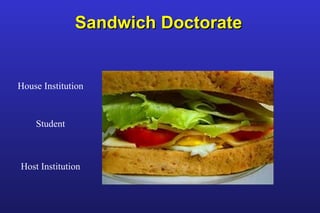
Sandwich Doctorate House Institution Student Host Institution
The University of Arkansas for Medical Sciences Graduate School
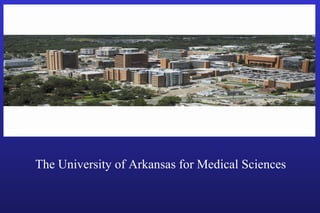
The University of Arkansas for Medical Sciences
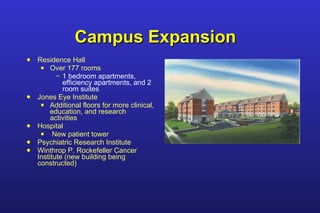
Campus Expansion Residence Hall Over 177 rooms 1 bedroom apartments, efficiency apartments, and 2 room suites Jones Eye Institute Additional floors for more clinical, education, and research activities Hospital New patient tower Psychiatric Research Institute Winthrop P. Rockefeller Cancer Institute (new building being constructed)
About UAMS Research grants and contracts at UAMS and its affiliates exceed $100 million a year Number of faculty has tripled in the past decade. Out of 123 medical schools, 69 for NIH funding 7 buildings on campus house research Two Biomedical Research Centers, Barton Research Center, Arkansas Cancer Research Center, Institute for Aging, Shorey Building, and Jones Eye Institute Research also performed by UAMS faculty in the VA and at the Arkansas Children’s Hospital Research Institute
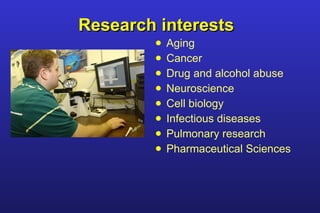
Research interests Aging Cancer  Drug and alcohol abuse  Neuroscience  Cell biology Infectious diseases Pulmonary research Pharmaceutical Sciences
University of Arkansas for Medical Sciences College of Health Related Professions College of Medicine College of Nursing College of Pharmacy College of Public Health Graduate School Over 2500 students (260 graduate students)
Graduate School M.S. degrees Biochemistry and Molecular Biology Interdisciplinary Biomedical Sciences Neurobiology and Developmental Sciences Pathology  Pharmaceutical Sciences Physiology and Biophysics
Graduate School M.S. degrees Clinical Nutrition Communicative Disorders (Speech Pathology) Genetic Counseling Occupational and Environmental Health
Graduate School Ph.D. degrees Biochemistry and Molecular Biology Interdisciplinary Biomedical Sciences Interdisciplinary Toxicology Microbiology and Immunology Neurobiology and Developmental Sciences Pharmacology Physiology and Biophysics Pharmaceutical Sciences
Graduate School Ph.D. degrees Communication Sciences and Disorders Health Systems Research Health Promotion and Prevention Research Nursing Science
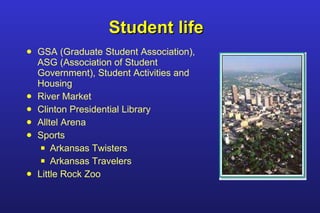
Student life GSA (Graduate Student Association), ASG (Association of Student Government), Student Activities and Housing River Market Clinton Presidential Library Alltel Arena Sports Arkansas Twisters Arkansas Travelers Little Rock Zoo
Estimated biomedical sciences Ph.D. timeline First year Take courses Rotate in laboratories Second year Take more courses Begin work on project Pass qualifier at the end of second year
Years 3-6 Finish up any classes Research, research, research Write and defend dissertation Average time to get Ph.D.~ 5 years Estimated biomedical sciences Ph.D. timeline
Application deadlines Many of the programs do not have set deadlines, but it is better to apply early in order to secure a spot in the program if you are accepted. Feb. 15 Communication Sciences and Disorders  Genetic Counseling Microbiology and Immunology January 15 Nursing Science
General application requirements Application TOEFL (Students from non English speaking institutions) General GRE scores Subject GRE scores (this is very dependent on program) Letters of recommendation (number varies) Essay Make sure you submit all application requirements in a timely manner (prepare early)
What makes a competitive application? Grades General and major GRE scores Letters Get from people that know your academic background and career goals Research Advisors Essay Can use essay to talk about any deficiencies in application Experience Research (especially important for Ph.D. programs) Publications Presentations  Interviews
GRE http://www.ets.org What does it test? “ The GRE® General Test measures verbal reasoning, quantitative reasoning, critical thinking, and analytical writing skills that are not related to any specific field of study.” 3 sections Verbal Reasoning: 200-800 Quantitative Reasoning: 200-800 Analytical Reasoning: 0-6
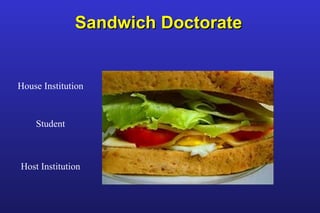
Sandwich Doctorate House Institution Student Host Institution
Our Strategic Advantage Two institutions with the opportunity to form a  synergistic collaboration  in areas of common interest UAMS Bilingual Faculty experienced in working with Latin America Strong academic background Strong record of scientific productivity UTPL Well organized  Support for the collaboration at the highest levels A small but highly motivated pool of faculty A pool of highly motivated students Good and continuing improving infrastructure for  “In situ”  research Focus in one of the highest biodiversity areas of the world
UTPL-UAMS Activities 2007 -2011 Memorandum of Agreement (8/2010) Intellectual Property Agreements (in preparation) UAMS Faculty visits UTPL  (10 Faculty) UTPL Faculty visits UAMS (10 Faculty) Short term research visits by Faculty and Students (6 UAMS, 6 UTPL)  Joint Publications (1 accepted, 4 in preparation) Joint Meeting Presentations (10) Graduate Students (1 MS completed 6/2011, 3 accepted 2012) at UAMS Visiting students at UTPL (2 , and 2 scheduled for 1/2012) Distance courses (1 graduate, 1 undergraduate) Weekly telemedicine conference
Challenges to “Sandwich”  Students are highly stressed Discontinuity in their academic progress Students have difficulty integrating to the host institution environment Students have difficulty reintegrating to their institutional environment  Language barrier Family situation Expen$$$ive
What we can we do The student: This program is only for the most highly motivated students The host institution: Provide strong and supportive academic advisers that understand the nature of the “sandwich program” and are willing to help Provide in-state-tuition Develop a culture of working with the “Sandwich Students”
What we can we do House Institution: Provide adequate economic support to the student, life is expensive in the USA Provide conditions to work during the “ In situ ” periods, minimized teaching and administrative duties, research environment Recognize the extraordinary effort that the “sandwich” student is making and provide commensurate salary at their return  Provide lots of recognition and encouragement
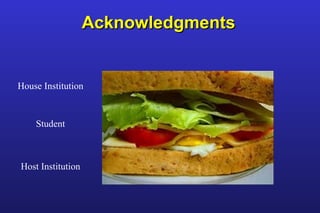
Acknowledgments House Institution Student Host Institution

Ponente: Cesar Compadre, Profesor de la Universidad de Arkansas

  • 1.
    Sandwich Doctorate HouseInstitution Student Host Institution
  • 2.
    The University ofArkansas for Medical Sciences Graduate School
  • 3.
    The University ofArkansas for Medical Sciences
  • 4.
    Campus Expansion ResidenceHall Over 177 rooms 1 bedroom apartments, efficiency apartments, and 2 room suites Jones Eye Institute Additional floors for more clinical, education, and research activities Hospital New patient tower Psychiatric Research Institute Winthrop P. Rockefeller Cancer Institute (new building being constructed)
  • 5.
    About UAMS Researchgrants and contracts at UAMS and its affiliates exceed $100 million a year Number of faculty has tripled in the past decade. Out of 123 medical schools, 69 for NIH funding 7 buildings on campus house research Two Biomedical Research Centers, Barton Research Center, Arkansas Cancer Research Center, Institute for Aging, Shorey Building, and Jones Eye Institute Research also performed by UAMS faculty in the VA and at the Arkansas Children’s Hospital Research Institute
  • 6.
    Research interests AgingCancer Drug and alcohol abuse Neuroscience Cell biology Infectious diseases Pulmonary research Pharmaceutical Sciences
  • 7.
    University of Arkansasfor Medical Sciences College of Health Related Professions College of Medicine College of Nursing College of Pharmacy College of Public Health Graduate School Over 2500 students (260 graduate students)
  • 8.
    Graduate School M.S.degrees Biochemistry and Molecular Biology Interdisciplinary Biomedical Sciences Neurobiology and Developmental Sciences Pathology Pharmaceutical Sciences Physiology and Biophysics
  • 9.
    Graduate School M.S.degrees Clinical Nutrition Communicative Disorders (Speech Pathology) Genetic Counseling Occupational and Environmental Health
  • 10.
    Graduate School Ph.D.degrees Biochemistry and Molecular Biology Interdisciplinary Biomedical Sciences Interdisciplinary Toxicology Microbiology and Immunology Neurobiology and Developmental Sciences Pharmacology Physiology and Biophysics Pharmaceutical Sciences
  • 11.
    Graduate School Ph.D.degrees Communication Sciences and Disorders Health Systems Research Health Promotion and Prevention Research Nursing Science
  • 12.
    Student life GSA(Graduate Student Association), ASG (Association of Student Government), Student Activities and Housing River Market Clinton Presidential Library Alltel Arena Sports Arkansas Twisters Arkansas Travelers Little Rock Zoo
  • 13.
    Estimated biomedical sciencesPh.D. timeline First year Take courses Rotate in laboratories Second year Take more courses Begin work on project Pass qualifier at the end of second year
  • 14.
    Years 3-6 Finishup any classes Research, research, research Write and defend dissertation Average time to get Ph.D.~ 5 years Estimated biomedical sciences Ph.D. timeline
  • 15.
    Application deadlines Manyof the programs do not have set deadlines, but it is better to apply early in order to secure a spot in the program if you are accepted. Feb. 15 Communication Sciences and Disorders Genetic Counseling Microbiology and Immunology January 15 Nursing Science
  • 16.
    General application requirementsApplication TOEFL (Students from non English speaking institutions) General GRE scores Subject GRE scores (this is very dependent on program) Letters of recommendation (number varies) Essay Make sure you submit all application requirements in a timely manner (prepare early)
  • 17.
    What makes acompetitive application? Grades General and major GRE scores Letters Get from people that know your academic background and career goals Research Advisors Essay Can use essay to talk about any deficiencies in application Experience Research (especially important for Ph.D. programs) Publications Presentations Interviews
  • 18.
    GRE http://www.ets.org Whatdoes it test? “ The GRE® General Test measures verbal reasoning, quantitative reasoning, critical thinking, and analytical writing skills that are not related to any specific field of study.” 3 sections Verbal Reasoning: 200-800 Quantitative Reasoning: 200-800 Analytical Reasoning: 0-6
  • 19.
    Sandwich Doctorate HouseInstitution Student Host Institution
  • 20.
    Our Strategic AdvantageTwo institutions with the opportunity to form a synergistic collaboration in areas of common interest UAMS Bilingual Faculty experienced in working with Latin America Strong academic background Strong record of scientific productivity UTPL Well organized Support for the collaboration at the highest levels A small but highly motivated pool of faculty A pool of highly motivated students Good and continuing improving infrastructure for “In situ” research Focus in one of the highest biodiversity areas of the world
  • 21.
    UTPL-UAMS Activities 2007-2011 Memorandum of Agreement (8/2010) Intellectual Property Agreements (in preparation) UAMS Faculty visits UTPL (10 Faculty) UTPL Faculty visits UAMS (10 Faculty) Short term research visits by Faculty and Students (6 UAMS, 6 UTPL) Joint Publications (1 accepted, 4 in preparation) Joint Meeting Presentations (10) Graduate Students (1 MS completed 6/2011, 3 accepted 2012) at UAMS Visiting students at UTPL (2 , and 2 scheduled for 1/2012) Distance courses (1 graduate, 1 undergraduate) Weekly telemedicine conference
  • 22.
    Challenges to “Sandwich” Students are highly stressed Discontinuity in their academic progress Students have difficulty integrating to the host institution environment Students have difficulty reintegrating to their institutional environment Language barrier Family situation Expen$$$ive
  • 23.
    What we canwe do The student: This program is only for the most highly motivated students The host institution: Provide strong and supportive academic advisers that understand the nature of the “sandwich program” and are willing to help Provide in-state-tuition Develop a culture of working with the “Sandwich Students”
  • 24.
    What we canwe do House Institution: Provide adequate economic support to the student, life is expensive in the USA Provide conditions to work during the “ In situ ” periods, minimized teaching and administrative duties, research environment Recognize the extraordinary effort that the “sandwich” student is making and provide commensurate salary at their return Provide lots of recognition and encouragement
  • 25.
    Acknowledgments House InstitutionStudent Host Institution