Class/grade: 3 Age group: 8 yrs old 
School: Sekolah Pilar indonesia School code: 7850 
Teacher(s): Arief and Ika 
Date: 
Proposed duration: + 6 weeks 
2. What do we want to learn? 
What are the key concepts (form, function, causation, change, connection, 
perspective, responsibility, reflection) to be emphasized within this inquiry? 
Key concepts: Function, connection, change 
Related concepts: quantity, number, measure, equivalent, value, fractions 
What lines of inquiry will define the scope of the inquiry into the central idea? 
· The base 10 place value system is used to represent numbers and number 
relationships. (Function) 
· Fractions and decimals are ways of representing whole-part relationships. 
(connection) 
· The operations of addition, subtraction, multiplication and division are related to 
each other and are used to process information to solve problems (connection) 
· Number operations can be modelled in a variety of ways.(Reflection) 
What teacher questions/provocations will drive these inquiries? 
· What is a number? 
· How to read, write, estimate, compare and order numbers to hundreds or 
beyond? 
· What is the difference between fractions and decimals? 
#Teachers provide some objects such as beads or buttons, many pieces of 
straws and plastic cups. Ask students to count directly or put the objects in 
groups/rows then students have to show how to write and mention the numbers 
accurately. 
1. What is our purpose? 
To inquire into the following: 
 transdiciplinary theme 
Strand: Numeration 
 Central Idea 
 Numbers are used to describe quantities, to compare quantities, to identify 
specific objects in collections and to measure. 
Summative assessment task(s): 
By the end of the unit, students will: 
- Read, represent, compare, and order whole numbers to 1000, and use 
concrete materials to represent fractions and money amounts to 1000 
- Solve problems involving the addition and subtraction of two-digit numbers, 
using a variety of mental strategies (e.g., to add 37 + 26, add the tens, add 
the ones, then combine the tens and ones, like this: 30 + 20 = 50, 7 + 6 = 
13, 50 + 13 = 63); 
- Able to demonstrate an understanding of addition and subtraction in three-digit 
numbers. 
- Use long division strategy with or without remainders. 
- Understand fractions and decimals to represent whole-part relationships 
Maths planner
3. How might we know what we have learned? 
This column should be used in conjunction with “How best might we learn?” 
What are the possible ways of assessing students’ prior knowledge 
and skills? What evidence will we look for? 
1. To find the students prior knowledge, we use the strategy: I see, I think, I 
wonder. We provide stations that contain tables. 
2. Every station has different work. Students who work in groups then identify 
and write numbers or words shown in the table starting from numbers to 
1000, naming fractions, decimals, place value and number patterns. 
3. The result would be discussed together. 
What are the possible ways of assessing student learning in the context of 
the lines of inquiry? What evidence will we look for? 
1. The base 10 place value system is used to represent numbers and number 
relationships. (Students are expected to be able to develop their 
understanding of the base 10 place value system and will model, read, 
write, estimate, compare and order numbers to hundreds or beyond) 
2. Fractions and decimals are ways of representing whole-part relationships 
(Students are expected to have an understanding of fractions as 
representations of whole-part relationships and will be able to model 
fractions and use fraction names in real-life situations) 
3. The operations of addition, subtraction, multiplication and division are 
related to each other and are used to process information to solve 
problems & Number operations can be modelled in a variety of ways 
(Students are expected to select, use and describe a range of strategies to 
solve problems involving addition, subtraction, multiplication and division, 
using estimation strategies to check the reasonableness of their answers) 
4. How best might we learn? 
What are the learning experiences suggested by the teacher and/or students to encourage 
the students to engage with the inquiries and address the driving questions? 
Tuning in 
- Unpack the central idea, lines of inquiry and concepts 
- Using stations and I see, I think, I wonder strategy 
Finding out 
- Explore different ways of counting: addition, long division, dividing with remainders, 2 digits 
multiplication and 3 digits subtraction 
- Students to practice and classify the new strategy of counting and state the differences with 
the previous one. 
Sorting out 
- Students to discuss and state the difference between the new strategies with the previous one. 
Going further 
- Students to work on some problems on numbers: Fractions, equivalent fractions, fraction 
patterns, look for the relation between fractions and decimals, 
- Students to make sure and strength their understanding and showing the evidence of the 
numbers relations by creating spider web or mind map. 
Making conclusion 
- Students to finish their spider web or mind map 
What opportunities will occur for transdisciplinary skills development and for the 
development of the attributes of the learner profile? 
During this unit we focus on Self-management skills that enable students to know and apply appropriate 
rules or instructions of certain tasks. 
Attributes of the LP: Principled and Balanced 
Attitudes: integrity and commitment. 
5. What resources need to be gathered? 
What people, places, audio-visuals materials, related literature, music, art, computer software, etc, will be available? Think of a NUMBER by Johnny Ball, New Signpost, 
Queensland, Nelson Maths 3 Book, Collection of Maths lesson by Marilyn Burns, About Teaching Mathematics A K-8 Resource by Marilyn Burns, straw, cups, beads, 
buttons, ice cream sticks, playing cards (bridges), calendar, clock etc. 
How will the classrooms environment, local environment, and/or the community be used to facilitate the inquiry?
6. To what extend did we achieve our purpose? 
Assess the outcome of the inquiry by providing evidence of students’ understanding of the central idea. The 
reflections of all the teachers involved in the planning and the teaching of the inquiry should be included. 
Firstly, this unit was challenging and interesting for students. Primarily students have known the basic 
understanding of numeration and maths operations. Then they became more enthusiastic when they inquired 
into the history of numbers and different ways people use numbers: Think of a NUMBER by Johnny Ball, and 
that really helped them to be engaged with the first line of inquiry which enables students to develop their 
understanding of the base 10 place value system and will model, read, write, estimate, compare and 
order numbers to hundreds and beyond. 
Secondly, when we discussed about fractions, most of the students have acquired some terminologies such as 
numerators and denominators and that have helped them to solve the advanced level of problems. Beside that 
they also could show the relationship between fractions and decimals by creating drawings or graphs. 
Lastly, most of the students who tried to work on problems in groups, they helped each other to overcome the 
problems they worked on. They used a variety of strategies especially in fractions and division problem and 
they could show the way to get the results. They also communicated the problems with the teachers if they 
found advanced problems enthusiastically. 
How you could improve on the assessment task(s) so that you would have a more accurate picture of each 
student’s understanding of the central idea. 
Presumably, this unit assessment could be integrated with art or PE lesson by creating stuff or games that use 
numbers on it or by creating artificial soccer tournaments management, to count how many times every team or 
player plays in a tournament and so on, so the students can think more deeply, especially in real life situations. 
What was the evidence that connections were made between the central idea and the transdiciplinary theme? 
 central idea: Numbers are used to describe quantities, to compare quantities, to identify 
specific objects in collections and to measure. 
 transdiciplinary theme 
Strand: Numeration 
7. To what extend did we include the elements of the PYP? 
What were the learning experiences that enabled students to: 
· develop an understanding of the concepts identified in “What do we want 
to learn?” 
Function: This concept was selected because the ability to analyze function, 
types and strategies of maths operations is fundamental to learning and 
solving problems. 
Connection: This concept was selected because the operations 
of addition, subtraction, multiplication and division are related to one another 
and are used to process information in order to solve problems and will be 
able to model and use them in real-life situations. 
Reflection: We used this concept because number operations can be 
modelled in a variety of ways. Students can reflect on their ability or creativity 
then use many of strategies even to solve the same problems. 
· demonstrate the learning and application of particular transdiciplinary 
skills? 
We focused on self-management skills, 
· develop particular attributes of the learner profile and/or attitudes? 
In each case, explain your selection. 
Attributes of the LP: Principled and Balanced 
We encouraged students to develop their strong sense of fairness that helps 
them to understand the importance of intellectual, physical and emotional to 
achieve personal well-being which appropriate to maths operations system 
Attitudes: integrity and commitment. 
We encourage students to develop integrity and commitment with a strong 
sense of fairness, justice and take responsibility and consequences to their 
own learning.
8. What a student-initiated inquiries arose from the learning? 
Record a range of student-initiated inquiries and student questions and highlight 
any that were incorporated into the teaching and learning. 
- What is a fraction? 
- What is a remainder? 
- How to add fractions? 
- How to prove the relationship between fractions and decimals? 
What student-initiated actions arose from the learning? 
No observable action at this stage. 
9. Teacher notes 
The students had different ways of learning and that was correlated to their level of 
understanding. However what we could highlight was they could show the inquiry 
process as expectedly and followed the learning progress in positive manners. We 
hope they could use their current understanding as the basic knowledge for the next 
grade level and more advanced problems.

Maths planner

  • 1.
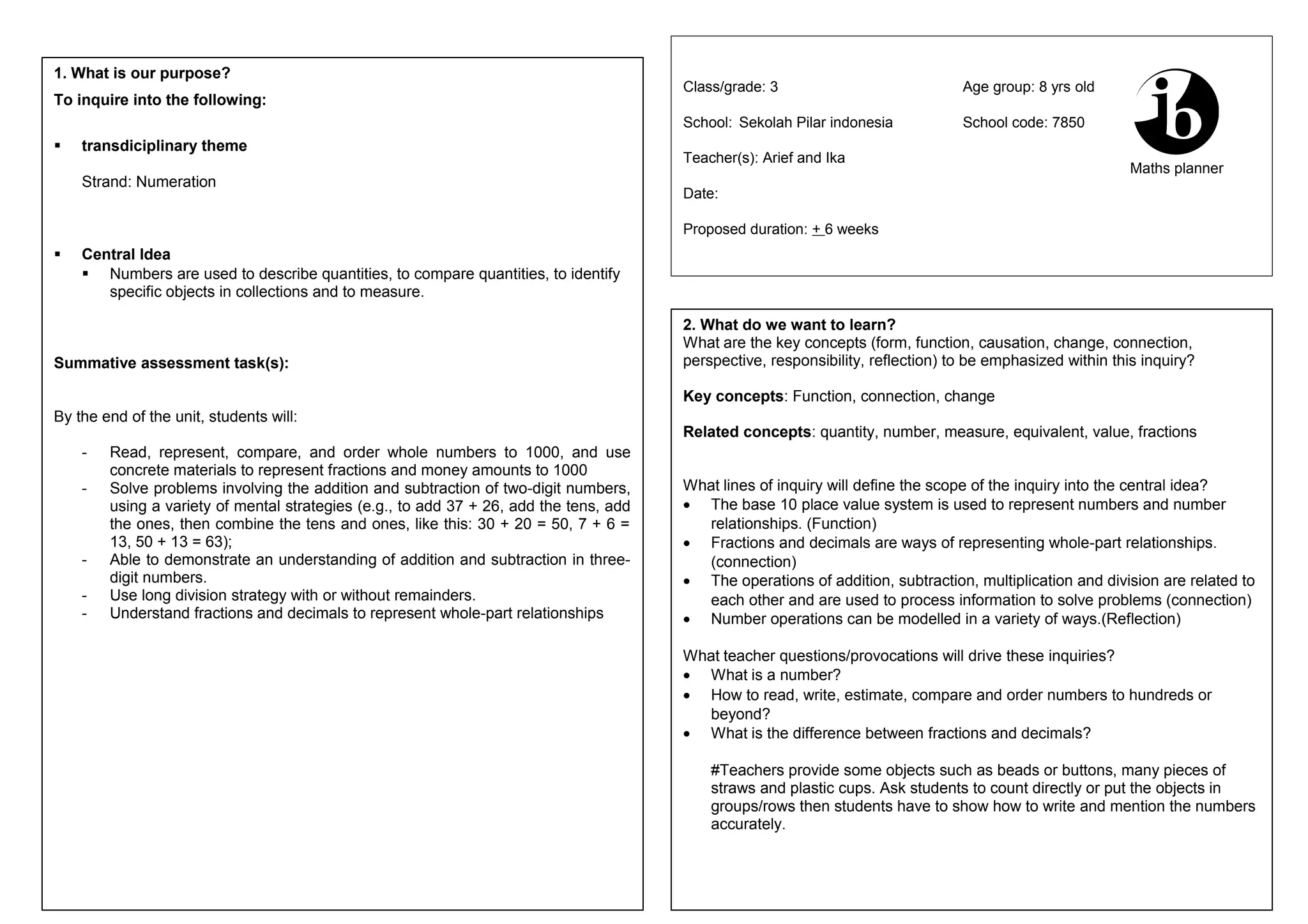
    Class/grade: 3 Agegroup: 8 yrs old School: Sekolah Pilar indonesia School code: 7850 Teacher(s): Arief and Ika Date: Proposed duration: + 6 weeks 2. What do we want to learn? What are the key concepts (form, function, causation, change, connection, perspective, responsibility, reflection) to be emphasized within this inquiry? Key concepts: Function, connection, change Related concepts: quantity, number, measure, equivalent, value, fractions What lines of inquiry will define the scope of the inquiry into the central idea? · The base 10 place value system is used to represent numbers and number relationships. (Function) · Fractions and decimals are ways of representing whole-part relationships. (connection) · The operations of addition, subtraction, multiplication and division are related to each other and are used to process information to solve problems (connection) · Number operations can be modelled in a variety of ways.(Reflection) What teacher questions/provocations will drive these inquiries? · What is a number? · How to read, write, estimate, compare and order numbers to hundreds or beyond? · What is the difference between fractions and decimals? #Teachers provide some objects such as beads or buttons, many pieces of straws and plastic cups. Ask students to count directly or put the objects in groups/rows then students have to show how to write and mention the numbers accurately. 1. What is our purpose? To inquire into the following:  transdiciplinary theme Strand: Numeration  Central Idea  Numbers are used to describe quantities, to compare quantities, to identify specific objects in collections and to measure. Summative assessment task(s): By the end of the unit, students will: - Read, represent, compare, and order whole numbers to 1000, and use concrete materials to represent fractions and money amounts to 1000 - Solve problems involving the addition and subtraction of two-digit numbers, using a variety of mental strategies (e.g., to add 37 + 26, add the tens, add the ones, then combine the tens and ones, like this: 30 + 20 = 50, 7 + 6 = 13, 50 + 13 = 63); - Able to demonstrate an understanding of addition and subtraction in three-digit numbers. - Use long division strategy with or without remainders. - Understand fractions and decimals to represent whole-part relationships Maths planner
  • 2.
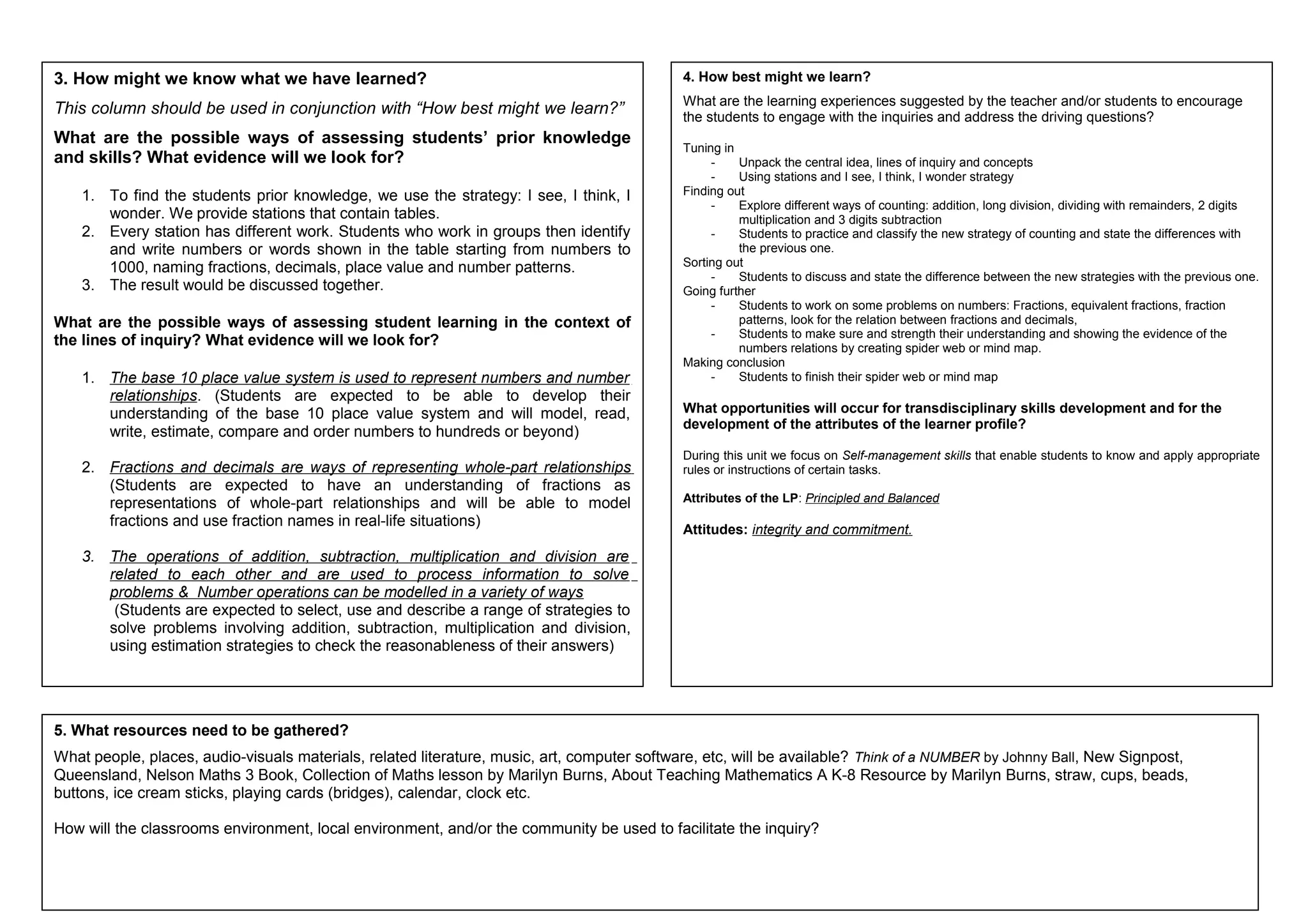
    3. How mightwe know what we have learned? This column should be used in conjunction with “How best might we learn?” What are the possible ways of assessing students’ prior knowledge and skills? What evidence will we look for? 1. To find the students prior knowledge, we use the strategy: I see, I think, I wonder. We provide stations that contain tables. 2. Every station has different work. Students who work in groups then identify and write numbers or words shown in the table starting from numbers to 1000, naming fractions, decimals, place value and number patterns. 3. The result would be discussed together. What are the possible ways of assessing student learning in the context of the lines of inquiry? What evidence will we look for? 1. The base 10 place value system is used to represent numbers and number relationships. (Students are expected to be able to develop their understanding of the base 10 place value system and will model, read, write, estimate, compare and order numbers to hundreds or beyond) 2. Fractions and decimals are ways of representing whole-part relationships (Students are expected to have an understanding of fractions as representations of whole-part relationships and will be able to model fractions and use fraction names in real-life situations) 3. The operations of addition, subtraction, multiplication and division are related to each other and are used to process information to solve problems & Number operations can be modelled in a variety of ways (Students are expected to select, use and describe a range of strategies to solve problems involving addition, subtraction, multiplication and division, using estimation strategies to check the reasonableness of their answers) 4. How best might we learn? What are the learning experiences suggested by the teacher and/or students to encourage the students to engage with the inquiries and address the driving questions? Tuning in - Unpack the central idea, lines of inquiry and concepts - Using stations and I see, I think, I wonder strategy Finding out - Explore different ways of counting: addition, long division, dividing with remainders, 2 digits multiplication and 3 digits subtraction - Students to practice and classify the new strategy of counting and state the differences with the previous one. Sorting out - Students to discuss and state the difference between the new strategies with the previous one. Going further - Students to work on some problems on numbers: Fractions, equivalent fractions, fraction patterns, look for the relation between fractions and decimals, - Students to make sure and strength their understanding and showing the evidence of the numbers relations by creating spider web or mind map. Making conclusion - Students to finish their spider web or mind map What opportunities will occur for transdisciplinary skills development and for the development of the attributes of the learner profile? During this unit we focus on Self-management skills that enable students to know and apply appropriate rules or instructions of certain tasks. Attributes of the LP: Principled and Balanced Attitudes: integrity and commitment. 5. What resources need to be gathered? What people, places, audio-visuals materials, related literature, music, art, computer software, etc, will be available? Think of a NUMBER by Johnny Ball, New Signpost, Queensland, Nelson Maths 3 Book, Collection of Maths lesson by Marilyn Burns, About Teaching Mathematics A K-8 Resource by Marilyn Burns, straw, cups, beads, buttons, ice cream sticks, playing cards (bridges), calendar, clock etc. How will the classrooms environment, local environment, and/or the community be used to facilitate the inquiry?
  • 3.
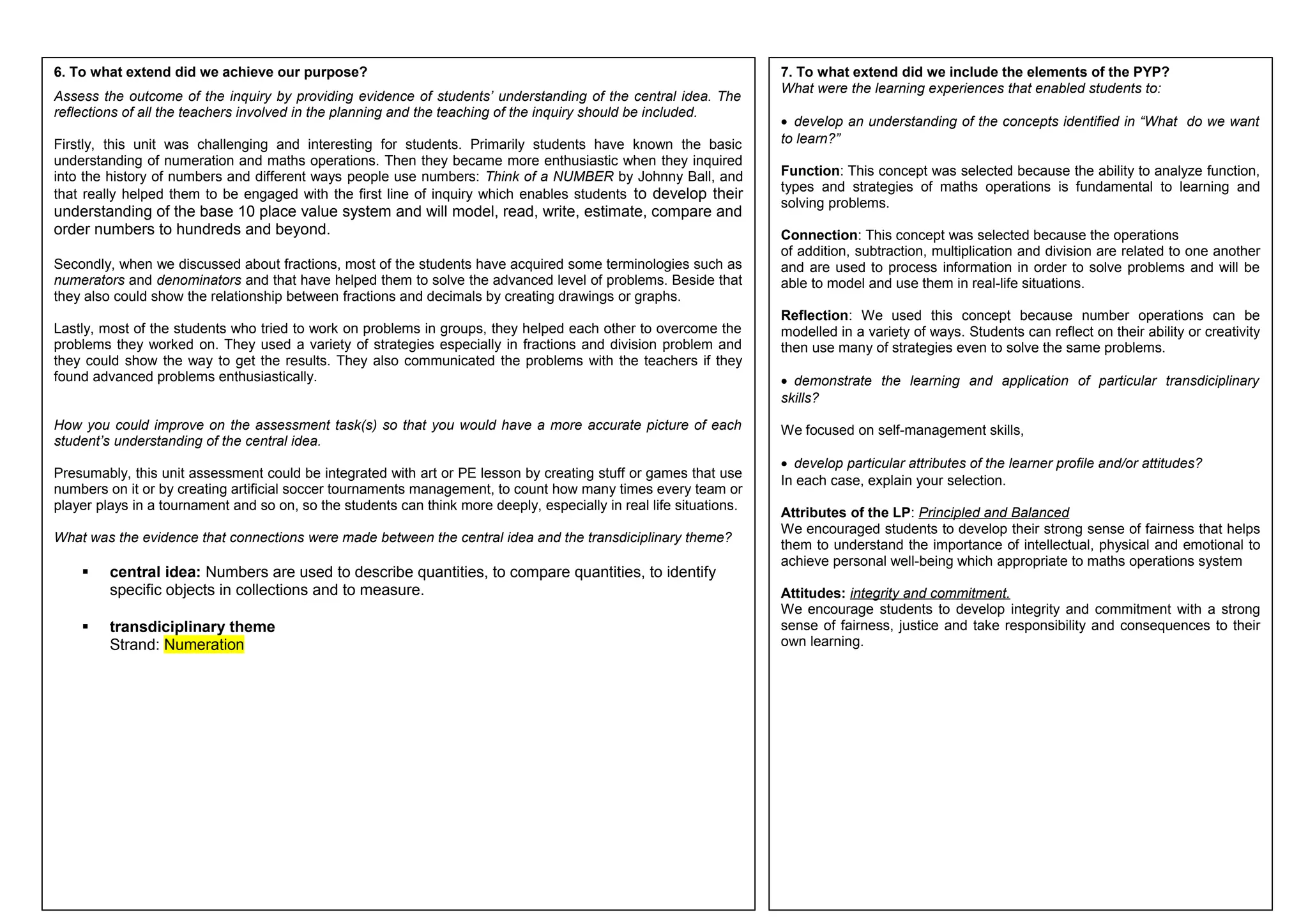
    6. To whatextend did we achieve our purpose? Assess the outcome of the inquiry by providing evidence of students’ understanding of the central idea. The reflections of all the teachers involved in the planning and the teaching of the inquiry should be included. Firstly, this unit was challenging and interesting for students. Primarily students have known the basic understanding of numeration and maths operations. Then they became more enthusiastic when they inquired into the history of numbers and different ways people use numbers: Think of a NUMBER by Johnny Ball, and that really helped them to be engaged with the first line of inquiry which enables students to develop their understanding of the base 10 place value system and will model, read, write, estimate, compare and order numbers to hundreds and beyond. Secondly, when we discussed about fractions, most of the students have acquired some terminologies such as numerators and denominators and that have helped them to solve the advanced level of problems. Beside that they also could show the relationship between fractions and decimals by creating drawings or graphs. Lastly, most of the students who tried to work on problems in groups, they helped each other to overcome the problems they worked on. They used a variety of strategies especially in fractions and division problem and they could show the way to get the results. They also communicated the problems with the teachers if they found advanced problems enthusiastically. How you could improve on the assessment task(s) so that you would have a more accurate picture of each student’s understanding of the central idea. Presumably, this unit assessment could be integrated with art or PE lesson by creating stuff or games that use numbers on it or by creating artificial soccer tournaments management, to count how many times every team or player plays in a tournament and so on, so the students can think more deeply, especially in real life situations. What was the evidence that connections were made between the central idea and the transdiciplinary theme?  central idea: Numbers are used to describe quantities, to compare quantities, to identify specific objects in collections and to measure.  transdiciplinary theme Strand: Numeration 7. To what extend did we include the elements of the PYP? What were the learning experiences that enabled students to: · develop an understanding of the concepts identified in “What do we want to learn?” Function: This concept was selected because the ability to analyze function, types and strategies of maths operations is fundamental to learning and solving problems. Connection: This concept was selected because the operations of addition, subtraction, multiplication and division are related to one another and are used to process information in order to solve problems and will be able to model and use them in real-life situations. Reflection: We used this concept because number operations can be modelled in a variety of ways. Students can reflect on their ability or creativity then use many of strategies even to solve the same problems. · demonstrate the learning and application of particular transdiciplinary skills? We focused on self-management skills, · develop particular attributes of the learner profile and/or attitudes? In each case, explain your selection. Attributes of the LP: Principled and Balanced We encouraged students to develop their strong sense of fairness that helps them to understand the importance of intellectual, physical and emotional to achieve personal well-being which appropriate to maths operations system Attitudes: integrity and commitment. We encourage students to develop integrity and commitment with a strong sense of fairness, justice and take responsibility and consequences to their own learning.
  • 4.
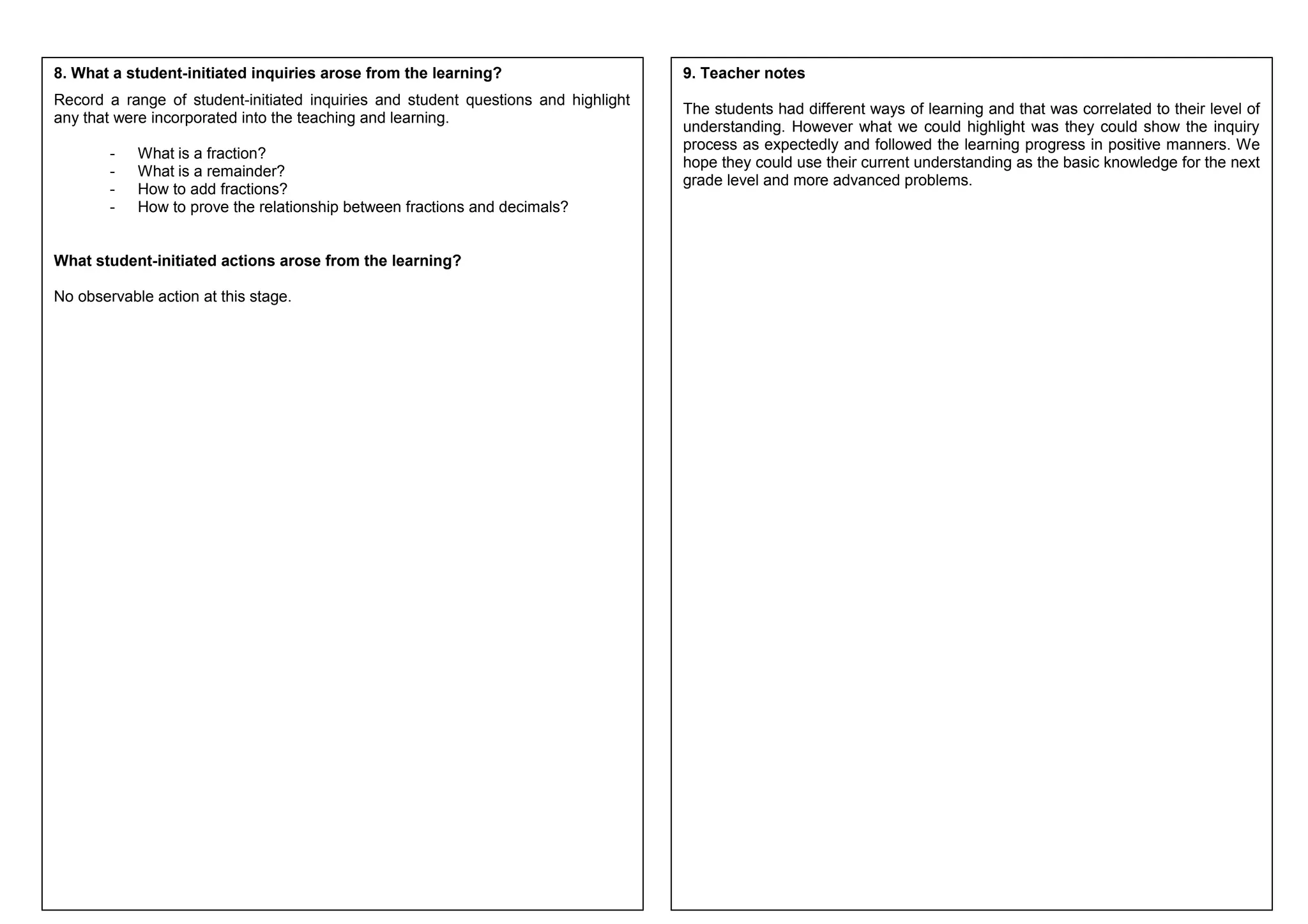
    8. What astudent-initiated inquiries arose from the learning? Record a range of student-initiated inquiries and student questions and highlight any that were incorporated into the teaching and learning. - What is a fraction? - What is a remainder? - How to add fractions? - How to prove the relationship between fractions and decimals? What student-initiated actions arose from the learning? No observable action at this stage. 9. Teacher notes The students had different ways of learning and that was correlated to their level of understanding. However what we could highlight was they could show the inquiry process as expectedly and followed the learning progress in positive manners. We hope they could use their current understanding as the basic knowledge for the next grade level and more advanced problems.