Chapter 3
Ancient Greece
The Bible states that after the
Flood, the descendants of
Javan, one of Japheth’s
sons, travelled westward from
Mesopotamia and settled in the
“isles of the Gentiles”- Genesis
10:4-5.
This land is believed to be Greece.
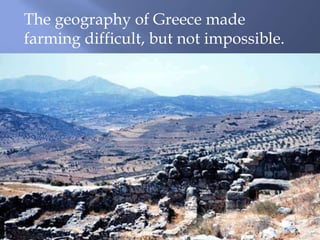
The geography of Greece made
farming difficult, but not impossible.
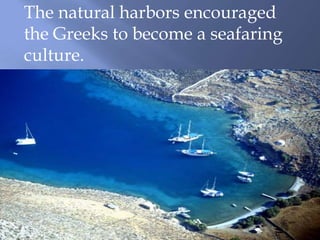
The natural harbors encouraged
the Greeks to become a seafaring
culture.
http://education.nationalgeographic.com/educat
ion/media/ancient-mariners-
mediterranean/?ar_a=1
Video – ship wreck found from
ancient Greece.
 The Mountains and terrain made
communication difficult, the
isolation of the communities
caused the Greeks to develop a
fierce independent nature and
patriotism.
 They became known for their
love of individualism and self
sufficiency.
Archaeologists have found the
remains of two
civilizations, Minoan and
Mycenaean. They predate the
Greek civilization in the
Aegean region. The
civilizations were short-
lived, but their culture left its
mark on those to follow.
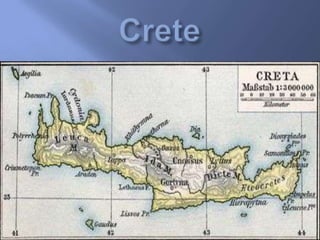
The earliest center of civilization in
the Aegean region was on the
island of Crete.
By 2000 BC, the Minoan
civilization flourished – named
after King Minos.
Trade allowed Minoans contact
with Egyptians who desired
Cretan olive oil and pottery.
It is suggested that the
Philistines were colonists from
this Cretan civilization.
Minoan love for beauty is evident
in the ruins of the palace at
Knossos.
It consisted of hundreds of rooms
and covered several acres.
“Modern conveniences” – flushing
toilets, bathtubs and piped water.
Mainland Greece
Established by invaders from the
north.
Much of their knowledge of
art, architecture and commerce
came from the Minoans.
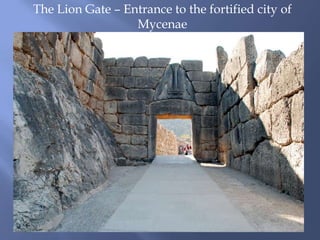
The Lion Gate – Entrance to the fortified city of
Mycenae
When Knossos was
destroyed, possibly by
the
Mycenaeans, Mycenae
became the leading
commercial center of
the Aegean region.
Though the Minoans loved
beauty, their culture reflected a
strong military fervor.
- Palaces were built high on
hills and fortified.
- Rival kings fought often.
- Trade was expanded through
raids piracy and colonization.
The major commercial trade rival
of Mycenae was the city of Troy.
According to legend, the
Mycenaeans went to war with
Troy after Trojan Prince Paris
kidnapped the wife of a Spartan
King.
http://library.thinkquest.org/3011/troy.htm
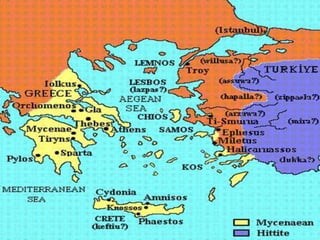
Troy sat on a hill overlooking
the Hellespont.
This strait separates Asia Minor
from Europe. It linked the sea
trade of the Agaean world with
the land trade of the Fertile
Crescent.
Troy fell to the Mycenaeans
after the use of the “Trojan
Horse”.
This victory was short lived.
Around 1200
BC, Dorians, invaders from the
north conquered the main
Mycenaean fortresses.
The Dorian victory
marked the decline of
the Mycenaean
civilization and began
the Greek “Dark
Ages”.
The “Dark Ages” was a period of
invasion and neglect of the great
palace fortresses. They fell into
ruin.
They adopted a simpler life in
local villages and had little
contact with the outside world.
There was a blending of elements
in the Agaean world into a
common Greek Culture.
Knowledge from this period rests
largely on the poems the Iliad and
the Odyssey by Homer.
The Dark Ages are sometimes
called the “Homeric Age” because
his poems provide the only
glimpse of their culture.
Homer’s poems describe the
shaping of Greek culture
with stories of heroic
figures, brutal warfare and
great adventure.
Mythology played a very big
role in the shaping of Greek
culture.
Greeks used myths to explain
their beliefs about life, the
world and their gods.
According to Greek
mythology, twelve chief gods
and goddesses lived on Mount
Olympus, the heaven of the
gods.
Zeus was the “king of gods and
man,” he ruled Mount
Olympus.
Apollo, son of Zeus, was the god
of the sun, music, and medicine.
Athena, was the patron of the city
Athens. She was the goddess of
wisdom.
Poseidon, Zeus’s brother ruled the
sea and earthquakes.
Anthropomorphic – having human
form or attributes.
The Greek gods of mythology had
human characteristics but
possessed amazing powers and
immortality.
They had the power to help or
harm man.
The apostle Paul may have
had Greek polytheism in
mind when he said that the
Gentiles were guilty before
God because they had
“changed the glory of the
uncorruptible God into an
image made like corruptible
man” Romans 1:23.
In honor of Zeus, the Greeks held
religious festivals every 4 years at
Olympia, the site of a temple of
Zeus.
Physical contests became the chief
feature.
They became known as the
Olympic Games.
The games became so
popular that the
Olympiad, the four year
interval between the
games, became the Greek
method of dating
historical events.
The Games were a
very rare example
of cooperation
between the city
states.
Though their language, customs
and religious beliefs were the
same, the Greeks lacked political
unity.
As the Nile of Egypt brought the
Egyptians together, the mountains
of Greece isolated them and
hindered national unity.
They built their cities at the foot of
a hill. They a built a fortress on top
of the hill where they would
escape too when attacked.
The city was called the polis (city
state). This was the basic political
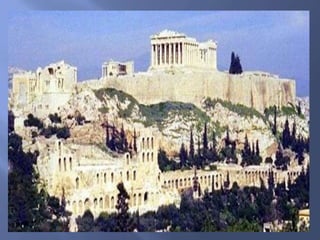
unit of Greece. The fortified hill
was called the acropolis (from the
word acro meaning “high”).
Greek city-states experienced four
basic forms of government.
Monarchy
Oligarchy
Tyranny
Democracy
Monarchy – Ruled by one. The
king received advice from a
council of nobles and a popular
assembly.
…gradually, the council assumed
the king’s powers….
This led to an
Oligarchy- rule of a few.
This produced tension between the
wealthy noble class and the lower
classes.
…this led to political unrest…
Dissatisfaction and unrest often
led to tyranny. Total control of the
government, usually gained by
military force.
Tyrants were not necessarily
corrupt.
Sometimes the tyrant was a
champion for the lower
classes. His reform often
allowed more people to
participate in the
government.
A unique political contribution of
the Greeks was the development
of democracy – rule by the people.
In this government, each adult
male citizen could share
responsibility of ruling his city.
The development of Greek city-
states was important in Greek
history.
Sparta and Athens represented
two opposing political systems
and ways of life. Other city-
states followed the example of
one or the other.
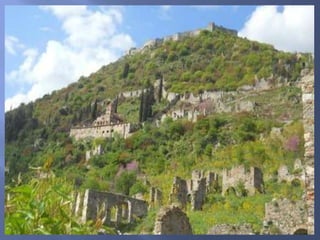
Sparta – located in the Southern
part of Greece on the
Peloponnesus peninsula.
Conquered by the Dorians – her
inhabitants were made slaves.
(Helots)
As the new rulers of Sparta
conquered surrounding areas and
enslaved their people the Helots
soon outnumbered the Spartans.
Because of fear of uprising, the
Spartans created a thoroughly
militaristic state.
Sparta life centered on warrior
training.
The highest goal of each Spartan
was the be the best warrior for his
city-state.
Sparta controlled ALL aspects of
her citizens’ lives.
A board of Spartan nobles guarded
the “status quo”. They protected
their society against change.
To ensure the success of the city
state, they used force or
intimidation to help establish
oligarchies in neighboring city-
states.
The city-states organized the
Peloponnesian League, with
Sparta at its head.
Its purpose was to stop the
advance of democratic principles
that were fostered by the
Athenians.
Sparta is associated
with
militarism, oligarc
hy and
glorification of the
state.
Athens nurtured
creativity, commercial
endeavors, democracy and
individualism. The Athenians
maintained the creative and
intellectual heritage of the
Minoan and Mycenaean
During the Homeric Age, Athens
was ruled by a king.
The noble class rose in power and
established a council of nobles
with a chief magistrate or archon.
One archon made positive
changes in Athenian government.
Under the leadership of
Solon, Athens took a step toward
democracy.
Political and economic stability
overcame the tension and hostility
created by the council of nobles.
He created the council of Four
Hundred, this gave representation
to all sections of Athens.
Solon forbade the practice of
making debtors into slavery.
After the death of Solon, the
political unrest returned.
Tyrants arose and made change.
Under the leadership
of Pericles, Athens
established a “rule of
the people.”
Athens, a fierce supporter of
independence and self
sufficiency, assisted Greek
colonies that had been
overtaken by the Persians.
Under King Darius I the
Persians crushed the revolt and
sought to punish Athens for her
part in the rebellion.
He sent a force to the Bay of
Marathon. The Athenians
marched out to meet the
Persians and won.
Darius was enraged and
set out to destroy the
Athenians. He died
before he could carry out
his invasion.
His son, Xerxes, set out to
complete this task.
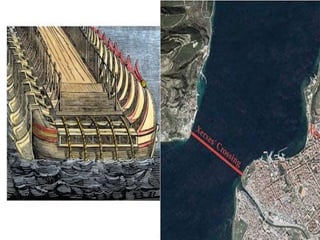
After one failed attempt, Xerxes
was able to build a bridge across
the Hellespont from Asia Minor to
Greece.
They tied together ships with
ropes, and laid down a plank
roadway across the decks.
The Athenians and the
Spartans disagreed on how to
defend Greece. The Spartan
plan would leave Athens
exposed.
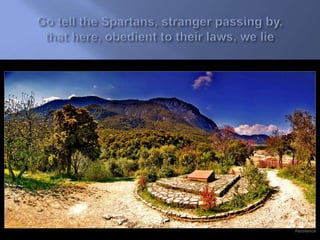
The Greeks made their stand at
Thermopylae.
The Persians were unable to
take the pass. But, a Greek
traitor showed them another
way thru the mountains. All
but 300 of the Greeks escaped.
The 300 stayed behind and
fought to the death in order to
hold the pass as long as
possible.
Xerxes burnt Athens to the
ground. The Athenians had
retreated to Salamis, an island off
the coast.
Themistocles, the leader of
Athens, devised a trap. He leaked
information to Xerxes that the
Athenians were escaping by
sailing north.

Xerxes fleet was unable to
maneuver in their ships in the
morning tide…The smaller Greek
ships were able to ram and sink
many of the Persian ships as
Xerxes looked on.

The Persians continued to interfere
in Greek affairs, but the Greeks
were able to hold on to their
independence.
Freedom from the
Persians lifted the Greek
spirit. A period of great
cultural achievement
known as the “Golden
Age” would follow.
Athens became the leading
city-state of all Greece. She
encouraged the formation of
a defensive alliance among
the city-states. This alliance
was known as the Delian
League.
This was the Age of Pericles.
He established a democracy.
He called Athens the “school of
Greece.”
Great advancements were
made in
thought, art, science, literature,
drama, and architecture.
Following the Golden Age came the
Peloponnesian war. This was a
devastating civil war pitting Athens
against Greece.
Sparta was concerned over the great
influence and wealth Athens had
accumulated.
Sparta emerged victorious, but
constant uprisings due to oppressive
Spartan control continued to plague
the city-states.
Macedonia was united under
the rule of King Philip II. His
kingdom extended into Greece.
Many city-states began to turn
to him hoping to find unity.
Philip was assassinated and his
son, Alexander, took the throne.
He had been taught by Aristotle
who instilled in him a great love
for Greek culture.
Alexander defeated the Persian
army under Darius II.
He had successfully avenged
the Greeks and become the
king of Asia.
Alexander’s thirst for conquest
was not satisfied. He marched to
India and was gone for eight years.
But, his men would not continue.
Before he was 33, Alexander died
of a fever.
Daniel foretold that Alexander’s
empire would be divided into four
kingdoms.
Daniel 8:21-22;11:4
There was no successor so his
generals fought for control and his
empire was divided.
Greek motto:
“Nothing in excess, and
everything in
proportion.”
The Greek army never conquered
the world, but her culture did.
Through Alexander’s
conquests, the language, and way
of life spread throughout the
world.
The term Hellenic is used to
describe Greed culture.
Hellenistic means “like the Greek.”
The Greeks began the
formal study of human
thought, the
humanities.
Greeks assumed a great truth: man
is the highest of created beings, but
they did not glorify God for
creating man, they celebrated and
glorified the ability of man.
They did not acknowledge their
responsibility to the
Creator, rather they believed man
was the judge of all things.
Thales of Miletus – The Father
of Philosophy
He sought to explain origin of
all things.
Socrates – “Know thyself”
Believed that truth could be
attained through reason, virtue
was knowledge and ignorance
produced evil.
Plato – Pupil of Socrates
Established the Academy in
Athens. Wrote Republic.
Realized that too much liberty
and freedom often leads to
anarchy – the breakdown of
government and order.
Aristotle – Came to Athens
from northern Greece.
- Studied at Plato’s academy.
- Tutor of Alexander the Great
To aide in man’s reasoning
ability, Aristotle developed the
syllogism.
3 step process of logical
thinking.
1. Greeks are human
2. Aristotle is Greek
3. Therefore, Aristotle is
human.
Epicurean and Stoic philosophies
Epicurus believed that great
happiness could be achieved thru
the avoidance of pain and fear.
Founded by Zeno – he taught that
man must accept his fate and life
a life of duty and self control.
Pythagoras – philosopher and
mathematician.
- Concluded that the
universe could be explained in
mathematical terms.
Hippocrates – Father of Medicine
Contrary to the Greek philosophy
that illness was a punishment of
the gods, he surmised illness has a
natural cause and recommended
treatments such as rest and proper
diet.
-Euclid – Father of Geometry
-Archimedes – Discovered the
principle of the lever.(ex…car jack)
-Eratosthenes – used geometry to
surmise that the world is
round…seventeen centuries
BEFORE Columbus.
Herodotus – Father of History.
Tried to present accurate
accounts, but his work contained
many myths and exaggerations.
Thucydides – wrote History of the
Peloponnesian War. Wrote a better
account than Herodotus because
he wrote without letting his
personal experiences and actions
influence his account.
Sophocles – wrote tragedy
Aristophanes – wrote comedy
Greeks excelled in art. The most
highly prized was their
urns, sculptures, and temples.
Grecian urns are among the most
beautiful ever fashioned. They
painted scenes of everyday
life, battles, competitions, and
activities of the gods.
Greek sculpture falls into three
periods
Archaic
Classical
Hellenistic
Three styles of Greek
architecture :
Doric –solid and masculine
Ionic – graceful
Corinthian - ornate

Power point

  • 1.
  • 2.
    The Bible statesthat after the Flood, the descendants of Javan, one of Japheth’s sons, travelled westward from Mesopotamia and settled in the “isles of the Gentiles”- Genesis 10:4-5. This land is believed to be Greece.
  • 3.
    The geography ofGreece made farming difficult, but not impossible.
  • 4.
    The natural harborsencouraged the Greeks to become a seafaring culture.
  • 5.
  • 6.
     The Mountainsand terrain made communication difficult, the isolation of the communities caused the Greeks to develop a fierce independent nature and patriotism.  They became known for their love of individualism and self sufficiency.
  • 7.
    Archaeologists have foundthe remains of two civilizations, Minoan and Mycenaean. They predate the Greek civilization in the Aegean region. The civilizations were short- lived, but their culture left its mark on those to follow.
  • 9.
    The earliest centerof civilization in the Aegean region was on the island of Crete. By 2000 BC, the Minoan civilization flourished – named after King Minos.
  • 10.
    Trade allowed Minoanscontact with Egyptians who desired Cretan olive oil and pottery. It is suggested that the Philistines were colonists from this Cretan civilization.
  • 11.
    Minoan love forbeauty is evident in the ruins of the palace at Knossos. It consisted of hundreds of rooms and covered several acres. “Modern conveniences” – flushing toilets, bathtubs and piped water.
  • 12.
    Mainland Greece Established byinvaders from the north. Much of their knowledge of art, architecture and commerce came from the Minoans.
  • 13.
    The Lion Gate– Entrance to the fortified city of Mycenae
  • 14.
    When Knossos was destroyed,possibly by the Mycenaeans, Mycenae became the leading commercial center of the Aegean region.
  • 15.
    Though the Minoansloved beauty, their culture reflected a strong military fervor. - Palaces were built high on hills and fortified. - Rival kings fought often. - Trade was expanded through raids piracy and colonization.
  • 16.
    The major commercialtrade rival of Mycenae was the city of Troy. According to legend, the Mycenaeans went to war with Troy after Trojan Prince Paris kidnapped the wife of a Spartan King. http://library.thinkquest.org/3011/troy.htm
  • 18.
    Troy sat ona hill overlooking the Hellespont. This strait separates Asia Minor from Europe. It linked the sea trade of the Agaean world with the land trade of the Fertile Crescent.
  • 19.
    Troy fell tothe Mycenaeans after the use of the “Trojan Horse”. This victory was short lived. Around 1200 BC, Dorians, invaders from the north conquered the main Mycenaean fortresses.
  • 20.
    The Dorian victory markedthe decline of the Mycenaean civilization and began the Greek “Dark Ages”.
  • 21.
    The “Dark Ages”was a period of invasion and neglect of the great palace fortresses. They fell into ruin. They adopted a simpler life in local villages and had little contact with the outside world. There was a blending of elements in the Agaean world into a common Greek Culture.
  • 22.
    Knowledge from thisperiod rests largely on the poems the Iliad and the Odyssey by Homer. The Dark Ages are sometimes called the “Homeric Age” because his poems provide the only glimpse of their culture.
  • 23.
    Homer’s poems describethe shaping of Greek culture with stories of heroic figures, brutal warfare and great adventure.
  • 24.
    Mythology played avery big role in the shaping of Greek culture. Greeks used myths to explain their beliefs about life, the world and their gods.
  • 25.
    According to Greek mythology,twelve chief gods and goddesses lived on Mount Olympus, the heaven of the gods. Zeus was the “king of gods and man,” he ruled Mount Olympus.
  • 26.
    Apollo, son ofZeus, was the god of the sun, music, and medicine. Athena, was the patron of the city Athens. She was the goddess of wisdom. Poseidon, Zeus’s brother ruled the sea and earthquakes.
  • 27.
    Anthropomorphic – havinghuman form or attributes. The Greek gods of mythology had human characteristics but possessed amazing powers and immortality. They had the power to help or harm man.
  • 28.
    The apostle Paulmay have had Greek polytheism in mind when he said that the Gentiles were guilty before God because they had “changed the glory of the uncorruptible God into an image made like corruptible man” Romans 1:23.
  • 29.
    In honor ofZeus, the Greeks held religious festivals every 4 years at Olympia, the site of a temple of Zeus. Physical contests became the chief feature. They became known as the Olympic Games.
  • 30.
    The games becameso popular that the Olympiad, the four year interval between the games, became the Greek method of dating historical events.
  • 31.
    The Games werea very rare example of cooperation between the city states.
  • 32.
    Though their language,customs and religious beliefs were the same, the Greeks lacked political unity. As the Nile of Egypt brought the Egyptians together, the mountains of Greece isolated them and hindered national unity.
  • 33.
    They built theircities at the foot of a hill. They a built a fortress on top of the hill where they would escape too when attacked. The city was called the polis (city state). This was the basic political unit of Greece. The fortified hill was called the acropolis (from the word acro meaning “high”).
  • 34.
    Greek city-states experiencedfour basic forms of government. Monarchy Oligarchy Tyranny Democracy
  • 35.
    Monarchy – Ruledby one. The king received advice from a council of nobles and a popular assembly. …gradually, the council assumed the king’s powers….
  • 36.
    This led toan Oligarchy- rule of a few. This produced tension between the wealthy noble class and the lower classes. …this led to political unrest…
  • 37.
    Dissatisfaction and unrestoften led to tyranny. Total control of the government, usually gained by military force. Tyrants were not necessarily corrupt.
  • 38.
    Sometimes the tyrantwas a champion for the lower classes. His reform often allowed more people to participate in the government.
  • 39.
    A unique politicalcontribution of the Greeks was the development of democracy – rule by the people. In this government, each adult male citizen could share responsibility of ruling his city.
  • 40.
    The development ofGreek city- states was important in Greek history. Sparta and Athens represented two opposing political systems and ways of life. Other city- states followed the example of one or the other.
  • 41.
    Sparta – locatedin the Southern part of Greece on the Peloponnesus peninsula. Conquered by the Dorians – her inhabitants were made slaves. (Helots)
  • 43.
    As the newrulers of Sparta conquered surrounding areas and enslaved their people the Helots soon outnumbered the Spartans. Because of fear of uprising, the Spartans created a thoroughly militaristic state.
  • 44.
    Sparta life centeredon warrior training. The highest goal of each Spartan was the be the best warrior for his city-state. Sparta controlled ALL aspects of her citizens’ lives.
  • 45.
    A board ofSpartan nobles guarded the “status quo”. They protected their society against change. To ensure the success of the city state, they used force or intimidation to help establish oligarchies in neighboring city- states.
  • 46.
    The city-states organizedthe Peloponnesian League, with Sparta at its head. Its purpose was to stop the advance of democratic principles that were fostered by the Athenians.
  • 47.
    Sparta is associated with militarism,oligarc hy and glorification of the state.
  • 49.
    Athens nurtured creativity, commercial endeavors,democracy and individualism. The Athenians maintained the creative and intellectual heritage of the Minoan and Mycenaean
  • 51.
    During the HomericAge, Athens was ruled by a king. The noble class rose in power and established a council of nobles with a chief magistrate or archon. One archon made positive changes in Athenian government.
  • 52.
    Under the leadershipof Solon, Athens took a step toward democracy. Political and economic stability overcame the tension and hostility created by the council of nobles. He created the council of Four Hundred, this gave representation to all sections of Athens.
  • 53.
    Solon forbade thepractice of making debtors into slavery. After the death of Solon, the political unrest returned. Tyrants arose and made change.
  • 54.
    Under the leadership ofPericles, Athens established a “rule of the people.”
  • 55.
    Athens, a fiercesupporter of independence and self sufficiency, assisted Greek colonies that had been overtaken by the Persians.
  • 56.
    Under King DariusI the Persians crushed the revolt and sought to punish Athens for her part in the rebellion. He sent a force to the Bay of Marathon. The Athenians marched out to meet the Persians and won.
  • 57.
    Darius was enragedand set out to destroy the Athenians. He died before he could carry out his invasion. His son, Xerxes, set out to complete this task.
  • 58.
    After one failedattempt, Xerxes was able to build a bridge across the Hellespont from Asia Minor to Greece. They tied together ships with ropes, and laid down a plank roadway across the decks.
  • 60.
    The Athenians andthe Spartans disagreed on how to defend Greece. The Spartan plan would leave Athens exposed. The Greeks made their stand at Thermopylae.
  • 62.
    The Persians wereunable to take the pass. But, a Greek traitor showed them another way thru the mountains. All but 300 of the Greeks escaped. The 300 stayed behind and fought to the death in order to hold the pass as long as possible.
  • 63.
    Xerxes burnt Athensto the ground. The Athenians had retreated to Salamis, an island off the coast. Themistocles, the leader of Athens, devised a trap. He leaked information to Xerxes that the Athenians were escaping by sailing north.
  • 64.
    Xerxes fleet wasunable to maneuver in their ships in the morning tide…The smaller Greek ships were able to ram and sink many of the Persian ships as Xerxes looked on. The Persians continued to interfere in Greek affairs, but the Greeks were able to hold on to their independence.
  • 65.
    Freedom from the Persianslifted the Greek spirit. A period of great cultural achievement known as the “Golden Age” would follow.
  • 66.
    Athens became theleading city-state of all Greece. She encouraged the formation of a defensive alliance among the city-states. This alliance was known as the Delian League.
  • 67.
    This was theAge of Pericles. He established a democracy. He called Athens the “school of Greece.” Great advancements were made in thought, art, science, literature, drama, and architecture.
  • 68.
    Following the GoldenAge came the Peloponnesian war. This was a devastating civil war pitting Athens against Greece. Sparta was concerned over the great influence and wealth Athens had accumulated. Sparta emerged victorious, but constant uprisings due to oppressive Spartan control continued to plague the city-states.
  • 69.
    Macedonia was unitedunder the rule of King Philip II. His kingdom extended into Greece. Many city-states began to turn to him hoping to find unity.
  • 70.
    Philip was assassinatedand his son, Alexander, took the throne. He had been taught by Aristotle who instilled in him a great love for Greek culture.
  • 71.
    Alexander defeated thePersian army under Darius II. He had successfully avenged the Greeks and become the king of Asia.
  • 72.
    Alexander’s thirst forconquest was not satisfied. He marched to India and was gone for eight years. But, his men would not continue. Before he was 33, Alexander died of a fever.
  • 73.
    Daniel foretold thatAlexander’s empire would be divided into four kingdoms. Daniel 8:21-22;11:4 There was no successor so his generals fought for control and his empire was divided.
  • 74.
    Greek motto: “Nothing inexcess, and everything in proportion.”
  • 75.
    The Greek armynever conquered the world, but her culture did. Through Alexander’s conquests, the language, and way of life spread throughout the world. The term Hellenic is used to describe Greed culture. Hellenistic means “like the Greek.”
  • 76.
    The Greeks beganthe formal study of human thought, the humanities.
  • 77.
    Greeks assumed agreat truth: man is the highest of created beings, but they did not glorify God for creating man, they celebrated and glorified the ability of man. They did not acknowledge their responsibility to the Creator, rather they believed man was the judge of all things.
  • 78.
    Thales of Miletus– The Father of Philosophy He sought to explain origin of all things.
  • 79.
    Socrates – “Knowthyself” Believed that truth could be attained through reason, virtue was knowledge and ignorance produced evil.
  • 80.
    Plato – Pupilof Socrates Established the Academy in Athens. Wrote Republic. Realized that too much liberty and freedom often leads to anarchy – the breakdown of government and order.
  • 81.
    Aristotle – Cameto Athens from northern Greece. - Studied at Plato’s academy. - Tutor of Alexander the Great
  • 82.
    To aide inman’s reasoning ability, Aristotle developed the syllogism. 3 step process of logical thinking. 1. Greeks are human 2. Aristotle is Greek 3. Therefore, Aristotle is human.
  • 83.
    Epicurean and Stoicphilosophies Epicurus believed that great happiness could be achieved thru the avoidance of pain and fear. Founded by Zeno – he taught that man must accept his fate and life a life of duty and self control.
  • 84.
    Pythagoras – philosopherand mathematician. - Concluded that the universe could be explained in mathematical terms.
  • 85.
    Hippocrates – Fatherof Medicine Contrary to the Greek philosophy that illness was a punishment of the gods, he surmised illness has a natural cause and recommended treatments such as rest and proper diet.
  • 86.
    -Euclid – Fatherof Geometry -Archimedes – Discovered the principle of the lever.(ex…car jack) -Eratosthenes – used geometry to surmise that the world is round…seventeen centuries BEFORE Columbus.
  • 87.
    Herodotus – Fatherof History. Tried to present accurate accounts, but his work contained many myths and exaggerations.
  • 88.
    Thucydides – wroteHistory of the Peloponnesian War. Wrote a better account than Herodotus because he wrote without letting his personal experiences and actions influence his account.
  • 89.
    Sophocles – wrotetragedy Aristophanes – wrote comedy
  • 90.
    Greeks excelled inart. The most highly prized was their urns, sculptures, and temples. Grecian urns are among the most beautiful ever fashioned. They painted scenes of everyday life, battles, competitions, and activities of the gods.
  • 91.
    Greek sculpture fallsinto three periods Archaic Classical Hellenistic
  • 92.
    Three styles ofGreek architecture : Doric –solid and masculine Ionic – graceful Corinthian - ornate