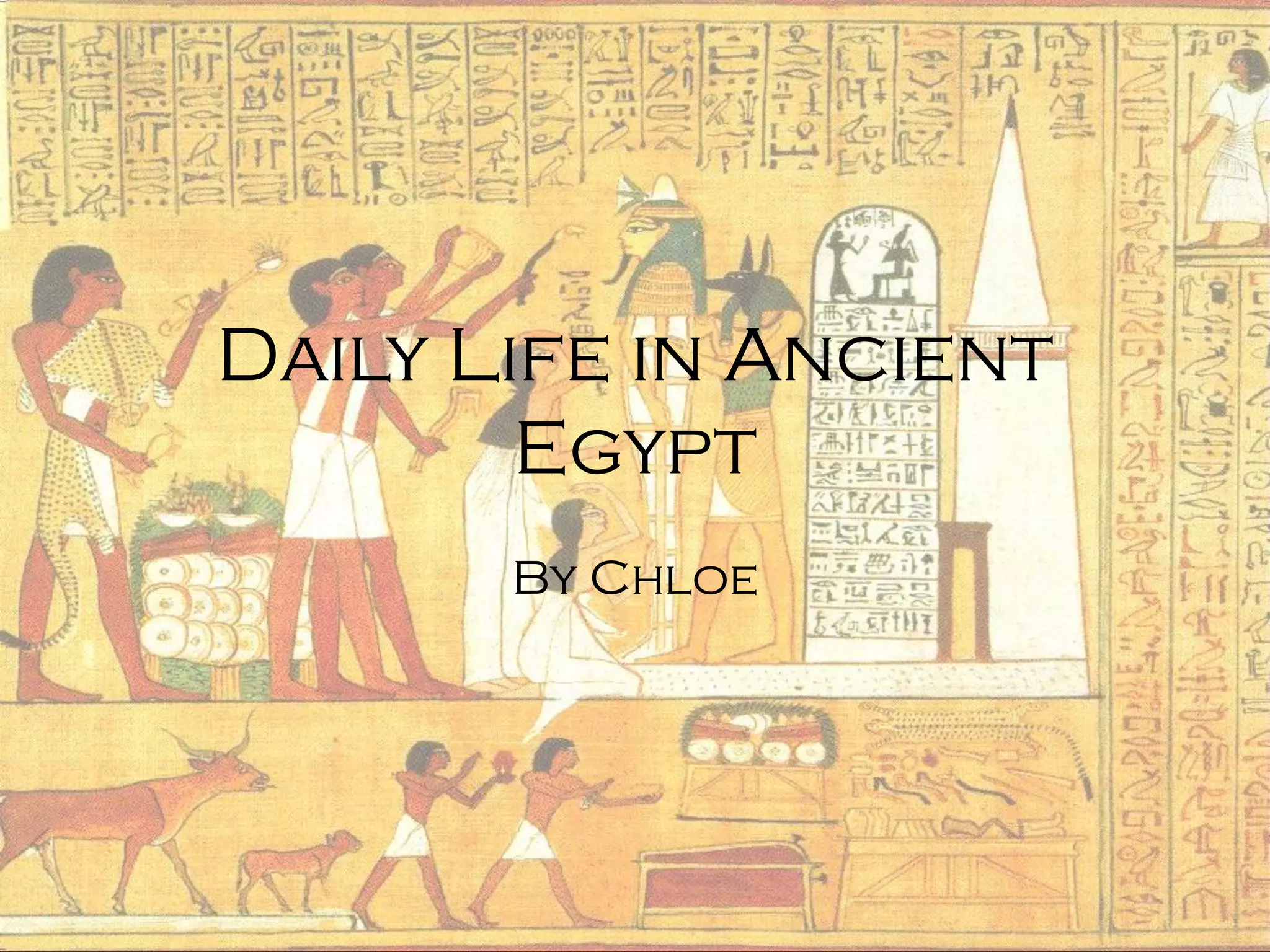
Daily Life in Ancient
        Egypt
       By Chloe
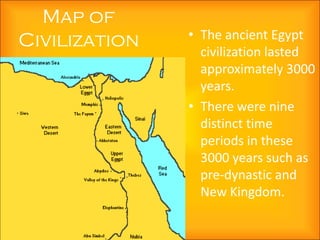
Map of
Civilization   • The ancient Egypt
                 civilization lasted
                 approximately 3000
                 years.
               • There were nine
                 distinct time
                 periods in these
                 3000 years such as
                 pre-dynastic and
                 New Kingdom.
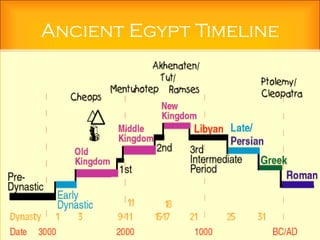
Ancient Egypt Timeline
Background
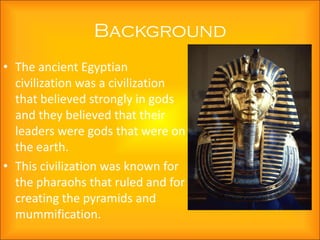
• The ancient Egyptian
  civilization was a civilization
  that believed strongly in gods
  and they believed that their
  leaders were gods that were on
  the earth.
• This civilization was known for
  the pharaohs that ruled and for
  creating the pyramids and
  mummification.
Social Structure
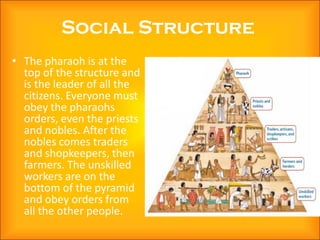
• The pharaoh is at the
  top of the structure and
  is the leader of all the
  citizens. Everyone must
  obey the pharaohs
  orders, even the priests
  and nobles. After the
  nobles comes traders
  and shopkeepers, then
  farmers. The unskilled
  workers are on the
  bottom of the pyramid
  and obey orders from
  all the other people.
Housing
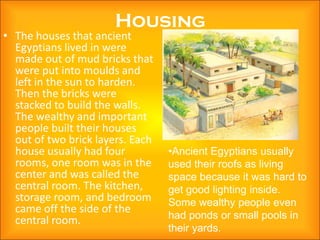
• The houses that ancient
  Egyptians lived in were
  made out of mud bricks that
  were put into moulds and
  left in the sun to harden.
  Then the bricks were
  stacked to build the walls.
  The wealthy and important
  people built their houses
  out of two brick layers. Each
  house usually had four          •Ancient Egyptians usually
  rooms, one room was in the      used their roofs as living
  center and was called the       space because it was hard to
  central room. The kitchen,      get good lighting inside.
  storage room, and bedroom       Some wealthy people even
  came off the side of the
  central room.                   had ponds or small pools in
                                  their yards.
Food
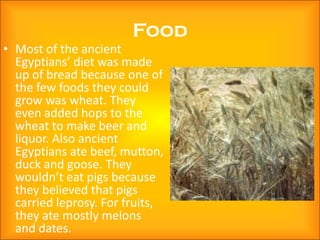
• Most of the ancient
  Egyptians’ diet was made
  up of bread because one of
  the few foods they could
  grow was wheat. They
  even added hops to the
  wheat to make beer and
  liquor. Also ancient
  Egyptians ate beef, mutton,
  duck and goose. They
  wouldn’t eat pigs because
  they believed that pigs
  carried leprosy. For fruits,
  they ate mostly melons
  and dates.
Family Life
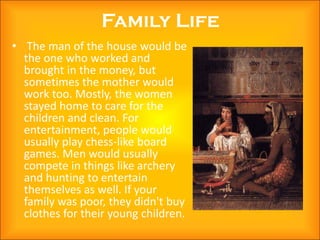
• The man of the house would be
  the one who worked and
  brought in the money, but
  sometimes the mother would
  work too. Mostly, the women
  stayed home to care for the
  children and clean. For
  entertainment, people would
  usually play chess-like board
  games. Men would usually
  compete in things like archery
  and hunting to entertain
  themselves as well. If your
  family was poor, they didn't buy
  clothes for their young children.
Marriage
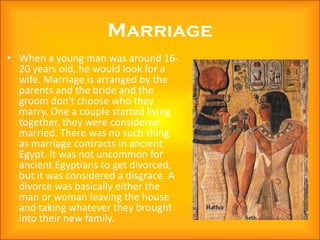
• When a young man was around 16-
  20 years old, he would look for a
  wife. Marriage is arranged by the
  parents and the bride and the
  groom don't choose who they
  marry. One a couple started living
  together, they were considered
  married. There was no such thing
  as marriage contracts in ancient
  Egypt. It was not uncommon for
  ancient Egyptians to get divorced,
  but it was considered a disgrace. A
  divorce was basically either the
  man or woman leaving the house
  and taking whatever they brought
  into their new family.
Childhood
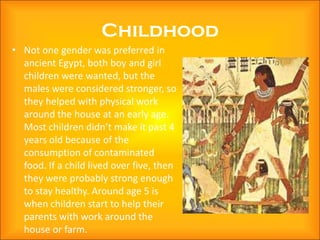
• Not one gender was preferred in
  ancient Egypt, both boy and girl
  children were wanted, but the
  males were considered stronger, so
  they helped with physical work
  around the house at an early age.
  Most children didn’t make it past 4
  years old because of the
  consumption of contaminated
  food. If a child lived over five, then
  they were probably strong enough
  to stay healthy. Around age 5 is
  when children start to help their
  parents with work around the
  house or farm.
Education
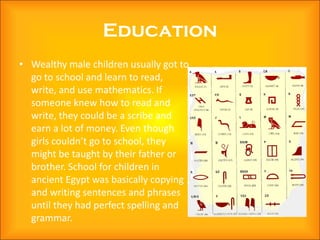
• Wealthy male children usually got to
  go to school and learn to read,
  write, and use mathematics. If
  someone knew how to read and
  write, they could be a scribe and
  earn a lot of money. Even though
  girls couldn’t go to school, they
  might be taught by their father or
  brother. School for children in
  ancient Egypt was basically copying
  and writing sentences and phrases
  until they had perfect spelling and
  grammar.
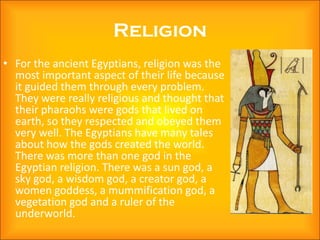
Religion
• For the ancient Egyptians, religion was the
  most important aspect of their life because
  it guided them through every problem.
  They were really religious and thought that
  their pharaohs were gods that lived on
  earth, so they respected and obeyed them
  very well. The Egyptians have many tales
  about how the gods created the world.
  There was more than one god in the
  Egyptian religion. There was a sun god, a
  sky god, a wisdom god, a creator god, a
  women goddess, a mummification god, a
  vegetation god and a ruler of the
  underworld.
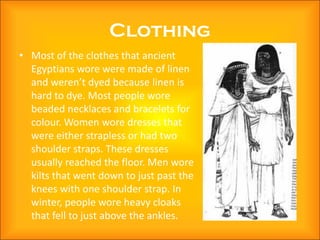
Clothing
• Most of the clothes that ancient
  Egyptians wore were made of linen
  and weren’t dyed because linen is
  hard to dye. Most people wore
  beaded necklaces and bracelets for
  colour. Women wore dresses that
  were either strapless or had two
  shoulder straps. These dresses
  usually reached the floor. Men wore
  kilts that went down to just past the
  knees with one shoulder strap. In
  winter, people wore heavy cloaks
  that fell to just above the ankles.
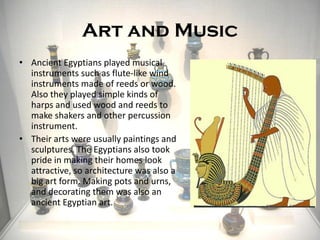
Art and Music
• Ancient Egyptians played musical
  instruments such as flute-like wind
  instruments made of reeds or wood.
  Also they played simple kinds of
  harps and used wood and reeds to
  make shakers and other percussion
  instrument.
• Their arts were usually paintings and
  sculptures. The Egyptians also took
  pride in making their homes look
  attractive, so architecture was also a
  big art form. Making pots and urns,
  and decorating them was also an
  ancient Egyptian art.
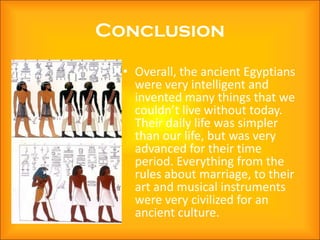
Conclusion

  • Overall, the ancient Egyptians
    were very intelligent and
    invented many things that we
    couldn’t live without today.
    Their daily life was simpler
    than our life, but was very
    advanced for their time
    period. Everything from the
    rules about marriage, to their
    art and musical instruments
    were very civilized for an
    ancient culture.
Picture bibliography
• Title picture (slide 1)
http://egypthistorytourism.blogspot.com/2010/10/ancient-
   egypt.html
• Map (slide 2)
http://www.jimloy.com/egypt/map.htm
• Timeline (slide 3)
• http://www.tigtail.org/TIG/L_View/TVM/E/Ancient/Egypt/egy
   ptian.html
• Pharaoh (slide 4)
http://euler.slu.edu/~bart/egyptianhtml/kings%20and%20Quee
   ns/TUTANKHAMEN.htm
Picture Bibliography 2
• Social pyramid (slide 5)
• http://thecorefour.glogster.com/the-nile-civilization-of-
  egypt/
• Wheat plant (slide 7)
• http://www.ancient-egypt-online.com/ancient-egyptian-
  food.html
• Family life (slide 8)
• http://www.hartifacts.com/phoenix/festival/winetour/W
  T_resource.htm
• Marriage (slide 9)
• http://www.awakening-
  healing.com/Egyptian_Gods_&_Goddesses.htm
Picture Bibliography 3
•   Children (slide 10)
•   http://euro-med.dk/?s=blue+cards
•   Hieroglyphics (slide 11)
•   http://atschool.eduweb.co.uk/trinity/projects/egypt/alphabet.html
•   Egyptian god Horus (slide 12)
•   http://professortravel-egypt.com/ancientreligions.html
•   Egyptian clothing (slide 13)
•   http://www.islandnet.com/~kpotter/egypt/cloth.htm
•   Pots and urns (slide 14)
•   http://upload.wikimedia.org/wikipedia/commons/7/7f/Egyptian_Min
    iature_Glasswares.jpg
•   Harp (slide 14)
•   http://www.zwoje-scrolls.com/zwoje39/text07p.htm
•   Ancient Egyptian people (slide 15)
•   http://www.one-ppm.com/Libya/LibyanPeople.htm
Information bibliography
• http://wiki.answers.com/Q/How_long_did_the_civili
  zation_of_ancient_Egypt_last
• http://historylink101.net/egypt_1/a-housing.htm
• http://www.historyforkids.org/learn/egypt/food/egy
  ptfood.htm
  Salariya, David. How Would you Survive as an Ancient
  Egyptian.
  Franklin Watts publishing, 1995
• http://fathom.lib.uchicago.edu/2/21701778/
• http://www2.sptimes.com/Egypt/EgyptCredit.4.3.ht
  ml
Information
         Bibliography 2
Toutant, Arnold. Ancient Worlds
Oxford Press, 2000
http://en.wikipedia.org/wiki/Ancient_Egypt
http://en.wikipedia.org/wiki/Art_of_ancient_Eg
  ypt

Chloe_socials

  • 1.
    Daily Life inAncient Egypt By Chloe
  • 2.
    Map of Civilization • The ancient Egypt civilization lasted approximately 3000 years. • There were nine distinct time periods in these 3000 years such as pre-dynastic and New Kingdom.
  • 3.
  • 4.
    Background • The ancientEgyptian civilization was a civilization that believed strongly in gods and they believed that their leaders were gods that were on the earth. • This civilization was known for the pharaohs that ruled and for creating the pyramids and mummification.
  • 5.
    Social Structure • Thepharaoh is at the top of the structure and is the leader of all the citizens. Everyone must obey the pharaohs orders, even the priests and nobles. After the nobles comes traders and shopkeepers, then farmers. The unskilled workers are on the bottom of the pyramid and obey orders from all the other people.
  • 6.
    Housing • The housesthat ancient Egyptians lived in were made out of mud bricks that were put into moulds and left in the sun to harden. Then the bricks were stacked to build the walls. The wealthy and important people built their houses out of two brick layers. Each house usually had four •Ancient Egyptians usually rooms, one room was in the used their roofs as living center and was called the space because it was hard to central room. The kitchen, get good lighting inside. storage room, and bedroom Some wealthy people even came off the side of the central room. had ponds or small pools in their yards.
  • 7.
    Food • Most ofthe ancient Egyptians’ diet was made up of bread because one of the few foods they could grow was wheat. They even added hops to the wheat to make beer and liquor. Also ancient Egyptians ate beef, mutton, duck and goose. They wouldn’t eat pigs because they believed that pigs carried leprosy. For fruits, they ate mostly melons and dates.
  • 8.
    Family Life • Theman of the house would be the one who worked and brought in the money, but sometimes the mother would work too. Mostly, the women stayed home to care for the children and clean. For entertainment, people would usually play chess-like board games. Men would usually compete in things like archery and hunting to entertain themselves as well. If your family was poor, they didn't buy clothes for their young children.
  • 9.
    Marriage • When ayoung man was around 16- 20 years old, he would look for a wife. Marriage is arranged by the parents and the bride and the groom don't choose who they marry. One a couple started living together, they were considered married. There was no such thing as marriage contracts in ancient Egypt. It was not uncommon for ancient Egyptians to get divorced, but it was considered a disgrace. A divorce was basically either the man or woman leaving the house and taking whatever they brought into their new family.
  • 10.
    Childhood • Not onegender was preferred in ancient Egypt, both boy and girl children were wanted, but the males were considered stronger, so they helped with physical work around the house at an early age. Most children didn’t make it past 4 years old because of the consumption of contaminated food. If a child lived over five, then they were probably strong enough to stay healthy. Around age 5 is when children start to help their parents with work around the house or farm.
  • 11.
    Education • Wealthy malechildren usually got to go to school and learn to read, write, and use mathematics. If someone knew how to read and write, they could be a scribe and earn a lot of money. Even though girls couldn’t go to school, they might be taught by their father or brother. School for children in ancient Egypt was basically copying and writing sentences and phrases until they had perfect spelling and grammar.
  • 12.
    Religion • For theancient Egyptians, religion was the most important aspect of their life because it guided them through every problem. They were really religious and thought that their pharaohs were gods that lived on earth, so they respected and obeyed them very well. The Egyptians have many tales about how the gods created the world. There was more than one god in the Egyptian religion. There was a sun god, a sky god, a wisdom god, a creator god, a women goddess, a mummification god, a vegetation god and a ruler of the underworld.
  • 13.
    Clothing • Most ofthe clothes that ancient Egyptians wore were made of linen and weren’t dyed because linen is hard to dye. Most people wore beaded necklaces and bracelets for colour. Women wore dresses that were either strapless or had two shoulder straps. These dresses usually reached the floor. Men wore kilts that went down to just past the knees with one shoulder strap. In winter, people wore heavy cloaks that fell to just above the ankles.
  • 14.
    Art and Music •Ancient Egyptians played musical instruments such as flute-like wind instruments made of reeds or wood. Also they played simple kinds of harps and used wood and reeds to make shakers and other percussion instrument. • Their arts were usually paintings and sculptures. The Egyptians also took pride in making their homes look attractive, so architecture was also a big art form. Making pots and urns, and decorating them was also an ancient Egyptian art.
  • 15.
    Conclusion •Overall, the ancient Egyptians were very intelligent and invented many things that we couldn’t live without today. Their daily life was simpler than our life, but was very advanced for their time period. Everything from the rules about marriage, to their art and musical instruments were very civilized for an ancient culture.
  • 16.
    Picture bibliography • Titlepicture (slide 1) http://egypthistorytourism.blogspot.com/2010/10/ancient- egypt.html • Map (slide 2) http://www.jimloy.com/egypt/map.htm • Timeline (slide 3) • http://www.tigtail.org/TIG/L_View/TVM/E/Ancient/Egypt/egy ptian.html • Pharaoh (slide 4) http://euler.slu.edu/~bart/egyptianhtml/kings%20and%20Quee ns/TUTANKHAMEN.htm
  • 17.
    Picture Bibliography 2 •Social pyramid (slide 5) • http://thecorefour.glogster.com/the-nile-civilization-of- egypt/ • Wheat plant (slide 7) • http://www.ancient-egypt-online.com/ancient-egyptian- food.html • Family life (slide 8) • http://www.hartifacts.com/phoenix/festival/winetour/W T_resource.htm • Marriage (slide 9) • http://www.awakening- healing.com/Egyptian_Gods_&_Goddesses.htm
  • 18.
    Picture Bibliography 3 • Children (slide 10) • http://euro-med.dk/?s=blue+cards • Hieroglyphics (slide 11) • http://atschool.eduweb.co.uk/trinity/projects/egypt/alphabet.html • Egyptian god Horus (slide 12) • http://professortravel-egypt.com/ancientreligions.html • Egyptian clothing (slide 13) • http://www.islandnet.com/~kpotter/egypt/cloth.htm • Pots and urns (slide 14) • http://upload.wikimedia.org/wikipedia/commons/7/7f/Egyptian_Min iature_Glasswares.jpg • Harp (slide 14) • http://www.zwoje-scrolls.com/zwoje39/text07p.htm • Ancient Egyptian people (slide 15) • http://www.one-ppm.com/Libya/LibyanPeople.htm
  • 19.
    Information bibliography • http://wiki.answers.com/Q/How_long_did_the_civili zation_of_ancient_Egypt_last • http://historylink101.net/egypt_1/a-housing.htm • http://www.historyforkids.org/learn/egypt/food/egy ptfood.htm Salariya, David. How Would you Survive as an Ancient Egyptian. Franklin Watts publishing, 1995 • http://fathom.lib.uchicago.edu/2/21701778/ • http://www2.sptimes.com/Egypt/EgyptCredit.4.3.ht ml
  • 20.
    Information Bibliography 2 Toutant, Arnold. Ancient Worlds Oxford Press, 2000 http://en.wikipedia.org/wiki/Ancient_Egypt http://en.wikipedia.org/wiki/Art_of_ancient_Eg ypt