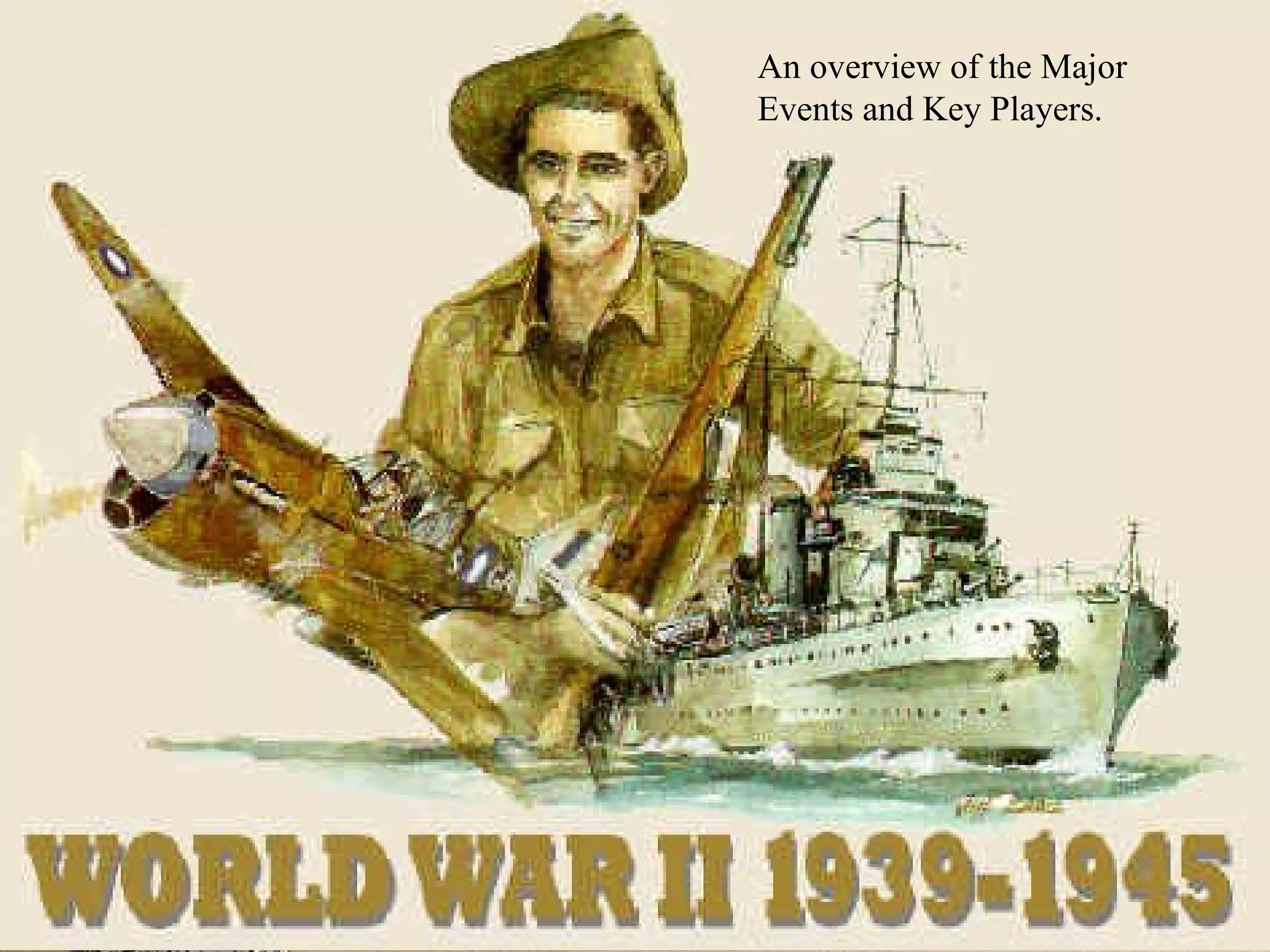
An overview of the Major
Events and Key Players.
Key Players in the War
Axis Powers          Allied Powers
 Adolf Hitler        Neville Chamberlain
 Benito Mussolini    Winston Churchill
 Hideki Tojo         Charles De Gaulle
                      Franklin Roosevelt
                      Harry Truman
                      Joseph Stalin
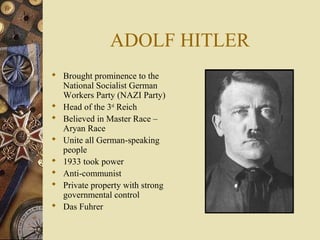
ADOLF HITLER
 Brought prominence to the
  National Socialist German
  Workers Party (NAZI Party)
 Head of the 3rd Reich
 Believed in Master Race –
  Aryan Race
 Unite all German-speaking
  people
 1933 took power
 Anti-communist
 Private property with strong
  governmental control
 Das Fuhrer
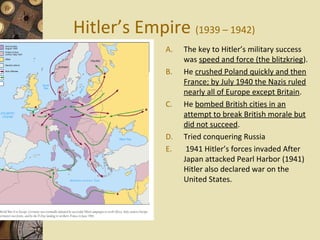
Hitler’s Empire (1939 – 1942)
              A.   The key to Hitler’s military success
                   was speed and force (the blitzkrieg).
              B.   He crushed Poland quickly and then
                   France; by July 1940 the Nazis ruled
                   nearly all of Europe except Britain.
              C.   He bombed British cities in an
                   attempt to break British morale but
                   did not succeed.
              D.   Tried conquering Russia
              E.    1941 Hitler’s forces invaded After
                   Japan attacked Pearl Harbor (1941)
                   Hitler also declared war on the
                   United States.
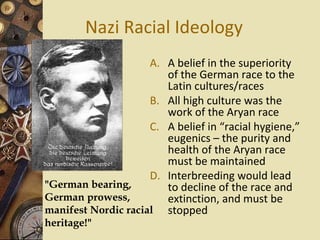
Nazi Racial Ideology
                     A. A belief in the superiority
                        of the German race to the
                        Latin cultures/races
                     B. All high culture was the
                        work of the Aryan race
                     C. A belief in “racial hygiene,”
                        eugenics – the purity and
                        health of the Aryan race
                        must be maintained
                     D. Interbreeding would lead
"German bearing,        to decline of the race and
German prowess,         extinction, and must be
manifest Nordic racial stopped
heritage!"
Hitler’s New Order
A. Hitler began building a New Order based
   on racial imperialism.
B. Nordic peoples were treated with
   preference; the French were heavily
   taxed; the Slavs were treated as “sub-
   humans.”
C. Polish workers and Russian prisoners of
   war did most of the heavy labor.
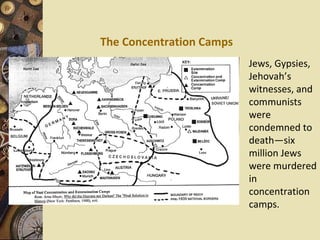
The Concentration Camps
                          Jews, Gypsies,
                          Jehovah’s
                          witnesses, and
                          communists
                          were
                          condemned to
                          death—six
                          million Jews
                          were murdered
                          in
                          concentration
                          camps.
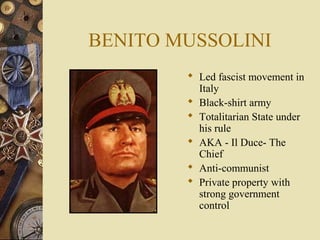
BENITO MUSSOLINI
         Led fascist movement in
          Italy
         Black-shirt army
         Totalitarian State under
          his rule
         AKA - Il Duce- The
          Chief
         Anti-communist
         Private property with
          strong government
          control
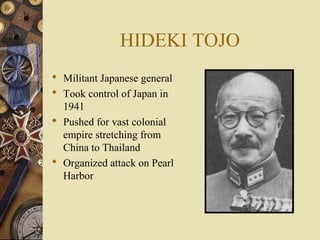
HIDEKI TOJO
 Militant Japanese general
 Took control of Japan in
  1941
 Pushed for vast colonial
  empire stretching from
  China to Thailand
 Organized attack on Pearl
  Harbor
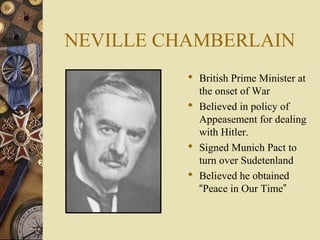
NEVILLE CHAMBERLAIN
           British Prime Minister at
            the onset of War
           Believed in policy of
            Appeasement for dealing
            with Hitler.
           Signed Munich Pact to
            turn over Sudetenland
           Believed he obtained
            “Peace in Our Time”
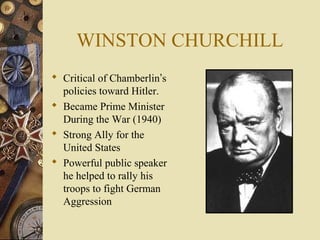
WINSTON CHURCHILL
 Critical of Chamberlin’s
  policies toward Hitler.
 Became Prime Minister
  During the War (1940)
 Strong Ally for the
  United States
 Powerful public speaker
  he helped to rally his
  troops to fight German
  Aggression
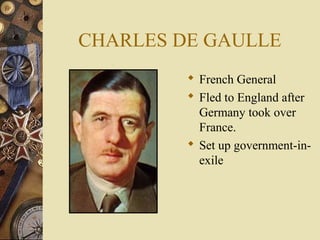
CHARLES DE GAULLE
          French General
          Fled to England after
           Germany took over
           France.
          Set up government-in-
           exile
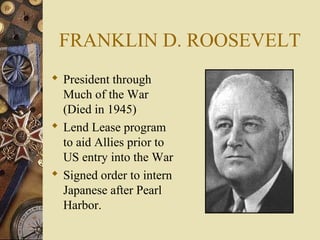
FRANKLIN D. ROOSEVELT
 President through
  Much of the War
  (Died in 1945)
 Lend Lease program
  to aid Allies prior to
  US entry into the War
 Signed order to intern
  Japanese after Pearl
  Harbor.
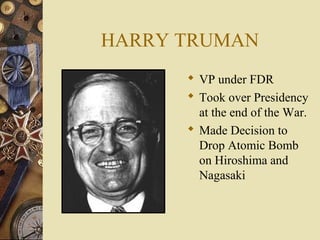
HARRY TRUMAN
       VP under FDR
       Took over Presidency
        at the end of the War.
       Made Decision to
        Drop Atomic Bomb
        on Hiroshima and
        Nagasaki
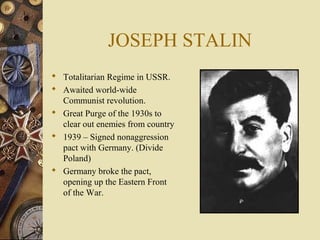
JOSEPH STALIN
 Totalitarian Regime in USSR.
 Awaited world-wide
  Communist revolution.
 Great Purge of the 1930s to
  clear out enemies from country
 1939 – Signed nonaggression
  pact with Germany. (Divide
  Poland)
 Germany broke the pact,
  opening up the Eastern Front
  of the War.
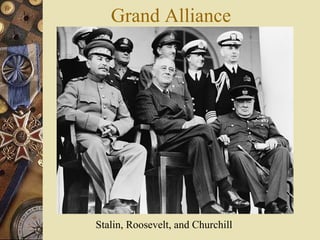
Grand Alliance


Stalin, Roosevelt, and Churchill
Background
 Treaty of Versailles (1919) - Harsh treatment of
  Germany: land losses, reparations, military reductions,
  and war guilt
 League of Nations (1920) – International organization
  charged with preventing future wars. United States
  senate refused to allow the United States of America to
  become a member. The League had neither the will nor
  the power to check the rising totalitarian governments.
Background
 Washington Conference (1922) – Italy, Japan, the United
  States of America, France, and Britain agree to not build
  up their navies for ten years
 Mussolini takes over Italy (1922)
 Kellogg-Briand Pact (1928) – sixty-two nations agree to
  solve problems diplomatically
 Japan invades Manchuria (1931)
 Hitler comes to power (1933)
Short Term Causes
 Italian, Japanese, and German aggression
  not stopped by League of Nations
Short Term Causes
 Appeasement – Britain and France wanted to avoid war
  and therefore gave in to Hitler’s demands
 Western democracies would not act aggressively
   – Britain – Sympathetic towards Germany – knew Versailles
     Treaty too harsh, wanted to avoid war
   – France – Would not do anything without Britain
   – United States of America – Isolation from Europe
Major Events of World War II-
           The War
 1940 – Germany invades Norway and Denmark
 1940 – France Falls
 Summer 1940 – Britain withstands the German
  onslaught
 1941- Germany broke pact with USSR
  – German setbacks- the harsh winters in Soviet Union;
    Bitter defeat in Stalingrad
Major Events of World War II -
    American Involvement
 Lend-Lease Program to aid Allies
 Attack on Pearl Harbor – December 7,
  1941- A Day that will live in infamy
 US enters World War II
 1942 – War turned in favor of the Allies
  – Victories in North Africa versus Germany
  – Victory in the Battle of the Midway in the
    Pacific
Major Events in World War II –
     The End of the War
 June 6, 1944 – Storming of Normandy
 December 1944- Hitler lost the battle of
  the Bulge
 Germany surrendered in May 1945
 Atomic Bomb dropped on Hiroshima and
  Nagasaki in August of 1945
 Japan Surrendered in September 1945

The 2nd World War

  • 1.
    An overview ofthe Major Events and Key Players.
  • 2.
    Key Players inthe War Axis Powers Allied Powers  Adolf Hitler  Neville Chamberlain  Benito Mussolini  Winston Churchill  Hideki Tojo  Charles De Gaulle  Franklin Roosevelt  Harry Truman  Joseph Stalin
  • 3.
    ADOLF HITLER  Broughtprominence to the National Socialist German Workers Party (NAZI Party)  Head of the 3rd Reich  Believed in Master Race – Aryan Race  Unite all German-speaking people  1933 took power  Anti-communist  Private property with strong governmental control  Das Fuhrer
  • 4.
    Hitler’s Empire (1939– 1942) A. The key to Hitler’s military success was speed and force (the blitzkrieg). B. He crushed Poland quickly and then France; by July 1940 the Nazis ruled nearly all of Europe except Britain. C. He bombed British cities in an attempt to break British morale but did not succeed. D. Tried conquering Russia E. 1941 Hitler’s forces invaded After Japan attacked Pearl Harbor (1941) Hitler also declared war on the United States.
  • 5.
    Nazi Racial Ideology A. A belief in the superiority of the German race to the Latin cultures/races B. All high culture was the work of the Aryan race C. A belief in “racial hygiene,” eugenics – the purity and health of the Aryan race must be maintained D. Interbreeding would lead "German bearing, to decline of the race and German prowess, extinction, and must be manifest Nordic racial stopped heritage!"
  • 6.
    Hitler’s New Order A.Hitler began building a New Order based on racial imperialism. B. Nordic peoples were treated with preference; the French were heavily taxed; the Slavs were treated as “sub- humans.” C. Polish workers and Russian prisoners of war did most of the heavy labor.
  • 7.
    The Concentration Camps Jews, Gypsies, Jehovah’s witnesses, and communists were condemned to death—six million Jews were murdered in concentration camps.
  • 8.
    BENITO MUSSOLINI  Led fascist movement in Italy  Black-shirt army  Totalitarian State under his rule  AKA - Il Duce- The Chief  Anti-communist  Private property with strong government control
  • 9.
    HIDEKI TOJO  MilitantJapanese general  Took control of Japan in 1941  Pushed for vast colonial empire stretching from China to Thailand  Organized attack on Pearl Harbor
  • 10.
    NEVILLE CHAMBERLAIN  British Prime Minister at the onset of War  Believed in policy of Appeasement for dealing with Hitler.  Signed Munich Pact to turn over Sudetenland  Believed he obtained “Peace in Our Time”
  • 11.
    WINSTON CHURCHILL  Criticalof Chamberlin’s policies toward Hitler.  Became Prime Minister During the War (1940)  Strong Ally for the United States  Powerful public speaker he helped to rally his troops to fight German Aggression
  • 12.
    CHARLES DE GAULLE  French General  Fled to England after Germany took over France.  Set up government-in- exile
  • 13.
    FRANKLIN D. ROOSEVELT President through Much of the War (Died in 1945)  Lend Lease program to aid Allies prior to US entry into the War  Signed order to intern Japanese after Pearl Harbor.
  • 14.
    HARRY TRUMAN  VP under FDR  Took over Presidency at the end of the War.  Made Decision to Drop Atomic Bomb on Hiroshima and Nagasaki
  • 15.
    JOSEPH STALIN  TotalitarianRegime in USSR.  Awaited world-wide Communist revolution.  Great Purge of the 1930s to clear out enemies from country  1939 – Signed nonaggression pact with Germany. (Divide Poland)  Germany broke the pact, opening up the Eastern Front of the War.
  • 16.
  • 17.
    Background  Treaty ofVersailles (1919) - Harsh treatment of Germany: land losses, reparations, military reductions, and war guilt  League of Nations (1920) – International organization charged with preventing future wars. United States senate refused to allow the United States of America to become a member. The League had neither the will nor the power to check the rising totalitarian governments.
  • 18.
    Background  Washington Conference(1922) – Italy, Japan, the United States of America, France, and Britain agree to not build up their navies for ten years  Mussolini takes over Italy (1922)  Kellogg-Briand Pact (1928) – sixty-two nations agree to solve problems diplomatically  Japan invades Manchuria (1931)  Hitler comes to power (1933)
  • 19.
    Short Term Causes Italian, Japanese, and German aggression not stopped by League of Nations
  • 20.
    Short Term Causes Appeasement – Britain and France wanted to avoid war and therefore gave in to Hitler’s demands  Western democracies would not act aggressively – Britain – Sympathetic towards Germany – knew Versailles Treaty too harsh, wanted to avoid war – France – Would not do anything without Britain – United States of America – Isolation from Europe
  • 21.
    Major Events ofWorld War II- The War  1940 – Germany invades Norway and Denmark  1940 – France Falls  Summer 1940 – Britain withstands the German onslaught  1941- Germany broke pact with USSR – German setbacks- the harsh winters in Soviet Union; Bitter defeat in Stalingrad
  • 22.
    Major Events ofWorld War II - American Involvement  Lend-Lease Program to aid Allies  Attack on Pearl Harbor – December 7, 1941- A Day that will live in infamy  US enters World War II  1942 – War turned in favor of the Allies – Victories in North Africa versus Germany – Victory in the Battle of the Midway in the Pacific
  • 23.
    Major Events inWorld War II – The End of the War  June 6, 1944 – Storming of Normandy  December 1944- Hitler lost the battle of the Bulge  Germany surrendered in May 1945  Atomic Bomb dropped on Hiroshima and Nagasaki in August of 1945  Japan Surrendered in September 1945