New Kingdom Egypt
Hatshepsut
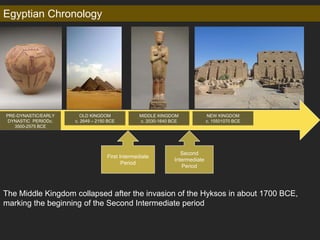
Egyptian Chronology
PRE-DYNASTIC/EARLY
DYNASTIC PERIODc.
3500-2575 BCE
OLD KINGDOM
c. 2649 – 2150 BCE
MIDDLE KINGDOM
c. 2030-1640 BCE
NEW KINGDOM
c. 15501070 BCE
The Middle Kingdom collapsed after the invasion of the Hyksos in about 1700 BCE,
marking the beginning of the Second Intermediate period
First Intermediate
Period
Second
Intermediate
Period
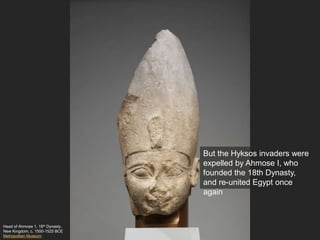
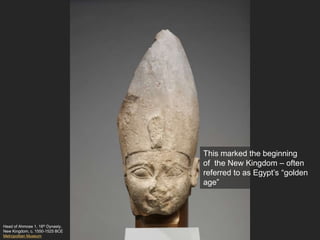
Head of Ahmose 1, 18th Dynasty,
New Kingdom, c. 1550-1525 BCE
Metropolitan Museum
But the Hyksos invaders were
expelled by Ahmose I, who
founded the 18th Dynasty,
and re-united Egypt once
again
Head of Ahmose 1, 18th Dynasty,
New Kingdom, c. 1550-1525 BCE
Metropolitan Museum
This marked the beginning
of the New Kingdom – often
referred to as Egypt’s “golden
age”
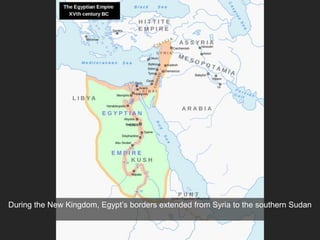
During the New Kingdom, Egypt’s borders extended from Syria to the southern Sudan
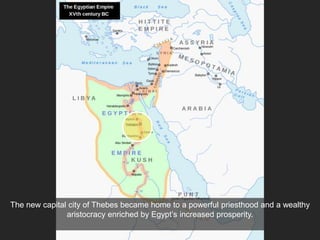
The new capital city of Thebes became home to a powerful priesthood and a wealthy
aristocracy enriched by Egypt’s increased prosperity.
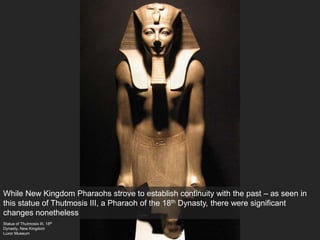
Statue of Thutmosis III, 18th
Dynasty, New Kingdom
Luxor Museum
While New Kingdom Pharaohs strove to establish continuity with the past – as seen in
this statue of Thutmosis III, a Pharaoh of the 18th Dynasty, there were significant
changes nonetheless
Image source: https://discoveringegypt.com/pyramids-temples-of-egypt/pyramids-of-giza/
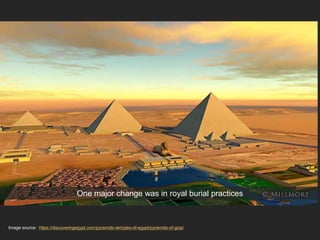
One major change was in royal burial practices
Image source: https://discoveringegypt.com/pyramids-temples-of-egypt/pyramids-of-giza/
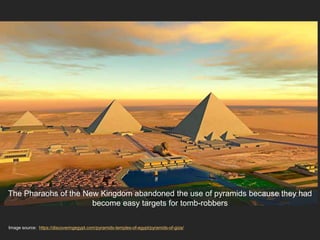
The Pharaohs of the New Kingdom abandoned the use of pyramids because they had
become easy targets for tomb-robbers
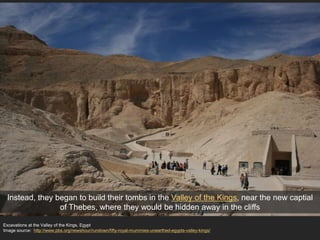
Excavations at the Valley of the Kings, Egypt
Image source: http://www.pbs.org/newshour/rundown/fifty-royal-mummies-unearthed-egypts-valley-kings/
Instead, they began to build their tombs in the Valley of the Kings, near the new captial
of Thebes, where they would be hidden away in the cliffs
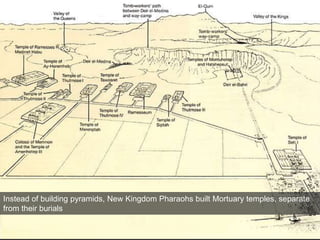
Instead of building pyramids, New Kingdom Pharaohs built Mortuary temples, separate
from their burials
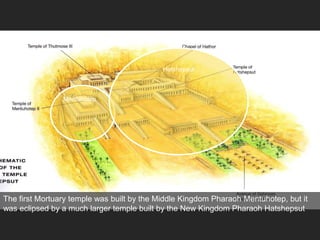
The first Mortuary temple was built by the Middle Kingdom Pharaoh Mentuhotep, but it
was eclipsed by a much larger temple built by the New Kingdom Pharaoh Hatshepsut
Mentuhotep
Hatshepsut
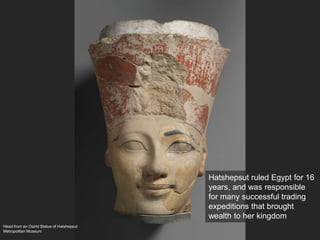
Head from an Osirid Statue of Hatshepsut
Metropolitan Museum
Hatshepsut ruled Egypt for 16
years, and was responsible
for many successful trading
expeditions that brought
wealth to her kingdom
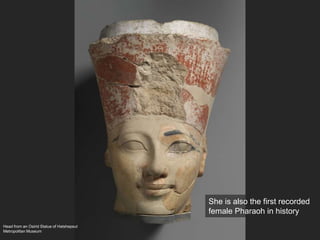
Head from an Osirid Statue of Hatshepsut
Metropolitan Museum
She is also the first recorded
female Pharaoh in history
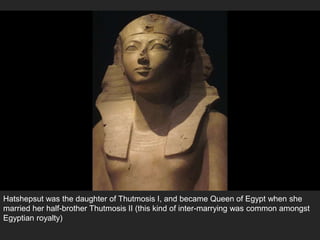
Hatshepsut was the daughter of Thutmosis I, and became Queen of Egypt when she
married her half-brother Thutmosis II (this kind of inter-marrying was common amongst
Egyptian royalty)
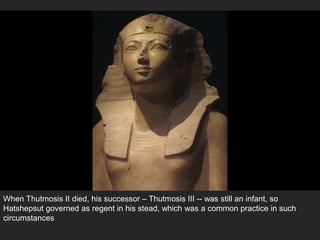
When Thutmosis II died, his successor – Thutmosis III -- was still an infant, so
Hatshepsut governed as regent in his stead, which was a common practice in such
circumstances
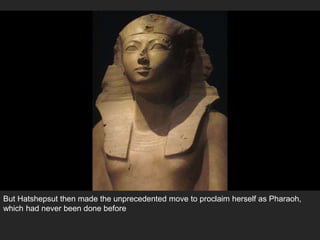
But Hatshepsut then made the unprecedented move to proclaim herself as Pharaoh,
which had never been done before
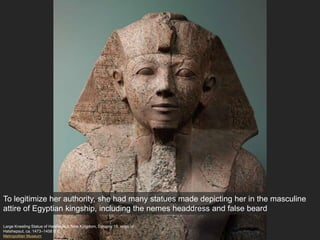
Large Kneeling Statue of Hatshepsut, New Kingdom, Dynasty 18, reign of
Hatshepsut, ca. 1473–1458 B.C.
Metropolitan Museum
To legitimize her authority, she had many statues made depicting her in the masculine
attire of Egyptian kingship, including the nemes headdress and false beard
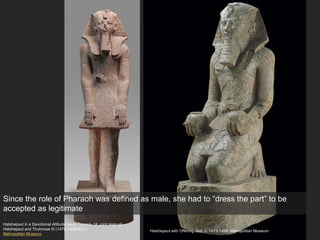
Hatshepsut with Offering Jars, c. 1473-1458. Metropolitan Museum
Hatshepsut in a Devotional Attitude, early Dynasty 18; joint reign of
Hatshepsut and Thutmose III (1479–1458 B.C.)
Metropolitan Museum
Since the role of Pharaoh was defined as male, she had to “dress the part” to be
accepted as legitimate
Hatshepsut as Female King, early Dynasty 18; joint reign of
Hatshepsut and Thutmose III (1479–1458 B.C.)
Metropolitan Museum
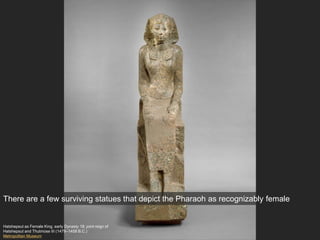
There are a few surviving statues that depict the Pharaoh as recognizably female
Hatshepsut as Female King, early Dynasty 18; joint reign of
Hatshepsut and Thutmose III (1479–1458 B.C.)
Metropolitan Museum
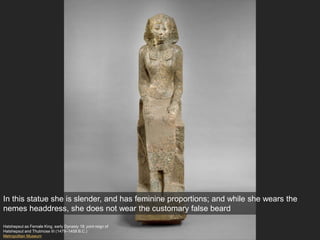
In this statue she is slender, and has feminine proportions; and while she wears the
nemes headdress, she does not wear the customary false beard
Sphinx of Hatshepsut, early Dynasty 18; joint reign of
Hatshepsut and Thutmose III (1479–1458 B.C.)
Metropolitan Museum
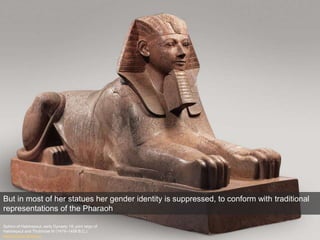
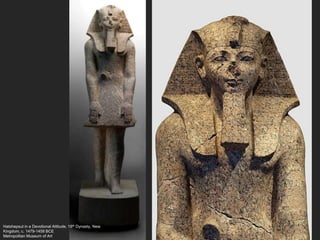
But in most of her statues her gender identity is suppressed, to conform with traditional
representations of the Pharaoh
Hatshepsut in a Devotional Attitude, 18th Dynasty, New
Kingdom, c. 1479-1458 BCE
Metropolitan Museum of Art
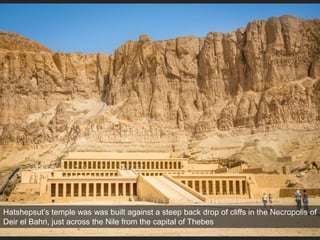
Hatshepsut’s temple was was built against a steep back drop of cliffs in the Necropolis of
Deir el Bahri, just across the Nile from the capital of Thebes
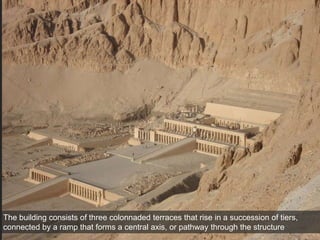
The building consists of three colonnaded terraces that rise in a succession of tiers,
connected by a ramp that forms a central axis, or pathway through the structure
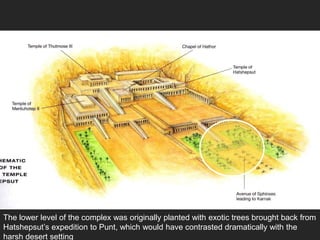
The lower level of the complex was originally planted with exotic trees brought back from
Hatshepsut’s expedition to Punt, which would have contrasted dramatically with the
harsh desert setting
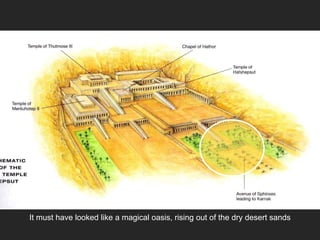
It must have looked like a magical oasis, rising out of the dry desert sands
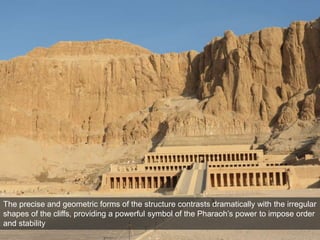
The precise and geometric forms of the structure contrasts dramatically with the irregular
shapes of the cliffs, providing a powerful symbol of the Pharaoh’s power to impose order
and stability
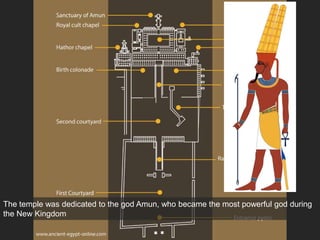
The temple was dedicated to the god Amun, who became the most powerful god during
the New Kingdom
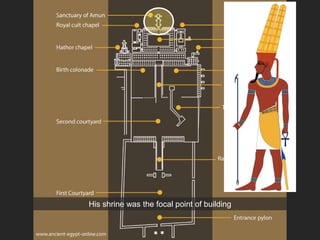
His shrine was the focal point of building
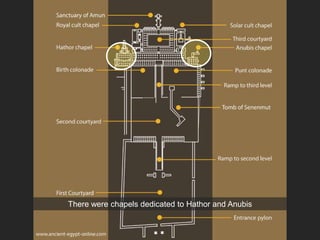
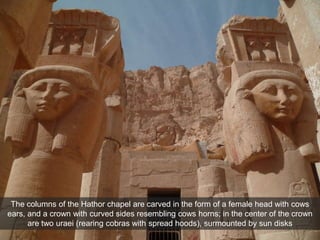
There were chapels dedicated to Hathor and Anubis
The columns of the Hathor chapel are carved in the form of a female head with cows
ears, and a crown with curved sides resembling cows horns; in the center of the crown
are two uraei (rearing cobras with spread hoods), surmounted by sun disks
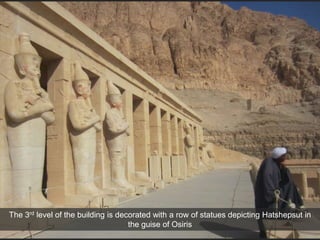
The 3rd level of the building is decorated with a row of statues depicting Hatshepsut in
the guise of Osiris
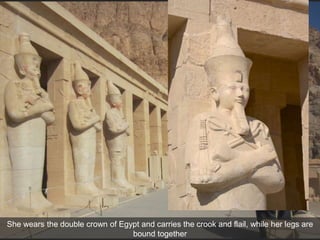
She wears the double crown of Egypt and carries the crook and flail, while her legs are
bound together
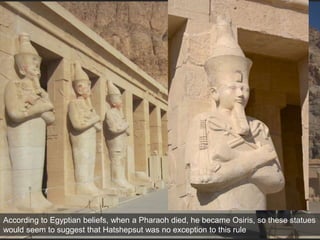
According to Egyptian beliefs, when a Pharaoh died, he became Osiris, so these statues
would seem to suggest that Hatshepsut was no exception to this rule
In the so-called Birth Colonnade, there is a cycle of painted reliefs depicting
Hatshepsut’s divine birth from the god Amun
In this scene we see Hatshepsut suckling from the goddess Hathor, who takes the form
of a cow
Decorations of the temple included statues depicting Hatshepsut making offerings to the
god Amun
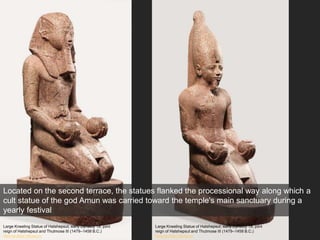
Large Kneeling Statue of Hatshepsut, early Dynasty 18; joint
reign of Hatshepsut and Thutmose III (1479–1458 B.C.)
Metropolitan Museum
Large Kneeling Statue of Hatshepsut, early Dynasty 18; joint
reign of Hatshepsut and Thutmose III (1479–1458 B.C.)
Metropolitan Museum
Large Kneeling Statue of Hatshepsut, early Dynasty 18; joint
reign of Hatshepsut and Thutmose III (1479–1458 B.C.)
Metropolitan Museum
Large Kneeling Statue of Hatshepsut, early Dynasty 18; joint
reign of Hatshepsut and Thutmose III (1479–1458 B.C.)
Metropolitan Museum
Located on the second terrace, the statues flanked the processional way along which a
cult statue of the god Amun was carried toward the temple's main sanctuary during a
yearly festival
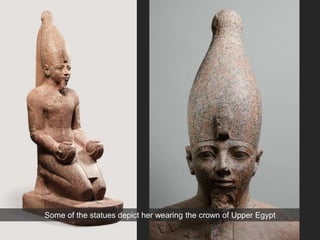
Some of the statues depict her wearing the crown of Upper Egypt
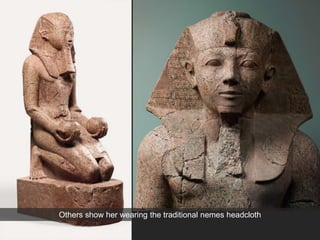
Others show her wearing the traditional nemes headcloth
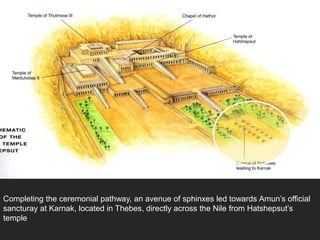
Completing the ceremonial pathway, an avenue of sphinxes led towards Amun’s official
sancturay at Karnak, located in Thebes, directly across the Nile from Hatshepsut’s
temple
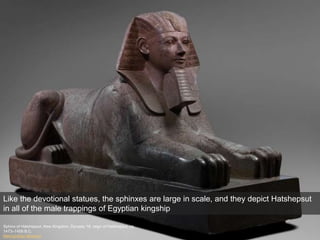
Sphinx of Hatshepsut, New Kingdom, Dynasty 18, reign of Hatshepsut, ca.
1473–1458 B.C.
Metropolitan Museum
Like the devotional statues, the sphinxes are large in scale, and they depict Hatshepsut
in all of the male trappings of Egyptian kingship
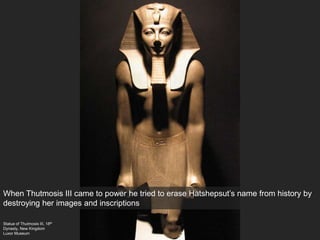
Statue of Thutmosis III, 18th
Dynasty, New Kingdom
Luxor Museum
When Thutmosis III came to power he tried to erase Hatshepsut’s name from history by
destroying her images and inscriptions
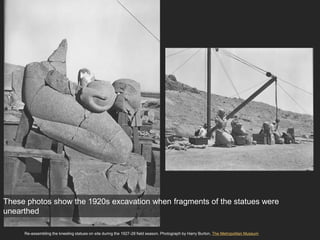
Re-assembling the kneeling statues on site during the 1927-28 field season. Photograph by Harry Burton, The Metropolitan Museum
These photos show the 1920s excavation when fragments of the statues were
unearthed
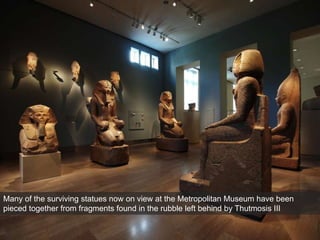
Many of the surviving statues now on view at the Metropolitan Museum have been
pieced together from fragments found in the rubble left behind by Thutmosis III
Thanks for Listening!
Next up: Egyptian Temples
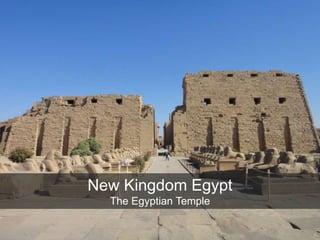
New Kingdom Egypt
The Egyptian Temple
Statuette of Amun-Re, c. 747-664
BCE
Walters Art Museum
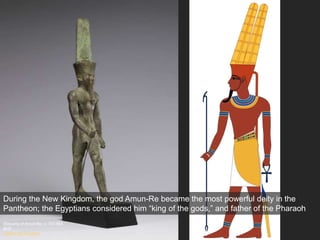
During the New Kingdom, the god Amun-Re became the most powerful deity in the
Pantheon; the Egyptians considered him “king of the gods,” and father of the Pharaoh
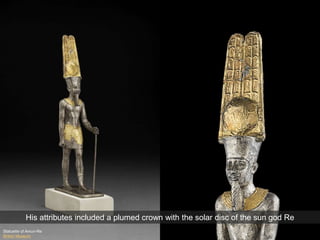
Statuette of Amun-Re
British Museum
His attributes included a plumed crown with the solar disc of the sun god Re
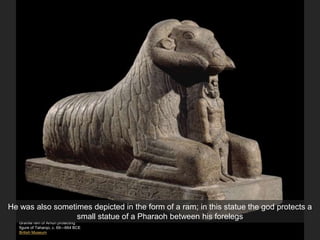
Granite ram of Amun protecting
figure of Taharqo, c. 69—664 BCE
British Museum
He was also sometimes depicted in the form of a ram; in this statue the god protects a
small statue of a Pharaoh between his forelegs
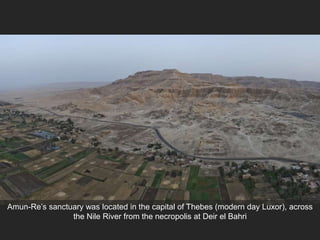
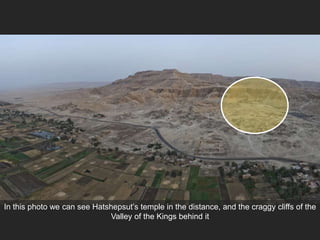
Amun-Re’s sanctuary was located in the capital of Thebes (modern day Luxor), across
the Nile River from the necropolis at Deir el Bahri
In this photo we can see Hatshepsut’s temple in the distance, and the craggy cliffs of the
Valley of the Kings behind it
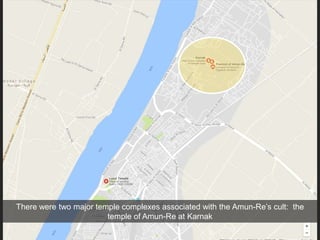
There were two major temple complexes associated with the Amun-Re’s cult: the
temple of Amun-Re at Karnak
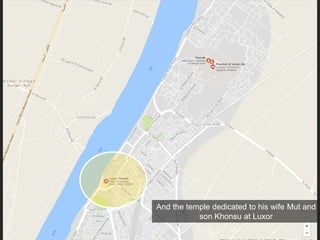
And the temple dedicated to his wife Mut and
son Khonsu at Luxor
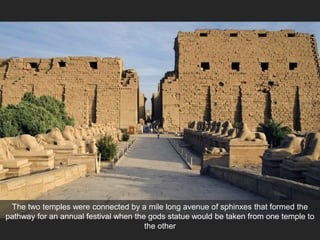
The two temples were connected by a mile long avenue of sphinxes that formed the
pathway for an annual festival when the gods statue would be taken from one temple to
the other
Image source: https://www.khanacademy.org/humanities/ancient-art-civilizations/egypt-art/new-kingdom/a/karnak
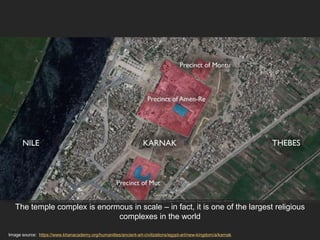
The temple complex is enormous in scale – in fact, it is one of the largest religious
complexes in the world
Image source: https://www.khanacademy.org/humanities/ancient-art-civilizations/egypt-art/new-kingdom/a/karnak
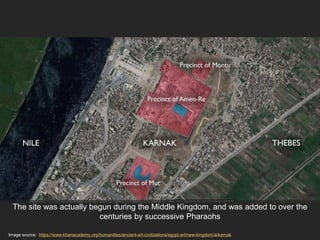
The site was actually begun during the Middle Kingdom, and was added to over the
centuries by successive Pharaohs
Image source: http://www.nevworldwonders.com/2013/08/preview-karnak.html
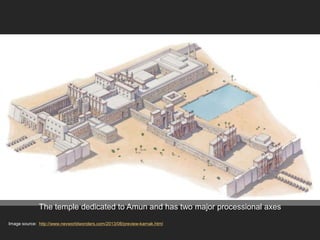
The temple dedicated to Amun and has two major processional axes
Image source: http://www.nevworldwonders.com/2013/08/preview-karnak.html
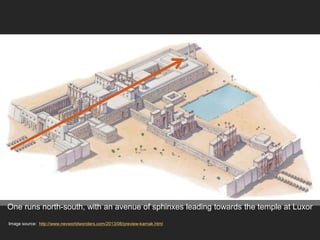
One runs north-south, with an avenue of sphinxes leading towards the temple at Luxor
Image source: http://www.nevworldwonders.com/2013/08/preview-karnak.html
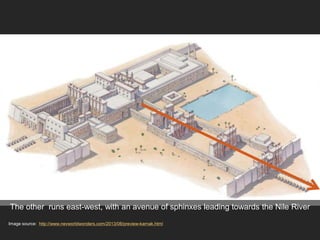
The other runs east-west, with an avenue of sphinxes leading towards the Nile River
Image source: http://www.nevworldwonders.com/2013/08/preview-karnak.html
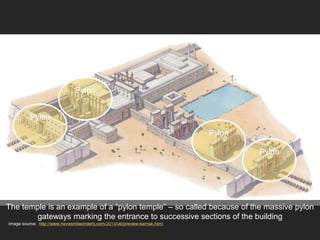
The temple is an example of a “pylon temple” – so called because of the massive pylon
gateways marking the entrance to successive sections of the building
Pylon
Pylon
Pylon
Pylon
Egyptian Pylon Temple
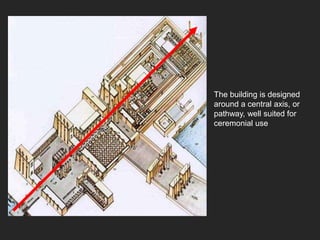
The building is designed
around a central axis, or
pathway, well suited for
ceremonial use
Egyptian Pylon Temple
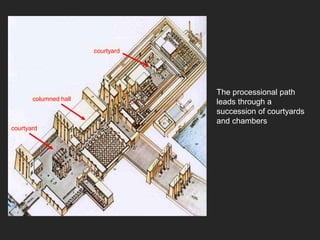
courtyard
columned hall
courtyard
The processional path
leads through a
succession of courtyards
and chambers
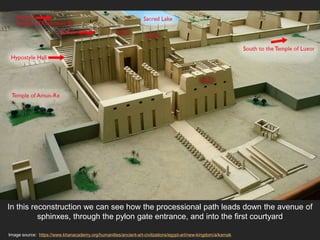
Image source: https://www.khanacademy.org/humanities/ancient-art-civilizations/egypt-art/new-kingdom/a/karnak
In this reconstruction we can see how the processional path leads down the avenue of
sphinxes, through the pylon gate entrance, and into the first courtyard
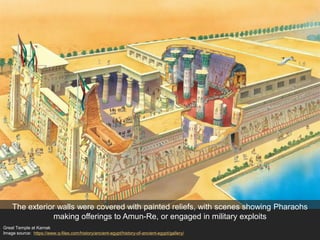
Great Temple at Karnak
Image source: https://www.q-files.com/history/ancient-egypt/history-of-ancient-egypt/gallery/
The exterior walls were covered with painted reliefs, with scenes showing Pharaohs
making offerings to Amun-Re, or engaged in military exploits
Egyptian Pylon Temple
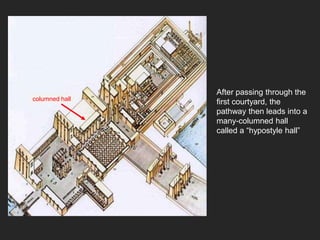
columned hall
After passing through the
first courtyard, the
pathway then leads into a
many-columned hall
called a “hypostyle hall”
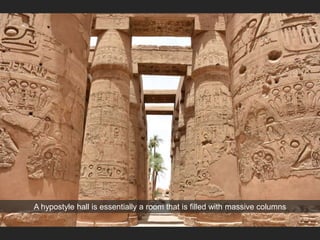
A hypostyle hall is essentially a room that is filled with massive columns
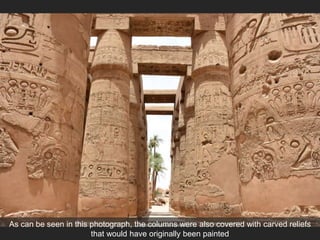
As can be seen in this photograph, the columns were also covered with carved reliefs
that would have originally been painted
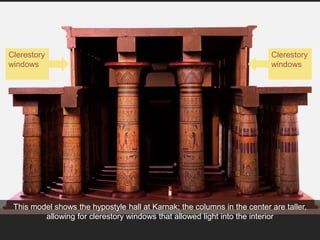
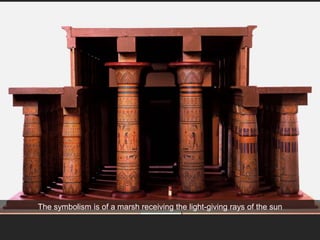
This model shows the hypostyle hall at Karnak; the columns in the center are taller,
allowing for clerestory windows that allowed light into the interior
Clerestory
windows
Clerestory
windows
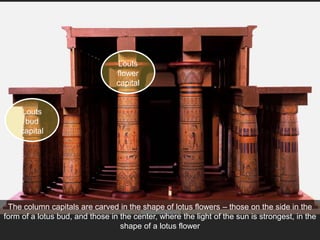
The column capitals are carved in the shape of lotus flowers – those on the side in the
form of a lotus bud, and those in the center, where the light of the sun is strongest, in the
shape of a lotus flower
Louts
bud
capital
Louts
flower
capital
The symbolism is of a marsh receiving the light-giving rays of the sun
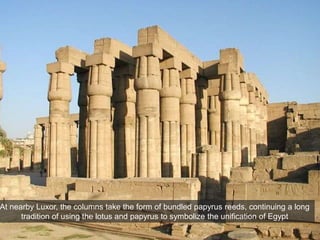
At nearby Luxor, the columns take the form of bundled papyrus reeds, continuing a long
tradition of using the lotus and papyrus to symbolize the unification of Egypt
Great Temple at Karnak
Image source: https://www.q-files.com/history/ancient-egypt/history-of-ancient-egypt/gallery/
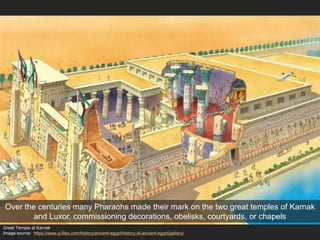
Over the centuries many Pharaohs made their mark on the two great temples of Karnak
and Luxor, commissioning decorations, obelisks, courtyards, or chapels
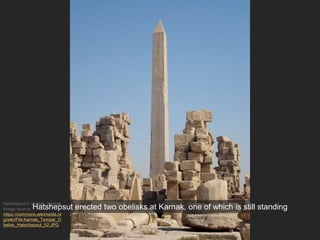
Hatshepsut’s Obelisk, Karnak
Image source:
https://commons.wikimedia.or
g/wiki/File:Karnak_Tempel_O
belisk_Hatschepsut_02.JPG
Hatshepsut erected two obelisks at Karnak, one of which is still standing
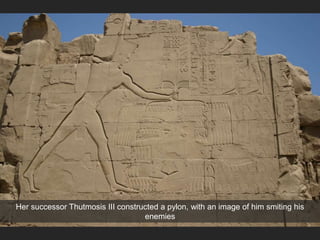
Her successor Thutmosis III constructed a pylon, with an image of him smiting his
enemies
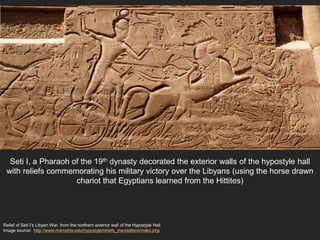
Relief of Seti I’s Libyan War, from the northern exterior wall of the Hypostyle Hall
Image source: http://www.memphis.edu/hypostyle/reliefs_inscriptions/index.php
Seti I, a Pharaoh of the 19th dynasty decorated the exterior walls of the hypostyle hall
with reliefs commemorating his military victory over the Libyans (using the horse drawn
chariot that Egyptians learned from the Hittites)
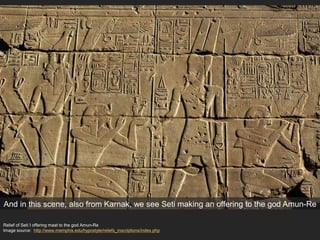
Relief of Seti I offering maat to the god Amun-Re
Image source: http://www.memphis.edu/hypostyle/reliefs_inscriptions/index.php
And in this scene, also from Karnak, we see Seti making an offering to the god Amun-Re
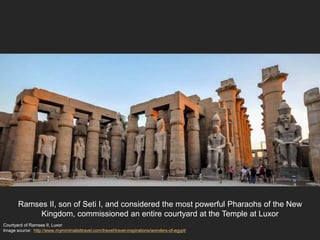
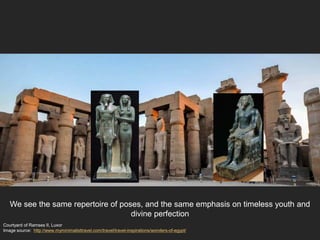
Courtyard of Ramses II, Luxor
Image source: http://www.myminimalisttravel.com/travel/travel-inspirations/wonders-of-egypt/
Ramses II, son of Seti I, and considered the most powerful Pharaohs of the New
Kingdom, commissioned an entire courtyard at the Temple at Luxor
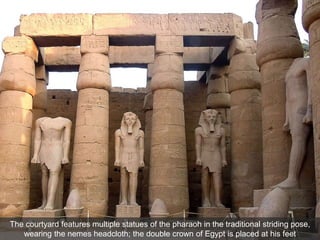
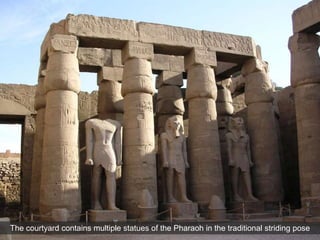
The courtyard features multiple statues of the pharaoh in the traditional striding pose,
wearing the nemes headcloth; the double crown of Egypt is placed at his feet
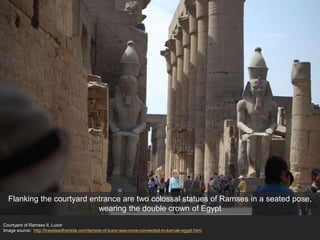
Courtyard of Ramses II, Luxor
Image source: http://travelswithsheila.com/temple-of-luxor-was-once-connected-to-karnak-egypt.html
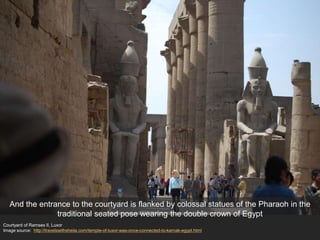
Flanking the courtyard entrance are two colossal statues of Ramses in a seated pose,
wearing the double crown of Egypt
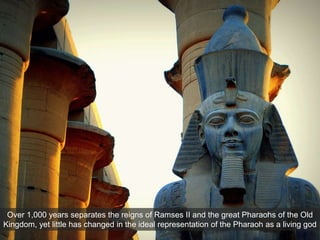
Over 1,000 years separates the reigns of Ramses II and the great Pharaohs of the Old
Kingdom, yet little has changed in the ideal representation of the Pharaoh as a living god
Courtyard of Ramses II, Luxor
Image source: http://www.myminimalisttravel.com/travel/travel-inspirations/wonders-of-egypt/
We see the same repertoire of poses, and the same emphasis on timeless youth and
divine perfection
Thanks for Listening!
Next up: Akhenaten the Heretic Pharaoh
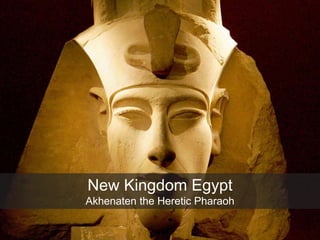
New Kingdom Egypt
Akhenaten the Heretic Pharaoh
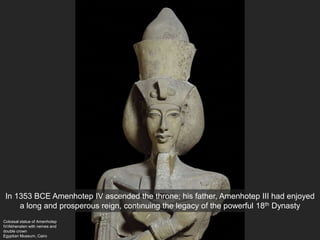
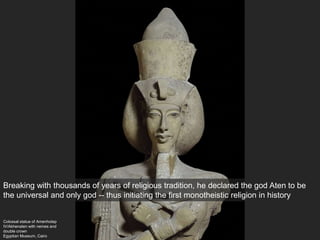
Colossal statue of Amenhotep
IV/Akhenaten with nemes and
double crown
Egyptian Museum, Cairo
In 1353 BCE Amenhotep IV ascended the throne; his father, Amenhotep III had enjoyed
a long and prosperous reign, continuing the legacy of the powerful 18th Dynasty
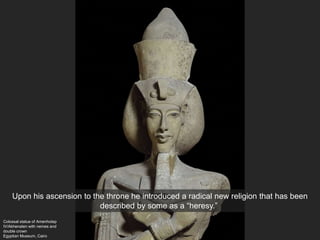
Colossal statue of Amenhotep
IV/Akhenaten with nemes and
double crown
Egyptian Museum, Cairo
Upon his ascension to the throne he introduced a radical new religion that has been
described by some as a “heresy.”
Colossal statue of Amenhotep
IV/Akhenaten with nemes and
double crown
Egyptian Museum, Cairo
Breaking with thousands of years of religious tradition, he declared the god Aten to be
the universal and only god -- thus initiating the first monotheistic religion in history
Colossal statue of Amenhotep
IV/Akhenaten with nemes and
double crown
Egyptian Museum, Cairo
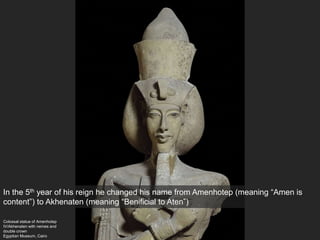
In the 5th year of his reign he changed his name from Amenhotep (meaning “Amen is
content”) to Akhenaten (meaning “Benificial to Aten”)
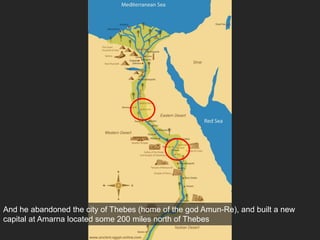
And he abandoned the city of Thebes (home of the god Amun-Re), and built a new
capital at Amarna located some 200 miles north of Thebes
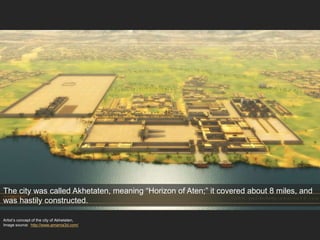
Artist’s concept of the city of Akhetaten,
Image source: http://www.amarna3d.com/
The city was called Akhetaten, meaning “Horizon of Aten;” it covered about 8 miles, and
was hastily constructed.
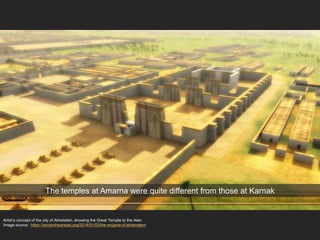
Artist’s concept of the city of Akhetaten, showing the Great Temple to the Aten
Image source: https://ancientneareast.org/2014/01/03/the-enigma-of-akhenaten/
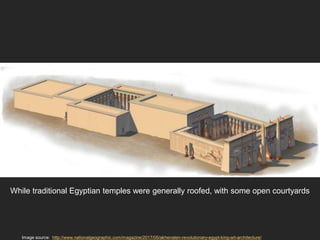
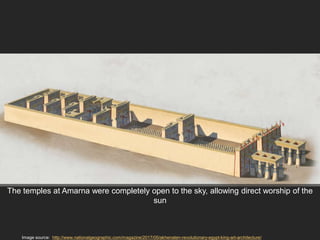
The temples at Amarna were quite different from those at Karnak
Image source: http://www.nationalgeographic.com/magazine/2017/05/akhenaten-revolutionary-egypt-king-art-architecture/
While traditional Egyptian temples were generally roofed, with some open courtyards
Image source: http://www.nationalgeographic.com/magazine/2017/05/akhenaten-revolutionary-egypt-king-art-architecture/
The temples at Amarna were completely open to the sky, allowing direct worship of the
sun
Akhenaton, from the temple of Aton, Karnak
18th Dynasty, New Kingdom, c. 1353-1335 BCE
Egyptian Museum, Cairo
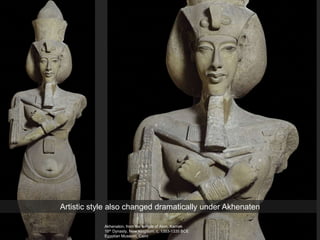
Artistic style also changed dramatically under Akhenaten
Akhenaton, from the temple of Aton, Karnak
18th Dynasty, New Kingdom, c. 1353-1335 BCE
Egyptian Museum, Cairo
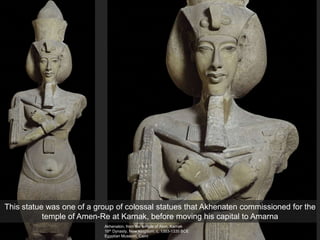
This statue was one of a group of colossal statues that Akhenaten commissioned for the
temple of Amen-Re at Karnak, before moving his capital to Amarna
Akhenaton, from the temple of Aton, Karnak
18th Dynasty, New Kingdom, c. 1353-1335 BCE
Egyptian Museum, Cairo
It depicts the Pharaoh in the guise of Osiris, wearing the double crown of Egypt
combined with the nemes headcloth and false beard, carrying the crook and flail with
crossed arms
Akhenaton, from the temple of Aton, Karnak
18th Dynasty, New Kingdom, c. 1353-1335 BCE
Egyptian Museum, Cairo
Representations of the Pharaoh in the guise of Osiris were common, but the Style of
Akhenaten’s statues is unprecedented
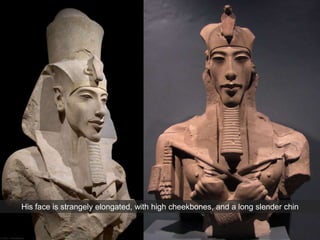
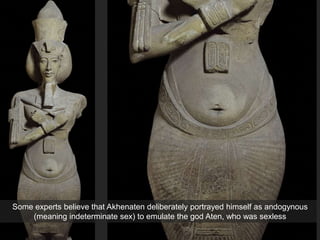
His face is strangely elongated, with high cheekbones, and a long slender chin
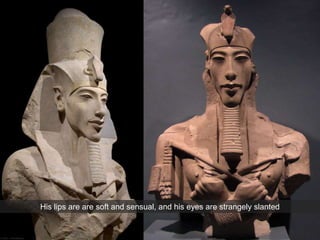
His lips are are soft and sensual, and his eyes are strangely slanted
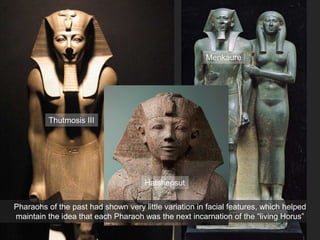
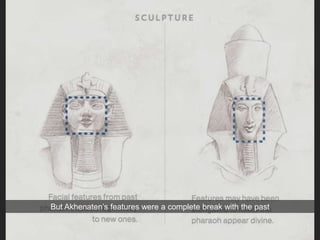
Pharaohs of the past had shown very little variation in facial features, which helped
maintain the idea that each Pharaoh was the next incarnation of the “living Horus”
Menkaure
Thutmosis III
Hatshepsut
But Akhenaten’s features were a complete break with the past
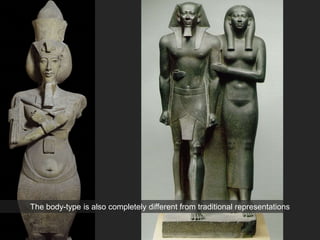
The body-type is also completely different from traditional representations
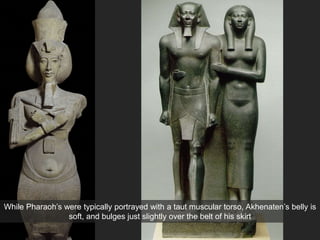
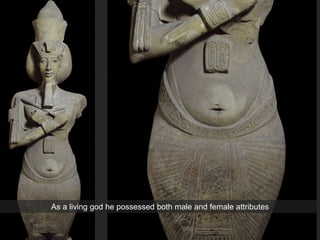
While Pharaoh’s were typically portrayed with a taut muscular torso, Akhenaten’s belly is
soft, and bulges just slightly over the belt of his skirt
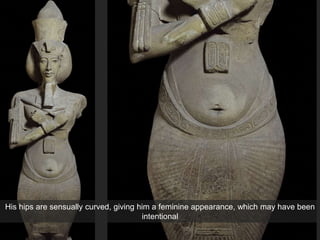
His hips are sensually curved, giving him a feminine appearance, which may have been
intentional
Some experts believe that Akhenaten deliberately portrayed himself as andogynous
(meaning indeterminate sex) to emulate the god Aten, who was sexless
As a living god he possessed both male and female attributes
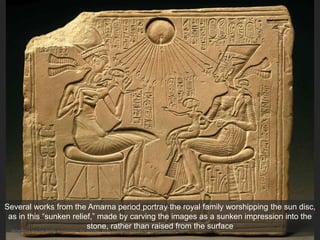
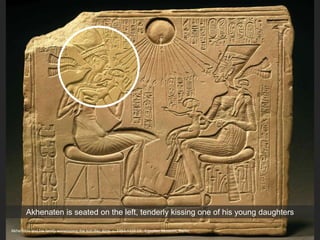
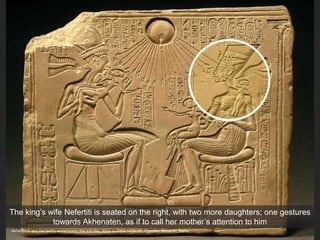
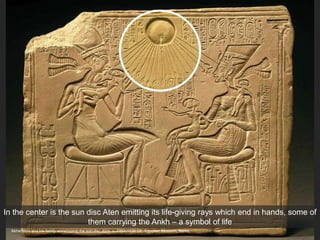
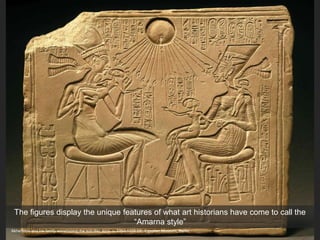
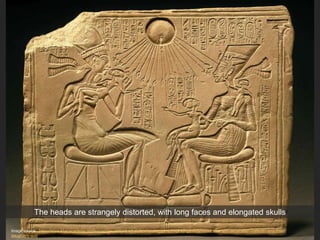
Akhenaton and his family worshipping the sun disc Aton, c. 1353-1335 CE. Egyptian Museum, Berlin
Several works from the Amarna period portray the royal family worshipping the sun disc,
as in this “sunken relief,” made by carving the images as a sunken impression into the
stone, rather than raised from the surface
Akhenaton and his family worshipping the sun disc Aton, c. 1353-1335 CE. Egyptian Museum, Berlin
Akhenaten is seated on the left, tenderly kissing one of his young daughters
Akhenaton and his family worshipping the sun disc Aton, c. 1353-1335 CE. Egyptian Museum, Berlin
The king’s wife Nefertiti is seated on the right, with two more daughters; one gestures
towards Akhenaten, as if to call her mother’s attention to him
Akhenaton and his family worshipping the sun disc Aton, c. 1353-1335 CE. Egyptian Museum, Berlin
In the center is the sun disc Aten emitting its life-giving rays which end in hands, some of
them carrying the Ankh – a symbol of life
Akhenaton and his family worshipping the sun disc Aton, c. 1353-1335 CE. Egyptian Museum, Berlin
The figures display the unique features of what art historians have come to call the
“Amarna style”
Image source: https://www.khanacademy.org/humanities/ancient-art-civilizations/egypt-art/new-kingdom/e/house-altar-with-akhenaten--nefertiti--and-three-
daughters-quiz
The heads are strangely distorted, with long faces and elongated skulls
Akhenaton and his family worshipping the sun disc Aton, c. 1353-1335 CE. Egyptian Museum, Berlin
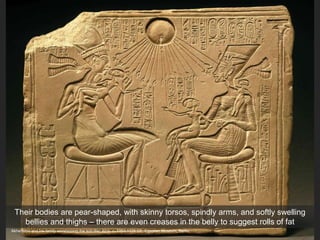
Their bodies are pear-shaped, with skinny torsos, spindly arms, and softly swelling
bellies and thighs – there are even creases in the belly to suggest rolls of fat
Akhenaton and his family worshipping the sun disc Aton, c. 1353-1335 CE. Egyptian Museum, Berlin
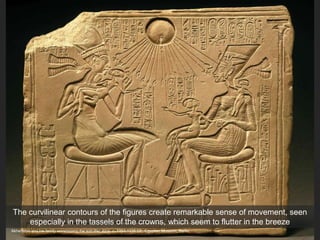
The curvilinear contours of the figures create remarkable sense of movement, seen
especially in the tassels of the crowns, which seem to flutter in the breeze
Akhenaton and his family worshipping the sun disc Aton, c. 1353-1335 CE. Egyptian Museum, Berlin
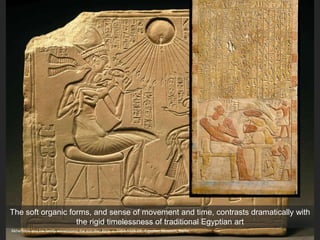
The soft organic forms, and sense of movement and time, contrasts dramatically with
the rigid timelessness of traditional Egyptian art
Akhenaton and his family worshipping the sun disc Aton, c. 1353-1335 CE. Egyptian Museum, Berlin
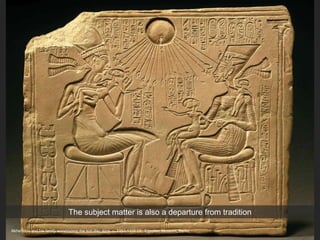
The subject matter is also a departure from tradition
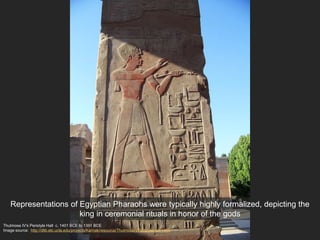
Thutmose IV's Peristyle Hall c. 1401 BCE to 1391 BCE
Image source: http://dlib.etc.ucla.edu/projects/Karnak/resource/ThutmoseIVPeristyleHall/1665
Representations of Egyptian Pharaohs were typically highly formalized, depicting the
king in ceremonial rituals in honor of the gods
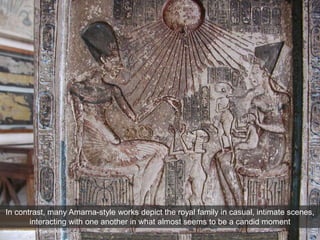
Stela of Akhenaten, Egyptian Museum, Ca
In contrast, many Amarna-style works depict the royal family in casual, intimate scenes,
interacting with one another in what almost seems to be a candid moment
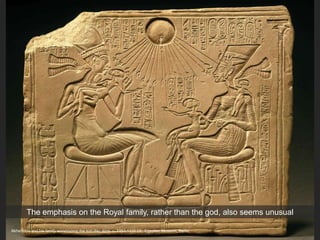
Akhenaton and his family worshipping the sun disc Aton, c. 1353-1335 CE. Egyptian Museum, Berlin
The emphasis on the Royal family, rather than the god, also seems unusual
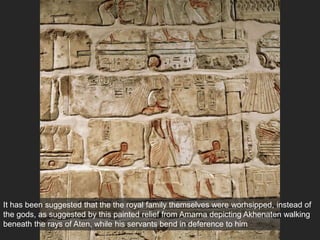
It has been suggested that the the royal family themselves were worhsipped, instead of
the gods, as suggested by this painted relief from Amarna depicting Akhenaten walking
beneath the rays of Aten, while his servants bend in deference to him
Image source: http://www.nationalgeographic.com/magazine/2017/05/akhenaten-revolutionary-egypt-king-art-architecture/
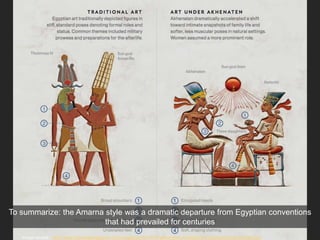
To summarize: the Amarna style was a dramatic departure from Egyptian conventions
that had prevailed for centuries
Image source: http://www.nationalgeographic.com/magazine/2017/05/akhenaten-revolutionary-egypt-king-art-architecture/
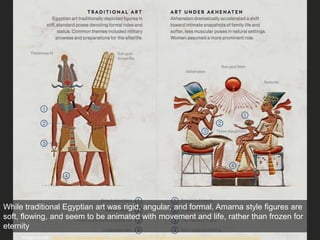
While traditional Egyptian art was rigid, angular, and formal, Amarna style figures are
soft, flowing, and seem to be animated with movement and life, rather than frozen for
eternity
Image source: http://www.nationalgeographic.com/magazine/2017/05/akhenaten-revolutionary-egypt-king-art-architecture/
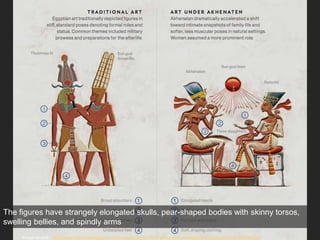
The figures have strangely elongated skulls, pear-shaped bodies with skinny torsos,
swelling bellies, and spindly arms
Image source: http://www.nationalgeographic.com/magazine/2017/05/akhenaten-revolutionary-egypt-king-art-architecture/
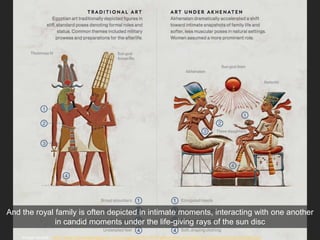
And the royal family is often depicted in intimate moments, interacting with one another
in candid moments under the life-giving rays of the sun disc
Image source: http://www.nationalgeographic.com/magazine/2017/05/akhenaten-revolutionary-egypt-king-art-architecture/
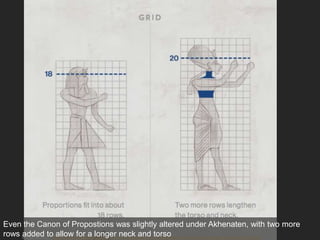
Even the Canon of Propostions was slightly altered under Akhenaten, with two more
rows added to allow for a longer neck and torso
The Wilbour Plaque, c. 1353-1336 BCE.
Brooklyn Museum
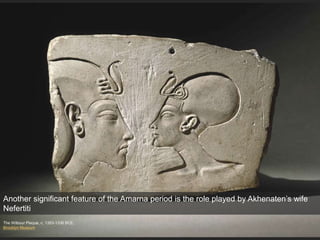
Another significant feature of the Amarna period is the role played by Akhenaten’s wife
Nefertiti
The Wilbour Plaque, c. 1353-1336 BCE.
Brooklyn Museum
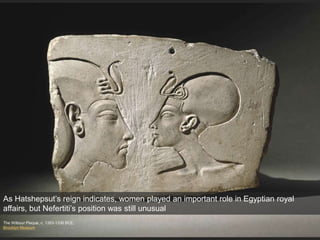
As Hatshepsut’s reign indicates, women played an important role in Egyptian royal
affairs, but Nefertiti’s position was still unusual
The Wilbour Plaque, c. 1353-1336 BCE.
Brooklyn Museum
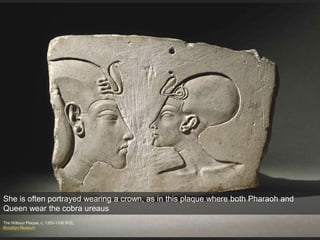
She is often portrayed wearing a crown, as in this plaque where both Pharaoh and
Queen wear the cobra ureaus
Akhenaten and family worshipping Aten
Louvre
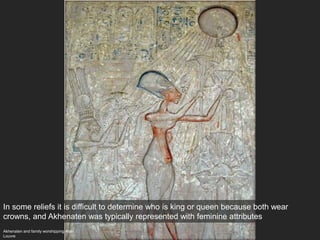
In some reliefs it is difficult to determine who is king or queen because both wear
crowns, and Akhenaten was typically represented with feminine attributes
Bust of Nefertiti, 18th Dynasty, c. 1353-1335
Egyptian museum, Berlin
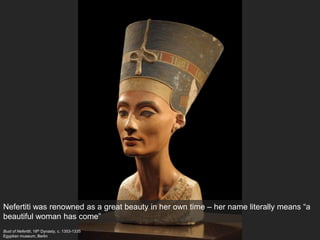
Nefertiti was renowned as a great beauty in her own time – her name literally means “a
beautiful woman has come”
Bust of Nefertiti, 18th Dynasty, c. 1353-1335
Egyptian museum, Berlin
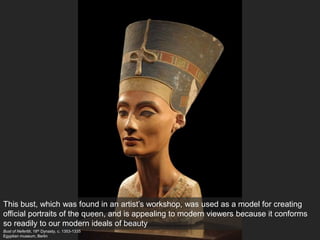
This bust, which was found in an artist’s workshop, was used as a model for creating
official portraits of the queen, and is appealing to modern viewers because it conforms
so readily to our modern ideals of beauty
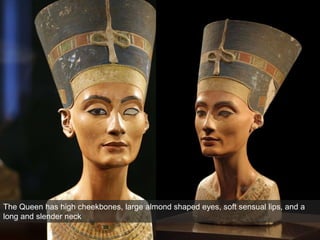
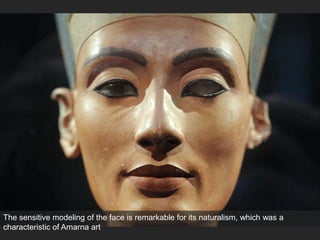
The Queen has high cheekbones, large almond shaped eyes, soft sensual lips, and a
long and slender neck
The sensitive modeling of the face is remarkable for its naturalism, which was a
characteristic of Amarna art
Akhenaten Sacrificing a Duck, c. 1353-1336 BCE
Metropolitan Museum
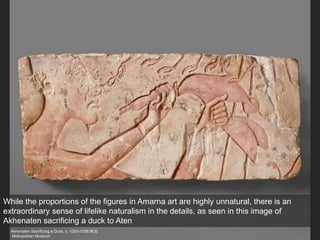
While the proportions of the figures in Amarna art are highly unnatural, there is an
extraordinary sense of lifelike naturalism in the details, as seen in this image of
Akhenaten sacrificing a duck to Aten
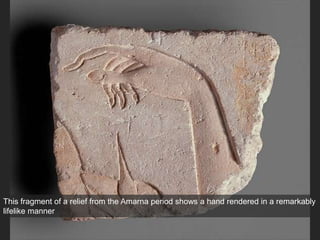
This fragment of a relief from the Amarna period shows a hand rendered in a remarkably
lifelike manner
Thutmose and his mother Senisneb, (facsimile by Nina de Garis Davies)
Metropolitan Museum
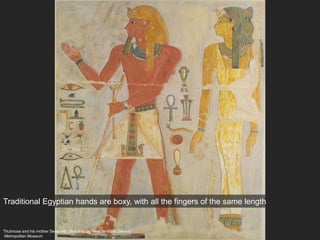
Traditional Egyptian hands are boxy, with all the fingers of the same length
Two Princesses, New Kingdom, Dynasty 18, reign of Akhenaten, ca. 1349–1336
B.C. Limestone with remains of paint
Metropolitan New York
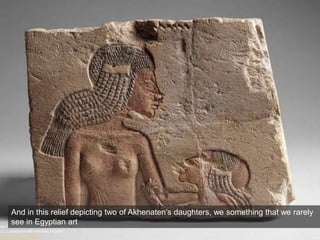
And in this relief depicting two of Akhenaten’s daughters, we something that we rarely
see in Egyptian art
Two Princesses, New Kingdom, Dynasty 18, reign of Akhenaten, ca. 1349–1336
B.C. Limestone with remains of paint
Metropolitan New York
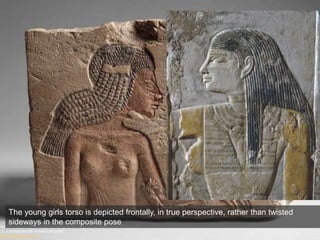
The young girls torso is depicted frontally, in true perspective, rather than twisted
sideways in the composite pose
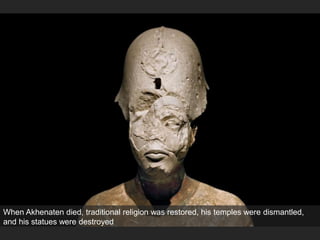
When Akhenaten died, traditional religion was restored, his temples were dismantled,
and his statues were destroyed
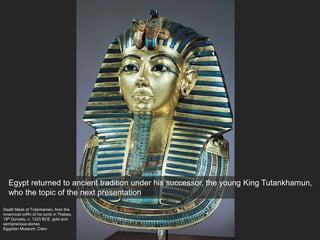
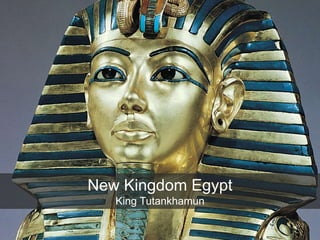
Death Mask of Tutanhamen, from the
innermost coffin of his tomb in Thebes,
18th Dynasty, c. 1323 BCE, gold and
semiprecious stones
Egyptian Museum, Cairo
Egypt returned to ancient tradition under his successor, the young King Tutankhamun,
who the topic of the next presentation
Thanks for Listening!
Next up: King Tutankhamun
New Kingdom Egypt
King Tutankhamun
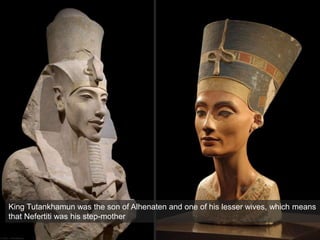
King Tutankhamun was the son of Alhenaten and one of his lesser wives, which means
that Nefertiti was his step-mother
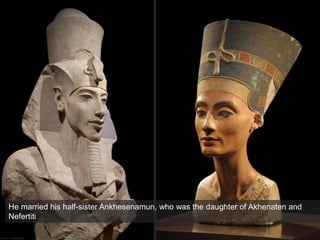
He married his half-sister Ankhesenamun, who was the daughter of Akhenaten and
Nefertiti
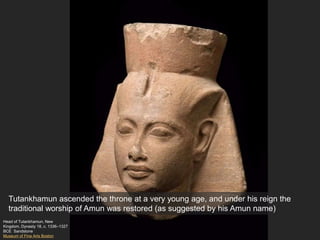
Head of Tutankhamun, New
Kingdom, Dynasty 18, c. 1336–1327
BCE Sandstone
Museum of Fine Arts Boston
Tutankhamun ascended the throne at a very young age, and under his reign the
traditional worship of Amun was restored (as suggested by his Amun name)
Head of Tutankhamun, New
Kingdom, Dynasty 18, c. 1336–1327
BCE
Metropolitan Museum
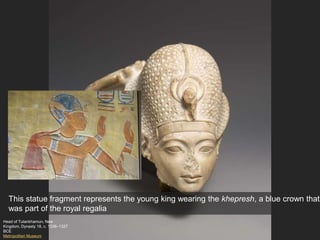
This statue fragment represents the young king wearing the khepresh, a blue crown that
was part of the royal regalia
Head of Tutankhamun, New
Kingdom, Dynasty 18, c. 1336–1327
BCE
Metropolitan Museum
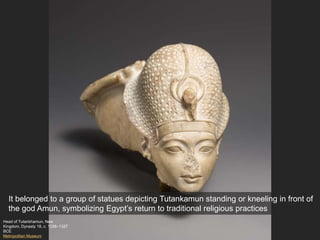
It belonged to a group of statues depicting Tutankamun standing or kneeling in front of
the god Amun, symbolizing Egypt’s return to traditional religious practices
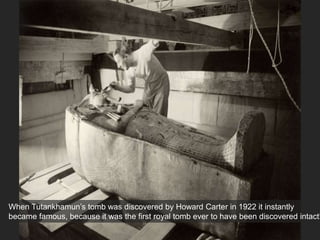
When Tutankhamun’s tomb was discovered by Howard Carter in 1922 it instantly
became famous, because it was the first royal tomb ever to have been discovered intact!
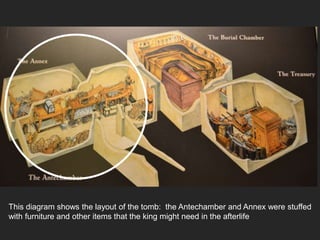
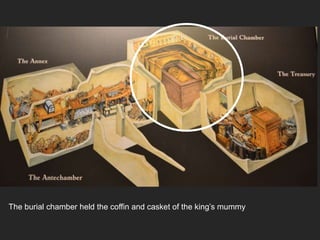
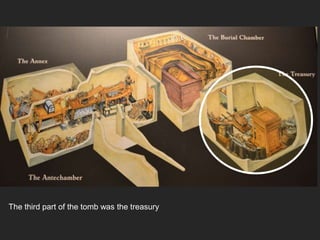
This diagram shows the layout of the tomb: the Antechamber and Annex were stuffed
with furniture and other items that the king might need in the afterlife
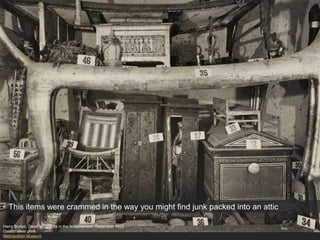
Harry Burton, Detail of Objects in the Antechamber, December 1922
Gelatin silver print
Metropolitan Museum
This items were crammed in the way you might find junk packed into an attic
The burial chamber held the coffin and casket of the king’s mummy
Image source: http://news.nationalgeographic.com/2015/09/150928-king-tut-tomb-door-nefertiti-archaeology-egypt/
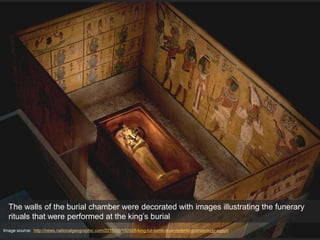
The walls of the burial chamber were decorated with images illustrating the funerary
rituals that were performed at the king’s burial
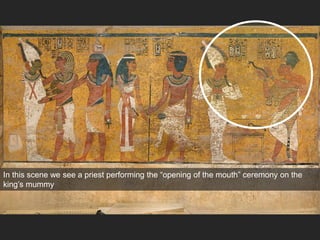
In this scene we see a priest performing the “opening of the mouth” ceremony on the
king’s mummy
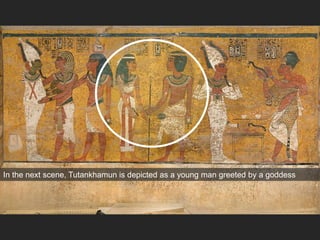
In the next scene, Tutankhamun is depicted as a young man greeted by a goddess
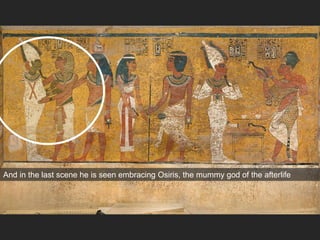
And in the last scene he is seen embracing Osiris, the mummy god of the afterlife
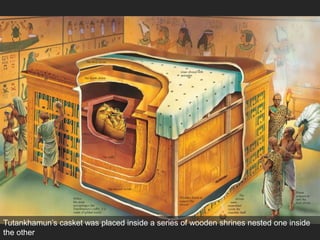
Tutankhamun’s casket was placed inside a series of wooden shrines nested one inside
the other
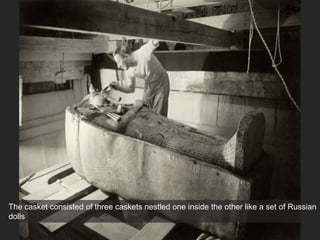
The casket consisted of three caskets nestled one inside the other like a set of Russian
dolls
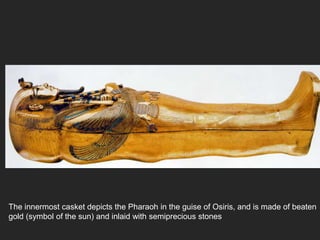
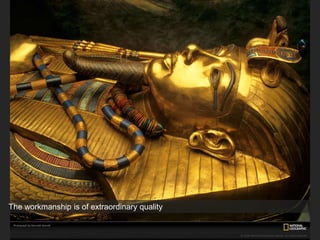
The innermost casket depicts the Pharaoh in the guise of Osiris, and is made of beaten
gold (symbol of the sun) and inlaid with semiprecious stones
The workmanship is of extraordinary quality
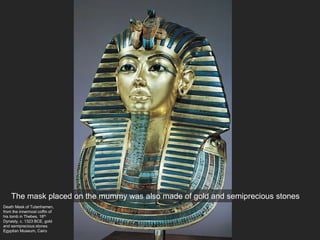
Death Mask of Tutanhamen,
from the innermost coffin of
his tomb in Thebes, 18th
Dynasty, c. 1323 BCE, gold
and semiprecious stones
Egyptian Museum, Cairo
The mask placed on the mummy was also made of gold and semiprecious stones
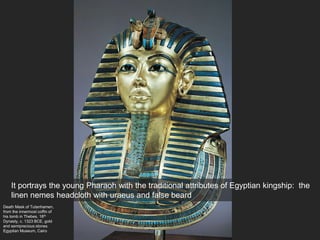
Death Mask of Tutanhamen,
from the innermost coffin of
his tomb in Thebes, 18th
Dynasty, c. 1323 BCE, gold
and semiprecious stones
Egyptian Museum, Cairo
It portrays the young Pharaoh with the traditional attributes of Egyptian kingship: the
linen nemes headcloth with uraeus and false beard
The third part of the tomb was the treasury
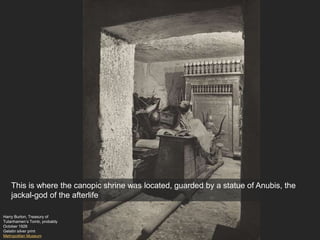
Harry Burton, Treasury of
Tutanhamen’s Tomb, probably
October 1926
Gelatin silver print
Metropolitan Museum
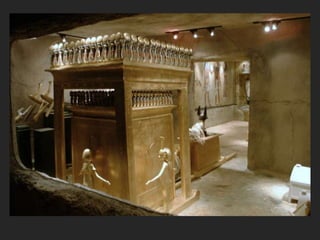
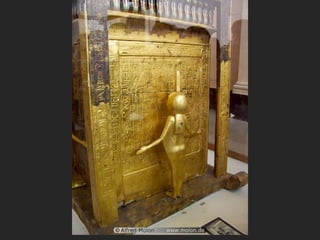
This is where the canopic shrine was located, guarded by a statue of Anubis, the
jackal-god of the afterlife
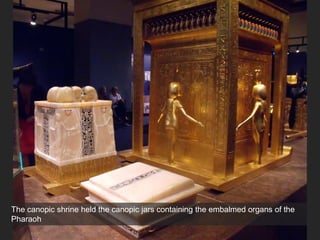
The canopic shrine held the canopic jars containing the embalmed organs of the
Pharaoh
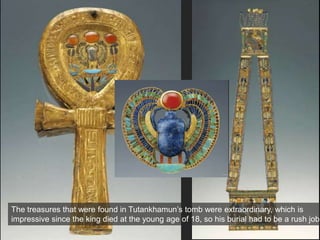
The treasures that were found in Tutankhamun’s tomb were extraordinary, which is
impressive since the king died at the young age of 18, so his burial had to be a rush job!
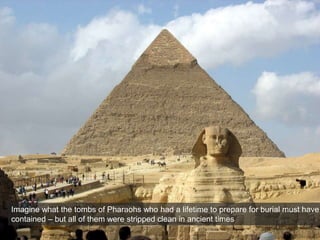
Imagine what the tombs of Pharaohs who had a lifetime to prepare for burial must have
contained – but all of them were stripped clean in ancient times
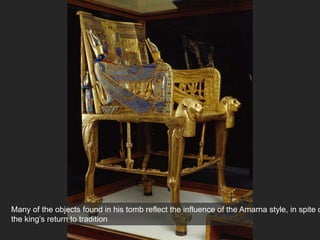
Many of the objects found in his tomb reflect the influence of the Amarna style, in spite o
the king’s return to tradition
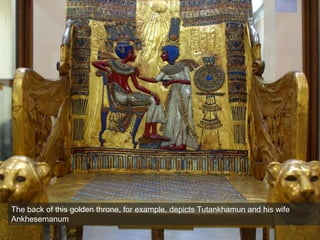
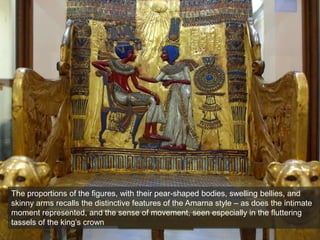
The back of this golden throne, for example, depicts Tutankhamun and his wife
Ankhesemanum
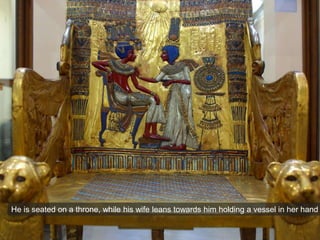
He is seated on a throne, while his wife leans towards him holding a vessel in her hand
The proportions of the figures, with their pear-shaped bodies, swelling bellies, and
skinny arms recalls the distinctive features of the Amarna style – as does the intimate
moment represented, and the sense of movement, seen especially in the fluttering
tassels of the king’s crown
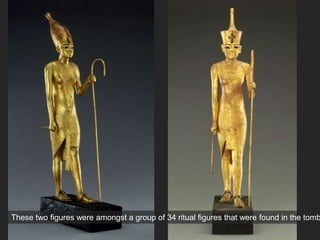
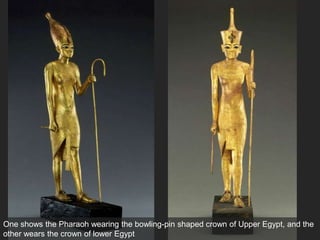
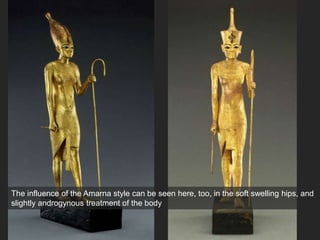
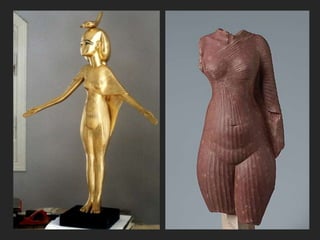
These two figures were amongst a group of 34 ritual figures that were found in the tomb
One shows the Pharaoh wearing the bowling-pin shaped crown of Upper Egypt, and the
other wears the crown of lower Egypt
The influence of the Amarna style can be seen here, too, in the soft swelling hips, and
slightly androgynous treatment of the body
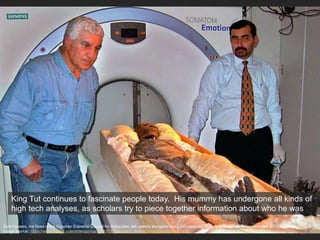
Zahi Hawass, the head of the Egyptian Supreme Council for Antiquities, left, stands alongside the 3,300-year-old mummy of King Tutankhamun in this 2005 file photo
Image source: https://www.thestar.com/entertainment/2007/11/04/egypt_unveils_king_tuts_mummy.html
King Tut continues to fascinate people today. His mummy has undergone all kinds of
high tech analyses, as scholars try to piece together information about who he was
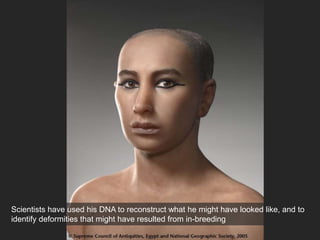
Scientists have used his DNA to reconstruct what he might have looked like, and to
identify deformities that might have resulted from in-breeding
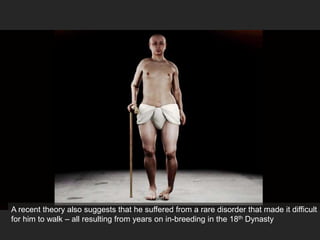
A recent theory also suggests that he suffered from a rare disorder that made it difficult
for him to walk – all resulting from years on in-breeding in the 18th Dynasty
Image source: http://io9.gizmodo.com/why-king-tuts-dna-is-fueling-race-wars-1539130793
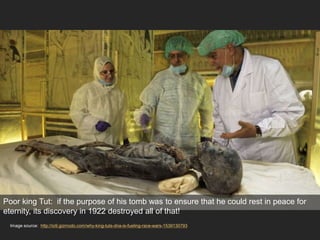
Poor king Tut: if the purpose of his tomb was to ensure that he could rest in peace for
eternity, its discovery in 1922 destroyed all of that!
Thanks for Listening!
Next up: Ramses the Great
The Canopic Shrine
New Kingdom Egypt
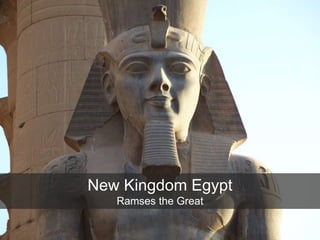
Ramses the Great
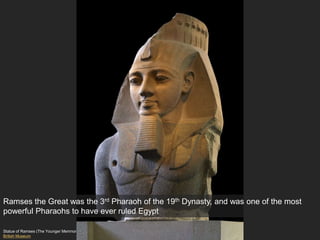
Statue of Ramses (The Younger Memnon), 19th Dynasty, New Kingdom
British Museum
Ramses the Great was the 3rd Pharaoh of the 19th Dynasty, and was one of the most
powerful Pharaohs to have ever ruled Egypt
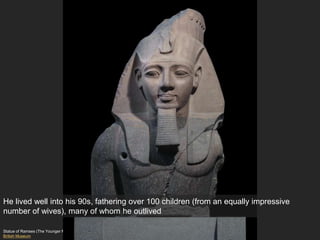
Statue of Ramses (The Younger Memnon), 19th Dynasty, New Kingdom
British Museum
He lived well into his 90s, fathering over 100 children (from an equally impressive
number of wives), many of whom he outlived
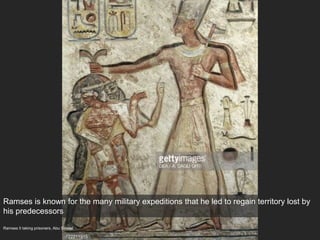
Ramses II taking prisoners, Abu Simbel
Ramses is known for the many military expeditions that he led to regain territory lost by
his predecessors
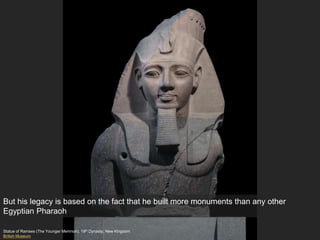
But his legacy is based on the fact that he built more monuments than any other
Egyptian Pharaoh
Statue of Ramses (The Younger Memnon), 19th Dynasty, New Kingdom
British Museum
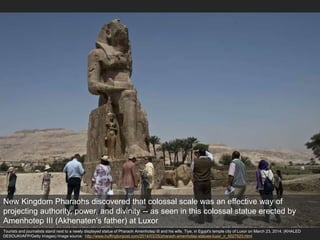
Tourists and journalists stand next to a newly displayed statue of Pharaoh Amenhotep III and his wife, Tiye, in Egypt's temple city of Luxor on March 23, 2014. (KHALED
DESOUKI/AFP/Getty Images) Image source: http://www.huffingtonpost.com/2014/03/25/pharaoh-amenhotep-statues-luxor_n_5027523.html
New Kingdom Pharaohs discovered that colossal scale was an effective way of
projecting authority, power, and divinity -- as seen in this colossal statue erected by
Amenhotep III (Akhenaten’s father) at Luxor
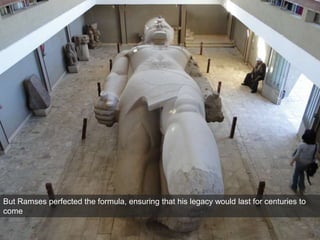
But Ramses perfected the formula, ensuring that his legacy would last for centuries to
come
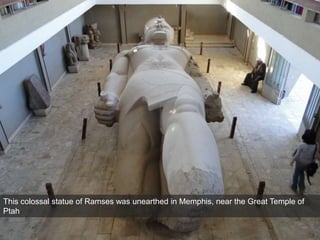
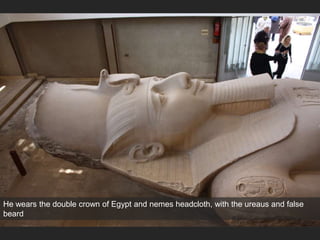
This colossal statue of Ramses was unearthed in Memphis, near the Great Temple of
Ptah
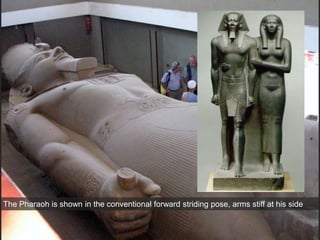
The Pharaoh is shown in the conventional forward striding pose, arms stiff at his side
He wears the double crown of Egypt and nemes headcloth, with the ureaus and false
beard
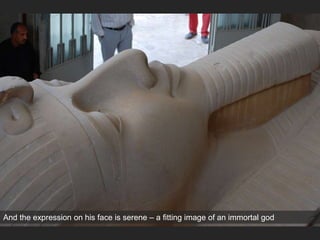
And the expression on his face is serene – a fitting image of an immortal god
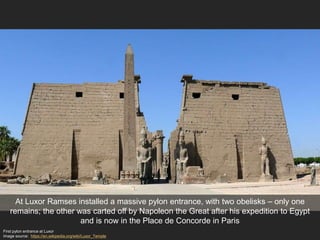
At Luxor Ramses installed a massive pylon entrance, with two obelisks – only one
remains; the other was carted off by Napoleon the Great after his expedition to Egypt
and is now in the Place de Concorde in Paris
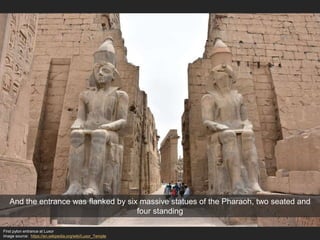
First pylon entrance at Luxor
Image source: https://en.wikipedia.org/wiki/Luxor_Temple
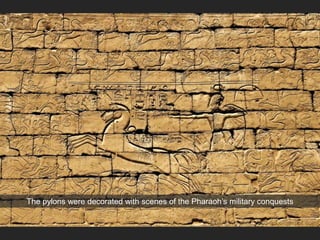
The pylons were decorated with scenes of the Pharaoh’s military conquests
First pylon entrance at Luxor
Image source: https://en.wikipedia.org/wiki/Luxor_Temple
And the entrance was flanked by six massive statues of the Pharaoh, two seated and
four standing
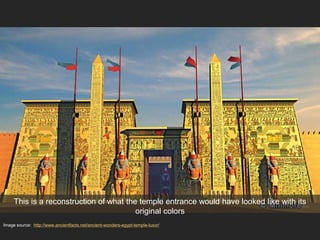
This is a reconstruction of what the temple entrance would have looked like with its
original colors
Image source: http://www.ancientfacts.net/ancient-wonders-egypt-temple-luxor/
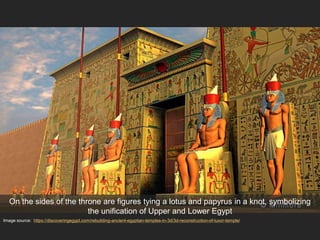
Image source: https://discoveringegypt.com/rebuilding-ancient-egyptian-temples-in-3d/3d-reconstruction-of-luxor-temple/
On the sides of the throne are figures tying a lotus and papyrus in a knot, symbolizing
the unification of Upper and Lower Egypt
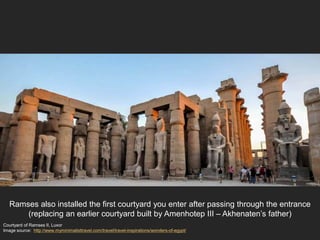
Courtyard of Ramses II, Luxor
Image source: http://www.myminimalisttravel.com/travel/travel-inspirations/wonders-of-egypt/
Ramses also installed the first courtyard you enter after passing through the entrance
(replacing an earlier courtyard built by Amenhotep III – Akhenaten’s father)
The courtyard contains multiple statues of the Pharaoh in the traditional striding pose
Courtyard of Ramses II, Luxor
Image source: http://travelswithsheila.com/temple-of-luxor-was-once-connected-to-karnak-egypt.html
And the entrance to the courtyard is flanked by colossal statues of the Pharaoh in the
traditional seated pose wearing the double crown of Egypt
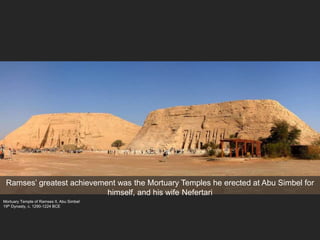
Mortuary Temple of Ramses II, Abu Simbel
19th Dynasty, c. 1290-1224 BCE
Ramses’ greatest achievement was the Mortuary Temples he erected at Abu Simbel for
himself, and his wife Nefertari
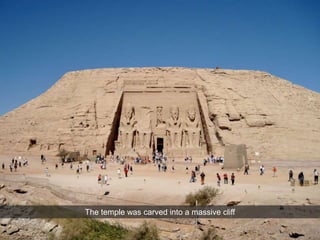
The temple was carved into a massive cliff
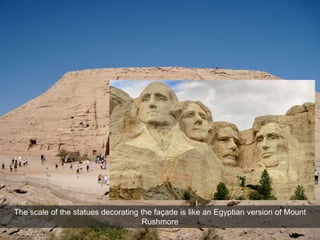
The scale of the statues decorating the façade is like an Egyptian version of Mount
Rushmore
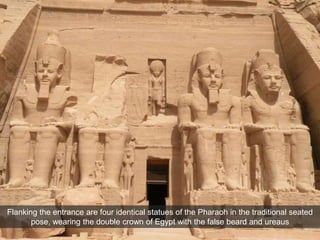
Flanking the entrance are four identical statues of the Pharaoh in the traditional seated
pose, wearing the double crown of Egypt with the false beard and ureaus
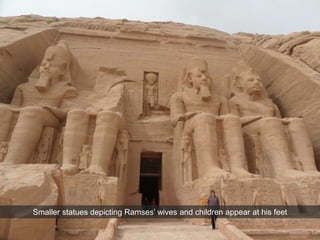
Smaller statues depicting Ramses’ wives and children appear at his feet
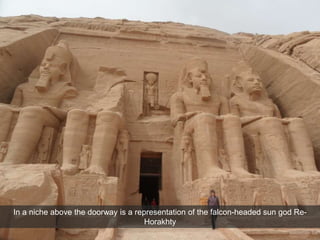
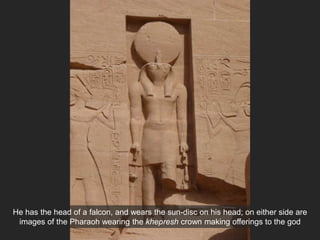
In a niche above the doorway is a representation of the falcon-headed sun god Re-
Horakhty
He has the head of a falcon, and wears the sun-disc on his head; on either side are
images of the Pharaoh wearing the khepresh crown making offerings to the god
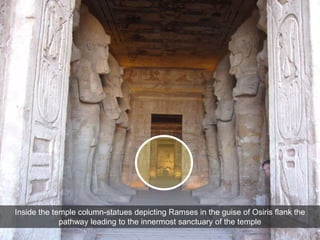
Inside the temple column-statues depicting Ramses in the guise of Osiris flank the
pathway leading to the innermost sanctuary of the temple
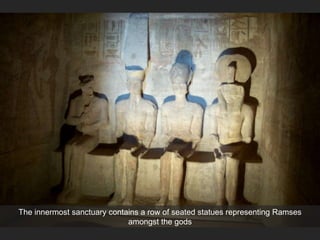
The innermost sanctuary contains a row of seated statues representing Ramses
amongst the gods
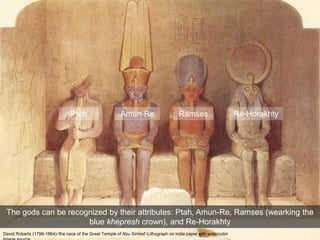
David Roberts (1796-1864)-'the naos of the Great Temple of Abu Simbel'-Lithograph on india paper with watercolor
Ptah Amun-Re Ramses Re-Horakhty
The gods can be recognized by their attributes: Ptah, Amun-Re, Ramses (wearking the
blue khepresh crown), and Re-Horakhty
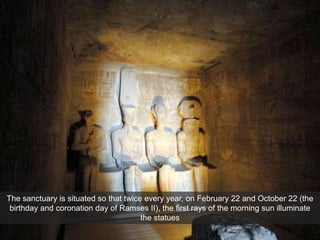
The sanctuary is situated so that twice every year, on February 22 and October 22 (the
birthday and coronation day of Ramses II), the first rays of the morning sun illuminate
the statues
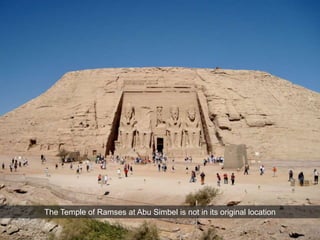
The Temple of Ramses at Abu Simbel is not in its original location
Image source: http://mashable.com/2015/05/26/abu-simbel-relocation/#QCZLKBFrgPqC
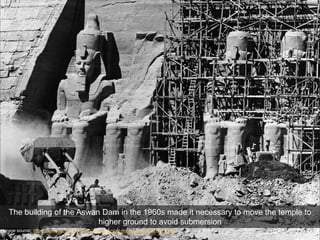
The building of the Aswan Dam in the 1960s made it necessary to move the temple to
higher ground to avoid submersion
Image source: http://mashable.com/2015/05/26/abu-simbel-relocation/#QCZLKBFrgPqC
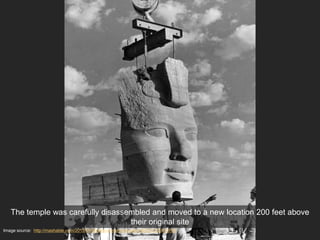
The temple was carefully disassembled and moved to a new location 200 feet above
their original site
Roman Period
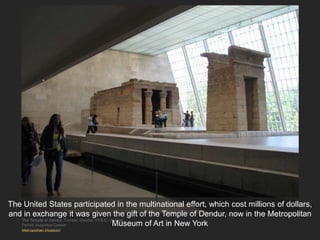
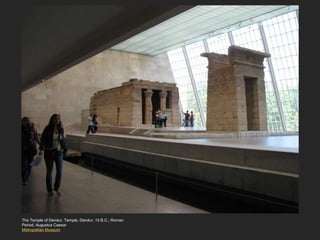
The Temple of Dendur, Temple, Dendur, 15 B.C.; Roman
Period, Augustus Caesar
Metropolitan Museum
The United States participated in the multinational effort, which cost millions of dollars,
and in exchange it was given the gift of the Temple of Dendur, now in the Metropolitan
Museum of Art in New York
Thanks for Listening!
Next up: The Tombs of the Nobles
New Kingdom Egypt
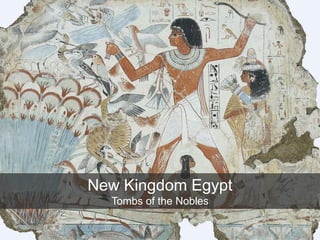
Tombs of the Nobles
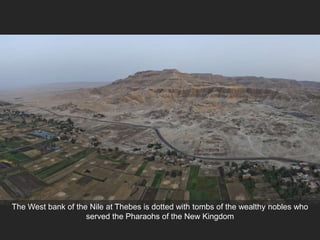
The West bank of the Nile at Thebes is dotted with tombs of the wealthy nobles who
served the Pharaohs of the New Kingdom
Their tombs were like the McMansions of ancient Egypt – large in scale, and richly
decorated to reflect the privileged lifestyle of the wealthy elite
Tomb of Menna (TT69), Theban necropolis, reign of Thutmosis IV
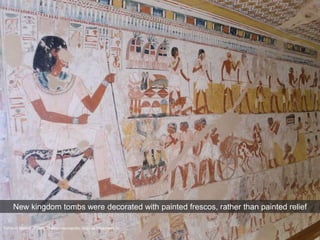
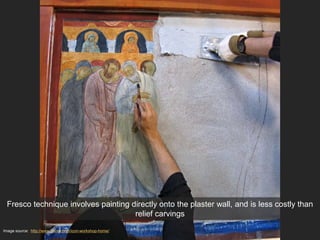
New kingdom tombs were decorated with painted frescos, rather than painted relief
Image source: http://www.gsinai.com/icon-workshop-home/
Fresco technique involves painting directly onto the plaster wall, and is less costly than
relief carvings
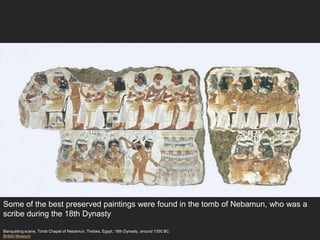
Banqueting scene, Tomb Chapel of Nebamun, Thebes, Egypt, 18th Dynasty, around 1350 BC
British Museum
Some of the best preserved paintings were found in the tomb of Nebamun, who was a
scribe during the 18th Dynasty
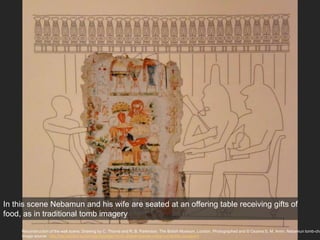
Reconstruction of the wall scene. Drawing by C. Thorne and R. B. Parkinson. The British Museum, London. Photographed and © Osama S. M. Amin. Nebamun tomb-cha
Image source: http://etc.ancient.eu/photos/egyptian-tomb-chapel-scenes-nebamun-british-museum/
In this scene Nebamun and his wife are seated at an offering table receiving gifts of
food, as in traditional tomb imagery
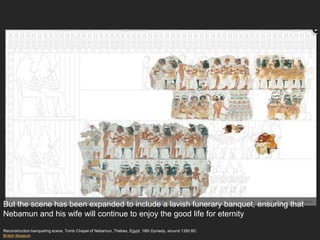
Reconstruction banqueting scene, Tomb Chapel of Nebamun, Thebes, Egypt, 18th Dynasty, around 1350 BC
British Museum
But the scene has been expanded to include a lavish funerary banquet, ensuring that
Nebamun and his wife will continue to enjoy the good life for eternity
Banqueting scene, Tomb Chapel of Nebamun, Thebes, Egypt, 18th Dynasty, around 1350 BC
British Museum
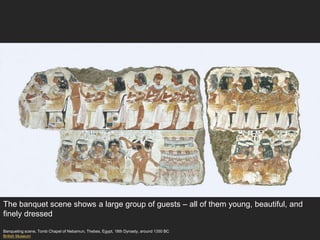
The banquet scene shows a large group of guests – all of them young, beautiful, and
finely dressed
Banqueting scene, Tomb Chapel of Nebamun, Thebes, Egypt, 18th Dynasty, around 1350 BC
British Museum
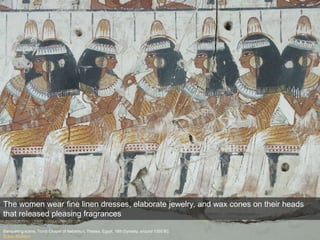
The women wear fine linen dresses, elaborate jewelry, and wax cones on their heads
that released pleasing fragrances
Banqueting scene, Tomb Chapel of Nebamun, Thebes, Egypt, 18th Dynasty, around 1350 BC
British Museum
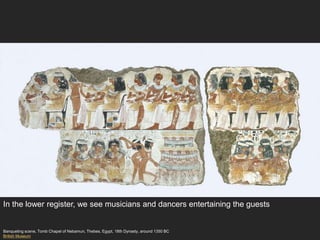
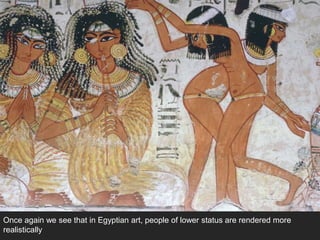
In the lower register, we see musicians and dancers entertaining the guests
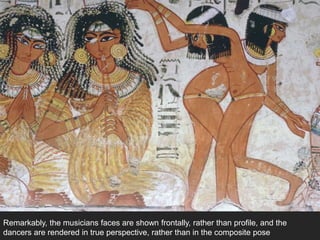
Remarkably, the musicians faces are shown frontally, rather than profile, and the
dancers are rendered in true perspective, rather than in the composite pose
Once again we see that in Egyptian art, people of lower status are rendered more
realistically
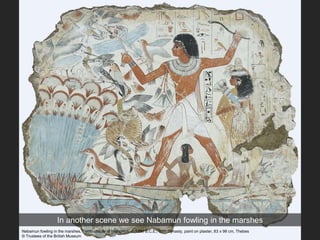
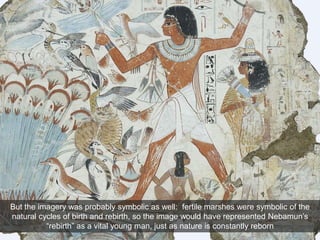
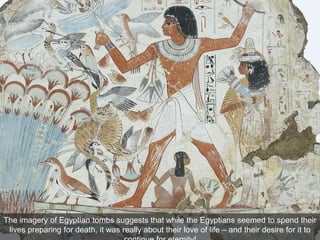
In another scene we see Nabamun fowling in the marshes
Nebamun fowling in the marshes, Tomb-chapel of Nebamun, c. 1350 B.C.E., 18th Dynasty, paint on plaster, 83 x 98 cm, Thebes
© Trustees of the British Museum
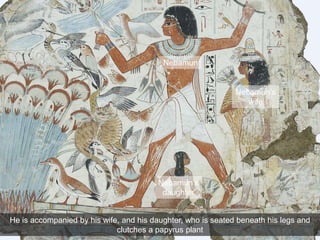
He is accompanied by his wife, and his daughter, who is seated beneath his legs and
clutches a papyrus plant
Nebamun
Nebamun’s
wife
Nebamun’s
daughter
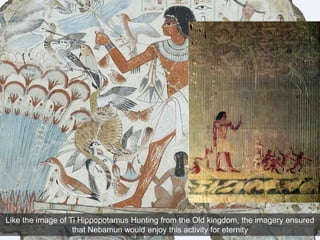
Like the image of Ti Hippopotamus Hunting from the Old kingdom, the imagery ensured
that Nebamun would enjoy this activity for eternity
But the imagery was probably symbolic as well: fertile marshes were symbolic of the
natural cycles of birth and rebirth, so the image would have represented Nebamun’s
“rebirth” as a vital young man, just as nature is constantly reborn
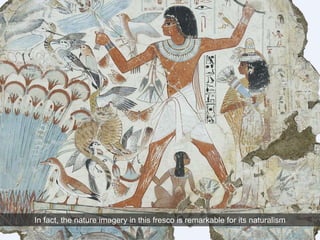
In fact, the nature imagery in this fresco is remarkable for its naturalism
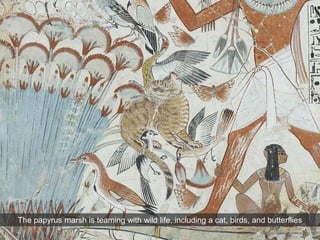
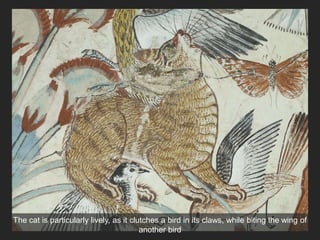
The papyrus marsh is teaming with wild life, including a cat, birds, and butterflies
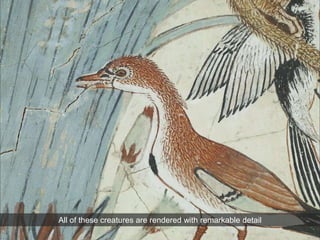
All of these creatures are rendered with remarkable detail
The cat is particularly lively, as it clutches a bird in its claws, while biting the wing of
another bird
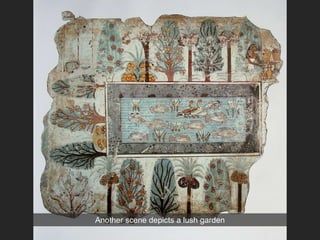
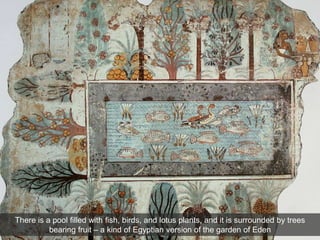
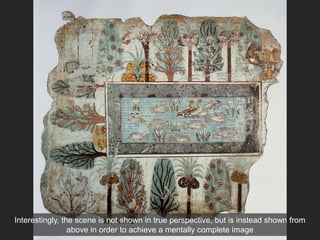
Another scene depicts a lush garden
There is a pool filled with fish, birds, and lotus plants, and it is surrounded by trees
bearing fruit – a kind of Egyptian version of the garden of Eden
Interestingly, the scene is not shown in true perspective, but is instead shown from
above in order to achieve a mentally complete image
The imagery of Egyptian tombs suggests that while the Egyptians seemed to spend their
lives preparing for death, it was really about their love of life – and their desire for it to
Thanks for Listening!
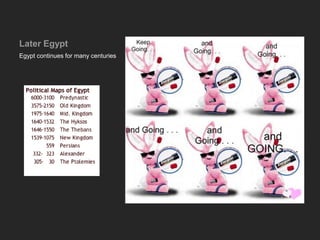
Later Egypt
Egypt continues for many centuries
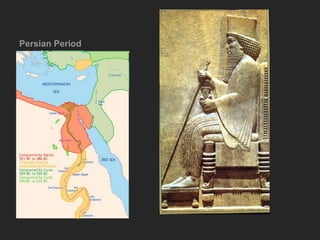
Persian Period
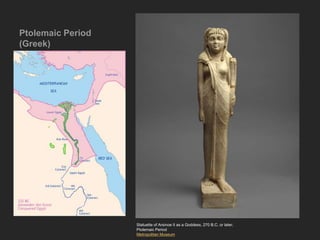
Ptolemaic Period
(Greek)
Statuette of Arsinoe II as a Goddess, 270 B.C. or later;
Ptolemaic Period
Metropolitan Museum
Roman Period
The Temple of Dendur, Temple, Dendur, 15 B.C.; Roman
Period, Augustus Caesar
Metropolitan Museum
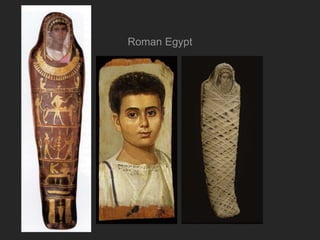
Roman Egypt
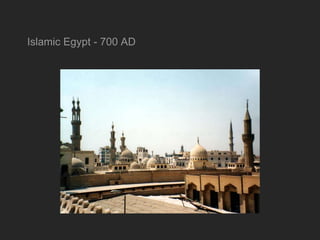
Islamic Egypt - 700 AD
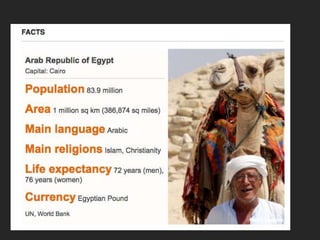
Modern Egypt
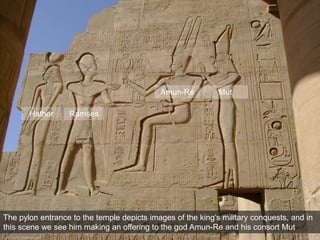
The pylon entrance to the temple depicts images of the king’s military conquests, and in
this scene we see him making an offering to the god Amun-Re and his consort Mut
RamsesHathor
Amun-Re Mut

New Kingdom Egypt

  • 1.
  • 2.
    Egyptian Chronology PRE-DYNASTIC/EARLY DYNASTIC PERIODc. 3500-2575BCE OLD KINGDOM c. 2649 – 2150 BCE MIDDLE KINGDOM c. 2030-1640 BCE NEW KINGDOM c. 15501070 BCE The Middle Kingdom collapsed after the invasion of the Hyksos in about 1700 BCE, marking the beginning of the Second Intermediate period First Intermediate Period Second Intermediate Period
  • 3.
    Head of Ahmose1, 18th Dynasty, New Kingdom, c. 1550-1525 BCE Metropolitan Museum But the Hyksos invaders were expelled by Ahmose I, who founded the 18th Dynasty, and re-united Egypt once again
  • 4.
    Head of Ahmose1, 18th Dynasty, New Kingdom, c. 1550-1525 BCE Metropolitan Museum This marked the beginning of the New Kingdom – often referred to as Egypt’s “golden age”
  • 5.
    During the NewKingdom, Egypt’s borders extended from Syria to the southern Sudan
  • 6.
    The new capitalcity of Thebes became home to a powerful priesthood and a wealthy aristocracy enriched by Egypt’s increased prosperity.
  • 7.
    Statue of ThutmosisIII, 18th Dynasty, New Kingdom Luxor Museum While New Kingdom Pharaohs strove to establish continuity with the past – as seen in this statue of Thutmosis III, a Pharaoh of the 18th Dynasty, there were significant changes nonetheless
  • 8.
  • 9.
    Image source: https://discoveringegypt.com/pyramids-temples-of-egypt/pyramids-of-giza/ ThePharaohs of the New Kingdom abandoned the use of pyramids because they had become easy targets for tomb-robbers
  • 10.
    Excavations at theValley of the Kings, Egypt Image source: http://www.pbs.org/newshour/rundown/fifty-royal-mummies-unearthed-egypts-valley-kings/ Instead, they began to build their tombs in the Valley of the Kings, near the new captial of Thebes, where they would be hidden away in the cliffs
  • 11.
    Instead of buildingpyramids, New Kingdom Pharaohs built Mortuary temples, separate from their burials
  • 12.
    The first Mortuarytemple was built by the Middle Kingdom Pharaoh Mentuhotep, but it was eclipsed by a much larger temple built by the New Kingdom Pharaoh Hatshepsut Mentuhotep Hatshepsut
  • 13.
    Head from anOsirid Statue of Hatshepsut Metropolitan Museum Hatshepsut ruled Egypt for 16 years, and was responsible for many successful trading expeditions that brought wealth to her kingdom
  • 14.
    Head from anOsirid Statue of Hatshepsut Metropolitan Museum She is also the first recorded female Pharaoh in history
  • 15.
    Hatshepsut was thedaughter of Thutmosis I, and became Queen of Egypt when she married her half-brother Thutmosis II (this kind of inter-marrying was common amongst Egyptian royalty)
  • 16.
    When Thutmosis IIdied, his successor – Thutmosis III -- was still an infant, so Hatshepsut governed as regent in his stead, which was a common practice in such circumstances
  • 17.
    But Hatshepsut thenmade the unprecedented move to proclaim herself as Pharaoh, which had never been done before
  • 18.
    Large Kneeling Statueof Hatshepsut, New Kingdom, Dynasty 18, reign of Hatshepsut, ca. 1473–1458 B.C. Metropolitan Museum To legitimize her authority, she had many statues made depicting her in the masculine attire of Egyptian kingship, including the nemes headdress and false beard
  • 19.
    Hatshepsut with OfferingJars, c. 1473-1458. Metropolitan Museum Hatshepsut in a Devotional Attitude, early Dynasty 18; joint reign of Hatshepsut and Thutmose III (1479–1458 B.C.) Metropolitan Museum Since the role of Pharaoh was defined as male, she had to “dress the part” to be accepted as legitimate
  • 20.
    Hatshepsut as FemaleKing, early Dynasty 18; joint reign of Hatshepsut and Thutmose III (1479–1458 B.C.) Metropolitan Museum There are a few surviving statues that depict the Pharaoh as recognizably female
  • 21.
    Hatshepsut as FemaleKing, early Dynasty 18; joint reign of Hatshepsut and Thutmose III (1479–1458 B.C.) Metropolitan Museum In this statue she is slender, and has feminine proportions; and while she wears the nemes headdress, she does not wear the customary false beard
  • 22.
    Sphinx of Hatshepsut,early Dynasty 18; joint reign of Hatshepsut and Thutmose III (1479–1458 B.C.) Metropolitan Museum But in most of her statues her gender identity is suppressed, to conform with traditional representations of the Pharaoh
  • 23.
    Hatshepsut in aDevotional Attitude, 18th Dynasty, New Kingdom, c. 1479-1458 BCE Metropolitan Museum of Art
  • 24.
    Hatshepsut’s temple waswas built against a steep back drop of cliffs in the Necropolis of Deir el Bahri, just across the Nile from the capital of Thebes
  • 25.
    The building consistsof three colonnaded terraces that rise in a succession of tiers, connected by a ramp that forms a central axis, or pathway through the structure
  • 26.
    The lower levelof the complex was originally planted with exotic trees brought back from Hatshepsut’s expedition to Punt, which would have contrasted dramatically with the harsh desert setting
  • 27.
    It must havelooked like a magical oasis, rising out of the dry desert sands
  • 28.
    The precise andgeometric forms of the structure contrasts dramatically with the irregular shapes of the cliffs, providing a powerful symbol of the Pharaoh’s power to impose order and stability
  • 29.
    The temple wasdedicated to the god Amun, who became the most powerful god during the New Kingdom
  • 30.
    His shrine wasthe focal point of building
  • 31.
    There were chapelsdedicated to Hathor and Anubis
  • 32.
    The columns ofthe Hathor chapel are carved in the form of a female head with cows ears, and a crown with curved sides resembling cows horns; in the center of the crown are two uraei (rearing cobras with spread hoods), surmounted by sun disks
  • 33.
    The 3rd levelof the building is decorated with a row of statues depicting Hatshepsut in the guise of Osiris
  • 34.
    She wears thedouble crown of Egypt and carries the crook and flail, while her legs are bound together
  • 35.
    According to Egyptianbeliefs, when a Pharaoh died, he became Osiris, so these statues would seem to suggest that Hatshepsut was no exception to this rule
  • 36.
    In the so-calledBirth Colonnade, there is a cycle of painted reliefs depicting Hatshepsut’s divine birth from the god Amun
  • 37.
    In this scenewe see Hatshepsut suckling from the goddess Hathor, who takes the form of a cow
  • 38.
    Decorations of thetemple included statues depicting Hatshepsut making offerings to the god Amun Large Kneeling Statue of Hatshepsut, early Dynasty 18; joint reign of Hatshepsut and Thutmose III (1479–1458 B.C.) Metropolitan Museum Large Kneeling Statue of Hatshepsut, early Dynasty 18; joint reign of Hatshepsut and Thutmose III (1479–1458 B.C.) Metropolitan Museum
  • 39.
    Large Kneeling Statueof Hatshepsut, early Dynasty 18; joint reign of Hatshepsut and Thutmose III (1479–1458 B.C.) Metropolitan Museum Large Kneeling Statue of Hatshepsut, early Dynasty 18; joint reign of Hatshepsut and Thutmose III (1479–1458 B.C.) Metropolitan Museum Located on the second terrace, the statues flanked the processional way along which a cult statue of the god Amun was carried toward the temple's main sanctuary during a yearly festival
  • 40.
    Some of thestatues depict her wearing the crown of Upper Egypt
  • 41.
    Others show herwearing the traditional nemes headcloth
  • 42.
    Completing the ceremonialpathway, an avenue of sphinxes led towards Amun’s official sancturay at Karnak, located in Thebes, directly across the Nile from Hatshepsut’s temple
  • 43.
    Sphinx of Hatshepsut,New Kingdom, Dynasty 18, reign of Hatshepsut, ca. 1473–1458 B.C. Metropolitan Museum Like the devotional statues, the sphinxes are large in scale, and they depict Hatshepsut in all of the male trappings of Egyptian kingship
  • 44.
    Statue of ThutmosisIII, 18th Dynasty, New Kingdom Luxor Museum When Thutmosis III came to power he tried to erase Hatshepsut’s name from history by destroying her images and inscriptions
  • 45.
    Re-assembling the kneelingstatues on site during the 1927-28 field season. Photograph by Harry Burton, The Metropolitan Museum These photos show the 1920s excavation when fragments of the statues were unearthed
  • 46.
    Many of thesurviving statues now on view at the Metropolitan Museum have been pieced together from fragments found in the rubble left behind by Thutmosis III
  • 47.
    Thanks for Listening! Nextup: Egyptian Temples
  • 48.
    New Kingdom Egypt TheEgyptian Temple
  • 49.
    Statuette of Amun-Re,c. 747-664 BCE Walters Art Museum During the New Kingdom, the god Amun-Re became the most powerful deity in the Pantheon; the Egyptians considered him “king of the gods,” and father of the Pharaoh
  • 50.
    Statuette of Amun-Re BritishMuseum His attributes included a plumed crown with the solar disc of the sun god Re
  • 51.
    Granite ram ofAmun protecting figure of Taharqo, c. 69—664 BCE British Museum He was also sometimes depicted in the form of a ram; in this statue the god protects a small statue of a Pharaoh between his forelegs
  • 52.
    Amun-Re’s sanctuary waslocated in the capital of Thebes (modern day Luxor), across the Nile River from the necropolis at Deir el Bahri
  • 53.
    In this photowe can see Hatshepsut’s temple in the distance, and the craggy cliffs of the Valley of the Kings behind it
  • 54.
    There were twomajor temple complexes associated with the Amun-Re’s cult: the temple of Amun-Re at Karnak
  • 55.
    And the templededicated to his wife Mut and son Khonsu at Luxor
  • 56.
    The two templeswere connected by a mile long avenue of sphinxes that formed the pathway for an annual festival when the gods statue would be taken from one temple to the other
  • 57.
    Image source: https://www.khanacademy.org/humanities/ancient-art-civilizations/egypt-art/new-kingdom/a/karnak Thetemple complex is enormous in scale – in fact, it is one of the largest religious complexes in the world
  • 58.
    Image source: https://www.khanacademy.org/humanities/ancient-art-civilizations/egypt-art/new-kingdom/a/karnak Thesite was actually begun during the Middle Kingdom, and was added to over the centuries by successive Pharaohs
  • 59.
    Image source: http://www.nevworldwonders.com/2013/08/preview-karnak.html Thetemple dedicated to Amun and has two major processional axes
  • 60.
    Image source: http://www.nevworldwonders.com/2013/08/preview-karnak.html Oneruns north-south, with an avenue of sphinxes leading towards the temple at Luxor
  • 61.
    Image source: http://www.nevworldwonders.com/2013/08/preview-karnak.html Theother runs east-west, with an avenue of sphinxes leading towards the Nile River
  • 62.
    Image source: http://www.nevworldwonders.com/2013/08/preview-karnak.html Thetemple is an example of a “pylon temple” – so called because of the massive pylon gateways marking the entrance to successive sections of the building Pylon Pylon Pylon Pylon
  • 63.
    Egyptian Pylon Temple Thebuilding is designed around a central axis, or pathway, well suited for ceremonial use
  • 64.
    Egyptian Pylon Temple courtyard columnedhall courtyard The processional path leads through a succession of courtyards and chambers
  • 65.
    Image source: https://www.khanacademy.org/humanities/ancient-art-civilizations/egypt-art/new-kingdom/a/karnak Inthis reconstruction we can see how the processional path leads down the avenue of sphinxes, through the pylon gate entrance, and into the first courtyard
  • 66.
    Great Temple atKarnak Image source: https://www.q-files.com/history/ancient-egypt/history-of-ancient-egypt/gallery/ The exterior walls were covered with painted reliefs, with scenes showing Pharaohs making offerings to Amun-Re, or engaged in military exploits
  • 67.
    Egyptian Pylon Temple columnedhall After passing through the first courtyard, the pathway then leads into a many-columned hall called a “hypostyle hall”
  • 68.
    A hypostyle hallis essentially a room that is filled with massive columns
  • 69.
    As can beseen in this photograph, the columns were also covered with carved reliefs that would have originally been painted
  • 70.
    This model showsthe hypostyle hall at Karnak; the columns in the center are taller, allowing for clerestory windows that allowed light into the interior Clerestory windows Clerestory windows
  • 71.
    The column capitalsare carved in the shape of lotus flowers – those on the side in the form of a lotus bud, and those in the center, where the light of the sun is strongest, in the shape of a lotus flower Louts bud capital Louts flower capital
  • 72.
    The symbolism isof a marsh receiving the light-giving rays of the sun
  • 73.
    At nearby Luxor,the columns take the form of bundled papyrus reeds, continuing a long tradition of using the lotus and papyrus to symbolize the unification of Egypt
  • 74.
    Great Temple atKarnak Image source: https://www.q-files.com/history/ancient-egypt/history-of-ancient-egypt/gallery/ Over the centuries many Pharaohs made their mark on the two great temples of Karnak and Luxor, commissioning decorations, obelisks, courtyards, or chapels
  • 75.
    Hatshepsut’s Obelisk, Karnak Imagesource: https://commons.wikimedia.or g/wiki/File:Karnak_Tempel_O belisk_Hatschepsut_02.JPG Hatshepsut erected two obelisks at Karnak, one of which is still standing
  • 76.
    Her successor ThutmosisIII constructed a pylon, with an image of him smiting his enemies
  • 77.
    Relief of SetiI’s Libyan War, from the northern exterior wall of the Hypostyle Hall Image source: http://www.memphis.edu/hypostyle/reliefs_inscriptions/index.php Seti I, a Pharaoh of the 19th dynasty decorated the exterior walls of the hypostyle hall with reliefs commemorating his military victory over the Libyans (using the horse drawn chariot that Egyptians learned from the Hittites)
  • 78.
    Relief of SetiI offering maat to the god Amun-Re Image source: http://www.memphis.edu/hypostyle/reliefs_inscriptions/index.php And in this scene, also from Karnak, we see Seti making an offering to the god Amun-Re
  • 79.
    Courtyard of RamsesII, Luxor Image source: http://www.myminimalisttravel.com/travel/travel-inspirations/wonders-of-egypt/ Ramses II, son of Seti I, and considered the most powerful Pharaohs of the New Kingdom, commissioned an entire courtyard at the Temple at Luxor
  • 80.
    The courtyard featuresmultiple statues of the pharaoh in the traditional striding pose, wearing the nemes headcloth; the double crown of Egypt is placed at his feet
  • 81.
    Courtyard of RamsesII, Luxor Image source: http://travelswithsheila.com/temple-of-luxor-was-once-connected-to-karnak-egypt.html Flanking the courtyard entrance are two colossal statues of Ramses in a seated pose, wearing the double crown of Egypt
  • 82.
    Over 1,000 yearsseparates the reigns of Ramses II and the great Pharaohs of the Old Kingdom, yet little has changed in the ideal representation of the Pharaoh as a living god
  • 83.
    Courtyard of RamsesII, Luxor Image source: http://www.myminimalisttravel.com/travel/travel-inspirations/wonders-of-egypt/ We see the same repertoire of poses, and the same emphasis on timeless youth and divine perfection
  • 84.
    Thanks for Listening! Nextup: Akhenaten the Heretic Pharaoh
  • 85.
    New Kingdom Egypt Akhenatenthe Heretic Pharaoh
  • 86.
    Colossal statue ofAmenhotep IV/Akhenaten with nemes and double crown Egyptian Museum, Cairo In 1353 BCE Amenhotep IV ascended the throne; his father, Amenhotep III had enjoyed a long and prosperous reign, continuing the legacy of the powerful 18th Dynasty
  • 87.
    Colossal statue ofAmenhotep IV/Akhenaten with nemes and double crown Egyptian Museum, Cairo Upon his ascension to the throne he introduced a radical new religion that has been described by some as a “heresy.”
  • 88.
    Colossal statue ofAmenhotep IV/Akhenaten with nemes and double crown Egyptian Museum, Cairo Breaking with thousands of years of religious tradition, he declared the god Aten to be the universal and only god -- thus initiating the first monotheistic religion in history
  • 89.
    Colossal statue ofAmenhotep IV/Akhenaten with nemes and double crown Egyptian Museum, Cairo In the 5th year of his reign he changed his name from Amenhotep (meaning “Amen is content”) to Akhenaten (meaning “Benificial to Aten”)
  • 90.
    And he abandonedthe city of Thebes (home of the god Amun-Re), and built a new capital at Amarna located some 200 miles north of Thebes
  • 91.
    Artist’s concept ofthe city of Akhetaten, Image source: http://www.amarna3d.com/ The city was called Akhetaten, meaning “Horizon of Aten;” it covered about 8 miles, and was hastily constructed.
  • 92.
    Artist’s concept ofthe city of Akhetaten, showing the Great Temple to the Aten Image source: https://ancientneareast.org/2014/01/03/the-enigma-of-akhenaten/ The temples at Amarna were quite different from those at Karnak
  • 93.
  • 94.
    Image source: http://www.nationalgeographic.com/magazine/2017/05/akhenaten-revolutionary-egypt-king-art-architecture/ Thetemples at Amarna were completely open to the sky, allowing direct worship of the sun
  • 95.
    Akhenaton, from thetemple of Aton, Karnak 18th Dynasty, New Kingdom, c. 1353-1335 BCE Egyptian Museum, Cairo Artistic style also changed dramatically under Akhenaten
  • 96.
    Akhenaton, from thetemple of Aton, Karnak 18th Dynasty, New Kingdom, c. 1353-1335 BCE Egyptian Museum, Cairo This statue was one of a group of colossal statues that Akhenaten commissioned for the temple of Amen-Re at Karnak, before moving his capital to Amarna
  • 97.
    Akhenaton, from thetemple of Aton, Karnak 18th Dynasty, New Kingdom, c. 1353-1335 BCE Egyptian Museum, Cairo It depicts the Pharaoh in the guise of Osiris, wearing the double crown of Egypt combined with the nemes headcloth and false beard, carrying the crook and flail with crossed arms
  • 98.
    Akhenaton, from thetemple of Aton, Karnak 18th Dynasty, New Kingdom, c. 1353-1335 BCE Egyptian Museum, Cairo Representations of the Pharaoh in the guise of Osiris were common, but the Style of Akhenaten’s statues is unprecedented
  • 99.
    His face isstrangely elongated, with high cheekbones, and a long slender chin
  • 100.
    His lips areare soft and sensual, and his eyes are strangely slanted
  • 101.
    Pharaohs of thepast had shown very little variation in facial features, which helped maintain the idea that each Pharaoh was the next incarnation of the “living Horus” Menkaure Thutmosis III Hatshepsut
  • 102.
    But Akhenaten’s featureswere a complete break with the past
  • 103.
    The body-type isalso completely different from traditional representations
  • 104.
    While Pharaoh’s weretypically portrayed with a taut muscular torso, Akhenaten’s belly is soft, and bulges just slightly over the belt of his skirt
  • 105.
    His hips aresensually curved, giving him a feminine appearance, which may have been intentional
  • 106.
    Some experts believethat Akhenaten deliberately portrayed himself as andogynous (meaning indeterminate sex) to emulate the god Aten, who was sexless
  • 107.
    As a livinggod he possessed both male and female attributes
  • 108.
    Akhenaton and hisfamily worshipping the sun disc Aton, c. 1353-1335 CE. Egyptian Museum, Berlin Several works from the Amarna period portray the royal family worshipping the sun disc, as in this “sunken relief,” made by carving the images as a sunken impression into the stone, rather than raised from the surface
  • 109.
    Akhenaton and hisfamily worshipping the sun disc Aton, c. 1353-1335 CE. Egyptian Museum, Berlin Akhenaten is seated on the left, tenderly kissing one of his young daughters
  • 110.
    Akhenaton and hisfamily worshipping the sun disc Aton, c. 1353-1335 CE. Egyptian Museum, Berlin The king’s wife Nefertiti is seated on the right, with two more daughters; one gestures towards Akhenaten, as if to call her mother’s attention to him
  • 111.
    Akhenaton and hisfamily worshipping the sun disc Aton, c. 1353-1335 CE. Egyptian Museum, Berlin In the center is the sun disc Aten emitting its life-giving rays which end in hands, some of them carrying the Ankh – a symbol of life
  • 112.
    Akhenaton and hisfamily worshipping the sun disc Aton, c. 1353-1335 CE. Egyptian Museum, Berlin The figures display the unique features of what art historians have come to call the “Amarna style”
  • 113.
  • 114.
    Akhenaton and hisfamily worshipping the sun disc Aton, c. 1353-1335 CE. Egyptian Museum, Berlin Their bodies are pear-shaped, with skinny torsos, spindly arms, and softly swelling bellies and thighs – there are even creases in the belly to suggest rolls of fat
  • 115.
    Akhenaton and hisfamily worshipping the sun disc Aton, c. 1353-1335 CE. Egyptian Museum, Berlin The curvilinear contours of the figures create remarkable sense of movement, seen especially in the tassels of the crowns, which seem to flutter in the breeze
  • 116.
    Akhenaton and hisfamily worshipping the sun disc Aton, c. 1353-1335 CE. Egyptian Museum, Berlin The soft organic forms, and sense of movement and time, contrasts dramatically with the rigid timelessness of traditional Egyptian art
  • 117.
    Akhenaton and hisfamily worshipping the sun disc Aton, c. 1353-1335 CE. Egyptian Museum, Berlin The subject matter is also a departure from tradition
  • 118.
    Thutmose IV's PeristyleHall c. 1401 BCE to 1391 BCE Image source: http://dlib.etc.ucla.edu/projects/Karnak/resource/ThutmoseIVPeristyleHall/1665 Representations of Egyptian Pharaohs were typically highly formalized, depicting the king in ceremonial rituals in honor of the gods
  • 119.
    Stela of Akhenaten,Egyptian Museum, Ca In contrast, many Amarna-style works depict the royal family in casual, intimate scenes, interacting with one another in what almost seems to be a candid moment
  • 120.
    Akhenaton and hisfamily worshipping the sun disc Aton, c. 1353-1335 CE. Egyptian Museum, Berlin The emphasis on the Royal family, rather than the god, also seems unusual
  • 121.
    It has beensuggested that the the royal family themselves were worhsipped, instead of the gods, as suggested by this painted relief from Amarna depicting Akhenaten walking beneath the rays of Aten, while his servants bend in deference to him
  • 122.
    Image source: http://www.nationalgeographic.com/magazine/2017/05/akhenaten-revolutionary-egypt-king-art-architecture/ Tosummarize: the Amarna style was a dramatic departure from Egyptian conventions that had prevailed for centuries
  • 123.
    Image source: http://www.nationalgeographic.com/magazine/2017/05/akhenaten-revolutionary-egypt-king-art-architecture/ Whiletraditional Egyptian art was rigid, angular, and formal, Amarna style figures are soft, flowing, and seem to be animated with movement and life, rather than frozen for eternity
  • 124.
    Image source: http://www.nationalgeographic.com/magazine/2017/05/akhenaten-revolutionary-egypt-king-art-architecture/ Thefigures have strangely elongated skulls, pear-shaped bodies with skinny torsos, swelling bellies, and spindly arms
  • 125.
    Image source: http://www.nationalgeographic.com/magazine/2017/05/akhenaten-revolutionary-egypt-king-art-architecture/ Andthe royal family is often depicted in intimate moments, interacting with one another in candid moments under the life-giving rays of the sun disc
  • 126.
    Image source: http://www.nationalgeographic.com/magazine/2017/05/akhenaten-revolutionary-egypt-king-art-architecture/ Eventhe Canon of Propostions was slightly altered under Akhenaten, with two more rows added to allow for a longer neck and torso
  • 127.
    The Wilbour Plaque,c. 1353-1336 BCE. Brooklyn Museum Another significant feature of the Amarna period is the role played by Akhenaten’s wife Nefertiti
  • 128.
    The Wilbour Plaque,c. 1353-1336 BCE. Brooklyn Museum As Hatshepsut’s reign indicates, women played an important role in Egyptian royal affairs, but Nefertiti’s position was still unusual
  • 129.
    The Wilbour Plaque,c. 1353-1336 BCE. Brooklyn Museum She is often portrayed wearing a crown, as in this plaque where both Pharaoh and Queen wear the cobra ureaus
  • 130.
    Akhenaten and familyworshipping Aten Louvre In some reliefs it is difficult to determine who is king or queen because both wear crowns, and Akhenaten was typically represented with feminine attributes
  • 131.
    Bust of Nefertiti,18th Dynasty, c. 1353-1335 Egyptian museum, Berlin Nefertiti was renowned as a great beauty in her own time – her name literally means “a beautiful woman has come”
  • 132.
    Bust of Nefertiti,18th Dynasty, c. 1353-1335 Egyptian museum, Berlin This bust, which was found in an artist’s workshop, was used as a model for creating official portraits of the queen, and is appealing to modern viewers because it conforms so readily to our modern ideals of beauty
  • 133.
    The Queen hashigh cheekbones, large almond shaped eyes, soft sensual lips, and a long and slender neck
  • 134.
    The sensitive modelingof the face is remarkable for its naturalism, which was a characteristic of Amarna art
  • 135.
    Akhenaten Sacrificing aDuck, c. 1353-1336 BCE Metropolitan Museum While the proportions of the figures in Amarna art are highly unnatural, there is an extraordinary sense of lifelike naturalism in the details, as seen in this image of Akhenaten sacrificing a duck to Aten
  • 136.
    This fragment ofa relief from the Amarna period shows a hand rendered in a remarkably lifelike manner
  • 137.
    Thutmose and hismother Senisneb, (facsimile by Nina de Garis Davies) Metropolitan Museum Traditional Egyptian hands are boxy, with all the fingers of the same length
  • 138.
    Two Princesses, NewKingdom, Dynasty 18, reign of Akhenaten, ca. 1349–1336 B.C. Limestone with remains of paint Metropolitan New York And in this relief depicting two of Akhenaten’s daughters, we something that we rarely see in Egyptian art
  • 139.
    Two Princesses, NewKingdom, Dynasty 18, reign of Akhenaten, ca. 1349–1336 B.C. Limestone with remains of paint Metropolitan New York The young girls torso is depicted frontally, in true perspective, rather than twisted sideways in the composite pose
  • 140.
    When Akhenaten died,traditional religion was restored, his temples were dismantled, and his statues were destroyed
  • 141.
    Death Mask ofTutanhamen, from the innermost coffin of his tomb in Thebes, 18th Dynasty, c. 1323 BCE, gold and semiprecious stones Egyptian Museum, Cairo Egypt returned to ancient tradition under his successor, the young King Tutankhamun, who the topic of the next presentation
  • 142.
    Thanks for Listening! Nextup: King Tutankhamun
  • 143.
  • 144.
    King Tutankhamun wasthe son of Alhenaten and one of his lesser wives, which means that Nefertiti was his step-mother
  • 145.
    He married hishalf-sister Ankhesenamun, who was the daughter of Akhenaten and Nefertiti
  • 146.
    Head of Tutankhamun,New Kingdom, Dynasty 18, c. 1336–1327 BCE Sandstone Museum of Fine Arts Boston Tutankhamun ascended the throne at a very young age, and under his reign the traditional worship of Amun was restored (as suggested by his Amun name)
  • 147.
    Head of Tutankhamun,New Kingdom, Dynasty 18, c. 1336–1327 BCE Metropolitan Museum This statue fragment represents the young king wearing the khepresh, a blue crown that was part of the royal regalia
  • 148.
    Head of Tutankhamun,New Kingdom, Dynasty 18, c. 1336–1327 BCE Metropolitan Museum It belonged to a group of statues depicting Tutankamun standing or kneeling in front of the god Amun, symbolizing Egypt’s return to traditional religious practices
  • 149.
    When Tutankhamun’s tombwas discovered by Howard Carter in 1922 it instantly became famous, because it was the first royal tomb ever to have been discovered intact!
  • 150.
    This diagram showsthe layout of the tomb: the Antechamber and Annex were stuffed with furniture and other items that the king might need in the afterlife
  • 151.
    Harry Burton, Detailof Objects in the Antechamber, December 1922 Gelatin silver print Metropolitan Museum This items were crammed in the way you might find junk packed into an attic
  • 152.
    The burial chamberheld the coffin and casket of the king’s mummy
  • 153.
    Image source: http://news.nationalgeographic.com/2015/09/150928-king-tut-tomb-door-nefertiti-archaeology-egypt/ Thewalls of the burial chamber were decorated with images illustrating the funerary rituals that were performed at the king’s burial
  • 154.
    In this scenewe see a priest performing the “opening of the mouth” ceremony on the king’s mummy
  • 155.
    In the nextscene, Tutankhamun is depicted as a young man greeted by a goddess
  • 156.
    And in thelast scene he is seen embracing Osiris, the mummy god of the afterlife
  • 157.
    Tutankhamun’s casket wasplaced inside a series of wooden shrines nested one inside the other
  • 158.
    The casket consistedof three caskets nestled one inside the other like a set of Russian dolls
  • 159.
    The innermost casketdepicts the Pharaoh in the guise of Osiris, and is made of beaten gold (symbol of the sun) and inlaid with semiprecious stones
  • 160.
    The workmanship isof extraordinary quality
  • 161.
    Death Mask ofTutanhamen, from the innermost coffin of his tomb in Thebes, 18th Dynasty, c. 1323 BCE, gold and semiprecious stones Egyptian Museum, Cairo The mask placed on the mummy was also made of gold and semiprecious stones
  • 162.
    Death Mask ofTutanhamen, from the innermost coffin of his tomb in Thebes, 18th Dynasty, c. 1323 BCE, gold and semiprecious stones Egyptian Museum, Cairo It portrays the young Pharaoh with the traditional attributes of Egyptian kingship: the linen nemes headcloth with uraeus and false beard
  • 163.
    The third partof the tomb was the treasury
  • 164.
    Harry Burton, Treasuryof Tutanhamen’s Tomb, probably October 1926 Gelatin silver print Metropolitan Museum This is where the canopic shrine was located, guarded by a statue of Anubis, the jackal-god of the afterlife
  • 165.
    The canopic shrineheld the canopic jars containing the embalmed organs of the Pharaoh
  • 166.
    The treasures thatwere found in Tutankhamun’s tomb were extraordinary, which is impressive since the king died at the young age of 18, so his burial had to be a rush job!
  • 167.
    Imagine what thetombs of Pharaohs who had a lifetime to prepare for burial must have contained – but all of them were stripped clean in ancient times
  • 168.
    Many of theobjects found in his tomb reflect the influence of the Amarna style, in spite o the king’s return to tradition
  • 169.
    The back ofthis golden throne, for example, depicts Tutankhamun and his wife Ankhesemanum
  • 170.
    He is seatedon a throne, while his wife leans towards him holding a vessel in her hand
  • 171.
    The proportions ofthe figures, with their pear-shaped bodies, swelling bellies, and skinny arms recalls the distinctive features of the Amarna style – as does the intimate moment represented, and the sense of movement, seen especially in the fluttering tassels of the king’s crown
  • 172.
    These two figureswere amongst a group of 34 ritual figures that were found in the tomb
  • 173.
    One shows thePharaoh wearing the bowling-pin shaped crown of Upper Egypt, and the other wears the crown of lower Egypt
  • 174.
    The influence ofthe Amarna style can be seen here, too, in the soft swelling hips, and slightly androgynous treatment of the body
  • 175.
    Zahi Hawass, thehead of the Egyptian Supreme Council for Antiquities, left, stands alongside the 3,300-year-old mummy of King Tutankhamun in this 2005 file photo Image source: https://www.thestar.com/entertainment/2007/11/04/egypt_unveils_king_tuts_mummy.html King Tut continues to fascinate people today. His mummy has undergone all kinds of high tech analyses, as scholars try to piece together information about who he was
  • 176.
    Scientists have usedhis DNA to reconstruct what he might have looked like, and to identify deformities that might have resulted from in-breeding
  • 177.
    A recent theoryalso suggests that he suffered from a rare disorder that made it difficult for him to walk – all resulting from years on in-breeding in the 18th Dynasty
  • 178.
    Image source: http://io9.gizmodo.com/why-king-tuts-dna-is-fueling-race-wars-1539130793 Poorking Tut: if the purpose of his tomb was to ensure that he could rest in peace for eternity, its discovery in 1922 destroyed all of that!
  • 179.
    Thanks for Listening! Nextup: Ramses the Great
  • 180.
  • 183.
  • 184.
    Statue of Ramses(The Younger Memnon), 19th Dynasty, New Kingdom British Museum Ramses the Great was the 3rd Pharaoh of the 19th Dynasty, and was one of the most powerful Pharaohs to have ever ruled Egypt
  • 185.
    Statue of Ramses(The Younger Memnon), 19th Dynasty, New Kingdom British Museum He lived well into his 90s, fathering over 100 children (from an equally impressive number of wives), many of whom he outlived
  • 186.
    Ramses II takingprisoners, Abu Simbel Ramses is known for the many military expeditions that he led to regain territory lost by his predecessors
  • 187.
    But his legacyis based on the fact that he built more monuments than any other Egyptian Pharaoh Statue of Ramses (The Younger Memnon), 19th Dynasty, New Kingdom British Museum
  • 188.
    Tourists and journalistsstand next to a newly displayed statue of Pharaoh Amenhotep III and his wife, Tiye, in Egypt's temple city of Luxor on March 23, 2014. (KHALED DESOUKI/AFP/Getty Images) Image source: http://www.huffingtonpost.com/2014/03/25/pharaoh-amenhotep-statues-luxor_n_5027523.html New Kingdom Pharaohs discovered that colossal scale was an effective way of projecting authority, power, and divinity -- as seen in this colossal statue erected by Amenhotep III (Akhenaten’s father) at Luxor
  • 189.
    But Ramses perfectedthe formula, ensuring that his legacy would last for centuries to come
  • 190.
    This colossal statueof Ramses was unearthed in Memphis, near the Great Temple of Ptah
  • 191.
    The Pharaoh isshown in the conventional forward striding pose, arms stiff at his side
  • 192.
    He wears thedouble crown of Egypt and nemes headcloth, with the ureaus and false beard
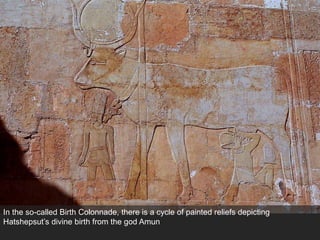
  • 193.
    And the expressionon his face is serene – a fitting image of an immortal god
  • 194.
    At Luxor Ramsesinstalled a massive pylon entrance, with two obelisks – only one remains; the other was carted off by Napoleon the Great after his expedition to Egypt and is now in the Place de Concorde in Paris First pylon entrance at Luxor Image source: https://en.wikipedia.org/wiki/Luxor_Temple
  • 195.
    The pylons weredecorated with scenes of the Pharaoh’s military conquests
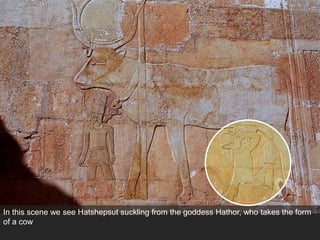
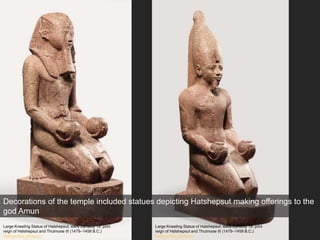
  • 196.
    First pylon entranceat Luxor Image source: https://en.wikipedia.org/wiki/Luxor_Temple And the entrance was flanked by six massive statues of the Pharaoh, two seated and four standing
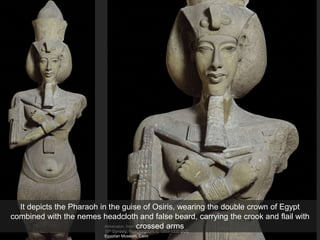
  • 197.
    This is areconstruction of what the temple entrance would have looked like with its original colors Image source: http://www.ancientfacts.net/ancient-wonders-egypt-temple-luxor/
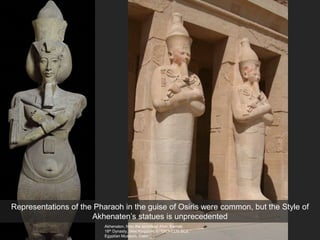
  • 198.
    Image source: https://discoveringegypt.com/rebuilding-ancient-egyptian-temples-in-3d/3d-reconstruction-of-luxor-temple/ Onthe sides of the throne are figures tying a lotus and papyrus in a knot, symbolizing the unification of Upper and Lower Egypt
  • 199.
    Courtyard of RamsesII, Luxor Image source: http://www.myminimalisttravel.com/travel/travel-inspirations/wonders-of-egypt/ Ramses also installed the first courtyard you enter after passing through the entrance (replacing an earlier courtyard built by Amenhotep III – Akhenaten’s father)
  • 200.
    The courtyard containsmultiple statues of the Pharaoh in the traditional striding pose
  • 201.
    Courtyard of RamsesII, Luxor Image source: http://travelswithsheila.com/temple-of-luxor-was-once-connected-to-karnak-egypt.html And the entrance to the courtyard is flanked by colossal statues of the Pharaoh in the traditional seated pose wearing the double crown of Egypt
  • 202.
    Mortuary Temple ofRamses II, Abu Simbel 19th Dynasty, c. 1290-1224 BCE Ramses’ greatest achievement was the Mortuary Temples he erected at Abu Simbel for himself, and his wife Nefertari
  • 203.
    The temple wascarved into a massive cliff
  • 204.
    The scale ofthe statues decorating the façade is like an Egyptian version of Mount Rushmore
  • 205.
    Flanking the entranceare four identical statues of the Pharaoh in the traditional seated pose, wearing the double crown of Egypt with the false beard and ureaus
  • 206.
    Smaller statues depictingRamses’ wives and children appear at his feet
  • 207.
    In a nicheabove the doorway is a representation of the falcon-headed sun god Re- Horakhty
  • 208.
    He has thehead of a falcon, and wears the sun-disc on his head; on either side are images of the Pharaoh wearing the khepresh crown making offerings to the god
  • 209.
    Inside the templecolumn-statues depicting Ramses in the guise of Osiris flank the pathway leading to the innermost sanctuary of the temple
  • 210.
    The innermost sanctuarycontains a row of seated statues representing Ramses amongst the gods
  • 211.
    David Roberts (1796-1864)-'thenaos of the Great Temple of Abu Simbel'-Lithograph on india paper with watercolor Ptah Amun-Re Ramses Re-Horakhty The gods can be recognized by their attributes: Ptah, Amun-Re, Ramses (wearking the blue khepresh crown), and Re-Horakhty
  • 212.
    The sanctuary issituated so that twice every year, on February 22 and October 22 (the birthday and coronation day of Ramses II), the first rays of the morning sun illuminate the statues
  • 213.
    The Temple ofRamses at Abu Simbel is not in its original location
  • 214.
    Image source: http://mashable.com/2015/05/26/abu-simbel-relocation/#QCZLKBFrgPqC Thebuilding of the Aswan Dam in the 1960s made it necessary to move the temple to higher ground to avoid submersion
  • 215.
    Image source: http://mashable.com/2015/05/26/abu-simbel-relocation/#QCZLKBFrgPqC Thetemple was carefully disassembled and moved to a new location 200 feet above their original site
  • 216.
    Roman Period The Templeof Dendur, Temple, Dendur, 15 B.C.; Roman Period, Augustus Caesar Metropolitan Museum The United States participated in the multinational effort, which cost millions of dollars, and in exchange it was given the gift of the Temple of Dendur, now in the Metropolitan Museum of Art in New York
  • 217.
    Thanks for Listening! Nextup: The Tombs of the Nobles
  • 218.
  • 219.
    The West bankof the Nile at Thebes is dotted with tombs of the wealthy nobles who served the Pharaohs of the New Kingdom
  • 220.
    Their tombs werelike the McMansions of ancient Egypt – large in scale, and richly decorated to reflect the privileged lifestyle of the wealthy elite
  • 221.
    Tomb of Menna(TT69), Theban necropolis, reign of Thutmosis IV New kingdom tombs were decorated with painted frescos, rather than painted relief
  • 222.
    Image source: http://www.gsinai.com/icon-workshop-home/ Frescotechnique involves painting directly onto the plaster wall, and is less costly than relief carvings
  • 223.
    Banqueting scene, TombChapel of Nebamun, Thebes, Egypt, 18th Dynasty, around 1350 BC British Museum Some of the best preserved paintings were found in the tomb of Nebamun, who was a scribe during the 18th Dynasty
  • 224.
    Reconstruction of thewall scene. Drawing by C. Thorne and R. B. Parkinson. The British Museum, London. Photographed and © Osama S. M. Amin. Nebamun tomb-cha Image source: http://etc.ancient.eu/photos/egyptian-tomb-chapel-scenes-nebamun-british-museum/ In this scene Nebamun and his wife are seated at an offering table receiving gifts of food, as in traditional tomb imagery
  • 225.
    Reconstruction banqueting scene,Tomb Chapel of Nebamun, Thebes, Egypt, 18th Dynasty, around 1350 BC British Museum But the scene has been expanded to include a lavish funerary banquet, ensuring that Nebamun and his wife will continue to enjoy the good life for eternity
  • 226.
    Banqueting scene, TombChapel of Nebamun, Thebes, Egypt, 18th Dynasty, around 1350 BC British Museum The banquet scene shows a large group of guests – all of them young, beautiful, and finely dressed
  • 227.
    Banqueting scene, TombChapel of Nebamun, Thebes, Egypt, 18th Dynasty, around 1350 BC British Museum The women wear fine linen dresses, elaborate jewelry, and wax cones on their heads that released pleasing fragrances
  • 228.
    Banqueting scene, TombChapel of Nebamun, Thebes, Egypt, 18th Dynasty, around 1350 BC British Museum In the lower register, we see musicians and dancers entertaining the guests
  • 229.
    Remarkably, the musiciansfaces are shown frontally, rather than profile, and the dancers are rendered in true perspective, rather than in the composite pose
  • 230.
    Once again wesee that in Egyptian art, people of lower status are rendered more realistically
  • 231.
    In another scenewe see Nabamun fowling in the marshes Nebamun fowling in the marshes, Tomb-chapel of Nebamun, c. 1350 B.C.E., 18th Dynasty, paint on plaster, 83 x 98 cm, Thebes © Trustees of the British Museum
  • 232.
    He is accompaniedby his wife, and his daughter, who is seated beneath his legs and clutches a papyrus plant Nebamun Nebamun’s wife Nebamun’s daughter
  • 233.
    Like the imageof Ti Hippopotamus Hunting from the Old kingdom, the imagery ensured that Nebamun would enjoy this activity for eternity
  • 234.
    But the imagerywas probably symbolic as well: fertile marshes were symbolic of the natural cycles of birth and rebirth, so the image would have represented Nebamun’s “rebirth” as a vital young man, just as nature is constantly reborn
  • 235.
    In fact, thenature imagery in this fresco is remarkable for its naturalism
  • 236.
    The papyrus marshis teaming with wild life, including a cat, birds, and butterflies
  • 237.
    All of thesecreatures are rendered with remarkable detail
  • 238.
    The cat isparticularly lively, as it clutches a bird in its claws, while biting the wing of another bird
  • 239.
    Another scene depictsa lush garden
  • 240.
    There is apool filled with fish, birds, and lotus plants, and it is surrounded by trees bearing fruit – a kind of Egyptian version of the garden of Eden
  • 241.
    Interestingly, the sceneis not shown in true perspective, but is instead shown from above in order to achieve a mentally complete image
  • 242.
    The imagery ofEgyptian tombs suggests that while the Egyptians seemed to spend their lives preparing for death, it was really about their love of life – and their desire for it to
  • 243.
  • 248.
    Later Egypt Egypt continuesfor many centuries
  • 249.
  • 250.
    Ptolemaic Period (Greek) Statuette ofArsinoe II as a Goddess, 270 B.C. or later; Ptolemaic Period Metropolitan Museum
  • 251.
    Roman Period The Templeof Dendur, Temple, Dendur, 15 B.C.; Roman Period, Augustus Caesar Metropolitan Museum
  • 252.
  • 253.
  • 254.
  • 255.
    The pylon entranceto the temple depicts images of the king’s military conquests, and in this scene we see him making an offering to the god Amun-Re and his consort Mut RamsesHathor Amun-Re Mut