Egyptian Civilization
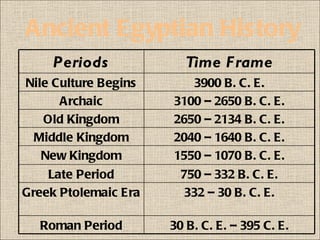
Ancient Egyptian History
    Periods              Time F rame
Nile Culture Begins      3900 B. C. E.
      Archaic         3100 – 2650 B. C. E.
   Old Kingdom        2650 – 2134 B. C. E.
 Middle Kingdom       2040 – 1640 B. C. E.
   New Kingdom        1550 – 1070 B. C. E.
    Late Period         750 – 332 B. C. E.
Greek Ptolemaic Era     332 – 30 B. C. E.

  Roman Period        30 B. C. E. – 395 C. E.
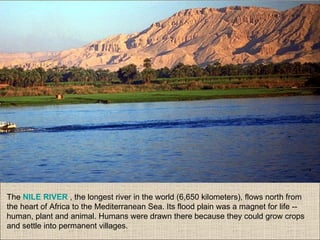
The NILE RIVER , the longest river in the world (6,650 kilometers), flows north from
the heart of Africa to the Mediterranean Sea. Its flood plain was a magnet for life --
human, plant and animal. Humans were drawn there because they could grow crops
and settle into permanent villages.
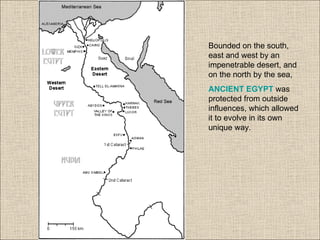
Bounded on the south,
east and west by an
impenetrable desert, and
on the north by the sea,
ANCIENT EGYPT was
protected from outside
influences, which allowed
it to evolve in its own
unique way.
For centuries, THE NILE RIVER FLOODED THE VALLEY, enriching the land with a
thick layer of alluvial soil. Flooding occurred from July to September as the result of
the tropical rains in the Ethiopian tableland. The river attained its highest level in
October, then began to recede to its lowest point sometime between April and June.
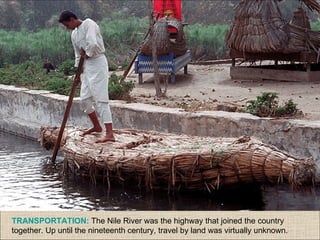
TRANSPORTATION: The Nile River was the highway that joined the country
together. Up until the nineteenth century, travel by land was virtually unknown.
ARCHITECTURE: The
ancient Egyptians built their
pyramids, tombs, temples
and palaces out of STONE,
the most durable of all
building materials.
These building projects took
a high degree of
architectural and
engineering SKILL, and the
organization of a LARGE
WORKFORCE consisting
of highly trained craftsmen
and laborers.
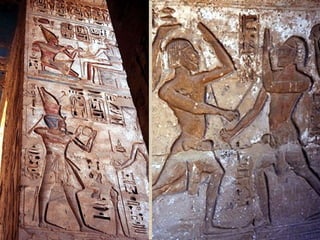
Apart from the pyramids, EGYPTIAN BUILDINGS were decorated with
PAINTINGS, CARVED STONE IMAGES, HIEROGLYPHS, and THREE-
DIMENSIONAL STATUES. The art tells the story of the pharaohs, the gods, the
common people and the natural world of plants, birds and animals.
One of the oldest mysteries surrounding ancient Egypt concerns the building of the
PYRAMIDS. How did humans move such massive blocks of stone using only Stone
Age tools? The Egyptians left thousands of illustrations depicting daily life in the Old
Kingdom. Curiously enough, none of them show how pyramids were built.
SEVERAL THEORIES attempt to explain how pyramids were constructed, but for
now, the mystery has yet to be solved.
The Ramp Theory

One theory suggests that RAMPS were used to haul the stone
blocks on wooden sleds up the side of the pyramids. The ramps
were lubricated with water to reduce friction when hauling the blocks.
As few as 10 men were needed to drag a stone block up a ramp.
may have been several ramps on each side of the pyramid at
different levels, and a ramp may have been coiled around the
pyramid as it grew in height. Once a stone block reached its desired
level, wooden rockers may have been used to maneuver it into
position.
Ramp on pyramid
Stone block on sled
Pouring water to lubricate the ramp
Rocking a block into position
•   GOVERNMENT and RELIGION were inseparable in ancient Egypt. The
    PHARAOH was the head of State and the divine representative of the
    gods on earth.
•   Religion and government brought order to society through:
     – The construction of TEMPLES
     – The creation of LAWS
     – TAXATION
     – The ORGANIZATION OF LABOR
     – TRADE with neighbors
     – The DEFENCE of the country’s interests.
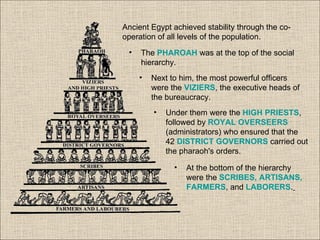
Ancient Egypt achieved stability through the co-
operation of all levels of the population.
 •   The PHAROAH was at the top of the social
     hierarchy.
     •   Next to him, the most powerful officers
         were the VIZIERS, the executive heads of
         the bureaucracy.
         •   Under them were the HIGH PRIESTS,
             followed by ROYAL OVERSEERS
             (administrators) who ensured that the
             42 DISTRICT GOVERNORS carried out
             the pharaoh's orders.

               •   At the bottom of the hierarchy
                   were the SCRIBES, ARTISANS,
                   FARMERS, and LABORERS.
Next to pharaoh, the most powerful
officer in the hierarchy was the VIZIER,
the EXECUTIVE HEAD of the
bureaucracy.
The position of vizier was filled by a
prince or a person of exceptional ability.
 His title is translated as
"superintendent of all works of the king.“
 As the SUPREME JUDGE of the state,
the vizier ruled on all petitions and
grievances brought to the court.
All ROYAL COMMANDS passed
through his hands before being
transmitted to the scribes in his office.
They in turn dispatched orders to the
heads of distant towns and villages, and
dictated the rules and regulations
related to the collection of taxes.
The ancient Egyptians remained very conscious of SOCIAL
STRATIFICATION, and barriers between the classes were quite rigid.
Climbing the social ladder was difficult, but it could be achieved through
outstanding accomplishments in professions such as that of the scribes
and the MILITARY.
The military took part in WARFARE and TRADE missions, helping to
maintain Egypt's sovereignty and expand its territories.
The EGYPTIAN LANGUAGE was one of the earliest languages to be written
down, perhaps only the Sumerian language is older.
First appearing on stone and pottery dating from 3100 B.C. to 3000 B.C., it
remained in use for almost 3,000 years.
The last inscription was written in A.D. 394.
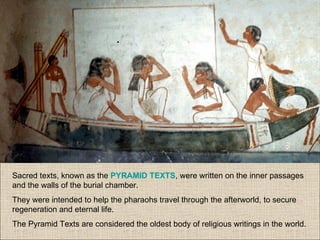
Sacred texts, known as the PYRAMID TEXTS, were written on the inner passages
and the walls of the burial chamber.
They were intended to help the pharaohs travel through the afterworld, to secure
regeneration and eternal life.
The Pyramid Texts are considered the oldest body of religious writings in the world.
RELIGION is the glue that binds local communities together and transforms them
into nations. It creates common understandings and shared values that are
essential to the growth of a civilization.
As human society evolved,
people gradually gained a degree
of personal identity.
With a higher sense of
individuality, humans began to
conceive the gods in a
personalized form.
This stage in development is
called MYTHICAL.
In Egypt, this process began
during the late prehistoric period,
when writing was being invented
and myths were being
formulated.
Osiris                   Isis                  Horus

At that stage, every Egyptian town had its own particular deity represented by
an ANIMAL (such as a cat-goddess, cobra-goddess, ibis-god or jackal-god).
Eventually, these gods and goddesses were given HUMAN BODIES and
credited with human attributes and activities.
The temples in the major cities throughout the land were constructed to
venerate LOCAL GODS.
During the New Kingdom, these temples honored a TRIAD OF GODS based
on the pattern established by the mythical family of OSIRIS, ISIS and
HORUS.
Like all religions, that of ancient
Egypt was COMPLEX. It evolved
over the centuries from one that
emphasized local deities into a
national religion with a smaller
number of principal deities.
Some theologians think that Egypt
was moving towards a monotheistic
faith in a single creator, symbolized
by the SUN GOD.
There was no single belief system,
but the Egyptians shared a common
understanding about the
CREATION OF THE WORLD and
the possibility of REVERTING TO
CHAOS if the destructive forces of
the universe were unleashed.
LIVESTOCK was important to the Egyptian economy, supplying meat, milk,
hides, and dung for cooking fuel.
A variety of DOMESTICATED ANIMALS were raised, including cattle, oxen,
sheep, goats, pigs, ducks and geese. Peasants probably enjoyed meat on
special occasions..
DRAFT ANIMALS such as oxen increased agricultural productivity.
HERDSMEN and SHEPHERDS lived a semi-nomadic life, pasturing their animals
in the marshes of the Nile.
Barley and emmer, were used to make BEER and BREAD, the main staples
of the Egyptian diet. Grains were harvested and stored in GRANARIES until
ready to be processed.
The quantities harvested each season far exceeded the needs of the
country, so much was exported to neighbouring countries, providing a rich
source of INCOME for the Egyptian treasury
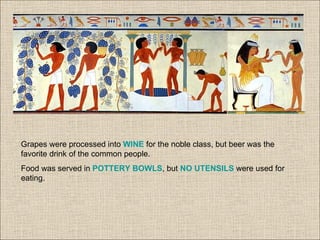
Grapes were processed into WINE for the noble class, but beer was the
favorite drink of the common people.
Food was served in POTTERY BOWLS, but NO UTENSILS were used for
eating.
Pharaohs and nobles participated in HUNTING, FISHING and FOWLING
expeditions, a means of recreation that had ritualistic and religious
significance.
HUNTING SCENES often depicted on temple walls and tombs reinforce the
prowess of kings and nobles. Rabbits, deer, gazelles, bulls, oryx, antelopes,
hippopotamuses, elephants and lions were among the wild animals hunted for
their meat and skins.

Ancient egypt

  • 2.
  • 3.
    Ancient Egyptian History Periods Time F rame Nile Culture Begins 3900 B. C. E. Archaic 3100 – 2650 B. C. E. Old Kingdom 2650 – 2134 B. C. E. Middle Kingdom 2040 – 1640 B. C. E. New Kingdom 1550 – 1070 B. C. E. Late Period 750 – 332 B. C. E. Greek Ptolemaic Era 332 – 30 B. C. E. Roman Period 30 B. C. E. – 395 C. E.
  • 5.
    The NILE RIVER, the longest river in the world (6,650 kilometers), flows north from the heart of Africa to the Mediterranean Sea. Its flood plain was a magnet for life -- human, plant and animal. Humans were drawn there because they could grow crops and settle into permanent villages.
  • 6.
    Bounded on thesouth, east and west by an impenetrable desert, and on the north by the sea, ANCIENT EGYPT was protected from outside influences, which allowed it to evolve in its own unique way.
  • 7.
    For centuries, THENILE RIVER FLOODED THE VALLEY, enriching the land with a thick layer of alluvial soil. Flooding occurred from July to September as the result of the tropical rains in the Ethiopian tableland. The river attained its highest level in October, then began to recede to its lowest point sometime between April and June.
  • 8.
    TRANSPORTATION: The NileRiver was the highway that joined the country together. Up until the nineteenth century, travel by land was virtually unknown.
  • 10.
    ARCHITECTURE: The ancient Egyptiansbuilt their pyramids, tombs, temples and palaces out of STONE, the most durable of all building materials. These building projects took a high degree of architectural and engineering SKILL, and the organization of a LARGE WORKFORCE consisting of highly trained craftsmen and laborers.
  • 11.
    Apart from thepyramids, EGYPTIAN BUILDINGS were decorated with PAINTINGS, CARVED STONE IMAGES, HIEROGLYPHS, and THREE- DIMENSIONAL STATUES. The art tells the story of the pharaohs, the gods, the common people and the natural world of plants, birds and animals.
  • 15.
    One of theoldest mysteries surrounding ancient Egypt concerns the building of the PYRAMIDS. How did humans move such massive blocks of stone using only Stone Age tools? The Egyptians left thousands of illustrations depicting daily life in the Old Kingdom. Curiously enough, none of them show how pyramids were built. SEVERAL THEORIES attempt to explain how pyramids were constructed, but for now, the mystery has yet to be solved.
  • 16.
    The Ramp Theory Onetheory suggests that RAMPS were used to haul the stone blocks on wooden sleds up the side of the pyramids. The ramps were lubricated with water to reduce friction when hauling the blocks. As few as 10 men were needed to drag a stone block up a ramp. may have been several ramps on each side of the pyramid at different levels, and a ramp may have been coiled around the pyramid as it grew in height. Once a stone block reached its desired level, wooden rockers may have been used to maneuver it into position.
  • 17.
  • 18.
  • 19.
    Pouring water tolubricate the ramp
  • 20.
    Rocking a blockinto position
  • 22.
    GOVERNMENT and RELIGION were inseparable in ancient Egypt. The PHARAOH was the head of State and the divine representative of the gods on earth. • Religion and government brought order to society through: – The construction of TEMPLES – The creation of LAWS – TAXATION – The ORGANIZATION OF LABOR – TRADE with neighbors – The DEFENCE of the country’s interests.
  • 23.
    Ancient Egypt achievedstability through the co- operation of all levels of the population. • The PHAROAH was at the top of the social hierarchy. • Next to him, the most powerful officers were the VIZIERS, the executive heads of the bureaucracy. • Under them were the HIGH PRIESTS, followed by ROYAL OVERSEERS (administrators) who ensured that the 42 DISTRICT GOVERNORS carried out the pharaoh's orders. • At the bottom of the hierarchy were the SCRIBES, ARTISANS, FARMERS, and LABORERS.
  • 24.
    Next to pharaoh,the most powerful officer in the hierarchy was the VIZIER, the EXECUTIVE HEAD of the bureaucracy. The position of vizier was filled by a prince or a person of exceptional ability. His title is translated as "superintendent of all works of the king.“ As the SUPREME JUDGE of the state, the vizier ruled on all petitions and grievances brought to the court. All ROYAL COMMANDS passed through his hands before being transmitted to the scribes in his office. They in turn dispatched orders to the heads of distant towns and villages, and dictated the rules and regulations related to the collection of taxes.
  • 25.
    The ancient Egyptiansremained very conscious of SOCIAL STRATIFICATION, and barriers between the classes were quite rigid. Climbing the social ladder was difficult, but it could be achieved through outstanding accomplishments in professions such as that of the scribes and the MILITARY. The military took part in WARFARE and TRADE missions, helping to maintain Egypt's sovereignty and expand its territories.
  • 27.
    The EGYPTIAN LANGUAGEwas one of the earliest languages to be written down, perhaps only the Sumerian language is older. First appearing on stone and pottery dating from 3100 B.C. to 3000 B.C., it remained in use for almost 3,000 years. The last inscription was written in A.D. 394.
  • 28.
    Sacred texts, knownas the PYRAMID TEXTS, were written on the inner passages and the walls of the burial chamber. They were intended to help the pharaohs travel through the afterworld, to secure regeneration and eternal life. The Pyramid Texts are considered the oldest body of religious writings in the world.
  • 30.
    RELIGION is theglue that binds local communities together and transforms them into nations. It creates common understandings and shared values that are essential to the growth of a civilization.

  • 31.
    As human societyevolved, people gradually gained a degree of personal identity. With a higher sense of individuality, humans began to conceive the gods in a personalized form. This stage in development is called MYTHICAL. In Egypt, this process began during the late prehistoric period, when writing was being invented and myths were being formulated.
  • 32.
    Osiris Isis Horus At that stage, every Egyptian town had its own particular deity represented by an ANIMAL (such as a cat-goddess, cobra-goddess, ibis-god or jackal-god). Eventually, these gods and goddesses were given HUMAN BODIES and credited with human attributes and activities. The temples in the major cities throughout the land were constructed to venerate LOCAL GODS. During the New Kingdom, these temples honored a TRIAD OF GODS based on the pattern established by the mythical family of OSIRIS, ISIS and HORUS.
  • 33.
    Like all religions,that of ancient Egypt was COMPLEX. It evolved over the centuries from one that emphasized local deities into a national religion with a smaller number of principal deities. Some theologians think that Egypt was moving towards a monotheistic faith in a single creator, symbolized by the SUN GOD. There was no single belief system, but the Egyptians shared a common understanding about the CREATION OF THE WORLD and the possibility of REVERTING TO CHAOS if the destructive forces of the universe were unleashed.
  • 35.
    LIVESTOCK was importantto the Egyptian economy, supplying meat, milk, hides, and dung for cooking fuel. A variety of DOMESTICATED ANIMALS were raised, including cattle, oxen, sheep, goats, pigs, ducks and geese. Peasants probably enjoyed meat on special occasions.. DRAFT ANIMALS such as oxen increased agricultural productivity. HERDSMEN and SHEPHERDS lived a semi-nomadic life, pasturing their animals in the marshes of the Nile.
  • 36.
    Barley and emmer,were used to make BEER and BREAD, the main staples of the Egyptian diet. Grains were harvested and stored in GRANARIES until ready to be processed. The quantities harvested each season far exceeded the needs of the country, so much was exported to neighbouring countries, providing a rich source of INCOME for the Egyptian treasury
  • 37.
    Grapes were processedinto WINE for the noble class, but beer was the favorite drink of the common people. Food was served in POTTERY BOWLS, but NO UTENSILS were used for eating.
  • 38.
    Pharaohs and noblesparticipated in HUNTING, FISHING and FOWLING expeditions, a means of recreation that had ritualistic and religious significance. HUNTING SCENES often depicted on temple walls and tombs reinforce the prowess of kings and nobles. Rabbits, deer, gazelles, bulls, oryx, antelopes, hippopotamuses, elephants and lions were among the wild animals hunted for their meat and skins.