Industry, Immigration, Cities, and Wealth
How did the US become an Industrial
Giant?
Natural Resources
What draws people to America?
From where do immigrants
come?
How does the government help business grow?
Railroads
 https://www.youtube.com/watch?v=UBpTohx1
Challenges of Industrialization and Urbanization
Laissez faire & Social
Darwinism
Business Gets Big
Labor Unrest
Samuel Gompers Eugene
Debs
Political Machines
Civil Service Reform
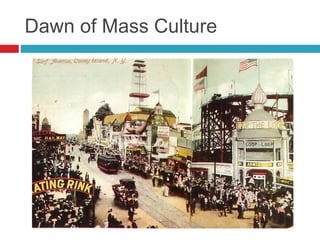
Dawn of Mass Culture
Us hist 1875 1890

Us hist 1875 1890

Editor's Notes

  • #3 Elicit responses. Student responses should include: abundant natural resources, available labor due to growth in population, including immigration, legal protections given to industry from SC
  • #4 Map comes 2nd US resource-rich Coal, iron, later oil Iron later used to make steel Farmland for abundant food Coastline and rivers for shipping
  • #6 Push Factors: lack of social mobility in Europe; potato famine in Ireland; political unrest Pull Factors: industrialization; economic opportunities in cities
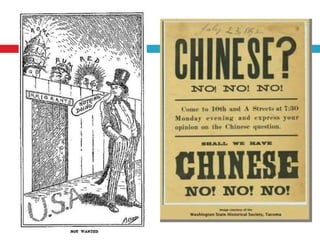
  • #8 Reaction to immigration: nativism -- anti-Irish; Catholic; Chinese (West)
  • #9 Elicit Responses: student responses should include: SC decisions that helped, building railroads, roads, enforcing patent laws; high tarriffs
  • #10 Patent law encouraged innovation Edison – light bulb Alexander Graham Bell – telephone Christopher Sholes -- Typewriter
  • #11 1869: transcontinental railroad complete 1890: 180,000 miles of track (6 times the length at the start of Civil War) -- creation of time zones
  • #12 Railroad lines invent time zones – Why?
  • #13 George Pullman: sleeper car manufacturer; company town Cornelius Vanderbilt: railroad tycoon
  • #14 Elicit responses: student responses should include: over-crowding, lack of jobs, transportation, fire, sanitation, Industrialization: poor treatment of workers; monopolies; concentration of wealth; need of and resentment of labor unions; political corruption
  • #15 LF: marketplace should not be regulated or interfered with SD: Darwin: “survival of the fittest” applies to business; success guided by natural law. -- corruption of Darwin’s theory -- riches a sign of God’s favor -- the poor must be lazy, inferior people who deserved what they got
  • #16 Carnegie: steel magnate Vertical: own all the steps that produces a good Horizontal: buy out all competitors
  • #17 John D. Rockefeller: Standard Oil
  • #18 Robber barons; trusts; forcing the poor to work for their benefit What is the point of this cartoon? Has industrialization been good for the “common man” according to the artist?
  • #20 What’s the natural consequence of leaving business alone. AFL: Gompers; IWW & Debs Haymarket Riots -- protest against police beating a striker turns violent -- public opinion turns against organized labor
  • #22 Tweed Ring Graft: illegal use of political power for personal gain Controlling NY politics through fear, corruption and intimidation
  • #24 Civil Service Reform: Pendleton Act 1883: bipartisan civil service commission makes appointments to federal jobs Takes the politics out of working for the gov’t -- lower level federal jobs no longer given out as patronage -- drives politicians further into the arms of big business
  • #25 Why did a “popular culture” emerge? -- people wanted a break from their hard industrial jobs -- more wealth and less work meant some leisure time available -- amusment parks; baseball; department stores -- catalogues nad advertising
  • #26 Cincinnati Red Stockings, first pro baseball team (1869 here) started in 1866