UNIT
3
The interaction function
Natural Science 2. Secondary Education
THIS IS HOW PLANTS REACT
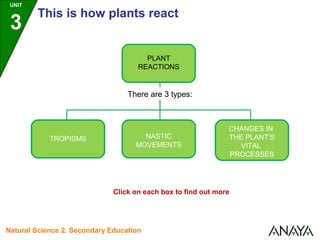
There are 3 types:
UNIT
3
This is how plants react
PLANT
REACTIONS
TROPISMS NASTIC
MOVEMENTS
Click on each box to find out more
CHANGES IN
THE PLANT’S
VITAL
PROCESSES
Natural Science 2. Secondary Education
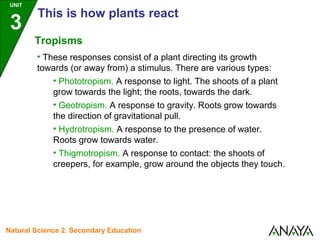
• These responses consist of a plant directing its growth
towards (or away from) a stimulus. There are various types:
• Phototropism. A response to light. The shoots of a plant
grow towards the light; the roots, towards the dark.
• Geotropism. A response to gravity. Roots grow towards
the direction of gravitational pull.
• Hydrotropism. A response to the presence of water.
Roots grow towards water.
• Thigmotropism. A response to contact: the shoots of
creepers, for example, grow around the objects they touch.
Tropisms
UNIT
3
This is how plants react
Natural Science 2. Secondary Education
Go back to the Start menu
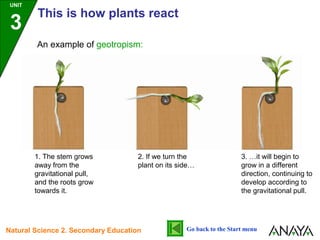
An example of geotropism:
1. The stem grows
away from the
gravitational pull,
and the roots grow
towards it.
2. If we turn the
plant on its side…
3. …it will begin to
grow in a different
direction, continuing to
develop according to
the gravitational pull.
UNIT
3
This is how plants react
Natural Science 2. Secondary Education
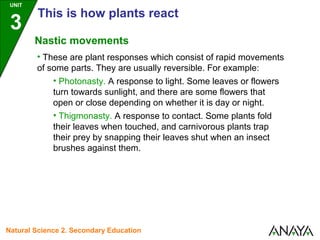
• These are plant responses which consist of rapid movements
of some parts. They are usually reversible. For example:
• Photonasty. A response to light. Some leaves or flowers
turn towards sunlight, and there are some flowers that
open or close depending on whether it is day or night.
• Thigmonasty. A response to contact. Some plants fold
their leaves when touched, and carnivorous plants trap
their prey by snapping their leaves shut when an insect
brushes against them.
Nastic movements
UNIT
3
This is how plants react
Natural Science 2. Secondary Education
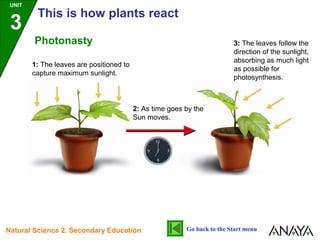
1: The leaves are positioned to
capture maximum sunlight.
2: As time goes by the
Sun moves.
3: The leaves follow the
direction of the sunlight,
absorbing as much light
as possible for
photosynthesis.
Photonasty
UNIT
3
This is how plants react
Go back to the Start menuNatural Science 2. Secondary Education
• Some plants react to stimuli by modifying some of their vital
processes.
• The most characteristic reactions of this type are the
seasonal changes in plants, like flowering in spring, fruit
maturing in the summer and leaves falling in autumn. These
changes all depend on factors like temperature, light, the
length of the day and night, etc.
Changes in the plant’s vital processes
UNIT
3
This is how plants react
Natural Science 2. Secondary Education
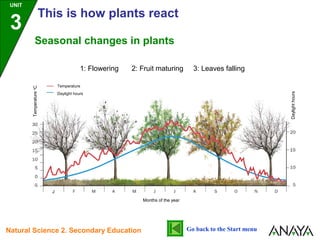
Seasonal changes in plants
1: Flowering 2: Fruit maturing 3: Leaves falling
Months of the year
Temperatureo
C
Temperature
Daylight hours
J
Daylighthours
UNIT
3
This is how plants react
Go back to the Start menuNatural Science 2. Secondary Education

Anaya interaction in plants

  • 1.
    UNIT 3 The interaction function NaturalScience 2. Secondary Education THIS IS HOW PLANTS REACT
  • 2.
    There are 3types: UNIT 3 This is how plants react PLANT REACTIONS TROPISMS NASTIC MOVEMENTS Click on each box to find out more CHANGES IN THE PLANT’S VITAL PROCESSES Natural Science 2. Secondary Education
  • 3.
    • These responsesconsist of a plant directing its growth towards (or away from) a stimulus. There are various types: • Phototropism. A response to light. The shoots of a plant grow towards the light; the roots, towards the dark. • Geotropism. A response to gravity. Roots grow towards the direction of gravitational pull. • Hydrotropism. A response to the presence of water. Roots grow towards water. • Thigmotropism. A response to contact: the shoots of creepers, for example, grow around the objects they touch. Tropisms UNIT 3 This is how plants react Natural Science 2. Secondary Education
  • 4.
    Go back tothe Start menu An example of geotropism: 1. The stem grows away from the gravitational pull, and the roots grow towards it. 2. If we turn the plant on its side… 3. …it will begin to grow in a different direction, continuing to develop according to the gravitational pull. UNIT 3 This is how plants react Natural Science 2. Secondary Education
  • 5.
    • These areplant responses which consist of rapid movements of some parts. They are usually reversible. For example: • Photonasty. A response to light. Some leaves or flowers turn towards sunlight, and there are some flowers that open or close depending on whether it is day or night. • Thigmonasty. A response to contact. Some plants fold their leaves when touched, and carnivorous plants trap their prey by snapping their leaves shut when an insect brushes against them. Nastic movements UNIT 3 This is how plants react Natural Science 2. Secondary Education
  • 6.
    1: The leavesare positioned to capture maximum sunlight. 2: As time goes by the Sun moves. 3: The leaves follow the direction of the sunlight, absorbing as much light as possible for photosynthesis. Photonasty UNIT 3 This is how plants react Go back to the Start menuNatural Science 2. Secondary Education
  • 7.
    • Some plantsreact to stimuli by modifying some of their vital processes. • The most characteristic reactions of this type are the seasonal changes in plants, like flowering in spring, fruit maturing in the summer and leaves falling in autumn. These changes all depend on factors like temperature, light, the length of the day and night, etc. Changes in the plant’s vital processes UNIT 3 This is how plants react Natural Science 2. Secondary Education
  • 8.
    Seasonal changes inplants 1: Flowering 2: Fruit maturing 3: Leaves falling Months of the year Temperatureo C Temperature Daylight hours J Daylighthours UNIT 3 This is how plants react Go back to the Start menuNatural Science 2. Secondary Education