Tropism
6th Grade Science
Have you ever wondered how
seedlings “know” which way to grow?
• The plant must send its roots down into the
soil for minerals and water.
• The plant must send its stems up into the
light and air so that it can manufacture
food.
• Seeds grow the correct way no matter
which way they are planted into the
ground.
Tropism?
• Tropism is the growing or bending of a
plant in response to an external source of
stimulation.
• Several different types of tropism:
– Phototropism (photo = light)
– Geotropism (geo = earth)
– Hydrotropism (hydro = water)
Geotropism
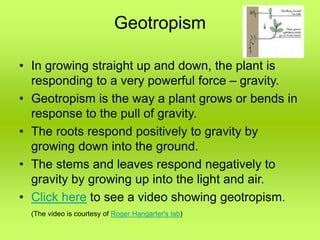
• In growing straight up and down, the plant is
responding to a very powerful force – gravity.
• Geotropism is the way a plant grows or bends in
response to the pull of gravity.
• The roots respond positively to gravity by
growing down into the ground.
• The stems and leaves respond negatively to
gravity by growing up into the light and air.
• Click here to see a video showing geotropism.
(The video is courtesy of Roger Hangarter's lab)
Phototropism
• Triggered by light.
• Phototropism is the way a plant grows
or bends in response to light.
• The roots respond negatively to light by
growing away from it.
• The stems and leaves respond
positively to light by growing towards it.
• Click here to view a video showing
phototropism.
The video is courtesy of Roger Hangarter's lab
Hydrotropism
• Triggered by water.
• The way a plant grows or bends in
response to water.
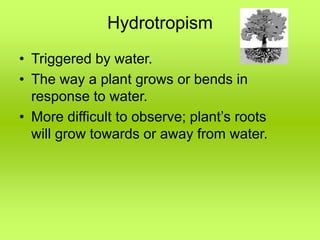
• More difficult to observe; plant’s roots
will grow towards or away from water.
Three important stimuli for plant
growth
• Touch- Some plants show
a response to touch
called thigmotropism.
The stems of vines, such
as grapes coil around
objects when they grow.
• Light- All plants exhibit a
response to light called
phototropism. The plants
will grow towards the
light, showing a positive
phototropism.
• Gravity-Plants also
respond to gravity. This is
called gravitropism.
Roots show positive
gravitropism—they grow
downward. Stems, show
negative gravitropism—
they grow upward.
Hormones and Tropisms
• Plants are able to
respond to touch, light,
and gravity because they
have hormones. A
hormone produced by a
plant is a chemical that
affects they way that they
grow and develop.
• One important hormone is
called auxin. Auxin
speeds up the rate at
which a plant’s cells grow.
Photoperiodism
• The amount of darkness a plant receives determines the
time of flowering in many plants. A plant’s response to
seasonal changes in length of night and day is called
photoperiodism.
Winter Dormancy
• As winter draws near,
many plants go into a
state of dormancy.
• Dormancy is the period
when an organism’s
growth or activity stops.
• Dormancy helps plants
survive during the winter
months. It helps them
survive freezing
temperatures and lack of
water.
Life Spans of Angiosperms
• Angiosperms are classified as annuals, biennials, and
perennials.
• Flowering plants that complete a life cycle in one growing
season are called annuals.
• Biennials will complete their life cycle in two years. In the
first year, they germinate and grow roots, with very short
stems and leaves. In the second year, they lengthen
their stems and produce flowers and seeds.
• Perennials will live more than two years. Most will flower
every year. They will die during the winter months, and
new ones will grow during the spring.
• Brainpop

Tropism.ppt

  • 1.
  • 2.
    Have you everwondered how seedlings “know” which way to grow? • The plant must send its roots down into the soil for minerals and water. • The plant must send its stems up into the light and air so that it can manufacture food. • Seeds grow the correct way no matter which way they are planted into the ground.
  • 3.
    Tropism? • Tropism isthe growing or bending of a plant in response to an external source of stimulation. • Several different types of tropism: – Phototropism (photo = light) – Geotropism (geo = earth) – Hydrotropism (hydro = water)
  • 4.
    Geotropism • In growingstraight up and down, the plant is responding to a very powerful force – gravity. • Geotropism is the way a plant grows or bends in response to the pull of gravity. • The roots respond positively to gravity by growing down into the ground. • The stems and leaves respond negatively to gravity by growing up into the light and air. • Click here to see a video showing geotropism. (The video is courtesy of Roger Hangarter's lab)
  • 5.
    Phototropism • Triggered bylight. • Phototropism is the way a plant grows or bends in response to light. • The roots respond negatively to light by growing away from it. • The stems and leaves respond positively to light by growing towards it. • Click here to view a video showing phototropism. The video is courtesy of Roger Hangarter's lab
  • 6.
    Hydrotropism • Triggered bywater. • The way a plant grows or bends in response to water. • More difficult to observe; plant’s roots will grow towards or away from water.
  • 7.
    Three important stimulifor plant growth • Touch- Some plants show a response to touch called thigmotropism. The stems of vines, such as grapes coil around objects when they grow. • Light- All plants exhibit a response to light called phototropism. The plants will grow towards the light, showing a positive phototropism. • Gravity-Plants also respond to gravity. This is called gravitropism. Roots show positive gravitropism—they grow downward. Stems, show negative gravitropism— they grow upward.
  • 8.
    Hormones and Tropisms •Plants are able to respond to touch, light, and gravity because they have hormones. A hormone produced by a plant is a chemical that affects they way that they grow and develop. • One important hormone is called auxin. Auxin speeds up the rate at which a plant’s cells grow.
  • 9.
    Photoperiodism • The amountof darkness a plant receives determines the time of flowering in many plants. A plant’s response to seasonal changes in length of night and day is called photoperiodism.
  • 10.
    Winter Dormancy • Aswinter draws near, many plants go into a state of dormancy. • Dormancy is the period when an organism’s growth or activity stops. • Dormancy helps plants survive during the winter months. It helps them survive freezing temperatures and lack of water.
  • 11.
    Life Spans ofAngiosperms • Angiosperms are classified as annuals, biennials, and perennials. • Flowering plants that complete a life cycle in one growing season are called annuals. • Biennials will complete their life cycle in two years. In the first year, they germinate and grow roots, with very short stems and leaves. In the second year, they lengthen their stems and produce flowers and seeds. • Perennials will live more than two years. Most will flower every year. They will die during the winter months, and new ones will grow during the spring. • Brainpop