RHS Level 2 Certificate
Week 19 – Outdoor food
production. Vegetables –
crop rotation, intercropping
and successional cropping
Learning outcomes
 1.1 Describe the methods used to advance and extend the productive
season of outdoor food crops; including the use of polythene, mulches,
fleece, ‘enviromesh’, low tunnels, cloches and cold frames.
 1.2 Describe propagation methods used in the production of vegetable
crops, including direct sowing and raising plants in seed beds, blocks
and modules
 2. Crop rotation etc
 2.1 State the benefits and limitations of using crop rotation.
 2.2 Describe a four-bed system of crop rotation.
 2.3 Explain how successional cropping can be achieved for a NAMED
crop by using sowing and planting dates, choice of cultivars and
environmental protection.
 2.4 Explain how intercropping can be used to maximise production.
 2.5 Describe the effect of plant spacing on a named crop.
 2.6 Describe what is meant by ‘cut and come again’ vegetables
Extending the season for food crops
 Using protection – cloches, greenhouse,
poly-tunnel - at the beginning and end of the
season.
 Using varieties that are suited to the stage of
the growing season. For example Peas
(Pisum sativum) can be picked from May to
September if the right varieties are chosen.
 Sow in succession – so that there are new
plants ready to harvest as one batch finishes.
Successional cropping
 Sowing different varieties – early, mid-
season and late
 Sowing a few seeds at regular intervals so
that the plants do not all reach maturity at the
same time. For example, hearting lettuce
(such as Cos) take 8 -14 weeks to reach
maturity. Sowing half a row each week-10
days from late March until late July gives
continuity of harvest May to October.
Propagation methods for vegetables
 Seed – sown outside or sown in pots under cover.
Modules or soil blocks to minimise root disturbance.
Seed beds for brassicas that will be transplanted.
 Plants – young vegetable plants at planting out stage
can be purchased from mail order suppliers who will
deliver in the correct week for planting.
 Roots, slips and sets – Asparagus (Asparagus
officinalis) is supplied as a root, Sweet potatoes
(Ipomoea batatas) as slips (shoots with part of the
root tuber – a bit like propagating Dahlia) and onions
(Allium sativum) as sets (juvenile bulbs).
Intercropping and other intensive
cropping approaches
 Intercropping – growing rows or plants of a quickly
maturing vegetable between those of a slow growing
one.
 Catch cropping – growing a quickly maturing crop on
soil left vacant by a harvested crop or set aside to be
planted later.
 Mixed cropping – growing several vegetables
together that benefit each other and are harvested at
the same time (e.g. ’the Three Sisters’: sweet corn,
beans and squash).
‘Cut and come again’ and ‘baby’ veg.
 Cut and come again – takes advantage of the fact that
leafy vegetables will re-grow if the growing point/roots
are not removed by harvesting. Either involves
removing a few leaves at a time or harvesting the head
and stimulating re-growth.
 ‘Baby’ vegetables – quick maturing cultivars sown at
close spacings so that the competition encourages
smaller plants that grow rapidly to maturity and can be
harvested small and early.
Crop Rotation – basic principles
 Three or four groups (excluding permanent
planting) depending on plot size. More groups =
longer cycle (the longer the cycle the better).
 Four group cycle – legumes, brassicas, alliums,
roots. (For a three group – put alliums with
roots).
 Legumes are generally followed by brassicas.
 Root crops (include potatoes if space does not
permit a separate area) tend to be followed by
alliums (the cultivation required for roots
minimises weed competition).
Crop rotation – rotation groups
 Vegetables divided into five groups –
permanent planting (perennials like
Asparagus); Brassicas; Legumes; Alliums;
root crops.
 Salad crops and some others like Sweet
Corn and squash do not fall into a rotation
group
 The principle is not to grow the same group
on the same soil two years running.
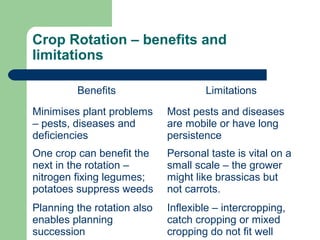
Crop Rotation – benefits and
limitations
Benefits Limitations
Minimises plant problems
– pests, diseases and
deficiencies
Most pests and diseases
are mobile or have long
persistence
One crop can benefit the
next in the rotation –
nitrogen fixing legumes;
potatoes suppress weeds
Personal taste is vital on a
small scale – the grower
might like brassicas but
not carrots.
Planning the rotation also
enables planning
succession
Inflexible – intercropping,
catch cropping or mixed
cropping do not fit well
Learning outcomes
 1.1 Describe the methods used to advance and extend the productive
season of outdoor food crops; including the use of polythene, mulches,
fleece, ‘enviromesh’, low tunnels, cloches and cold frames.
 1.2 Describe propagation methods used in the production of vegetable
crops, including direct sowing and raising plants in seed beds, blocks
and modules
 2. Crop rotation etc
 2.1 State the benefits and limitations of using crop rotation.
 2.2 Describe a four-bed system of crop rotation.
 2.3 Explain how successional cropping can be achieved for a NAMED
crop by using sowing and planting dates, choice of cultivars and
environmental protection.
 2.4 Explain how intercropping can be used to maximise production.
 2.5 Describe the effect of plant spacing on a named crop.
 2.6 Describe what is meant by ‘cut and come again’ vegetables

Rhs level 2 certificate year 1 week 19 2016

  • 1.
    RHS Level 2Certificate Week 19 – Outdoor food production. Vegetables – crop rotation, intercropping and successional cropping
  • 2.
    Learning outcomes  1.1Describe the methods used to advance and extend the productive season of outdoor food crops; including the use of polythene, mulches, fleece, ‘enviromesh’, low tunnels, cloches and cold frames.  1.2 Describe propagation methods used in the production of vegetable crops, including direct sowing and raising plants in seed beds, blocks and modules  2. Crop rotation etc  2.1 State the benefits and limitations of using crop rotation.  2.2 Describe a four-bed system of crop rotation.  2.3 Explain how successional cropping can be achieved for a NAMED crop by using sowing and planting dates, choice of cultivars and environmental protection.  2.4 Explain how intercropping can be used to maximise production.  2.5 Describe the effect of plant spacing on a named crop.  2.6 Describe what is meant by ‘cut and come again’ vegetables
  • 3.
    Extending the seasonfor food crops  Using protection – cloches, greenhouse, poly-tunnel - at the beginning and end of the season.  Using varieties that are suited to the stage of the growing season. For example Peas (Pisum sativum) can be picked from May to September if the right varieties are chosen.  Sow in succession – so that there are new plants ready to harvest as one batch finishes.
  • 4.
    Successional cropping  Sowingdifferent varieties – early, mid- season and late  Sowing a few seeds at regular intervals so that the plants do not all reach maturity at the same time. For example, hearting lettuce (such as Cos) take 8 -14 weeks to reach maturity. Sowing half a row each week-10 days from late March until late July gives continuity of harvest May to October.
  • 5.
    Propagation methods forvegetables  Seed – sown outside or sown in pots under cover. Modules or soil blocks to minimise root disturbance. Seed beds for brassicas that will be transplanted.  Plants – young vegetable plants at planting out stage can be purchased from mail order suppliers who will deliver in the correct week for planting.  Roots, slips and sets – Asparagus (Asparagus officinalis) is supplied as a root, Sweet potatoes (Ipomoea batatas) as slips (shoots with part of the root tuber – a bit like propagating Dahlia) and onions (Allium sativum) as sets (juvenile bulbs).
  • 6.
    Intercropping and otherintensive cropping approaches  Intercropping – growing rows or plants of a quickly maturing vegetable between those of a slow growing one.  Catch cropping – growing a quickly maturing crop on soil left vacant by a harvested crop or set aside to be planted later.  Mixed cropping – growing several vegetables together that benefit each other and are harvested at the same time (e.g. ’the Three Sisters’: sweet corn, beans and squash).
  • 7.
    ‘Cut and comeagain’ and ‘baby’ veg.  Cut and come again – takes advantage of the fact that leafy vegetables will re-grow if the growing point/roots are not removed by harvesting. Either involves removing a few leaves at a time or harvesting the head and stimulating re-growth.  ‘Baby’ vegetables – quick maturing cultivars sown at close spacings so that the competition encourages smaller plants that grow rapidly to maturity and can be harvested small and early.
  • 8.
    Crop Rotation –basic principles  Three or four groups (excluding permanent planting) depending on plot size. More groups = longer cycle (the longer the cycle the better).  Four group cycle – legumes, brassicas, alliums, roots. (For a three group – put alliums with roots).  Legumes are generally followed by brassicas.  Root crops (include potatoes if space does not permit a separate area) tend to be followed by alliums (the cultivation required for roots minimises weed competition).
  • 9.
    Crop rotation –rotation groups  Vegetables divided into five groups – permanent planting (perennials like Asparagus); Brassicas; Legumes; Alliums; root crops.  Salad crops and some others like Sweet Corn and squash do not fall into a rotation group  The principle is not to grow the same group on the same soil two years running.
  • 10.
    Crop Rotation –benefits and limitations Benefits Limitations Minimises plant problems – pests, diseases and deficiencies Most pests and diseases are mobile or have long persistence One crop can benefit the next in the rotation – nitrogen fixing legumes; potatoes suppress weeds Personal taste is vital on a small scale – the grower might like brassicas but not carrots. Planning the rotation also enables planning succession Inflexible – intercropping, catch cropping or mixed cropping do not fit well
  • 11.
    Learning outcomes  1.1Describe the methods used to advance and extend the productive season of outdoor food crops; including the use of polythene, mulches, fleece, ‘enviromesh’, low tunnels, cloches and cold frames.  1.2 Describe propagation methods used in the production of vegetable crops, including direct sowing and raising plants in seed beds, blocks and modules  2. Crop rotation etc  2.1 State the benefits and limitations of using crop rotation.  2.2 Describe a four-bed system of crop rotation.  2.3 Explain how successional cropping can be achieved for a NAMED crop by using sowing and planting dates, choice of cultivars and environmental protection.  2.4 Explain how intercropping can be used to maximise production.  2.5 Describe the effect of plant spacing on a named crop.  2.6 Describe what is meant by ‘cut and come again’ vegetables