Major Advisor
(Dr. Avdhesh Kumar)
Professor, GBPUAT, Pantnagar
Incharge Doctoral Seminar
(Dr. R.S.Chauhan)
Professor & HOD Aquaculture,
GBPUAT, Pantnagar
Research Scholar
Mr. Tarang Kumar Shah
Ph.D(Aquaculture) III Sem.
Id. No- 51134
Date-19/12/2017
Time- 10A.M
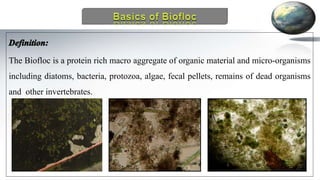
The Biofloc is a protein rich macro aggregate of organic material and micro-organisms
including diatoms, bacteria, protozoa, algae, fecal pellets, remains of dead organisms
and other invertebrates.
Introduction
 As the human population continues to grow, food production industries such as
aquaculture will need to expand as well.
 This technology helps in minimizing use of water by maintaining the water quality
within the system and also reduces the water exchange (Crab, 2010).
 Biofloc technology initially known as bacteria floc was initiated in fish (tilapia) by
Yoram in late 1980s and shrimp farming in Belize in late 1990s by McIntosh (1999
& 2000).
 In order to preserve the environment and the natural resources, this expansion will
need to take place in a sustainable way.
1. Aquaculture expansion
2. To develop sustainable aquaculture systems
3. To support economic and social sustainability
Bio Floc Technology
 The basic technology was developed by Dr. Yoram Avnimelech in Israel and initially
implemented commercially in Belize by Belize Aquaculture.
 Biofloc technology is a technique of enhancing water quality in aquaculture through
balancing carbon and nitrogen in the system.
 The technology works on the basic principle of flocculation within the system
(Avnimelech 2009).
 Biofloc technology (BFT) has been successfully implemented in aquaculture especially
shrimp farming. Biofloc technology has become a popular technology in the farming of
Pacific white shrimp, Litopenaeus vannamei.
Cont…
 The basic requirements for biofloc system operation include high stocking density, high
aeration and lined ponds.
 It has basically two major roles i.e. water quality maintenance and providing nutrients
(Emerenciano et al., 2013).
 A crucial factor in the system is the control of biofloc in ponds during operation. Fish
/Shrimp are fed with a lot of feed.
 A basic factor in designing a biofloc system is the species to be cultured.
 Biofloc systems are also most suitable for species that can tolerate high solids
concentration in water and are generally tolerant of poor water quality.
 Species such as shrimp and tilapia have physiological adaptations that allow them to
consume biofloc and digest microbial protein.
Suitable culture species
 The two basic types are those that are exposed to natural light and those that are not.
1. Green water biofloc systems.
2. Brown- water biofloc systems
 Biofloc systems exposed to natural light include outdoor, lined ponds or tanks for the
culture of shrimp or tilapia and lined raceways for shrimp culture in greenhouses.
 some biofloc systems (raceways and tanks) have been installed in closed buildings with no
exposure to natural light.
Mechanism of floc formation
 The flocculation of microbial communities is a complex process.
 Within the floc's matrix, a combination of physical, chemical and biological phenomena
is operating.
 The exact mechanisms and the methods to engineer microbiological flocs remain largely
unknown.
 These structures form a matrix that encapsulates the microbial cells, and play a major
role in binding the floc components together.
 They are typically made up out of polysaccharides, protein, humic compounds, nucleic
acids and lipids.
• They are produced as slime or capsule layers under various nutritional conditions but
particularly in case of limitation by nutrients like e.g. nitrogen.
• Checking concentration of Biofloc:
Factors influencing floc formation and floc structure in bio-flocs technology
 Dissolved Oxygen
 Organic carbon source
 Organic loading rate
 Temperature
 pH
Sampling Method
Read density of flocs in cone
(ml/l)
Let it settled for 15-20 minutes
1 liter / 2 places/ between 10-12 am
Measuring procedure
‘Floc’ Development
Average Floc Development
0
2
4
6
8
10
12
14
20 30 40 50 60 70 80 90 100 110 120 130
DOC (days)
Floc (ml/L)
Floc
Basic of BFT in Shrimp Farming
1. High stocking density - over 130 – 150 PL10/m2
2. High aeration – 28 to 32 HP/ha/ PWAs
3. Paddle wheel position in ponds
4. HDPE / Concrete lined ponds
5. Grain (pellet)
6 Molasses
7. Expected production 20–25 MT/ha/crop
Grain pellet Bioflocs Dark Vannamei HDPE lined pond
Fish (Tilapia) In Biofloc System
 Nursery phase presents several benefits such as optimization of farm land, increase in survival and
enhanced growth performance in grow-out ponds.
 BFT has been applied successfully in nursery phase in different shrimp species such as L.vannamei,
P. monodon and F. setiferus.
 Better nutrition by continuous consumption of biofloc:
 The growth enhancement of L. vannamei post larvae reared in nursery BFT is related to a better
nutrition by continuous consumption of biofloc, which might positively influence grow-out
performance of L.vannamei.
Nursery
 Enhance growth performance:
It was observed that presence of bioflocs resulted in increases of 50% in weight and almost 80% in
final biomass in F. paulensis early post larval stage when compared to conventional clear-water
system.
 Maintain favorable water quality and enhance production:
The addition of substrates in BFT systems increased growth and further enhanced production, while
also contributing to more favourable water quality conditions.
Grow out
 In grow-out, BFT has been also shown nutritional and zoo technical benefits.
 It was estimated that more than 29% of the daily food intake of L. vannamei consisted of
microbial flocs, decreasing FCR and reducing costs in feed.
 The reference showed that juveniles of L. vannamei fed with 35% pelletized feed grew
significantly better in biofloc conditions as compared to clear-water conditions.
 It was showed that controlling the concentration of particles in super-intensive shrimp culture
systems can significantly improve shrimp production and water quality.
 It was evaluated the stocking density in a 120d of L. vannamei BFT culture, reporting
consistent survival of 92, 81 and 75% with 150, 300 and 450 shrimp/m2, respectively.
 Moreover, the study performed in a heterotrophic-based condition detected no significant
difference in FCR when feeding L. vannamei 30% and 45% diets and 39% and 43% diets,
respectively.
 It is not known exactly how microbial flocs enhance growth.
Application in Breeding
 Biofloc in a form of rich-lipid-protein source could be utilized for first stages of broodstock's
gonads formation and ovary development.
 Furthermore, production of brood stock in BFT could be located in small areas close to
hatchery facilities, preventing spread of diseases caused by shrimp transportation.
 BFT could enhance spawning performance as compared to the conventional pond and tank-
reared system, respectively i.e. high number of eggs per spawn and high spawning.
Use of biofloc in Aquaponics
 Aquaponics is a sustainable food production system that combines a traditional
aquaculture with hydroponics in a symbiotic environment.
 Nowadays, BFT have been successfully applied in aquaponics. The presence of rich-
biota (microorganisms of biofloc) and a variety of nutrients such as micro and
macronutrients originated from un-eaten or non-digested feed seems to contribute in
plant nutrition.
 A well known example of biofloc and aquaponics interaction was also developed by
UVI.
 High concentration of solids may cause excessive adhesion of microorganism on plants roots
(biofilm), causing its damage, lowering oxygenation and poor growth.
Belize, Central America
Biofloc system culture
Belize Aqua Ltd – A view
Belize Aqua Ltd - ponds
Malaysia
Biofloc System initiated – on going
Seawater Intake –
2.6 km offshore
Well designed farm layout
Biofloc
BAB Semi biofloc (8-9 MT /0.8ha
pond -Target)
Shrimp Farms in Indonesia & Malaysia
Global Medan Indonesia
Bali, Indonesia
CPB Lampung, Indonesia
Nyan Taw Shrimp Farming
GAA 2005
Blue Archipelago, Malaysia
Potential of BFT – PERU
Lined and covered
Piura - Intensive with
freshwater covered
Tumbes-Extensive with SW
Piura Intensive FW Nursery
Piura -Inside covered pond
Grain
Potential for BFT – GUATEMALA
Lined with high energy input
Pasca Shrimp Farm 1
Potential for BFT – CHINA
Lined, covered & high energy input
Inside covered & lined ponds
Covered ponds
Covered ponds
 A very high survival of 98-99 % of L. vannamei was achieved in a periphyton-and-biofloc-
based nursery tank- based rearing system compared to 91-92 % in the conventional system.
One nursery-tank of 100 tonnes could generate revenue of 50,000 – 100,000 per year.
 Following this successful nursery-rearing; in the same system, grow-out culture was
completed under biofloc- based rearing. A final weight of 22-23g in 110 days culture could
be observed.
 This Technology will be disseminated after further standardization and demonstration of the
technology with the involvement of stakeholders.
• 120 days experiment were conducted to investigate the effect of biofloc technology
(BFT) systems with zero water exchange (WE), BFT with 10% WE.
• The results showed that rearing tilapia in BFT did not significantly deteriorated water
quality parameters such as total ammonia nitrogen, nitrate, pH and temperature.
Advantages
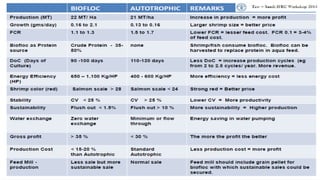
1. Bio-security very good (from water) – to date WSSV negative using the system.
2. Zero water exchange – less than 100% exchange for whole culture period.
3. Production (Carrying capacity): 5-10% better than normal system
4. Shrimp size bigger by about 2.0 g than normal system
5. FCR low – between 1.0 to 1.3
6. Production cost lower by around 15-20 %.
Disadvantages
1. High energy input – paddlewheels 28HP/ha.
2. Power failure critical – maximum one hour at any time (better zero hour failure)
3. Full HDPE lined ponds – minimum semi-HDPE lined
4. Technology similar but more advance – need to train technicians
Advantages/ Disadvantages
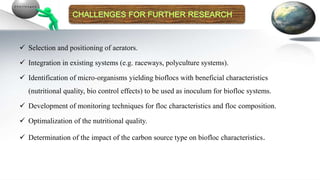
 Selection and positioning of aerators.
 Integration in existing systems (e.g. raceways, polyculture systems).
 Identification of micro-organisms yielding bioflocs with beneficial characteristics
(nutritional quality, bio control effects) to be used as inoculum for biofloc systems.
 Development of monitoring techniques for floc characteristics and floc composition.
 Optimalization of the nutritional quality.
 Determination of the impact of the carbon source type on biofloc characteristics.
Conclusion
• Biofloc technology application offers benefits in improving aquaculture production that
could contribute to the achievement of sustainable development goals.
• This technology could result in higher productivity with less impact to the environment.
• Cardona, E., Lorgeoux, B., Chim, L., Goguenheim, J., Le Delliou, H. and Cahu, C., 2016. Biofloc contribution to
antioxidant defence status, lipid nutrition and reproductive performance of broodstock of the shrimp Litopenaeus
stylirostris: Consequences for the quality of eggs and larvae. Aquaculture, 452:.252-262.
• Crab R., Defoirdt T., Bossier P. & Verstraete W.(2012) Biofloc technology in aquaculture: beneficial effects and
future challenges. Aquaculture 357: 351–356.
• Ekasari, J., Zairin, M., Putri, D.U., Sari, N.P., Surawidjaja, E.H. and Bossier, P., 2015. Biofloc‐based reproductive
performance of Nile tilapia Oreochromis niloticus L. broodstock. Aquaculture Research, 46(2): 509-512.
• Abdallah Tageldien Mansour, Maria Ángeles Esteban, 2017. Effects of carbon sources and plant protein levels in
a biofloc system on growth performance, and the immune and antioxidant status of Nile tilapia (Oreochromis
niloticus),Fish & Shellfish Immunology, Volume 64: 202–209
• Avnimelech, Y., 2009. Biofloc Technology — A Practical Guide Book. The World Aquaculture Society, Baton
Rouge, Louisiana, United States. 182 pp.
• Crab, R., 2010. Biofloc Technology: An Integrated System for the Removal of Nutrients and Simultaneous
Production of Feed in Aquaculture. Ghent University. Faculty of Bioscience Engineering, Ghent, Belgium, 178
pp.
• Crab, R., Avnimelech, Y., Defoirdt, T., Bossier, P. and Vestraete. W., 2007. Nitrogen Removal Techniques in
Aquaculture for a Sustainable Production. Aquaculture, 270:1–14.
References
Seminar

Seminar

  • 1.
    Major Advisor (Dr. AvdheshKumar) Professor, GBPUAT, Pantnagar Incharge Doctoral Seminar (Dr. R.S.Chauhan) Professor & HOD Aquaculture, GBPUAT, Pantnagar Research Scholar Mr. Tarang Kumar Shah Ph.D(Aquaculture) III Sem. Id. No- 51134 Date-19/12/2017 Time- 10A.M
  • 2.
    The Biofloc isa protein rich macro aggregate of organic material and micro-organisms including diatoms, bacteria, protozoa, algae, fecal pellets, remains of dead organisms and other invertebrates.
  • 3.
    Introduction  As thehuman population continues to grow, food production industries such as aquaculture will need to expand as well.  This technology helps in minimizing use of water by maintaining the water quality within the system and also reduces the water exchange (Crab, 2010).  Biofloc technology initially known as bacteria floc was initiated in fish (tilapia) by Yoram in late 1980s and shrimp farming in Belize in late 1990s by McIntosh (1999 & 2000).  In order to preserve the environment and the natural resources, this expansion will need to take place in a sustainable way.
  • 4.
    1. Aquaculture expansion 2.To develop sustainable aquaculture systems 3. To support economic and social sustainability
  • 5.
    Bio Floc Technology The basic technology was developed by Dr. Yoram Avnimelech in Israel and initially implemented commercially in Belize by Belize Aquaculture.  Biofloc technology is a technique of enhancing water quality in aquaculture through balancing carbon and nitrogen in the system.  The technology works on the basic principle of flocculation within the system (Avnimelech 2009).  Biofloc technology (BFT) has been successfully implemented in aquaculture especially shrimp farming. Biofloc technology has become a popular technology in the farming of Pacific white shrimp, Litopenaeus vannamei.
  • 6.
    Cont…  The basicrequirements for biofloc system operation include high stocking density, high aeration and lined ponds.  It has basically two major roles i.e. water quality maintenance and providing nutrients (Emerenciano et al., 2013).  A crucial factor in the system is the control of biofloc in ponds during operation. Fish /Shrimp are fed with a lot of feed.
  • 8.
     A basicfactor in designing a biofloc system is the species to be cultured.  Biofloc systems are also most suitable for species that can tolerate high solids concentration in water and are generally tolerant of poor water quality.  Species such as shrimp and tilapia have physiological adaptations that allow them to consume biofloc and digest microbial protein. Suitable culture species
  • 9.
     The twobasic types are those that are exposed to natural light and those that are not. 1. Green water biofloc systems. 2. Brown- water biofloc systems  Biofloc systems exposed to natural light include outdoor, lined ponds or tanks for the culture of shrimp or tilapia and lined raceways for shrimp culture in greenhouses.  some biofloc systems (raceways and tanks) have been installed in closed buildings with no exposure to natural light.
  • 11.
    Mechanism of flocformation  The flocculation of microbial communities is a complex process.  Within the floc's matrix, a combination of physical, chemical and biological phenomena is operating.  The exact mechanisms and the methods to engineer microbiological flocs remain largely unknown.  These structures form a matrix that encapsulates the microbial cells, and play a major role in binding the floc components together.  They are typically made up out of polysaccharides, protein, humic compounds, nucleic acids and lipids.
  • 12.
    • They areproduced as slime or capsule layers under various nutritional conditions but particularly in case of limitation by nutrients like e.g. nitrogen. • Checking concentration of Biofloc:
  • 13.
    Factors influencing flocformation and floc structure in bio-flocs technology  Dissolved Oxygen  Organic carbon source  Organic loading rate  Temperature  pH
  • 14.
    Sampling Method Read densityof flocs in cone (ml/l) Let it settled for 15-20 minutes 1 liter / 2 places/ between 10-12 am Measuring procedure
  • 15.
    ‘Floc’ Development Average FlocDevelopment 0 2 4 6 8 10 12 14 20 30 40 50 60 70 80 90 100 110 120 130 DOC (days) Floc (ml/L) Floc
  • 16.
    Basic of BFTin Shrimp Farming 1. High stocking density - over 130 – 150 PL10/m2 2. High aeration – 28 to 32 HP/ha/ PWAs 3. Paddle wheel position in ponds 4. HDPE / Concrete lined ponds 5. Grain (pellet) 6 Molasses 7. Expected production 20–25 MT/ha/crop Grain pellet Bioflocs Dark Vannamei HDPE lined pond
  • 17.
    Fish (Tilapia) InBiofloc System
  • 19.
     Nursery phasepresents several benefits such as optimization of farm land, increase in survival and enhanced growth performance in grow-out ponds.  BFT has been applied successfully in nursery phase in different shrimp species such as L.vannamei, P. monodon and F. setiferus.  Better nutrition by continuous consumption of biofloc:  The growth enhancement of L. vannamei post larvae reared in nursery BFT is related to a better nutrition by continuous consumption of biofloc, which might positively influence grow-out performance of L.vannamei. Nursery
  • 20.
     Enhance growthperformance: It was observed that presence of bioflocs resulted in increases of 50% in weight and almost 80% in final biomass in F. paulensis early post larval stage when compared to conventional clear-water system.  Maintain favorable water quality and enhance production: The addition of substrates in BFT systems increased growth and further enhanced production, while also contributing to more favourable water quality conditions.
  • 21.
    Grow out  Ingrow-out, BFT has been also shown nutritional and zoo technical benefits.  It was estimated that more than 29% of the daily food intake of L. vannamei consisted of microbial flocs, decreasing FCR and reducing costs in feed.  The reference showed that juveniles of L. vannamei fed with 35% pelletized feed grew significantly better in biofloc conditions as compared to clear-water conditions.  It was showed that controlling the concentration of particles in super-intensive shrimp culture systems can significantly improve shrimp production and water quality.
  • 22.
     It wasevaluated the stocking density in a 120d of L. vannamei BFT culture, reporting consistent survival of 92, 81 and 75% with 150, 300 and 450 shrimp/m2, respectively.  Moreover, the study performed in a heterotrophic-based condition detected no significant difference in FCR when feeding L. vannamei 30% and 45% diets and 39% and 43% diets, respectively.  It is not known exactly how microbial flocs enhance growth.
  • 23.
    Application in Breeding Biofloc in a form of rich-lipid-protein source could be utilized for first stages of broodstock's gonads formation and ovary development.  Furthermore, production of brood stock in BFT could be located in small areas close to hatchery facilities, preventing spread of diseases caused by shrimp transportation.  BFT could enhance spawning performance as compared to the conventional pond and tank- reared system, respectively i.e. high number of eggs per spawn and high spawning.
  • 24.
    Use of bioflocin Aquaponics  Aquaponics is a sustainable food production system that combines a traditional aquaculture with hydroponics in a symbiotic environment.  Nowadays, BFT have been successfully applied in aquaponics. The presence of rich- biota (microorganisms of biofloc) and a variety of nutrients such as micro and macronutrients originated from un-eaten or non-digested feed seems to contribute in plant nutrition.  A well known example of biofloc and aquaponics interaction was also developed by UVI.
  • 25.
     High concentrationof solids may cause excessive adhesion of microorganism on plants roots (biofilm), causing its damage, lowering oxygenation and poor growth.
  • 27.
    Belize, Central America Bioflocsystem culture Belize Aqua Ltd – A view Belize Aqua Ltd - ponds
  • 28.
    Malaysia Biofloc System initiated– on going Seawater Intake – 2.6 km offshore Well designed farm layout Biofloc BAB Semi biofloc (8-9 MT /0.8ha pond -Target)
  • 29.
    Shrimp Farms inIndonesia & Malaysia Global Medan Indonesia Bali, Indonesia CPB Lampung, Indonesia Nyan Taw Shrimp Farming GAA 2005 Blue Archipelago, Malaysia
  • 30.
    Potential of BFT– PERU Lined and covered Piura - Intensive with freshwater covered Tumbes-Extensive with SW Piura Intensive FW Nursery Piura -Inside covered pond Grain
  • 31.
    Potential for BFT– GUATEMALA Lined with high energy input Pasca Shrimp Farm 1
  • 32.
    Potential for BFT– CHINA Lined, covered & high energy input Inside covered & lined ponds Inside covered & lined ponds Covered ponds Covered ponds
  • 35.
     A veryhigh survival of 98-99 % of L. vannamei was achieved in a periphyton-and-biofloc- based nursery tank- based rearing system compared to 91-92 % in the conventional system. One nursery-tank of 100 tonnes could generate revenue of 50,000 – 100,000 per year.  Following this successful nursery-rearing; in the same system, grow-out culture was completed under biofloc- based rearing. A final weight of 22-23g in 110 days culture could be observed.  This Technology will be disseminated after further standardization and demonstration of the technology with the involvement of stakeholders.
  • 37.
    • 120 daysexperiment were conducted to investigate the effect of biofloc technology (BFT) systems with zero water exchange (WE), BFT with 10% WE. • The results showed that rearing tilapia in BFT did not significantly deteriorated water quality parameters such as total ammonia nitrogen, nitrate, pH and temperature.
  • 39.
    Advantages 1. Bio-security verygood (from water) – to date WSSV negative using the system. 2. Zero water exchange – less than 100% exchange for whole culture period. 3. Production (Carrying capacity): 5-10% better than normal system 4. Shrimp size bigger by about 2.0 g than normal system 5. FCR low – between 1.0 to 1.3 6. Production cost lower by around 15-20 %. Disadvantages 1. High energy input – paddlewheels 28HP/ha. 2. Power failure critical – maximum one hour at any time (better zero hour failure) 3. Full HDPE lined ponds – minimum semi-HDPE lined 4. Technology similar but more advance – need to train technicians Advantages/ Disadvantages
  • 40.
     Selection andpositioning of aerators.  Integration in existing systems (e.g. raceways, polyculture systems).  Identification of micro-organisms yielding bioflocs with beneficial characteristics (nutritional quality, bio control effects) to be used as inoculum for biofloc systems.  Development of monitoring techniques for floc characteristics and floc composition.  Optimalization of the nutritional quality.  Determination of the impact of the carbon source type on biofloc characteristics.
  • 41.
    Conclusion • Biofloc technologyapplication offers benefits in improving aquaculture production that could contribute to the achievement of sustainable development goals. • This technology could result in higher productivity with less impact to the environment.
  • 42.
    • Cardona, E.,Lorgeoux, B., Chim, L., Goguenheim, J., Le Delliou, H. and Cahu, C., 2016. Biofloc contribution to antioxidant defence status, lipid nutrition and reproductive performance of broodstock of the shrimp Litopenaeus stylirostris: Consequences for the quality of eggs and larvae. Aquaculture, 452:.252-262. • Crab R., Defoirdt T., Bossier P. & Verstraete W.(2012) Biofloc technology in aquaculture: beneficial effects and future challenges. Aquaculture 357: 351–356. • Ekasari, J., Zairin, M., Putri, D.U., Sari, N.P., Surawidjaja, E.H. and Bossier, P., 2015. Biofloc‐based reproductive performance of Nile tilapia Oreochromis niloticus L. broodstock. Aquaculture Research, 46(2): 509-512. • Abdallah Tageldien Mansour, Maria Ángeles Esteban, 2017. Effects of carbon sources and plant protein levels in a biofloc system on growth performance, and the immune and antioxidant status of Nile tilapia (Oreochromis niloticus),Fish & Shellfish Immunology, Volume 64: 202–209 • Avnimelech, Y., 2009. Biofloc Technology — A Practical Guide Book. The World Aquaculture Society, Baton Rouge, Louisiana, United States. 182 pp. • Crab, R., 2010. Biofloc Technology: An Integrated System for the Removal of Nutrients and Simultaneous Production of Feed in Aquaculture. Ghent University. Faculty of Bioscience Engineering, Ghent, Belgium, 178 pp. • Crab, R., Avnimelech, Y., Defoirdt, T., Bossier, P. and Vestraete. W., 2007. Nitrogen Removal Techniques in Aquaculture for a Sustainable Production. Aquaculture, 270:1–14. References